
Mark 14:54

Greek (Tischendorf 8th ed.) Mark 14:54 appears in the Greek New Testament. The text above is from the Tischendorf 8th edition. Each word links to its Strong’s number and a concise gloss. Click any word for its full Thayer’s Greek Lexicon entry.
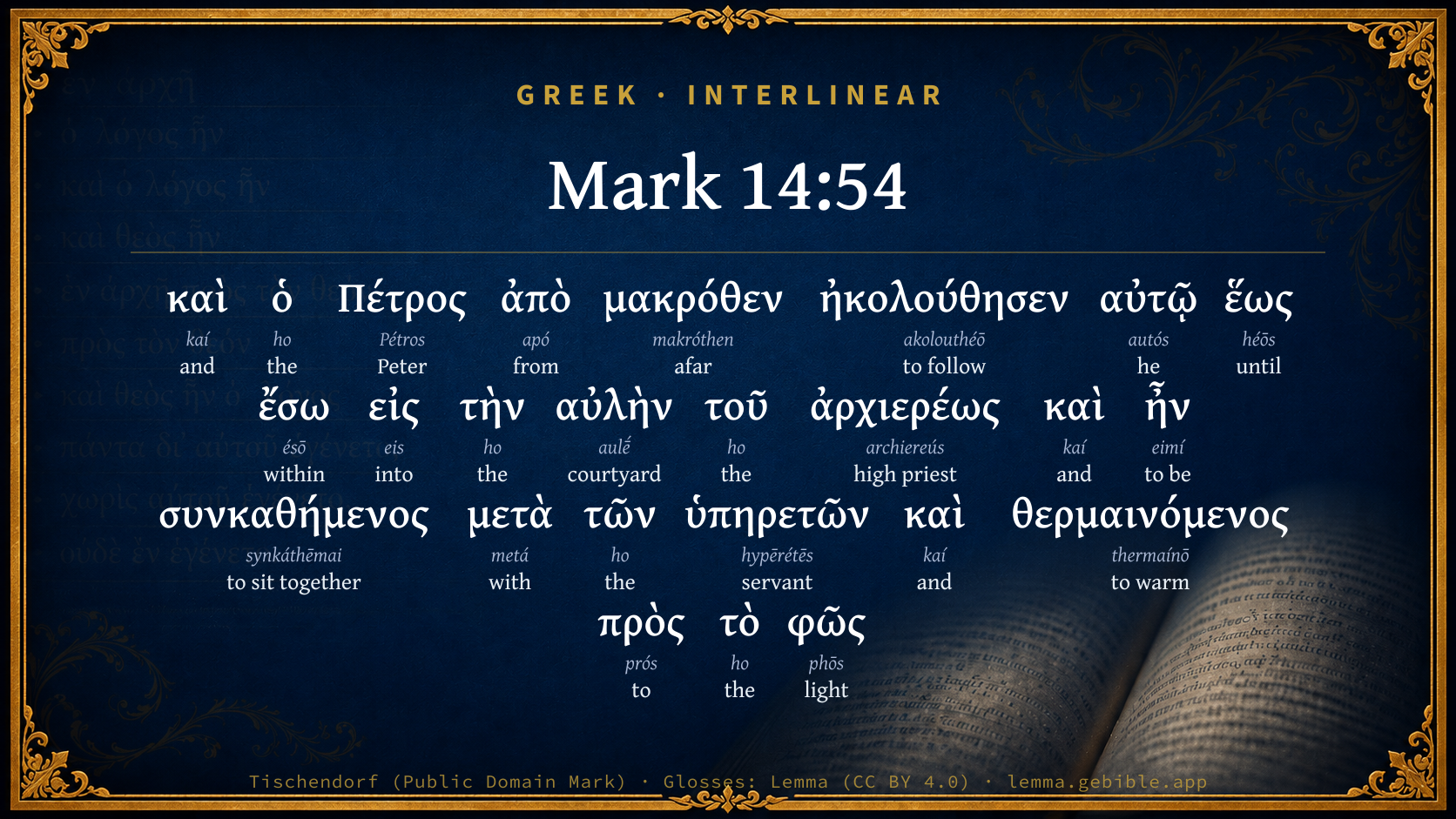
Download image
Cite this verse

Mark 14:54 (World English Bible). Public Domain. Lemma interlinear Bible study tool, https://lemma.gebible.app/v/mark/14/54.

Show BibTeX & RIS
BibTeX
RIS
English Translation
Peter had followed him from a distance, until he came into the court of the high priest. He was sitting with the officers, and warming himself in the light of the fire.
World English Bible · Public Domain
Highlights
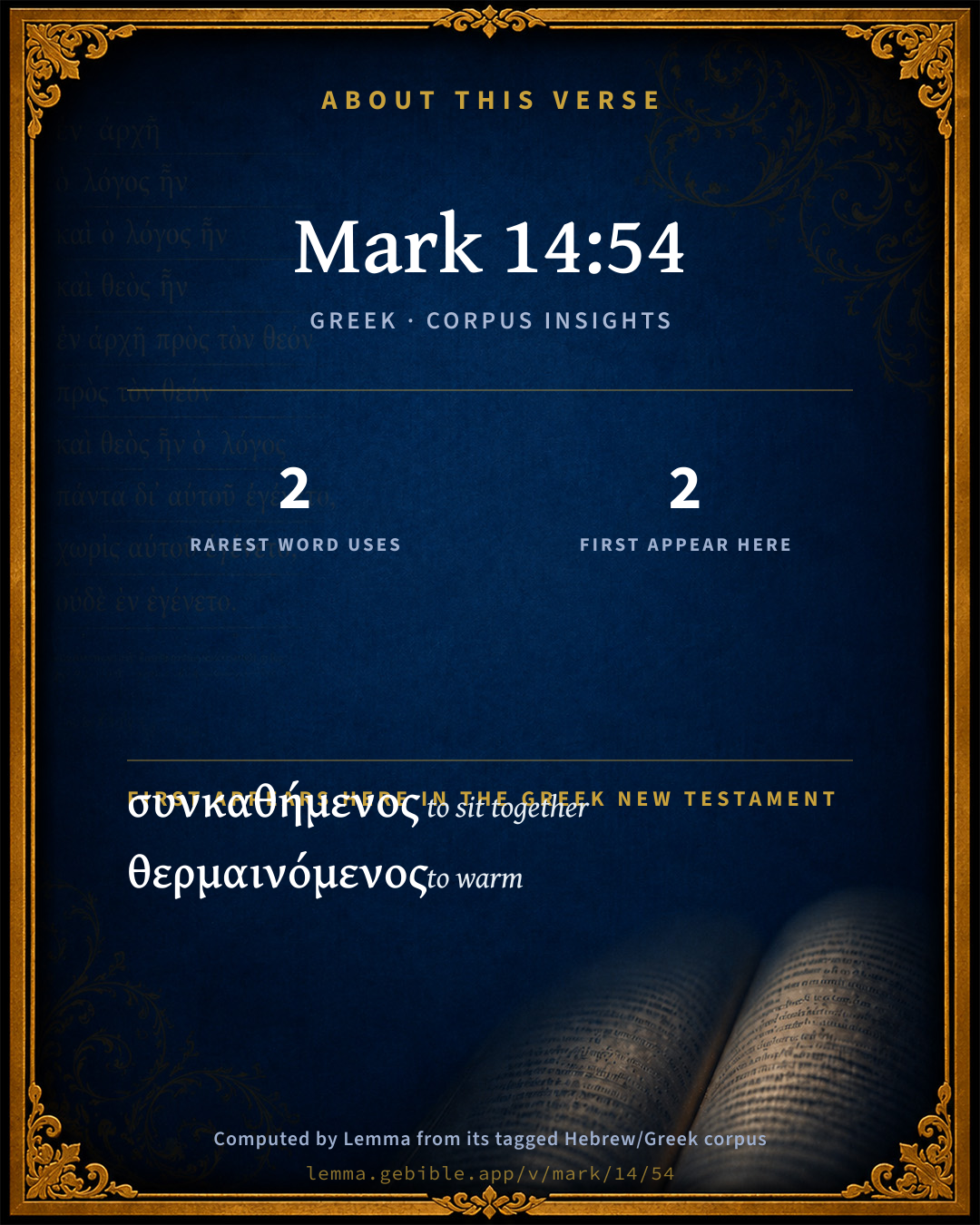
  • 2 first appearances in the Greek New Testament
Full analysis ↓
Download a study sheet

One document with this verse’s original text, its word-by-word gloss line, the meaning frame, cross-references with their text, attributed commentary, and full source and license credits — printable, and it pastes into notes with its structure intact.

This verse Autodidact and up

Study sheet (.html) Plain text (.txt)

A passage Seminary Student

Up to 50 verses in one chapter. A passage sheet keeps up to 6 commentary sources and 12 cross-references per verse, in the order this page ranks them, and says so on the sheet whenever that leaves anything out. Ask for a single verse and you get the Autodidact verse sheet above.

Everything on this page stays free to read, with no account — the sheet is a download of what is already on screen, not access to it.

Want to remove ads? Support Godless Engineer
Compare translations 3

The same verse in 3 English versions, stacked beneath the original-language interlinear above. Click any original word for its lexicon entry.

Each is an independent rendering of the whole verse — the interlinear is not word-aligned to these translations.

Highlighted words mark where these versions differ — a whole-verse word diff, not a word-by-word alignment.

  • World English Bible Public Domain
    Peter had followed him from a distance, until he came into the court of the high priest. He was sitting with the officers, and warming himself in the light of the fire.
  • King James Version Public Domain
    And Peter followed him afar off, even into the palace of the high priest: and he sat with the servants, and warmed himself at the fire.
  • unfoldingWord Literal Text CC BY-SA 4.0
    And Peter followed him from a distance, as far as inside into the courtyard of the high priest, and he was sitting with the officers and warming himself at the fire.

unfoldingWord Literal Text — © unfoldingWord, licensed CC BY-SA 4.0. Word-aligned USFM3 via Door43 (git.door43.org/unfoldingWord/en_ult).

Versions to compare (up to 4)

3 of 4 selected

Show all 19 translations

Every available English version of this verse, each an independent rendering of the whole verse.

  • World English Bible Public Domain
    Peter had followed him from a distance, until he came into the court of the high priest. He was sitting with the officers, and warming himself in the light of the fire.
  • Berean Standard Bible Public Domain
    Peter followed Him at a distance, right into the courtyard of the high priest. And he sat with the officers and warmed himself by the fire.
  • Majority Standard Bible Public Domain
    Peter followed Him at a distance, right into the courtyard of the high priest. And he sat with the officers and warmed himself by the fire.
  • King James Version Public Domain
    And Peter followed him afar off, even into the palace of the high priest: and he sat with the servants, and warmed himself at the fire.
  • American Standard Version (1901) Public Domain
    And Peter had followed him afar off, even within, into the court of the high priest; and he was sitting with the officers, and warming himself in the light `of the fire'.
  • Revised Version (1885) Public Domain
    And Peter had followed him afar off, even within, into the court of the high priest; and he was sitting with the officers, and warming himself in the light of the fire.
  • Geneva Bible (1599) Public Domain
    And Peter folowed him afarre off, euen into the hall of the hie Priest, and sate with the seruants, and warmed himselfe at the fire.
  • Douay-Rheims (1899) Public Domain
    And Peter followed him from afar off, even into the court of the high priest; and he sat with the servants at the fire, and warmed himself.
  • Young's Literal Translation Public Domain
    and Peter afar off did follow him, to the inside of the hall of the chief priest, and he was sitting with the officers, and warming himself near the fire.
  • Literal Standard Version CC BY-SA 4.0
    and Peter followed Him far off, to the inside of the hall of the chief priest, and he was sitting with the officers, and warming himself near the fire.
  • Unlocked Literal Bible CC BY-SA 4.0
    Now Peter followed him from a distance, as far as the courtyard of the high priest. He sat among the guards, who were near a fire to keep warm.
  • unfoldingWord Literal Text CC BY-SA 4.0
    And Peter followed him from a distance, as far as inside into the courtyard of the high priest, and he was sitting with the officers and warming himself at the fire.
  • Darby Bible Public Domain
    And Peter followed him at a distance, till [he was] within the court of the high priest's palace; and he was sitting with the officers and warming himself in the light [of the fire].
  • World Messianic Bible Public Domain
    Peter had followed him from a distance, until he came into the court of the high priest. He was sitting with the officers, and warming himself in the light of the fire.
  • Webster's Bible Public Domain
    And Peter followed him at a distance, even into the palace of the high priest: and he sat with the servants, and warmed himself at the fire.
  • Free Bible Version CC BY-SA 4.0
    Peter followed him at a distance, and went into the courtyard of the high priest's house. He sat down with the guards and warmed himself by the fire.
  • Bible in Basic English Public Domain
    And Peter had come after him at a distance, even into the house of the high priest; and he was seated with the captains, warming himself in the light of the fire.
  • Text-Critical English NT CC BY 4.0
    Peter had followed Jesus at a distance, right into the courtyard of the high priest. There he sat with the officers, warming himself in the light of the fire.
  • Tyndale New Testament (1534) Public Domain
    And Peter folowed him a greate waye of even into the pallys of the hye preste and sat with the servauntes and warmed him sylfe at the fyre.

Literal Standard Version (2020), Covenant Press — licensed CC BY-SA 4.0. Text via the HelloAO Bible API (eBible.org). Unlocked Literal Bible (unfoldingWord) — licensed CC BY-SA 4.0. Text via the HelloAO Bible API (eBible.org). unfoldingWord Literal Text — © unfoldingWord, licensed CC BY-SA 4.0. Word-aligned USFM3 via Door43 (git.door43.org/unfoldingWord/en_ult). Free Bible Version, Dr. Jonathan Gallagher — licensed CC BY-SA 4.0. Text via the HelloAO Bible API (eBible.org).

Word by word

More ways to search: Search by grammar → Find every occurrence → Compare this word →

Practice this passage: Drill this verse → Learn its vocabulary →

συνκαθήμενος
synkáthēmai
G4775
“to sit together”
Verb, Present, Middle or Passive deponent, Participle, Nominative, Singular, Masculine
Part of Speech
Verb
Tense
Present
Voice
Middle or Passive deponent
Mood
Participle
Case
Nominative
Number
Singular
Gender
Masculine
Full Thayer's Definition

Origin: from G4862 and G2521

TDNT: None

1. to sit together, to sit with one another
  1. καὶ kaí G2532 “and” Conjunction
  2. ὁ ho G3588 “the” Article, Nominative, Singular, Masculine
  3. Πέτρος Pétros G4074 “Peter” Noun, Nominative, Singular, Masculine
  4. ἀπὸ apó G575 “from” Preposition
  5. μακρόθεν makróthen G3113 “afar” Adverb
  6. ἠκολούθησεν akolouthéō G190 “to follow” Verb, Aorist, Active, Indicative, 3rd person, Singular
  7. αὐτῷ autós G846 “he” Personal pronoun, Dative, Singular, Masculine
  8. ἕως héōs G2193 “until” Adverb
  9. ἔσω ésō G2080 “within” Adverb
  10. εἰς eis G1519 “into” Preposition
  11. τὴν ho G3588 “the” Article, Accusative, Singular, Feminine
  12. αὐλὴν aulḗ G833 “courtyard” Noun, Accusative, Singular, Feminine
  13. τοῦ ho G3588 “the” Article, Genitive, Singular, Masculine
  14. ἀρχιερέως archiereús G749 “high priest” Noun, Genitive, Singular, Masculine
  15. καὶ kaí G2532 “and” Conjunction
  16. ἦν eimí G1510 “to be” Verb, Imperfect, Active, Indicative, 3rd person, Singular
  17. μετὰ metá G3326 “with” Preposition
  18. τῶν ho G3588 “the” Article, Genitive, Plural, Masculine
  19. ὑπηρετῶν hypērétēs G5257 “servant” Noun, Genitive, Plural, Masculine
  20. καὶ kaí G2532 “and” Conjunction
  21. θερμαινόμενος thermaínō G2328 “to warm” Verb, Present, Middle, Participle, Nominative, Singular, Masculine
  22. πρὸς prós G4314 “to” Preposition
  23. τὸ ho G3588 “the” Article, Accusative, Singular, Neuter
  24. φῶς phōs G5457 “light” Noun, Accusative, Singular, Neuter

About this verse

These counts appear in no published source. They are computed here, from the morphology-tagged text and Lemma’s own curated glosses. What Lemma adds →

25
words
19
distinct lemmas
Gospels
section

Notable vocabulary

The rarest word here is συνκαθήμενος to sit together G4775 — appearing just 2 times in the whole Greek New Testament.

First appearance in Scripture

These words make their first canonical appearance in the Greek New Testament here:

  • συνκαθήμενος to sit together G4775
  • θερμαινόμενος to warm G2328

Shared distinctive vocabulary

συνκαθήμενος to sit together G4775 occurs in 2 verses of the Greek New Testament. Also found in:
Repetition

Words recur within this verse:

Cross-references

13

Topical passages linked to Mark 14:54 in the Treasury of Scripture Knowledge — connected by theme and wording, ordered by reader-vote popularity; previews shown in the World English Bible.

  • John 18:18 Now the servants and the officers were standing there, having made a fire of coals, for it was cold. They were warming themselves. Peter was with them, standing and warming himself.
  • Matthew 26:3 Then the chief priests, the scribes, and the elders of the people were gathered together in the court of the high priest, who was called Caiaphas.
  • John 18:15–16 Simon Peter followed Jesus, as did another disciple. Now that disciple was known to the high priest, and entered in with Jesus into the court of the high priest;
  • John 18:25 Now Simon Peter was standing and warming himself. They said therefore to him, "You aren't also one of his disciples, are you?" He denied it, and said, "I am not."
  • 1 Samuel 13:7 Now some of the Hebrews had gone over the Jordan to the land of Gad and Gilead; but as for Saul, he was yet in Gilgal, and all the people followed him trembling.
  • 1 Kings 19:9 He came there to a cave, and lodged there; and, behold, the word of Yahweh came to him, and he said to him, What are you doing here, Elijah?
  • 1 Kings 19:13 It was so, when Elijah heard it, that he wrapped his face in his mantle, and went out, and stood in the entrance of the cave. Behold, there came a voice to him, and said, What are you doing here, Elijah?
  • Matthew 26:58 But Peter followed him from a distance, to the court of the high priest, and entered in and sat with the officers, to see the end.
  • Mark 14:29–31 But Peter said to him, "Although all will be offended, yet I will not."
  • Mark 14:38 Watch and pray, that you may not enter into temptation. The spirit indeed is willing, but the flesh is weak."
  • Mark 14:67–68 and seeing Peter warming himself, she looked at him, and said, "You were also with the Nazarene, Jesus!"
  • Luke 22:44 Being in agony he prayed more earnestly. His sweat became like great drops of blood falling down on the ground.
  • Luke 22:55–56 When they had kindled a fire in the middle of the courtyard, and had sat down together, Peter sat among them.

Cross-references courtesy of OpenBible.info (CC BY 4.0).

Commentary

Notes on Mark 14:54 from classic Christian and Jewish commentators (each source and its license shown beneath its notes). The classic Christian expositions comment on the surrounding passage and are grouped to its opening verse, so a note may address several verses; the Jewish commentaries on the Tanakh (Rashi and others) are per-verse, so they appear only where the commentator wrote on this verse.

Lemma curates 59 commentaries, every one of them public domain or Creative Commons licensed, each selected and text-cleaned for this edition rather than reprinted as found. About our sources →

The Biblical Illustrator

Joseph S. Exell

Mar_14:54

And Peter followed Him afar off.

Following afar off

A young man, it is told, was for several months in a backsliding state, which manifested itself in the usual way,-of conformity to a fashionable and unholy course of life, and a neglect of the ordinances and institutions of the house of God. During this time he called on a deacon of the church, who was a watchmaker, and asked him to repair his watch. What is the difficulty with your watch? said he. It has lost time lately, said the young man. The deacon looked at him with a steady and significant eye, and said, Havent you lost time lately? These few words brought the backslider to repentance, to the church, and to duty.

Peters fall: its lessons

I. Who followed Him afar off? Peter.

1. Then seniority and leadership in the church are no guarantee against falling into sin. In the order of choice, Peter was the oldest of the apostles. He was also their recognized leader. Peter is the last man that should have followed afar off, both because of seniority and leadership, and the blighting influence that would naturally and inevitably result from his conduct. The power of leadership involves tremendous responsibility.

2. Then a man may backslide while blessed with the most faithful and efficient gospel teaching. Peters experience shows that a man may sin shamefully while blessed with the most perfect gospel teaching.

3. Then a man may backslide while blessed with the most affectionate pastoral care. Jesus foresaw his dangers; told him of the enemys purpose; warned him of this very fall, and in the true pastoral spirit bore him to God in prayer: I have prayed for thee. Surely no man was ever blessed with such pastoral solicitude and fidelity, and yet, in spite of it all, Peter fell.

4. Then high professions of loyalty and love are not always to be relied upon. Peters assurances partook somewhat of the nature of boasting. Great natures never burden you with vows and assurances. They are the product and sign of a weak; unreliable character. Peter soon found out, however, that it is one thing to make vows in the heavenly atmosphere of the upper room, but quite another thing to pay those vows amid the provocation of Gethsemane, and the excitement of the judgment hall. I have heard of a little boat that carried such an immense whistle that it took all the steam to blow it; so, whenever it whistled it stopped running. Too many in our churches are like that little boat; the whistle of their profession is too big for their supply of steam. It takes all their energy to blow it, to tell of their attainments, and what wonders they are going to do. (T. Kelly)

.

Following Christ afar off

I. Let us inquire, in the outset, concerning the significance of this action of Simon.

1. The facts are very simple. When Christ retrieved the folly which this impetuous disciple had committed, and healed the ear of Malchus, it does not appear that the magnanimity of the Master had any effect in mitigating the malignity of the mob. Simons stroke with his unusual weapon, instead of checking those belligerent people bearing swords and staves, came very near exasperating them. He simply put himself and his friends to flight, and then the crowd had it all their own way. It is a mournful record to read: They all forsook Him and fled. But now, after this sudden and useless panic, it appears that at least two of our Lords followers rallied their courage a little. They turned upon their flying footsteps, and started after the melancholy train. These were Peter and John. And the whole force of the dramatic incident we are studying is disclosed in the contrast of their behaviour. John ran with a will. As in the race afterwards for Christs sepulchre he easily distanced Peter (Joh_20:4), so now he arrived first in the palace. Moreover, he soon showed how brave he was, and how much in earnest to retrieve his temporary defection he was, by urging his way directly through all obstacles into the very apartment where Jesus had been taken for trial; he went in with Jesus, but Peter stood at the door without (Joh_18:15-16).

2. The meaning of all this is what makes it so important. One has no need of being deceived ever as to the exact commencement of any defection from Christ. Backsliding is earliest in the heart, then it shows itself in ones ways (Pro_14:14). Absalom was a rebel while as yet he made no overt attack on his fathers throne. The younger son was a prodigal before he started for the far country. Peter was a renegade and a poltroon from the earliest instant in which, listless and halting, he had begun to follow Jesus only afar off. For an analysis of his experience would have disclosed three bad elements.

1. There was petulance in it. Simons self-love was wounded when Jesus administered the somewhat extensive rebuke he had received (Mat_26:52-54). He felt himself aggrieved. His defection began with sullenness. We cannot doubt that his countenance fell; he wore an injured expression.

2. There was distrust in his experience. We have seen that there was some reason for all the disciples to apprehend violence, instantaneous and passionate. Peter was fully responsible for that. The immediate result of his rashness was danger rather than deliverance. But could not Jesus be relied upon for rescue? Was not John fully protected afterwards?

3. There was unbelief in his experience. This disciple evidently had become ashamed of his adhesion to Jesus as the Messiah. An omnipotent Son of God was in his estimation for the moment letting things go too far, when He suffered Himself to be apprehended by a rabble and maltreated in this way without a word. Perhaps Simon lost confidence in His cause. If the words of Matthew are to be taken literally (Mat_26:58), this disciple did not follow Jesus, even afar off, so much from affection as from curiosity; he went into the palace not to see Jesus, but to see the end.

II. Let us go a step farther now, and inquire concerning the results of this behaviour of Peter.

1. It took him away from Christs personal presence. There was always to this disciple a peculiar exhilaration and help in the companionship of his Divine Lord. Under the shining of His countenance he constantly grows humble, gentle, and affectionate. Just as Mercury, that feeblest of all the planets in our solar system, seems most brilliant when likeliest to disappear, because nearest the sun, so Simon actually appears at his best when he is the most outshone; and the moment he wanders, he wanes. Duty is to most of us what this personal leadership was to the disciples. If we follow our religious duties close up, they will bring us near Jesus.

2. Again, this behaviour separated Peter from the sympathy of Jesus adherents. In union there is strength. Those disciples ought not to have allowed themselves to be scattered during the trials of that passover night. For together they would have helped each other very much. Now we do not know what became of any of them except John. If Peter had been sitting by Johns side he certainly would have been safer. He was easily influenced, and the beloved disciple soon recovered his courage and loyalty. Whenever professed Christians are seen to be falling away from each other by following the Master afar off, there is reason for alarm in reference to their spiritual interests. Only sin is solitary, and only guilt loves to live alone. Hence there is vast wisdom in the ancient counsel that believers should not forsake the assembling of themselves together, as the manner of some is (Heb_10:25).

3. Moreover, this behaviour threw Peter hopelessly into the companionship of his enemies. Peter fell into bad company the instant he fell out of good.

III. It is time for us to inquire concerning the real cause of Simon Peters defection that night.

1. It would not be enough to ascribe it just to a sudden fright of alarm.

2. It was because his piety, at that period of his history, was fashioned more by feeling than by principle. Peters spirituality blew in a gusty sort of way because his theological groundwork was faulty. We remember more than one occasion when he deliberately interfered with our Lords communication of the doctrine of the atonement. As a master, a teacher, a leader, he loved Jesus personally; there he rested. Jesus away, he failed. Soft gales do not always waft to the heaven; they the rather often aid in an unperceived drift towards the open sea. Simon loved to have all things beautiful and serene. He was the man who grew ecstatic on the mount of transfiguration, and proposed that Jesus should stay there. His sensibilities were so shocked at the thought of the Saviours maltreatment, that he protested against the official act of sealing the covenant of redemption with blood. The words were characteristic: This shall not be unto Thee (Mat_16:22). Now let it be remembered that for nobody is there any hope of standing firm under stress of opposition, if his piety has been nurtured only in tender hours of emotional enjoyment. Spiritual impulses will be dangerously irregular and intermittent unless they have the help of steady purpose underneath. Carpenters never cut ships knees from tropical palms. The grand doctrines of the cross must be wrought into the very fibre of ones soul, as the granite soil and the winter tempests of the mountains are wrought into the gnarls of the oak which the shipwright loves. That is to say, Christian character is reared out of a determinate wrestle with sin.

IV. Finally, let us inquire concerning the admonition which is suggested by this behaviour of Peter.

1. How can this sin be repeated in our time? We follow Jesus afar off when we refuse to defend the doctrines of redemption before unbelievers who scoff at a blood atonement-when we allow the rules and institutions of the Christian Church to be derided or belittled in our hearing-when we neglect the ordinances of Gods house and refuse the fixed practice of family devotion-when we strain Christian liberty to see how much of indulgence in worldliness an unattacked church membership will bear. There is no difficulty whatever in modern experience in the way of repeating Peters wrong.

2. It is a better question to ask, How can this sin of following Christ afar off be avoided in our time? John, and not Peter, is our pattern. The way to escape the taunts of maidservants in the hall is to go right up the steps into the presence of Jesus. It touches us to the heart to read the words which show how well Simon understood all his cowardice and folly long years afterwards (1Pe_5:6-10). (C. S. Robinson, D. D.)

The Biblical Illustrator, edited by Joseph S. Exell (c. 1880s–1900s) — public domain. Text from a community e-Sword module.

Bengel's Gnomon

Johann Albrecht Bengel

Mar 14:54. Μετὰ τῶν ὑπηρετῶν, with the attendants) Often a fall is incurred more easily in the presence of such as servants, who are less feared, than among their masters, [the great].—θερμαινόμενος, warming himself) Often under care for the body the soul is neglected.—φῶς, the light) Appropriately light is the expression used instead of fire: Peter was recognised by the light, when under other circumstances he might have been safer: comp. Mar 14:67.

Bengel's Gnomon of the New Testament — English translation (T&T Clark, Edinburgh, 1860) — public domain. Text from a community e-Sword module.

Expositor's Greek Testament

ed. W. Robertson Nicoll

Mar 14:54 . ὁ Πέτρος : the story of Peter’s denial begins here, and, after being suspended by the account of the trial, is resumed at Mar 14:66 . ἀπὸ μακρόθεν , from afar ( ἀπὸ redundant here as elsewhere), fearful, yet drawn on by love and curiosity. ἕως ἔσω εἰς : a redundant but expressive combination, suggesting the idea of one stealthily feeling his way into the court of the palace, venturing further and further in, and gaining courage with each step ( vide Weiss, Mk.-Evan., p. 470). θερμαινόμενος : nights cold even at Easter in Palestine; a fire in the court welcome in the early hours of morning, when something unusual was going on. “However hot it may be in the daytime, the nights in spring are almost always cold” Furrer, Wanderungen , p. 241. πρὸς τὸ φῶς , at the fire; here called light, because it was there to give light as well as heat. Elsner and Raphel cite instances of the use of φῶς for fire from Xenophon. Hesychius gives πῦρ as one of its meanings.

The Expositor's Greek Testament, edited by W. Robertson Nicoll (1897–1910) — public domain. Text from a community e-Sword module.

Adam Clarke's Commentary

Verse 54. Peter followed] On Peter's denial, see Mt 26:57, &c.

At the fire.] προς τ οφως, literally, at the light, i.e. a fire that cast considerable light, in consequence of which, the maid servant was the better able to distinguish him: see Mr 14:67.

Adam Clarke's Commentary on the Bible (1810–1826) — public domain. Text from a community e-Sword/MySword module.

Ellicott's Commentary for English Readers

(54) Sat . . . and warmed himself.—Better, was sitting and warming himself.

With the servants.—Better, with the officers.

At the fire.—Literally, at the light; the word bringing out very vividly the effect of the glare of the charcoal fire on St. Peter’s face,

A Bible Commentary for English Readers, edited by Charles John Ellicott (1878–1897) — public domain. Text from a community e-Sword module.

The Cambridge Bible for Schools and Colleges

gen. ed. J. J. S. Perowne

54. And Peter] Before the palace or within its outer porch appears to have been a large open square court, in which public business was transacted. Into it Peter and John ventured to follow (Joh_18:15). The latter, as being acquainted with the high-priest, easily obtained admittance; Peter, at first rejected by the porteress, was suffered to enter at the request of his brother Apostle.

and warmed himself] The night was chilly, and in the centre of the court the servants of the high-priest had made a fire of charcoal, and there Peter, now admitted, was warming himself at the open hearth.

The Cambridge Bible for Schools and Colleges (gen. ed. J. J. S. Perowne; Cambridge University Press, 1878–1918) — public domain. Text from a community e-Sword module.

John Gill's Exposition

And there arose certain,.... Two false witnesses, as in Mat 26:60, who stood up in court; for witnesses were obliged to stand, whilst they gave in their testimony:

"says R. Bo, in the name of R. Hona, witnesses ought "to stand", whilst they bear witness; as it is said, Deu 19:17. "Both the men shall stand" (m), &c.''

And bare false witness against him, saying; as follows.

(m) T. Herios. Sanhedrin, fol. 21. 3. & Yoma, fol. 43. 2. Maimon. Hilch. Sanhedrin, c. 21. sect. 3.

John Gill's Exposition of the Whole Bible (1746–1763) — public domain (CC PDM 1.0). Text via the HelloAO Bible API.

Trapp's Complete Commentary

John Trapp

54 And Peter followed him afar off, even into the palace of the high priest: and he sat with the servants, and warmed himself at the fire.

Ver. 54. At the fire] προς το φως. At the light, or by the light, that is (say some), by the candle light (for that discovered him), referring ad lumen to the light, to sedens. to sitting.

John Trapp, A Commentary or Exposition upon All the Books of the Old and New Testament (1647–1656) — public domain. Text from a community e-Sword module.

The Pulpit Commentary

And Peter had followed him afar off, even within, into the court (eiv thn) of the high priest. This court was the place where the guards and servants of the high priest were assembled. Our Lord was within, in a large room, being arraigned before the council. St. John informs us (Joh_18:15) that he himself, being known to the high priest, had gone in with Jesus into the court of the high priest; and that he had been the means of bringing in Peter, who had been standing outside at the door leading into the court. We now see Peter among the servants, crouching over the fire. The weather was cold, for it was early springtime; and it was now after midnight. Peter was warming himself in the light of the fire (pro fwv), and so his features were clearly seen in the glow of the brightly burning charcoal.

Vers. 54, 66-72. Peter denying Christ.

The seeming discrepancies of the accounts by the evangelists of Peter"s threefold denial are explained on the ground of their independency of one another, and their making prominent various portions of a lengthened and complex series of actions. "Three denials are mentioned by all the evangelists, and three occasions are distinguished; but on some of these there was more than one speaker, and probably more than one answer." This circumstance was

I AN EVIDENCE OF THE POWER OF EVIL IN GOOD MEN. This is the great lesson of the sins of the saints. There ought to be continual watchfulness, and living and walking in the Spirit.

1. It is not well to expose one"s self to temptation unless from the highest motives. Curiosity seems to have been the ruling principle in Peter"s mind. He was following the highest good, but not as perceiving it to be so, or truly desiring it a perilous state of things. There are many unworthy followings of Christ, which have the "greater condemnation." Duty and self-sacrifice will, on the other hand, carry men safely through the most terrible trials.

2. Low views of Christ"s character and office tend to unworthy conduct. The whole spiritual state of Peter was such as to expose him to the perpetration of the worst actions, and this arose from prevalence of false conceptions of Christ"s person and work. His attitude and occupation immediately beforehand ("afar off;" "warming himself") have been regarded by many as symbolical of his spiritual position with regard to his Master. Scepticism and mental confusion on religious subjects, if not corrected or neutralized by close fellowship with Christ, or loyalty to the highest truth one knows, have sad moral results. Peter was still clinging against hope to his idea of a worldly Messiah.

3. Evil words and actions, if once indulged in, are the more easily repeated and aggravated. He proceeds from an equivocation neither know nor understand what thou sayest to a stronger and more direct negative, and then to oaths and profanities.

II AN EVIDENCE OF THE NECESSITY AND POWER OF CHRIST"S ATONEMENT. Even good men like Peter, if left to themselves, will grievously err and sin. How are men in such a position to be recovered?

1. There must therefore be a saving principle outside, and independent of ourselves. It is by virtue of his completed sacrifice in spirit that Christ by a look recalls his fallen disciple, and thus shows:

2. The power of his Spirit to redeem. In connection with such a power over spirit and conscience the greatest sins may be made the turning-points of repentance. Memory was appealed to, and the outward signs predicted by the Savior served as a spiritual index or clock of conscience. The cockcrowing has also an element of hope in it; it marked the dawning of a new day of penitence and enlightenment. M.

Following afar off.

The story of Peter"s denial is not omitted by any of the evangelists. They were more anxious for truth than for reputation. They set before us the strongest disciple at his weakest moment without a word of wonder, of blame, or of excuse. Our text indicates the state of mind which led to his fall. He was just beginning his descent to the depths of shame. Because he "followed afar off" he found the door of the house shut against him, cutting him off from John and from his Lord. Outside, alone, in the dark, he became more despondent as he reflected that Jesus was in the power of his foes, and that any attempt at rescue had been rebuked by himself; so by the time John came out he had given up hope, and still stood afar off from his Lord, amidst his foes. Then and there occurred this moral tragedy in Church history. Let us consider

I SOME MOTIVES WHICH SHOULD HAVE INDUCED PETER TO FOLLOW CLOSELY.

1. The remembrance of his own professions. When Jesus had asked, "Will ye also go away?" Peter had made a noble response; and when an earnest warning had been uttered a few hours before this, he had exclaimed, "Though all shall be offended, yet will not I" He meant his promises, and to abide by them; but though the spirit was willing, the flesh was weak. The world is fair in expecting more from those who are professed followers of Christ. Flight is more disgraceful to a soldier in uniform than to a camp-follower.

2. Peter"s recognized leadership of his brethren was another reason for close following. The Lord indicated that Peter would be their leader from the first, and the disciples acquiesced in this, always making way for him to speak and act on their behalf. His responsibility was the heavier. If he had continued to watch, they would have done so; if he had followed closely, they might have rallied. The failure of one was the failure of all. Each one is responsible to God for the talent, position, or force of character which constitutes him a leader of men. To whom much is given, from him much is required.

3. The loneliness of the Lord ought to have appealed to Peter"s heroism and generosity. We can hardly understand holy, with his noble impulses, he could have left Jesus alone amongst his foes. Yet how often do Christians now fail to stand forth like men to rebuke wrong-doing at any risk! The fact that they alone represent their Lord amid evil companions, is an appeal to all that is chivalrous in them to speak.

4. The remembrance of Christ"s personal love to him might have drawn him nearer. Jesus had dealt gently and generously with Peter. He had chosen him, with two of his brethren, to see his glory on the Mount of Transfiguration, and to see something of his dire agony in the garden. He had been faithfully warned of danger, and assured of the intercession of his Lord. Yet all seemed forgotten, and he only "followed afar off." It is when we realize the words, "He loved me, and gave himself for me," that we can say," My soul followeth hard after God.

II SOME EXCUSES WHICH PETER MIGHT HAVE URGED FOR HIS CONDUCT.

1. It seemed as if he could do no good to his Lord. He had tried in his own way to defend him, but had been rebuked, and no other way seemed open. He forgot that, though his Master had refused the use of physical force, he would have gladly welcomed human sympathy. John had deeper insight. Amid the sea of hatred which surged around him, our Lord saw at least one face which expressed love and sympathy. Utilitarianism sometimes keeps us from beautiful and graceful acts, because we do not see immediate, practical good in them. We should probably not have poured out the spikenard as Mary did, but should have joined with those who asked, "To what purpose is this waste?" Let us never follow afar off because we do not see the practical advantage of walking closely with our Lord. Heaven"s best blessings are too subtle to be tabulated.

2. It seemed as if evil would befall himself if he stood close beside his Master. On entering the palace amongst this excited rabble, he might fear personal violence, especially if he were recognized as the assailant of Malchus. He wished, therefore, to conduct himself as one of the miscellaneous crowd. In doing so he put his soul in danger, instead of his body. "He that sayeth his life shall lose it," his Lord had said, and Peter learnt the meaning soon. This mingling of courage and cowardice puts many a man in danger. May God give us the whole-hearted fidelity which even Peter failed that night to show! A.R.

The Pulpit Commentary (1880–1919), ed. H.D.M. Spence-Jones & Joseph S. Exell — public domain. Text from a community e-Sword module.

McGarvey & Pendleton's Commentaries

J. W. McGarvey

J. W. McGarvey's The Fourfold Gospel [CXXVII. Peter Thrice Denies the Lord].

CXXVII. PETER THRICE DENIES THE LORD. (Court of the high priest's residence. Friday before and about dawn.) aMATT. XXVI. 58, 69-75; bMARK XIV. 54, 66-72; cLUKE XXII. 54-62; dJOHN XVIII. 15-18, 25-27.

a58 But d15 And Simon Peter followed Jesus [leaving Jesus in the palace of the high priest, we now turn back to the garden of Gethsemane at the time when Jesus left it under arrest, that we may follow the course of Simon Peter in his threefold denial of the Master], and i so did another disciple. [This other disciple was evidently the apostle John, who thus speaks of himself impersonally.] Now that disciple was known unto the high priest, and entered in with Jesus into the court of the high priest [John's acquaintanceship appears to have been with the household as well as with the high priest personally, for we find that it is used as a permit at the doorway. It is likely that the high priest knew John rather in a business way-- Act_4:13]; b54 And Peter had followed him afar off, aunto the court of the high priest, d16 but Peter was standing at the door without. So the other disciple, who was known unto the high priest, went out and spake unto her that kept the door, and brought in Peter. beven within, into the court of the high priest [For courts of houses see Act_12:13. John would have shown a truer kindness to Peter had he let him stay out]; d17 The maid therefore that kept the door saith unto Peter, Art thou also one of this man's disciples? He saith, I am not. aand [Peter] entered in [The doorkeeper evidently recognized John as a disciple, and was therefore suspicious of Peter. The cowardly "I am not" of Peter is a sad contrast to the strong "I am he" of Jesus], [700] d18 Now the servants and the officers were standing there, having made a fire of coals; for it was cold; and they were warming themselves: and Peter also was with them [they were gathered around a little smokeless charcoal fire], c55 And when they had kindled a fire in the midst of the court, and had sat down together, Peter asat with the officers, cin the midst of them. ato see the end. [Though his faith in Christ was shaken, he still loved him enough to see what would become of him.] band he was sitting with the officers, and warming himself in the light of the fire. c56 And a69 Now bas dSimon Peter awas sitting dstanding awithout bbeneath in the court, there cometh acame unto him, ca certain bone of the maids of the high priest; 67 and seeing Peter cas he sat in the light of the fire, bwarming himself, she looked cand looking stedfastly upon him, said, bsaith, asaying, Thou also wast with Jesus the Galilaean. bthe Nazarene, even Jesus. cThis man also was with him. a70 But he denied before them all, saying, I know not what thou sayest. bI neither know, nor understand what thou sayest: cWoman, I know him not. dThey said therefore unto him, Art thou also one of his disciples? He denied, and said, I am not. band he went out into the porch; and the cock crew. a71 And when he was gone out into the porch, cafter a little while another saw him, and said, Thou also art one of them. But Peter said, Man, I am not. b69 And aanother bthe maid saw him, and began again to say asaith unto them that were there, bthat stood by, This is one of them. aThis man also was with Jesus of Nazareth. b70 But a72 And again he denied bit. awith an oath, I know not the man. [Peter's second denial was of a quadruple nature. He denied to four different parties, but in such quick succession that the event is regarded as one.] 73 And after a little cafter the space of about one hour another confidently affirmed, saying, Of a [701] truth this man also was with him; for he is a Galilaean. 60 But Peter said, Man, I know not what thou sayest. bAgain they that stood by acame and said to Peter, Of a truth thou also art one of them; bfor thou art a Galilaean. afor thy speech maketh thee known. And immediately, while he yet spake, the cock crew. d26 One of the servants of the high priest, being a kinsman of him whose ear Peter cut off, saith, Did not I see thee in the garden with him? b70 But d27 Peter therefore denied again: a74 Then began he to curse and to swear, I know not the bthis aman. bof whom ye speak. 72 And straightway cimmediately, while he yet spake, bthe second time the cock crew. [Exasperated by the repeated accusations, Peter loses his temper and begins to emphasize his denial by profanity. Desire to make good his denial is now supreme in his thoughts and the Lord whom he denies is all but forgotten.] c61 And the Lord turned, and looked upon Peter. And Peter remembered bAnd Peter called to mind the word, cof the Lord, awhich Jesus had said, bhow that he said unto him, aBefore the cock crow, btwice, cthis thou shalt deny me thrice. 62 And he went out, bAnd when he thought thereon, he wept. cbitterly. [When Peter remembered the loving tenderness of Jesus manifested when he foretold Peter's crime it formed a background against which the sin appeared in all its hideous enormity.]

[FFG 700-702]

J. W. McGarvey (with Philip Y. Pendleton), Commentaries on the New Testament (The Fourfold Gospel, 1914; Acts; and the epistles) — public domain. Text from a community e-Sword/MySword module.

Cambridge Greek Testament for Schools and Colleges

54. ὁ Πέτρος ἀπὸ μακρόθεν ἠκολούθησεν. When the first panic was over, Peter’s affection re-asserted itself; and perhaps there was some shame at this pitiful result of his self-confident professions; but his fears keep him at a distance. All three have μακρόθεν, but Mk alone has the superfluous ἀπό (Mar 5:6, Mar 8:3, Mar 11:13), and here it is Mt. who has the imperf., while Mk has the less accurate aor. After Jesus had been taken inside the palace, Peter, with the help of a disciple who was probably St John (see on Joh 18:15), obtained admission to the αὐλή, atrium, or open court, from which the room in which the Sanhedrin was sitting could be seen. There he sat with the Levitical guard, warming himself. Jerusalem is 2500 feet above the sea, and the nights in spring are cold. The superfluous εἰς—ἕως ἔσω εἰς—is in Mk only. That it was Judas who got Peter admitted is incredible.

πρὸς τὸ φῶς. Both Mk and Lk. notice this. His care for his comfort was fatal; the firelight caused him to be recognized. Xenophon uses φῶς in the sense of fire (πῦρ). Syr-Sin. omits the words.

Cambridge Greek Testament for Schools and Colleges (Cambridge University Press, 1896; 21 vols, various authors incl. Carr, Maclear, Plummer, Farrar, Lumby, Moule, M. R. James, Simcox) — public domain. Text from a community e-Sword module.

Alford’s Greek Testament

Henry Alford

54.] The usage of φῶς for a fire is found in Xen. Cyr. vii. 5. 27, οἱ δʼ ἐπὶ τοὺς φύλακας ταχθέντες ἐπεισπίπτουσιν αὐτοῖς πίνουσι πρὸς φῶς πολύ.

Henry Alford, The Greek Testament (1849–1861) — public domain. Text from a community e-Sword module.

International Critical Commentary

54. ἀπὸ μακρόθεν3 ἕως ἔσω, εἰς τὴν αὐλὴν—literally, as far as inside, into the court. It seems better here to retain the proper meaning of αὐλὴν, viz. the open space, enclosed by the walls of the palace, the court, though it probably has the meaning palace in some places.4 ὑπηρετῶν—the attendants, or officials of the Sanhedrim, like the Roman lictors, or our sergeants-at-arms, or doorkeepers. πρὸς τὸ φῶς—at the light of the fire. R V. Possibly the light, instead of the fire itself, is named, because it calls attention to the fact that Peter was in sight, not hid away in the darkness.

International Critical Commentary — older volumes (1896–1929), various authors — public domain. Text from a community e-Sword module.

Vincent's Word Studies in the New Testament

Marvin R. Vincent

Palace [αυλην] . Rather, court, as Rev., the quadrangle round which the chambers were built. See on Mt 26:3.

Sat with [ην συγκαθημενος] . The verb With the participle denoting continuousness. What occurred after occurred while he was sitting. So Rev. Servants. Rev., officers. See on Mt 5:25.

At the fire [προς το φως] . Fwv is never used of the fire itself, but of the light of the fire; and this is the point to which the evangelist directs attention : that the firelight, Shining on Peter's face, Called forth the challenge of the maid (verse 66).

Marvin R. Vincent, Word Studies in the New Testament (1887–1900) — public domain. Text from a community e-Sword/MySword module.

Lesson kit

Teaching starters — assembled from the data on this page, not authored interpretation. Every prompt links to the verse data it draws on. Edit before teaching.

Mark, in the Gospels, opens this verse with 25 words (19 distinct Greek lemmas). Its most distinctive word is synkáthēmai (“to sit together”). A historical commentator’s framing appears above. Read the whole chapter for the surrounding context.

Discussion questions

  1. The word synkáthēmai carries the sense “to sit together.” How does it shape the verse?
  2. 2 words make their first appearance in Scripture here. What does this debut establish?
  3. How does Acts 26:30, which shares the word «to sit together», read alongside this verse?
  4. What does the repetition of “the” (5× in this one verse) do in this verse?
  5. These translations render this verse differently; the difference is in the English rendering, not the original. What questions does that raise?
  6. Compare how The Biblical Illustrator and Bengel's Gnomon read this verse. Where do they agree or differ?

Things to notice

  • 2 words make their first canonical appearance in Scripture here.
  • These translations choose different wording for 19 words in this verse.
  • “the” occurs 5× in this single verse.
  • 19 distinct Greek lemmas span 25 words in this verse.

Reading settings

Reading text

Shown beneath each verse's original-language words.

Old Testament
Old Testament edition

Read the OT as the Masoretic Hebrew (MT) or the Greek Septuagint (LXX).

English shown for the Greek Septuagint (in the Hebrew ↔ Greek comparison).

Comparing translations? Open the Compare panel on any verse page to stack up to four side by side.