Matthew 28:8

Greek (Tischendorf 8th ed.) Matthew 28:8 appears in the Greek New Testament. The text above is from the Tischendorf 8th edition. Each word links to its Strong’s number and a concise gloss. Click any word for its full Thayer’s Greek Lexicon entry.
Download image
Cite this verse

Matthew 28:8 (World English Bible). Public Domain. Lemma interlinear Bible study tool, https://lemma.gebible.app/v/matthew/28/8.

Show BibTeX & RIS
BibTeX
RIS
English Translation
They departed quickly from the tomb with fear and great joy, and ran to bring his disciples word.
World English Bible · Public Domain
Download a study sheet

One document with this verse’s original text, its word-by-word gloss line, the meaning frame, cross-references with their text, attributed commentary, and full source and license credits — printable, and it pastes into notes with its structure intact.

This verse Autodidact and up

Study sheet (.html) Plain text (.txt)

A passage Seminary Student

Up to 50 verses in one chapter. A passage sheet keeps up to 6 commentary sources and 12 cross-references per verse, in the order this page ranks them, and says so on the sheet whenever that leaves anything out. Ask for a single verse and you get the Autodidact verse sheet above.

Everything on this page stays free to read, with no account — the sheet is a download of what is already on screen, not access to it.

Want to remove ads? Support Godless Engineer
Compare translations 3

The same verse in 3 English versions, stacked beneath the original-language interlinear above. Click any original word for its lexicon entry.

Each is an independent rendering of the whole verse — the interlinear is not word-aligned to these translations.

Highlighted words mark where these versions differ — a whole-verse word diff, not a word-by-word alignment.

  • World English Bible Public Domain
    They departed quickly from the tomb with fear and great joy, and ran to bring his disciples word.
  • King James Version Public Domain
    And they departed quickly from the sepulchre with fear and great joy; and did run to bring his disciples word.
  • unfoldingWord Literal Text CC BY-SA 4.0
    And having quickly gone away from the tomb with fear and great joy, they ran to report to his disciples.

unfoldingWord Literal Text — © unfoldingWord, licensed CC BY-SA 4.0. Word-aligned USFM3 via Door43 (git.door43.org/unfoldingWord/en_ult).

Versions to compare (up to 4)

3 of 4 selected

Show all 19 translations

Every available English version of this verse, each an independent rendering of the whole verse.

  • World English Bible Public Domain
    They departed quickly from the tomb with fear and great joy, and ran to bring his disciples word.
  • Berean Standard Bible Public Domain
    So they hurried away from the tomb in fear and great joy, and ran to tell His disciples.
  • Majority Standard Bible Public Domain
    So they hurried out from the tomb in fear and great joy, and ran to tell His disciples.
  • King James Version Public Domain
    And they departed quickly from the sepulchre with fear and great joy; and did run to bring his disciples word.
  • American Standard Version (1901) Public Domain
    And they departed quickly from the tomb with fear and great joy, and ran to bring his disciples word.
  • Revised Version (1885) Public Domain
    And they departed quickly from the tomb with fear and great joy, and ran to bring his disciples word.
  • Geneva Bible (1599) Public Domain
    So they departed quickly from the sepulchre, with feare and great ioye, and did runne to bring his disciples worde.
  • Douay-Rheims (1899) Public Domain
    And they went out quickly from the sepulchre with fear and great joy, running to tell his disciples.
  • Young's Literal Translation Public Domain
    And having gone forth quickly from the tomb, with fear and great joy, they ran to tell to his disciples;
  • Literal Standard Version CC BY-SA 4.0
    And having gone forth quickly from the tomb, with fear and great joy, they ran to tell His disciples;
  • Unlocked Literal Bible CC BY-SA 4.0
    The women quickly left the tomb with fear and great joy, and ran to tell his disciples.
  • unfoldingWord Literal Text CC BY-SA 4.0
    And having quickly gone away from the tomb with fear and great joy, they ran to report to his disciples.
  • Darby Bible Public Domain
    And going out quickly from the tomb with fear and great joy, they ran to bring his disciples word.
  • World Messianic Bible Public Domain
    They departed quickly from the tomb with fear and great joy, and ran to bring his disciples word.
  • Webster's Bible Public Domain
    And they departed quickly from the sepulcher, with fear and great joy; and ran to bring word to his disciples.
  • Free Bible Version CC BY-SA 4.0
    They quickly left the tomb, both afraid and very happy, running to tell his disciples.
  • Bible in Basic English Public Domain
    And they went away quickly, with fear and great joy, to give his disciples the news.
  • Text-Critical English NT CC BY 4.0
    So they went out quickly from the tomb with fear and great joy, and ran to tell his disciples.
  • Tyndale New Testament (1534) Public Domain
    And they departed quickly from the sepulcre with feare and greate Ioye: and did runne to bringe his disciples worde.

Literal Standard Version (2020), Covenant Press — licensed CC BY-SA 4.0. Text via the HelloAO Bible API (eBible.org). Unlocked Literal Bible (unfoldingWord) — licensed CC BY-SA 4.0. Text via the HelloAO Bible API (eBible.org). unfoldingWord Literal Text — © unfoldingWord, licensed CC BY-SA 4.0. Word-aligned USFM3 via Door43 (git.door43.org/unfoldingWord/en_ult). Free Bible Version, Dr. Jonathan Gallagher — licensed CC BY-SA 4.0. Text via the HelloAO Bible API (eBible.org).

Word by word

More ways to search: Search by grammar → Find every occurrence → Compare this word →

Practice this passage: Drill this verse → Learn its vocabulary →

ταχὺ
tachý
G5035
“quickly”
Adverb
Part of Speech
Adverb
Full Thayer's Definition

Origin: neuter singular of G5036 (as adverb)

TDNT: None

1. quickly, speedily (without delay)
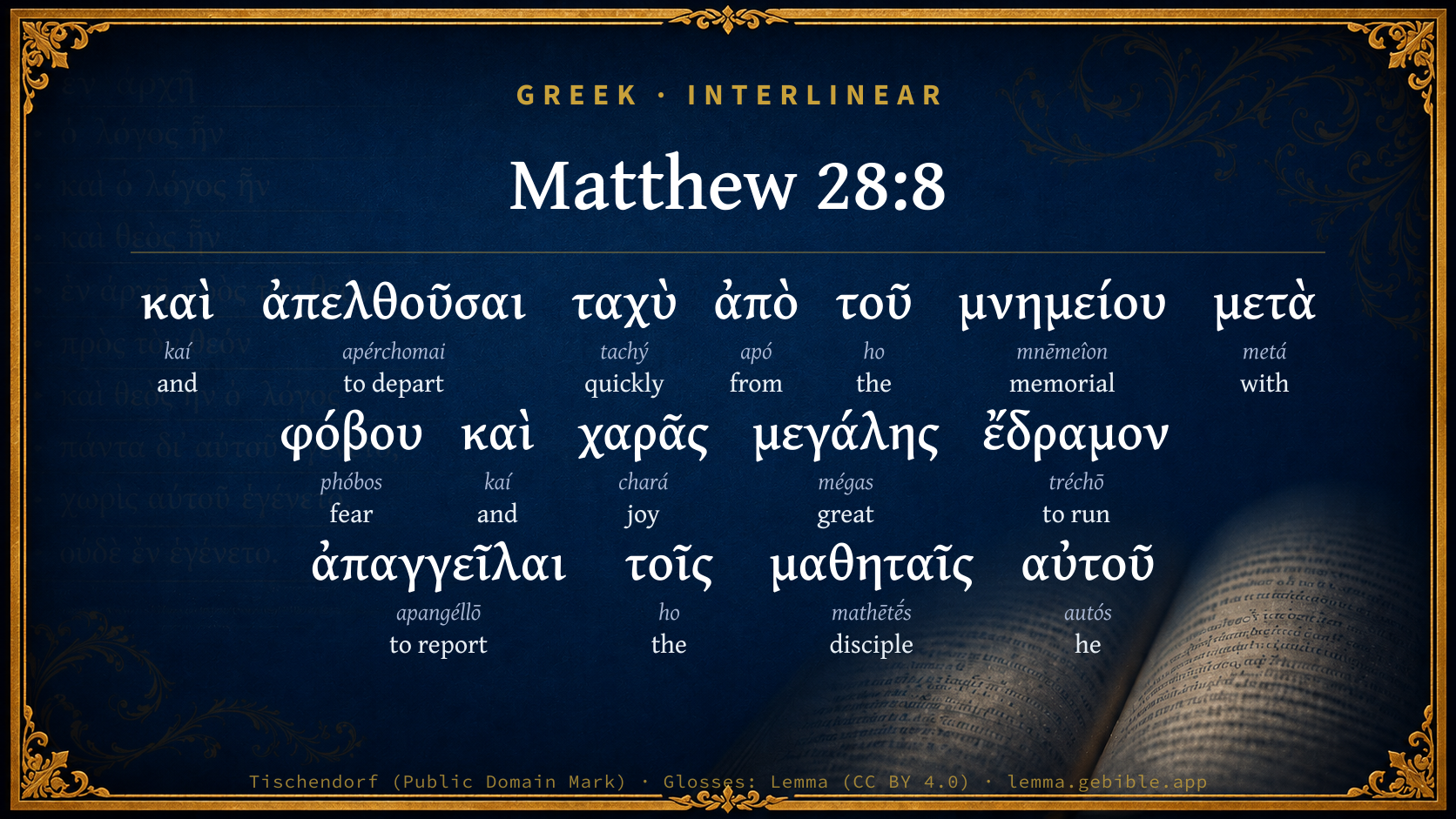
  1. καὶ kaí G2532 “and” Conjunction
  2. ἀπελθοῦσαι apérchomai G565 “to depart” Verb, Aorist, Active, Participle, Nominative, Plural, Feminine
  3. ἀπὸ apó G575 “from” Preposition
  4. τοῦ ho G3588 “the” Article, Genitive, Singular, Neuter
  5. μνημείου mnēmeîon G3419 “memorial” Noun, Genitive, Singular, Neuter
  6. μετὰ metá G3326 “with” Preposition
  7. φόβου phóbos G5401 “fear” Noun, Genitive, Singular, Masculine
  8. καὶ kaí G2532 “and” Conjunction
  9. χαρᾶς chará G5479 “joy” Noun, Genitive, Singular, Feminine
  10. μεγάλης mégas G3173 “great” Adjective, Genitive, Singular, Feminine
  11. ἔδραμον tréchō G5143 “to run” Verb, Aorist, Active, Indicative, 3rd person, Plural
  12. ἀπαγγεῖλαι apangéllō G518 “to report” Verb, Aorist, Active, Infinitive
  13. τοῖς ho G3588 “the” Article, Dative, Plural, Masculine
  14. μαθηταῖς mathētḗs G3101 “disciple” Noun, Dative, Plural, Masculine
  15. αὐτοῦ autós G846 “he” Personal pronoun, Genitive, Singular, Masculine

About this verse

These counts appear in no published source. They are computed here, from the morphology-tagged text and Lemma’s own curated glosses. What Lemma adds →

16
words
14
distinct lemmas
Gospels
section

Notable vocabulary

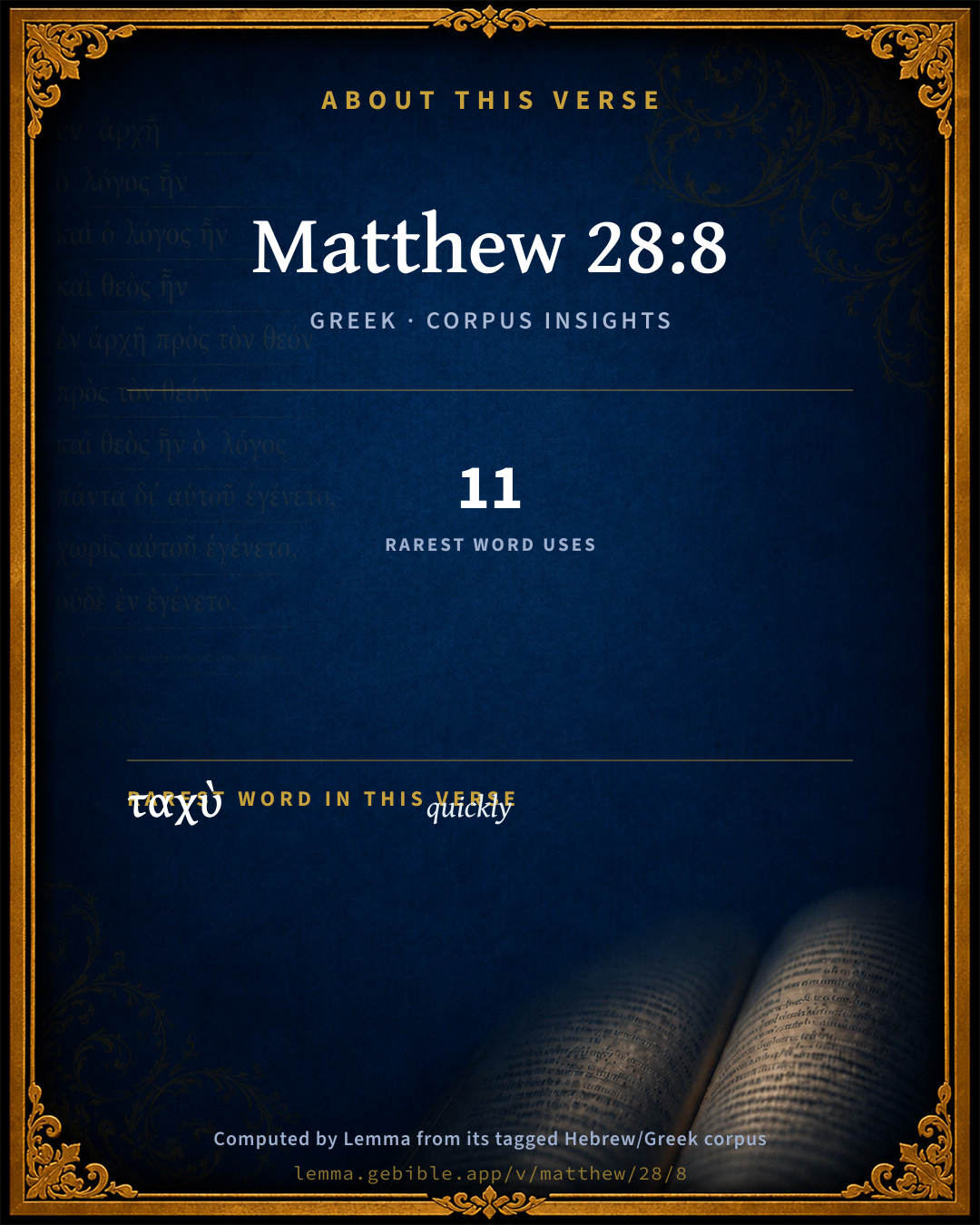
The rarest word here is ταχὺ quickly G5035 — appearing just 11 times in the whole Greek New Testament.

Shared distinctive vocabulary

ταχὺ quickly G5035 occurs in 11 verses of the Greek New Testament. Also found in:

Repetition

Words recur within this verse:

Cross-references

7

Topical passages linked to Matthew 28:8 in the Treasury of Scripture Knowledge — connected by theme and wording, ordered by reader-vote popularity; previews shown in the World English Bible.

  • Psalms 2:11 Serve Yahweh with fear, And rejoice with trembling.
  • Mark 16:8 They went out, and fled from the tomb, for trembling and astonishment had come on them. They said nothing to anyone; for they were afraid.
  • Luke 24:36–41 As they said these things, Jesus himself stood among them, and said to them, "Peace be to you."
  • John 16:20 Most assuredly I tell you, that you will weep and lament, but the world will rejoice. You will be sorrowful, but your sorrow will be turned into joy.
  • Ezra 3:12–13 But many of the priests and Levites and heads of fathers' [houses], the old men who had seen the first house, when the foundation of this house was laid before their eyes, wept with a loud voice; and many shouted aloud for joy:
  • John 16:22 Therefore you now have sorrow, but I will see you again, and your heart will rejoice, and no one will take your joy away from you.
  • John 20:20–21 When he had said this, he showed them his hands and his side. The disciples therefore were glad when they saw the Lord.

Cross-references courtesy of OpenBible.info (CC BY 4.0).

Commentary

Notes on Matthew 28:8 from classic Christian and Jewish commentators (each source and its license shown beneath its notes). The classic Christian expositions comment on the surrounding passage and are grouped to its opening verse, so a note may address several verses; the Jewish commentaries on the Tanakh (Rashi and others) are per-verse, so they appear only where the commentator wrote on this verse.

Lemma curates 59 commentaries, every one of them public domain or Creative Commons licensed, each selected and text-cleaned for this edition rather than reprinted as found. About our sources →

The Biblical Illustrator

Joseph S. Exell

Mat_28:8

And they departed quickly from the sepulchre.

Joy in the morning

Just as a man who has travelled in the dark, looks back at break of day from some lofty eminence on the way that he has gone, and admires the beauty and magnificence of objects that he passed, aware only of their existence and not their claims, or even deeming them objects of fear and not of delight, so the disciples, when enlightened from above, recalled the scenes and events of their Masters life, and rejoiced in much which at the time they had not understood. Thus was it especially with the death and departure of Christ. They were to His followers like the fabled statue of Memnon, which sent forth sounds, mournful in the night, but melodious at the rising of the sun - when Gods morning light arose, how sweet the notes those facts, once only sad, emitted. (A. J. Morris.)

Sorrow ministering to joy

It is said that gardeners sometimes, when they would bring a rose to richer flowering, deprive it for a season of light and moisture. Silent and dark it stands, dropping one fading leaf after another, and seeming to go down patienty to death. But when every leaf is dropped, and the plant stands stripped to the uttermost, a new life is even then working in the buds, from which shall spring a tender foliage and a brighter wealth of flowers. So often, in celestial gardening, every leaf of earthly joy must drop, before a new and Divine bloom visits the soul. (Mrs. H. B. Stowe.)

Joy the shadow of sorrow

In this world full often our-joys are only the tender shadows which our sorrows cast. (H. W. Beecher.)

The Biblical Illustrator, edited by Joseph S. Exell (c. 1880s–1900s) — public domain. Text from a community e-Sword module.

Godbey's Commentary on the New Testament

William B. Godbey

RETURN OF THE WOMEN

Mat 28:8-10; Mar 16:8; Luk 24:9-11; Joh 20:2. “Then she runs, and comes to Simon Peter, and to the other disciple, whom Jesus loved, and says to them, They have taken away the Lord from the sepulcher, and we know not where they have placed Him.” This is spoken of Mary Magdalene, the most prominent of our Lord’s female disciples, and the only woman John mentions in this early visit to the sepulcher. This is not out of harmony with the other three, from the simple fact that she was the leader of the heroic sisterhood who lingered last at the cross, and hastened first to greet the risen Lord and look into the empty sepulcher.

I must here observe, in reference to Mark’s Gospel, that this eighth verse, which you see in the above reference, winds it up, the following twelve verses having been added by an unknown hand after Mark had laid down his pen. This fact of these last twelve verses not appearing in the old and authoritative manuscripts, does not necessarily invalidate their claims to inspiration, the author might have been inspired for ought we know, though we can have no idea as to his name. As it is believed that Peter dictated this Gospel to Mark, his faithful amanuensis and gospel helper, while in Rome, about A. D. 63, some suppose his martyrdom stopped the work, and consequently some one took it on himself to finish it out somewhat after the order of Matthew’s, which had been written A. D. 48. From the simple fact that in all of this writing I have used the Greek Testament by Tischendorf, on the basis of the Sinaitic manuscript which he discovered in the Convent of St. Catherine, on Mt. Sinai, A. D. 1859, and has thrown a flood of light on the New Testament, being the oldest manuscript and the only one entire, and as it closes Mark’s Gospel with this eighth verse of the sixteenth chapter, I shall neither quote nor expound the ensuing twelve verses; for, like Joh 8:1-11, and not a few other isolated passages, they are not in my book.

Matthew: “Having quickly come out from the sepulcher, with fear and great joy, they were running to tell His disciples.” You see how these women take the report of the angels, and run with all expedition to render obedience. “And while they were going to tell His disciples, behold, Jesus met them, saying, Hail! And they having come, embraced His feet, and worshipped Him. Then Jesus says to them, Fear not; go, tell My brethren, that they may depart into Galilee, and there they shall see Me.” Luke: “And returning from the sepulcher, they proclaimed these things to the eleven, and all the rest, And they were Mary Magdalene, Joanna, Mary the mother of James, and the other women along with them, who continued to tell these things to the apostles. And their words appeared unto them like a dream, and they believed them not.” Though Jesus had three different times distinctly prophesied to them His crucifixion and resurrection, they had never understood it; but were all settled in the common conviction that the Christ would never die, but abide and reign forever. Luke says that these prophecies were withheld from them, so they understood them not. That was all right. It was absolutely necessary that these most salient facts of redeeming mercy should be prominent in the prophetical curriculum, which, along with miracles, constitutes the basis of all faith in the Christhood.

Then why withhold it from their understanding until after it was all over? Good reason! If the disciples had understood it, they would have fought, bled, and died in His defense. Thousands would have helped them, and a bloody civil war broken out at the time of His arrest. Through fear of the people, His enemies were often restrained from laying hands on Him, finally attacking Him at midnight, doing their best to kill Him before day; and despite the tardiness of Pilate and Herod, actually had Him nailed to the cross at the early hour of 9 A.M., Pilate finally signing His death-warrant as a sheer peace measure, as he saw the crowd gathering rapidly, and knew they were going to fight for Him, and thus involve the whole country in a terrible civil war. In the good providence of God, the prophecies revealing His crucifixion and resurrection were withheld from the understanding of His disciples till after the momentous tragedy of the world’s redemption was consummated. When they saw Him expire on the cross, they gave up all hope of His Messiahship, settling down in the conclusion that He was the greatest prophet the world ever saw and no more, so that when those women came and told them that He was absent from the sepulcher, and the angels had said He was risen, and that they had actually seen Him, their words seemed like a dream — the news was too good to be believed.

William B. Godbey, Commentary on the New Testament (1896–1900) — public domain. Text from a community e-Sword module.

Bengel's Gnomon

Johann Albrecht Bengel

Mat 28:8. Φόβου καὶ χαρᾶς μεγάλης, with fear and great joy) These emotions can coexist in spiritual matters.

Bengel's Gnomon of the New Testament — English translation (T&T Clark, Edinburgh, 1860) — public domain. Text from a community e-Sword module.

Meyer's Critical & Exegetical Commentary

Heinrich August Wilhelm Meyer

Mat_28:8 Μετὰ φόβου, ἐφʼ οἷς εἶδον παραδόξοις· μετὰ χαρᾶς δὲ, ἐφʼ οἷς ἤκουσαν εὐαγγελίοις, Euthymius Zigabenus.

μεγάλης] applying to both substantives. For similar instances of the mingling of fear with joy (Virg. Aen. i. 514, xi. 807, al.), consult Wetstein; Köster in the Stud. u. Krit. 1862, p. 351.

Meyer — Critical and Exegetical Commentary on the New Testament — English translation by Peter Christie, edited by Frederick Crombie (T&T Clark, 1880) — public domain. Text from a community e-Sword module.

Expositor's Greek Testament

ed. W. Robertson Nicoll

Mat 28:8-10 . Appearance of Jesus to the women on the way to deliver their message .

Mat 28:8 . ἀπελθοῦσαι : the reading of T. R. ( ἐξελθ .) implies that they had been within the tomb, of which no mention is made in Matthew. They went away from, not out of, the tomb. ἀπὸ τ . μν ., depending on ἀπελθοῦσαι , in Mark on ἔφυγον . μετὰ φόβου καὶ χαρᾶς μεγάλης , with fear and great joy. This union of apparently opposite emotions is true to human nature. All powerful tides of gladness cause nervous thrills that feel like fear and trembling. Cf. Isa 60:5 and Phi 2:12 . The fear and trembling St. Paul speaks of are the result of an exhilarating consciousness of having a great solemn work in hand a race to run, a prize to win.

The Expositor's Greek Testament, edited by W. Robertson Nicoll (1897–1910) — public domain. Text from a community e-Sword module.

Jamieson, Fausset & Brown

Robert Jamieson, A. R. Fausset & David Brown

And they departed quickly--Mark (Mar 16:8) says "they fled."

from the sepulchre with fear and great joy--How natural this combination of feelings! See on a similar statement of Mar 16:11.

and did run to bring his disciples word--"Neither said they anything to any man [by the way]; for they were afraid" (Mar 16:8).

Appearance to the Women (Mat 28:9-10).

This appearance is recorded only by Matthew.

Jamieson, Fausset & Brown — Commentary Critical and Explanatory on the Whole Bible (1871) — public domain (CC PDM 1.0). Text via the HelloAO Bible API.

Adam Clarke's Commentary

Verse 8. They departed quickly from the sepulchre] At the desire of the angel they went into the tomb, to have the fullest certainty of the resurrection.

Fear and great joy] Fear, produced by the appearance of this glorious messenger of God; and great joy occasioned by the glad tidings of the resurrection of their Lord and Master. At the mention of unexpected good news, fear and joy are generally intermingled.

----Vix sum apud me, ita animus commotus est metu,

Spe, gaudio, mirando hoc tanto, tam repentino bono.

TERANT. Andr. v. 945.

"I am almost beside myself, my mind is so agitated with fear, hope, and joy, at this unexpected good news."

Adam Clarke's Commentary on the Bible (1810–1826) — public domain. Text from a community e-Sword/MySword module.

Ellicott's Commentary for English Readers

(8) They departed quickly.—It is natural that independent narratives, given long years afterwards, of what had passed in the agitation of “fear and great joy “should present seeming, or even real, discrepancies as well as coincidences. The discrepancies, such as they are, at any rate, show that the narratives were independent. The best solution of the questions presented by a comparison of the Gospel narrative at this stage is that Mary Magdalene ran eagerly to tell Peter and John, leaving the other Mary and Joanna (Luk_24:10), and then followed in the rear of the two disciples (Joh_20:2). Then when they had left, the Lord showed Himself first to her (Joh_20:14), and then to the others (Mat_28:9), whom she had by that time joined, and then they all hastened together to tell the rest of the disciples.

A Bible Commentary for English Readers, edited by Charles John Ellicott (1878–1897) — public domain. Text from a community e-Sword module.

John Gill's Exposition

And they departed quickly from the sepulchre,.... Or "they went out from it", as it may be rendered, and as it is in Mar 16:8, which shows, that they went into the sepulchre upon the invitation of the angel, and saw the place where the Lord lay; and here it was the angel gave them their instructions, and errand to the disciples; which as soon as they received, they quitted the sepulchre in all haste, partly in obedience to the angel's orders, and partly through surprise and fear; for Mark says, "they fled from the sepulchre", Mar 16:8, as persons terrified and affrighted: and it is added here,

with fear and great joy: a mixture of both these; with fear and dread, because of the vision they had seen, and with joy at the news of Christ's resurrection; and yet in this their faith might not be so confirmed, as to have no doubt about it: they might fear the body was taken away, and removed to some other place, and that this they had seen might be a deception and a delusion. However, between both joy and fear, they set out,

and did run to bring his disciples word; as Mary Magdalene ran to Peter, Joh 20:2, nor is running unusual for women, or unbecoming them on certain occasions; see Gen 24:20. Their fright, as well as their joy, and their regard to the angel's order, might cause them to run, and make the quicker dispatch.

John Gill's Exposition of the Whole Bible (1746–1763) — public domain (CC PDM 1.0). Text via the HelloAO Bible API.

Trapp's Complete Commentary

John Trapp

8 And they departed quickly from the sepulchre with fear and great joy; and did run to bring his disciples word.

Ver. 8. And they departed quickly] According as they were bidden. A ready heart makes riddance of God’s work, and does it up quickly, as afraid to be taken with its task undone. Baruch repaired earnestly, and had done quickly, Neh 3:30. Alexander being asked how he had so soon overrun so many countries, answered roundly, By making quick work, by despatching and not lingering long in a place. Μηδεν αναβαλλομενος. Plut.

With fear and great joy] A strange composition of two contrary passions; but frequently found in the best hearts, Psa 2:11. God loves at once familiarity and fear.

John Trapp, A Commentary or Exposition upon All the Books of the Old and New Testament (1647–1656) — public domain. Text from a community e-Sword module.

Albert Barnes' Notes on the Bible

And they departed quickly - Joyful at the “news,” and wishing to impart it to all, they fled to find the disciples, and to tell them that the Lord was risen.

With fear and great joy - Fear because of:

1.The wonderful scenes which they had witnessed the stone rolled away, and the presence of an angel;

2.A confused state of mind, apprehensive, perhaps, that it might not, after all, be true.

The news was too good to be credited at once, yet they had sufficient faith in it to fill them with great and unexpected joy. Perhaps no language could better express the state of their minds - the mingled awe and rejoicing - than that which is used here.

And did run ... - They ran to announce what they had seen to the disciples. The city, where the disciples were, was half a mile or more from the place.

Albert Barnes' Notes on the Bible (1834–1885) — public domain. Text from a community e-Sword/MySword module.

Whedon's Commentary on the Bible

Daniel D. Whedon

8. With fear — For in spite of the consoling words of the angel, the sense of an angel’s presence filled them with tremor. Great joy — In spite of the tremor, a joy at the thought that the Saviour had risen, thrilled their hearts and frames.

Daniel D. Whedon (gen. ed.), Commentary on the Old and New Testaments (1874–1909) — public domain. Text from a community e-Sword module.

The Pulpit Commentary

They departed (exelyousai , better apelyousai) quickly from the sepulchre. At the angel"s invitation (ver. 6), they, or some of them, had entered into the inner chamber of the tomb, (Luk_24:3) and now came hurrying out. With fear and great joy. With a mixture of emotions fear at the sight of the heavenly visitant, the supernatural presence, and joy at the assurance that their beloved Master had risen again, having burst the bonds of death. Did run. They did as they were bidden with all possible speed, acting as heralds of good tidings to the disconsolate disciples.

The Pulpit Commentary (1880–1919), ed. H.D.M. Spence-Jones & Joseph S. Exell — public domain. Text from a community e-Sword module.

Burkitt's Expository Notes on the New Testament

William Burkitt

Observe here, What haste and speed these holy women make to carry the news of Christ’s resurrection to the apostles; such as find and feel their hearts grieved for the absence and want of Christ, will be very ready to comfort such as are in the same condition. O how glad are these holy women to carry the good news of their Lord’s resurrection to the heart-broken disciples!

Observe, 2. How these holy women hastened, in obedience to the angel’s command, to tell the disciples to meet with Christ in the way. Such as obey the directions of God’s ministers, seeking Christ in his own way and means, shall find him to their comfort sooner than they expected. These holy women find Christ before they looked for him: as they went to tell his disciples, Jesus met them. O happy women, while they were weeping for a dead Christ, they find a living Jesus.

Observe, 3. The affectionate and loving title which Christ puts upon his disciples: Tell my brethren. He might have said, "Go tell those apostate apostles, that cowardly left me in my danger, that durst not own me in the high priest’s hall, that durst not come within the shadow of my cross, nor within the sight of my sepulchre." Not a word of this, by way of upbraiding them for their late shameful cowardice, but all words of kindness: Go tell my brethren.

Where note, That Christ calls his disciples brethren after his resurrection and exaltation, as he had done before in his state of humiliation, to show the continuance of his former affection to them, and that the change of his condition had wrought no change in his affection to his despised members: but those that were his brethren before, in the time of his abasement, are so still after his exaltation and advancement.

Observe lastly, The place where Christ chooses to meet with and speak to his disciples, not in Jerusalem, but in Galilee; I go before them into Galilee, there they shall see me. Jerusalem was now a forsaken place, a people abandoned to destruction; Christ would not show himself openly to them, but Galilee was a place where Christ’s ministry was more acceptable. Such places wherein Christ is most welcome to preach, shall be most honoured with his presence. In Galilee they shall see me.\

William Burkitt's Expository Notes on the New Testament (1700–1703) — public domain. Text from a community e-Sword module.

unfoldingWord translationNotes

Door43 World Missions Community

The women

"Mary Magdalene and the other woman named Mary"

Behold

The word "behold" here alerts us to pay attention to the surprising information that follows. Your language may have a way of doing this.

Greetings

This is an ordinary greeting, much like "Hello" in English.

took hold of his feet

"got down on their knees and held onto his feet"

my brothers

This refers to Jesus' disciples.

translationWords

grave

joy

worship

brother

unfoldingWord translationNotes — © Distant Shores Media and the Door43 World Missions Community, licensed CC BY-SA 4.0. Source: git.door43.org/Door43/en_tn.

Alford’s Greek Testament

Henry Alford

8.] μετὰ φόβου, ἐφʼ οἷς εἶδον παραδόξοις· μετὰ χαρᾶς δέ, ἐφʼ οἷς ἤκουσαν εὐαγγελίοις.

Henry Alford, The Greek Testament (1849–1861) — public domain. Text from a community e-Sword module.

International Critical Commentary

8. And they went away quickly from the tomb with fear and great joy; and ran to bring His disciples word.] Mk. has “And they went out, and fled from the tomb; for fear and amazement possessed them: and they told no one anything; for they were afraid.” With these words our Mk. ends. See Swete.

Attempts have recently been made2 to show that Mat 28:9-20 preserves in part the lost ending of Mk.’s Gospel. 28:11-15, no doubt, formed no part of it, for this section is the sequel of 27:62-66, which is an interpolation into Mk., and like it, no doubt, came from a non-Marcan source. But it is urged that in 28:9-10, 16-20 we have a portion of Mk.’s lost ending edited by the author of the first Gospel. The argument rests (1) upon the probability that Mk. contained just such a narrative as we have recorded in Mat 28:9-10, Mat 28:16-20, which supplies the fulfilment of the promise, Mar 16:7; (2) upon some points in Mt.’s narrative which suggest that he is editing an earlier account.

E.g. (a) Mar 16:7 has τοῖς μαθηταῖς αὐτοῦ καὶ τῷ Πέτρῳ. This suggests that there was to be a special appearance to Peter, and possibly that τοῖς μαθηταῖς indicates not the “Eleven,” but the larger body of Christ’s disciples. If Mt., for reasons indicated below, proposed to omit this appearance to Peter, it is natural that he should omit τῷ Πέτρῳ here.

(b) Mar 16:8 says that the women “told no one, for they were afraid.” It is very natural that this should have been followed by an appearance to them of Christ dispelling their fear and repeating the angel’s message. Mt. alters “and told no one,” etc., into “ran to tell His disciples.” Consequently the appearance of Christ, vv. 9-10, repeating the angel’s message is quite unmotived. It would seem that Mt. has found Mk.’s οὐδενὶ οὐδὲν εἶπαν difficult, and has altered it, and then has continued with the appearance of Christ without noticing that the clause “they told no one,” etc., is necessary to explain the appearance.

(c) The τὸ ὄρος of Mat 28:16 is unexplained in Mt. If in Mk. there stood an account of Christ’s appearance to Peter (Mar 16:7) and the Eleven, at the latter of which He again bade them go to Galilee, and appointed a mountain as a meeting-place, it would be adequately accounted for. In that case Mar 16:8 must have been followed by narratives which recorded that the women brought Christ’s message to the disciples, that the disciples disbelieved, and that, therefore, Christ Himself appeared to them and probably also to Peter. Why, then, has Mt. omitted all this? For the same reasons that have caused him to make the alterations of Mk.’s statements about the Twelve which are tabulated in Introduction, p. xxxiii f.

(d) In Mat 28:17 we read that “when they saw Him they worshipped. But some doubted.” Who are the some? Hardly some of the Eleven. It is inconceivable that Mt. should end his Gospel leaving his readers with the impression that some of the Eleven doubted the fact of Christ’s resurrection. The οἱ presupposes a larger gathering than the Eleven only. But Mt. says distinctly οἱ ἕνδεκα μαθηταί. Yes; but this does not preclude the possibility, even in the editor’s mind, that others were present. If in his source an appearance to the Eleven immediately preceded, which he has omitted, it is not unnatural that he should say that the Eleven went to Galilee, and there they and others met Christ at the appointed place of gathering.

These suggestions seem to make it possible that the Mk. which Mt. had before him contained after v. 8 words corresponding to Mat 28:9-10, then a statement that the disciples disbelieved the message of the women; and that, therefore, Christ appeared to Peter and to the Eleven, repeating the command to go to Galilee, and appointing a mountain as a place of meeting; lastly, a narrative corresponding to Mat 28:16-20. The whole of Mat 28:9-10 might be Marcan so far as language goes, except, perhaps, καὶ ἰδού (ἰδού occurs in Mk. only in sayings, not in narrative), and τότε, which never occurs in Mk. in narrative. For ὑπήντησεν, cf. Mar 5:2; for προσελθοῦσαι, cf. Mar 1:31, Mar 1:6:35, Mar 1:10:2, Mar 1:12:28, Mar 1:14:35, Mar 1:45; for ἐκράτησαν, cf. (of the hand, but gen., not acc.) Mar 1:31, Mar 1:5:41, Mar 1:9:27; for προσεκύνησαν, cf. Mar 5:6, Mar 15:19. But προσέρχεσθαι and προσκυνεῖν are so characteristic of Mt., that, like καὶ ἰδού and τότε, they may be due to Mt.’s editorial revision. How much of Mat 28:16-20 stood in Mk. cannot, of course, be determined with any precision. οἱ δὲ ἕνδεκα μαθηταί seems to have been transferred here by the editor from the narrative which preceded in Mk. πορεύεσθαι occurs only in Mar 9:30 (B* D), and in Mt. twenty-eight times. It is therefore probably editorial. οὖ never occurs in Mk. τάσσομαι never occurs in Mk., and in Mt. only here in this sense. διστάζω does not occur in Mk., and in Mt. only again 14:31. προσκυνεῖν may be editorial. μαθητεύειν is probably editorial. πάντα τὰ ἔθνη is probably Marcan, cf. Mar 13:10. τηρεῖν may be Marcan, cf. Mar 7:9. So may ἐνετειλάμην, Mar 10:3, Mar 13:34. On the other hand, καὶ ἰδού is probably and ἕως τῆς συντελείας τοῦ αἰῶνος certainly editorial. See on 13:39. It is true that vv. 9-10, 16-20 contain no phrase that is characteristically Marcan. We should expect to find in a narrative section like this εὐθὺς, an historic present, an imperfect or some other characteristic of Mk.’s style. But still this is not decisive. If, e.g., Mk.’s Gospel were lost from 15:41, we should feel doubtful whether Mat 27:57-61 were based on Mk. These verses contain no characteristically Marcan phrases, whilst ἐμαθητεύθη, προσελθών, τότε are all Matthæan. This is probably due to the fact that the section in Mk. has few of his most characteristic phrases, though now that we have it before us we can specify the following as finding analogies in his language: ἤδη ὀψίας γενομένης, cf. 6:35(2), 8:2, 11:11; ἦν προσδεχόμενος, Mk. has ἦν with a participle 16 times, Mt. only 6, of which 4 are from Mk.; the repetition of εἰ ἤδη τέθνηκεν; ἦν λελατομημένον; and the imperfect ἐθεώρουν. Indeed, the test of language is so indecisive that we might pick at random sections which Mt. has borrowed from Mk., e.g. 12:46-50, 8:23-27, of which we could not be sure that Mk. was the source, if the corresponding sections of his Gospel had been lost. It must, therefore, remain as a possible inference, on the grounds stated above, that Mat 28:9-10, Mat 28:15-20 are based on verses which originally stood at the end of Mk.’s Gospel. If this were not the case, it is possible that vv. 16-20 are an editorial epilogue to the Gospel. A parallel may perhaps be found in 25:31-46 if this is a Chrisitian homily based quite possibly on traditional sayings of Christ, placed at the end of the great discourse, 24:4-25:30, as a suitable peroration to the speech. In this case vv. 18-20 may be based on sayings from the Logia or other sources.

(M?)

International Critical Commentary — older volumes (1896–1929), various authors — public domain. Text from a community e-Sword module.

Lesson kit

Teaching starters — assembled from the data on this page, not authored interpretation. Every prompt links to the verse data it draws on. Edit before teaching.

Matthew, in the Gospels, opens this verse with 16 words (14 distinct Greek lemmas). Its most distinctive word is tachý (“quickly”). A historical commentator’s framing appears above. Read the whole chapter for the surrounding context.

Discussion questions

  1. What does “quickly” (tachý) contribute to the verse as a whole?
  2. Matthew 5:25 shares the word «quickly» with this verse. How do the two illuminate each other?
  3. “and” occurs 2× in this one verse. What is the effect of the repetition?
  4. These translations render this verse differently; the difference is in the English rendering, not the original. What questions does that raise?
  5. Reading how The Biblical Illustrator and Godbey's Commentary on the New Testament read this verse, where do the two commentators agree and where do they part?

Things to notice

Reading settings

Reading text

Shown beneath each verse's original-language words.

Old Testament
Old Testament edition

Read the OT as the Masoretic Hebrew (MT) or the Greek Septuagint (LXX).

English shown for the Greek Septuagint (in the Hebrew ↔ Greek comparison).

Comparing translations? Open the Compare panel on any verse page to stack up to four side by side.