
Mark 15:40

Greek (Tischendorf 8th ed.) Mark 15:40 appears in the Greek New Testament. The text above is from the Tischendorf 8th edition. Each word links to its Strong’s number and a concise gloss. Click any word for its full Thayer’s Greek Lexicon entry.
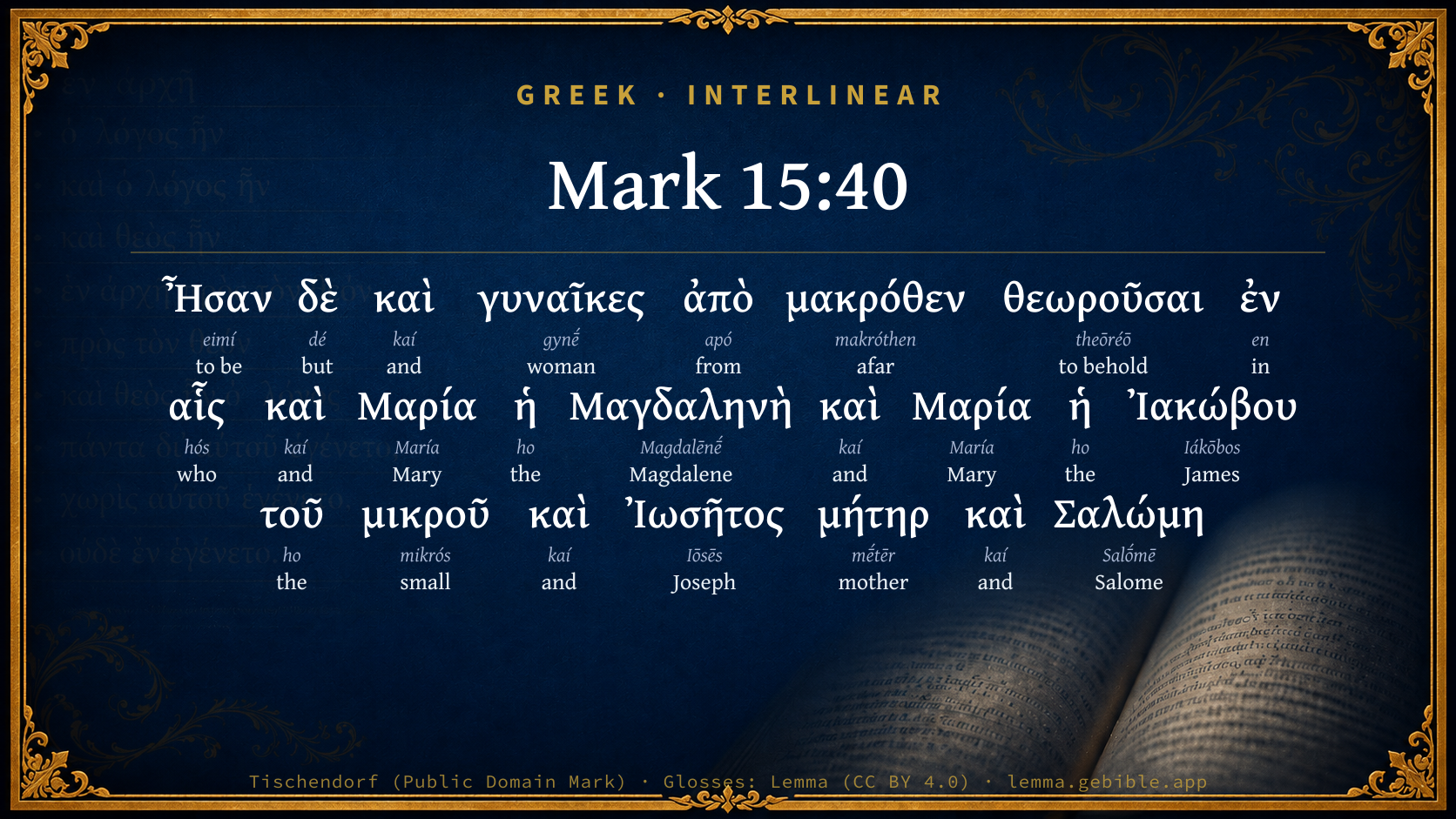
Download image
Cite this verse

Mark 15:40 (World English Bible). Public Domain. Lemma interlinear Bible study tool, https://lemma.gebible.app/v/mark/15/40.

Show BibTeX & RIS
BibTeX
RIS
English Translation
There were also women watching from afar, among whom were both Mary Magdalene, and Mary the mother of James the less and of Joses, and Salome;
World English Bible · Public Domain
Highlights
  • 1 first appearance in the Greek New Testament
Full analysis ↓
Download a study sheet

One document with this verse’s original text, its word-by-word gloss line, the meaning frame, cross-references with their text, attributed commentary, and full source and license credits — printable, and it pastes into notes with its structure intact.

This verse Autodidact and up

Study sheet (.html) Plain text (.txt)

A passage Seminary Student

Up to 50 verses in one chapter. A passage sheet keeps up to 6 commentary sources and 12 cross-references per verse, in the order this page ranks them, and says so on the sheet whenever that leaves anything out. Ask for a single verse and you get the Autodidact verse sheet above.

Everything on this page stays free to read, with no account — the sheet is a download of what is already on screen, not access to it.

Want to remove ads? Support Godless Engineer
Compare translations 3

The same verse in 3 English versions, stacked beneath the original-language interlinear above. Click any original word for its lexicon entry.

Each is an independent rendering of the whole verse — the interlinear is not word-aligned to these translations.

Highlighted words mark where these versions differ — a whole-verse word diff, not a word-by-word alignment.

  • World English Bible Public Domain
    There were also women watching from afar, among whom were both Mary Magdalene, and Mary the mother of James the less and of Joses, and Salome;
  • King James Version Public Domain
    There were also women looking on afar off: among whom was Mary Magdalene, and Mary the mother of James the less and of Joses, and Salome;
  • unfoldingWord Literal Text CC BY-SA 4.0
    Now there were also women watching from a distance, among whom also Mary Magdalene and Mary the mother of James the little and of Joses and Salome,

unfoldingWord Literal Text — © unfoldingWord, licensed CC BY-SA 4.0. Word-aligned USFM3 via Door43 (git.door43.org/unfoldingWord/en_ult).

Versions to compare (up to 4)

3 of 4 selected

Show all 19 translations

Every available English version of this verse, each an independent rendering of the whole verse.

  • World English Bible Public Domain
    There were also women watching from afar, among whom were both Mary Magdalene, and Mary the mother of James the less and of Joses, and Salome;
  • Berean Standard Bible Public Domain
    And there were also women watching from a distance. Among them were Mary Magdalene, Mary the mother of James the younger and of Joses, and Salome.
  • Majority Standard Bible Public Domain
    And there were also women watching from a distance. Among them were Mary Magdalene, Mary the mother of James the younger and of Joses, and Salome.
  • King James Version Public Domain
    There were also women looking on afar off: among whom was Mary Magdalene, and Mary the mother of James the less and of Joses, and Salome;
  • American Standard Version (1901) Public Domain
    And there were also women beholding from afar: among whom `were' both Mary Magdalene, and Mary the mother of James the less and of Joses, and Salome;
  • Revised Version (1885) Public Domain
    And there were also women beholding from afar: among whom were both Mary Magdalene, and Mary the mother of James the less and of Joses, and Salome;
  • Geneva Bible (1599) Public Domain
    There were also women, which beheld afarre off, among whom was Marie Magdalene, and Marie (the mother of Iames the lesse, and of Ioses) and Salome,
  • Douay-Rheims (1899) Public Domain
    And there were also women looking on afar off: among whom was Mary Magdalen, and Mary the mother of James the less and of Joseph, and Salome:
  • Young's Literal Translation Public Domain
    And there were also women afar off beholding, among whom was also Mary the Magdalene, and Mary of James the less, and of Joses, and Salome,
  • Literal Standard Version CC BY-SA 4.0
    And there were also women beholding far off, among whom was also Mary the Magdalene, and Mary of James the less, and of Joses, and Salome,
  • Unlocked Literal Bible CC BY-SA 4.0
    There were also women who looked on from a distance. Among them were Mary Magdalene, Mary (the mother of James the younger and of Joses), and Salome.
  • unfoldingWord Literal Text CC BY-SA 4.0
    Now there were also women watching from a distance, among whom also Mary Magdalene and Mary the mother of James the little and of Joses and Salome,
  • Darby Bible Public Domain
    And there were women also looking on from afar off, among whom were both Mary of Magdala, and Mary the mother of James the less and of Joses, and Salome;
  • World Messianic Bible Public Domain
    There were also women watching from afar, among whom were both Miriam Magdalene and Miriam the mother of Jacob the less and of Yosi, and Shalom;
  • Webster's Bible Public Domain
    There were also women looking on at a distance, among whom was Mary Magdalene, and Mary the mother of James the younger, and of Joses, and Salome;
  • Free Bible Version CC BY-SA 4.0
    Some women were watching from a distance including Mary Magdalene, Mary the mother of James the younger and Joses, and Salome.
  • Bible in Basic English Public Domain
    And there were women watching from a distance: among them were Mary Magdalene, and Mary, the mother of James the less and of Joses, and Salome,
  • Text-Critical English NT CC BY 4.0
    There were also some women looking on from a distance, among whom were Mary Magdalene, Mary the mother of James the younger and of Joses, and Salome.
  • Tyndale New Testament (1534) Public Domain
    Ther were also wemen a good waye of beholdinge him: amonge whom was Mary Magdalen and Mary the mother of Iames the lytle and of Ioses and Mary Salome

Literal Standard Version (2020), Covenant Press — licensed CC BY-SA 4.0. Text via the HelloAO Bible API (eBible.org). Unlocked Literal Bible (unfoldingWord) — licensed CC BY-SA 4.0. Text via the HelloAO Bible API (eBible.org). unfoldingWord Literal Text — © unfoldingWord, licensed CC BY-SA 4.0. Word-aligned USFM3 via Door43 (git.door43.org/unfoldingWord/en_ult). Free Bible Version, Dr. Jonathan Gallagher — licensed CC BY-SA 4.0. Text via the HelloAO Bible API (eBible.org).

Word by word

More ways to search: Search by grammar → Find every occurrence → Compare this word →

Practice this passage: Drill this verse → Learn its vocabulary →

Σαλώμη
Salṓmē
G4539
“Salome”
Noun, Nominative, Singular, Feminine
Part of Speech
Noun
Case
Nominative
Number
Singular
Gender
Feminine
Full Thayer's Definition

Origin: probably of hebrew origin [feminine from G7965 ]

TDNT: None

Salome = "peaceful" 1. the wife of Zebedee and the mother of the apostle James the elder and John
  1. Ἦσαν eimí G1510 “to be” Verb, Imperfect, Active, Indicative, 3rd person, Plural
  2. δὲ dé G1161 “but” Conjunction
  3. καὶ kaí G2532 “and” Conjunction
  4. γυναῖκες gynḗ G1135 “woman” Noun, Nominative, Plural, Feminine
  5. ἀπὸ apó G575 “from” Preposition
  6. μακρόθεν makróthen G3113 “afar” Adverb
  7. θεωροῦσαι theōréō G2334 “to behold” Verb, Present, Active, Participle, Nominative, Plural, Feminine
  8. ἐν en G1722 “in” Preposition
  9. αἷς hós G3739 “who” Relative pronoun, Dative, Plural, Feminine
  10. καὶ kaí G2532 “and” Conjunction
  11. Μαρία María G3137 “Mary” Noun, Nominative, Singular, Feminine
  12. ἡ ho G3588 “the” Article, Nominative, Singular, Feminine
  13. Μαγδαληνὴ Magdalēnḗ G3094 “Magdalene” Noun, Nominative, Singular, Feminine
  14. καὶ kaí G2532 “and” Conjunction
  15. Μαρία María G3137 “Mary” Noun, Nominative, Singular, Feminine
  16. ἡ ho G3588 “the” Article, Nominative, Singular, Feminine
  17. Ἰακώβου Iákōbos G2385 “James” Noun, Genitive, Singular, Masculine
  18. τοῦ ho G3588 “the” Article, Genitive, Singular, Masculine
  19. μικροῦ mikrós G3398 “small” Adjective, Genitive, Singular, Masculine
  20. καὶ kaí G2532 “and” Conjunction
  21. Ἰωσῆτος Iōsēs G2500 “Joseph” Noun, Genitive, Singular, Masculine
  22. μήτηρ mḗtēr G3384 “mother” Noun, Nominative, Singular, Feminine
  23. καὶ kaí G2532 “and” Conjunction

About this verse

These counts appear in no published source. They are computed here, from the morphology-tagged text and Lemma’s own curated glosses. What Lemma adds →

24
words
17
distinct lemmas
Gospels
section

Notable vocabulary

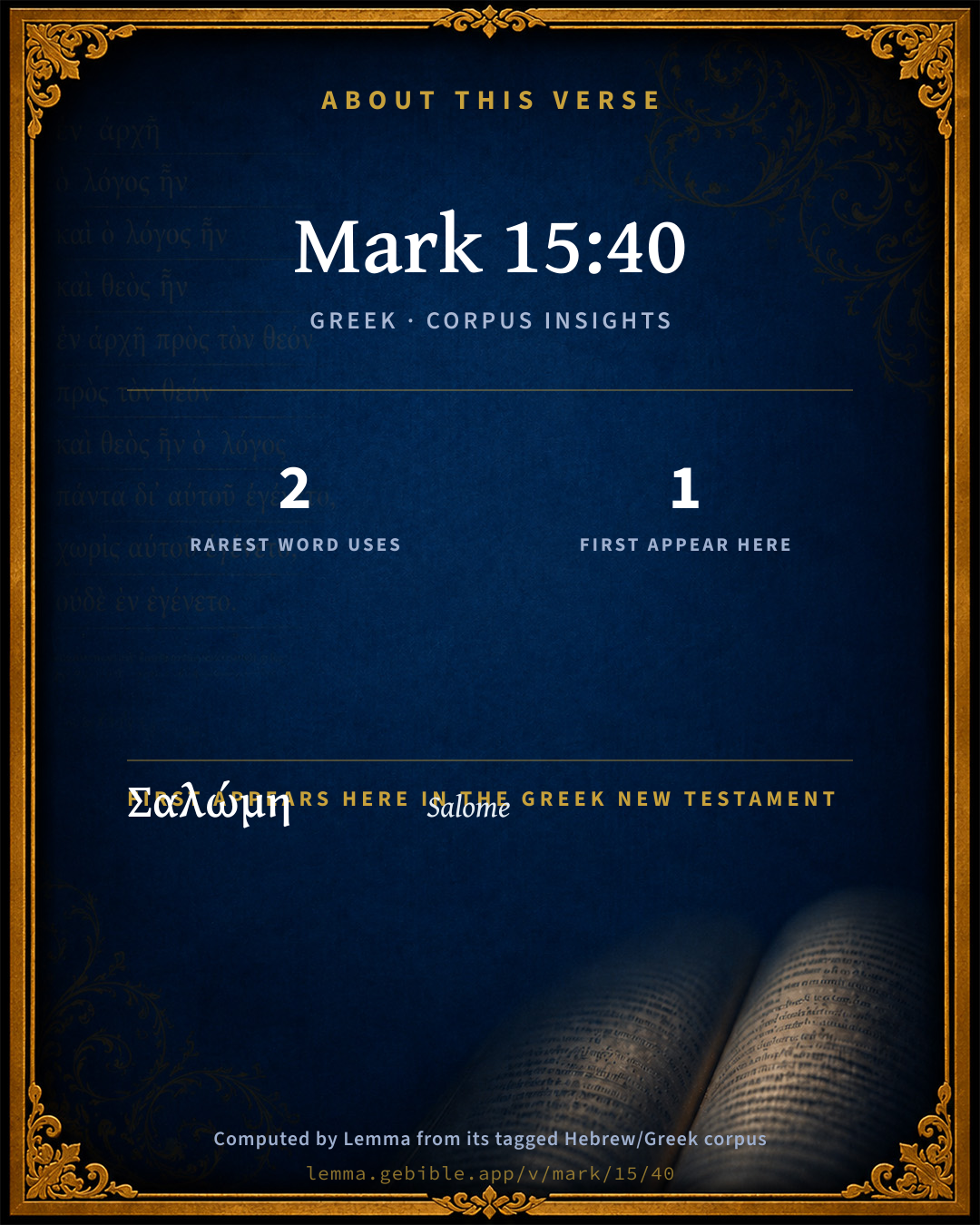
The rarest word here is Σαλώμη Salome G4539 — appearing just 2 times in the whole Greek New Testament.

First appearance in Scripture

This word makes its first canonical appearance in the Greek New Testament here:

  • Σαλώμη Salome G4539

Shared distinctive vocabulary

Σαλώμη Salome G4539 occurs in 2 verses of the Greek New Testament. Also found in:
Repetition

Words recur within this verse:

Cross-references

13

Topical passages linked to Mark 15:40 in the Treasury of Scripture Knowledge — connected by theme and wording, ordered by reader-vote popularity; previews shown in the World English Bible.

  • Matthew 27:55–56 Many women were there watching from afar, who had followed Jesus from Galilee, serving him.
  • Luke 8:2–3 and certain women who had been healed of evil spirits and infirmities: Mary who was called Magdalene, from whom seven demons had gone out;
  • Luke 23:49 All his acquaintances, and the women who followed with him from Galilee, stood at a distance, watching these things.
  • Matthew 13:55 Isn't this the carpenter's son? Isn't his mother called Mary, and his brothers, James, Joses, Simon, and Judas?
  • Matthew 27:61 Mary Magdalene was there, and the other Mary, sitting opposite the tomb.
  • Matthew 28:1 Now after the Sabbath, as it began to dawn on the first day of the week, Mary Magdalene and the other Mary came to see the tomb.
  • Mark 15:47–16:1 Mary Magdalene and Mary, the mother of Joses, saw where he was laid.
  • Mark 16:9 Now when he had risen early on the first day of the week, he appeared first to Mary Magdalene, from whom he had cast out seven demons.
  • Psalms 38:11 My lovers and my friends stand aloof from my plague. My kinsmen stand far away.
  • John 19:25–27 But there were standing by the cross of Jesus his mother, and his mother's sister, Mary the wife of Clopas, and Mary Magdalene.
  • 1 Corinthians 9:5 Have we no right to take along a wife who is a believer, even as the rest of the apostles, and the brothers of the Lord, and Cephas?
  • John 20:11–18 But Mary was standing outside at the tomb weeping. So, as she wept, she stooped and looked into the tomb,
  • James 1:1 James, a servant of God and of the Lord Jesus Christ, to the twelve tribes which are in the Dispersion: Greetings.

Cross-references courtesy of OpenBible.info (CC BY 4.0).

Commentary

Notes on Mark 15:40 from classic Christian and Jewish commentators (each source and its license shown beneath its notes). The classic Christian expositions comment on the surrounding passage and are grouped to its opening verse, so a note may address several verses; the Jewish commentaries on the Tanakh (Rashi and others) are per-verse, so they appear only where the commentator wrote on this verse.

Lemma curates 59 commentaries, every one of them public domain or Creative Commons licensed, each selected and text-cleaned for this edition rather than reprinted as found. About our sources →

Tyndale Open Study Notes

Tyndale Open Resources

15:40-41 These women had supplied some of Jesus’ economic needs (see Luke 8:2-3). They were also present at the burial (Mark 15:47) and the empty tomb (16:1-8) and would be the first witnesses of Jesus’ resurrection. • Mary Magdalene, from the village of Magdala near the shore of the Sea of Galilee, was a key figure in the resurrection accounts (16:1, 9; Matt 28:1; Luke 24:10; John 20:1, 11-18). • Mary (the mother of James the younger): This James might have been James the son of Alphaeus (Mark 3:18). • Salome is mentioned only here and in Mark 16:1.

Tyndale Open Study Notes — © Tyndale Open Resources, licensed CC BY-SA 4.0. Text via the HelloAO Bible API.

Expositor's Greek Testament

ed. W. Robertson Nicoll

Mar 15:40 . On the faithful women who looked on from afar, vide on Mt. Mk. singles out for special mention the same three as Mt.: Mary of Magdala, Mary the mother of James and Joses, and the mother of Zebedee’s children. Mk. distinguishes James, the brother of Joses, as τοῦ μικροῦ = either the little in stature (Meyer and Weiss), or the less in age, the younger (Schanz). Mk. refers to the mother of Zebedee’s children by her own name, Salome. Neither evangelist mentions Mary, the mother of Jesus.

The Expositor's Greek Testament, edited by W. Robertson Nicoll (1897–1910) — public domain. Text from a community e-Sword module.

Geneva Bible (1599)

Geneva Bible translators

Christ to the great shame of men which forsook the Lord, chose women for his witnesses, which beheld all this whole action.

Geneva Bible (1599) marginal notes — public domain. Text via Bolls.life.

Adam Clarke's Commentary

Verse 40. Joses] Some MSS. and versions read Joset, others Joseph. See Clarke on Mt 27:56.

Adam Clarke's Commentary on the Bible (1810–1826) — public domain. Text from a community e-Sword/MySword module.

Ellicott's Commentary for English Readers

(40) Among whom was Mary Magdalene.—The list is the same as that in Mat_27:56, with the exceptions (1) of the epithet “less,” or better, little, as applied to James, and (2) the name of Salome instead of “the mother of Zebedee’s children.”

A Bible Commentary for English Readers, edited by Charles John Ellicott (1878–1897) — public domain. Text from a community e-Sword module.

The Cambridge Bible for Schools and Colleges

gen. ed. J. J. S. Perowne

40. There were also women] forerunners of the noble army of Holy Women, who were, in the ages to come, throughout the length and breadth of Christendom, to minister at many a death-bed out of love for Him Who died “the Death.”

Mary Magdalene] Mary of Magdala, out of whom had gone forth seven demons (Luk_8:2). This is the first time she is mentioned by St Mark.

Mary the mother of James the less] The “Mary of Clopas” (Joh_19:25) who stood by the cross, and “Mary of James the Less” (comp. Mat_27:56), are the same person; she was the sister of the Blessed Virgin, and had married Clopas or Alphæus.

James the less] James the Little, so called to distinguish him from the Apostle St James, the son of Zebedee. Some think he was so called (a) because he was younger than the other James; or (b) on account of his low stature; or (c) because, when elevated to the bishopric of Jerusalem (Gal_2:12), he took the name in humility, to distinguish him from his namesake, now famous in consequence of his martyrdom (Act_12:2).

Joses] See note above, Mar_3:31.

Salome] See note above, Mar_10:35.

The Cambridge Bible for Schools and Colleges (gen. ed. J. J. S. Perowne; Cambridge University Press, 1878–1918) — public domain. Text from a community e-Sword module.

John Gill's Exposition

And Pilate marvelled if he were already dead,.... For death, by crucifixion, was a slow lingering death; persons that were in their full strength hung a great while before they expired; and the two thieves, which were crucified with Christ, were not dead when he was:

and calling unto him the centurion; who was set to watch him:

he asked him, whether he had been any while dead; he inquired of him, whether he was dead, and how long he had been dead.

John Gill's Exposition of the Whole Bible (1746–1763) — public domain (CC PDM 1.0). Text via the HelloAO Bible API.

Trapp's Complete Commentary

John Trapp

40 There were also women looking on afar off: among whom was Mary Magdalene, and Mary the mother of James the less and of Joses, and Salome;

Ver. 40. James the less] viz. In stature, note, or age.

John Trapp, A Commentary or Exposition upon All the Books of the Old and New Testament (1647–1656) — public domain. Text from a community e-Sword module.

The Pulpit Commentary

And there were also women holding from afar (apo makroyen yewrousai). St. Matthew (Mat_27:55) says that there were many. Amongst them were Mary Magdalene, and Mary the wife of Clopas, or Alphaeus, and mother of James the less and of Joses, called brethren of our Lord, and the mother of Zebedee"s children, that is, Salerno. The mother of our Lord had been there until the time when, having with St. John crept as near the cross of Jesus as she might venture, she was consigned by our Lord to St. John"s care, and taken away by him. St. Mark mentions this to show the faith and love of these holy women, because in the very presence of the enemies of Christ they dared to stand by his cross, and shrank not from testifying their piety and devotion. St. John says that they stood near. He must have known; for at one time at least he was standing near. St. Matthew and St. Mark speak of them as at a distance. They were at a distance, no doubt, for the most part, as compared with the soldiers, whose duty it was to be in close attendance and to keep the people off. But these devoted women came as near as they could, so as to see and hear their Lord. Perhaps they were sometimes further off and sometimes nearer, as they saw opportunity, or as the humor of the officials suffered them.

Vers. 40, 41. Women watching the cross.

The prominence of women in the Gospel narrative suggests the fact that Christianity has done more to awaken the spiritual nature of women, and to furnish them with a sphere for the exercise of their special gifts and graces, than any other religion. For the first time the gospel gave to woman dignity and recognized position in spiritual things. In the gospel, the feminine as well as the masculine aspects and phases of morality are represented. Why were they at the cross?

I A PROOF OF THEIR ATTACHMENT TO CHRIST.

1. They had already shown this. They were, some of them, of good social standing, and had command of considerable means. This advantage they had employed in the interests of Christ and his work" they ministered unto him" when he was in Galilee. And the service they rendered involved a certain inconvenience and trouble, for they had to follow him almost as much as his apostles.

2. Now they gave even more signal evidence. Modestly retiring to the outskirts of the rabble, they persistently watched him. They might have been excused by ordinary scruples from witnessing the horrible scene, but they could not allow themselves to go away. He still represented their highest spiritual interest, and they were willing to brave anything for his sake.

II A TRIAL OF THEIR LOVE. It rose into heroic resolution and sacrifice.

1. How typical their experience was of that which their sisters have had to go through in all ages! They stood by helpless, unable to render any further service. It was not for them to attempt a rescue when brave men had forsaken him and fled. But they could show the virtue of passive endurance. They could prove to the Sufferer that their love was unabated, their faith forlorn, but not dead. So many a noble wife, sister, or mother has had to stand by when loved ones have been done to death, or ruined by great concerns in which they might not interfere. They have been able only to trust and wait and pray, to comfort when they could not deliver. One consolation remained to them they had done what they could.

2. To so try it was the grandest recognition of its genuineness. They were accounted worthy to suffer with Christ. Their affection was to pass through the fires seven times refined. Peter might be faithless, and the rest of the disciples sadly fail, but they could watch with the Savior as his spirit sank beneath its accumulated woe. M.

Vers. 40-47. The burial.

I FAITH THRIVES IN SORROW. Remoter disciples draw near, and secret disciples come forth, in the hour of humiliation and defeat. The sun sets, but not their hope; and the stars rise, but their faith is earlier up.

II LOVE SURVIVES ALL LOSS. Its burning ray, like that of a hidden gem, flashes out in the gloom. The nobleness of Christ had taught them to master selfishness and despair. His form was enshrined in the "amber of memory." They who had been all eye when he was present, were all recollection now that he was gone.

III GRIEFS ARE CERTAIN, JOYS COME BY SURPRISE. It was certain that Jesus was dead; and none expected his resurrection. There is change, not loss, in the kingdom of the spirit. God takes away a good to restore it in a new form. Disappointment vacates the heart for higher blessings. His revelation is in light and shadow. J.

The Pulpit Commentary (1880–1919), ed. H.D.M. Spence-Jones & Joseph S. Exell — public domain. Text from a community e-Sword module.

Cambridge Greek Testament for Schools and Colleges

40. [3467][3468][3469] omit ἦν after ἐν αἷς.

[3467] Codex Sinaiticus. 4th cent. Discovered by Tischendorf in 1859 at the Monastery of St Katharine on Mount Sinai. Now at St Petersburg. The whole Gospel, ending at Mar 16:8. Photographic facsimile, 1911.

[3468] Codex Vaticanus. 4th cent., but perhaps a little later than א. In the Vatican Library almost since its foundation by Pope Nicolas V., and one of its greatest treasures. The whole Gospel, ending at Mar 16:8. Photographic facsimile, 1889.

[3469] Codex Regius. 8th cent. An important witness. At Paris. Contains Mar 1:1 to Mar 10:15; Mar 10:30 to Mar 15:1; Mar 15:20 to Mar 16:20, but the shorter ending is inserted between Mar 16:8 and Mar 16:9, showing that the scribe preferred it to the longer one.

40. ἦσαν δὲ καὶ γυναῖκες. The centurion was not the only person who regarded the death of Christ with reverence and awe. There were also women beholding from afar (R.V.). Cf. Mar 5:6, Mar 8:3, Mar 11:13, Mar 14:54. They had no mind to see more of the horrible details of the crucifixions, still less to hear the derisive language of Christ’s triumphant enemies. His Mother and her sister, Mary of Clopas, with Mary Magdalen, had been near the Cross for a time, but they had come away, and the beloved disciple had taken the first to his own home; but the two others with Salome had joined a group at a distance and still remained. Lk. gives no names, but says that “all His acquaintance” were there also. Are the disciples included in οἱ γνωστοὶ αὐτῷ? John had probably returned to the cross; but where were the Ten?

[3544] ἡ Μαγδαληνή. Mary of Magdala. Mk has not mentioned her before, but assumes that she is known to his readers. Gratitude for her great deliverance (Mar 16:9; Luk 8:2) had made her a devoted follower. The common identification of her with the “sinner” of Luk 7:37 is a monstrous error, which ought never to be repeated.

[3544] Codex Campianus. 9th cent. At Paris. Gospels complete.

[3545]. ἡ Ἰακώβου τ. μικροῦ κ. Ἰωσῆτος μήτηρ. Syr-Sin. has “Mary the daughter of James the less, the mother of Joseph”; but Mary the mother of James the less (little) and of Joses (A.V., R.V.) is right. She was the wife of Clopas (Joh 19:25), who is certainly not the same as Cleopas (Luk 24:18) and cannot with any certainty be identified with Alphaeus. See on Mar 3:18. James and Joses are mentioned, not as being famous, but in order to distinguish their mother from other Marys. They are not the James and Joses of Mar 6:3. James was called ὁ μικρός probably because of his stature, but Deissmann (Bib. St. p. 144) suggests age. “The younger” would probably have been ὁ μικρότερος (Gen 42:32), or ὁ νεώτερος (Gen 42:34; Luk 15:12), or ὁ ἐλάσσων (Gen 25:23).

[3545] Codex Campianus. 9th cent. At Paris. Gospels complete.

Σαλώμη. Mk treats her also as known to his readers. Mt. gives no name but substitutes “the mother of the sons of Zebedee,” who has been previously mentioned by him (Mat 20:20). She was probably the sister of Christ’s Mother. See on Joh 19:25.

Cambridge Greek Testament for Schools and Colleges (Cambridge University Press, 1896; 21 vols, various authors incl. Carr, Maclear, Plummer, Farrar, Lumby, Moule, M. R. James, Simcox) — public domain. Text from a community e-Sword module.

International Critical Commentary

40. ἡ Μαγδαληνή—the Magdalene, the same as we say, the Nazarene. It denotes an inhabitant of Magdala, a town on the W. shore of the Lake of Galilee, three miles north of Tiberias. The only identification of her given in the Gospels is in Luk 8:2, where she is said to be one out of whom Jesus had cast seven devils. There is absolutely no support for the tradition that she was the sinful woman who anointed the feet of Jesus (Luk 7:36 sq.). Μαρία ἡ Ἰακώβου τοῦ μικροῦ κ. Ἰωσῆτος—Mary, the mother of James the little, and of Joses. In the list of the apostles, James is called the son of Alphæus, while in J. 19:25, the name of one of the women standing by the cross is given as Mary, the wife of Clopas. These coincidences have led to the conjecture that Alphæus and Clopas are identical, both being Greek forms of the Aramaic חַלְפַּיִ, and that, therefore, this Mary was the mother of the second James in the list of the apostles. The further conjecture that she was the sister of Mary, the mother of Jesus, is based on the unnecessary supposition that Μαρία in J. 19:25, is in apposition with ἡ ἀδελφὴ. It involves the further difficulty of two sisters of the same name. It is connected, moreover, with the theory that the brothers of Jesus were cousins, the sons of this Mary, and apostles. This theory has against it, the fact that it is in the interest of the dogma of the perpetual virginity of Mary, the mother of Jesus. It also makes the brothers of Jesus apostles, which is clearly against the record.1 Σαλώμη—the mother of James and John. This is not directly stated, but it is inferred from a comparison of Mat 27:56 with this passage. A further comparison with J. 19:25 has led to the conjecture that she is the sister of the mother of Jesus mentioned there. This might account for Jesus’ commending his mother to John, but it is conjecture only, and will remain so. James is called ὁ μικρός, the little, to distinguish him from the other “celebrities” of the name. But whether it designates him as less in stature, or in age, or of less importance, there are no data for determining.

Omit ἦν after ἐν αἶς, Tisch. (Treg.) WH. RV. א BL, mss. Vulg. Omit τοῦ before Ἰακώβου, Tisch. Treg. WH. א BCKU ΔΠ* 1, 11. Ἰωσῆτος, instead of Ἰωσῆ, Tisch. Treg. WH. א BDgr. L Δ 13, 33, 69, 346, two mss. Lat. Vet. Memph.

International Critical Commentary — older volumes (1896–1929), various authors — public domain. Text from a community e-Sword module.

Vincent's Word Studies in the New Testament

Marvin R. Vincent

Magdalene. See on Mt 27:56.

Marvin R. Vincent, Word Studies in the New Testament (1887–1900) — public domain. Text from a community e-Sword/MySword module.

Lesson kit

Teaching starters — assembled from the data on this page, not authored interpretation. Every prompt links to the verse data it draws on. Edit before teaching.

Mark, in the Gospels, opens this verse with 24 words (17 distinct Greek lemmas). Its most distinctive word is Salṓmē (“Salome”). A historical commentator’s framing appears above. Read the whole chapter for the surrounding context.

Discussion questions

  1. The word Salṓmē carries the sense “Salome.” How does it shape the verse?
  2. This is the first place “Salome” appears in Scripture (first appears here). What does its debut here establish?
  3. How does Mark 16:1, which shares the word «Salome», read alongside this verse?
  4. What does the repetition of “Mary” (2× in this one verse) do in this verse?
  5. These translations render this verse differently. What is at stake in choosing one wording over another?
  6. Compare how Tyndale Open Study Notes and Expositor's Greek Testament read this verse. Where do they agree or differ?

Things to notice

  • 1 word makes its first canonical appearance in Scripture here.
  • These translations choose different wording for 9 words in this verse.
  • “Mary” occurs 2× in this single verse.
  • 17 distinct Greek lemmas span 24 words in this verse.

Reading settings

Reading text

Shown beneath each verse's original-language words.

Old Testament
Old Testament edition

Read the OT as the Masoretic Hebrew (MT) or the Greek Septuagint (LXX).

English shown for the Greek Septuagint (in the Hebrew ↔ Greek comparison).

Comparing translations? Open the Compare panel on any verse page to stack up to four side by side.