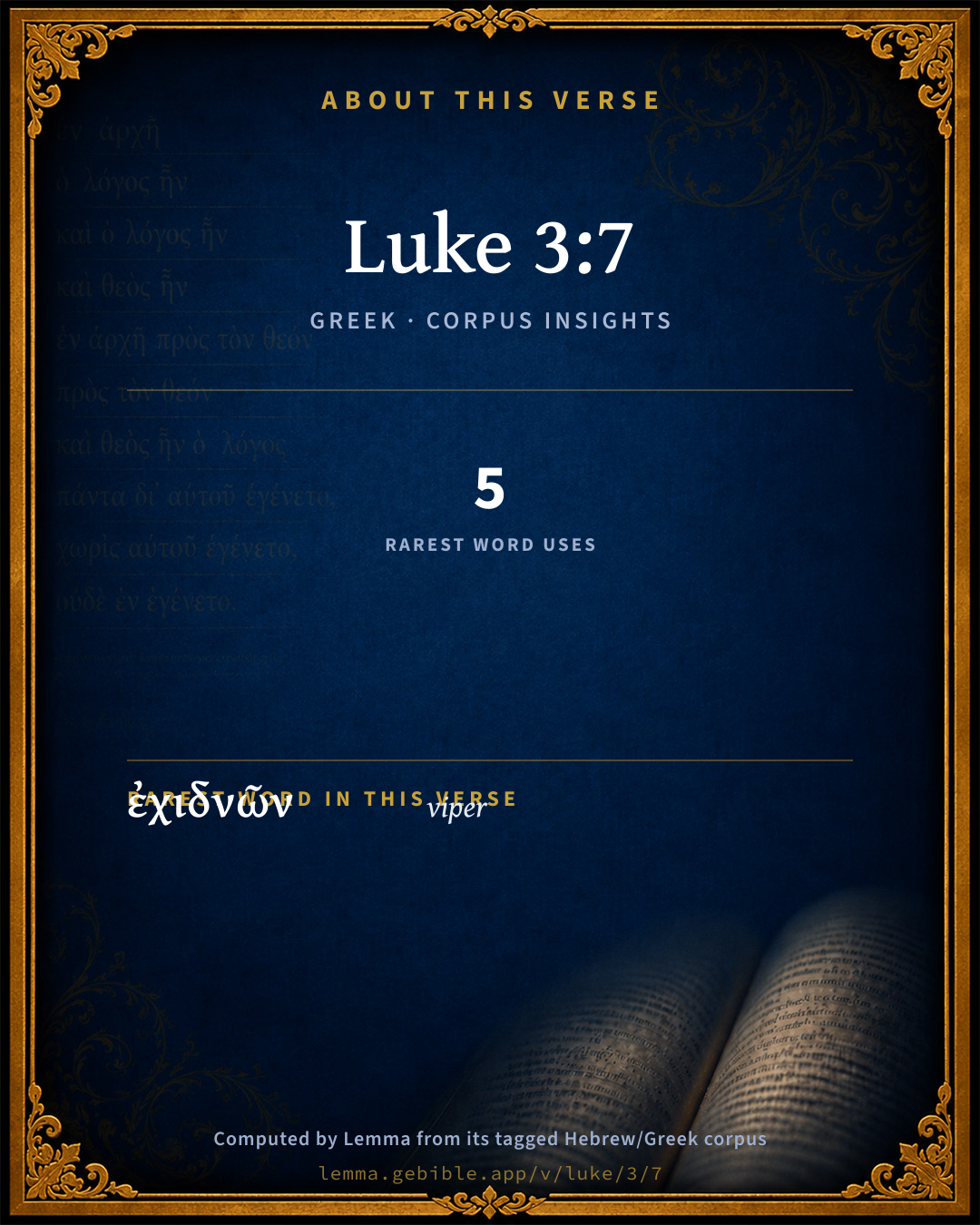
Luke 3:7

Greek (Tischendorf 8th ed.) Luke 3:7 appears in the Greek New Testament. The text above is from the Tischendorf 8th edition. Each word links to its Strong’s number and a concise gloss. Click any word for its full Thayer’s Greek Lexicon entry.
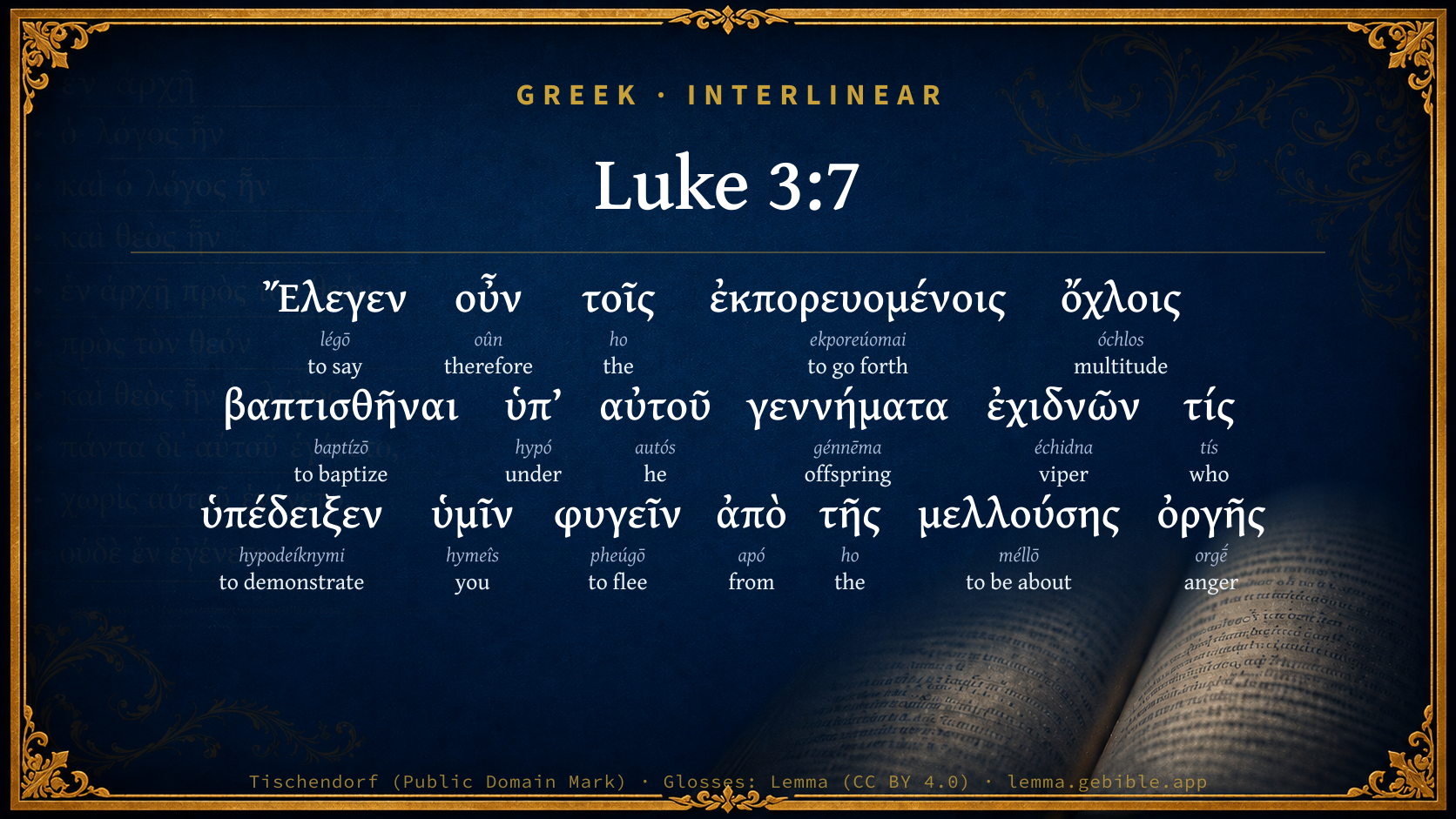
Download image
Cite this verse

Luke 3:7 (World English Bible). Public Domain. Lemma interlinear Bible study tool, https://lemma.gebible.app/v/luke/3/7.

Show BibTeX & RIS
BibTeX
RIS
English Translation
He said therefore to the multitudes who went out to be baptized by him, "You offspring of vipers, who warned you to flee from the wrath to come?
World English Bible · Public Domain
Download a study sheet

One document with this verse’s original text, its word-by-word gloss line, the meaning frame, cross-references with their text, attributed commentary, and full source and license credits — printable, and it pastes into notes with its structure intact.

This verse Autodidact and up

Study sheet (.html) Plain text (.txt)

A passage Seminary Student

Up to 50 verses in one chapter. A passage sheet keeps up to 6 commentary sources and 12 cross-references per verse, in the order this page ranks them, and says so on the sheet whenever that leaves anything out. Ask for a single verse and you get the Autodidact verse sheet above.

Everything on this page stays free to read, with no account — the sheet is a download of what is already on screen, not access to it.

Want to remove ads? Support Godless Engineer
Compare translations 3

The same verse in 3 English versions, stacked beneath the original-language interlinear above. Click any original word for its lexicon entry.

Each is an independent rendering of the whole verse — the interlinear is not word-aligned to these translations.

Highlighted words mark where these versions differ — a whole-verse word diff, not a word-by-word alignment.

  • World English Bible Public Domain
    He said therefore to the multitudes who went out to be baptized by him, "You offspring of vipers, who warned you to flee from the wrath to come?
  • King James Version Public Domain
    Then said he to the multitude that came forth to be baptized of him, O generation of vipers, who hath warned you to flee from the wrath to come?
  • unfoldingWord Literal Text CC BY-SA 4.0
    So he said to the crowds coming out to be baptized by him, “Offspring of vipers! Who warned you to flee from the coming wrath?

unfoldingWord Literal Text — © unfoldingWord, licensed CC BY-SA 4.0. Word-aligned USFM3 via Door43 (git.door43.org/unfoldingWord/en_ult).

Versions to compare (up to 4)

3 of 4 selected

Show all 19 translations

Every available English version of this verse, each an independent rendering of the whole verse.

  • World English Bible Public Domain
    He said therefore to the multitudes who went out to be baptized by him, "You offspring of vipers, who warned you to flee from the wrath to come?
  • Berean Standard Bible Public Domain
    Then John said to the crowds coming out to be baptized by him, “You brood of vipers, who warned you to flee from the coming wrath?
  • Majority Standard Bible Public Domain
    Then John said to the crowds coming out to be baptized by him, “You brood of vipers, who warned you to flee from the coming wrath?
  • King James Version Public Domain
    Then said he to the multitude that came forth to be baptized of him, O generation of vipers, who hath warned you to flee from the wrath to come?
  • American Standard Version (1901) Public Domain
    He said therefore to the multitudes that went out to be baptized of him, Ye offspring of vipers, who warned you to flee from the wrath to come?
  • Revised Version (1885) Public Domain
    He said therefore to the multitudes that went out to be baptized of him, Ye offspring of vipers, who warned you to flee from the wrath to come?
  • Geneva Bible (1599) Public Domain
    Then said he to the people that were come out to be baptized of him, O generations of vipers, who hath forewarned you to flee from the wrath to come?
  • Douay-Rheims (1899) Public Domain
    He said therefore to the multitudes that went forth to be baptized by him: Ye offspring of vipers, who hath shewed you to flee from the wrath to come?
  • Young's Literal Translation Public Domain
    Then said he to the multitudes coming forth to be baptised by him, `Brood of vipers! who did prompt you to flee from the coming wrath?
  • Literal Standard Version CC BY-SA 4.0
    Then he said to the multitudes coming forth to be immersed by him, “Brood of vipers! Who prompted you to flee from the coming wrath?
  • Unlocked Literal Bible CC BY-SA 4.0
    So John said to the crowds who were coming out to be baptized by him, “You offspring of vipers! Who warned you to run away from the wrath that is coming?
  • unfoldingWord Literal Text CC BY-SA 4.0
    So he said to the crowds coming out to be baptized by him, “Offspring of vipers! Who warned you to flee from the coming wrath?
  • Darby Bible Public Domain
    He said therefore to the crowds which went out to be baptised by him, Offspring of vipers, who has forewarned you to flee from the coming wrath?
  • World Messianic Bible Public Domain
    He said therefore to the multitudes who went out to be immersed by him, “You offspring of vipers, who warned you to flee from the wrath to come?
  • Webster's Bible Public Domain
    Then said he to the multitude that came forth to be baptized by him, O generation of vipers, who hath warned you to flee from the wrath to come?
  • Free Bible Version CC BY-SA 4.0
    John addressed the crowds that came to him to be baptized. “You viper's brood! Who warned you to flee from the coming judgment?” he asked.
  • Bible in Basic English Public Domain
    So he said to the people who went out to him for baptism: You offspring of snakes, at whose word are you going in flight from the wrath to come?
  • Text-Critical English NT CC BY 4.0
    John said to the crowds that were coming out to be baptized by him, “You brood of vipers, who warned you to flee from the coming wrath?
  • Tyndale New Testament (1534) Public Domain
    Then sayde he to the people that were come to be baptysed of him: O generacion of vipers who hath taught you to flye from the wrath to come?

Literal Standard Version (2020), Covenant Press — licensed CC BY-SA 4.0. Text via the HelloAO Bible API (eBible.org). Unlocked Literal Bible (unfoldingWord) — licensed CC BY-SA 4.0. Text via the HelloAO Bible API (eBible.org). unfoldingWord Literal Text — © unfoldingWord, licensed CC BY-SA 4.0. Word-aligned USFM3 via Door43 (git.door43.org/unfoldingWord/en_ult). Free Bible Version, Dr. Jonathan Gallagher — licensed CC BY-SA 4.0. Text via the HelloAO Bible API (eBible.org).

Word by word

More ways to search: Search by grammar → Find every occurrence → Compare this word →

Practice this passage: Drill this verse → Learn its vocabulary →

ἐχιδνῶν
échidna
G2191
“viper”
Noun, Genitive, Plural, Feminine
Part of Speech
Noun
Case
Genitive
Number
Plural
Gender
Feminine
Full Thayer's Definition

Origin: of uncertain origin

TDNT: 15:35,3

1. a viper, offspring of vipers a. addressed to cunning, malignant, wicked men
  1. Ἔλεγεν légō G3004 “to say” Verb, Imperfect, Active, Indicative, 3rd person, Singular
  2. οὖν oûn G3767 “therefore” Conjunction
  3. τοῖς ho G3588 “the” Article, Dative, Plural, Masculine
  4. ἐκπορευομένοις ekporeúomai G1607 “to go forth” Verb, Present, Middle or Passive deponent, Participle, Dative, Plural, Masculine
  5. ὄχλοις óchlos G3793 “multitude” Noun, Dative, Plural, Masculine
  6. βαπτισθῆναι baptízō G907 “to baptize” Verb, Aorist, Passive, Infinitive
  7. ὑπ’ hypó G5259 “under” Preposition
  8. αὐτοῦ autós G846 “he” Personal pronoun, Genitive, Singular, Masculine
  9. γεννήματα génnēma G1081 “offspring” Noun, Vocative, Plural, Neuter
  10. τίς tís G5101 “who” Interrogative pronoun, Nominative, Singular, Masculine
  11. ὑπέδειξεν hypodeíknymi G5263 “to demonstrate” Verb, Aorist, Active, Indicative, 3rd person, Singular
  12. ὑμῖν hymeîs G5210 “you” Personal pronoun, 2nd person, Dative, Plural
  13. φυγεῖν pheúgō G5343 “to flee” Verb, Aorist, Active, Infinitive
  14. ἀπὸ apó G575 “from” Preposition
  15. τῆς ho G3588 “the” Article, Genitive, Singular, Feminine
  16. μελλούσης méllō G3195 “to be about” Verb, Present, Active, Participle, Genitive, Singular, Feminine
  17. ὀργῆς orgḗ G3709 “anger” Noun, Genitive, Singular, Feminine

About this verse

These counts appear in no published source. They are computed here, from the morphology-tagged text and Lemma’s own curated glosses. What Lemma adds →

18
words
17
distinct lemmas
Gospels
section

Notable vocabulary

The rarest word here is ἐχιδνῶν viper G2191 — appearing just 5 times in the whole Greek New Testament.

Shared distinctive vocabulary

ἐχιδνῶν viper G2191 occurs in 5 verses of the Greek New Testament. Also found in:

Repetition

A word recurs within this verse:

  • τοῖς the G3588 ×2

Cross-references

11

Topical passages linked to Luke 3:7 in the Treasury of Scripture Knowledge — connected by theme and wording, ordered by reader-vote popularity; previews shown in the World English Bible.

  • Matthew 23:33 You serpents, you offspring of vipers, how will you escape the judgment of Gehenna?
  • Matthew 12:34 You offspring of vipers, how can you, being evil, speak good things? For out of the abundance of the heart, the mouth speaks.
  • 1 Thessalonians 1:10 and to wait for his Son from heaven, whom he raised from the dead-- Jesus, who delivers us from the wrath to come.
  • Genesis 3:15 I will put enmity between you and the woman, and between your offspring and her offspring. He will bruise your head, and you will bruise his heel."
  • Psalms 58:4–5 Their poison is like the poison of a snake; Like a deaf cobra that stops its ear,
  • Isaiah 59:5 They hatch adders' eggs, and weave the spider's web: he who eats of their eggs dies; and that which is crushed breaks out into a viper.
  • Matthew 3:7–10 But when he saw many of the Pharisees and Sadducees coming for his baptism, he said to them, "You offspring of vipers, who warned you to flee from the wrath to come?
  • John 8:44 You are of your Father, the devil, and you want to do the desires of your father. He was a murderer from the beginning, and doesn't stand in the truth, because there is no truth in him. When he speaks a lie, he speaks on his own; for he is a liar, and the father of it.
  • Acts 13:10 and said, "Full of all deceit and all cunning, you son of the devil, you enemy of all righteousness, will you not cease to pervert the right ways of the Lord?
  • Hebrews 6:18 that by two immutable things, in which it is impossible for God to lie, we may have a strong encouragement, who have fled for refuge to take hold of the hope set before us.
  • 1 John 3:8 He who sins is of the devil, for the devil has been sinning from the beginning. To this end the Son of God was revealed, that he might destroy the works of the devil.

Cross-references courtesy of OpenBible.info (CC BY 4.0).

Commentary

Notes on Luke 3:7 from classic Christian and Jewish commentators (each source and its license shown beneath its notes). The classic Christian expositions comment on the surrounding passage and are grouped to its opening verse, so a note may address several verses; the Jewish commentaries on the Tanakh (Rashi and others) are per-verse, so they appear only where the commentator wrote on this verse.

Lemma curates 59 commentaries, every one of them public domain or Creative Commons licensed, each selected and text-cleaned for this edition rather than reprinted as found. About our sources →

Adam Clarke's Commentary

Verse 7. - 9. On this account of the Baptist's mode of preaching, see Clarke's notes on Mt 3:7-11.

Adam Clarke's Commentary on the Bible (1810–1826) — public domain. Text from a community e-Sword/MySword module.

Ellicott's Commentary for English Readers

(7) Then said he to the multitude.—Better, multitudes. In St. Matthew the words “Generation” (or brood) “of vipers” are related, probably with greater accuracy, as having been addressed specifically to the Pharisees and Sadducees. On the question itself, see Note on Mat_3:7.

A Bible Commentary for English Readers, edited by Charles John Ellicott (1878–1897) — public domain. Text from a community e-Sword module.

The Cambridge Bible for Schools and Colleges

gen. ed. J. J. S. Perowne

7. to the multitude] Rather, multitudes. Different crowds came from different directions, Mat_3:5; Mar_1:5.

O generation of vipers] Rather, broods of vipers. They were like “serpents born of serpents.” The comparison was familiar to Hebrew poetry (Psa_68:4; Isa_14:9), and we learn from Mat_3:7 that it was specially pointed at the Pharisees and Sadducees, to whom it was addressed no less sternly by our Lord (Mat_23:33). It described the venomous hypocrisy which turned religion itself into a vice, and hid a deadly malice under the glittering semblance of a zeal for orthodoxy. But let it be borne in mind that only teachers of transcendent holiness, and immediately inspired by God with fervency and insight, may dare to use such language. The metaphor was one of those desert symbols which would be suggested to St John both by the scene of his preaching and by the language of Isaiah with which he shews special familiarity.

from the wrath to come] The Jews had been taught by Prophecy that the Advent of their Deliverer should be preceded by a time of anguish which they called “the Woes of the Messiah;” comp. Mal_3:2, “Who may abide the day of His coming? and who shall stand when He appeareth? For He is like a refiner’s fire, and like fuller’s soap.” Id. Luk_4:1 “Behold I send you Elijah the Prophet before the coming of the great and dreadful day of the Lord.” Such prophecies received their primary fulfilment at the Destruction of Jerusalem (see Mat_24:28; Mar_13:19-20); and await their final fulfilment hereafter. Rev_6:16.

The Cambridge Bible for Schools and Colleges (gen. ed. J. J. S. Perowne; Cambridge University Press, 1878–1918) — public domain. Text from a community e-Sword module.

John Gill's Exposition

Then said he to the multitude,.... That is, John, as the Ethiopic version reads; and the multitude to whom he spake the following words, were many of the Pharisees and Sadducees, as appears from Mat 3:7

That came forth to be baptized of him; who came out of their houses, towns, and cities, round about, to the place where John was; and hearing and seeing what he was about, desired to be admitted to his baptism: not that they "were baptised of him"; as the Arabic version renders it; but they came with a view of being baptized, were it thought fit and proper they should: but John refused them, saying to them,

O generation of vipers, who hath warned you to flee from the wrath to come? See Gill on Mat 3:7.

John Gill's Exposition of the Whole Bible (1746–1763) — public domain (CC PDM 1.0). Text via the HelloAO Bible API.

Trapp's Complete Commentary

John Trapp

7 Then said he to the multitude that came forth to be baptized of him, O generation of vipers, who hath warned you to flee from the wrath to come?

Ver. 7. {See Trapp on "Mat 3:7"}

John Trapp, A Commentary or Exposition upon All the Books of the Old and New Testament (1647–1656) — public domain. Text from a community e-Sword module.

The Biblical Illustrator

Joseph S. Exell

Luk_3:7-8

Then said he to the multitude that came forth

John and the populace

It is a matter of some interest, even as a memoir of ancient manners, to conceive the various and strikingly marked aspect of the multitude that now fled to John in the desert.

There stood the Pharisee, covered from head to heel with the emblems of his sanctity, the haughtiest and most scornful of men; but then, for once, divested of his spiritual influence, and asking, What shall I dote be saved? There stood the splendid and voluptuous scribe--the man of affected philosophy, for once feeling that he had a soul to be saved. There stood the grasping and the iron hand of the publican, the common tribute gatherer, laying his accumulated gains before the feet of the prophet, and bowing down to the dust. There stood the moldier, subdued and hardened by the barbarous habits of his life, until he became a merciless murderer, there he stood, flinging down his sword at the feet of the prophet, and imploring to be purified from blood by the waters of baptism. In the midst of these kneeling and humble thousands stood the prophet full of the Holy Ghost, in utter defiance of human power, undaunted by the voice of human authority, and undismayed by the barbarism of the multitude, tendering to all alike the words of judgment: Ye men of sin, ye splendid voluptuaries, who now cry out for mercy, show not by your words but by your deeds that you have abjured sin; and you, ye haughty despisers of all mens virtue, be ye holy. Ye jealous and persecuting Pharisees, cast off your self-righteous praises, rend the heart and not the garment, be humble, contrite, and holy. (G. Croby, M. A.)

Necessity of warning

A man left to himself will go to the devil. If he turns away from his sin, it is because of some outside pressure. The attraction of gravitation is seen in souls as well as in all material things. They fall by their own weight. If you see them going upwards, you may be sure that a strong hand or a strong wind has been under them to start them in that direction. Sinners need to be warned of their danger. The responsibility is on us to warn others, and to heed the warnings which come to us. Who has warned you? Whom have you warned? (H. C.Trumbull.)

Taking warning

Waldus, a rich merchant in Lyons, seeing one drop down dead in the streets, went home, and repented, changed his fife, and became a preacher, and was the father and founder of the people called Waldenses. Tis good to take warning by others harms, and by the sight of their death, to look after our own life. (Venning.)

Warnings of God

As the mother bird shrieks when the hawk is in the sky, that her young ones may hide themselves under her wings, so God, the Father of men, utters His voice of warning against sinners, that they may rush to His mercys protection, before the devouring lion of hell overtake them in destruction. (John Bate.)

The Baptists heraldry

Nor is it difficult to account for this widespread and profound agitation. In the first place, the people were chafing under the yoke of pagan Rome. Remembering that they were Jehovahs covenant-people, their yearning for deliverance naturally took on a religious form. Again, there was at this time among the Jews, and perhaps throughout the East, the expectation, more or less distinct, of one who was to be a heaven-sent deliverer. Hearing of the sanctity of Judeas hermit, how natural that the Jews, weary of bondage and shame, should flock to John in the hope that he was the promised one. Again, there is in asceticism something which is fascinating. It betokens an exceptional, earnest, character; and men are ever moved by the exceptional, especially when it takes the form of terrible moral earnestness. And John was a terribly earnest ascetic. And therefore all Israel flocked to his preaching, feeling the thrall of his magnetism, even as idolatrous Israel centuries before had swayed under stormy Elijah, and as voluptuous Italy centuries afterward bowed before stern Savonarola, and frivolous France centuries still later grew solemn before saintly Lacordaire. Once more, Johns message was a message of terror. No soothing words were his, no soporific platitudes. So it was in Assyria when heathen Nineveh robed herself in sackcloth before the denunciation of Hebrew Jonah. So it was in France when awakened Europe wept and groaned before the Tartarean oratory of St. Bernard. So it was in New England when Northampton church-member and and Stockbridge Indian quailed and wailed before the wrathful eloquence of Edwards. How, then, came such persons to the Jordan to listen to the wrathful eloquence of the stern apostle of repentance? Ah, there are times when the proudest, most worldly of natures are stirred to their very depths. There are times when even the Pharisee finds that his rubric is too narrow and icy, and that he has been living a hollow life. There are times when even the Sadducee feels his moral nature asserting itself at cost of every barrier of unbelief and moral petrifaction. There are times when conscience speaks louder than will or passion. Thus did the desert-preacher rightly divide the word of truth, giving to each his appropriate share, not demanding of the publican repentance for the Pharisees self-righteousness, nor of the Sadducee penitence for the soldiers crime. In this respect, at least, John of the desert was a model preacher. Would God, all the ministers of His word were as faithful! (G. D. Boardman.)

Insincere penitents

Fra Rocco, a Dominican, preached a celebrated penitential sermon on one occasion; when all the audience were in terror and fell on their knees, showing every sign of contrition. Then he cried,

All who are truly penitent, hold up your hands! Every man in the vast multitude held up his hand. Then he said, Holy Archangel Michael, thou who standest with adamantine sword at the judgment-seat of God, cut me off every hand which has been held up hypocritically. Every hand dropped. (E. P. Hood.)

Appropriate preaching

It is related of John Wesley that, preaching to an audience of courtiers and noblemen, he used the generation of vipers text, and flung denunciation right and left. That sermon should have been preached at Newgate, said a displeased courtier to Wesley on passing out.

No, said the fearless apostle; my text there would have been, Behold the Lamb of God, which taketh away the sin of the world!

(Baxendales Anecdotes. )

Folly of arguing about instead of escaping from coming wrath

Many have puzzled themselves, says John Newton, about the origin of evil. I am content to observe that there is evil, and that there is a way of escape from it; and with that I begin and end. One of the most exquisite mechanisms of torture devised, by the Hohenstaufen family, during the height of their despotic control, was a cell which gradually shrunk in upon itself, the walls day by day contracting, till the prisoner was finally crushed in the pressure of their embrace. For a day or so he would perceive no alteration--at first he would doubt the evidence of his senses; but at last the fearful truth would burst upon him that day after day the dimensions of his cell became smaller, and that in its slow but certain contraction he would, if he remained, be finally destroyed. Suppose that a door opened to him, and a voice said: Escape for your life--now is the time. To-morrow will be too late. Is it likely he would sit down and say, I do not understand the principle of this complex piece of mechanism. I prefer investigating it, and will stay behind for the purpose? And yet what does the man around whose heart sin is gradually winding itself closer and closer do but this when he rejects Christs gospel? Human reason alone tells him that a heart swathed in the bandages of wrath, or pleasure, or passion, can never, until released, be fit for the peace and love of heaven. Experience tells him that the terrible thraldom is every day becoming closer and closer, so that soon he must be crushed in its folds. The gospel tells him, escape for thy life! And why, oh, reader, when thy only thought should be about such escape, wilt thou sit down and speculate upon the causes of thy imprisonment?--causes unto which, when thus confined, thou canst never penetrate. Fly through the open door, and in the omniscience of the next world thou wilt know why sin was permitted for time. Take heed lest, by remaining where thou art, thou findest that for the impenitent sin is the portion for eternity.

Earnestness is needed in warning others

The energy of the manner of the late Rowland Hill and the power of his voice are said to have been at times overwhelming. While once preaching at Wotton-under-Edge, his country residence, he was carried away by the impetuous rush of his feelings, and raising himself to his full stature, be exclaimed, Beware, I am in earnest; men call me an enthusiast, but I am not: mine are words of truth and soberness. When I first came into this part of the country, I was walking on yonder hill; I saw a gravel-pit fall in, and bury three human beings alive. I lifted up my voice for help, so loud, that I was heard in the town below, a distance of a mile: help came and rescued two of the poor sufferers. No one called me an enthusiast then--and when I see eternal destruction ready to fall upon poor sinners, and about to entomb them irrecoverably in an eternal mass of woe, and call on them to escape by repenting and fleeing to Christ, shall I be called an enthusiast? No, sinner, I am not an enthusiast in so doing.

The Biblical Illustrator, edited by Joseph S. Exell (c. 1880s–1900s) — public domain. Text from a community e-Sword module.

Joseph Benson's Commentary

Luk 3:7-9. Then said he to the multitude, O generation of vipers — See note on Mat 3:7. Bring forth, therefore, fruits worthy of repentance — The Baptist did not stop at preaching repentance, and rest satisfied with the people’s making a profession thereof, but he insisted on the necessity of their bringing forth fruits suitable to such a profession, or a thorough reformation of their conduct in all respects. See this explained particularly in the notes on Mat 3:8-10. Begin not to say within yourselves, We have Abraham to our father — That is, trust not in your being members of the visible church, or in any external privileges whatsoever; for God requires a change of heart, and that now, without delay. For the axe is laid to the root of the trees — That is, the patience of God is very near come to an end, with respect to you, and his judgments are at hand and ready to be inflicted; so that if you continue unfruitful, notwithstanding the extraordinary means now to be tried with you, destruction will speedily overtake you. The drift of all John’s sermons was to root out their prejudices, and give them a sense of this important truth, that acceptance with God does not depend upon flowing garments, broad phylacteries, frequent ablutions, much fasting, and long prayers; but that good works, proceeding from faith and love, are necessary thereto.

Joseph Benson's Commentary on the Old and New Testaments (1811–1818) — public domain. Text from a community e-Sword module.

Whedon's Commentary on the Bible

Daniel D. Whedon

7. Baptized of him—Baptism proper, doubtless, was inaugurated by John the Baptist. It was an appropriation and concentration into a single rite of all the lustrations and washings of the Old Testament dispensation. Thereby it became the emblem of the out-poured spirit, of regeneration, and so of induction from the world into the kingdom of God. And thence being the rite of initiation into the Christian Church, it becomes the successor of circumcision.

John’s baptism proclaimed to the Jew that he needed yet to be introduced into the kingdom of God. That baptism by faith was the transition process by which the nation was to pass from the old Church to the new. Rejecting it, Israel would miss his way, and finally find himself outside the kingdom of God.

Generation of vipers—No apology must be made (as by Van Oosterzee) for the denunciatory preaching of John; no more than for the thunder and smoke of Sinai, or for the fire and brimstone of Gehenna. Neither commentator nor preacher should effeminately shrink at the “mention of hell to ears polite.” Doubtless John applied precisely the right epithet, and threatened precisely the true destiny, to these future murderers of the Messiah he crone to announce.

The multitude hero embraced, according to Mat_3:7, the Pharisees and Sadducees, for whom the rebukes of John, however general, had a special application.

Daniel D. Whedon (gen. ed.), Commentary on the Old and New Testaments (1874–1909) — public domain. Text from a community e-Sword module.

Burkitt's Expository Notes on the New Testament

William Burkitt

Mat 3:7-8 says, that the Baptist spake these words to the Pharisees and Sadducees, whom he gives, first, a quick and cutting compellation, O generation of vipers: then a sharp and severe reprehension, Who hath warned you to flee from the wrath to come? And, last of all, a seasonable exhortation, Bring forth therefore fruits meet for repentance.

As if he had said, "O ye Pharisees, and worst of men, I perceive by your coming hither, somebody has alarmed you with the notice of that dreadful vengeance that is coming upon this generation; to prevent which you pretend repentance of your sins: but let me see by your actions that you are not only demure, but sincere penitents; let me see the fruits of your repentence in the daily course of your conversation."

Learn here, 1. That the condition of proud Pharisees, pretending and false-hearted hypocrites, though very dangerous, yet is not hopeless and desperate; and their salvation, though the worst of men, must not be despaired of. St. John reproves them for their sins, but yet encourages their repentance.

2. That sincere repentance is not a barren thing, but does constantly bring forth fruits answerable to its nature: as faith without works, so repentance without fruits, is dead also. The genuine fruits of repentance are humility of heart and holiness of life.

Observe, lastly, the cautionary direction which he gives to these hypocrites not to rest in their external privileges: Think not to say within yourselves, we have Abraham to our father; glory not in this, that you are the only visible church that God has upon earth, for God can, out of the obdurate Gentile world, raise up a people to himself, take them into covenant with himself, and cast you out.

Learn hence, 1. That men are exceeding apt to boast of and glory in their external privileges, and to place religion most in those things wherein God places it least. How did the Jews glory in their fleshly descent from Abraham, as if God was tied to Abraham’s line, and could have no people if he had not them for his people?

2. That it is a vain thing to expect exemption from the judgments of God, because of outward privileges enjoyed by us. If we be not born again of the Spirit, it will avail us nothing to be born of Abraham’s flesh: if Abraham’s faith be not found in our hearts, it will be of no advantage to us that Abraham’s blood is running in our veins: Think not to say, we have Abraham to our father.

William Burkitt's Expository Notes on the New Testament (1700–1703) — public domain. Text from a community e-Sword module.

Godbey's Commentary on the New Testament

William B. Godbey

JOHN REJECTS THE HON TONS OF THE CHURCH

Mat 3:7-8; Luk 3:7-8. Among the teeming myriads, here came the Pharisees, with their boasted orthodoxy; and the Sadducees, with their “higher criticism,” cutting up God’s Word to suit their carnal natures, — both feeling sure that John will be glad to get them, and have their influence; as the Pharisees rule by their official power, and the Sadducees by their money. The trouble with great people is, they are too high for the graces of God, which, like water — their symbol — always flows down. John had the spiritual gift which we all need, and it is our privilege to have; i.e., discernment of spirits. He saw they did not repent — and good reason: they thought they were all right. That is the way Satan fills up hell with the great people of the Church. They will not repent, because they think they are Christians. While Satan has his arms round them, dragging them into hell, they think he is an angel of light, lifting them up to heaven. God is no respecter of persons. The king has to be saved just like the crank, and the proud society woman must get low down in the dust, and cry to God like the poor harlot, whose heart the lightning of conviction has torn all to pieces.

William B. Godbey, Commentary on the New Testament (1896–1900) — public domain. Text from a community e-Sword module.

The People's New Testament

B. W. Johnson

7. Offspring of vipers. Spoken to the Pharisees (Matt. 3:7).

B. W. Johnson's The People's New Testament with Notes (1889–1891) — public domain. Electronic text from the Christian Classics Ethereal Library (CCEL) ThML edition.

Tyndale Open Study Notes

Tyndale Open Resources

3:7 God’s coming wrath is the judgment for all who reject the gospel. Israel as a nation would experience this wrath in the destruction of Jerusalem in AD 70 (see 21:20-23).

Tyndale Open Study Notes — © Tyndale Open Resources, licensed CC BY-SA 4.0. Text via the HelloAO Bible API.

Meyer's Critical & Exegetical Commentary

Heinrich August Wilhelm Meyer

Luk_3:7-9. See on Mat_3:7-10.

ὄχλοις] Kuinoel erroneously says: Pharisaei et Sadducaei. See rather on Mat_3:7.[72]

ἐκπορ.] the present. The people are represented as still on their way.

ΟὖΝ] since otherwise you cannot escape the wrath to come.

ΚΑῚ ΜῊ ἌΡΞΗΣΘΕ Κ.Τ.Λ.] and begin not to think, do not allow yourselves to fancy! do not dispose yourselves to the thought! Omnem excusationis etiam conatum praecidit, Bengel. Bornemann explains as though the words were καὶ μὴ πάλιν (he likens it to the German expression, das alte Lied anfangen); and Fritzsche, ad Matth. p. 540, as if it meant καὶ μηδέ, ne quidem. Comp. also Bengel.

[72] The generalization proves nothing on behalf of Lukes having been ignorant of our Matthew (Weiss). From such individual instances an easy argument is drawn, but with great uncertainty, especially as Luke knew and made use of a multitude of evangelistic sources of which we know nothing.

Meyer — Critical and Exegetical Commentary on the New Testament — English translation by Peter Christie, edited by Frederick Crombie (T&T Clark, 1880) — public domain. Text from a community e-Sword module.

Expositor's Greek Testament

ed. W. Robertson Nicoll

Luk 3:7-9 . John’s preaching ( cf. Mat 3:7-10 ). Lk. gives no account of John’s aspect and mode of life, leaving that to be inferred from Luk 1:80 . On the other hand he enters into more detail in regard to the drift of his preaching. These verses contain Lk.’s version of the Baptist’s censure of his time.

Luk 3:7 . ἐκπορευομένοις ὄχλοις : what Mt. represents as addressed specially to the Pharisees and Sadducees, Lk. less appropriately gives as spoken to the general crowd. Note that here, as in the other synoptists, the crowd comes to John, though in Luk 3:3 John goes to them. γεννήματα ἐχιδνῶν : on this figure vide Mt. Lk.’s report of the Baptist’s severe words corresponds closely to Mt.’s, suggesting the use of a common source, if not of Mt. himself. The points of variation are unimportant.

The Expositor's Greek Testament, edited by W. Robertson Nicoll (1897–1910) — public domain. Text from a community e-Sword module.

Cambridge Greek Testament for Schools and Colleges

7. τοῖς ὄχλοις, ‘to the multitudes.’ Different crowds came from different directions, Mat 3:5; Mar 1:5. This discourse falls into three sections (1) the warning (7–9); (2) the practical exhortation (10–14); (3) the Announcement of the Messiah (15–17).

γεννήματα ἐχιδνῶν, ‘broods of vipers.’ They were like “serpents born of serpents.” The comparison was familiar to Hebrew poetry (Psa 68:4; Isa 14:9), and we learn from Mat 3:7 that it was specially pointed at the Pharisees and Sadducees, to whom it was addressed no less sternly by our Lord (Mat 23:33). It described the venomous hypocrisy which turned religion itself into a vice, and hid a deadly malice under the glittering semblance of a zeal for orthodoxy. St John saw that, without any real belief in his message and ministry, they were coming to his baptism as to a mere external official act. His question shews his disbelief in their sincerity (Mat 21:25). But let it be borne in mind that only teachers of transcendent holiness, and immediately inspired by God with fervency and insight, may dare to use such language. The metaphor was one of those desert symbols which would be suggested to St John both by the scene of his preaching and by the language of Isaiah with which he shews special familiarity.

ἀπὸ τῆς μελλούσης ὀργῆς. i.e. the approaching Messianic judgment. Rom 2:5. Apart from this expression of the Baptist, the word ὀργή only occurs three times in the four Gospels. The Jews had been taught by prophecy that the Advent of their Deliverer should be preceded by a time of anguish which they called “the Woes of the Messiah;” comp. Mal 3:2, “Who may abide the day of His coming? and who shall stand when He appeareth? For He is like a refiner’s fire, and like fuller’s soap.” Id. Luk 4:1 “Behold I send you Elijah the prophet before the coming of the great and dreadful day of the Lord.” Such prophecies received their primary fulfilment at the Destruction of Jerusalem (see Mat 24:28; Mar 13:19-20); and await their final fulfilment hereafter. Rev 6:16.

Cambridge Greek Testament for Schools and Colleges (Cambridge University Press, 1896; 21 vols, various authors incl. Carr, Maclear, Plummer, Farrar, Lumby, Moule, M. R. James, Simcox) — public domain. Text from a community e-Sword module.

International Critical Commentary

7-17. John’s Preaching and its Effects. This section gives us the burden of his preaching (Ἑλεγεν, imperf.) in accordance (οὖν) with the character which has just been indicated. The herald who has to see that hearts are prepared for the Messiah must be stern with hypocrites and with hardened sinners, because the impenitent cannot escape punishment (7-9); must supply different treatment for different classes (10-14; comp. ver. 5); and must declare the certainty of his Master’s coming and of its consequences (15-17).

7. Ἔλεγεν οὖν. “He used to say, therefore”: being the predicted Forerunner, his utterances were of this character. We need not regard this as a report of what was said on any one occasion, but as a summary of what he was in the habit of saying during his ministry to the multitudes who came out of the towns and villages (ἐκπορευομένοις) into the wilderness to hear the Prophet and gain something from him. Mt. (3:7) represents this severe rebuke as addressed to the Pharisees and Sadducees; which confirms the view that Lk. is here giving us the substance of the preaching rather than what John said on some particular day. What he said to some was also said to all; and as the salvation offered was universal, so also was the sin. This is thoroughly characteristic of Lk.

βαπτισθῆναι. As a substitute for repentance, or as some magical rite, which would confer a benefit on them independently of their moral condition. Their desire for his baptism showed their belief in him as a Prophet; otherwise the baptism would have been valueless (Joh 1:25; comp. Zec 13:1 ; Eze 36:25). Hence the indignation of John’s disciples when they heard of Jesus baptizing, a rite which they regarded as their master’s prerogative (Joh 3:26). The title ὁ βαπτιστής or ὁ βαπτίζων shows that his baptism was regarded as something exceptional and not an ordinary purification (Jos. Ant. xviii. 5, 2). Its exceptional character consisted in (1) its application to the whole nation, which had become polluted; (2) its being a preparation for the more perfect baptism of the Messiah. It is only when baptism is administered by immersion that its full significance is seen.

βαπτίζω is intensive from βάπτω, like βαλλίζω from βάλλω: βάπτω, “I dip”; βαπτίζω, “I immerse.” Γεννήματα is “offspring” of animals or men (Ecclus. 10:18); “fruits” of the earth or of plants (Deu 28:4, Deu 28:11, Deu 28:18, Deu 28:42, Mat 26:29; Mar 14:25; Luk 22:18); “rewards” of righteousness (Hos 10:12; 2Co 9:10).

Γεννήματα ἐχιδνῶν. Genimina (Vulg.) or generatio (b ff2 l q r) or progenies (a c d e f) viperarum. In Mt. this is addressed to the Pharisees, first by John and afterwards by Jesus (3:7, 12:34, 23:33). It indicates another parentage than that of Abraham (Joh 8:44), and is perhaps purposely used in opposition to their trust in their descent: comp. Aesch. Cho. 249; Soph. Ant. 531. John’s metaphors, like those of the prophecy (ver. 5), are from the wilderness;—vipers, stones, and barren trees. It is from this stern, but fresh and undesecrated region, and not from the “Holy,” but polluted City, that the regenerating movement proceeds (Isa 41:18). These serpent-like characters are the σκολιά that must be made straight. Comp. Psa 58:4, Psa 140:3.

ὑπέδειξεν. “Suggested” by showing to eye or ear: 6:47, 12:5; Act 9:16, Act 9:20:35; elsewhere in N.T. only Mat 3:7.

τῆς μελλούσης ὀργῆς. It is possible that this refers primarily to the national judgments involved in the destruction of Jerusalem and the banishment of the Jews (21:23; 1 Mac. 1:64); but the penalties to be inflicted at the last day are probably included (Rom 1:18, Rom 1:2:5, Rom 1:8, Rom 1:3:5, Rom 1:5:9). The Jews believed that the judgments of God, especially in connexion with the coming of the Messiah, as threatened by the Prophets (Joe 2:31; Mal 3:2, Mal 3:4:1; Isa 13:9), were to be executed on the heathen. The Baptist proclaims that there is no such distinction. Salvation is for all who prepare their hearts to receive the Messiah; judgment, for all who harden their hearts and reject Him. Birth is of no avail.

International Critical Commentary — older volumes (1896–1929), various authors — public domain. Text from a community e-Sword module.

Godet's Commentaries

Frédéric Louis Godet

3. Vers. 7-17.

The following discourse must not be regarded as a particular specimen of the preaching, the substance of which Luke has transmitted to us. It is a summary of all the discourses of John the Baptist during the period that preceded the baptism of Jesus. The imperf. ἔλεγεν, he used to say, clearly indicates Luke’s intention. This summary contains—1. A call to repentance, founded on the impending Messianic judgment (Luk 3:7-9); 2. Special practical directions for each class of hearers (Luk 3:10-14); 3. The announcement of the speedy appearance of the Messiah (Luk 3:15-17).

Vers. 7-9. “Then said he to the multitude that came forth to be baptized of him, O generation of vipers, who hath warned you to flee from the wrath to come? 8 Bring forth therefore fruits worthy of repentance, and begin not to say within yourselves, We have Abraham to our father; for I say unto you, that God is able of these stones to raise up children unto Abraham. 9 And now also the axe is laid unto the root of the trees; every tree therefore which bringeth not forth good fruit is hewn down, and cast into the fire.”

What a stir would be produced at the present day by the preaching of a man, who, clothed with the authority of holiness, should proclaim with power the speedy coming of the Lord, and His impending judgment! Such was the appearance of John in Israel.

The expression that came forth (Luk 3:7) refers to their leaving inhabited places to go into the desert (comp. Luk 7:24). In Matthew it is a number of Pharisees and Sadducees that are thus accosted. In that Gospel, the reference is to a special case, as the aor. εἶπεν, he said to them, shows. But for all this it may have been, as Luke gives us to understand, a topic on which John ordinarily expatiated to his hearers. The reproachful address, generation of vipers, expresses at once their wickedness and craft. John compares these multitudes who come to his baptism, because they regard it as a ceremony that is to ensure their admission into the Messianic kingdom, to successive broods of serpents coming forth alive from the body of their dam. This severe term is opposed to the title children of Abraham, and appears even to allude to another father, whom Jesus expressly names in another place (Joh 8:37-44). Keim observes, with truth, that this figurative language of John (comp. the following images, stones, trees) is altogether the language of the desert. What excites such lively indignation in the forerunner, is to see people trying to evade the duty of repentance by means of its sign, by baptism performed as an opus operatum. In this deception he perceives the suggestion of a more cunning counsellor than the heart of man. ῾Υποδείκνυμι: to address advice to the ear, to suggest. The choice of this term excludes Meyer’s sense: “Who has reassured you, persuading you that your title children of Abraham would preserve you from divine wrath?”

The wrath to come is the Messiah’s judgment. The Jews made it fall solely on the heathen; John makes it come down on the head of the Jews themselves.

Therefore (Luk 3:8) refers to the necessity of a sincere repentance, resulting from the question in Luk 3:7. The fruits worthy of repentance are not the Christian dispositions flowing from faith; they are those acts of justice, equity, and humanity, enumerated Luk 3:10-14, the conscientious practice of which leads a man to faith (Act 10:35). But John fears that the moment their conscience begins to be aroused, they will immediately soothe it, by reminding themselves that they are children of Abraham. Μὴ ἄρζησθε, literally, “do not begin...,” that is to say: “As soon as my voice awakens you, do not set about saying...” The μὴ δόζητε, do not think, in Matthew, indicates an illusory claim. On the abuse of this title by the Jews, see Joh 8:33-39, Rom 4:1, Jas 2:21. It is to the posterity of Abraham, doubtless, that the promises are made, but the resources of God are not limited. Should Israel prove wanting, with a word He can create for Himself a new people. In saying, of these stones, John points with his finger to the stones of the desert or on the river banks. This warning is too solemn to be only an imaginary supposition. John knew the prophecies; he was not ignorant that Moses and Isaiah had announced the rejection of Israel and the calling of the Gentiles. It is by this threatening prospect that he endeavours to stir up the zeal of his contemporaries. This word contained in germ the whole teaching of St. Paul on the contrast between the carnal and the spiritual posterity of Abraham developed in Romans 9 and Galatians 3. In Deuteronomy the circumcision of the flesh had already been similarly contrasted with the circumcision of the heart (Deu 30:6).

In Luk 3:7-8 Israel is reminded of the incorruptible holiness of the judgment awaiting them; Luk 3:9 proclaims it at hand. ῎Ηδη δὲ καί: “and now also.” The image is that of an orchard full of fruit trees. An invisible axe is laid at the trunk of every tree. This figure is connected with that of the fruits (Luk 3:8). At the first signal, the axe will bury itself in the trunks of the barren trees; it will cut them down to the very roots. It is the emblem of the Messianic judgment. It applies at once to the national downfall and the individual condemnation, two notions which are not yet distinct in the mind of John. This fulminating address completely irritated the rulers, who had been willing at one time to come and hear him; from this time they broke all connection with John and his baptism. This explains the passage (Luk 7:30) in which Jesus declares that the rulers refused to be baptized. This rejection of John’s ministry by the official authorities is equally clear from Mat 21:25: “If we say, Of God; he will say, Why then did ye not believe on him?” The proceeding of the Sanhedrim, Joh 1:19 et seq., proves the same thing.

Frédéric Louis Godet — Commentaries on Luke, John, Romans, and 1 Corinthians — English translation (T&T Clark, Edinburgh, 1870s–1890s) — public domain. Text from a community e-Sword module.

Haydock's Catholic Bible Commentary

This saint of the desert, seeing all the inhabitants of Palestine surrounding and admiring him, was not elated with the honour, but openly and severely rebuked them. (St. John Chrysostom, hom. xi. on S. Matt) --- According to St. Matthew, the Baptist addressed these words principally to the Pharisees and Sadducees, there and then present.

George Leo Haydock (1774–1849), Haydock's Catholic Family Bible and Commentary, 1859 edition — public domain. Excludes Psalms (Douay-Rheims chapter numbering differs from Protestant) and Deuterocanonical books (Catholic canon only).

The Pulpit Commentary

Then said he to the multitude that came forth to be baptized of him. The following grave cutting rebukes, the burning reminders, must not be read as an extract from any one particular sermon of the Baptist, or even as a report of any of his discourses, but rather as a general sketch of the line of argument the great prophet adopted in his teaching. O generation of vipers, who hath warned you to flee from the wrath to come? In St. Matthew"s account of John"s work such scathing words as these were addressed to members of the Pharisee and Sadducee sects, who evidently flocked in great numbers to his baptism. They were alarmed and disturbed at his preaching; they feared that that drear time of awful suffering, generally known as the "woes of Messiah," a period which their great rabbis had told them would precede Messiah"s advent, was at hand; they would provide themselves with some talisman against this time of sore calamity. The inspired predictor of these "woes men evidently looked on John as such bade them come to his baptism; this baptism would be surely a safeguard, an easy bit of ritual, thought they, and one that readily approved itself to men trained in the rabbis" schools of that age, so they came to him in numbers. But John read their hearts; hence his stern fiery rebukes. "Let it be horse in mind that only teachers of transcendent holiness, and immediately inspired by God with fervency and insight, may dare to use such language" (Farrar).

The ministry of fear.

We read that "Noah, moved with fear," built the ark which, in saving him and his family, saved the human race. Fear, dread of impending danger, has its place in the heart of man, and its work in the service of mankind. God made his appeal to it when he dealt with Israel; there was much of it in the Law. It was not absent from the ministry of Jesus Christ; it was he who spoke to men of the "millstone about the neck," of the undying worm, of the doom less tolerable than that of Tyre and Sidon. John"s teaching seems to have been composed very largely of this element; he spoke freely of the "wrath to come." We are bound to consider

I THE FUTURE WHICH WE HAVE TO FEAR. We are not to imagine that because those terrible pictures of physical suffering which arose from mistaking the meaning of our Lord"s figurative words have long ceased to haunt the minds of men, there is therefore nothing to apprehend in the future. That would be a reaction from one extreme to another. If we take the authority of Scripture as decisive, it is certain that the impenitent have everything to fear. They have to face:

1. Judgment and, with judgment, condemnation. "We must all appear before the judgment-seat of Christ." "Every one shall give account of himself to God." What reason here for keen apprehension on the part of the impenitent sensualist, oppressor, defrauder, scorner!

2. The penalty which is due to guilt. This may be heavier or lighter, according as the light in which a man lived was clearer or less clear; but when we think how sin is branded and smitten now, what shame and suffering follow in its train in this world of probation, how seriously Divine wrath visits iniquity even in the day of grace, we may well shrink, with a fear that is not craven but simply wise, from enduring the penalty of unforgiven sin in the world of retribution. (see Rom_2:5-9) It is not the brave, but the blind and the infatuated, who are indifferent to "the wrath to" come.

II OUR COMMON INTEREST IN THIS SOLEMN THEME. "Who hath warned you," said John, addressing himself (as we learn from Matthew) more particularly to the Pharisees and Sadducces, "to flee from the wrath to come? How comes it that you, who are so perfectly satisfied with yourselves and charge yourselves with no defects, are concerned about judgment? And how is it that you Sadducees, who profess not to believe in any future at all, are trembling in view of another world?" Why did the rigid formalist and the sceptic come to listen so attentively to his doctrine of repentance? The truth was and is that the supposed sufficiency of Pharisaical proprieties, and the barrier of sceptical denials, break down in the hour when the faithful and fearless prophet speaks, when the stern but friendly truth of God finds its way to the human conscience. Our carefully constructed defenses may last for days, or even years, but they will not last for ever; the hour comes whoa some strong reality sweeps them away. There is not one of us, into how many different classes or denominations we may be divided, who does not need to inquire earnestly of God"s spokesman what is the way of escape from the penalty of sin. And we know what is

III THE SURE WAY OF ESCAPE. It is that of penitence, on which John so strongly insisted; and of faith in that "Lamb of God" whom he pointed out as "taking away the sins of the world. C.

The Pulpit Commentary (1880–1919), ed. H.D.M. Spence-Jones & Joseph S. Exell — public domain. Text from a community e-Sword module.

Kretzmann's Popular Commentary

Paul E. Kretzmann

John’s preaching:

v. 7. Then said he to the multitude that came forth to be baptized of him, O generation of vipers, who hath warned you to flee from the wrath to come?

v. 8. Bring forth therefore fruits worthy of repentance, and begin not to say within yourselves, We have Abraham to our father; for I say unto you, That God is able of these stones to raise up children unto Abraham.

v. 9. And now also the ax is laid unto the root of the trees; every tree therefore which bringeth not forth good fruit is hewn down and cast into the fire.

These words of John, although directed mainly to the Pharisees and Sadducees, found their application to most of the people that came to John’s baptism, inasmuch as they blindly followed their blind leaders in their hypocritical behavior. The great mass may ever be willing enough to come and hear an earnest preacher of repentance, but they have no intention of changing their heart. Therefore John fitly calls them generation of vipers, who have the nature and the attributes of serpents, Psa 140:3. Their pitiful attempt to escape the wrath to come by feigning piety and giving themselves the resemblance of truth-seekers will not save them from the wrath to come. Fruits of repentance, deeds of love and kindness that flow out of a heart which, in repentant humility, has turned to Christ, they only will be accepted as proof of an entire change of mind, of the fact that the new birth has taken place. Not fictitious, but real, actual fruits are demanded, such as measure up to the thoroughness of the change of heart. "In order that they might not glory in their repentance and righteousness, He says to them furthermore: Bring forth fruits worthy of repentance.

As though He would say: You want to be righteous before all other men and depend upon your own works; change this foolish notion, acknowledge yourselves to be poor sinners, and perform other and better fruits of repentance. " And begin not to say within yourselves; the fact that Mat 3:8 has: Think not to say within yourselves, need cause us no uneasiness, for the Aramaic word which John undoubtedly used in this sentence, with a very slight change in the vocalization, may mean either "think" or "begin. " And the Lord, by accepting both forms, has authorized both readings. That they had Abraham to their father, that they were direct, lineal descendants of the father of the Jewish race, that their genealogies supported them in this boast, upon this fact many Jews relied for their acceptance before God. But they are not all Abraham’s children that can trace their family back to him, according to the flesh, Joh 8:39; Rom 4:11. The real children of Abraham are those that, like him, place their trust for salvation in the Lord and His redemption. And besides, God can very well create children unto Abraham out of the stones of the desert. Of the entire Jewish nation the words were true that the ax was laid to the roots; if the national tree would not bring forth fruit when this last great chance was offered them and bring forth good fruit, then their judgment would be carried out upon them, as a warning also for all future generations, no matter where they might be living in the world. The last great visitation of grace for the children had dawned with the coming of the Baptist. Once more and for the last time the hand of sparing mercy stayed the hand of avenging justice which had even now lifted the ax; the people as a whole rejected the Savior, and the ax of God’s wrath cut down the unfruitful fig-tree in the vineyard. The final disposition of all those that continue to reject the salvation of Jesus the Christ is the fire of the punishment of hell.

Paul E. Kretzmann, Popular Commentary of the Bible (1921–1924) — public domain. Text from a community e-Sword module.

unfoldingWord translationNotes

Door43 World Missions Community

to be baptized by him

This can be stated in active form. AT: "for John to baptize them" (See: Active or Passive)

You offspring of vipers

This is a metaphor. Here "offspring" means "having the characteristic of." Vipers are poisonous snakes that are dangerous and represent evil. AT: "You evil poisonous snakes" or "You are evil, like poisonous snakes (See: Metaphor)

Who warned you ... coming?

He was not really expecting them to answer. John was rebuking the people because they were asking him to baptize them so that God would not punish them, but they did not want to stop sinning. AT: "You cannot flee from God's wrath like this!" or "You cannot escape from God's wrath just by being baptized!" (See: Rhetorical Question)

from the wrath that is coming

The word "wrath" is used here to refer to God's punishment because his wrath precedes it. AT: "from the punishment that God is sending" or "from God's wrath on which he is about to act" (See: Metonymy and Active or Passive)

translationWords

John (the Baptist)

baptize

offspring

serpent

wrath

unfoldingWord translationNotes — © Distant Shores Media and the Door43 World Missions Community, licensed CC BY-SA 4.0. Source: git.door43.org/Door43/en_tn.

Alford’s Greek Testament

Henry Alford

7-9.] Matt. vv. 7-10. John’s speech is verbatim as Matt., except that καρπ. ἀξ. is singular, and δόξητε Matt. = ἄρξησθε Luke. This indicates a common origin of this portion, which however is still thus slightly deflected; and let it be borne in mind that the slighter the deflection, the more striking the independence of the Evangelists.

μὴ ἄρξησθε λ.] ‘Omnem excusationis etiam conatum præcidit.’ Bengel.

Henry Alford, The Greek Testament (1849–1861) — public domain. Text from a community e-Sword module.

Vincent's Word Studies in the New Testament

Marvin R. Vincent

He said [ελεγεν] to the multitudes that came forth [εκπορευομενοις] . The use of the tenses is graphic. He said, the imperfect, and came forth, the present participle; both denoting action in progress, or customary action; so that the sense is, he kept saying, or he used to say to those who were coming out, to the crowds of people which kept pouring out successively. Compare ejxeporeueto, went out, also imperfect, Mt 3:5. Luke gives the substance of the Baptist's preaching summarily.

Generation [γεννηματα] . Lit., births. Rev., better, offspring. It has been observed that John's figurative language is altogether the language of the desert. Notice the succession of images : Brood of vipers; fruits (of repentance) the axe at the root of the tree; the slave boy loosing or bearing the sandals; the baptism of fire; the winnowing fan, the threshing floor, the garner, and the burning of the chaff.

Warned [υπεδειξεν] . From upo, under, and deiknumi, to shew. Hence, literally, to shew secretly. The word implies a private or confidential hint or reminder. Compare chapter Luk 12:5; Act 9:16; Luk 20:35.

Marvin R. Vincent, Word Studies in the New Testament (1887–1900) — public domain. Text from a community e-Sword/MySword module.

Lesson kit

Teaching starters — assembled from the data on this page, not authored interpretation. Every prompt links to the verse data it draws on. Edit before teaching.

Luke, in the Gospels, opens this verse with 18 words (17 distinct Greek lemmas). Its most distinctive word is échidna (“viper”). A historical commentator’s framing appears above. Read the whole chapter for the surrounding context.

Discussion questions

  1. How does “viper” (échidna) shape what this verse is saying?
  2. How does Matthew 3:7, which shares the word «viper», read alongside this verse?
  3. What does the repetition of “the” (2× in this one verse) do in this verse?
  4. These translations render this verse differently; the difference is in the English rendering, not the original. What questions does that raise?
  5. Compare how Adam Clarke's Commentary and Ellicott's Commentary for English Readers read this verse. Where do they agree or differ?

Things to notice

Reading settings

Reading text

Shown beneath each verse's original-language words.

Old Testament
Old Testament edition

Read the OT as the Masoretic Hebrew (MT) or the Greek Septuagint (LXX).

English shown for the Greek Septuagint (in the Hebrew ↔ Greek comparison).

Comparing translations? Open the Compare panel on any verse page to stack up to four side by side.