Luke 6:29

Greek (Tischendorf 8th ed.) Luke 6:29 appears in the Greek New Testament. The text above is from the Tischendorf 8th edition. Each word links to its Strong’s number and a concise gloss. Click any word for its full Thayer’s Greek Lexicon entry.
Download image
Cite this verse

Luke 6:29 (World English Bible). Public Domain. Lemma interlinear Bible study tool, https://lemma.gebible.app/v/luke/6/29.

Show BibTeX & RIS
BibTeX
RIS
English Translation
To him who strikes you on the cheek, offer also the other; and from him who takes away your cloak, don't withhold your coat also.
World English Bible · Public Domain
Download a study sheet

One document with this verse’s original text, its word-by-word gloss line, the meaning frame, cross-references with their text, attributed commentary, and full source and license credits — printable, and it pastes into notes with its structure intact.

This verse Autodidact and up

Study sheet (.html) Plain text (.txt)

A passage Seminary Student

Up to 50 verses in one chapter. A passage sheet keeps up to 6 commentary sources and 12 cross-references per verse, in the order this page ranks them, and says so on the sheet whenever that leaves anything out. Ask for a single verse and you get the Autodidact verse sheet above.

Everything on this page stays free to read, with no account — the sheet is a download of what is already on screen, not access to it.

Want to remove ads? Support Godless Engineer
Compare translations 3

The same verse in 3 English versions, stacked beneath the original-language interlinear above. Click any original word for its lexicon entry.

Each is an independent rendering of the whole verse — the interlinear is not word-aligned to these translations.

Highlighted words mark where these versions differ — a whole-verse word diff, not a word-by-word alignment.

  • World English Bible Public Domain
    To him who strikes you on the cheek, offer also the other; and from him who takes away your cloak, don't withhold your coat also.
  • King James Version Public Domain
    And unto him that smiteth thee on the one cheek offer also the other; and him that taketh away thy cloak forbid not to take thy coat also.
  • unfoldingWord Literal Text CC BY-SA 4.0
    To the one striking you on the cheek, offer also the other, and from the one taking away your cloak, also do not withhold your tunic.

unfoldingWord Literal Text — © unfoldingWord, licensed CC BY-SA 4.0. Word-aligned USFM3 via Door43 (git.door43.org/unfoldingWord/en_ult).

Versions to compare (up to 4)

3 of 4 selected

Show all 19 translations

Every available English version of this verse, each an independent rendering of the whole verse.

  • World English Bible Public Domain
    To him who strikes you on the cheek, offer also the other; and from him who takes away your cloak, don't withhold your coat also.
  • Berean Standard Bible Public Domain
    If someone strikes you on one cheek, turn to him the other also. And if someone takes your cloak, do not withhold your tunic as well.
  • Majority Standard Bible Public Domain
    If someone strikes you on one cheek, turn to him the other also. And if someone takes your cloak, do not withhold your tunic as well.
  • King James Version Public Domain
    And unto him that smiteth thee on the one cheek offer also the other; and him that taketh away thy cloak forbid not to take thy coat also.
  • American Standard Version (1901) Public Domain
    To him that smiteth thee on the `one' cheek offer also the other; and from him that taketh away thy cloak withhold not thy coat also.
  • Revised Version (1885) Public Domain
    To him that smiteth thee on the one cheek offer also the other; and from him that taketh away thy cloke withhold not thy coat also.
  • Geneva Bible (1599) Public Domain
    And vnto him that smiteth thee on ye one cheeke, offer also the other: and him that taketh away thy cloke, forbid not to take thy coate also.
  • Douay-Rheims (1899) Public Domain
    And to him that striketh thee on the one cheek, offer also the other. And him that taketh away from thee thy cloak, forbid not to take thy coat also.
  • Young's Literal Translation Public Domain
    and to him smiting thee upon the cheek, give also the other, and from him taking away from thee the mantle, also the coat thou mayest not keep back.
  • Literal Standard Version CC BY-SA 4.0
    and to him striking you on the cheek, give also the other, and from him taking away from you the mantle, also the coat you may not keep back.
  • Unlocked Literal Bible CC BY-SA 4.0
    To him who strikes you on the one cheek, offer him also the other. If someone takes away your coat, do not withhold your tunic either.
  • unfoldingWord Literal Text CC BY-SA 4.0
    To the one striking you on the cheek, offer also the other, and from the one taking away your cloak, also do not withhold your tunic.
  • Darby Bible Public Domain
    To him that smites thee on the cheek, offer also the other; and from him that would take away thy garment, forbid not thy body-coat also.
  • World Messianic Bible Public Domain
    To him who strikes you on the cheek, offer also the other; and from him who takes away your cloak, don’t withhold your coat also.
  • Webster's Bible Public Domain
    And to him that smiteth thee on the one cheek, offer also the other; and him that taketh away thy cloke, forbid not to take thy coat also.
  • Free Bible Version CC BY-SA 4.0
    If someone hits you on one cheek, turn the other cheek. If someone takes your coat, don't prevent them taking your shirt.
  • Bible in Basic English Public Domain
    If a man gives you a blow on one side of your face, then let the other side be turned to him; from him who takes away your coat, do not keep back your robe.
  • Text-Critical English NT CC BY 4.0
    If anyone strikes yoʋ on one cheek, offer him the other also. If anyone takes away yoʋr cloak, do not withhold yoʋr tunic from him either.
  • Tyndale New Testament (1534) Public Domain
    And vnto him that smyteth the on the one cheke offer also the other. And him that taketh awaye thy goune forbid not to take thy coote also.

Literal Standard Version (2020), Covenant Press — licensed CC BY-SA 4.0. Text via the HelloAO Bible API (eBible.org). Unlocked Literal Bible (unfoldingWord) — licensed CC BY-SA 4.0. Text via the HelloAO Bible API (eBible.org). unfoldingWord Literal Text — © unfoldingWord, licensed CC BY-SA 4.0. Word-aligned USFM3 via Door43 (git.door43.org/unfoldingWord/en_ult). Free Bible Version, Dr. Jonathan Gallagher — licensed CC BY-SA 4.0. Text via the HelloAO Bible API (eBible.org).

Word by word

More ways to search: Search by grammar → Find every occurrence → Compare this word →

Practice this passage: Drill this verse → Learn its vocabulary →

σιαγόνα
siagṓn
G4600
“jaw”
Noun, Accusative, Singular, Feminine
Part of Speech
Noun
Case
Accusative
Number
Singular
Gender
Feminine
Full Thayer's Definition

Origin: of uncertain derivation

TDNT: None

1. the jaw, the jaw bone
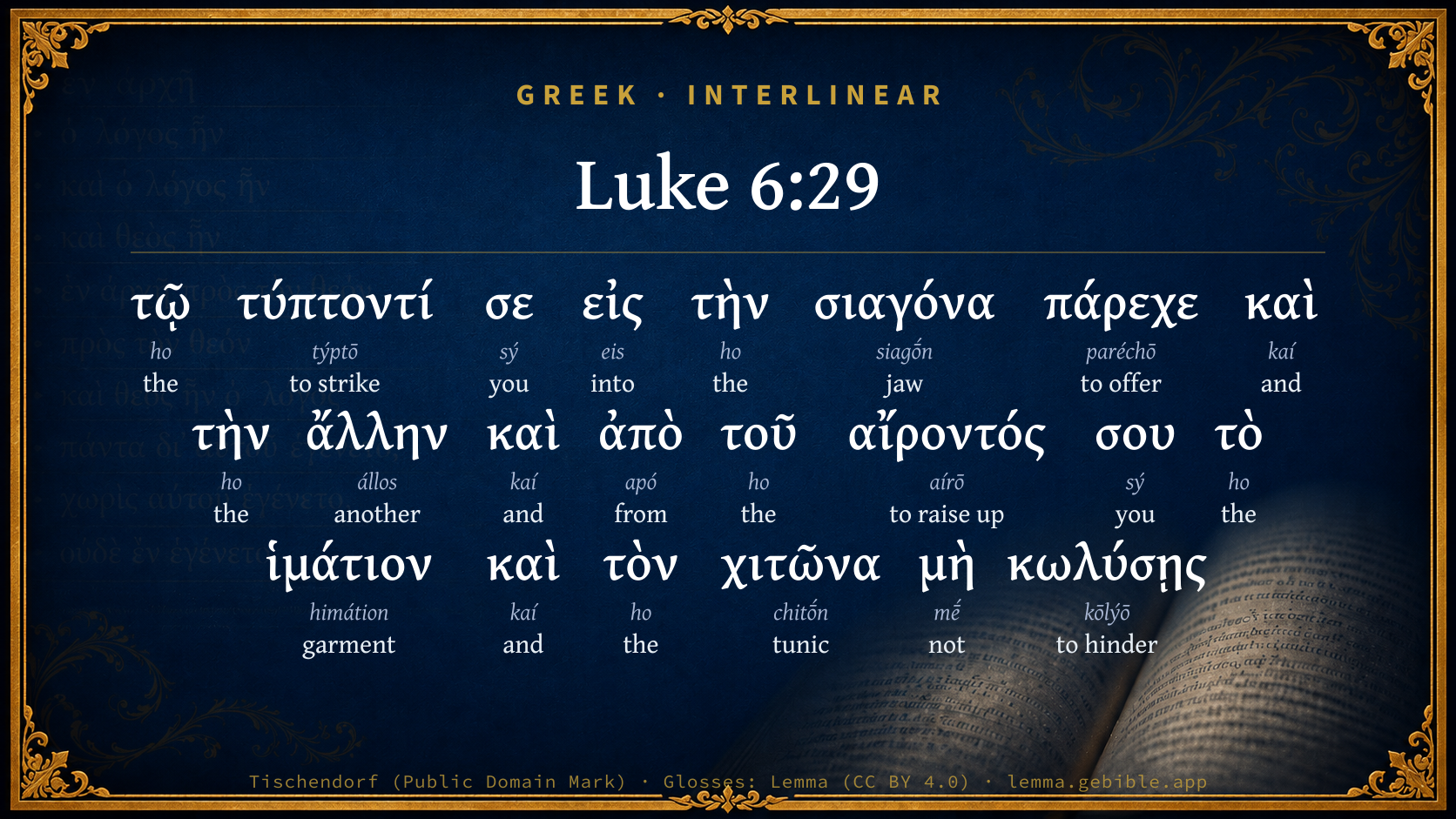
  1. τῷ ho G3588 “the” Article, Dative, Singular, Masculine
  2. τύπτοντί týptō G5180 “to strike” Verb, Present, Active, Participle, Dative, Singular, Masculine
  3. σε sý G4771 “you” Personal pronoun, 2nd person, Accusative, Singular
  4. εἰς eis G1519 “into” Preposition
  5. τὴν ho G3588 “the” Article, Accusative, Singular, Feminine
  6. πάρεχε paréchō G3930 “to offer” Verb, Present, Active, Imperative, 2nd person, Singular
  7. καὶ kaí G2532 “and” Conjunction
  8. τὴν ho G3588 “the” Article, Accusative, Singular, Feminine
  9. ἄλλην állos G243 “another” Adjective, Accusative, Singular, Feminine
  10. καὶ kaí G2532 “and” Conjunction
  11. ἀπὸ apó G575 “from” Preposition
  12. τοῦ ho G3588 “the” Article, Genitive, Singular, Masculine
  13. αἴροντός aírō G142 “to raise up” Verb, Present, Active, Participle, Genitive, Singular, Masculine
  14. σου sý G4771 “you” Personal pronoun, 2nd person, Genitive, Singular
  15. τὸ ho G3588 “the” Article, Accusative, Singular, Neuter
  16. ἱμάτιον himátion G2440 “garment” Noun, Accusative, Singular, Neuter
  17. καὶ kaí G2532 “and” Conjunction
  18. τὸν ho G3588 “the” Article, Accusative, Singular, Masculine
  19. χιτῶνα chitṓn G5509 “tunic” Noun, Accusative, Singular, Masculine
  20. μὴ mḗ G3361 “not” Particle, Negative
  21. κωλύσῃς kōlýō G2967 “to hinder” Verb, Aorist, Active, Subjunctive, 2nd person, Singular

About this verse

These counts appear in no published source. They are computed here, from the morphology-tagged text and Lemma’s own curated glosses. What Lemma adds →

22
words
14
distinct lemmas
Gospels
section

Notable vocabulary

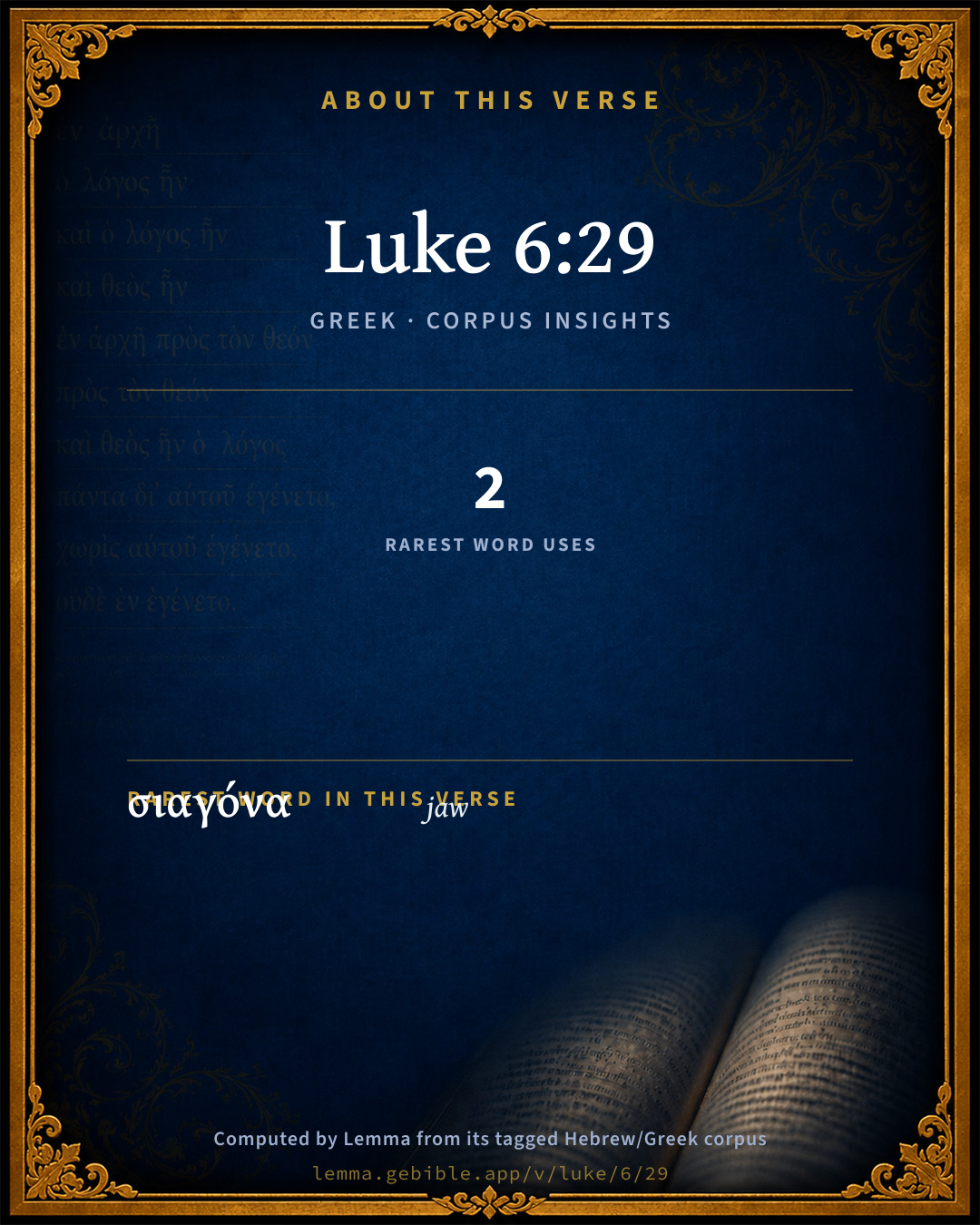
The rarest word here is σιαγόνα jaw G4600 — appearing just 2 times in the whole Greek New Testament.

Shared distinctive vocabulary

σιαγόνα jaw G4600 occurs in 2 verses of the Greek New Testament. Also found in:

Repetition

Words recur within this verse:

Cross-references

14

Topical passages linked to Luke 6:29 in the Treasury of Scripture Knowledge — connected by theme and wording, ordered by reader-vote popularity; previews shown in the World English Bible.

  • Matthew 5:39–42 But I tell you, don't resist him who is evil; but whoever strikes you on your right cheek, turn to him the other also.
  • Hebrews 10:34 For you both had compassion on me in my chains, and joyfully accepted the plundering of your possessions, knowing that you have for yourselves a better possession and an enduring one in the heavens.
  • 2 Corinthians 11:20 For you bear with a man, if he brings you into bondage, if he devours you, if he takes you captive, if he exalts himself, if he strikes you on the face.
  • 1 Corinthians 6:7 Therefore it is already altogether a defect in you, that you have lawsuits one with another. Why not rather be wronged? Why not rather be defrauded?
  • Isaiah 50:6 I gave my back to the strikers, and my cheeks to those who plucked off the hair; I didn't hide my face from shame and spitting.
  • Lamentations 3:30 Let him give his cheek to him who strikes him; let him be filled full with reproach.
  • Matthew 26:67 Then they spit in his face and beat him with their fists, and some slapped him,
  • John 18:22 When he had said this, one of the officers standing by slapped Jesus with his hand, saying, "Do you answer the high priest like that?"
  • Luke 22:64 Having blindfolded him, they struck him on the face and asked him, "Prophesy! Who is the one who struck you?"
  • 1 Corinthians 4:11 Even to this present hour we hunger, thirst, are naked, are beaten, and have no certain dwelling place.
  • 2 Samuel 19:30 Mephibosheth said to the king, yes, let him take all, because my lord the king is come in peace to his own house.
  • 2 Chronicles 18:23 Then Zedekiah the son of Chenaanah came near, and struck Micaiah on the cheek, and said, Which way went the Spirit of Yahweh from me to speak to you?
  • Micah 5:1 Now you shall gather yourself in troops, Daughter of troops. He has laid siege against us; They will strike the judge of Israel with a rod on the cheek.
  • Acts 23:2 The high priest, Ananias, commanded those who stood by him to strike him on the mouth.

Cross-references courtesy of OpenBible.info (CC BY 4.0).

Commentary

Notes on Luke 6:29 from classic Christian and Jewish commentators (each source and its license shown beneath its notes). The classic Christian expositions comment on the surrounding passage and are grouped to its opening verse, so a note may address several verses; the Jewish commentaries on the Tanakh (Rashi and others) are per-verse, so they appear only where the commentator wrote on this verse.

Lemma curates 59 commentaries, every one of them public domain or Creative Commons licensed, each selected and text-cleaned for this edition rather than reprinted as found. About our sources →

Joseph Benson's Commentary

Luk 6:29; Luk 6:31. To him, &c. — You who hear my gospel ought to be patient under injuries, as well as benevolent toward the unthankful. To him that smiteth thee on thy cheek — that taketh away thy cloak — These seem to be proverbial expressions, to signify an invasion of the tenderest points of honour and property. Offer the other, &c. Forbid not thy coat — That is, rather yield to his repeating the affront, or injury, than gratify resentment in righting yourself, in any method not becoming Christian love. Give to every man — Friend or enemy, what thou canst spare, and he really wants; and of him that taketh away thy goods — By borrowing; ask them not again — If he be insolvent: or, do not exact them if it will distress the person concerned to repay thee: rather lose them, if consistent with other duties, than demand them by a legal process. Dr. Doddridge translates and paraphrases the clause thus: “From him that taketh away thy possessions, in an injurious manner, do not immediately demand them back in the forms of law, but rather endeavour, by gentle methods, to reduce the offender to reason.” The Greek expression, του αιροντος τα σα, here rendered, taketh away thy goods, properly signifies, taketh them away violently, or by fraud. But, as Dr. Macknight observes, “Whatever sense we put on our Lord’s precept, it must be understood with the limitations which common sense directs us to make; namely, that we give and lend freely to all who ask, or permit them to retain what they have unjustly taken, provided only that it be a thing of small account, which we can easily spare, and the persons who ask or take such things be in real necessity.” And as ye would that men should do unto you, &c. — See note on Mat 7:12.

Joseph Benson's Commentary on the Old and New Testaments (1811–1818) — public domain. Text from a community e-Sword module.

Meyer's Critical & Exegetical Commentary

Heinrich August Wilhelm Meyer

Luk_6:29. See on Mat_5:39 f.

ἀπὸ τοῦ κ.τ.λ.] κωλύειν ἀπό τινος, to keep back from any one; Xen. Cyrop. i. 3. 11 : ἀπὸ σοῦ κωλύων; iii. 3. 51: ἀπὸ τῶν αἰσχρῶν κωλῦσαι; Gen_23:6. Erasmus says aptly: Subito mutatus numerus facit ad inculcandum praeceptum, quod unusquisque sic audire debeat quasi sibi uni dicatur.

Meyer — Critical and Exegetical Commentary on the New Testament — English translation by Peter Christie, edited by Frederick Crombie (T&T Clark, 1880) — public domain. Text from a community e-Sword module.

Expositor's Greek Testament

ed. W. Robertson Nicoll

Luk 6:29 = Mat 5:39-40 with some changes: τύπτειν for ῥαπίζειν , παρέχειν for στρέφειν ; αἴροντος suggests the idea of robbery instead of legal proceedings pointed at by Mt.’s κριθῆναι ; ἱμάτιον and χιτῶνα change places, naturally, as the robber takes first the upper garment; for Mt.’s ἄφες Lk. puts μὴ κωλύσῃς = withhold not (for the construction τινὰ ἀπό τινος κωλύειν , which Bornemann thought unexampled, vide Gen 23:6 , Sept [66] ).

[66] Septuagint.

The Expositor's Greek Testament, edited by W. Robertson Nicoll (1897–1910) — public domain. Text from a community e-Sword module.

Adam Clarke's Commentary

Verse 29. Thy cloak - thy coat] In Mt 5:40, I have said that COAT, χιτωνα, signifies under garment, or strait coat; and CLOAK, ιματιον, means upper garment, or great coat. This interpretation is confirmed by the following observations of Bishop Pearce. The χιτων was a tunica, or vestcoat, over which the Jews and other nations threw an outer coat, or gown, called a cloak, Mt 5:40, (which is meant by ιματιον,) when they went abroad, or were not at work. Hence the common people at Rome, who did not usually wear, or had no right to wear, the toga, are called by Horace tunicatus popellus, Epist. i. 7, 65. This account of the difference between the χιτων and the ιματιον appears plainly from what Maximus Tyrius says, The inner garment which is over the body they call χιτωνισκον, and the outer one the ιματιον. And so Plutarch, (in NUPT. p. 139, ed. Fran. 1620,) speaking of a man who felt the heat of the sun too much for him, says that he put off, τον χιτωνα, τῳ ἰματιῳ, his vestcoat also with his cloak.

Adam Clarke's Commentary on the Bible (1810–1826) — public domain. Text from a community e-Sword/MySword module.

Ellicott's Commentary for English Readers

(29) And unto him that smiteth thee . . .—See Notes on Mat_5:39-40.

And him that taketh away thy cloke.—St. Luke’s report of the maxim points to direct violence, St. Matthew’s to legal process. It is noticeable also that St. Luke inverts the order of the “cloke” and the “coat.” “If he takes the upper garment, give him the under one also.”

A Bible Commentary for English Readers, edited by Charles John Ellicott (1878–1897) — public domain. Text from a community e-Sword module.

The Cambridge Bible for Schools and Colleges

gen. ed. J. J. S. Perowne

29. offer also the other] The general principle “resist not evil” (Mat_5:39; 1Co_6:7; 1Pe_2:19-23) impressed for ever on the memory and conscience of mankind by a striking paradox. That it is only meant as a paradox in its literal sense is shewn by the fact that our Lord Himself, while most divinely true to its spirit, did not act on the letter of it (Joh_18:22-23). The remark of a good man on reading the Sermon on the Mount, “either this is not true, or we are no Christians,” need not be correct of any of us. The precepts are meant,

St Augustine said, more “ad praeparationem cordis quae intus est” than

“ad opus quod in aperto fit;” but still, the fewer exceptions we make the better, and the more absolutely we apply the spirit of the rules, the fewer difficulties shall we find about the letter.

thy cloke...thy coat] The himation was the upper garment, the shawl-like abba; the chiton was the tunic. See on Luk_3:11.

The Cambridge Bible for Schools and Colleges (gen. ed. J. J. S. Perowne; Cambridge University Press, 1878–1918) — public domain. Text from a community e-Sword module.

John Gill's Exposition

And give to every man that asketh,.... See Gill on Mat 5:42.

And of him that taketh away thy goods; not by force, but by consent, having either lent them, or sold them to him: for if they were taken away by force, the person so taking them was to be deemed a thief and a robber, and to be treated as such; but one that takes them by agreement, and is not able to make a return of them, or to give a valuable consideration for them, of such an one ask them not again: do not exact or demand them, but give him a release, as the law requires, in Deu 15:2 which seems to be respected here; and where the same word is used by the Septuagint, as here.

John Gill's Exposition of the Whole Bible (1746–1763) — public domain (CC PDM 1.0). Text via the HelloAO Bible API.

Trapp's Complete Commentary

John Trapp

29 And unto him that smiteth thee on the one cheek offer also the other; and him that taketh away thy cloke forbid not to take thy coat also.

Ver. 29. That smiteth thee on the one cheek] Socrates, when one gave him a box on the ear in the market place, said, Quam molestum est nescire homines quando prodire debeant cam galea? What an odd thing it is to go abroad without a helmut.

John Trapp, A Commentary or Exposition upon All the Books of the Old and New Testament (1647–1656) — public domain. Text from a community e-Sword module.

The Pulpit Commentary

And unto him that smiteth thee on the one cheek offer also the other. This and the following direction is clothed in language of Eastern. picturesqueness, to drive home to the listening crowds the great and novel truths he was urging upon them. No reasonable, thoughtful man would feel himself bound to the letter of these commandments. Our Lord, for instance, himself did not offer himself to be stricken again, (Joh_18:22, Joh_18:23) but firmly, though with exquisite courtesy, rebuked the one who struck him. St. Paul, too, (Act_23:3) never dreamed of obeying the letter of this charge. It is but an assertion of a great principle, and so, with the exception of a very few mistaken fanatics, all the great teachers of Christianity have understood it.

The Pulpit Commentary (1880–1919), ed. H.D.M. Spence-Jones & Joseph S. Exell — public domain. Text from a community e-Sword module.

John Wesley's Explanatory Notes

To him that smiteth thee on the cheek - Taketh away thy cloak - These seem to be proverbial expressions, to signify an invasion of the tenderest points of honour and property. Offer the other - Forbid not thy coat - That is, rather yield to his repeating the affront or injury, than gratify resentment in righting your self; in any method not becoming Christian love. Matt. v, 39.

John Wesley, Explanatory Notes Upon the Whole Bible (1754–1765) — public domain. Text via the GEBible commentary corpus.

unfoldingWord translationNotes

Door43 World Missions Community

To him who strikes you

"If anyone hits you"

on the one cheek

"on one side of your face"

offer him also the other

It may be helpful to state what the attacker will do to the person. AT: "turn your face so that he can strike the other cheek also" (See: Ellipsis)

do not withhold

"do not prevent him from taking"

Give to everyone who asks you

"If anyone asks you for something, give it to him"

do not ask him to give

"do not require him to give" or "do not demand that he give"

translationWords

tunic

unfoldingWord translationNotes — © Distant Shores Media and the Door43 World Missions Community, licensed CC BY-SA 4.0. Source: git.door43.org/Door43/en_tn.

Cambridge Greek Testament for Schools and Colleges

29. ἐπὶ τὴν σιαγόνα. Literally, on the jaw—perhaps to imply coarse and brutal violence.

πάρεχε καὶ τὴν ἄλλην. The general principle “resist not evil” (Mat 5:39; 1Co 6:7; 1Pe 2:19-23) impressed for ever on the memory and conscience of mankind by a striking paradox. That it is only meant as a paradox in its literal sense is shewn by the fact that our Lord Himself, while most divinely true to its spirit, did not act on the letter of it (Joh 18:22-23). The remark of a good man on reading the Sermon on the Mount, “either this is not true, or we are no Christians,” need not be correct of any of us. The precepts are meant, St Augustine said, more “ad praeparationem cordis quae intus est” than “ad opus quod in aperto fit;” but still, the fewer exceptions we make the better, and the more absolutely we apply the spirit of the rules, the fewer difficulties shall we find about the letter. Erasmus remarks that the sudden change of number from the plural to the singular makes the command more emphatically individual. Our Lord enunciates the principle and abstains from laying down the limitation which His hearers in all ages are eager to make.

τὸ ἱμάτιον … τὸν χιτῶνα. The himation was the upper garment, the shawl-like abba; the chitôn was the tunic. See on Luk 3:11.

Cambridge Greek Testament for Schools and Colleges (Cambridge University Press, 1896; 21 vols, various authors incl. Carr, Maclear, Plummer, Farrar, Lumby, Moule, M. R. James, Simcox) — public domain. Text from a community e-Sword module.

Alford’s Greek Testament

Henry Alford

29.] See Mat 5:39 ff.

Henry Alford, The Greek Testament (1849–1861) — public domain. Text from a community e-Sword module.

International Critical Commentary

29, 30. Whereas vv. 27, 28 refer to the active ἀγάπη which returns good for evil, these refer rather to the passive μακποθυμία, which never retaliates. The four precepts here given are startling. It is impossible for either governments or individuals to keep them. A State which endeavoured to shape its policy in exact accordance with them would soon cease to exist; and if individuals acted in strict obedience to them society would be reduced to anarchy. Violence, robbery, and shameless exaction would be supreme. The inference is that they are not precepts, but illustrations of principles. They are in the form of rules; but as they cannot be kept as rules, we are compelled to 1ook beyond the letter to the spirit which they embody. If Christ had given precepts which could be kept literally, we might easily have rested content with observing the letter, and have never penetrated to the spirit. What is the spirit? Among other things:—that resistance of evil and refusal to part with our property must never tae a personal matter: so far as we are concerned we must be willing to suffer still more and to surrender still more. It is right to withstand and even to punish those who injure us: but in order to correct them and protect society; not because of any personal animus. It is right also to withold our possessions from those who without good reason ask for them; but in order to check idleness and effrontery; not because we are too fond of our posessions to part with them. So far as our personal feeling goes, we ought to ready to offer the other cheek, and to give, without desire of recovery, whatever is demanded or taken from us. Love knows no limits but those which love itself imposes. When love resists or refuses, it is because compliance would be a violation of love, not because it would involve loss or suffering.

29. τῷ πύπτοντί σε ἐπὶ τὴν σιαγόνα. A violent blow with the fist seems to be meant rather than a contemptuous slap, for נשׁוגאסִ means “jaw-bone” (Jdg 15:15, Jdg 15:16; Eze 29:4; Mic 5:1; Hos 11:4). In what follows also it is an act of violence that is meant; for in that case the upper and more valuable garment (ἱμάτιον) would be taken first. In Mat 5:40 the spoiler adopts a legal method of spoliation (κριθῆναι), and takes the under and less indispensable garment (χιτῶνα) first. See on 3:2 and comp. Joh 19:23.

Here only do we find τύτειν ἐπί c. acc. In clam Grk. c. gen., e g. ἐπὶ κόρρης τύπτειν or πατάσσειν (Plato, Gorg. 486 C, 508 D, 527 A). Some times we have εἰς (Mat 27:30), which some MSS. read here and 18:13. Comp. Xen. Cyr. v. 4, 5. So also κωλύειν ἀπό is not common. Comp. οὐ μὴ κωλύσει τὸ μνημεῖον αὐτοῦἀπὸ σοῦ (Gen 13:6) and ἀπὸ σοῦ κωλύων (Xen. Cyr. i. 3, 11, iii. 3. 51). The more usual constr. both in N.T. and class. Grk. is either acc. and inf. (23:2; Act 16:6, Act 24:23) Or acc. of pers. and gen. of thing (Act 27:43). Note that αἴρειν, does not mean simply “take,” which is λαμβάνειν, but either “take up” (5:24, 9:23) “take away” (19:24, 23:18).

International Critical Commentary — older volumes (1896–1929), various authors — public domain. Text from a community e-Sword module.

Vincent's Word Studies in the New Testament

Marvin R. Vincent

Cheek [σιαγονα] . Lit., the jaw. The cheek is pareia. The blow intended is not, therefore, a mere slap, but a heavy blow; an act of violence rather than of contempt.

Taketh away [αιροντος] . Lit., taketh up, lifteth.

Cloke - coat. See on Mt 5:40.

Marvin R. Vincent, Word Studies in the New Testament (1887–1900) — public domain. Text from a community e-Sword/MySword module.

Godet's Commentaries

Frédéric Louis Godet

Vers. 29 and 30. Patient Charity.—“And unto him that smiteth thee on the one cheek, offer also the other; and him that taketh away thy cloak, forbid not to take thy coat also. 30. Give to every man that asketh of thee; and of him that taketh away thy goods ask them not again.”

Paul also regards μακροθυμεῖν, to be long-suffering, as on a par with χρηστεύεσθαι, to do good (Charity suffereth long, and is kind, 1Co 13:4). The natural heart thinks it does a great deal when it respects a neighbour’s rights; it does not rise to the higher idea of sacrificing its own. Jesus here describes a charity which seems to ignore its own rights, and knows no bounds to its self-sacrifice. He exhibits this sublime ideal in actual instances (lit. in the most concrete traits) and under the most paradoxical forms. In order to explain these difficult words, Olshausen maintained that they only applied to the members of the kingdom of God among themselves, and not to the relations of Christians with the world. But would Jesus have entertained the supposition of strikers and thieves among His own people? Again, it has been said that these precepts expressed nothing more than an emphatic condemnation of revenge (Calvin), that they were hyperboles (Zwingle), a portrayal of the general disposition which the Christian is to exemplify in each individual case, according as regard for God’s glory and his neighbour’s salvation may permit (Tholuck); which comes to St. Augustine’s idea, that these precepts concern the praeparatio cordis rather than the opus quod in aperto fit. Without denying that there is some truth in all these explanations, we think that they do not altogether grasp the idea. Jesus means that, as far as itself is concerned, charity know no limits to its self-denial. If, therefore, it ever puts a stop to its concessions, it is in no way because it feels its patience exhausted; true charity is infinite as God Himself, whose essence it is. Its limit, if it has any, is not that which its rights draw around it; it is a limit like that which the beautiful defines for itself, proceeding from within. It is in charity that the disciple of Jesus yields, when he yields; it is in charity also that he resists, when he resists. CHARITY HAS NO OTHER LIMIT THAN CHARITY ITSELF, that is to say, it is boundless.—Σιαγών does not-properly mean, as it is ordinarily translated, the cheek (παρειά), but the jaw; the blow given, therefore, is not a slap, but a heavy blow. Consequently it is an act of violence, rather than of contempt, that is meant.

The disciple who has completely sacrificed his person, naturally will not refuse his clothes. As ἱμάτιον denotes the upper garment, and χιτῶν the under garment or tunic which is worn next the skin, it would seem that here also it is an act of violence that is meant, a theft perpetrated by main force; the thief first snatches away the upper garment. Matthew presents the reverse order: “He who would take away thy coat, let him have thy cloak also.” This is because with him it is an affair of legal process (if any man will sue thee at the law). The creditor begins by possessing himself of the coat, which is less valuable; then, if he is not sufficiently compensated, he claims the under garment. This juridical form stands connected in Matthew with the article of the Mosaic code which Jesus has just cited: an eye for an eye, a tooth for a tooth. Matthew, therefore, appears to have preserved the original words of this passage. But is it possible to conceive, that if Luke had had Matthew’s writing before him, or the document made use of by the author of this Gospel, he would have substituted, on his own authority, a totally different thought from that of his predecessor?

Ver. 30. Another form of the same thought. A Christian, so far as he is concerned, would neither refuse anything nor claim anything back. If, therefore, he does either one or the other, it is always out of charity. This sentiment regulates his refusals as well as his gifts, the maintenance as well as the sacrifice of his rights.

Frédéric Louis Godet — Commentaries on Luke, John, Romans, and 1 Corinthians — English translation (T&T Clark, Edinburgh, 1870s–1890s) — public domain. Text from a community e-Sword module.

Lesson kit

Teaching starters — assembled from the data on this page, not authored interpretation. Every prompt links to the verse data it draws on. Edit before teaching.

Luke, in the Gospels, opens this verse with 22 words (14 distinct Greek lemmas). Its most distinctive word is siagṓn (“jaw”). A historical commentator’s framing appears above. Read the whole chapter for the surrounding context.

Discussion questions

  1. How does “jaw” (siagṓn) shape what this verse is saying?
  2. Matthew 5:39 shares the word «jaw» with this verse. How do the two illuminate each other?
  3. “the” occurs 6× in this one verse. What is the effect of the repetition?
  4. These translations render this verse differently; the difference is in the English rendering, not the original. What questions does that raise?
  5. Reading how Joseph Benson's Commentary and Meyer's Critical & Exegetical Commentary read this verse, where do the two commentators agree and where do they part?

Things to notice

Reading settings

Reading text

Shown beneath each verse's original-language words.

Old Testament
Old Testament edition

Read the OT as the Masoretic Hebrew (MT) or the Greek Septuagint (LXX).

English shown for the Greek Septuagint (in the Hebrew ↔ Greek comparison).

Comparing translations? Open the Compare panel on any verse page to stack up to four side by side.