

Luke 11:24
Greek (Tischendorf 8th ed.) Luke 11:24 appears in the Greek New Testament. The text above is from the Tischendorf 8th edition. Each word links to its Strong’s number and a concise gloss. Click any word for its full Thayer’s Greek Lexicon entry.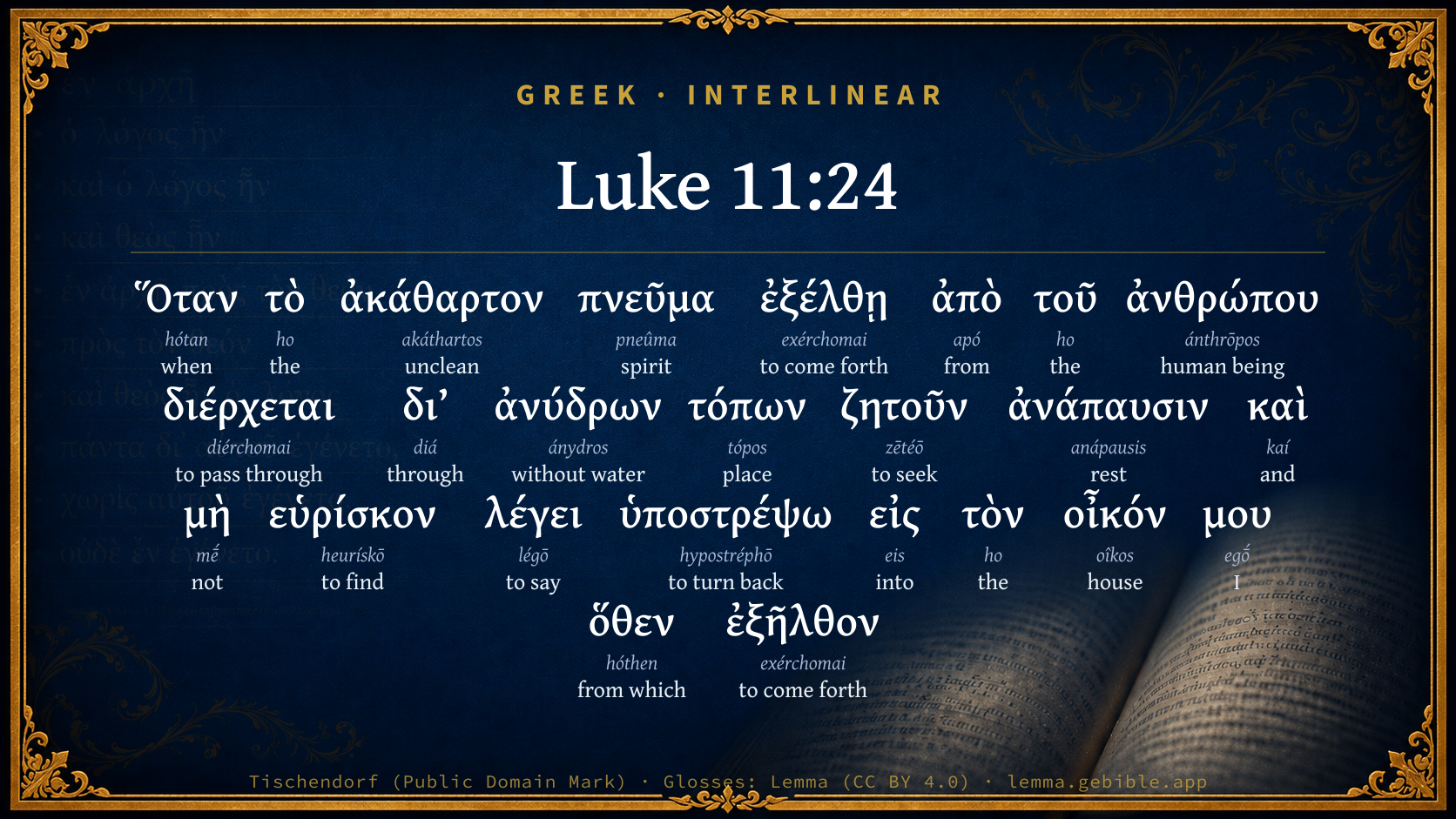
The unclean spirit, when he has gone out of the man, passes through dry places, seeking rest, and finding none, he says, 'I will turn back to my house from which I came out.'
Download a study sheet
One document with this verse’s original text, its word-by-word gloss line, the meaning frame, cross-references with their text, attributed commentary, and full source and license credits — printable, and it pastes into notes with its structure intact.
This verse Autodidact and up
A passage Seminary Student
Up to 50 verses in one chapter. A passage sheet keeps up to 6 commentary sources and 12 cross-references per verse, in the order this page ranks them, and says so on the sheet whenever that leaves anything out. Ask for a single verse and you get the Autodidact verse sheet above.
Everything on this page stays free to read, with no account — the sheet is a download of what is already on screen, not access to it.
Compare translations 3
The same verse in 3 English versions, stacked beneath the original-language interlinear above. Click any original word for its lexicon entry.
Each is an independent rendering of the whole verse — the interlinear is not word-aligned to these translations.
Highlighted words mark where these versions differ — a whole-verse word diff, not a word-by-word alignment.
-
World English Bible Public Domain
The unclean spirit, when he has gone out of the man, passes through dry places, seeking rest, and finding none, he says, 'I will turn back to my house from which I came out.'
-
King James Version Public Domain
When the unclean spirit is gone out of a man, he walketh through dry places, seeking rest; and finding none, he saith, I will return unto my house whence I came out.
-
unfoldingWord Literal Text CC BY-SA 4.0
When the unclean spirit has gone out from the man, it passes through waterless places seeking rest, and not finding any, it says, ‘I will return to my house from which I came out.’
unfoldingWord Literal Text — © unfoldingWord, licensed CC BY-SA 4.0. Word-aligned USFM3 via Door43 (git.door43.org/unfoldingWord/en_ult).
Show all 19 translations
Every available English version of this verse, each an independent rendering of the whole verse.
-
World English Bible Public Domain
The unclean spirit, when he has gone out of the man, passes through dry places, seeking rest, and finding none, he says, 'I will turn back to my house from which I came out.'
-
Berean Standard Bible Public Domain
When an unclean spirit comes out of a man, it passes through arid places seeking rest and does not find it. Then it says, ‘I will return to the house I left.’
-
Majority Standard Bible Public Domain
When an unclean spirit comes out of a man, it passes through arid places seeking rest and does not find it. Then it says, ‘I will return to the house I left.’
-
King James Version Public Domain
When the unclean spirit is gone out of a man, he walketh through dry places, seeking rest; and finding none, he saith, I will return unto my house whence I came out.
-
American Standard Version (1901) Public Domain
The unclean spirit when he is gone out of the man, passeth through waterless places, seeking rest, and finding none, he saith, I will turn back unto my house whence I came out.
-
Revised Version (1885) Public Domain
The unclean spirit when he is gone out of the man, passeth through waterless places, seeking rest; and finding none, he saith, I will turn back unto my house whence I came out.
-
Geneva Bible (1599) Public Domain
When the vncleane spirite is gone out of a man, he walketh through drie places, seeking rest: and when he findeth none he saieth, I wil returne vnto mine house whence I came out.
-
Douay-Rheims (1899) Public Domain
When the unclean spirit is gone out of a man, he walketh through places without water, seeking rest; and not finding, he saith: I will return into my house whence I came out.
-
Young's Literal Translation Public Domain
`When the unclean spirit may go forth from the man it walketh through waterless places seeking rest, and not finding, it saith, I will turn back to my house whence I came forth;
-
Literal Standard Version CC BY-SA 4.0
When the unclean spirit may go forth from the man, it walks through waterless places seeking rest, and not finding, it says, I will return to my house from where I came forth;
-
Unlocked Literal Bible CC BY-SA 4.0
When an unclean spirit has gone away from a man, it passes through waterless places and looks for rest. Finding none, it says, 'I will return to my house from which I came.'
-
unfoldingWord Literal Text CC BY-SA 4.0
When the unclean spirit has gone out from the man, it passes through waterless places seeking rest, and not finding any, it says, ‘I will return to my house from which I came out.’
-
Darby Bible Public Domain
When the unclean spirit has gone out of the man, he goes through dry places seeking rest; and not finding [any] he says, I will return to my house whence I came out.
-
World Messianic Bible Public Domain
The unclean spirit, when he has gone out of the man, passes through dry places, seeking rest; and finding none, he says, ‘I will turn back to my house from which I came out.’
-
Webster's Bible Public Domain
When the unclean spirit is gone out of a man, he walketh through dry places, seeking rest: and finding none, he saith, I will return to my house whence I came out.
-
Free Bible Version CC BY-SA 4.0
When an evil spirit leaves someone, it goes through the desert looking for a place to stay. When it doesn't find anywhere, it says, ‘I'll return to the house I left.’
-
Bible in Basic English Public Domain
The unclean spirit, when he has gone out of a man, goes through dry places, looking for rest; and when he does not get it, he says, I will go back to my house from which I came.
-
Text-Critical English NT CC BY 4.0
“When an unclean spirit has gone out of a person, it goes through waterless places seeking rest. But when it does not find any, it says, ‘I will return to the house I left.’
-
Tyndale New Testament (1534) Public Domain
When the vnclene sprete is gone out of a man he walketh through waterlesse places sekinge reest. And when he fyndeth none he sayeth: I will returne agayne vnto my housse whence I came out.
Literal Standard Version (2020), Covenant Press — licensed CC BY-SA 4.0. Text via the HelloAO Bible API (eBible.org). Unlocked Literal Bible (unfoldingWord) — licensed CC BY-SA 4.0. Text via the HelloAO Bible API (eBible.org). unfoldingWord Literal Text — © unfoldingWord, licensed CC BY-SA 4.0. Word-aligned USFM3 via Door43 (git.door43.org/unfoldingWord/en_ult). Free Bible Version, Dr. Jonathan Gallagher — licensed CC BY-SA 4.0. Text via the HelloAO Bible API (eBible.org).
Word by word
More ways to search: Search by grammar → Find every occurrence → Compare this word →
Practice this passage: Drill this verse → Learn its vocabulary →
- Appears 4× in the Greek New Testament
- First appears at Matthew 12:43
- Part of Speech
- Adjective
- Case
- Genitive
- Number
- Plural
- Gender
- Masculine
Full Thayer's Definition
- Ὅταν hótan G3752 “when” Conjunction
- τὸ ho G3588 “the” Article, Nominative, Singular, Neuter
- ἀκάθαρτον akáthartos G169 “unclean” Adjective, Nominative, Singular, Neuter
- πνεῦμα pneûma G4151 “spirit” Noun, Nominative, Singular, Neuter
- ἐξέλθῃ exérchomai G1831 “to come forth” Verb, Aorist, Active, Subjunctive, 3rd person, Singular
- ἀπὸ apó G575 “from” Preposition
- τοῦ ho G3588 “the” Article, Genitive, Singular, Masculine
- ἀνθρώπου ánthrōpos G444 “human being” Noun, Genitive, Singular, Masculine
- διέρχεται diérchomai G1330 “to pass through” Verb, Present, Middle or Passive deponent, Indicative, 3rd person, Singular
- δι’ diá G1223 “through” Preposition
- ἀνύδρων ánydros G504 “without water” Adjective, Genitive, Plural, Masculine
- τόπων tópos G5117 “place” Noun, Genitive, Plural, Masculine
- ζητοῦν zētéō G2212 “to seek” Verb, Present, Active, Participle, Nominative, Singular, Neuter
- ἀνάπαυσιν anápausis G372 “rest” Noun, Accusative, Singular, Feminine
- καὶ kaí G2532 “and” Conjunction
- μὴ mḗ G3361 “not” Particle, Negative
- εὑρίσκον heurískō G2147 “to find” Verb, Present, Active, Participle, Nominative, Singular, Neuter
- λέγει légō G3004 “to say” Verb, Present, Active, Indicative, 3rd person, Singular
- ὑποστρέψω hypostréphō G5290 “to turn back” Verb, Future, Active, Indicative, 1st person, Singular
- εἰς eis G1519 “into” Preposition
- τὸν ho G3588 “the” Article, Accusative, Singular, Masculine
- οἶκόν oîkos G3624 “house” Noun, Accusative, Singular, Masculine
- μου egṓ G1473 “I” Personal pronoun, 1st person, Genitive, Singular
- ὅθεν hóthen G3606 “from which” Adverb
- ἐξῆλθον exérchomai G1831 “to come forth” Verb, Aorist, Active, Indicative, 1st person, Singular
About this verse
These counts appear in no published source. They are computed here, from the morphology-tagged text and Lemma’s own curated glosses. What Lemma adds →
- 25
- words
- 22
- distinct lemmas
- Gospels
- section
Cross-references
17Topical passages linked to Luke 11:24 in the Treasury of Scripture Knowledge — connected by theme and wording, ordered by reader-vote popularity; previews shown in the World English Bible.
- Matthew 12:43–45 But the unclean spirit, when he is gone out of the man, passes through waterless places, seeking rest, and doesn't find it.
- Job 2:2 Yahweh said to Satan, "Where have you come from?" Satan answered Yahweh, and said, "From going back and forth in the earth, and from walking up and down in it."
- 1 Peter 5:8 Be sober and self-controlled. Be watchful. Your adversary the devil, walks around like a roaring lion, seeking whom he may devour.
- Psalms 63:1 God, you are my God. I will earnestly seek you. My soul thirsts for you, My flesh longs for you, In a dry and weary land, where there is no water.
- Job 1:7 Yahweh said to Satan, "Where have you come from?" Then Satan answered Yahweh, and said, "From going back and forth in the earth, and from walking up and down in it."
- Mark 5:10 He begged him much that he would not send them away out of the country.
- Isaiah 44:3 For I will pour water on him who is thirsty, and streams on the dry ground; I will pour my Spirit on your seed, and my blessing on your offspring:
- Isaiah 57:20–21 But the wicked are like the troubled sea; for it can't rest, and its waters cast up mire and dirt.
- Ephesians 2:2 in which you once walked according to the course of this world, according to the prince of the powers of the air, the spirit who now works in the children of disobedience;
- Isaiah 48:22 There is no peace, says Yahweh, to the wicked.
- Mark 9:25 When Jesus saw that a multitude came running together, he rebuked the unclean spirit, saying to him, "You mute and deaf spirit, I command you, come out of him, and never enter him again!"
- Proverbs 4:16 For they don't sleep, unless they do evil. Their sleep is taken away, unless they make someone fall.
- Isaiah 35:1–2 The wilderness and the dry land shall be glad; and the desert shall rejoice, and blossom as the rose.
- Isaiah 35:7 The glowing sand shall become a pool, and the thirsty ground springs of water: in the habitation of jackals, where they lay, shall be grass with reeds and rushes.
- Isaiah 41:17–19 The poor and needy seek water, and there is none, and their tongue fails for thirst; I, Yahweh, will answer them, I, the God of Israel, will not forsake them.
- Judges 6:37–40 behold, I will put a fleece of wool on the threshing floor; if there be dew on the fleece only, and it be dry on all the ground, then shall I know that you will save Israel by my hand, as you have spoken.
- Ezekiel 47:8–11 Then said he to me, These waters issue forth toward the eastern region, and shall go down into the Arabah; and they shall go toward the sea; into the sea [shall the waters go] which were made to issue forth; and the waters shall be healed.
Cross-references courtesy of OpenBible.info (CC BY 4.0).
Where the printed editions differ
1 variantPlaces in this verse where the major printed Greek editions disagree on the wording in a way that affects the translation — a comparison of editions, not a manuscript-by-manuscript collation. The editions are the modern critical texts (Nestlé-Aland 28/27, SBL, Westcott-Hort, Tregelles, Tyndale House) and the traditional texts behind the KJV (the Textus Receptus and the Byzantine/Majority text). It is not a claim about which reading is original.
-
Extra text
τότε
“then”
In NA28NA27WH Not in TynSBLTregTRByzτότε (tote) 'then' is only in older manuscripts (NA28+NA27+WH)
Textual data: Translators Amalgamated Greek New Testament (STEPBible TAGNT) · CC BY 4.0.
Lesson kit
Teaching starters — assembled from the data on this page, not authored interpretation. Every prompt links to the verse data it draws on. Edit before teaching.
Luke, in the Gospels, opens this verse with 25 words (22 distinct Greek lemmas). Its most distinctive word is ánydros (“without water”). A historical commentator’s framing appears above. Read the whole chapter for the surrounding context.
Discussion questions
- What does “without water” (ánydros) contribute to the verse as a whole?
- How does Matthew 12:43, which shares the word «without water», read alongside this verse?
- What does the repetition of “to come forth” (2× in this one verse) do in this verse?
- These translations render this verse differently; the difference is in the English rendering, not the original. What questions does that raise?
- Compare how The Biblical Illustrator and Joseph Benson's Commentary read this verse. Where do they agree or differ?
Things to notice
- These translations choose different wording for 13 words in this verse.
- “to come forth” occurs 2× in this single verse.
- 22 distinct Greek lemmas span 25 words in this verse.
Commentary
Notes on Luke 11:24 from classic Christian and Jewish commentators (each source and its license shown beneath its notes). The classic Christian expositions comment on the surrounding passage and are grouped to its opening verse, so a note may address several verses; the Jewish commentaries on the Tanakh (Rashi and others) are per-verse, so they appear only where the commentator wrote on this verse.
Lemma curates 59 commentaries, every one of them public domain or Creative Commons licensed, each selected and text-cleaned for this edition rather than reprinted as found. About our sources →
The Biblical Illustrator
Joseph S. Exell
The Biblical Illustrator, edited by Joseph S. Exell (c. 1880s–1900s) — public domain. Text from a community e-Sword module.
Joseph Benson's Commentary
Joseph Benson's Commentary on the Old and New Testaments (1811–1818) — public domain. Text from a community e-Sword module.
Whedon's Commentary on the Bible
Daniel D. Whedon
Daniel D. Whedon (gen. ed.), Commentary on the Old and New Testaments (1874–1909) — public domain. Text from a community e-Sword module.
Meyer's Critical & Exegetical Commentary
Heinrich August Wilhelm Meyer
Meyer — Critical and Exegetical Commentary on the New Testament — English translation by Peter Christie, edited by Frederick Crombie (T&T Clark, 1880) — public domain. Text from a community e-Sword module.
Expositor's Greek Testament
ed. W. Robertson Nicoll
The Expositor's Greek Testament, edited by W. Robertson Nicoll (1897–1910) — public domain. Text from a community e-Sword module.
Geneva Bible (1599)
Geneva Bible translators
Geneva Bible (1599) marginal notes — public domain. Text via Bolls.life.
Adam Clarke's Commentary
Adam Clarke's Commentary on the Bible (1810–1826) — public domain. Text from a community e-Sword/MySword module.
Ellicott's Commentary for English Readers
A Bible Commentary for English Readers, edited by Charles John Ellicott (1878–1897) — public domain. Text from a community e-Sword module.
The Cambridge Bible for Schools and Colleges
gen. ed. J. J. S. Perowne
The Cambridge Bible for Schools and Colleges (gen. ed. J. J. S. Perowne; Cambridge University Press, 1878–1918) — public domain. Text from a community e-Sword module.
John Gill's Exposition
John Gill's Exposition of the Whole Bible (1746–1763) — public domain (CC PDM 1.0). Text via the HelloAO Bible API.
Trapp's Complete Commentary
John Trapp
John Trapp, A Commentary or Exposition upon All the Books of the Old and New Testament (1647–1656) — public domain. Text from a community e-Sword module.
Albert Barnes' Notes on the Bible
Albert Barnes' Notes on the Bible (1834–1885) — public domain. Text from a community e-Sword/MySword module.
Haydock's Catholic Bible Commentary
George Leo Haydock (1774–1849), Haydock's Catholic Family Bible and Commentary, 1859 edition — public domain. Excludes Psalms (Douay-Rheims chapter numbering differs from Protestant) and Deuterocanonical books (Catholic canon only).
Matthew Poole's English Annotations
Matthew Poole's English Annotations on the Holy Bible (1683–1685) — public domain. Text from a community e-Sword/MySword module.
The Pulpit Commentary
The Pulpit Commentary (1880–1919), ed. H.D.M. Spence-Jones & Joseph S. Exell — public domain. Text from a community e-Sword module.
Kretzmann's Popular Commentary
Paul E. Kretzmann
Paul E. Kretzmann, Popular Commentary of the Bible (1921–1924) — public domain. Text from a community e-Sword module.
McGarvey & Pendleton's Commentaries
J. W. McGarvey
J. W. McGarvey (with Philip Y. Pendleton), Commentaries on the New Testament (The Fourfold Gospel, 1914; Acts; and the epistles) — public domain. Text from a community e-Sword/MySword module.
unfoldingWord translationNotes
Door43 World Missions Community
unfoldingWord translationNotes — © Distant Shores Media and the Door43 World Missions Community, licensed CC BY-SA 4.0. Source: git.door43.org/Door43/en_tn.
Cambridge Greek Testament for Schools and Colleges
Cambridge Greek Testament for Schools and Colleges (Cambridge University Press, 1896; 21 vols, various authors incl. Carr, Maclear, Plummer, Farrar, Lumby, Moule, M. R. James, Simcox) — public domain. Text from a community e-Sword module.
Alford’s Greek Testament
Henry Alford
Henry Alford, The Greek Testament (1849–1861) — public domain. Text from a community e-Sword module.
International Critical Commentary
International Critical Commentary — older volumes (1896–1929), various authors — public domain. Text from a community e-Sword module.
Vincent's Word Studies in the New Testament
Marvin R. Vincent
Marvin R. Vincent, Word Studies in the New Testament (1887–1900) — public domain. Text from a community e-Sword/MySword module.