
Luke 6:13

Greek (Tischendorf 8th ed.) Luke 6:13 appears in the Greek New Testament. The text above is from the Tischendorf 8th edition. Each word links to its Strong’s number and a concise gloss. Click any word for its full Thayer’s Greek Lexicon entry.
Download image
Cite this verse

Luke 6:13 (World English Bible). Public Domain. Lemma interlinear Bible study tool, https://lemma.gebible.app/v/luke/6/13.

Show BibTeX & RIS
BibTeX
RIS
English Translation
When it was day, he called his disciples, and from them he chose twelve, whom he also named apostles:
World English Bible · Public Domain
Highlights
  • 1 first appearance in the Greek New Testament
Full analysis ↓
Download a study sheet

One document with this verse’s original text, its word-by-word gloss line, the meaning frame, cross-references with their text, attributed commentary, and full source and license credits — printable, and it pastes into notes with its structure intact.

This verse Autodidact and up

Study sheet (.html) Plain text (.txt)

A passage Seminary Student

Up to 50 verses in one chapter. A passage sheet keeps up to 6 commentary sources and 12 cross-references per verse, in the order this page ranks them, and says so on the sheet whenever that leaves anything out. Ask for a single verse and you get the Autodidact verse sheet above.

Everything on this page stays free to read, with no account — the sheet is a download of what is already on screen, not access to it.

Want to remove ads? Support Godless Engineer
Compare translations 3

The same verse in 3 English versions, stacked beneath the original-language interlinear above. Click any original word for its lexicon entry.

Each is an independent rendering of the whole verse — the interlinear is not word-aligned to these translations.

Highlighted words mark where these versions differ — a whole-verse word diff, not a word-by-word alignment.

  • World English Bible Public Domain
    When it was day, he called his disciples, and from them he chose twelve, whom he also named apostles:
  • King James Version Public Domain
    And when it was day, he called unto him his disciples: and of them he chose twelve, whom also he named apostles;
  • unfoldingWord Literal Text CC BY-SA 4.0
    And when day came, he called his disciples, and he chose 12 from them, whom he also named apostles:

unfoldingWord Literal Text — © unfoldingWord, licensed CC BY-SA 4.0. Word-aligned USFM3 via Door43 (git.door43.org/unfoldingWord/en_ult).

Versions to compare (up to 4)

3 of 4 selected

Show all 19 translations

Every available English version of this verse, each an independent rendering of the whole verse.

  • World English Bible Public Domain
    When it was day, he called his disciples, and from them he chose twelve, whom he also named apostles:
  • Berean Standard Bible Public Domain
    When daylight came, He called His disciples to Him and chose twelve of them, whom He also designated as apostles:
  • Majority Standard Bible Public Domain
    When daylight came, He called His disciples to Him and chose twelve of them, whom He also designated as apostles:
  • King James Version Public Domain
    And when it was day, he called unto him his disciples: and of them he chose twelve, whom also he named apostles;
  • American Standard Version (1901) Public Domain
    And when it was day, he called his disciples; and he chose from them twelve, whom also he named apostles:
  • Revised Version (1885) Public Domain
    And when it was day, he called his disciples: and he chose from them twelve, whom also he named apostles;
  • Geneva Bible (1599) Public Domain
    And when it was day, he called his disciples, and of them he chose twelue which also he called Apostles.
  • Douay-Rheims (1899) Public Domain
    And when day was come, he called unto him his disciples; and he chose twelve of them (whom also he named apostles):
  • Young's Literal Translation Public Domain
    and when it became day, he called near his disciples, and having chosen from them twelve, whom also he named apostles,
  • Literal Standard Version CC BY-SA 4.0
    and when it became day, He called near His disciples, also having chosen twelve from them, whom He also named apostles:
  • Unlocked Literal Bible CC BY-SA 4.0
    When it was day, he called his disciples to him, and he chose twelve of them, whom he also named apostles.
  • unfoldingWord Literal Text CC BY-SA 4.0
    And when day came, he called his disciples, and he chose 12 from them, whom he also named apostles:
  • Darby Bible Public Domain
    And when it was day he called his disciples, and having chosen out twelve from them, whom also he named apostles:
  • World Messianic Bible Public Domain
    When it was day, he called his disciples, and from them he chose twelve, whom he also named emissaries:
  • Webster's Bible Public Domain
    And when it was day, he called to him his disciples: and of them he chose twelve, whom also he named Apostles;
  • Free Bible Version CC BY-SA 4.0
    When morning came he called together his disciples, and chose twelve of them. These are the names of the apostles:
  • Bible in Basic English Public Domain
    And the day came and, turning to his disciples, he made a selection from among them of twelve, to whom he gave the name of Apostles;
  • Text-Critical English NT CC BY 4.0
    When daybreak came, he called his disciples and chose twelve from among them, whom he also named apostles:
  • Tyndale New Testament (1534) Public Domain
    And assone as it was daye he called his disciples and of the he chose twelve which also he called apostles.

Literal Standard Version (2020), Covenant Press — licensed CC BY-SA 4.0. Text via the HelloAO Bible API (eBible.org). Unlocked Literal Bible (unfoldingWord) — licensed CC BY-SA 4.0. Text via the HelloAO Bible API (eBible.org). unfoldingWord Literal Text — © unfoldingWord, licensed CC BY-SA 4.0. Word-aligned USFM3 via Door43 (git.door43.org/unfoldingWord/en_ult). Free Bible Version, Dr. Jonathan Gallagher — licensed CC BY-SA 4.0. Text via the HelloAO Bible API (eBible.org).

Word by word

More ways to search: Search by grammar → Find every occurrence → Compare this word →

Practice this passage: Drill this verse → Learn its vocabulary →

προσεφώνησεν
prosphōnéō
G4377
“to call to”
Verb, Aorist, Active, Indicative, 3rd person, Singular
Part of Speech
Verb
Tense
Aorist
Voice
Active
Mood
Indicative
Person
3rd person
Number
Singular
Full Thayer's Definition

Origin: from G4314 and G5455

TDNT: None

1. to call to, to address by calling 2. to call to one's self, summon
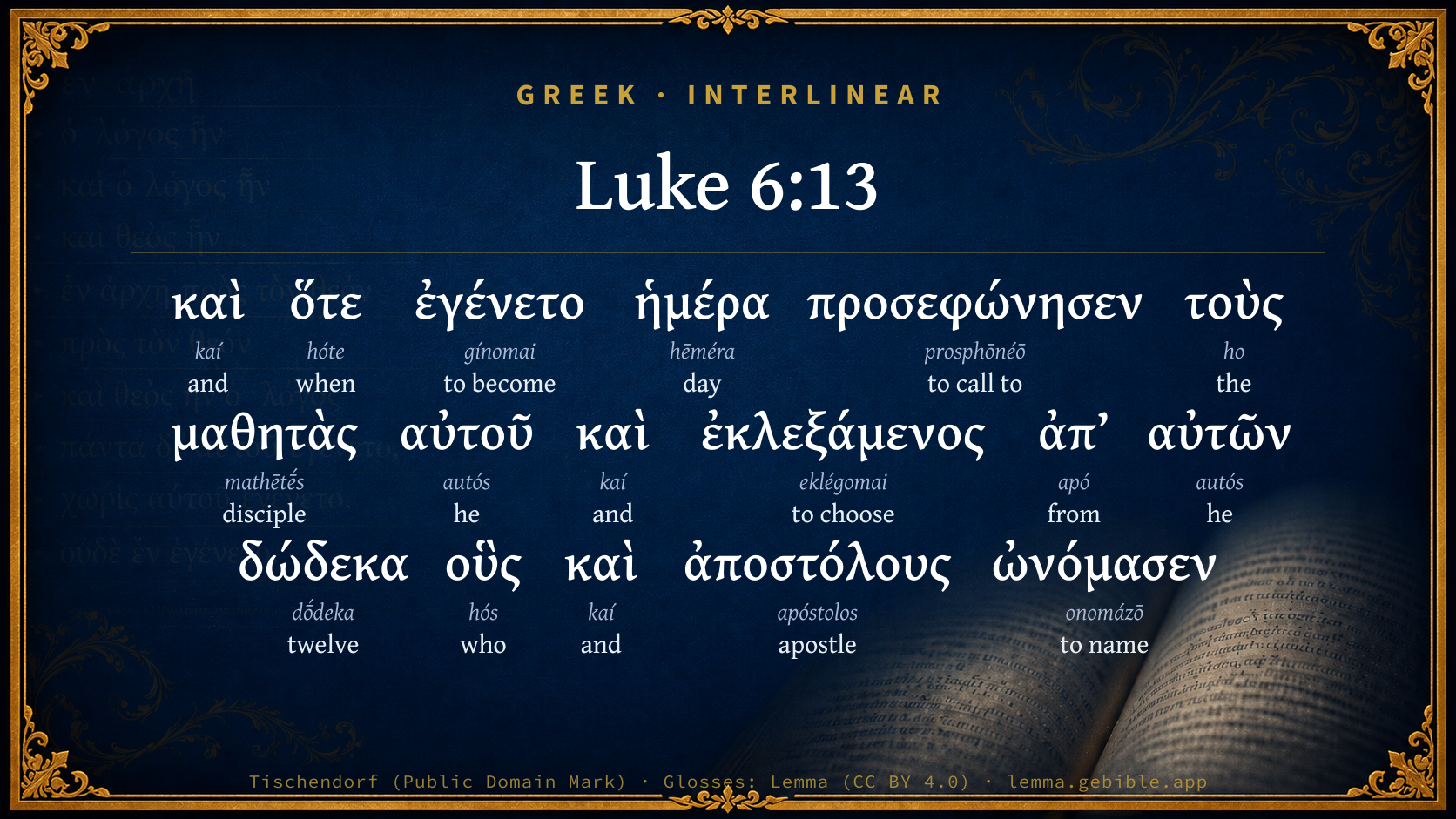
  1. καὶ kaí G2532 “and” Conjunction
  2. ὅτε hóte G3753 “when” Adverb
  3. ἐγένετο gínomai G1096 “to become” Verb, Aorist, Middle deponent, Indicative, 3rd person, Singular
  4. ἡμέρα hēméra G2250 “day” Noun, Nominative, Singular, Feminine
  5. τοὺς ho G3588 “the” Article, Accusative, Plural, Masculine
  6. μαθητὰς mathētḗs G3101 “disciple” Noun, Accusative, Plural, Masculine
  7. αὐτοῦ autós G846 “he” Personal pronoun, Genitive, Singular, Masculine
  8. καὶ kaí G2532 “and” Conjunction
  9. ἐκλεξάμενος eklégomai G1586 “to choose” Verb, Aorist, Middle, Participle, Nominative, Singular, Masculine
  10. ἀπ’ apó G575 “from” Preposition
  11. αὐτῶν autós G846 “he” Personal pronoun, Genitive, Plural, Masculine
  12. δώδεκα dṓdeka G1427 “twelve” Adjective, Numeral (indeclinable)
  13. οὓς hós G3739 “who” Relative pronoun, Accusative, Plural, Masculine
  14. καὶ kaí G2532 “and” Conjunction
  15. ἀποστόλους apóstolos G652 “apostle” Noun, Accusative, Plural, Masculine
  16. ὠνόμασεν onomázō G3687 “to name” Verb, Aorist, Active, Indicative, 3rd person, Singular

About this verse

These counts appear in no published source. They are computed here, from the morphology-tagged text and Lemma’s own curated glosses. What Lemma adds →

17
words
14
distinct lemmas
Gospels
section

Notable vocabulary

The rarest word here is προσεφώνησεν to call to G4377 — appearing just 7 times in the whole Greek New Testament.

First appearance in Scripture

This word makes its first canonical appearance in the Greek New Testament here:

  • ὠνόμασεν to name G3687

Shared distinctive vocabulary

προσεφώνησεν to call to G4377 occurs in 7 verses of the Greek New Testament. Also found in:
Repetition

Words recur within this verse:

  • καὶ and G2532 ×3
  • αὐτοῦ he G846 ×2

Cross-references

16

Topical passages linked to Luke 6:13 in the Treasury of Scripture Knowledge — connected by theme and wording, ordered by reader-vote popularity; previews shown in the World English Bible.

  • Mark 3:13–19 He went up into the mountain, and called to himself those whom he wanted, and they went to him.
  • Matthew 9:36–10:4 But when he saw the multitudes, he was moved with compassion for them, because they were harassed and scattered, like sheep without a shepherd.
  • Revelation 21:14 The wall of the city had twelve foundations, and on them twelve names of the twelve Apostles of the Lamb.
  • Mark 6:7 He called to himself the twelve, and began to send them out two by two; and he gave them authority over the unclean spirits.
  • Mark 6:30 The apostles gathered themselves together to Jesus, and they told him all things, whatever they had done, and whatever they had taught.
  • Luke 9:1–2 He called the twelve together, and gave them power and authority over all demons, and to cure diseases.
  • Ephesians 2:20 being built on the foundation of the apostles and prophets, Christ Jesus himself being the chief cornerstone;
  • Matthew 19:28 Jesus said to them, "Most assuredly I tell you that you who have followed me, in the regeneration when the Son of Man will sit on the throne of his glory, you also will sit on twelve thrones, judging the twelve tribes of Israel.
  • Luke 11:49 Therefore also the wisdom of God said, 'I will send to them prophets and apostles; and some of them they will kill and persecute,
  • Luke 22:30 that you may eat and drink at my table in my Kingdom. You will sit on thrones, judging the twelve tribes of Israel."
  • Acts 1:13 When they had come in, they went up into the upper room, where they were staying; that is Peter, John, James, Andrew, Philip, Thomas, Bartholomew, Matthew, James the son of Alphaeus, Simon the Zealot, and Judas the son of James.
  • Ephesians 4:11 He gave some to be apostles; and some, prophets; and some, evangelists; and some, shepherds and teachers;
  • Hebrews 3:1 Therefore, holy brothers, partakers of a heavenly calling, consider the Apostle and High Priest of our confession, Jesus;
  • 2 Peter 3:2 that you should remember the words which were spoken before by the holy prophets, and the commandments of us, the apostles of the Lord and Savior:
  • Revelation 12:1 A great sign was seen in heaven: a woman clothed with the sun, and the moon under her feet, and on her head a crown of twelve stars.
  • Revelation 18:20 Rejoice over her, O heaven, you saints, apostles, and prophets; for God has judged your judgment on her."

Cross-references courtesy of OpenBible.info (CC BY 4.0).

Commentary

Notes on Luke 6:13 from classic Christian and Jewish commentators (each source and its license shown beneath its notes). The classic Christian expositions comment on the surrounding passage and are grouped to its opening verse, so a note may address several verses; the Jewish commentaries on the Tanakh (Rashi and others) are per-verse, so they appear only where the commentator wrote on this verse.

Lemma curates 59 commentaries, every one of them public domain or Creative Commons licensed, each selected and text-cleaned for this edition rather than reprinted as found. About our sources →

The Biblical Illustrator

Joseph S. Exell

Luk_6:13-16

And when it was day, He called unto Him His disciples: and of them He chose twelve, whom also He named apostles

The call of the twelve

Up till this time it can hardly be said that the kingdom of God was set up.

At the hour of His widest popularity, yet at a crisis of gathering peril, in face of the people and the adversary together, He virtually sets up His kingdom. It was a moment of decision. It was a policy of safety, because a policy of boldness. It was an act of calm, foresighted courage, full in its simplicity of the moral sublime. Let us gather up and realize the circumstances.

1. Our Lords night-long preparation for this step is worthy of devout attention. The veil of loneliness and of night is on that prayer. But may we not humbly venture so far at least into that nights solitary and sacred communings? Courage to go forward; wisdom to choose those whom His Father had chosen, and had given Him for that end. Can the Son of God be true brother to us all if at such an hour He needs not to ask these things for Himself? And for them, that they might rise to the height of their high calling. And for us, and for all the long line of Christian generations to be built up on these twelve foundations I May we not so read that long-night prayer of consecration and of intercession by our Priest and King? A lone dark watch on the cool hill-top, with the stars of God Looking calmly down on Him, and the great lake spread silently out below, as far from earthly care and sin, as near the heavens in their pureness, as may be--behold the oratory of the Son of Man.

2. When morning broke over the dark wall of the opposite shore, it showed Him pale from sleeplessness, but serene from prayer. Beneath Him, on the hill-side, was the gathering of His disciples. Man by man, He called whom He would by name; and man by man, the elect twelve left their wondering companions to take their places by the Masters side, to be for ever now chief councillors in His kingdom, the next in honour and the next in danger. Most of them have been heard of already in the narrative: Simon the Rock and his lesser brother, with the two sons of Thunder, whom He had called together from their fishing-nets to be four partners in the ministry; Philip of Bethsaida and his friend Nathanael, as together a year ago they found the Christ; two of the Lords own brothers and the Capernaum publican just called two days before; and one Simon the Zealot and Thomas; and, last and strangest of all, that one, unsuspected as yet by any save Jesus, who was a devil. The glorious company of the apostles, the Church has called them in her hymn; but had we seen them that dawn, as they clustered round their King, we must have thought them a strange, unlikely, inglorious band. Twelve Galilean workmen, with average ability and the prejudices of their class; attracted indeed by the superiority of this Man, and yielding to His influence, but neither comprehending who He was, nor what He was to do; ignorant, rude, strong-passioned, ill-assorted: by these Twelve to lay the foundations of the Church of God so broad and deep that on them might be built the hopes of all mankind and the destinies of the saved, regenerated earth! Did ever means seem in more foolish disproportion to the end? Yet He did it. These foolish things (1Co_1:27) God chose to confound the wise. The might of Jesus spirit turned them to apostles; and to that dozen workmen on the hill all Christendom in all time has looked back as to the planters and fathers of its faith. It is always the same. For the humbling of human pride, and the practice of Christian faith, God works salvation for men by means which men despise. Look at that morning! scene as the act of God our Saviour, and it will read you this lesson, that by using earthen vessels, soiled even and chipped, He would magnify the treasure of His strength, which groweth mighty to save through very weakness. Look at it as a great venture of the Son of Man launching His Fathers cause upon the world, and it is the grandest example of faith, setting itself to achieve the impossible by the help of the Almighty. (J. O. Dykes, D. D.)

The testimony of the apostles

The institution of the apostleship opens a new and solemn era in the ministry of Jesus Christ, and St. Luke tells us that our Lord prepared for it in solitude, meditation, and prayer. A few days after one of those frequent meetings with the Pharisees, which were as the painful stages of the weary pilgrimage which was to end in the cross, Jesus left His disciples; He went up a mountain, and there, beneath the starry sky of the East, during the long and silent hours of night, He communed with God. Then, when the day came, He selected twelve men from among those who followed Him, and made them His apostles. He chose twelve, to indicate that these men were about to form upon earth the true people of God, the spiritual Israel of which the first was but a type. He chose them, poor, ignorant, weak, in order to show that the power by which they were to conquer the world came not of them, but descended from above. We shall study together the aims of this institution. Why did Jesus institute apostles, and how did they fulfil the mission with which they had been entrusted?

I. Who says apostle, says MESSENGER. The twelve were to be the first missionaries of the gospel. Ignorant, poor, and without the least personal prestige, they dared to attempt the conquest of the world with no other arms than the Word of which they were the bearers.

II. Howbeit, this role of messengers of God, which the apostles fulfilled with so much power and fidelity, does not constitute the whole of their original and unique ministry. If we study the question closely, we shall see that the apostles are above all, and in a special sense, the WITNESSES of Jesus Christ: the personal, ocular, and duly accredited witnesses of the person, acts, and teaching of their Master.

III. THE NECESSITY OF THE APOSTOLICAL TESTIMONY IS NOW OBVIOUS. Let us go one step further, and consider whether this testimony is really worthy of belief.

1. They were sincere. But--

2. A man may be mistaken though sincere. Were they? Well, in the name of my reason, I rise up against this revolting hypothesis, a thousand times more miraculous than the miracles it will not own; it is in the name of my reason that I assert that the delusion of a few Galileans cannot have produced moral harmony, that folly cannot have given birth to the loftiest reason, that hallucination cannot have invented Jesus of Nazareth!

IV. But is there testimony sufficient for the Church? Evidently, no. It has pleased God that the eternal Christ, as well as the historical Christ, should have His witness from the very first days of the Church, and that is the profound signification of St. Pauls apostleship.

V. Will our Protestant Churches continue to be apostolical Churches? Let this be our highest ambition--to be in our turn the witnesses of Christ. (E. Bersier, D. D.)

The King choosing His ministers

1. The words when it was day, recall the preceding verse. When the work most expressed His authority, He was still renouncing all independence. Every prayer is a renunciation of independence. Every prayer says, We can do nothing without Thee. As His prayers were the essentially true prayers, they must have had this meaning perfectly, without any reservation.

2. That night in which He was not alone, because the Father was with Him, prepared Him to come down amidst the disciples whom He had gathered about Him. He had gathered them; they knew it. Each of them had heard a voice, more or less distinctly, bidding him come. Each had yielded to One who, he felt, had a right to command him. And now He takes twelve out of their number. He calls them apostles. They are to be sent forth.

3. Clearly they were distinguished from the other members of the little flock. What had caused the difference? Bid He merely like them better that the rest? Had they merited some greater honour at His hands? Had He discovered some peculiar capacity in them? All such questions would occur to these poor fishermen; would occur to them not less because they were poor fishermen.

4. The number which our Lord fixed upon for His apostles of course reminded them of the tribes into which their nation was divided. (F. D. Maurice.)

Disciples and apostles

Disciple means learner. Apostle means missionary. When, then, Jesus turned His disciples into apostles you see what an event it was!

1. It was really the flowering of that gospel which He had been pouring into them through all their discipleship. The plant fills itself with the richness of the earth. No noise is made. The whole transaction lies between the plant and the rich earth that feeds it through its open roots. All is silent, private, restricted. But some day the world looks, and lo! the process has burst open. Upon the long-fed plant is burning a gorgeous flower for the world to see. The long supply of nourishment has opened into a great display of glory. The earth has sent its richness through the plant to enlighten and to bless the world. The disciple has turned to an apostle.

2. Notice, when Jesus took this great step forward He did not leave behind His old life with His disciples. He chose out of the number of His disciples twelve, whom also He named apostles. They were to be disciples still. They did not cease to be learners when He made them missionaries. The plant does not cease to feed itself out of the ground when it opens its glorious flowers for the world to see. All the more it needs supply, now that it has fulfilled its life. And so this great epoch in the Christian Church was an addition not a substitution.

3. And notice yet another thing. It is out of the very heart of the discipleship that the apostleship proceeds. It is the very best, the choicest, as we say, of the disciples, that are chosen to be apostles. It is they who have listened to Him longest, and most intelligently, and most lovingly. Always it is the best of the inward life of anything, that which lies the closest to its heart, and is the fullest of its spirit, which flowers into the outward impulse which comes to complete its life. (Phillips Brooks, D. D.)

The twelve apostles

They were not great men, strong men, learned men, but they must have had qualifications of some kind for the position to which they were called. What were these qualifications?

1. They were good men.

2. They were men of sensitive mind, ready for Divine calls, open to Divine impulses.

3. They were men of simple, child-like heart--men who had great capacity for faith. (J. Foster.)

The witness of the apostles

1. As their name implies, the apostles were men sent to do a given work. They did what they did because they were sent.

2. They were men with a definite work in hand; they had to witness to the world what their Master had been, and had done, and had suffered while they were with Him.

3. This witness they bore in three ways:--

(1) By their words--they preached Christ;

(2) By their works--they built up the Church of Christ;

(3) By their sufferings--they died for Christ. And if fourthly, it be asked why we should trust the witness of these apostles, I answer that their witness, as recorded by themselves or their reporters in the gospels, shows that they were at once sincere and accurate. (Canon Liddon.)

Simon, whom He also named Peter, and Andrew his brother, James and John

Brotherhood in Christ

Two pairs of brothers. Significant and suggestive that twice in the small number of the twelve it should have happened that the natural tie of brotherhood was emphasized by a common call to the new life, and a common work in the same service. The world is covered with a network of brotherhoods. This network of brotherhoods, like every evident fact of life, sets us to ask three questions--

1. What is its immediate cause? The cause of this interwoven network, this reticulation of life with life, is the whole system of nature by which each human being takes its start from another human being, and is kept, for a time at least, in associations of company and dependence with the being from whom it sprang, and with the other beings who have the same source with it.

2. What is the direct result of such relationships? They are full of mutual helpfulness and pleasure.

3. What is the final reason of this relationship? Here the answer is not so entirely clear and certain. But as we watch and think it seems to me that we are at least led to wonder whether one final cause or purpose of this interlacing of life with life, by natural and indissoluble kinships, may not be just this, the providing, as it were, of open communications, of a system of shafts or channels piercing this human mass in every direction, crossing and recrossing one another, through which those higher influences, which ought to reach every corner and every individual of the great structural humanity, may be freely carried everywhere, and no most remote or insignificant atom of the mass be totally and necessarily untouched. And if we look at Christs larger method, at the way in which His work went on after it had gone beyond that earliest stage among his personal kindred, the same thing still appears. His truth ran abroad in the channels which were made by the natural relations of mankind. (Phillips Brooks, D. D.)

Reflections upon the list of apostles

In the service of Christ there is room and work for all sorts and conditions of men--for men of genius, for men of thought, for men of action.

1. Are we impetuous, adventurous, original? Christ has chosen and called US. If we are true to His call, we shall become steadfast as a rock, and, while we blunder on our way, we shall announce the coming and presence of the Lord.

2. Are we of those in whom the pale cast of thought is all sicklied oer with doubt? Christ has chosen and called us. If we are true to His call, we shall see that we may believe, until we can believe even greater things than we can see.

3. Are we practical men, conversant with affairs, capable of handling them to purpose Christ has chosen and called us, that we may be with Him, and preach His gospel, that we may bear witness to Him by a life which reflects His own; and if we are true to His call, we shall also be with Him where He now is, seeing and sharing His everlasting and indisturbable peace. (T. T. Lynch.)

Our Lords choice of apostles

I. WHY DID OUR LORD CHOOSE APOSTLES?

1. TO spread the Christian religion after His ascension.

2. To record and transmit to future ages the most important facts concerning Jesus--His miracles, doctrines, precepts.

II. WHY WERE TWELVE THOUGHT NECESSARY?

1. AS the apostles were to be witnesses to the world of facts of the highest importance, it was proper that they should not be too few. The consistent evidence of twelve men must be unexceptionable. Their thorough agreement as to the same facts, doctrines, and precepts, is remarkable and convincing, especially when we consider that after Christs ascension they were so widely scattered as to shut off all possibility of collusion.

2. They were destined to propagate the gospel among many nations. They were not too numerous, in proportion to the duties assigned them.

3. If it be farther demanded why twelve were fixed on, rather than eleven, or thirteen, we can give no other answer, but that this was probably done to gratify the Jews, who might prefer twelve, as corresponding to the number of their tribes.

III. WHY DID JESUS GIVE A PREFERENCE TO THOSE INDIVIDUALS WHOM HE SELECTED? (J. Thomson, D. D.)

The apostolic band

The choice of apostles is one of the most brilliant proofs of the adorable wisdom of the Saviour.

1. He chooses simple-minded, yet already measurably-prepared men. To some has the Baptists instruction, to others the toilsome fisherman-life, or the active publicans office, been a more suitable school of preparation than a scientific preparation by Hillel or Shammal.

2. Few, yet very diverse, men. He works intensively before He begins to labour extensively on the kingdom of God that is to be founded. He will rather perfect some than only partially train many. Accordingly He trains them with and also by means of one another, and shows how fully His gospel accommodates itself to every point of human development, and how it is perfectly calculated for every ones individual necessities.

3. Some prominent to go with several less noticeable men whom He gathers together into a little company. So far as we can see, the beautiful figurative language used in 1Co_12:14-27, is also completely applicable to the organism of the apostolic circle. Had all been as distinguished as a Peter, a John, and as afterwards a Paul, the unity would have suffered by the diversity, and the one light would have been broken into altogether too many colours. (J. J. Van Oosterzee, D. D.)

The catalogue of the apostles

1. A source of knowledge. This catalogue fills

(1) a brilliant chapter in the history of mankind;

(2) a sublime chapter in the history of Jesus;

(3) a noteworthy chapter in the history of the Divine government.

2. A support of faith. It witnesses of

(1) the truth;

(2) the sublimity;

(3) the divinity;

(4)the imperishableness--of the gospel.

3. A school of life. It displays the image of the

(1) condition,

(2) intended work, and

(3) prerogatives--of the Christian Church even in our days. (J. J. Van Oosterzee, D. D. )

Why was Judas Iscariot selected as an apostle

A circumstance calculated to excite our wonder; that He who was perfect Himself, and who came into the world to establish a religion of purity and holiness, should choose for one of His constant attendants a man; who was unprincipled and incorrigible. Mistake on Christs part was impossible Joh_2:25).

1. The testimony of Judas in favour of the purity of Jesus, renders the evidence complete. Judas, after committing his crime, was placed in that situation in which every fault, every accusation, every blemish, that he could bring against his Master, would have a tendency to palliate, if not to vindicate himself.

2. Judas testifies to all ages that the leading passions may be so bad, and the habits so inveterate, that the very best possible opportunities of improvement cannot be of any advantage.

3. The selection of Judas has furnished an excellent opportunity of teaching Christians another important truth: That if the means of instruction and improvement which Jesus Christ employed be neglected or perverted, no other means will be bestowed. (J. Thomson, D. D.)

The traitor among the twelve

It is natural to ask, Why was there a traitor among the twelve? and what good purpose was served by this development of iniquity, which He who rules over all was thus pleased to permit. Now, here was fulfilled, in the most striking way, the declaration that the wrath of men shall praise God, and the remainder of wrath He shall restrain.

I. THE HISTORY OF JUDAS ISCARIOT FURNISHES A STRIKING PROOF OF THE TRUTH OF CHRISTIANITY.

1. It is a proof of this, as it is a fulfilment of prophecy (Psa_69:1-36; Psa_109:1-31.; Zec_11:12, &c.).

2. It brings forward the testimony of an enemy, and a perfectly well-informed enemy, in support of Christianity.

II. This history teaches us that THE OCCASIONAL OCCURRENCE OF GRIEVOUS OFFENCES AMONG PROFESSORS OF RELIGION, SHOULD NOT PREJUDICE US AGAINST RELIGION ITSELF. If even among the apostles such a case occurred, it need not greatly surprise us that something similar should take place in the Church from time to time.

III. A MOST AWFUL WARNING TO ALL WHO PROFESS TO BE THE DISCIPLES

OF CHRIST, TO BEWARE LEST THEY FALL IN A SIMILAR WAY.

(James Foote, M. A.)

Zealots

Simon called Zelotes has apparently two surnames in Scripture, but they mean the same thing. He is called Simon the Cananite in Hebrew--not because he was an inhabitant of Cana or a Canaanite, but that word, when interpreted, means precisely the same as the Greek word Zelotes. He was called Simon the Zealot. I suppose that he had this name before his conversion. It is thought by some that he was a member of that very fierce and fanatical political sect of the Jews, called the Zealots, by whose means the siege of Jerusalem was rendered so much more bloody than it would have been; but this does not seem very probable, for the sect of the Zealots had scarcely arisen in the time of the Saviour, and therefore we are inclined to think with Hackett in his exposition of the Acts, that he was so called because of his zealous attachment to his religion as a Jew, for there were some in the different classes of Jewish society who were so excessively full of zeal as to gain the name of Zealot. But it strikes me that he must have been a zealot after conversion too, for within that sacred circle which surrounded our Lord, every word was truth, and the Master would not have allowed any of His disciples to have worn a surname which was not expressive or truthful. May we so act and live that we might truthfully wear the title of Christian Zealots.

I. LET US POURTRAY THE UNCONVERTED ZEALOT.

1. Zeal frequently expends itself on other things than religion. Politics. Science. Business.

2. The unconverted zealot, should his zeal expend itself upon religion, is generally exceedingly boastful. Jehu.

3. The unconverted zealot is generally an ignorant zealot (Rom_10:2). Probably there is more zeal to be found among the professors of false doctrine than among the followers of the truth.

4. The zeal of unconverted men is generally partial. It may be a zeal for something good, but not for everything that is good. Zealous he is for sect and party when the whole that the sect may hold is not of more value than the gnat, and yet great fundamental doctrinal truths are forgotten, as though they were of no value whatever. Brethren, may we be earnest men of God, but I pray that we may be zealous for all truth.

5. The zealot, again, while unconverted, is generally (if it be in his power) a persecutor. concerning zeal, persecuting the Church.

6. His aims are often sinister. Let us beware of a zeal for lifting up ourselves. Zeal must be pure--fire off the altar.

7. The unconverted zealot is generally but temporary in his zeal. When he was sick, says an old legend, the devil a monk would be; but when he got well--you know how he gave up his fine intentions.

II. THE TRUE CHRISTIAN ZEALOT.

1. How his zeal manifests itself.

(1) In his private dealings with God. He is zealous in repentance--his tears come welling up from his heart. Sin is not a little distasteful, but is exceedingly disgusting to him. His faith, too, is not merely a trembling recognition of truth, but it is a firm grasp of everlasting verities. The Christian zealot, when he is alone with God, throws his whole heart into His service.

(2) In his prayers. He prays like a man who means it, and will take no denial.

(3) In his jealousy for Gods honour. Elijah. Phineas. Up with truth, and down with falsehood. A man is no zealot and cannot be called Zelotes, unless he has a holy jealousy for the honour of Christ, and His crown, and His truth.

(4) In the abundance of his labours and gifts. Zeal labours for Christ. For a picture of zeal take St. Paul. How he compasses sea and land! Storms cannot stay him, mountains cannot impede his progress. O that we could live while we live; but our existence--that is all we can call it--our existence, what a poor thing it is! We run like shallow streams: we have not force enough to turn the mill of industry, and have not depth enough to bear the vessel of progress, and have not flood enough to cheer the meads of poverty. We are dry too often in the summers drought, and we are frozen in the winters cold.

(5) By the anguish which his soul feels when his labours for Christ are not successful. Zeal must move not merely the tongue, or the foot, or the hand, but also the heart.

(6) In a vehement love and attachment to the person of the Saviour. Nothing can make a man zealous like attachment to a person. When Napoleons soldiers won so many victories, and especially in the earlier part of his career, when against such deadly odds they earned such splendid triumphs, what was the reason? The little corporal was there, and whenever it came to a desperate rush he was the first to cross the bridge or charge the enemy, always exposing himself to danger; and their attachment to his person, and their love and admiration of his valour, made them follow at his heels, swift to victory. Have not we heard of those who threw themselves in the way of the cannon ball to save his life? There could not have been such triumphs if there had not been a man who knew how to govern men by attaching them to himself. And oh, the person of the Saviour! What attachment can there be equal to that which binds a Christian to his Lord?

2. This brings us now, in the next place, to think awhile of how this zeal is maintained and kept up. To keep up a good fire of zeal we must have much fuel, and the fire will partake of the quality of the fuel, so that it must be good firing to make holy zeal.

(1) If I understand aright, zeal is the fruit of the Holy Spirit, and genuine zeal draws its life and vital force from the continued operations of the Holy Ghost in the soul.

(2) Next to this, zeal feeds upon truths like these. It is stirred by the ruin of sinners. The very sight of sinners makes a right-hearted man zealous for their conversion. The wants of the age are enough, if a man has any sense of what eternal realities are, to make us zealous to the highest pitch.

(3) And next, Christian zeal feeds itself upon a sense of gratitude. Look to the hole of the pit whence ye were digged, and you will see abundant reason why you should spend and be spent for God.

(4) Zeal for God feeds itself upon the thought of the eternal future. It feels that all it can do is little compared with what is wanting, and that time is short compared with the work to be done, and therefore it devotes all that it has to the cause of its Lord.

(5) Above all, zeal for God feeds itself on love to Christ. Lady Powerscourt says somewhere, If we want to be thoroughly hot with zeal, we must go near to the furnace of the Saviours love.

(6) Above all, Christian zeal must be sustained by a vigorous inner life.

3. I have to close by commending zeal. In commending zeal, let me say, methinks it should commend itself to every Christian man without a word of mine, but if you must have it, remember that God Himself is zealous. The zeal of the Lord of hosts will perform this. Christ was zealous. We read of Him that the zeal of Gods house had eaten Him up, and when He took the scourge of small cords and purged the Temple, John tells us that it was written of Him, The zeal of Thine house hath eaten Me up. A prophet tells us that He was clothed with zeal as with a cloak. He had not zeal over a part of Him, but was clothed with it as with some great cloak covering Him from head to foot. Christ was all zeal. (C. H. Spurgeon.)

The Biblical Illustrator, edited by Joseph S. Exell (c. 1880s–1900s) — public domain. Text from a community e-Sword module.

Whedon's Commentary on the Bible

Daniel D. Whedon

13. Chose twelve—The successive stages of apostolic induction are, first, the admitting to a more intimate association of one and another as disciples, Joh_1:35-51; second, a choice of one or several at a time to be strictly his intimate followers in order to be his future preachers, Luk_5:1-11; third, the formation of the whole into an organism of twelve, under the title of apostles, as specified in the present verse; fourth, a sending of them forth upon a trial mission, Mat_10:1-42; fifth, their endowment with the apostolic keys, Mat_16:13-20; sixth, their qualification for the exercise of their inspired and miraculous apostolic authority by the Pentecostal effusion of the Spirit. Act_2:4. Under these officers the apostolic Church was formed, the inspired Gospels and Epistles were written, and the canon of the New Testament was selected and fixed for the Church of the future.

Whom also he named apostles— They had before been friends and disciples; now he appropriates for their wearing the new and illustrious church-title, APOSTLES. It is to be noted that in the following catalogue their names are given by couples, doubtless to indicate how they were assorted in sending them forth two by two. First, then, were the two brothers of Bethsaida, Simon and Andrew; next the second pair of Bethsaidan brothers, cousins to Jesus, James and John; then Philip and Nathaniel surnamed Bartholomew.

See SUPPLEMENTARY NOTE below.

SUPPLEMENTARY NOTE TO Luk_6:13.

The Sacred Numbers.

The choosing of the Twelve suggests the subject of the Sacred Numbers apparent in Scripture. (See Stuart on the Apocalypse, vol. ii, p. 409.)

The decimal numbers, tens, hundreds, thousands, etc., are obviously founded on the practical ease and beauty of these numbers, which have rendered them the basis of arithmetic the world over. Assuming the unit as the seed of numbers, then the unit added to THREE makes the sacred FOUR, (3+1=4;) THREE added to FOUR makes the SEVEN, (3+4=7;) and THREE into FOUR makes TWELVE, (3x4=12.)

NUMBER THREE.

Three is emphatically the divine number, as indicative of the Creator, or original being—God. The divine substance, being pure, original, simple, spiritual substance, is unit. This—God incommunicable—the dim background of Deity, generates a Revealer or manifested self, and thence a third all-pervading Effluence. In this and other modes, perhaps all the great primary religions of the world, from the eastern verge of China to the western shore of Ireland, nay, including the continent of America, are more or less clearly TRINITARIAN.

In the Hindoo theology Para-Brama is the background, who developes into Brahma, the Creator, Vishnu, the Preserver, and Shiva, the Destroyer and Renewer. Among the Buddhists, we have the Trine—Buddhas, the Revealer, Dharmas, the Revealed, and Sanghas, the hosts who obey revelation. In the Chaldee oracles, it is said, “Unity hath produced a second, which dwells in it and shines in intellectual light; from this proceeds a third, which shines through the whole world.” The Phenician theology assigns to the universe a triplet principium—Jupiter, that is, the heavens, the earth, and love, which unites the two. Among the Chinese, the name of deity is Tao; that is, the Three-one. The celebrated Tao-Tsee says that “Tao [the original godhead] is by his nature one; but the first has produced a second; the second a third; and these three have created all things.” Among the Persians, from Zervane Akerene, or the Uncreated Time, was generated Oromasd, the good, and Ahriman, the evil. They also had Mithras as mediator-god between the good and evil, to whom they assigned the triangle as a symbol. Among the Egyptians, from Athor, or the original Night, were the three, Kneph, Phthas, and Osiris; which, in the natural world, are symbolized by light, fire, and sun; and in the ideal world by omnipotence, wisdom, and goodness.

Among the Greeks and Romans the number three often appears in sacred things. Virgil (Eclog. 8:73) says: “These three threads, diversified by three different colours, I bind around; three times I carry the effigy around these altars; the god delights in this uneven number.” This Servius, the ancient commentator, identifies with “the threefold number that [the Romans] assigned to the supreme god, from whom is the beginning, middle, and end.” Plutarch, (de Isid., c. 46:) the greatest and divinest nature consists of three. And Plato (de Leg. 4:716) says: “God, according to the ancient saying, contains the beginning, the end, and the middle of all things.”

Among the Hebrews no mere impersonal god, or abstract divine substance, appears. Nor does the Old Testament distinctly and explicitly reveal a trinity, as such. Still an occult plurality in the Godhead seems implied in various ways. The ordinary term for deity is Elohim, which is a plural noun. Says Simon Ben Joachi, an ancient rabbi, as quoted by Dr. Clark on Gen_1:1 : “Come, see the mystery of the word Elohim; there are three degrees, and each degree by itself alone; and yet they are all one, and joined together in one, and not divided from each other.” In view of this fact, and the plural name, Elohim, we cannot but recognize a reference to this occult divine plurality in the phrases in Genesis: Let US make man, Let US go down, Become like one of US. The trine benediction in Num_6:24-26 illustrates the triple nature of this plurality, to which we may parallel as a beautiful interpretation the Christian benediction, so properly used in dismissing our congregations, 2Co_13:14 : “The grace of our Lord Jesus Christ,” etc.; as well as the formula of baptism, in the name of the Father, Son, and Holy Ghost. The trisagion or thrice-holy of Isaiah, Holy, Holy, Holy, (chap. Luk_6:3,) repeated Rev_4:8, have the same occult reference, and in this last passage the trine description of eternity, which is, and was, and is to come, being an expansion of the meaning of the word Jehovah, develops an occult trinity even in that incommunicable name.

The triangle, as symbolical of Deity, is a most expressive image of the trine nature. It is in use among the Hindoos. A triangle, with its point upward, is the symbol of Shiva; with the point downward, of Vishnu. Among the Chinese the same symbol is used for the divinities. A tripod they call spirit, from its symbolical signification. This visible and tangible emblem conveys to us a very vivid impression of the general faith of the religious world in a trinity of the divine nature.

THE SACRED NUMBER FOUR.

As the number three indicated God, so the number four indicated the creation. For four contains and depends upon three for its existence, and yet requires a unit to be added to make it different from three. As three represents the divine, so four represents the created or mundane. The followers of that most ancient of Greek theosophists, Pythagoras, paid mystic regard to the number four; invented for it a peculiar name, the Tetraktys, by which they swore. The tetraktys they held to be an emblem of the kosmos, or the universal order or creation. This is a most obvious idea; for the square is the most orderly of figures. A surface of squares, unlike a surface of circular figures, will adjust or square to each other, without interspace or discrepancy. Besides, all solids were conceived to have the four dimensions—length, breadth, height, and depth. And the most perfect of all solids and the most perfect emblem of the kosmos, the CUBE, “consists of fours throughout.”

This relation between the four and the kosmos being once the starting-point, we might expect that four would be detected in various arrangements of the world. Four are the elements—earth, air, fire, and water. Four are the cardinal points whose lines intersect the globe. Four are the seasons that sweep over its face. The biblical use of the number four is not as plentiful and decided as of some other numbers. Four quarters or points are assigned to the heavens and to the earth— Eze_7:2; Zec_1:18-21; Rev_7:1; Rev_20:8. The heavens are divided into four great constellations—Job_9:9; Job_38:31. In the vision of Ezekiel, chap. 1, as well as in Revelation, there appears the clearest reference to the four of creation. The four living creatures, which seem in fact to be symbols of the creation, and several other fours embraced in this vision, receive much elucidation from our discussion.

THE SACRED NUMBER SEVEN.

Commentators have been in the habit of saying, without exactly knowing the meaning of their own words, certainly without knowing their full meaning, that the number seven is “a number of completeness and perfection.” How it is any more a number of completeness and perfection than six, eight, or ten, they have not proceeded to show. But from the views here presented, a meaning comes into their words. Seven is (3+4=7) the sum of three and four, and thus embraces in its comprehension the entire sum of existence, both God and creation—Theos and kosmos. This is, therefore, most truly a number of completeness and perfection.

The act of the creation shows God and kosmos in combination. It is the Great Three involving the Great Four, and thus running through the Great Seven. The great week of creation, Genesis ii, then, is simply the great periods in which the seven is coming into complete expansion.

“The mystical square of the Hindoos, which is used as an amulet.” says Stuart, “is designed to represent the world. It contains three rows of squares (a union of three and four) joined together and marked with unit numbers, so that if read in any direction the sum of them is fifteen. The form [embracing the nine digits] is thus:

89504e470d0a1a0a0000000d49484452000000910000009e0803000000055018c4000002e8504c54450000000101010202020303030404040505050606060707070808080909090a0a0a0b0b0b0c0c0c0d0d0d0e0e0e0f0f0f1010101111111212121313131414141515151616161717171818181919191a1a1a1b1b1b1c1c1c1d1d1d1e1e1e1f1f1f2020202020202222222323232424242424242626262727272828282828282a2a2a2b2b2b2c2c2c2c2c2c2e2e2e2f2f2f3030303030303232323333333434343434343636363737373838383838383a3a3a3b3b3b3c3c3c3c3c3c3e3e3e3f3f3f4040404141414141414343434444444545454646464747474848484949494949494b4b4b4c4c4c4d4d4d4e4e4e4f4f4f5050505151515151515353535454545555555656565757575858585959595959595b5b5b5c5c5c5d5d5d5e5e5e5f5f5f6060606161616161616363636464646565656666666767676868686969696969696b6b6b6c6c6c6d6d6d6e6e6e6f6f6f7070707171717171717373737474747575757676767777777878787979797979797b7b7b7c7c7c7d7d7d7e7e7e7f7f7f8080808181818282828383838383838585858686868787878888888989898a8a8a8b8b8b8c8c8c8d8d8d8e8e8e8f8f8f9090909191919292929393939393939595959696969797979898989999999a9a9a9b9b9b9c9c9c9d9d9d9e9e9e9f9f9fa0a0a0a1a1a1a2a2a2a3a3a3a3a3a3a5a5a5a6a6a6a7a7a7a8a8a8a9a9a9aaaaaaabababacacacadadadaeaeaeafafafb0b0b0b1b1b1b2b2b2b3b3b3b3b3b3b5b5b5b6b6b6b7b7b7b8b8b8b9b9b9babababbbbbbbcbcbcbdbdbdbebebebfbfbfc0c0c0c1c1c1c2c2c2c3c3c3c3c3c3c5c5c5c6c6c6c7c7c7c8c8c8c9c9c9cacacacbcbcbcccccccdcdcdcecececfcfcfd0d0d0d1d1d1d2d2d2d3d3d3d3d3d3d5d5d5d6d6d6d7d7d7d8d8d8d9d9d9dadadadbdbdbdcdcdcdddddddedededfdfdfe0e0e0e1e1e1e2e2e2e3e3e3e3e3e3e5e5e5e6e6e6e7e7e7e8e8e8e9e9e9eaeaeaebebebecececedededeeeeeeefefeff0f0f0f1f1f1f2f2f2f3f3f3f3f3f3f5f5f5f6f6f6f7f7f7079d469700000001624b47440088051d48000000097048597300000ec400000ec401952b0e1b0000200049444154789c34bc77a05d55b9ee3d032121a4272421909010100445a4570511c1634751102c07c5ee51ac07f158381604114104050dbd84407adbd9d97db5d9cb187394d9cb2a3b3ba0de73bf3fbe7fef3316f7ee8424ecbdd69a638ef196dff38e774c8d781e8db39853cff55cc3b003df771d97708ebf759b8586e3da9ec88aaa484418ca042fe54916eaaecfb26eaf889334affbb3831e4fd44ba4488a8207619426827116048c73c6b88c53c9431ea579d1cbca7e99d7559645948848a6619e6505cb848ca228c9ab9e26a84f65c4fc8c79b669383464d471021a10cb76f0bfde44dbf1022e589c15659e2649daebc534c44f6d97883889858cb3b2cc621665452a194df3240c98942146c308e111a734e49c4bc1459c97652de322cdcabcac52ea512188c9c25038cca332c5c7273d2d0cdc8009ea869ee33aa6e5334e2cd3f16cbfd3b19dc06f4f1bae178421c185b3348a64d6ad981b04b669da3e93910c02a226c3e5f87788090e03ab6351eaaab9a7f85f816f92300c23c1988c9324c2fdd150b03493bee5d1d06de34dd408bc8086219749a4b996e9e24648a3691262b59a34f0ac4e5b5723727cea4d7b84b80e6611cb30bc40213d3bc09d61f0b2281386b9c67524fe962cf0bc80797ac7c74005094880d9260463c6a5621112ca58988422151c2fe6c4b67ce287369657b85c84ae69fa712534c7323d11cb70a6611062b75bae69d99da95610da8eeff97e87b0d075a990094ccd0f70e1c0f168e0d8b669875919ab69094216522c4c1878f837712c92649207ee70cebd80f8aeab568ff84110e026791c38412078603bc4b7eca66bdb4ec36214237279dad388e706b801aae6cac56bacb6eeea132d2e024a612aaee15312508241c5c375f649947833cdc06d4f357d89f7c1a002180a669dfaf00ecb36db064cc8333bbaae5b819a63bd6d7892111f5f5e48e28262eaf238f47ce234039de0cedb8ee9f8817a3fd3f0030f3748dbf6a49e4e1a4ec7b2db13131d9f39ba89f9b3a61d4c0aa38615c52eed7589db6c977667d2b18dc6914942c7457b1a2bdcf6cc765337741353ac37da3e66ca6c763ccb0824bcc371a6f592c18303d7f18c80c6c229b222f674d3f3ad84cdb43dc7680f785b3a32611a864e18f36dee361bd3877f73dfc1bdaf6efdcbd6ed07f7befedaeefd7b77efde79e8f0fe03474676efd9b563f7c1d1910307773df1dce3cf6ddff1f7175ff9fb132feedfbfede9addb76efde73f0c0debdfbf7edd937b263e7f6975fddbd67c7ae1dafed1a393cd69e3a34fafa2bfbc6c2b143070e1d3e326d8e99ed89a966bb338e3f1a13a3236347c6c60fefd9b5fbc0b6df7cd02cf234d42c0b8b8c39b65a223ef2f419f3d7ae5ebe64d1a245272d9cbf70c5da352b579eb06cf5eaf5679ebd65d39285eb4e5f7bf2e96bcf5bf3f64d9bd769679cbd65d5098bd66c5cb96cc9b295ab572e5bba74e5da75eb369cb56ae5d2252bd6ac5cac69f3169cb4f4e40dab566f3ef5e4358b966edab07ef589272cdb70c239abe79fb064c38927af3ae5cc33d72d5b7af1eae5eb4f9ab77ce3952f5f7eeb8457f48436d3d45dc420df1aa319dffde0237ffcc31ffef8e8c3f7fff2e13f3cf6cc2b2f3df7cc634f3df3dcb67d23075f78f8774f3cfd97279ededb7a6ed7b61d233b4747766edf3f363eb17dc7f6179e7fe9f927ffbef5b9179f7fe685d7b6feeda9ad2fbefcdc53bffbdd437ffcfd830f3fbcf3c907bef79d9fdefd9d5ffcf4075fffeccdb77de5c25b2e79f765977ee89dd75f7af135d75c70ee3baf3f6dfd99cb97bced82bf199ffa90e0499968cd56076181b1da72da8dcfbc4eb8d398e9388e350d7f93f08f10d19147b14404f5451209b76847f6e8ae5d13adc9299a10d7653ca0592ef234967ebba5cf4c374c4261d74ddb6d4c4dee1f6f866ed8e5be086ca3d5b218e93568412a23b17195e9f199f6fe69f3f0117d3271de7d4db3e998a9e6da96697b849180a7ceda6db60bc3b403d7744c9ba918c211dee338925450cb93d24b125330f3955dfb59cad294509e245c56bdaaca10957cc76db72d2a91394257269ee71ef9ed8e88b43d3f629e83941217844ed02e157eca38deee78ed86654ee9416b949df1e346bb9c8d3512c01530a2b8f4a37ddab31d4a5952573189284239d200f25792174591d5759696654a119bc8ee0b4fb87f821814b9a35b6592c9244d188dd2888584883c1322e516152e1393277c6e264f7226228e99660813a1cbcb242ab9ca3af86655c4d40fe3bc3870f965138e99a79aa7a2046122e9dbf96beb5ea59908f08234eda7029f82dc1a65559d271855d52d92b4cca8f48af886854fd18ae6b3314b05a23c463d9b219d72d750af4f0892b743b89b949dcb7e49aba8c007a665af8a652ca39c4555fa4652568988923445962b7073949f7ec3e19256b586cb4679c4f3b80ac3cea2d790c2a2b28b6891545512a559545439676955d6090dc238cb07f0d0c8bd68d94b89a4832a1926970076d8c5ebe3a2edaae49f4671fa4698d324f0da67dd170545916449e8fa22cf3399e5595e77abba2e93384f919ef03dce45112cbb710a2b906b71cc602f2ce7b1eb8f9db4dd214198a4914c645ee679770078284418e5795de64092ba8605c749e7ed2b9f4626ea9759319c47cc60991639836de3df555996d51b714f14827536ff30f0e2ac3b80e12b4aa8037c70b79bf3b22a313f39f026cf220044cbb9f013869b44b996a52c948c1579c1d8ee930f30246619011c045e0ef2e9256529d52400258a1cd61be751941f59b3e2098fb33acf61126a9dbadd12c38d656d295e1acccef6fbc5d1b88ce299b55f72b038835e5ee29e803f5424308384a4052e5917b132d1244eb2a0f38eabdb7a452a0d7386640cfaeaa6e2f1938f64791ce1b2095637037f09b508c2d141721ce42371f57e9a14bbe62f79cc1222c70fab22cbf23c87e11530d73e536b72f4d8d15e5a0ea282c5a3277dc61fe47157965555e1ea45aa38214f956117705118076e3483951aa7ff5bdb955ea6a5799ad5093c3115ee3717ece57596602c595d9579c27cd7032402649c2029ba5d5853bf98c5bdbda62d79c29480993255ab99a9ab7453b3f678541605e6a857c6dd7e0af73d70fc2d74b6487ab2cee324cf139852cc65967091a819abf17ebca3280bee9cf3ab2071904522f8742fe3492c85fb89057b8222815fc4ca314af825015b31c199c04c77bbdddeec5c5ee545bc63d1f2ada6e2d06ea26e10b6ce13bfb2fa81af4ca8ee75b14047fb55d7c488be1066717eac5fa71844168532c32a258898cacdbab55a3c4c5f9145e6dadfd973a48a351947699570b86c167fe2d4311f9c986658b51e3e1a7125091dd305f36111b30283aa4b0c80ec5c75d2f32613329dc5276208652addad0541d8a911247a98e0b23a5a76eb29baeff8efa422ade78ed6b05f650f2cc3c722bd4be0645a55589b0c2fcce3bcb3e2eb93b345dcd5c0d802589ed7f8f9a7de3e63a5180dae8ae083d9e03ca59de9960550ca1050fa836e89b5c8cd1d6b8e7fd9a05c166fe4bd5e7f30c0e5f6de0589e04758ef015e55e18551551c72761df7d3415cf76bb8561e0bf84054140c18c622207a0c0f8de34c2d9ed0ed2bbe352906b2d422162053508fd933addb2e1b33a9ccb3d065f55c54c98a37dce7aebce2d44f1e963a51949c16755e06c27f525bf09ce147dd0c565977732c40fce019377fe6031ffa3d8585d4c70655d99b2d67fb793cb6fa6f15827dce655e20cc2294f7261ffef8aaf73d3eca6033d2ebf0aa972585b4887bda939321028326437f08ddd4375b375db767c2f5289218e13485fbd268dbea170ffcdbc27bf67a8613c266129954bc889e5db078376591f25d067ef57cd7bc73edb2759af6b9b6e41126a8ea97755c02c30f2cff138401e74618c542c451986ffb8f95dfd97e8e76e14b54184511c23ff21cd9476fadfd9b1ea722d700228eed85925077e6a23b0fdb465b0fd328b0dd8a1cb51a9d0f9f3333beeaf85b9cc4b27da8b6448832ee672f2c5cb2d7735ddfe10cfced07c46d7ff65bcf6c7d66d55f264224392896014454d9ade203ebff2a0410b5190ac921cfd8c8d4795b1e1df99db6e62f362e2f8a8cd22cf53da94faf78ca4a23dfd3dc80808d894c847b78e34fa7a8d16cc1664287a74dd9997a64fe7f00817ebba3692a2cc690729acb4a6c3d7ef111a6245817410e861833e7aa270fd007bed284e9714659daadbb51deeb6707373f0ba2267e53bc255ae2375fd832fff283ffb9e4ace76da4203b2e91a7996393505ffd942ea330d60c2f8454f35915f9236b7e75a4095d4be2040e1f743cbb75cbbc6777ec9adeceacb8109e43618e411226c1530bd7ecb7c34446479576043808efb6a7cac6cf1ea43a0c96297d1ba501cfca68f7eabfc6d4685bad3852501325edd7cfbcfc36fd97dad257a56715a19fe4b1ef42df25fec6172c2cafa7993ee704aa00d2b875d603ba451dc831e419ea4aa7b57ffd82f33ef31feffbe248cadeb237e88984c6fed61567be3a61858e579028c288e0d43a359f3f7dd70894269262d5ad6481f853c85d8b1e1544d7691043d30a2ca9671fd9b76ff4828b6e9f84782928b47ae2ba714aa5bf65079521155a4031cb4100b544db67ffd013cc313c24372282d89fd97d82769f9cb87fc14ff4186acc759504ca45eaff7dc559a316cf7cbf82568a90aad3246e8e5db5f8a0e3375d48d3b42cf25968f24cec5cf9442cfc304f73842341a94cc6bced63ff7ef54b2fea9d6e9d780a4f0172c02bfd94574284215bc3fa5002b5295c6f64f90747756eb56ca82d23765ce6eb9bb45da6bb7dc1bb5d238b02537765c9eb24779f38f1b4692841bd233ba1544025a4e3bd3e5fb3e8c4ce29c4a500f16f90491a3a2fad7f0a242a0b091f47eee0094cf6f9bd2b7e3df3addddeac40a6a825080f995e4c2f7ad2050704da11375466cdec309a9c77e7b89f49e222ab1619cf527dc75dc7ed7dfd95ff3eee94292bb0c1baba971d9344b2efadbce98085081c06b06e1ae0336577fc73272c3fd4699b86e140ff8565d64b62421f3fe1091932dbc6122698cb9819eee823d73c33f3fb4dcf4cf85dc3d055a5018b992663eb9eb0525fc08e20d6a09afd8eed8d9e78af0babf0c1b8481fae1fb4f77c7bf9d3c6d897b42bdbaea7ebaea3bb31e9ce49ebc71b6fdad5e14853220ba00a614c2199faeeda757b75ddb775c397d0df3c0b43b3fd2bed218874d783cc0075c592c4e2a9bb6f7efec55f684fda1d5b0fc1be31526a94fa874fd96a866dc7d030e9b6a3776020eec8d23f86befb562904640e2c0e76fee0ac071e3d77ed23d9e1d0b608c7f4a775dc9afab6b6e4b526400dfcc9b0e8984e91b03f5d75c11e5ab06141aa009577d39cb4ee59f8182170dd04e387b1f1e0f06b576bda699ab6f1f5d873bc3209555105499b3536bc6c870609b488e81dab6d445206238bb7869607eb45440b7c9eb38ec7ad7b2fbce07bd3999544be43114ff27ee493f8bf169cb2ab0328083d378662023f083bb55e78143e0be592e2da11008745f6a13b37bc9867c87be05a352211faf4de0f7fe2d6f77ef9114b6435cb064aeaa8824261ad7e4987444934eeb55ab6e1648eef1d3ef115047c86558d30c0bcf0a79a611a8e38a61eb932a58e2a0839c8e3b3f9bdcb2f3ce4813485ef4631a64960e5d3aae6152c25cd4b458580d03076f67f76ddd332ea211b5670bd1817a73dabe35b1315224f31cb386002b456213576b4e7db32901174bfd1715d5710128e1ff7a2496260b8920855910221a5e4e33293ff0014665c95df0c3638269c1f2e583f298a280585c0d193087e3d9b70a4bdea7fabfb453a1f9479372ef9c497e63dd831e103651f589d2639f017982468a9a2559e953d7c5f25605f74b49d4185f0af11ee5b88466e2a78437b7ec2c6801023e0269094658ea066f7ffa724b45f17a9aa903104a090fd62f5b98db8904917bcdfed554040c8c86ceecdbc005a0130d26a00c906483872e7bcdf1b1616a6ea816eaaa21afcab9f020f8b9ac9a3b5eccef5bb19f4522efcc8d30ed12e52b7e64aa860e99b0ca2f8f8ed0d1152656b488e29663392ddb497b2ea282465a814292e9dcece7ab76997b4928c224f468a092170e2acdf2bf1e28825a51a3c74545764b2fd1f6b9e51ec9b61e18afea0ae6793fe1b8337ea22efcb5e196655315be5f5b17f1c4512d376b784e8418bc0810003aa6a3a366f3f898b0a4a9f03030514481883c54228e9bcc47700d8455976e384de30efdaa0a824a439f456097d9664dd7e2f8fe27aaec820dcd28c813973e8d7ab171e4caa382af3baee0f0a11f7805865863f407ab34767fb3590b3df03c167934bf64100e65090581de8f4c836e991e3f7b9a2e8ca240e33092126986bbb6009440bc8866e5da9773358827591769913251083989d121a0ee108b09cc7715ef7aafe2c481be224afe2d0b850db890f13cac88a9c3b2e07eee3fadd01a449b7dfef77a1a406bd12027364d1dea08656d1103e404d32365bc1ccb2519ae57dc803f849c15dd37418b258595775ff68aa88184231c2bb82eb17df6ac1fe07731867ddad0be9e9eae731be6a406a51d6f0f5a25ff0e6d9daeb142a38a5786bce3d9f173586d11dcc418354ddc100039a1d74b1ccc1e1a5874889bbd0882a77e293dc9637b3622cccb31ea41b263ae34ea7e3c6bd48b947d99b4bf005fccfe77a2222d76bd7d9515e1e9deb2abb2ef2c837deaa0ec71049451713875f45bf928d33b557035508f7619610f3c81658bfb2ea6162eaaa87f1e013947449d9c4da295116fd5c0b114d1485072de3d009071c9ed57817c09570c97cdbe84097031c314a7cd5583808955efec179d777e26eb7df8588ca14f8708084ef5399e6c7aaee5c17eaa25b14dd42b4ced65e7111ad2357c4298004261ba9f890d7b3905f10ed4a7375118e223a76f2b42ccb63951642b742e553615b7be78d0434c9031a583cb080aa86619a852ae8c7f8747c21e0c4c039acda293f9a664af7e53d846cae2a4c82057e0059379be6083165ad64774c66ce3e7e17837843a42810b710e00947f482a2c5dc420a67c9a0df53de13d87b161da6493657687ea8362cb8cf7c6ff771d371a82a129e093c236e731a915e4968253a090d550a0bf28239fbdf76fc37a7022121662132548007d64b099a8dcb9cb002360ffd5956cc1addbc709fc8a3a8543511187e9e84c07fdc43aa1c05ee8ba0d12d1330a3b3f3b8bd7618568966634a42c95c4cc7abda4ce41201c1e8c78cc11a6d2f083c4fddd51033432816901489ec2b167cbee5134c17728e4cd3882160c4598220921684d745d69b837b56a4b56fbdb6ddf64d1318e013550a9758bd44e57af8d9ecdc51ac3b263a1134e0fb8edf6d7a8e8c3564ea54490ca7d5d8ba64cc770c1bc00223a51217435e44ee500995585c558098b0ca8436566bf7cc00ae938cb914234144c584a7c38d01706996084c4a155979fbe0bb163ee3f8533ad43ab894aafc845fb03a154dba7d2c59b78fe5631e0ff62dde6d9b09cd34841c4c1156c4d19f5b3e41bc21b986a0bb4c86180af0c467301182a48ef181eeea286c6344477c0e514b5c7035517b45244a23116740a638cfa2040b12d9893d79eeca572999d6bd004ad57503856620d880231dab0a0194e60023a20e355f3f6967bbc902aa411a0521851cf4cde7968d79b6ebb98ee38355a56fd8e058d7b2a9202e209023bf300469cb9e3a49bbe7a0457dd09ac715d56244ae54458f7458f052a504d0cf94d51c597adc56c39e3131849893802ab7064cfa6136f43235a27e059435fdd68b4bf6b49a81976b81e38682e15a566beba24366c7b06dd3b03dcff3f546473702ea389097664bedfb602621389bc6f87cedfec30e7cc1b67c972943e5906819b084b32c56c880e01d72fc70e238edef866baa982739ec90c301607d01cb2b0c08e94465c12c0d4caff5f7e587311526d35cc797b0f5c06bcffcedc44346bb03a56ab9ae69397adb0dc22c74714d6ab561df02f0cbb970c9d482f97f9f41040a2c93d814a82d45a80a92a1a00e2609f60417a55120e8f4f14bf7249964a6adac210408d25062b6789e20abc0eac218011d23f21b8fae98a0cc6dc0d72c4f40afba4ebbf5ecb2314737290f5ce21b53ad66cba361e2d99823ea82e663e1b40da8454ac74f58f8bc018327b639dc1b82254631f72041b8a78a4909f82c70882ddcb1a527ee862ee16d43d583251603cc2ca84be26109182bcc912fd41c4dddbf62d20fcd19aac1723902546077f497564f3a1d4823c7f43cfdd0c454c3716c4c98a3f6fc3cdf27d4ed9881cb3de7c8a2c5cf990122a2a57ba6e318a6724f62772cac3fd4348fcb02815cbab97de44ced250b6aa761a945c7aa73db0988d331104d730513350758c65ec799f9ed3a3880e5961a64a454e1dd6ceb2faf1e371b16f15bd386d51a6db44de25bceb0e0a0ebb6d5d15ddff54257786e63ddfa573bb6657966c79decd8b6e379369443bbed42b302f5a071a1b8821932ba7dcba2dd906fce780771a5d56c9bb685f5d3a767f4c90e7c18b11b5ead92aad9fefde656d3f653685aa410708737e38c6f5d383d3539ddb61a87a73ad3535347c61bd36ddee4b6d7093bfa64a077da539891d6443ab264dd6bc144cbf6cc31bd353136d36eb68c607ab23131a693c0091d9279a61eb36c62f4614ddbdbb0c2d7fd3dcdd6f8e84cbbe3b4a746475bae39bdfb88e53b0cb210ead0e95881f7d8090db06315693283b49532946dfbcf2b8ce0fe4d6fbfe8dc0d5bde79deb5575ff1fe8fffdb8d9ffcd1bd5fbdeb8eaf7eeecb5ffeeae7bffdfdbbbeffabc79ff9f34ba6b6fe8503b76f3a79c3699bdeffce8d2b57ac59b376dddb4e3be3828baffec86dd75ef7f18fddfaad6fde7debf7fffd2b1fd8fedf8bb4cf1ddcfaf3877f7dd7f7eef9c9cf7efd8b1ffff8fbbff8fd033ffdee777ef0f31ffde4be9fdef3f35fddf7ccd63f3dfec85f8e047f3c73d49cf39258031a47d09b31ef140f9f76d8fffdbbaf78cfbbcf38efeaf7beede4052bb79c75deb5975e75fea5676fd4b465c76bab4fd1b435daaaa5ef6a68978cda8fde79d327efbaed969bafbbf0824b2ebde882cd27af3df5e455a76e3a6bcb791bd79e7eea9653b433dfa6bd7ccebc13ef68fd70e596b59b8f5fba72dd86d527680b4ebbfcbaf3710317ac59b676c582935669279fbce1bc65578dbbcf9ed649f2a3b2d4948c0209a69eeffefa1d075a8d3f3dfad04fbff3b33f3df1e32fddf2c5ef7eefbffe72e7d7effac977be70e5651fbee1aa4fdd76e525d77ce8e31ffb8471c259a34ee3e05fb78e1edaf3ec938f3dfee4938f3dfccbfffcc9cf7ef483fffcc9c30f3ef2ab7b7ff6a39ffdf4d22f7e74cb9ef3976d7ecdfecb77bff3b51fdefaf9cf7dfece3b6efef8ad9ffbe60fefbae9eaeb6ebde1bdd75e79d9d5efbde8caf3aff9e019ef9fb6ff74a25d1b73f91c342dfc50d5aef9a1fbdee5bb9c07c6f86153b2c076939e147394762493267798252a641262570defd4f98784c3113cbd010401749be0a1cfe1f6901bb24ce29408bb9b97d6d19d27ceb3d3b4079b4af258a632202149de3896ca12c1d2ebf8dc4b0a107112c4c1dd9b9198dc5ea24926f26e952541e23eb2312cdc089982567d805a5e7705456ca571584473d19c0892ee9b553851a6ee07171ff14270fbac8caa5e0df8e80eb22887cbe7c96cd60711bab4fa9f38ea9974b3d67c630ee105f2adaa069594c7e6de7cb3a4ac84c04959775626696fd01df405fdc5b51310dde5ac56443287ec0276960f9cdb282860870669855428095246c8fa7937aa4451fd4f01fcebca818d4c7ff38a3dbce8bbe49f7325b087d248a9c00a883ddb4b006849caeb3ca806ff3f9d3eff4c5b64fc9fb548ca2cab4b2860d5d391d54791facaac3f888a304aed869f05bff9b01de115423b9a4779a57622a4f1f54f36c3045ad098b2053148e0c791357d24245138dbfd47740cfc8f6142c4fa9db3974cc49e821dda4f21a9cb5ec907753707b8904179ac168cf4ebffaf92a9e56dd1a2a00a8334aaaa5800b5211362a07b4a7a32191c3b36074aa786982bcde096cf74686f646e5683eeee0e62de8506fae1cd7e5894d24170a19ee7041182857964d42a2a7c1468a6df031d467e4d1b9b16ed6289da8eaa8fd5990aba924380558994490ddddac324e4d96c9f84e6c6c541378d79c6eb6a90d1fa1f79bfc8ea019057c6951a4f774e186e71b420f1876e2740f67eaa01bbbb8344d459387ee3e52e23b86f047aead380c600f298c7bc39cede98831e2b531e38919bfa93a72c3e4c641a23dc1745af08319c585544e208fc9a571879d1ebe57545fc230be7b7806a366629add320e92571deed175136a855da2f0b886c02864d52f2919b0cc6484e3408e41c1006e5b2ffbc732da6b677a96ab8a0812abc140356f5c336c9d4e612f4816bc58e08c6572e6b052211be13085e67a655d4aa31264aa10cb2acc0ca94bd59a84b1eecd116352887a3c2f8f29c032f55bb529516836e226225e40032607a91f89fb9a223520ecee64003dc7be488994baed43139c84b4059576d274344573d708dde0a62acaa5a1c167b8c8d2f5aa6638e22551f0410b96e1407605699436f43cb0278b2a2974610aafb8f5bd680dd7b5191c0a70bdc55c97d51e4820cbb91b28867ccf178c45cf78e8b3aa21255a1118c21c60b8c60f2aa8f1b3a65e0741231cbb4dcc0b3f1622454db74d536e4709b3d04568c698b267c91c6aa992a067b200265aaf5088a24547b244a70e1cf587afb972d386251615189e1f3ba948c596d2431bde900f1621981544818c7c4b43f75c57400e1e168210f825892d031b66ff94467da8a824e8724dcc21c85b06fdab25c5de76cc20fa08f20465cd0d3616dc11e0b16a79aa9a8cbbabd485660045775f3c450008a3719008e345f5d72dc113be0366c859a7692fac0b130b49a7ae0cb94036e7b816a1820089c377db211504bd7352600a6d43274e79593de373563c7a163d3443820352a3897b934f7ef36f1ee61f710fe8c7d32aa2ddf63aa11391ec5c03171407160a8eb111665a99204b81a567dead9f9c74dd3300a851b240828a1a95b34497cdd4bc3380dd5ae80125d80cfd8bbe0db4d4a3cc3d16868eb80838923f2d009978c76984030012efa98195fa88d4c5ca8d5b0a91a112194ca1e67938b4e1b710141d4f5c3302f0511c207208670861cb29287511239c4a1b2f9b4a64d874430ae93416eb9be52c98e120c218dd5de62cca4dde820a8cac955df3be2aace300d200aa2c3d8ecd7cebb7d7a049a10741a71db9832a9e545a215d8a167b6dbd09001781aaa55f071eda4092b1082c074882cea5cf8765bff173264a74855bb986fb63a167562e38179da41489590c52ea4a7e75a1db751d87edbc78d3b2d9d08d5dec50427eed83b7f38e3c04952ad4899173062067e6bf13760253e4a00002000494441549ad621d76c4c361da7cdbca89202e971803700a43dcfb58d76abe98b808ccd5b3ed57121e3304724544e2f58cf675676d4076fb62c8e980a9cb6a4f587e337dab9e4ae0b1112c71cf39d35bcb63e13b439f32d4f26512a02559c899c2b7f6db81214aee5318421735bcd6466edf56393d381a546e43bc236ada695f682014ca7e582bd0317bc38ee3082555bdfb009a2270c00300fe11c715754fd04d60bbd6e31e843f0b621fc3f2fdaa8f60089389a21b8250860be9e3aafbcdec51b39d46f91661ce25bd503ae79c47698177a1ab003eaac333969eebde8c3a30794f7779ce1ee0d838aa1cc10ad19de66cc86c960f55a701b3ab664c3843fd4cd4ce9461147d421cc40e2aac0225cedb320564833a27f59b245e761d0d2a334649934daee4cd9d86d7842a8cd3615e621cc90c6a3c0bce07113028fba1af11c5fadbbbdf3c0f9bf6a1b8d0073032fa19669fa4ac4d7b168f8337891af2a4ab077db710e2edd7cd8c522760c9722ad25a9b01be3be9d4e5bd6244518527981f224c8dc474e5c3d010f6d77584ce0c19da65db9336ebb19cd6138a05758910fb04a437bfa8ca74c1b0130d1a2b7ea07cc9edc77fae70c6240e813a5ba8b5ccaa8b1ed993ffd2104ac7526030fd29bbb1d55163872da45ca532d13a18629b1cfcde9ff78e4f96df7ed6c781e433080aa8ba22a2e66ee9b77dc01cfe34c02a2a23c722d7f3c38fcfddb5e983154493543e4523d8d50d46173c38bd04d9eab836a8b2ac18c1af2e0c677b459568018c195b9cda3c4fff307379db86ad44b9012081d76851255cd9f38eb3d86ea9252738f8b6731d167962dd016ad7fba035252a567cecbb8579787ee39fe64ab1ceab4342fcb144667ddbbec6d8ffd78f3382245914732533f83d527e6a9db100043d55b8390135a5e2c3cf3b4dbdca3b41be103c2a8ac0ab8ece1fbbfa7cd3343371500aba22a8b0a682182031b2e9d186e0ce0e2aa1d963bade9e56bcebde8ca86e85511215151a475d4ed97fbfe73f132b30c58515749a5b81009ecddc77d65e2a9f31eb11c44b234ef3b2cabab3ccbac352feb14b7996b00beaa4ea5b0bc89454f7949c41577039a20506022c1a4f68e19238b2a16b0b44a029ac46ee5b4369c350dcf8f678f75a15dbdac329b33ef6ceeef4cebb28dd5286ad546d34b643df1b0761a627b372daab97edded55d23fb0fefcfdbab579e1845b72594167266522d3aaa26bffee634022d506a59ace38e57c62e19341dd03e4c45951e43db5b99f46d6c99f3402a896ba48408b40fb5814445f7f61db816a4dd2b2274b9e76733973e63d4f7cff77d3f1d1242bc176ddaa1be47351eb256d5590657d409aaa5dcdf6f2c839f96c924c9eb7fce1568ae562aa772751ffd1757f77b8ccca4c3b5a61f6012d6934b5e86f418ed8a67678f2bcafaa7145eaaebcbb89989f4418798d0bd502f9bbbdecbdbaea5c0d79d6e3fd1cd99f3cb3f0e08e87cebedf8ad58854351e542b06333fd1b47684309f1430d75e1fa6d5deb065bb3e7aeae2cf4ec72242e8ee778b34af32e69df2ac3b0476ad87d09565d5206293cbf03d4fed3a0d1b8a9212ec299acbff606502294875fa1ced5779d80fd8d471373662e278027ad887138bc4bcffe34ed8feccdafd62d8845de419125c3f361e3a4e9be1a2146a57211bb6f5e47bcfbdf9db9f5eabdda4a7714dcba45f81a6b228b44edb06d608824803f796555976b97778c9731ef5540f0df41b28a7ec167938bde41137056f61beca61ef139ff3c5b8f6d169e439d5dc872c92d4b2108f7d678f3f79f7ba91882779a5900dc2642e717e35ff0433498fd6b90a12aa5c5c3afb7ffb81cffef7bc259f27693c1b75d5ee208c977377f3eb6a371376345b973dd58bc28d5df39f26c3ad28e48044f694fc8ec3e6a27b4d93c6499de60955f4901e65f1e4899f6a5a21c210e1495726851305bf58dba063979fda6c4168f42ab5e5f0bf7399343fad2d72901abbb9da85a86ab07afec7adcf355b4bb40711497b90568a78541f807fc676903dfc5353aa3f155c048d6dda565faa0602c41d4e2bcc120bddf1455f0ef4ac2807d042942589480b0172f874db66792e00b2fdac889a7cfc466d946dbbe024d3562382882bc376d86b75eed616383185f862759117dd5e5db44ebaf02bbbf66ad78fca2ca972a1eaaa3c02aeb4d6bf8c1baef354734d03e98f3073fc95e3b65ab6aeeaef8acd40d409f79bbbb4ebacb184812001f680454300b08eacfb544b65d834c7b2c96eeacc8e9f75dac88eef694f66314bca0a939bb23a2e63f2a5c527d24ae65917fe1c0d4352e7dd2bee3e7cf7b94d1975612d619643a864c8850796bf102609d39986304cdd76cb741b2f9ff86cbbf98a49b9ab5b3e495d971df9e9b5679d7bd6a9373c1350a10702c901d107ecb443fbcab8a19b819481118a10fac51cf9f74bcfffcaab1653022a88b388862ecfc343ef5b745a03aac666c722a624075cf1e977aebfe0f69178b87b81006458c85aa087e6aa5d3c48cb6ea20d533fe85e1f7f467b72bab9d3f403bdd171410d863bf1e4cf7ef4fdef7ff5de3dc64cd30a8686c7c398d9bbb42fec6ee9b62226dd259ee972d27af6bf7ff2d434644dce6c2038080476efefbd52db6cc8903926308ea8d278ec4e7ced9d57ffd63394fd0c372ea8fa51e08f2f7ec55325ea48f34ddd5125455fdfb6f0792bd4d5589abacf90b5883edd72adc030c0a8814f2909a5c246cfda77dc177775dc90581d2bb003df028ff9dc683a9cf1b88c7ce80116c2ea2377df55da691d1ea85202b04c35fb8ab4125650f561cc480aa964a9445ef7adce7eedef1d9d42566832705ca806f0c80bc73dab070e021f1204044226cca926a47fb746f6259142b3288b54a5d5d9a37d61bfe161441689c1d894e2bf18e12656dbe09154cd2d81eb50164c7ce0b8b51de1456ae354c52df8546cc66f1ce57a32ac79436baa8da41864bd4ffb6b43e79c52ad884390bea456e7c5f92f5bc3aa3c3e34ce1147032c31c40f50818609728a449009e33c0e76685f18376d4735981542f51fc2a0695c9619f20a2c057123910186ca3a1f3b61592b51356bfc4445951c39f328f791e6ca5cb5ef756bc0903acc624d2c785ab71162c0d9d0952a5787de2b27ee0667aaa09bc70867dd7eafd7578d8df83864ca6114ef95d2a661b05bfb8e2a06f3b41a1c8d12d5eb5a26b97a83eaa855276fb2aa8f00104bfbe39a7688c9aacaf2e18a76bb151bccc6a23e5acc764bdc4996222f77cb8838ed15af06441d14d2722893a8e8565ee7afda2b769028b2523cc01502146a5bb82870dfd0eb393ca14a3ab61b1c5cf08348150b8beee0689e24d5ec6c1757e8ce0e8a1c6f5101bf1a00009284de326fc5582070f15a612cb011e1d8cf327ff6d8a0d745bccc12a4e512d0492697ef8c249631d1ca1eb835ab70f37fd55ea3f16c95e276b37276b8df8ca45fa95a46d1cd63b5715d571980931fd2fe7d92ab4a1fdc76809ff407352265daad6454cbbc875495e508a540b92f2c7a5fac3a4802dc3426984779f94ff1e63f93ff29eb6e5fb5df5683d99e120472efc21d593a002268aa091de12bf3e91fb5a7691a571538a65b1579da7ba3570efb2f0748d9b9ea1a57949275ddf0d049f78df7d47926ac52aefa2c547955b570f6ca28abd58ce505cbca484c7e4dfb260f6d4b16eaf856a5fa496452d548cdbd1ede5575916faadea09f516b64c1445ed7b875cde69c080ec29dfe95f6821fc5fdde708318a9adec4670222e935c6df1e699da5ecfb2a4975447d6fe8dabfc5761f8f5a097a9133e8ca9de5db596aa0300d138c15d78f7acbcd9857f2379ab2cad727f855f71a864e7d03a952029d549347de9880dc5d52bb50ef43aa5b6e5ecbef7846d6ea4e858b94c3a0b471084f12c1fee19038232d5479de8218f5e5ef22c83ca56a91c905240f3131f6a2a2f13241a10e060ee68bf373b5b57fab7b4abf57e2fefd779840f28d4fce377ce48a83674e0a33c7d0bc7327de5840ff70db916c492c7886afaeefb16bfea67aa17285287e06655d6f13143189edaeb67e0e91849d81349fccce2977c338c118c912f92b7ce2808227bdd389d9bede6aa25b806947407cedd0bae7340556fcc96c30e0fcc699e778f0e62df41468792e554751f2811d13eb98d0f723d5f93458a2c1c38cdf13f2edec600adaaa188d2304546d59ba6d368198edac71f4a110c55b70cfd51edb1c32e8f7cdda6c3bd3516e34e59d48343f5d5a131c70b61c2bda3c7dcef2dba5dd469f6e6b15ef7ff7e01617b5db5c78c34a2bafa8003885ed4d7d7368903ba893581dc08616f76cc474e785da6aa3b1bd91f6a1ea9a539d5eae8bae940bf2aada73816da9a84db563c6d025caca61950644bd5a325555d3ce32c55a7d69084856a398f8f7c69deb72341059c63d835dd5506ad926c5cf1e19e26e7ca266046f4d0d216278cb142832847e6f01dcfba4f3bc03d984c1c98ba1d449409dbf030da509d89238200b7d5ae76d8b15f5df8b0e10ae120fd85905a08a729535ba15856c07ce0da8e4f4d1d5ffbbfb5eeebaee3f32c811dc5e9d0266133e0aa6ad8f4a84aa2887408d0f1eb8b74bc86d8b11625a127816cbc7db7364e9b08af61677cbc69533794812f22553b531b9a50e658a3d0b584eeec38ee3796c984efc984232425701c2434d559938b24b40dc3e8b4b86fcc4cbcf68dd3ee98eec097890257a1bec078b3396874d817ca62d5d03e4c2f4756754217e2556a34728330e0866f7d597b01eb523263eaf068c3539d7410ad7054e6131040e2b53a10b4219f76ad9d0b5e683914421e0928400a2f31a2b78ee2c88451cf322c3f24dd3c705efee4b26b777a59d2892857070ff122c67a7dac7d80948d858b737570a4aa12b2ffed33866b23e66a24721cbbe3cc4c9a3f5dbd27f023e175a6c7264c11da0a806042dcb77da763ce344d2298ab8fc646b4e36d8f05e028c288177852d56601c51d67d88202e6e8343b0e118db6dbdeff75ede76d279b8bfb85ea4752fd36044c003deb504f9f996ebbcce34a9d097ff7a609cb373c126aae745db3653746267eb274970e2544d52628292255e7f33cc832980eb59d36b8c0f7a940c09fdabfe8a18986035805f7b8324708f44cc753dc10b13206f1b51d84b8b41f5b0fbefdf938f0b3a864b18c61ffaa1ae17a987d2a89d16cdb70ae1a422195f4f51587bd108691686d463875b913347eb66494da42b5470ca9d077d5a143c7c2df709fc00d886b42a41708253fd67e6b0500451fb195276a879fd8aa90abaa2c5070460b73a4e76910ecf9e2dac7cb5988de634854aaaf96c908f485d915eafca5427e89b04619b15f9b3fc21016e35a9ba63c4f59ecd3a9df9c34c99abaca9edc737cdb752dddb03d9b311afa985d7c0a07ee5970c0bb4e7b367d2397de8c2ea157540d9958c4c705a4da84564746434162bb1d35bfbefcd1b0afb6e5dbaae69d4a81e80b03f203d88aafda6c7d55fc4a8ac8dfa51d0110865d4f6b3296674c98c6c8efb483d424ed99866ee9ed4ec7f18cb6eef886ef398ede343c5bef1836202d09260efc12cee390d0f4136a987acb701d5d789e20cd69d3b21d5c8c0ad2327ddf79e0d41d5e9cd6c1b4eb183012d8338c9384469bd8263ecf3411076d30acd338a04d4a99cb7e57b36508f9288db0f1e4711374eff3dbb63ef1b7175ed9f6ea6bfb0feddebe73ffa19dbb5fdf7160df6bdb47f6edd8b67def91e95dad57e71a4dee657abb7970ac357270aadd9c9e69368d8926730f1db27011d30615d3966eb9de431bc7a360d7deb1039307f7ee3d3c3935dd989c1c9d32a7465a46a7393d39d3b10e1d191b1d37793aa64d076e1a82d86842315bb91f4c6d5d383df2b953b7ac3c7efeb2b5a76e3c65cbdb36ac59bf69cb964deb4ebff0e2b79fb1e5ed175c7cf1c5975c76e5fb7fe9fdf1f33b275fffc9cd17acda74c5259b2ebcee3d17bffbe2cbafbee8fd777dedd35ff8d9b7bff98daf7de3ee7b7e71df3d77fee0b0fd83935ee7af5dbef29cd357be6df3e673ce3ffffc0b3e74e3d5efbfe523d77fecb6db3f77c767eff8f7af7cfa8ecfddf1d5dfed7527b586d594beec6bd5605026aa395ffff912a3dafbfdfffaf24deff9d0ad375f7ff507de77c9559fb8f5a3d75c78c69a934f7fd795575d78c1a597bce31d17bf6de9d9bb7efe9e2973fc816f7ffdb31fbdf1f2abae7ccf073e78e38dff76d6e653d69f7dfe651fb8fe820bafbcf4b20bd65c73ce19d7bd667f73d161e2effed37f7de38bb7df7acb276ffec84dd7bfe793efbafa8e2bcfb9e4ec776c3c75e5896bd6ac5eb4f6f445efdb2bf6cd9f540db88847605ff0552a761db97fc56199f3370ba7edcad00a913c54ed3e12aa2a09351c407c986660cf34ca5b97bf2ecbd638acd9f71a8d8eaf1a541cabd541bc48a8ed233f38d33333e694d0bfbef1901c0c4ff5d439c841c2377a2caf4d57d844379a13b63dd17463bbc5f49df3a7042f3222b4b76a793927ee1f568d10d5922a590cccabe3b8db8ba1525235e6981752a499ca0111ed5c7ff678e677a69d98d3bcddb690ee28049a920d0107f4c548de3ca64560eefb8076383ed6071b166a44ea7c7f9427952455aa0aa7290c39adc3a48ea4f7e2fc06dc05014e2b4a50743f0f13fdbfd7e8f0680fc95b35990cfb60f3281eb62d810de59039d23a8bbafa7bcfdbeb9589690a4f8f5c2780de42fa89a26250f0d8810b27d4126913592bbc7dd14e47c12734bf9243a06b486244b592f15c64092b92b090791ec6e193c723326216134d9dd4aaba2999997cf00c4308d5d81c08c88fb45431bf97cd020a33a8807ca8b7aa5e9f48e7d337185dc79a984156c9313909221fb25694f57299f20a713b0912d116c26edeb47cb7a94aa8893ab0a8dafbaa38f38d7c90565119415296b8e3c13f238737fe78bccec3449df01d766b17882b9d873735a888fb6514ca3ca1344692edf6330c1b924c1d19543de871f28fd0f26fbffc50d3b10d3f95201ac418955e20399022c2884b4ad511db344823af7dd5ba71021c0a7da6aac7591c4541a2fa47c99b71a91e0fd0cbff55484cd8c0fddd7c9d811ebb8906cbc154e1dd333f5f3a53f50bc020708d7b903ed1b0de56ab26e1b939b54dab2a4b2dc89e8fac3b924215443e02380fd43a87111448ff8d7e3948d45e1f8625fc208cd9a59b2602559f2e66958e1bee39067591e67c2eaf23c8814125335e76b93ff1ebf91d129571754c436c5735c28c39f72f39c4546360a20e1816d2b4b382f8a99246c0bf8aabba3b103da93bfa0d1bac841894358d340f3d1b898ac3e8795ca522ed8a2c777ce991082ed2d9b4b1051e8f84180e08c696ffab9dcf55c7aaaceec779117733facf2c3d2a68feab13dabe2c445e684cc99f3c91a5ffc0aaa940b57eaa3e12756e571d9f4de321c62bed3c3c3840dccaefcf9c75ce9ea919dbeb4cb53ce918ba03904c553798ea0a6321680a99c19a8afaeee43be7edb4d4132d6455802143d34d9330ad6431879083118bb456c7e9240fcc476e98323212b358532735b34484d2f9cd8a8940ed765191aa6e3c0830755238567bd330a0a111219032b3e39f7fdd8151cb753a2dcb0fcc4ec7428e05ca7106b14cd5d32888675bd6b41d7afe47af3ce4a66a8b3befd5bda32513d0e9752f2de7baaaa2ab4ead0e9b36b298de7f512892a3833ad2540b7ca41e7861ff7ce5182de0fe04fa87794aa7ab878928319546ea5ca83acac459104ff2659b5f6b13dfc2e4841e14813a229bc9280a1dcb0b9d80ab42156dabe71bec3fe584991012318b5201d310b6c37b90db690e2682db4245c643f55e24eceb1b22da2ca9d3d3d4de869229aef3a393c759a5765fb232974460c954d506c2b31eb609c76adf0cc17960b105f377e29f2e24a8a2d5503dba02201e33c0948895fac247f892788975c5d52d59a846d2449d58863e50bda2eaf8a13aba3ae82b6594a946f3d0ba60b54efc7fcccd75b544410d1462e07ce3d46951893257ae1e87c38e5c1ea5f87004494855acb652341029fedb574f4305a847b4e015993a4f045fe54a4a72254f13b58f61c1fe06a38be64d473df06898f6bbb0cea49ccd54593ccb548119aab9d72d4a28ed98742efb881bc37a64a8a916402c6916eab76e6a8b5c2829ae22b454378b950be5ff3da03a3c199ce72cca1ba72f9d54711743c12053c8febc2ed41e52849483df95aa520f8e26841c3cfdec09d9af62aa4435b094223e63c1ba55a1ce92213ff5076a05aa525897dfa567b359da8365e37a3548379cbc61b3c5539147aa3b3e1a3605aa8a13e1eaaf5ce9ac4215c8f3aa9a5cb8fe50489332c58823d53fa932dbf07c35e83e51556bd5029316657c78e3fa49deeb96c37a50363ca89a0faaac5765b3d0764a8854ea2473b796d6577e521cebd5acea6b5ca80a62169343976f7254621584a8136ef8d004d23f637258d653d3a34c9c55a9e76cb8b5e9b90c768f1454bf712c8f91aadf50952718dd6080f5a97ab33566dadb75ea9a695ea942545aab0a56afdf4ffa795465b21b2b234508c088b070b475fba7fcc4ed937ea609915479e853cbf8d829e08d5e8d09535e5929e12cfd3e07d986ccc33dcb8028399dd853e79dbd17f09ee61109315330d8d937681ef58bbc8afab335140acde6ba19b7c3d10d573605a8a11ee4eaea50fc85cce2d9a4a4b343b9ad8e2321b564b9b0cffdac1d54e9fff05843da4e62eaf966f313a74377489b4067aafe8bb008f52299d68967657598aa67cc1080bd2f18bff6a323168b54e74154628a230841acb3f4f9bfde0cd4ce5889d983c9a6f9be455b266901aee923eee0350896457cb4e0b6f4ffdfae1904241214356eb85bf09c1d0d0b0d3a03e2c4b1cdf19bcf6c99b6ad9b0add5ddf64ed5669ed9d7ef5b5bd0de235c66da20eb2e4b167778c77de7908d29e451c09161388a112df18d9abeb531e03d8c799646109154db72f7af7be4e4890b5a93ae3077348c21c12c1252204ee0588275cd5c8ddcec4f5df753dbf13798e16d8861d048ee18c7c7ccba41e80db8d4ec774893bd3b69c3d3f3b63e539dfda3f7150775a0634a2efda6e6b6c74c59776dbd0298107718a20ede864e64fb7fde0a7cf4c8e760496df83a0a291d56eebcf2fb9765f135a86227c730171cce331e740e3fec73bd27554f91912c5712da3333572e61d13bad90929d13c1b2a9d784670f0a653c76c41209681488e69e6c2d9f18ecbb6eef9d6c69b76d63dc3522dba9ee723307656deb9cf71210043a4beb84d6993bc7ce96d3b7fbce6c6dd919f521764a202383ef5f98557347d75ac2092aadb455de9d0f8f89f57becb9951e7e4d46134f00c826d7b7ce967a70885b7641a94a20b016f0707dfb30ce4a042631201876d2b8b9ebffa4707a69eddbcf9451958907e4089bc9b8bb0b5ec6393521dfd178ad6ac3831dd4757bebff39c76ea81ae0c7d92546a239fb0c07b75dd876d1633085f305b8ebce05886fffc0dcbcece5d95942255c04b8104a43d72d2d7ec589d5e959a15800225f7bd914b40ba3c511e8eb102882d7bc7fc739f6dff65cb7b47d479188a25e7f094c03cbce4d2d6b071200c085210c6ef3dff8567d8ae93963c47ba8649b23ac5ec89c835779cf1693b8c4171c9f0c8bc7a38917be463ff76ee87595fddf55b3bf421c63eb367d5bd5cda1930523343754838a2f6c8bb343d0aa2e1c955bc1c61afdf5eb5f0bcbfdd7ee9e3b4291187d2b240506e358ce6e67735663851f34d4590133b618db638f8d0e273ac9a382e53477f322f3b9a92edcb2ff52245b3dd5ed5eb5510147cfabb273da75d714461bf502112981148dedeb7e1c13c327a45ce351987619a0a198c9e3e6f5c32a60ab2698c143f7dacdd797585b644fbeb8119d6ef9004ee0b1ce9058e7ded478d80ab4e064003b170a36df1a747bfa9addb0a9009c361af3aabbb60cc874efc6288f0da9f2df3f2585dccc66eb26ff17fbe72e62dcd5a14eaa899ea4214acee345e59f747839658a052135118e61912b771e516aee65255bf080d1b4d6a9bff79d1330f6adac5239ee10dcf3c208ae3063a67bc7b321b3ed22c4da2b9441288a3177ffeccb72efab1abb65db9aa2201bd48143ebae44b7694804a910a549f4529ad337f3ef9cab26b8030698610cbd4c91f5ef9fe8e650f992441804a35481baea487d5bce61c51529541f0b17151fc2f77f6e18b9eb59dbf7de0dc5dd061482ba147a304d76b2f3b6b3453cf0553794f97756acbf6b4156ddff8f66d7ac5de7afc5ad69dcd6bfed0bc4f1931882ccdfbc7f2d97f74fbf1becdbb9e7c70e9eadfbd326e518891b84096e619917b573fce813ed5a0aba5b994651127a479d9665aa575a2e00ec9fe98975b176e3a44e8c1cb378d94d5bf8a2a671e8c1b9469acbe64129e16a9a6cd74b6c237a36f5df37ab371e6c6bd4d4ad5891c00795a25ddecafabbeaa4e950dfafd376a55ac14ede7cebef1fc8f2fbde4a6cf1c68d82160ad9b4658e8a6b77be33388f6c88bd0b4651ca92e573e75dec97616d70825595d4395fea36d7c52fbf9b4397aedd92fc9c40a443c5cb542dae6caf7757cf5641868c3ac85417afb2fd41e1e9f385e7b9dc7982326d561c75e52c54facfc5a5b56bdb959e4f27fbdd17df39f391d1f9f7e58bb77a6d3f6e1162c4c66290d8c5de32f9df61425884f610595ad4684751f3f778dc5ec001920aebb296d1849e7b7976cfaf24bb76b971d88304299aac773c4b130f579ef3198cc863b7cd99b79c79fb53faa6ddbf5c8ead35fb6b83a3b1617757fee8d3c270f68b738597f706c904664ae8e060308eadd93af9f7ab7356d22f3c0058a59cf771bdb0ffde5d4a7888724c3c2e1aa555592e5f635e7cad80d25f502a0bf74b2f25ff4d5ad3fb8fa877f19cdfe958f81b5240902e8b8b6ae5dd7015147913a74aed390bf21477e7bc625377ce555468854cf4b498a9a0892f03f2dfd929df7a1b592bc3f7774d8e062df78ea156b2f7ccf856da43126a26eec0ba77178e6a10dcf252180348e35095badeabce49dabcff1bd36b1f4e64c4ba55528a1b6c53d6a4d194116550117c44308e2fe94b3e8e3ad4333ba0bc5e104142a612e7a63da9c23e2588c144b7c2f60514a635ec67f3ee9f3d0b40811a2ce5c510e3b484649a719eeb65cb834f4867068e9b46df2dbf5cfe7089f340cb5e1a1c3249664fcd273a907991c181d9b70ee794160e9042341f0a782bb246286ad4a38eef4da3bf61e361c75c24e89576afb71120c37928a44baea517d3a83038980fe55fbf08889b4a55bd20f0862aa4c3b4486aa9538f4d529b48097847acc311f3c653250adba840df59a82f5ac75e54571483ba10b494828313a6600dd83350d6d24df6141d5f4f053df696eb80b94808f8f98d3569db5412cddb7185386a17a9ca14941db61a7fde8c2af04aa39d850dd935ca5ab8447a13ed301c30c1fbc4231710945567e7cf1de56db8f626a6baa5ea1ce237eff90e00000065c49444154da7bb79ce511b7f1d652104f6f76f002c1b328c00c0341a10b2d125a2468ee5f7aa7552ac600f238488ba024e10e9568ccd5c30ab01821e49b6ff92fbde36fa028c0046e0926afeafe10b5ed89a68bd51daa190ed92eb9cb9e3ee588d906db98547babaa5397defe4d677b916416580c291459daf2d569b58c7b10859ca6c8a76610da236ddbdcf2d5d129ea9a1651cdcc42314944a07952f5d421c85a755e0306e53aee136b7e6b233c157902038ad4b1b20873a81ef0806c86d7a9d09df43048fed439266c56c0583405044a639123675d6863fa74c3767dcfd2bd005a59958103570dc8934212c3c50af9cd03cbbe30e527e00ed75367c868c012c8680c487d8ea78e85a98d33cfa6e491c5bf74a32c2bb8a79ec8387c9aa6ab5a16106a1d55c9a68117cb0a818b3cb0a1a15ae5caccd30aa5292523933b4ebdd80a3bb66e981630b28d15b2db064d88e70d9fa4c858c46c2ff40cc7d2cffe6eb3e362d2d5ce20a62850f8a346a40ed852b569060760ae1bf1c7d6ffdd12f8b6002e9270b8a186a1859ee571139e1310df8e6117ddd4ba67d544e8823105d3d4b62ceed36fee5c7d89d7e339843416ccb20dd84ccb0c9321ef83d6805d0c6ada8ac3d6c4193f2291a110153e0ace45b68b847ac696ca73ea143c57a10f30d5fcf1bc472df040bf122c18a6700ab2c6a86c5f1aea24411858a9cc7811b5ef5e3a19f99d8e4b88367c8c558278be77c19963d2e6ca5fd41a5b34b43b982855df8a7854a99b6331ef38aee95cf20b474f997aa2260b5a6d9b297a1916503042552751678a85cc6bfdc78b5e881391ccf60506a40a1484b84154209325269c94726a1749c192b079f7718701c25e52975adc9dad9288b9e6f4e677598955a87e4fc51358790c817af0fc5809ab440e4f82461e2dc616fcd9009a108f25d064a96a5b6356d49d9dad859c134c22a9e5e540cc49f3fe152f9b4c6dce5779cfa3ddc1a056cf0624204fb7e091255cee83fa72298c87d636229dfeafcc2bb5b406c6a9e14facbfd8c17591ed249c0273a59e36a674b47adc6094aa0ab22aa2f83366ebe4470eb621169a0665011c990b558c85921e5432557d0f857a42abcff3decf4ed81195fd5ab572a5c9dc3f52d13daabab9f19b4b229d2888858a705e9ceed2c6e7fe4f0757d71245184617f22296a2dad62d71cd8522138a3ec0cb0c4422a3a4c8842489822e0ca240caa0a2b28410b4b04c4ad8022bb73425dbd61d4bdd0f9dfd9c9defd9f9dedd99dd22a9ffd0f338577335c3bcf33ee73de77d9f7380572ce57507883a099dcc32e96be5748bc1c354444c5d02c9cdd2bcc05050fd30b450d17814abf3a2b0db9fc863f7103e592f16551e261fb03e73ad82dbb6b2816d3d15892dc837dd234aa952b66dcbd444cd9460bc72b460000496cb855f7281c33c0e5103b1f16dab3f992bfcd6fe2a8e753385562809fcfe53c0bb593c355d0fa695e4a2c1e630e1358fbd07694e45ebbac658e6aa775c2a63932be6b720b1e57190819c187998a42af66d98459d522c21381ec38cba925dd24da08126dc588661176549e7189556000015533501bc82b5bd993f2c6708aa03338930db8065f6364339816e40efb40ae505e48f03e144d3629e4e92327c99a1284a4ce488e6b1245334143ec7289644a7736871e2718795170109750cec058e5f101991cda8451b23fcf84806f4272d9a8a80d944b2659b65c96065905c48022cfe723f5511f435a980fdd90600802ec40f1ca34c504cb847aca0df088d1f1c2fb32c60232350141e88e5381d5efb8148a511097954d9c938a02943d37c3641312033730ccf646998b25aaa626414f4720ba0bec86c322981c25877c6c0b2cda5b2cb99686a35c32532f01b321152a7f4924cd90e60f2184a9c57a2d76ea7f25990ace904e8e31448165811b369324ed2543c42023026e02273cb8b04f57df1677a756525120e115f67e7c24428b4b094888543739f261788851fc4fc2249c6e940e8ed83b199e9c989c0dc7c28f0fec5c80cf1e5e36bbfffd560ffbd3b9dede7cfdde87dfce86c77e7a5ab5d1dad4d7d3caca3d63fdba1c12220c367a8e920914e2c47c3c1d9a940e0f3d474707a74e8cdc4bba1a197e3cffa7a7a069f0ef4dfbdde7de6c9c0c38bcf6f0d0f8fdebfd2deda72baeb645b5bcb21afa7f668c785e387eb6beaebbcbb7cf5bec6a69623dd071b1a7dfbf6eff1389d6eafd7edf338ddb5de860d2e6f4d75f536e7f6aa2a87cb55b7638b67e3e69d6ef726d789582aca94f9d27f4879731a03b431eb0000000049454e44ae426082

The number five thus occupies the middle station and designates the soul of the world; the other numbers designate the world; the even ones the earthly elements; the uneven ones the heavenly elements. Man, as an image of the world, a real μικροκοσμος, [microcosm or little world,] is drawn by the Hindoos upon this magic square with his hands and feet extended to the four corners.”

And it is through the creative week that we develop the almost uniform use to which we see the number seven applied, namely, as a measure of the time of any completed sacred performance. The order of ideas, as we should trace it, is as follows: First. Seven, as the sacred 3+4, is the measure of the accomplishment of the 3+4 in creation. Second. It becomes, thence, in a reduced pattern, the measure of the ordinary week; and thence, Third. It becomes the measure of other holy seasons or rounds of sacred performance. Hence it became a ritual number. Seven days was the feast of the passover kept. After a lapse of seven days circumcision was performed. Purification from touch of a corpse lasted seven days. These are but a small part of the instituted performance of seven-day duties. On the seventh month was the holy convocation at the feast of trumpets. (Num_29:1.) Seven weeks after the wave offering Pentecost commenced. After seven times seven years was the jubilee. The blood of propitiation was sprinkled seven times. So that there was not only the seven or week of days, but the week of months and the week of years. And there was not only the week of times but the week of things.

The week being thus an established measure, its number of seven becomes a measure of anything of a sacred character within a fair proportion. The seventh year gave Jacob his wife, and the seventh year emancipated any Hebrew servant. Wedding feasts were seven days. Seven years was Solomon building the temple. Jericho was taken with a storm of sevens. Cain was to have a sevenfold vengeance, and Lamech seventy sevens. God will chasten seven times, Lev_26:28; and Israel shall flee seven ways, Deu_28:7; Deu_28:25. Pharaoh’s dreams abounded in sevens. Sevens of clean animals entered the ark seven days before the flood commenced. The same number out of the circle of Hebraisms is sacredly used by Balaam. (Num_23:1.) It was used in the times and land of Job. (Job_5:19.) It is even a sacred number with regal Babylon. (Dan_3:19; Dan_4:16.)

From this train of thought we have a clear illustration of the original establishment, the patriarchal retention, the wide diffusion of the week-division, and the consequent perpetual obligation of the sabbath or weekly sacred rest. Perhaps the change from the Jewish to the Christian week might herefrom be also shown to be an easy idea. Other suggestions arise which we must here omit.

In the New Testament, besides Mar_8:8, and Luk_8:2, and Luk_11:26, the Apocalypse is profuse of symbolic sevens. Seven are the Churches of Asia, the spirits before the throne, the golden candlesticks, the stars, the eyes which are the spirits of God, the horns and eyes of the lamb, the uttering thunders, the seals, the trumpets, the vials, the heads and crowns of the dragon, the heads of the beast, the hills and kings of Rome. The clearest chronological prophecy of the Messiah in the entire Old Testament, that of Dan_9:25, embraces a period of seventy sevens.

The half of seven appears in several of the numbers which figure largely in prophetic expositions. Half-seven years are the three years and six months of Luk_4:25; Jas_5:17; the forty-two months of Rev_11:2; Rev_13:5; the time, times, and half time of Dan_7:25; Dan_12:7; Rev_12:14; and the 1260 days of Rev_11:13; Rev_12:6. Twice seven appears thrice in Matthew’s genealogy of Jesus; a clear indication of its constructive character. See note on Mat_1:17.

THE SACRED NUMBER TWELVE.

As three added to four is so eminent a sacred number, so three multiplying four (3x4=12) is bound to be, at least in some degree, sacred. But the distinctive nature of these different sacred figures has hardly been clearly noted. As unit is primary, unwrought, simple substance, so three is the divine number, four the mundane number, seven the ritual number, and twelve the governmental number. This product of the 3x4 found a happy coincidence for itself, first, in the twelve signs of the zodiac, within which the sun’s course is circumscribed, and the twelve annual moon-changes or months; and, perhaps, derives thence something of its governmental character. Its next coincidence is found with the twelve sons of Jacob, and thence the twelve tribes of Israel. In this its governmental character was completed. But many of the ancient governmental conformities to this number were clearly to be derived from the Israelite twelvedom of tribes. And we see that an anxious respect was paid to this number when the generational basis in some measure failed. The tribe of Levi had no allotment of territory, and Joseph’s two sons were called in to make up the complement of the twelve states. So in Revelation 7, where the idolatrous tribe of Dan is expunged and Levi counted, the deficit is supplied in the same way.

Twelve were the Arabian tribes descended from Ishmael, and twelve the Saracen tribes, even to the time of Mohammed. Twelve were the most ancient Egyptian dynasties. Twelve states formed the Ionian confederacy. Twelve were the associations of Achaians in Peloponnesus; twelve the towns founded by Cecrops in Attica; twelve were the tables of Roman law; by twelves the Etrurians classified their magistrates; twelve were the parts of Plato’s Republic; twelve the counsellors of the Phaeacian king, and twelve the ancient members of the court of Areopagus.

“In the Scriptures,” says Professor Stuart, “we might naturally expect to find the number twelve often introduced on account of the twelve tribes of Israel. Thus in Exo_15:27, twelve. fountains of water at Elim; Exo_24:4, twelve pillars around the altar; Lev_24:5, twelve cakes of showbread; Exo_28:10; Exo_28:21, twelve gems in the breastplate of the high priest; Num_7:3; Num_7:87; Num_29:17, offerings of different kinds by twelves; Num_7:84-87, various vessels to be made for the temple by twelves; Num_13:3, seq., twelve spies to the land of Canaan; Jos_4:3, twelve stones from the Jordan, carried by twelve men and thrown into a monumental heap; 1Ki_4:7; 1Ki_4:26, twelve prefects of Solomon’s household, and twelve thousand horsemen; 1Ki_7:25, twelve brazen oxen supporting the laver; 1Ki_10:20, twelve brazen lions near the throne; Eze_43:16, the altar twelve cubits long and broad; not to mention many other twelves. In the New Testament the twelve apostles take the lead. In the Apocalypse we have twelve thousand in each of the twelve tribes, who are sealed in the forehead as the servants of God. (Rev_7:4, seq.) In Rev_21:12, seq., we have an account of the New Jerusalem with twelve gates, (comp. Eze_48:31, seq.,) and twelve angels to keep them, and the names of the twelve tribes are written on them; there are also twelve rows of stones in the foundation of the walls, on which the names of the twelve apostles are inscribed. Besides all this the city measures twelve thousand furlongs, and its walls are twelve times twelve cubits high.”

That our Saviour intended the number of his twelve apostles to symbolize with the twelve patriarchs, is, we think, clear, from the symbolical promise, that they should “sit upon twelve thrones, judging the twelve tribes of Israel.” Mat_19:28. The same care for the preservation of the duodecimal number of patriarchal tribes reappears in the preservation of the apostolic number, by the election of Matthias in the place of Judas. That there is a divine idea in this, is evident from the symbolical usages in the Apocalypse. In Rev_12:1, the woman that symbolizes the Church has upon her head a crown of twelve stars. And the tree of life, emblem of Gospel grace, has twelve manner of fruits; that is, a monthly harvest, thus combining therein a Mosaical and apostolic allusion.

Daniel D. Whedon (gen. ed.), Commentary on the Old and New Testaments (1874–1909) — public domain. Text from a community e-Sword module.

Kretzmann's Popular Commentary

Paul E. Kretzmann

The Twelve Apostles. Luk 6:13-16

v. 13. And when it was day, He called unto Him His disciples; and of them He chose twelve, whom also He named apostles:

v. 14. Simon (whom He also named Peter) and Andrew, his brother, James and John, Philip and Bartholomew,

v. 15. Matthew and Thomas, James, the son of Alphaeus, and Simon, called Zelotes,

v. 16. and Judas, the brother of James, and Judas Iscariot, which also was the traitor.

Having prepared Himself for this important step by an all-night vigil and prayer, Jesus now carried out His plan. He called all His disciples to Him, and from their total number He selected twelve, to whom He gave the honoring title apostles, those sent forth. Their principal work was to continuing going forth in His name and spreading the glorious Gospel of His redemption. A few notices concerning the work of these men, taken from Scripture and history, may prove of interest. Simon, who later became a true Peter or rock-man, was actively engaged in missionary work in the East and West. He is said to have suffered martyrdom in Rome under Nero, by being crucified. His brother Andrew did his principal work in Scythia, north of the Black Sea, where he also suffered death by crucifixion. James, the son of Zebedee, was the first martyr from the ranks of the apostles, dying by the sword of Herod, Act 12:2. His brother John was the beloved disciple of the Lord. He died at an advanced age in the midst of his congregation at Ephesus. Philip is said to have proclaimed the Gospel in Phrygia, where he suffered martyrdom by crucifixion. Bartholomew, or Nathanael, worked in India and suffered a like fate. Matthew Levi is said to have been the first apostle of the Ethiopians. He was put to death in a frightful manner by nails driven through his body. Thomas Didymus, the Doubter, brought the Gospel-message into the far East, into Media, Persia, and India, where he also died as a martyr. James, the son of Alphaeus, also known as the Younger, Mar 15:40, is probably to be distinguished from James, the brother of the Lord, the author of the Epistle of James. Simon of Cana, called Zelotes, is said to have journeyed as far as the British Isles and there suffered martyrdom. Judas, the son of James, to be distinguished from the brother of James of the same name, was known also as Lebbaeus or Thaddaeus. His field of activity was Arabia. The last apostle, Judas of Kerioth, was the traitor.

Paul E. Kretzmann, Popular Commentary of the Bible (1921–1924) — public domain. Text from a community e-Sword module.

Godbey's Commentary on the New Testament

William B. Godbey

HE CALLS THE TWELVE APOSTLES

Mat 10:2-4; Mar 3:13-19; & Luk 6:13-16. Mark: “And He goes up into a mountain, and calls to Him those whom He wished, and He made twelve, that they may be with Him, and that He may send them out to preach, and to have the power to heal the sick and to cast out demons.” Luke says that “He went out into the mountain to pray, and was spending the night in the prayer of God. And when it was day, He called His disciples, and selecting twelve from them, whom He called Apostles.” Bishop Taylor used to make it a rule to spend a night in prayer before he sent away the missionaries to their respective fields of labor. Rev. A.B. Simpson anticipates those wonderful, unprecedented, and paradoxical missionary collections by a night of prayer. O what an example here for Annual Conferences, and other responsible transactions in the kingdom of God! Where E.V. says, “He ordained twelve” (Mar 3:14), the original is epoiese, which simply means “made;” i.e., He selected twelve out of the company of disciples who followed Him, and made them apostles. The word apostle is from apo, “from,” and stello, “send.” Hence it means persons sent forth, as the inspired Twelve were commissioned and sent into all the world. King James’s translators used the word “ordained,” here and elsewhere, in order to sustain the Church usages and authority, there being no such a meaning in the original. Our Savior made the twelve apostles just like He makes you what you are, if true to His providence and grace. He has a vast diversity of workers in His kingdom. He made them all what they are. We have nothing to do but perfectly submit to His Word, Spirit, and providence, and rest assured He will make us efficient workers in His vineyard, though infinitely diverse, either from other. Paul says,

“He gave some apostles, some prophets, some evangelists, some pastors and teachers, for the perfecting of the saints.” (Eph 4:2.)

Hence, you see, all of these offices are perpetuated to the end of time. Under the shibboleth of Church ordination, floods of ecclesiastical misrule and tyranny have been turned on the Church, terribly to the detriment of her efficiency in the salvation of the world. The great dogma of ordination, as claimed and practiced by the High-Church isms, is unknown in the Bible, a true translation eliminating it altogether. It is all right for the Churches to corroborate the Holy Ghost in the ordination of God’s saints for the work to which He calls them.

Matthew: “He placed on Simon the name Peter;” i.e., “rock,” which the world never saw till after the fires of Pentecost burnt up the debris, and swept away the cowardice, and revealed the solid rock. “James the son of Zebedee, and John the brother of James; and on these he put the names Boanerges, which is, Sons of thunder.”

This name is very significant, showing that James and John had tremendous voices, so they could roar hike thunder. O, what a blessing — a stalwart physical constitution and stentorian voice! If the Lord has given you a strong voice, appreciate the honor of a Boanerges, and consecrate this rich and valuable gift to God. “And Andrew, Philip, and Bartholomew;” i.e., son of Tolmai, a patronymic for Nathanael. “Matthew, Thomas; James the son of Ahpheus [also called James the Less]; and Thaddeus [i.e., Jude], and Simeon the Canaanite.” Matthew and Mark call him the “Canaanite,” while Luke says, “Simon, called Zelotes” — i.e., “the zealot.” Now if you will look in a Greek dictionary, you will find “zelotes” and “canaanite” synonymous, neither of them being proper names, as E.V. has them. The simple lexical meaning is, “zealous,” setting forth the fact that Simon was a red-hot holiness evangelist, full of life and fire. “And Judas Iscariot, who also betrayed Him.” What a momentous transaction took place on this mountain, when our Lord selected these twelve men, not from the colleges nor the palaces, but from the lower walks of labor and private life, and invested them with the commission to preach the gospel to all the world! To this they all proved true but Judas Iscariot, whom Satan unfortunately captured before he received the baptism of the Holy Ghost and fire, the indispensable qualification of them all. However, he was nobly succeeded by Matthias, who, with the other eleven, received his allotment in the distribution of the world among the Twelve, going to Abyssinia; Mark, to Egypt; Matthew, to Ethiopia; Peter, to Rome; Andrew, to Armenia; Bartholomew, to Phrygia; Philip, to Syria; Jude, to Tartary; Thomas, to India. After our Lord’s ascension, He augmented this number by the addition of five more noble apostles — i.e.,

Paul, Apollos, Barnabas, and James and Judas, the brothers of the Lord — the two Jameses included in the original Twelve both suffering martyrdom in Jerusalem.

Luk 6:17. “And coming down along with them, He stood on a level place.” The Mount of Beatitudes, hanging over the city of Capernaum, has a nice plateati, about half-way down from the summit, which is doubtless the plain on which our Lord halted with the Twelve, whom He had constituted apostles. “A multitude of His disciples, and a great host of the people from all Judea, Jerusalem, and Tyre and Sidon by the seaside, who came to bear Him, and to be healed of their diseases, and those troubled with unclean spirits; and they continued to be healed. And the whole crowd sought to touch Him, because power was going out from Him and was healing all.” After the night of prayer, spent high up in the Mount of Beatitudes, calling His disciples to Him, He proceeds to select from them the twelve apostles, accompanied by whom He descends from the summit about 8 A.M. No sooner does He descend to the plateau till the people, recognizing Him, come rushing from all directions. Moved with sympathy, He now does a mighty work of bodily healing and demoniacal ejectment, thus wonderfully saving the people, both from sin and sickness. Where E.V. says, “Power was going out from Him and was healing all,” the Greek says “dynamite,” a word which men of science have recently Anglicized and adopted, to indicate the greatest mechanical power in the known world, and very appropriately, as it is the word constantly used in the New Testament to reveal the matchless wonders of omnipotent grace.

William B. Godbey, Commentary on the New Testament (1896–1900) — public domain. Text from a community e-Sword module.

Tyndale Open Study Notes

Tyndale Open Resources

6:13 Disciples were students and followers; apostles were specially commissioned representatives. • The number twelve symbolically represents the twelve tribes of Israel. The apostles represented the restored people of God.

Tyndale Open Study Notes — © Tyndale Open Resources, licensed CC BY-SA 4.0. Text via the HelloAO Bible API.

Bengel's Gnomon

Johann Albrecht Bengel

Luk 6:13. Ὅτε, when) at early morning.—μαθητὰς, the disciples) who as yet formed a mixed multitude.—ἐκλεξάμενος, having chosen out) The construction remains pendent up to Luk 6:17 [where the verb ἔστη completes the Syntax].—καὶ, also) Two appellations for them arose from this, and were subsequently used in other passages of Scripture, viz. The Twelve, and The Apostles.

Bengel's Gnomon of the New Testament — English translation (T&T Clark, Edinburgh, 1860) — public domain. Text from a community e-Sword module.

Expositor's Greek Testament

ed. W. Robertson Nicoll

Luk 6:13 . τοὺς μαθητὰς , the disciples, of whom a considerable number have gathered about Jesus, and who have followed Him to the hill. ἀποστόλους , Apostles, used by Lk. in the later sense, here and elsewhere. The word is more frequent in his Gospel than in Mt. and Mk. (six times in Lk., once in Mt., twice in Mk.).

The Expositor's Greek Testament, edited by W. Robertson Nicoll (1897–1910) — public domain. Text from a community e-Sword module.

Godet's Commentaries

Frédéric Louis Godet

Vers. 13-17 a.In the execution, as in the choice, of this important measure, Jesus no doubt submitted Himself to divine direction. His numerous disciples spent the night not far from the mountain-top to which He withdrew. During this lengthened communion, He presented them all, one by one, to His Father; and God’s finger pointed out those to whom He was to entrust the salvation of the world. When at last all had been made perfectly clear, towards morning He called them to Him, and made the selection which had thus been pre-arranged. The καί, also, indicates that the title proceeded from Jesus, as well as the commission. Schleiermacher thought that this nomination was made simply in reference to the following discourse, of which these twelve were to be the official hearers, and that the name apostles (Luk 6:13, “whom He also named apostles”) might have been given them on some other occasion, either previous or subsequent. The similar expression relative to Peter, Luk 6:14, might favour this latter opinion. Nevertheless, it is natural to suppose that He entitled them apostles when He first distinguished them from the rest of the disciples, just as He gave Simon the surname Peter when He met him for the first time (John 1). And if these twelve men had been chosen to attend Jesus officially simply on this occasion, they would not be found the same in all the catalogues of apostles. The fact of this choice is expressly confirmed by Mark (Mar 3:13-14), and indirectly by John (Joh 6:70): “Have not I chosen you twelve (ἐξελεξάμην)?”

The function of the apostles has often been reduced to that of simple witnesses. But this very title of apostles, or ambassadors, expresses more, comp. 2Co 5:20, “We are ambassadors for Christ...; and we beseech you to be reconciled to God.” When Jesus says, “I pray for them who shall believe on me through their word,” the expression their word evidently embraces more than the simple narration of the facts about Jesus and His works.

The marked prominence which Luke, together with Mark, gives to the choosing of the Twelve, is the best refutation of the unfair criticism which affects to discover throughout his work indications of a design to depreciate them.

According to Keim (t. ii. p. 305), the choice of the Twelve must have taken place later on, at the time of their first mission, Luk 9:1 et seq. It is then, in fact, that Matthew gives the catalogue, Luk 10:1 et seq. His idea is that Luke imagined this entire scene on the mountain in order to refer the choosing of the apostles to as early a period as possible, and thus give a double and triple consecration to their authority, and that thus far Mark followed him. But Luke, he believes, went much further still. Wanting to put some discourse into the mouth of Jesus on this occasion, he availed himself for this purpose of part of the Sermon on the Mount, though it was a discourse which had nothing in common with the occasion. Mark, however, rejected this amplification, but with the serious defect of not being able to assign any adequate reason for the choosing of the apostles at this time. Thus far Keim.

But, 1. The preface to the account of the first apostolic mission in Matthew (Mat 10:1), “and having called to Him the twelve disciples, He gave them...,” does away with the idea of their having been chosen just at this time, and implies that this event had already taken place. According to Matthew himself, the college of the Twelve is already in existence; Jesus calls them to set them to active service. 2. A scene described in such solemn terms as that of Luke (Jesus spending a night in prayer to God), cannot be an invention on his part, consistently with the slightest pretensions to good faith. 3. The narrative of Mark is an indisputable confirmation of Luke’s; for it is independent of it, as appears from the way, so completely his own, in which he defines the object of choosing the apostles. 4. We have seen how exactly this measure was adapted to that stage of development which the work of Jesus had now reached. 5. Does not rationalistic criticism condemn itself, by attributing to Luke here the entire invention of a scene designed to confer the most solemn consecration on the apostolic authority of the Twelve, and by asserting elsewhere that this same Luke labours to depreciate them (the Tübingen school, and, to a certain extent, Keim himself; see on Luk 9:1)?

The four catalogues of apostles (Mat 10:2 et seq.; Mar 3:16 et seq.; Luke 6; and Act 1:13) present three marks of resemblance: 1 st. They contain the same names, with the exception of Jude the son of James, for whom in Mark Thaddaeus is substituted, and in Matthew Lebbaeus, surnamed Thaddaeus (according to the received reading), Thaddaeus (according to א. B.), Lebbaeus (according to D.). 2 d. These twelve are distributed in the four lists into three groups of four each, and no individual of either of these groups is transferred to another. We may conclude from this that the apostolical college consisted of three concentric circles, of which the innermost was in the closest relations with Jesus. 3 d. The same three apostles are found at the head of each quaternion, Peter, Philip, and James.

Besides this quaternary division, Matthew and Luke indicate a division into pairs, at least (according to the received reading, in Luke, and certainly in Matthew) for the last eight apostles. In the Acts, the first four apostles are connected with each other by καί; the remaining eight are grouped in pairs.

Luke places at the head of them the two brothers, Simon and Andrew, with whom Jesus became acquainted while they were with the Forerunner (John 1). At the first glance, Jesus had discerned that power of taking the lead, that promptness of view and action, which distinguished Peter He pointed him out at the time by the surname כ5, in Aramaean כֵיפָא, Cephas (properly a mass of rock), as he on whom He would found the edifice of His Church. If the character of Peter was weak and unstable, he was none the less for that the bold confessor on whose testimony the Church was erected in Israel and among the heathen (Acts 2, 10). There is nothing in the text to indicate that this surname was given to Peter at this time. The aor. ὠνόμασε indicates the act simply, without reference to time. The καί merely serves to express the identity of the person (Luk 6:16).

Andrew was one of the first believers. At the time when Jesus chose the Twelve, he was no doubt appointed at the same time as Peter; but he gradually falls below James and John, to whom he appears to have been inferior; he is placed after them in Mark and in the Acts. The order followed by Luke indicates a very primitive source. Andrew is very often found associated with Philip (Joh 6:7-9; Joh 12:21-22). In their ordinary life, he formed the link between the first and the second group, at the head of which was Philip.

The second pair of the first group is formed by the two sons of Zebedee, James and John. Mark supplies (Luk 3:17) a detail respecting them which is full of interest: Jesus had surnamed them sons of thunder. This surname would have been offensive had it expressed a fault; it denoted, therefore, rather the ardent zeal of these two brothers in the cause of Jesus, and their exalted affection for His person. This feeling which burned within their hearts, came forth in sudden flashes, like lightning from the cloud. Joh 1:42 contains a delicate trace of the calling of James; this, therefore, must have taken place while he was with John the Baptist, immediately after that of his brother. James was the first martyr from the number of the apostles (Acts 12). This fact is only to be explained by the great influence which he exerted after Pentecost. John was the personal friend of Jesus, who doubtless felt Himself better understood by him than by any of the others. Whilst the other disciples were especially impressed by His miracles, and stored up His moral teaching, John, attracted rather by His person, treasured up in his heart those sayings in which Jesus unfolded His consciousness of Himself.

Wieseler has tried to prove that these two brothers were first-cousins of Jesus, by Salome, their mother, who would have been the sister of the Virgin Mary. Comp. Mat 27:56, Mar 15:40, with Joh 19:25. But this interpretation of the passage in John is hardly natural.

The second quaternion, which no doubt comprised natures of a second order, contained also two pairs. The first consists, in all three Gospels, of Philip and Bartholomew. In the Acts, Philip is associated with Thomas. Philip was the fifth believer (John 1); he was originally from Bethsaida, as were also the preceding four. Joh 6:5 seems to show that Jesus was on terms of special cordiality with him.

The name Bartholomew signifies son of Tolmai; it was therefore only a surname. It has long been supposed that the true name of this apostle was Nathanael. Joh 21:2, where Nathanael is named amongst a string of apostles, proves unquestionably that he was one of the Twelve. Since, according to John 1, he had been drawn to Jesus by Philip, it is natural that he should be associated with him in the catalogues of the apostles.

Matthew and Thomas form the second pair of the second group in the three Syn., whilst in the Acts Matthew is associated with Bartholomew. One remarkable circumstance, all the more significant that it might easily pass unperceived, is this, that whilst in Mark and Luke Matthew is placed first of the pair, in our first Gospel he occupies the second place. Further, in this Gospel also, the epithet the publican is added to his name, which is wanting in the two others. Are not these indications of a personal participation, more or less direct, of the Apostle Matthew in the composition of the first Gospel? Having been formerly a toll-collector, Matthew must have been more accustomed to the use of the pen than his colleagues. It is not surprising, therefore, that he should be the first among them who felt called to put into writing the history and instructions of Jesus. The account of his calling implies that he possessed unusual energy, decision, and strength of faith. Perhaps it was for that reason Jesus saw fit to associate him with Thomas, a man of scruples and doubts. The name of the latter signifies a twin. The circumstances of his call are unknown. He was doubtless connected with Jesus first of all as a simple disciple, and then his serious character attracted the attention of the Master. If the incident Luk 9:59-60 was not placed so long after the Sermon on the Mount, we might be tempted with some writers to apply it to Thomas.

The third quaternion contains the least striking characters in the number of the Twelve. All these men, however, not excepting Judas Iscariot, have had their share in the fulfilment of the apostolic task, the transmission of the holy figure of the Christ to the Church through all time. The stream of oral tradition was formed by the affluents of all these sources together. The last pair comprises here, as in the Acts, James the son of Alphaeus, and Simon the Zealot. But the distribution is different in the two other Syn.

It has been generally allowed since the fourth century that this James is the person so often mentioned, in the Acts and the Galatians, as the brother of the Lord, the first head of the flock at Jerusalem. This identity is made out, (1) by applying to him the passage Mar 15:40, according to which his surname would have been the less or the younger (relatively to James the son of Zebedee), and his mother would have been a Mary, whom, according to Joh 19:25, we should have to regard as a sister (probably sister-in-law) of the mother of Jesus; (2) by identifying the name of his father Alphaeus with the name Clopas ( חלפי= Κλωπᾶς), which was borne, according to Hegesippus, by a brother of Joseph; (3) by taking the term brother in the sense of cousin (of the Lord). But this hypothesis cannot, in our judgment, be maintained: (1) The word ἀδελφός, brother, used as it is by the side of μήτηρ, mother (“the mother and brethren of Jesus”), can only signify brother in the proper sense. The example often cited, Gen 13:8, when Abraham says to Lot, “We are brethren,” is not parallel. (2) John says positively (Luk 7:5) that the brethren of Jesus did not believe on Him, and this long after the choice of the Twelve (Joh 6:70). This is confirmed by Luk 8:19 et seq.; comp. with Mar 3:20-35. One of them could not, therefore, be found among His apostles. A comparison of all the passages leads us to distinguish, as is generally done at the present day, three Jameses: the first, the son of Zebedee (Luk 6:14); the second, the son of Alphaeus indicated here, whom there is nothing to prevent our identifying with James the less, the son of Clopas and Mary, and regarding him as the first-cousin of Jesus; the third, the brother of the Lord, not a believer before the death of Jesus, but afterwards first bishop of the flock at Jerusalem.

The surname Zealot, given to Simon, is probably a translation of the adj. kanna (in the Talmud, kananit), zealous. If this be correct, this apostle belonged to that fanatical party which brought about the ruin of the people, by leading them into war against the Romans. This sense corresponds with the epithet Κανανίτης, which is applied to him in the Byz. reading of Matthew and Mark, confirmed here by the authority of the Sinait. This name is simply the Hebrew term, translated by Luke, and Hellenized by Matthew and Mark. The reading Καναναῖος in some Alex. may signify either Canaanite or citizen of Cana. This second etymology is not very probable. The first would be more so, if in Mat 15:22 this word, in the sense of Canaanite, were not written with an X instead of a K. Luke has therefore given the precise meaning of the Aramaean term employed in the document of which he availed himself (Keim, t. ii. p. 319).

The last pair comprises the two Judes. There were in fact two men of this name in the apostolic college, although Matthew and Mark mention but one, Judas Iscariot. This is very clear from Joh 14:22: “Judas, not Iscariot, saith to Him.” The names Lebbaeus and Thaddaeus, in Matthew and Mark, are therefore surnames, derived, the former from לֵב, H4213, heart, the latter either from תד, mamma, or from שׁדי, potens. The name Thaddaï is of frequent occurrence in the Talmud. These surnames were probably the names by which they were usually designated in the Church. The genitive ᾿Ιακώβου must, according to usage, signify son of James; this was to distinguish this Judas from the next. With the desire to make this apostle also a cousin of Jesus, the phrase has frequently been translated brother of James, that is to say, of the son of Alphaeus, mentioned Luk 6:15. But there is no instance of the genitive being used in this sense. In the 14th verse, Luke himself thought it necessary to use the full expression, τὸν ἀδελφὸν αὐτοῦ. And would not the two other Syn., who join Lebbaeus immediately to James, have indicated this relationship?

As there was a town called Kerijoth in Judaea, it is probable that the name Iscariot signifies a man of Kerijoth (at the present day Kuriut), towards the northern boundary of Judaea. The objections which De Wette has raised against this etymology are without force. He proposes, with Lightfoot, the etymology ascara, strangulation. Hengstenberg prefers isch schéker, man of falsehood, from which it would follow that this surname was given post eventum. These etymologies are all the more untenable, that in the fourth Gospel, according to the most probable reading (᾿Ισκαριώτου, Joh 6:71 and elsewhere), this surname Iscariot must have been originally that of the father of Judas. The character of this man appears to have been cold, reserved, and calculating. He was so very reserved that, with the exception perhaps of John, none of the disciples guessed his secret hatred. In the coolness of his audacity, he ventured to cope with Jesus Himself (Joh 12:4-5). With what motive did Jesus choose a man of this character? He had spontaneously joined himself, as did so many others, to the number of His disciples; there was therefore a germ of faith in him, and perhaps, at the outset, an ardent zeal for the cause of Jesus. But there also existed in him, as in all the others, the selfish views and ambitious aspirations which were almost inseparable from the form which the Messianic hope had taken, until Jesus purified it from this alloy. In the case of Judas, as of all the others, it was a question which of the two conflicting principles would prevail in his heart: whether faith, and through this the sanctifying power of the spirit of Jesus, or pride, and thereby the unbelief which could not fail eventually to result from it. This was, for Judas, a question of moral liberty. As for Jesus, He was bound to submit in respect to him, as in respect to all the others, to God’s plan. On the one hand, He might certainly hope, by admitting Judas into the number of His apostles, to succeed in purifying his heart, whilst by setting him aside He might irritate him and estrange him for ever. On the other hand, He certainly saw through him sufficiently well to perceive the risk He ran in giving him a place in that inner circle which He was about to form around His person. We may suppose, therefore, that, during that long night which preceded the appointment of the Twelve, this was one of the questions which engaged His deepest solicitude; and certainly it was not until the will of His Father became clearly manifest, that He admitted this man into the rank of the Twelve, notwithstanding His presentiment of the heavy cross He was preparing for Himself (Joh 6:64; Joh 6:71). Still, even Judas fulfilled his apostolic function; his despairing cry, “I have betrayed the innocent blood!” is a testimony which resounds through the ages as loudly as the preaching of Peter at Pentecost, or as the cry of the blood of James, the first martyr.

The καί, also, after ὅς (Luk 6:16), omitted by some authorities, is perhaps taken from the two other Syn. If it is authentic, it is intended to bring out more forcibly, through the identity of the person, the contradiction between his mission and the course he took.

Surrounded by the Twelve and the numerous circle of disciples from which He had chosen them, Jesus descends from the summit of the mountain. Having reached a level place on its slopes, He stops; the crowd which was waiting for Him towards the foot of the mountain, ascends and gathers about Him. Τόπος πεδινός, a level place on an inclined plane. Thus the alleged contradiction with the expression, the mountain, in Matthew disappears (see above).

The ἔστη, He stood still, in opposition to having come down, does not in any way denote the attitude of Jesus during the discourse. There is therefore no contradiction between this expression and Matthew’s, having sat down.

What are we to say of the discovery of Baur, who thinks that, by substituting having come down, Luk 6:16, for He went up, Mat 5:1, Luke intended to degrade the Sermon on the Mount!

Frédéric Louis Godet — Commentaries on Luke, John, Romans, and 1 Corinthians — English translation (T&T Clark, Edinburgh, 1870s–1890s) — public domain. Text from a community e-Sword module.

Jamieson, Fausset & Brown

Robert Jamieson, A. R. Fausset & David Brown

(See on Mat 10:2-4.)

Jamieson, Fausset & Brown — Commentary Critical and Explanatory on the Whole Bible (1871) — public domain (CC PDM 1.0). Text via the HelloAO Bible API.

Adam Clarke's Commentary

Verse 13. He chose twelve] εκλεξαμενος απ αυτων, He chose twelve OUT of them. Our Lord at this time had several disciples, persons who were converted to God under his ministry; and, out of these converts, he chose twelve, whom he appointed to the work of the ministry; and called them apostles, i.e. persons sent or commissioned by himself, to preach that Gospel to others by which they had themselves been saved. These were favoured with extraordinary success:

1. Because they were brought to the knowledge of God themselves.

2. Because they received their commission from the great Head of the Church. And

3. Because, as he had sent them, he continued to accompany their preaching with the power of his Spirit.

These three things always unite in the character of a genuine apostle. See on Mt 10:1-4.

Adam Clarke's Commentary on the Bible (1810–1826) — public domain. Text from a community e-Sword/MySword module.

Ellicott's Commentary for English Readers

(13) And when it was day.—In the place which he assigns to the choice of the Twelve, St. Luke agrees more closely with St. Mark than with St. Matthew, who makes it precede the narratives of the disciples plucking the ears of corn, and the healing of the withered hand, which here it follows. A precisely-harmonised arrangement seems here impossible, and is, happily, unimportant. We must be content to admit the possibility, whether accidental or intentional, of one or other of the Gospels, possibly of all three, arranging facts in some other order than that of chronological sequence. The point to which St. Luke’s record was obviously intended to give prominence is that the choice of the Twelve came as the result of the night of prayer, just as the prominent thought in St. Matthew (Mat_9:36) is that it grew out of our Lord’s compassion for the multitude that were as sheep without a shepherd.

A Bible Commentary for English Readers, edited by Charles John Ellicott (1878–1897) — public domain. Text from a community e-Sword module.

The Cambridge Bible for Schools and Colleges

gen. ed. J. J. S. Perowne

13. he chose twelve] doubtless with a reference to the twelve tribes of Israel.

whojn also he named apostles] The word means primarily ‘messengers,’ as in Php_2:25. It is a translation of the Hebrew Sheloochim, who often acted as emissaries of the Synagogue (comp. Mar_3:14, ἴνα ἀποστέλλῃ αὐτούς). In the other Gospels it only occurs in this sense in Mar_6:30; Mat_10:2; and only once in the LXX., 1Ki_14:6. It has two usages in the N. T., one general (Joh_13:16; Rom_16:7; Heb_3:1), and one special (1Co_9:1 and passim). The call of the Apostles was now necessitated both by the widespread fame of our Lord, and the deadly animosity already kindled against Him. Their training soon became the most important part of His work on earth.

The Cambridge Bible for Schools and Colleges (gen. ed. J. J. S. Perowne; Cambridge University Press, 1878–1918) — public domain. Text from a community e-Sword module.

John Gill's Exposition

Simon, whom he also named Peter,.... Which signifies a rock, or stone, as Cephas also does, see Joh 1:42 from his constancy, steadfastness, and solidity:

and Andrew his brother; who was called at the same time with him, and were brethren, both in nature and grace:

James and John: the two sons of Zebedee, who were called next:

Philip and Bartholomew; the latter of these is by some thought to be Nathanael.

John Gill's Exposition of the Whole Bible (1746–1763) — public domain (CC PDM 1.0). Text via the HelloAO Bible API.

Trapp's Complete Commentary

John Trapp

13 And when it was day, he called unto him his disciples: and of them he chose twelve, whom also he named apostles;

Ver. 13. And of them he chose] {See Trapp on "Mat 10:1"}

John Trapp, A Commentary or Exposition upon All the Books of the Old and New Testament (1647–1656) — public domain. Text from a community e-Sword module.

Albert Barnes' Notes on the Bible

See the notes at Mat 10:1-4.

Albert Barnes' Notes on the Bible (1834–1885) — public domain. Text from a community e-Sword/MySword module.

Haydock's Catholic Bible Commentary

These twelve Christ chose as individual companions and domestics. To these he committed the charge of founding and governing his Church. He sent them as legates, or ambassadors, (for this is the import of the word apostle) to all the world. Hence their power was more universal than that of bishops, which is confined to their own dioceses or districts. The jurisdiction of the apostles was not limited to place. (Tirinus) --- This power which Jesus Christ delegated to his apostles, and which was for the benefit and regulation of the universal Church in all future ages, the apostles, in their turn, delegated to their successors in the ministry, with such regulations and limitations as have been judged in the Holy Ghost necessary for the proper government of the spiritual kingdom of God upon earth. And it is the height of presumption to question any ordinations that come to us with the authority of the Catholic Church: for, "whatever the Church says, is true; whatever she permits is lawful; whatever she forbids, is evil; whatever she ordains, is holy; whatever she institutes, is good." (St. Augustine) --- How futile then is the objection of Calvin, who pretends that an apostle, being nothing but a legate, can make no laws, nor prescribe or teach any thing not expressed in his mandatum! (Calvin, Inst. lib. iv. chap. 8)

George Leo Haydock (1774–1849), Haydock's Catholic Family Bible and Commentary, 1859 edition — public domain. Excludes Psalms (Douay-Rheims chapter numbering differs from Protestant) and Deuterocanonical books (Catholic canon only).

Matthew Poole's English Annotations

We have twice already met with these names of the twelve disciples, whom our Saviour called apostles, intending them not only to be with him, and to have a more special communion with him, but also to be sent out with power to preach, baptize, and to work miracles: See Poole on "Mat 10:2-4". See Poole on "Mar 3:14", and following verses to Mar 3:19. There were amongst them two whose names were Simon: the one Christ named

Peter; the other is called

Simon Zelotes here; Simon the Canaanite, by Matthew and Mark. Two whose names were James: the one was the son of Zebedee, the other was

the son of Alphaeus. Two whose names were Judas: the one is called Thaddaeus by Mark; Lebbaeus and Thaddaeus, by Matthew;

Judas the brother of James, by Luke; (this was the penman of the Epistle of Jude); and

Judas Iscariot, the traitor. The other six were all of differing names. What occurs of difficulty as to their names: See Poole on "Mat 10:2", and following verses to Mat 10:4. See Poole on "Mar 3:14", and following verses to Mar 3:19.

Matthew Poole's English Annotations on the Holy Bible (1683–1685) — public domain. Text from a community e-Sword/MySword module.

The Pulpit Commentary

And when it was day, he called unto him his disciples: and of them he chose twelve. St. Luke frequently alludes to Jesus spending periods of time in prayer. He would have the readers of his Gospel never lose sight of the perfect humanity of the Saviour, and, while ever keeping in view the higher objects of his earthly mission, still is careful always to present him as the Example of a true life. This is why he mentions so often the prayers of Jesus. This time the Master continued in prayer all night. It was a momentous task which lay before him on the following morning the choice of a few men, the measureless influence of whose life and work we, though we live eighteen centuries after the choice was made, and see already how the twelve have moved the world, are utterly unable to apprehend. In these solemn hours of communion with the Eternal, we may in all reverence suppose that the Blessed One took counsel with his Father, presenting, as Godet phrases it, one by one to the All-seing, while God"s finger pointed out those to whom he was to entrust the salvation of the world. Whom also he named apostles. The literal meaning of this term is "one who is sent," but in classical Greek it had acquired a distinct meaning as "envoy or ambassador" of a sovereign or of a state. These favoured men, then, received this as the official designation by which they were ever to be known. Unknown, unhonoured, and for the most part unlearned men, they with all their love and devotion for their Master who had called them, little recked that morning on the mountain-side to what they were called, and of whom they were the chosen envoys! The four lists of the apostles copied above vary very slightly. There was evidently in the matter of the holy twelve an unerring tradition at the time when Luke wrote these chronicles at Rome or Alexandria, at Ephesus or at Antioch, all knew every detail connected with the great first leaders of the faith. The bare list of names was enough. The Church of the first days knew a hundred facts connected with these famous men. The Church of the future needed no details of private history. These apostles, great though they were, were only instruments in the Master"s hand; what they did and suffered was, after all, of little moment to those who should come after. In the four bare skeleton lists, though, certain points are noticeable.

(1) Each catalogue fails into three divisions containing four names. In each of these divisions the same name always stands first, as though some precedence or authority was deputed to this one over the other three forming the division. This, in the absence of any further notice, must not be pressed. It is, however, a very probable inference. The names of these three are Peter, Philip, James.

(2) The twelve were thus divided into three distinct companies, of which the first (this is clearly borne out by the gospel story) stood in the closest relation to Jesus. Of the twelve, the first five came from Bethsaida on the lake, and they all apparently with the exception of Judas the traitor, who came from a town in Judaea were Galileans. The names are all Hebrew (Aramaic) with the exception of Philip and Andrew, which are Greek. It was, however, at that time by no means uncommon for Jews to possess Greek names, so widely did Hellenic influence extend over Egypt, Syria, and the Mediterranean-washed countries of Asia.

Vers. 13-16. The designation of the twelve.

Our Lord appears to have formally designated the twelve, on this occasion, to be his apostles. He had called them singly before; now he appoints them to their post in a more formal manner. This act of his suggests to us some thoughts upon

I THEIR LIKENESS TO ONE ANOTHER, and the consequent bond of union between one another. This consisted in:

1. A common nationality, with all that meant to an intensely patriotic people.

2. A common faith, including a common hope that a new prophet would arise and accomplish all that was looked for from the expected Messiah.

3. Similar circumstances, education and social position; not the same, indeed, but of the same class.

4. A common attachment to Jesus Christ; in the case of most of them a trust and an affection that were to deepen every day, in the case of one of them a faith that was to slacken and to depart.

II THEIR DIVERGENCES FROM ONE ANOTHER.

1. In the habits of mind and life formed by different occupations.

2. In mental constitution and moral disposition. How different Peter from John, and both from Thomas, and all three from James, etc.!

3. In reputation. Of some of them we know nothing but their names; we do not know where they laboured or what was the kind or measure of their service. Tradition has been busy with their names, but history tells us nothing. Of others we have a considerable knowledge, and their reputation is great indeed and will be ever growing.

4. In their career: one ending in shame and gloom; the others in honour and in glory.

III THEIR FUNCTIONS. These, according to Mark, (Mar_3:14, 15) were threefold.

1. Being with Christ, and witnessing his life; thus qualifying themselves to attest his purity, his power, his love.

2. Preaching the gospel; making known to their countrymen that the Promised One for whom they had so long been looking had come at last, and had come with the most gracious words on his lips that man had ever spoken.

3. Verifying the truth by acts of beneficent power they were to exercise "power to heal." And it is in no small or mean sense that our Lord summons us all to do these same things.

(1) To be with him; sitting at his feet and learning of him his heavenly truth; following him along his course, and becoming filled with a deep sense of his stainless purity and surpassing love; kneeling at his cross, and receiving all the benefit and blessing of his great salvation.

(2) Declaring to others all that we have thus learned of Christ, our Lord and Saviour; making known to the sad, the suffering, the sinful, what a Friend and Refuge they will find in him.

(3) Verifying the truth of our attestations by comforting stricken hearts, by enlightening darkened minds, by transforming evil lives, by lifting men up, God helping us, from the depths of wrong and of despair to the noble and blessed heights of holiness and joy and hope. C.

The Pulpit Commentary (1880–1919), ed. H.D.M. Spence-Jones & Joseph S. Exell — public domain. Text from a community e-Sword module.

John Wesley's Explanatory Notes

Matt. x, 2; Mark iii, 14; Acts i, 13.

John Wesley, Explanatory Notes Upon the Whole Bible (1754–1765) — public domain. Text via the GEBible commentary corpus.

Burkitt's Expository Notes on the New Testament

William Burkitt

As the Jewish church arose from twelve patriarchs, so the Christian church became planted by twelve apostles. The person sending them forth was Christ; none may undertake the work and calling of the ministry, but those whom Christ appoints and calls, not immediately by himself, but mediately by the governors of his church. The persons commissioned were disciples before they were apostles; to teach us, that Christ will have such as preach the gospel to be disciples before they are ministers; trained up in the faith and doctrine of the gospel, before they undertake a public charge.

Observe next, how carefully the names of the twelve apostles, those laborious persons in the service of souls, are recorded and transmitted with honor to posterity. God will singularly honor those who singularly honor him, and are the special instruments of his glory.

Of the twelve apostles, Peter is named first, and Judas last: Peter is first named, because probably older than the rest, or because for order’s sake he might speak before the rest; from which may be inferred a primacy, but no supremacy; a priority of order, but no superiority of degree; as a foreman of a grand jury has a precedency, but no pre-eminency; he is first in order before the rest, but has no authority over the rest; neither did St. Peter ever assume to himself a power of deciding controversies.

But we find St. James, in that first general council mentioned speaking somewhat definitely, Thus I judge, or determine the matter, and yet St. Peter was then and there present. Act 15:13 Had the champions of the church of Rome such a passage in all the scripture for St. Peter’s authority, it would make a louder noise than feed my sheep. Joh 21:16

Again, as St. Peter is named first, so Judas is mentioned last, with a brand of infamy upon him, the traitor; the person that betrayed his Lord and Master.

From which we may gather, that though the truth of grace be absolutely necessary to a minister’s salvation, yet the want of it does not disannul his office, nor hinder the lawfulness of his ministry Judas, though a traitor, was yet a lawful minister; and a heart-hypocrite is no hypocrite before the church, though he should be damned for his hypocrisy before God.

William Burkitt's Expository Notes on the New Testament (1700–1703) — public domain. Text from a community e-Sword module.

The People's New Testament

B. W. Johnson

13. He called his disciples. After the night of prayer. Out of these twelve were chosen. For notes on the call of the Apostles see Matt. 10:1–5. These are four lists of the twelve: that here: Matt. 10:2–4; Mark 3:16–19; Acts 1:13. They differ slightly because some of the apostles had two different names: for example, Matthew is also called Levi, and Simon is called Peter.

B. W. Johnson's The People's New Testament with Notes (1889–1891) — public domain. Electronic text from the Christian Classics Ethereal Library (CCEL) ThML edition.

Cambridge Greek Testament for Schools and Colleges

13. δώδεκα. Doubtless with a reference to the twelve tribes of Israel.

οὓς καὶ ἀποστόλους ὠνόμασεν. The word means primarily messengers,’ as in Php 2:25. It is a translation of the Hebrew Sheloochim, who often acted as emissaries of the Synagogue (comp. Mar 3:14, ἴνα ἀποστέλλῃ αὐτούς). It is used 36 times by St Luke , 21 times by St Paul. In the other Gospels it only occurs in this sense in Mar 6:30; Mat 10:2; and only once in the LXX[134], 1Ki 14:6. It has two usages in the N.T., one general (Joh 13:16; Rom 16:7; Heb 3:1), and one special (1Co 9:1 and passim). The call of the Apostles was now necessitated both by the widespread fame of our Lord, and the deadly animosity already kindled against Him. Their training soon became the most important part of His work on earth.

[134] LXX. Septuagint.

Cambridge Greek Testament for Schools and Colleges (Cambridge University Press, 1896; 21 vols, various authors incl. Carr, Maclear, Plummer, Farrar, Lumby, Moule, M. R. James, Simcox) — public domain. Text from a community e-Sword module.

Alford’s Greek Testament

Henry Alford

13. προσεφ. τ. μ. αὐτ.] Expressed in Mark, προσκαλεῖται οὓς ἤθελεν αὐτός—i.e. He summoned to Him a certain larger number, out of whom He selected Twelve. We are not to suppose that this selection was now first made out of a miscellaneous number—but now first formally announced; the Apostles, or most of them, had had each their special individual calling to be, in a peculiar manner, followers of the Lord, before this.

ὠνόμασεν—not at a previous, or subsequent period, as Schleiermacher suggests (Trans. p. 89); but at this time. Mark (3:14) gives the substance, without the form, of the word ἀπόστολος—ἐποίησεν δώδεκα ἵνα … ἀποστέλλῃ αὐτοὺς κηρύσσειν …

Henry Alford, The Greek Testament (1849–1861) — public domain. Text from a community e-Sword module.

International Critical Commentary

13. ἐγένετο ἡμέρα. The phrase is freq. in Lk. (4:42, 22:66; Act 12:18, Act 12:16:35, Act 12:23:12, 27:29, 33, 39).—προσεφώνησεν. “Called to Him, summoned.” This is the more correct use of the word. Elsewhere in N.T. it means “address, call to”; and, excepting Mat 11:16, it is used only by Lk. (7:32, 13:12, 23:20; Act 21:40, Act 22:2).—τοὺς μαθητάς. These are the larger circle of disciples, out of whom He selected the Twelve. Comp. Joh 6:70; Mat 19:28; Rev 21:14. That either the larger circle or the Twelve had spent the night with Him is neither stated nor implied.

ἐκλεξάμενος. This implies the telling over (λέγειν) in preference to others (ἐκ) for one’s own advantage (mid.). The word is fatal to Lange’s theory that Judas was forced upon our Lord by the importunity of the other Apostles (L. of C. ii. p. 179).

οὓς καὶἀποστόλους ὠνόμασεν. Not at the time possibly, but afterwards. The καί marks the naming as a separate act from the election. The word ἀπόστολος is used only once each by Mt. (10:2), Mk. (6:30), and Jn. (8:16); by Lk. six times in the Gospel (9:10, 9:49, 17:5, 22:14, 24:10) and often in the Acts. In the Gospels the Twelve are generally called the Twelve. The word occurs once in, LXX, ἐγώ εἰμι ἀπόστολος πρός πρός σε σκληρός (1Ki 14:6); and once in N.T. it is used of Christ (Heb 3:1), See Lft. Galatians, pp. 92-101, 6th ed.; D. B.2 art. “Apostle” Harnack in Texte u. Untersuch. ii. 111 ff.; Sanday on Rom 1:1. The theory that Lk. writes in order to depreciate the Twelve, does not harmonize with the solemn importance which he assigns to their election. And criticism is out of harmony with itself, when it adopts this theory, and then suggests that Lk. has invented this early election See on 22:45.Mar 3:14 is doubtful.

International Critical Commentary — older volumes (1896–1929), various authors — public domain. Text from a community e-Sword module.

Vincent's Word Studies in the New Testament

Marvin R. Vincent

Chose [εκλεξαμενος] . Mark has ejpoihsen, he made or constituted. He named apostles. Peculiar to Luke.

Marvin R. Vincent, Word Studies in the New Testament (1887–1900) — public domain. Text from a community e-Sword/MySword module.

Lesson kit

Teaching starters — assembled from the data on this page, not authored interpretation. Every prompt links to the verse data it draws on. Edit before teaching.

Luke, in the Gospels, opens this verse with 17 words (14 distinct Greek lemmas). Its most distinctive word is prosphōnéō (“to call to”). A historical commentator’s framing appears above. Read the whole chapter for the surrounding context.

Discussion questions

  1. What does “to call to” (prosphōnéō) contribute to the verse as a whole?
  2. This is the first place “to name” appears in Scripture (first appears here). What does its debut here establish?
  3. How does Matthew 11:16, which shares the word «to call to», read alongside this verse?
  4. What does the repetition of “and” (3× in this one verse) do in this verse?
  5. The translations on this page render this verse differently — a whole-verse word diff, not a word-by-word alignment. What might account for the different wordings?
  6. Compare how The Biblical Illustrator and Whedon's Commentary on the Bible read this verse. Where do they agree or differ?

Things to notice

  • 1 word makes its first canonical appearance in Scripture here.
  • These translations choose different wording for 4 words in this verse.
  • “and” occurs 3× in this single verse.
  • 14 distinct Greek lemmas span 17 words in this verse.

Reading settings

Reading text

Shown beneath each verse's original-language words.

Old Testament
Old Testament edition

Read the OT as the Masoretic Hebrew (MT) or the Greek Septuagint (LXX).

English shown for the Greek Septuagint (in the Hebrew ↔ Greek comparison).

Comparing translations? Open the Compare panel on any verse page to stack up to four side by side.