
Luke 1:52

Greek (Tischendorf 8th ed.) Luke 1:52 appears in the Greek New Testament. The text above is from the Tischendorf 8th edition. Each word links to its Strong’s number and a concise gloss. Click any word for its full Thayer’s Greek Lexicon entry.
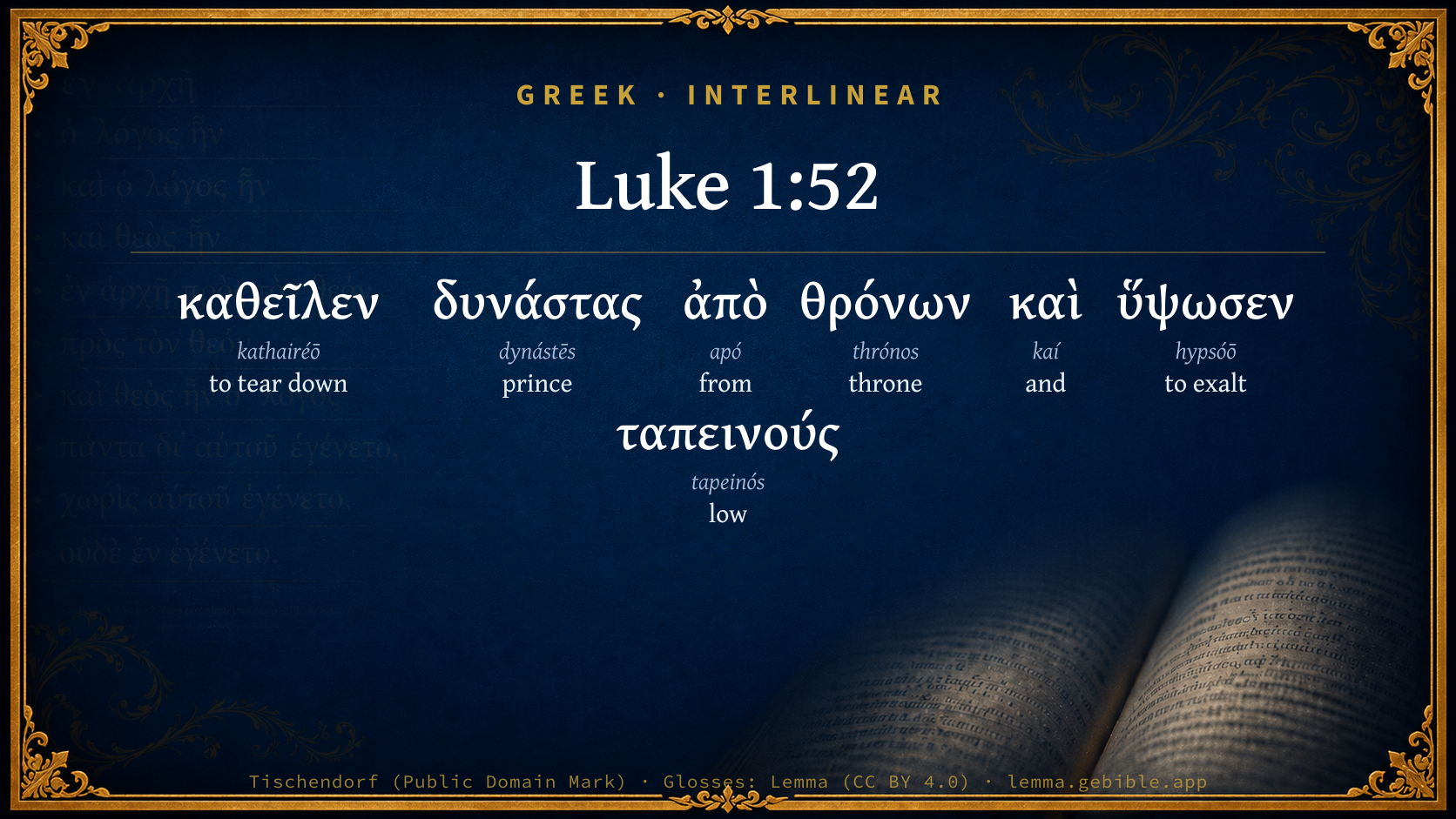
Download image
Cite this verse

Luke 1:52 (World English Bible). Public Domain. Lemma interlinear Bible study tool, https://lemma.gebible.app/v/luke/1/52.

Show BibTeX & RIS
BibTeX
RIS
English Translation
He has put down princes from their thrones. And has exalted the lowly.
World English Bible · Public Domain
Highlights
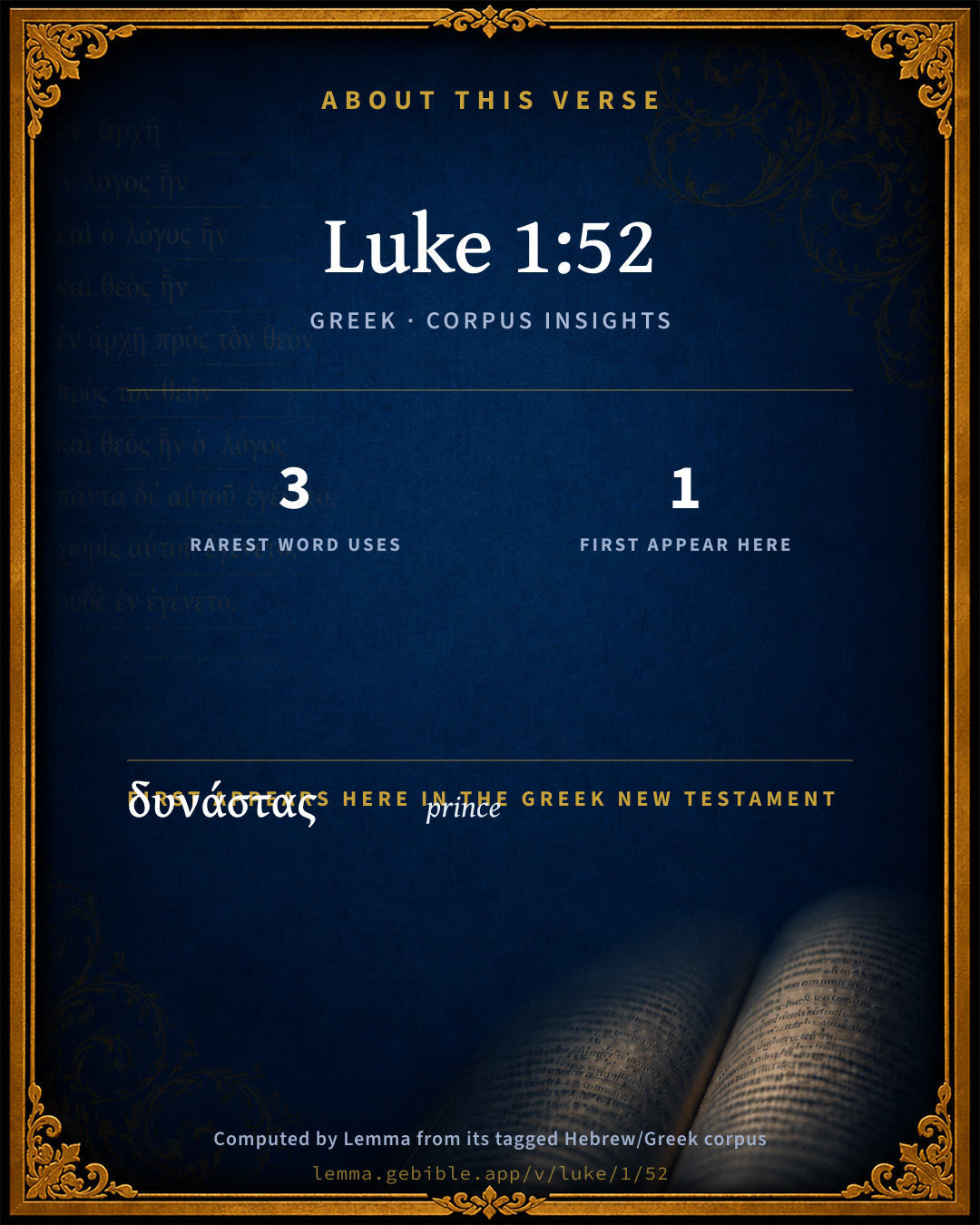
  • 1 first appearance in the Greek New Testament
Full analysis ↓
Download a study sheet

One document with this verse’s original text, its word-by-word gloss line, the meaning frame, cross-references with their text, attributed commentary, and full source and license credits — printable, and it pastes into notes with its structure intact.

This verse Autodidact and up

Study sheet (.html) Plain text (.txt)

A passage Seminary Student

Up to 50 verses in one chapter. A passage sheet keeps up to 6 commentary sources and 12 cross-references per verse, in the order this page ranks them, and says so on the sheet whenever that leaves anything out. Ask for a single verse and you get the Autodidact verse sheet above.

Everything on this page stays free to read, with no account — the sheet is a download of what is already on screen, not access to it.

Want to remove ads? Support Godless Engineer
Compare translations 3

The same verse in 3 English versions, stacked beneath the original-language interlinear above. Click any original word for its lexicon entry.

Each is an independent rendering of the whole verse — the interlinear is not word-aligned to these translations.

Highlighted words mark where these versions differ — a whole-verse word diff, not a word-by-word alignment.

  • World English Bible Public Domain
    He has put down princes from their thrones. And has exalted the lowly.
  • King James Version Public Domain
    He hath put down the mighty from their seats, and exalted them of low degree.
  • unfoldingWord Literal Text CC BY-SA 4.0
    He has thrown down rulers from their thrones and he has raised up the lowly.

unfoldingWord Literal Text — © unfoldingWord, licensed CC BY-SA 4.0. Word-aligned USFM3 via Door43 (git.door43.org/unfoldingWord/en_ult).

Versions to compare (up to 4)

3 of 4 selected

Show all 19 translations

Every available English version of this verse, each an independent rendering of the whole verse.

  • World English Bible Public Domain
    He has put down princes from their thrones. And has exalted the lowly.
  • Berean Standard Bible Public Domain
    He has brought down rulers from their thrones, but has exalted the humble.
  • Majority Standard Bible Public Domain
    He has brought down rulers from their thrones, but has exalted the humble.
  • King James Version Public Domain
    He hath put down the mighty from their seats, and exalted them of low degree.
  • American Standard Version (1901) Public Domain
    He hath put down princes from `their' thrones, And hath exalted them of low degree.
  • Revised Version (1885) Public Domain
    He hath put down princes from their thrones, And hath exalted them of low degree.
  • Geneva Bible (1599) Public Domain
    Hee hath put downe the mighty from their seates, and exalted them of lowe degree.
  • Douay-Rheims (1899) Public Domain
    He hath put down the mighty from their seat, and hath exalted the humble.
  • Young's Literal Translation Public Domain
    He brought down the mighty from thrones, And He exalted the lowly,
  • Literal Standard Version CC BY-SA 4.0
    He brought down the mighty from thrones, || And He exalted the lowly,
  • Unlocked Literal Bible CC BY-SA 4.0
    He has thrown down princes from their thrones and he has raised up those of low condition.
  • unfoldingWord Literal Text CC BY-SA 4.0
    He has thrown down rulers from their thrones and he has raised up the lowly.
  • Darby Bible Public Domain
    He has put down rulers from thrones, and exalted the lowly.
  • World Messianic Bible Public Domain
    He has put down princes from their thrones, and has exalted the lowly.
  • Webster's Bible Public Domain
    He hath put down the mighty from their seats, and exalted them of low degree.
  • Free Bible Version CC BY-SA 4.0
    He tears the powerful down from their thrones, and elevates those who are humble.
  • Bible in Basic English Public Domain
    He has put down kings from their seats, lifting up on high the men of low degree.
  • Text-Critical English NT CC BY 4.0
    He has brought down rulers from their thrones and exalted the lowly.
  • Tyndale New Testament (1534) Public Domain
    He putteth doune the myghty from their seates and exalteth them of lowe degre.

Literal Standard Version (2020), Covenant Press — licensed CC BY-SA 4.0. Text via the HelloAO Bible API (eBible.org). Unlocked Literal Bible (unfoldingWord) — licensed CC BY-SA 4.0. Text via the HelloAO Bible API (eBible.org). unfoldingWord Literal Text — © unfoldingWord, licensed CC BY-SA 4.0. Word-aligned USFM3 via Door43 (git.door43.org/unfoldingWord/en_ult). Free Bible Version, Dr. Jonathan Gallagher — licensed CC BY-SA 4.0. Text via the HelloAO Bible API (eBible.org).

Word by word

More ways to search: Search by grammar → Find every occurrence → Compare this word →

Practice this passage: Drill this verse → Learn its vocabulary →

About this verse

These counts appear in no published source. They are computed here, from the morphology-tagged text and Lemma’s own curated glosses. What Lemma adds →

7
words
7
distinct lemmas
Gospels
section

Notable vocabulary

The rarest word here is δυνάστας prince G1413 — appearing just 3 times in the whole Greek New Testament.

First appearance in Scripture

This word makes its first canonical appearance in the Greek New Testament here:

  • δυνάστας prince G1413

Shared distinctive vocabulary

δυνάστας prince G1413 occurs in 3 verses of the Greek New Testament. Also found in:
Cross-references

13

Topical passages linked to Luke 1:52 in the Treasury of Scripture Knowledge — connected by theme and wording, ordered by reader-vote popularity; previews shown in the World English Bible.

  • Ezekiel 17:24 All the trees of the field shall know that I, Yahweh, have brought down the high tree, have exalted the low tree, have dried up the green tree, and have made the dry tree to flourish; I, Yahweh, have spoken and have done it.
  • James 4:10 Humble yourselves in the sight of the Lord, and he will exalt you.
  • Psalms 107:40–41 He pours contempt on princes, And causes them to wander in a trackless waste.
  • 1 Samuel 2:6–8 Yahweh kills, and makes alive: He brings down to Sheol, and brings up.
  • Luke 18:14 I tell you, this man went down to his house justified rather than the other; for everyone who exalts himself will be humbled, but he who humbles himself will be exalted."
  • Psalms 113:6–8 Who stoops down to see in heaven and in the earth?
  • Ecclesiastes 4:14 For out of prison he came forth to be king; yes, even in his kingdom he was born poor.
  • 1 Samuel 2:4 The bows of the mighty men are broken; Those who stumbled are girded with strength.
  • Job 5:11–13 So that he sets up on high those who are low, Those who mourn are exalted to safety.
  • Amos 9:11 In that day I will raise up the tent of David who is fallen, and close up its breaches, and I will raise up its ruins, and I will build it as in the days of old;
  • James 1:9–10 But let the brother in humble circumstances glory in his high position;
  • Job 34:24–28 He breaks in pieces mighty men in ways past finding out, And sets others in their place.
  • Mark 6:3 Isn't this the carpenter, the son of Mary, and brother of James, Joses, Judas, and Simon? Aren't his sisters here with us?" They were offended at him.

Cross-references courtesy of OpenBible.info (CC BY 4.0).

Commentary

Notes on Luke 1:52 from classic Christian and Jewish commentators (each source and its license shown beneath its notes). The classic Christian expositions comment on the surrounding passage and are grouped to its opening verse, so a note may address several verses; the Jewish commentaries on the Tanakh (Rashi and others) are per-verse, so they appear only where the commentator wrote on this verse.

Lemma curates 59 commentaries, every one of them public domain or Creative Commons licensed, each selected and text-cleaned for this edition rather than reprinted as found. About our sources →

Joseph Benson's Commentary

Luk 1:52-56. He hath put down the mighty from their seats — The mighty think to secure themselves by might in their seats, but he puts them down and overturns their seats; while, on the other hand, those of low degree, who despaired of ever advancing themselves, and thought of nothing else but being very low, are wonderfully exalted. To apply this to the subject which gave occasion to this divine hymn: “The kings who sprang from David, had, no doubt, one after another expected to be the parents of the Messiah; and when the kingdom was taken from them, such of the royal progeny as were in the highest station, would reckon this their certain and high privilege. But now their hope was wholly overthrown. They were brought down by God from that height of dignity to which, in their own imagination, they had exalted themselves; and a person in the meanest condition of all the royal seed was raised to it.” He hath filled the hungry, &c. — “Both the poor and the rich are here represented as waiting at God’s gate in the condition of beggars, the rich in expectation of receiving the honour of giving birth to the Messiah; the poor in expectation, not of that blessing, but hoping for such small favours as suited their condition. While they wait in this state, God, by an exercise of his sovereignty, bestows the favour, so much courted by the rich, on a poor family, to its unspeakable satisfaction, and sends the rich away disappointed and discontented.” See Macknight, and notes on 1Sa 2:3-9. He hath holpen his servant Israel — Dr. Campbell reads this and the next verse, He supporteth Israel his servant, (as he promised to our fathers,) ever inclined to mercy toward Abraham and his race. The word αντελαβετο, here rendered he hath holpen, properly signifies, to interpose in favour of a person in great necessity or extreme danger; and also to hold by the hand, to sustain from falling, or to lift up when fallen, and so to afford aid or help; this he hath done, saith the virgin, in remembrance of his mercy; for then God is said signally to remember his people, when, after a long oppression, in which he seemed to have forgotten them, he works a mighty salvation for them, (see Psa 136:23.) And he did this, also, in pursuance of his promise made to our forefathers, to send the Messiah to be an everlasting blessing to all that should believe in him, and so become the seed of Abraham by faith. And Mary abode with her about three months — Till very near the time of her delivery; and returned to her own house — Having, to her unspeakable satisfaction and great comfort, found all things as the angel had told her; and soon after took a journey with Joseph to Bethlehem.

Joseph Benson's Commentary on the Old and New Testaments (1811–1818) — public domain. Text from a community e-Sword module.

Bengel's Gnomon

Johann Albrecht Bengel

Luk 1:52. Δυνάστας, the mighty [potentates]) as Saul, and Herod.

Bengel's Gnomon of the New Testament — English translation (T&T Clark, Edinburgh, 1860) — public domain. Text from a community e-Sword module.

Godet's Commentaries

Frédéric Louis Godet

Ver. 52. From the moral contrast between the proud and the faithful, Mary passes to a contrast of their social position, the mighty and those of low degree. The former are those who reign without that spirit of humility which is inspired by the fear of Jehovah.

The third antithesis (Luk 1:53), which is connected with the preceding, is that of suffering and prosperity. The hungry represent the class which toils for a living—artisans, like Joseph and Mary; the rich are men gorged with wealth, Israelites or heathen, who, in the use they make of God’s gifts, entirely forget their dependence and responsibility. The abundance which is to compensate the former certainly consists—the contrast requires it—of temporal enjoyments. But since this abundance is an effect of the divine blessing, it implies, as its condition, the possession of spiritual graces. For, from the Old Testament point of view, prosperity is only a snare, when it does not rest on the foundation of peace with God. And so also, the spoliation which is to befall the rich is without doubt the loss of their temporal advantages. But what makes this loss a real evil is, that it is the effect of a divine curse upon their pride.

The poetic beauty of these three verses is heightened by a crossing of the members of the three antitheses, which is substituted for the ordinary method of symmetrical parallelism. In the first contrast (Luk 1:51), the righteous occupy the first place, the proud the second; in the second, on the contrary (Luk 1:52), the mighty occupy the first place, so as to be in close connection with the proud of Luk 1:51, and the lowly the second; in the third (Luk 1:53), the hungry come first, joining themselves with the lowly of Luk 1:52, and the rich form the second member. The mind passes in this way, as it were, on the crest of a wave, from like to like, and the taste is not offended, as it would have been by a symmetrical arrangement in which the homogeneous members of the contrast occurred every time in the same order.

Frédéric Louis Godet — Commentaries on Luke, John, Romans, and 1 Corinthians — English translation (T&T Clark, Edinburgh, 1870s–1890s) — public domain. Text from a community e-Sword module.

Geneva Bible (1599)

Geneva Bible translators

Such as none account is made of, and are vile in men’s eyes, which are indeed the poor in spirit, that is, such as challenge nothing to themselves in the sight of God.

The mighty and rich men.

Geneva Bible (1599) marginal notes — public domain. Text via Bolls.life.

Adam Clarke's Commentary

Verse 52. He hath put down the mighty from their seats] Or, He hath taken down potentates from their thrones. This probably alludes to the removal of Saul from the throne of Israel, and the establishment of the kingdom in the person and family of David. And as Mary spoke prophetically, this saying may also allude to the destruction of the kingdom of Satan and his allies, and the final prevalence of the kingdom of Christ.

Adam Clarke's Commentary on the Bible (1810–1826) — public domain. Text from a community e-Sword/MySword module.

Ellicott's Commentary for English Readers

(52) The mighty.—The word (that from which we get our English “dynasty”) is applied to the eunuch “of great authority” under Candace, in Act_8:27, and is used as a divine name in “the blessed and only Potentate” of 1Ti_6:15. Here it is used generally of all human rulers.

From their seats.—Better, their thrones, as the word is for the most part translated. (Comp. Mat_19:28, and in this very chapter, Luk_1:32.)

Of low degree.—The adjective is that from which the noun translated “low estate,” in Luk_1:48, had been formed.

A Bible Commentary for English Readers, edited by Charles John Ellicott (1878–1897) — public domain. Text from a community e-Sword module.

The Cambridge Bible for Schools and Colleges

gen. ed. J. J. S. Perowne

52. He hath put down the mighty from their seats] Rather, He puts down potentates from thrones. The aorists throughout are gnomic, i. e. they do not express single but normal acts. The thought is common throughout the Bible, e. g. Luk_18:14; Dan_4:30; 1Sa_2:6-10; Psa_113:6-8; 1Co_1:26-29. The ancients noticed the fact (κύκλος τῶν ἀνθρωπηΐων ἐστὶ πρηγμάτων, Hdt. i. 207; “Irus et est subito qui modo Croesus erat,” Ov. Trist. iii. vii. 41) but did not draw the true lessons from it.

The Cambridge Bible for Schools and Colleges (gen. ed. J. J. S. Perowne; Cambridge University Press, 1878–1918) — public domain. Text from a community e-Sword module.

John Gill's Exposition

He hath put down the mighty from their seats,.... As mighty kings and emperors from their thrones, as he often does, in the course of his providence; setting up one, and putting down another: or the mighty angels, from their seats of bliss and happiness in heaven; who rebelling against God, opposing the incarnation of Christ, taking it ill, that the human nature should be advanced above theirs, were cast down to hell; and are reserved in chains of darkness, to the judgment of the great day: or this may have respect to the putting down the monarchies and kingdoms of this world, by the kingdom of the Messiah to be set up; which, though at first was mean and despicable, like a stone cut out of a mountain, will increase, spread, and break in pieces, and destroy all other kingdoms:

and exalted them of low degree; as David to the throne of Israel, from the sheepfold, and following the ewes great with young; and now his house and family, which were sunk very low, by raising of his seed, of a poor virgin in his family, unto Israel, a Saviour Jesus; in whose days the poor had the Gospel preached, and received it: these were chosen and called: the great things of the Gospel were revealed to babes, and hid from the wise and prudent; and beggars were raised from the dunghill, to sit among princes, and to inherit the throne of glory: a method, which God in his infinite wisdom and grace has been pleased to take, more or less, in all ages of time; for not many mighty and noble are called by grace; but usually the foolish, the weak, and the base things of the world.

John Gill's Exposition of the Whole Bible (1746–1763) — public domain (CC PDM 1.0). Text via the HelloAO Bible API.

Trapp's Complete Commentary

John Trapp

52 He hath put down the mighty from their seats, and exalted them of low degree.

Ver. 52. He hath put down the mighty] As he did Bajazet, the proud Turk, and set up Tamerlane, a Scythian shepherd; who said that he was sent from heaven to punish Bajazet’s rashness, and to teach him that the proud are hated of God, whose promise is to pluck down the mighty, and raise up the lowly.

John Trapp, A Commentary or Exposition upon All the Books of the Old and New Testament (1647–1656) — public domain. Text from a community e-Sword module.

Albert Barnes' Notes on the Bible

Hath put down the mighty - The “mighty” here denotes princes, kings, or conquerors. See Isa 14:12-14.

Their seats - Their “thrones,” or the places where they sat in pomp and power.

Exalted them - Raised them up, or placed them in the seats of those who had been removed.

Low degree - Low or humble birth and condition in life. This probably has reference to the case of her ancestor David. Mary was celebrating the mercies of God to herself, to her family, and of course to her ancestors. It was natural to allude to that great event in their history when Saul was overcome in battle, and when David was taken from the sheepfold and placed on the throne. The origin of illustrious families is often obscure. People are often raised by industry, talent, and the favor of God, from very humble stations - from the farm or mechanic’s shop - to places of great trust in the church and state. They who are thus elevated, if imbued with right feelings, will not despise their former employments nor their former companions, nor will they esteem their parents or friends the less because they still remain in the same rank in life. No conduct is more odious and unchristian than to be ashamed of our birth or the humble circumstances of our friends.

Albert Barnes' Notes on the Bible (1834–1885) — public domain. Text from a community e-Sword/MySword module.

John Wesley's Explanatory Notes

He hath put down the mighty - Both angels and men.

John Wesley, Explanatory Notes Upon the Whole Bible (1754–1765) — public domain. Text via the GEBible commentary corpus.

unfoldingWord translationNotes

Door43 World Missions Community

He has thrown down princes from their thrones

A throne is a chair that a ruler sits on, and it is a symbol of his authority. If a prince is brought down from his throne, it means he no longer has the authority to reign. AT: "He has taken away the authority of princes" or "He has made rulers stop ruling" (See: Synecdoche)

raised up those of low condition

In this word picture, people who are important are higher than people who are less important. AT: "has has made humble people important" or "has given honor to people whom others have not honored" (See: Metaphor)

of low condition

"in poverty." See how you translated this in Luke 1:48.

He has filled the hungry ... the rich he has sent away empty

The contrast between these two opposite actions should be made clear in the translation if possible.

filled the hungry with good things

Possible meanings are 1) "given the hungry good food to eat" or 2) "given the needy good things."

translationWords

prince

throne

raise

lowly

unfoldingWord translationNotes — © Distant Shores Media and the Door43 World Missions Community, licensed CC BY-SA 4.0. Source: git.door43.org/Door43/en_tn.

Cambridge Greek Testament for Schools and Colleges

52. καθεῖλεν δυνάστας ἀπὸ θρόνων. ‘He puts down potentates from thrones.’ The aorists throughout are gnomic, i.e. they do not express single but normal acts. Winer, indeed, denies this gnomic use of the aorist—to express what is wont to be done—in the N. T. (Gram., p. 346); but his explanation that the aorists represent the rapid succession of (normal) facts, comes to the same thing. See a marked instance in Jas 1:11 ἀνέτειλεν ὁ ἥλιος … καὶ ἐξήρανε τὸν χόρτον. Hence Bleek renders these aorists by presents which is also the English way of expressing the gnomic aorist. Thus πολλὰ παρὰ γνώμην ἔπεσε means ‘many things happen unexpectedly.’ The thought is common throughout the Bible, e.g. Luk 18:14; Dan 4:30; 1Sa 2:6-10; Psa 113:6-8; 1Co 1:26-29. The ancients noticed the fact (κύκλος τῶν ἀνθρωπηΐων ἐστὶ πρηγμάτων, Hdt. I. 207; “Irus et est subito qui modo Croesus erat,” Ov. Trist. III. vii. 41), but did not draw the true lessons from it. With the general thought compare Wis 5:23, “Ill dealings shall overthrow the thrones of the mighty.” The rare word δυνάστας is rendered potentates in 1Ti 6:15.

Cambridge Greek Testament for Schools and Colleges (Cambridge University Press, 1896; 21 vols, various authors incl. Carr, Maclear, Plummer, Farrar, Lumby, Moule, M. R. James, Simcox) — public domain. Text from a community e-Sword module.

International Critical Commentary

52. καθεῖλεν δυνάστας ἀπὸ θρόνων καὶ ὕψωσεν ταπεινούς. “He hath put down potentates from thrones.” “Potentates” rather than “princes” (RV.), or “the mighty” (AV.), because of 1Ti 6:15. Comp. δυνάσται Φαραώ (Gen 50:4). In Act 8:27 it is an adj. It is probable that ταπεινούς here means primarily the oppressed poor as opposed to tyrannical rulers. See Hatch, Biblical Greek, pp. 73-77. Besides the parallels given in the table (p. 31) comp. ἀναλαμβάνων πρᾳεῖς ὁ κύριος, ταπεινῶν δὲ ἁμαρτωλοὺς ἕως τῆς γῆς (Psa 147:6); θρόνους ἀρχόντων καθεῖλεν ὁ κύριος, καὶ ἐκάθισεν πρᾳεῖς ἀντʼ αὐτῶν (Ecclus. 10:14); also Luk 14:11, Luk 14:18:14; Jas 1:9, Jas 1:10. In Clem. Rom. Cor. lix. 3 we have what looks like a paraphrase, but may easily come from O.T. Comp. Enoch xlvi. 5.

International Critical Commentary — older volumes (1896–1929), various authors — public domain. Text from a community e-Sword module.

Lesson kit

Teaching starters — assembled from the data on this page, not authored interpretation. Every prompt links to the verse data it draws on. Edit before teaching.

Luke, in the Gospels, opens this verse with 7 words (7 distinct Greek lemmas). Its most distinctive word is dynástēs (“prince”). A historical commentator’s framing appears above. Read the whole chapter for the surrounding context.

Discussion questions

  1. How does “prince” (dynástēs) shape what this verse is saying?
  2. This is the first place “prince” appears in Scripture (first appears here). What does its debut here establish?
  3. How does Acts 8:27, which shares the word «prince», read alongside this verse?
  4. These translations render this verse differently. What is at stake in choosing one wording over another?
  5. Compare how Joseph Benson's Commentary and Bengel's Gnomon read this verse. Where do they agree or differ?

Things to notice

  • 1 word makes its first canonical appearance in Scripture here.
  • These translations choose different wording for 14 words in this verse.
  • 7 distinct Greek lemmas span 7 words in this verse.

Reading settings

Reading text

Shown beneath each verse's original-language words.

Old Testament
Old Testament edition

Read the OT as the Masoretic Hebrew (MT) or the Greek Septuagint (LXX).

English shown for the Greek Septuagint (in the Hebrew ↔ Greek comparison).

Comparing translations? Open the Compare panel on any verse page to stack up to four side by side.