Matthew 23:33

Greek (Tischendorf 8th ed.) Matthew 23:33 appears in the Greek New Testament. The text above is from the Tischendorf 8th edition. Each word links to its Strong’s number and a concise gloss. Click any word for its full Thayer’s Greek Lexicon entry.
Download image
Cite this verse

Matthew 23:33 (World English Bible). Public Domain. Lemma interlinear Bible study tool, https://lemma.gebible.app/v/matthew/23/33.

Show BibTeX & RIS
BibTeX
RIS
English Translation
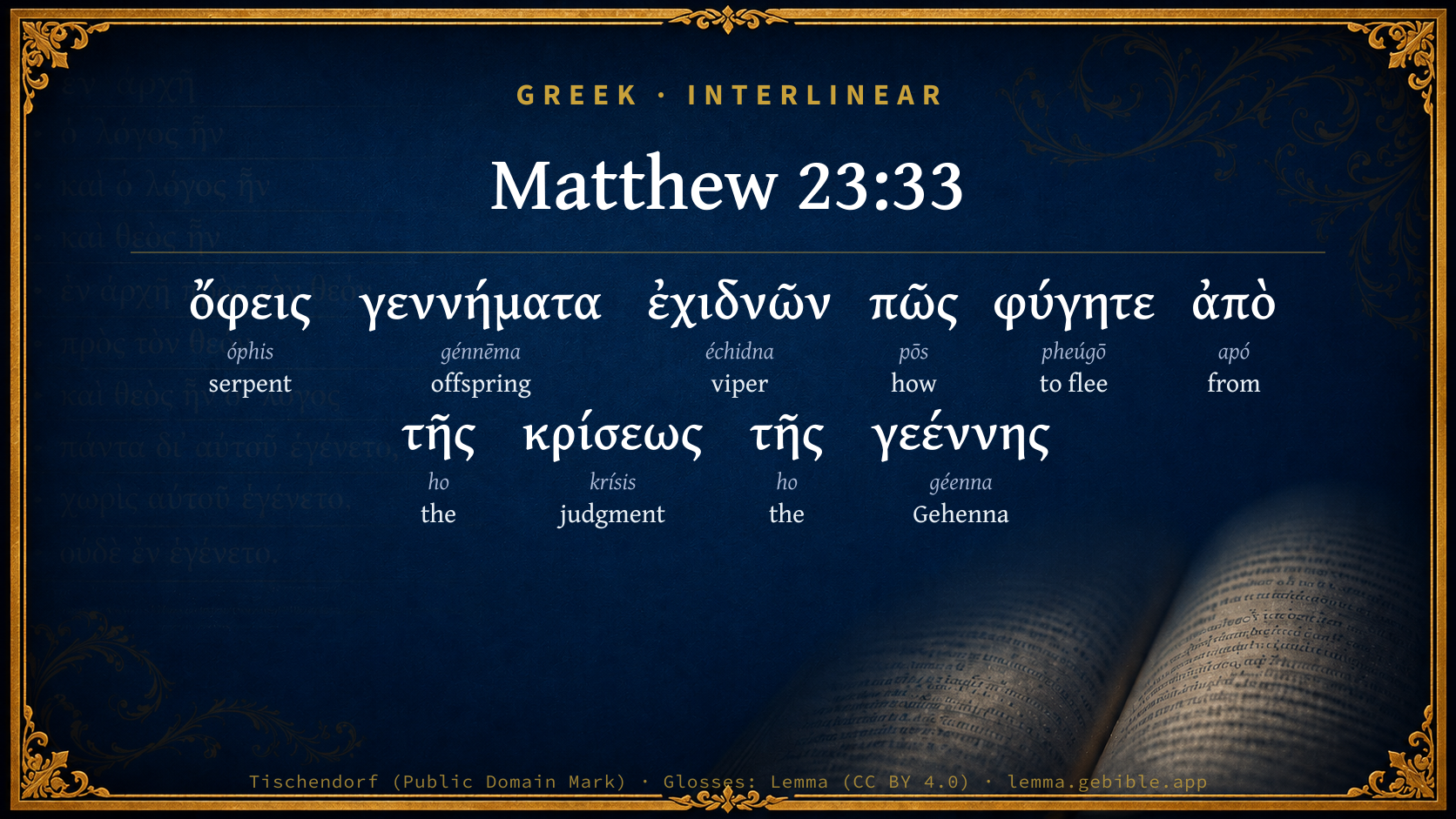
You serpents, you offspring of vipers, how will you escape the judgment of Gehenna?
World English Bible · Public Domain
Download a study sheet

One document with this verse’s original text, its word-by-word gloss line, the meaning frame, cross-references with their text, attributed commentary, and full source and license credits — printable, and it pastes into notes with its structure intact.

This verse Autodidact and up

Study sheet (.html) Plain text (.txt)

A passage Seminary Student

Up to 50 verses in one chapter. A passage sheet keeps up to 6 commentary sources and 12 cross-references per verse, in the order this page ranks them, and says so on the sheet whenever that leaves anything out. Ask for a single verse and you get the Autodidact verse sheet above.

Everything on this page stays free to read, with no account — the sheet is a download of what is already on screen, not access to it.

Want to remove ads? Support Godless Engineer
Compare translations 3

The same verse in 3 English versions, stacked beneath the original-language interlinear above. Click any original word for its lexicon entry.

Each is an independent rendering of the whole verse — the interlinear is not word-aligned to these translations.

Highlighted words mark where these versions differ — a whole-verse word diff, not a word-by-word alignment.

  • World English Bible Public Domain
    You serpents, you offspring of vipers, how will you escape the judgment of Gehenna?
  • King James Version Public Domain
    Ye serpents, ye generation of vipers, how can ye escape the damnation of hell?
  • unfoldingWord Literal Text CC BY-SA 4.0
    Serpents, offspring of vipers, how might you escape from the judgment of Gehenna?

unfoldingWord Literal Text — © unfoldingWord, licensed CC BY-SA 4.0. Word-aligned USFM3 via Door43 (git.door43.org/unfoldingWord/en_ult).

Versions to compare (up to 4)

3 of 4 selected

Show all 19 translations

Every available English version of this verse, each an independent rendering of the whole verse.

  • World English Bible Public Domain
    You serpents, you offspring of vipers, how will you escape the judgment of Gehenna?
  • Berean Standard Bible Public Domain
    You snakes! You brood of vipers! How will you escape the sentence of hell?
  • Majority Standard Bible Public Domain
    You snakes! You brood of vipers! How will you escape the sentence of hell?
  • King James Version Public Domain
    Ye serpents, ye generation of vipers, how can ye escape the damnation of hell?
  • American Standard Version (1901) Public Domain
    Ye serpents, ye offspring of vipers, how shall ye escape the judgment of hell?
  • Revised Version (1885) Public Domain
    Ye serpents, ye offspring of vipers, how shall ye escape the judgment of hell?
  • Geneva Bible (1599) Public Domain
    O serpents, the generation of vipers, howe should ye escape the damnation of hell!
  • Douay-Rheims (1899) Public Domain
    You serpents, generation of vipers, how will you flee from the judgment of hell?
  • Young's Literal Translation Public Domain
    `Serpents! brood of vipers! how may ye escape from the judgment of the gehenna?
  • Literal Standard Version CC BY-SA 4.0
    Serpents! Brood of vipers! How may you escape from the judgment of Gehenna?
  • Unlocked Literal Bible CC BY-SA 4.0
    You serpents, you offspring of vipers, how will you escape the judgment of hell?
  • unfoldingWord Literal Text CC BY-SA 4.0
    Serpents, offspring of vipers, how might you escape from the judgment of Gehenna?
  • Darby Bible Public Domain
    Serpents, offspring of vipers, how should ye escape the judgment of hell?
  • World Messianic Bible Public Domain
    You serpents, you offspring of vipers, how will you escape the judgment of Gehinnom?
  • Webster's Bible Public Domain
    Ye serpents, ye generation of vipers, how can ye escape the damnation of hell?
  • Free Bible Version CC BY-SA 4.0
    You snakes, you brood of vipers, how will you escape the judgment of Gehenna?
  • Bible in Basic English Public Domain
    You snakes, offspring of snakes, how will you be kept from the punishment of hell?
  • Text-Critical English NT CC BY 4.0
    You serpents, you brood of vipers! How will you escape being sentenced to hell?
  • Tyndale New Testament (1534) Public Domain
    Yee serpentes and generacion of vipers how shuld ye scape the dampnacion of hell?

Literal Standard Version (2020), Covenant Press — licensed CC BY-SA 4.0. Text via the HelloAO Bible API (eBible.org). Unlocked Literal Bible (unfoldingWord) — licensed CC BY-SA 4.0. Text via the HelloAO Bible API (eBible.org). unfoldingWord Literal Text — © unfoldingWord, licensed CC BY-SA 4.0. Word-aligned USFM3 via Door43 (git.door43.org/unfoldingWord/en_ult). Free Bible Version, Dr. Jonathan Gallagher — licensed CC BY-SA 4.0. Text via the HelloAO Bible API (eBible.org).

Word by word

More ways to search: Search by grammar → Find every occurrence → Compare this word →

Practice this passage: Drill this verse → Learn its vocabulary →

About this verse

These counts appear in no published source. They are computed here, from the morphology-tagged text and Lemma’s own curated glosses. What Lemma adds →

10
words
9
distinct lemmas
Gospels
section

Notable vocabulary

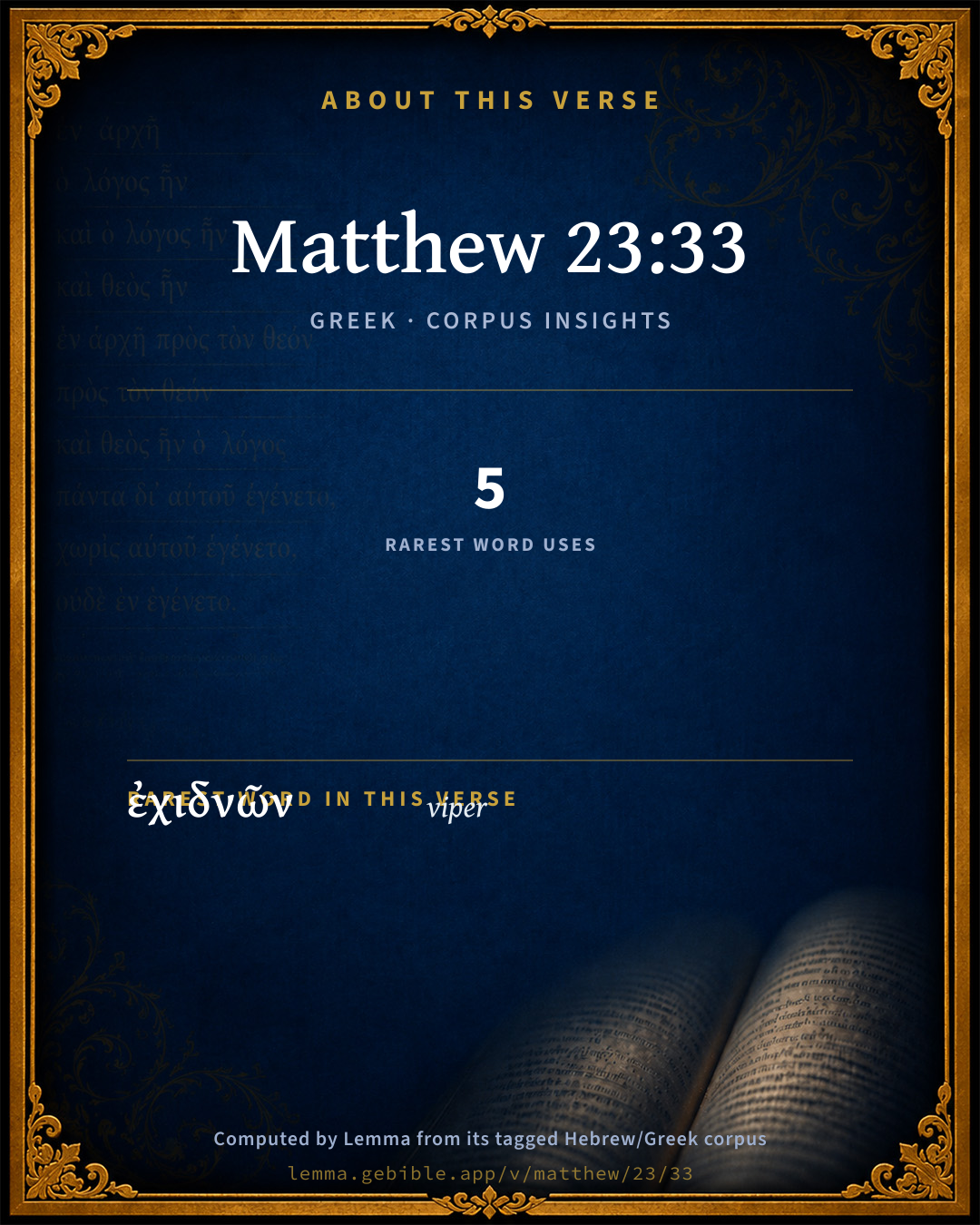
The rarest word here is ἐχιδνῶν viper G2191 — appearing just 5 times in the whole Greek New Testament.

Shared distinctive vocabulary

ἐχιδνῶν viper G2191 occurs in 5 verses of the Greek New Testament. Also found in:

Repetition

A word recurs within this verse:

Cross-references

15

Topical passages linked to Matthew 23:33 in the Treasury of Scripture Knowledge — connected by theme and wording, ordered by reader-vote popularity; previews shown in the World English Bible.

  • Matthew 3:7 But when he saw many of the Pharisees and Sadducees coming for his baptism, he said to them, "You offspring of vipers, who warned you to flee from the wrath to come?
  • Matthew 12:34 You offspring of vipers, how can you, being evil, speak good things? For out of the abundance of the heart, the mouth speaks.
  • Matthew 5:22 But I tell you, that everyone who is angry with his brother without a cause shall be in danger of the judgment; and whoever shall say to his brother, 'Raca!' shall be in danger of the council; and whoever shall say, 'You fool!' shall be in danger of the fire of Gehenna.
  • Luke 3:7 He said therefore to the multitudes who went out to be baptized by him, "You offspring of vipers, who warned you to flee from the wrath to come?
  • Genesis 3:15 I will put enmity between you and the woman, and between your offspring and her offspring. He will bruise your head, and you will bruise his heel."
  • Psalms 58:3–5 The wicked go astray from the womb. They are wayward as soon as they are born, speaking lies.
  • Matthew 21:34–35 When the season for the fruit drew near, he sent his servants to the farmers, to receive his fruit.
  • John 8:44 You are of your Father, the devil, and you want to do the desires of your father. He was a murderer from the beginning, and doesn't stand in the truth, because there is no truth in him. When he speaks a lie, he speaks on his own; for he is a liar, and the father of it.
  • Revelation 12:9 The great dragon was thrown down, the old serpent, he who is called the devil and Satan, the deceiver of the whole world. He was thrown down to the earth, and his angels were thrown down with him.
  • Isaiah 57:3–4 But draw near here, you sons of the sorceress, the seed of the adulterer and the prostitute.
  • Matthew 23:13–15 "Woe to you, scribes and Pharisees, hypocrites! For you devour widows' houses, and as a pretense you make long prayers. Therefore you will receive greater condemnation.
  • 2 Corinthians 11:3 But I am afraid that somehow, as the serpent deceived Eve in his craftiness, so your minds might be corrupted from the simplicity that is in Christ.
  • Hebrews 2:3 how will we escape if we neglect so great a salvation-- which at the first having been spoken through the Lord, was confirmed to us by those who heard;
  • Hebrews 10:29 How much worse punishment, do you think, will he be judged worthy of, who has trodden under foot the Son of God, and has counted the blood of the covenant with which he was sanctified an unholy thing, and has insulted the Spirit of grace?
  • Hebrews 12:25 See that you don't refuse him who speaks. For if they didn't escape when they refused him who warned on the Earth, how much more will we not escape who turn away from him who warns from heaven,

Cross-references courtesy of OpenBible.info (CC BY 4.0).

Commentary

Notes on Matthew 23:33 from classic Christian and Jewish commentators (each source and its license shown beneath its notes). The classic Christian expositions comment on the surrounding passage and are grouped to its opening verse, so a note may address several verses; the Jewish commentaries on the Tanakh (Rashi and others) are per-verse, so they appear only where the commentator wrote on this verse.

Lemma curates 59 commentaries, every one of them public domain or Creative Commons licensed, each selected and text-cleaned for this edition rather than reprinted as found. About our sources →

The Biblical Illustrator

Joseph S. Exell

Mat_23:29; Mat_23:33; Mat_23:36

How can ye escape the damnation of hell?

-

The difficulty of escaping the damnation of hell

I. What your situation actually is.

1. You are even now under sentence of condemnation.

2. You need to be awakened, no man will escape a danger he does not perceive.

3. In order to escape final condemnation you must pursue religion with perseverance.

II. The obstacles.

1. The effect of sin is to make men blind to their own sins.

2. The sinner often seeks deliverance in a way in which it cannot be obtained.

3. The unbelieving heart will not submit to God until its opposition be removed.

4. The fascinating power of worldly objects.

5. Then you say the difficulties are so great that you have not courage to make the attempt to escape. (E. Payson, D. D.)

Pretence vain

To pretend holiness when there is none is a vain thing. What were the foolish virgins better for their blazing lamps when they wanted oil? What is the lamp of profession without the oil of saving grace? What comfort will a show of holiness yield at last? Will painted gold enrich? Painted wine refresh him that is thirsty? Will painted holiness be a cordial at the hour of death? A pretence of sanctification is not to be rested in. Many ships have had the name of Hope, the Safeguard, the Triumph, yet have been cast away upon the rocks; so many who have had the name of saintship have been cast into hell. (T. Watson.)

Suspension and infliction of judgments

1. It is not right that God should punish one generation for the sins of another.

2. It is just that God should punish all generations for their own sins.

3. God might if He pleased pass by the sins of all generations; He might punish them hereafter, not here.

4. It is right that God should punish one generation and not another. He has always acted as a Sovereign in sparing or punishing particular generations. God delayed to destroy the Egyptians.

5. When God does spare one generation and punish another He always has some good reason for both sparing and punishing.

6. The sins of one generation may be a good reason why God should punish the sins of another.

7. It is criminal and foolish for one generation to imitate the sins of a former.

8. It is well for the present generation to discountenance open vices prevailing.

9. Sinners always are the troublers of the world. (N. Emmons, D. D.)

The Biblical Illustrator, edited by Joseph S. Exell (c. 1880s–1900s) — public domain. Text from a community e-Sword module.

Bengel's Gnomon

Johann Albrecht Bengel

Mat 23:33. Ἐχιδνῶν, of vipers) Which are mentioned in Mat 23:30-32.—πῶς φύγητε, how can ye escape) The subjunctive.

Bengel's Gnomon of the New Testament — English translation (T&T Clark, Edinburgh, 1860) — public domain. Text from a community e-Sword module.

Meyer's Critical & Exegetical Commentary

Heinrich August Wilhelm Meyer

Mat_23:33. Πῶς φύγητε] Conjunctive, with a deliberative force: how are you, judging from your present character, to escape from (see on Mat_3:7), etc. Comp. Mat_26:54; Mar_4:30 : Hom. Il. i. 150: πῶς τίς τοι πρόφρων ἔπεσιν πείθηται Ἀχαιῶν;

The κρίσις τῆς γεένν. means the pronouncing of the sentence which condemns to Gehenna. The phrase judicium Gehennae is also of very frequent occurrence in Rabbinical writers. See Wetstein. The judgment comes when the measure is full. Comp. 1Th_2:16.

Meyer — Critical and Exegetical Commentary on the New Testament — English translation by Peter Christie, edited by Frederick Crombie (T&T Clark, 1880) — public domain. Text from a community e-Sword module.

Expositor's Greek Testament

ed. W. Robertson Nicoll

Mat 23:33 . wful ending to a terrific charge, indicating that the men who are predestined to superlative wickedness are appropriately doomed to the uttermost penalty. ὄφεις , γεν . ἐχιδνῶν ; already stigmatised as false, fools, blind, they are now described as venomous, murderous in thought and deed. Cf. Mat 3:7 . πῶς φύγητε , the deliberative subjunctive. “The verb of a deliberative question is most frequently in the first person, but occasionally in the second or third. Mat 23:33 , Rom 10:14 .” Burton, § 170.

The Expositor's Greek Testament, edited by W. Robertson Nicoll (1897–1910) — public domain. Text from a community e-Sword module.

Geneva Bible (1599)

Geneva Bible translators

See also Matt. 5:22.

Geneva Bible (1599) marginal notes — public domain. Text via Bolls.life.

Jamieson, Fausset & Brown

Robert Jamieson, A. R. Fausset & David Brown

Ye serpents, ye generation of vipers, how can ye escape the damnation of hell?--In thus, at the end of His ministry, recalling the words of the Baptist at the outset of his, our Lord would seem to intimate that the only difference between their condemnation now and then was, that now they were ripe for their doom, which they were not then.

Jamieson, Fausset & Brown — Commentary Critical and Explanatory on the Whole Bible (1871) — public domain (CC PDM 1.0). Text via the HelloAO Bible API.

Adam Clarke's Commentary

Verse 33. Ye serpents, ye generation of vipers] What a terrible stroke! - Ye are serpents, and the offspring of serpents. This refers to Mt 23:31: they confessed that they were the children of those who murdered the prophets; and they are now going to murder Christ and his followers, to show that they have not degenerated - an accursed seed, of an accursed breed. My old MS. translates this passage oddly - Gee serpentis, fruytis of burrownyngis of eddris that sleen her modris. There seems to be here an allusion to a common opinion, that the young of the adder or viper which are brought forth alive eat their way through the womb of their mothers. Hence that ancient enigma attributed to LACTANTIUS: -

Non possum nasci, si non occidero matrem.

Occidi matrem: sed me manet exitus idem.

Id mea mors faciet, quod jam mea fecit origo.

Cael. Firm. Symposium, N. xv.

I never can be born, nor see the day,

Till through my parent's womb I eat my way.

Her I have slain; like her must yield my breath;

For that which gave me life, shall cause my death.

Every person must see with what propriety this was applied to the Jews, who were about to murder the very person who gave them their being and all their blessings.

Adam Clarke's Commentary on the Bible (1810–1826) — public domain. Text from a community e-Sword/MySword module.

Ellicott's Commentary for English Readers

(33) Ye generation of vipers.—Better, as in Mat_3:7, brood, or progeny of vipers. The word of rebuke which had come before from the lips of the Baptist, comes now, with even more intense keenness, from those of the Christ.

How can ye escape?—Better—to maintain the parallelism with the Baptist’s words, which was, we can hardly doubt, designed—How should ye flee from?

A Bible Commentary for English Readers, edited by Charles John Ellicott (1878–1897) — public domain. Text from a community e-Sword module.

The Cambridge Bible for Schools and Colleges

gen. ed. J. J. S. Perowne

33. generation of vipers] See note ch. Mat_3:7.

the damnation of hell] Rather, the judgment of Gehenna.

The Cambridge Bible for Schools and Colleges (gen. ed. J. J. S. Perowne; Cambridge University Press, 1878–1918) — public domain. Text from a community e-Sword module.

John Gill's Exposition

Wherefore, behold I send unto you prophets,.... To try them, whether they would show the respect to prophets, they pretended to have for them; by building and beautifying their sepulchres; by exclaiming against their forefathers for shedding their blood; and by declaring, that had they lived in their days, they would not have joined with them in it; and to make it appear, that these were all empty words, and specious pretences; and that they had the same malicious and bloody principles in them; and would be guilty of the same practices, and so fill up the measure of their fathers' sins; and bring upon them the punishment of everlasting burnings hereafter, as well as ruin and destruction on their nation, city, and temple now. Christ here speaks, as, one having power and authority, to qualify and send forth men, under the several characters here mentioned, and of what he should do after his resurrection: for notwithstanding the people of the Jews would crucify him, and use him as they did, in a barbarous manner; yet after all this, he would send his ministers to them, to gather his elect out from among them, to render the rest inexcusable, and to show his longsuffering and patience. The persons designed by "prophets", "wise men", and "Scribes", are his apostles: called "prophets"; because they were divinely inspired to write, and preach in his name; had the gift of foretelling future events, and of explaining with the greatest clearness and exactness, the prophecies of the Old Testament; showing their respect unto, and accomplishment in Christ: "wise men"; because they were made wise unto salvation, and capable of instructing others: they were filled with all spiritual and evangelical wisdom, and preached the wisdom of God in a mystery, even the hidden wisdom: and Scribes; because they were well instructed in the kingdom of heaven, and had the true knowledge of the law, and could rightly interpret it, as well as make known the Gospel of the grace of God. Christ chooses to use these names and titles, because the Jews pretended to have great veneration for the ancient prophets, and these he should send, would not be a whit inferior to them, but in many things exceed them; and they had great esteem for their wise men and Scribes, who would be vastly exceeded by these ministers of his, and yet would be used very badly by them:

and some of them ye shall kill; as Stephen, the first "martyr", who was stoned to death by them; and James, the brother of John, whom Herod, to their good liking, killed with the sword; and the other James they threw headlong from off the pinnacle of the temple, and killed him with a fuller's club (r),

And crucify; so Simeon, the son of Cleophas, was crucified at the instigation of the Jews, as Eusebius relates (s),

And some of them ye shall scourge in your synagogues; as John, Peter, and Paul:

and persecute them from city to city; as they did Paul and Barnabas, as the Acts of the Apostles testify,

(r) Euseb. Eccl. Hist. l. 2. c. 23. (s) Ib. l. 3. c. 32.

John Gill's Exposition of the Whole Bible (1746–1763) — public domain (CC PDM 1.0). Text via the HelloAO Bible API.

Trapp's Complete Commentary

John Trapp

33 Ye serpents, ye generation of vipers, how can ye escape the damnation of hell?

Ver. 33. Ye serpents] Serpentum tot sunt venena, quot genera, saith Isidore, tot pernicics quot species, tot dolores quot colores. See how our Saviour sharps up these heresiarchs, that, if possible, they might be made sound in the faith. So deals Peter by Simon Magus, Paul by Elymas, many of our champions by their Popish antagonists. Before God you are deceivers of the people (said Mr Philpot, martyr, to his persecutors), before God there is no truth in you. And to mocking Morgan he said, I must tell thee, thou painted wall and hypocrite, in the name of the living Lord, that God shall rain fire and brimstone upon such scorners of his word and blasphemers of his people as thou art. And afterwards, Thou art but an ass in the things of God, in that thou kickest against the truth, and art void of all godly understanding. Thou hast seduced others (said Bonner to Philpot), and madest them rejoice and sing with thee. Yea, my Lord, quoth he, we shall sing when you shall cry, Woe, woe, except ye repent. What an arrogant fool is this (said the bishop), I will handle thee like a heretic, and that shortly. I fear nothing, I thank God (said the other), that you can do unto me. But God shall destroy such as thou art, and that shortly, as I trust. Likewise to the Bishop of Chichester he spake thus: I perceive you are blind guides, and leaders of the blind, and therefore, as I am bound to tell you, very hypocrites, tyrannously persecuting the truth, which you are not able to disprove. Thus Hilary called Constantius Antichrist, and Auxentius devil, because they were Arians, Mihi certe Auxentius nihil aliud erit quam diabolus, quia Arianus.

Ye generation of vipers] Quarum morsus insanabilis. Sic contra sycophantarum morsum non est remedium. {See Trapp on "Mat 3:7"} Vipers’ teeth are buried in their gums, that one would think they could not bite: so hypocrites.

John Trapp, A Commentary or Exposition upon All the Books of the Old and New Testament (1647–1656) — public domain. Text from a community e-Sword module.

Albert Barnes' Notes on the Bible

Ye serpents - This name is given to them on account of their pretending to be pious, and very much devoted to God, but being secretly evil, At the heart, with all their pretensions, they were filled with evil designs, as the serpent was, Gen 3:1-5

Generation of vipers - See the notes at Mat 12:34.

Damnation of hell - This refers, beyond all question, to future punishment. So great was their wickedness and hypocrisy, that, if they persevered in this course, it was impossible to escape the damnation that should come on the guilty. This is the sternest language that Jesus ever used to wicked people. But it by no means authorizes ministers to use such language to sinners now. Christ knew that this was true of them. He had an authority which none now have. It is not the province of ministers to denounce judgment, or to use severe names, least of all to do it on pretence of imitating Christ. He knew the hearts of people. We know them not. He had authority to declare certainly that those whom he addressed would be lost. We have no such authority. He addressed persons; we address characters.

Albert Barnes' Notes on the Bible (1834–1885) — public domain. Text from a community e-Sword/MySword module.

Whedon's Commentary on the Bible

Daniel D. Whedon

33. Ye serpents, ye generation of vipers — See our commentary on Mat_3:7. The severity of our Lord’s language is a precedent for rebuke, but no precedent for such authority and power of rebuke. He had a divine attribute to see the character as it was, and a divine authority to pronounce its nature, and a right to inflict punishment which no mere mortal has.

How can ye escape the damnation of hell? — The question is sometimes the strongest mode of affirmation. Our Lord here means to assert that they cannot escape the damnation of hell. The word here used for hell is in the original Gehenna.

These EIGHT WOES are reduced by Dr. Stier to the sacred number seven, as he considers the last as a simple summation of the whole.

Daniel D. Whedon (gen. ed.), Commentary on the Old and New Testaments (1874–1909) — public domain. Text from a community e-Sword module.

The Pulpit Commentary

Vers. 33-39. Declaration of the sentence on these Pharisees and their generation.

Ye serpents, ye generation of vipers; gennhmata ecidnwn : offspring of vipers. Our Lord repeats the Baptist"s denunciation. (Mat_3:7) They were of devilish nature, inherited from their very birth the disposition and character of Satan. So Christ said on another occasion, "Ye are of your father the devil, and the lusts of your father it is your will to do. He was a murderer from the beginning, and stood not in the truth". (Joh_8:44) How can ye escape? Pwv fughte ; the deliberative conjunctive, How shall ye escape? Quo mode fugietis? (Vulgate). There is no emphasis on "can" in the Authorized Version. What hope is there now of your repentance? Can anything soften the hardness of your hearts? The Baptist had spoken more hopefully, "Who hath warned you to flee from the wrath to come?" But now the day of grace is past; the sin against the Holy Ghost is committed; there remaineth only the fearful looking for of judgment. The damnation of hell; literally, the judgment of Gehenna; judicio Gehennae (Vulgate); i.e. the sentence that condemns to eternal death. (Mat_5:22) The phrase is common in the rabbinical writings (see Lightfoot). "Before sinning, we ought to fear lest it be the filling up; after sinning, we should trust in a truly Christian hope that it is not, and repent. This is the only means to escape the damnation of hell; but how rare is this grace after a pharisaical life!" (Quesnel). Hypocrisy is a bar to repentance.

Holy denunciation.

Revised Version, "Ye serpents, ye offspring of vipers, how shall ye escape the judgment of hell?" margin, "Gehenna." It is neither right nor wise to attempt any mitigations or modifications of this intensely severe sentence. Let the words stand precisely as we find them; and let the sentence be the sternest, severest, intensest sentence that ever passed the Divine lips of our blessed Lord. Capable of being misunderstood and misrepresented, they are capable also of most rational and most reasonable explanation. All we have to do is to inquire whether the persons referred to, and the circumstances under which the words were uttered, would justify a noble-minded man in speaking so intensely. If they would. then Jesus is justified.

I THESE DENUNCIATIONS, READ IN THE LIGHT OF THE PERSONS DENOUNCED. Explain that they would have been unsuitable for the Pharisees as a class. They would have been over-intense if applied to the formalist and hypocritical sections of the Pharisee class. But they are strictly appropriate to those few men who, for months past, had been resisting every witness that favoured Christ"s claim; had been plotting, dodging, scheming, to destroy Christ; had come fawning upon him, with malice, hatred, and all uncharitableness in their hearts. Defeated in argument, they would not admit defeat. Humiliated by our Lord s answers, they were still bent on effecting their shameless purpose. What did such men deserve? What was left to be done with them? They had to be shown up, as men are shown up when withering denunciations are heaped upon them, under which they cower, conscience smitten. Jesus was doing the best thing possible for those wretched men, by these holy enunciations, the mere form of which must be judged by Eastern, not Western, models.

II THESE DENUNCIATIONS, READ IN THE LIGHT OF THE PERSON DENOUNCING. Those who so readily accuse Christ of over-severity would be the very first and loudest in accusing him of moral weakness, inability to recognize or respond to sin, if such instances of severity had not been recorded. The true man, the Divine man, feels adequately in response to every situation; and we may unhesitatingly affirm that this was a time to be sublimely indignant, and that burning words of wrath terrible as these were the fitting thing for the occasion. R.T.

The Pulpit Commentary (1880–1919), ed. H.D.M. Spence-Jones & Joseph S. Exell — public domain. Text from a community e-Sword module.

John Wesley's Explanatory Notes

Ye serpents - Our Lord having now lost all hope of reclaiming these, speaks so as to affright others from the like sins.

John Wesley, Explanatory Notes Upon the Whole Bible (1754–1765) — public domain. Text via the GEBible commentary corpus.

The People's New Testament

B. W. Johnson

33. Ye generations of vipers, how can ye escape? etc. Brood of vipers, full of venom, deadly as serpents, treacherous as the lurking serpent. So John had called them nearly four years before (Matt. 3:7).

B. W. Johnson's The People's New Testament with Notes (1889–1891) — public domain. Electronic text from the Christian Classics Ethereal Library (CCEL) ThML edition.

Cambridge Greek Testament for Schools and Colleges

33. γεννήματα ἐχιδνῶν. See note ch. Mat 3:7.

Cambridge Greek Testament for Schools and Colleges (Cambridge University Press, 1896; 21 vols, various authors incl. Carr, Maclear, Plummer, Farrar, Lumby, Moule, M. R. James, Simcox) — public domain. Text from a community e-Sword module.

International Critical Commentary

33. Ye serpents, ye offspring of vipers, how are you to escape from the condemnation of Gehenna?

(L)

International Critical Commentary — older volumes (1896–1929), various authors — public domain. Text from a community e-Sword module.

Lesson kit

Teaching starters — assembled from the data on this page, not authored interpretation. Every prompt links to the verse data it draws on. Edit before teaching.

Matthew, in the Gospels, opens this verse with 10 words (9 distinct Greek lemmas). Its most distinctive word is échidna (“viper”). A historical commentator’s framing appears above. Read the whole chapter for the surrounding context.

Discussion questions

  1. What does “viper” (échidna) contribute to the verse as a whole?
  2. How does Matthew 3:7, which shares the word «viper», read alongside this verse?
  3. What does the repetition of “the” (2× in this one verse) do in this verse?
  4. The translations on this page render this verse differently — a whole-verse word diff, not a word-by-word alignment. What might account for the different wordings?
  5. Compare how The Biblical Illustrator and Bengel's Gnomon read this verse. Where do they agree or differ?

Things to notice

Reading settings

Reading text

Shown beneath each verse's original-language words.

Old Testament
Old Testament edition

Read the OT as the Masoretic Hebrew (MT) or the Greek Septuagint (LXX).

English shown for the Greek Septuagint (in the Hebrew ↔ Greek comparison).

Comparing translations? Open the Compare panel on any verse page to stack up to four side by side.