Luke 4:38

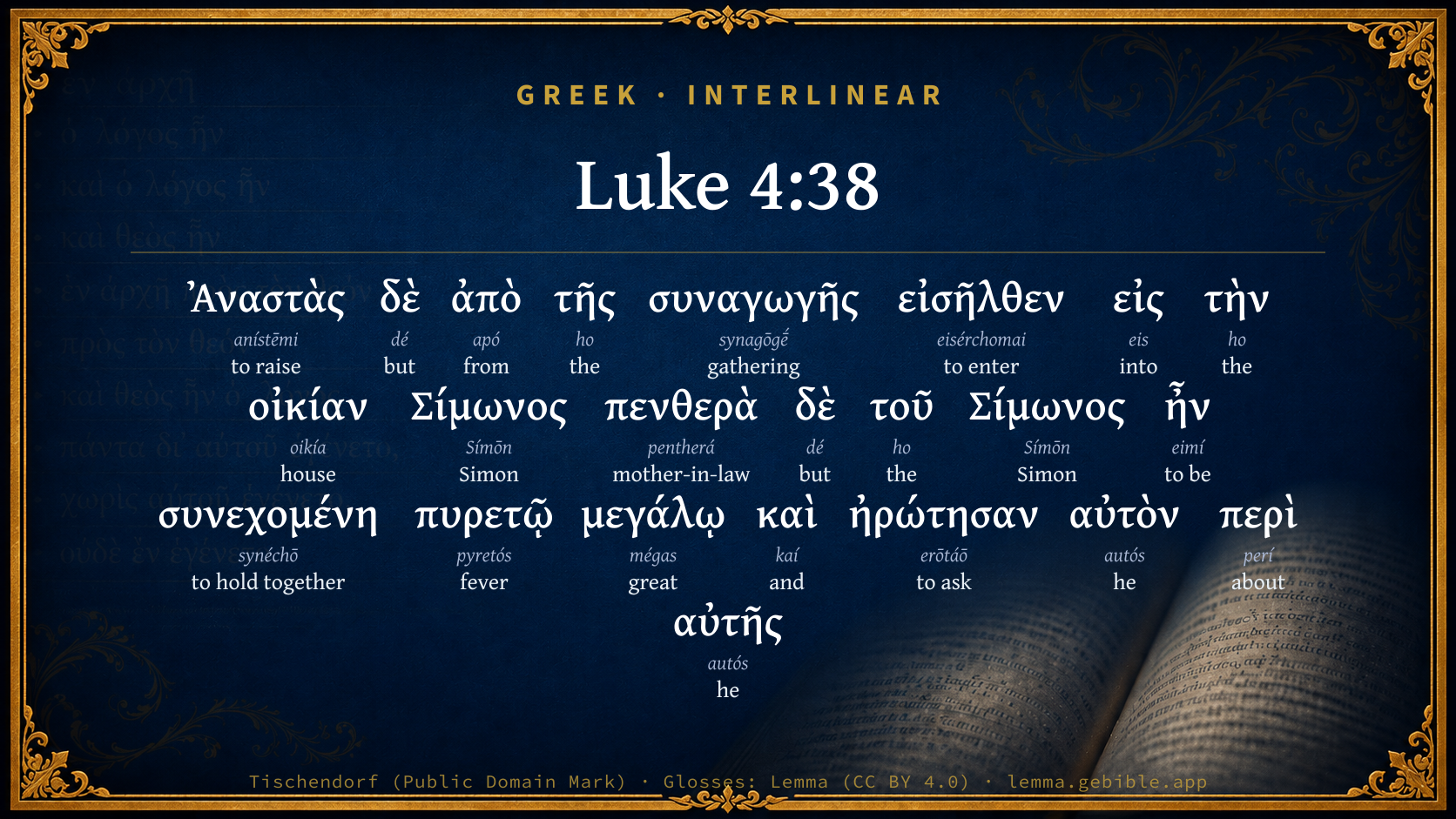
Greek (Tischendorf 8th ed.) Luke 4:38 appears in the Greek New Testament. The text above is from the Tischendorf 8th edition. Each word links to its Strong’s number and a concise gloss. Click any word for its full Thayer’s Greek Lexicon entry.
Download image
Cite this verse

Luke 4:38 (World English Bible). Public Domain. Lemma interlinear Bible study tool, https://lemma.gebible.app/v/luke/4/38.

Show BibTeX & RIS
BibTeX
RIS
English Translation
He rose up from the synagogue, and entered into Simon's house. Simon's mother-in-law was afflicted with a great fever, and they begged him for her.
World English Bible · Public Domain
Download a study sheet

One document with this verse’s original text, its word-by-word gloss line, the meaning frame, cross-references with their text, attributed commentary, and full source and license credits — printable, and it pastes into notes with its structure intact.

This verse Autodidact and up

Study sheet (.html) Plain text (.txt)

A passage Seminary Student

Up to 50 verses in one chapter. A passage sheet keeps up to 6 commentary sources and 12 cross-references per verse, in the order this page ranks them, and says so on the sheet whenever that leaves anything out. Ask for a single verse and you get the Autodidact verse sheet above.

Everything on this page stays free to read, with no account — the sheet is a download of what is already on screen, not access to it.

Want to remove ads? Support Godless Engineer
Compare translations 3

The same verse in 3 English versions, stacked beneath the original-language interlinear above. Click any original word for its lexicon entry.

Each is an independent rendering of the whole verse — the interlinear is not word-aligned to these translations.

Highlighted words mark where these versions differ — a whole-verse word diff, not a word-by-word alignment.

  • World English Bible Public Domain
    He rose up from the synagogue, and entered into Simon's house. Simon's mother-in-law was afflicted with a great fever, and they begged him for her.
  • King James Version Public Domain
    And he arose out of the synagogue, and entered into Simon's house. And Simon's wife's mother was taken with a great fever; and they besought him for her.
  • unfoldingWord Literal Text CC BY-SA 4.0
    Then arising from the synagogue, he entered into the house of Simon. And Simon’s mother-in-law was suffering with a high fever, and they asked him concerning her.

unfoldingWord Literal Text — © unfoldingWord, licensed CC BY-SA 4.0. Word-aligned USFM3 via Door43 (git.door43.org/unfoldingWord/en_ult).

Versions to compare (up to 4)

3 of 4 selected

Show all 19 translations

Every available English version of this verse, each an independent rendering of the whole verse.

  • World English Bible Public Domain
    He rose up from the synagogue, and entered into Simon's house. Simon's mother-in-law was afflicted with a great fever, and they begged him for her.
  • Berean Standard Bible Public Domain
    After Jesus had left the synagogue, He went to the home of Simon, whose mother-in-law was suffering from a high fever. So they appealed to Jesus on her behalf,
  • Majority Standard Bible Public Domain
    After Jesus had left the synagogue, He went to the home of Simon, whose mother-in-law was suffering from a high fever. So they appealed to Jesus on her behalf,
  • King James Version Public Domain
    And he arose out of the synagogue, and entered into Simon's house. And Simon's wife's mother was taken with a great fever; and they besought him for her.
  • American Standard Version (1901) Public Domain
    And he rose up from the synagogue, and entered into the house of Simon. And Simon's wife's mother was holden with a great fever; and they besought him for her.
  • Revised Version (1885) Public Domain
    And he rose up from the synagogue, and entered into the house of Simon. And Simon’s wife’s mother was holden with a great fever; and they besought him for her.
  • Geneva Bible (1599) Public Domain
    And he rose vp, and came out of the Synagogue, and entred into Simons house. And Simons wiues mother was taken with a great feuer, and they required him for her.
  • Douay-Rheims (1899) Public Domain
    And Jesus rising up out of the synagogue, went into Simon's house. And Simon's wife's mother was taken with a great fever, and they besought him for her.
  • Young's Literal Translation Public Domain
    And having risen out of the synagogue, he entered into the house of Simon, and the mother-in-law of Simon was pressed with a great fever, and they did ask him about her,
  • Literal Standard Version CC BY-SA 4.0
    And having risen out of the synagogue, He entered into the house of Simon, and the mother-in-law of Simon was pressed with a great fever, and they asked Him about her,
  • Unlocked Literal Bible CC BY-SA 4.0
    Then Jesus left the synagogue and entered into the house of Simon. Now Simon's mother-in-law was suffering with a high fever, and they pleaded with him on her behalf.
  • unfoldingWord Literal Text CC BY-SA 4.0
    Then arising from the synagogue, he entered into the house of Simon. And Simon’s mother-in-law was suffering with a high fever, and they asked him concerning her.
  • Darby Bible Public Domain
    And rising up out of the synagogue, he entered into the house of Simon. But Simon's mother-in-law was suffering under a bad fever; and they asked him for her.
  • World Messianic Bible Public Domain
    He rose up from the synagogue and entered into Simon’s house. Simon’s mother-in-law was afflicted with a great fever, and they begged him to help her.
  • Webster's Bible Public Domain
    And he arose out of the synagogue, and entered into Simon's house. And the mother of Simon's wife was taken with a violent fever; and they besought him for her.
  • Free Bible Version CC BY-SA 4.0
    Leaving the synagogue, Jesus went to Simon's house. Simon's mother-in-law was sick with a high fever and those who were there asked Jesus to help.
  • Bible in Basic English Public Domain
    And he got up and went out of the Synagogue and went into the house of Simon. And Simon's wife's mother was very ill with a burning heat; and in answer to their prayers for her
  • Text-Critical English NT CC BY 4.0
    Then Jesus arose, left the synagogue, and entered Simon's house. Now Simon's mother-in-law was suffering from a high fever, and they asked Jesus to help her.
  • Tyndale New Testament (1534) Public Domain
    And he roose vp and came oute of the sinagoge and entred in to Simons housse. And Simons motherelawe was take with a greate fever and they made intercession to him for her.

Literal Standard Version (2020), Covenant Press — licensed CC BY-SA 4.0. Text via the HelloAO Bible API (eBible.org). Unlocked Literal Bible (unfoldingWord) — licensed CC BY-SA 4.0. Text via the HelloAO Bible API (eBible.org). unfoldingWord Literal Text — © unfoldingWord, licensed CC BY-SA 4.0. Word-aligned USFM3 via Door43 (git.door43.org/unfoldingWord/en_ult). Free Bible Version, Dr. Jonathan Gallagher — licensed CC BY-SA 4.0. Text via the HelloAO Bible API (eBible.org).

Word by word

More ways to search: Search by grammar → Find every occurrence → Compare this word →

Practice this passage: Drill this verse → Learn its vocabulary →

πενθερὰ
pentherá
G3994
“mother-in-law”
Noun, Nominative, Singular, Feminine
Part of Speech
Noun
Case
Nominative
Number
Singular
Gender
Feminine
Full Thayer's Definition

Origin: from G3995

TDNT: None

1. mother-in-law, a wife's mother
  1. Ἀναστὰς anístēmi G450 “to raise” Verb, Aorist, Active, Participle, Nominative, Singular, Masculine
  2. δὲ dé G1161 “but” Conjunction
  3. ἀπὸ apó G575 “from” Preposition
  4. τῆς ho G3588 “the” Article, Genitive, Singular, Feminine
  5. συναγωγῆς synagōgḗ G4864 “gathering” Noun, Genitive, Singular, Feminine
  6. εἰσῆλθεν eisérchomai G1525 “to enter” Verb, Aorist, Active, Indicative, 3rd person, Singular
  7. εἰς eis G1519 “into” Preposition
  8. τὴν ho G3588 “the” Article, Accusative, Singular, Feminine
  9. οἰκίαν oikía G3614 “house” Noun, Accusative, Singular, Feminine
  10. Σίμωνος Símōn G4613 “Simon” Noun, Genitive, Singular, Masculine
  11. δὲ dé G1161 “but” Conjunction
  12. τοῦ ho G3588 “the” Article, Genitive, Singular, Masculine
  13. Σίμωνος Símōn G4613 “Simon” Noun, Genitive, Singular, Masculine
  14. ἦν eimí G1510 “to be” Verb, Imperfect, Active, Indicative, 3rd person, Singular
  15. συνεχομένη synéchō G4912 “to hold together” Verb, Present, Passive, Participle, Nominative, Singular, Feminine
  16. πυρετῷ pyretós G4446 “fever” Noun, Dative, Singular, Masculine
  17. μεγάλῳ mégas G3173 “great” Adjective, Dative, Singular, Masculine
  18. καὶ kaí G2532 “and” Conjunction
  19. ἠρώτησαν erōtáō G2065 “to ask” Verb, Aorist, Active, Indicative, 3rd person, Plural
  20. αὐτὸν autós G846 “he” Personal pronoun, Accusative, Singular, Masculine
  21. περὶ perí G4012 “about” Preposition
  22. αὐτῆς autós G846 “he” Personal pronoun, Genitive, Singular, Feminine

About this verse

These counts appear in no published source. They are computed here, from the morphology-tagged text and Lemma’s own curated glosses. What Lemma adds →

23
words
18
distinct lemmas
Gospels
section

Notable vocabulary

The rarest word here is πενθερὰ mother-in-law G3994 — appearing just 6 times in the whole Greek New Testament.

Shared distinctive vocabulary

πενθερὰ mother-in-law G3994 occurs in 5 verses of the Greek New Testament. Also found in:

Repetition

Words recur within this verse:

  • Σίμωνος Simon G4613 ×2
  • τῆς the G3588 ×3
  • δὲ but G1161 ×2
  • αὐτὸν he G846 ×2

Cross-references

8

Topical passages linked to Luke 4:38 in the Treasury of Scripture Knowledge — connected by theme and wording, ordered by reader-vote popularity; previews shown in the World English Bible.

  • Matthew 8:14–15 When Jesus came into Peter's house, he saw his wife's mother lying sick with a fever.
  • Mark 1:29–31 Immediately, when they had come out of the synagogue, they came into the house of Simon and Andrew, with James and John.
  • John 11:22 Even now I know that, whatever you ask of God, God will give you."
  • James 5:14–15 Is any among you sick? Let him call for the elders of the assembly, and let them pray over him, anointing him with oil in the name of the Lord,
  • Matthew 15:23 But he answered her not a word. His disciples came and begged him, saying, "Send her away; for she cries after us."
  • Luke 7:3–4 When he heard about Jesus, he sent to him elders of the Jews, asking him to come and save his servant.
  • John 11:3 The sisters therefore sent to him, saying, "Lord, behold, he for whom you have great affection is sick."
  • 1 Corinthians 9:5 Have we no right to take along a wife who is a believer, even as the rest of the apostles, and the brothers of the Lord, and Cephas?

Cross-references courtesy of OpenBible.info (CC BY 4.0).

Commentary

Notes on Luke 4:38 from classic Christian and Jewish commentators (each source and its license shown beneath its notes). The classic Christian expositions comment on the surrounding passage and are grouped to its opening verse, so a note may address several verses; the Jewish commentaries on the Tanakh (Rashi and others) are per-verse, so they appear only where the commentator wrote on this verse.

Lemma curates 59 commentaries, every one of them public domain or Creative Commons licensed, each selected and text-cleaned for this edition rather than reprinted as found. About our sources →

The Biblical Illustrator

Joseph S. Exell

Luk_4:38-39

And He arose out of the synagogue and entered into Simons house

Simons wifes mother

Suffering is to be found everywhere, in the public synagogue and in the private house.

Even Peters house was not exempt. The chosen ones are tried as by fire, and the rod proves their election. (J. Parker, D. D.)

Simons house

How came Peter to have a house at Capernaum? Poor fishermen do not often have two houses, May it not be that, finding the Lord Jesus was frequently at Capernaum, Peter thought it best to have a dwelling there, that he might be always present when the Master was preaching, and that he might do his best to entertain Him between whiles? I like to think that the servant changed his place of abode for the Masters sake. Would it not be well if many Christian people had some little consideration when they are choosing a house, as to whether it will be convenient for the hearing of the Word? (C. H. Spurgeon.)

Sickness produces seriousness

Professor Henry Drummond, the author of Natural Law in the Spiritual World, has been very earnestly at work in the revival in the Edinburgh University. His addresses have been intensely evangelical, and have been wondrously powerful in their effects on the students. One anecdote seemed to have touched them deeply. Substantially it was to this effect:--Some years ago, in the University, there was a fine, manly fellow, a medical student, a very Hercules in strength, but as gentle and lovable as he was strong. He was immensely popular, the captain of the football club, and not a cricket match was considered complete without him. He was a man of good intellectual gifts as well. He caught typhoid fever while attending the Royal Infirmary, and soon he lay dying in a private ward. One of the house physicians, an earnest Christian and successful soul-winner, spoke to him about God and eternity. The dear fellow listened, became anxious, and eagerly heard the story of redeeming love. Will you give yourself to Jesus? asked the doctor. He did not answer for a space, and then, earnestly regarding the man of God, he said, But dont you think it would be awful mean just to make it up now, at my last gasp, with One I have rejected all my life? Yes, it would be mean; but, dear fellow, it would be far meaner not to do it. He wants you to do it now, for He has made you willing, and it would be doubly mean to reject a love that is pursuing you even to death. The dying man saw the point, and apprehending the greatness of that exceeding love, he cast himself upon the Eternal Heart of Mercy and passed away in sweet peace and blessedness.

Blessed results of sickness

When God would rescue a man from that unreal world of names and mere knowledge, He does what He did with Job--He strips him of his flocks, and his herds, and his wealth; or else, whatis the equivalent, of the power of enjoying them--the desire of his eyes falls from him at a stroke. Things become real then. Trial brings man face to face with God--God and he touch; and the flimsy veil of bright cloud that hung between him and the sky is blown away; he feels that he is standing outside the earth with nothing between him and the Eternal Infinite. Oh I there is something in the sick-bed, and the aching heart, and the restlessness and the languor of shattered health, and the sorrow of affections withered, and the stream of life poisoned at its fountain, and the cold, lonely feeling of utter rawness of heart which is felt when God strikes home in earnest that forces a man to feel what is real and what is not. This is the blessing of affliction to those who will lie still and not struggle in a cowardly or a resentful way. It is God speaking to Job out of the whirlwind, and saying: In the sunshine and the warmth you cannot meet Me; but in the hurricane and the darkness, when wave after wave has swept down and across the soul, you shall see My Form, and hear My Voice, and know that your Redeemer liveth. (F. W. Robertson.)

The ministry of gratitude

I. The fact that this restored woman began at once to minister to Christ and to His disciples proves THE CERTAINTY OF HER CURE; and there are no better ways of proving the thoroughness of our conversion than by conduct similar to hers. Suppose the patient had lain there and had begun to talk about how she felt, how much better she was, what a strange sensation passed through her when the Saviour rebuked the disease, and how strangely well she felt; yet if she had not risen up, but had lain there still, there would have been no evidence of her restoration, at any rate none that you or I could judge of. So when persons tell us that they have felt great changes of heart, we must see their outward ministerings for Christ. If their actions be holy, if their lives be purified, then shall we know, but not till then, that their nature is renewed. Suppose this good woman, still lying upon her bed, had begun to say, Well, I hope I am healed, and had begun to express some feeble expectation that one day she would be able to exercise the functions of health, we could not have known that she was restored. Something more was wanted than mere hopes and expectations. Note the nature of the acts which this restored woman performed, because they are symbolical of the best form of actions by which to judge of a person being renewed.

1. Her duties were humble ones. She was probably the head of the household, and she began at once to discharge the duties of a housewife: duties unostentatious and commonplace. Attention to humble duties is a better sign of grace than an ambition for lofty and elevated works.

2. Remember, too, that this good woman attended to home duties. She did not go down the street a hundred yards off to glorify Christ; she, I daresay, did that afterwards; but she began at home: charity begins there, and so should piety. That is the best religion which is most at home at home. Grace which smiles around the family hearth is grace indeed.

3. She attended to suitable duties, duties consistent with her sex and condition. She did not try to be what God had not made her, but did what she could.

4. One other point before leaving this; these things become a conclusive proof of grace in the heart, when they are voluntarily rendered as this good womans ministry was. I do not read that she was asked to do anything for Christ, but it suggested itself to her at once, without command or request. Her work was done promptly, for immediately she arose and did it. Promptness is the soul of obedience.

II. This womans ministry showed THE PERFECTION OF HER CURE. And, beloved, it is one mark of a work of grace in the soul when the converted man becomes at once a servant of Christ. The human theory of moral reformations makes time a great element in its operations. If you are to reclaim a great offender you must win him from one vice first, and then from another; you must put him through a process of education by which he gradually perceives that what he has been accustomed to do is bad for himself, and wakes up to the conviction that honesty and sobriety will be the best for his own profit. Time is required by the moral reformer, or he cannot develop his plans. He ridicules the idea of effecting anything in an hour or two.

III. Peters wifes mother, in ministering to Christ proved HER OWN GRATITUDE. Her acts of hospitality were an exhibition of her thankfulness. Brethren, if we want to evidence our gratitude to Christ we had better do it in the same way as she did.

IV. This womans ministering to Christ proved THE CONDESCENSION OF THE PHYSICIAN. He who healed her of the fever did not need her to minister to Him; He who had power to heal diseases had certainly power to subsist without human ministry. If Christ could raise her up, He must be omnipotent and Divine; what need, then, had He of a womans service? Yet He condescended to accept it. What condescension that He should accept ministry from His own creatures; what gentleness that He so often chose womans ministry. He came to earth, and the first garments of His infancy were wrapped about Him by a womans hands, and here He dwelt till at last He died, and holy women bound Him up in the cerements of the tomb and laid Him in the sepulchre. It seems easy enough to believe that the Blessed Virgin and Mary Magdalene and other holy women were honoured of God; but that you, dear sister, should be allowed to take a part in His service--is not this marvellous? Will you not bless Him, and minister with the utmost cheerfulness because you feel it to be so great a grace? (C. H. Spurgeon.)

All may minister for God

On our birthdays our little children love to give their father something, if it is only a bunch of flowers out of the garden, or a fourpenny piece with a hole in it; they like to do it to show their love; and wise parents will be sure to let their children do such things for them. So is it with our great Father in heaven. What are our Sunday-school teachings and our preachings, and all that, but these cracked fourpenny pieces? Just nothing at all; but the Lord allows us to do His work for His own loves sake. His love to us finds a sweetness in our love to Him. I am most thankful that in the Church there is room for such a variety of ministries. Some brethren are so queerly constituted that I cannot tell what they were made for; but I believe if they are Gods people there is a place for them in His spiritual temple. A man who was accustomed to buy timber and work it up, on one occasion found a very crooked stick of wood in his bargain, and said to his son as he put it aside. I cannot tell, John, whatever I shall do with it; it is the ugliest shaped piece I ever bought in my life; but it so happened while building a barn that he wanted a timber exactly of that shape, and it fitted in so thoroughly well that he said, It really seems as if that tree grew on purpose for that corner. So our gracious Lord has arranged His Church, so that every crooked stick will fit in somewhere or other, if it be only a tree of His own right hand planting: He has made it with a purpose, and knows when it will answer that purpose. How this ought to rebuke any who say, I do not see what I can do. Dear friend, there is a peculiar work for you; find it out--and methinks it will not be far off: the exercise of a little reflection will soon enable you to discover it. Be grateful that this is a certain fact, without exception, that every child of God who has been healed has some ministry which he can render to Christ, and which he ought to render at once. Bless God, dear brother, that He counts you worthy to suffer for His names sake. You know the old story of Sir Walter Raleigh. When Queen Elizabeth, one day, came to a miry place in the road, he took off his cloak for her to walk upon. Did he regret it? No, he was delighted at it, and half the court wished for another muddy place that they might be able to do the same. Oh, you that love your Lord, be willing to lie down for Christs sake, and pave the miry parts of the way by being despised for His names sake. This honour you should covet, and should not shun. Arise and minister, ye healed ones; and as for you who are not healed, may you believe in Him who is able to restore you with His touch. He is mighty to save. Believe in Him and you shall live. (C. H. Spurgeon.)

A sympathetic physician

The pious, good-natured Dr. Helm had no time, as he was wont to say, to get ill. Always busy, ever pleased to visit the cottage of the poorest as the mansions of the rich, all classes of Berlin joined to do honour to the good old man on the jubilee of his fiftieth year of service. The festivities lasted three days. The constant noise and excitement had made the doctor more than usually tired. Late at night a poor woman came to beg him to visit her child, who was taken suddenly ill. The servants had orders to send all applications away, as the doctor felt he needed rest; but the woman, knowing the house, managed to get to the doctors private room to plead her cause. Still Dr. Heim said he could not go. After all had retired to rest Madame Heim said to her husband, What is the matter with you, doctor? Why dont you sleep? Because I cant, he said; its a curious thing with my conscience; I must go and see that child. He rang the bell, and forgetting his fatigue, ran to the sick child, whom he was the means of restoring to health. After the visit he returned and slept soundly. (Baxendales Anecdotes.)

The Biblical Illustrator, edited by Joseph S. Exell (c. 1880s–1900s) — public domain. Text from a community e-Sword module.

Joseph Benson's Commentary

Luk 4:38-44. He entered into Simon’s house — See notes on Mat 8:14-17; and Mar 1:29-35. When the sun was setting — And consequently the sabbath ended, which they considered as continuing from sunset to sunset; all that had any sick brought them — Fully persuaded that he could and would heal them; which he accordingly did; he laid his hands on every one of them, and healed them — Like the Pharisees, they seem to have questioned whether it was lawful for him to do cures on the sabbath day. Reader, he is the same yesterday, to-day, and for ever: he is still able to do cures, and is he not willing? Try him: bring thy sick soul, or even thy sick body, or that of thy relative or friend, to him in prayer, and have faith in him, that he can and will heal it. Remember, His eyes are over the righteous, and his ears are open to their prayers — None ever trusted in him and were confounded. See note on Mar 11:22-24.

Joseph Benson's Commentary on the Old and New Testaments (1811–1818) — public domain. Text from a community e-Sword module.

Whedon's Commentary on the Bible

Daniel D. Whedon

§ 28. PETER’S WIFE’S MOTHER HEALED; THE MIRACLES IN GALILEE, Luk_4:38-44.

Mat_8:14-25; Mar_1:29-39. See notes on parallel passages.

Daniel D. Whedon (gen. ed.), Commentary on the Old and New Testaments (1874–1909) — public domain. Text from a community e-Sword module.

Tyndale Open Study Notes

Tyndale Open Resources

4:38 Simon’s home: Simon was from Bethsaida (John 1:44), but his present home and fishing business were in Capernaum. • Simon’s mother-in-law: Peter was married (see 1 Cor 9:5), but his wife is not named.

Tyndale Open Study Notes — © Tyndale Open Resources, licensed CC BY-SA 4.0. Text via the HelloAO Bible API.

Bengel's Gnomon

Johann Albrecht Bengel

Luk 4:38. Ἀναστὰς δὲ ἐκ, and having arisen from) An abbreviated expression [for Having arisen from His seat and gone out of the synagogue].

Bengel's Gnomon of the New Testament — English translation (T&T Clark, Edinburgh, 1860) — public domain. Text from a community e-Sword module.

Meyer's Critical & Exegetical Commentary

Heinrich August Wilhelm Meyer

Luk_4:38-41. See on Mat_8:14-16; Mar_1:29-34. Matthew places the narrative later, not till after the Sermon on the Mount.[91]

ἀπὸ τῆς συναγωγ.] He went from the synagogue into the house of Simon. The article before πενθερά is not needed. Winer, p. 108 f. [E. T. 148 ff.]. Luke, the physician, uses the technical expression for violent fever-heat: πυρετὸς μέγας (the opposite: μικρός). See Galen, De diff. febr. 1, in Wetstein.

ἠρώτησαν] they asked; Peter, to wit, and the members of the family,hence it is not the plural introduced here without reason only from Mar_1:30 (Weiss).

ἐπάνω αὐτῆς] so that He was bending over her.

ἐπετίμ. τῷ πυρετῷ] the fever regarded as a hostile power, and as personal. Mark, whom Matthew follows, has not this detail; whereas both have the touching with the hand. A divergence in the tradition as to the miraculous method of cure.

αὐτοῖς] refers to Jesus, Simon, and the other members of the family. Comp. ἠρώτησαν, Luk_4:38.

Luk_4:40. ἀσθενοῦντας νόσοις] according to Matthew, demoniacs and sick persons (comp. Mark), with which Luke nevertheless also agrees at Luk_4:41.[92]

τὰς χεῖρας ἐπιτιθείς] Matthew has ΛΌΓῼ, with reference, however, to the demoniacs. In ἙΝῚ ἙΚΆΣΤῼ, which need not be pressed (Weiss, Holtzmann), are implied the solicitude and the indefatigableness of this miraculous ministry of love.

ΛΑΛΕῖΝ, ὍΤΙ] to speak, because. See on Mar_1:34.

[91] The arrangement in Luke, so far as he places (ch. 5) the call of Peter later, is in any case not arbitrarily produced, although he follows the tradition which (as Matthew) does not include the companionship of James and John (so Mark).

[92] All three also agree essentially as to the time of day (δύνοντος τοῦ ἡλίου). Until the evening Jesus had remained in the house of Simon, therefore the siek were first brought to Him there. Thus it was neither with a view to avoiding the heat of the sun, nor to choosing, from delicacy of feeling, as Lange supposes, the twilight for the public exhibition of infirmities.

Meyer — Critical and Exegetical Commentary on the New Testament — English translation by Peter Christie, edited by Frederick Crombie (T&T Clark, 1880) — public domain. Text from a community e-Sword module.

Expositor's Greek Testament

ed. W. Robertson Nicoll

Luk 4:38-39 . Peter’s mother-in-law (Mat 8:14-15 , Mar 1:29-31 ). Σίμωνος : another anticipation. In Mk. the call of Peter and others to discipleship has been previously narrated. One wonders that Lk. does not follow his example in view of his preface, where the apostles are called eye-witnesses, ἀπʼ ἀρχῆς . ἦν συνεχομένη , etc.: Lk’.s desire to magnify the power comes clearly out here. “The analytic imperfect implies that the fever was chronic, and the verb that it was severe,” Farrar (C. G. T.). Then he calls it a great fever: whether using a technical term (fevers classed by physicians as great and small), as many think, or otherwise, as some incline to believe (Hahn, Godet, etc.), in either case taking pains to exclude the idea of a minor feverish attack.

The Expositor's Greek Testament, edited by W. Robertson Nicoll (1897–1910) — public domain. Text from a community e-Sword module.

Godet's Commentaries

Frédéric Louis Godet

3 d. Luk 4:38-39.

Peter, according to our narrative, seems to have lived at Capernaum. According to Joh 1:45, he was originally of Bethsaida. The two places were very near, and might have had a common synagogue; or, while originally belonging to the one, Peter might have taken up his abode at the other.

The term πενθερά (not μητρυῖα) proves that Peter was married, which agrees with 1Co 9:5. It is possible that from this time Jesus took up His abode in Peter’s house, Mat 17:24 et seq.

According to Mar 1:29, His train of disciples consisted, not only of Simon and Andrew, but also of James and John. This already existing association supposes a prior connection between Jesus and these young fishermen, which is explained in John 1. Luke does not name the companions of Jesus. We only see by the words, she arose and ministered unto them (Luk 4:39), that He was not alone.

The expression πυρετὸς μέγας does not appear to be used here in the technical sense which it has in ancient books of medicine, where it denotes a particular kind of fever.

In Luke, Jesus bends down over the sick woman. This was a means of entering into spiritual communication with her; comp. Peter’s words to the impotent man (Act 3:4): Look on me. In Matthew, He touches the sick woman with His hand. This action has the same design. In Mark, He takes her by the hand to lift her up. How are these variations to be explained, if all three drew from the same source, or if one derived his account from the other?

Luke says, literally, He rebuked the fever; as if He saw in the disease some principle hostile to man. This agrees with Joh 8:44, where the devil is called the murderer of man.

It was doubtless at the time of the evening meal (Luk 4:40). The first use which the sick woman makes of her recovered strength was to serve up a repast for her guests. Holtzmann finds a proof in the plur. αὐτοῖς, “she served them,” that Luke’s narrative depends on Mark; for thus far Luke has only spoken of Jesus: He came down (Luk 4:31), He entered (Luk 4:38). But this proof is weak. In the description of the public scene, Luke would only present the principal person, Jesus; while in the account of the domestic scene he would naturally mention also the other persons, since they had all the same need of being waited upon.

In Luke and Mark the position of this narrative is very nearly the same, with merely this difference, that in the latter it follows the calling of the four disciples, while in Luke it precedes it. In Matthew, on the contrary, it is placed very much later—after the Sermon on the Mount. As to the details, Matthew is almost identical with Mark. Thus the two evangelists which agree as to the time (Luke and Mark) differ most as to the details, and the two which come nearest to each other in details (Matthew and Mark) differ considerably as to time. How can this singular relation be explained if they drew from common written sources, or if they copied from each other? Luke here omits Andrew, whom Mark mentions. Why so, if he copied from the primitive Mark? Had he any animosity against Andrew? Holtzmann replies: Because he does not speak of Andrew in what follows. As if, in Mark himself, he was any the more mentioned in the incidents that follow!

Frédéric Louis Godet — Commentaries on Luke, John, Romans, and 1 Corinthians — English translation (T&T Clark, Edinburgh, 1870s–1890s) — public domain. Text from a community e-Sword module.

Geneva Bible (1599)

Geneva Bible translators

In that, that Christ healeth the diseases of the body with his word only, he proveth that he is God Almighty, sent for man’s salvation.

Geneva Bible (1599) marginal notes — public domain. Text via Bolls.life.

Adam Clarke's Commentary

Verse 38. Simon's wife's mother] See Clarke on Mt 8:14-17. As soon as Peter began to follow Christ, his family began to benefit by it. It is always profitable to contract an acquaintance with good men. One person full of faith and prayer may be the means of drawing down innumerable blessings on his family and acquaintance. Every person who knows the virtue and authority of Christ should earnestly seek his grace in behalf of all the spiritually diseased in his household; nor can he seek the aid of Christ in vain.

Adam Clarke's Commentary on the Bible (1810–1826) — public domain. Text from a community e-Sword/MySword module.

Ellicott's Commentary for English Readers

(38, 39) And he arose out of the synagogue.—. See Notes on Mat_8:14 Peculiar to St. Luke and indicating what we may venture to call accurate diagnosis, are the “great fever,” our Lord’s “rebuking” the fever, and the “immediate” rising to minister.

A Bible Commentary for English Readers, edited by Charles John Ellicott (1878–1897) — public domain. Text from a community e-Sword module.

The Cambridge Bible for Schools and Colleges

gen. ed. J. J. S. Perowne

38, 39. The Healing of Simon’s Wife’s Mother

38. into Simon’s house] St Mark, nearly connected with St Peter, says more accurately “the house of Simon and Andrew” (Luk_1:29). This is the first mention of Peter in St Luke, but the name was too well known in the Christian Church to need further explanation. Peter and Andrew were of Bethsaida (House of Fish), (Joh_1:44; Joh_12:21), a little fishing village, as its name imports, now Ain et Tabijah or ‘the Spring of the Figtree,’ where, alone on the Sea of Galilee, there is a little strip of bright hard sand. St Luke does not mention this Bethsaida, though he mentions another at the northern end of the Lake (Luk_9:10). It was so near Capernaum that our Lord may have walked thither, or possibly Simon’s mother-in-law may have had a house at Capernaum. It is a remarkable indication of the little cloud of misunderstanding that seems to have risen between Jesus and those of His own house (Mat_13:57; Joh_4:44), that though they were then living at Capernaum (Mat_9:1; Mat_17:24)—having perhaps been driven there by the hostility of the Nazarenes—their home was not His home.

Simon’s wife’s mother] “St Peter, the Apostle of Christ, who was himself a married man.” Marriage Service. She seems afterwards to have travelled with him (1Co_9:5). Her (most improbable) traditional name was Concordia or Perpetua (Grabe, Spicil. Patr. i. 330).

with a great fever] St Luke, being a physician, uses the technical medical distinction of the ancients, which divided fevers into ‘great’ and ‘little’ (Galen). For other medical and psychological touches see Luk_5:12, Luk_6:6, Luk_22:50-51; Act_3:6-8; Act_4:22; Act_9:33, &c.

they besought him] not, as elsewhere, the imperfect (Joh_4:47), but the aorist, implying that they only had to ask Him once. St Mark confirms this when he says (Luk_1:30), “immediately they speak to Him about her.”

The Cambridge Bible for Schools and Colleges (gen. ed. J. J. S. Perowne; Cambridge University Press, 1878–1918) — public domain. Text from a community e-Sword module.

John Gill's Exposition

And he stood over her,.... "At her head", as the Persic version reads: he inclined himself towards her, to see how she did, and to take her by the hand, and lift her up;

and rebuked the fever. The Syriac and Persic versions read, "her fever", that which was upon her;

and it left her, as Mark says, "immediately"; as soon as ever he had touched her hand, and rebuked the fever, and bid it be gone:

and immediately she arose, and ministered unto them; See Gill on Mat 8:15.

John Gill's Exposition of the Whole Bible (1746–1763) — public domain (CC PDM 1.0). Text via the HelloAO Bible API.

Haydock's Catholic Bible Commentary

It is evident that St. Peter was married; but after his call to the apostleship, he left his wife, as St. Jerome writes, in ep. xliii. Chap. ii. ad Julianum, and lib. i. adv. Jovin. See Matthew xix. 29.

George Leo Haydock (1774–1849), Haydock's Catholic Family Bible and Commentary, 1859 edition — public domain. Excludes Psalms (Douay-Rheims chapter numbering differs from Protestant) and Deuterocanonical books (Catholic canon only).

Matthew Poole's English Annotations

We met with this history both in Matthew and Mark. See Poole on "Mat 8:14", and following verses to Mat 8:15. See Poole on "Mar 1:29", and following verses to Mar 1:31.

Matthew Poole's English Annotations on the Holy Bible (1683–1685) — public domain. Text from a community e-Sword/MySword module.

The Pulpit Commentary

And he arose out of the synagogue, and entered into Simon"s house. And Simon"s wife"s mother was taken with a great fever; and they besought him for her. This abrupt mention of Peter (Simon) for the first time, without any explanatory notice, tells us that when St. Luke wrote his Gospel Peter was well known and honored in all the Churches. The Lord"s choice of one who was already married, the subsequent favor showed to him, the high position evidently accorded to him in the Church of the first days, is a perpetual protest against the exaggerated asceticism which later was so earnestly taught in ecclesiastical Christianity. The epithet "great," applied to the fever, was a well-known technical term; it was used by Galen of fevers. There are several expressions in this Gospel which remind us that the author was a trained physician.

The Pulpit Commentary (1880–1919), ed. H.D.M. Spence-Jones & Joseph S. Exell — public domain. Text from a community e-Sword module.

John Wesley's Explanatory Notes

Matt. viii, 14; Mark i, 29.

John Wesley, Explanatory Notes Upon the Whole Bible (1754–1765) — public domain. Text via the GEBible commentary corpus.

Kretzmann's Popular Commentary

Paul E. Kretzmann

The healing of Peter’s mother-in-law:

v. 38. And He arose out of the synagogue, and entered into Simon’s house. And. Simon’s wife’s mother was taken with a great fever; and they besought Him for her.

v. 39. And He stood over her, and rebuked the fever; and it left her; and immediately she arose and ministered unto them.

From the synagogue Jesus went directly to the home of Simon Peter, of whose call Luke tells in the next chapter. Having lived at Bethsaida formerly, Simon had moved to Capernaum, where he lived with his family, to which the mother of his wife belonged. Evidently, Scripture knows nothing of the foolish unkindness which is now so commonly shown to those to whom relevance and honor is due. This aged woman, at any rate, must have been esteemed very highly in the house of her son-in-law, for when she was prostrated with a fever, severely afflicted with the severity of the attack, they, the members of the family, made intercession for her to Jesus. The Lord immediately signified His willingness. Stepping to the cot on which she was lying, He raised Himself in the fullness of His majesty, He threatened the fever, and it obeyed His voice. The healing was immediate and complete. If in any family someone becomes a disciple of Jesus, there is a path between that house and heaven, guarded by angels. Not only in temporal things, but especially in spiritual matters blessings will attend such a house where a faithful soul prays. And the subsequent serving of the mother-in-law of Peter after healing shows that the beautiful, but rare plant of gratitude nourished in that house.

Paul E. Kretzmann, Popular Commentary of the Bible (1921–1924) — public domain. Text from a community e-Sword module.

Burkitt's Expository Notes on the New Testament

William Burkitt

Here observe, 1. That St. Peter, a disciple, yea, an apostle, was a married person. Neither the prophets of the Old Testament, nor the apostles of the New, did abhor the marriage bed, nor judge themselves too pure for an institution of their maker. The church of Rome, by denying the lawfulness of priests’ marriage, makes herself wiser than God, who says, Marriage is honorable amongst all men. Heb 13:4

Observe, 2. Peter, though a good man, and his wife’s mother probably a gracious woman, yet is his family visited with sickness: strength of grace, and dearness of respect even from Christ himself, cannot prevail against diseases. God’s own children are visited with bodily sickness as well as others.

Observe, 3. The divine power of Christ manifested in this miraculous course: He stood over her, says St. Luke; He took her by the hand, and lifted her up, says St. Mark.

Here was an ordinary distemper cured after an extraordinary manner, by a touch of Christ’s hand in an instant: Immediately the fever left her, and she arose and ministered unto them. That she could arise argued her cure miraculous; that she could and did arise, and administer to Christ and his disciples, argued her thankfulness.

After Christ hath healed any of us, it ought to be our first care to administer unto him: that is, to employ our recovered strength in the service of Christ, and to improve our restored health to the honor and glory of Christ.

William Burkitt's Expository Notes on the New Testament (1700–1703) — public domain. Text from a community e-Sword module.

McGarvey & Pendleton's Commentaries

J. W. McGarvey

J. W. McGarvey's The Fourfold Gospel [XXXII. Healing Peter's Mother-in-Law].

XXXII. HEALING PETER'S MOTHER-IN-LAW AND MANY OTHERS. (At Capernaum.) aMATT. VIII. 14-17; bMARK I. 29-34; cLUKE IV. 38-41.

c38 And he arose out of the synagogue [where he had just healed the demoniac], b29 And straightway, when they were come out of the synagogue, they came centered binto the house of Simon and Andrew, with James and John. [Peter and Andrew had dwelt at Bethsaida ( Joh_1:44). They may have removed to Capernaum, or Bethsaida, being near by, may be here counted as a part, or suburb, of Capernaum. Its name does not contradict this view, for it means "house of fishing" or "fishery."] 30 Now Simon's wife's mother lay sick of { cwas holden with a great fever. [The Papists, who claim that Peter was the first pope, must confess that he was married at this time, and continued to be so for years afterwards ( 1Co_9:5). Celibacy is unauthorized by Scripture ( Heb_13:4). God says it is not good ( Gen_2:18). Luke speaks as a physician; for Galen, the father of medicine, divided fevers into little and great.] a14 And when Jesus was come into Peter's house, he saw his wife's mother lying sick of a fever. band straightway they tell him of her: cand they besought him for her. [Their interest in her shows the spirit of love and kindness which pervaded the home.] b31 and he came c39 And he stood over her, and rebuked the fever [Though it was an inanimate force, it was still subject to rebuke, as were the winds and waves of Galilee-- Mat_8:26]; a15 And he touched her hand, band took her by the hand, and raised her up [thus showing the miracle came from him, and that he felt a tender interest in the sufferer]; cand it bthe fever cleft her: and immediately she rose up aarose, band she ministered unto them. ahim. [Her complete recovery emphasized the miracle. Such fevers invariably leave the patient weak, [170] and the period of convalescence is long and trying, and often full of danger. She showed her gratitude by her ministry.] b32 And at even, awhen even was come, cwhen the sun was setting, bdid set, call they that had any sick with divers diseases, brought them unto him; bthey brought unto him all that were sick, and them amany bthat were possessed with demons. [Their delay till sundown was unquestionably caused by the traditional law of the Sabbath which forbade men to carry any burden on that day ( Joh_5:10). The Sabbath closed at sundown ( Lev_23:32). The distinction is drawn between the sick and the demon-possessed. Lightfoot gives two reasons why demoniacal possession was so common at that time, viz.: 1, the intense wickedness of the nation; 2, the addiction of the nation to magic, whereby the people invited evil spirits to be familiar with them.] cand he laid his hands on every one of them, aand he cast out the spirits with a word, and healed all cthem athat were sick: 17 that it might be fulfilled which was spoken through Isaiah the prophet [ Isa_53:4], saying, Himself took our infirmities, and bare our diseases. [Isaiah's vision is progressive; he sees, first, a man of sorrows; second, a man sorrowful because he bore the sickness and sorrows of others; third, a man who also bore sin, and healed the souls of others by so doing. Such was the order of Christ's life. His early years were spent in poverty and obscurity; his days of ministry in bearing, by sympathy and compassion, the sicknesses and sorrows of others ( Joh_11:35, Mar_14:34); and in the hour of his crucifixion, he became the world's sin-bearer-- Joh_1:29, 1Pe_2:24.] b33 And all the city was gathered together at the door. 34 And he healed many that were sick of divers diseases, and cast out many demons; c41 And demons also came out from many, crying out, and saying, Thou art the Son of God. And rebuking them, he suffered them bthe demons cnot to speak, bbecause they knew him. cthat he was Christ. [Those who are disposed to frequent spiritual seances and to seek information from mediums should remember that the Son of God permitted his disciples to receive no information from such sources. He forbade demons to speak in the presence of his own, even on the most important of all topics.] [171]

[FFG 169-170]

J. W. McGarvey (with Philip Y. Pendleton), Commentaries on the New Testament (The Fourfold Gospel, 1914; Acts; and the epistles) — public domain. Text from a community e-Sword/MySword module.

The People's New Testament

B. W. Johnson

38, 39. Simon's wife's mother. See notes on Matt. 8:14–17. Compare Mark 1:29–34.

B. W. Johnson's The People's New Testament with Notes (1889–1891) — public domain. Electronic text from the Christian Classics Ethereal Library (CCEL) ThML edition.

unfoldingWord translationNotes

Door43 World Missions Community

Connecting Statement:

Jesus is still in Capernaum, but he is now at the house of Simon, where he heals Simon's mother-in-law and many people.

Then Jesus left

This introduces a new event. (See: Introduction of a New Event)

Simon's mother-in-law

"the mother of Simon's wife"

was suffering with

This is an idiom that means "was very sick with" (See: Idiom)

a high fever ... rebuked the fever

"very hot skin ... heat" or "very hot skin ... rebuked the hotness"

pleaded with him on her behalf

This means they asked Jesus to heal her from the fever. This can be stated clearly. AT: "asked Jesus to heal her from the fever" or "asked Jesus to cure her fever" (See: Assumed Knowledge and Implicit Information)

So he stood

The word "So" makes it clear that he did this because the people pleaded with him on behalf of Simon's mother-in-law.

stood over her

"went to her and leaned over her"

rebuked the fever, and it left her

"spoke sternly to the fever, and it left her" or "commanded the fever to leave her, and it did." It may be helpful to state clearly what he told the fever to do. AT: "commanded that her skin should become cool, and it did" or "commanded the sickness to leave her, and it did" (See: Assumed Knowledge and Implicit Information)

started serving them

Here this means she began to prepare food for Jesus and the other people in the house.

translationWords

Peter

plea

servant

unfoldingWord translationNotes — © Distant Shores Media and the Door43 World Missions Community, licensed CC BY-SA 4.0. Source: git.door43.org/Door43/en_tn.

Cambridge Greek Testament for Schools and Colleges

38, 39. THE HEALING OF SIMON’S WIFE’S MOTHER

38. εἰς τὴν οἰκίαν Σίμωνος. St Mark, nearly connected with St Peter, says more accurately “the house of Simon and Andrew” (Luk 1:29). This is the first mention of Peter in St Luke, but the name was too well known in the Christian Church to need further explanation. Peter and Andrew were of Bethsaida (Joh 1:44; Joh 12:21), a little fishing village, as its name (House of Fish) imports, now Ain et Tabijah or ‘the Spring of the Figtree,’ where, alone on the Sea of Galilee, there is a little strip of bright hard sand. St Luke does not mention this Bethsaida, though he mentions another at the northern end of the Lake (Luk 9:10). It was so near Capernaum that our Lord may have walked thither, or possibly Simon’s mother-in-law may have had a house at Capernaum. It is a remarkable indication of the little cloud of misunderstanding that seems to have risen between Jesus and those of His own house (Mat 13:57; Joh 4:44), that though they were then living at Capernaum (Mat 9:1; Mat 17:24)—having perhaps been driven there by the hostility of the Nazarenes—their home was not His home.

πενθερὰ δὲ τοῦ Σίμωνος. “St Peter, the Apostle of Christ, who was himself a married man.” Marriage Service. St Peter’s wife seems afterwards to have travelled with him (1Co 9:5). Her (most improbable) traditional name was Concordia or Perpetua (Grabe, Spicil. Patr. I. 330).

ἦν συνεχομένη. ‘Was severely distressed.’ The analytic imperfect implies that the fever was chronic, and the verb that it was severe (Mat 4:24).

πυρετῷ μεγάλῳ. St Luke, being a physician, uses the technical medical distinction of the ancients, which divided fevers into ‘great’ and ‘little’ (Galen, De diff. febr. 1). For other medical and psychological touches see Luk 5:12, Luk 6:6, Luk 22:50-51; Act 3:6-8; Act 4:22; Act 9:33, &c.

ἠρώτησαν αὐτόν. Not, as elsewhere, the imperfect (Joh 4:47), but the aorist, implying that they only had to ask Him once. St Mark confirms this when he says (Luk 1:30), ‘immediately they speak to Him about her.’

Cambridge Greek Testament for Schools and Colleges (Cambridge University Press, 1896; 21 vols, various authors incl. Carr, Maclear, Plummer, Farrar, Lumby, Moule, M. R. James, Simcox) — public domain. Text from a community e-Sword module.

Alford’s Greek Testament

Henry Alford

38-41.] Healing of Simon’s wife’s mother, and many others. Mat 8:14-17. Mar 1:29-34. Our account has only a slight additional detail, which is interesting however as giving another side of an eye-witness’s evidence—it is ἐπιστὰς ἐπάνω αὐτῆς. Now this is implied in laying hold of her hand, as she was in bed; which particulars are both mentioned by Matt. and Mark:—this being one of those many cases where alteration (of κρατήσας τ. χειρ.… into ἐπιστ. ἐπ. αὐτ.) is utterly inconceivable.

38.] πενθερά, anarthrous, being in fact predicative; as in all such cases of appellatives: see ch. 10:6.

πυρ. μεγάλῳ] An epithet used by Luke, as a physician;—σύνηθες ἤδη τοῖς ἰατροῖς ὀνομάζειν … τὸν μέγαν τε καὶ μικρὸν πυρετόν. Galen de different. Febr. i. (Wetstein.) Bleek doubts this, and understands it only of the intensity of the fever.

Henry Alford, The Greek Testament (1849–1861) — public domain. Text from a community e-Sword module.

International Critical Commentary

38, 39. The Healing of Peter’s Mother-in-law. Mar 1:30.

It is quite beyond doubt that the relationship expressed bye πενθερά is either “wife’s mother” or “husband’s mother” (12:53; Mat 8:14, Mat 8:10:35; Mar 1:30; Rth 1:14, Rth 1:2:11, Rth 1:18, Rth 1:19, 23; Mic 7:6; Dem. Plut. Lucian). so also πενθερός is either “wife’s father” or “husband’s father” (Joh 18:13; Gen 38:13, Gen 38:25; Jdg 1:16; 1Sa 4:19, 1Sa 4:21). But for “wife’s father” the more indefinite γαμβρός (“a relation by marriage”) is freq. in LXX (Exo 3:1, Exo 3:4:18; Num 10:29; Jdg 4:11, Jdg 4:19:4, Jdg 4:7, Jdg 4:9). In Greek there is a distinct term for “stepmother,” viz. the very common word μητρυιά (Ham. Hes. Hdt. AEæsch. Plat. Plut.); and if Lk. had intended to designate the second wife of Peter’s father, he would have used this term. That he should have ignored a word in common use which would express his meaning, and employ another word which has quite a different meaning, is incredible. That peter was married is clear from 1Co 9:5. Clement of Alexandria says that Peter’s wife helped him in ministering to women,—an apostolic anticipation of Zenana missions (Strom. iii. 6, p. 536, ed. Potter). He also states that Peter and Philip had children, and that Philip gave his daughters in marriage (ibid. p. 535, ed Potter, quoted Eus. H. E. iii. 30. 1); but he gives no names. It is remarkable that nothing is known of any children of any one Apostle. This is the first mention of Peter by Lk., who treats him as a person too well known to need introduction. For other miracles of mercy on the sabbath see on 14:1.

38. Ἀναστὰς δὲ ἀπὸ τῆς συναγωγῆς. This may refer to Christ’s rising from His seat; but it is more natural to understand it of His leaving the synagogue. The verb is used where no sitting of lying is presupposed, and means no more than preparation for departure (1:39, 15:18, 20, 23:1; Act 10:20, Act 22:10): see on 1:39. Mk. has ἐξελθόντες, the plur. including Simon and Andrew, James and John. Neither Lk. nor Mt. mention the presence of disciples, but Peter, and perhaps Andrew, may be understood among those who ἠρώτησαν αὐτὸν περὶ αὐτῆς.

συνεχομένη πυρετῷ μεγάλῳ. Perhaps all three words are medical, and certainly συνέχομαι occurs three times as often in Lk. as in the rest of N.T. Galen states that fevers were distinguished as “great” and “slight,” μεγάλοι and σμικροί (Hobart, p. 3). Comp. Plat. Gorg. 512 A. Note the analytical tense.

International Critical Commentary — older volumes (1896–1929), various authors — public domain. Text from a community e-Sword module.

Vincent's Word Studies in the New Testament

Marvin R. Vincent

Taken [συνεχομενη] . Rev., holden. So Wyc. See on Mt 4:24. The word is used nine times by Luke, and only three times elsewhere. Paul uses it of the constraining of Christ 's love (2Co 5:14), and of being in a strait (Phi 1:23). In Act 28:8, it is joined with fever, as here, and is a common medical term in the same sense.

A great fever [πυρετω μεγαλω] . Another mark of the physician. The epithet great is peculiar to Luke. The ancient physicians distinguished fevers into great and small.

Marvin R. Vincent, Word Studies in the New Testament (1887–1900) — public domain. Text from a community e-Sword/MySword module.

Lesson kit

Teaching starters — assembled from the data on this page, not authored interpretation. Every prompt links to the verse data it draws on. Edit before teaching.

Luke, in the Gospels, opens this verse with 23 words (18 distinct Greek lemmas). Its most distinctive word is pentherá (“mother-in-law”). A historical commentator’s framing appears above. Read the whole chapter for the surrounding context.

Discussion questions

  1. What does “mother-in-law” (pentherá) contribute to the verse as a whole?
  2. Matthew 8:14 shares the word «mother-in-law» with this verse. How do the two illuminate each other?
  3. “Simon” occurs 2× in this one verse. What is the effect of the repetition?
  4. These translations render this verse differently. What is at stake in choosing one wording over another?
  5. Reading how The Biblical Illustrator and Joseph Benson's Commentary read this verse, where do the two commentators agree and where do they part?

Things to notice

Reading settings

Reading text

Shown beneath each verse's original-language words.

Old Testament
Old Testament edition

Read the OT as the Masoretic Hebrew (MT) or the Greek Septuagint (LXX).

English shown for the Greek Septuagint (in the Hebrew ↔ Greek comparison).

Comparing translations? Open the Compare panel on any verse page to stack up to four side by side.