Luke 8:12

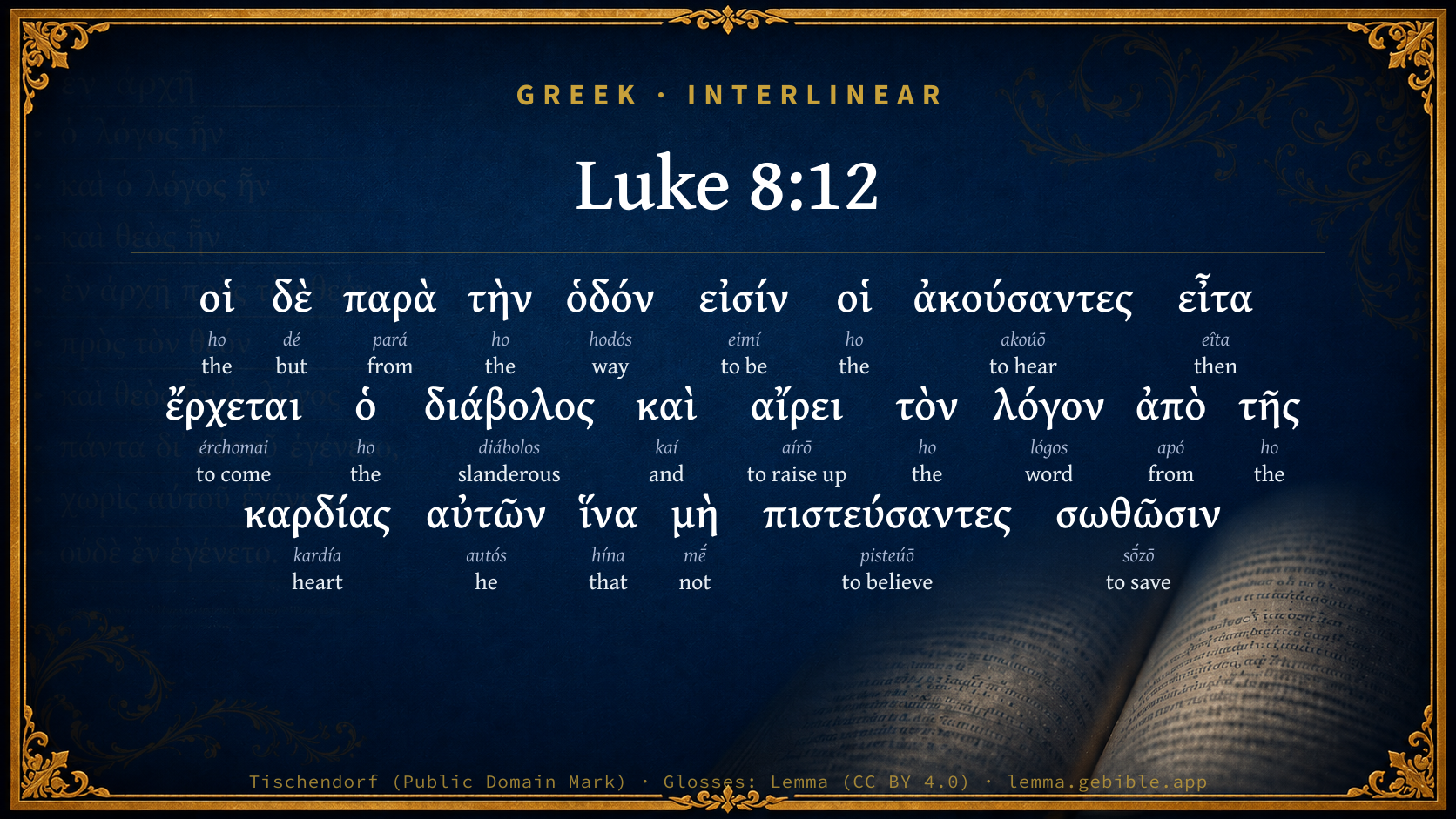
Greek (Tischendorf 8th ed.) Luke 8:12 appears in the Greek New Testament. The text above is from the Tischendorf 8th edition. Each word links to its Strong’s number and a concise gloss. Click any word for its full Thayer’s Greek Lexicon entry.
Download image
Cite this verse

Luke 8:12 (World English Bible). Public Domain. Lemma interlinear Bible study tool, https://lemma.gebible.app/v/luke/8/12.

Show BibTeX & RIS
BibTeX
RIS
English Translation
Those along the road are those who hear, then the devil comes, and takes away the word from their heart, that they may not believe and be saved.
World English Bible · Public Domain
Download a study sheet

One document with this verse’s original text, its word-by-word gloss line, the meaning frame, cross-references with their text, attributed commentary, and full source and license credits — printable, and it pastes into notes with its structure intact.

This verse Autodidact and up

Study sheet (.html) Plain text (.txt)

A passage Seminary Student

Up to 50 verses in one chapter. A passage sheet keeps up to 6 commentary sources and 12 cross-references per verse, in the order this page ranks them, and says so on the sheet whenever that leaves anything out. Ask for a single verse and you get the Autodidact verse sheet above.

Everything on this page stays free to read, with no account — the sheet is a download of what is already on screen, not access to it.

Want to remove ads? Support Godless Engineer
Compare translations 3

The same verse in 3 English versions, stacked beneath the original-language interlinear above. Click any original word for its lexicon entry.

Each is an independent rendering of the whole verse — the interlinear is not word-aligned to these translations.

Highlighted words mark where these versions differ — a whole-verse word diff, not a word-by-word alignment.

  • World English Bible Public Domain
    Those along the road are those who hear, then the devil comes, and takes away the word from their heart, that they may not believe and be saved.
  • King James Version Public Domain
    Those by the way side are they that hear; then cometh the devil, and taketh away the word out of their hearts, lest they should believe and be saved.
  • unfoldingWord Literal Text CC BY-SA 4.0
    And the ones along the path are the ones having heard, but then the devil comes and takes away the word from their hearts, so they may not believe be saved.

unfoldingWord Literal Text — © unfoldingWord, licensed CC BY-SA 4.0. Word-aligned USFM3 via Door43 (git.door43.org/unfoldingWord/en_ult).

Versions to compare (up to 4)

3 of 4 selected

Show all 19 translations

Every available English version of this verse, each an independent rendering of the whole verse.

  • World English Bible Public Domain
    Those along the road are those who hear, then the devil comes, and takes away the word from their heart, that they may not believe and be saved.
  • Berean Standard Bible Public Domain
    The seeds along the path are those who hear, but the devil comes and takes away the word from their hearts, so that they may not believe and be saved.
  • Majority Standard Bible Public Domain
    The seeds along the path are those who hear, but the devil comes and takes away the word from their hearts, so that they may not believe and be saved.
  • King James Version Public Domain
    Those by the way side are they that hear; then cometh the devil, and taketh away the word out of their hearts, lest they should believe and be saved.
  • American Standard Version (1901) Public Domain
    And those by the way side are they that have heard; then cometh the devil, and taketh away the word from their heart, that they may not believe and be saved.
  • Revised Version (1885) Public Domain
    And those by the way side are they that have heard; then cometh the devil, and taketh away the word from their heart, that they may not believe and be saved.
  • Geneva Bible (1599) Public Domain
    And they that are beside the way, are they that heare: afterward commeth the deuill, and taketh away the worde out of their hearts, least they should beleeue, and be saued.
  • Douay-Rheims (1899) Public Domain
    And they by the way side are they that hear; then the devil cometh, and taketh the word out of their heart, lest believing they should be saved.
  • Young's Literal Translation Public Domain
    and those beside the way are those hearing, then cometh the Devil, and taketh up the word from their heart, lest having believed, they may be saved.
  • Literal Standard Version CC BY-SA 4.0
    and those beside the way are those hearing, then comes the Devil, and takes up the word from their heart, lest having believed, they may be saved.
  • Unlocked Literal Bible CC BY-SA 4.0
    The ones along the path are those who have heard, but then the devil comes and takes away the word from their hearts, so they may not believe and be saved.
  • unfoldingWord Literal Text CC BY-SA 4.0
    And the ones along the path are the ones having heard, but then the devil comes and takes away the word from their hearts, so they may not believe be saved.
  • Darby Bible Public Domain
    But those by the wayside are those who hear; then comes the devil and takes away the word from their heart that they may not believe and be saved.
  • World Messianic Bible Public Domain
    Those along the road are those who hear; then the devil comes and takes away the word from their heart, that they may not believe and be saved.
  • Webster's Bible Public Domain
    Those by the way side, are they that hear; then cometh the devil, and taketh away the word out of their hearts, lest they should believe and be saved.
  • Free Bible Version CC BY-SA 4.0
    The seeds that fall on the road are those who hear the message, but then the devil comes and steals away the truth from their minds so they won't trust in God and be saved.
  • Bible in Basic English Public Domain
    Those by the side of the road are those who have given hearing; then the Evil One comes and takes away the word from their hearts, so that they may not have faith and get salvation.
  • Text-Critical English NT CC BY 4.0
    The ones along the path are those who hear; then the devil comes and takes away the word from their heart, so that they may not believe and be saved.
  • Tyndale New Testament (1534) Public Domain
    Thoose that are besyde the waye are they that heare and afterwarde cometh the devyll and taketh awaye the worde out of their hertes lest they shuld beleve and be saved.

Literal Standard Version (2020), Covenant Press — licensed CC BY-SA 4.0. Text via the HelloAO Bible API (eBible.org). Unlocked Literal Bible (unfoldingWord) — licensed CC BY-SA 4.0. Text via the HelloAO Bible API (eBible.org). unfoldingWord Literal Text — © unfoldingWord, licensed CC BY-SA 4.0. Word-aligned USFM3 via Door43 (git.door43.org/unfoldingWord/en_ult). Free Bible Version, Dr. Jonathan Gallagher — licensed CC BY-SA 4.0. Text via the HelloAO Bible API (eBible.org).

Word by word

More ways to search: Search by grammar → Find every occurrence → Compare this word →

Practice this passage: Drill this verse → Learn its vocabulary →

εἶτα
eîta
G1534
“then”
Adverb
Part of Speech
Adverb
Full Thayer's Definition

Origin: of uncertain affinity

TDNT: None

1. then 2. next, after that
  1. οἱ ho G3588 “the” Article, Nominative, Plural, Masculine
  2. δὲ dé G1161 “but” Conjunction
  3. παρὰ pará G3844 “from” Preposition
  4. τὴν ho G3588 “the” Article, Accusative, Singular, Feminine
  5. ὁδόν hodós G3598 “way” Noun, Accusative, Singular, Feminine
  6. εἰσίν eimí G1510 “to be” Verb, Present, Active, Indicative, 3rd person, Plural
  7. οἱ ho G3588 “the” Article, Nominative, Plural, Masculine
  8. ἀκούσαντες akoúō G191 “to hear” Verb, Aorist, Active, Participle, Nominative, Plural, Masculine
  9. ἔρχεται érchomai G2064 “to come” Verb, Present, Middle or Passive deponent, Indicative, 3rd person, Singular
  10. ὁ ho G3588 “the” Article, Nominative, Singular, Masculine
  11. διάβολος diábolos G1228 “slanderous” Adjective, Nominative, Singular, Masculine
  12. καὶ kaí G2532 “and” Conjunction
  13. αἴρει aírō G142 “to raise up” Verb, Present, Active, Indicative, 3rd person, Singular
  14. τὸν ho G3588 “the” Article, Accusative, Singular, Masculine
  15. λόγον lógos G3056 “word” Noun, Accusative, Singular, Masculine
  16. ἀπὸ apó G575 “from” Preposition
  17. τῆς ho G3588 “the” Article, Genitive, Singular, Feminine
  18. καρδίας kardía G2588 “heart” Noun, Genitive, Singular, Feminine
  19. αὐτῶν autós G846 “he” Personal pronoun, Genitive, Plural, Masculine
  20. ἵνα hína G2443 “that” Conjunction
  21. μὴ mḗ G3361 “not” Particle, Negative
  22. πιστεύσαντες pisteúō G4100 “to believe” Verb, Aorist, Active, Participle, Nominative, Plural, Masculine
  23. σωθῶσιν sṓzō G4982 “to save” Verb, Aorist, Passive, Subjunctive, 3rd person, Plural

About this verse

These counts appear in no published source. They are computed here, from the morphology-tagged text and Lemma’s own curated glosses. What Lemma adds →

24
words
19
distinct lemmas
Gospels
section

Notable vocabulary

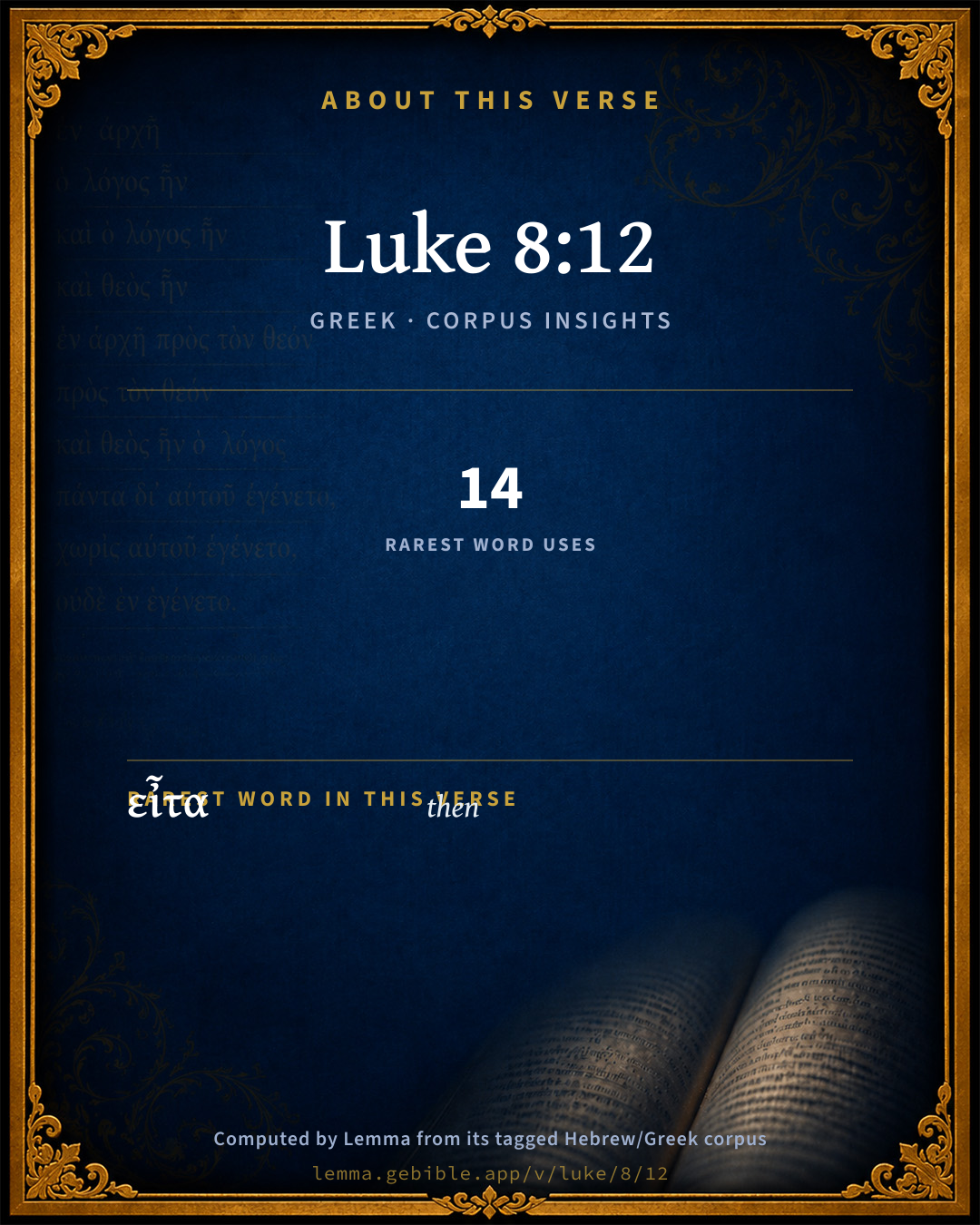
The rarest word here is εἶτα then G1534 — appearing just 14 times in the whole Greek New Testament.

Shared distinctive vocabulary

εἶτα then G1534 occurs in 13 verses of the Greek New Testament. Also found in:

Repetition

A word recurs within this verse:

Cross-references

10

Topical passages linked to Luke 8:12 in the Treasury of Scripture Knowledge — connected by theme and wording, ordered by reader-vote popularity; previews shown in the World English Bible.

  • 2 Thessalonians 2:9–14 even he whose coming is according to the working of Satan with all power and signs and lying wonders,
  • Matthew 13:19 When anyone hears the word of the Kingdom, and doesn't understand it, the evil one comes, and snatches away that which has been sown in his heart. This is what was sown by the roadside.
  • Revelation 12:9 The great dragon was thrown down, the old serpent, he who is called the devil and Satan, the deceiver of the whole world. He was thrown down to the earth, and his angels were thrown down with him.
  • Proverbs 1:24–26 Because I have called, and you have refused; I have stretched out my hand, and no one has paid attention;
  • Mark 4:15 These are the ones by the road, where the word is sown; and when they have heard, immediately Satan comes, and takes away the word which has been sown in them.
  • Proverbs 4:5 Get wisdom. Get understanding. Don't forget, neither swerve from the words of my mouth.
  • James 1:23–24 For if anyone is a hearer of the word and not a doer, he is like a man beholding his natural face in a mirror;
  • Proverbs 1:29 Because they hated knowledge, And didn't choose the fear of Yahweh.
  • Isaiah 65:11 But you who forsake Yahweh, who forget my holy mountain, who prepare a table for Fortune, and who fill up mixed wine to Destiny;
  • Luke 8:5 "The farmer went out to sow his seed. As he sowed, some fell along the road, and it was trampled under foot, and the birds of the sky devoured it.

Cross-references courtesy of OpenBible.info (CC BY 4.0).

Commentary

Notes on Luke 8:12 from classic Christian and Jewish commentators (each source and its license shown beneath its notes). The classic Christian expositions comment on the surrounding passage and are grouped to its opening verse, so a note may address several verses; the Jewish commentaries on the Tanakh (Rashi and others) are per-verse, so they appear only where the commentator wrote on this verse.

Lemma curates 59 commentaries, every one of them public domain or Creative Commons licensed, each selected and text-cleaned for this edition rather than reprinted as found. About our sources →

The Biblical Illustrator

Joseph S. Exell

Luk_8:12

Then cometh the devil

The devils punctuality, power, and purpose

I.

First observe the evil ones PUNCTUALITY. NO sooner does the seed fall than the fowls devour it. Our text says then, that is, there and then, cometh the devil. Mark renders it, Satan cometh immediately. Whoever else may loiter, Satan never does. No sooner does a camel fall dead in the wilderness than the vultures appear. Not a bird was visible, nor did it seem possible that there could be one within a radius of many miles, yet speedily there are specks in the sky, and soon the devourers are gorging themselves with flesh: even thus do the spirits of evil scent their prey from afar, end hasten to their destroying work h little delay might put the case beyond Satanic power, hence the prompitude of diabolic activity.

II. Notice his POWER. It is not said that he tries to do it, but that he actually does so. He sees, he comes, and he conquers. His power is partly derived from his natural sagacity. He is more than a match for preacher and hearer united if the Holy Spirit be not there to baffle him. He has also acquired fresh cunning by long practice in his accursed business. Moreover, he derives his chief power from the mans condition of soul: it is easy for birds to pick up seed which lies exposed on a trodden path.

III. His PURPOSE. Lest they should believe and be saved Satan takes away the Word out of their hearts. Here also is wisdom--wisdom hidden within the enemys cunning. If the gospel remains in contact with the heart its tendency is to produce faith. (C. H. Spurgeon.)

Inattentive hearers

I. WHAT IS FAITH? I answer, it is a firm persuasion of the truth of the gospel, accompanied with a deep sense of its importance, and a cordial acceptance of its gracious proposals; and so producing the genuine fruits of love and obedience. We have heard the gospel. Have we believed it? Have we received it in the love of it? and are our hearts and lives influenced and governed by it?

II. To speak of THE SALVATION PROMISED TO THEM THAT BELIEVE.

1. A salvation from moral evil.

2. A salvation from natural evil. Not that good men are exempted from the common afflictions of life. But they are converted into blessings for them, and they are provided with all needful supports under their afflictions.

3. A deliverance also from penal evil

III. THE CONNECTION BETWEEN FAITH AND SALVATION. It is necessary, in order to our being saved, that we believe. Now this necessity arises out of the Divine appointment, and the reason and nature of the thing.

1. It is the will of God, that those who are saved should believe.

2. There is a fitness or suitableness in faith to the end of its appointment, so that the necessity of it arises out of the nature of the thing itself. No sober man who contemplates faith, accompanied with those dispositions and affections necessary to constitute a real Christian, can pronounce it an unreasonable and useless thing. And how is that good to be possessed without a temper of heart suited to the enjoyment of it? And how is this temper to be acquired but by believing? Thus have we considered the nature of faith, described the salvation promised to it, and shown the connection between the one and the other. Let us now return to the argument in the text. Satan clearly perceiving the influence of faith in the great business of salvation, and well knowing, too that faith comes by hearing, uses all his artifices to divert mens attention from the Word, and to prevent its salutary effect upon their hearts.

It now remains that we make two or three reflections on the general subject of this discourse.

1. If Satan takes the measures you have heard to prevent the success of the gospel, and to confirm men in impenitence and unbelief, how truly is he denominated by our Saviour the wicked one, and how righteous is that sentence which will shortly be executed upon him!

2. How much is it to be lamented that men will suffer themselves to be deceived and ruined by the devices of this great adversary!

3. And lastly, Let us admire and adore the grace of God which defeats the designs of Satan, and makes the Word effectual upon the hearts of multitudes, notwithstanding all the opposition it meets with. (S. Stennett, D. D.)

The fowls of the air

Satans power would be far less formidable if it extended to our circumstances only, and did not reach to our mind. We have, however, the express testimony of the Word of God that it does reach thus far; and it is this district of Satanic power which I purpose now to investigate.

1. With those faculties of mind, if there be any, which are purely intellectual, which do not in any way determine or affect moral character and conduct, it cannot be supposed that the great enemy of mankind busies himself at all.

2. Perhaps, however, there are fewer powers which are purely intellectual than we are accustomed to imagine. The mind and heart of man are very closely and subtly kneaded up together. Certain it is that there are certain faculties which, more or less, belong to both elements, of which it is hard to say whether they are more intellectual or moral.

3. One of these is memory. The agency of the fowls in the parable is external; it is not in the soil itself, nor is it connected with the soil; and in like manner, the foe who removes the seed from the heart, that is, from the memory of man, is external. In this parable you have the hosts or tribes of the air doing the work of the prince of the power of the air.

4. Thus, for all who recognize the words of Christ as being the very truth of God, it seems to be a settled point, resting upon the authority of the Master, that Satan exercises a certain power over the memory.

5. I turn with a sense of relief from this dark part of the subject to notice the immense power for good which the memory has under a guidance much greater than that of Satan--the guidance of the grace of God.

6. In conclusion, let the memories of the young be thoroughly charged with the Word of God. (Dean Goulburn.)

Transient piety

Beloved, how many professors fail in this respect. They follow the Lord by fits and starts; they go out from us because they are not of us; for if they had been of us, doubtless they would have continued with us. They leap into religion as the flying-fish leaps into the air; they fall back again into their sins, as the same fish returns to its element. They make a great flame for a time like the crackling of thorns, but lo! the flame has soon expired, for they are not like the miraculous bush which burned, God dwells not in them. (C. H. Spurgeon.)

Lack of continuance

The great trial of our Christian life is at this point. Will we continue? Thousands of girls begin to practise at the piano; thousands make no small attainment; but only the scores continue, and become eminent. Half a college class, at some time or other, begin to collect a cabinet or herbarium, but only here and there one perseveres. After years have elapsed that one has become, perhaps, possessed of a wonderful treasury, and is, perhaps, also in the way of renown. All, or nearly all, of this is due to his gift of continuance. One day I was looking at a fruit-bearing passion-vine, covering half the side of a friends house, vigorous, graceful. That friend showed me two or three little, tiny, frail-looking specimens of the same in a box. Why, said she, I keep the box full of seeds, but only a few of them germinate. They are so slow in germinating, too. It takes two or three months for one to make its appearance. How many persons there are who would never have any noble passion-vine climbing in beauty about their dwelling, simply because they have no grace of continuing to care for the plant in the slow months of its early life. (A. L. Stone.)

The Biblical Illustrator, edited by Joseph S. Exell (c. 1880s–1900s) — public domain. Text from a community e-Sword module.

Tyndale Open Study Notes

Tyndale Open Resources

8:12 to have the devil come and take it away: Satan seeks to prevent unbelievers from seeing the truth.

Tyndale Open Study Notes — © Tyndale Open Resources, licensed CC BY-SA 4.0. Text via the HelloAO Bible API.

Bengel's Gnomon

Johann Albrecht Bengel

Luk 8:12. Ἀπὸ τῆς καρδίας, out of their heart) Implying the great power of the Devil; [who, however, has less power on the second and third classes mentioned in this place than on the first.—V. g.]—πιστεύσαντες, having believed) We are saved by the word through faith: Luk 8:13. Faith is the appropriate fruit of the word.

Bengel's Gnomon of the New Testament — English translation (T&T Clark, Edinburgh, 1860) — public domain. Text from a community e-Sword module.

Expositor's Greek Testament

ed. W. Robertson Nicoll

Luk 8:12 . οἱ ἀκούσαντες : this is not a sufficient definition of the wayside hearers; all the classes described heard. The next clause, beginning with εἰτα , must be included in the definition = the wayside men are persons in whose case, so soon as they have heard, cometh, etc. ὁ διάβολος : each gospel has a different name for the evil one; ὁ πονηρὸς , Mt., ὁ σατανᾶς , Mk. ἵνα μὴ πιστεύσαντες σωθῶσιν , lest believing they should be saved; peculiar to Lk., and in expression an echo of St. Paul and the apostolic age.

The Expositor's Greek Testament, edited by W. Robertson Nicoll (1897–1910) — public domain. Text from a community e-Sword module.

Adam Clarke's Commentary

Verse 12. Those by the way side] Bishop PEARCE thinks that Luke by ον here means σποροι, the seeds, though he acknowledges that he has never found such a word as σποροι in the plural number signifying seeds.

Adam Clarke's Commentary on the Bible (1810–1826) — public domain. Text from a community e-Sword/MySword module.

Ellicott's Commentary for English Readers

(12) Then cometh the devil.—Note St. Luke’s use of this word instead of the “Satan” of St. Mark and “the wicked one” of St. Matthew, and his fuller statement of the purpose, “lest they should believe and be saved.”

A Bible Commentary for English Readers, edited by Charles John Ellicott (1878–1897) — public domain. Text from a community e-Sword module.

The Cambridge Bible for Schools and Colleges

gen. ed. J. J. S. Perowne

12. Those by the way side] These are hearers who are hardened— either beaten (i) flat by lifeless familiarity—heartless formalists, Pharisaic theologians, and insincere professors; or (ii) by perversity and indifference, the habit and custom of a worldly and dissolute life. Notice the intensity of thought which identifies the scattered seeds with those in whose hearts they are sown. “The way is the heart beaten and dried by the passage of evil thoughts.” H. de S. Victore.

the devil] The Accuser or Slanderer. St Mark has “the wicked one,” St Matthew “Satan.” taketh away] “Snatches,” Mat_13:19.—It is done in a moment; by a smile at the end of the sermon; by a silly criticism at the Church door; by foolish gossip on the way home. These are “the fowls of the air” whom the Evil One uses in this task.

lest they should believe] Rather, that they may not believe. “Therefore we ought to give the more earnest heed to the things which we have heard, lest at any time we should let them slip,” or rather “drift away from them,” Heb_2:1.

The Cambridge Bible for Schools and Colleges (gen. ed. J. J. S. Perowne; Cambridge University Press, 1878–1918) — public domain. Text from a community e-Sword module.

John Gill's Exposition

They on the rock are they, which when they hear,.... The seed that fell upon the rock, or stony ground, signify such sort of hearers,

who receive the word with joy. The Ethiopic version reads, "with joy of heart". But, this sort of hearers receive not the word into their hearts, or with their hearts believe it, and from their hearts obey it, only into their heads; and have only, an historical faith of it; nor with hearty, spiritual, solid joy, or joy in the Holy Ghost: for their hearts remain like a rock, unbroken by the word; but with a flash of natural affection, which quickly goes off.

And these have no root; neither "in themselves", as the other evangelists say, they have no true grace in them; nor have they any root in Christ, nor in the love of God:

which for a while believe: their faith is a temporary one, like that of Simon Magus; which shows it is not true faith; for that is an abiding grace, Christ, who is the author, is the finisher of it, and prays for it, that it fail not. The Persic version renders it, "in the time of hearing they have faith"; and such sort of hearers there are, who, whilst they are hearing, assent to what they hear, but when they are gone, either forget it, or, falling into bad company, are prevailed upon to doubt of it, and disbelieve it. The Arabic version renders it, "they believe for a small time"; their faith do not continue long, nor their profession of it, both are soon dropped:

and in the time of temptation fall away: "or go back", as the Vulgate Latin version, they draw back unto perdition; or "forsake that", as the Arabic version reads, the word, they have heard, and received, their faith in it, and profession of it: "and soon become apostates", as the Persic version renders it. By "the time of temptation", is not meant any particular and sore temptation of Satan, but a time of affliction and persecution, as appears from the other evangelists; which is a trying time to professors of religion, and when those who have not the root of the matter in them, fall away.

John Gill's Exposition of the Whole Bible (1746–1763) — public domain (CC PDM 1.0). Text via the HelloAO Bible API.

Trapp's Complete Commentary

John Trapp

12 Those by the way side are they that hear; then cometh the devil, and taketh away the word out of their hearts, lest they should believe and be saved.

Ver. 12. Taketh away the word] Lest, if it should lie long upon their hard hearts, it should break through them with its weight, as being able to save their souls, Jas 1:21.

John Trapp, A Commentary or Exposition upon All the Books of the Old and New Testament (1647–1656) — public domain. Text from a community e-Sword module.

The Pulpit Commentary

Those by the wayside are they that hear; then cometh the devil, and taketh away the Word out of their hearts, lest they should believe and be saved. The wayside hearers represent the great outer circle of men and women who more or less respect religion. It must be carefully borne in mind that in none of the four classes pictured in the parable are despisers of God, declared enemies of religion, portrayed. To these the gospel, with its warnings and its promises, rarely if ever speaks. These of "the wayside" are they whose hearts resemble a footpath, beaten hard and fiat by the constant passing to and fro of wishes of the flesh, of thoughts concerning earthly things, mere sordid hopes and fears. Into these hearts the Word can never really penetrate. Momentary influence now anti again seems to have been gained, but the many watchful agents of the evil one, with swift wings, like birds of the air, swoop down and snatch away the scattered seed which for a moment seemed as though it would take root. Judas Iscariot the Jew, and Pontius Pilate the Roman, might be instanced as types of this class. These before their awful fate both appeared to have been moved. The one for long months followed the Lord and was trusted by him; the other pitied, and for a moment in his Pilate"s case pity seemed passing into love and admiration, and tried to find a way of escape for the innocent Prisoner. But the one betrayed, and the other delivered to death, the sinless Son of God!

The Pulpit Commentary (1880–1919), ed. H.D.M. Spence-Jones & Joseph S. Exell — public domain. Text from a community e-Sword module.

Scofield Reference Notes

C. I. Scofield

saved

(See Scofield "Rom 1:16")

The Scofield Reference Bible (1917 edition), notes by C. I. Scofield — public domain. Text from a community e-Sword module.

Cambridge Greek Testament for Schools and Colleges

12. ἀκούσαντες אBL and most edd.

12. οἱ δὲ παρὰ τὴν ὁδόν. The prepositions are used with accurate variety, παρὰ τὴν ὁδόν, ἐπὶ τῆς πέτρας, εἰς τὰς ἀκάνθας, ἐν τῇ καλῇ γῇ. The word σπαρέντες must be understood from σπόρος. The seed is (grammatically) identified with those into whose hearts it is sown. More definitely the phrase would have been ‘The seed sown by the wayside indicates the moral condition of those who, &c.’ Notice the intensity of thought which identifies the scattered seeds with those in whose hearts they are sown. “The way is the heart beaten and dried by the passage of evil thoughts.” H. de S. Victore. These are hearers who are hardened—either beaten flat (i) by lifeless familiarity—heartless formalists, Pharisaic theologians, and insincere professors; or (ii) by perversity and indifference, the habit and custom of a worldly and dissolute life.

ὁ διάβολος. The Accuser or Slanderer. St Mark has “the wicked one,” St Matthew, “Satan.”

αἴρει. ‘Snatches,’ Mat 13:19.—It is done in a moment; by a smile at the end of the sermon; by a silly criticism at the church door; by foolish gossip on the way home. These are “the fowls of the air” whom the Evil One uses in this task.

ἀπὸ τῆς καρδίας αὐτῶν, not as in A.V[176], “out of their hearts,” for the prep. is not ἐκ but ἀπό, “from their heart.” The seed had not sunk in; it only lay on the surface.

[176] A.V. Authorised Version.

ἵνα μὴ πιστεύσαντες σωθῶσιν. ‘That they may not by believing be saved.’ “Therefore we ought to give the more earnest heed to the things which we have heard, lest at any time we should let them slip,” or rather “drift away from them,” Heb 2:1.

Cambridge Greek Testament for Schools and Colleges (Cambridge University Press, 1896; 21 vols, various authors incl. Carr, Maclear, Plummer, Farrar, Lumby, Moule, M. R. James, Simcox) — public domain. Text from a community e-Sword module.

International Critical Commentary

12. οἱ δὲ παρὰ τὴν ὁδόν. There is no need to understand σπαρέντες, as is clear from Mar 4:15. “Those by the wayside” is just as intelligible as “Those who received seed by the wayside.”

εἶτα ἔρχεται ὁ διάβολος. Much more vivid than “And the birds are the devil.” This is Christ’s own interpretation of the birds, and it is strong evidence for the existence of a personal devil. Why did not Jesus explain the birds as meaning impersonal temptations? He seems pointedly to insist upon a personal adversary. See on 10:18. Mt. has ὁ πονηρός Mk. ὁ σατανᾶς The concluding words are peculiar to Lk.: “in order that they may no by believing be saved.” Perhaps a sign of Pauline influence.

International Critical Commentary — older volumes (1896–1929), various authors — public domain. Text from a community e-Sword module.

Lesson kit

Teaching starters — assembled from the data on this page, not authored interpretation. Every prompt links to the verse data it draws on. Edit before teaching.

Luke, in the Gospels, opens this verse with 24 words (19 distinct Greek lemmas). Its most distinctive word is eîta (“then”). A historical commentator’s framing appears above. Read the whole chapter for the surrounding context.

Discussion questions

  1. The word eîta carries the sense “then.” How does it shape the verse?
  2. Mark 4:17 shares the word «then» with this verse. How do the two illuminate each other?
  3. “the” occurs 6× in this one verse. What is the effect of the repetition?
  4. The translations on this page render this verse differently — a whole-verse word diff, not a word-by-word alignment. What might account for the different wordings?
  5. Reading how The Biblical Illustrator and Tyndale Open Study Notes read this verse, where do the two commentators agree and where do they part?

Things to notice

Reading settings

Reading text

Shown beneath each verse's original-language words.

Old Testament
Old Testament edition

Read the OT as the Masoretic Hebrew (MT) or the Greek Septuagint (LXX).

English shown for the Greek Septuagint (in the Hebrew ↔ Greek comparison).

Comparing translations? Open the Compare panel on any verse page to stack up to four side by side.