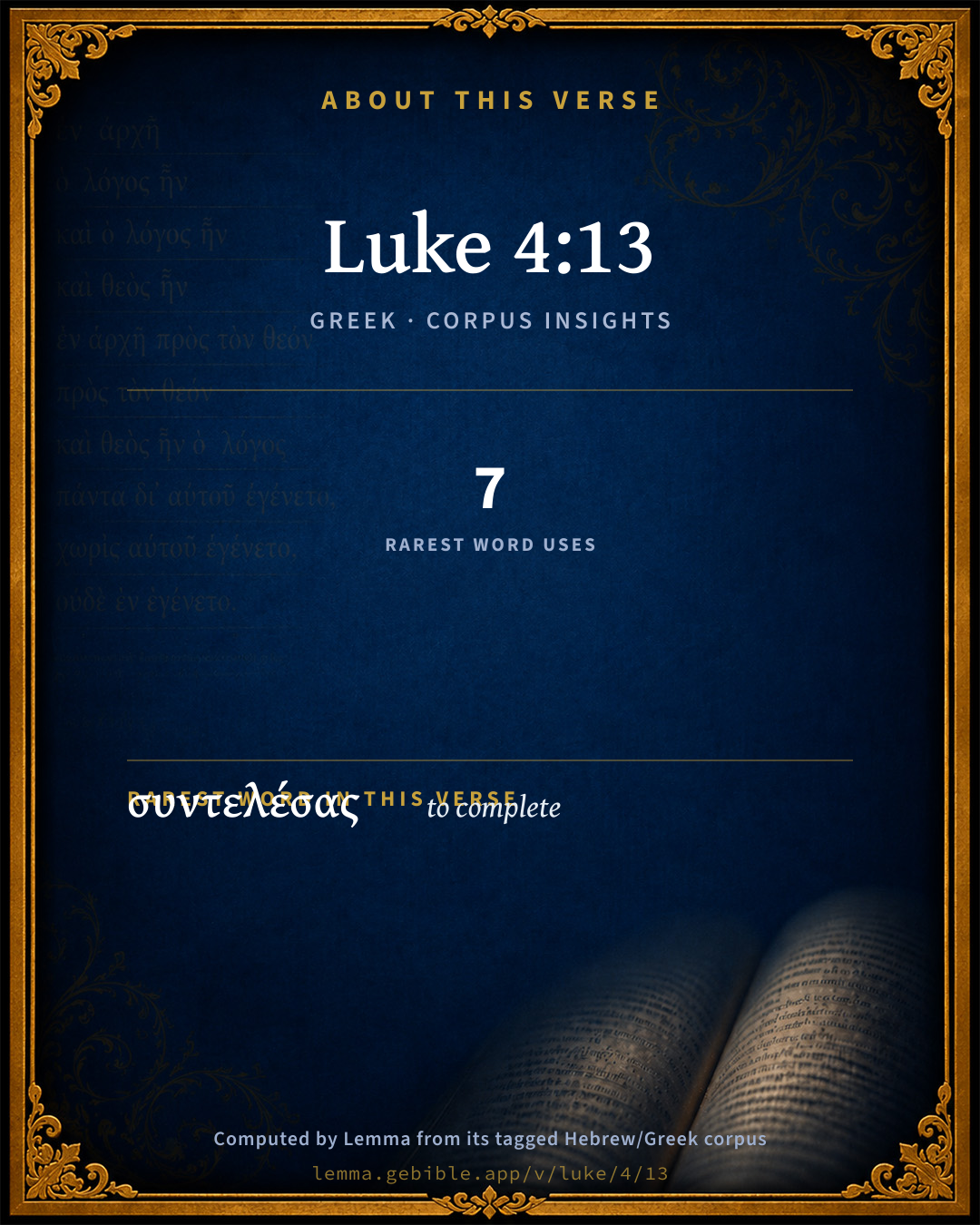
Luke 4:13

Greek (Tischendorf 8th ed.) Luke 4:13 appears in the Greek New Testament. The text above is from the Tischendorf 8th edition. Each word links to its Strong’s number and a concise gloss. Click any word for its full Thayer’s Greek Lexicon entry.
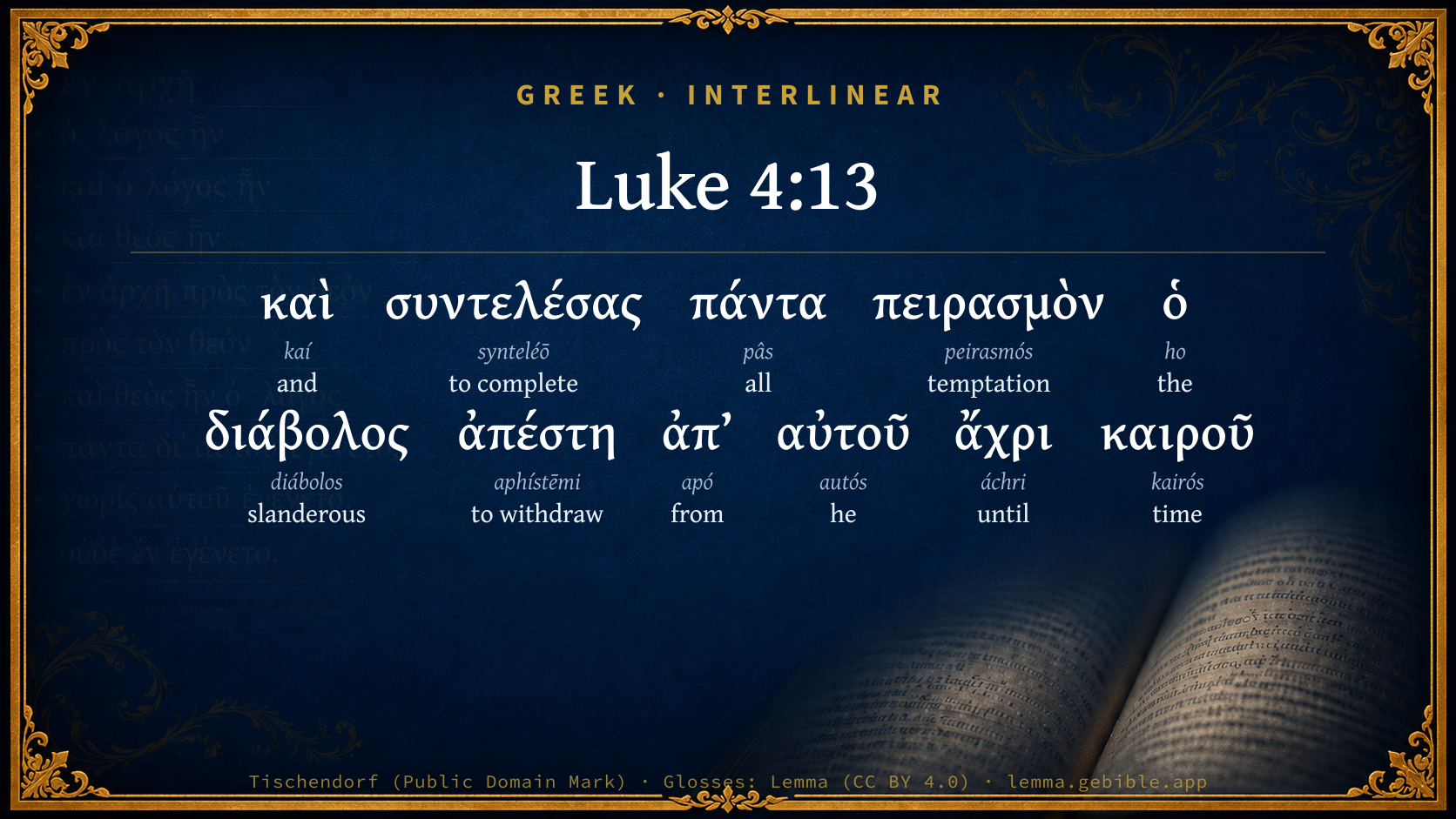
Download image
Cite this verse

Luke 4:13 (World English Bible). Public Domain. Lemma interlinear Bible study tool, https://lemma.gebible.app/v/luke/4/13.

Show BibTeX & RIS
BibTeX
RIS
English Translation
When the devil had completed every temptation, he departed from him until another time.
World English Bible · Public Domain
Download a study sheet

One document with this verse’s original text, its word-by-word gloss line, the meaning frame, cross-references with their text, attributed commentary, and full source and license credits — printable, and it pastes into notes with its structure intact.

This verse Autodidact and up

Study sheet (.html) Plain text (.txt)

A passage Seminary Student

Up to 50 verses in one chapter. A passage sheet keeps up to 6 commentary sources and 12 cross-references per verse, in the order this page ranks them, and says so on the sheet whenever that leaves anything out. Ask for a single verse and you get the Autodidact verse sheet above.

Everything on this page stays free to read, with no account — the sheet is a download of what is already on screen, not access to it.

Want to remove ads? Support Godless Engineer
Compare translations 3

The same verse in 3 English versions, stacked beneath the original-language interlinear above. Click any original word for its lexicon entry.

Each is an independent rendering of the whole verse — the interlinear is not word-aligned to these translations.

Highlighted words mark where these versions differ — a whole-verse word diff, not a word-by-word alignment.

  • World English Bible Public Domain
    When the devil had completed every temptation, he departed from him until another time.
  • King James Version Public Domain
    And when the devil had ended all the temptation, he departed from him for a season.
  • unfoldingWord Literal Text CC BY-SA 4.0
    And having finished every temptation, the devil went away from him until an opportune time.

unfoldingWord Literal Text — © unfoldingWord, licensed CC BY-SA 4.0. Word-aligned USFM3 via Door43 (git.door43.org/unfoldingWord/en_ult).

Versions to compare (up to 4)

3 of 4 selected

Show all 19 translations

Every available English version of this verse, each an independent rendering of the whole verse.

  • World English Bible Public Domain
    When the devil had completed every temptation, he departed from him until another time.
  • Berean Standard Bible Public Domain
    When the devil had finished every temptation, he left Him until an opportune time.
  • Majority Standard Bible Public Domain
    When the devil had finished every temptation, he left Him until an opportune time.
  • King James Version Public Domain
    And when the devil had ended all the temptation, he departed from him for a season.
  • American Standard Version (1901) Public Domain
    And when the devil had completed every temptation, he departed from him for a season.
  • Revised Version (1885) Public Domain
    And when the devil had completed every temptation, he departed from him for a season.
  • Geneva Bible (1599) Public Domain
    And when the deuil had ended all the tentation, he departed from him for a litle season.
  • Douay-Rheims (1899) Public Domain
    And all the temptation being ended, the devil departed from him for a time.
  • Young's Literal Translation Public Domain
    And having ended all temptation, the Devil departed from him till a convenient season.
  • Literal Standard Version CC BY-SA 4.0
    And having ended all temptation, the Devil departed from Him until a convenient season.
  • Unlocked Literal Bible CC BY-SA 4.0
    When the devil had finished testing Jesus, he went away and left him until another time.
  • unfoldingWord Literal Text CC BY-SA 4.0
    And having finished every temptation, the devil went away from him until an opportune time.
  • Darby Bible Public Domain
    And the devil, having completed every temptation, departed from him for a time.
  • World Messianic Bible Public Domain
    When the devil had completed every temptation, he departed from him until another time.
  • Webster's Bible Public Domain
    And when the devil had ended all the temptation, he departed from him for a season.
  • Free Bible Version CC BY-SA 4.0
    When the devil had completed all his temptations, he waited for another opportunity.
  • Bible in Basic English Public Domain
    And when all these tests were ended the Evil One went away from him for a time.
  • Text-Critical English NT CC BY 4.0
    And when the devil had finished all these temptations, he left him until an opportune time.
  • Tyndale New Testament (1534) Public Domain
    Assone as the devyll had ended all his temptacions he departed from him for a season.

Literal Standard Version (2020), Covenant Press — licensed CC BY-SA 4.0. Text via the HelloAO Bible API (eBible.org). Unlocked Literal Bible (unfoldingWord) — licensed CC BY-SA 4.0. Text via the HelloAO Bible API (eBible.org). unfoldingWord Literal Text — © unfoldingWord, licensed CC BY-SA 4.0. Word-aligned USFM3 via Door43 (git.door43.org/unfoldingWord/en_ult). Free Bible Version, Dr. Jonathan Gallagher — licensed CC BY-SA 4.0. Text via the HelloAO Bible API (eBible.org).

Word by word

More ways to search: Search by grammar → Find every occurrence → Compare this word →

Practice this passage: Drill this verse → Learn its vocabulary →

συντελέσας
synteléō
G4931
“to complete”
Verb, Aorist, Active, Participle, Nominative, Singular, Masculine
Part of Speech
Verb
Tense
Aorist
Voice
Active
Mood
Participle
Case
Nominative
Number
Singular
Gender
Masculine
Full Thayer's Definition

Origin: from G4862 and G5055

TDNT: 09:02,1

1. to end together or at the same time 2. to end completely a. bring to an end, finish, complete 3. to accomplish, bring to fulfilment a. to come to pass 4. to effect, make, (conclude) 5. to finish a. to make an end of b. to bring to an end c. destroy
  1. καὶ kaí G2532 “and” Conjunction
  2. πάντα pâs G3956 “all” Adjective, Accusative, Singular, Masculine
  3. πειρασμὸν peirasmós G3986 “temptation” Noun, Accusative, Singular, Masculine
  4. ὁ ho G3588 “the” Article, Nominative, Singular, Masculine
  5. διάβολος diábolos G1228 “slanderous” Adjective, Nominative, Singular, Masculine
  6. ἀπέστη aphístēmi G868 “to withdraw” Verb, Aorist, Active, Indicative, 3rd person, Singular
  7. ἀπ’ apó G575 “from” Preposition
  8. αὐτοῦ autós G846 “he” Personal pronoun, Genitive, Singular, Masculine
  9. ἄχρι áchri G891 “until” Adverb
  10. καιροῦ kairós G2540 “time” Noun, Genitive, Singular, Masculine

About this verse

These counts appear in no published source. They are computed here, from the morphology-tagged text and Lemma’s own curated glosses. What Lemma adds →

11
words
11
distinct lemmas
Gospels
section

Notable vocabulary

The rarest word here is συντελέσας to complete G4931 — appearing just 7 times in the whole Greek New Testament.

Shared distinctive vocabulary

συντελέσας to complete G4931 occurs in 7 verses of the Greek New Testament. Also found in:

Cross-references

4

Topical passages linked to Luke 4:13 in the Treasury of Scripture Knowledge — connected by theme and wording, ordered by reader-vote popularity; previews shown in the World English Bible.

  • James 4:7 Be subject therefore to God. But resist the devil, and he will flee from you.
  • Hebrews 4:15 For we don't have a high priest who can't be touched with the feeling of our infirmities, but one who has been in all points tempted like we are, yet without sin.
  • Matthew 4:11 Then the devil left him, and behold, angels came and ministered to him.
  • John 14:30 I will no more speak much with you, for the prince of the world comes, and he has nothing in me.

Cross-references courtesy of OpenBible.info (CC BY 4.0).

Commentary

Notes on Luke 4:13 from classic Christian and Jewish commentators (each source and its license shown beneath its notes). The classic Christian expositions comment on the surrounding passage and are grouped to its opening verse, so a note may address several verses; the Jewish commentaries on the Tanakh (Rashi and others) are per-verse, so they appear only where the commentator wrote on this verse.

Lemma curates 59 commentaries, every one of them public domain or Creative Commons licensed, each selected and text-cleaned for this edition rather than reprinted as found. About our sources →

The Biblical Illustrator

Joseph S. Exell

Luk_4:9; Luk_4:13

And he brought Him to Jerusalem, and set Him on a pinnacle of the Temple, and said unto Him, If Thou be the Son of God, cast Thyself down from hence

It is Satans policy in tempting to run from one extreme to another

Reasons of this policy are--

1.

The avoiding of one extreme gives the soul such a swing, if care be not used to prevent it, that they are cast more than half way upon the other.

2. While men avoid one extreme by running into another, they carry with them such strong impressions of the evil they would avoid, and such fierce prejudices, that it is not an ordinary conviction will bring them right, but they are apt to be confident of the goodness of the way they take, and so are the more bold and fixed in their miscarriage. That as distrust on the one hand, so presumption on the other, is one of his grand designs.

Show what presumption is. It is in the general a confidence without a ground.

1. It is made up of audacity--which is a bold and daring undertaking of a thing--and security.

2. The ground of it is an error of judgment. A blind or a misled judgment doth always nourish it.

3. In its way of working it is directly opposite to distrust, and is a kind of excessive though irregular hope.

1. Then it is presumption, when from external or subordinate means men expect that for which they were never designed nor appointed of God.

2. When men do expect those fruits and effects from anything unto which it is appointed, in neglect or opposition to the supreme cause, without whose concurrent influence they cannot reach their proper ends--that is, our hopes are wholly centred upon means, when in the meantime our eye is not upon God.

3. It is a presumption to expect things above the reach of our present state and condition.

4. When men expect things contrary to the rules that God hath set for His dispensations of mercy, they boldly presume upon His will.

5. It is also a presumption to expect any mercy, though common and usual, without the ordinary means by which God in providence hath settled the usual dispensations of such favours.

6. When ordinary or extraordinary mercies are expected for an unlawful end.

Having thus proved that presumption is one of the great things he aims at, I shall next discover the reasons of his earnestness and industry in his design, which are these--

1. It is a sin very natural, in which he hath the advantage of our own readiness and inclination.

2. As it is easy for Satans attempt, so it is remote from conviction, and not rooted out without great difficulty.

3. The greatness of the sin when it is committed, is another reason of his diligence in the pursuit of it.

4. The dangerous issues and consequences of this way of tinning, do not a little animate Satan to tempt to it. It was no small piece of Satans craft to take this advantage, while the impression of trust in the want of outward means was warm upon the heart of Christ. He hoped thereby the more easily to draw Him to an excess. For he knows that a zealous earnestness to avoid a sin, and to keep to a duty, doth often too much incline us to an extreme, and he well hoped that when Christ had declared Himself so positively to depend upon God, he might have prevailed to have stretched that dependence beyond its due bounds, taking the opportunity of His sway that way, which, as a ship before wind and tide, might soon be over-driven. (R. Gilpin.)

Satan watches the wind

They admire how it comes to pass that their temptations should so suddenly alter, that when Satan seems to be so intent upon one design, he should so quickly change, and urge them presently to a different or contrary thing; but they may know that the devil watcheth the wind, and spreads his sail according to the advantage which ariseth from our answer or repulse. So that if we would but plough with our own heifer, and observe our frame of spirit, we should easily find out this riddle. For as it is in disputings and arguings of men, replies beget new matter for answer, and so do they multiply one another; thus are temptations altered and multiplied, and out of the ashes of one assault repelled, another doth quickly spring up. (R. Gilpin.)

The influence of place in temptation

As long as Noah was in the ark in the midst of the waters, he had in him no presumptuous thought; but sitting under the vine in his vineyard, he was overcome therewith. And just Lot 2Pe_2:8) in Sodom, had no fit time or place to be presumptuous; but when he dwelt in the mountain in security, then he committed incest with his daughters, being made drunk by them. David, so long as he was persecuted by Saul, tossed up and down from post to pillar, had no leisure to be presumptuous; but in the top of his turret, when he was at rest in his palace. (Bishop Andrewes.)

The same devil

But though it be not the same temptation, yet it is the same devil in both places. (Bishop Andrewes.)

Pride seeks the pinnacle

All other sins keep out of the way, as well as they can, but pride is not ashamed to be manifested, nay, it loves to have witnesses of its folly and insolency. (Bishop Hacker.)

Satan loves open sins

This is that itch which Satan hath rubbed upon self-admiring pride, sometime to be gazed upon at one place, sometime at another, by the court, by the theatre, by the congregation assembled to praise God, by the whole city, if it be possible, as it was purposed in this temptation. But the more publication pride makes of itself, the more scandal is given, the more scandal the more guiltiness, and the more guiltiness the greater condemnation. Satan loves these open, these flaming sins, that weak ones may run to them like moths to the light of a candle, and be touched and scorched with coming near them. (Bishop Andrewes.)

The holy Temple defiled

And above all places on earth if he make us his instruments to defile the holy Temple, Gods glory is put to the greatest scandal and reproach. And this is brought to pass so many ways, that it is plain to see there hath been a most witty complotter in the treachery.

1. When any prelate is so puffed up that he thinks himself too great to be a doorkeeper in Gods house, but will be higher than all the Church, and set on the top of the pinnacle, who, sitting in the Temple of God, exalts himself above all that is called God.

2. The temple is defiled by setting up idols in the courts of our heavenly King, even in the midst of thee, O thou sanctuary of the Lord.

3. By offering up unclean sacrifice, either false doctrine, or impious prayers, or superstitious worship, or corrupted sacraments.

4. When men set their foot within the sacred tabernacle with carnal thoughts, with worldly imaginations, with no zeal or attention.

5. To bring any profane work, any secular business within those walls which are consecrated to the name of the Lord. (Bishop Andrewes.)

Satan not discouraged by failure

The manner is, after one hath taken a foil, his courage will fail. The angel would have been gone, when he saw he could not prevail over Jacob (Gen_32:26). But it is not so here with the devil. For when he saw that his first temptation would not prevail he trieth another. (Bishop Andrewes.)

A new assault made out of vanquished temptation

He is not only content to take a foil, but even out of the same thing wherewith he was foiled maketh he matter of a new temptation, a new ball of fire. Out of Christs conquest, he makes a new assault; that is, since he will needs trust, he will set him on trusting; he shall trust as much as he will. As the former tempted him to diffidence, so this shall tempt him to precedence. (Bishop Andrewes)

1. It is a favourite snare of the tempter to take men, ay, Christian men, to pinnacles.

2. It is to tempt God, to do anything wrong on the plea of imagined or intended good to others.

3. Too many make the same mis-use of the Bible that the devil did.

4. The believer must appropriate to himself the Bible promises and commandments.

5. Obedience must be kept abidingly in mind.

6. We must never sunder means from ends.

7. Let the tempted realize the great protecting hands. (A. B.Grosart.)

A pinnacle of the Temple

The pinnacle is properly the wing of the temple-buildings, not of the main building itself. The pinnacle has been supposed to be the pediment of the three-storied royal hall, which Herod had erected at the southern corner of the temple area, and which reached to the mouth of the Tyropoeon, and stood high above the ravine of Cedron, where it turns into the Valley of Hinnom. Josephus thus describes it. It was an astonishing work of art, the like of which was nowhere else to be seen, for the valley was so deep, that when any one standing on the top looked down into it, he lost his head. Above this, Herod erected a portico of four storeys of pillars, of such extraordinary height, that when any one ascended to the parapet, so as to look down from the roof on the entire depth of building and natural precipice, he stood a chance of becoming giddy before his eyes reached the bottom of the abyss. The parapet here, no doubt, formed a low pediment, such as is common to the gables of Grecian temples. On the top of this pediment stood Jesus, with Satan by Him. A great commotion, and, indeed, a riot was caused in Jerusalem, by the erection of a golden Roman eagle, on the Temple gate, as crowning the pediment, by Herod the Great, about 4 B.C. The eagle was torn down and broken in pieces by the rioters. It was a symbol both of Roman power and of Jupiter, the king of the gods. Now--perhaps in covert reference to this incident-Satan plants the Lord on the apex of the pediment of Herods great four-storied hall, or, possibly on the entrance gate, on the very pedestal from which the golden eagle had been thrown down. (S. Baring-Gould, M. A.)

The devil where least expected

During the past week I had a nosegay of flowers brought me. I handled them, and they passed through the hands of my household. They had been in the house four-and-twenty hours, when, going into the room where they were, I observed a serpent issuing from among the flowers. When I approached it darted about the room, shooting out its poisoned fangs. I thought, How like the old serpent the devil, coming to us hidden in those beautiful flowers, where we least expected to find anything so dangerous! (J. Stuchbery.)

Christ in the pinnacle

Looking down from that dizzy height, He could see the marble pavement and the people walking upon it. Cast Thyself down from hence. He could have done it. Sustained by angel hands, kept secure by His own inherent power, He could have descended without harm into the midst of the people. No doubt it would have brought Him great applause from the idle and wonder-mongering crowd, but whose tears would it have wiped away, whose aching heart would it have comforted, whose sickness would it have healed? Never, never, would the Lord of love put forth His power for such a useless, fruitless, purpose as that; and He kept his Divine resources in all their virgin freshness and fulness. He kept them untouched till presently the lepers crossed His path and He could cleanse them, till presently the dying were within His reach and He could lift them into life again, till the broken-hearted were by His side, and He could dry up the fountain of their woe and make their broken hearts to be whole again. (C. Vince.)

Satan busy during spiritual exercises

To the holy city, to the holiest place in the holy city, the Temple, is the Lord Jesus taken by the tempter, and there afresh tempted. Whither then will not the tempter enter? What light-flaming battlement will be not over-leap? My dear friends, we must be vigilant everywhere; at all times, and in all places: in the house of God; at the family altar; within our closets; beside our opened Bible. I would even say that most of all must we watch unto prayer in these holy scenes and seasons. For it is with the roaring lion, who ever goes about seeking whom he may devour, as with the beasts of prey in the forest. I remember once, when camped on the shores of one of the great lakes of America, that in the stillness of the pine-forest, within whose shadows our camp-fire was lit, it was a sight to see the wild beasts stealthily stealing to their watering-places. It so chanced that in the tangled jungle opposite us, there was one of their lurking-places; and as the moonlight streamed its wan radiance over it, I could see the fierce creatures couched behind a shattered pine. Why there? Because from beneath its roots, gushing from out the ferns, was a spring of water. Thither the flocks and herds, came, and just as they lapped their refreshing draught, out sprang at a bound the wehr-wolf or other terrible beast. It is precisely so with us. While the believer is quenching his souls longings and thirstings at the well of salvation, the adversary crouches to make his fatal spring. Alas, alas l that so many of the flock are borne way. (A. B. Grosart, D. D.)

1. The tempter comes a second time with an if. Doubt is to potent a thing to be lightly or readily abandoned.

2. The tempter goes from extreme to extreme. This seems to be a favourite device of the evil one.

3. The tempter is very successful in tempting professing Christians with his If [=since] son thou be of God, cast Thyself beneath. Everyday observation will satisfy that there are two classes who fall before this snare. There is first of all the man who has newly proved the power of the gift of faith to produce absolute trust. Strong in that trust, there is the danger of thinking of and relying more upon the gift than the Giver; and of acting upon the grace in possession as semi-independent, instead of looking to Him who holds all grace in His own hands. Presumption inevitably comes out of that; self-confidence, rashness, high thoughts, and all under the guise of an unquestioning faith. My dear friends, search and see if you are not liable to presume upon your Christian character, and to run risks such as you should else shrink from.

4. The tempter seeks first to lead into sin, and then to justify the sin by Scripture.

5. The tempter can only persuade, never compel. Satan can tempt and persuade us, but he cannot force us to sin, or he cannot cast thee down unless thou cast thyself down. (A. B. Grosart, D. D.)

What was the evil in this suggested act?

It was twofold, evil alike on the Godward and on the manward side.

1. In the first aspect it meant that God should be forced to do for Him what He had before refused to do for Himself--make Him an object of supernatural care, exempted from obedience to natural law, a child of miracle, exceptional in His very physical relations to God and Nature.

2. In the second aspect it meant that He was to be a Son of wonder, clothed with marvels, living a life that struck the senses and dazzled the fancies of the poor vulgar crowd. In the one case it had been fatal to Himself, in the other, to His mission. Special as were His relations to God, He did not presume on these, but, with Divine self-command, lived, though the supernatural Son, like the natural child of the Eternal Father. His human life was as real as it was ideal. The Divine did not supersede the human, nor seek to transcend its limits, physical and spiritual. And His fidelity to our nature has been its pre-eminent blessing. No man who knows the spirit of Christ will presume either on the providence or the mercy of God, because certain that there remains, even in their highest achievements, the dutiful servants of Divine wisdom and righteousness. He who came to show us the Father, showed Him not as a visible guardian, not as an arbitrary, mechanical providence, but as an invisible presence about our spirits, about our ways, source of our holiest thoughts, our tenderest feelings, our wisest actions. The Only-begotten lived as one of many brethren, though as the only one conscious of His Sonship. And, perhaps, His self-sacrifice reached here its sublimest point. He would not, and He did not, tempt the Lord His God, but lived His beautiful and perfect life within the terms of the human, yet penetrated and possessed by the Divine. (A. M. Fairbairn, D. D.)

The temptation to presumption

If God is to be so trusted, try Him. Show thyself His darling. Here is the word itself for it. Take Him at His word. Again, with a written word, the Lord meets him. And He does not quote Scripture for logical purposes--to confute Satan intellectually, but as given even Satan the reason of His conduct. If the Father told Him to cast Himself down, that moment the pinnacle pointed naked to the sky. If the devil threw Him down, let God send His angels; or, if better, allow Him to be dashed in pieces in the valley below. But never will He forestall the Divine will. The Father shall order what comes next. The Son will obey. In the path of His work He will turn aside for no stone. There let the angels bear Him in their hands if need be. But He will not choose the path because there is a stone in it. He will not choose at all. He will go where the Spirit leads him. (George Macdonald, LL. D.)

The temptation of display

I. THE ATTACK.

1. It was a temptation to presumption.

2. The object o! this presumption was display.

3. The temptation was presented with an excuse in Scripture.

II. THE REPULSE.

1. Our Lord again quotes Scripture, partly

(a) for the same reason as formerly, for that which is good when rightly handled must not be abandoned because evil persons abuse it; and partly

(b) because Scripture is best interpreted and balanced by Scripture.

2. The words quoted by our Lord show that He regarded the act of presumption suggested by Satan as an insult to God. (W. F. Adeney, M. A.)

Illustrations

Walker was treated less respectfully. William thought him a busybody, who had been properly punished for running into danger without any call of duty, and expressed that feeling, with characteristic bluntness on the field of battle. Sir, said an attendant, the Bishop of Derry has been killed by a shot at the ford. What took him there? growled the king. (Macaulays History of England.)

Wellington, of an officer killed: What business had he lurking there? Shall not mention him in my despatch.

Trusting and tempting providence

You may rely upon God for protection, solace, help, but not if you are foolhardy. No miracle will do for you what you can do for yourself. Jesus might have come down by the staircase; there was no need to get down the other way--tempt providence, and providence will fail you to a certainty. If you are idle and feckless, no philosophers stone will turn your dross into gold. If you have weak lungs and expose yourself recklessly to chill, Gods icy wind will slay you in spite of your prayers. If you neglect the laws of health and live fast, you will soon sink from the heaven of health into the hell of disease. If, from the pinnacle of desire, you leap into the pit of lust, you shall die mangled. If, from the pinnacle of greed, you plunge into the gulf of peculation, you fall crushed. The moral order of the universe will not be suspended for you--Thou shalt not tempt the Lord thy God. (H. R.Haweis, M. A.)

Pinnacle of the Temple

Some places are as dangerous for our souls as the pinnacle of the Temple was for the body. (D. Dyke.)

Cast Thyself down from hence

Humility employed in the service of pride

That He might fall down bodily, and be proud spiritually, and so he thrust together a frivolous presumption, and a dangerous descension. How much is humility abused when pride will wear the colours of that great virtue to deceive the world. There was gross ambition in Absaloms stooping to steal the hearts of the people. As a kite will sweep the earth with his wings, that he may truss the prey in his talons, and fly aloft to devour it, so all the crouches and submissions which an ambitious man makes are to get somewhat what he seeks for, and to clamber to promotion. This is observed, because Satan impels Christ to cast Himself down, not for true humilitys sake, but upon vainglory to flutter in the air, that all Jerusalem might take notice how precious He was to the care and custody of all the angels. (Bishop Hacket.)

Election no reason for presumption

I see now who is the author of that fallacy which, I fear, hath cost many a soul the loss of eternal life, that such as assure themselves they are elect ones, they are the sons of God, may make bold with their Fathers mercy, may rely upon it, and now and then transgress His commandments for their pleasure, or profit, or some other fleshly consideration; there is no condemnation to them that are in Christ Jesus; God sees no sin in the righteous-though they fall they shall rise again; and many more such deluding axioms as they apply them, which I beseech you return back again to hell with him that invented them. (Bishop Hacket.)

Trusting too much

As, seeing the water of distrust will not extinguish His faith, but that He would trust in God, he endeavoureth now by Scriptures (that magnify the providence of God, and the confidence we are to put in Him) to set Him as far gone in the other extreme, by presuming or trusting too much, that so the fire, which before he would have quenched, may now so flame out as not to keep itself within the chimney, but to set the whole house on fire. (Bishop Andrewes.)

Vice coloured with virtue

The devil sees that against Gods children oftentimes he can have no other advantage, than that which they had against Daniel (Dan_6:1-28.) in the law of his God, in the graces of Gods Spirit, and therefore he dyes his bad clothes in good colours, and paints the foul faces of sin with the colours of graces and virtues to deceive us; as here he presents presumption to Christ under the colour and in the habit of faith; and so now covetousness, of frugality and good husbandry; drunkenness and carousing of healths, of good fellowship; sottish sloth, of quietness (Ecc_4:3), unlawful sports both in regard of the nature of the games, as dice. What need have we not to be carried away with everything that hath a show of goodness, or of indifferency, but to bring these painted strumpets of the devil to the light, yea, and to the heat of the Word of God, and then their painting shall melt away, and we shall see their beauty came only out of the devils box? (D. Dyke.)

For it is written, He shall give His angels charge over thee

Satan quoting the Psalms

A man would have thought Satan would have skipped the Book of the Psalms though he had searched over all the Scripture beside. It is the volume of joy, of consolation, of alacrity, the very songs of angels. Is any man merry, let him sing psalms, says St. James. Is there any use of that sweet harmony for him that lives in perpetual torment? (Bishop Hacket.)

Scripture not defiled by Satanic uses

I will not put myself to the task to go any further in this reckoning; for all schisms and heresies, and almost all sins, will shroud under the patronage of the Word of God. Yet such is the pureness of that fountain, that it is not puddled, though dirty swine do wallow in it; nay, though the devil himself run headlong into it, as he did into the sea. Here he tumbles about in this psalm to cast dirt upon it, yet the psalm is no whit less sacred and venerable than it was before. (Ibid.)

Misuse of Scripture no argument against its use

It is no disgrace nor disparagement to the Scriptures to proceed from Satan, nor any occasion to make us leave cur hold; for Christ answereth again, and striketh with the same weapon wherewith He was stricken, showing us that it is lawful to use a text well, against them that do abuse a text; and if Christs example be our precedent, then we may allege Scripture against depraved Scripture. For the bee may gather honey on the same stalk that the spider doth poison. And though a swashbuckler kill a man with his weapon, yet a soldier may lawfully knit a sword to his side; and though there be many piracies committed on the sea, yet may the merchants traffic; or though some surfeit by gluttony, yet may others use their temperate diet. And if the devil change himself into an angel of light, shall therefore the angels lose their light?

Misquoted Scripture

In the ways all is safe. Out of the ways all is perilous.

Satanic use of Scripture

I shall show to what base designs he makes it subserve.

1. He useth this artifice to beget and propagate erroneous doctrines. Hence no opinion is so vile, but pretends to Scripture as its patron.

2. He makes abused Scripture to encourage sinful actions.

3. By this imitation of the commands and promises of God, he doth strangely engage such as he can thus delude unto desperate undertakings.

4. He sometimes procures groundless peace and assurance in the hearts of careless ones by Scripture misapplied. Lastly: This way of Satans setting home scriptures proves sadly effectual to beget or heighten the inward distresses and fears of the children of God. It is a wonder to hear some dispute against themselves, so nimble they be to object a scripture against their peace, above their reading or ability, that you would easily conclude there is one at hand that prompts them, and suggests these things to their own prejudice. And sometime a scripture will be set so cross or edgeway to their good and comfort, that many pleadings, much time, prayers, and discourses cannot remove it. I have known some that have seriously professed scriptures have been thrown into their hearts like arrows, and have with such violence fixed a false apprehension upon their minds, as that God had cut them off, that they were reprobate, damned, &c., that they have borne the tedious, restless affrightments of it for many days, and yet the thing itself, as well as the issue of it, doth declare that this was not the fruit of the Spirit of God, which is a spirit of truth, and cannot suggest a falsehood, but of Satan, who hath been a liar from the beginning. (R. Gilpin.)

Scripture falsely cited

Another point of Satans unfaithful dealing with Scripture is his false citation of it. It is nothing with him to alter, change, or leave out such a part as may make against him. If he urge promises upon men, in order to their security and negligence, he conceals the condition of them, and banisheth the threatening far from their minds, representing the mercy of God in a false glass, as if He had promised to save and bring to heaven every man upon the common and easy terms of being called a Christian. If it be his purpose to disquiet the hearts of Gods children, to promote their fears, or to lead them to despair, then he sets home the commands and threatenings, but hides the promises that might relieve them, and, which is remarkable, he hath so puzzled some by setting on their hearts a piece of Scripture, that when the next words, or next verse, might have eased them of their fears, and answered the sad objections which they raised against themselves from thence, as if their eyes had been holden, or as if a mist had been cast over them, they have not for a long time been able to consider the relief which they might have had. This hiding of Scripture from their eyes, setting aside what God may do for the just chastisement of His childrens folly, is effected by the strong impression which Satan sets upon their hearts, and by holding their minds down to a fixed meditation of the dreadful inferences which he presents to them from thence, not suffering them to divert their thoughts by his incessant clamours against them. (R. Gilpin.)

The Word of God

Now, brethren, I would have you remember two things throughout, in our Lords use of Scripture, in this sore contest. First: As towards Himself and His own human, and therefore, it might be supposed, infirm heart. It is, you see, the sole argument which He uses, the sole guide which He takes, the sole source of strength on which He throws Himself. You see nothing added to it, no consideration from any other quarter, of reason, or convenience, or ultimate gain; no calculations of any kind called in to give it fresh power, or an influence not properly its own. It is thrust boldly, nakedly, solitarily forward, by its own strength alone sustained. Secondly: It is clearly implied that the powerful spirit who was tempting Him, was quite as well aware as He Himself that Gods word was immutable and unconquerable; and that it contained within itself all that faith needed to resist his utmost assaults. He knew full well that all spiritual strength and comfort was contained in it; nay, a clothing of the soul that rested on it with the very power of Him who spake it in His truth and holiness, and victory to tread all sin and temptation under foot. With all his subtlety, therefore, and devices of a bad wisdom, he has nothing to reply to the bold and straightforward declaration of Gods will. He is struck dumb. It seems, after this, useless before Christians, to give any reasons why it should be so, seeing that we have such a witness to it; but one or two immediately occur to every thoughtful person, which I will just suggest.

1. Almighty God is the very truth itself, and it is no more possible for Him to utter what is false than for the glorious and blessed sun to shoot forth darkness instead of light.

2. He is all-powerful, as well as all true, and therefore, if He be bent upon executing His will, whatever it be, it is impossible to resist it.

3. He is all good, and gracious, and loving, and hath poured the riches of His mercy into the book which He has given unto us; and so far from dreading these perfections of His nature, which make all that He has said unchangeable, and grieving that it cannot be blotted out--herein is our joy, as sons of God by adoption and grace, that it is written that heaven and earth shall pass away, but not one tittle of that blessed writing! And now, only turn for a moment to what it is in this temptation of Satan of which our Lord affirmed that it was the Word of God, and found strength whereby, in the hour of His great need, to vanquish the tempter, and bring down angels out of heaven to minister to Him! For you may be sure, that the sinless Lamb of God, who took our nature upon Him, that we might be raised to the purity of His, seeing that He was flesh and blood in all things, sin only excepted, hath recorded His own temptations, because He knew full well, by the wisdom that was in Him, that the very same would assault us!

Look well, dear brethren, to this!

1. Though it be true, that we must all labour in the station to which God has called us, and by the sweat of our brow must eat bread, yet that is not the first thing; that is not the great, the one thing needful. The kingdom of God is not meat, or drink, but righteousness, and peace and joy in the Holy Ghost. My meat, saith our Lord, and therefore ours, is to do the will of My Father which is in heaven! Thou shalt not live by bread alone, but by every word that proceedeth out of the mouth of God. Look at the lilies of the field, how they grow I they toil not, neither do they spin I and yet your heavenly Father clotheth them I Shall He not much more clothe you, O ye of little faith? In one word, It is written, and it cannot be changed. Again--look at this: Do you never tempt the Lord your God? that is, presume upon His aiding and protecting you, where He has not promised to do so, but the contrary, and so bring a curse upon the soul, and not a blessing I But, you may say, can we trust God too much P or throw our whole souls with too unreserved a love and confidence upon His fatherly care? But to presume on His love when our heart is elsewhere, and when we refuse to obey His evident commandments, is death to us! Again, it is written, Thou shalt not tempt the Lord thy God. Thirdly: Do we fall down and worship Satan? It is written, Thou shalt worship the Lord thy God, and Him only shalt thou serve! Finally: Before we part, let me once more impress upon you, that all this, and much more of the like import, is written, and that to tell you so is the same thing as to tell you that it will all come to pass, as sure as man is sinful and ignorant, and God wise, holy, and true. And in more than one sense it is thus written: for first of all--you find it in the holy book! There it is, and fire cannot burn it out, nor water wash it out, nor all the wishes and struggles of ungodly men make it less, even by a single letter. It is written, therefore, not only in a book, but in the eternal counsels of God, out of the depths of which, in the fulness of time, it hath all issued forth to us. It has been written from everlasting to everlasting, that thus it shall be. But there is one more book, dear brethren, in which this blessed, and eternal, and unchangeable word must be written, if we would be the better or the more blessed for it. In our own hearts--in our souls, in the fleshly tablets within us, and not on stone tables, or paper books, must the Word of God be engraven by the Spirit. So long as it remains an outward thing, merely spoken or merely written, it is only condemnation; it hath a sword in its hand, and killeth. (J. Garbett, M. A.)

The devil quoting Scripture

The failure of the tempter has not deterred mankind from venturing on the same appeal, with no very unlike design. Among the crowd of pilgrims who throng the pages of his allegory, Bunyan depicts one Mr. Selfwill, who holds that a man may follow the vices as well as the virtues of pilgrims. But what ground has he for so saying? is Mr. Greathearts query. And old Mr. Honesty replies: Why, he said he had Scripture for his warrant.

The devil can quote Scripture for his purpose;

An evil soul producing holy witness

Is like a villain with a smiling cheek,

A goodly apple rotten at the core.

Such is Antonios stricture on Shylocks appeal to Jacobs practice; and there is a parallel passage to it in the next act, where Bassanio is the speaker:--

In religion,

What damned error, but some sober brow

Will bless it and approve it, with a text

Hiding the grossness with fair ornament.

Shakespeare embodies in Richard of Gloucester a type of the political intriguer; as where the usurper thus answers the gulled associates who urge him to be avenged on the opposite faction:--

But then I sigh, and with a piece of Scripture

Tell them that God bids us do good for evil.

And thus I clothe my naked villainy

With old odd ends, stolen forth of holy writ;

And seem a saint when most I play the devil.

An unmitigated scoundrel in one of Mr. Dickenss books is represented as openly grudging his old father the scant remnant of his days (on the ground that Three-score and tens the Bible-mark); whereupon the author interposes this parenthetical comment: Is any one surprised at Mr. Jonas making such a reference to such a book for such a purpose? Does any one doubt the old saw that the devil quotes Scripture for his own ends? If he will take the trouble to look about him, he may find a greater number of confirmations of the fact in the occurrences of a single day than the steam-gun can discharge balls in a minute. (F. Jacox.)

The religious devil

But what is this I see? Satan himself with a Bible under his arm, with a text in his mouth? No devil is so dangerous as the religious devil. So writes Bishop Hall, speaking of the temptation of Christ. There are two classes of devils, the religious and the irreligious--both in reality irreligious--and the former more so than the latter; but these make no show or pretence of religion, whereas those do. St. Paul had to contend with them. Speaking of false apostles, he wrote: And no marvel; for Satan himself is transformed into an angel of light, &c. The religious devil has often been enthroned as the head of the Church on earth; he has at one time or another enjoyed the emoluments of every bishopric in Europe; there is scarcely a monastery of which he has not been abbot; there are not many pulpits from which he has not preached, for he is to be found in every denomination. A religious devil has been known to join a Church, and go from one Church to another, from one denomination to another, in order to secure customers in the congregation. (H. S. Brown.)

Satans many disguises

No player hath so many several dresses to come in upon the stage as the devil hath forms of temptation; but he is most dangerous when he appears in Samuels mantle, and silvers his foul tongue with fair language. (Gurnall.)

The Word of God the end of controversy

To dispatch this out of hand, the misconstruing the Word of God is the beginning of all strife; the true allegation of it is the end of a controversy. (Bishop Hacket.)

Satan Gods ape

That the Scripture is alleged in a perverse apish imitation, because Christ had alleged Scripture before. Thus hath the devil always been Gods ape, as in sacrifices, washings, tithes, priests, altars, oracles of the heathen, all which he did apishly imitate, and counterfeit the like to those in the Church of God, thinking by this means to disgrace the ordinances of God. (D. Dyke.)

The abuse of Scripture

That the abuse of the Scriptures must not take away the use of it. Christ doth not give over alleging Scripture because the devil abused it. The honest traveller doth so much the more wear his weapon and his sword because the thief useth the same weapon. (D. Dyke.)

And Jesus answering said unto him, It is said, Thou shalt not tempt the Lord thy God

Faith distinguished from presumption

Thou shalt not tempt, &e. Is there any law which can be laid down which will serve in all cases to distinguish faith from presumption, which will warn us when we are no longer honouring God by our trust, but dishonouring Him by our unbelief?

There is, and it is as follows

The moment trust in God presumes to break any one, even the least, of the laws of God, and then expects God to save it from the consequences of its disobedience, it is not trust, but unbelief; it is not faith, but presumption; it is not honouring, it is tempting, God. (G. S. Barrett, B.A.)

Our Lords quotations from the Scriptures

The words of all the three answers to the tempter come from two chapters of Deuteronomy, one of which (chapter 6.) supplied one of the passages for the phylacteries or frontiers worn by devout Jews. The fact is in every way suggestive. A prominence was thus given to that portion of the book which made it an essential part of the education of every Israelite, The words which our Lord now uses had, we must believe, been familiar to Him from His childhood, and He had read their meaning rightly. With them He may have sustained the faith of others in the struggles of the Nazareth home with poverty and want. And now He finds in them a truth which belongs to His high calling as well as to His life of lowliness. (Dean Plumptre.)

The inductive study of the Scriptures

What the Saviour did here was to fill out and complete the interpretation of the passage which Satan had repeated, and He did that by showing from various passages the conditions within which alone the former could be rationally and intelligently accepted. Now the procedure of the Lord in this instance plainly implies that one portion or saying of Scripture is to be read in connection with all other portions of it, and is to be understood and interpreted only in that sense which is in harmony with every other utterance of the sacred oracles. What Nature is to the physical philosopher, Scripture is to the theologian. In prosecuting a systematic examination of the Scriptures there are three things in reference to which we must be always on our guard.

1. We must see to it that all the passages brought together have a real bearing on the subject in hand.

2. We must see to it that we give to each passage its own legitimate weight--no more, no less.

3. We must see to it that our induction of passages is complete. (W. M. Taylor, D. D.)

Spiritual acuteness

There is a story of a limner, that to show his art, drew a white line so small that it could hardly be discerned; another, to show that he could excel him, drew a black line through the middle of it. It required an acute sight to detect either. But our Saviour at first view immediately discerned the black line of temptation to run through the plausible advice that Satan gave Him. (White.)

Tempting God

And surely one principal and notorious offence is committed when a man exposeth his life to unnecessary dangers, upon an ill-grounded confidence that God will bring him off with safety.

2. The Lord is tempted when we will not believe Him, unless we see signs and wonders, and provoke Him to let us see some print of His omnipotence, or we will fall out, and trust Him no more.

3. There is another crooked branch, much like unto the former, growing out of the same root; not simply by declining natural means, but by declining all means; having no calling, using no labour, cashiering all providence, and yet expecting to live and thrive as well as they that eat the bread of carefulness by the sweat of their brows.

4. Then they shall stand for the fourth, that make holy vows, and bind themselves in a perpetual obligation, where God hath given no promise of assistance, that they shall be able to perform them.

5. Fifthly, to use such things again, which either always or for the most part have been unto us an occasion of sinning, is to tempt the Lord, whether He will let those things prevail against our souls which so often have proved unto us an occasion of falling.

6. And sixthly, this smells of a most audacious spirit, provoking wrath, and urging, the patient God to indignation, when you make slight of all the terrors and miacies in the law, as if they were high words; but do what you will they shall never fall upon you. This was the first imposture that Satan put upon our first parents. (Bishop Hacket.)

Tempting Providence

To go into any peril, however great, at the call of duty, trusting that God will protect, is faith. To go into any peril, when there is no call of duty, trusting that God will protect, is presumption. Every one can see that, as a general principle, presumption is not faith. Both are trust in God; but faith is reasonable trust, presumption is unreasonable trust. Faith is trusting God, where He has told us and because He has told us to trust Him. Presumption is trusting that God will do what would suit us, though He has never said He would. I know that the two trusts shade off into each other; and it is difficult, in some cases, to say whether to trust that God will provide, will order, will protect, is faith or presumption. Many virtues have a black shadow that keeps near them, a corresponding vice into which they melt by imperceptible gradations. Who will say exactly where courage ends and foolhardiness begins; where tact ends and trickery begins? But then it is just here that each mans own conscience and common sense must guide him. We read in the history of that same great king who has already been named of a case in which the tempting of Gods providence brought instant and awful consequence. During a battle in Flanders, King William was giving his orders under a shower of bullets, when he saw with surprise and anger among the officers of his staff, one Michael Godfrey, a mercantile man, the Deputy-Governor of the Bank of England. A foolhardy curiosity to see real war had brought him there. The king said, sharply, Sir, you ought not to run these hazards; you are not a soldier; you can be of no use to us here. Sir, answered Godfrey, I run no more hazard than your Majesty. Not so, said William; I am where it is my duty to be; and I may without presumption commit my life to Gods keeping; but you The sentence was never finished; at that moment a cannon-ball laid Godfrey dead at the kings feet. I do not venture to talk of judgments. But here the mans death was beyond all question the consequence of his temerity. Now that we have thought of the general truth set forth in the text, I wish to show you its application to certain particular cases, with which we are all quite familiar.

I. The text tells us, if it tells us anything, THAT WE OUGHT NOT, NEEDLESSLY, TO GO IN THE WAY OF INFECTIOUS DISEASE. Well, there are some people who, if they would not fail of their duty, must just trust in Gods providence, and run that risk. This is part of their vocation; to this they are called of God. To them the promise is, that His angels will keep them; for here is their way, the way God has set them; and in that way God has said He will protect His people, heartily doing their appointed work. The doctor, fulfilling his noble calling; the nurse; the minister. It is no tempting of Providence if such as have been named be near the sick, even where sickness is most malignant. But there it ends. To go, when you are not needed; when you can do no good; when you may carry away fatal infection to others: that is doing what Christ in my text forbids.

II. There is another familiar instance in which my text is disregarded, which one constantly hears named as a singular folly and eccentricity, but which, in the light of the word of our Master, looks something more serious than folly. There are many men, as we all know, whose business, and daily work, lies upon the sea, fishermen and sailors; and there are others also who are many times called to be upon the sea. Now, God has made us so, and made the waters so, that if we fall into deep water and sink beneath its surface, we must soon die; two minutes, and, as a rule, life is gone. But God has made us so, and made the waters so, that in two or three weeks we may each acquire a simple art, that needs no machinery, no tools, nothing but the limbs God gave us, and skill to use them, and courage got in their use; and then, this simple art acquired, we may fall into deep water, and be just as safe and as much at our ease as on dry land. Now, strange to say, a great many of those men whose work is on the waters will not take the trouble of learning this simple art, the knowledge of which, the exercise of which for five or six minutes, may some day just decide the question, Whether or not their poor children shall or shall not be left fatherless little paupers.

III. And now let us think of a third case in which the warning in my text should be laid to heart by all of us. THIS IS AS CONCERNS THOUGHT AND FORESIGHT IN THE MATTER OF OUR WORLDLY MEANS; the laying by in prosperous times against the rainy day which may come; the provision to be diligently made by the head of every family, while health and strength last, for the support of wife and children after he is taken away. The Savings Bank and the Life Insurance Company are sacred institutions as much as any institutions can be. It is tempting Providence when a workingman, earning large wages, does not try to lay by something which may be a stay should sickness come, or work fail. He ought to go to the Savings Bank as regularly as he goes to the church. Then it is tempting Providence, in another walk of life, when a professional man, earning a considerable income, spends it all, though knowing it must cease with his life, never caring what is to become of his wife and children if he dies.

IV. Surely it is a tempting of Gods providence IF WE NO NOT TAKE EVERY MEANS TO PREVENT THE CHOLERA FROM COMING, AND TO PREPARE FOR IT SHOULD IT COME. He has put within our reach means that conduce to the health of the community. We know that impure air, and impure water, and filthy dwellings, and drunkenness, are direct invitations to the cholera; and though no authority, however stringent and searching, can compel individuals to be clean and sober, yet an enlightened, efficient magistracy has great power. We know that it is tempting Providence to pray without working, and yet that all our work will go for nothing without Gods blessing sought by prayer. All through my discourse I have been pointing out to you what you are bound, as reasonable creatures, to do for yourselves. Do it; but after all is done you must still pray for Gods blessing on it; you must still trust in His providence. True faith in Him will do its own best as though it could do all; and then remember that without His blessing it can do nothing. That is our way, and by Gods grace we shall go on in it. By Gods grace. (A. H. K. Boyd, D. D.)

Presumption

1. In a way of distrust.

(1) Some will not believe the gospel except they see a miracle or hear an oracle. Christ representeth their thoughts (Luk_16:30).

(2) Some will not believe Gods providence, but make question of His power and goodness, and care over us and our welfare, when He hath given us sufficient proof thereof.

(3) Some will not be satisfied as to their spiritual estate without some sensible proof or such kind of assurance as God usually vouchsafeth not to His people.

2. In a way of presumption; so we tempt God when, without any warrant, we presume of Gods power and providence.

(1) When without call we rush into any danger, or throw ourselves into it, with an expectation God will fetch us off again.

(2) When we undertake things for which we are not fitted and prepared, either habitually or actually, as to speak largely without meditation.

The heinousness of the sin.

1. Because it is a great arrogancy when we seek thus to subject the Lord to our direction, will, and carnal affections.

2. It is great unbelief, or a calling into question Gods power, mercy, and goodness to us.

3. It looseneth the bonds of all obedience, because we set up new laws of commerce between God and us; for when we suspect Gods fidelity to us, unless He do such things as we fancy, we suspect our fidelity to Him.

4. It is wantonness, rather than want, puts us upon tempting of God.

5. It argues impatiency--They soon forgat His works; they waited not for His counsel, but lusted exceedingly in the wilderness, and tempted God in the desert (Psa_106:13-14).

6. The greatness of the sin is seen by the punishments of it. One is mentioned--Neither let us tempt Christ, as some of them also tempted, and were destroyed of serpents (1Co_10:9). (T. Manton, D. D.)

He departed from Him for a season

The devil leaveth Him

He had run out his line, and tried all his strength, our Saviour stood it out till His enemy tilted the very dregs of his gall, and drew them out. He that undertakes an ill cause cannot except, but the hearing of it was very fair, if he may plead out his matter till he can say no more; so the tempter cannot say he was cut off before he came to a period, he was provided of better arguments, but he was stopped from proceeding, he could not make these cavils for shame, for his departure was not commanded until he ended all his temptation. (Bishop Hacket.)

Satan ashamed

Another reason why he fled from the presence of Christ is, he was so beaten out of all falsehoods and inventions by the evidence of truth, that he was ashamed to appear any longer before the face of the Conqueror. (Bishop Hacket.)

Breathing time

The use of it shall come home to ourselves thus: The Lord sometimes takes off our foe from us and gives us breathing time after temptations, it is but for a season, not to flatter ourselves with quietness and security, but to repair our ruins to keep out the batteries that will ensue. It is but a refreshing after the fit of an ague, the sick day is coming again. Like a calm upon the sea, while a sweet gale blows what sensible man will not have all things ready for a tempest. Remember the parable, Luk_11:1-54. And what the unclean spirit said, I will return into my house from whence I came. (Bishop Hacket.)

A feigned departure

A fox will stretch himself for dead that poultry may come into his reach and never fear him; yet if they do stalk towards him, they shall find to their cost he is not past doing mischief. So the tempter will give back, as if he were fled for ever, but he departs only for a more seasonable opportunity, and will return again with seven spirits worse than himself, when you are worse prepared. (Bishop Hacket.)

The life of temptation

The circle of attack had been exhausted. All possible temptation had been summed up, and had failed. Creation, providence, redemption, had each furnished the ground of attack. Body, soul, and spirit had each been assailed. But in vain. The triumphant Lord had been tempted in all points, like as we are, yet without sin. But the words which immediately follow are of dark and ominous significance: He departed from Him for a season. What do these words mean? To what further and future conflicts do they point? Can we discover in the after narrative of the Gospels any light on these mysterious words? Yes, four or five times at least in our Lords after-life did specific temptation occur.

1. The first of these renewed assaults occurs in Joh_6:15. The miracle of the feeding of the five thousand had just taken place and had made a profound impression on the multitude. They resolved at once to proclaim Jesus as their Messianic King. Once more the former temptation was repeated. How did Christ meet it? Withdrew into a mountain to pray.

2. A little later on a still more remarkable repetition of the same temptation in which the tempter was none other than one of Christs own disciples, is recorded in the Gospel of Matthew. Christ had been unfolding to His disciples, how that He must go unto Jerusalem, and suffer many things, &c. Mat_16:21, &c.). Simon Peter took Him, and began to rebuke Him, saying, Be it far from Thee, Lord. In these words another than Peter had spoken to Christ. Satan had come again. The Lord turned and said unto Peter, almost repeating the very words He had spoken to Satan, Get thee behind Me, Satan, &e. And then follow the words, so solemn and piercing, which told the disciples that the only way to the kingdom of God on earth is the way of the cross: Whosoever would save his life, &c.

3. The third recurrence of this temptation took place nearly at the close of Christs earthly life, and just before the anguish of Gethsemane. Multitude crying Hosanna (Mar_11:9-10). Once more the earthly crown seemed within our Lords grasp. The conflict, however, did not fully begin until the day but one after this triumphal entry. Certain Greeks had desired to see Jesus. In them Christ sees the first fruits of His redeeming work among the Gentiles. The hour is come, He says, that the Son of Man should be glorified. But the mention of His own glorification at once suggests the dark and sorrowful way through which alone it could be reached. For one moment there was a human shrinking from the cup. Father, He cried, save Me from this hour. The next words check the natural shrinking--But for this cause came I unto this hour. And the answer quickly came. Voice from heaven spake of which we only read at the great crises of His life. The victory was once more won, and with new and triumphant joy Jesus cries, Now is the judgment of this world; now shall the prince of this world be cast out, &c.

4. One final crisis in the life of Jesus is recorded in the Gospels. Hitherto each successive assault had been beaten back, and now the time of conflict was drawing to a close. Gethsemane still intervened between the struggle in the upper room and the crucifixion, and it is in Gethsemane that the last conflict takes place. The last damning act of ingratitude is consummated in the traitors kiss, but as Jesus is betrayed into the hands of men, the last words He utters in the garden disclose the presence of a vaster hostility than even the hatred of the son of perdition: This is your hour, and the power of darkness, &c. (Luk_22:53).

5. Possibly during the crucifixion there was a recurrence of another of these three wilderness temptations. The very words that Satan used challenging Christ to prove His Divine Sonship by a miracle, are again heard in the scornful mockery of the crowd beneath the cross, If Thou art the Son of God, come down from the cross (Mat_27:42). But Christs triumph in the wilderness over Satan was only augmented in the voluntary obedience of the eternal Son to death, even the death of the cross. He had come to save others, and Himself He would not save.

6. It is impossible to believe that the instances of temptations which we have been considering were all the temptations which Christ endured subsequently to His temptation in the wilderness. His life, from first to last, was a tempted life. Was there no temptation to our Lord

(1) in the poverty of His earthly life?

(2) in the hopeless indifference and deadness of the people?

(3) in the activities of His public life--activities so incessant that we read that there was not, at one time, leisure so much as to eat?

7. The life of temptation was also a life of uninterrupted victory. It is in this light that the sinlessness of Jesus becomes amazing. It is idle to imagine that it is possible to get rid of the supernatural in the Gospels by blotting out the miracles wrought by Jesus. The miracle of Jesus remains--the miracle of a will ceaselessly assaulted, but as ceaselessly victorious; the miracle of a goodness touching, like the sunlight, the darkest and most festering pollutions of this world and remaining as untainted as the sunlight by contact with impurity. (G. S. Barrett, B. A.)

How to vanquish temptation

In his charge to the newly-ordained ministers Dr. Pope, when ex-President, referred to a certain teacher of the Church who, on one occasion, asked his pupils by what means they sought to vanquish the temptation to worldly lusts, One answered By prayer I Another, By endeavouring to realize what the punishment of transgression will be! The third, however, replied, When the tempter comes I simply say, The place is occupied pass on! The best way to keep tares out of a bushel, says an old writer, is to fill it with wheat.

Christ the devils master

Timms had a very wicked master, whose ridicule of all religion was sad to hear. Coming up to his old servant one flay, he said, Timms, I hear youre converted. Yes, master, praise the Lord Can you tell me whos the devils father? said the master. I dinno as I can, but I can tell e whos is master, and thats the Lord Jesus Christ; He clean licked him when He had the fight with him; and, master, I can tell e whos the devils servant. You be, master, and accordin to my knowledge of him you be servin a bad master. (Sword and Trowel.)

Angelic ministry after temptation

That God maketh use of the ministry of angels in supporting and comforting His afflicted servants. Why doth God make use of the ministry of angels? and how far?

1. To manifest unto them the greatness and glory of His work in the recovering mankind, flint their delight in the love and wisdom of God may be increased.

2. To maintain a society and communion between all the parts of the family of God.

3. To preserve His people from many dangers and casualties, which fall not within the foresight of man, God employeth the watchers, as they are called in the Book of Daniel, Dan_4:13; Dan_4:17, for He is tender of His people, and doth all things by proper means. Now the angels having a larger foresight than we, they are appointed to be guardians.

4. Because they are witnesses of the obedience and fidelity of Christs disciples, and, so far as God permitteth, they cannot but assist them in their conflicts. Thus Paul; We are made a spectacle unto the world, and--angels and to men (1Co_4:9). (T. Manton, D. D.)

Resisting Satan

I. THE KIND OF RESISTANCE.

1. It must not be faint and cold. Some kind of resistance may be made by general and common graces; the light of nature will rise up in defiance of many sins, especially at first, before men have sinned away natural light; or else the resistance at least is in some cold way. But it must be earnest and vehement, as against the enemy of God and our souls.

2. It must be a thorough resistance of all sin, take the little foxes, dash Babylons brats against the stones. Lesser sticks set the great ones on fire. The devil cannot hope to prevail for great things presently.

3. It must not be for a while, but continued; not only to stand out against the first assault, but a long siege.

II. ARGUMENTS TO PERSUADE IT.

1. Because he cannot overcome you without your own consent.

2. The sweetness of victory will recompense the trouble of resistance. It is much more pleasing to deny a temptation than to yield to it; the pleasure of sin is short-lived, but the pleasure of self-denial is eternal.

3. Grace, the more it is tried and exercised, the more it is evidenced to be right and sincere (Rom_5:3-5).

4. Grace is strengthened when it hath stood out against a trial; as a tree shaken with fierce winds is more fruitful, its roots being loosened. Satan is a loser and you a gainer by temptations wherein you have approved your fidelity to God; as a man holdeth a stick the faster when another seeketh to wrest it out of his hands.

5. The more we resist Satan, the greater will our reward be (2Ti_4:7-8). The danger of the battle will increase the joy of the victory, as the dangers of the way make home the sweeter.

7. The Lords grace is promised to him that resisteth. God keepeth us from the evil one, but it is by our watchfulness and resistance; His power maketh it effectual.

III. WHAT ARE THE GRACES THAT ENABLE US IN THIS RESISTANCE? I answer, the three fundamental graces, faith, hope, and love. (T. Manton, D. D.)

The Biblical Illustrator, edited by Joseph S. Exell (c. 1880s–1900s) — public domain. Text from a community e-Sword module.

Joseph Benson's Commentary

Luk 4:13. When the devil had ended, &c., he departed from him for a season — This implies that he assaulted him afterward, which, if not before, he certainly did in the garden of Gethsemane, Luk 22:53, where Jesus saith to the Jews, This is your hour, and the power of darkness. When the tempter was gone, a number of good angels came and ministered to Jesus, bringing him every thing he had need of; as appears from the force of the expression, διηκονουν αυτω. See note on Mat 4:11.

Joseph Benson's Commentary on the Old and New Testaments (1811–1818) — public domain. Text from a community e-Sword module.

Tyndale Open Study Notes

Tyndale Open Resources

4:13 The next opportunity might have been Judas’s betrayal (22:3-6, 21-22, 47-48); the supreme test came at Gethsemane (22:39-46).

Tyndale Open Study Notes — © Tyndale Open Resources, licensed CC BY-SA 4.0. Text via the HelloAO Bible API.

Bengel's Gnomon

Johann Albrecht Bengel

Luk 4:13. Συντελέσας, when he Had consummated) There is no temptation against which believers cannot both derive arms of defence, and learn the way to contend, from this temptation of our Lord.—πάντα, all) He had expended all his weapons of offence. Thus then the enemy being so vanquished was wholly vanquished.—ἄχρι καιροῦ, until a season) viz. a convenient season.[44] [It was when the passion of our Lord was approaching especially, that the prince of the world returned.—V. g.]

[44] Not as Engl. Vers. for a season.—ED. and TRANSL.

Bengel's Gnomon of the New Testament — English translation (T&T Clark, Edinburgh, 1860) — public domain. Text from a community e-Sword module.

Expositor's Greek Testament

ed. W. Robertson Nicoll

Luk 4:13 . πάντα π ., every kind of temptation. ἄχρι καιροῦ : implying that the same sort of temptations recurred in the experience of Jesus.

The Expositor's Greek Testament, edited by W. Robertson Nicoll (1897–1910) — public domain. Text from a community e-Sword module.

Godet's Commentaries

Frédéric Louis Godet

5 th. Luk 4:13. Historical Conclusion.

The expression πάντα πειρασμόν does not signify all the temptation (this would require ὅλον), but every kind of temptation. We have seen that the temptations mentioned refer, one to the person of Jesus, another to the nature of His work, the third to His use of the divine aid accorded to Him for this work; they are therefore very varied. Further, connected as they are, they form a complete cycle; and this is expressed in the term συντελέσας, having finished, fulfilled. Nevertheless Luke announces, in the conclusion of his narrative, the future return of Satan to subject Jesus to a fresh trial. If the words ἄχρι καιροῦ signified, as they are often translated, for a season, we might think that this future temptation denotes in general the trials to which Jesus would be exposed during the course of His ministry. But these words signify, until a favourable time. Satan expects, therefore, some new opportunity, just such a special occasion as the previous one. This conflict, foretold so precisely, can be none other than that of Gethsemane. “This is the hour and power of darkness,” said Jesus at that very time (Luk 22:53); and a few moments before, according to John (Joh 14:30), He had said. “The prince of this world cometh.” Satan then found a new means of acting on the soul of Jesus, through the fear of suffering. Just as in the desert he thought he could dazzle this heart, that had had no experience of life, with the éclat of success and the intoxication of delight; so in Gethsemane he tried to make it swerve by the nightmare of punishment and the anguish of grief. These, indeed, are the two levers by which he succeeds in throwing men out of the path of obedience.

Luke omits here the fact mentioned by Matthew and Mark, of the approach of angels to minister to Jesus. It is no dogmatic repugnance which makes him omit it, for he mentions an instance wholly similar, Luk 22:43. Therefore he was ignorant of it; and consequently he was not acquainted with the two other narratives.

Frédéric Louis Godet — Commentaries on Luke, John, Romans, and 1 Corinthians — English translation (T&T Clark, Edinburgh, 1870s–1890s) — public domain. Text from a community e-Sword module.

Ellicott's Commentary for English Readers

(13) When the devil had ended all the temptation.—Better, had completed every kind of temptation. The three trials were each typical in character, and taken together they made up the cycle of those to which our Lord’s human nature was then open.

For a season.—Till a [convenient] season—i.e., till the close of the great work, the time of the power of darkness (Luk_22:53), when the prince of this world again came (Joh_14:30), and, trying then the power of suffering, as he had before tried the allurement of the world, found that he was foiled in the latter temptation as he had been in the earlier.

A Bible Commentary for English Readers, edited by Charles John Ellicott (1878–1897) — public domain. Text from a community e-Sword module.

The Cambridge Bible for Schools and Colleges

gen. ed. J. J. S. Perowne

13. had ended all the temptation] Rather, every temptation. “He had,” as Bengel says, “shot his last dart.” The temptations had been addressed (1) to the desire of the flesh—trying to make the test of Sonship to God consist not in obedience but in the absence of pain; (2) to the pride of life—as though earthly greatness were a sign of God’s approval, and as though greatness consisted in power and success; (3) to spiritual pride—as though the elect of God might do as they will, and be secure against consequences.

he departed] “Resist the devil, and he will flee from you,” Jas_4:7.

for a season] Rather, until an opportunity, though the meaning comes to be the same (Act_13:11). St Matthew adds “And lo! angels came and began to minister unto Him.” We do not again meet with angels in a visible form till the Agony in Gethsemane. It must not be imagined that our Lord was only tempted at this crisis. He shared temptation with us, as the common lot of our humanity. “Many other were the occasions on which he endured temptation,” Bonaventura, Vit. Christi. See Luk_22:28; Heb_4:15. We may however infer from the Gospels that henceforth His temptations were rather the negative ones caused by suffering, than the positive ones caused by allurement. Ullmann, p. 30. See Mat_27:40 (like the first temptation); Joh_7:3-4 (analogous to the second in St Matthew’s order); Joh_7:15 (like the third); Van Oosterzee. See too Luk_22:3; Luk_22:53; Mat_16:22; Joh_14:30; Joh_8:44.

The Cambridge Bible for Schools and Colleges (gen. ed. J. J. S. Perowne; Cambridge University Press, 1878–1918) — public domain. Text from a community e-Sword module.

John Gill's Exposition

And when the devil had ended all the temptation,.... Or "all his temptations", as the Syriac version reads; not only the last mentioned, but all the rest, whether inward or outward, in a visible or in an invisible manner; whether during his forty days fast, or after he was an hungered, when he had tried every way, and all sorts of temptations with him; and when he had done this, "in", or "with all his power", as the Ethiopic version reads; "when he had done his utmost", and his best; and as the Persic version adds, "and profited nothing"; could not succeed, or get any advantage over him:

he departed from him for a season; till another opportunity should offer, or till that time should come, when would be the hour and power of darkness; and by means of one of his disciples, he should bruise his heel, and bring him to an accursed death; Joh 14:30.

John Gill's Exposition of the Whole Bible (1746–1763) — public domain (CC PDM 1.0). Text via the HelloAO Bible API.

Trapp's Complete Commentary

John Trapp

13 And when the devil had ended all the temptation, he departed from him for a season.

Ver. 13. He departed from him for a season] We must look for the other bout, and in a calm prepare for a storm. The tempter is restless and impudent; so that a man is to expect, if he live out his days, to be urged to all sins, to the breach of every branch of the ten commandments, and to be put to it in respect of every article of the Creed.

John Trapp, A Commentary or Exposition upon All the Books of the Old and New Testament (1647–1656) — public domain. Text from a community e-Sword module.

Haydock's Catholic Bible Commentary

For a time, viz. until his Passion, in which he again most grievously tempted him, by the hands of impious persecutors, whom he could not overcome with sensuality, covetousness, or vanity. The devil now deals with men in the same manner. He tempts them, and, being overcome, leaves them for a time, to prompt them to rest in a fatal security; that indulging indolence, they may at some future period be attacked, with greater certainty of success, when unprepared. Knowing, therefore, the trick and design of our infernal enemy, how much does it behove us to be on our guard; and having overcome in one temptation, prepare ourselves for another; never resting in the presumptuous thought, that we are sufficiently strong in virtue to resist the enemy, without fresh preparation. (Dionysius) --- This history of the various temptations to which our Saviour subjects himself, as related by St. Luke, is exactly the same as that given by St. Matthew with this only difference, that the order in which the temptations took place is not the same in both evangelists: but it does not matter what order is observed, where all the circumstances are related. (St. Augustine)

George Leo Haydock (1774–1849), Haydock's Catholic Family Bible and Commentary, 1859 edition — public domain. Excludes Psalms (Douay-Rheims chapter numbering differs from Protestant) and Deuterocanonical books (Catholic canon only).

Matthew Poole's English Annotations

Matthew saith, the devil left him, and, behold, angels came and ministered unto Him. Luke saith, he departed from him for a season, when he had ended all the temptation. Those words, for a season, seem to intimate that our Saviour had further conflicts with the devil than are here mentioned; and possibly those words, all the temptation, may hint us, that the devil offered more temptations than the evangelist have recorded, though some affirm that all temptations fall under those which are the heads of these temptations, and think those words,

for a season, signify until the time of his passion, when he entered into the heart of Judas, and armed all his instruments against this Captain of our salvation.

Matthew Poole's English Annotations on the Holy Bible (1683–1685) — public domain. Text from a community e-Sword/MySword module.

Whedon's Commentary on the Bible

Daniel D. Whedon

13. All the temptation—The fast of Moses of forty days was doubtless a miniature image of Israel’s sojourn in the wilderness of forty years. So, too, this new founder of a spiritual Israel passes through the terrible ordeal which is representative of the probation his Church must pass in her earthly sojourning. Happy shall she be, like her Head, in the crowning victory.

For a season—Defeated and discouraged, Satan lets him alone for a while. But intense malignity allows neither the devil nor his angels or agents any permanent repose. He will harass Jesus, in his own person or through them, at every possible interval; and especially at the time of the events recorded Luk_22:3, and those following.

To what we have said on the free moral agency of Christ, including his volitional power to obey temptation, we here add as follows. There are three views on the subject:

1. Christ had no volitional power to obey temptation. This is the old Calvinistic view, maintained especially by the adherents of the Synod of Dort, and especially by Dr. Edwards in his work on the Will.

2. The man Jesus had such volitional power. This is the old Arminian view, maintained by Episcopius, Limborch, and Curcellaeus, against the dogmas of Dort.

3. The eternal Logos had the volitional power to sin, having concentrated and reduced himself down to finite and human conditions. This is a German view not yet fully brought before the American Church. It is concisely but clearly presented and maintained by Dr. Nast in his commentary on Mat_4:1-11.

Daniel D. Whedon (gen. ed.), Commentary on the Old and New Testaments (1874–1909) — public domain. Text from a community e-Sword module.

The Pulpit Commentary

And when the devil had ended all the temptation. "Thou Spirit, who ledd"st this glorious eremite Into the desert, his victorious field, Against the spiritual foe, and brought"st him thence By proof the undoubted Son of God. (Milton.)

St. Matthew closes the story of the "victorious field" by telling us how, when every hellish suggestion had been made and repelled, the wearied and exhausted Jesus was visited and refreshed by the visible ministry of angels. The words of the Greek original translated "all the temptation" would be more accurately rendered by "every kind of temptation." The three great temptations, related by two of the evangelists in detail, are very varied and comprehensive in character, and appeal to most of the human passions and desires; but from the words with which St. Luke began his recital, "being forty days tempted of the devil," it is clear that Jesus was incessantly tempted the whole time by hellish whispers and suggestions, perhaps of the same kind, though with varied details, as the three we have recorded for us. Besides the uses of the temptation mystery in the development of the humanity of the blessed Son of God, the great scene has its deep lessons for all sorts and conditions of men in all times. Some eminent expositors would seem to wish to limit the area of the teaching of the temptation, and to regard it as mainly an experience preserved for the guidance of the disciples of the Master. They so say these scholars were, from this scene in the life of the great Teacher, to learn never to use their miraculous power for their personal advantage (first temptation); never to associate with wicked men for the attainment of good ends (second temptation); never to perform a miracle in an ostentatious spirit (third temptation). All this was doubtless contained in the Lord"s story of his awful experience, and the lesson was never forgotten by the twelve and.their own immediate followers. But the instruction was not meant to be confined to the little circle of his own; it was, like the whole of the gospel teaching, intended for all sorts and conditions of men. The common everyday lesson which every child may read in this story of his Master"s trial, is that from the plain appointed path of duty, which very often too is the path of suffering, no persuasion however skillfully worded, no sophistry however plausible, must be sufficient to turn him. He departed from him for a season; more accurately, till a convenient season. It is evident that all through the two years and a half of the public ministry, which succeeded the events just recorded, Jesus was exposed to the various trials and temptations to which suffering mortal flesh is exposed. So Bonaventura, in his "Life of Christ," says, "Many other were the occasions on which he endured temptation." Still there is no doubt but that the "convenient season" here pointedly alluded to referred to that other great epoch of temptation just before the cross, when our Lord prayed in the agony of the garden at the close of his earthly work. There the tempter tried if great suffering was not able to conquer that Sinless One.

The Pulpit Commentary (1880–1919), ed. H.D.M. Spence-Jones & Joseph S. Exell — public domain. Text from a community e-Sword module.

John Wesley's Explanatory Notes

A convenient season - In the garden of Gethsemane, chap. xxii, 53.

John Wesley, Explanatory Notes Upon the Whole Bible (1754–1765) — public domain. Text via the GEBible commentary corpus.

Cambridge Greek Testament for Schools and Colleges

13. πάντα πειρασμόν. ‘Every temptation.’ “He had,” as Bengel says, “shot his last dart.” The temptations had been addressed (1) to the desire of the flesh—trying to make the test of Sonship to God consist not in obedience but in the absence of pain; (2) to the pride of life—as though earthly greatness were a sign of God’s approval, and as though greatness consisted in power and success; (3) to spiritual pride—as though the elect of God might do as they will, and be secure against consequences. See note on Luk 4:10.

ἀπέστη. “Resist the devil, and he will flee from you,” Jas 4:7.

ἄχρι καιροῦ. ‘Until an opportunity,’ though the meaning comes to be the same as “for a season” (Act 13:11). The words cannot possibly be equivalent to ἕως τέλους. St Matthew adds, “And, lo! angels came and began to minister unto Him.” We do not again meet with angels in a visible form till the Agony in Gethsemane. It must not be imagined that our Lord was only tempted at this crisis. He shared temptation with us, as the common lot of our humanity. “Many other were the occasions on which He endured temptation,” Bonaventura, Vit. Christi. See Luk 22:28; Heb 4:15. We may however infer from the Gospels that henceforth His temptations were rather the negative ones caused by suffering, than the positive ones caused by allurement. Ullmann, p. 30. See Mat 27:40 (like the first temptation); Joh 7:3-4 (analogous to the second in St Matthew’s order); Joh 7:15 (like the third); Van Oosterzee. See too Luk 22:3; Luk 22:53; Mat 16:22; Joh 14:30; Joh 8:44. It is instructive to compare this narrative with those of St Matthew (Mat 4:1-11) and St Mark (Mar 1:12-13); St John omits the Temptation, perhaps because he mainly relates that which he personally witnessed. St Mark in his condensed allusion does not specify the three temptations. St Luke omits the ministry of angels, though not from any dislike to it (Luk 22:43).

Cambridge Greek Testament for Schools and Colleges (Cambridge University Press, 1896; 21 vols, various authors incl. Carr, Maclear, Plummer, Farrar, Lumby, Moule, M. R. James, Simcox) — public domain. Text from a community e-Sword module.

Alford’s Greek Testament

Henry Alford

13. ἄχρι καιρ.] See on Matt., ver. 11, and note on ch. 22:53.

Henry Alford, The Greek Testament (1849–1861) — public domain. Text from a community e-Sword module.

International Critical Commentary

13. πάντα πειρασμόν. “Every kind of temptation”: a further indication that He was tempted throughout the forty days, and that what is recorded is merely an illustration of what took place. The enemy tried all his weapons, and was at all points defeated. Comp. πᾶσα ἁμαρτία καὶ βλασφημία, “all manner of sin and blasphemy” (Mat 12:31); πᾶν δένδρον, “every kind of tree (Mat 3:10); ὁ μὲν πάσης ἡδονῆς ἀπολαύων καὶ μηδεμιᾶς ἀπεχόμενος ἀκόλαστος, “he who enjoys every kind of pleasure,” etc. (Arist. Eth. Nic. ii. 2. 7)

ἄχρι καιροῦ. “Until a convenient season.” This rendering gives the proper meaning both of ἄχρι and of καιρός: comp. Act 13:11, Act 13:24:25; Luk 21:24. It is Satan’s expectation that on some future occasion he will have an opportunity of better success; and an opportunity came when Judas was allowed to deliver the Christ into the hands of His enemies. That this was such an occasion seems to be indicated by Christ’s own declarations “The prince of this world cometh; and he bath nothing in Me” (Joh 14:30); and “This is your hour and the power of darkness” (Luk 22:53). Satan was not visible in a bodily shape then, and probably not on this earlier occasion.It is Peter who on one occasion became a visible tempter (Mat 16:23; Mar 8:33). Not that we are to suppose, however, that Satan entirely desisted from attacks between the beginning and end of Christ’s ministry: “Ye are they which have continued with Me in My temptations,” rather implies the contrary (22:28); but the evil one seems to have accumulated attacks at the beginning and the end. In the wilderness he employed the attractiveness of painless glory and success; in the garden he tried the dread of suffering and failure. All human temptation takes place through the instrumentality of pleasure or pain. Comp. 22:3.

Luke says nothing about the ministration of Angels which followed the temptation, as recorded by both Mt. and Mk., not because he doubts such facts, for he repeatedly records them (1:11, 26, 2:9, 22:43; Act 5:19, Act 8:26, Act 7:7, Act 23:23), but probably because his source said nothing about them. Mk. seems to mean that Angels were ministering to Jesus during the whole of the forty days: his three imperfects (ἦν … ἦν … διηκόνουν) are co-ordinate.

The Temptation is not a dream, nor a vision, nor a myth, nor a parable, translated into history by those who heard and misunderstood it but an historical fact. It was part of the Messiah’s preparation for His work. In His baptism He received strength. In His temptation He ractised the use of it. Moreover, He thus as man acquired experience (Heb. v. 8) of the possibilities of evil, and of the violent and subtle ways in which His work could be ruined.

Only from Himself could the disciples have learned the history of this struggle.Among other things it taught them the value of the Jewish Scriptures. With these for their guide they could overcome the evil one, as He had done: no special illumination was necessary (16:29, 31).

4:14-9:50. The Ministry in Galilee

Lk., like Mt. and Mk., omit the early ministry in Judæa; but we shall find that his narrative, like theirs, implies it. All three of them connect the beginning of the Galilean ministry with the Baptism and the Temptation; while Mt. and Mk. make the imprisonment of the Baptist to be the occasion of Christ’s departure from Judæa into Galilee (Mat 4:12; Mar 1:14). But they neither assert nor imply that John was imprisoned soon after the Temptation; nor do they explain why the arrest of John by Herod Antipas should make Christ take refuge in this same Herod’s dominions. It is from the Fourth Gospel that we learn that there was a considerable interval between the Temptation and John’s imprisonment, and that during it Jesus went into Galilee and returned to Judaea again (2:13). From it also we learn that the occasion of the second departure into Galilee was the jealousy of the Pharisees, who had been told that Jesus was making and baptizing more disciples even than the Baptist. Much as they disliked and feared the revolutionary influence of John, they feared that of Jesus still more. John declared that he was not the Christ, he “did no sign,” and he upheld the Law. Whereas Jesus had been pointed out as the Messiah; lie worked miracles, and He disregarded, not only traditions which were held to be equal to the Law (Joh 4:9), but even the Law itself in the matter of the Sabbath (Joh 5:9, Joh 5:10). Thus we see that it was not to escape the persecution of Herod, but to escape that of the Pharisees, who had delivered the Baptist into the hands of Herod, that Jesus retired a second time from Judaea into Galilee. It was “after that John was delivered up” (Mar 1:14),and “when He heard that John was delivered up” (Mat 4:12), that Christ retired into Galilee. In neither case was it Herod’s action, but the action of those who delivered John into the hands of Herod, that led to Christ’s change of sphere. And in this way what is recorded in the Fourth Gospel explains the obscurities the other three.

There is a slight apparent difference between the first two Gospels and the third. The three Evangelists agree in noticing only one return from Judæa to Galilee, and possibly each knows of only one. But whereas Mt. and Mk. seem to point to the second return, for they connect it with the delivering up a the Baptist, Lk. seems rather to point to the first return, for he connects it with “the power of the Spirit,” an expression which Suggests a reference to that power which Jesus had received at the Baptism and exercised in the Temptation. It is quite possible, however, that the expression refers to the power with which He had worked miracles and taught in Galilee and Judaæ in which case all three Gospels treat of the second return to Galilee.

Not very much plan is discernible in this portion of the Gospel; and it may be doubted whether the divisions made by commentators correspond with any arrangement which the writer had in his mind. But even artificial schemes help to a clearer apprehension of the whole; and the arrangement suggested by Godet is, at any rate, useful for this purpose. He takes the Development in the Position of Christ’s Disciples as the principle of his divisions.

International Critical Commentary — older volumes (1896–1929), various authors — public domain. Text from a community e-Sword module.

Vincent's Word Studies in the New Testament

Marvin R. Vincent

Had ended all the temptation. Peculiar to Luke. The verb suntelesav, from sun, together, and telew, to accomplish, means to bring to one end together; hence to bring to an end utterly. Better therefore as Rev., completed. The temptations formed a complete cycle, so that it could afterward be said of Jesus that "he was in all points tried like as we are" (Heb 4:15).

All the temptation [παντα πειρασμον] . Incorrect, Rev., rightly, every temptation. So Wyc., Every temptation ended.

For a season [αχρι καιρου] . Peculiar to Luke. More strictly, until a convenient time; since Satan meant to assail him again, as he did in the person of Peter (Mr 8:33); by the Pharisees (Joh 8:40 sq.); and at Gethsemane. See chapter Luk 22:53.

Marvin R. Vincent, Word Studies in the New Testament (1887–1900) — public domain. Text from a community e-Sword/MySword module.

Lesson kit

Teaching starters — assembled from the data on this page, not authored interpretation. Every prompt links to the verse data it draws on. Edit before teaching.

Luke, in the Gospels, opens this verse with 11 words (11 distinct Greek lemmas). Its most distinctive word is synteléō (“to complete”). A historical commentator’s framing appears above. Read the whole chapter for the surrounding context.

Discussion questions

  1. What does “to complete” (synteléō) contribute to the verse as a whole?
  2. How does Mark 13:4, which shares the word «to complete», read alongside this verse?
  3. The translations on this page render this verse differently — a whole-verse word diff, not a word-by-word alignment. What might account for the different wordings?
  4. Compare how The Biblical Illustrator and Joseph Benson's Commentary read this verse. Where do they agree or differ?

Things to notice

Reading settings

Reading text

Shown beneath each verse's original-language words.

Old Testament
Old Testament edition

Read the OT as the Masoretic Hebrew (MT) or the Greek Septuagint (LXX).

English shown for the Greek Septuagint (in the Hebrew ↔ Greek comparison).

Comparing translations? Open the Compare panel on any verse page to stack up to four side by side.