
Matthew 26:16

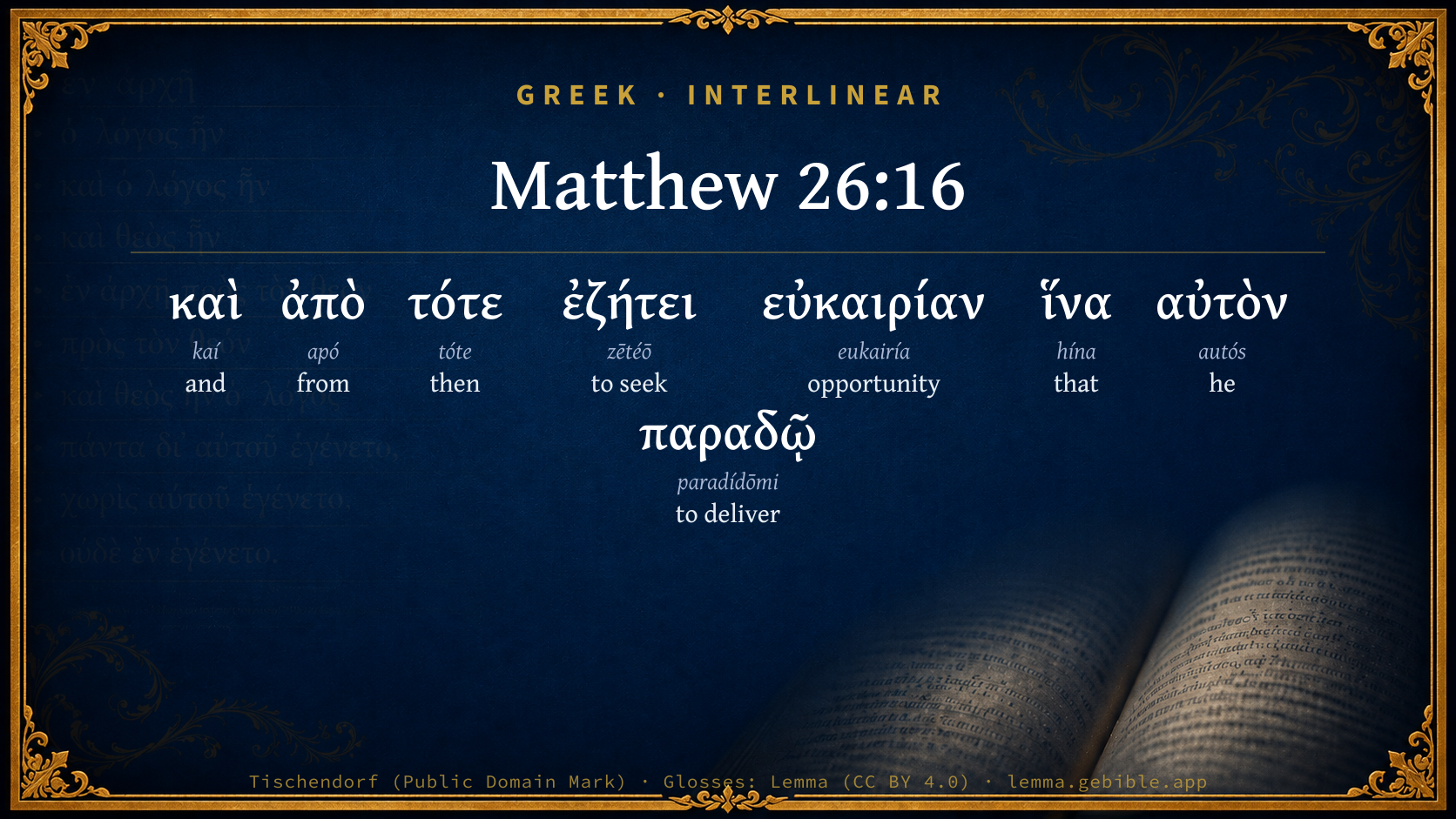
Greek (Tischendorf 8th ed.) Matthew 26:16 appears in the Greek New Testament. The text above is from the Tischendorf 8th edition. Each word links to its Strong’s number and a concise gloss. Click any word for its full Thayer’s Greek Lexicon entry.
Download image
Cite this verse

Matthew 26:16 (World English Bible). Public Domain. Lemma interlinear Bible study tool, https://lemma.gebible.app/v/matthew/26/16.

Show BibTeX & RIS
BibTeX
RIS
English Translation
From that time he sought opportunity to betray him.
World English Bible · Public Domain
Highlights
  • 1 first appearance in the Greek New Testament
Full analysis ↓
Download a study sheet

One document with this verse’s original text, its word-by-word gloss line, the meaning frame, cross-references with their text, attributed commentary, and full source and license credits — printable, and it pastes into notes with its structure intact.

This verse Autodidact and up

Study sheet (.html) Plain text (.txt)

A passage Seminary Student

Up to 50 verses in one chapter. A passage sheet keeps up to 6 commentary sources and 12 cross-references per verse, in the order this page ranks them, and says so on the sheet whenever that leaves anything out. Ask for a single verse and you get the Autodidact verse sheet above.

Everything on this page stays free to read, with no account — the sheet is a download of what is already on screen, not access to it.

Want to remove ads? Support Godless Engineer
Compare translations 3

The same verse in 3 English versions, stacked beneath the original-language interlinear above. Click any original word for its lexicon entry.

Each is an independent rendering of the whole verse — the interlinear is not word-aligned to these translations.

Highlighted words mark where these versions differ — a whole-verse word diff, not a word-by-word alignment.

  • World English Bible Public Domain
    From that time he sought opportunity to betray him.
  • King James Version Public Domain
    And from that time he sought opportunity to betray him.
  • unfoldingWord Literal Text CC BY-SA 4.0
    And from then he was seeking an opportunity in order that he might hand him over.

unfoldingWord Literal Text — © unfoldingWord, licensed CC BY-SA 4.0. Word-aligned USFM3 via Door43 (git.door43.org/unfoldingWord/en_ult).

Versions to compare (up to 4)

3 of 4 selected

Show all 19 translations

Every available English version of this verse, each an independent rendering of the whole verse.

  • World English Bible Public Domain
    From that time he sought opportunity to betray him.
  • Berean Standard Bible Public Domain
    So from then on Judas looked for an opportunity to betray Jesus.
  • Majority Standard Bible Public Domain
    So from then on Judas looked for an opportunity to betray Jesus.
  • King James Version Public Domain
    And from that time he sought opportunity to betray him.
  • American Standard Version (1901) Public Domain
    And from that time he sought opportunity to deliver him `unto them.'
  • Revised Version (1885) Public Domain
    And from that time he sought opportunity to deliver him unto them.
  • Geneva Bible (1599) Public Domain
    And from that time, he sought opportunitie to betraie him.
  • Douay-Rheims (1899) Public Domain
    And from thenceforth he sought opportunity to betray him.
  • Young's Literal Translation Public Domain
    and from that time he was seeking a convenient season to deliver him up.
  • Literal Standard Version CC BY-SA 4.0
    and from that time he was seeking a convenient season to deliver Him up.
  • Unlocked Literal Bible CC BY-SA 4.0
    From that moment he sought an opportunity to deliver him to them.
  • unfoldingWord Literal Text CC BY-SA 4.0
    And from then he was seeking an opportunity in order that he might hand him over.
  • Darby Bible Public Domain
    And from that time he sought a good opportunity that he might deliver him up.
  • World Messianic Bible Public Domain
    From that time he sought opportunity to betray him.
  • Webster's Bible Public Domain
    And from that time he sought opportunity to betray him.
  • Free Bible Version CC BY-SA 4.0
    From then on he looked for an opportunity to betray Jesus.
  • Bible in Basic English Public Domain
    And from that time he was watching for a chance to give him into their hands.
  • Text-Critical English NT CC BY 4.0
    And from then on he was looking for an opportunity to betray Jesus.
  • Tyndale New Testament (1534) Public Domain
    And from that tyme he sought oportunite to betraye him.

Literal Standard Version (2020), Covenant Press — licensed CC BY-SA 4.0. Text via the HelloAO Bible API (eBible.org). Unlocked Literal Bible (unfoldingWord) — licensed CC BY-SA 4.0. Text via the HelloAO Bible API (eBible.org). unfoldingWord Literal Text — © unfoldingWord, licensed CC BY-SA 4.0. Word-aligned USFM3 via Door43 (git.door43.org/unfoldingWord/en_ult). Free Bible Version, Dr. Jonathan Gallagher — licensed CC BY-SA 4.0. Text via the HelloAO Bible API (eBible.org).

Word by word

More ways to search: Search by grammar → Find every occurrence → Compare this word →

Practice this passage: Drill this verse → Learn its vocabulary →

About this verse

These counts appear in no published source. They are computed here, from the morphology-tagged text and Lemma’s own curated glosses. What Lemma adds →

8
words
8
distinct lemmas
Gospels
section

Notable vocabulary

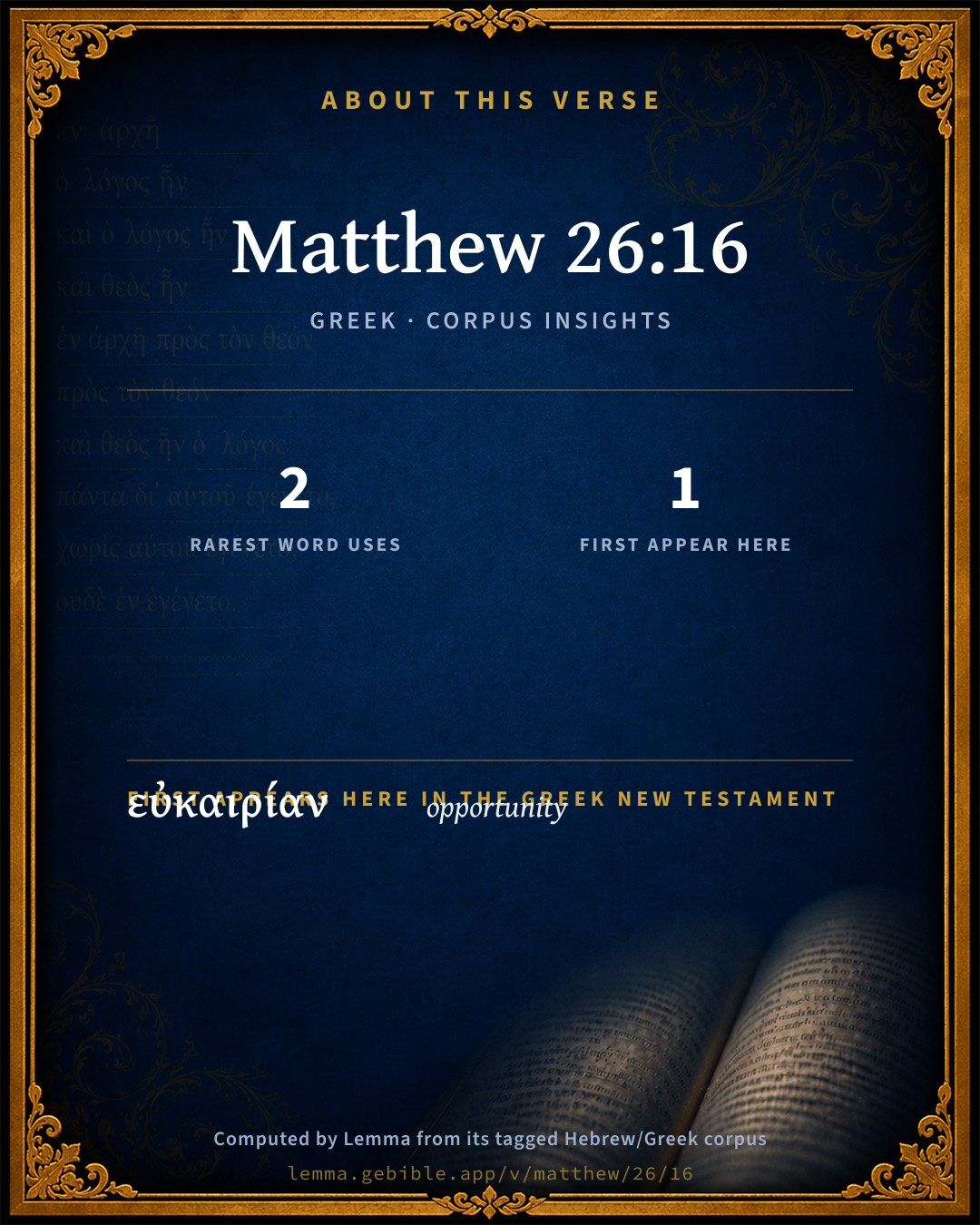
The rarest word here is εὐκαιρίαν opportunity G2120 — appearing just 2 times in the whole Greek New Testament.

First appearance in Scripture

This word makes its first canonical appearance in the Greek New Testament here:

  • εὐκαιρίαν opportunity G2120

Shared distinctive vocabulary

εὐκαιρίαν opportunity G2120 occurs in 2 verses of the Greek New Testament. Also found in:
Cross-references

2

Topical passages linked to Matthew 26:16 in the Treasury of Scripture Knowledge — connected by theme and wording, ordered by reader-vote popularity; previews shown in the World English Bible.

  • Mark 14:11 They, when they heard it, were glad, and promised to give him money. He sought how he might conveniently deliver him.
  • Luke 22:6 He consented, and sought an opportunity to deliver him to them in the absence of the multitude.

Cross-references courtesy of OpenBible.info (CC BY 4.0).

Commentary

Notes on Matthew 26:16 from classic Christian and Jewish commentators (each source and its license shown beneath its notes). The classic Christian expositions comment on the surrounding passage and are grouped to its opening verse, so a note may address several verses; the Jewish commentaries on the Tanakh (Rashi and others) are per-verse, so they appear only where the commentator wrote on this verse.

Lemma curates 59 commentaries, every one of them public domain or Creative Commons licensed, each selected and text-cleaned for this edition rather than reprinted as found. About our sources →

Expositor's Greek Testament

ed. W. Robertson Nicoll

Mat 26:16 . εὐκαιρίαν , a good occasion, the verb, εὐκαιρέω (Mar 6:31 ), belongs to late Greek (Lobeck, Phryn. , p. 125).

The Expositor's Greek Testament, edited by W. Robertson Nicoll (1897–1910) — public domain. Text from a community e-Sword module.

Adam Clarke's Commentary

Verse 16. He sought opportunity] ευκαιριαν, a convenient or fit opportunity. Men seldom leave a crime imperfect: when once sin is conceived, it meets, in general, with few obstacles, till it brings forth death. How deceitful, how deeply damning, is the love of money! Well might a heathen exclaim, while contemplating the grave of a person who was murdered for the sake of his wealth: -

---------- Quid non mortalia pectora cogis

AURI SACRA FAMES? VIRG. AEn. iii. 56

"O! cursed lust of gold! what wilt thou not compel the human heart to perpetrate?."

Judas is deservedly considered as one of the most infamous of men, his conduct base beyond description, and his motives vile. But how many, since his time, have walked in the same way! How many, for the sake of worldly wealth, have renounced the religion of their Lord and Master, and sold Jesus, and their interest in heaven, for a short-lived portion of secular good! From Joh 12:6, we learn that Judas, who was treasurer to our Lord and his disciples, (for he carried the bag,) was a thief, and frequently purloined a portion of what was given for the support of this holy family. Being disappointed of the prey he hoped to have from the sale of the precious ointment, Mt 26:9, he sold his Master to make up the sum. A thorough Jew!

Adam Clarke's Commentary on the Bible (1810–1826) — public domain. Text from a community e-Sword/MySword module.

John Gill's Exposition

And from that time he sought opportunity to betray him. Luke adds, "in the absence of the multitude", Luk 22:6; in the most private manner, when he was alone, and in some solitary place, that no tumult might arise, and that there might be no danger of a rescue: for so he, and the chief priests, had consulted, and settled it, as what would be most prudent and advisable; and therefore, from that time forward, being prompted on by Satan, and the lucre of the money he was to receive, he narrowly watched, and diligently observed, the best and most fitting season to perform his enterprise, and quickly offered.

; in the most private manner, when he was alone, and in some solitary place, that no tumult might arise, and that there might be no danger of a rescue: for so he, and the chief priests, had consulted, and settled it, as what would be most prudent and advisable; and therefore, from that time forward, being prompted on by Satan, and the lucre of the money he was to receive, he narrowly watched, and diligently observed, the best and most fitting season to perform his enterprise, and quickly offered.

Matthew 26:17

mat 26:17

mat 26:17

mat 26:17Now the first day of the feast of unleavened bread,.... There were seven of these days, and this was the first of them, in which the Jews might not eat leavened bread, from the fourteenth, to the twenty first of the month Nisan; in commemoration of their being thrust out of Egypt, in so much haste, that they had not time to leaven the dough, which was in their kneading troughs: wherefore, according to their canons (c), on the night of the fourteenth day; that is, as Bartenora explains it, the night, the day following of which is the fourteenth, they search for leaven in all private places and corners, to bring; it out, and burn it, or break it into small pieces, and scatter it in the wind, or throw it into the sea. Mark adds, "when they killed the passover", Mar 14:12; and Luke says, "when the passover must be killed", Luk 22:7; which was to be done on the fourteenth day of the month Nisan, after the middle of the day; and this was an indispensable duty, which all were obliged to: for so they say (d),

"every man, and every woman, are bound to observe this precept; and whoever makes void this commandment presumptuously, if he is not defiled, or afar off, lo! he is guilty of cutting off.''

The time of killing the passover was after the middle of the day; and it is said (e) that

"if they killed it before the middle of the day it was not right; and they did not kill it till after the evening sacrifice, and after they had offered the evening incense; and after they had trimmed the lamps, they began to slay the passovers, or paschal lambs, unto the end of the day; and if they slayed after the middle of the day, before the evening sacrifice, it was right.''

The reason of this was, because the lamb was to be slain between the two evenings; the first of which began at noon, as soon as ever the day declined: and this was not done privately, but in the temple; for thus it is (f) affirmed,

"they do not kill the passover but in the court, as the rest of the holy things.''

The time and manner of killing the lamb, and by whom, of the sprinkling of the blood, and of their flaying it, and taking out the fat, and burning it on the altar, may be seen in the Misna (g).

The disciples came to Jesus; that is, Peter and John, as may be learnt from , for these only seem to have had any notion of Judas's betraying Christ, from what had been said at the supper in Bethany, two days before; the rest thought he was gone to prepare for the feast, and therefore were under no concern about it; but these two judged otherwise, and therefore came to Christ to know his mind concerning it; for it was high time that a preparation should be made; for this was Thursday morning, and the lamb was to be killed in the afternoon, and ate at even.

Saying unto him, where wilt thou that we prepare for thee to eat the passover? This question in Luke follows upon an order which Christ gave to these disciples; "saying, go and prepare us the passover, that we may eat", Luk 22:8, for masters used to give their servants orders to get ready the passover for them; and which were expressed in much such language as this (h):

"he that says to his servant, , "go and slay the passover for me": if he kills a kid, he may eat of it.''

It is reported (i) of

"Rabban Gamaliel, that he said to his servant Tabi, , "go and roast" the passover for us upon an iron grate.''

The disciples having received such an order from their master, inquire not in what town or city they must prepare the passover, for that was always ate in Jerusalem; see Deu 16:5, where they were obliged, by the Jewish canon (k), to lodge that night; though they might eat the unleavened bread, and keep the other days of the feast any where, and in every place (l); but they inquire in what house he would have it got ready; for they might make use of any house, and the furniture of it, where they could find room, and conveniency, without any charge; for they did not let out their houses, or any of their rooms, or beds, in Jerusalem; but, at festivals, the owners of them gave the use of them freely to all that came (m): and it is (n) observed among the wonders and miracles done at Jerusalem, that though there were such multitudes at their feasts, yet

"a man could never say to his friend, I have not found a fire to roast the passover lambs in Jerusalem, nor I have not found a bed to sleep on in Jerusalem, nor the place is too strait for me to lodge in, in Jerusalem.''

(c) Misn. Pesach. c. 1. sect, 1. Maimon. Chametz Umetzah, c. 2. sect. 3, 4. & 3. 11. (d) Maimon. Hilch. Korban Pesaeh. c. 1. sect. 1. 2. (e) Ib. sect. 4. Moses Kotsensis Mitavot Tora pr. affirm. 39. (f) Maimon. lb. sect. 3. (g) Pesachim, c. 5. sect. 1, 2, 3, 4, 5, 6, 9, 10. (h) Ib. c. 8. 2. (i) Ib. c. 7. sect. 2. (k) T. Bab. Pesach. fol. 95. 2. & Gloss in ib. (l) Maimon. Hilch. Chametz Umetzah, c. 6. sect. 1. (m) T. Bab. Yoma, fol. 12. 1. Megilia, fol. 26. 1. & Gloss. in ib. Maimon Hilch. Beth Habbechira, c. 7. sect. 14. & Ceseph Misna in ib. (n) Abot R. Nathan, c. 35. Pirke Abot, c. 5. sect. 5.

John Gill's Exposition of the Whole Bible (1746–1763) — public domain (CC PDM 1.0). Text via the HelloAO Bible API.

Trapp's Complete Commentary

John Trapp

16 And from that time he sought opportunity to betray him.

Ver. 16. And from that time he sought] So it was no sudden, but a prepensed wickedness, done in cold blood, and upon mature deliberation. God’s people when they sin, they are surprised, and taken before they are aware, Gal 6:1. There is no way of wickedness in them, ordinarily, Psa 139:24. It is of incogitancy: put them in mind, and they mend all. Or, it is of passion: and passions last not long. They deny not Christ that bought them: they can do nothing against the truth, they will not forego God upon any terms, they never sin with deliberation about this chief end: if they err, it is only in the way, as thinking that they may fulfil such a lust, and keep God too.

John Trapp, A Commentary or Exposition upon All the Books of the Old and New Testament (1647–1656) — public domain. Text from a community e-Sword module.

Whedon's Commentary on the Bible

Daniel D. Whedon

16. Sought opportunity to betray him — Luke informs us that the opportunity he sought was the absence of the multitude. The people were so strongly on the side of Jesus that the authorities dare not openly apprehend him. Their method was to take him secretly, charge him with some crime, and thus gain the multitude against him.

Daniel D. Whedon (gen. ed.), Commentary on the Old and New Testaments (1874–1909) — public domain. Text from a community e-Sword module.

The Pulpit Commentary

From that time. As soon as he had made his bargain. Opportunity. "In the absence of the multitude," St. Luke adds. The Sanhedrin no longer thought it necessary to wait for the termination of the festival (ver. 5). Judas would enable them to seize Christ in his most secret retirement, and at the most opportune moment.

The Pulpit Commentary (1880–1919), ed. H.D.M. Spence-Jones & Joseph S. Exell — public domain. Text from a community e-Sword module.

The People's New Testament

B. W. Johnson

16. From that time. The time of the bargain with the priests. No one can tell certainly what day the bargain was completed.

B. W. Johnson's The People's New Testament with Notes (1889–1891) — public domain. Electronic text from the Christian Classics Ethereal Library (CCEL) ThML edition.

Cambridge Greek Testament for Schools and Colleges

16. εὐκαιρίαν. See Lob. Phryn. 126. εὐκαιρία is admitted as a classical word, but the verb εὐκαιρεῖν is rejected. προκόπτειν and προκοπὴ are an instance of the reverse. Cp. Cic. de Offic. I. 40, ‘Tempus actionis opportunum Græce εὐκαιρία, Latine appellatur occasio.’

Cambridge Greek Testament for Schools and Colleges (Cambridge University Press, 1896; 21 vols, various authors incl. Carr, Maclear, Plummer, Farrar, Lumby, Moule, M. R. James, Simcox) — public domain. Text from a community e-Sword module.

International Critical Commentary

(M) 16. And from that time he was seeking a favourable opportunity that he might deliver Him.] Mk. has: “And he was seeking how he might favourably deliver Him.”—εὐκαιρίαν] = “opportunity.” Cicero, Ad Att. xvi.82; Plat. Phædr. 272 A; Ox. Pap. i. 123. 3 (third or fourth century a.d.).

International Critical Commentary — older volumes (1896–1929), various authors — public domain. Text from a community e-Sword module.

Lesson kit

Teaching starters — assembled from the data on this page, not authored interpretation. Every prompt links to the verse data it draws on. Edit before teaching.

Matthew, in the Gospels, opens this verse with 8 words (8 distinct Greek lemmas). Its most distinctive word is eukairía (“opportunity”). A historical commentator’s framing appears above. Read the whole chapter for the surrounding context.

Discussion questions

  1. The word eukairía carries the sense “opportunity.” How does it shape the verse?
  2. This is the first place “opportunity” appears in Scripture (first appears here). What does its debut here establish?
  3. How does Luke 22:6, which shares the word «opportunity», read alongside this verse?
  4. These translations render this verse differently; the difference is in the English rendering, not the original. What questions does that raise?
  5. Compare how Expositor's Greek Testament and Adam Clarke's Commentary read this verse. Where do they agree or differ?

Things to notice

  • 1 word makes its first canonical appearance in Scripture here.
  • These translations choose different wording for 8 words in this verse.
  • 8 distinct Greek lemmas span 8 words in this verse.

Reading settings

Reading text

Shown beneath each verse's original-language words.

Old Testament
Old Testament edition

Read the OT as the Masoretic Hebrew (MT) or the Greek Septuagint (LXX).

English shown for the Greek Septuagint (in the Hebrew ↔ Greek comparison).

Comparing translations? Open the Compare panel on any verse page to stack up to four side by side.