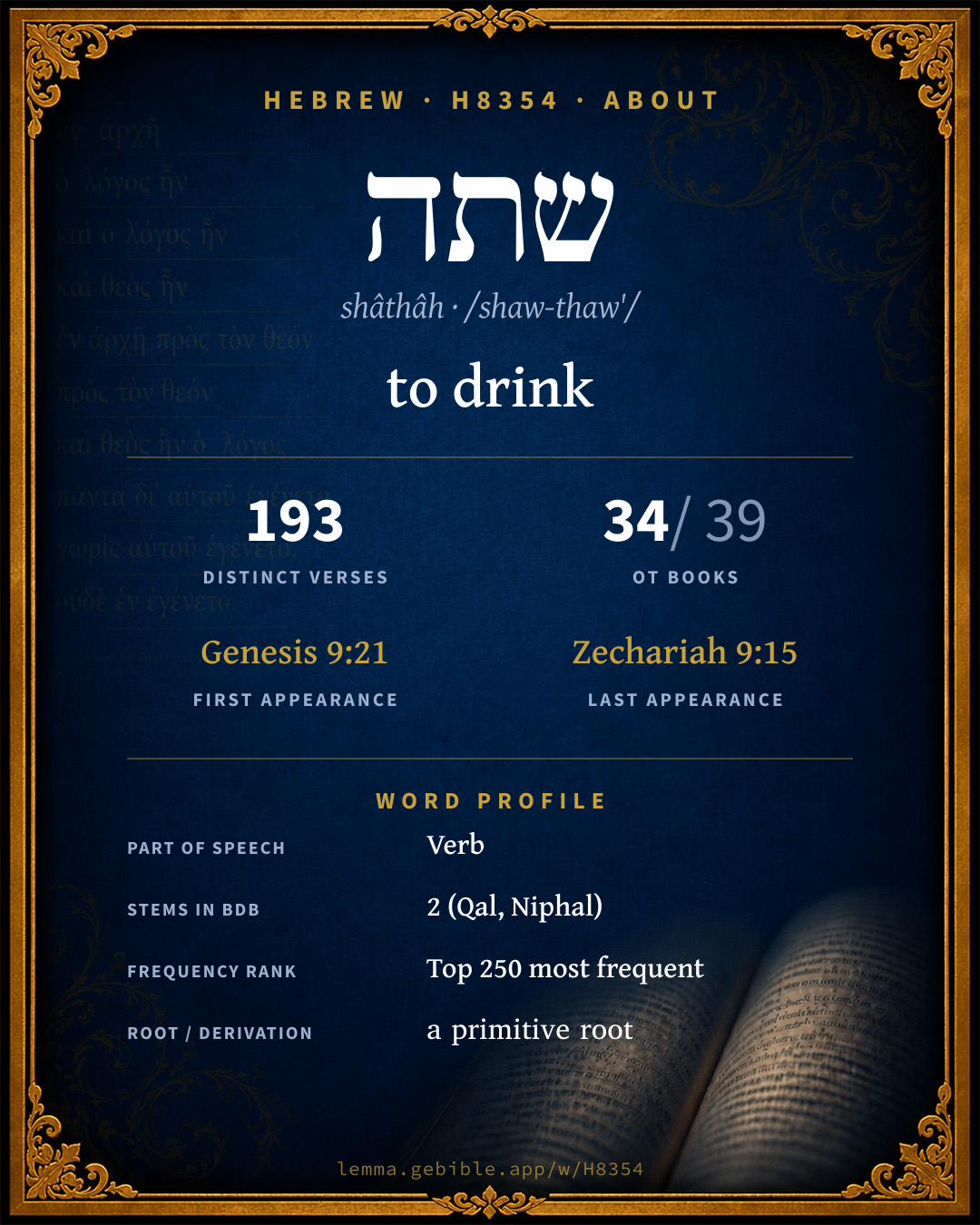
שָׁתָה
to drink
‘to drink’ is one of 2 main senses fuller range ↓
Full lexicon entry — Brown-Driver-Briggs (BDB)
From Brown-Driver-Briggs (BDB)
Where this word appears
See every Qal verb in the Hebrew Bible →
Grammar key — what these labels mean
Part of speech
- Verb
- An action or state-of-being word.
Stem
- Qal
- The basic, simple active stem — the plain form of the verb (“he wrote”). Here: ‘of man’
- Niphal
- Usually the simple passive or reflexive of the Qal (“he was written”).
Form
- Infinitive Construct
- A bound verbal noun, frequently with prepositions (“to write / in writing”).
- Imperfect
- An incomplete, ongoing, or future action (“he will / would write”).
- Sequential Imperfect
- An imperfect with prefixed waw — the standard past-narrative form (waw-consecutive imperfect).
- Participle Active
- A verbal adjective expressing ongoing or characteristic action (“writing / one who writes”).
- Infinitive Absolute
- An unbound verbal noun, often intensifying or standing in for a finite verb.
- Imperative
- A direct command (“write!”).
- Sequential Perfect
- A perfect with prefixed waw continuing a preceding imperfect or command (waw-consecutive perfect).
- Perfect
- A completed action or state — Hebrew marks aspect (completeness) more than strict tense (“he wrote”).
- Jussive
- A third- or second-person volitional form expressing wish or command (“let him write”).
- Cohortative
- A first-person volitional form expressing wish or resolve (“let me / let us write”).
State
- Absolute
- The independent form of a noun, not bound to a following word.
- Construct
- A noun bound to a following noun in a possessive / “of” relationship (the construct chain).
Person
- 3rd Person
- The one spoken about (“he / she / it / they”).
- 2nd Person
- The one addressed (“you”).
- 1st Person
- The speaker (“I / we”).
Gender
- Masculine
- Grammatically masculine.
- Common
- Either gender — not distinguished for this form.
- Feminine
- Grammatically feminine.
Number
- Plural
- More than one (in Hebrew, generally three or more).
- Singular
- One.
Grammatical forms 42 distinct
- Verb, Qal, Infinitive Construct 42 times (19%)
- Verb, Qal, Imperfect, 3rd Person, Masculine, Plural 16 times (7%)
- Verb, Qal, Imperfect, 3rd Person, Masculine, Singular 13 times (6%)
- Verb, Qal, Sequential Imperfect, 3rd Person, Masculine, Plural 12 times (6%)
- Verb, Qal, Sequential Imperfect, 3rd Person, Masculine, Singular 10 times (5%)
- Verb, Qal, Imperfect, 2nd Person, Masculine, Singular 10 times (5%)
- Verb, Qal, Infinitive Absolute 9 times (4%)
- Verb, Qal, Imperative, 2nd Person, Masculine, Singular 9 times (4%)
+34 more forms (96 occurrences)
Parsed forms decoded from the imported morphology (morphhb / Westminster Leningrad Codex — WLC text public domain, morphhb tagging CC BY 4.0), counted across 217 parsed occurrences — not distinct verses.
Every verse where H8354 appears — 193 distinct verses across 34 books. Click any verse to open its interlinear word-by-word view. Verse text shown in the World English Bible for context — . Each verse’s Hebrew form is shown with its reference; the English is not keyword-highlighted, since the data carries no word-level English alignment. Use “Compare translations” on any verse to read it across multiple English versions. This concordance covers the Hebrew Bible; Septuagint (Greek Old Testament) occurrences are not indexed here.
Genesis 14 verses
- Genesis 9:21 וַ/יֵּ֥שְׁתְּ conj + Qal wimpf 3ms He drank of the wine, and got drunk. He was uncovered within his tent.
- Genesis 24:14 וְ/אֶשְׁתֶּ֔ה שְׁתֵ֔ה conj + Qal impf 1cs Qal impv 2ms Let it happen, that the young lady to whom I will say, 'Please let down your pitcher, that I may drink.' She will say, 'Drink, and I will also give your camels a drink.' Let the same be she who you have appointed for your servant Isaac. Thereby will I know that you have shown kindness to my master."
- Genesis 24:18 שְׁתֵ֣ה Qal impv 2ms She said, "Drink, my lord." She hurried, and let down her pitcher on her hand, and gave him drink.
- Genesis 24:19 לִ/שְׁתֹּֽת prep + Qal inf.cs When she had done giving him drink, she said, "I will also draw for your camels, until they have done drinking."
- Genesis 24:22 לִ/שְׁתּ֔וֹת prep + Qal inf.cs It happened, as the camels had done drinking, that the man took a golden ring of half a shekel weight, and two bracelets for her hands of ten shekels weight of gold,
- Genesis 24:44 שְׁתֵ֔ה Qal impv 2ms She will tell me, "Drink, and I will also draw for your camels." Let the same be the woman whom Yahweh has appointed for my master's son.'
- Genesis 24:46 שְׁתֵ֔ה וָ/אֵ֕שְׁתְּ Qal impv 2ms conj + Qal wimpf 1cs She hurried and let down her pitcher from her shoulder, and said, 'Drink, and I will also give your camels a drink.' So I drank, and she made the camels drink also.
- Genesis 24:54 וַ/יִּשְׁתּ֗וּ conj + Qal wimpf 3mp They ate and drank, he and the men who were with him, and stayed all night. They rose up in the morning, and he said, "Send me away to my master."
- Genesis 25:34 וַ/יֵּ֔שְׁתְּ conj + Qal wimpf 3ms Jacob gave Esau bread and stew of lentils. He ate and drank, rose up, and went his way. So Esau despised his birthright.
- Genesis 26:30 וַ/יִּשְׁתּֽוּ conj + Qal wimpf 3mp He made them a feast, and they ate and drink.
- Genesis 27:25 וַ/יֵּֽשְׁתְּ conj + Qal wimpf 3ms He said, "Bring it near to me, and I will eat of my son's venison, that my soul may bless you." He brought it near to him, and he ate. He brought him wine, and he drank.
- Genesis 30:38 לִ/שְׁתּוֹת֙ לִ/שְׁתּֽוֹת prep + Qal inf.cs prep + Qal inf.cs He set the rods which he had peeled opposite the flocks in the gutters in the watering-troughs where the flocks came to drink. They conceived when they came to drink.
- Genesis 43:34 וַ/יִּשְׁתּ֥וּ conj + Qal wimpf 3mp He sent portions to them from before him, but Benjamin's portion was five times as much as any of theirs. They drank, and were merry with him.
- Genesis 44:5 יִשְׁתֶּ֤ה Qal impf 3ms Isn't this that from which my lord drinks, and by which he indeed divines? You have done evil in so doing.'"
Exodus 11 verses
- Exodus 7:18 לִ/שְׁתּ֥וֹת prep + Qal inf.cs The fish that are in the river shall die, and the river shall become foul; and the Egyptians shall loathe to drink water from the river."'"
- Exodus 7:21 לִ/שְׁתּ֥וֹת prep + Qal inf.cs The fish that were in the river died; and the river became foul, and the Egyptians couldn't drink water from the river; and the blood was throughout all the land of Egypt.
- Exodus 7:24 לִ/שְׁתּ֑וֹת לִ/שְׁתֹּ֔ת prep + Qal inf.cs prep + Qal inf.cs All the Egyptians dug round about the river for water to drink; for they couldn't drink of the water of the river.
- Exodus 15:23 לִ/שְׁתֹּ֥ת prep + Qal inf.cs When they came to Marah, they couldn't drink from the waters of Marah, for they were bitter. Therefore the name of it was called Marah.
- Exodus 15:24 נִּשְׁתֶּֽה Qal impf 1cp The people murmured against Moses, saying, "What shall we drink?"
- Exodus 17:1 לִ/שְׁתֹּ֥ת prep + Qal inf.cs All the congregation of the children of Israel traveled from the wilderness of Sin, by their journeys, according to Yahweh's commandment, and encamped in Rephidim; but there was no water for the people to drink.
- Exodus 17:2 וְ/נִשְׁתֶּ֑ה conj + Qal impf 1cp Therefore the people quarreled with Moses, and said, "Give us water to drink." Moses said to them, "Why do you quarrel with me? Why do you test Yahweh?"
- Exodus 17:6 וְ/שָׁתָ֣ה conj + Qal wpf 3ms Behold, I will stand before you there on the rock in Horeb. You shall strike the rock, and water will come out of it, that the people may drink." Moses did so in the sight of the elders of Israel.
- Exodus 24:11 וַ/יִּשְׁתּֽוּ conj + Qal wimpf 3mp He didn't lay his hand on the nobles of the children of Israel. They saw God, and ate and drank.
- Exodus 32:6 וְ/שָׁת֔וֹ conj + Qal inf.abs They rose up early on the next day, and offered burnt offerings, and brought peace-offerings; and the people sat down to eat and to drink, and rose up to play.
- Exodus 34:28 שָׁתָ֑ה Qal pf 3ms He was there with Yahweh forty days and forty nights; he neither ate bread, nor drank water. He wrote on the tablets the words of the covenant, the ten commandments.
Leviticus 2 verses
- Leviticus 10:9 תֵּ֣שְׁתְּ Qal juss 2ms "Drink no wine nor strong drink, you, nor your sons with you, when you go into the Tent of Meeting, that you don't die: it shall be a statute forever throughout your generations:
- Leviticus 11:34 יִשָּׁתֶ֔ה Niphal impf 3ms All food which may be eaten, that on which water comes, shall be unclean; and all drink that may be drunk in every such vessel shall be unclean.
Numbers 9 verses
- Numbers 6:3 יִשְׁתֶּ֑ה יִשְׁתֶּ֔ה Qal impf 3ms Qal impf 3ms he shall separate himself from wine and strong drink. He shall drink no vinegar of wine, or vinegar of fermented drink, neither shall he drink any juice of grapes, nor eat fresh grapes or dried.
- Numbers 6:20 יִשְׁתֶּ֥ה Qal impf 3ms and the priest shall wave them for a wave offering before Yahweh. This is holy for the priest, together with the breast that is waved and the thigh that is offered. After that the Nazirite may drink wine.
- Numbers 20:5 לִ/שְׁתּֽוֹת prep + Qal inf.cs Why have you made us to come up out of Egypt, to bring us in to this evil place? it is no place of seed, or of figs, or of vines, or of pomegranates; neither is there any water to drink.
- Numbers 20:11 וַ/תֵּ֥שְׁתְּ conj + Qal wimpf 3fs Moses lifted up his hand, and struck the rock with his rod twice: and water came forth abundantly, and the congregation drank, and their cattle.
- Numbers 20:17 נִשְׁתֶּ֖ה Qal impf 1cp Please let us pass through your land: we will not pass through field or through vineyard, neither will we drink of the water of the wells: we will go along the king's highway; we will not turn aside to the right hand nor to the left, until we have passed your border.
- Numbers 20:19 נִשְׁתֶּה֙ Qal impf 1cp The children of Israel said to him, We will go up by the highway; and if we drink of your water, I and my cattle, then will I give the price of it: let me only, without [doing] anything [else], pass through on my feet.
- Numbers 21:22 נִשְׁתֶּ֖ה Qal impf 1cp Let me pass through your land: we will not turn aside into field, or into vineyard; we will not drink of the water of the wells: we will go by the king's highway, until we have passed your border.
- Numbers 23:24 יִשְׁתֶּֽה Qal impf 3ms Behold, the people rises up as a lioness, As a lion does he lift himself up: He shall not lie down until he eat of the prey, Drink the blood of the slain.
- Numbers 33:14 לִ/שְׁתּֽוֹת prep + Qal inf.cs They traveled from Alush, and encamped in Rephidim, where was no water for the people to drink.
Deuteronomy 9 verses
- Deuteronomy 2:6 וּ/שְׁתִיתֶֽם conj + Qal wpf 2mp You shall purchase food of them for money, that you may eat; and you shall also buy water of them for money, that you may drink.
- Deuteronomy 2:28 וְ/שָׁתִ֑יתִי conj + Qal wpf 1cs You shall sell me food for money, that I may eat; and give me water for money, that I may drink: only let me pass through on my feet,
- Deuteronomy 9:9 שָׁתִֽיתִי Qal pf 1cs When I was gone up onto the mountain to receive the tables of stone, even the tables of the covenant which Yahweh made with you, then I stayed on the mountain forty days and forty nights; I did neither eat bread nor drink water.
- Deuteronomy 9:18 שָׁתִ֑יתִי Qal pf 1cs I fell down before Yahweh, as at the first, forty days and forty nights; I did neither eat bread nor drink water; because of all your sin which you sinned, in doing that which was evil in the sight of Yahweh, to provoke him to anger.
- Deuteronomy 11:11 תִּשְׁתֶּה Qal impf 3fs but the land, where you go over to possess it, is a land of hills and valleys, [and] drinks water of the rain of the sky,
- Deuteronomy 28:39 תִשְׁתֶּה֙ Qal impf 2ms You shall plant vineyards and dress them, but you shall neither drink of the wine, nor gather [the grapes]; for the worm shall eat them.
- Deuteronomy 29:6 שְׁתִיתֶ֑ם Qal pf 2mp You have not eaten bread, neither have you drunk wine or strong drink; that you may know that I am Yahweh your God.
- Deuteronomy 32:14 תִּשְׁתֶּה Qal impf 2ms Butter of the herd, and milk of the flock, With fat of lambs, Rams of the breed of Bashan, and goats, With the finest of the wheat; Of the blood of the grape you drank wine.
- Deuteronomy 32:38 יִשְׁתּ֖וּ Qal impf 3mp Which ate the fat of their sacrifices, And drank the wine of their drink-offering? Let them rise up and help you, Let them be your protection.
Judges 10 verses
- Judges 7:5 לִ/שְׁתּֽוֹת prep + Qal inf.cs So he brought down the people to the water: and Yahweh said to Gideon, Everyone who laps of the water with his tongue, as a dog laps, him shall you set by himself; likewise everyone who bows down on his knees to drink.
- Judges 7:6 לִ/שְׁתּ֥וֹת prep + Qal inf.cs The number of those who lapped, putting their hand to their mouth, was three hundred men: but all the rest of the people bowed down on their knees to drink water.
- Judges 9:27 וַ/יִּשְׁתּ֔וּ conj + Qal wimpf 3mp They went out into the field, and gathered their vineyards, and trod [the grapes], and held festival, and went into the house of their god, and did eat and drink, and cursed Abimelech.
- Judges 13:4 תִּשְׁתִּ֖י Qal juss 2fs Now therefore please beware and drink no wine nor strong drink, and don't eat any unclean thing:
- Judges 13:7 תִּשְׁתִּ֣י Qal juss 2fs but he said to me, Behold, you shall conceive, and bear a son; and now drink no wine nor strong drink, and eat not any unclean thing; for the child shall be a Nazirite to God from the womb to the day of his death.
- Judges 13:14 תֵּ֔שְׁתְּ Qal juss 3fs She may not eat of anything that comes of the vine, neither let her drink wine or strong drink, nor eat any unclean thing; all that I commanded her let her observe.
- Judges 15:19 וַ/יֵּ֔שְׁתְּ conj + Qal wimpf 3ms But God split the hollow place that is in Lehi, and water came out of it. When he had drunk, his spirit came again, and he revived: therefore the name of it was called En Hakkore, which is in Lehi, to this day.
- Judges 19:4 וַ/יִּשְׁתּ֔וּ conj + Qal wimpf 3mp His father-in-law, the young lady's father, retained him; and he abode with him three days: so they ate and drink, and lodged there.
- Judges 19:6 וַ/יִּשְׁתּ֑וּ conj + Qal wimpf 3mp So they sat down, and ate and drink, both of them together: and the young lady's father said to the man, Please be pleased to stay all night, and let your heart be merry.
- Judges 19:21 וַ/יִּשְׁתּֽוּ conj + Qal wimpf 3mp So he brought him into his house, and gave the donkeys fodder; and they washed their feet, and ate and drink.
Ruth 3 verses
- Ruth 2:9 וְ/שָׁתִ֕ית conj + Qal wpf 2fs Let your eyes be on the field that they reap, and go after them: haven't I charged the young men that they shall not touch you? and when you are thirsty, go to the vessels, and drink of that which the young men have drawn.
- Ruth 3:3 וְ/לִ/שְׁתּֽוֹת conj + prep + Qal inf.cs Wash yourself therefore, and anoint you, and put your clothing on you, and get you down to the threshing floor, but don't make yourself known to the man, until he shall have done eating and drinking.
- Ruth 3:7 וַ/יֵּשְׁתְּ֙ conj + Qal wimpf 3ms When Boaz had eaten and drunk, and his heart was merry, he went to lie down at the end of the heap of grain: and she came softly, and uncovered his feet, and laid her down.
1 Samuel 4 verses
- 1 Samuel 1:9 שָׁתֹ֑ה Qal inf.abs So Hannah rose up after they had eaten in Shiloh, and after they had drunk. Now Eli the priest was sitting on his seat by the door-post of the temple of Yahweh.
- 1 Samuel 1:15 שָׁתִ֑יתִי Qal pf 1cs Hannah answered, No, my lord, I am a woman of a sorrowful spirit: I have drunk neither wine nor strong drink, but I poured out my soul before Yahweh.
- 1 Samuel 30:12 שָׁ֣תָה Qal pf 3ms They gave him a piece of a cake of figs, and two clusters of raisins: and when he had eaten, his spirit came again to him; for he had eaten no bread, nor drunk any water, three days and three nights.
- 1 Samuel 30:16 וְ/שֹׁתִים֙ conj + Qal ptcp.act mp When he had brought him down, behold, they were spread abroad over all the ground, eating and drinking, and dancing, because of all the great spoil that they had taken out of the land of the Philistines, and out of the land of Judah.
2 Samuel 7 verses
- 2 Samuel 11:11 וְ/לִ/שְׁתּ֖וֹת conj + prep + Qal inf.cs Uriah said to David, The ark, and Israel, and Judah, abide in booths; and my lord Joab, and the servants of my lord, are encamped in the open field; shall I then go into my house, to eat and to drink, and to lie with my wife? as you live, and as your soul lives, I will not do this thing.
- 2 Samuel 11:13 וַ/יֵּ֖שְׁתְּ conj + Qal wimpf 3ms When David had called him, he ate and drink before him; and he made him drunk: and at even he went out to lie on his bed with the servants of his lord, but didn't go down to his house.
- 2 Samuel 12:3 תִשְׁתֶּה֙ Qal impf 3fs but the poor man had nothing, except one little ewe lamb, which he had bought and raised. It grew up together with him, and with his children. It ate of his own food, drank of his own cup, and lay in his bosom, and was to him like a daughter.
- 2 Samuel 16:2 לִ/שְׁתּ֥וֹת prep + Qal inf.cs The king said to Ziba, What do you mean by these? Ziba said, The donkeys are for the king's household to ride on; and the bread and summer fruit for the young men to eat; and the wine, that such as are faint in the wilderness may drink.
- 2 Samuel 19:35 אֶשְׁתֶּ֔ה Qal impf 1cs I am this day eighty years old: can I discern between good and bad? can your servant taste what I eat or what I drink? can I hear any more the voice of singing men and singing women? why then should your servant be yet a burden to my lord the king?
- 2 Samuel 23:16 לִ/שְׁתּוֹתָ֔/ם prep + Qal inf.cs + sfx pers 3mp The three mighty men broke through the host of the Philistines, and drew water out of the well of Bethlehem, that was by the gate, and took it, and brought it to David: but he would not drink of it, but poured it out to Yahweh.
- 2 Samuel 23:17 לִ/שְׁתּוֹתָ֑/ם prep + Qal inf.cs + sfx pers 3mp He said, Be it far from me, Yahweh, that I should do this: [shall I drink] the blood of the men who went in jeopardy of their lives? therefore he would not drink it. These things did the three mighty men.
1 Kings 20 verses
- 1 Kings 1:25 וְ/שֹׁתִ֖ים conj + Qal ptcp.act mp For he is gone down this day, and has slain oxen and fatlings and sheep in abundance, and has called all the king's sons, and the captains of the host, and Abiathar the priest; and, behold, they are eating and drinking before him, and say, [Long] live king Adonijah.
- 1 Kings 4:20 וְ/שֹׁתִ֖ים conj + Qal ptcp.act mp Judah and Israel were many as the sand which is by the sea in multitude, eating and drinking and making merry.
- 1 Kings 13:8 אֶשְׁתֶּה Qal impf 1cs The man of God said to the king, If you will give me half your house, I will not go in with you, neither will I eat bread nor drink water in this place;
- 1 Kings 13:9 תִשְׁתֶּה Qal impf 2ms for so was it charged me by the word of Yahweh, saying, You shall eat no bread, nor drink water, neither return by the way that you came.
- 1 Kings 13:16 אֶשְׁתֶּ֤ה Qal impf 1cs He said, I may not return with you, nor go in with you; neither will I eat bread nor drink water with you in this place:
- 1 Kings 13:17 תִשְׁתֶּ֥ה Qal impf 2ms for it was said to me by the word of Yahweh, You shall eat no bread nor drink water there, nor turn again to go by the way that you came.
- 1 Kings 13:18 וְ/יֵ֣שְׁתְּ conj + Qal impf 3ms He said to him, I also am a prophet as you are; and an angel spoke to me by the word of Yahweh, saying, Bring him back with you into your house, that he may eat bread and drink water. [But] he lied to him.
- 1 Kings 13:19 וַ/יֵּ֥שְׁתְּ conj + Qal wimpf 3ms So he went back with him, and ate bread in his house, and drank water.
- 1 Kings 13:22 וַ/תֵּ֣שְׁתְּ תֵּ֣שְׁתְּ conj + Qal wimpf 2ms Qal juss 3ms but came back, and have eaten bread and drunk water in the place of which he said to you, Eat no bread, and drink no water; your body shall not come to the tomb of your fathers.
- 1 Kings 13:23 שְׁתוֹת֑/וֹ Qal inf.cs + sfx pers 3ms It happened, after he had eaten bread, and after he had drunk, that he saddled for him the donkey, [to wit], for the prophet whom he had brought back.
- 1 Kings 16:9 שֹׁתֶ֣ה Qal ptcp.act ms His servant Zimri, captain of half his chariots, conspired against him. Now he was in Tirzah, drinking himself drunk in the house of Arza, who was over the household in Tirzah:
- 1 Kings 17:4 תִּשְׁתֶּ֑ה Qal impf 2ms It shall be, that you shall drink of the brook; and I have commanded the ravens to feed you there.
- 1 Kings 17:6 יִשְׁתֶּֽה Qal impf 3ms The ravens brought him bread and flesh in the morning, and bread and flesh in the evening; and he drank of the brook.
- 1 Kings 17:10 וְ/אֶשְׁתֶּֽה conj + Qal coh 1cs So he arose and went to Zarephath; and when he came to the gate of the city, behold, a widow was there gathering sticks: and he called to her, and said, Please get me a little water in a vessel, that I may drink.
- 1 Kings 18:41 וּ/שְׁתֵ֑ה conj + Qal impv 2ms Elijah said to Ahab, Get you up, eat and drink; for there is the sound of abundance of rain.
- 1 Kings 18:42 וְ/לִ/שְׁתּ֑וֹת conj + prep + Qal inf.cs So Ahab went up to eat and to drink. Elijah went up to the top of Carmel; and he bowed himself down on the earth, and put his face between his knees.
- 1 Kings 19:6 וַ/יֵּ֔שְׁתְּ conj + Qal wimpf 3ms He looked, and, behold, there was at his head a cake baked on the coals, and a jar of water. He ate and drink, and laid him down again.
- 1 Kings 19:8 וַ/יִּשְׁתֶּ֑ה conj + Qal wimpf 3ms He arose, and ate and drink, and went in the strength of that food forty days and forty nights to Horeb the Mount of God.
- 1 Kings 20:12 שֹׁתֶ֛ה Qal ptcp.act ms It happened, when [Ben Hadad] heard this message, as he was drinking, he and the kings, in the pavilions, that he said to his servants, Set [yourselves in array]. They set [themselves in array] against the city.
- 1 Kings 20:16 שֹׁתֶ֨ה Qal ptcp.act ms They went out at noon. But Ben Hadad was drinking himself drunk in the pavilions, he and the kings, the thirty-two kings who helped him.
2 Kings 8 verses
- 2 Kings 3:17 וּ/שְׁתִיתֶ֛ם conj + Qal wpf 2mp For thus says Yahweh, You shall not see wind, neither shall you see rain; yet that valley shall be filled with water, and you shall drink, both you and your cattle and your animals.
- 2 Kings 6:22 וְ/יִשְׁתּ֔וּ conj + Qal juss 3mp He answered, You shall not strike them: would you strike those whom you have taken captive with your sword and with your bow? set bread and water before them, that they may eat and drink, and go to their master.
- 2 Kings 6:23 וַ/יִּשְׁתּ֔וּ conj + Qal wimpf 3mp He prepared great provision for them; and when they had eaten and drunk, he sent them away, and they went to their master. The bands of Syria came no more into the land of Israel.
- 2 Kings 7:8 וַ/יִּשְׁתּ֔וּ conj + Qal wimpf 3mp When these lepers came to the outermost part of the camp, they went into one tent, and ate and drink, and carried there silver, and gold, and clothing, and went and hid it; and they came back, and entered into another tent, and carried there also, and went and hid it.
- 2 Kings 9:34 וַ/יֵּ֑שְׁתְּ conj + Qal wimpf 3ms When he was come in, he ate and drink; and he said, See now to this cursed woman, and bury her; for she is a king's daughter.
- 2 Kings 18:27 וְ/לִ/שְׁתּ֛וֹת conj + prep + Qal inf.cs But Rabshakeh said to them, Has my master sent me to your master, and to you, to speak these words? Hasn't he sent me to the men who sit on the wall, to eat their own dung, and to drink their own water with you?
- 2 Kings 18:31 וּ/שְׁת֖וּ conj + Qal impv 2mp Don't listen to Hezekiah: for thus says the king of Assyria, Make your peace with me, and come out to me; and eat you everyone of his vine, and everyone of his fig tree, and everyone drink the waters of his own cistern;
- 2 Kings 19:24 וְ/שָׁתִ֖יתִי conj + Qal pf 1cs I have dug and drunk strange waters, and with the sole of my feet will I dry up all the rivers of Egypt.
1 Chronicles 4 verses
- 1 Chronicles 11:18 לִ/שְׁתּוֹתָ֔/ם prep + Qal inf.cs + sfx pers 3mp The three broke through the host of the Philistines, and drew water out of the well of Bethlehem, that was by the gate, and took it, and brought it to David: but David would not drink of it, but poured it out to Yahweh,
- 1 Chronicles 11:19 אֶשְׁתֶּ֤ה לִ/שְׁתּוֹתָ֑/ם Qal impf 1cs prep + Qal inf.cs + sfx pers 3mp and said, My God forbid it me, that I should do this: shall I drink the blood of these men who have put their lives in jeopardy? for with [the jeopardy of] their lives they brought it. Therefore he would not drink it. These things did the three mighty men.
- 1 Chronicles 12:39 וְ/שׁוֹתִ֑ים conj + Qal ptcp.act mp They were there with David three days, eating and drinking; for their brothers had made preparation for them.
- 1 Chronicles 29:22 וַ/יִּשְׁתּ֜וּ conj + Qal wimpf 3mp and ate and drink before Yahweh on that day with great gladness. They made Solomon the son of David king the second time, and anointed him to Yahweh to be prince, and Zadok to be priest.
Ezra 1 verse
Nehemiah 2 verses
- Nehemiah 8:10 וּ/שְׁת֣וּ conj + Qal impv 2mp Then he said to them, Go your way, eat the fat, and drink the sweet, and send portions to him for whom nothing is prepared; for this day is holy to our Lord: neither be you grieved; for the joy of Yahweh is your strength.
- Nehemiah 8:12 וְ/לִ/שְׁתּוֹת֙ conj + prep + Qal inf.cs All the people went their way to eat, and to drink, and to send portions, and to make great mirth, because they had understood the words that were declared to them.
Esther 3 verses
- Esther 3:15 לִ/שְׁתּ֔וֹת prep + Qal inf.cs The posts went forth in haste by the king's commandment, and the decree was given out in Shushan the palace. The king and Haman sat down to drink; but the city of Shushan was perplexed.
- Esther 4:16 תִּשְׁתּ֜וּ Qal juss 2mp Go, gather together all the Jews who are present in Shushan, and fast you for me, and neither eat nor drink three days, night or day: I also and my maidens will fast in like manner; and so will I go in to the king, which is not according to the law: and if I perish, I perish.
- Esther 7:1 לִ/שְׁתּ֖וֹת prep + Qal inf.cs So the king and Haman came to banquet with Esther the queen.
Job 7 verses
- Job 1:4 וְ/לִ/שְׁתּ֖וֹת conj + prep + Qal inf.cs His sons went and held a feast in the house of each one on his birthday; and they sent and called for their three sisters to eat and to drink with them.
- Job 1:13 וְ/שֹׁתִ֣ים conj + Qal ptcp.act mp It fell on a day when his sons and his daughters were eating and drinking wine in their eldest brother's house,
- Job 1:18 וְ/שֹׁתִ֣ים conj + Qal ptcp.act mp While he was still speaking, there came also another, and said, "Your sons and your daughters were eating and drinking wine in their eldest brother's house,
- Job 6:4 שֹׁתָ֣ה Qal ptcp.act fs For the arrows of the Almighty are within me, My spirit drinks up their poison. The terrors of God set themselves in array against me.
- Job 15:16 שֹׁתֶ֖ה Qal ptcp.act ms How much less one who is abominable and corrupt, A man who drinks iniquity like water!
- Job 21:20 יִשְׁתֶּֽה Qal impf 3ms Let his own eyes see his destruction. Let him drink of the wrath of the Almighty.
- Job 34:7 יִֽשְׁתֶּה Qal impf 3ms What man is like Job, Who drinks scorn like water,
Psalms 5 verses
- Psalms 50:13 אֶשְׁתֶּֽה Qal impf 1cs Will I eat the flesh of bulls, Or drink the blood of goats?
- Psalms 69:12 שׁוֹתֵ֥י Qal ptcp.act mp cs Those who sit in the gate talk about me. I am the song of the drunkards.
- Psalms 75:8 יִשְׁתּ֑וּ Qal impf 3mp For in the hand of Yahweh there is a cup, Full of foaming wine mixed with spices. He pours it out. Indeed the wicked of the earth drink and drink it to its very dregs.
- Psalms 78:44 יִשְׁתָּיֽוּ/ן Qal impf 3mp + sfx n Turned their rivers into blood, And their streams, so that they could not drink.
- Psalms 110:7 יִשְׁתֶּ֑ה Qal impf 3ms He will drink of the brook in the way; Therefore he will lift up his head.
Proverbs 8 verses
- Proverbs 4:17 יִשְׁתּֽוּ Qal impf 3mp For they eat the bread of wickedness, And drink the wine of violence.
- Proverbs 5:15 שְׁתֵה Qal impv 2ms Drink water out of your own cistern, Running water out of your own well.
- Proverbs 9:5 וּ֝/שְׁת֗וּ conj + Qal impv 2mp "Come, eat some of my bread, Drink some of the wine which I have mixed!
- Proverbs 23:7 וּ֭/שְׁתֵה conj + Qal impv 2ms For as he thinks about the cost, so he is. "Eat and drink!" he says to you, But his heart is not with you.
- Proverbs 26:6 שֹׁתֶ֑ה Qal ptcp.act ms One who sends a message by the hand of a fool Is cutting off feet and drinking violence.
- Proverbs 31:4 שְׁתוֹ Qal inf.cs It is not for kings, Lemuel; It is not for kings to drink wine; Nor for princes to say, 'Where is strong drink?'
- Proverbs 31:5 יִ֭שְׁתֶּה Qal impf 3ms Lest they drink, and forget the law, And pervert the justice due to anyone who is afflicted.
- Proverbs 31:7 יִ֭שְׁתֶּה Qal impf 3ms Let him drink, and forget his poverty, And remember his misery no more.
Ecclesiastes 5 verses
- Ecclesiastes 2:24 וְ/שָׁתָ֔ה conj + Qal wpf 3ms There is nothing better for a man than that he should eat and drink, and make his soul enjoy good in his labor. This also I saw, that it is from the hand of God.
- Ecclesiastes 3:13 וְ/שָׁתָ֔ה conj + Qal wpf 3ms Also that every man should eat and drink, and enjoy good in all his labor, is the gift of God.
- Ecclesiastes 5:18 וְ֠/לִ/שְׁתּוֹת conj + prep + Qal inf.cs Behold, that which I have seen to be good and proper is for one to eat and to drink, and to enjoy good in all his labor, in which he labors under the sun, all the days of his life which God has given him; for this is his portion.
- Ecclesiastes 8:15 וְ/לִ/שְׁתּ֖וֹת conj + prep + Qal inf.cs Then I commended mirth, because a man has no better thing under the sun, than to eat, and to drink, and to be joyful: for that will accompany him in his labor all the days of his life which God has given him under the sun.
- Ecclesiastes 9:7 וּֽ/שֲׁתֵ֥ה conj + Qal impv 2ms Go your way--eat your bread with joy, and drink your wine with a merry heart; for God has already accepted your works.
Song of Solomon 1 verse
Isaiah 14 verses
- Isaiah 5:22 לִ/שְׁתּ֣וֹת prep + Qal inf.cs Woe to those who are mighty to drink wine, And champions at mixing strong drink;
- Isaiah 21:5 שָׁתֹ֑ה Qal inf.abs They prepare the table, they set the watch, they eat, they drink: rise up, you princes, anoint the shield.
- Isaiah 22:13 וְ/שָׁת֣וֹת וְ/שָׁת֔וֹ conj + Qal inf.abs conj + Qal inf.abs and behold, joy and gladness, killing oxen and killing sheep, eating flesh and drinking wine: let us eat and drink, for tomorrow we shall die.
- Isaiah 24:9 יִשְׁתּוּ לְ/שֹׁתָֽי/ו Qal impf 3mp prep + Qal ptcp.act mp cs + sfx pers 3ms They shall not drink wine with a song; strong drink shall be bitter to those who drink it.
- Isaiah 29:8 שֹׁתֶ֔ה Qal ptcp.act ms It shall be as when a hungry man dreams, and, behold, he eats; but he awakes, and his soul is empty: or as when a thirsty man dreams, and, behold, he drinks; but he awakes, and, behold, he is faint, and his soul has appetite: so shall the multitude of all the nations be, that fight against Mount Zion.
- Isaiah 36:12 וְ/לִ/שְׁתּ֛וֹת conj + prep + Qal inf.cs But Rabshakeh said, Has my master sent me to your master, and to you, to speak these words? [has he] not [sent me] to the men who sit on the wall, to eat their own dung, and to drink their own water with you?
- Isaiah 36:16 וּ/שְׁת֖וּ conj + Qal impv 2mp Don't listen to Hezekiah: for thus says the king of Assyria, Make your peace with me, and come out to me; and eat you everyone of his vine, and everyone of his fig tree, and drink you everyone the waters of his own cistern;
- Isaiah 37:25 וְ/שָׁתִ֣יתִי conj + Qal pf 1cs I have dug and drunk water, and with the sole of my feet will I dry up all the rivers of Egypt.
- Isaiah 44:12 שָׁ֥תָה Qal pf 3ms The smith [makes] an axe, and works in the coals, and fashions it with hammers, and works it with his strong arm: yes, he is hungry, and his strength fails; he drinks no water, and is faint.
- Isaiah 51:17 שָׁתִ֛ית שָׁתִ֖ית Qal pf 2fs Qal pf 2fs Awake, awake, stand up, Jerusalem, that have drunk at the hand of Yahweh the cup of his wrath; you have drunken the bowl of the cup of staggering, and drained it.
- Isaiah 51:22 לִ/שְׁתּוֹתָ֖/הּ prep + Qal inf.cs + sfx pers 3fs Thus says your Lord Yahweh, and your God who pleads the cause of his people, Behold, I have taken out of your hand the cup of staggering, even the bowl of the cup of my wrath; you shall no more drink it again:
- Isaiah 62:8 יִשְׁתּ֤וּ Qal impf 3mp Yahweh has sworn by his right hand, and by the arm of his strength, Surely I will no more give your grain to be food for your enemies; and foreigners shall not drink your new wine, for which you have labored:
- Isaiah 62:9 יִשְׁתֻּ֖/הוּ Qal impf 3mp + sfx pers 3ms but those who have garnered it shall eat it, and praise Yahweh; and those who have gathered it shall drink it in the courts of my sanctuary.
- Isaiah 65:13 יִשְׁתּ֖וּ Qal impf 3mp Therefore thus says the Lord Yahweh, Behold, my servants shall eat, but you shall be hungry; behold, my servants shall drink, but you shall be thirsty; behold, my servants shall rejoice, but you shall be disappointed;
Jeremiah 13 verses
- Jeremiah 2:18 לִ/שְׁתּ֖וֹת לִ/שְׁתּ֖וֹת prep + Qal inf.cs prep + Qal inf.cs Now what have you to do in the way to Egypt, to drink the waters of the Shihor? or what have you to do in the way to Assyria, to drink the waters of the River?
- Jeremiah 16:8 וְ/לִ/שְׁתּֽוֹת conj + prep + Qal inf.cs You shall not go into the house of feasting to sit with them, to eat and to drink.
- Jeremiah 22:15 וְ/שָׁתָ֗ה conj + Qal pf 3ms Shall you reign, because you strive to excel in cedar? Didn't your father eat and drink, and do justice and righteousness? then it was well with him.
- Jeremiah 25:16 וְ/שָׁת֕וּ conj + Qal wpf 3cp They shall drink, and reel back and forth, and be mad, because of the sword that I will send among them.
- Jeremiah 25:26 יִשְׁתֶּ֥ה Qal impf 3ms and all the kings of the north, far and near, one with another; and all the kingdoms of the world, which are on the surface of the earth: and the king of Sheshach shall drink after them.
- Jeremiah 25:27 שְׁת֤וּ Qal impv 2mp You shall tell them, Thus says Yahweh of Hosts, the God of Israel: Drink you, and be drunken, and spew, and fall, and rise no more, because of the sword which I will send among you.
- Jeremiah 25:28 לִ/שְׁתּ֑וֹת שָׁת֥וֹ תִשְׁתּֽוּ prep + Qal inf.cs Qal inf.abs Qal impf 2mp It shall be, if they refuse to take the cup at your hand to drink, then shall you tell them, Thus says Yahweh of Hosts: You shall surely drink.
- Jeremiah 35:5 שְׁתוּ Qal impv 2mp I set before the sons of the house of the Rechabites bowls full of wine, and cups; and I said to them, Drink you wine.
- Jeremiah 35:6 נִשְׁתֶּה תִשְׁתּוּ Qal impf 1cp Qal impf 2mp But they said, We will drink no wine; for Jonadab the son of Rechab, our father, commanded us, saying, You shall drink no wine, neither you, nor your sons, forever:
- Jeremiah 35:8 שְׁתֽוֹת Qal inf.cs We have obeyed the voice of Jonadab the son of Rechab, our father, in all that he charged us, to drink no wine all our days, we, our wives, our sons, or our daughters;
- Jeremiah 35:14 שְׁתֽוֹת שָׁתוּ֙ Qal inf.cs Qal pf 3cp The words of Jonadab the son of Rechab, that he commanded his sons, not to drink wine, are performed; and to this day they drink none, for they obey their father's commandment: but I have spoken to you, rising up early and speaking; and you have not listened to me.
- Jeremiah 49:12 לִ/שְׁתּ֤וֹת שָׁת֣וֹ יִשְׁתּ֔וּ שָׁתֹ֖ה תִּשְׁתֶּֽה prep + Qal inf.cs Qal inf.abs Qal impf 3mp Qal inf.abs Qal impf 2ms For thus says Yahweh: Behold, they to whom it didn't pertain to drink of the cup shall assuredly drink; and are you he who shall altogether go unpunished? you shall not go unpunished, but you shall surely drink.
- Jeremiah 51:7 שָׁת֣וּ Qal pf 3cp Babylon has been a golden cup in Yahweh's hand, who made all the earth drunken: the nations have drunk of her wine; therefore the nations are mad.
Lamentations 1 verse
Ezekiel 15 verses
- Ezekiel 4:11 תִשְׁתֶּ֖ה תִּשְׁתֶּֽה Qal impf 2ms Qal impf 2ms You shall drink water by measure, the sixth part of a hin: from time to time shall you drink.
- Ezekiel 4:16 יִשְׁתּֽוּ Qal impf 3mp Moreover he said to me, Son of man, behold, I will break the staff of bread in Jerusalem: and they shall eat bread by weight, and with fearfulness; and they shall drink water by measure, and in dismay:
- Ezekiel 12:18 תִּשְׁתֶּֽה Qal impf 2ms Son of man, eat your bread with quaking, and drink your water with trembling and with fearfulness;
- Ezekiel 12:19 יִשְׁתּ֑וּ Qal impf 3mp and tell the people of the land, Thus says the Lord Yahweh concerning the inhabitants of Jerusalem, and the land of Israel: They shall eat their bread with fearfulness, and drink their water in dismay, that her land may be desolate, [and despoiled] of all that is therein, because of the violence of all those who dwell therein.
- Ezekiel 23:32 תִּשְׁתִּ֔י Qal impf 2fs Thus says the Lord Yahweh: You shall drink of your sister's cup, which is deep and large; you shall ridiculed and had in derision; it contains much.
- Ezekiel 23:34 וְ/שָׁתִ֨ית conj + Qal wpf 2fs You shall even drink it and drain it out, and you shall gnaw the broken pieces of it, and shall tear your breasts; for I have spoken it, says the Lord Yahweh.
- Ezekiel 25:4 יִשְׁתּ֥וּ Qal impf 3mp therefore, behold, I will deliver you to the children of the east for a possession, and they shall set their encampments in you, and make their dwellings in you; they shall eat your fruit, and they shall drink your milk.
- Ezekiel 31:14 שֹׁ֣תֵי Qal ptcp.act mp cs to the end that none of all the trees by the waters exalt themselves in their stature, neither set their top among the thick boughs, nor that their mighty ones stand up on their height, [even] all who drink water: for they are all delivered to death, to the lower parts of the earth, in the midst of the children of men, with those who go down to the pit.
- Ezekiel 31:16 שֹׁ֥תֵי Qal ptcp.act mp cs I made the nations to shake at the sound of his fall, when I cast him down to Sheol with those who descend into the pit; and all the trees of Eden, the choice and best of Lebanon, all that drink water, were comforted in the lower parts of the earth.
- Ezekiel 34:18 תִּשְׁתּ֔וּ Qal impf 2mp Seems it a small thing to you to have fed on the good pasture, but you must tread down with your feet the residue of your pasture? and to have drunk of the clear waters, but you must foul the residue with your feet?
- Ezekiel 34:19 תִּשְׁתֶּֽינָה Qal impf 3fp As for my sheep, they eat that which you have trodden with your feet, and they drink that which you have fouled with your feet.
- Ezekiel 39:17 וּ/שְׁתִ֥יתֶם conj + Qal wpf 2mp You, son of man, thus says the Lord Yahweh: Speak to the birds of every sort, and to every animal of the field, Assemble yourselves, and come; gather yourselves on every side to my sacrifice that I do sacrifice for you, even a great sacrifice on the mountains of Israel, that you may eat flesh and drink blood.
- Ezekiel 39:18 תִּשְׁתּ֑וּ Qal impf 2mp You shall eat the flesh of the mighty, and drink the blood of the princes of the earth, of rams, of lambs, and of goats, of bulls, all of them fatlings of Bashan.
- Ezekiel 39:19 וּ/שְׁתִ֥יתֶם conj + Qal wpf 2mp You shall eat fat until you be full, and drink blood until you be drunken, of my sacrifice which I have sacrificed for you.
- Ezekiel 44:21 יִשְׁתּ֖וּ Qal impf 3mp Neither shall any of the priests drink wine, when they enter into the inner court.
Daniel 1 verse
Joel 2 verses
- Joel 1:5 שֹׁ֣תֵי Qal ptcp.act mp cs Wake up, you drunkards, and weep! Wail, all you drinkers of wine, because of the sweet wine; For it is cut off from your mouth.
- Joel 3:3 וַ/יִּשְׁתּֽוּ conj + Qal wimpf 3mp And have cast lots for my people, And have given a boy for a prostitute, And sold a girl for wine, that they may drink.
Amos 6 verses
- Amos 2:8 יִשְׁתּ֔וּ Qal impf 3mp And they lay themselves down beside every altar on clothes taken in pledge; And in the house of their God they drink the wine of those who have been fined.
- Amos 4:1 וְ/נִשְׁתֶּֽה conj + Qal impf 1cp Listen to this word, you cows of Bashan, who are on the mountain of Samaria, who oppress the poor, who crush the needy, who tell their lords, "Bring, and let us drink."
- Amos 4:8 לִ/שְׁתּ֥וֹת prep + Qal inf.cs So two or three cities staggered to one city to drink water, And were not satisfied: Yet you haven't returned to me," says Yahweh.
- Amos 5:11 תִשְׁתּ֖וּ Qal impf 2mp Forasmuch therefore as you trample on the poor, And take taxes from him of wheat: You have built houses of hewn stone, But you will not dwell in them. You have planted pleasant vineyards, But you shall not drink their wine.
- Amos 6:6 הַ/שֹּׁתִ֤ים ptcl def.art + Qal ptcp.act mp Who drink wine in bowls, And anoint themselves with the best oils; But they are not grieved for the affliction of Joseph.
- Amos 9:14 וְ/שָׁת֖וּ conj + Qal wpf 3cp I will bring back the captivity of my people Israel, And they will rebuild the ruined cities, and inhabit them; and they will plant vineyards, and drink wine from them. They shall also make gardens, And eat the fruit of them.
Obadiah 1 verse
Jonah 1 verse
Micah 1 verse
Habakkuk 1 verse
Zephaniah 1 verse
Haggai 1 verse
Zechariah 2 verses
- Zechariah 7:6 תִשְׁתּ֑וּ הַ/שֹּׁתִֽים Qal impf 2mp ptcl def.art + Qal ptcp.act mp When you eat, and when you drink, don't you eat for yourselves, and drink for yourselves?
- Zechariah 9:15 וְ/שָׁת֥וּ conj + Qal pf 3cp Yahweh of Hosts will defend them; And they will destroy and overcome with sling-stones; And they will drink, and roar as through wine; And they will be filled like bowls, Like the corners of the altar.
About this entry
At a glance — auto-summarized from this page’s data, not written by a person. Every figure links to its source below. This summary describes the numbers; it doesn’t interpret them.
שתה — transliterated shâthâh — is a Hebrew verb carrying the sense “to drink.” Debuting at Genesis 9:21, it then recurs through the corpus. Spanning 193 verses in 34 books, it ranks among the common words of the Hebrew Bible. Different stems carry different senses — BDB groups them under 2 stems, among them Qal and Niphal. From the same root come משתה, שתה and שתי. Each statement above links to its evidence; the full detail follows below.
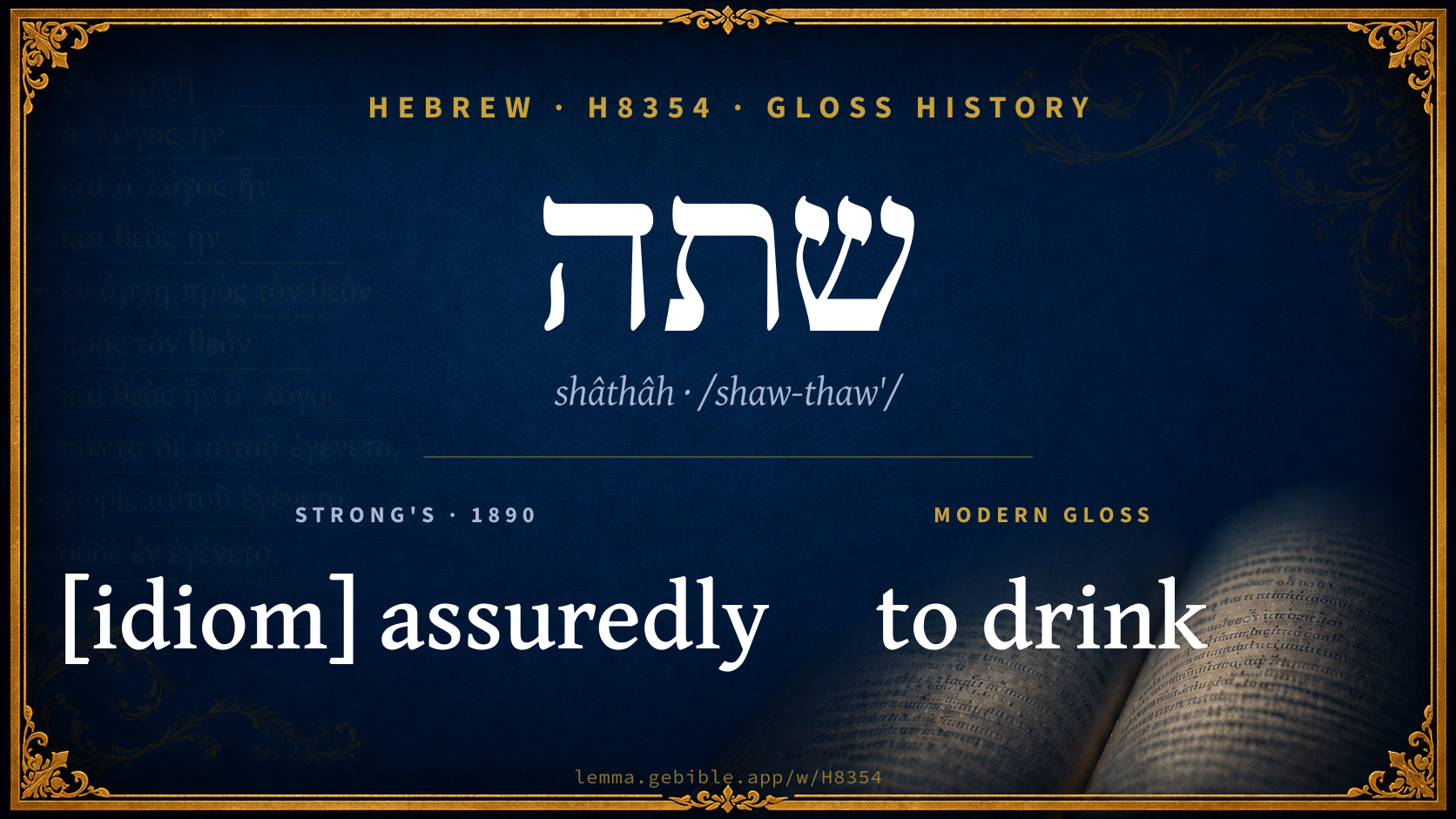
Gloss history
Strong's 1890 vs modern scholarship
About this word
Strong's H8354 catalogs a Hebrew word from the Hebrew Old Testament.
These counts are not copied from any lexicon or concordance. They are computed here, from the morphology-tagged Hebrew Old Testament. What Lemma adds →
- 193
- distinct verses
- The word appears in 193 distinct verses.
- 34 / 39
- OT books
- The word appears in 34 of 39 Old Testament books.
- #219
- by frequency
- Top 250 most frequent Hebrew words (rank 219 of 8,640 Hebrew words by occurrence).
View all 193 occurrences in the concordance →
By section of the Old Testament
By traditional corpus
Conventional, traditional groupings — biblical authorship is debated, so this is a traditional corpus grouping, not an authorship claim. Each share is this word’s portion of its verses in that division of the Hebrew canon. Each figure is a share of the word’s 193 distinct verses.
- Prophets (Nevi'im) 107 verses · 55%
- Torah (Pentateuch) 45 verses · 23%
- Writings (Ketuvim) 41 verses · 21%
How translations render this word
Counts come from each version’s own published word-to-Strong’s tagging or interlinear alignment — an approximate guide to how each version renders this word, not a word-level alignment the data otherwise carries. Because each total is that version’s own tagged count, the per-version totals vary from one another and need not match the appearance or distinct-verse counts above. These counts may also differ from a printed concordance because Lemma counts each distinctly tagged rendering and does not collapse phrase taggings into a single head-word total. This is a fixed set of word-tagged versions (KJV, ASV, BSB, ULT) and does not change with the reading translation you choose elsewhere. Each version’s license is shown beside its name below (and on Sources).
- King James Version: Drink 102×, Drinking 10×, Drunk 6×
- American Standard Version: Drink 88×, Drinking 8×, Drunk 5×
- Berean Standard Bible: Drink 91×, Drank 19×, Drinking 16×
- unfoldingWord Literal Text: Drink 88×, Drinking 17×, Drank 15×
King James Version Public Domain
Renders H8354 across 217 tagged occurrences — most commonly:
Plus other, less common renderings. Plus 62 renderings that appear only once — usually multi-word phrases or single function words the recovered tagging swept in, not distinct renderings.
American Standard Version Public Domain
Renders H8354 across 219 tagged occurrences — most commonly:
Plus other, less common renderings. Plus 73 renderings that appear only once — usually multi-word phrases or single function words the recovered tagging swept in, not distinct renderings.
Berean Standard Bible Public Domain
Renders H8354 across 212 tagged occurrences — most commonly:
Plus other, less common renderings. Plus 40 renderings that appear only once — usually multi-word phrases or single function words the recovered tagging swept in, not distinct renderings. Not rendered by a distinct English word in 5 further occurrences.
unfoldingWord Literal Text CC BY-SA 4.0
Renders H8354 across 233 tagged occurrences — most commonly:
Plus other, less common renderings. Plus 37 renderings that appear only once — usually multi-word phrases or single function words the recovered tagging swept in, not distinct renderings.
10 senses and sub-senses in the full BDB
Hebrew verbs can shift meaning by stem (binyan): Qal is the basic action, Niphal is often passive or reflexive, Piel often intensifies or makes it factitive, and Hiphil is typically causative. The senses below are grouped under the stem BDB assigns to each.
What do BDB’s symbols mean?
BDB uses these scholarly abbreviations:
| Symbol | Meaning |
|---|---|
| 𝔊 | the Septuagint (the ancient Greek translation, LXX) |
| 𝔙 | the Vulgate (the Latin translation) |
| 𝔖 | the Syriac version (the Peshitta) |
| 𝔗 | the Targum (the Aramaic translation) |
| ψ | the Psalms |
| √ | root (the underlying root or stem) |
| ‖ | parallel passage (a synonymous or contrasted parallel) |
| † | the dagger: every passage where the word occurs is cited |
The 10 senses and sub-senses the full Brown-Driver-Briggs lexicon distinguishes for this word, in lexicon order (not ranked by frequency), with BDB’s own verbatim wording and sub-sense lettering. Shown in Hebrew script with BDB’s own scholarly abbreviations. The condensed entry is in the Lexicon Entry tab. See also the Forms in the corpus table below.
Qal
- Pf. 3 ms. שׁ׳ Ex 34:28 +, 1 s. שָׁתִ֫יתִי 1 S 15 +, etc.; Impf. 3 ms. יִשְׁתֶּה Gn 44:5 +, וַיִּשְׁתֶּה 1 K 19:8, usually וַיֵּשְׁתְּ Gn 9:21 +; juss. וְיֵשְׁתְּ 1 K 13:18; 3 fs. וַתֵּשְׁתְּ Nu 20:11; 2 ms. apoc. תֵּשְׁתְּ Ju 13:14 +, וַתֵּשְׁתְּ 1 K 13:22; 1 s. וָאֵשְׁתְּ Gn 24:46; 3 mpl. יִשְׁתָּי֑וּן ψ 78:44, etc.; Imv. ms. שְׁתֵה Gn 24:14 +, etc.; Inf. abs. שָׁתֹה Is 21:5; Je 49:12 (in 1 S 1:9 after prep., anom., Ges§ 113 e, om. 𝔊 Th We Dr and mod.), שָׁתוֹ Je 25:28 +, שָׁתוֹת Is 22:13 (Ges§ 75 n); cstr. שְׁתוֹ †Pr 31:4, שְׁתוֹת Je 35:8, 14, לִשְׁתֹּת Gn 24:19 +, sf. שְׁתוֹתוֹ 1 K 13:33, לִשְׁתּוֹתָהּ Is 51:22 etc.; Pt. act. שֹׁתֶה Is 29:8 +, f. שֹׁתָה Jb 6:4, etc.;— e.g. Exodus 34:28
- 1.
- a. of man: drink, water, wine, etc., Ex 34:28 (JE), cf. 15:24 (J), 1 S 30:12 Am 2:8; 4:8; 5:11; Is 5:22; 62:8, 9; Pr 31:4, Ju 13:4, 7, 14 + often (2 times JE; 6 times D); by measure (short allowance) Ez 4:11, 16; milk †Ez 25:4, cf. Ct 5:1; blood 1 Ch 11:19 (fig. of water gained by hazard); fig. חֲמָתָם שֹׁתָה רוּחִי Jb 6:4 whose venom [of arrows of י׳] my spirit drinks up; acc. + מִן of source †Ex 7:18 (J), v 21 (E), 15:23 (J), Pr 5:15 (fig.); acc. (of wine, water, etc.) om. Gn 24:14(×2); 27:25; 43:34 (all J) + 11 times J, Ex 7:24; 17:6 (E), Nu 20:5 (JE), v 11; 33:14 (P), Ju 15:19 + often; acc. שׁין †2 K 18:27 = Is 36:12; מַמְתַקִּים Ne 8:10; abs. Ec 2:24 +; + מִן of source 1 K 17:4, 6 ψ 110:7, מִכֹּסוֹ 2 S 12:3; שׁ׳ בְּמִזְרְקֵי יַיִן † Am 6:6, cf. Gn 44:5; שׁ׳ בְּיַיִן †Pr 9:5; c. מִן partit. Gn 9:21; Ex 7:24; Ru 2:9, also (fig.) Je 51:7 (and Jb 21:20 infra). e.g. Exodus 34:28
- b. pt. as subst. שֹׁתֵי מַיִם Ez 31:14, 16, שֹׁתֵי יַיִן Jo 1:5; שׁוֹתֵי שֵׁכָר ψ 69:13. e.g. Ezekiel 31:14
- c. drink wine in sacrificial feast Dt 32:38 (poem); blood of sacrificial victim ψ 50:13 (fig. of י׳). e.g. Deuteronomy 32:38
- d. subj. animals Nu 20:19; Jon 3:7 (both + men), also (fig.) Ez 34:18, 19; acc. (water) om. Gn 24:19, 22; 30:38(×2). e.g. Numbers 20:19
- e. fig. of drinking cup of י׳’s wrath, שׁ׳ אֶת־כּוֹס חֲמָתוֹ Is 51:17 (+ מִיַּד י׳), cf. v 17, v 22, v. also Ez 23:32, 34 and (acc. om.) Je 25:16, 26, 27 + 8 times Je, Hb 2:16; abs. Ob 16(×3); acc. שְׁמָרִים ψ 75:9; שׁ׳ מֵחֲמַת שַׁדַּי Jb 21:20. e.g. Isaiah 51:17
- f. drink blood, fig. of slaughter, Nu 23:24 (JE; of lion, metaph. of Isr.), Zc 9:15 (read דָּמָם for הָמוּ 𝔊 Codd. Sta Now Marti); so (blood of י׳’s sacrifice) Ez 39:17, 18, 19. e.g. Numbers 23:24
- g. fig. of wicked deeds: יֵין חֲמָסִים יִשְׁתּוּ Pr 4:17 (‖ לָֽחֲמוּ לֶחֶם רֶשַׁע; these are their food and drink), cf. Jb 15:16; 34:7, but Pr 26:6 appar. = suffers violence (cf. De Toy). e.g. Proverbs 4:17
- 2. late, = feast Est 3:15; 7:1 (cf. מִשְׁתֶּה). e.g. Esther 3:15
Niphal
- Impf. 3 ms. יִשָּׁתֶה Lv 11:34 (P) all which is (may be) drunk, c. ב of vessel.—נִשְׁתָּ֑וָה Pr 27:15 v. I. שׁוה ad fin. For cause, give, to drink v. שׁקה. e.g. Leviticus 11:34
Senses from the full Brown-Driver-Briggs lexicon (Brown, Driver, Briggs; Oxford 1906 — public domain), digitized via Sefaria, supplemented by the OpenScriptures HebrewLexicon (CC BY 4.0). Full attribution on Sources.
Word origin
vb. drink (NH id.; Assyrian šatû, Ethiopic ሰትየ Old Aramaic שתה, Aramaic שְׁתָא, אִשְׁתִּי, [ܫܬܐ], ܐܶܫܬܻܝ]; Sab. שתי DHMZMG xxxvii (1883), 403 HomChr 124);—
— Brown-Driver-Briggs (Oxford 1906, public domain), digitized via Sefaria, supplemented by the OpenScriptures HebrewLexicon (CC BY 4.0). See Sources.
Origin: a primitive root
Jastrow Dictionary
A second Hebrew/Aramaic lexicon for comparison, covering Aramaic and post-biblical (Talmudic, Targumic, Midrashic) usage that the biblical-Hebrew BDB does not. Matched by lemma rather than by Strong’s number, so a lemma may carry more than one Jastrow headword (shown separately below), and the entries cover usage well beyond the Bible.
שָׁתָה
- , v. שתי
שתי
- (b. h.) [to be settled, satisfied,] to drink. Pes. 86ᵇ השׁוֹתֶה כוסו וכ׳ he who drinks his cupful at one draught is called greedy (גַּרְגְּרָן). Ber. 51ᵃ מקבלו … ושׁוֹתֵהוּ בשמאל he must receive it (the medicine, v. אִסְפַּרְגּוֹס) with his right hand, and drink it (take it to his lips) with his left hand. Ib.ᵇ השותה כפלים he who drinks an even number of cups (v. זוּג). Tosef. Sot. XV, 11; B. Bath. 60ᵇ כשחרב … ושלא לִשְׁתּוֹת יין when the Temple was destroyed, … there were many scrupulous persons (פרושים, determined) not to eat meat nor drink wine. Ib. נִשְׁתֶּה יין וכ׳ should we drink wine, of which libations were offered on the altar? Ib. מים לא נשתה וכ׳ then let us drink no water, because water libation has ceased. Keth. 8ᵇ רבים שָׁתוּ רבים יִשְׁתּוּ many have drank (the cup of mourning), many shall drink, v. מִשְׁתֶּה. Nidd. 24ᵇ כמה … שָׁתַת אמו וכ׳ how much unmixed wine the mother of this embryo must have drunk!; a. fr.—Part. pass. שָׁתוּי being under the influence of drink. Erub. 64ᵃ שְׁתוּי יין אל וכ׳ Ms. M. (ed. only שָׁ׳) one feeling the wine must not pray, contrad. to שִׁכּוֹר, q. v. Lev. R. s. 12 שנכנסו שְׁתוּיֵי יין וכ׳ they (Nadab and Abihu) entered the Tabernacle while under the influence of wine; a. fr.—[Hif. from שָׁקָה q. v.]
שתי ²
- [to settle,]
- 1. to lay the foundation of; v. שָׁתַת II.
- 2. to fix the warp, start the loom, v. שְׁתִי.
- 1. to found, establish, v. שָׁתַת II.
- 2. to weave. Midr. Sam. ch. XIX (ref. to נסכתי, Ps. II, 6) הִשְׁתֵּיתִיו I have woven him (established him, ref. to מסכת, Jud. XVI, 14); Yalk. Is. 338; Yalk. Ps. 620 השיתיו (corr. acc.). e.g. Psalms 2:6
- to be established, started. Y. Yoma V, 42ᶜ, v. שְׁתִיָּה II; a. e.
- same. Tosef. Yoma III (II), 6 ed. Zuck. (Var. נשתת), v. שָׁתַת II
A Dictionary of the Targumim, the Talmud Babli and Yerushalmi, and the Midrashic Literature (Marcus Jastrow; London, Luzac, 1903) — Public Domain. Digitized via Sefaria. Digitized via Sefaria. Full attribution on Sources.
Forms in the corpus
The 155 distinct written forms H8354 takes in the Hebrew Bible, most frequent first — each parse links to that stem’s occurrences in the concordance. Hebrew forms include their vowel points and cantillation, so a single lemma takes many written forms.
The 60 most common forms are shown; 95 rarer forms follow in the full concordance.
Same root — word family
Other BDB entries built from the same root as H8354, grouped by Strong’s listed origin. These share a root / origin per the lexicon — not necessarily a shared meaning. Each links to that word’s own entry.
Derived from this word
Compare all same-root words → They share a root, not necessarily a meaning.
Septuagint verse parallels
This word appears in 185 verses that also exist in the Greek Old Testament (Septuagint), out of the 193 Hebrew verses it occurs in. You can read those verses in Greek by switching the Old Testament edition to the Septuagint.
Read these verses in the Septuagint
- Genesis 9:21
- Exodus 7:18
- Leviticus 10:9
- Numbers 6:3
- Deuteronomy 2:6
- Judges 7:5
- Ruth 2:9
- 1 Samuel 1:9
- 2 Samuel 11:11
- 1 Kings 1:25
- 2 Kings 3:17
- 1 Chronicles 11:18
This is a verse-level parallel only — the same verses exist in both the Hebrew and Greek Old Testaments. No word-level Hebrew↔Greek correspondence is claimed: the data carries no such alignment, so no Greek word is shown as this Hebrew word’s translation. Coverage is not total — the Septuagint omits the deuterocanon and renumbers the Psalms, so some Hebrew verses have no direct Greek parallel.