
Isaiah 44:12

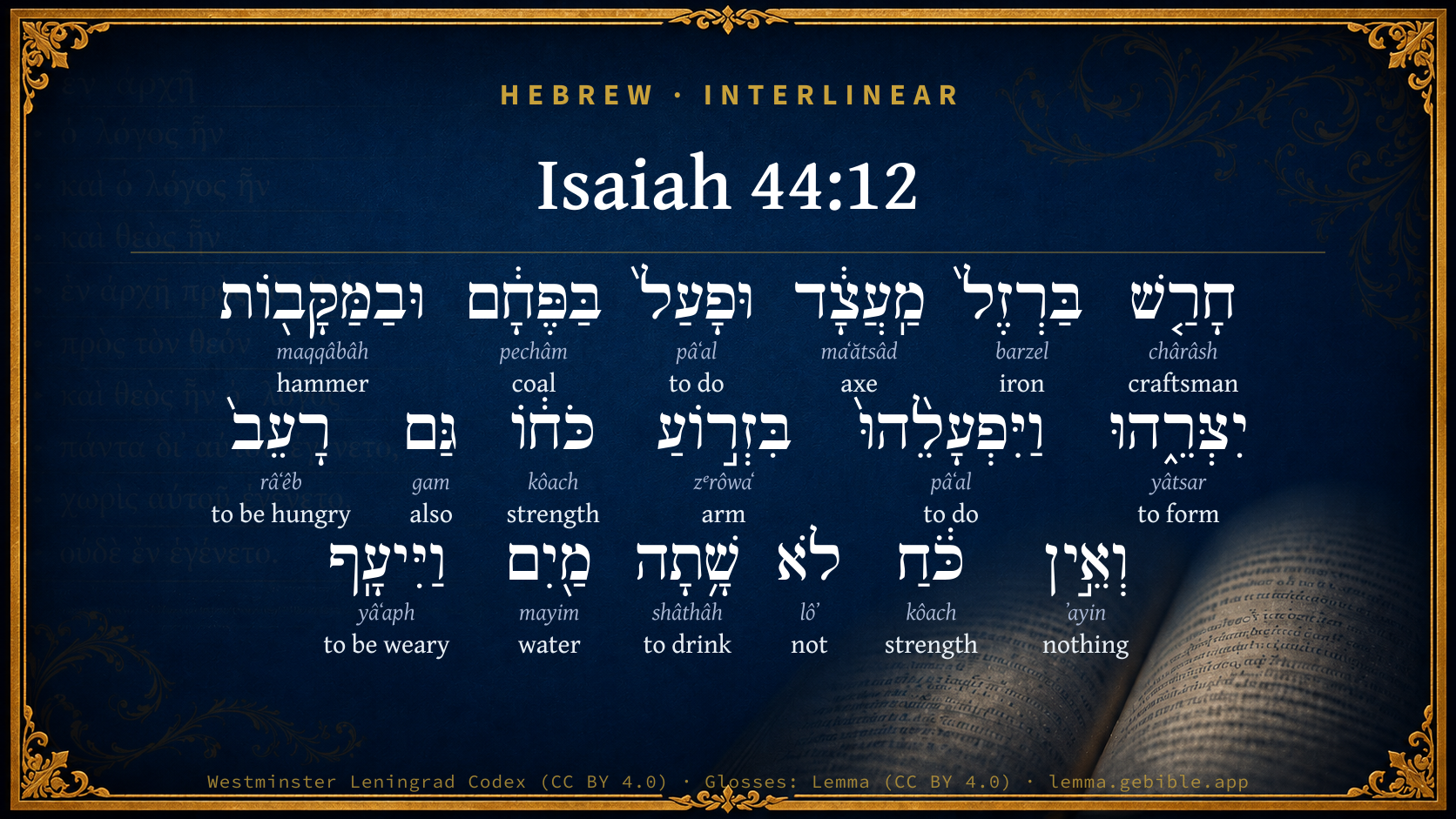
Hebrew (Westminster Leningrad Codex) Isaiah 44:12 appears in the Hebrew Old Testament. The text above is from the Westminster Leningrad Codex. Each word links to its Strong’s number, a concise gloss, and parsing drawn from the Open Scriptures Hebrew Bible morphology. Click any word for its full Brown-Driver-Briggs (BDB) entry.
Download image
Cite this verse

Isaiah 44:12 (World English Bible). Public Domain. Lemma interlinear Bible study tool, https://lemma.gebible.app/v/isaiah/44/12.

Show BibTeX & RIS
BibTeX
RIS
English Translation
The smith [makes] an axe, and works in the coals, and fashions it with hammers, and works it with his strong arm: yes, he is hungry, and his strength fails; he drinks no water, and is faint.
World English Bible · Public Domain
Highlights
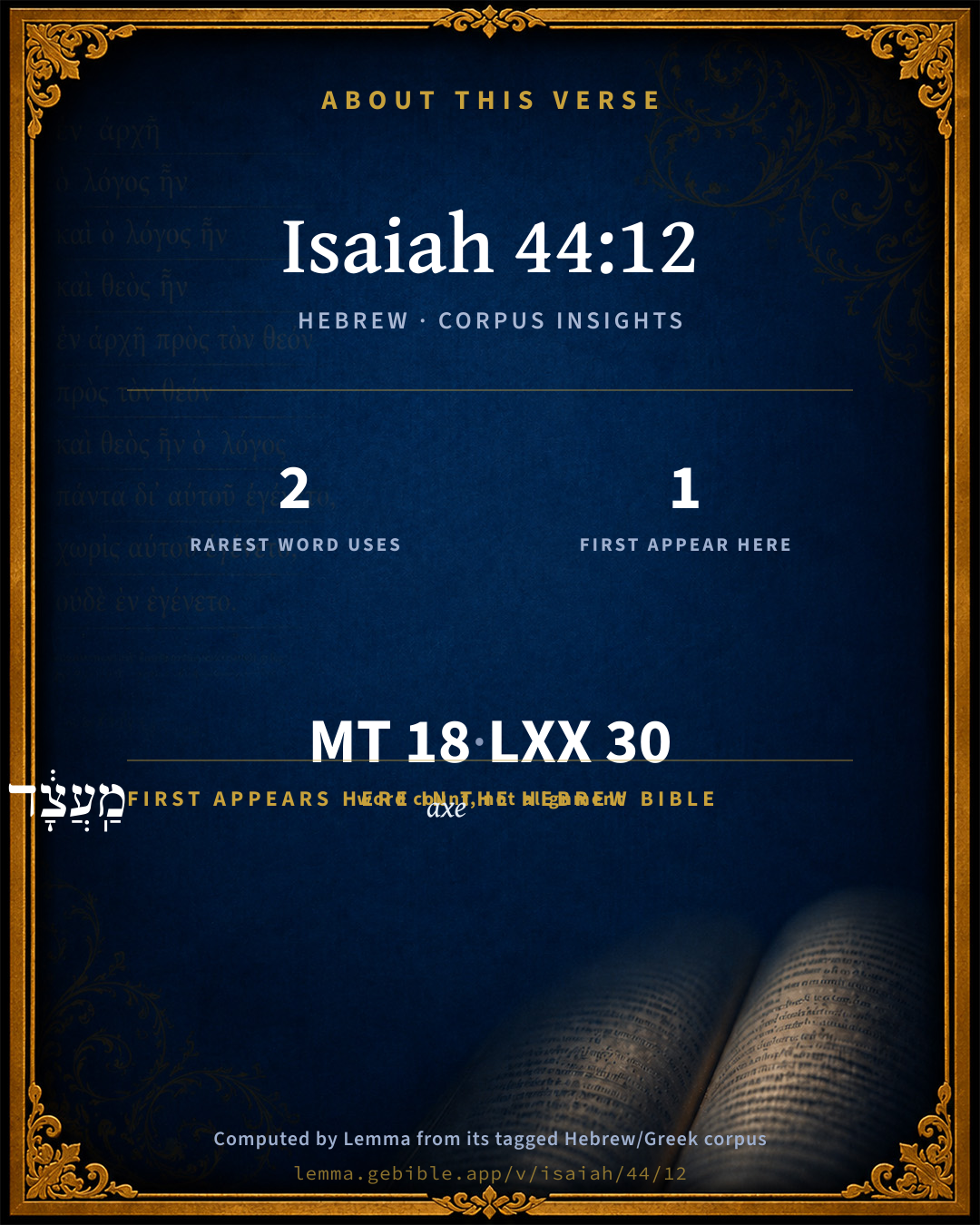
  • 1 first appearance in the Hebrew Bible
Full analysis ↓
Download a study sheet

One document with this verse’s original text, its word-by-word gloss line, the meaning frame, cross-references with their text, attributed commentary, and full source and license credits — printable, and it pastes into notes with its structure intact.

This verse Autodidact and up

Study sheet (.html) Plain text (.txt)

A passage Seminary Student

Up to 50 verses in one chapter. A passage sheet keeps up to 6 commentary sources and 12 cross-references per verse, in the order this page ranks them, and says so on the sheet whenever that leaves anything out. Ask for a single verse and you get the Autodidact verse sheet above.

Everything on this page stays free to read, with no account — the sheet is a download of what is already on screen, not access to it.

Want to remove ads? Support Godless Engineer
Compare translations 3

The same verse in 3 English versions, stacked beneath the original-language interlinear above. Click any original word for its lexicon entry.

Each is an independent rendering of the whole verse — the interlinear is not word-aligned to these translations.

Highlighted words mark where these versions differ — a whole-verse word diff, not a word-by-word alignment.

  • World English Bible Public Domain
    The smith [makes] an axe, and works in the coals, and fashions it with hammers, and works it with his strong arm: yes, he is hungry, and his strength fails; he drinks no water, and is faint.
  • King James Version Public Domain
    The smith with the tongs both worketh in the coals, and fashioneth it with hammers, and worketh it with the strength of his arms: yea, he is hungry, and his strength faileth: he drinketh no water, and is faint.
  • unfoldingWord Literal Text CC BY-SA 4.0
    The craftsman of iron a tool, and he works over the coal, and he forms it with hammers, and he works it with the arm of his strength. He also hungers, and there is no strength; he does not drink water, and he tires.

unfoldingWord Literal Text — © unfoldingWord, licensed CC BY-SA 4.0. Word-aligned USFM3 via Door43 (git.door43.org/unfoldingWord/en_ult).

Versions to compare (up to 4)

3 of 4 selected

Show all 18 translations

Every available English version of this verse, each an independent rendering of the whole verse.

  • World English Bible Public Domain
    The smith [makes] an axe, and works in the coals, and fashions it with hammers, and works it with his strong arm: yes, he is hungry, and his strength fails; he drinks no water, and is faint.
  • Berean Standard Bible Public Domain
    The blacksmith takes a tool and labors over the coals; he fashions an idol with hammers and forges it with his strong arms. Yet he grows hungry and loses his strength; he fails to drink water and grows faint.
  • Majority Standard Bible Public Domain
    The blacksmith takes a tool and labors over the coals; he fashions an idol with hammers and forges it with his strong arms. Yet he grows hungry and loses his strength; he fails to drink water and grows faint.
  • King James Version Public Domain
    The smith with the tongs both worketh in the coals, and fashioneth it with hammers, and worketh it with the strength of his arms: yea, he is hungry, and his strength faileth: he drinketh no water, and is faint.
  • American Standard Version (1901) Public Domain
    The smith `maketh' an axe, and worketh in the coals, and fashioneth it with hammers, and worketh it with his strong arm: yea, he is hungry, and his strength faileth; he drinketh no water, and is faint.
  • Revised Version (1885) Public Domain
    The smith maketh an axe, and worketh in the coals, and fashioneth it with hammers, and worketh it with his strong arm: yea, he is hungry, and his strength faileth; he drinketh no water, and is faint.
  • Geneva Bible (1599) Public Domain
    The smith taketh an instrument, and worketh in the coles, and facioneth it with hammers, and worketh it with the strength of his armes: yea, he is an hungred, and his strength faileth: he drinketh no water, and is faint.
  • Douay-Rheims (1899) Public Domain
    The smith hath wrought with his file, with coals, and with hammers he hath formed it, and hath wrought with the strength of his arm: he shall hunger and faint, he shall drink no water, and shall be weary.
  • Young's Literal Translation Public Domain
    He hath wrought iron `with' an axe, And hath wrought with coals, And with hammers doth form it, And doth work it by his powerful arm, Yea, he is hungry, and there is no power, He doth not drink water, and he is wearied.
  • Literal Standard Version CC BY-SA 4.0
    He has worked iron [with] an axe, || And has worked with coals, || And forms it with hammers, || And works it by his powerful arm, || Indeed, he is hungry, and there is no power, || He does not drink water, and he is wearied.
  • Unlocked Literal Bible CC BY-SA 4.0
    The smith works with his tools, forming it, working over the coals. He shapes it with hammers and works it with his strong arm. He is hungry, and his strength wanes; he drinks no water and becomes faint.
  • unfoldingWord Literal Text CC BY-SA 4.0
    The craftsman of iron a tool, and he works over the coal, and he forms it with hammers, and he works it with the arm of his strength. He also hungers, and there is no strength; he does not drink water, and he tires.
  • Darby Bible Public Domain
    The iron-smith [hath] a chisel, and he worketh in the coals, and he fashioneth it with hammers, and worketh it with his strong arm; -- but he is hungry, and his strength faileth; he hath not drunk water, and he is faint.
  • World Messianic Bible Public Domain
    The blacksmith takes an ax, works in the coals, fashions it with hammers, and works it with his strong arm. He is hungry, and his strength fails; he drinks no water, and is faint.
  • Webster's Bible Public Domain
    The smith with the tongs both worketh in the coals, and fashioneth it with hammers, and worketh it with the strength of his arms: yes, he is hungry, and his strength faileth: he drinketh no water, and is faint.
  • Free Bible Version CC BY-SA 4.0
    The blacksmith makes an iron tool for woodcarving. Working over hot coals, he hammers it into shape as hard as he can. He gets hungry and loses his strength, and because he doesn't drink he grows weak.
  • Bible in Basic English Public Domain
    The iron-worker is heating the metal in the fire, giving it form with his hammers, and working on it with his strong arm: then for need of food his strength gives way, and for need of water he becomes feeble.
  • JPS Tanakh (1917) Public Domain
    The smith maketh an axe, and worketh in the coals, and fashioneth it with hammers, and worketh it with his strong arm; yea, he is hungry, and his strength faileth; he drinketh no water, and is faint.

Literal Standard Version (2020), Covenant Press — licensed CC BY-SA 4.0. Text via the HelloAO Bible API (eBible.org). Unlocked Literal Bible (unfoldingWord) — licensed CC BY-SA 4.0. Text via the HelloAO Bible API (eBible.org). unfoldingWord Literal Text — © unfoldingWord, licensed CC BY-SA 4.0. Word-aligned USFM3 via Door43 (git.door43.org/unfoldingWord/en_ult). Free Bible Version, Dr. Jonathan Gallagher — licensed CC BY-SA 4.0. Text via the HelloAO Bible API (eBible.org).

Word by word

More ways to search: Search by grammar → Find every occurrence → Compare this word →

Practice this passage: Drill this verse → Learn its vocabulary →

מַֽעֲצָ֔ד
maʻătsâd
H4621
“axe”
Noun, Common, Masculine, Singular, Absolute
Part of Speech
Noun
Type
Common
Gender
Masculine
Number
Singular
State
Absolute
Full BDB Definition

Origin: from an unused root meaning to hew

TWOT: 1668a

axe
  1. חָרַ֤שׁ chârâsh H2796 “craftsman of” Noun, Common, Masculine, Singular, Construct
  2. בַּרְזֶל֙ barzel H1270 “iron” Noun, Common, Masculine, Singular, Absolute
  3. וּפָעַל֙ pâʻal H6466 “and · to do” Conjunction + Verb, Qal, Perfect, 3rd Person, Masculine, Singular
  4. בַּפֶּחָ֔ם pechâm H6352 “in/at the · coal” Preposition, Determined + Noun, Common, Masculine, Singular, Absolute
  5. וּבַמַּקָּב֖וֹת maqqâbâh H4717 “and · in/at the · hammers” Conjunction + Preposition, Determined + Noun, Common, Feminine, Plural, Absolute
  6. יִצְּרֵ֑הוּ yâtsar H3335 “to form · him” Verb, Qal, Imperfect, 3rd Person, Masculine, Singular + Suffix, Personal, 3rd Person, Masculine, Singular
  7. וַיִּפְעָלֵ֨הוּ֙ pâʻal H6466 “and · to do · him” Conjunction + Verb, Qal, Sequential Imperfect, 3rd Person, Masculine, Singular + Suffix, Personal, 3rd Person, Masculine, Singular
  8. בִּזְר֣וֹעַ zᵉrôwaʻ H2220 “in/at · arm of” Preposition + Noun, Common, Both, Singular, Construct
  9. כֹּח֔וֹ kôach H3581 “strength · his” Noun, Common, Masculine, Singular, Construct + Suffix, Personal, 3rd Person, Masculine, Singular
  10. גַּם gam H1571 “also” Particle, Accusative
  11. רָעֵב֙ râʻêb H7456 “to be hungry” Verb, Qal, Perfect, 3rd Person, Masculine, Singular
  12. וְאֵ֣ין ʼayin H369 “and · nothing” Conjunction + Particle, Negative
  13. כֹּ֔חַ kôach H3581 “strength” Noun, Common, Masculine, Singular, Absolute
  14. לֹא lôʼ H3808 “not” Particle, Negative
  15. שָׁ֥תָה shâthâh H8354 “to drink” Verb, Qal, Perfect, 3rd Person, Masculine, Singular
  16. מַ֖יִם mayim H4325 “water(s)” Noun, Common, Masculine, Plural, Absolute
  17. וַיִּיעָֽף yâʻaph H3286 “and · to be weary” Conjunction + Verb, Qal, Sequential Imperfect, 3rd Person, Masculine, Singular

About this verse

These counts appear in no published source. They are computed here, from the morphology-tagged text and Lemma’s own curated glosses. What Lemma adds →

18
words
16
distinct lemmas
Prophets
section

Notable vocabulary

The rarest word here is מַֽעֲצָ֔ד axe H4621 — appearing just 2 times in the whole Hebrew Bible.

First appearance in Scripture

This word makes its first canonical appearance in the Hebrew Bible here:

  • מַֽעֲצָ֔ד axe H4621

Shared distinctive vocabulary

מַֽעֲצָ֔ד axe H4621 occurs in 2 verses of the Hebrew Bible. Also found in:

Grammatical profile

  • 6 verbs
  • 9 nouns
  • 3 particles

Verb forms

  • וּפָעַל֙ Qal · Perfect
  • יִצְּרֵ֑הוּ Qal · Imperfect
  • וַיִּפְעָלֵ֨הוּ֙ Qal · Sequential Imperfect
  • רָעֵב֙ Qal · Perfect
  • שָׁ֥תָה Qal · Perfect
  • וַיִּיעָֽף Qal · Sequential Imperfect

Repetition

Words recur within this verse — often emphatic in Hebrew:

  • וּפָעַל֙ to do H6466 ×2
  • כֹּח֔וֹ strength H3581 ×2

Hebrew & Septuagint length

In English translation the verse runs 37 words from the Hebrew and 40 from the Septuagint (LXX English) — closely comparable.

A rough comparison of the two English renderings, which tokenize alike — not a word-level alignment.

Word counts can differ between the Hebrew and the Greek without any difference in meaning — e.g. the Hebrew direct-object marker אֵת has no separate Greek word, and Greek often adds the article ὁ.

In the original languages it is 18 Hebrew tokens and 30 Greek tokens — but the two are counted differently (Hebrew bundles its prefixes and suffixes into one token; the Greek is in lemma form), so that isn’t a like-for-like length.

Cross-references

7

Topical passages linked to Isaiah 44:12 in the Treasury of Scripture Knowledge — connected by theme and wording, ordered by reader-vote popularity; previews shown in the World English Bible.

  • Isaiah 40:19 The image, a workman has cast [it], and the goldsmith overlays it with gold, and casts [for it] silver chains.
  • Isaiah 41:6–7 They help everyone his neighbor; and [every one] says to his brother, Be of good courage.
  • Isaiah 46:6–7 Some pour out gold from the bag, and weigh silver in the balance. They hire a goldsmith, and he makes it a god. They fall down--yes, they worship.
  • Exodus 32:4 He received what they handed him, and fashioned it with an engraving tool, and made it a molten calf; and they said, "These are your gods, Israel, which brought you up out of the land of Egypt."
  • Exodus 32:8 They have turned aside quickly out of the way which I commanded them. They have made themselves a molten calf, and have worshiped it, and have sacrificed to it, and said, 'These are your gods, Israel, which brought you up out of the land of Egypt.'"
  • Jeremiah 10:3–11 For the customs of the peoples are vanity; for one cuts a tree out of the forest, the work of the hands of the workman with the axe.
  • Habakkuk 2:13 Behold, isn't it of Yahweh of Hosts that the peoples labor for the fire, and the nations weary themselves for vanity?

Cross-references courtesy of OpenBible.info (CC BY 4.0).

Hebrew and Greek witnesses Masoretic Hebrew ↔ Greek Septuagint

The same verse in the two great witnesses to the Old Testament, shown verse-for-verse.

These are two independent witnesses, not word-aligned to each other, and the Septuagint is shown in lemma (dictionary) form.

Hebrew Isaiah 44:12 Masoretic · Westminster Leningrad Codex

חָרַ֤שׁ בַּרְזֶל֙ מַֽעֲצָ֔ד וּפָעַל֙ בַּפֶּחָ֔ם וּבַמַּקָּב֖וֹת יִצְּרֵ֑הוּ וַיִּפְעָלֵ֨הוּ֙ בִּזְר֣וֹעַ כֹּח֔וֹ גַּם רָעֵב֙ וְאֵ֣ין כֹּ֔חַ לֹא שָׁ֥תָה מַ֖יִם וַיִּיעָֽף

The smith [makes] an axe, and works in the coals, and fashions it with hammers, and works it with his strong arm: yes, he is hungry, and his strength fails; he drinks no water, and is faint.

World English Bible · Public Domain

Greek LXX Isaiah 44:12 Septuagint · lemma form

ὅτι ὀξύνω τέκτων σίδηρος σκεπάρνῳ ἐργάζομαι αὐτός καί ἐν τέρετον τετραίνω αὐτός ἐργάζομαι αὐτός ἐν ὁ βραχίων ὁ ἰσχύς αὐτός καί πεινάω καί ἀσθενέω καί οὐ μή πίνω ὕδωρ ἐκλέγω

For the artificer sharpens the iron; he fashions the idol with an axe, and fixes it with an awl, and fashions it with the strength of his arm: and he will be hungry and weak, and will drink no water.

LXX2012 (modern English Septuagint) · Public Domain

On this verse, Adam Clarke's Commentary discusses the Septuagint’s reading. Read the note in Commentary ↓

Hebrew: Westminster Leningrad Codex (CC BY 4.0). Greek: Septuagint (public domain); English from LXX2012 (modern English Septuagint) (Public Domain). How the Septuagint differs from the Hebrew →

Targum (Aramaic paraphrase)

1

The Targum is the ancient Jewish Aramaic paraphrase of the Hebrew Scriptures — an interpretive translation, not the Hebrew text itself. Onkelos (literal) and Pseudo-Jonathan (expansive) render the Torah, and Jonathan the Prophets. Coverage is partial: where no permissively-licensed English translation exists for a verse, only the Aramaic is shown. This is verse-level text, not a word-by-word alignment to the Hebrew.

  1. Targum Jonathan Prophets (Joshua–Malachi)
    נַפְחָא מִבַּרְזְלָא חֲצִינָא עָבֵיד וּנְפַח נוּר בְּשִׁיחוּרִין וּבְמַקוּבִין מַתְקֵיף לֵיהּ וְעָבִיד לֵיהּ בִּתְקוֹף חֵילֵהּ דְאִם יִכְפַּן עַבְדֵהּ וְלָא יֵיכוּל לָא יְהֵי בֵיהּ חֵיל וְאִם יִצְחֵי וְלָא יִשְׁתֵּי מַיָא יְהֵי מְשַׁלְהֵי:

    The smith maketh an axe out of iron, and bloweth the coals in the fire, and maketh it firm with the hammer, and worketh it with the power of his strength; but when he that worketh it is hungry, and does not eat bread, he hath no strength; and if he is thirsty, and drinketh no water, he fainteth.

    Targum Jonathan — Aramaic: “Mikraot Gedolot” (public domain). English: “Sefaria Community Translation” (CC0 1.0 (public-domain dedication)); “London "Chaldee Paraphrase," 1871” (public domain). Text via Sefaria.

Commentary

Notes on Isaiah 44:12 from classic Christian and Jewish commentators (each source and its license shown beneath its notes). The classic Christian expositions comment on the surrounding passage and are grouped to its opening verse, so a note may address several verses; the Jewish commentaries on the Tanakh (Rashi and others) are per-verse, so they appear only where the commentator wrote on this verse.

Lemma curates 59 commentaries, every one of them public domain or Creative Commons licensed, each selected and text-cleaned for this edition rather than reprinted as found. About our sources →

Adam Clarke's Commentary

Verse 12. The smith with the tongs, c. - "The smith cutteth off a portion of iron"] מעצד meatstsed, Participium Pihel of עצד atsad, to cut still used in that sense in the Arabic. See Simonis Lex. Heb. The Septuagint and Syriac take the word in this form: but they render it sharpeneth the iron. See Castell. Lex. in voce.

The sacred writers are generally large and eloquent upon the subject of idolatry; they treat it with great severity, and set forth the absurdity of it in the strongest light. But this passage of Isaiah, Isa 44:12-20, far exceeds any thing that ever was written upon the subject, in force of argument, energy of expression, and elegance of composition. One or two of the apocryphal writers have attempted to imitate the prophet, but with very ill success; Wisd. 13:11-19; 15:7, c. Baruch vi., especially the latter, who, injudiciously dilating his matter, and introducing a number of minute circumstances, has very much weakened the force and effect of his invective. On the contrary a heathen author, in the ludicrous way, has, in a line or two, given idolatry one of the severest strokes it ever received: -

Olim truncus eram ficulnus, inutile lignum,

Cum faber incertus, scamnum faceretne Priapum,

Maluit esse Deum. Deus inde ego.

HORAT. Satyr, lib. 1. sat. viii.

"Formerly I was the stump of a fig tree, a useless log; when the carpenter, after hesitating whether to make me a god or a stool, at last determined to make me a god. Thus I became a god!"

From the tenth to the seventeenth verse, a most beautiful strain of irony is carried on against idolatry. And we may naturally think that every idolater, who either read or heard it, must have been for ever ashamed of his own devices. - L.

Adam Clarke's Commentary on the Bible (1810–1826) — public domain. Text from a community e-Sword/MySword module.

Trapp's Complete Commentary

John Trapp

Isa 44:12 The smith with the tongs both worketh in the coals, and fashioneth it with hammers, and worketh it with the strength of his arms: yea, he is hungry, and his strength faileth: he drinketh no water, and is faint.

Ver. 12. The smith with the tongs, &c.] He lively setteth forth the weakness of the workmen, that thereby may be understood the weakness of the idols, since they cannot help in the least those that take such pains about them. All these things must be taken as spoken with utmost scorn and stomach.

And fashioneth it with hammers.] He knocks and works his idol in manner as he doth his coulter or ploughshare.

With the strength of his arms.] Tanto conatu tantas nugas agit, cum sit calidus in re frigida: he much troubleth himself about such trifles. Hoc agunt ut nihil agant.

John Trapp, A Commentary or Exposition upon All the Books of the Old and New Testament (1647–1656) — public domain. Text from a community e-Sword module.

Albert Barnes' Notes on the Bible

The smith with the tongs - The prophet proceeds here to show the folly and absurdity of idolatry; and in order to this he goes into an extended statement Isa 44:12-19 of the manner in which idols were usually made. Lowth remarks, ‘The sacred writers are generally large and eloquent on the subject of idolatry; they treat it with great severity, and set forth the absurdity of it in the strongest light. But this passage of Isaiah far exceeds anything that was ever written on the subject, in force of argument, energy of expression, and elegance of composition. One or two of the Apocryphal writers have attempted to imitate the prophet, but with very ill success (Wisd. 13:11-19; 15:7; etc.; Baruch 6) Horace, however, has given a description of the making of idols, which, for severity of satire, and pungency of sarcasm, has a strong resemblance to this description in Isaiah:

Olim truncus eram ficulnus, inutile lignum;

Cum faber, incertus scamnum faceretne Priapum

Maluit esse Deum.

Sat. I. viii. 1-3.

Lowth renders the phrase ‘the smith with the tongs,’ ‘The smith cutteth off a portion of iron.’ Noyes, ‘The smith prepareth an axe’ The Septuagint, ‘The carpenter sharpeneth (ὤζυνε ōzune) iron’ (σίδηρον sidēron), that is, an axe. So also the Syriac. Gesenius renders it, ‘The smith makes an axe.’ Many other renderings of the passage have been proposed. The idea in this verse is, I think, that the prophet describes the commencement of the process of making a graven image. For that purpose, he goes back even to the making of the instruments by which it is manufactured, and in this verse he describes the process of making an axe, with a view to the cutting down of the tree, and forming a god. That he does not here refer to the making of the idol itself is apparent from the fact that the process here described is that of working in iron; but idols were not made of iron, and that here described especially (Isa 44:11 ff) is one made of wood. The phrase used here, therefore, refers to the process of axe-making with a view to cutting down a tree to make a god; and the prophet describes the ardor and activity with which it is done, to show how much haste they were in to complete it. The literal translation of this phrase is, ‘The workman (חרשׁ chârash, st. const. for חרשׁ chârâsh) of iron (maketh) an axe.’

Both worketh in the coals - And he works the piece of iron of which he is making an axe in the coals. He blows the coals in order to produce an intense heat (see Isa 54:16) - ‘Behold, I have created the smith that bloweth the coals in the fire.’

And fashioneth it with hammers - Forms the mass of iron into an axe. Axes were not cast, but made.

And worketh it with the strength of his arms - Or, he works it with his strong arms - referring to the fact that the arm of the smith, by constant usage, becomes exceedingly strong. A description remarkably similar to this occurs in Virgil when he is describing the Cyclops:

Illi inter sesc magna vi brachia tollunt

In numerum; versantque tenaci forcipe ferrum.

Georg. iv. 174, 175.

Heaved with vast strength their arms in order rise,

And blow to blow in measured chime replies;

While with firm tongs they turn the sparkling ore,

And Etna’s caves with ponderous anvils roar.

Sotheby.

Yea, he is hungry - He exhausts himself by his hard labor. The idea is, that he is so anxious to have it done, so engaged, so diligent, that he does not even stop to take necessary refreshment.

And his strength faileth - He works until he is completely exhausted.

He drinketh no water - He does not intermit his work even long enough to take a draught of water, so hurried is he. While the iron is hot, he works with intense ardor, lest it should grow cool, and his work be retarded - a very graphic description of what all have seen in a blacksmith’s shop. The Rev. John Williams states that when the South Sea islanders made an idol, they strictly abstained from food; and although they might be, and were sometimes, three days about the work, no water, and he believes no food, passed their lips all the time. This fact would convey a satisfactory elucidation of an allusion not otherwise easily explained (Pictorial Bible).

Albert Barnes' Notes on the Bible (1834–1885) — public domain. Text from a community e-Sword/MySword module.

Joseph Benson's Commentary

Isa 44:12-17. The smith, &c. — “The sacred writers,” says Bishop Lowth, “are generally large and eloquent upon the subject of idolatry: they treat it with great severity, and set forth the absurdity of it in the strongest light. But this passage of Isaiah far exceeds any thing that ever was written upon the subject, in force of argument, energy of expression, and elegance of composition. One or two of the apocryphal writers have attempted to imitate the prophet, but with very ill success: Wis 13:11-19; Wis 15:7, &c.; Baruk, chap. 6.; especially the latter, who, injudiciously dilating his matter, and introducing a number of minute circumstances, has very much weakened the force and effect of his invective. On the contrary, a heathen author, in the ludicrous way, has, in a line or two, given idolatry one of the severest strokes it ever received:

“Olim truncus eram ficulnus, inutile lignum;

Cum faber, incertus scamnum faceretne Priapum, Maluit esse Deum.”

“I was of old the trunk of a fig-tree, a useless block;

when the carpenter, uncertain whether to make a bench or a

Priapus, chose that I should be a god.” — Hor., lib. 1. sat. 8.

He maketh it after the figure of a man, &c. — In the same comely shape and proportions which are in a living man; that it may remain in the house — In the dwelling-house of him that made it. He heweth him down cedars and the oak — Which afford the best and most durable timber; which he strengtheneth for himself — He plants, and with care and diligence improves those trees, that he or his posterity may thence have materials for their images, and those things which belong to them. He maketh an image, and falleth down thereto — Having related the practices of idolaters, he now discovers the vanity and folly of them, that they make their fire and their god of the same materials, distinguished only by the art of man, and roast their meat with the article which they worship.

Joseph Benson's Commentary on the Old and New Testaments (1811–1818) — public domain. Text from a community e-Sword module.

Keil & Delitzsch

C. F. Keil & F. Delitzsch

The prophet now conducts us into the workshops. "The iron-smith has a chisel, and works with red-hot coals, and shapes it with hammers, and works it with his powerful arm. He gets hungry thereby, and his strength fails; if he drink no water, he becomes exhausted. The carpenter draws the line, marks it with the pencil, carries it out with planes, and makes a drawing of it with the compass, and carries it out like the figure of a man, like the beauty of a man, which may dwell in the house." The two words chârash barzel are connected together in the sense of faber ferrarius, as we may see from the expression chârash ‛ētsı̄m (the carpenter, faber lignarius), which follows in Isa 44:13. Chârash is the construct of chârâsh (= charrâsh), as in Exo 28:11. The second kametz of this form of noun does indeed admit of contraction, but only to the extent of a full short vowel; consequently the construct of the plural is not חרשׁי, but חרשׁי (Isa 45:16, etc.). Hence Isa 44:12 describes how the smith constructs an idol of iron, Isa 44:13 how the carpenter makes one of wood. But the first clause, מעצד בּרזל חרשׁ, is enigmatical. In any case, מעצד is a smith's tool of some kind (from עצד, related to חצד). And consequently Gesenius, Umbreit, and others, adopt the rendering, "the smith an axe, that does he work ... ;" but the further account of the origin of an idol says nothing at all about this axe, which the smith supplies to the carpenter, that he may hew out an idol with it. Hitzig renders it, "The smith, a hatchet does he work, and forms it (viz., into an idol);" but what a roundabout way! first to make a hatchet and then make it into an idol, which would look very slim when made. Knobel translates it, "As for the cutting-smith, he works it;" but this guild of cutting-smiths certainly belongs to Utopia. The best way to render the sentence intelligible, would be to supply לו: "The smith has (uses) the ma‛ătsâd." But in all probability a word has dropped out; and the Septuagint rendering, ὅτι ὤξυνεν τέκτων σίδηρον σκεπάρνω εἰργάσατο κ.τ.λ, shows that the original reading of the text was מעצד ברזל חרס חדד, and that חדד got lost on account of its proximity to יחץ. The meaning therefore is, "The smith has sharpened, or sharpens (chiddēd, syn. shinnēn) the ma‛ătsâd," possibly the chisel, to cut the iron upon the anvil; and works with red-hot coals, making the iron red-hot by blowing the fire. The piece of iron which he cuts off is the future idol, and this he shapes with hammers (יצרהוּ the future of יצר). And what of the carpenter? He stretches the line upon the block of wood, to measure the length and breadth of the idol; he marks it upon the wood with red-stone (sered, rubrica, used by carpenters), and works it with planes (maqtsu‛ōth, a feminine form of מקצוע, from קצע, to cut off, pare off, plane; compare the Arabic mikta‛), and with the compasses (mechūgâh, the tool used, lâchūg, i.e. for making a circle) he draws the outline of it, that is to say, in order that the different parts of the body may be in right proportion; and he constructs it in such a manner that it acquires the shape of a man, the beautiful appearance of a man, to be set up like a human inmate in either a temple or private house. The piel תּאר (תּאר), from which comes yetāărēhū, is varied here (according to Isaiah's custom; cf., Isa 29:7; Isa 26:5) with the poelתּאר, which is to be understood as denoting the more exact configuration. The preterites indicate the work for which both smith and carpenter have made their preparations; the futures, the work in which they are engaged.

Keil & Delitzsch — Biblical Commentary on the Old Testament (1861–1891) — public domain (CC PDM 1.0). Text via the HelloAO Bible API. (Old Testament only.)

Geneva Bible (1599)

Geneva Bible translators

He describeth the raging affection of the idolaters, which forget their own necessities to set forth their devotion toward their idols.

Geneva Bible (1599) marginal notes — public domain. Text via Bolls.life.

Jamieson, Fausset & Brown

Robert Jamieson, A. R. Fausset & David Brown

tongs--rather, "prepareth (to be supplied) an axe," namely, with which to cut down the tree designed as the material of the idol. The "smith" (Hebrew, "workman in iron") here answers to the "carpenter" (Hebrew, "workman in wood"). "He worketh it (the axe, not the idol, which was wood, not metal) in the coals," &c. The axe was wrought, not cast. The smith makes the axe for the carpenter.

hungry . . . drinketh no water--so eager is he to expedite his work while the iron is hot. If the god were worth anything, it would not let him grow "faint" with hunger and thirst. Williams, the missionary, states that the South Sea islanders when they make an idol abstain from food and drink.

Jamieson, Fausset & Brown — Commentary Critical and Explanatory on the Whole Bible (1871) — public domain (CC PDM 1.0). Text via the HelloAO Bible API.

Ellicott's Commentary for English Readers

(12) The smith with the tongs.—We begin with the metal idol. Better, The smith uses a chisel. The work involves stooping over the charcoal furnace. The maker of the god is exhausted with his toil, and requires food and drink to sustain him.

A Bible Commentary for English Readers, edited by Charles John Ellicott (1878–1897) — public domain. Text from a community e-Sword module.

The Cambridge Bible for Schools and Colleges

gen. ed. J. J. S. Perowne

12, 13. This truth enforced by a description of the manufacture of the idols.

The smith] lit. “the workman in iron,” as opposed to the “workman in wood” of the next verse. The text is corrupt at the beginning. R.V. has “the smith (maketh) an axe”; LXX. “the workman sharpeneth iron, worketh it with the adze &c.,” not perceiving that the verse speaks of the blacksmith’s labours. It is possible, no doubt, to take the word for “axe” (which is found again only in Jer_10:3), as meaning “cutting instrument,” for dividing the mass of iron on the anvil; but this is suggested by nothing in the verse; and moreover, the description is certainly not that of the manufacture of an implement, whether for the smith or the carpenter. The only feasible solution is to omit the “axe” altogether as a marginal gloss by some reader who fell into the same error as the LXX. translator. Render: The smith works with the coals.

fashioneth it (the iron core of the idol) with hammers] cf. ch. Isa_41:7.

and worketh it with his strong arm] R.V. Gesenius cites in illustration two lines of Vergil (Georg. IV. 174 f.),

“Illi inter sese magna vi brachia tollunt

In numerum, versantque tenaci forcipe ferrum.”

yea, he is hungry …] The point is that the man who makes his own gods exhausts his strength in the process; contrast ch. Isa_40:31.

The Cambridge Bible for Schools and Colleges (gen. ed. J. J. S. Perowne; Cambridge University Press, 1878–1918) — public domain. Text from a community e-Sword module.

John Gill's Exposition

The smith with the tongs,.... Or, "the worker of iron" (c); the blacksmith, who had a concern in making of idols, for some were made of iron, Dan 5:4, or in making plates to cover them, or nails to fasten them with, or instruments which the carpenter made use of in cutting down trees, and fitting the wood for an image; such as the axe or hatchet, or plane, and which some think is here meant, by the word translated "tongs", but is rendered an "axe", Jer 10:3 and is used for that, or an hatchet, or a plane, by the Misnic (d) writers; so the Targum renders it,

"the smith out of iron makes an axe or hatchet:''

"both worketh in the coals"; he puts his iron in the coals, and blows upon them, and so makes it soft and malleable, and then takes it out:

and fashioneth it with hammers: beats it with hammers upon the anvil, and puts it into what form he pleases:

and worketh it with the strength of his arms; uses his utmost strength to bring it into a form he is desirous of:

yea, he is hungry, and his strength faileth; he drinketh no water, and is faint; he works at it with all his might and main, is earnest at it, and is eagerly desirous of finishing his work; he works till he is hungry and thirsty, and for want of food is ready to faint and sink; and yet will not give himself time to eat and drink, being so intent upon his work: or the sense is, though he is hungry and thirsty, and faints for want of provisions, yet the god he is making, or has made, cannot supply him with any: this is said to expose the folly of idol making, and of idol worship.

(c) "faber ferri", Pagninus, Montanus; "faber ferrarius", V. L. Vitringa. (d) Misn. Sabbat, c. 12. sect. 1. Celim, c. 29. 6.

John Gill's Exposition of the Whole Bible (1746–1763) — public domain (CC PDM 1.0). Text via the HelloAO Bible API.

Haydock's Catholic Bible Commentary

File. Hebrew mahatsad, (Haydock; Jeremias x. 3.) "to make an ax, with," &c. This is the remote cause of the idol.

George Leo Haydock (1774–1849), Haydock's Catholic Family Bible and Commentary, 1859 edition — public domain. Excludes Psalms (Douay-Rheims chapter numbering differs from Protestant) and Deuterocanonical books (Catholic canon only).

Matthew Poole's English Annotations

Both worketh in the coals, and fashioneth it with hammers; first he makes the metal soft and pliable, by putting it among burning coals, and then he taketh it out, and beateth it into what form he pleaseth. It must be here noted, that some of these images were made of brass and iron, as others were of gold and silver, Dan 5:4.

He is hungry, and his strength faileth; he drinketh no water, and is faint: this is mentioned, either,

1. As an argument of the vanity of idols, which cannot relieve their poor workmen, when they are ready to faint away through hunger, and thirst, and weariness. Or,

2. As an evidence of great zeal and industry in carrying on this work, so that they forget or neglect to eat and drink when their necessities require it. This I prefer,

1. Because it suits best with the next foregoing clause, he worketh with the strength of his arms, i.e. fervently, and putting forth all his might in the work.

2. Because the prophet in this, and in the next following verses, is only describing the mechanical part, or the matter of images, and the art and labour of the workmen in making them; and afterwards proceeds to the theological consideration of the thing, and the confutation of these practices, as we shall see.

Matthew Poole's English Annotations on the Holy Bible (1683–1685) — public domain. Text from a community e-Sword/MySword module.

Whedon's Commentary on the Bible

Daniel D. Whedon

12, 13. Notably, withering sarcasm is presented in these verses. Let the ridiculous farce come out in the translation following, that of Delitzsch: In the workshops, “The iron smith has a chisel, and works with redhot coals, and shapes it with hammer, and works it with his powerful arm. He gets hungry thereby, and his strength fails. If he drinks no water his strength fails. The carpenter draws the line, marks it with pencil, carries it out with the planes, makes a drawing of it with the compass, and carries it out like the figure of a man, like the beauty of a man, that it may dwell in the house.” Note the points: Great haste to have the idol made quickly. Some emergency. Hunger is neglected, and fainting occurs from thirst. Very eager to expedite the work while the iron is hot. Yet the god gives or allows no relief, except to hunger and thirst. Is such a god of any worth? Then the idol must be like a man — a beautiful man — and its divinity is on the same level.

Daniel D. Whedon (gen. ed.), Commentary on the Old and New Testaments (1874–1909) — public domain. Text from a community e-Sword module.

The Pulpit Commentary

The smith with the tongs. The Hebrew text is defective, some word having fallen out. We should probably supply "maketh," and translate, The smith maketh an axe, and worketh it in the coals, and with hammers fashioneth it. The description of image-making thus commences with the fashioning of the carpenter"s tools. He is hungry, etc. The artificer who takes the first step in "forming a god" (ver. 10) is himself hungry and thirsty, depending on so mean a thing as food to supply him with the needful strength. Unless he can cat and drink, the whole work is brought to a standstill.

The Pulpit Commentary (1880–1919), ed. H.D.M. Spence-Jones & Joseph S. Exell — public domain. Text from a community e-Sword module.

John Wesley's Explanatory Notes

Faint - This is mentioned as an evidence of great zeal and industry in carrying on this work; so that they forget or neglect to eat and drink.

John Wesley, Explanatory Notes Upon the Whole Bible (1754–1765) — public domain. Text via the GEBible commentary corpus.

J. A. Alexander on Isaiah

Joseph Addison Alexander

“He has carved iron (with) a graver, and has wrought (it) in the coals, and with the hammers he will shape it, and then work it with his arm of strength. Besides (or moreover), he is hungry and has no strength, he has not drunk water and is faint.” The meaning and construction of several of the words here used have been disputed, but the most probable meaning of the whole verse is the one just expressed in the translation. The common version, ‘strength of his arms’, is a needless and enfeebling transposition. The true sense of the words is ‘his arm of strength’. The description in the last clause seems intended to convey these several ideas: that the man who undertakes to make a god is himself a mortal, subject to ordinary human infirmities; that his god is utterly unable to relieve him or supply his wants; and that neither these considerations nor the toil which he must undergo in order to attain his end are sufficient to deter him from his self-tormenting efforts.

Joseph Addison Alexander, The Prophecies of Isaiah (1846–1847; New York: Scribner, 1870–1878) — public domain. Text from a community e-Sword module.

unfoldingWord translationNotes

Door43 World Missions Community

General Information:

Yahweh continues speaking.

forming it

"forming the idol" or "creating the idol"

translationWords

works

unfoldingWord translationNotes — © Distant Shores Media and the Door43 World Missions Community, licensed CC BY-SA 4.0. Source: git.door43.org/Door43/en_tn.

Rashi

Rabbi Shlomo Yitzchaki (Rashi)

The ironsmith a smith of iron.

an axe Heb. מַעֲצָָד. That is one of the tools of the blacksmiths.

and he works the image. with coal Heb. פֶּחָם, charbon in French.

and with sledge hammers Heb. מַקָּבוֹת, marteau in French.

he fashions it Heb. יִצְּרֵהוּ, an expression of fashioning.

and he made it with his strong arm; yea he is hungry etc. Even he, the fashioner, lacks strength and is weak, for if he becomes hungry he has no strength, or if he does not drink water, he becomes faint immediately. Surely his product has no power to help.

Rashi on the Tanakh — English translations: “The Judaica Press complete Tanach with Rashi, translated by A. J. Rosenberg” (CC BY 4.0); “Pentateuch with Rashi's commentary by M. Rosenbaum and A.M. Silbermann, 1929-1934” (public domain); “The Metsudah Tanach series, Lakewood, N.J” (CC BY 4.0); and “The Book of Joshua, Metsudah Publications, 1997” (CC BY 4.0). Text via Sefaria.

Ibn Ezra

Rabbi Abraham ibn Ezra

חָרַשׁ Smith. In the construct state the ר has Pathah, in the absolute it has Kamez, without exception.

מעצר A cutting instrument of iron.

מקבות Borer. An instrument used for making a hole.

יצרהו He fashioneth it. Comp. צורה form, or, what is still better, יצירה formation.

He is hungry. The smith is hungry.

Ibn Ezra on the Tanakh — English translations: “Sefaria Community Translation” (CC0 1.0 (public-domain dedication)); “Yalkut, Sifsei Chachomim Chumash, Metsudah Publications, 2009” (CC BY 4.0); and “Commentary of Ibn Ezra on Isaiah - trans. by M. Friedlander, 1873” (public domain). Text via Sefaria.

Lesson kit

Teaching starters — assembled from the data on this page, not authored interpretation. Every prompt links to the verse data it draws on. Edit before teaching.

Isaiah, in the Prophets, opens this verse with 18 words (16 distinct Hebrew lemmas). Its most distinctive word is maʻătsâd (“axe”). A historical commentator’s framing appears above. Read the whole chapter for the surrounding context.

Discussion questions

  1. How does “axe” (maʻătsâd) shape what this verse is saying?
  2. The word “axe” first appears here in Scripture. What is being introduced at this debut?
  3. Jeremiah 10:3 shares the word «axe» with this verse. How do the two illuminate each other?
  4. “to do” occurs 2× in this one verse. What is the effect of the repetition?
  5. These translations render this verse differently; the difference is in the English rendering, not the original. What questions does that raise?
  6. The verb «וּפָעַל֙» is Qal Perfect. How does its form color the action?
  7. Reading how Adam Clarke's Commentary and Trapp's Complete Commentary read this verse, where do the two commentators agree and where do they part?

Things to notice

Reading settings

Reading text

Shown beneath each verse's original-language words.

Old Testament
Old Testament edition

Read the OT as the Masoretic Hebrew (MT) or the Greek Septuagint (LXX).

English shown for the Greek Septuagint (in the Hebrew ↔ Greek comparison).

Comparing translations? Open the Compare panel on any verse page to stack up to four side by side.