
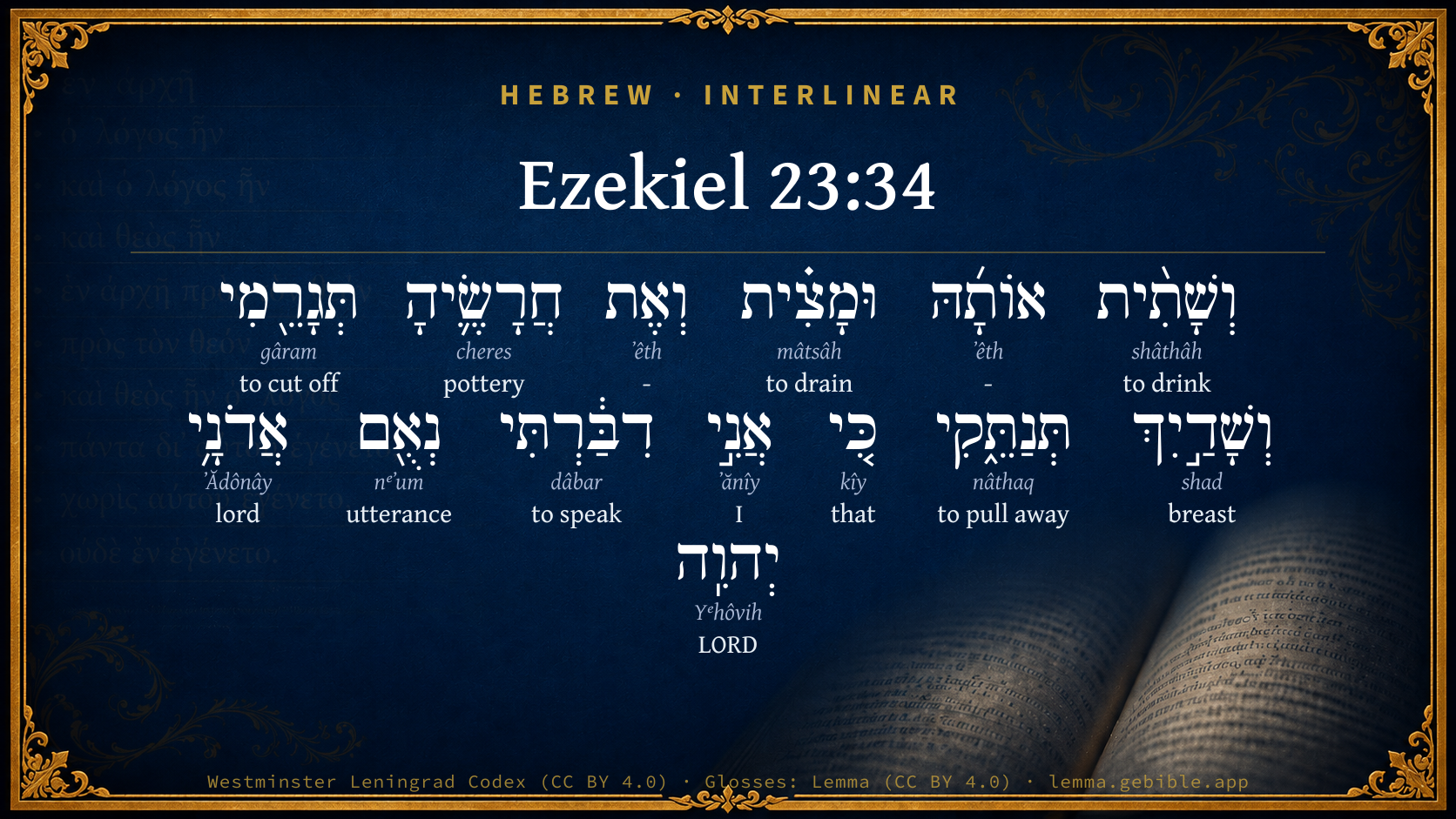
Ezekiel 23:34

Hebrew (Westminster Leningrad Codex) Ezekiel 23:34 appears in the Hebrew Old Testament. The text above is from the Westminster Leningrad Codex. Each word links to its Strong’s number, a concise gloss, and parsing drawn from the Open Scriptures Hebrew Bible morphology. Click any word for its full Brown-Driver-Briggs (BDB) entry.
Download image
Cite this verse

Ezekiel 23:34 (World English Bible). Public Domain. Lemma interlinear Bible study tool, https://lemma.gebible.app/v/ezekiel/23/34.

Show BibTeX & RIS
BibTeX
RIS
English Translation
You shall even drink it and drain it out, and you shall gnaw the broken pieces of it, and shall tear your breasts; for I have spoken it, says the Lord Yahweh.
World English Bible · Public Domain
Download a study sheet

One document with this verse’s original text, its word-by-word gloss line, the meaning frame, cross-references with their text, attributed commentary, and full source and license credits — printable, and it pastes into notes with its structure intact.

This verse Autodidact and up

Study sheet (.html) Plain text (.txt)

A passage Seminary Student

Up to 50 verses in one chapter. A passage sheet keeps up to 6 commentary sources and 12 cross-references per verse, in the order this page ranks them, and says so on the sheet whenever that leaves anything out. Ask for a single verse and you get the Autodidact verse sheet above.

Everything on this page stays free to read, with no account — the sheet is a download of what is already on screen, not access to it.

Want to remove ads? Support Godless Engineer
Compare translations 3

The same verse in 3 English versions, stacked beneath the original-language interlinear above. Click any original word for its lexicon entry.

Each is an independent rendering of the whole verse — the interlinear is not word-aligned to these translations.

Highlighted words mark where these versions differ — a whole-verse word diff, not a word-by-word alignment.

  • World English Bible Public Domain
    You shall even drink it and drain it out, and you shall gnaw the broken pieces of it, and shall tear your breasts; for I have spoken it, says the Lord Yahweh.
  • King James Version Public Domain
    Thou shalt even drink it and suck it out, and thou shalt break the sherds thereof, and pluck off thine own breasts: for I have spoken it, saith the Lord GOD.
  • unfoldingWord Literal Text CC BY-SA 4.0
    You will drink it and drain it empty; then you will shatter it and tear your breasts with the pieces. For I have declared it—this is the Lord Yahweh’s declaration.’

unfoldingWord Literal Text — © unfoldingWord, licensed CC BY-SA 4.0. Word-aligned USFM3 via Door43 (git.door43.org/unfoldingWord/en_ult).

Versions to compare (up to 4)

3 of 4 selected

Show all 18 translations

Every available English version of this verse, each an independent rendering of the whole verse.

  • World English Bible Public Domain
    You shall even drink it and drain it out, and you shall gnaw the broken pieces of it, and shall tear your breasts; for I have spoken it, says the Lord Yahweh.
  • Berean Standard Bible Public Domain
    You will drink it and drain it; you will dash it to pieces, and tear your breasts. For I have spoken,’ declares the Lord GOD.
  • Majority Standard Bible Public Domain
    You will drink it and drain it; you will dash it to pieces, and tear your breasts. For I have spoken,’ declares the Lord GOD.
  • King James Version Public Domain
    Thou shalt even drink it and suck it out, and thou shalt break the sherds thereof, and pluck off thine own breasts: for I have spoken it, saith the Lord GOD.
  • American Standard Version (1901) Public Domain
    Thou shalt even drink it and drain it out, and thou shalt gnaw the sherds thereof, and shalt tear thy breasts; for I have spoken it, saith the Lord Jehovah.
  • Revised Version (1885) Public Domain
    Thou shalt even drink it and drain it out, and thou shalt gnaw the sherds thereof, and shalt tear thy breasts: for I have spoken it, saith the Lord GOD.
  • Geneva Bible (1599) Public Domain
    Thou shalt euen drinke it, and wring it out to the dregges, and thou shalt breake the sheards thereof, and teare thine owne breasts: for I haue spoken it, sayth the Lord God.
  • Douay-Rheims (1899) Public Domain
    And thou shalt drink it, and shalt drink it up even to the dregs, and thou shalt devour the fragments thereof, thou shalt rend thy breasts: because I have spoken it, saith the Lord God.
  • Young's Literal Translation Public Domain
    And thou hast drunk it, and hast drained `it', And its earthen ware thou dost gnaw, And thine own breasts thou pluckest off, For I have spoken, An affirmation of the Lord Jehovah,
  • Literal Standard Version CC BY-SA 4.0
    And you have drunk it, and have drained [it], || And you gnaw its earthen ware, || And you pluck off your own breasts, || For I have spoken, || A declaration of Lord YHWH,
  • Unlocked Literal Bible CC BY-SA 4.0
    You will drink it and drain it empty; then you will shatter it and tear your breasts with the pieces. For I have declared it—this is the Lord Yahweh's declaration.'
  • unfoldingWord Literal Text CC BY-SA 4.0
    You will drink it and drain it empty; then you will shatter it and tear your breasts with the pieces. For I have declared it—this is the Lord Yahweh’s declaration.’
  • Darby Bible Public Domain
    thou shalt even drink it and suck it out, and thou shalt gnaw the sherds thereof, and pluck off thine own breasts: for I have spoken [it], saith the Lord Jehovah.
  • World Messianic Bible Public Domain
    You will even drink it and drain it out. You will gnaw the broken pieces of it, and will tear your breasts; for I have spoken it,’ says the Lord GOD.
  • Webster's Bible Public Domain
    Thou shalt even drink it, and empty it to the dregs, and thou shalt break its pieces, and pluck off thy own breasts: for I have spoken it, saith the Lord GOD.
  • Free Bible Version CC BY-SA 4.0
    You will drink it all down, smash it to pieces on the ground, and tear at your breasts. This is what I have spoken, declares the Lord God.
  • Bible in Basic English Public Domain
    And after drinking it and draining it out, you will take the last drops of it to the end, pulling off your breasts: for I have said it, says the Lord.
  • JPS Tanakh (1917) Public Domain
    Thou shalt even drink it and drain it, and thou shalt craunch the sherds thereof, and shalt tear thy breasts; for I have spoken it, saith the Lord GOD.

Literal Standard Version (2020), Covenant Press — licensed CC BY-SA 4.0. Text via the HelloAO Bible API (eBible.org). Unlocked Literal Bible (unfoldingWord) — licensed CC BY-SA 4.0. Text via the HelloAO Bible API (eBible.org). unfoldingWord Literal Text — © unfoldingWord, licensed CC BY-SA 4.0. Word-aligned USFM3 via Door43 (git.door43.org/unfoldingWord/en_ult). Free Bible Version, Dr. Jonathan Gallagher — licensed CC BY-SA 4.0. Text via the HelloAO Bible API (eBible.org).

Word by word

More ways to search: Search by grammar → Find every occurrence → Compare this word →

Practice this passage: Drill this verse → Learn its vocabulary →

תְּגָרֵ֖מִי
gâram
H1633
“to cut off”
Verb, Piel, Imperfect, 2nd Person, Feminine, Singular
Part of Speech
Verb
Stem
Piel
Form
Imperfect
Person
2nd Person
Gender
Feminine
Number
Singular
Full BDB Definition

Origin: a primitive root

TWOT: 382b

to cut off, reserve, lay aside, leave, save - (Qal) to reserve - (Piel) to break bones, gnaw bones, break
  1. וְשָׁתִ֨ית shâthâh H8354 “and · to drink” Conjunction + Verb, Qal, Sequential Perfect, 2nd Person, Feminine, Singular
  2. אוֹתָ֜הּ ʼêth H853 “- · her” Particle, Direct Object + Suffix, Personal, 3rd Person, Feminine, Singular
  3. וּמָצִ֗ית mâtsâh H4680 “and · to drain” Conjunction + Verb, Qal, Sequential Perfect, 2nd Person, Feminine, Singular
  4. וְאֶת ʼêth H853 “and · -” Conjunction + Particle, Direct Object
  5. חֲרָשֶׂ֛יהָ cheres H2789 “potsherds · her” Noun, Common, Masculine, Plural, Construct + Suffix, Personal, 3rd Person, Feminine, Singular
  6. וְשָׁדַ֣יִךְ shad H7699 “and · breasts · your” Conjunction + Noun, Common, Masculine, Dual, Construct + Suffix, Personal, 2nd Person, Feminine, Singular
  7. תְּנַתֵּ֑קִי nâthaq H5423 “to pull away” Verb, Piel, Imperfect, 2nd Person, Feminine, Singular
  8. כִּ֚י kîy H3588 “that” Conjunction
  9. אֲנִ֣י ʼănîy H589 “I” Pronoun, Personal, 1st Person, Common, Singular
  10. דִבַּ֔רְתִּי dâbar H1696 “to speak” Verb, Piel, Perfect, 1st Person, Common, Singular
  11. נְאֻ֖ם nᵉʼum H5002 “utterance of” Noun, Common, Masculine, Singular, Construct
  12. אֲדֹנָ֥י ʼĂdônây H136 “Lord · my” Noun, Common, Masculine, Plural, Construct + Suffix, Personal, 1st Person, Common, Singular
  13. יְהוִֽה Yᵉhôvih H3069 “LORD” Noun, Proper

About this verse

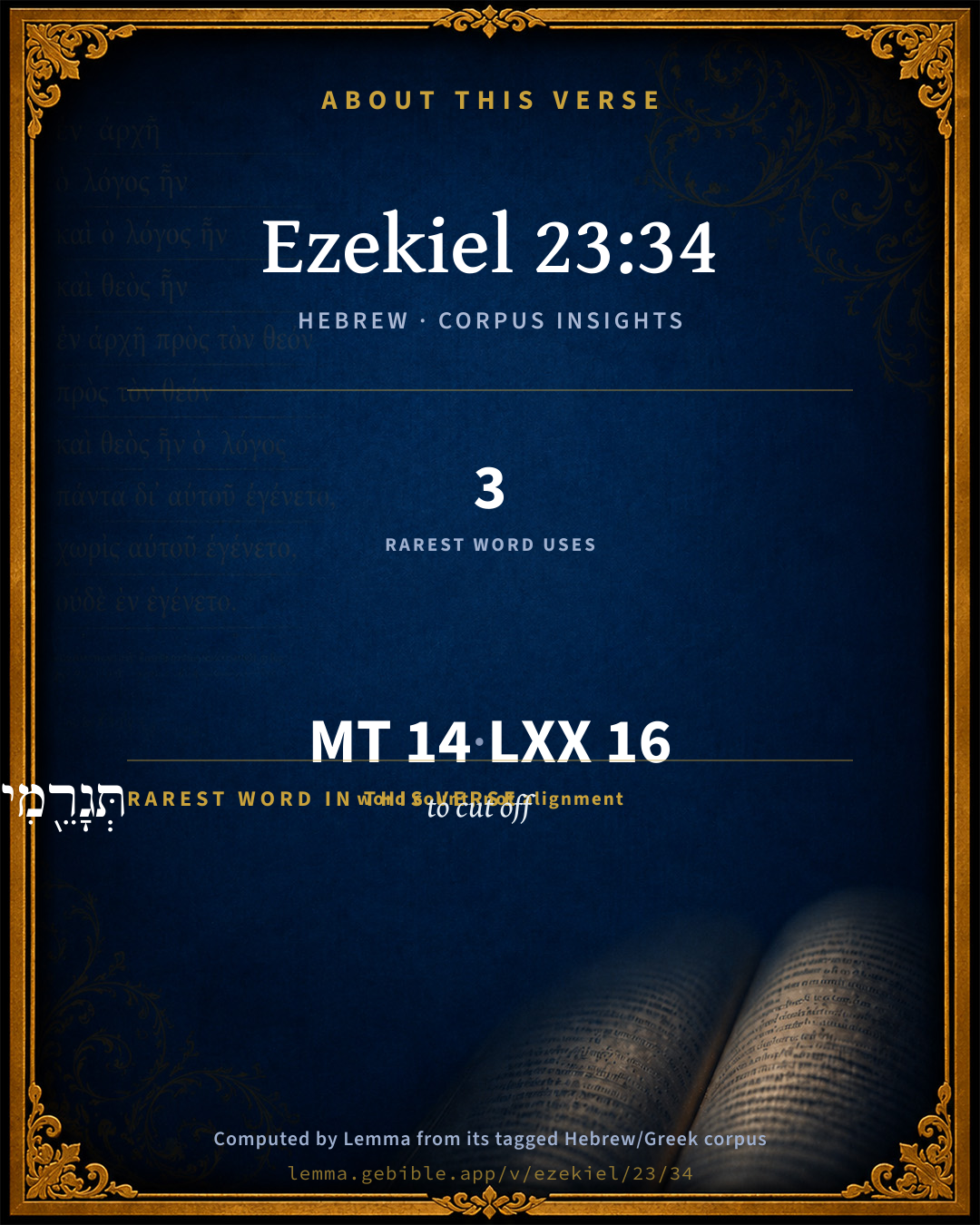
These counts appear in no published source. They are computed here, from the morphology-tagged text and Lemma’s own curated glosses. What Lemma adds →

14
words
13
distinct lemmas
Prophets
section

Notable vocabulary

The rarest word here is תְּגָרֵ֖מִי to cut off H1633 — appearing just 3 times in the whole Hebrew Bible.

Shared distinctive vocabulary

תְּגָרֵ֖מִי to cut off H1633 occurs in 3 verses of the Hebrew Bible. Also found in:

Grammatical profile

  • 5 verbs
  • 5 nouns
  • 1 pronoun
  • 1 conjunction
  • 2 particles

Verb forms

  • וְשָׁתִ֨ית Qal · Sequential Perfect
  • וּמָצִ֗ית Qal · Sequential Perfect
  • תְּגָרֵ֖מִי Piel · Imperfect
  • תְּנַתֵּ֑קִי Piel · Imperfect
  • דִבַּ֔רְתִּי Piel · Perfect

Hebrew & Septuagint length

In English translation the verse runs 32 words from the Hebrew and 22 from the Septuagint (LXX English) — the Septuagint runs noticeably shorter here. See the side-by-side →

A rough comparison of the two English renderings, which tokenize alike — not a word-level alignment.

Word counts can differ between the Hebrew and the Greek without any difference in meaning — e.g. the Hebrew direct-object marker אֵת has no separate Greek word, and Greek often adds the article ὁ.

In the original languages it is 14 Hebrew tokens and 16 Greek tokens — but the two are counted differently (Hebrew bundles its prefixes and suffixes into one token; the Greek is in lemma form), so that isn’t a like-for-like length.

Cross-references

5

Topical passages linked to Ezekiel 23:34 in the Treasury of Scripture Knowledge — connected by theme and wording, ordered by reader-vote popularity; previews shown in the World English Bible.

  • Psalms 75:8 For in the hand of Yahweh there is a cup, Full of foaming wine mixed with spices. He pours it out. Indeed the wicked of the earth drink and drink it to its very dregs.
  • Isaiah 51:17 Awake, awake, stand up, Jerusalem, that have drunk at the hand of Yahweh the cup of his wrath; you have drunken the bowl of the cup of staggering, and drained it.
  • Ezekiel 23:3 and they played the prostitute in Egypt; they played the prostitute in their youth; there were their breasts pressed, and there was handled the bosom of their virginity.
  • Ezekiel 23:8 Neither has she left her prostitution since [the days of] Egypt; for in her youth they lay with her, and they handled the bosom of her virginity; and they poured out their prostitution on her.
  • Revelation 18:7 However much she glorified herself, and grew wanton, so much give her of torment and mourning. For she says in her heart, 'I sit a queen, and am no widow, and will in no way see mourning.'

Cross-references courtesy of OpenBible.info (CC BY 4.0).

Hebrew and Greek witnesses Masoretic Hebrew ↔ Greek Septuagint

The same verse in the two great witnesses to the Old Testament, shown verse-for-verse.

Here the Septuagint runs noticeably shorter than the Hebrew — LXX2012 (modern English Septuagint) 22 words vs World English Bible 32. A rough length comparison of the two English translations, not a word-level alignment — read both below.

These are two independent witnesses, not word-aligned to each other, and the Septuagint is shown in lemma (dictionary) form.

Hebrew Ezekiel 23:34 Masoretic · Westminster Leningrad Codex

וְשָׁתִ֨ית אוֹתָ֜הּ וּמָצִ֗ית וְאֶת חֲרָשֶׂ֛יהָ תְּגָרֵ֖מִי וְשָׁדַ֣יִךְ תְּנַתֵּ֑קִי כִּ֚י אֲנִ֣י דִבַּ֔רְתִּי נְאֻ֖ם אֲדֹנָ֥י יְהוִֽה

You shall even drink it and drain it out, and you shall gnaw the broken pieces of it, and shall tear your breasts; for I have spoken it, says the Lord Yahweh.

World English Bible · Public Domain

Greek LXX Ezekiel 23:34 Septuagint · lemma form

καί πίνω αὐτός καί ὁ ἑορτή καί ὁ νουμηνία αὐτός ἀποστρέφω διότι ἐγώ λαλέω λέγω κύριος

drink you it, and I will take away her feasts and her new moons: for I have spoken it, says the Lord.

LXX2012 (modern English Septuagint) · Public Domain

On this verse, The Cambridge Bible for Schools and Colleges discusses the Septuagint’s reading. Read the note in Commentary ↓

Hebrew: Westminster Leningrad Codex (CC BY 4.0). Greek: Septuagint (public domain); English from LXX2012 (modern English Septuagint) (Public Domain). How the Septuagint differs from the Hebrew →

Targum (Aramaic paraphrase)

1

The Targum is the ancient Jewish Aramaic paraphrase of the Hebrew Scriptures — an interpretive translation, not the Hebrew text itself. Onkelos (literal) and Pseudo-Jonathan (expansive) render the Torah, and Jonathan the Prophets. Coverage is partial: where no permissively-licensed English translation exists for a verse, only the Aramaic is shown. This is verse-level text, not a word-by-word alignment to the Hebrew.

  1. Targum Jonathan Prophets (Joshua–Malachi)
    וְתִשְׁתִּין יָתָהּ וְתִגְמְרִין וְיַת פוּרְעֲנוּתָהָא תְקַבְּלִין וּבִסְרִיךְ תִּתְלְשִׁין אֲרֵי אֲנָא גְזָרֵית בְּמֵימְרִי אֲמַר יְיָ אֱלֹהִים:

    (no public-domain English translation for this verse)

    Targum Jonathan — Aramaic: “Mikraot Gedolot” (public domain). English: “Sefaria Community Translation” (CC0 1.0 (public-domain dedication)); “London "Chaldee Paraphrase," 1871” (public domain). Text via Sefaria.

Commentary

Notes on Ezekiel 23:34 from classic Christian and Jewish commentators (each source and its license shown beneath its notes). The classic Christian expositions comment on the surrounding passage and are grouped to its opening verse, so a note may address several verses; the Jewish commentaries on the Tanakh (Rashi and others) are per-verse, so they appear only where the commentator wrote on this verse.

Lemma curates 59 commentaries, every one of them public domain or Creative Commons licensed, each selected and text-cleaned for this edition rather than reprinted as found. About our sources →

Trapp's Complete Commentary

John Trapp

Eze 23:34 Thou shalt even drink it and suck [it] out, and thou shalt break the sherds thereof, and pluck off thine own breasts: for I have spoken [it], saith the Lord GOD.

Ver. 34. And thou shalt break the sherds thereof,] i.e., Of the cup, which thou shalt cast away with utmost indignation: but thou hast thy bane.

And pluck off thine own breast.] For a revenge of thy fornication therewith committed.

John Trapp, A Commentary or Exposition upon All the Books of the Old and New Testament (1647–1656) — public domain. Text from a community e-Sword module.

Jamieson, Fausset & Brown

Robert Jamieson, A. R. Fausset & David Brown

break . . . sherds--So greedily shalt thou suck out every drop like one drinking to madness (the effect invariably ascribed to drinking God's cup of wrath, Jer 51:7; Hab 2:16) that thou shalt crunch the very shreds of it; that is, there shall be no evil left which thou shalt not taste.

pluck off thine own breasts--enraged against them as the ministers to thine adultery.

Jamieson, Fausset & Brown — Commentary Critical and Explanatory on the Whole Bible (1871) — public domain (CC PDM 1.0). Text via the HelloAO Bible API.

Adam Clarke's Commentary

Verse 34. Thou shalt - pluck off thine own breasts] Thou shalt tear them; a frequent action in extreme sorrow and desolation. Weeping, tearing the bosom, and beating the breasts.

Tunc vero rupique sinus, et pectora planxi.

OVID'S Ep. 5.

Adam Clarke's Commentary on the Bible (1810–1826) — public domain. Text from a community e-Sword/MySword module.

The Cambridge Bible for Schools and Colleges

gen. ed. J. J. S. Perowne

34. Cf. Psa_75:8; Isa_51:17.

break the sheards] gnaw the sherds. The act of plucking out her own breasts is that of one intoxicated to madness, Jer_25:16. The words are wanting in LXX. Beating the breasts and tearing the cheeks was a sign of excessive grief (Hamasa, p. 373). “The women rent the breast of their dress, went half-naked, tore their faces, and beat their skin till it was lacerated with shoes (Aghani, xiv. 101, 28; xv. 139, 6; Hudh. 139, 3),” Well., Skizzen, iii. p. 160.

The Cambridge Bible for Schools and Colleges (gen. ed. J. J. S. Perowne; Cambridge University Press, 1878–1918) — public domain. Text from a community e-Sword module.

John Gill's Exposition

Thou shalt even drink it, and suck it out,.... The very dregs of it, that which lies at the bottom, which is the most nauseous and the most pernicious; not through love to it, but through force, shall be obliged to it; see Psa 75:8,

and thou shall break the sherds thereof; and suck them, so that not a drop of the liquor shall be lost; even what has penetrated into the earthen vessel, which this cup is supposed to be; and therefore it shall be broken to pieces, and these pieces sucked, that all may be got out; suggesting that there will be no abatement of the punishment, it shall be endured to the utmost: or it may be an allusion to drunkards, who, having drunk up their liquor, and become drunk, break their glasses, pots, and cups, and to which the next clause agrees:

and pluck off thine own breasts; as men in their drunken fits, being like mad men, tear their own flesh; and so the Targum paraphrases it,

"thou shall tear thy flesh;''

so the Jews, under punishment for sin, and pressed with the guilt of it, through indignation at themselves should tear their flesh, and particularly pluck off their breasts: the allusion is to fornication, to which idolatry is compared, in which those parts are particularly affected; see Eze 23:21, the Syriac version renders this and the former clause thus, "thou shall shave thine hair and cut off thy breasts"; Kimchi thinks by the "breasts" are meant the oral and written laws, which ceased in the time of the captivity; but without any foundation:

for I have spoken it, saith the Lord; and therefore it shall be done.

John Gill's Exposition of the Whole Bible (1746–1763) — public domain (CC PDM 1.0). Text via the HelloAO Bible API.

Haydock's Catholic Bible Commentary

Fragments, as drunkards sometimes bite (Haydock) the cup in their rage. --- Rend. What had been the occasion of thy fall: (Calmet) pectori planxi. (Ovid, ep. 5.)

George Leo Haydock (1774–1849), Haydock's Catholic Family Bible and Commentary, 1859 edition — public domain. Excludes Psalms (Douay-Rheims chapter numbering differs from Protestant) and Deuterocanonical books (Catholic canon only).

Matthew Poole's English Annotations

Thou shalt even drink it; nothing shall divert the punishment.

And suck it out; the dregs shalt thou drink, and multiply thine own sorrows.

Break the sherds; either out of indignation, or to suck out what was imbibed.

Pluck off thine own breasts; which tempted others, and undid thyself, for which cause thou now revengest thyself upon thyself.

Matthew Poole's English Annotations on the Holy Bible (1683–1685) — public domain. Text from a community e-Sword/MySword module.

Whedon's Commentary on the Bible

Daniel D. Whedon

34. Thou shalt break the sherds — Or, “gnaw the sherds” (R.V.). In her madness and pain the drunken woman lacerates her lips with the broken cup and plucks off (mutilates, or tears, Eze_23:25) her own breasts. See Jer_25:15-18.) This verse is sometimes omitted in the critical versions of the text because of its ambiguity.

Daniel D. Whedon (gen. ed.), Commentary on the Old and New Testaments (1874–1909) — public domain. Text from a community e-Sword module.

The Pulpit Commentary

Thou shalt break the shards thereof. The picture of the desolate adulteress becomes yet more terrible. Like a forlorn and desperate castaway, she does shameful execution on herself; breaks her cup, and completes the work of mutilation in its most terrible form. That is the doom decreed for her, because she had forgotten her true husband and the love of her espousals. Revised Version gives gnaw the shards thereof, painting yet more vividly the despair of the outcast.

Ver. 35 (first half of verse). Forgetting God.

I FORGETTING GOD IMPLIES THAT HE HAS FORMERLY BEEN KNOWN. We cannot forget what we have never known. The lower animal, which is incapable of entertaining a thought of God, cannot forget him. If I forget much, I must have known much.

1. Men have a natural knowledge of God. Few races, if any, are without a trace of religion. The Andaman islanders and the Fuegians are said to have been discovered in that state. If so, they are just the exception that proves the rule. The science of comparative religion reveals an underlying primitive theism beneath the tangled growth of later mythology. St. Paul appealed to the natural knowledge of God among the heathen. (Rom_1:21)

1. They who have seen the Jewish and Christian revelation have a larger knowledge of God. Israel had known God by his special manifestations in the Law, in his providence and miracles, in the prophets. All Christendom is open to the higher knowledge of God in Christ. Children in Christian homes and Sunday schools have known God, though they may have forsaken him in later days.

2. The people of God have the fullest knowledge of God. True Israelites and Christians know God as he is never known to the outer world. They have the knowledge of experience, spiritual sympathy, and fellowship. (Joh_14:7)

II THERE ARE MANY INDUCEMENTS TO FORGET GOD.

1. He is invisible. The knowledge of God is held only by faith. The decay of faith leads to forgetting God. It requires some spiritual effort to keep our hold on the Unseen.

2. Earthly interests distract our thoughts. These things are seen, present and pressing; they crowd about us and force themselves upon us. They make themselves felt as intensely real. Pleasures of life and cares of life, fascinating delights and absorbing anxieties, all tend. to put out the thought of God.

3. Sinful inclinations rouse an aversion to the thought of God. He is holy; lie disapproves of sin. It is not pleasant to think of God when we are choosing the evil way.

III FORGETTING GOD IS ITSELF A GREAT SIN. We can control our memory by fixing our thoughts upon God. This is not a case of mere brain failure. There is a moral defect behind it. Apart from all active deeds, the very forgetting God is itself wicked on several grounds.

1. God has never forgotten us. He has provided for our daily needs, while we have been ignoring the hand from which the provision came. He is our Father. Gratitude and love should keep the thought of God warm in our heart. To forget God implies gross unthankfulness and a base lack of natural affection.

2. God claims our attention and obedience. He is our Lord. He expects us to listen to his voice, give heed to his commands, and obey his will. But to forget God is to ignore these duties.

IV FORGETTING GOD IS HURTFUL TO MAN. They know not what they miss who forsake their true life and forget their Father in heaven. Seeking liberty, they court death.

1. This is the loss of the best blessings of Heaven. The light of God"s countenance is despised. His guidance, comfort, support, and salvation are neglected. The joy of communion is renounced.

2. This incurs a fatal doom. God cannot let us forget him forever. If we do not remember his love today, we may encounter his wrath tomorrow. (Psa_44:20, Psa_44:21)

V GOD MERCIFULLY INTERFERES TO SAVE US FROM FORGETTING HIM.

1. He reveals himself in his Word. The revelation of nature is daily spread before us. But when that is despised, God adds the more clear voice of prophecy. We have the open Bible to remind us of God.

2. God comes to us in his Son. As men had forgotten him, God came right down among them, looked at them through a human countenance, and spoke in a human voice. Christ comes to save us from forgetting God.

3. God rouses us by his providence. We are forgetting God while all goes smoothly. Then his thunders burst over us. They startle and alarm, but they awaken. Thus God saves us from forgetting him.

The Pulpit Commentary (1880–1919), ed. H.D.M. Spence-Jones & Joseph S. Exell — public domain. Text from a community e-Sword module.

John Wesley's Explanatory Notes

Thou - Shalt stagger with sorrows, that shall intoxicate, and astonish. Suck it out - The dregs shalt thou drink, and multiply thine own sorrows. Break the sheards - To suck out what remains. And pluck - Revenging thyself upon thyself.

John Wesley, Explanatory Notes Upon the Whole Bible (1754–1765) — public domain. Text via the GEBible commentary corpus.

Rashi

Rabbi Shlomo Yitzchaki (Rashi)

and drain [Heb. וּמָצְת,] an expression of sucking to the last drop, et tu suceras in French, and you will suck.

and its shards He compares the cup that gives Israel the drink of retribution to an earthenware vessel, which, once broken, can no longer be repaired. So will it be that once their salvation comes and the cup breaks, He will not return to give them any more to drink. When He speaks of giving drink to the nations, however, He calls it gold, as it is said (Jer. 51:7): “Babylon is a golden cup in the Lord’s hand, it intoxicates all the earth.”

you shall scrape [Heb. תְּגָרֵמִי,] like (Num. 24:8): “and he scrapes (יְגָרֵם) their bones”; (Zeph. 3:3), “they did not leave over the bones (גָרְמוּ) for morning,” ronger in French, to gnaw. He scrapes with his teeth around the bone or the shard to detach from it the meat adhering to it. Menachem (p. 59) connects it to an expression of breaking, and he interprets: “and he breaks their bones,” and “they did not break the bones for morning,” in like manner.

Rashi on the Tanakh — English translations: “The Judaica Press complete Tanach with Rashi, translated by A. J. Rosenberg” (CC BY 4.0); “Pentateuch with Rashi's commentary by M. Rosenbaum and A.M. Silbermann, 1929-1934” (public domain); “The Metsudah Tanach series, Lakewood, N.J” (CC BY 4.0); and “The Book of Joshua, Metsudah Publications, 1997” (CC BY 4.0). Text via Sefaria.

Lesson kit

Teaching starters — assembled from the data on this page, not authored interpretation. Every prompt links to the verse data it draws on. Edit before teaching.

Ezekiel, in the Prophets, opens this verse with 14 words (13 distinct Hebrew lemmas). Its most distinctive word is gâram (“to cut off”). The Greek Septuagint runs shorter here. A historical commentator’s framing appears above. Read the whole chapter for the surrounding context.

Discussion questions

  1. The word gâram carries the sense “to cut off.” How does it shape the verse?
  2. How does Numbers 24:8, which shares the word «to cut off», read alongside this verse?
  3. The Septuagint runs shorter here than the Hebrew. What might account for the difference?
  4. These translations render this verse differently. What is at stake in choosing one wording over another?
  5. «וְשָׁתִ֨ית» is a Qal Sequential Perfect verb. How does that grammatical form shape the action described?
  6. Compare how Trapp's Complete Commentary and Jamieson, Fausset & Brown read this verse. Where do they agree or differ?

Things to notice

Reading settings

Reading text

Shown beneath each verse's original-language words.

Old Testament
Old Testament edition

Read the OT as the Masoretic Hebrew (MT) or the Greek Septuagint (LXX).

English shown for the Greek Septuagint (in the Hebrew ↔ Greek comparison).

Comparing translations? Open the Compare panel on any verse page to stack up to four side by side.