
2 Kings 18:27

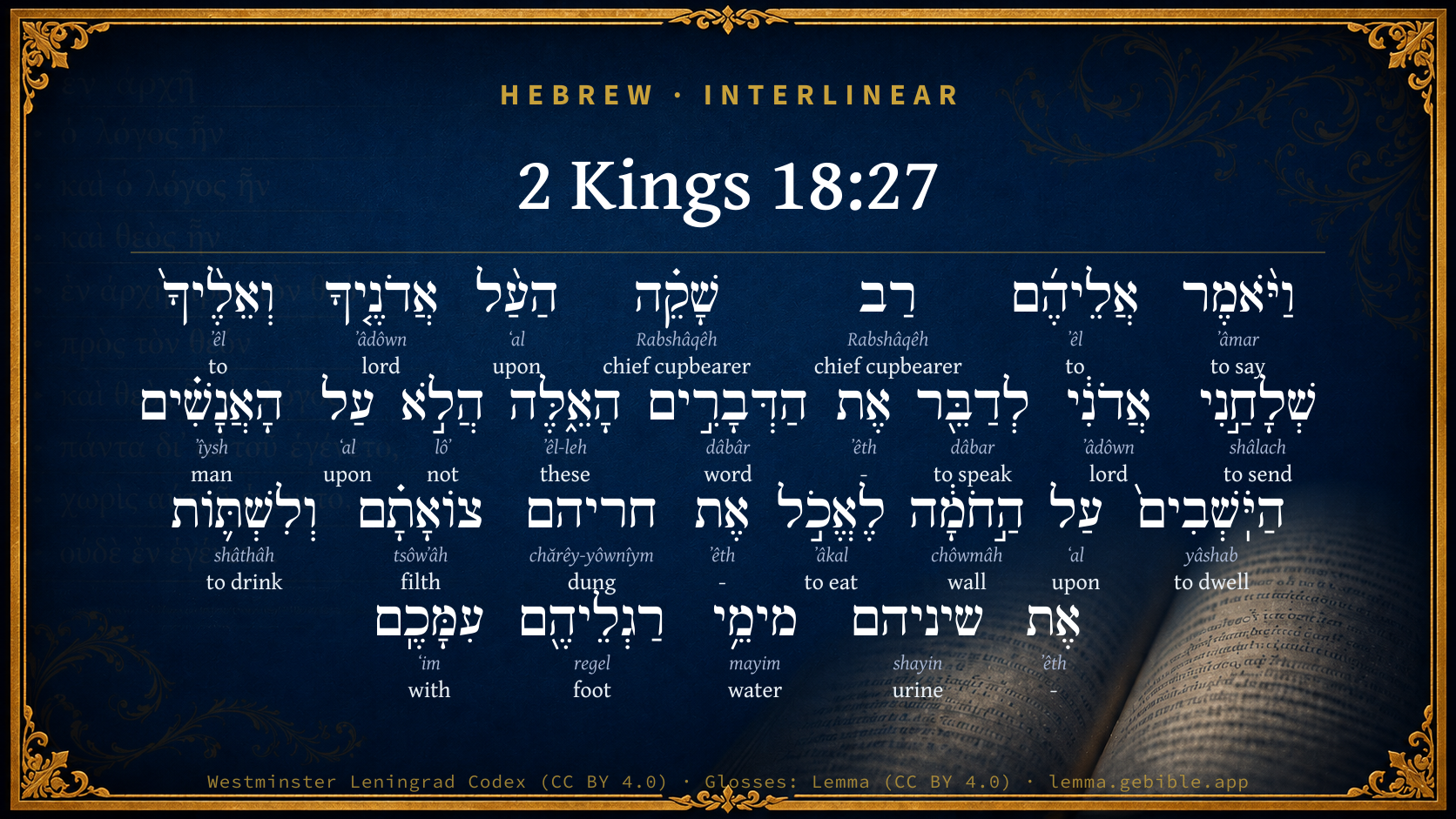
Hebrew (Westminster Leningrad Codex) 2 Kings 18:27 appears in the Hebrew Old Testament. The text above is from the Westminster Leningrad Codex. Each word links to its Strong’s number, a concise gloss, and parsing drawn from the Open Scriptures Hebrew Bible morphology. Click any word for its full Brown-Driver-Briggs (BDB) entry.
Download image
Cite this verse

2 Kings 18:27 (World English Bible). Public Domain. Lemma interlinear Bible study tool, https://lemma.gebible.app/v/2-kings/18/27.

Show BibTeX & RIS
BibTeX
RIS
English Translation
But Rabshakeh said to them, Has my master sent me to your master, and to you, to speak these words? Hasn't he sent me to the men who sit on the wall, to eat their own dung, and to drink their own water with you?
World English Bible · Public Domain
Highlights
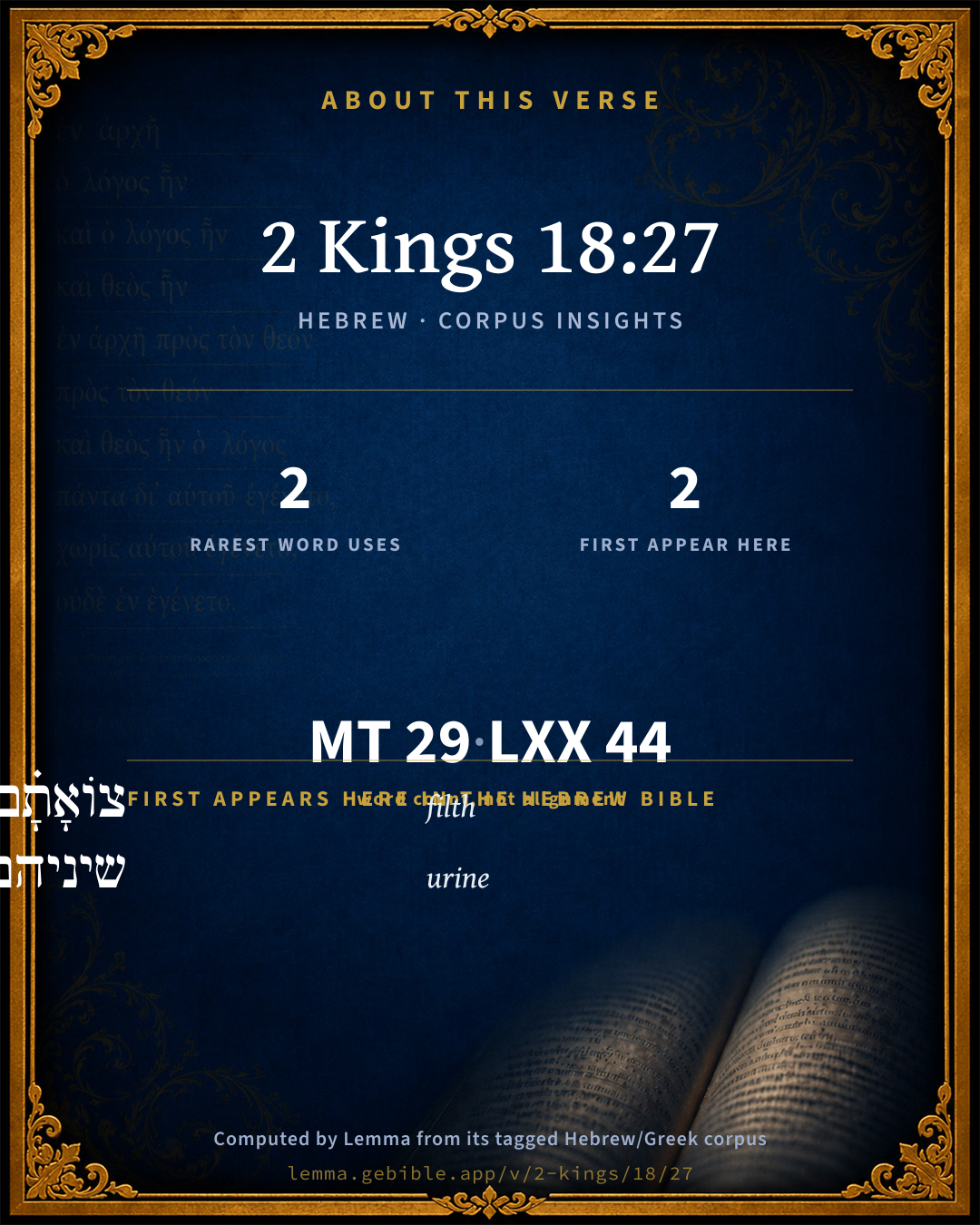
  • 2 first appearances in the Hebrew Bible
Full analysis ↓
Download a study sheet

One document with this verse’s original text, its word-by-word gloss line, the meaning frame, cross-references with their text, attributed commentary, and full source and license credits — printable, and it pastes into notes with its structure intact.

This verse Autodidact and up

Study sheet (.html) Plain text (.txt)

A passage Seminary Student

Up to 50 verses in one chapter. A passage sheet keeps up to 6 commentary sources and 12 cross-references per verse, in the order this page ranks them, and says so on the sheet whenever that leaves anything out. Ask for a single verse and you get the Autodidact verse sheet above.

Everything on this page stays free to read, with no account — the sheet is a download of what is already on screen, not access to it.

Want to remove ads? Support Godless Engineer
Compare translations 3

The same verse in 3 English versions, stacked beneath the original-language interlinear above. Click any original word for its lexicon entry.

Each is an independent rendering of the whole verse — the interlinear is not word-aligned to these translations.

Highlighted words mark where these versions differ — a whole-verse word diff, not a word-by-word alignment.

  • World English Bible Public Domain
    But Rabshakeh said to them, Has my master sent me to your master, and to you, to speak these words? Hasn't he sent me to the men who sit on the wall, to eat their own dung, and to drink their own water with you?
  • King James Version Public Domain
    But Rabshakeh said unto them, Hath my master sent me to thy master, and to thee, to speak these words? hath he not sent me to the men which sit on the wall, that they may eat their own dung, and drink their own piss with you?
  • unfoldingWord Literal Text CC BY-SA 4.0
    But the Rabshakeh said to them, “Did my master send me to speak these words to your master and to you? not to the men sitting on the wall, who will eat their dung and drink their urine with you?”

unfoldingWord Literal Text — © unfoldingWord, licensed CC BY-SA 4.0. Word-aligned USFM3 via Door43 (git.door43.org/unfoldingWord/en_ult).

Versions to compare (up to 4)

3 of 4 selected

Show all 18 translations

Every available English version of this verse, each an independent rendering of the whole verse.

  • World English Bible Public Domain
    But Rabshakeh said to them, Has my master sent me to your master, and to you, to speak these words? Hasn't he sent me to the men who sit on the wall, to eat their own dung, and to drink their own water with you?
  • Berean Standard Bible Public Domain
    But the Rabshakeh replied, “Has my master sent me to speak these words only to you and your master, and not to the men sitting on the wall, who are destined with you to eat their own dung and drink their own urine?”
  • Majority Standard Bible Public Domain
    But the Rabshakeh replied, “Has my master sent me to speak these words only to you and your master, and not to the men sitting on the wall, who are destined with you to eat their own dung and drink their own urine?”
  • King James Version Public Domain
    But Rabshakeh said unto them, Hath my master sent me to thy master, and to thee, to speak these words? hath he not sent me to the men which sit on the wall, that they may eat their own dung, and drink their own piss with you?
  • American Standard Version (1901) Public Domain
    But Rabshakeh said unto them, Hath my master sent me to thy master, and to thee, to speak these words? `hath he' not `sent me' to the men that sit on the wall, to eat their own dung, and to drink their own water with you?
  • Revised Version (1885) Public Domain
    But Rabshakeh said unto them, Hath my master sent me to thy master, and to thee, to speak these words? hath he not sent me to the men which sit on the wall, to eat their own dung, and to drink their own water with you?
  • Geneva Bible (1599) Public Domain
    But Rabshakeh saide vnto them, Hath my master sent me to thy master and to thee to speake these words, and not to the men which sit on the wall, that they may eate their owne doung, and drinke their owne pisse with you?
  • Douay-Rheims (1899) Public Domain
    And Rabsaces answered them, saying: Hath my master sent me to thy master and to thee, to speak these words, and not rather to the men that sit upon the wall, that they may eat their own dung, and drink their urine with you?
  • Young's Literal Translation Public Domain
    And the chief of the butlers saith unto them, `For thy lord, and unto thee, hath my lord sent me to speak these words? is it not for the men, those sitting on the wall to eat their own dung and to drink their own water, with you?'
  • Literal Standard Version CC BY-SA 4.0
    And the chief of the butlers says to them, “For your lord, and to you, has my lord sent me to speak these words? Is it not for the men—those sitting on the wall—to eat their own dung and to drink their own water, with you?”
  • Unlocked Literal Bible CC BY-SA 4.0
    But the chief commander said to them, “Has my master sent me to your master and to you to speak these words? Has he not sent me to the men who sit on the wall, who will have to eat their own dung and drink their own urine with you?”
  • unfoldingWord Literal Text CC BY-SA 4.0
    But the Rabshakeh said to them, “Did my master send me to speak these words to your master and to you? not to the men sitting on the wall, who will eat their dung and drink their urine with you?”
  • Darby Bible Public Domain
    And Rab-shakeh said to them, Is it to thy master and to thee that my master sent me to speak these words? Is it not to the men that sit on the wall, that they may eat their own dung and drink their own urine with you?
  • World Messianic Bible Public Domain
    But Rabshakeh said to them, “Has my master sent me to your master and to you, to speak these words? Hasn’t he sent me to the men who sit on the wall, to eat their own dung, and to drink their own urine with you?”
  • Webster's Bible Public Domain
    But Rab-shakeh said to them, Hath my master sent me to thy master, and to thee, to speak these words? hath he not sent me to the men who sit on the wall, that they may feed on their vilest excretions with you?
  • Free Bible Version CC BY-SA 4.0
    But the army general replied, “Did my master only send me to say these things to your master and to you, and not to the people sitting on the wall? They too, just like you, are going to have to eat their own excrement and drink their own urine!”
  • Bible in Basic English Public Domain
    But the Rab-shakeh said to them, Is it to your master or to you that my master has sent me to say these words? has he not sent me to the men seated on the wall? for they are the people who will be short of food with you when the town is shut in.
  • JPS Tanakh (1917) Public Domain
    But Rab-shakeh said unto them: 'Hath my master sent me to thy master, and to thee, to speak these words? hath he not sent me to the men that sit on the wall, to eat their own dung, and to drink their own water with you?'

Literal Standard Version (2020), Covenant Press — licensed CC BY-SA 4.0. Text via the HelloAO Bible API (eBible.org). Unlocked Literal Bible (unfoldingWord) — licensed CC BY-SA 4.0. Text via the HelloAO Bible API (eBible.org). unfoldingWord Literal Text — © unfoldingWord, licensed CC BY-SA 4.0. Word-aligned USFM3 via Door43 (git.door43.org/unfoldingWord/en_ult). Free Bible Version, Dr. Jonathan Gallagher — licensed CC BY-SA 4.0. Text via the HelloAO Bible API (eBible.org).

Word by word

More ways to search: Search by grammar → Find every occurrence → Compare this word →

Practice this passage: Drill this verse → Learn its vocabulary →

חריהם
chărêy-yôwnîym
H2755
“dung · their”
Noun, Common, Masculine, Plural, Construct + Suffix, Personal, 3rd Person, Masculine, Plural
Part of Speech
Noun
Type
Common
Gender
Masculine
Number
Plural
State
Construct
Full BDB Definition

Origin: from the pl. of H2716 and the pl. of H3123

TWOT: 730a

dung, doves' dung
  1. וַיֹּ֨אמֶר ʼâmar H559 “and · to say” Conjunction + Verb, Qal, Sequential Imperfect, 3rd Person, Masculine, Singular
  2. אֲלֵיהֶ֜ם ʼêl H413 “to · them” Preposition + Suffix, Personal, 3rd Person, Masculine, Plural
  3. רַב Rabshâqêh H7262 “chief cupbearer of” Noun, Common, Masculine, Singular, Construct
  4. שָׁקֵ֗ה Rabshâqêh H7262 “chief cupbearer” Noun, Proper
  5. הַעַ֨ל ʻal H5921 “upon” Particle, Interrogative + Preposition
  6. אֲדֹנֶ֤יךָ ʼâdôwn H113 “lords · your” Noun, Common, Masculine, Plural, Construct + Suffix, Personal, 2nd Person, Masculine, Singular
  7. וְאֵלֶ֨יךָ֙ ʼêl H413 “and · to · you” Conjunction + Preposition + Suffix, Personal, 2nd Person, Masculine, Singular
  8. שְׁלָחַ֣נִי shâlach H7971 “to send · me” Verb, Qal, Perfect, 3rd Person, Masculine, Singular + Suffix, Personal, 1st Person, Common, Singular
  9. אֲדֹנִ֔י ʼâdôwn H113 “lord · my” Noun, Common, Masculine, Singular, Construct + Suffix, Personal, 1st Person, Common, Singular
  10. לְדַבֵּ֖ר dâbar H1696 “to speak” Preposition + Verb, Piel, Infinitive Construct
  11. אֶת ʼêth H853 “-” Particle, Direct Object
  12. הַדְּבָרִ֣ים dâbâr H1697 “the · words” Particle, Definite Article + Noun, Common, Masculine, Plural, Absolute
  13. הָאֵ֑לֶּה ʼêl-leh H428 “the · these” Particle, Definite Article + Pronoun, Demonstrative, Common, Plural
  14. הֲלֹ֣א lôʼ H3808 “not” Particle, Interrogative + Particle, Negative
  15. עַל ʻal H5921 “upon” Preposition
  16. הָאֲנָשִׁ֗ים ʼîysh H376 “the · men” Particle, Definite Article + Noun, Common, Masculine, Plural, Absolute
  17. הַיֹּֽשְׁבִים֙ yâshab H3427 “the · dwelling” Particle, Definite Article + Verb, Qal, Participle Active, Masculine, Plural, Absolute
  18. עַל ʻal H5921 “upon” Preposition
  19. הַ֣חֹמָ֔ה chôwmâh H2346 “the · wall” Particle, Definite Article + Noun, Common, Feminine, Singular, Absolute
  20. לֶאֱכֹ֣ל ʼâkal H398 “to eat” Preposition + Verb, Qal, Infinitive Construct
  21. אֶת ʼêth H853 “-” Particle, Direct Object
  22. צוֹאָתָ֗ם tsôwʼâh H6675 “filth · their” Noun, Common, Feminine, Singular, Construct + Suffix, Personal, 3rd Person, Masculine, Plural
  23. וְלִשְׁתּ֛וֹת shâthâh H8354 “and · to drink” Conjunction + Preposition + Verb, Qal, Infinitive Construct
  24. אֶת ʼêth H853 “-” Particle, Direct Object
  25. שיניהם shayin H7890 “urine · their” Noun, Common, Masculine, Plural, Construct + Suffix, Personal, 3rd Person, Masculine, Plural
  26. מימֵ֥י mayim H4325 “water(s) of” Noun, Common, Masculine, Plural, Construct
  27. רַגְלֵיהֶ֖ם regel H7272 “feet · their” Noun, Common, Feminine, Dual, Construct + Suffix, Personal, 3rd Person, Masculine, Plural
  28. עִמָּכֶֽם ʻim H5973 “with · you” Preposition + Suffix, Personal, 2nd Person, Masculine, Plural

About this verse

These counts appear in no published source. They are computed here, from the morphology-tagged text and Lemma’s own curated glosses. What Lemma adds →

29
words
22
distinct lemmas
Historical
section

Notable vocabulary

The rarest word here is חריהם dung H2755 — appearing just 2 times in the whole Hebrew Bible.

First appearance in Scripture

These words make their first canonical appearance in the Hebrew Bible here:

  • צוֹאָתָ֗ם filth H6675
  • שיניהם urine H7890

Shared distinctive vocabulary

חריהם dung H2755 occurs in 2 verses of the Hebrew Bible. Also found in:

Grammatical profile

  • 6 verbs
  • 12 nouns
  • 1 pronoun
  • 6 prepositions
  • 4 particles

Verb forms

  • וַיֹּ֨אמֶר Qal · Sequential Imperfect
  • שְׁלָחַ֣נִי Qal · Perfect
  • לְדַבֵּ֖ר Piel · Infinitive Construct
  • הַיֹּֽשְׁבִים֙ Qal · Participle Active
  • לֶאֱכֹ֣ל Qal · Infinitive Construct
  • וְלִשְׁתּ֛וֹת Qal · Infinitive Construct

Repetition

Words recur within this verse — often emphatic in Hebrew:

  • הַעַ֨ל upon H5921 ×3
  • רַב chief cupbearer H7262 ×2
  • אֲדֹנֶ֤יךָ lord H113 ×2
  • אֲלֵיהֶ֜ם to H413 ×2

Hebrew & Septuagint length

In English translation the verse runs 45 words from the Hebrew and 48 from the Septuagint (LXX English) — closely comparable.

A rough comparison of the two English renderings, which tokenize alike — not a word-level alignment.

Word counts can differ between the Hebrew and the Greek without any difference in meaning — e.g. the Hebrew direct-object marker אֵת has no separate Greek word, and Greek often adds the article ὁ.

In the original languages it is 29 Hebrew tokens and 44 Greek tokens — but the two are counted differently (Hebrew bundles its prefixes and suffixes into one token; the Greek is in lemma form), so that isn’t a like-for-like length.

Cross-references

6

Topical passages linked to 2 Kings 18:27 in the Treasury of Scripture Knowledge — connected by theme and wording, ordered by reader-vote popularity; previews shown in the World English Bible.

  • Deuteronomy 28:53–57 You shall eat the fruit of your own body, the flesh of your sons and of your daughters, whom Yahweh your God has given you, in the siege and in the distress with which your enemies shall distress you.
  • 2 Kings 6:25 There was a great famine in Samaria: and, behold, they besieged it, until a donkey's head was sold for eighty [pieces] of silver, and the fourth part of a kab of dove's dung for five [pieces] of silver.
  • Psalms 73:8 They scoff and speak with malice. In arrogance, they threaten oppression.
  • Lamentations 4:5 Those who did feed delicately are desolate in the streets: Those who were brought up in scarlet embrace dunghills.
  • Ezekiel 4:13 Yahweh said, Even thus shall the children of Israel eat their bread unclean, among the nations where I will drive them.
  • Ezekiel 4:15 Then he said to me, Behold, I have given you cow's dung for man's dung, and you shall prepare your bread thereon.

Cross-references courtesy of OpenBible.info (CC BY 4.0).

Hebrew and Greek witnesses Masoretic Hebrew ↔ Greek Septuagint

The same verse in the two great witnesses to the Old Testament, shown verse-for-verse.

These are two independent witnesses, not word-aligned to each other, and the Septuagint is shown in lemma (dictionary) form.

Hebrew 2 Kings 18:27 Masoretic · Westminster Leningrad Codex

וַיֹּ֨אמֶר אֲלֵיהֶ֜ם רַב שָׁקֵ֗ה הַעַ֨ל אֲדֹנֶ֤יךָ וְאֵלֶ֨יךָ֙ שְׁלָחַ֣נִי אֲדֹנִ֔י לְדַבֵּ֖ר אֶת הַדְּבָרִ֣ים הָאֵ֑לֶּה הֲלֹ֣א עַל הָאֲנָשִׁ֗ים הַיֹּֽשְׁבִים֙ עַל הַ֣חֹמָ֔ה לֶאֱכֹ֣ל אֶת חריהם צוֹאָתָ֗ם וְלִשְׁתּ֛וֹת אֶת שיניהם מימֵ֥י רַגְלֵיהֶ֖ם עִמָּכֶֽם

But Rabshakeh said to them, Has my master sent me to your master, and to you, to speak these words? Hasn't he sent me to the men who sit on the wall, to eat their own dung, and to drink their own water with you?

World English Bible · Public Domain

Greek LXX 2 Kings 18:27 Septuagint · lemma form

καί εἶπον πρός αὐτός ραψακης μή ἐπί ὁ κύριος σύ καί πρός σύ ἀποστέλλω ἐγώ ὁ κύριος ἐγώ λαλέω ὁ λόγος οὗτος οὐ ἐπί ὁ ἀνήρ ὁ καταἧμαι ἐπί ὁ τεῖχος ὁ ἐσθίω ὁ κόπρος αὐτός καί πίνω ὁ οὖρον αὐτός μετά σύ ἅμα

And Rapsakes said to them, Has my master sent me to your master, and to you, to speak these words? has he not sent me to the men who sit on the wall, that they may eat their own dung, and drink their own water together with you.

LXX2012 (modern English Septuagint) · Public Domain

Hebrew: Westminster Leningrad Codex (CC BY 4.0). Greek: Septuagint (public domain); English from LXX2012 (modern English Septuagint) (Public Domain). How the Septuagint differs from the Hebrew →

Targum (Aramaic paraphrase)

1

The Targum is the ancient Jewish Aramaic paraphrase of the Hebrew Scriptures — an interpretive translation, not the Hebrew text itself. Onkelos (literal) and Pseudo-Jonathan (expansive) render the Torah, and Jonathan the Prophets. Coverage is partial: where no permissively-licensed English translation exists for a verse, only the Aramaic is shown. This is verse-level text, not a word-by-word alignment to the Hebrew.

  1. Targum Jonathan Prophets (Joshua–Malachi)
    וַאֲמַר לְהוֹן רַבְשָׁקֵה הַעַל רִבּוֹנָךְ וַעֲלָךְ שַׁלְחַנִי רִבּוֹנִי לְמַלָלָא יַת כָּל פִּתְגָמַיָא הָאִלֵין הֲלָא עַל גַבְרַיָא דְיַתְבִין עַל שׁוּרָא לְמֵיכַל יַת מַפְקַתְהוֹן וּלְמִשְׁתֵי יַת מֵימֵי רִגְלֵיהוֹן בִּצְיָרָא עִמְכוֹן:

    (no public-domain English translation for this verse)

    Targum Jonathan — Aramaic: “Mikraot Gedolot” (public domain). English: “Sefaria Community Translation” (CC0 1.0 (public-domain dedication)); “London "Chaldee Paraphrase," 1871” (public domain). Text via Sefaria.

Commentary

Notes on 2 Kings 18:27 from classic Christian and Jewish commentators (each source and its license shown beneath its notes). The classic Christian expositions comment on the surrounding passage and are grouped to its opening verse, so a note may address several verses; the Jewish commentaries on the Tanakh (Rashi and others) are per-verse, so they appear only where the commentator wrote on this verse.

Lemma curates 59 commentaries, every one of them public domain or Creative Commons licensed, each selected and text-cleaned for this edition rather than reprinted as found. About our sources →

Trapp's Complete Commentary

John Trapp

2Ki 18:27 But Rabshakeh said unto them, Hath my master sent me to thy master, and to thee, to speak these words? [hath he] not [sent me] to the men which sit on the wall, that they may eat their own dung, and drink their own piss with you?

Ver. 27. Hath he not sent me to the men that sit on the wall?] The soldiers and common sort, of whom your master and you take little care what extremities they undergo, as they are shortly sure to do by a long siege.

John Trapp, A Commentary or Exposition upon All the Books of the Old and New Testament (1647–1656) — public domain. Text from a community e-Sword module.

Joseph Benson's Commentary

2Ki 18:27-29. Hath he not sent me to the men, &c. — To tell them to what extremity and misery he will force them. Then Rab-shakeh cried with a loud voice in the Jews’ language — That he might affright the people into a compliance with his proposal, which he perceived that Eliakim and his brethren endeavoured to prevent. Thus saith the king, &c. — Here he proclaims again, with the greatest assurance, the power of his king, and the weakness of Hezekiah; representing from thence, how they were deluded with empty promises if he persuaded them he should be able to defend them.

Joseph Benson's Commentary on the Old and New Testaments (1811–1818) — public domain. Text from a community e-Sword module.

Tyndale Open Study Notes

Tyndale Open Resources

18:27 my master . . . wants all the people to hear: The Assyrians used the native tongue of a besieged city as part of their psychological warfare.

Tyndale Open Study Notes — © Tyndale Open Resources, licensed CC BY-SA 4.0. Text via the HelloAO Bible API.

Geneva Bible (1599)

Geneva Bible translators

Hebrew, the water of their feet.

Geneva Bible (1599) marginal notes — public domain. Text via Bolls.life.

Jamieson, Fausset & Brown

Robert Jamieson, A. R. Fausset & David Brown

that they may eat, &c.--This was designed to show the dreadful extremities to which, in the threatened siege, the people of Jerusalem would be reduced.

Next: 2 Kings Chapter 19

Jamieson, Fausset & Brown — Commentary Critical and Explanatory on the Whole Bible (1871) — public domain (CC PDM 1.0). Text via the HelloAO Bible API.

Adam Clarke's Commentary

Verse 27. That they may eat their own dung] That they may be duly apprised, if they hold on Hezekiah's side, Jerusalem shall be most straitly besieged, and they be reduced to such a state of famine as to be obliged to eat their own excrements.

Adam Clarke's Commentary on the Bible (1810–1826) — public domain. Text from a community e-Sword/MySword module.

Ellicott's Commentary for English Readers

(27) Hath my master . . .—Rather, Is it to thy lord and to thee that my lord hath sent me to speak these words?

The men which sit on the wall—i.e., the soldiers on guard.

That they may eat . . .—These coarse words are meant to express the consequence of their resistance: it will bring them to such dire straits that they will be fain to appease the cravings of hunger and thirst with the vilest garbage. (Comp. 2Ki_6:25 seq.)

A Bible Commentary for English Readers, edited by Charles John Ellicott (1878–1897) — public domain. Text from a community e-Sword module.

Albert Barnes' Notes on the Bible

That they may eat ... - “My master hath sent me,” the Rab-shakeh seems to say, “to these men, whom I see stationed on the wall to defend the place and bear the last extremities of a prolonged siege - these men on whom its worst evils will fall, and who have therefore the greatest interest in avoiding it by a timely surrender.” He expresses the evils by a strong coarse phrase, suited to the rude soldiery, and well calculated to rouse their feelings. The author of Chronicles has softened down the words 2Ch 32:11.

Albert Barnes' Notes on the Bible (1834–1885) — public domain. Text from a community e-Sword/MySword module.

Haydock's Catholic Bible Commentary

With you. Insolent bravado! whence some have inferred the probability of pigeons’ dung being really eaten, chap. vi. 25. (Calmet) --- Rabsaces threatens them with all the horrors of famine, so that they shall eat such things, if they refuse to give up the city. (Menochius)

George Leo Haydock (1774–1849), Haydock's Catholic Family Bible and Commentary, 1859 edition — public domain. Excludes Psalms (Douay-Rheims chapter numbering differs from Protestant) and Deuterocanonical books (Catholic canon only).

Matthew Poole's English Annotations

To tell them to what extremities and miseries he will force them.

Matthew Poole's English Annotations on the Holy Bible (1683–1685) — public domain. Text from a community e-Sword/MySword module.

Whedon's Commentary on the Bible

Daniel D. Whedon

27. That they may eat their own dung — “He says in substance: Ye are abusing your common people. In exposing them to a wasting siege ye are bringing them, with yourselves, into the direct extremity, so that they will at last be compelled to consume their own excrement.” — Bahr.

Daniel D. Whedon (gen. ed.), Commentary on the Old and New Testaments (1874–1909) — public domain. Text from a community e-Sword module.

The Pulpit Commentary

But Rabshakeh said unto them, Hath my master sent me to thy master, and to thee, to speak these words? hath he not sent me to the men which sit on the wall? An intolerable speech on the part of an envoy, and one which might have justified an order to send an arrow through his head. Ambassadors are accredited by governments to governments, and the safe conduct granted to them is on the understanding that they will conduct themselves according to established usage. In no state of society can it have been allowable for envoys to intervene between the governors and the governed, and endeavor to stir up discontent among the latter. Yet this is what Rabshakeh did, and boasted of doing. Well might Isaiah say of such an arrogant and lawless aggressor, "He hath broken the covenant, he hath despised the cities, he regardeth no man". (see Isa_33:8) That they may eat their own dung, and drink their own piss with you? Rabshakeh means to say that the effect of the men "sitting on the wall," and continuing the defense of the town, will be to bring them to the last extremity of hunger and thirst, when they will be forced even to consume their own excrement. (comp. 2Ki_6:25-29)

The Pulpit Commentary (1880–1919), ed. H.D.M. Spence-Jones & Joseph S. Exell — public domain. Text from a community e-Sword module.

John Wesley's Explanatory Notes

To the men - To tell them to what extremities and miseries he will force them.

John Wesley, Explanatory Notes Upon the Whole Bible (1754–1765) — public domain. Text via the GEBible commentary corpus.

Rashi

Rabbi Shlomo Yitzchaki (Rashi)

To eat their own excrement. In the hunger [caused] by the siege.

Their dung. Dung that is excreted through the orifice of the anus. Our Rabbis explained to euphemize and read, “צואתם” [instead of חריהם].

Their own urine. Loose excrement, the glands of the rectum, which is held by three glands. Alternatively, an expression of excrement which comes about through the chewing of the teeth [=שניהם].

Rashi on the Tanakh — English translations: “The Judaica Press complete Tanach with Rashi, translated by A. J. Rosenberg” (CC BY 4.0); “Pentateuch with Rashi's commentary by M. Rosenbaum and A.M. Silbermann, 1929-1934” (public domain); “The Metsudah Tanach series, Lakewood, N.J” (CC BY 4.0); and “The Book of Joshua, Metsudah Publications, 1997” (CC BY 4.0). Text via Sefaria.

Lesson kit

Teaching starters — assembled from the data on this page, not authored interpretation. Every prompt links to the verse data it draws on. Edit before teaching.

2 Kings, in the Historical, opens this verse with 29 words (22 distinct Hebrew lemmas). Its most distinctive word is chărêy-yôwnîym (“dung”). A historical commentator’s framing appears above. Read the whole chapter for the surrounding context.

Discussion questions

  1. How does “dung” (chărêy-yôwnîym) shape what this verse is saying?
  2. 2 words here appear for the first time in Scripture. What is being introduced at this debut?
  3. 2 Kings 6:25 shares the word «dung» with this verse. How do the two illuminate each other?
  4. “upon” occurs 3× in this one verse. What is the effect of the repetition?
  5. These translations render this verse differently. What is at stake in choosing one wording over another?
  6. The verb «וַיֹּ֨אמֶר» is Qal Sequential Imperfect. How does its form color the action?
  7. Reading how Trapp's Complete Commentary and Joseph Benson's Commentary read this verse, where do the two commentators agree and where do they part?

Things to notice

Reading settings

Reading text

Shown beneath each verse's original-language words.

Old Testament
Old Testament edition

Read the OT as the Masoretic Hebrew (MT) or the Greek Septuagint (LXX).

English shown for the Greek Septuagint (in the Hebrew ↔ Greek comparison).

Comparing translations? Open the Compare panel on any verse page to stack up to four side by side.