
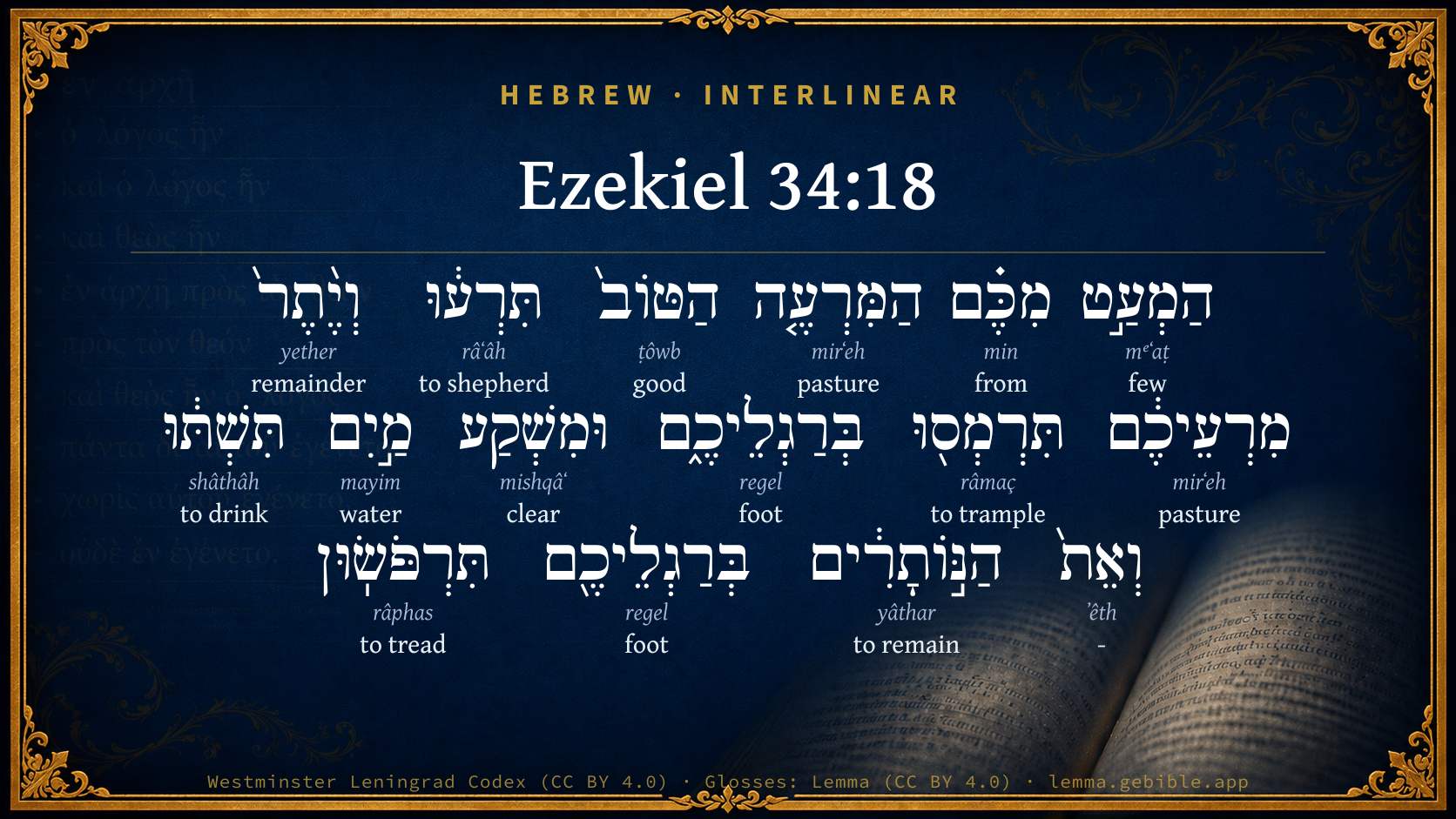
Ezekiel 34:18

Hebrew (Westminster Leningrad Codex) Ezekiel 34:18 appears in the Hebrew Old Testament. The text above is from the Westminster Leningrad Codex. Each word links to its Strong’s number, a concise gloss, and parsing drawn from the Open Scriptures Hebrew Bible morphology. Click any word for its full Brown-Driver-Briggs (BDB) entry.
Download image
Cite this verse

Ezekiel 34:18 (World English Bible). Public Domain. Lemma interlinear Bible study tool, https://lemma.gebible.app/v/ezekiel/34/18.

Show BibTeX & RIS
BibTeX
RIS
English Translation
Seems it a small thing to you to have fed on the good pasture, but you must tread down with your feet the residue of your pasture? and to have drunk of the clear waters, but you must foul the residue with your feet?
World English Bible · Public Domain
Highlights
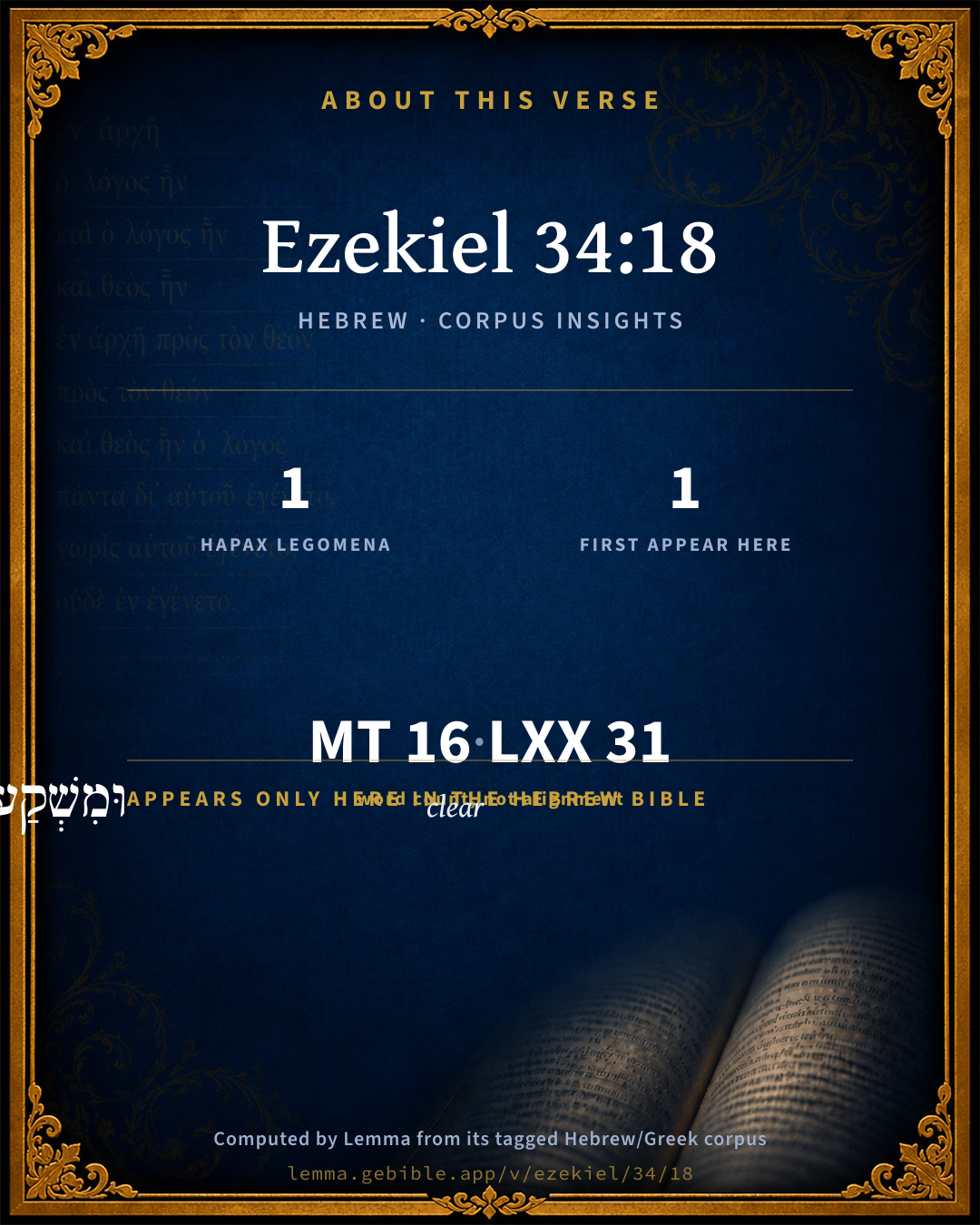
  • 1 hapax legomenon — only here in the Hebrew Bible
  • 1 first appearance in the Hebrew Bible
Full analysis ↓
Download a study sheet

One document with this verse’s original text, its word-by-word gloss line, the meaning frame, cross-references with their text, attributed commentary, and full source and license credits — printable, and it pastes into notes with its structure intact.

This verse Autodidact and up

Study sheet (.html) Plain text (.txt)

A passage Seminary Student

Up to 50 verses in one chapter. A passage sheet keeps up to 6 commentary sources and 12 cross-references per verse, in the order this page ranks them, and says so on the sheet whenever that leaves anything out. Ask for a single verse and you get the Autodidact verse sheet above.

Everything on this page stays free to read, with no account — the sheet is a download of what is already on screen, not access to it.

Want to remove ads? Support Godless Engineer
Compare translations 3

The same verse in 3 English versions, stacked beneath the original-language interlinear above. Click any original word for its lexicon entry.

Each is an independent rendering of the whole verse — the interlinear is not word-aligned to these translations.

Highlighted words mark where these versions differ — a whole-verse word diff, not a word-by-word alignment.

  • World English Bible Public Domain
    Seems it a small thing to you to have fed on the good pasture, but you must tread down with your feet the residue of your pasture? and to have drunk of the clear waters, but you must foul the residue with your feet?
  • King James Version Public Domain
    Seemeth it a small thing unto you to have eaten up the good pasture, but ye must tread down with your feet the residue of your pastures? and to have drunk of the deep waters, but ye must foul the residue with your feet?
  • unfoldingWord Literal Text CC BY-SA 4.0
    Is it not enough to feed on the good pasture, that you must trample down with your feet what is left of the pasture; and to drink from clear waters, that you must muddy the rivers with your feet?

unfoldingWord Literal Text — © unfoldingWord, licensed CC BY-SA 4.0. Word-aligned USFM3 via Door43 (git.door43.org/unfoldingWord/en_ult).

Versions to compare (up to 4)

3 of 4 selected

Show all 18 translations

Every available English version of this verse, each an independent rendering of the whole verse.

  • World English Bible Public Domain
    Seems it a small thing to you to have fed on the good pasture, but you must tread down with your feet the residue of your pasture? and to have drunk of the clear waters, but you must foul the residue with your feet?
  • Berean Standard Bible Public Domain
    Is it not enough for you to feed on the good pasture? Must you also trample the rest of the pasture with your feet? Is it not enough for you to drink the clear waters? Must you also muddy the rest with your feet?
  • Majority Standard Bible Public Domain
    Is it not enough for you to feed on the good pasture? Must you also trample the rest of the pasture with your feet? Is it not enough for you to drink the clear waters? Must you also muddy the rest with your feet?
  • King James Version Public Domain
    Seemeth it a small thing unto you to have eaten up the good pasture, but ye must tread down with your feet the residue of your pastures? and to have drunk of the deep waters, but ye must foul the residue with your feet?
  • American Standard Version (1901) Public Domain
    Seemeth it a small thing unto you to have fed upon the good pasture, but ye must tread down with your feet the residue of your pasture? and to have drunk of the clear waters, but ye must foul the residue with your feet?
  • Revised Version (1885) Public Domain
    Seemeth it a small thing unto you to have fed upon the good pasture, but ye must tread down with your feet the residue of your pasture? and to have drunk of the clear waters, but ye must foul the residue with your feet?
  • Geneva Bible (1599) Public Domain
    Seemeth it a small thing vnto you to haue eaten vp the good pasture, but yee must treade downe with your feete the residue of your pasture? and to haue drunke of the deepe waters, but yee must trouble the residue with your feete?
  • Douay-Rheims (1899) Public Domain
    Was it not enough for you to feed upon good pastures? but you must also tread down with your feet the residue of your pastures: and when you drank the dearest water, you troubled the rest with your feet.
  • Young's Literal Translation Public Domain
    Is it a little thing for you -- the good pasture ye enjoy, And the remnant of your pasture ye tread down with your feet, And a depth of waters ye do drink, And the remainder with your feet ye trample,
  • Literal Standard Version CC BY-SA 4.0
    Is it a little thing for you—[that] you enjoy the good pasture, || And tread down the remnant of your pasture with your feet, || And drink a depth of waters, || And trample the remainder with your feet,
  • Unlocked Literal Bible CC BY-SA 4.0
    Is it not enough to feed on the good pasture, that you must trample down with your feet what is left of the pasture; and to drink from clear waters, that you must muddy the rivers with your feet?
  • unfoldingWord Literal Text CC BY-SA 4.0
    Is it not enough to feed on the good pasture, that you must trample down with your feet what is left of the pasture; and to drink from clear waters, that you must muddy the rivers with your feet?
  • Darby Bible Public Domain
    Is it too small a thing unto you to have eaten up the good pastures, but ye must tread down with your feet the rest of your pastures; and to have drunk of the settled waters, but ye must foul the rest with your feet?
  • World Messianic Bible Public Domain
    Does it seem a small thing to you to have fed on the good pasture, but you must tread down with your feet the residue of your pasture? And to have drunk of the clear waters, but must you foul the residue with your feet?
  • Webster's Bible Public Domain
    Seemeth it a small thing to you to have eaten up the good pasture, but ye must tread down with your feet the residue of your pastures? and to have drank of the deep waters, but ye must foul the residue with your feet?
  • Free Bible Version CC BY-SA 4.0
    Aren't you satisfied with feeding in good pasture? Do you have to trample down the rest of the pasture with your feet? Aren't you satisfied to drink the clear water? Do you have to muddy the rest of it with your feet?
  • Bible in Basic English Public Domain
    Does it seem a small thing to you to have taken your food on good grass-land while the rest of your grass-land is stamped down under your feet? and that after drinking from clear waters you make the rest of the waters dirty with your feet?
  • JPS Tanakh (1917) Public Domain
    Seemeth it a small thing unto you to have fed upon the good pasture, but ye must tread down with your feet the residue of your pasture? and to have drunk of the settled waters, but ye must foul the residue with your feet?

Literal Standard Version (2020), Covenant Press — licensed CC BY-SA 4.0. Text via the HelloAO Bible API (eBible.org). Unlocked Literal Bible (unfoldingWord) — licensed CC BY-SA 4.0. Text via the HelloAO Bible API (eBible.org). unfoldingWord Literal Text — © unfoldingWord, licensed CC BY-SA 4.0. Word-aligned USFM3 via Door43 (git.door43.org/unfoldingWord/en_ult). Free Bible Version, Dr. Jonathan Gallagher — licensed CC BY-SA 4.0. Text via the HelloAO Bible API (eBible.org).

Word by word

More ways to search: Search by grammar → Find every occurrence → Compare this word →

Practice this passage: Drill this verse → Learn its vocabulary →

וּמִשְׁקַע
mishqâʻ
H4950
“and · clear of”
Conjunction + Noun, Common, Masculine, Singular, Construct
Part of Speech
Conjunction + Noun
Type
Common
Gender
Masculine
Number
Singular
State
Construct
Full BDB Definition

Origin: from H8257

TWOT: 2456a

what is settled or clarified, clear
  1. הַמְעַ֣ט mᵉʻaṭ H4592 “few” Particle, Interrogative + Noun, Common, Masculine, Singular, Absolute
  2. מִכֶּ֗ם min H4480 “from · you” Preposition + Suffix, Personal, 2nd Person, Masculine, Plural
  3. הַמִּרְעֶ֤ה mirʻeh H4829 “the · pasture” Particle, Definite Article + Noun, Common, Masculine, Singular, Absolute
  4. הַטּוֹב֙ ṭôwb H2896 “the · good” Particle, Definite Article + Adjective, Adjective, Masculine, Singular, Absolute
  5. תִּרְע֔וּ râʻâh H7462 “to shepherd” Verb, Qal, Imperfect, 2nd Person, Masculine, Plural
  6. וְיֶ֨תֶר֙ yether H3499 “and · remainder of” Conjunction + Noun, Common, Masculine, Singular, Construct
  7. מִרְעֵיכֶ֔ם mirʻeh H4829 “pastures · your” Noun, Common, Masculine, Plural, Construct + Suffix, Personal, 2nd Person, Masculine, Plural
  8. תִּרְמְס֖וּ râmaç H7429 “to trample” Verb, Qal, Imperfect, 2nd Person, Masculine, Plural
  9. בְּרַגְלֵיכֶ֑ם regel H7272 “in/at · feet · your” Preposition + Noun, Common, Feminine, Dual, Construct + Suffix, Personal, 2nd Person, Masculine, Plural
  10. מַ֣יִם mayim H4325 “water(s)” Noun, Common, Masculine, Plural, Absolute
  11. תִּשְׁתּ֔וּ shâthâh H8354 “to drink” Verb, Qal, Imperfect, 2nd Person, Masculine, Plural
  12. וְאֵת֙ ʼêth H853 “and · -” Conjunction + Particle, Direct Object
  13. הַנּ֣וֹתָרִ֔ים yâthar H3498 “the · remaining” Particle, Definite Article + Verb, Niphal, Participle Active, Masculine, Plural, Absolute
  14. בְּרַגְלֵיכֶ֖ם regel H7272 “in/at · feet · your” Preposition + Noun, Common, Feminine, Dual, Construct + Suffix, Personal, 2nd Person, Masculine, Plural
  15. תִּרְפֹּשֽׂוּן râphas H7515 “to tread” Verb, Qal, Imperfect, 2nd Person, Masculine, Plural + Suffix, n

About this verse

These counts appear in no published source. They are computed here, from the morphology-tagged text and Lemma’s own curated glosses. What Lemma adds →

16
words
14
distinct lemmas
Prophets
section

Notable vocabulary

1 hapax legomenon — a word that appears only here in the entire Hebrew Bible:

  • וּמִשְׁקַע clear H4950

First appearance in Scripture

This word makes its first canonical appearance in the Hebrew Bible here:

  • וּמִשְׁקַע clear H4950

Shared distinctive vocabulary

תִּרְפֹּשֽׂוּן to tread H7515 occurs in 3 verses of the Hebrew Bible. Also found in:

Grammatical profile

  • 5 verbs
  • 8 nouns
  • 1 adjective
  • 1 preposition
  • 1 particle

Verb forms

  • תִּרְע֔וּ Qal · Imperfect
  • תִּרְמְס֖וּ Qal · Imperfect
  • תִּשְׁתּ֔וּ Qal · Imperfect
  • הַנּ֣וֹתָרִ֔ים Niphal · Participle Active
  • תִּרְפֹּשֽׂוּן Qal · Imperfect

Repetition

Words recur within this verse — often emphatic in Hebrew:

  • הַמִּרְעֶ֤ה pasture H4829 ×2
  • בְּרַגְלֵיכֶ֑ם foot H7272 ×2

Hebrew & Septuagint length

In English translation the verse runs 44 words from the Hebrew and 40 from the Septuagint (LXX English) — closely comparable.

A rough comparison of the two English renderings, which tokenize alike — not a word-level alignment.

Word counts can differ between the Hebrew and the Greek without any difference in meaning — e.g. the Hebrew direct-object marker אֵת has no separate Greek word, and Greek often adds the article ὁ.

In the original languages it is 16 Hebrew tokens and 31 Greek tokens — but the two are counted differently (Hebrew bundles its prefixes and suffixes into one token; the Greek is in lemma form), so that isn’t a like-for-like length.

Cross-references

13

Topical passages linked to Ezekiel 34:18 in the Treasury of Scripture Knowledge — connected by theme and wording, ordered by reader-vote popularity; previews shown in the World English Bible.

  • Matthew 23:13 "Woe to you, scribes and Pharisees, hypocrites! For you devour widows' houses, and as a pretense you make long prayers. Therefore you will receive greater condemnation.
  • Luke 11:52 Woe to you lawyers! For you took away the key of knowledge. You didn't enter in yourselves, and those who were entering in, you hindered."
  • Numbers 16:9 [seems it but] a small thing to you, that the God of Israel has separated you from the congregation of Israel, to bring you near to himself, to do the service of the tent of Yahweh, and to stand before the congregation to minister to them;
  • Numbers 16:13 is it a small thing that you have brought us up out of a land flowing with milk and honey, to kill us in the wilderness, but you must needs make yourself also a prince over us?
  • 2 Samuel 7:19 This was yet a small thing in your eyes, Lord Yahweh; but you have spoken also of your servant's house for a great while to come; and this [too] after the manner of men, Lord Yahweh!
  • Isaiah 7:13 He said, "Listen now, house of David: Is it not enough for you to try the patience of men, that you will try the patience of my God also?
  • Ezekiel 34:2–3 Son of man, prophesy against the shepherds of Israel, prophesy, and tell them, even to the shepherds, Thus says the Lord Yahweh: Woe to the shepherds of Israel who feed themselves! Shouldn't the shepherds feed the sheep?
  • Ezekiel 16:20 Moreover you have taken your sons and your daughters, whom you have borne to me, and these have you sacrificed to them to be devoured. Were your prostitution a small matter,
  • Ezekiel 16:47 Yet have you not walked in their ways, nor done after their abominations; but, as [if that were] a very little [thing], you were more corrupt than they in all your ways.
  • Ezekiel 32:2 Son of man, take up a lamentation over Pharaoh king of Egypt, and tell him, You were likened to a young lion of the nations: yet are you as a monster in the seas; and you did break forth with your rivers, and troubled the waters with your feet, and fouled their rivers.
  • Micah 2:2 They covet fields, and seize them; And houses, and take them away: And they oppress a man and his house, Even a man and his heritage.
  • Matthew 15:6–9 he shall not honor his father or mother.' You have made the commandment of God void because of your tradition.
  • Genesis 30:15 She said to her, "Is it a small matter that you have taken away my husband? Would you take away my son's mandrakes, also?" Rachel said, "Therefore he will lie with you tonight for your son's mandrakes."

Cross-references courtesy of OpenBible.info (CC BY 4.0).

Hebrew and Greek witnesses Masoretic Hebrew ↔ Greek Septuagint

The same verse in the two great witnesses to the Old Testament, shown verse-for-verse.

These are two independent witnesses, not word-aligned to each other, and the Septuagint is shown in lemma (dictionary) form.

Hebrew Ezekiel 34:18 Masoretic · Westminster Leningrad Codex

הַמְעַ֣ט מִכֶּ֗ם הַמִּרְעֶ֤ה הַטּוֹב֙ תִּרְע֔וּ וְיֶ֨תֶר֙ מִרְעֵיכֶ֔ם תִּרְמְס֖וּ בְּרַגְלֵיכֶ֑ם וּמִשְׁקַע מַ֣יִם תִּשְׁתּ֔וּ וְאֵת֙ הַנּ֣וֹתָרִ֔ים בְּרַגְלֵיכֶ֖ם תִּרְפֹּשֽׂוּן

Seems it a small thing to you to have fed on the good pasture, but you must tread down with your feet the residue of your pasture? and to have drunk of the clear waters, but you must foul the residue with your feet?

World English Bible · Public Domain

Greek LXX Ezekiel 34:18 Septuagint · lemma form

καί οὐ ἱκανός σύ ὅτι ὁ καλός νομή νέμω καί ὁ κατάλοιπος ὁ νομή σύ καταπατέω ὁ πούς σύ καί ὁ καταἵστημι ὕδωρ πίνω καί ὁ λοιπός ὁ πούς σύ ταράσσω

And is it not enough for you that you⌃ fed on the good pasture, that you⌃ trampled with your feet the remnant of your pasture? and that you⌃ drank the standing water, that you⌃ disturbed the residue with your feet?

LXX2012 (modern English Septuagint) · Public Domain

Hebrew: Westminster Leningrad Codex (CC BY 4.0). Greek: Septuagint (public domain); English from LXX2012 (modern English Septuagint) (Public Domain). How the Septuagint differs from the Hebrew →

Targum (Aramaic paraphrase)

1

The Targum is the ancient Jewish Aramaic paraphrase of the Hebrew Scriptures — an interpretive translation, not the Hebrew text itself. Onkelos (literal) and Pseudo-Jonathan (expansive) render the Torah, and Jonathan the Prophets. Coverage is partial: where no permissively-licensed English translation exists for a verse, only the Aramaic is shown. This is verse-level text, not a word-by-word alignment to the Hebrew.

  1. Targum Jonathan Prophets (Joshua–Malachi)
    הַזְעֵיר לְכוֹן דְפַרְנוּס טַב אַתּוּן מִתְפַּרְנְסִין וּמוֹתַר פַּרְנוּסֵכוֹן דָיְשִׁין בְּרַגְלֵיכוֹן וּמִשְׁתֵּי מְתַקֵן אַתּוּן שָׁתָן וְיַת מוֹתְרָא בְּרַגְלֵיכוֹן אַתּוּן דָיְשִׁין:

    (no public-domain English translation for this verse)

    Targum Jonathan — Aramaic: “Mikraot Gedolot” (public domain). English: “Sefaria Community Translation” (CC0 1.0 (public-domain dedication)); “London "Chaldee Paraphrase," 1871” (public domain). Text via Sefaria.

Commentary

Notes on Ezekiel 34:18 from classic Christian and Jewish commentators (each source and its license shown beneath its notes). The classic Christian expositions comment on the surrounding passage and are grouped to its opening verse, so a note may address several verses; the Jewish commentaries on the Tanakh (Rashi and others) are per-verse, so they appear only where the commentator wrote on this verse.

Lemma curates 59 commentaries, every one of them public domain or Creative Commons licensed, each selected and text-cleaned for this edition rather than reprinted as found. About our sources →

Trapp's Complete Commentary

John Trapp

Eze 34:18 [Seemeth it] a small thing unto you to have eaten up the good pasture, but ye must tread down with your feet the residue of your pastures? and to have drunk of the deep waters, but ye must foul the residue with your feet?

Ver. 18. Seemeth it a small thing unto you.] Extenuant hypocritae suam culpam honesto titulo. {a} Hypocrites make the best and the least of their sins, which good men acknowledge with aggravation; but the works of the flesh are manifest. And here we have a lively picture of the Popish clergy, who eat up the best, and tread down the rest, et pro salutaribus aquis suam salivam hominibus obtrudunt, and for wholesome, obtrude brackish waters upon men to quench their thirst,

{a} Oecolamp.

John Trapp, A Commentary or Exposition upon All the Books of the Old and New Testament (1647–1656) — public domain. Text from a community e-Sword module.

Geneva Bible (1599)

Geneva Bible translators

By good pasture and deep waters is meant the pure word of God and the administration of justice, which they did not distribute to the poor till they had corrupted it.

Geneva Bible (1599) marginal notes — public domain. Text via Bolls.life.

Jamieson, Fausset & Brown

Robert Jamieson, A. R. Fausset & David Brown

Not content with appropriating to their own use the goods of others, they from mere wantonness spoiled what they did not use, so as to be of no use to the owners.

deep waters--that is, "limpid," as deep waters are generally clear. GROTIUS explains the image as referring to the usuries with which the rich ground the poor (Eze 22:12; Isa 24:2).

Jamieson, Fausset & Brown — Commentary Critical and Explanatory on the Whole Bible (1871) — public domain (CC PDM 1.0). Text via the HelloAO Bible API.

Adam Clarke's Commentary

Verse 18. Have eaten up the good pasture] Arrogate to yourselves all the promises of God, and will hardly permit the simple believer to claim or possess any token of God's favour.

Ye must foul the residue with your feet?] Ye abuse God's mercies; you consume much upon yourselves, and ye spoil more, on which the poor would have been glad to feed. There are some who would rather give food to their sporting dogs than to the poor around them, who are ready to starve, and who would be glad of the crumbs that fall from the table of those masters!

Adam Clarke's Commentary on the Bible (1810–1826) — public domain. Text from a community e-Sword/MySword module.

Ellicott's Commentary for English Readers

(18) Tread down . . . foul the residue.—The charge against them is that they not only first supplied and took care of themselves, but with careless insolence destroyed what should have been for others.

A Bible Commentary for English Readers, edited by Charles John Ellicott (1878–1897) — public domain. Text from a community e-Sword module.

The Cambridge Bible for Schools and Colleges

gen. ed. J. J. S. Perowne

18. The words are addressed to the rams and he-goats—the magnates and ruling classes.

deep waters] clear (lit. settled) waters, cf. Eze_32:14.

The Cambridge Bible for Schools and Colleges (gen. ed. J. J. S. Perowne; Cambridge University Press, 1878–1918) — public domain. Text from a community e-Sword module.

John Gill's Exposition

And as for my flock, they eat that which ye have trodden with your feet,.... They are forced to do it, not being able to come at any thing else; being as sheep without a shepherd, or worse:

and they drink that which ye have fouled with your feet; which, as it cannot be agreeable and relishing, so neither wholesome; as the leaven of the Scribes and Pharisees; the traditions of the elders; the false doctrines of false teachers, whose words eat as do a canker. The Targum of the whole verse is,

"and my people eat the residue of the food of your ministers, and drink the residue of the drink of your ministers.''

John Gill's Exposition of the Whole Bible (1746–1763) — public domain (CC PDM 1.0). Text via the HelloAO Bible API.

Matthew Poole's English Annotations

God awakens them by this interrogatory to think first, and then speak what this is. When you are full fed, and others hungry and ready to starve, who might live on that you leave if you did not spoil it, do you think such killing is no crime? Is it not a very great cruelty, and a most barbarous inhumanity? You great ones, who have much more than others, partly by the bounty of the Lord of the sheep, and partly by your injustice and rapine, you eat the fat and sweet, and what you cannot eat you waste and spoil; and what would you say, if your proud, fat, and spiteful servants in your houses should do so to their weaker, leaner, and modester servants?

The deep waters; which are clear to the eye and pleasant, which are sweet to their palate, which are wholesome to the drinker.

Ye must foul the residue with your feet; in spite as much as wantonness you stamp in them, raise all the mud from the bottom, that makes the waters unfit to be drunk: is this a trivial thing thus to starve and choke those you should feed and refresh? Such hath been the carriage of you rich, powerful, ruling, and governing part of my people, who have been forced either to live on what you made unwholesome and noxious, or to starve at home, or seek somewhat abroad; this hath destroyed many and dispersed more, but I will not always wink at and bear this.

Matthew Poole's English Annotations on the Holy Bible (1683–1685) — public domain. Text from a community e-Sword/MySword module.

John Wesley's Explanatory Notes

But ye must tread down - You great ones, eat the fat, and sweet; and what you cannot eat, you waste and spoil. The deep waters - Which are sufficient for all.

John Wesley, Explanatory Notes Upon the Whole Bible (1754–1765) — public domain. Text via the GEBible commentary corpus.

Rashi

Rabbi Shlomo Yitzchaki (Rashi)

Is it little for you that the strongest among you graze on the good pasture? If only you would not [also] tread the residues with your feet, and would let the rest of My flock eat them! But even the residue of your pasture you tread with your feet! And is it not enough for you that you drink the clear water, that you must tread the remainder with your feet?

the clear water [Heb. וּמִשְּׁקַע מַיִם,] lit. sunken water, the clear water, whose mud sank. It was not made murky with [the movement of] the feet. The symbolic meaning is as stated by the Targum: Is it little for you that [you] feed yourself the best food, and your attendants must eat the residue of your food? And [that] you drink the best, and your attendants must drink the residue?

Rashi on the Tanakh — English translations: “The Judaica Press complete Tanach with Rashi, translated by A. J. Rosenberg” (CC BY 4.0); “Pentateuch with Rashi's commentary by M. Rosenbaum and A.M. Silbermann, 1929-1934” (public domain); “The Metsudah Tanach series, Lakewood, N.J” (CC BY 4.0); and “The Book of Joshua, Metsudah Publications, 1997” (CC BY 4.0). Text via Sefaria.

Lesson kit

Teaching starters — assembled from the data on this page, not authored interpretation. Every prompt links to the verse data it draws on. Edit before teaching.

Ezekiel, in the Prophets, opens this verse with 16 words (14 distinct Hebrew lemmas). Its most distinctive word is mishqâʻ (“clear”). A historical commentator’s framing appears above. Read the whole chapter for the surrounding context.

Discussion questions

  1. The word mishqâʻ carries the sense “clear.” How does it shape the verse?
  2. 1 word here appears nowhere else in the Hebrew Bible. Why might the author reach for such rare wording?
  3. This is the first place “clear” appears in Scripture (first appears here). What does its debut here establish?
  4. How does Proverbs 25:26, which shares the word «to tread», read alongside this verse?
  5. What does the repetition of “pasture” (2× in this one verse) do in this verse?
  6. These translations render this verse differently. What is at stake in choosing one wording over another?
  7. «תִּרְע֔וּ» is a Qal Imperfect verb. How does that grammatical form shape the action described?
  8. Compare how Trapp's Complete Commentary and Geneva Bible (1599) read this verse. Where do they agree or differ?

Things to notice

  • 1 word in this verse appears nowhere else in the Hebrew Bible.
  • 1 word makes its first canonical appearance in Scripture here.
  • This verse counts 16 Hebrew ↔ 31 Greek words.
  • These translations choose different wording for 23 words in this verse.
  • “pasture” occurs 2× in this single verse.

Reading settings

Reading text

Shown beneath each verse's original-language words.

Old Testament
Old Testament edition

Read the OT as the Masoretic Hebrew (MT) or the Greek Septuagint (LXX).

English shown for the Greek Septuagint (in the Hebrew ↔ Greek comparison).

Comparing translations? Open the Compare panel on any verse page to stack up to four side by side.