
2 Samuel 11:13

Hebrew (Westminster Leningrad Codex) 2 Samuel 11:13 appears in the Hebrew Old Testament. The text above is from the Westminster Leningrad Codex. Each word links to its Strong’s number, a concise gloss, and parsing drawn from the Open Scriptures Hebrew Bible morphology. Click any word for its full Brown-Driver-Briggs (BDB) entry.
Download image
Cite this verse

2 Samuel 11:13 (World English Bible). Public Domain. Lemma interlinear Bible study tool, https://lemma.gebible.app/v/2-samuel/11/13.

Show BibTeX & RIS
BibTeX
RIS
English Translation
When David had called him, he ate and drink before him; and he made him drunk: and at even he went out to lie on his bed with the servants of his lord, but didn't go down to his house.
World English Bible · Public Domain
Download a study sheet

One document with this verse’s original text, its word-by-word gloss line, the meaning frame, cross-references with their text, attributed commentary, and full source and license credits — printable, and it pastes into notes with its structure intact.

This verse Autodidact and up

Study sheet (.html) Plain text (.txt)

A passage Seminary Student

Up to 50 verses in one chapter. A passage sheet keeps up to 6 commentary sources and 12 cross-references per verse, in the order this page ranks them, and says so on the sheet whenever that leaves anything out. Ask for a single verse and you get the Autodidact verse sheet above.

Everything on this page stays free to read, with no account — the sheet is a download of what is already on screen, not access to it.

Want to remove ads? Support Godless Engineer
Compare translations 3

The same verse in 3 English versions, stacked beneath the original-language interlinear above. Click any original word for its lexicon entry.

Each is an independent rendering of the whole verse — the interlinear is not word-aligned to these translations.

Highlighted words mark where these versions differ — a whole-verse word diff, not a word-by-word alignment.

  • World English Bible Public Domain
    When David had called him, he ate and drink before him; and he made him drunk: and at even he went out to lie on his bed with the servants of his lord, but didn't go down to his house.
  • King James Version Public Domain
    And when David had called him, he did eat and drink before him; and he made him drunk: and at even he went out to lie on his bed with the servants of his lord, but went not down to his house.
  • unfoldingWord Literal Text CC BY-SA 4.0
    And David called to him, and he ate to his face, and he drank, and he got him drunk. But he went out in the evening to lie down in his bed with the servants of his master, and he did not go down to his house.

unfoldingWord Literal Text — © unfoldingWord, licensed CC BY-SA 4.0. Word-aligned USFM3 via Door43 (git.door43.org/unfoldingWord/en_ult).

Versions to compare (up to 4)

3 of 4 selected

Show all 18 translations

Every available English version of this verse, each an independent rendering of the whole verse.

  • World English Bible Public Domain
    When David had called him, he ate and drink before him; and he made him drunk: and at even he went out to lie on his bed with the servants of his lord, but didn't go down to his house.
  • Berean Standard Bible Public Domain
    Then David invited Uriah to eat and drink with him, and he got Uriah drunk. And in the evening Uriah went out to lie down on his cot with his master’s servants, but he did not go home.
  • Majority Standard Bible Public Domain
    Then David invited Uriah to eat and drink with him, and he got Uriah drunk. And in the evening Uriah went out to lie down on his cot with his master’s servants, but he did not go home.
  • King James Version Public Domain
    And when David had called him, he did eat and drink before him; and he made him drunk: and at even he went out to lie on his bed with the servants of his lord, but went not down to his house.
  • American Standard Version (1901) Public Domain
    And when David had called him, he did eat and drink before him; and he made him drunk: and at even he went out to lie on his bed with the servants of his lord, but went not down to his house.
  • Revised Version (1885) Public Domain
    And when David had called him, he did eat and drink before him; and he made him drunk: and at even he went out to lie on his bed with the servants of his lord, but went not down to his house.
  • Geneva Bible (1599) Public Domain
    Then Dauid called him, and hee did eate and drinke before him, and he made him drunke: and at euen he went out to lie on his couch with the seruants of his Lord, but went not downe to his house.
  • Douay-Rheims (1899) Public Domain
    And David called him to eat and to drink before him, and he made him drunk: and he went out in the evening, and slept on his couch with the servants of his lord, and went not down into his house.
  • Young's Literal Translation Public Domain
    and David calleth for him, and he eateth before him, and drinketh, and he causeth him to drink, and he goeth out in the evening to lie on his couch with the servants of his lord, and unto his house he hath not gone down.
  • Literal Standard Version CC BY-SA 4.0
    and David calls for him, and he eats before him, and drinks, and he causes him to drink, and he goes out in the evening to lie on his bed with the servants of his lord, and he has not gone down to his house.
  • Unlocked Literal Bible CC BY-SA 4.0
    When David called him, he ate and drank before him, and David made him drunk. At evening Uriah went out to sleep on his bed with the servants of his master; he did not go down to his house.
  • unfoldingWord Literal Text CC BY-SA 4.0
    And David called to him, and he ate to his face, and he drank, and he got him drunk. But he went out in the evening to lie down in his bed with the servants of his master, and he did not go down to his house.
  • Darby Bible Public Domain
    And David invited him, and he ate and drank before him; and he made him drunk. And in the evening he went out to lie on his couch with the servants of his lord, but did not go down to his house.
  • World Messianic Bible Public Domain
    When David had called him, he ate and drank before him; and he made him drunk. At evening, he went out to lie on his bed with the servants of his lord, but didn’t go down to his house.
  • Webster's Bible Public Domain
    And when David had called him, he ate and drank before him; and he made him drunk: and at evening he went out to lie on his bed with the servants of his lord, but went not down to his house.
  • Free Bible Version CC BY-SA 4.0
    David invited Uriah to dinner. Uriah ate and drank with him, and David got Uriah drunk. But in the evening he went to sleep on his mat with the king's guards, and didn't go home.
  • Bible in Basic English Public Domain
    And when David sent for him, he took meat and drink with him, and David made him the worse for drink: and when evening came, he went to rest on his bed with the servants of his lord, but he did not go down to his house.
  • JPS Tanakh (1917) Public Domain
    And when David had called him, he did eat and drink before him; and he made him drunk; and at even he went out to lie on his bed with the servants of his lord, but went not down to his house.

Literal Standard Version (2020), Covenant Press — licensed CC BY-SA 4.0. Text via the HelloAO Bible API (eBible.org). Unlocked Literal Bible (unfoldingWord) — licensed CC BY-SA 4.0. Text via the HelloAO Bible API (eBible.org). unfoldingWord Literal Text — © unfoldingWord, licensed CC BY-SA 4.0. Word-aligned USFM3 via Door43 (git.door43.org/unfoldingWord/en_ult). Free Bible Version, Dr. Jonathan Gallagher — licensed CC BY-SA 4.0. Text via the HelloAO Bible API (eBible.org).

Word by word

More ways to search: Search by grammar → Find every occurrence → Compare this word →

Practice this passage: Drill this verse → Learn its vocabulary →

וַֽיְשַׁכְּרֵ֑הוּ
shâkar
H7937
“and · to be drunk · him”
Conjunction + Verb, Piel, Sequential Imperfect, 3rd Person, Masculine, Singular + Suffix, Personal, 3rd Person, Masculine, Singular
Part of Speech
Conjunction + Verb
Stem
Piel
Form
Sequential Imperfect
Person
3rd Person
Gender
Masculine
Number
Singular
Full BDB Definition

Origin: a primitive root

TWOT: 2388

to be or become drunk or drunken, be intoxicated - (Qal) to become drunken - (Piel) to make drunken, cause to be drunk - (Hiphil) to cause to be drunk - (Hithpael) to make oneself drunk
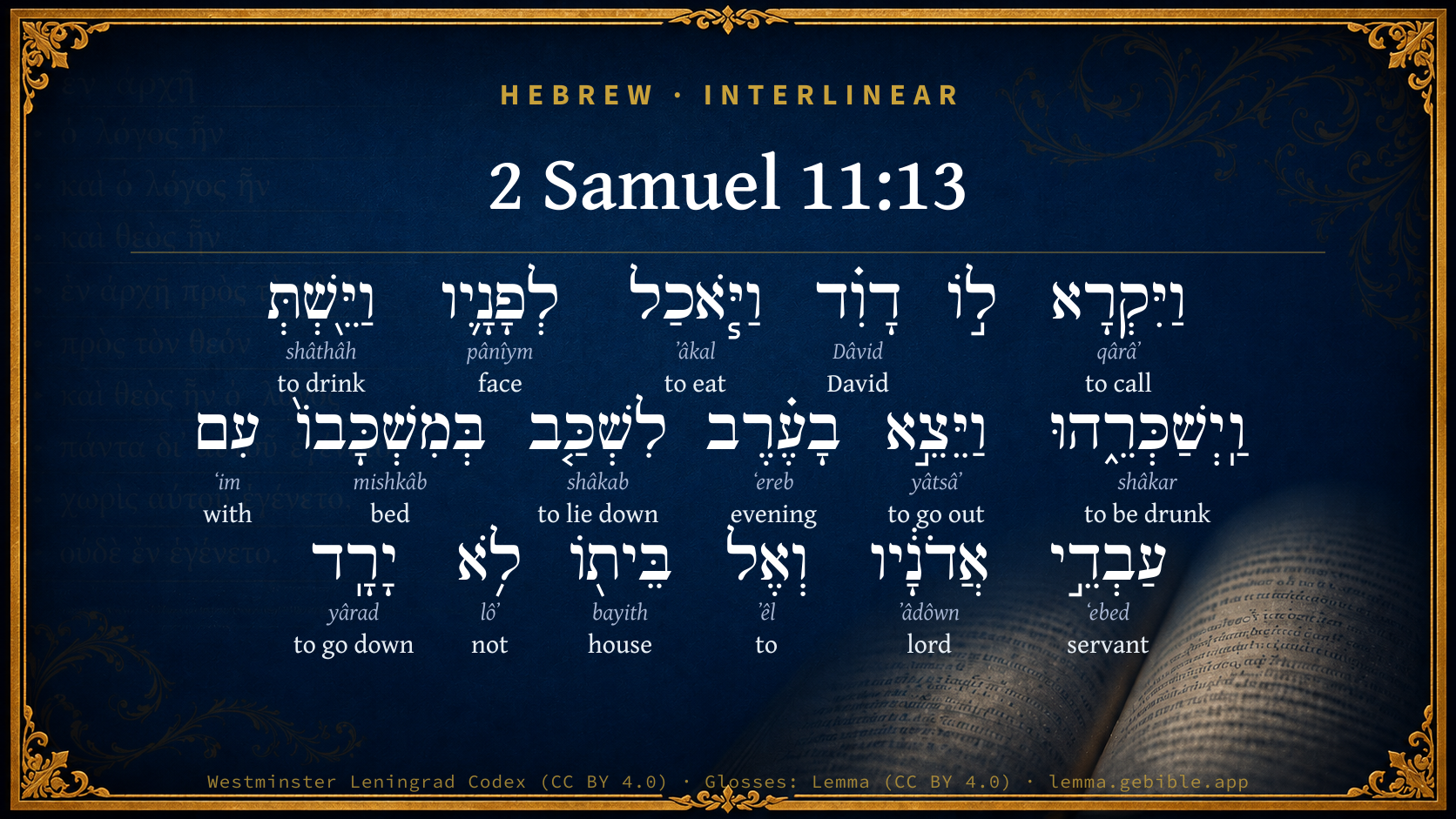
  1. וַיִּקְרָא qârâʼ H7121 “and · to call” Conjunction + Verb, Qal, Sequential Imperfect, 3rd Person, Masculine, Singular
  2. דָוִ֗ד Dâvid H1732 “David” Noun, Proper
  3. וַיֹּ֧אכַל ʼâkal H398 “and · to eat” Conjunction + Verb, Qal, Sequential Imperfect, 3rd Person, Masculine, Singular
  4. לְפָנָ֛יו pânîym H6440 “to/for · face(s) · his” Preposition + Noun, Common, Both, Plural, Construct + Suffix, Personal, 3rd Person, Masculine, Singular
  5. וַיֵּ֖שְׁתְּ shâthâh H8354 “and · to drink” Conjunction + Verb, Qal, Sequential Imperfect, 3rd Person, Masculine, Singular
  6. וַיֵּצֵ֣א yâtsâʼ H3318 “and · to go out” Conjunction + Verb, Qal, Sequential Imperfect, 3rd Person, Masculine, Singular
  7. בָעֶ֗רֶב ʻereb H6153 “in/at the · evening” Preposition, Determined + Noun, Common, Masculine, Singular, Absolute
  8. לִשְׁכַּ֤ב shâkab H7901 “to lie down” Preposition + Verb, Qal, Infinitive Construct
  9. בְּמִשְׁכָּבוֹ֙ mishkâb H4904 “in/at · bed · his” Preposition + Noun, Common, Masculine, Singular, Construct + Suffix, Personal, 3rd Person, Masculine, Singular
  10. עִם ʻim H5973 “with” Preposition
  11. עַבְדֵ֣י ʻebed H5650 “servants of” Noun, Common, Masculine, Plural, Construct
  12. אֲדֹנָ֔יו ʼâdôwn H113 “lords · his” Noun, Common, Masculine, Plural, Construct + Suffix, Personal, 3rd Person, Masculine, Singular
  13. וְאֶל ʼêl H413 “and · to” Conjunction + Preposition
  14. בֵּית֖וֹ bayith H1004 “house · his” Noun, Common, Masculine, Singular, Construct + Suffix, Personal, 3rd Person, Masculine, Singular
  15. לֹ֥א lôʼ H3808 “not” Particle, Negative
  16. יָרָֽד yârad H3381 “to go down” Verb, Qal, Perfect, 3rd Person, Masculine, Singular

About this verse

These counts appear in no published source. They are computed here, from the morphology-tagged text and Lemma’s own curated glosses. What Lemma adds →

18
words
17
distinct lemmas
Historical
section

Notable vocabulary

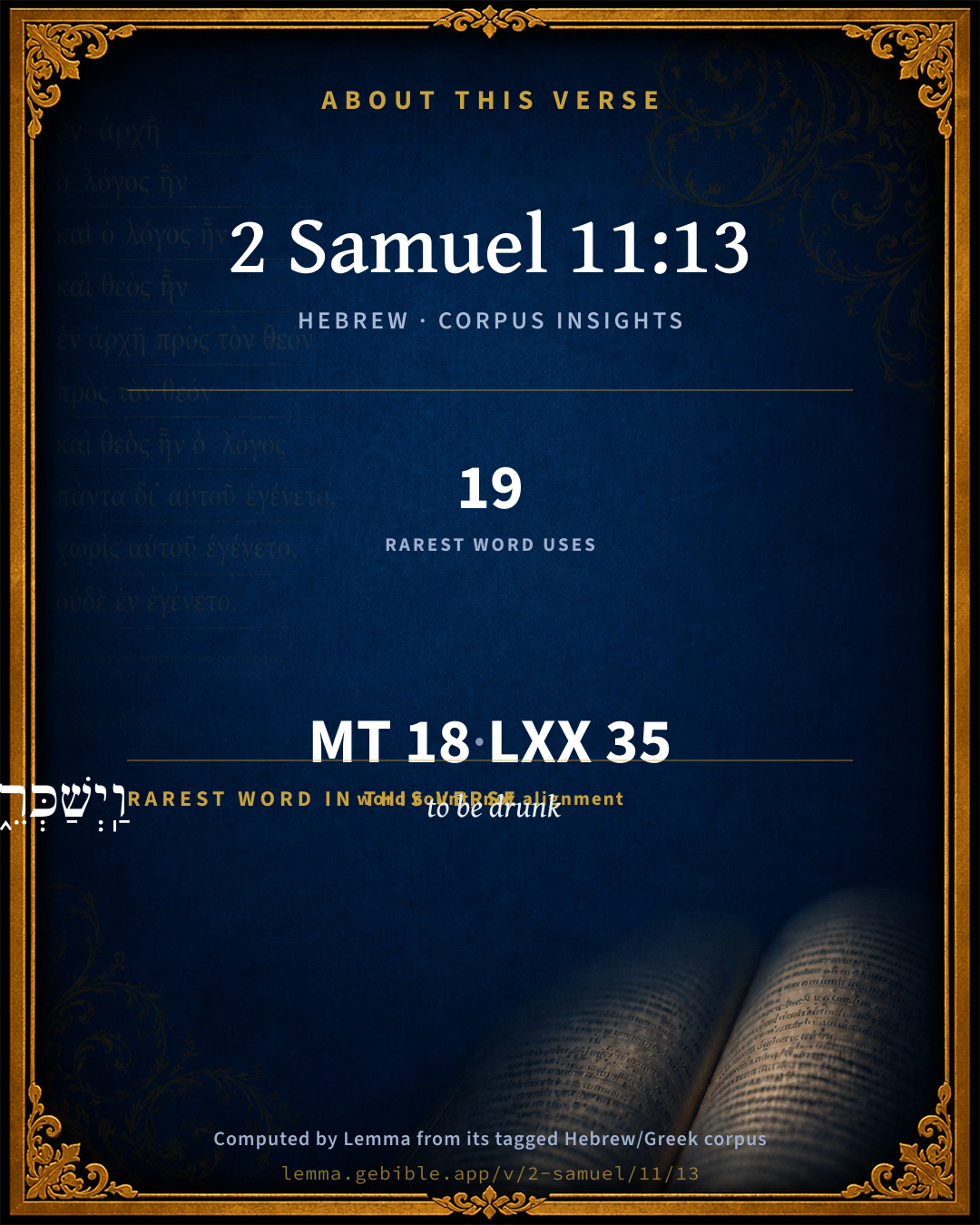
The rarest word here is וַֽיְשַׁכְּרֵ֑הוּ to be drunk H7937 — appearing just 19 times in the whole Hebrew Bible.

Shared distinctive vocabulary

וַֽיְשַׁכְּרֵ֑הוּ to be drunk H7937 occurs in 19 verses of the Hebrew Bible. Also found in:

Grammatical profile

  • 7 verbs
  • 7 nouns
  • 3 prepositions
  • 1 particle

Verb forms

  • וַיִּקְרָא Qal · Sequential Imperfect
  • וַיֹּ֧אכַל Qal · Sequential Imperfect
  • וַיֵּ֖שְׁתְּ Qal · Sequential Imperfect
  • וַֽיְשַׁכְּרֵ֑הוּ Piel · Sequential Imperfect
  • וַיֵּצֵ֣א Qal · Sequential Imperfect
  • לִשְׁכַּ֤ב Qal · Infinitive Construct
  • יָרָֽד Qal · Perfect

Hebrew & Septuagint length

In English translation the verse runs 40 words from the Hebrew and 41 from the Septuagint (LXX English) — closely comparable.

A rough comparison of the two English renderings, which tokenize alike — not a word-level alignment.

Word counts can differ between the Hebrew and the Greek without any difference in meaning — e.g. the Hebrew direct-object marker אֵת has no separate Greek word, and Greek often adds the article ὁ.

In the original languages it is 18 Hebrew tokens and 35 Greek tokens — but the two are counted differently (Hebrew bundles its prefixes and suffixes into one token; the Greek is in lemma form), so that isn’t a like-for-like length.

Cross-references

4

Topical passages linked to 2 Samuel 11:13 in the Treasury of Scripture Knowledge — connected by theme and wording, ordered by reader-vote popularity; previews shown in the World English Bible.

  • Habakkuk 2:15 "Woe to him who gives his neighbor drink, pouring your inflaming wine until they are drunk, so that you may gaze at their naked bodies!
  • Genesis 19:32–35 Come, let's make our father drink wine, and we will lie with him, that we may preserve our father's seed."
  • Exodus 32:21 Moses said to Aaron, "What did these people do to you, that you have brought a great sin on them?"
  • Proverbs 20:1 Wine is a mocker, and beer is a brawler; Whoever is led astray by them is not wise.

Cross-references courtesy of OpenBible.info (CC BY 4.0).

Hebrew and Greek witnesses Masoretic Hebrew ↔ Greek Septuagint

The same verse in the two great witnesses to the Old Testament, shown verse-for-verse.

These are two independent witnesses, not word-aligned to each other, and the Septuagint is shown in lemma (dictionary) form.

Hebrew 2 Samuel 11:13 Masoretic · Westminster Leningrad Codex

וַיִּקְרָא ל֣וֹ דָוִ֗ד וַיֹּ֧אכַל לְפָנָ֛יו וַיֵּ֖שְׁתְּ וַֽיְשַׁכְּרֵ֑הוּ וַיֵּצֵ֣א בָעֶ֗רֶב לִשְׁכַּ֤ב בְּמִשְׁכָּבוֹ֙ עִם עַבְדֵ֣י אֲדֹנָ֔יו וְאֶל בֵּית֖וֹ לֹ֥א יָרָֽד

When David had called him, he ate and drink before him; and he made him drunk: and at even he went out to lie on his bed with the servants of his lord, but didn't go down to his house.

World English Bible · Public Domain

Greek LXX 2 Samuel 11:13 Septuagint · lemma form

καί καλέω αὐτός δαυίδ καί ἐσθίω ἐνώπιον αὐτός καί πίνω καί μεθύω αὐτός καί ἐκἔρχομαι ἑσπέρα ὁ κοιμάω ἐπί ὁ κοίτη αὐτός μετά ὁ δοῦλος ὁ κύριος αὐτός καί εἰς ὁ οἶκος αὐτός οὐ καταβαίνω

And David called him, and he ate before him and drank, and he made him drunk: and he went out in the evening to lie upon his bed with the servants of his lord, and went not down to his house.

LXX2012 (modern English Septuagint) · Public Domain

Hebrew: Westminster Leningrad Codex (CC BY 4.0). Greek: Septuagint (public domain); English from LXX2012 (modern English Septuagint) (Public Domain). How the Septuagint differs from the Hebrew →

Targum (Aramaic paraphrase)

1

The Targum is the ancient Jewish Aramaic paraphrase of the Hebrew Scriptures — an interpretive translation, not the Hebrew text itself. Onkelos (literal) and Pseudo-Jonathan (expansive) render the Torah, and Jonathan the Prophets. Coverage is partial: where no permissively-licensed English translation exists for a verse, only the Aramaic is shown. This is verse-level text, not a word-by-word alignment to the Hebrew.

  1. Targum Jonathan Prophets (Joshua–Malachi)
    וּקְרָא לֵיהּ דָוִד וַאֲכַל קֳדָמוֹהִי וּשְׁתֵי וְרַוְיֵהּ וּנְפַק בְרַמְשָׁא לְמִשְׁכַּב בְּשִׁווּיֵהּ עִם עַבְדֵי רִבּוֹנֵיהּ וּלְבֵיתֵיהּ לָא נְחָת:

    (no public-domain English translation for this verse)

    Targum Jonathan — Aramaic: “Mikraot Gedolot” (public domain). English: “Sefaria Community Translation” (CC0 1.0 (public-domain dedication)); “London "Chaldee Paraphrase," 1871” (public domain). Text via Sefaria.

Commentary

Notes on 2 Samuel 11:13 from classic Christian and Jewish commentators (each source and its license shown beneath its notes). The classic Christian expositions comment on the surrounding passage and are grouped to its opening verse, so a note may address several verses; the Jewish commentaries on the Tanakh (Rashi and others) are per-verse, so they appear only where the commentator wrote on this verse.

Lemma curates 59 commentaries, every one of them public domain or Creative Commons licensed, each selected and text-cleaned for this edition rather than reprinted as found. About our sources →

Trapp's Complete Commentary

John Trapp

2Sa 11:13 And when David had called him, he did eat and drink before him; and he made him drunk: and at even he went out to lie on his bed with the servants of his lord, but went not down to his house.

Ver. 13. And made him drunk.] Thus doth David still proficere in peius, proceed from bad to worse; So plying good Uriah with cup after cup, that at length he was intoxicated. Vina parant animos Veneri. {a} A stomach boiling with wine easily foameth into lust, saith Jerome. Wine is the milk of Venus, saith another. David’s design here was to make Uriah, contrary to his oath, to lie with his wife. Tiberius, otherwise spare of speech, yet when drunk, arcana effutiebat omnia, would utter all the secrets of his heart. {b} So David hoped that Uriah, when well heated with wine, would lay aside all his austerities, and take his pleasure. All this was so much the worse done of David, because though he was drunk, with lust, when he lay with Bathsheba, yet he was sober enough when he made Uriah drunk; he went quietly and sedately on in it. Ruina maiorum sit cautela minorum. Be not highminded, but fear.

With the servants of his lord.] With the hinds and household servants; not with the guard, as before; perhaps because ashamed that he was overcome with drink.

But went not down to his house.] And so David was still disappointed, and by God Almighty counterplotted, that he might at length awake "out of the snare of the devil, who had carried him alive captive at his pleasure." {2Ti 2:26}

{a} Ovid, De Rem. Am., lib. ii.

{b} Sueton.

John Trapp, A Commentary or Exposition upon All the Books of the Old and New Testament (1647–1656) — public domain. Text from a community e-Sword module.

The Biblical Illustrator

Joseph S. Exell

2Sa_11:13

And when David had called him he made him drunk.

The sinfulness of causing drunkenness

It is a very wicked thing, under any design whatsoever, to make a person drunk. Woe to him that does so (Hab_2:15-16.) God will put a cup of trembling into the hands of those who put into the hands of others the cup of drunkenness. Robbing a man of Ins reason is worse than robbing him of his money, and drawing him into sin worse than drawing him into any trouble whatsoever. (M. Henry.)

The Biblical Illustrator, edited by Joseph S. Exell (c. 1880s–1900s) — public domain. Text from a community e-Sword module.

Geneva Bible (1599)

Geneva Bible translators

He made him drink more liberally than he was wont to do, thinking hereby he would have lain by his wife.

Geneva Bible (1599) marginal notes — public domain. Text via Bolls.life.

Adam Clarke's Commentary

Verse 13. He made him drunk] Supposing that in this state he would have been off his guard, and hastened down to his house.

Adam Clarke's Commentary on the Bible (1810–1826) — public domain. Text from a community e-Sword/MySword module.

Ellicott's Commentary for English Readers

(13) He made him drunk.—This fresh attempt of David to conceal his crime by attempting to send Uriah to his house while in a state of intoxication does not need comment, but Uriah’s resolve was so strong that it still governed his conduct while in this almost irresponsible condition.

A Bible Commentary for English Readers, edited by Charles John Ellicott (1878–1897) — public domain. Text from a community e-Sword module.

The Cambridge Bible for Schools and Colleges

gen. ed. J. J. S. Perowne

13. and he made him drunk] In the hope that he might forget his oath and break his resolution not to go home. But this plan also failed. “The Providence of God is here manifest, defeating David’s base contrivances, and bringing his sin to the open light. It is no less clear how mercy was at the bottom of this severity which issued in David’s deep repentance, and has also given to the Church one of the most solemn and searching warnings as to the evil of sin which is contained in the whole Bible.” Speaker’s Comm.

The Cambridge Bible for Schools and Colleges (gen. ed. J. J. S. Perowne; Cambridge University Press, 1878–1918) — public domain. Text from a community e-Sword module.

John Gill's Exposition

And when David had called him,.... Invited him to sup with him:

he did eat and drink before him; very freely and plentifully:

and he made him drunk: this was another sin of David's, done in order to make him forget his oath and vow, and that being inflamed with wine, desires might be excited in him to go home and lie with his wife; but even this scheme did not succeed:

and at even he went out to lie on his bed with the servants of his lord: in the guard room, where he had lain before:

but went not down to his house; for he was not so drunk but he remembered his oath, and kept his resolution not to go down to his own house; the Lord no doubt working upon his mind and disinclining him to it.

John Gill's Exposition of the Whole Bible (1746–1763) — public domain (CC PDM 1.0). Text via the HelloAO Bible API.

Haydock's Catholic Bible Commentary

Couch. It seems he was one of the guards. Josephus says he was Joab’s armour-bearer, (Antiquities vii. 7.) and one of David’s heroes, chap. xxiii. 39.

George Leo Haydock (1774–1849), Haydock's Catholic Family Bible and Commentary, 1859 edition — public domain. Excludes Psalms (Douay-Rheims chapter numbering differs from Protestant) and Deuterocanonical books (Catholic canon only).

Matthew Poole's English Annotations

When David had called him, i.e. being invited by David.

He made him drunk, or, he made him merry, as the word oft signifies. He caused him to drink more than was convenient.

He went out to lie on his bed; which it doth not appear that he did the night before; but now his excess in eating and drinking might make it more necessary for him.

With the servants of his lord, i.e. in some chamber in the king’s court, where the king’s servants used to take their repose.

Matthew Poole's English Annotations on the Holy Bible (1683–1685) — public domain. Text from a community e-Sword/MySword module.

Whedon's Commentary on the Bible

Daniel D. Whedon

13. He made him drunk — Hoping thus to unman him, that he might forget or neglect his resolution to stay away from home.

But went not down to his house — “The providence of God is here manifest,” says Bishop Hervey, “defeating David’s base contrivances, and bringing his sin to the open light. It is no less clear how mercy was at the bottom of this severity, which issued in David’s deep repentance, and has also given to the Church one of the most solemn and searching warnings as to the evil of sin which is contained in the whole Bible.”

Daniel D. Whedon (gen. ed.), Commentary on the Old and New Testaments (1874–1909) — public domain. Text from a community e-Sword module.

The Pulpit Commentary

He made him drunk. David thus adds sin to sin, and, in order to accomplish his vile end, he degrades the brave soldier whom already he had dishonoured. But even when intoxicated Uriah kept to his determination; and though on this second night there would not be the same pleasure in chatting with old comrades seen again after long absence, he still sleeps in the guard room. And thus there were witnesses that he had not gone to his house.

The Pulpit Commentary (1880–1919), ed. H.D.M. Spence-Jones & Joseph S. Exell — public domain. Text from a community e-Sword module.

Lesson kit

Teaching starters — assembled from the data on this page, not authored interpretation. Every prompt links to the verse data it draws on. Edit before teaching.

2 Samuel, in the Historical, opens this verse with 18 words (17 distinct Hebrew lemmas). Its most distinctive word is shâkar (“to be drunk”). A historical commentator’s framing appears above. Read the whole chapter for the surrounding context.

Discussion questions

  1. How does “to be drunk” (shâkar) shape what this verse is saying?
  2. How does Genesis 9:21, which shares the word «to be drunk», read alongside this verse?
  3. These translations render this verse differently. What is at stake in choosing one wording over another?
  4. «וַיִּקְרָא» is a Qal Sequential Imperfect verb. How does that grammatical form shape the action described?
  5. Compare how Trapp's Complete Commentary and The Biblical Illustrator read this verse. Where do they agree or differ?

Things to notice

Reading settings

Reading text

Shown beneath each verse's original-language words.

Old Testament
Old Testament edition

Read the OT as the Masoretic Hebrew (MT) or the Greek Septuagint (LXX).

English shown for the Greek Septuagint (in the Hebrew ↔ Greek comparison).

Comparing translations? Open the Compare panel on any verse page to stack up to four side by side.