Deuteronomy 2:6

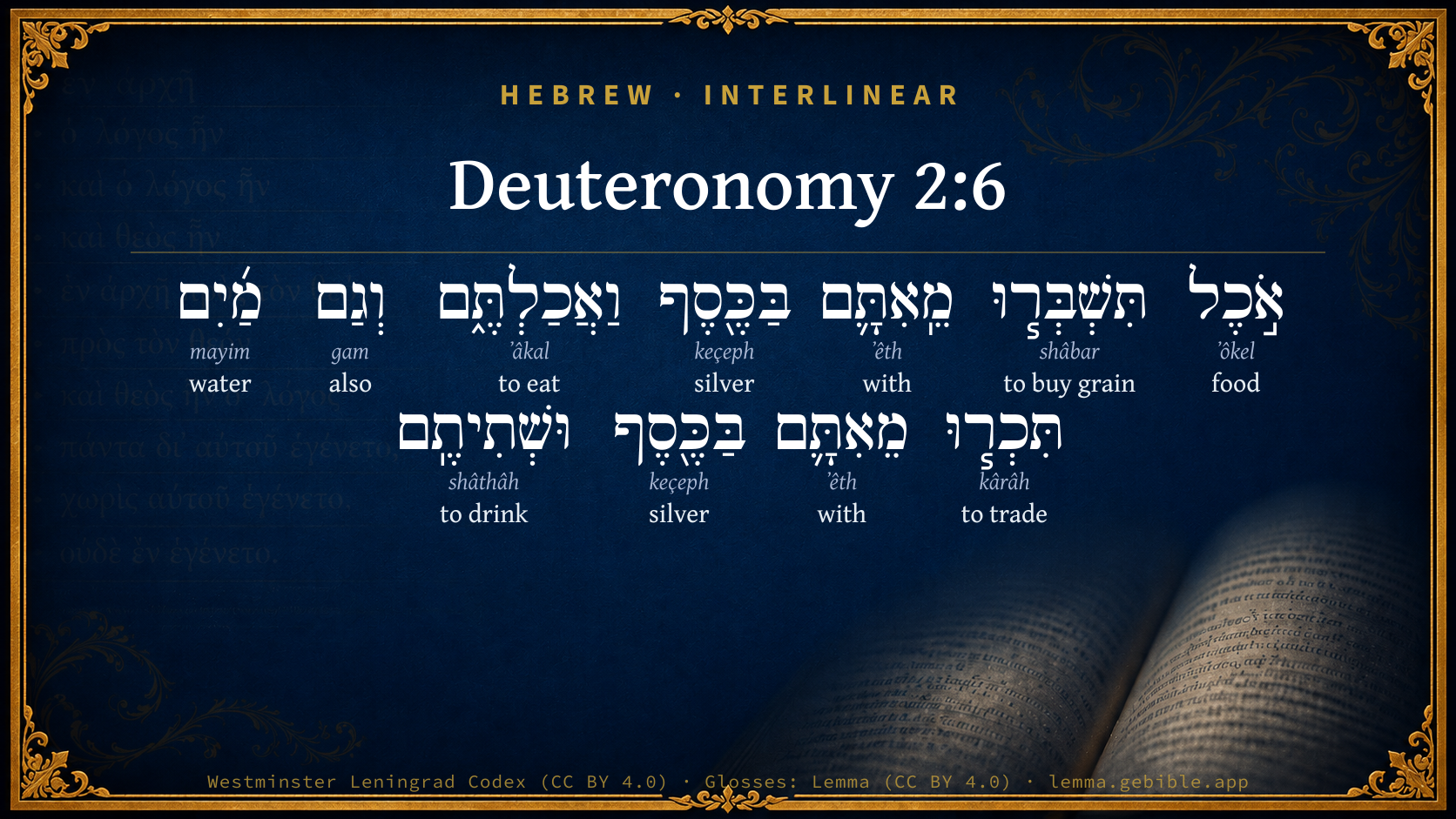
Hebrew (Westminster Leningrad Codex) Deuteronomy 2:6 appears in the Hebrew Old Testament. The text above is from the Westminster Leningrad Codex. Each word links to its Strong’s number, a concise gloss, and parsing drawn from the Open Scriptures Hebrew Bible morphology. Click any word for its full Brown-Driver-Briggs (BDB) entry.
Download image
Cite this verse

Deuteronomy 2:6 (World English Bible). Public Domain. Lemma interlinear Bible study tool, https://lemma.gebible.app/v/deuteronomy/2/6.

Show BibTeX & RIS
BibTeX
RIS
English Translation
You shall purchase food of them for money, that you may eat; and you shall also buy water of them for money, that you may drink.
World English Bible · Public Domain
Highlights
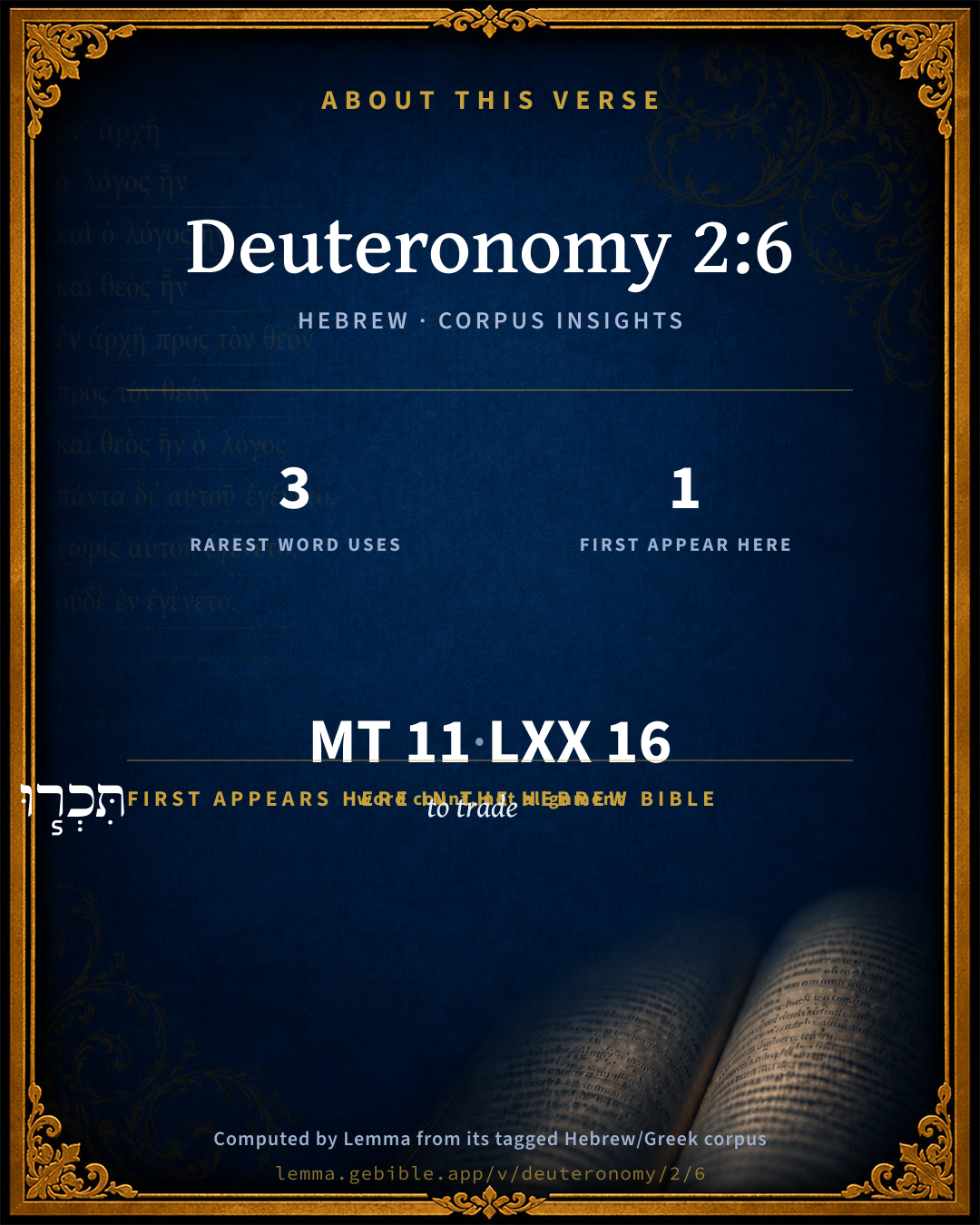
  • 1 first appearance in the Hebrew Bible
Full analysis ↓
Download a study sheet

One document with this verse’s original text, its word-by-word gloss line, the meaning frame, cross-references with their text, attributed commentary, and full source and license credits — printable, and it pastes into notes with its structure intact.

This verse Autodidact and up

Study sheet (.html) Plain text (.txt)

A passage Seminary Student

Up to 50 verses in one chapter. A passage sheet keeps up to 6 commentary sources and 12 cross-references per verse, in the order this page ranks them, and says so on the sheet whenever that leaves anything out. Ask for a single verse and you get the Autodidact verse sheet above.

Everything on this page stays free to read, with no account — the sheet is a download of what is already on screen, not access to it.

Want to remove ads? Support Godless Engineer
Compare translations 3

The same verse in 3 English versions, stacked beneath the original-language interlinear above. Click any original word for its lexicon entry.

Each is an independent rendering of the whole verse — the interlinear is not word-aligned to these translations.

Highlighted words mark where these versions differ — a whole-verse word diff, not a word-by-word alignment.

  • World English Bible Public Domain
    You shall purchase food of them for money, that you may eat; and you shall also buy water of them for money, that you may drink.
  • King James Version Public Domain
    Ye shall buy meat of them for money, that ye may eat; and ye shall also buy water of them for money, that ye may drink.
  • unfoldingWord Literal Text CC BY-SA 4.0
    You will buy food from them with silver, and you will eat. And also, you will purchase water from them with silver, and you will drink.”’

unfoldingWord Literal Text — © unfoldingWord, licensed CC BY-SA 4.0. Word-aligned USFM3 via Door43 (git.door43.org/unfoldingWord/en_ult).

Versions to compare (up to 4)

3 of 4 selected

Show all 18 translations

Every available English version of this verse, each an independent rendering of the whole verse.

  • World English Bible Public Domain
    You shall purchase food of them for money, that you may eat; and you shall also buy water of them for money, that you may drink.
  • Berean Standard Bible Public Domain
    You are to pay them in silver for the food you eat and the water you drink.’”
  • Majority Standard Bible Public Domain
    You are to pay them in silver for the food you eat and the water you drink.’”
  • King James Version Public Domain
    Ye shall buy meat of them for money, that ye may eat; and ye shall also buy water of them for money, that ye may drink.
  • American Standard Version (1901) Public Domain
    Ye shall purchase food of them for money, that ye may eat; and ye shall also buy water of them for money, that ye may drink.
  • Revised Version (1885) Public Domain
    Ye shall purchase food of them for money, that ye may eat; and ye shall also buy water of them for money, that ye may drink.
  • Geneva Bible (1599) Public Domain
    Ye shall buy meate of them for money to eate, and ye shall also procure water of them for money to drinke.
  • Douay-Rheims (1899) Public Domain
    You shall buy meats of them for money and shall eat: you shall draw waters for money, and shall drink.
  • Young's Literal Translation Public Domain
    `Food ye buy from them with money, and have eaten; and also water ye buy from them with money, and have drunk,
  • Literal Standard Version CC BY-SA 4.0
    You buy food from them with money, and have eaten; and you also buy water from them with money, and have drunk.
  • Unlocked Literal Bible CC BY-SA 4.0
    You will purchase food from them for money, so that you may eat; you will also buy water from them for money, so that you may drink.
  • unfoldingWord Literal Text CC BY-SA 4.0
    You will buy food from them with silver, and you will eat. And also, you will purchase water from them with silver, and you will drink.”’
  • Darby Bible Public Domain
    Ye shall buy of them food for money, that ye may eat; and water shall ye also buy of them for money, that ye may drink;
  • World Messianic Bible Public Domain
    You shall purchase food from them for money, that you may eat. You shall also buy water from them for money, that you may drink.’”
  • Webster's Bible Public Domain
    Ye shall buy food of them for money, that ye may eat; and ye shall also buy water of them for money, that ye may drink.
  • Free Bible Version CC BY-SA 4.0
    Pay them with money for the food you eat and the water you drink.”
  • Bible in Basic English Public Domain
    You may get food for your needs from them for a price, and water for drinking.
  • JPS Tanakh (1917) Public Domain
    Ye shall purchase food of them for money, that ye may eat; and ye shall also buy water of them for money, that ye may drink.

Literal Standard Version (2020), Covenant Press — licensed CC BY-SA 4.0. Text via the HelloAO Bible API (eBible.org). Unlocked Literal Bible (unfoldingWord) — licensed CC BY-SA 4.0. Text via the HelloAO Bible API (eBible.org). unfoldingWord Literal Text — © unfoldingWord, licensed CC BY-SA 4.0. Word-aligned USFM3 via Door43 (git.door43.org/unfoldingWord/en_ult). Free Bible Version, Dr. Jonathan Gallagher — licensed CC BY-SA 4.0. Text via the HelloAO Bible API (eBible.org).

Word by word

More ways to search: Search by grammar → Find every occurrence → Compare this word →

Practice this passage: Drill this verse → Learn its vocabulary →

תִּכְר֧וּ
kârâh
H3739
“to trade”
Verb, Qal, Imperfect, 2nd Person, Masculine, Plural
Part of Speech
Verb
Stem
Qal
Form
Imperfect
Person
2nd Person
Gender
Masculine
Number
Plural
Full BDB Definition

Origin: usually assigned as a primitive root, but probably only a special application of H3738 (through the common idea of planning implied in a bargain)

TWOT: 1034

(Qal) to get by trade, trade, buy, bargain over
  1. אֹ֣כֶל ʼôkel H400 “food” Noun, Common, Masculine, Singular, Absolute
  2. תִּשְׁבְּר֧וּ shâbar H7666 “to buy grain” Verb, Qal, Imperfect, 2nd Person, Masculine, Plural
  3. מֵֽאִתָּ֛ם ʼêth H854 “from · with · them” Preposition + Preposition + Suffix, Personal, 3rd Person, Masculine, Plural
  4. בַּכֶּ֖סֶף keçeph H3701 “in/at the · silver” Preposition, Determined + Noun, Common, Masculine, Singular, Absolute
  5. וַאֲכַלְתֶּ֑ם ʼâkal H398 “and · to eat” Conjunction + Verb, Qal, Sequential Perfect, 2nd Person, Masculine, Plural
  6. וְגַם gam H1571 “and · also” Conjunction + Particle, Accusative
  7. מַ֜יִם mayim H4325 “water(s)” Noun, Common, Masculine, Plural, Absolute
  8. מֵאִתָּ֛ם ʼêth H854 “from · with · them” Preposition + Preposition + Suffix, Personal, 3rd Person, Masculine, Plural
  9. בַּכֶּ֖סֶף keçeph H3701 “in/at the · silver” Preposition, Determined + Noun, Common, Masculine, Singular, Absolute
  10. וּשְׁתִיתֶֽם shâthâh H8354 “and · to drink” Conjunction + Verb, Qal, Sequential Perfect, 2nd Person, Masculine, Plural

About this verse

These counts appear in no published source. They are computed here, from the morphology-tagged text and Lemma’s own curated glosses. What Lemma adds →

11
words
9
distinct lemmas
Pentateuch
section

Notable vocabulary

The rarest word here is תִּכְר֧וּ to trade H3739 — appearing just 3 times in the whole Hebrew Bible.

First appearance in Scripture

This word makes its first canonical appearance in the Hebrew Bible here:

  • תִּכְר֧וּ to trade H3739

Shared distinctive vocabulary

תִּכְר֧וּ to trade H3739 occurs in 3 verses of the Hebrew Bible. Also found in:

Grammatical profile

  • 4 verbs
  • 4 nouns
  • 2 prepositions
  • 1 particle

Verb forms

  • תִּשְׁבְּר֧וּ Qal · Imperfect
  • וַאֲכַלְתֶּ֑ם Qal · Sequential Perfect
  • תִּכְר֧וּ Qal · Imperfect
  • וּשְׁתִיתֶֽם Qal · Sequential Perfect

Repetition

Words recur within this verse — often emphatic in Hebrew:

  • בַּכֶּ֖סֶף silver H3701 ×2
  • מֵֽאִתָּ֛ם with H854 ×2

Hebrew & Septuagint length

In English translation the verse runs 26 words from the Hebrew and 21 from the Septuagint (LXX English) — closely comparable.

A rough comparison of the two English renderings, which tokenize alike — not a word-level alignment.

Word counts can differ between the Hebrew and the Greek without any difference in meaning — e.g. the Hebrew direct-object marker אֵת has no separate Greek word, and Greek often adds the article ὁ.

In the original languages it is 11 Hebrew tokens and 16 Greek tokens — but the two are counted differently (Hebrew bundles its prefixes and suffixes into one token; the Greek is in lemma form), so that isn’t a like-for-like length.

Cross-references

5

Topical passages linked to Deuteronomy 2:6 in the Treasury of Scripture Knowledge — connected by theme and wording, ordered by reader-vote popularity; previews shown in the World English Bible.

  • Numbers 20:19 The children of Israel said to him, We will go up by the highway; and if we drink of your water, I and my cattle, then will I give the price of it: let me only, without [doing] anything [else], pass through on my feet.
  • Deuteronomy 2:28–29 You shall sell me food for money, that I may eat; and give me water for money, that I may drink: only let me pass through on my feet,
  • Matthew 7:12 Therefore whatever you desire for men to do to you, you shall also do to them; for this is the law and the prophets.
  • Romans 12:17 Repay no one evil for evil. Respect what is honorable in the sight of all men.
  • 2 Thessalonians 3:7–8 For you know how you ought to imitate us. For we didn't behave ourselves rebelliously among you,

Cross-references courtesy of OpenBible.info (CC BY 4.0).

Hebrew and Greek witnesses Masoretic Hebrew ↔ Greek Septuagint

The same verse in the two great witnesses to the Old Testament, shown verse-for-verse.

These are two independent witnesses, not word-aligned to each other, and the Septuagint is shown in lemma (dictionary) form.

Hebrew Deuteronomy 2:6 Masoretic · Westminster Leningrad Codex

אֹ֣כֶל תִּשְׁבְּר֧וּ מֵֽאִתָּ֛ם בַּכֶּ֖סֶף וַאֲכַלְתֶּ֑ם וְגַם מַ֜יִם תִּכְר֧וּ מֵאִתָּ֛ם בַּכֶּ֖סֶף וּשְׁתִיתֶֽם

You shall purchase food of them for money, that you may eat; and you shall also buy water of them for money, that you may drink.

World English Bible · Public Domain

Greek LXX Deuteronomy 2:6 Septuagint · lemma form

βρῶμα ἀργύριον ἀγοράζω παρά αὐτός καί ἐσθίω καί ὕδωρ μέτρον λαμβάνω παρά αὐτός ἀργύριον καί πίνω

Buy food of them for money and eat, and you⌃ shall receive water of them by measure for money, and drink.

LXX2012 (modern English Septuagint) · Public Domain

Hebrew: Westminster Leningrad Codex (CC BY 4.0). Greek: Septuagint (public domain); English from LXX2012 (modern English Septuagint) (Public Domain). How the Septuagint differs from the Hebrew →

Targum (Aramaic paraphrase)

2

The Targum is the ancient Jewish Aramaic paraphrase of the Hebrew Scriptures — an interpretive translation, not the Hebrew text itself. Onkelos (literal) and Pseudo-Jonathan (expansive) render the Torah, and Jonathan the Prophets. Coverage is partial: where no permissively-licensed English translation exists for a verse, only the Aramaic is shown. This is verse-level text, not a word-by-word alignment to the Hebrew.

  1. Targum Onkelos Torah (Genesis–Deuteronomy)
    עִבּוּרָא תִזְבְּנוּן מִנְהוֹן בְּכַסְפָּא וְתֵיכְלוּן וְאַף מַיָא תִּכְרוּן מִנְהוֹן בְּכַסְפָּא וְתִשְׁתּוּן

    (no public-domain English translation for this verse)

    Targum Onkelos — Aramaic: “Onkelos Genesis” (public domain); “Onkelos Exodus” (public domain); “Onkelos Leviticus” (public domain); “Onkelos Numbers” (public domain); “Onkelos Deuteronomy” (public domain). English: “Sefaria Community Translation” (CC0 1.0 (public-domain dedication)); “J.W. Etheridge. The Targums of Onkelos and Jonathan Ben Uzziel on the Pentateuch. London: Longmans, Green, 1862” (public domain). Text via Sefaria.

  2. Targum Pseudo-Jonathan Torah (Genesis–Deuteronomy)
    עִבּוּרָא תִּזְבּוּן מִנְהוֹן כַּד חַי בְּכַסְפָּא וְתֵיכְלוּן וְאוּף מַיָא תִזְבְּנוּן מִנְהוֹן בְּכַסְפָּא וְתִישְׁתּוּן

    You shall buy fresh provision of them for silver, that you may eat, and water shall you buy with silver, to drink.

    Targum Pseudo-Jonathan — Aramaic: “Targum Jonathan on Genesis” (public domain); “Targum Jonathan on Exodus” (public domain); “Targum Jonathan on Leviticus” (public domain); “Targum Jonathan on Numbers” (public domain); “Targum Jonathan on Deuteronomy” (public domain). English: “The Targum of Jonathan ben Uzziel, trans. J. W. Etheridge, London, 1862” (public domain). Text via Sefaria.

Commentary

Notes on Deuteronomy 2:6 from classic Christian and Jewish commentators (each source and its license shown beneath its notes). The classic Christian expositions comment on the surrounding passage and are grouped to its opening verse, so a note may address several verses; the Jewish commentaries on the Tanakh (Rashi and others) are per-verse, so they appear only where the commentator wrote on this verse.

Lemma curates 59 commentaries, every one of them public domain or Creative Commons licensed, each selected and text-cleaned for this edition rather than reprinted as found. About our sources →

Trapp's Complete Commentary

John Trapp

Deu 2:6 Ye shall buy meat of them for money, that ye may eat; and ye shall also buy water of them for money, that ye may drink.

Ver. 6. Buy meat of them for money.] "Money answereth all things," saith Solomon. {Ecc 10:19} Money is the monarch of the world, saith another, and bears most mastery. But that covetous Caliph of Babylon, taken by Haalon, brother to Mango the great Cham of Tartary, and commanded to eat his fill of that great wealth that he had heaped up together, found ere he died, that one mouthful of meat was more worth than a whole houseful of money. {a}

{a} Turk. Hist., fol. 113.

John Trapp, A Commentary or Exposition upon All the Books of the Old and New Testament (1647–1656) — public domain. Text from a community e-Sword module.

Joseph Benson's Commentary

Deu 2:6. Buy meat of them for money — For though the manna did yet rain upon them, they were not forbidden to buy other meats when they had opportunity, but only were forbidden greedily to hunger after them when they could not obtain them. Buy water — For water in those parts was scarce, and therefore private persons did severally dig pits for their particular use.

Joseph Benson's Commentary on the Old and New Testaments (1811–1818) — public domain. Text from a community e-Sword module.

Ellicott's Commentary for English Readers

(6) Ye shall buy meat . . . and . . . water.—Comp. Gen_14:23, “Lest thou shouldest say, I have made Abram rich,” and Deu_15:1, “I am thy shield, and thy exceeding great reward.”

A Bible Commentary for English Readers, edited by Charles John Ellicott (1878–1897) — public domain. Text from a community e-Sword module.

The Cambridge Bible for Schools and Colleges

gen. ed. J. J. S. Perowne

6. Ye shall purchase … ye shall buy] Heb. shabar, literally to deal in grain (Gen_41:57, etc.), but also victuals (Gen_42:7), and karah, to buy, only here Hos_3:2 and in Job. JE, Num_20:19 : if we drink of thy water, I and my cattle, then I will give the price thereof. To-day nomad Arabs, who winter in the warm ‘Arabah, seek to cross Mt Se‘îr with their cattle by one or other of several passes to summer pastures on the E. plateau and the wilderness of Moab. The passes are easily defended by the peasants of the Mt, who seek to prevent them; yet they are glad when the nomads travel on the edge of the desert, for then they can barter with them (Musil, Edom, ii. 15). Where there are no brooks but only cisterns or easily guarded springs, the peasant possessors of these will refuse to sell even small draughts to one or two passing travellers, as the writer has more than once experienced; cp. Musil, Moab, 132. It is conceivable how water would be still more jealously guarded from a large caravan or host, with appetites sufficient to exhaust the cisterns. It is implied in Deu_2:29 that Edom agreed to supply food and water.

The Cambridge Bible for Schools and Colleges (gen. ed. J. J. S. Perowne; Cambridge University Press, 1878–1918) — public domain. Text from a community e-Sword module.

John Gill's Exposition

That is, if they would, as Aben Ezra observes; for though they had manna daily, yet if they would they might buy other food when they had an opportunity, as they would now have of Edom; but then they were not to take it by force or stealth, but pay for it, which they were able to do. The same writer observes, that some read the words with an interrogation, "shall ye buy meat?" no, there is no need of it; for the Lord had blessed them with a sufficiency of it:

and ye shall also buy water of them for money; that ye may drink; which was usual in those hot countries; See Gill on Num 20:19 or dig water (y) that is, pay for digging of wells for water, or buy water out of wells dug in the land of Edom. Jarchi says in maritime places they express buying by this word, and so it is used in the Arabic language; See Gill on Hos 3:2.

(y) "fodietis", Montanus.

John Gill's Exposition of the Whole Bible (1746–1763) — public domain (CC PDM 1.0). Text via the HelloAO Bible API.

Haydock's Catholic Bible Commentary

Meats, if they wanted any other sort, besides manna. (Menochius)

George Leo Haydock (1774–1849), Haydock's Catholic Family Bible and Commentary, 1859 edition — public domain. Excludes Psalms (Douay-Rheims chapter numbering differs from Protestant) and Deuterocanonical books (Catholic canon only).

Matthew Poole's English Annotations

Buy meat of them; for though the manna did yet rain upon them, they were not forbidden to buy other meats when they had opportunity, but only were forbidden greedily to hunger after them when they could not obtain them.

Buy water of them; for water in those parts was scarce, and therefore private persons did severally dig pits for their particular use. See Gen 26:18; Num 21:18.

Matthew Poole's English Annotations on the Holy Bible (1683–1685) — public domain. Text from a community e-Sword/MySword module.

Whedon's Commentary on the Bible

Daniel D. Whedon

6. Buy water — The Hebrew word used implies purchasing permission to dig for water.

Daniel D. Whedon (gen. ed.), Commentary on the Old and New Testaments (1874–1909) — public domain. Text from a community e-Sword module.

John Wesley's Explanatory Notes

Buy meat - For thongh the manna did yet rain upon them, they were not forbidden to buy other meats when they had opportunity, but only were forbidden greedily to hunger after them when they could not obtain them. Buy water - For water in those parts was scarce, and therefore private persons did severally dig pits for their particular use.

John Wesley, Explanatory Notes Upon the Whole Bible (1754–1765) — public domain. Text via the GEBible commentary corpus.

unfoldingWord translationNotes

Door43 World Missions Community

General Information:

Moses continues to instruct Israel in how they are to treat the descendants of Esau.

You will purchase food from them

Yahweh is giving them permission or instruction, not a command, and he is telling them not to steal. "I permit you to purchase food from them" or "If you need food, you are to purchase it from them"

from them

"from Esau's descendants"

for money

If these words are not needed or make the translation unclear, you may omit them.

your God has blessed you ... your hand ... your walking ... your God ... with you, and you have lacked

Moses speaks to the Israelites as if they were one man, so all instances of "you" and "your" are singular. (See: Forms of You)

you in all the work of your hand

The "work of your hand" refers to all the work they had done. AT: "all of your work" (See: Synecdoche)

he has known your walking

Here what happened to the people while they were walking is spoken of as their "walking." (See: Metonymy)

forty years

"40 years" (See: Numbers)

you have lacked nothing

This is a litotes for "you have had everything you needed." (See: Litotes)

translationWords

Yahweh

God

bless

works

hand

walk

desert

unfoldingWord translationNotes — © Distant Shores Media and the Door43 World Missions Community, licensed CC BY-SA 4.0. Source: git.door43.org/Door43/en_tn.

Rashi

Rabbi Shlomo Yitzchaki (Rashi)

תכרו — This is an expression denoting purchase. Similar is (Genesis 50:5; see Rashi thereon), “which I have bought (כריתי) for myself”, for thus in the coast cities do they use for "trading” the term כירה (Rosh Hashanah 26a).

Rashi on the Tanakh — English translations: “The Judaica Press complete Tanach with Rashi, translated by A. J. Rosenberg” (CC BY 4.0); “Pentateuch with Rashi's commentary by M. Rosenbaum and A.M. Silbermann, 1929-1934” (public domain); “The Metsudah Tanach series, Lakewood, N.J” (CC BY 4.0); and “The Book of Joshua, Metsudah Publications, 1997” (CC BY 4.0). Text via Sefaria.

Ramban (Nachmanides)

Rabbi Moshe ben Nachman (Ramban / Nachmanides)

YE SHALL PURCHASE FOOD OF THEM FOR MONEY. If you should desire to eat of the fruits of their land you should not take it from them except for the full price, 23:9. at their pleasure, this being the sense of the word me’itam (of them) [purchase food ‘of them,’ i.e., with their consent]. Also you shall not drink water of them at all, except for money with their consent.

Ramban (Nachmanides) on the Tanakh — English translation: “Commentary on the Torah by Ramban (Nachmanides). Translated and annotated by Charles B. Chavel. New York, Shilo Pub. House, 1971-1976” (CC BY 4.0). Text via Sefaria.

Lesson kit

Teaching starters — assembled from the data on this page, not authored interpretation. Every prompt links to the verse data it draws on. Edit before teaching.

Deuteronomy, in the Pentateuch, opens this verse with 11 words (9 distinct Hebrew lemmas). Its most distinctive word is kârâh (“to trade”). A historical commentator’s framing appears above. Read the whole chapter for the surrounding context.

Discussion questions

  1. The word kârâh carries the sense “to trade.” How does it shape the verse?
  2. This is the first place “to trade” appears in Scripture (first appears here). What does its debut here establish?
  3. How does 2 Kings 6:23, which shares the word «to trade», read alongside this verse?
  4. What does the repetition of “silver” (2× in this one verse) do in this verse?
  5. The translations on this page render this verse differently — a whole-verse word diff, not a word-by-word alignment. What might account for the different wordings?
  6. «תִּשְׁבְּר֧וּ» is a Qal Imperfect verb. How does that grammatical form shape the action described?
  7. Compare how Trapp's Complete Commentary and Joseph Benson's Commentary read this verse. Where do they agree or differ?

Things to notice

Reading settings

Reading text

Shown beneath each verse's original-language words.

Old Testament
Old Testament edition

Read the OT as the Masoretic Hebrew (MT) or the Greek Septuagint (LXX).

English shown for the Greek Septuagint (in the Hebrew ↔ Greek comparison).

Comparing translations? Open the Compare panel on any verse page to stack up to four side by side.