
Jeremiah 35:6

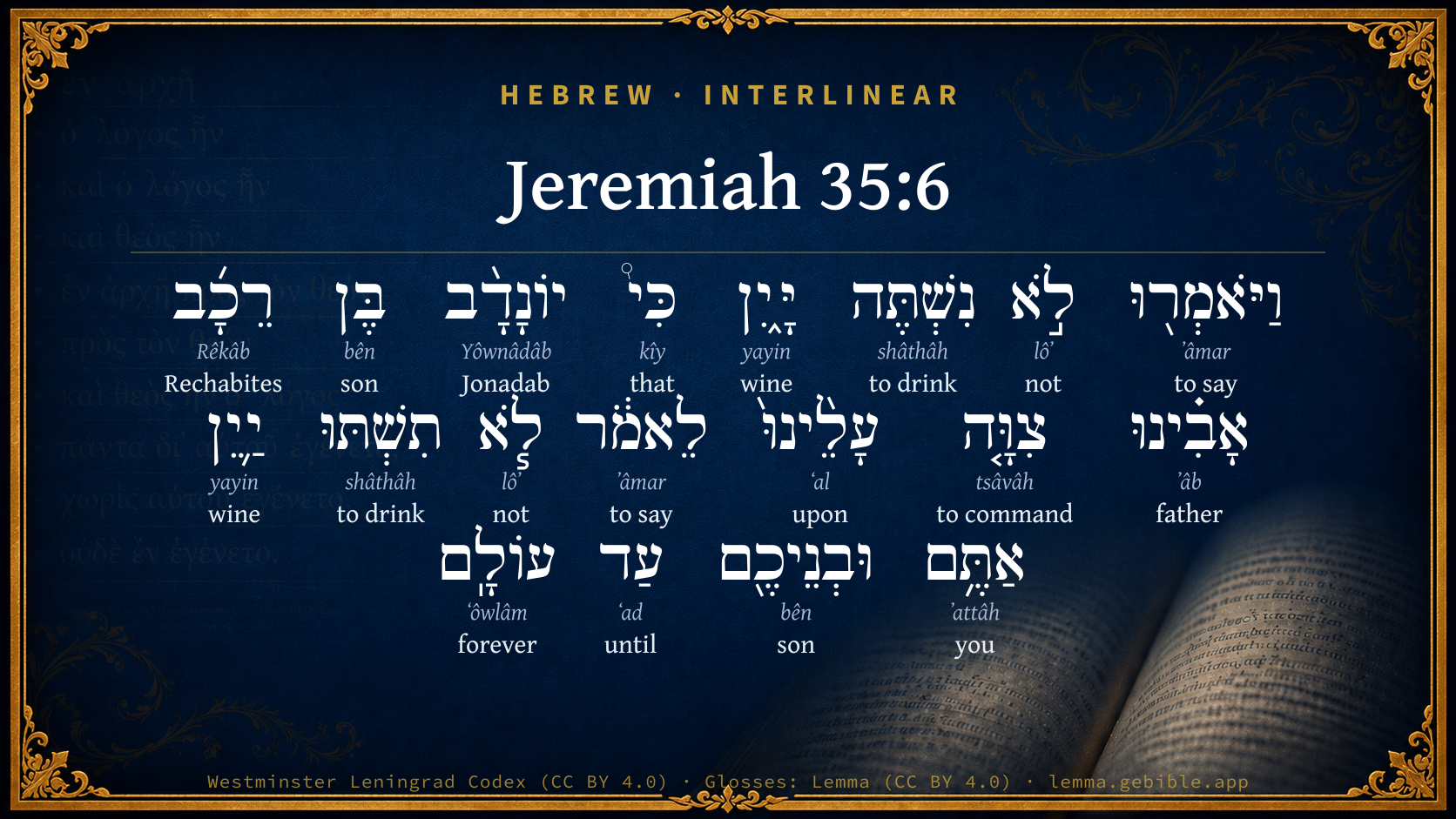
Hebrew (Westminster Leningrad Codex) Jeremiah 35:6 appears in the Hebrew Old Testament. The text above is from the Westminster Leningrad Codex. Each word links to its Strong’s number, a concise gloss, and parsing drawn from the Open Scriptures Hebrew Bible morphology. Click any word for its full Brown-Driver-Briggs (BDB) entry.
Download image
Cite this verse

Jeremiah 35:6 (World English Bible). Public Domain. Lemma interlinear Bible study tool, https://lemma.gebible.app/v/jeremiah/35/6.

Show BibTeX & RIS
BibTeX
RIS
English Translation
But they said, We will drink no wine; for Jonadab the son of Rechab, our father, commanded us, saying, You shall drink no wine, neither you, nor your sons, forever:
World English Bible · Public Domain
Download a study sheet

One document with this verse’s original text, its word-by-word gloss line, the meaning frame, cross-references with their text, attributed commentary, and full source and license credits — printable, and it pastes into notes with its structure intact.

This verse Autodidact and up

Study sheet (.html) Plain text (.txt)

A passage Seminary Student

Up to 50 verses in one chapter. A passage sheet keeps up to 6 commentary sources and 12 cross-references per verse, in the order this page ranks them, and says so on the sheet whenever that leaves anything out. Ask for a single verse and you get the Autodidact verse sheet above.

Everything on this page stays free to read, with no account — the sheet is a download of what is already on screen, not access to it.

Want to remove ads? Support Godless Engineer
Compare translations 3

The same verse in 3 English versions, stacked beneath the original-language interlinear above. Click any original word for its lexicon entry.

Each is an independent rendering of the whole verse — the interlinear is not word-aligned to these translations.

Highlighted words mark where these versions differ — a whole-verse word diff, not a word-by-word alignment.

  • World English Bible Public Domain
    But they said, We will drink no wine; for Jonadab the son of Rechab, our father, commanded us, saying, You shall drink no wine, neither you, nor your sons, forever:
  • King James Version Public Domain
    But they said, We will drink no wine: for Jonadab the son of Rechab our father commanded us, saying, Ye shall drink no wine, neither ye, nor your sons for ever:
  • unfoldingWord Literal Text CC BY-SA 4.0
    But they said, “We will not drink any wine, for our ancestor, Jonadab son of Rekab, commanded us, ‘Do not drink any wine, neither you nor your descendants, forever.

unfoldingWord Literal Text — © unfoldingWord, licensed CC BY-SA 4.0. Word-aligned USFM3 via Door43 (git.door43.org/unfoldingWord/en_ult).

Versions to compare (up to 4)

3 of 4 selected

Show all 18 translations

Every available English version of this verse, each an independent rendering of the whole verse.

  • World English Bible Public Domain
    But they said, We will drink no wine; for Jonadab the son of Rechab, our father, commanded us, saying, You shall drink no wine, neither you, nor your sons, forever:
  • Berean Standard Bible Public Domain
    “We do not drink wine,” they replied, “for our forefather Jonadab son of Rechab commanded us, ‘Neither you nor your descendants are ever to drink wine.
  • Majority Standard Bible Public Domain
    “We do not drink wine,” they replied, “for our forefather Jonadab son of Rechab commanded us, ‘Neither you nor your descendants are ever to drink wine.
  • King James Version Public Domain
    But they said, We will drink no wine: for Jonadab the son of Rechab our father commanded us, saying, Ye shall drink no wine, neither ye, nor your sons for ever:
  • American Standard Version (1901) Public Domain
    But they said, We will drink no wine; for Jonadab the son of Rechab, our father, commanded us, saying, Ye shall drink no wine, neither ye, nor your sons, for ever:
  • Revised Version (1885) Public Domain
    But they said, We will drink no wine: for Jonadab the son of Rechab our father commanded us, saying, Ye shall drink no wine, neither ye, nor your sons, for ever:
  • Geneva Bible (1599) Public Domain
    But they said, We will drinke no wine: for Ionadab the sonne of Rechab our father commanded vs, saying, Ye shall drinke no wine, neither you nor your sonnes for euer.
  • Douay-Rheims (1899) Public Domain
    And they answered: We will not drink wine: because Jonadab the son of Rechab, our father, commanded us, saying: You shall drink no wine, neither you, nor your children, for ever:
  • Young's Literal Translation Public Domain
    And they say, `We do not drink wine: for Jonadab son of Rechab, our father, charged us, saying, Ye do not drink wine, ye and your sons -- unto the age;
  • Literal Standard Version CC BY-SA 4.0
    And they say, “We do not drink wine: for Jonadab son of Rechab, our father, charged us, saying, You do not drink wine, you and your sons—for all time;
  • Unlocked Literal Bible CC BY-SA 4.0
    But they said, “We will not drink any wine, for our ancestor, Jonadab son of Rekab, commanded us, 'Do not drink any wine, neither you nor your descendants, forever.
  • unfoldingWord Literal Text CC BY-SA 4.0
    But they said, “We will not drink any wine, for our ancestor, Jonadab son of Rekab, commanded us, ‘Do not drink any wine, neither you nor your descendants, forever.
  • Darby Bible Public Domain
    And they said, We will drink no wine; for Jonadab the son of Rechab our father commanded us, saying, Ye shall drink no wine, ye nor your sons for ever;
  • World Messianic Bible Public Domain
    But they said, “We will drink no wine; for Jonadab the son of Rechab, our father, commanded us, saying, ‘You shall drink no wine, neither you nor your children, forever.
  • Webster's Bible Public Domain
    But they said, We will drink no wine: for Jonadab the son of Rechab our father commanded us, saying, Ye shall drink no wine, neither ye, nor your sons for ever:
  • Free Bible Version CC BY-SA 4.0
    “We don't drink wine,” they said, “because our forefather Jonadab son of Rechab gave us these orders: ‘You and your descendants must never drink wine.
  • Bible in Basic English Public Domain
    But they said, We will take no wine: for Jonadab, the son of Rechab our father, gave us orders, saying, You are to take no wine, you or your sons, for ever:
  • JPS Tanakh (1917) Public Domain
    But they said: 'We will drink no wine; for Jonadab the son of Rechab our father commanded us, saying: Ye shall drink no wine, neither ye, nor your sons, for ever;

Literal Standard Version (2020), Covenant Press — licensed CC BY-SA 4.0. Text via the HelloAO Bible API (eBible.org). Unlocked Literal Bible (unfoldingWord) — licensed CC BY-SA 4.0. Text via the HelloAO Bible API (eBible.org). unfoldingWord Literal Text — © unfoldingWord, licensed CC BY-SA 4.0. Word-aligned USFM3 via Door43 (git.door43.org/unfoldingWord/en_ult). Free Bible Version, Dr. Jonathan Gallagher — licensed CC BY-SA 4.0. Text via the HelloAO Bible API (eBible.org).

Word by word

More ways to search: Search by grammar → Find every occurrence → Compare this word →

Practice this passage: Drill this verse → Learn its vocabulary →

יוֹנָדָ֨ב
Yôwnâdâb
H3122
“Jonadab”
Noun, Proper
Part of Speech
Noun
Type
Proper
Full BDB Definition

Origin: a form of H3082

TWOT: None

Jonadab or Jehonadab = "Jehovah is willing" - a son of Rechab, chief of the Rechabites, in the time of Jehu and Ahab - a nephew of David
  1. וַיֹּאמְר֖וּ ʼâmar H559 “and · to say” Conjunction + Verb, Qal, Sequential Imperfect, 3rd Person, Masculine, Plural
  2. לֹ֣א lôʼ H3808 “not” Particle, Negative
  3. נִשְׁתֶּה shâthâh H8354 “to drink” Verb, Qal, Imperfect, 1st Person, Common, Plural
  4. יָּ֑יִן yayin H3196 “wine” Noun, Common, Masculine, Singular, Absolute
  5. כִּי֩ kîy H3588 “that” Conjunction
  6. בֶּן bên H1121 “son of” Noun, Common, Masculine, Singular, Construct
  7. רֵכָ֜ב Rêkâb H7394 “Rechabites” Noun, Proper
  8. אָבִ֗ינוּ ʼâb H1 “father · our” Noun, Common, Masculine, Singular, Construct + Suffix, Personal, 1st Person, Common, Plural
  9. צִוָּ֤ה tsâvâh H6680 “to command” Verb, Piel, Perfect, 3rd Person, Masculine, Singular
  10. עָלֵ֨ינוּ֙ ʻal H5921 “upon · us” Preposition + Suffix, Personal, 1st Person, Common, Plural
  11. לֵאמֹ֔ר ʼâmar H559 “to say” Preposition + Verb, Qal, Infinitive Construct
  12. לֹ֧א lôʼ H3808 “not” Particle, Negative
  13. תִשְׁתּוּ shâthâh H8354 “to drink” Verb, Qal, Imperfect, 2nd Person, Masculine, Plural
  14. יַ֛יִן yayin H3196 “wine” Noun, Common, Masculine, Singular, Absolute
  15. אַתֶּ֥ם ʼattâh H859 “you” Pronoun, Personal, 2nd Person, Masculine, Plural
  16. וּבְנֵיכֶ֖ם bên H1121 “and · sons · your” Conjunction + Noun, Common, Masculine, Plural, Construct + Suffix, Personal, 2nd Person, Masculine, Plural
  17. עַד ʻad H5704 “until” Preposition
  18. עוֹלָֽם ʻôwlâm H5769 “forever” Noun, Common, Masculine, Singular, Absolute

About this verse

These counts appear in no published source. They are computed here, from the morphology-tagged text and Lemma’s own curated glosses. What Lemma adds →

19
words
14
distinct lemmas
Prophets
section

Notable vocabulary

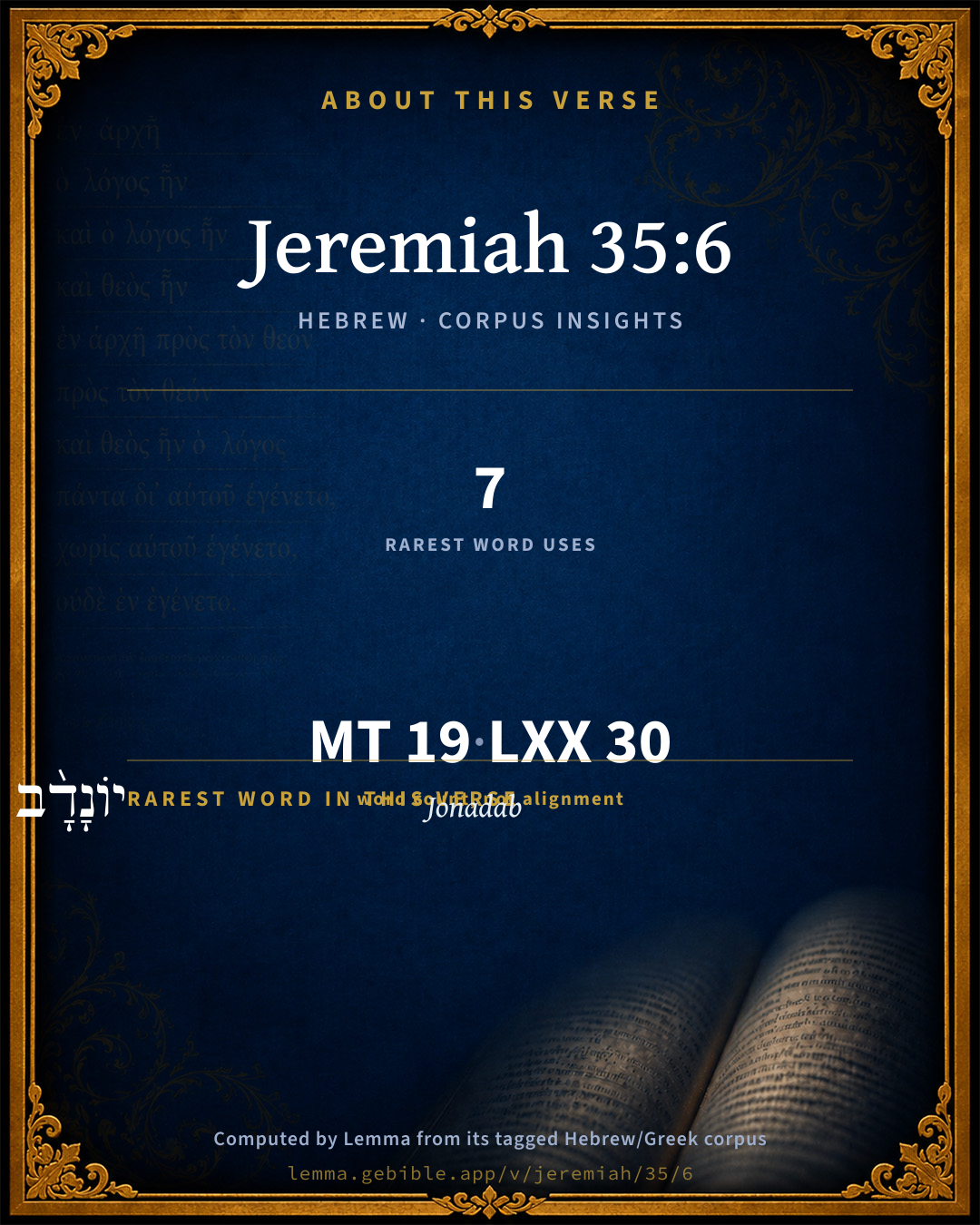
The rarest word here is יוֹנָדָ֨ב Jonadab H3122 — appearing just 7 times in the whole Hebrew Bible.

Shared distinctive vocabulary

יוֹנָדָ֨ב Jonadab H3122 occurs in 6 verses of the Hebrew Bible. Also found in:

Grammatical profile

  • 5 verbs
  • 8 nouns
  • 1 pronoun
  • 2 prepositions
  • 1 conjunction
  • 2 particles

Verb forms

  • וַיֹּאמְר֖וּ Qal · Sequential Imperfect
  • נִשְׁתֶּה Qal · Imperfect
  • צִוָּ֤ה Piel · Perfect
  • לֵאמֹ֔ר Qal · Infinitive Construct
  • תִשְׁתּוּ Qal · Imperfect

Repetition

Words recur within this verse — often emphatic in Hebrew:

  • וַיֹּאמְר֖וּ to say H559 ×2
  • נִשְׁתֶּה to drink H8354 ×2
  • יָּ֑יִן wine H3196 ×2
  • בֶּן son H1121 ×2
  • לֹ֣א not H3808 ×2

Hebrew & Septuagint length

In the original languages it is 19 Hebrew tokens and 30 Greek tokens — but the two are counted differently (Hebrew bundles its prefixes and suffixes into one token; the Greek is in lemma form), so that isn’t a like-for-like length.

Cross-references

20

Topical passages linked to Jeremiah 35:6 in the Treasury of Scripture Knowledge — connected by theme and wording, ordered by reader-vote popularity; previews shown in the World English Bible.

  • 2 Kings 10:15 When he was departed there, he lighted on Jehonadab the son of Rechab coming to meet him; and he greeted him, and said to him, Is your heart right, as my heart is with your heart? Jehonadab answered, It is. If it be, give me your hand. He gave him his hand; and he took him up to him into the chariot.
  • 1 Chronicles 2:55 The families of scribes who lived at Jabez: the Tirathites, the Shimeathites, the Sucathites. These are the Kenites who came of Hammath, the father of the house of Rechab.
  • Luke 1:15 For he will be great in the sight of the Lord, and he will drink no wine nor strong drink. He will be filled with the Holy Spirit, even from his mother's womb.
  • Leviticus 10:9 "Drink no wine nor strong drink, you, nor your sons with you, when you go into the Tent of Meeting, that you don't die: it shall be a statute forever throughout your generations:
  • Judges 13:7 but he said to me, Behold, you shall conceive, and bear a son; and now drink no wine nor strong drink, and eat not any unclean thing; for the child shall be a Nazirite to God from the womb to the day of his death.
  • Judges 13:14 She may not eat of anything that comes of the vine, neither let her drink wine or strong drink, nor eat any unclean thing; all that I commanded her let her observe.
  • Genesis 25:27 The boys grew. Esau was a skillful hunter, a man of the field. Jacob was a quiet man, living in tents.
  • Genesis 36:7 For their substance was too great for them to dwell together, and the land of their travels couldn't bear them because of their cattle.
  • Exodus 20:12 "Honor your father and your mother, that your days may be long in the land which Yahweh your God gives you.
  • Leviticus 23:42–43 You shall dwell in booths seven days. All who are native-born in Israel shall dwell in booths,
  • Numbers 6:2–5 "Speak to the children of Israel, and tell them: When either man or woman shall make a special vow, the vow of a Nazirite, to separate himself to Yahweh,
  • 2 Kings 10:23 Jehu went, and Jehonadab the son of Rechab, into the house of Baal; and he said to the worshippers of Baal, Search, and look that there be here with you none of the servants of Yahweh, but the worshippers of Baal only.
  • 1 Chronicles 16:19 When you were but a few men in number, Yes, very few, and foreigners in it;
  • Nehemiah 8:14–16 They found written in the law, how that Yahweh had commanded by Moses, that the children of Israel should dwell in booths in the feast of the seventh month;
  • Psalms 105:12 When they were but a few men in number, Yes, very few, and foreigners in it.
  • Jeremiah 35:10 but we have lived in tents, and have obeyed, and done according to all that Jonadab our father commanded us.
  • 1 Corinthians 7:26–31 I think that it is good therefore, because of the distress that is on us, that it is good for a man to be as he is.
  • Ephesians 6:2–3 "Honor your father and mother," which is the first commandment with a promise:
  • 1 Peter 2:11 Beloved, I beg you as foreigners and pilgrims, to abstain from fleshly lusts, which war against the soul;
  • Hebrews 11:9–13 By faith, he lived as an alien in the land of promise, as in a land not his own, dwelling in tents, with Isaac and Jacob, the heirs with him of the same promise.

Cross-references courtesy of OpenBible.info (CC BY 4.0).

Hebrew and Greek witnesses Masoretic Hebrew ↔ Greek Septuagint

The same verse in the two great witnesses to the Old Testament, shown verse-for-verse.

These are two independent witnesses, not word-aligned to each other, and the Septuagint is shown in lemma (dictionary) form.

Hebrew Jeremiah 35:6 Masoretic · Westminster Leningrad Codex

וַיֹּאמְר֖וּ לֹ֣א נִשְׁתֶּה יָּ֑יִן כִּי֩ יוֹנָדָ֨ב בֶּן רֵכָ֜ב אָבִ֗ינוּ צִוָּ֤ה עָלֵ֨ינוּ֙ לֵאמֹ֔ר לֹ֧א תִשְׁתּוּ יַ֛יִן אַתֶּ֥ם וּבְנֵיכֶ֖ם עַד עוֹלָֽם

But they said, We will drink no wine; for Jonadab the son of Rechab, our father, commanded us, saying, You shall drink no wine, neither you, nor your sons, forever:

World English Bible · Public Domain

Greek LXX Structure differs

In the Septuagint, Jeremiah is about an eighth shorter than the Hebrew and arranges its material differently — the Oracles Against the Nations (Hebrew chapters 46–51) appear in the middle of the Greek book, after 25:13. Because the chapter and verse boundaries do not line up, a verse-for-verse comparison with the Hebrew is not shown.

A verse-for-verse comparison isn’t shown here because the chapters and verses don’t line up. Switch to the LXX edition with the MT / LXX toggle above to read the Greek directly.

Hebrew: Westminster Leningrad Codex (CC BY 4.0). Greek: Septuagint (public domain); English from a public-domain English Septuagint. How the Septuagint differs from the Hebrew →

Targum (Aramaic paraphrase)

1

The Targum is the ancient Jewish Aramaic paraphrase of the Hebrew Scriptures — an interpretive translation, not the Hebrew text itself. Onkelos (literal) and Pseudo-Jonathan (expansive) render the Torah, and Jonathan the Prophets. Coverage is partial: where no permissively-licensed English translation exists for a verse, only the Aramaic is shown. This is verse-level text, not a word-by-word alignment to the Hebrew.

  1. Targum Jonathan Prophets (Joshua–Malachi)
    וַאֲמָרוּ לָא נִשְׁתֵּי חַמְרָא אֲרֵי יוֹנָדָב בַּר רֵכָב אֲבוּנָא פַּקֵיד עֲלָנָא לְמֵימָר לָא תִשְׁתּוּן חַמְרָא אַתּוּן וּבְנֵיכוֹן עַד עָלְמָא:

    (no public-domain English translation for this verse)

    Targum Jonathan — Aramaic: “Mikraot Gedolot” (public domain). English: “Sefaria Community Translation” (CC0 1.0 (public-domain dedication)); “London "Chaldee Paraphrase," 1871” (public domain). Text via Sefaria.

Commentary

Notes on Jeremiah 35:6 from classic Christian and Jewish commentators (each source and its license shown beneath its notes). The classic Christian expositions comment on the surrounding passage and are grouped to its opening verse, so a note may address several verses; the Jewish commentaries on the Tanakh (Rashi and others) are per-verse, so they appear only where the commentator wrote on this verse.

Lemma curates 59 commentaries, every one of them public domain or Creative Commons licensed, each selected and text-cleaned for this edition rather than reprinted as found. About our sources →

Trapp's Complete Commentary

John Trapp

Jer 35:6 But they said, We will drink no wine: for Jonadab the son of Rechab our father commanded us, saying, Ye shall drink no wine, [neither ye], nor your sons for ever:

Ver. 6. We will not drink wine.] This they were resolved on, not because they were persuaded, as Mohammed’s followers are, that in every grape there dwelt a devil, but because Jonadab, the son of Rechab, their progenitor, {2Ki 10:15} had two or three hundred years before charged them to forbear; not thereby to establish any new arbitrary service, or any rule of greater perfection of life {a} (as the Papists misallege it in favour of monkery and other will worships and superstitious observances), but only as a civil ordinance about things external, the foundation whereof is laid in the Word, which commandeth modesty, humility, sobriety, heavenly mindedness, &c.

{a} Haec leges vitae potius eram honestatis quam salutis animae.

John Trapp, A Commentary or Exposition upon All the Books of the Old and New Testament (1647–1656) — public domain. Text from a community e-Sword module.

Tyndale Open Study Notes

Tyndale Open Resources

35:6-10 Jehonadab had bound his descendants to a nomadic lifestyle free of the trappings of sedentary life, and the Recabites had been obedient.

Tyndale Open Study Notes — © Tyndale Open Resources, licensed CC BY-SA 4.0. Text via the HelloAO Bible API.

Geneva Bible (1599)

Geneva Bible translators

Teaching them hereby to flee all occasion of intemperancy, ambition and avarice, and that they might know that they were strangers in the earth, and be ready to depart at all occasions.

Whom Jehu the King of Israel favored for his zeal, 2 Kings 10:15.

Geneva Bible (1599) marginal notes — public domain. Text via Bolls.life.

Jamieson, Fausset & Brown

Robert Jamieson, A. R. Fausset & David Brown

Jonadab . . . our father--that is, forefather and director, three hundred years before (Kg2 10:15). They were called Rechabites, not Jonadabites, having received their name from Rechab the father, previously to their adopting the injunctions of Jonadab his son. This case affords no justification for slavish deference to the religious opinions of the Christian fathers: for Jonadab's injunction only affected matters of the present life; moreover, it was not binding on their consciences, for they deemed it not unlawful to go to Jerusalem in the invasion (Jer 35:11). What is praised here is not the father's injunction, but the obedience of the sons [CALVIN].

Jamieson, Fausset & Brown — Commentary Critical and Explanatory on the Whole Bible (1871) — public domain (CC PDM 1.0). Text via the HelloAO Bible API.

Adam Clarke's Commentary

Verse 6. We will drink no wine] The reason is given above. Their whole religious and political institution consisted in obedience to three simple precepts, each of which has an appropriate spiritual meaning: -

1. Ye shall drink no wine] Ye shall preserve your bodies in temperance, shall use nothing that would deprive you of the exercise of your sober reason at any time; lest in such a time ye should do what might be prejudicial to yourselves, injurious to your neighbour, or dishonourable to your God.

2. Neither shall ye build house] Ye shall not become residents in any place; ye shall not court earthly possessions; ye shall live free from ambition and from envy, that ye may be free from contention and strife.

3. But-ye shall dwell in tents] Ye shall imitate your forefathers, Abraham, Isaac, and Jacob, and the rest of the patriarchs, who dwelt in tents, being strangers and pilgrims upon earth, looking for a heavenly country, and being determined to have nothing here that would indispose their minds towards that place of endless rest, or prevent them from passing through temporal things so as not to lose those that are eternal.

There must necessarily be more in these injunctions than meets the eye in the letter of this account.

Adam Clarke's Commentary on the Bible (1810–1826) — public domain. Text from a community e-Sword/MySword module.

Ellicott's Commentary for English Readers

(6-8) We will drink no wine . . .—We have here, as it were, the rule of the tribe or order which looked to Jonadab as its founder. Like Samson (Jdg_13:4-5), Samuel (inferentially from 1Sa_1:11; 1Sa_1:15), and the Baptist (Luk_1:15), they were life-long Nazarites (Num_6:1-6). Jonadab’s intention was obviously to keep them as a separate people, retaining their nomadic form of life, free from the contamination of cities, or the temptations of acquired property, or the risks of attack which such property brought with it. They are now invited, and it must have seemed to them a strange invitation to come from a prophet’s lips, to break that rule, and they answer almost in the tone of a calm but indignant protest. They have been faithful hitherto, and they will continue faithful still. In the words “that your days may be long in the land” we may, perhaps, trace an echo of the fifth commandment (Exo_20:12), viewed as extending to the relations which connect the members of an order with its head. The rule has descended to the followers of Islam, and the law of abstinence has been extended by Abdul-Wahab to tobacco. Diodoras Siculus (xix. 94) relates that the Nabathæans adopted the Rechabite rule in its completeness. Possibly they were Rechabites.

A Bible Commentary for English Readers, edited by Charles John Ellicott (1878–1897) — public domain. Text from a community e-Sword module.

John Gill's Exposition

But they said, we will drink no wine,.... Or "we do not drink wine" (e); we are not used to it; we never do drink any; it is not lawful for us to do it; nor will we, let who will solicit us:

for Jonadab the son of Rechab our father; not their immediate father, but their progenitor; perhaps the same Jonadab is meant who lived in the times of Jehu, and rode with him in his chariot; by which it appears he was a man of note and figure, and who lived near three hundred years before this time, Kg2 10:15; which is more likely than that he should be a descendant of his, and the proper father of the present Rechabites, which is the opinion of Scaliger (f):

commanded us, saying, ye shall drink no wine, neither ye, nor your sons, for ever; as long as any of them were in the world. What was the reason of this command, and of what follows, is not easy to say; whether it was to prevent quarrels and contentions, luxury and sensuality; or to inure them to hardships; or to put them in remembrance that they were but strangers in the land in which they lived; or to retain them in the original course of life their ancestors had lived in, feeding cattle; be it what it will, these his sons thought themselves under obligations to observe it; and perhaps finding, by experience, it was for their good so to do.

(e) "non hibimus vinum", Vatablus, Schmidt. (f) Elench. Trihaeres. Serrar. c. 24.

John Gill's Exposition of the Whole Bible (1746–1763) — public domain (CC PDM 1.0). Text via the HelloAO Bible API.

Albert Barnes' Notes on the Bible

Wine is the symbol of a settled life, because the vine requires time for its growth and care in its cultivation, while the preparation of the wine itself requires buildings, and it then has to be stored up before it is ready for use. The drink of nomads consists of the milk of their herds.

Jer 35:7

Strangers - Because not of Jewish blood, though wandering in their territory.

Albert Barnes' Notes on the Bible (1834–1885) — public domain. Text from a community e-Sword/MySword module.

Haydock's Catholic Bible Commentary

Jonadab. A man much esteemed by Jehu, 4 Kings x. 15. (Worthington)

George Leo Haydock (1774–1849), Haydock's Catholic Family Bible and Commentary, 1859 edition — public domain. Excludes Psalms (Douay-Rheims chapter numbering differs from Protestant) and Deuterocanonical books (Catholic canon only).

Matthew Poole's English Annotations

It is uncertain whether father here signifies their immediate parent, or (which is more probable) their progenitor; it is most likely it referreth to that Jonadab of whom we read 2Ki 10:15, who was the father (that is, the progenitor) of this family of the Rechabites, at three hundred years distance. The reason why he left his posterity this charge is uncertain, probably to warn them against the luxury which he saw began to abound in Israel, and being desirous that they should inure themselves to a more hard and laborious life; being originally Kenites, and used to husbandry, and keeping of sheep and other cattle, he desired they should live according to their quality.

Matthew Poole's English Annotations on the Holy Bible (1683–1685) — public domain. Text from a community e-Sword/MySword module.

Whedon's Commentary on the Bible

Daniel D. Whedon

6, 7. Drink no wine — It will here be noticed that wine is intimately associated with settled life as opposed to a nomadic one. It is the fruit of culture — agri-culture — while the drink of the nomad is milk. The object of this rule of life would seem to be twofold. 1. To preserve their individuality; and 2. To preserve their purity.

Daniel D. Whedon (gen. ed.), Commentary on the Old and New Testaments (1874–1909) — public domain. Text from a community e-Sword module.

The Pulpit Commentary

Jonadab the son of Rechab our father. Jonadab (the contemporary of King John) is here called the "father" of the Rechabites (comp. vers. 14, 16), in the same sense in which the disciples of the prophets are called the "sons of the prophets;" he was a teacher, if not (in some sense) a prophet. This illustrates the uncompromising zeal of Jonadab 2Ki_10:23; the religion of Baal was probably at the opposite pole in the matter of luxury to that of Jehovah as practised by Jonadab. Not for you the life Of sloth and ease within the city"s gates, Where idol feasts are held, and incense smokes To Baalim and Ashtaroth; where man Loses his manhood, and the scoffers sit Perverting judgment, selfish, soft, impure. (Plumptre.)

Ye shall drink no wine, etc. The Rechabites were, in fact, typical Arabs. The Wahhabee movement, in our own century, may be taken as partly parallel, though, of course, a settled life is not one of the abominations of the neo-orthodox Islam. A still more complete parallel is given by Diodorus Siculus (19:94), who states it to be the law of the Nabataeans, "neither to sow corn, nor to plant any fruit-bearing herb, nor to drink wine, nor to prepare houses," and gives as the motive of this the preservation of their independence.

Vers. 6-10. The filial obedience of the Rechabites.

There is something very remarkable in this simple history. Originally aliens in race, (1Ch_2:55) they gained a place in the land of Israel. (Jud_1:16) Jonadab the son of Rechab, the ancestor of the race, was the true founder of the family. His character was so high that Jehu affected his company in order to gain esteem from the people. (2Ki_10:15, 2Ki_10:16) From him their ascetic rule of life was received, and they had continued to observe it with unswerving strictness. We have here an illustration of

I AN EXAGGERATED VIRTUE.

1. Their asceticism was a real virtue. In its various elements of temperance, simplicity, and hardihood, it presents a most exemplary and attractive aspect. It must have tended to holiness and happiness. It would be well for the men of our own day were they to imitate this race in these respects. Most of our social evils are easily traceable to the influence of intemperance, luxury, etc. It was a noble ideal nobly realized; yet:

2. It was exaggerated beyond natural limits. This is the penalty of those who rigidly observe one mode of life. Excellent as that may be at the first, and, as a whole, may still continue to be, it gets out of joint with the advancing customs of the age, isolates its votaries from the general current of the national life, and stereotypes the degree of civilization or barbarism which gave it birth. In its rigid observance it leads to anachronisms, inconveniences, etc. Its accidental features become more noticeable than its essential ones. Unless grounded on sufficient reasons and continually referred to these, unless adapted in its accidental features to the changing circumstances of the world, it tends to become unreal, and to produce unreal moral distinctions. There is something of weakness to be detected in the explanation of their presence in Jerusalem (ver. 11). They were out of place.

3. The secret of this was float it was founded upon an exaggerated sentiment. Asceticism is in itself neither good nor bad. It receives its real moral importance from the motives and aims that underlie it. In this instance the motive was excellent so far as it was legitimate, but it was clothed with a factitious sacredness and obligation. Consistently carried out, such a principle would stay all progress and sanction the most horrible crimes. That their ancestor had enjoined their mode of life was hardly a sufficient reason for it, and the motive of policy with which he had commanded it was not an exalted one. The true justification for a peculiar mode of life, especially when of this trying description, must be found in the great human and spiritual aims which religion especially in its later evangelical phase presents for our achievement. To guard the weakness of a brother, to further the moral and religious welfare of men, and to glorify God by holiness and unselfishness of conduct, are aims that may be ours if we will

II A MAGNIFIED PERSONAL INFLUENCE. The hold this man obtained over the conduct of his descendants through so many generations was most remarkable. A man or marked character, great reputation for sanctity, wisdom, and power of impressing others with his peculiar views, forms a conception of what life ought to be, especially for those who, like his own family, are strangers living on sufferance in the midst of another people. The Eastern feeling of respect for parents and reverence for ancestors and of the sacredness of tradition and custom associates itself with his teaching and example, and soon his rule of life becomes a fixed, ineradicable principle amongst his descendants far more potent than any law of the statute-book. This shows:

1. The power of personal influence. "Influence is the best kind of power." It belongs more or less to all of us; and we shall be held responsible for its legitimate increase and direction. The influence of any one of us is probably both greater and less than he suspects. It is a natural and proper instinct for man to seek this moral power, and the relations of life afford many opportunities for acquiring and exercising it. Parents.

2. The importance of securing that our influence shall be of the right kind. Ultimate results and effects must be left to God; but we have to do with our own character and aims, and with the known tendency of the means at our disposal. We should seek that our influence should be of the very highest kind. It is better to discover moral principles and" communicate spiritual inspirations than merely to initiate a custom. Jonadab"s influence was on the whole very salutary, but it was not of the highest kind, because he did not famish his imitators with a morally sufficient motive. So fixed and mechanical, indeed, had their obedience become that they appeared to have more regard to his precept than for the direct command of God (ver. 5). In this respect Jesus Christ is immeasurably his superior. His precepts are self-evident, and commended by his own personal example. He did not appeal to mere self-preservation, but to the noblest moral instincts and principles of our nature. We are not coerced by the personality of Jesus, but persuaded by the sweet reasonableness of his doctrine and Spirit. Influence like this may be slower in making its way, but in the end it is sure to be more lasting and universal. M.

The Pulpit Commentary (1880–1919), ed. H.D.M. Spence-Jones & Joseph S. Exell — public domain. Text from a community e-Sword module.

John Wesley's Explanatory Notes

Jonadab - Jonadab of whom we read, 2 Kings x, 15, was the father, that is the progenitor of the Rechabites, at three hundred years distance.

John Wesley, Explanatory Notes Upon the Whole Bible (1754–1765) — public domain. Text via the GEBible commentary corpus.

Lesson kit

Teaching starters — assembled from the data on this page, not authored interpretation. Every prompt links to the verse data it draws on. Edit before teaching.

Jeremiah, in the Prophets, opens this verse with 19 words (14 distinct Hebrew lemmas). Its most distinctive word is Yôwnâdâb (“Jonadab”). A historical commentator’s framing appears above. Read the whole chapter for the surrounding context.

Discussion questions

  1. How does “Jonadab” (Yôwnâdâb) shape what this verse is saying?
  2. How does 2 Samuel 13:3, which shares the word «Jonadab», read alongside this verse?
  3. What does the repetition of “to say” (2× in this one verse) do in this verse?
  4. The translations on this page render this verse differently — a whole-verse word diff, not a word-by-word alignment. What might account for the different wordings?
  5. «וַיֹּאמְר֖וּ» is a Qal Sequential Imperfect verb. How does that grammatical form shape the action described?
  6. Compare how Trapp's Complete Commentary and Tyndale Open Study Notes read this verse. Where do they agree or differ?

Things to notice

Reading settings

Reading text

Shown beneath each verse's original-language words.

Old Testament
Old Testament edition

Read the OT as the Masoretic Hebrew (MT) or the Greek Septuagint (LXX).

English shown for the Greek Septuagint (in the Hebrew ↔ Greek comparison).

Comparing translations? Open the Compare panel on any verse page to stack up to four side by side.