1 Kings 19:6

Hebrew (Westminster Leningrad Codex) 1 Kings 19:6 appears in the Hebrew Old Testament. The text above is from the Westminster Leningrad Codex. Each word links to its Strong’s number, a concise gloss, and parsing drawn from the Open Scriptures Hebrew Bible morphology. Click any word for its full Brown-Driver-Briggs (BDB) entry.
Download image
Cite this verse

1 Kings 19:6 (World English Bible). Public Domain. Lemma interlinear Bible study tool, https://lemma.gebible.app/v/1-kings/19/6.

Show BibTeX & RIS
BibTeX
RIS
English Translation
He looked, and, behold, there was at his head a cake baked on the coals, and a jar of water. He ate and drink, and laid him down again.
World English Bible · Public Domain
Highlights
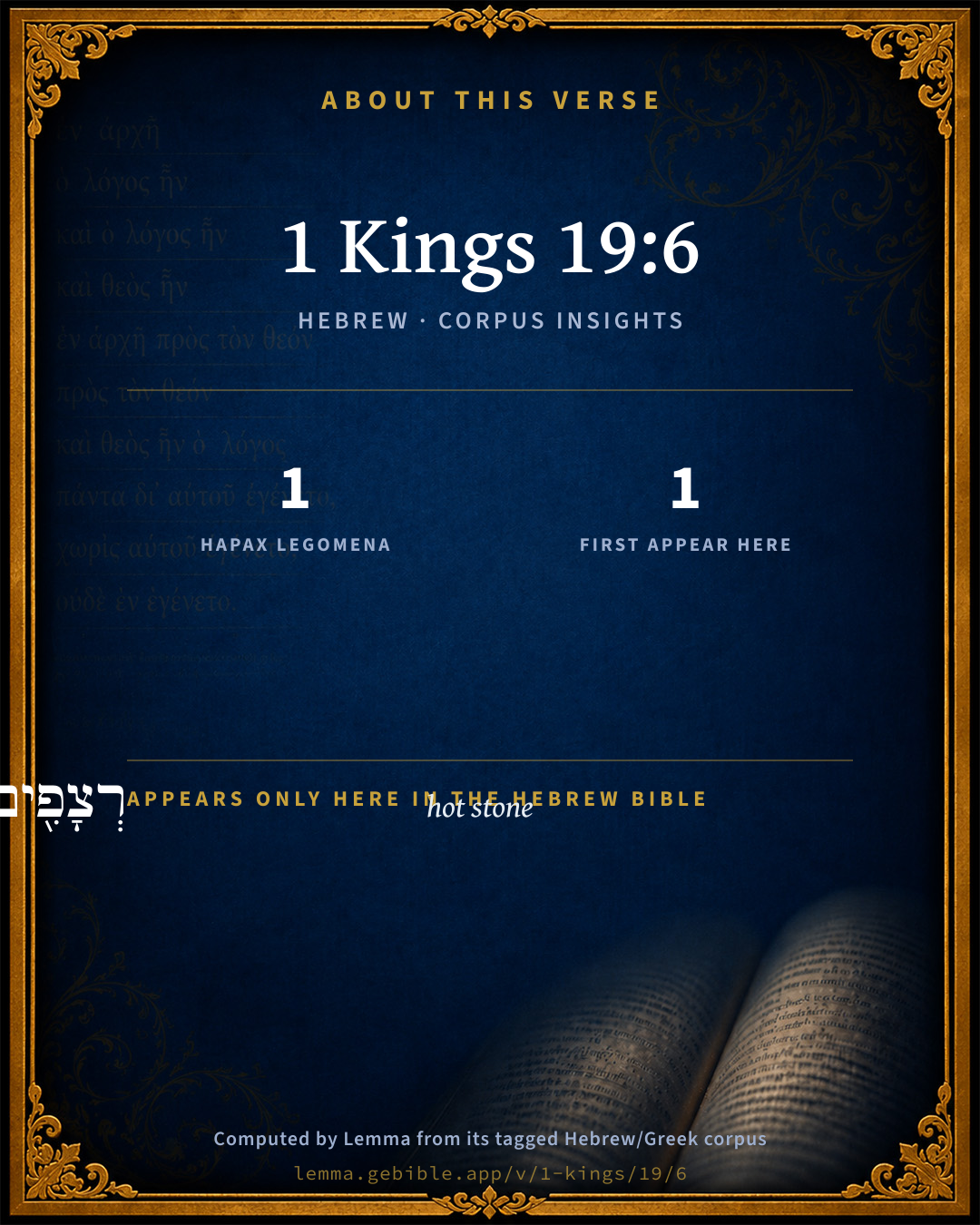
  • 1 hapax legomenon — only here in the Hebrew Bible
  • 1 first appearance in the Hebrew Bible
Full analysis ↓
Download a study sheet

One document with this verse’s original text, its word-by-word gloss line, the meaning frame, cross-references with their text, attributed commentary, and full source and license credits — printable, and it pastes into notes with its structure intact.

This verse Autodidact and up

Study sheet (.html) Plain text (.txt)

A passage Seminary Student

Up to 50 verses in one chapter. A passage sheet keeps up to 6 commentary sources and 12 cross-references per verse, in the order this page ranks them, and says so on the sheet whenever that leaves anything out. Ask for a single verse and you get the Autodidact verse sheet above.

Everything on this page stays free to read, with no account — the sheet is a download of what is already on screen, not access to it.

Want to remove ads? Support Godless Engineer
Compare translations 3

The same verse in 3 English versions, stacked beneath the original-language interlinear above. Click any original word for its lexicon entry.

Each is an independent rendering of the whole verse — the interlinear is not word-aligned to these translations.

Highlighted words mark where these versions differ — a whole-verse word diff, not a word-by-word alignment.

  • World English Bible Public Domain
    He looked, and, behold, there was at his head a cake baked on the coals, and a jar of water. He ate and drink, and laid him down again.
  • King James Version Public Domain
    And he looked, and, behold, there was a cake baken on the coals, and a cruse of water at his head. And he did eat and drink, and laid him down again.
  • unfoldingWord Literal Text CC BY-SA 4.0
    And he looked, and behold, by his head a bread-cake of hot stones and a jug of water. And he ate and drank, and he returned and lay down.

unfoldingWord Literal Text — © unfoldingWord, licensed CC BY-SA 4.0. Word-aligned USFM3 via Door43 (git.door43.org/unfoldingWord/en_ult).

Versions to compare (up to 4)

3 of 4 selected

Show all 18 translations

Every available English version of this verse, each an independent rendering of the whole verse.

  • World English Bible Public Domain
    He looked, and, behold, there was at his head a cake baked on the coals, and a jar of water. He ate and drink, and laid him down again.
  • Berean Standard Bible Public Domain
    And he looked around, and there by his head was a cake of bread baked over hot coals, and a jar of water. So he ate and drank and lay down again.
  • Majority Standard Bible Public Domain
    And he looked around, and there by his head was a cake of bread baked over hot coals, and a jar of water. So he ate and drank and lay down again.
  • King James Version Public Domain
    And he looked, and, behold, there was a cake baken on the coals, and a cruse of water at his head. And he did eat and drink, and laid him down again.
  • American Standard Version (1901) Public Domain
    And he looked, and, behold, there was at his head a cake baken on the coals, and a cruse of water. And he did eat and drink, and laid him down again.
  • Revised Version (1885) Public Domain
    And he looked, and, behold, there was at his head a cake baken on the coals, and a cruse of water. And he did eat and drink, and laid him down again.
  • Geneva Bible (1599) Public Domain
    And when he looked about, behold, there was a cake baken on the coles, and a pot of water at his head: so he did eate and drinke, and returned and slept.
  • Douay-Rheims (1899) Public Domain
    He looked, and behold there was at his head a hearth cake, and a vessel of water: and he ate and drank, and he fell asleep again.
  • Young's Literal Translation Public Domain
    and he looketh attentively, and lo, at his bolster a cake `baken on' burning stones, and a dish of water, and he eateth, and drinketh, and turneth, and lieth down.
  • Literal Standard Version CC BY-SA 4.0
    and he looks attentively, and behold, at his bolster [is] a cake [on] burning stones, and a dish of water, and he eats, and drinks, and turns, and lies down.
  • Unlocked Literal Bible CC BY-SA 4.0
    Elijah looked, and near his head was bread that had been baked on coals and a jug of water. So he ate and drank and then lay down again.
  • unfoldingWord Literal Text CC BY-SA 4.0
    And he looked, and behold, by his head a bread-cake of hot stones and a jug of water. And he ate and drank, and he returned and lay down.
  • Darby Bible Public Domain
    And he looked, and behold, at his head was a cake, baked on hot stones, and a cruse of water. And he ate and drank, and lay down again.
  • World Messianic Bible Public Domain
    He looked, and behold, there was at his head a cake baked on the coals, and a jar of water. He ate and drank, and lay down again.
  • Webster's Bible Public Domain
    And he looked, and behold, there was a cake baked on the coals, and a cruse of water at his head. And he ate and drank, and laid himself down again.
  • Free Bible Version CC BY-SA 4.0
    He looked around, and there beside his head was some bread baking over hot coals, and a jar of water. He ate and drank and lay down again.
  • Bible in Basic English Public Domain
    And looking up, he saw by his head a cake cooked on the stones and a bottle of water. So he took food and drink and went to sleep again.
  • JPS Tanakh (1917) Public Domain
    And he looked, and, behold, there was at his head a cake baked on the hot stones, and a cruse of water. And he did eat and drink, and laid him down again.

Literal Standard Version (2020), Covenant Press — licensed CC BY-SA 4.0. Text via the HelloAO Bible API (eBible.org). Unlocked Literal Bible (unfoldingWord) — licensed CC BY-SA 4.0. Text via the HelloAO Bible API (eBible.org). unfoldingWord Literal Text — © unfoldingWord, licensed CC BY-SA 4.0. Word-aligned USFM3 via Door43 (git.door43.org/unfoldingWord/en_ult). Free Bible Version, Dr. Jonathan Gallagher — licensed CC BY-SA 4.0. Text via the HelloAO Bible API (eBible.org).

Word by word

More ways to search: Search by grammar → Find every occurrence → Compare this word →

Practice this passage: Drill this verse → Learn its vocabulary →

רְצָפִ֖ים
retseph
H7529
“hot stones”
Noun, Common, Feminine, Plural, Absolute
Part of Speech
Noun
Type
Common
Gender
Feminine
Number
Plural
State
Absolute
Full BDB Definition

Origin: for H7565

TWOT: 2223a

hot stone, glowing stone or coal, flame, firebolt, spark
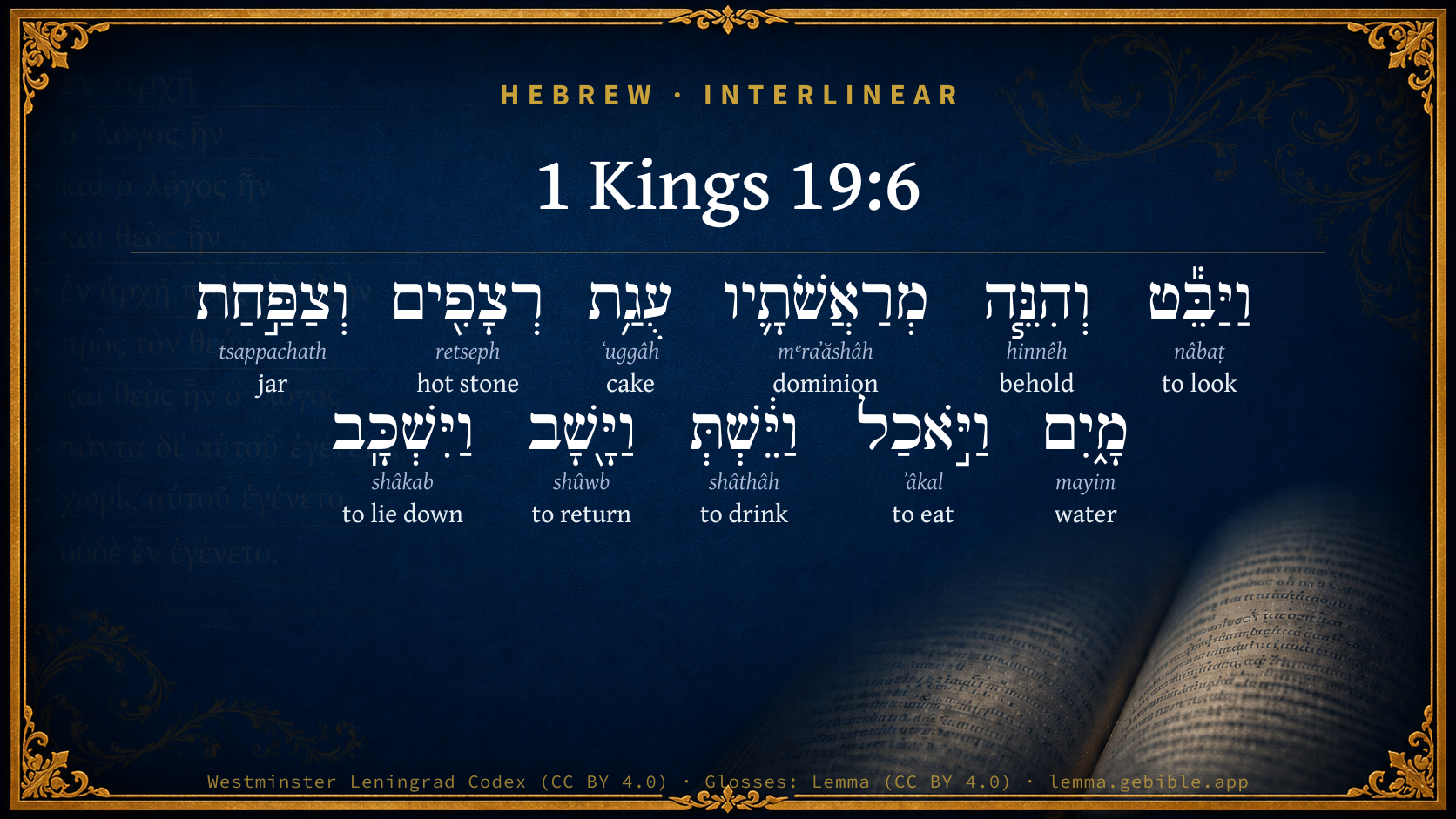
  1. וַיַּבֵּ֕ט nâbaṭ H5027 “and · to look” Conjunction + Verb, Hiphil, Sequential Imperfect, 3rd Person, Masculine, Singular
  2. וְהִנֵּ֧ה hinnêh H2009 “and · behold” Conjunction + Particle, Demonstrative
  3. מְרַאֲשֹׁתָ֛יו mᵉraʼăshâh H4763 “head place · his” Noun, Common, Feminine, Plural, Construct + Suffix, Personal, 3rd Person, Masculine, Singular
  4. עֻגַ֥ת ʻuggâh H5692 “cake of” Noun, Common, Feminine, Singular, Construct
  5. וְצַפַּ֣חַת tsappachath H6835 “and · jar of” Conjunction + Noun, Common, Feminine, Singular, Construct
  6. מָ֑יִם mayim H4325 “water(s)” Noun, Common, Masculine, Plural, Absolute
  7. וַיֹּ֣אכַל ʼâkal H398 “and · to eat” Conjunction + Verb, Qal, Sequential Imperfect, 3rd Person, Masculine, Singular
  8. וַיֵּ֔שְׁתְּ shâthâh H8354 “and · to drink” Conjunction + Verb, Qal, Sequential Imperfect, 3rd Person, Masculine, Singular
  9. וַיָּ֖שָׁב shûwb H7725 “and · to return” Conjunction + Verb, Qal, Sequential Imperfect, 3rd Person, Masculine, Singular
  10. וַיִּשְׁכָּֽב shâkab H7901 “and · to lie down” Conjunction + Verb, Qal, Sequential Imperfect, 3rd Person, Masculine, Singular

About this verse

These counts appear in no published source. They are computed here, from the morphology-tagged text and Lemma’s own curated glosses. What Lemma adds →

11
words
11
distinct lemmas
Historical
section

Notable vocabulary

1 hapax legomenon — a word that appears only here in the entire Hebrew Bible:

  • רְצָפִ֖ים hot stone H7529

First appearance in Scripture

This word makes its first canonical appearance in the Hebrew Bible here:

  • רְצָפִ֖ים hot stone H7529

Shared distinctive vocabulary

עֻגַ֥ת cake H5692 occurs in 7 verses of the Hebrew Bible. Also found in:

Grammatical profile

  • 5 verbs
  • 5 nouns
  • 1 particle

Verb forms

  • וַיַּבֵּ֕ט Hiphil · Sequential Imperfect
  • וַיֹּ֣אכַל Qal · Sequential Imperfect
  • וַיֵּ֔שְׁתְּ Qal · Sequential Imperfect
  • וַיָּ֖שָׁב Qal · Sequential Imperfect
  • וַיִּשְׁכָּֽב Qal · Sequential Imperfect

Hebrew & Septuagint length

In English translation the verse runs 29 words from the Hebrew and 31 from the Septuagint (LXX English) — closely comparable.

A rough comparison of the two English renderings, which tokenize alike — not a word-level alignment.

Word counts can differ between the Hebrew and the Greek without any difference in meaning — e.g. the Hebrew direct-object marker אֵת has no separate Greek word, and Greek often adds the article ὁ.

Cross-references

9

Topical passages linked to 1 Kings 19:6 in the Treasury of Scripture Knowledge — connected by theme and wording, ordered by reader-vote popularity; previews shown in the World English Bible.

  • 1 Kings 17:6 The ravens brought him bread and flesh in the morning, and bread and flesh in the evening; and he drank of the brook.
  • Matthew 4:11 Then the devil left him, and behold, angels came and ministered to him.
  • 1 Kings 17:9–15 Arise, get you to Zarephath, which belongs to Sidon, and dwell there: behold, I have commanded a widow there to sustain you.
  • Psalms 37:3 Trust in Yahweh, and do good. Dwell in the land, and enjoy safe pasture.
  • Isaiah 33:16 He shall dwell on high; his place of defense shall be the munitions of rocks; his bread shall be given [him]; his waters shall be sure.
  • Matthew 6:32 For the Gentiles seek after all these things, for your heavenly Father knows that you need all these things.
  • Mark 8:2–3 "I have compassion on the multitude, because they have stayed with me now three days, and have nothing to eat.
  • John 21:5 Jesus therefore said to them, "Children, have you anything to eat?" They answered him, "No."
  • John 21:9 So when they got out on the land, they saw a fire of coals there, and fish laid on it, and bread.

Cross-references courtesy of OpenBible.info (CC BY 4.0).

Hebrew and Greek witnesses Masoretic Hebrew ↔ Greek Septuagint

The same verse in the two great witnesses to the Old Testament, shown verse-for-verse.

These are two independent witnesses, not word-aligned to each other, and the Septuagint is shown in lemma (dictionary) form.

Hebrew 1 Kings 19:6 Masoretic · Westminster Leningrad Codex

וַיַּבֵּ֕ט וְהִנֵּ֧ה מְרַאֲשֹׁתָ֛יו עֻגַ֥ת רְצָפִ֖ים וְצַפַּ֣חַת מָ֑יִם וַיֹּ֣אכַל וַיֵּ֔שְׁתְּ וַיָּ֖שָׁב וַיִּשְׁכָּֽב

He looked, and, behold, there was at his head a cake baked on the coals, and a jar of water. He ate and drink, and laid him down again.

World English Bible · Public Domain

Greek LXX 1 Kings 19:6 Septuagint · lemma form

καί ἐπιβλέπω ηλιου καί ἰδού πρός κεφαλή αὐτός ἐγκρυφίας ὀλυρίτης καί καψάκης ὕδωρ καί ἀναἵστημι καί ἐσθίω καί πίνω καί ἐπιστρέφω κοιμάω

And Eliu looked, and, behold, at his head there was a cake of meal and a cruse of water; and he arose, and ate and drank, and returned and lay down.

LXX2012 (modern English Septuagint) · Public Domain

On this verse, The Pulpit Commentary discusses the Septuagint’s reading. Read the note in Commentary ↓

Hebrew: Westminster Leningrad Codex (CC BY 4.0). Greek: Septuagint (public domain); English from LXX2012 (modern English Septuagint) (Public Domain). How the Septuagint differs from the Hebrew →

Targum (Aramaic paraphrase)

1

The Targum is the ancient Jewish Aramaic paraphrase of the Hebrew Scriptures — an interpretive translation, not the Hebrew text itself. Onkelos (literal) and Pseudo-Jonathan (expansive) render the Torah, and Jonathan the Prophets. Coverage is partial: where no permissively-licensed English translation exists for a verse, only the Aramaic is shown. This is verse-level text, not a word-by-word alignment to the Hebrew.

  1. Targum Jonathan Prophets (Joshua–Malachi)
    וְאִסְתְּכֵי וְהָא אִסָדוֹהִי חֲרָרָא מְעַפְפָא וּצְלוּחִיתָא דְמַיָא וַאֲכַל וּשְׁתֵי וְתַב וּשְׁכִיב:

    (no public-domain English translation for this verse)

    Targum Jonathan — Aramaic: “Mikraot Gedolot” (public domain). English: “Sefaria Community Translation” (CC0 1.0 (public-domain dedication)); “London "Chaldee Paraphrase," 1871” (public domain). Text via Sefaria.

Commentary

Notes on 1 Kings 19:6 from classic Christian and Jewish commentators (each source and its license shown beneath its notes). The classic Christian expositions comment on the surrounding passage and are grouped to its opening verse, so a note may address several verses; the Jewish commentaries on the Tanakh (Rashi and others) are per-verse, so they appear only where the commentator wrote on this verse.

Lemma curates 59 commentaries, every one of them public domain or Creative Commons licensed, each selected and text-cleaned for this edition rather than reprinted as found. About our sources →

Trapp's Complete Commentary

John Trapp

1Ki 19:6 And he looked, and, behold, [there was] a cake baken on the coals, and a cruse of water at his head. And he did eat and drink, and laid him down again.

Ver. 6. There was a cake baken on the coals.] Heb., A cake of coals; that is, hot out of the oven. The angel was not long in bringing of it.

John Trapp, A Commentary or Exposition upon All the Books of the Old and New Testament (1647–1656) — public domain. Text from a community e-Sword module.

Adam Clarke's Commentary

Verse 6. A cake baken on the coals] All this seems to have been supernaturally provided.

Adam Clarke's Commentary on the Bible (1810–1826) — public domain. Text from a community e-Sword/MySword module.

Ellicott's Commentary for English Readers

(6) And laid him down.—There is a pathetic touch in the description of the prophet, wearied and disheartened, as caring not to eat sufficiently, and glad, after a morsel eaten, to forget himself again in sleep.

A Bible Commentary for English Readers, edited by Charles John Ellicott (1878–1897) — public domain. Text from a community e-Sword module.

The Cambridge Bible for Schools and Colleges

gen. ed. J. J. S. Perowne

6. and behold, there was] The R.V., following the Hebrew order, puts ‘at his head’ immediately after these words.

The Cambridge Bible for Schools and Colleges (gen. ed. J. J. S. Perowne; Cambridge University Press, 1878–1918) — public domain. Text from a community e-Sword module.

John Gill's Exposition

And he looked, and, behold, there was a cake baked on the coals,.... Just took off the coals, quite hot. Bochart (q) thinks it should be rendered, "baked on hot stones"; and such was the way of baking cakes in some of the eastern countries; see Gill on Gen 18:6, the stones hereabout might be heated by a supernatural power, and the cake baked on them by an angel; these sort of cakes are in Hebrew called "huggoth", as some pronounce the word, and are said to be now common in Bulgaria, where they are called "hugaces" (r):

and a cruse of water at his head; to drink of in eating the cake; which cruse or pot a learned man (s) thinks was Elijah's, not brought by the angel, only water put into it by him; see Sa1 26:11, and he did eat and drink; but not all that was set before him:

and laid him down again; to take some more sleep for his greater refreshment.

(q) Hierozoic. par. 1. l. 2. c. 33. col. 528. (r) Busbequius apud Calmet on the word "Bread". (s) Schacchi Elaeochrism. Myrothec. l. 1. c. 44. col. 224.

John Gill's Exposition of the Whole Bible (1746–1763) — public domain (CC PDM 1.0). Text via the HelloAO Bible API.

Albert Barnes' Notes on the Bible

A cake baken on the coals - It is not implied that Elijah found a fire lighted and the cake on it, but only that he found one of the usual baked cakes of the desert, which form the ordinary food of the Arab at the present day.

At his head - The Hebrew word means simply “the place on which the head lies;” hence, the marginal rendering, “bolster.”

Albert Barnes' Notes on the Bible (1834–1885) — public domain. Text from a community e-Sword/MySword module.

Haydock's Catholic Bible Commentary

Cake, baked in a hollow stone, covered with fire. The Arabs call such cakes, Ridpha. An angel brought this nourishment. (Calmet)

George Leo Haydock (1774–1849), Haydock's Catholic Family Bible and Commentary, 1859 edition — public domain. Excludes Psalms (Douay-Rheims chapter numbering differs from Protestant) and Deuterocanonical books (Catholic canon only).

Whedon's Commentary on the Bible

Daniel D. Whedon

6. A cake baken on the coals — Baked after the manner still common in the East, on smooth stones heated by coals of fire. Whether these provisions were prepared immediately by the angel, or by some traveller whom God led that way, we need not discuss, for either was possible. He who commanded the ravens to feed this prophet at the brook Cherith, might easily have put it into the heart of some passing Arab to leave the cake and the cruse of water at his head as he slept under the rothem shrub.

Daniel D. Whedon (gen. ed.), Commentary on the Old and New Testaments (1874–1909) — public domain. Text from a community e-Sword module.

The Pulpit Commentary

And he looked, and, behold, there was a cake same word as 1Ki_17:13 baken on the coals Heb. a cake of stones, or coals. LXX. ejgkrufiav. The thin, flat bread of the East, especially among the nomadic desert tribes, is constantly baked in a rude oven, constructed in the sand or soft. A little hollow is made; sometimes it is lined with stones to retain the heat; fuel, often the root of the genista, is placed upon it and kindled, and when the sand or stones are sufficiently hot, the embers are raked to one side, and the dough is placed in the oven, where it is sometimes covered with the ashes. Hence the Vulgate calls it subcinericius panis, and a cruse of water at his head i.e. , the place of his head. Marg. bolster. The word is almost used as a preposition. (Cf. 1Sa_19:13 1Sa_26:7) And he did eat and drink, and laid him down again. Heb. returned and laid down.

A cake baken on the coals," etc. Not only was the prophet protected, he was provided for by the angel. What a commentary on that verse, "He giveth it to his beloved while they sleep". (Psa_127:2, Hebrews) And does not God give us all food in like manner? While the farmer sleeps, the seed springs and grows up, he knoweth not how. (Mar_4:27) Our Keeper neither slumbers nor sleeps. (Psa_121:4) Observe also how God prepares a table in the wilderness. It is not the first time He has given angels" food in the desert (Psa_78:25; Neh_9:21; Deu_8:16)

The Pulpit Commentary (1880–1919), ed. H.D.M. Spence-Jones & Joseph S. Exell — public domain. Text from a community e-Sword module.

Rashi

Rabbi Shlomo Yitzchaki (Rashi)

Hot coals. Hot coals, and similarly, “and in his hand was a hot coal [רצפה].”

Rashi on the Tanakh — English translations: “The Judaica Press complete Tanach with Rashi, translated by A. J. Rosenberg” (CC BY 4.0); “Pentateuch with Rashi's commentary by M. Rosenbaum and A.M. Silbermann, 1929-1934” (public domain); “The Metsudah Tanach series, Lakewood, N.J” (CC BY 4.0); and “The Book of Joshua, Metsudah Publications, 1997” (CC BY 4.0). Text via Sefaria.

Lesson kit

Teaching starters — assembled from the data on this page, not authored interpretation. Every prompt links to the verse data it draws on. Edit before teaching.

1 Kings, in the Historical, opens this verse with 11 words (11 distinct Hebrew lemmas). Its most distinctive word is retseph (“hot stone”). A historical commentator’s framing appears above. Read the whole chapter for the surrounding context.

Discussion questions

  1. The word retseph carries the sense “hot stone.” How does it shape the verse?
  2. 1 word here appears nowhere else in the Hebrew Bible. Why might the author reach for such rare wording?
  3. This is the first place “hot stone” appears in Scripture (first appears here). What does its debut here establish?
  4. How does Genesis 18:6, which shares the word «cake», read alongside this verse?
  5. The translations on this page render this verse differently — a whole-verse word diff, not a word-by-word alignment. What might account for the different wordings?
  6. «וַיַּבֵּ֕ט» is a Hiphil Sequential Imperfect verb. How does that grammatical form shape the action described?
  7. Compare how Trapp's Complete Commentary and Adam Clarke's Commentary read this verse. Where do they agree or differ?

Things to notice

  • 1 word in this verse appears nowhere else in the Hebrew Bible.
  • 1 word makes its first canonical appearance in Scripture here.
  • These translations choose different wording for 21 words in this verse.
  • 11 distinct Hebrew lemmas span 11 words in this verse.

Reading settings

Reading text

Shown beneath each verse's original-language words.

Old Testament
Old Testament edition

Read the OT as the Masoretic Hebrew (MT) or the Greek Septuagint (LXX).

English shown for the Greek Septuagint (in the Hebrew ↔ Greek comparison).

Comparing translations? Open the Compare panel on any verse page to stack up to four side by side.