
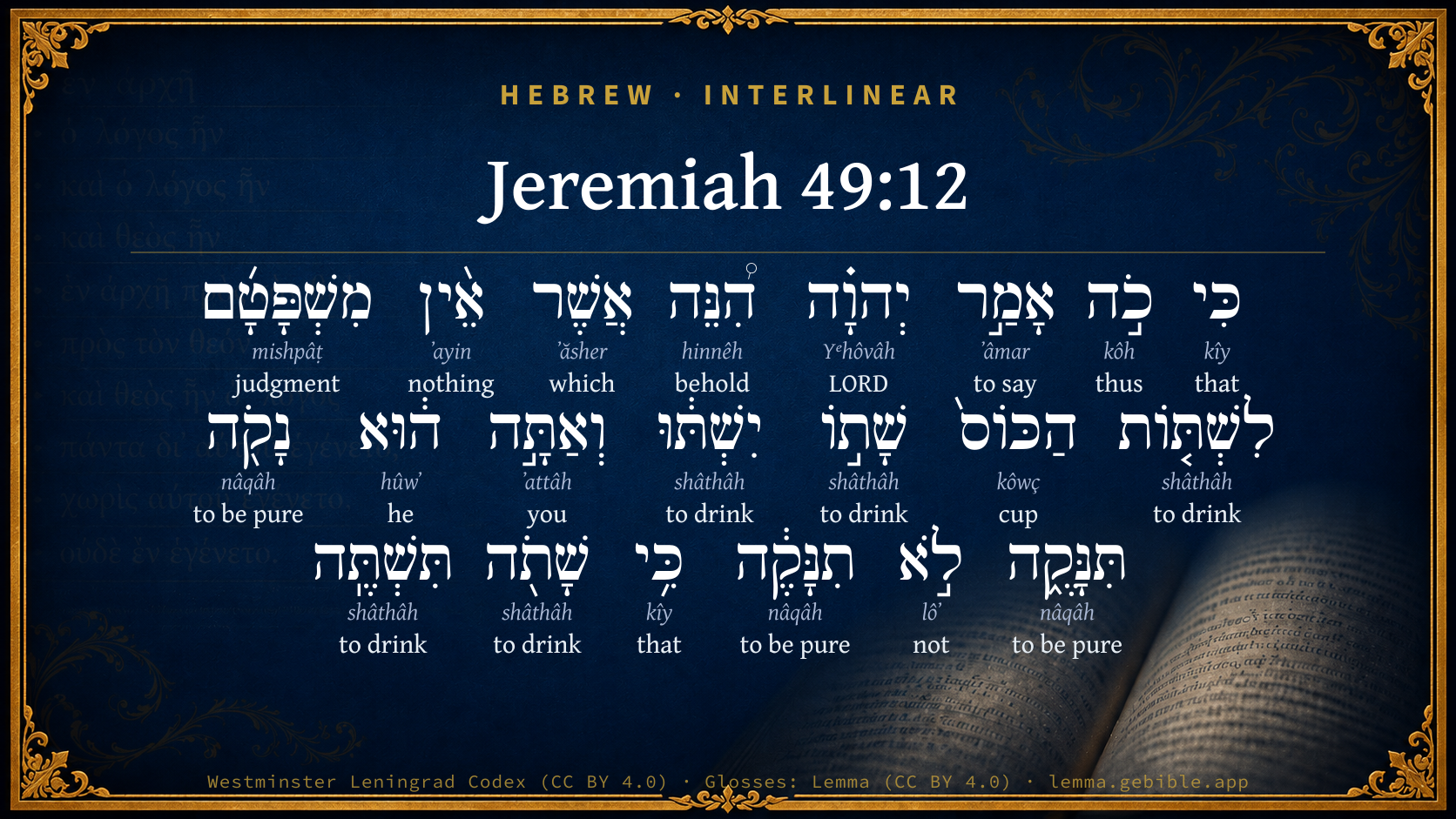
Jeremiah 49:12

Hebrew (Westminster Leningrad Codex) Jeremiah 49:12 appears in the Hebrew Old Testament. The text above is from the Westminster Leningrad Codex. Each word links to its Strong’s number, a concise gloss, and parsing drawn from the Open Scriptures Hebrew Bible morphology. Click any word for its full Brown-Driver-Briggs (BDB) entry.
Download image
Cite this verse

Jeremiah 49:12 (World English Bible). Public Domain. Lemma interlinear Bible study tool, https://lemma.gebible.app/v/jeremiah/49/12.

Show BibTeX & RIS
BibTeX
RIS
English Translation
For thus says Yahweh: Behold, they to whom it didn't pertain to drink of the cup shall assuredly drink; and are you he who shall altogether go unpunished? you shall not go unpunished, but you shall surely drink.
World English Bible · Public Domain
Download a study sheet

One document with this verse’s original text, its word-by-word gloss line, the meaning frame, cross-references with their text, attributed commentary, and full source and license credits — printable, and it pastes into notes with its structure intact.

This verse Autodidact and up

Study sheet (.html) Plain text (.txt)

A passage Seminary Student

Up to 50 verses in one chapter. A passage sheet keeps up to 6 commentary sources and 12 cross-references per verse, in the order this page ranks them, and says so on the sheet whenever that leaves anything out. Ask for a single verse and you get the Autodidact verse sheet above.

Everything on this page stays free to read, with no account — the sheet is a download of what is already on screen, not access to it.

Want to remove ads? Support Godless Engineer
Compare translations 3

The same verse in 3 English versions, stacked beneath the original-language interlinear above. Click any original word for its lexicon entry.

Each is an independent rendering of the whole verse — the interlinear is not word-aligned to these translations.

Highlighted words mark where these versions differ — a whole-verse word diff, not a word-by-word alignment.

  • World English Bible Public Domain
    For thus says Yahweh: Behold, they to whom it didn't pertain to drink of the cup shall assuredly drink; and are you he who shall altogether go unpunished? you shall not go unpunished, but you shall surely drink.
  • King James Version Public Domain
    For thus saith the LORD; Behold, they whose judgment was not to drink of the cup have assuredly drunken; and art thou he that shall altogether go unpunished? thou shalt not go unpunished, but thou shalt surely drink of it.
  • unfoldingWord Literal Text CC BY-SA 4.0
    For Yahweh says this, “See, those who did not deserve it must certainly drink some of the cup. Do you yourself think you will go without punishment? You will not, for you will certainly drink.

unfoldingWord Literal Text — © unfoldingWord, licensed CC BY-SA 4.0. Word-aligned USFM3 via Door43 (git.door43.org/unfoldingWord/en_ult).

Versions to compare (up to 4)

3 of 4 selected

Show all 18 translations

Every available English version of this verse, each an independent rendering of the whole verse.

  • World English Bible Public Domain
    For thus says Yahweh: Behold, they to whom it didn't pertain to drink of the cup shall assuredly drink; and are you he who shall altogether go unpunished? you shall not go unpunished, but you shall surely drink.
  • Berean Standard Bible Public Domain
    For this is what the LORD says: “If those who do not deserve to drink the cup must drink it, can you possibly remain unpunished? You will not go unpunished, for you must drink it too.
  • Majority Standard Bible Public Domain
    For this is what the LORD says: “If those who do not deserve to drink the cup must drink it, can you possibly remain unpunished? You will not go unpunished, for you must drink it too.
  • King James Version Public Domain
    For thus saith the LORD; Behold, they whose judgment was not to drink of the cup have assuredly drunken; and art thou he that shall altogether go unpunished? thou shalt not go unpunished, but thou shalt surely drink of it.
  • American Standard Version (1901) Public Domain
    For thus saith Jehovah: Behold, they to whom it pertained not to drink of the cup shall assuredly drink; and art thou he that shall altogether go unpunished? thou shalt not go unpunished, but thou shalt surely drink.
  • Revised Version (1885) Public Domain
    For thus saith the LORD: Behold, they to whom it pertained not to drink of the cup shall assuredly drink; and art thou he that shall altogether go unpunished? thou shalt not go unpunished, but thou shalt surely drink.
  • Geneva Bible (1599) Public Domain
    For thus sayth the Lord, Beholde, they whose iudgement was not to drinke of the cuppe, haue assuredly drunken, and art thou he that shall escape free? thou shalt not goe free, but thou shalt surely drinke of it.
  • Douay-Rheims (1899) Public Domain
    For thus saith the Lord: Behold they whose judgment was not to drink of the cup, shall certainly drink: and shalt thou come off as innocent? thou shalt not come off as innocent, but drinking thou shalt drink.
  • Young's Literal Translation Public Domain
    For thus said Jehovah: They whose judgment is not to drink of the cup, Do certainly drink, And thou `art' he that is entirely acquitted! Thou art not acquitted, for thou certainly drinkest.
  • Literal Standard Version CC BY-SA 4.0
    For thus said YHWH: They whose judgment is not to drink of the cup, || Do certainly drink, || And you [are] he that is entirely acquitted! You are not acquitted, for you certainly drink.
  • Unlocked Literal Bible CC BY-SA 4.0
    For Yahweh says this, “See, those who did not deserve it must certainly drink some of the cup. Do you yourself think you will go without punishment? You will not, for you will certainly drink.
  • unfoldingWord Literal Text CC BY-SA 4.0
    For Yahweh says this, “See, those who did not deserve it must certainly drink some of the cup. Do you yourself think you will go without punishment? You will not, for you will certainly drink.
  • Darby Bible Public Domain
    For thus saith Jehovah: Behold, they whose judgment was not to drink of the cup shall assuredly drink; and thou indeed, shouldest thou be altogether unpunished? Thou shalt not go unpunished, but thou shalt surely drink.
  • World Messianic Bible Public Domain
    For the LORD says: “Behold, they to whom it didn’t pertain to drink of the cup will certainly drink; and are you he who will altogether go unpunished? You won’t go unpunished, but you will surely drink.
  • Webster's Bible Public Domain
    For thus saith the LORD; Behold, they whose judgment was not to drink of the cup have assuredly drank; and art thou he that shall altogether go unpunished? thou shalt not go unpunished, but thou shalt surely drink of it.
  • Free Bible Version CC BY-SA 4.0
    This is what the Lord says: If those who were not required to drink from the cup of judgment had to do so, how could you not be punished yourselves? You won't go unpunished, because you have to drink it too.
  • Bible in Basic English Public Domain
    For the Lord has said, Those for whom the cup was not made ready will certainly be forced to take of it; and are you to go without punishment? you will not be without punishment, but will certainly be forced to take from the cup.
  • JPS Tanakh (1917) Public Domain
    For thus saith the LORD: Behold, they to whom it pertained not to drink of the cup shall assuredly drink; and art thou he that shall altogether go unpunished? thou shalt not go unpunished, but thou shalt surely drink.

Literal Standard Version (2020), Covenant Press — licensed CC BY-SA 4.0. Text via the HelloAO Bible API (eBible.org). Unlocked Literal Bible (unfoldingWord) — licensed CC BY-SA 4.0. Text via the HelloAO Bible API (eBible.org). unfoldingWord Literal Text — © unfoldingWord, licensed CC BY-SA 4.0. Word-aligned USFM3 via Door43 (git.door43.org/unfoldingWord/en_ult). Free Bible Version, Dr. Jonathan Gallagher — licensed CC BY-SA 4.0. Text via the HelloAO Bible API (eBible.org).

Word by word

More ways to search: Search by grammar → Find every occurrence → Compare this word →

Practice this passage: Drill this verse → Learn its vocabulary →

הַכּוֹס֙
kôwç
H3563
“the · cup”
Particle, Definite Article + Noun, Common, Feminine, Singular, Absolute
Part of Speech
Particle + Noun
Type
Common
Gender
Feminine
Number
Singular
State
Absolute
Full BDB Definition

Origin: from an unused root meaning to hold together

TWOT: 965 , 966

cup (noun feminine) - a kind of owl (an unclean bird) (noun masculine)
  1. כִּי kîy H3588 “that” Conjunction
  2. כֹ֣ה kôh H3541 “thus” Adverb
  3. אָמַ֣ר ʼâmar H559 “to say” Verb, Qal, Perfect, 3rd Person, Masculine, Singular
  4. יְהוָ֗ה Yᵉhôvâh H3068 “LORD” Noun, Proper
  5. הִ֠נֵּה hinnêh H2009 “behold” Particle, Demonstrative
  6. אֲשֶׁר ʼăsher H834 “which” Particle, Relative
  7. אֵ֨ין ʼayin H369 “nothing” Particle, Negative
  8. מִשְׁפָּטָ֜ם mishpâṭ H4941 “judgment · their” Noun, Common, Masculine, Singular, Construct + Suffix, Personal, 3rd Person, Masculine, Plural
  9. לִשְׁתּ֤וֹת shâthâh H8354 “to drink” Preposition + Verb, Qal, Infinitive Construct
  10. שָׁת֣וֹ shâthâh H8354 “to drink” Verb, Qal, Infinitive Absolute
  11. יִשְׁתּ֔וּ shâthâh H8354 “to drink” Verb, Qal, Imperfect, 3rd Person, Masculine, Plural
  12. וְאַתָּ֣ה ʼattâh H859 “and · you” Conjunction + Pronoun, Personal, 2nd Person, Masculine, Singular
  13. ה֔וּא hûwʼ H1931 “he” Pronoun, Personal, 3rd Person, Masculine, Singular
  14. נָקֹ֖ה nâqâh H5352 “to be pure” Verb, Qal, Infinitive Absolute
  15. תִּנָּקֶ֑ה nâqâh H5352 “to be pure” Verb, Niphal, Imperfect, 2nd Person, Masculine, Singular
  16. לֹ֣א lôʼ H3808 “not” Particle, Negative
  17. תִנָּקֶ֔ה nâqâh H5352 “to be pure” Verb, Niphal, Imperfect, 2nd Person, Masculine, Singular
  18. כִּ֥י kîy H3588 “that” Conjunction
  19. שָׁתֹ֖ה shâthâh H8354 “to drink” Verb, Qal, Infinitive Absolute
  20. תִּשְׁתֶּֽה shâthâh H8354 “to drink” Verb, Qal, Imperfect, 2nd Person, Masculine, Singular

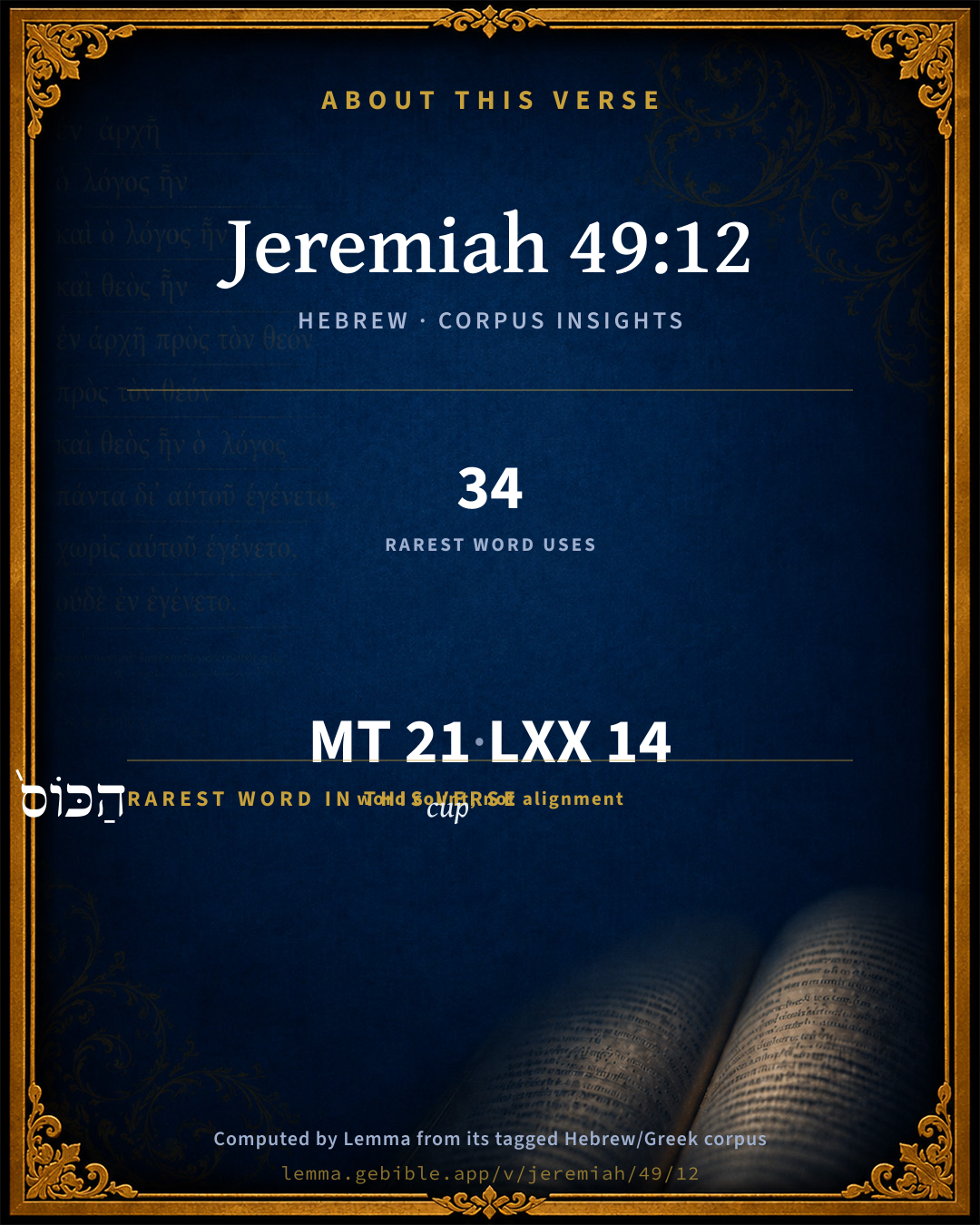
About this verse

These counts appear in no published source. They are computed here, from the morphology-tagged text and Lemma’s own curated glosses. What Lemma adds →

21
words
14
distinct lemmas
Prophets
section

Shared distinctive vocabulary

הַכּוֹס֙ cup H3563 occurs in 29 verses of the Hebrew Bible. Also found in:

Grammatical profile

  • 9 verbs
  • 3 nouns
  • 2 pronouns
  • 2 conjunctions
  • 1 adverb
  • 4 particles

Verb forms

  • אָמַ֣ר Qal · Perfect
  • לִשְׁתּ֤וֹת Qal · Infinitive Construct
  • שָׁת֣וֹ Qal · Infinitive Absolute
  • יִשְׁתּ֔וּ Qal · Imperfect
  • נָקֹ֖ה Qal · Infinitive Absolute
  • תִּנָּקֶ֑ה Niphal · Imperfect
  • תִנָּקֶ֔ה Niphal · Imperfect
  • שָׁתֹ֖ה Qal · Infinitive Absolute
  • תִּשְׁתֶּֽה Qal · Imperfect

Repetition

Words recur within this verse — often emphatic in Hebrew:

  • לִשְׁתּ֤וֹת to drink H8354 ×5
  • נָקֹ֖ה to be pure H5352 ×3
  • כִּי that H3588 ×2

Hebrew & Septuagint length

In the original languages it is 21 Hebrew tokens and 14 Greek tokens — but the two are counted differently (Hebrew bundles its prefixes and suffixes into one token; the Greek is in lemma form), so that isn’t a like-for-like length.

Cross-references

8

Topical passages linked to Jeremiah 49:12 in the Treasury of Scripture Knowledge — connected by theme and wording, ordered by reader-vote popularity; previews shown in the World English Bible.

  • Jeremiah 25:28–29 It shall be, if they refuse to take the cup at your hand to drink, then shall you tell them, Thus says Yahweh of Hosts: You shall surely drink.
  • Obadiah 1:16 For as you have drunk on my holy mountain, so will all the nations drink continually. Yes, they will drink, swallow down, and will be as though they had not been.
  • Proverbs 17:5 Whoever mocks the poor reproaches his Maker. He who is glad at calamity shall not be unpunished.
  • Jeremiah 25:15 For thus says Yahweh, the God of Israel, to me: take this cup of the wine of wrath at my hand, and cause all the nations, to whom I send you, to drink it.
  • Jeremiah 30:11 For I am with you, says Yahweh, to save you: for I will make a full end of all the nations where I have scattered you, but I will not make a full end of you; but I will correct you in measure, and will in no way leave you unpunished.
  • Jeremiah 46:27 But don't be afraid you, Jacob my servant, neither be dismayed, Israel: for, behold, I will save you from afar, and your seed from the land of their captivity; and Jacob shall return, and shall be quiet and at ease, and none shall make him afraid.
  • Lamentations 4:21–22 Rejoice and be glad, daughter of Edom, that dwell in the land of Uz: The cup shall pass through to you also; you shall be drunken, and shall make yourself naked.
  • 1 Peter 4:17–18 For the time has come for judgment to begin at the house of God. If it begins first with us, what will happen to those who don't obey the Gospel of God?

Cross-references courtesy of OpenBible.info (CC BY 4.0).

Hebrew and Greek witnesses Masoretic Hebrew ↔ Greek Septuagint

The same verse in the two great witnesses to the Old Testament, shown verse-for-verse.

These are two independent witnesses, not word-aligned to each other, and the Septuagint is shown in lemma (dictionary) form.

Hebrew Jeremiah 49:12 Masoretic · Westminster Leningrad Codex

כִּי כֹ֣ה אָמַ֣ר יְהוָ֗ה הִ֠נֵּה אֲשֶׁר אֵ֨ין מִשְׁפָּטָ֜ם לִשְׁתּ֤וֹת הַכּוֹס֙ שָׁת֣וֹ יִשְׁתּ֔וּ וְאַתָּ֣ה ה֔וּא נָקֹ֖ה תִּנָּקֶ֑ה לֹ֣א תִנָּקֶ֔ה כִּ֥י שָׁתֹ֖ה תִּשְׁתֶּֽה

For thus says Yahweh: Behold, they to whom it didn't pertain to drink of the cup shall assuredly drink; and are you he who shall altogether go unpunished? you shall not go unpunished, but you shall surely drink.

World English Bible · Public Domain

Greek LXX Structure differs

In the Septuagint, Jeremiah is about an eighth shorter than the Hebrew and arranges its material differently — the Oracles Against the Nations (Hebrew chapters 46–51) appear in the middle of the Greek book, after 25:13. Because the chapter and verse boundaries do not line up, a verse-for-verse comparison with the Hebrew is not shown.

A verse-for-verse comparison isn’t shown here because the chapters and verses don’t line up. Switch to the LXX edition with the MT / LXX toggle above to read the Greek directly.

Hebrew: Westminster Leningrad Codex (CC BY 4.0). Greek: Septuagint (public domain); English from a public-domain English Septuagint. How the Septuagint differs from the Hebrew →

Targum (Aramaic paraphrase)

1

The Targum is the ancient Jewish Aramaic paraphrase of the Hebrew Scriptures — an interpretive translation, not the Hebrew text itself. Onkelos (literal) and Pseudo-Jonathan (expansive) render the Torah, and Jonathan the Prophets. Coverage is partial: where no permissively-licensed English translation exists for a verse, only the Aramaic is shown. This is verse-level text, not a word-by-word alignment to the Hebrew.

  1. Targum Jonathan Prophets (Joshua–Malachi)
    אֲרֵי כִדְנַן אֲמַר יְיָ הָא דְלָא חֲזֵי לְהוֹן לְמִשְׁתָּאֵי כַסָא דְלוּטָא מִשְׁתָּא יִשְׁתּוּן וְאַתּוּן מְדַמָן דְמִזְכָא תִּזְכּוּן לָא תִזְכּוּן אֲרֵי מִשְׁתָּא תִשְׁתּוּן:

    (no public-domain English translation for this verse)

    Targum Jonathan — Aramaic: “Mikraot Gedolot” (public domain). English: “Sefaria Community Translation” (CC0 1.0 (public-domain dedication)); “London "Chaldee Paraphrase," 1871” (public domain). Text via Sefaria.

Commentary

Notes on Jeremiah 49:12 from classic Christian and Jewish commentators (each source and its license shown beneath its notes). The classic Christian expositions comment on the surrounding passage and are grouped to its opening verse, so a note may address several verses; the Jewish commentaries on the Tanakh (Rashi and others) are per-verse, so they appear only where the commentator wrote on this verse.

Lemma curates 59 commentaries, every one of them public domain or Creative Commons licensed, each selected and text-cleaned for this edition rather than reprinted as found. About our sources →

Trapp's Complete Commentary

John Trapp

Jer 49:12 For thus saith the LORD; Behold, they whose judgment [was] not to drink of the cup have assuredly drunken; and [art] thou he [that] shall altogether go unpunished? thou shalt not go unpunished, but thou shalt surely drink [of it].

Ver. 12. Behold they whose judgment, &c.] See Jer 25:29 Oba 1:19.

John Trapp, A Commentary or Exposition upon All the Books of the Old and New Testament (1647–1656) — public domain. Text from a community e-Sword module.

Joseph Benson's Commentary

Jer 49:12-13. They whose judgment was not to drink of the cup — Namely, of God’s wrath: see note on Jer 25:15; have assuredly drunken — The Israelites, God’s peculiar people, who, in regard to the gracious promises which he had made to them and to their fathers, the near relation in which they stood to him, and the many pious persons who, from age to age, were found among them, might, in all human appearance, have expected mercy at God’s hands, have, nevertheless, suffered dreadful judgments. And art thou he that shall altogether go unpunished? — Is Edom the righteous nation, which, above all others, deserves to be exempted from punishment? There is a peculiar emphasis, says Blaney, in the pronoun הוא, he, which denotes that Edom was he, the people, to which the punishment was peculiarly due: see note on Jer 25:29. I have sworn by myself — I have confirmed my threatening, as I have frequently confirmed my promises, by an oath; that Bozrah shall become a desolation, &c. — Bozrah, one of the chief cities of Idumea, is here put for that country in general, it being usual with the prophets to describe the destruction of a whole nation by the ruin of some one or more of its principal cities: see Jer 49:23; Amo 1:8; Amo 1:12-14.

Joseph Benson's Commentary on the Old and New Testaments (1811–1818) — public domain. Text from a community e-Sword module.

Tyndale Open Study Notes

Tyndale Open Resources

49:12-22 The cup of judgment symbolized the fulfillment of the Lord’s decrees (see 25:15-17). This section vividly depicts the aftermath of a nation’s drinking from that cup.

Tyndale Open Study Notes — © Tyndale Open Resources, licensed CC BY-SA 4.0. Text via the HelloAO Bible API.

Geneva Bible (1599)

Geneva Bible translators

I have not spared mine own people, and how should I pity thee?

Geneva Bible (1599) marginal notes — public domain. Text via Bolls.life.

Jamieson, Fausset & Brown

Robert Jamieson, A. R. Fausset & David Brown

(Compare Jer 25:15-16, Jer 25:29).

they whose judgment was not to drink of the cup--the Jews to whom, by virtue of the covenant relation, it did not belong to drink the cup. It might have been expected that they would be spared. He regards not the merits of the Jews, for they were as bad or worse than others: but the grace and adoption of God; it is just and natural ("judgment") that God should pardon His sons sooner than aliens [CALVIN].

Jamieson, Fausset & Brown — Commentary Critical and Explanatory on the Whole Bible (1871) — public domain (CC PDM 1.0). Text via the HelloAO Bible API.

Adam Clarke's Commentary

Verse 12. Art thou he that shall altogether go unpunished?] A similar form of speech appears, Jer 25:29. Others, less wicked than thou, have been punished and canst thou expect to escape? Thou shalt not escape.

Adam Clarke's Commentary on the Bible (1810–1826) — public domain. Text from a community e-Sword/MySword module.

John Calvin's Commentaries

He confirms the last verse, as I think, — that God’s vengeance awaited the whole seed of Esau, because it would be unreasonable to deal more severely with God’s people than with aliens, who had wholly shaken off the yoke. For I explain what is said here of the Church, Those to whom it was not their judgment to drink the cup shall surely drink Some apply this to neighboring nations who had not become so wicked as the Idumeans. But this exposition is frigid, and we ought always, as we have said elsewhere, to have regard to the design of the Prophet. What then was his object but to show to the faithful, that there was no reason for them to despond, however grievously God might afflict them, because the punishment which he would inflict on the Idumeans would in no way be milder; for we know that we are greatly tempted by envy when we see that the state of the impious and the reprobate is better than that of God’s children. And it was for this purpose that Psalm 37 was composed,

“Envy not the wicked, nor let their prosperity vex thee, because they shall soon perish.”

And David also, in Psalm 73:2, 3, confesses, that he in a manner staggered when he saw the wicked luxuriating in their pleasures, while the children of God were miserably treated. Then our Prophet in this place, as often elsewhere, had regard to the faithful, and wished to sustain them, lest they should succumb under their burden, when God afflicted them as well as the Idumeans. Hence he says, when speaking of the Idumeans, Drinking they shall drink the cup whose judgment was not to drink, and shalt thou be exempted? that is, “I will not spare my people, and should I spare aliens? this cannot be.”

We then see that it was a fruitful source of consolation to the faithful, when they heard that the wicked, who openly and avowedly disregarded God, could not escape his judgment.

But it may be now asked, how could he say that it was not the judgment of the Church to drink of the cup of God’s wrath? He speaks comparatively, and this answer ought to suffice us. It is certain that the Israelites deserved all the evils which they suffered. God then justly chastised them; he did not act without reason or through sudden wrath, but executed what he had previously decreed. It was then God’s judgment, even what he had determined and fixed; for judgment here is to be taken for God’s decree, by which he apportions to each his own lot. It was not then a judgment to the Israelites to drink of the cup, when one compared them to the Idumeans, — how so? Here a new question arises, for the Israelites had been worse than all others. The Idumeans had departed wholly from God; all light had become extinct among them; and then the law had not been given them: before Jacob went down to Egypt, who was to be from thence delivered according to the prefixed time made known to Abraham, they dwelt in mountains separated from the land of Canaan. They therefore possessed no part of God’s law, except that they had the empty symbol of circumcision. But the Israelites, on whom had always shone the doctrine of the law, were altogether inexcusable. Why then does the Prophet say that there was no judgment to them? My answer is, that the reference here is not to the persons of men, but on the contrary to the grace of God, through which he had been pleased to embrace the children of Israel. As then God had chosen that nation, what is regarded here is special adoption; for it is right in God to indulge his children, and it is right also in him to pardon them rather than aliens. When any one is offended with his own son, he will be reconciled to him; but an alien will not find pardon.

We now then see that the Prophet does not regard what the people had deserved, nor consider how detestable had been their impiety, and of what grievous punishment they were worthy; but on the contrary, he refers to that grace of God through which he had chosen the seed of Jacob. He had indeed previously chosen the whole seed of Abraham; but the rejection of Esau followed, so that Jacob alone remained as the seed. Since then God had manifested himself as a father to the children of Jacob, the Prophet says that it was not their judgment to drink of the cup, because it was according to reason and common sense that God should forgive them rather than aliens, whom he had already rejected, and who were like putrid members: They, then, whose judgment was not to drink the cup, drinking shall drink, and shalt thou escape free? The meaning is, that if the green wood is burnt, what will become of the dry? as Christ said. (Luke 23:31.) There is a similar consolation mentioned in 1 Peter 4:17, 18, where those afflictions are mentioned to which the Church of God is now exposed. Now, as we are tender and delicate, and the minds of many may be harassed, Peter says, that if God be so severe towards his own, those of his own household, what will become of the wicked? what dreadful vengeance awaits them?

We hence perceive the drift of the Prophet’s words, and what doctrine may be hence deduced, even that when we see God’s judgment beginning at God’s house, as the Prophet elsewhere says, (Jeremiah 25:29) and as also Peter says; that is, when God chastises his own children, and seems in the meantime to pass by the wicked, we ought patiently to wait for the visitation previously mentioned; and this ought always to be remembered by us, “If this be done in the green tree, what will be done in the dry?” We shall not then envy the wicked, when God defers and does not immediately execute his judgment; for the punishments inflicted by God on his servants are only temporary and limited, and intended as medicine, inasmuch as all we suffer are helps to our salvation, as Paul teaches us. (Romans 8:28.) As then God paternally chastises us, let us not shun his paternal hand; nor let us think that God deals more kindly with the wicked because he suspends his judgments, for at length they will be hurried into their own ruin, as the Prophet says here.

In speaking of a cup, the Prophet uses a phrase common in Scripture, for the Scripture by a metaphor calls punishment inflicted on men for their sins a cup; because God apportions to each his just measure. It is taken then as allowed, that calamities are not by chance, but proceed from God’s hand, as though he gave a cup to drink. Now when he afflicts his own, they are constrained to drink as it were his wrath; it is therefore a sour and a bitter cup. But the wicked shall hereafter drink poison. Even medicine, though displeasing to the taste because of its bitterness, is yet wholesome; but poison kills men, though its taste is like medicine. This then is the comparison that is used here by Jeremiah; Drinking, they shall drink the cup, even God’s servants, who yet ought to have been exempted through a singular privilege, even because God had chosen them to be his peculiar people; shalt thou, he says, be exempted from drinking? He addresses all aliens.

We have before seen another mode of speaking, “They shall drink to the dregs,” as though he had said, “God will not only give thee to drink a bitter cup, but its bitterness will kill and destroy thee, for God will constrain thee to drink the very dregs.” But still the meaning is the same, though the phrase is different. He then asserts that the Idumeans would not be exempt from God’s judgment, and why? because God does not spare even his own children. Here then is suggested to us the best consolation when God in various ways afflicts us: let us know that it cannot be otherwise, but that it is a prelude to the last judgment, when salvation shall surely be our portion, for God purifies us now by temporal punishments, that we may be then free from final vengeance. But when the ungodly are secure, let us know that God’s judgment is indeed hidden, but yet certain, and will shortly overtake them; for when they say,

“Peace and security, then sudden destruction will come upon them.” (1 Thessalonians 5:3.)

But the clock strikes.

John Calvin's Commentaries (1540-1563) — public domain. Text from the Calvin Translation Society English edition (1840s-50s) via the Christian Classics Ethereal Library (ccel.org). Calvin's coverage is partial (roughly two-thirds of the Bible); uncommented books and verses are honest gaps, never fabricated. The 19th-century editor's footnotes and remarks are omitted so the notes are faithfully Calvin's own voice.

Ellicott's Commentary for English Readers

(12) Behold, they whose judgment . . .—The imagery is taken up from Jer_25:15. Even those of whom it might have seemed that they were exempted, by God’s decree, from drinking of the cup of His wrath, had drunk. Could Esau hope for immunity? The thought is parallel to that of 1Pe_4:17.

A Bible Commentary for English Readers, edited by Charles John Ellicott (1878–1897) — public domain. Text from a community e-Sword module.

The Cambridge Bible for Schools and Colleges

gen. ed. J. J. S. Perowne

12. they to whom it pertained not] for the metaphor See on Jer_13:12, Jer_25:15.

The Cambridge Bible for Schools and Colleges (gen. ed. J. J. S. Perowne; Cambridge University Press, 1878–1918) — public domain. Text from a community e-Sword module.

John Gill's Exposition

For thus saith the Lord,.... This that follows shows that what goes before is not said by way of promise and comfort, but threatening:

behold, they whose judgment was not to drink of the cup have assuredly drunken; meaning either some of the other nations, who had not dealt so ill with the Jews as the Edomites had, at least their sins were not so aggravated as theirs were; they being akin to the Jews, and having used them in a very injurious and scornful manner; or the Jews themselves, who, in comparison of them, had not deserved divine vengeance, signified by a cup, a portion of wrath, and punishment righteously allotted them, and which they had partook of, being carried captive into Babylon: for this is not to be understood strictly of proper justice, but in a comparative sense; for otherwise it was but just and right that they should be treated in the manner they were; only they were not so guilty as these were;

and art thou he that shalt altogether go unpunished? if lesser sinners are not let go free, how should it be thought that greater ones should? and especially if judgment had begun at God's own people, the wicked Edomite, could not expect to escape;

thou shalt not go unpunished, but thou shalt surely drink of it; the cup of wrath and vengeance; or have the just punishment inflicted on them threatened them.

John Gill's Exposition of the Whole Bible (1746–1763) — public domain (CC PDM 1.0). Text via the HelloAO Bible API.

Haydock's Catholic Bible Commentary

Was not so much. There were some faithful Jews, chap. xxv. 28. (Calmet)

George Leo Haydock (1774–1849), Haydock's Catholic Family Bible and Commentary, 1859 edition — public domain. Excludes Psalms (Douay-Rheims chapter numbering differs from Protestant) and Deuterocanonical books (Catholic canon only).

Matthew Poole's English Annotations

That by

the cup is meant the wine cup of the Lord’s wrath, and that by those whose judgment was not to drink of it are meant the Jews, is not to be doubted; but the question is, how the prophet saith that it was not the judgment of the Jews to drink of this cup? The word here used is of so various significations as makes the fixing the sense of it here difficult; it cannot here signify justice, for in that sense it was the Jews’ judgment to drink of it; nor can it here (as it often doth) signify the effect of justice, God’s judicial dispensation; for they had drank of it, so it was their judgment. It must be taken in the most favourable sense imaginable. Either they who in regard of their relation to God, and God’s relation to them, might have looked upon it as none of their portion, yet have drank of it; or, they who in comparison with others did not deserve to drink of the cup, yet have drank of it: and can you think to escape? No, thou shalt not escape, but most surely drink of it. 1Pe 4:17, The time is come that judgment is begun at the house of God; and if it first begin with that, where shall the end of others be? When an Israelite hath not escaped the justice of God, an Edomite must not expect it.

Matthew Poole's English Annotations on the Holy Bible (1683–1685) — public domain. Text from a community e-Sword/MySword module.

Whedon's Commentary on the Bible

Daniel D. Whedon

12. They whose judgment, etc. — Namely, the Israelites, who, in falling under the judgments of God, had departed utterly from their proper normal experience. “And if the righteous scarcely be saved, where shall the ungodly and the sinner appear?”

Have… drunken — Rather, will certainly drink.

Daniel D. Whedon (gen. ed.), Commentary on the Old and New Testaments (1874–1909) — public domain. Text from a community e-Sword module.

The Pulpit Commentary

Whose judgment was not, etc.; rather, to whom it was not due, etc. Jehovah condescends to speak from a human point of view. So, Isa_28:21, the punishment of Jerusalem is called his "strange work." Have assuredly drunken; rather, shall surely drink.

Israel"s judgment an argument for Edom"s. cf. Jer_25:29 Pro_11:31 1Pe_4:18; and, for original, Oba_1:16.

I AN ILLUSTRATION OF THE CHARACTER OF GOD.

1. Proving his strict righteousness. There is no respect of persons. His love for righteousness and hatred of wrong are such that even his chosen people do not escape punishment. Salvation will not, therefore, be by favour or independent of character. The least sin will be judged. Individual saints shared in the general calamity.

2. His unfailing faithfulness. It was predicted particularly concerning Israel, and was declared as the law of his kingdom. Its fulfilment, therefore, vindicates the Divine veracity.

II AN ARGUMENT BASED UPON IT. If such a God reigns amongst men, can any transgressor escape? To such sinners, then, as the Edomites, the heathen or worldly enemies of godliness and the truth:

1. Punishment would be certain. Their present immunity was only as the lull before the storm. Conscience gathers no comfort from apparent prosperity. Israel"s punishment is a certain guarantee of Edom"s.

2. Punishment will be proportional to the sin. In such cases as that of Edom an open, flagrant, and conscious foe to the kingdom of God it would be far more severe. There is no promise of "bringing again their captivity." It was to be "as if it bad not been." Where the heathen, on the other hand, have not sinned so clearly against light, there will be condoning circumstances which will be taken into account. M.

The Pulpit Commentary (1880–1919), ed. H.D.M. Spence-Jones & Joseph S. Exell — public domain. Text from a community e-Sword module.

John Wesley's Explanatory Notes

They - The Jews, who in comparison with others did not deserve to drink of the cup, yet have drank of it, and can you think to escape? When an Israelite hath not escaped the justice of God, an Edomite must not expect it.

John Wesley, Explanatory Notes Upon the Whole Bible (1754–1765) — public domain. Text via the GEBible commentary corpus.

unfoldingWord translationNotes

Door43 World Missions Community

General Information:

Yahweh continues speaking about what will happen to Edom.

See

"Look" or "Listen" or "Pay attention to what I am about to tell you"

must certainly drink some of the cup ... for you will certainly drink

Here "the cup" is a metonym that represents the contents in the cup that the people must drink. The people experiencing Yahweh's punishment is spoken of as if Yahweh's punishment were liquid in a cup and the people must drink it. AT: "must certainly experience my punishment ... for you will certainly experience my punishment" or "I will certainly still punish ... for I will certainly punish you" (See: Metonymy and Metaphor)

Do you yourself think you will go without punishment?

Yahweh uses a question to emphasize the people of Edom have sinned and will certainly be punished. This question can be translated as a statement. AT: "Certainly, you must be aware that you will personally experience my punishment for your sins." (See: Rhetorical Question)

you yourself

The words "you" and "yourself" refer to Edom, which represents the people of Edom. The word "yourself" is used to draw attention to the people of Edom. AT: "you yourselves" (See: Forms of You and Metonymy and Reflexive Pronouns)

this is Yahweh's declaration

Yahweh speaks of himself by name to express the certainty of what he is declaring. See how you translated this in Jeremiah 1:8. AT: "this is what Yahweh has declared" or "this is what I, Yahweh, have declared" (See: First, Second, or Third Person)

Bozrah will become a horror, a disgrace, a devastation, and an object for cursing

The abstract nouns "a horror," "a disgrace," and "a devastation" can be translated as verbs. AT: "People will be horrified when they see that the city of Bozrah is devastated. And they will mock the city and use its name when they curse others" (See: Abstract Nouns)

Bozrah

This is the name of a city in Edom. (See: How to Translate Names)

All of its cities

"All of Edom's cities"

translationWords

oath

Yahweh

declare

devastate

curse

eternity

unfoldingWord translationNotes — © Distant Shores Media and the Door43 World Missions Community, licensed CC BY-SA 4.0. Source: git.door43.org/Door43/en_tn.

Rashi

Rabbi Shlomo Yitzchaki (Rashi)

those who do not deserve to drink For they were not brothers to Israel, and if they harmed them, they do not deserve the death sentence like you.

Rashi on the Tanakh — English translations: “The Judaica Press complete Tanach with Rashi, translated by A. J. Rosenberg” (CC BY 4.0); “Pentateuch with Rashi's commentary by M. Rosenbaum and A.M. Silbermann, 1929-1934” (public domain); “The Metsudah Tanach series, Lakewood, N.J” (CC BY 4.0); and “The Book of Joshua, Metsudah Publications, 1997” (CC BY 4.0). Text via Sefaria.

Lesson kit

Teaching starters — assembled from the data on this page, not authored interpretation. Every prompt links to the verse data it draws on. Edit before teaching.

Jeremiah, in the Prophets, opens this verse with 21 words (14 distinct Hebrew lemmas). Its most distinctive word is kôwç (“cup”). A historical commentator’s framing appears above. Read the whole chapter for the surrounding context.

Discussion questions

  1. What does “cup” (kôwç) contribute to the verse as a whole?
  2. How does Genesis 40:11, which shares the word «cup», read alongside this verse?
  3. What does the repetition of “to drink” (5× in this one verse) do in this verse?
  4. These translations render this verse differently; the difference is in the English rendering, not the original. What questions does that raise?
  5. «אָמַ֣ר» is a Qal Perfect verb. How does that grammatical form shape the action described?
  6. Compare how Trapp's Complete Commentary and Joseph Benson's Commentary read this verse. Where do they agree or differ?

Things to notice

Reading settings

Reading text

Shown beneath each verse's original-language words.

Old Testament
Old Testament edition

Read the OT as the Masoretic Hebrew (MT) or the Greek Septuagint (LXX).

English shown for the Greek Septuagint (in the Hebrew ↔ Greek comparison).

Comparing translations? Open the Compare panel on any verse page to stack up to four side by side.