
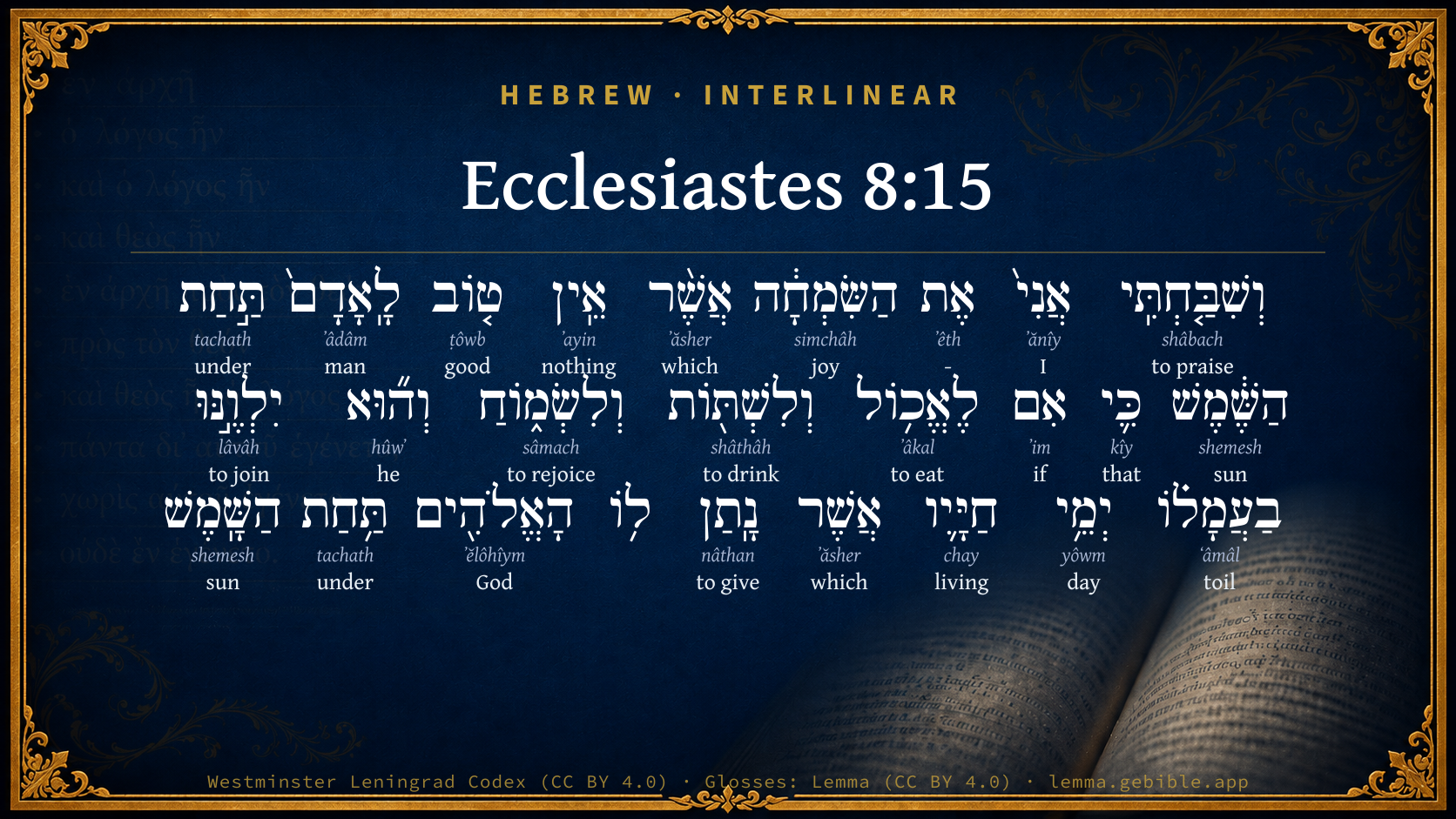
Ecclesiastes 8:15

Hebrew (Westminster Leningrad Codex) Ecclesiastes 8:15 appears in the Hebrew Old Testament. The text above is from the Westminster Leningrad Codex. Each word links to its Strong’s number, a concise gloss, and parsing drawn from the Open Scriptures Hebrew Bible morphology. Click any word for its full Brown-Driver-Briggs (BDB) entry.
Download image
Cite this verse

Ecclesiastes 8:15 (World English Bible). Public Domain. Lemma interlinear Bible study tool, https://lemma.gebible.app/v/ecclesiastes/8/15.

Show BibTeX & RIS
BibTeX
RIS
English Translation
Then I commended mirth, because a man has no better thing under the sun, than to eat, and to drink, and to be joyful: for that will accompany him in his labor all the days of his life which God has given him under the sun.
World English Bible · Public Domain
Download a study sheet

One document with this verse’s original text, its word-by-word gloss line, the meaning frame, cross-references with their text, attributed commentary, and full source and license credits — printable, and it pastes into notes with its structure intact.

This verse Autodidact and up

Study sheet (.html) Plain text (.txt)

A passage Seminary Student

Up to 50 verses in one chapter. A passage sheet keeps up to 6 commentary sources and 12 cross-references per verse, in the order this page ranks them, and says so on the sheet whenever that leaves anything out. Ask for a single verse and you get the Autodidact verse sheet above.

Everything on this page stays free to read, with no account — the sheet is a download of what is already on screen, not access to it.

Want to remove ads? Support Godless Engineer
Compare translations 3

The same verse in 3 English versions, stacked beneath the original-language interlinear above. Click any original word for its lexicon entry.

Each is an independent rendering of the whole verse — the interlinear is not word-aligned to these translations.

Highlighted words mark where these versions differ — a whole-verse word diff, not a word-by-word alignment.

  • World English Bible Public Domain
    Then I commended mirth, because a man has no better thing under the sun, than to eat, and to drink, and to be joyful: for that will accompany him in his labor all the days of his life which God has given him under the sun.
  • King James Version Public Domain
    Then I commended mirth, because a man hath no better thing under the sun, than to eat, and to drink, and to be merry: for that shall abide with him of his labour the days of his life, which God giveth him under the sun.
  • unfoldingWord Literal Text CC BY-SA 4.0
    And I praised, I, joy—that there is nothing good for humanity under the sun except to eat and to drink and to rejoice. And it will accompany him in his toil the days of his life that the God has given to him under the sun.

unfoldingWord Literal Text — © unfoldingWord, licensed CC BY-SA 4.0. Word-aligned USFM3 via Door43 (git.door43.org/unfoldingWord/en_ult).

Versions to compare (up to 4)

3 of 4 selected

Show all 18 translations

Every available English version of this verse, each an independent rendering of the whole verse.

  • World English Bible Public Domain
    Then I commended mirth, because a man has no better thing under the sun, than to eat, and to drink, and to be joyful: for that will accompany him in his labor all the days of his life which God has given him under the sun.
  • Berean Standard Bible Public Domain
    So I commended the enjoyment of life, because there is nothing better for a man under the sun than to eat and drink and be merry. For this joy will accompany him in his labor during the days of his life that God gives him under the sun.
  • Majority Standard Bible Public Domain
    So I commended the enjoyment of life, because there is nothing better for a man under the sun than to eat and drink and be merry. For this joy will accompany him in his labor during the days of his life that God gives him under the sun.
  • King James Version Public Domain
    Then I commended mirth, because a man hath no better thing under the sun, than to eat, and to drink, and to be merry: for that shall abide with him of his labour the days of his life, which God giveth him under the sun.
  • American Standard Version (1901) Public Domain
    Then I commended mirth, because a man hath no better thing under the sun, than to eat, and to drink, and to be joyful: for that shall abide with him in his labor `all' the days of his life which God hath given him under the sun.
  • Revised Version (1885) Public Domain
    Then I commended mirth, because a man hath no better thing under the sun, than to eat, and to drink, and to be merry: for that shall abide with him in his labour all the days of his life which God hath given him under the sun.
  • Geneva Bible (1599) Public Domain
    And I praysed ioy: for there is no goodnesse to man vnder the sunne, saue to eate and to drinke and to reioyce: for this is adioyned to his labour, the dayes of his life that God hath giuen him vnder the sunne.
  • Douay-Rheims (1899) Public Domain
    Therefore I commended mirth, because there was no good for a man under the sun, but to eat, and drink, and be merry, and that he should take nothing else with him of his labour in the days of his life, which God hath given him under the sun.
  • Young's Literal Translation Public Domain
    And I have praised mirth because there is no good to man under the sun except to eat and to drink, and to rejoice, and it remaineth with him of his labour the days of his life that God hath given to him under the sun.
  • Literal Standard Version CC BY-SA 4.0
    And I have praised mirth because there is no good to man under the sun except to eat and to drink, and to rejoice, and it remains with him of his labor the days of his life that God has given to him under the sun.
  • Unlocked Literal Bible CC BY-SA 4.0
    So I recommend happiness, because a man has no better thing under the sun than to eat and drink and to be happy. It is happiness that will accompany him in his labor for all the days of his life that God has given him under the sun.
  • unfoldingWord Literal Text CC BY-SA 4.0
    And I praised, I, joy—that there is nothing good for humanity under the sun except to eat and to drink and to rejoice. And it will accompany him in his toil the days of his life that the God has given to him under the sun.
  • Darby Bible Public Domain
    And I commended mirth, because there is nothing better for man under the sun than to eat, and to drink, and to be merry; for that shall abide with him of his labour the days of his life, which God hath given him under the sun.
  • World Messianic Bible Public Domain
    Then I commended mirth, because a man has no better thing under the sun than to eat, to drink, and to be joyful: for that will accompany him in his labor all the days of his life which God has given him under the sun.
  • Webster's Bible Public Domain
    Then I commended mirth, because a man hath no better thing under the sun, than to eat, and to drink, and to be merry: for that shall abide with him of his labor the days of his life, which God giveth him under the sun.
  • Free Bible Version CC BY-SA 4.0
    So I recommend enjoying life. There's nothing better for us here on earth than to eat and drink and be happy. Such an attitude will go with us as we work, and as we live our lives that God gives us here on earth.
  • Bible in Basic English Public Domain
    So I gave praise to joy, because there is nothing better for a man to do under the sun than to take meat and drink and be happy; for that will be with him in his work all the days of his life which God gives him under the sun.
  • JPS Tanakh (1917) Public Domain
    So I commended mirth, that a man hath no better thing under the sun, than to eat, and to drink, and to be merry, and that this should accompany him in his labour all the days of his life which God hath given him under the sun.

Literal Standard Version (2020), Covenant Press — licensed CC BY-SA 4.0. Text via the HelloAO Bible API (eBible.org). Unlocked Literal Bible (unfoldingWord) — licensed CC BY-SA 4.0. Text via the HelloAO Bible API (eBible.org). unfoldingWord Literal Text — © unfoldingWord, licensed CC BY-SA 4.0. Word-aligned USFM3 via Door43 (git.door43.org/unfoldingWord/en_ult). Free Bible Version, Dr. Jonathan Gallagher — licensed CC BY-SA 4.0. Text via the HelloAO Bible API (eBible.org).

Word by word

More ways to search: Search by grammar → Find every occurrence → Compare this word →

Practice this passage: Drill this verse → Learn its vocabulary →

וְשִׁבַּ֤חְתִּֽי
shâbach
H7623
“and · to praise”
Conjunction + Verb, Piel, Perfect, 1st Person, Common, Singular
Part of Speech
Conjunction + Verb
Stem
Piel
Form
Perfect
Person
1st Person
Gender
Common
Number
Singular
Full BDB Definition

Origin: a primitive root

TWOT: 2312 , 2313

to soothe, still, stroke - (Piel) to soothe, still - (Hiphil) stilling (participle) - to laud, praise, commend - (Piel) - to laud, praise (God) - to commend, congratulate (the dead) - (Hithpael) to boast
  1. אֲנִי֙ ʼănîy H589 “I” Pronoun, Personal, 1st Person, Common, Singular
  2. אֶת ʼêth H853 “-” Particle, Direct Object
  3. הַשִּׂמְחָ֔ה simchâh H8057 “the · joy” Particle, Definite Article + Noun, Common, Feminine, Singular, Absolute
  4. אֲשֶׁ֨ר ʼăsher H834 “which” Particle, Relative
  5. אֵֽין ʼayin H369 “nothing” Particle, Negative
  6. ט֤וֹב ṭôwb H2896 “good” Adjective, Adjective, Masculine, Singular, Absolute
  7. לָֽאָדָם֙ ʼâdâm H120 “to/for the · man” Preposition, Determined + Noun, Common, Masculine, Singular, Absolute
  8. תַּ֣חַת tachath H8478 “under” Preposition
  9. הַשֶּׁ֔מֶשׁ shemesh H8121 “the · sun” Particle, Definite Article + Noun, Common, Both, Singular, Absolute
  10. כִּ֛י kîy H3588 “that” Conjunction
  11. אִם ʼim H518 “if” Conjunction
  12. לֶאֱכ֥וֹל ʼâkal H398 “to eat” Preposition + Verb, Qal, Infinitive Construct
  13. וְלִשְׁתּ֖וֹת shâthâh H8354 “and · to drink” Conjunction + Preposition + Verb, Qal, Infinitive Construct
  14. וְלִשְׂמ֑וֹחַ sâmach H8055 “and · to rejoice” Conjunction + Preposition + Verb, Qal, Infinitive Construct
  15. וְה֞וּא hûwʼ H1931 “and · he” Conjunction + Pronoun, Personal, 3rd Person, Masculine, Singular
  16. יִלְוֶ֣נּוּ lâvâh H3867 “to join · him” Verb, Qal, Imperfect, 3rd Person, Masculine, Singular + Suffix, Personal, 3rd Person, Masculine, Singular
  17. בַעֲמָל֗וֹ ʻâmâl H5999 “in/at · toil · his” Preposition + Noun, Common, Both, Singular, Construct + Suffix, Personal, 3rd Person, Masculine, Singular
  18. יְמֵ֥י yôwm H3117 “days of” Noun, Common, Masculine, Plural, Construct
  19. חַיָּ֛יו chay H2416 “living things · his” Noun, Common, Masculine, Plural, Construct + Suffix, Personal, 3rd Person, Masculine, Singular
  20. אֲשֶׁר ʼăsher H834 “which” Particle, Relative
  21. נָֽתַן nâthan H5414 “to give” Verb, Qal, Perfect, 3rd Person, Masculine, Singular
  22. הָאֱלֹהִ֖ים ʼĕlôhîym H430 “the · God(s)” Particle, Definite Article + Noun, Common, Masculine, Plural, Absolute
  23. תַּ֥חַת tachath H8478 “under” Preposition
  24. הַשָּֽׁמֶשׁ shemesh H8121 “the · sun” Particle, Definite Article + Noun, Common, Both, Singular, Absolute

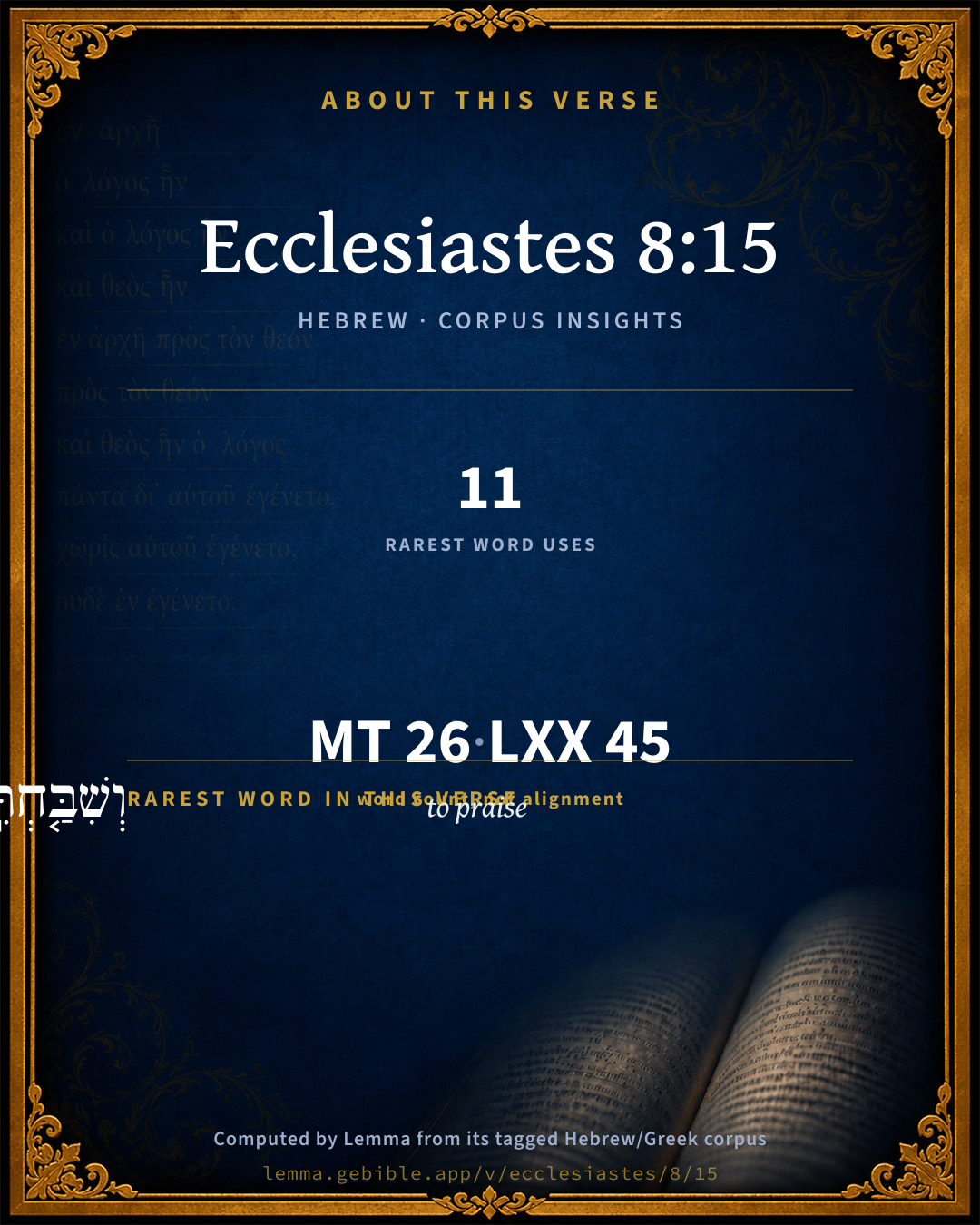
About this verse

These counts appear in no published source. They are computed here, from the morphology-tagged text and Lemma’s own curated glosses. What Lemma adds →

26
words
22
distinct lemmas
Wisdom
section

Notable vocabulary

The rarest word here is וְשִׁבַּ֤חְתִּֽי to praise H7623 — appearing just 11 times in the whole Hebrew Bible.

Shared distinctive vocabulary

וְשִׁבַּ֤חְתִּֽי to praise H7623 occurs in 11 verses of the Hebrew Bible. Also found in:

Grammatical profile

  • 6 verbs
  • 8 nouns
  • 1 adjective
  • 2 pronouns
  • 3 prepositions
  • 2 conjunctions
  • 4 particles

Verb forms

  • וְשִׁבַּ֤חְתִּֽי Piel · Perfect
  • לֶאֱכ֥וֹל Qal · Infinitive Construct
  • וְלִשְׁתּ֖וֹת Qal · Infinitive Construct
  • וְלִשְׂמ֑וֹחַ Qal · Infinitive Construct
  • יִלְוֶ֣נּוּ Qal · Imperfect
  • נָֽתַן Qal · Perfect

Repetition

Words recur within this verse — often emphatic in Hebrew:

  • תַּ֣חַת under H8478 ×2
  • הַשֶּׁ֔מֶשׁ sun H8121 ×2
  • אֲשֶׁ֨ר which H834 ×2

Hebrew & Septuagint length

In English translation the verse runs 46 words from the Hebrew and 45 from the Septuagint (LXX English) — closely comparable.

A rough comparison of the two English renderings, which tokenize alike — not a word-level alignment.

Word counts can differ between the Hebrew and the Greek without any difference in meaning — e.g. the Hebrew direct-object marker אֵת has no separate Greek word, and Greek often adds the article ὁ.

In the original languages it is 26 Hebrew tokens and 45 Greek tokens — but the two are counted differently (Hebrew bundles its prefixes and suffixes into one token; the Greek is in lemma form), so that isn’t a like-for-like length.

Cross-references

7

Topical passages linked to Ecclesiastes 8:15 in the Treasury of Scripture Knowledge — connected by theme and wording, ordered by reader-vote popularity; previews shown in the World English Bible.

  • Ecclesiastes 2:24 There is nothing better for a man than that he should eat and drink, and make his soul enjoy good in his labor. This also I saw, that it is from the hand of God.
  • Ecclesiastes 5:18 Behold, that which I have seen to be good and proper is for one to eat and to drink, and to enjoy good in all his labor, in which he labors under the sun, all the days of his life which God has given him; for this is his portion.
  • Ecclesiastes 3:12–13 I know that there is nothing better for them than to rejoice, and to do good as long as they live.
  • Ecclesiastes 9:7–9 Go your way--eat your bread with joy, and drink your wine with a merry heart; for God has already accepted your works.
  • Ecclesiastes 3:22 Therefore I saw that there is nothing better, than that a man should rejoice in his works; for that is his portion: for who can bring him to see what will be after him?
  • 1 Timothy 4:3–4 forbidding marriage and commanding to abstain from foods which God created to be received with thanksgiving by those who believe and know the truth.
  • 1 Timothy 6:17 Charge those who are rich in this present world that they not be haughty, nor have their hope set on the uncertainty of riches, but on the living God, who richly provides us with everything to enjoy;

Cross-references courtesy of OpenBible.info (CC BY 4.0).

Hebrew and Greek witnesses Masoretic Hebrew ↔ Greek Septuagint

The same verse in the two great witnesses to the Old Testament, shown verse-for-verse.

These are two independent witnesses, not word-aligned to each other, and the Septuagint is shown in lemma (dictionary) form.

Hebrew Ecclesiastes 8:15 Masoretic · Westminster Leningrad Codex

וְשִׁבַּ֤חְתִּֽי אֲנִי֙ אֶת הַשִּׂמְחָ֔ה אֲשֶׁ֨ר אֵֽין ט֤וֹב לָֽאָדָם֙ תַּ֣חַת הַשֶּׁ֔מֶשׁ כִּ֛י אִם לֶאֱכ֥וֹל וְלִשְׁתּ֖וֹת וְלִשְׂמ֑וֹחַ וְה֞וּא יִלְוֶ֣נּוּ בַעֲמָל֗וֹ יְמֵ֥י חַיָּ֛יו אֲשֶׁר נָֽתַן ל֥וֹ הָאֱלֹהִ֖ים תַּ֥חַת הַשָּֽׁמֶשׁ

Then I commended mirth, because a man has no better thing under the sun, than to eat, and to drink, and to be joyful: for that will accompany him in his labor all the days of his life which God has given him under the sun.

World English Bible · Public Domain

Greek LXX Ecclesiastes 8:15 Septuagint · lemma form

καί ἐπιαἰνέω ἐγώ σύν ὁ εὐφροσύνη ὅτι οὐ εἰμί ἀγαθός ὁ ἄνθρωπος ὑπό ὁ ἥλιος ὅτι εἰ μή ὁ ἐσθίω καί ὁ πίνω καί ὁ εὐφραίνω καί αὐτός συν προςεἰμί αὐτός ἐν μόχθος αὐτός ἡμέρα ζωή αὐτός ὅσος δίδωμι αὐτός ὁ θεός ὑπό ὁ ἥλιος

Then I praised mirth, because there is no good for a man under the sun, but to eat, and drink, and be merry: and this shall attend him in his labor all the days of his life, which God has given him under the sun.

LXX2012 (modern English Septuagint) · Public Domain

On this verse, Keil & Delitzsch discusses the Septuagint’s reading. Read the note in Commentary ↓

Hebrew: Westminster Leningrad Codex (CC BY 4.0). Greek: Septuagint (public domain); English from LXX2012 (modern English Septuagint) (Public Domain). How the Septuagint differs from the Hebrew →

Commentary

Notes on Ecclesiastes 8:15 from classic Christian and Jewish commentators (each source and its license shown beneath its notes). The classic Christian expositions comment on the surrounding passage and are grouped to its opening verse, so a note may address several verses; the Jewish commentaries on the Tanakh (Rashi and others) are per-verse, so they appear only where the commentator wrote on this verse.

Lemma curates 59 commentaries, every one of them public domain or Creative Commons licensed, each selected and text-cleaned for this edition rather than reprinted as found. About our sources →

Trapp's Complete Commentary

John Trapp

Ecc 8:15 Then I commended mirth, because a man hath no better thing under the sun, than to eat, and to drink, and to be merry: for that shall abide with him of his labour the days of his life, which God giveth him under the sun.

Ver. 15. Then I commended mirth.] A lawful lightsomeness and cheerfulness of heart, which maketh comforts to be much more comfortable, and troubles to be far less troublesome. Besides, acceptior est Deo grata laetitia quam diuturna quasi querula tristitia. {a} Cheerfulness is better pleasing to God than sourness and sullenness: this provokes him to anger, {Deu 28:47} as that which puts a man under the reign of continual unthankfulness - "Is any man merry? let him sing" {Jas 5:13} - makes him exceeding liable to temptations and perplexities, disableth him to make benefit of ordinances, indisposeth and unfitteth him for duties of active or passive obedience, takes off the wheels of the soul, and makes it as awkward as a limb out of joint, that can do nothing without deformity and pain.

Than to eat, and to drink, and to be merry.] Although it be the bread of sorrow that thou eatest, and the cup of affliction that thou drinkest, eat it, and drink it merrily. The Epicures held that a man might be cheerful amidst the most exquisite torments; (1.) In consideration of his honesty and fidelity, that he suffered for; (2.) In consideration of those pleasures and delights that formerly he had enjoyed, and now cheered up himself with the remembrance of. How much better may Christians do it in consideration of those unutterable joys and delights that they expect and hope for! Mendicato pane hic vivamus, &c., saith Luther. We may well be content, nay merry, though we should beg our bread here, to think that we shall one day feast with Abraham, Isaac, and Jacob in the kingdom of heaven.

{a} Bucholc.

John Trapp, A Commentary or Exposition upon All the Books of the Old and New Testament (1647–1656) — public domain. Text from a community e-Sword module.

The Biblical Illustrator

Joseph S. Exell

Ecc_8:15

Then I commended mirth, because a man hath no better thing under the sun, than to eat, and to drink, and to be merry.

The benefits of wholesome recreation

Viewed by itself, and apart from its context and from the rest of the argument of the wise king, this sentiment might seem to partake very much of the spirit of the Epicureans, so strongly condemned by St. Paul--Let us eat and drink, for to-morrow we die: but when we come to look closely into it, we find that it would be a manifest perversion of the whole passage to apply it in any such Epicurean sense. The man to whom he refers, as the one who is encouraged to eat and to drink and to be merry, is not the idle drone whose whole life is spent in self-indulgence, or in the pursuit of pleasure; not the Dives who fares sumptuously every day while so many around have scarcely wherewithal to purchase the scanty meal--but he, whose whole attention has been hitherto absorbed in some toilsome and laborious pursuit; he who has, so to speak, been the slave of wealth, or ambition, or pleasure, or business--the seeker after worldly wisdom--or, in fine, the man so filled with anxiety and care about the objects of his desire, as to need this salutary warning how better to employ his days. Thus, if we might venture to paraphrase the passage, we should assume it to bear some such an import as the following:--Be not so wrapt up in the cares or concerns of this life, oh! ye foolish sons of men, as to forget the grand end and aim of your being. There are, indeed, many things well worthy of your attainment, but none of so solid and enduring a character as to justify your total absorption in the pursuit of them. Lose not the real enjoyment of life by devoting it thus unremittingly to any earthly end. While thus toiling to secure some fancied good, you are really allowing to escape those fleeting moments which should be devoted to some loftier purpose. Aim first and chiefly to attain the heavenly wisdom, for this alone will bring peace at the last. And then, with regard to all earthly schemes of happiness, let not your pursuit of the problematic future deprive you of the lawful enjoyment of present good, but having food and raiment be therewith content. Eat, drink and be merry. Cultivate a cheerful and a happy frame of mind, as opposed to that gloomy, over-anxious, ever-toiling disposition, which you now possess--as is the cold, cheerless mantle of night to the glow and warmth of the midday sun--for this calm and tranquil state shall abide with you, and give you enjoyment in the midst of your labour all the days of your life which God giveth you under the sun. And who does not perceive the consonance of this advice with the more plain and direct teaching of our Lord and His inspired apostles? Who does not recognize in this Old Testament warning the foreshadowing of those deep and wholesome truths which Christ announced in tits famous sermon from the Mount? Therefore I say unto you, Take no thought for your life, what ye shall eat, or what ye shall drink; nor yet for your body, what ye shall put on. Is not the life more than meat, and the body than raiment? But rather seek ye first the kingdom of God and His righteousness, and all these things shall be added unto you. Who does not trace in the language of Solomon the workings of that same Spirit which inspired St. Paul to say, Whether therefore ye eat or drink, or whatsoever ye do, do all to the glory of God--Rejoice in the Lord alway; and again I say, Rejoice? Not, then, in antagonism to the spirit of the New Testament, but in perfect accordance with it, does Solomon, in the words of my text, recommend the rational enjoyment of the good things of this life. In what, then, does rational enjoyment or recreation consist? I think we may safely answer this question by the obvious reply--In the moderate use of all the gifts of Gods good providence, and in the healthful cultivation of all these faculties the improvement of which can tend to His honour or glory. Under this head, then, as you will perceive, so far as bodily refection is concerned, we should include the temperate use of all healthful articles, whether of food or of drink. Not that which entereth into the mouth defileth a man. God makes no distinction either of meats or drinks, provided we use all lawfully, to the just refreshment and strengthening of the body, not to its undue pampering, or mere carnal gratification. And so, also, with regard to questions of bodily or mental recreation. Healthful exercise, whether for the body or mind, may allowably be included under the Preachers commendation of rational mirth. The Scriptures have net prescribed to us what species of mirth to select, nor what to avoid. They have evidently left it as a matter of conscience, to the feelings and experience of every Christian, to choose his own most appropriate mode of rejoicing, provided, as in the former case, that even allowable mirth be not carried beyond the limits of moderation, and degenerate into senseless hilarity. It is true that St. James exhorts, Is any merry? let him sing psalms: but this advice is more of the nature of a permission than a command; and it is clearly evident, that with very many the literal interpretation of this precept, if it be correctly translated, would be impracticable, seeing that they are altogether devoid of musical tendencies. This passage, then, so far from limiting, as it has been supposed to do, the exhibition of our cheerful tendencies to psalm-singing alone, seems to me to make quite for the opposite view, and would apparently sanction the employment of any musical agency, and, by a parity of reasoning, of any other equally harmless and humanizing source of amusement as a justifiable mode of exhibiting a mirthful spirit before the Lord. (F F. Statham, B. A.)

.

The Biblical Illustrator, edited by Joseph S. Exell (c. 1880s–1900s) — public domain. Text from a community e-Sword module.

Tyndale Open Study Notes

Tyndale Open Resources

8:15 The Teacher’s conclusion is familiar (2:24-25; 3:12-13, 22; 5:18-20; 6:9). In spite of tragedies and hard labor, we can enjoy life and be happy. • In Hebrew, the word translated having fun means finding enjoyment in our daily activities, not pursuing pleasure or entertainment for its own sake.

Tyndale Open Study Notes — © Tyndale Open Resources, licensed CC BY-SA 4.0. Text via the HelloAO Bible API.

Geneva Bible (1599)

Geneva Bible translators

Read Eccl. 3:22.

Geneva Bible (1599) marginal notes — public domain. Text via Bolls.life.

Jamieson, Fausset & Brown

Robert Jamieson, A. R. Fausset & David Brown

no better thing, &c.--namely, for the "just" man, whose chief good is religion, not for the worldly.

abide--Hebrew, "adhere"; not for ever, but it is the only sure good to be enjoyed from earthly labors (equivalent to "of his labor the days of his life"). Still, the language resembles the skeptical precept (Co1 15:32), introduced only to be refuted; and "abide" is too strong language, perhaps, for a religious man to apply to "eating" and "mirth."

Jamieson, Fausset & Brown — Commentary Critical and Explanatory on the Whole Bible (1871) — public domain (CC PDM 1.0). Text via the HelloAO Bible API.

Adam Clarke's Commentary

Verse 15. Then I commended mirth] These are some more of the cavils of the infidel objector: "Since virtue is frequently under oppression, and vice triumphs in health, and rolls in wealth, I see plainly that we should not trouble ourselves about future things; and therefore should be governed by the maxim EDE, BIBE, LUDE. Post mortem nulla voluptas."

Eat, drink, and play,

While here you may;

For soon as death

Has stopp'd your breath,

Ye ne'er shall see a cheerful day.

Adam Clarke's Commentary on the Bible (1810–1826) — public domain. Text from a community e-Sword/MySword module.

Ellicott's Commentary for English Readers

(15) The writer returns to the sentiment expressed already (Ecc_2:24; Ecc_3:12; Ecc_3:22; Ecc_5:17).

Eat, and to drink, and to be merry.—The three words occur together 1Ki_4:20.

A Bible Commentary for English Readers, edited by Charles John Ellicott (1878–1897) — public domain. Text from a community e-Sword module.

The Cambridge Bible for Schools and Colleges

gen. ed. J. J. S. Perowne

15. Then I commended mirth] As before in chs. Ecc_2:14, Ecc_3:12; Ecc_3:22, Ecc_5:18, the Epicurean element of thought mingles with the higher fear of God, to which the seeker had just risen. There, at least, in regulated enjoyment, free from vices, and not without the fear of God which keeps men from them, there was something tangible, and it was better to make the best of that than to pine, with unsatisfied desires, after the impossible ideal of a perfectly righteous government in which there are no anomalies. For “of his labour” read in his labour.

The Cambridge Bible for Schools and Colleges (gen. ed. J. J. S. Perowne; Cambridge University Press, 1878–1918) — public domain. Text from a community e-Sword module.

John Gill's Exposition

Then I commended mirth,.... Innocent mirth, a cheerfulness of spirit in whatsoever state condition men are; serenity and tranquillity of mind, thankfulness for what they have, and a free and comfortable use of it; this the wise man praised and recommended to good men, as being much better than to fret at the prosperity of the wicked, and the seemingly unequal distribution of things in this world, and because they had not so much of them: as others; who yet had reason to be thankful for what they had, and to lift up their heads and be cheerful, and rejoice in hope of the glory of God in another world. The Targum interprets it of the joy of the law;

because a man hath no better thing under the sun than to eat, and to drink, and to be merry; of earthly things there is nothing better than for a man freely and cheerfully, with moderation and thankfulness, to enjoy what God has given him; this is what had been observed before, Ecc 2:24; and is not the language of an epicure, or a carnal man, who observing that no difference is made between the righteous and the wicked, that it is as well or better with the wicked than the righteous, determines to give up himself to sensual lusts and pleasures; but it is the good and wholesome advice of the wise man, for men to be easy under every providence, satisfied with their present condition and circumstances, and be cheerful and pleasant, and not distress themselves about things they cannot alter;

for that shall abide with him of his labour the days of his life,

which God giveth him under the sun; man's present life is under the sun, and is continued as long as it pleases God; though it is but short, rather to be counted by days than years, and is a laborious one; and all that he gets by his labour, enjoyed by him, is to eat and drink cheerfully; and this he may expect to have and continue with him as long as he lives, even food and raiment, and with this he should be content.

John Gill's Exposition of the Whole Bible (1746–1763) — public domain (CC PDM 1.0). Text via the HelloAO Bible API.

Albert Barnes' Notes on the Bible

Mirth - Better, Gladness, or “joy” (as in Ecc 2:10). The Hebrew word is applied not only to the pleasures arising from the physical senses, but also frequently to religious joy. The sentiment of this verse is a frequent conclusion of the writer’s personal experience (compare marginal references), and is unfairly charged with Epicureanism. The Preacher is careful to set forth pleasure as a gift from God, to be earned by labor, and received with thankfulness to the Giver, and to be accounted for to Him. His estimate of the pleasures of the senses is recorded in Ecc 7:2-6.

Albert Barnes' Notes on the Bible (1834–1885) — public domain. Text from a community e-Sword/MySword module.

Haydock's Catholic Bible Commentary

No good for a man, &c. Some commentators think the wise man here speaks in the person of the libertine, representing the objections of these men against divine Providence, and the inferences they draw from thence, which he takes care afterwards to refute. But it may also be said, that his meaning is to commend the moderate use of the goods of this world, preferably to the cares and solicitudes of worldlings, their attachment to vanity and curiosity, and presumptuously diving into the unsearchable ways of divine providence. (Challoner) (Chap. ii. 24., and iii. 12., and Ecclesiasticus xv.) (Calmet) --- Felicity is not attached to temporal prosperity, nor are the afflicted always miserable. (Worthington)

George Leo Haydock (1774–1849), Haydock's Catholic Family Bible and Commentary, 1859 edition — public domain. Excludes Psalms (Douay-Rheims chapter numbering differs from Protestant) and Deuterocanonical books (Catholic canon only).

Matthew Poole's English Annotations

This he speaks, either,

1. In the person of a sensual man. Things being so, as was related, Ecc 8:14, it is best to give a man’s self up to eating and drinking, and all manner of carnal delights. Or,

2. In his own name and person. Upon these considerations I concluded that it was most advisable for a man not to perplex and torment himself with the thoughts of the seeming inequality of Divine Providence, and of the great disorders which are in the world, or with cares and fears about future events, or with infinite and insatiable desires of worldly things; but quietly, and cheerfully, and thankfully to enjoy the comforts which God gives him. See Poole "Ecc 2:24; 3:12,13.

That shall abide with him of his labour; this is the best advantage which he can make of this world’s goods as to the present life.

Matthew Poole's English Annotations on the Holy Bible (1683–1685) — public domain. Text from a community e-Sword/MySword module.

Whedon's Commentary on the Bible

Daniel D. Whedon

15. I commended mirth — Koheleth has now reached the conclusion that, though prudence may regulate a life, it yet cannot affect the ways of providence or adjust the allotments of good and evil among men. So he concludes, as did Plutarch and other sages of old, that nothing remains to a man but to seek the tranquil enjoyment of what comes within his reach, for that is all the good he will have.

Daniel D. Whedon (gen. ed.), Commentary on the Old and New Testaments (1874–1909) — public domain. Text from a community e-Sword module.

The Pulpit Commentary

Then (and) I commended mirth. In face of the anomalies which meet us in our view of life, Koheleth recommends the calm enjoyment of such blessings and comforts as we possess, in exact accordance with what has already been said, (Ecc_2:24 Ecc_3:12, 22 5:18) though the road by which he arrives at the conclusion is not identical in both cases. In the earlier chapters the injunction is based on man"s inability to be the master of his own fate; in the present passage the inscrutable nature of the law that directs God"s moral government leads to the advice to make the best of circumstances. In neither instance need we trace veiled Epicureanism. The result obtained is reached by acute observation supplemented by faith in God. Under the sun. The phrase occurs twice in this verse and again in ver. 17, and implies that the view taken was limited to man"s earthly existence. To eat, and to drink, etc. This is not a commendation of a greedy, voluptuous life, but an injunction thankfully to enjoy the good provided by God without disquieting one"s self with the mysteries of Providence. So it was said of Israel in its palmy, (1Ki_4:20) "Judah and Israel were many, as the sand which is by the sea in multitude, eating and drinking, and making merry." For that shall abide with him of his labor; rather, and that this should accompany him in his labor. The Greek Version regards the verb as indicative, not subjunctive, nor, as others, as jussive: "This shall attend (sumprosestai) him in his work." But it seems better to consider Koheleth as saying that the happiest thing for a man is to make the best of what he has, and to take with him in all his work a cheerful and contented heart.

The Pulpit Commentary (1880–1919), ed. H.D.M. Spence-Jones & Joseph S. Exell — public domain. Text from a community e-Sword module.

John Wesley's Explanatory Notes

To be merry - This he speaks of sensual delights.

John Wesley, Explanatory Notes Upon the Whole Bible (1754–1765) — public domain. Text via the GEBible commentary corpus.

Keil & Delitzsch

C. F. Keil & F. Delitzsch

"Who is like the wise? and who understandeth the interpretation of things? The wisdom of a man maketh his face bright, and the rudeness of his face is changed." Unlike this saying: "Who is like the wise?" are the formulas חכם מי, Hos 14:9, Jer 11:11, Psa 107:43, which are compared by Hitzig and others. "Who is like the wise?" means: Who is equal to him? and this question, after the scheme מי־כמכה, Exo 15:11, presents him as one who has not his like among men. Instead of כּה the word כּחכם might be used, after לחכם, Ecc 2:16, etc. The syncope is, as at Eze 40:25, omitted, which frequently occurs, particularly in the more modern books, Eze 47:22; Ch2 10:7; Ch2 25:10; Ch2 29:27; Neh 9:19; Neh 12:38. The regular giving of Dagesh to כ after מי, with Jethib, not Mahpach, is as at Ecc 8:7 after כּי; Jethib is a disjunctive. The second question is not כּיודע, but יודע וּמי, and thus does not mean: who is like the man of understanding, but: who understands, viz., as the wise man does; thus it characterizes the incomparably excellent as such. Many interpreters (Oetinger, Ewald, Hitz., Heiligst., Burg., Elst., Zckl.) persuade themselves that דּבר פּשׁר is meant of the understanding of the proverb, 8b. The absence of the art., says Hitzig, does not mislead us: of a proverb, viz., the following; but in this manner determinate ideas may be made from all indeterminate ones. Rightly, Gesenius: explicationem ullius rei; better, as at Ecc 7:8 : cujusvis rei. Ginsburg compares נבון דּבר, Sa1 16:18, which, however, does not mean him who has the knowledge of things, but who is well acquainted with words. It is true that here also the chief idea פּשׁר first leads to the meaning verbum (according to which the lxx, Jer., the Targ., and Syr. translate; the Venet.: ἑρμηνείαν λόγου); but since the unfolding or explaining (pēshěr) refers to the actual contents of the thing spoken, verbi and rei coincide. The wise man knows how to explain difficult things, to unfold mysterious things; in short, he understands how to go to the foundation of things.

Keil & Delitzsch — Biblical Commentary on the Old Testament (1861–1891) — public domain (CC PDM 1.0). Text via the HelloAO Bible API. (Old Testament only.)

Rashi

Rabbi Shlomo Yitzchaki (Rashi)

joy for he should rejoice in his lot and engage in the “upright commands,”(See Ps. 19:9) which cause the heart to rejoice, and he should not be absorbed in increasing his wealth with usury and interest and robbery. Whoever does not rejoice in his lot and is absorbed in amassing money, eventually commits the sins of robbery, fraud, and taking interest. One who does not rejoice in his lot concerning the love of his wife, has a passionate lust for women, and harbors erotic thoughts about married women.

to eat and to drink from what the Holy One, blessed be He, graciously granted him, and to rejoice with his lot. And [according to] the Midrash Aggadah (Ecc. Rabbah 2:26): All mention of eating and drinking in Ecclesiastes, refers only to the study of Torah, as it is stated (Isa. 55:1): “go, buy and eat, etc.”

and that will accompany him will join him, as it is stated (ibid. 58:8): “and your righteousness shall go before you.”

the days of his life that God gave him he shall do so, and the end of the verse is connected to its beginning, and it is a transposed verse, [to be interpreted thus:] there is nothing better for man in the days of his life that God gave him than to eat, drink and rejoice, and that will accompany him in his toil.

Rashi on the Tanakh — English translations: “The Judaica Press complete Tanach with Rashi, translated by A. J. Rosenberg” (CC BY 4.0); “Pentateuch with Rashi's commentary by M. Rosenbaum and A.M. Silbermann, 1929-1934” (public domain); “The Metsudah Tanach series, Lakewood, N.J” (CC BY 4.0); and “The Book of Joshua, Metsudah Publications, 1997” (CC BY 4.0). Text via Sefaria.

Lesson kit

Teaching starters — assembled from the data on this page, not authored interpretation. Every prompt links to the verse data it draws on. Edit before teaching.

Ecclesiastes, in the Wisdom, opens this verse with 26 words (22 distinct Hebrew lemmas). Its most distinctive word is shâbach (“to praise”). A historical commentator’s framing appears above. Read the whole chapter for the surrounding context.

Discussion questions

  1. The word shâbach carries the sense “to praise.” How does it shape the verse?
  2. 1 Chronicles 16:35 shares the word «to praise» with this verse. How do the two illuminate each other?
  3. “under” occurs 2× in this one verse. What is the effect of the repetition?
  4. The translations on this page render this verse differently — a whole-verse word diff, not a word-by-word alignment. What might account for the different wordings?
  5. The verb «וְשִׁבַּ֤חְתִּֽי» is Piel Perfect. How does its form color the action?
  6. Reading how Trapp's Complete Commentary and The Biblical Illustrator read this verse, where do the two commentators agree and where do they part?

Things to notice

Reading settings

Reading text

Shown beneath each verse's original-language words.

Old Testament
Old Testament edition

Read the OT as the Masoretic Hebrew (MT) or the Greek Septuagint (LXX).

English shown for the Greek Septuagint (in the Hebrew ↔ Greek comparison).

Comparing translations? Open the Compare panel on any verse page to stack up to four side by side.