
Job 34:7

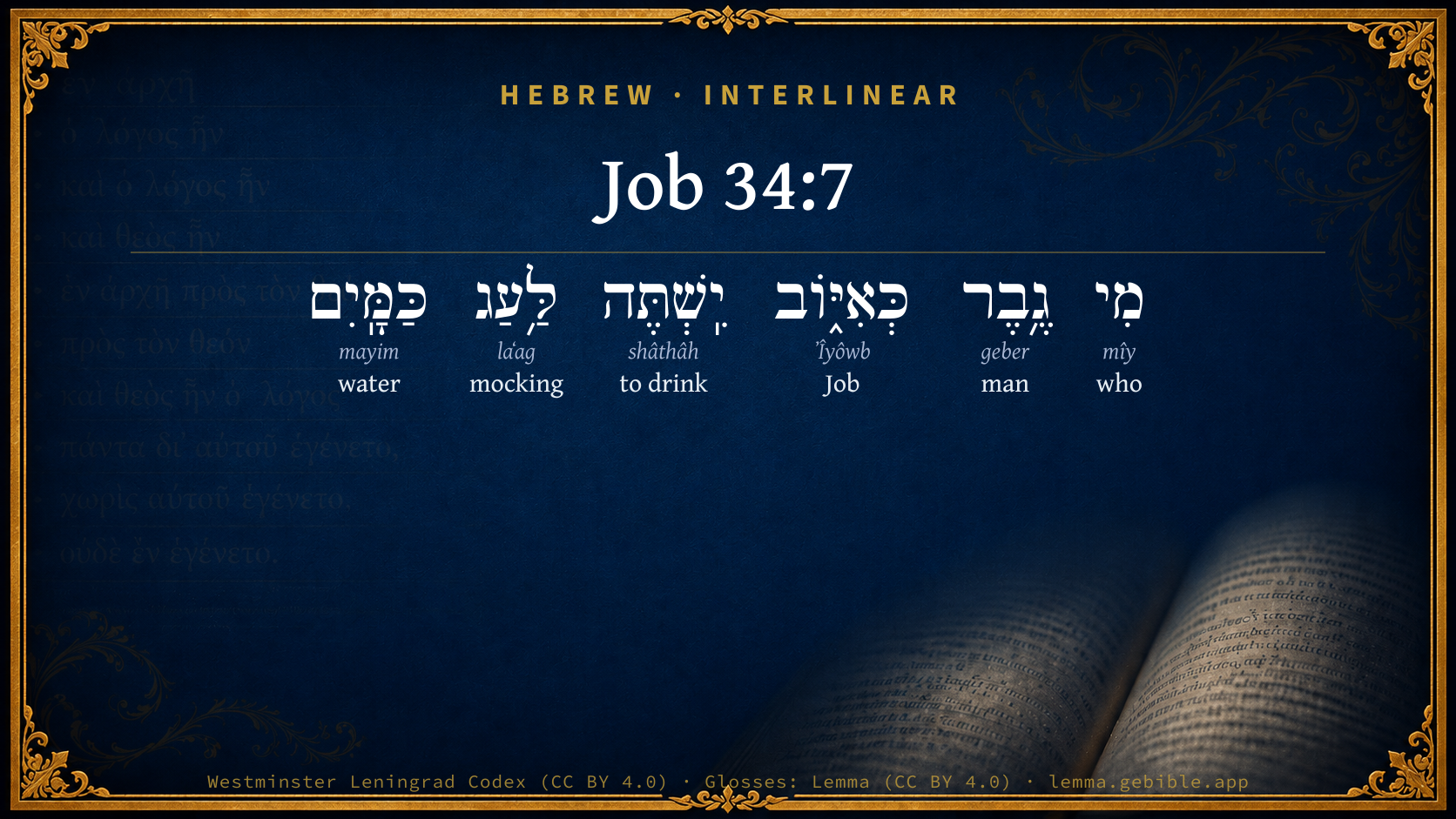
Hebrew (Westminster Leningrad Codex) Job 34:7 appears in the Hebrew Old Testament. The text above is from the Westminster Leningrad Codex. Each word links to its Strong’s number, a concise gloss, and parsing drawn from the Open Scriptures Hebrew Bible morphology. Click any word for its full Brown-Driver-Briggs (BDB) entry.
Download image
Cite this verse

Job 34:7 (World English Bible). Public Domain. Lemma interlinear Bible study tool, https://lemma.gebible.app/v/job/34/7.

Show BibTeX & RIS
BibTeX
RIS
English Translation
What man is like Job, Who drinks scorn like water,
World English Bible · Public Domain
Highlights
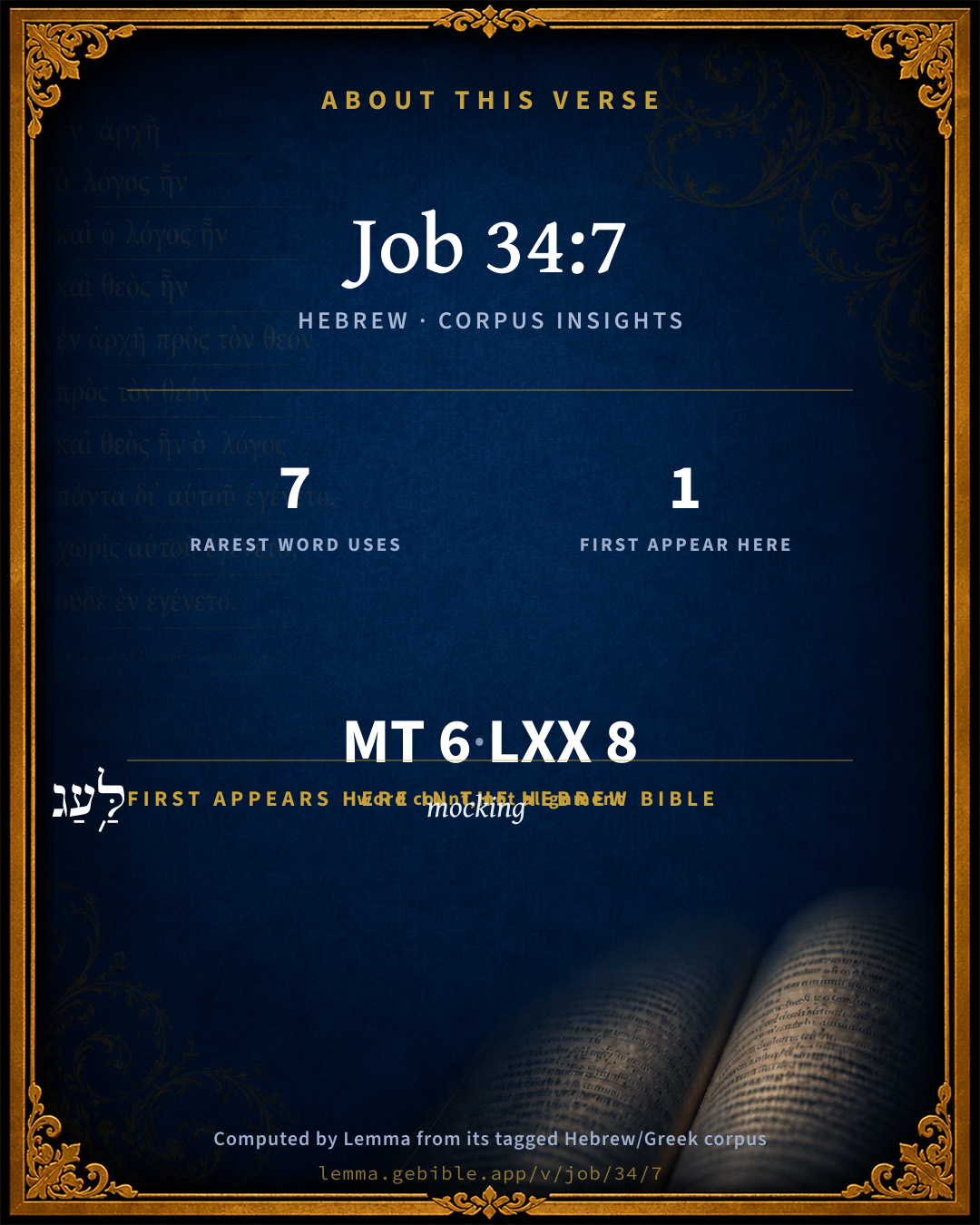
  • 1 first appearance in the Hebrew Bible
Full analysis ↓
Download a study sheet

One document with this verse’s original text, its word-by-word gloss line, the meaning frame, cross-references with their text, attributed commentary, and full source and license credits — printable, and it pastes into notes with its structure intact.

This verse Autodidact and up

Study sheet (.html) Plain text (.txt)

A passage Seminary Student

Up to 50 verses in one chapter. A passage sheet keeps up to 6 commentary sources and 12 cross-references per verse, in the order this page ranks them, and says so on the sheet whenever that leaves anything out. Ask for a single verse and you get the Autodidact verse sheet above.

Everything on this page stays free to read, with no account — the sheet is a download of what is already on screen, not access to it.

Want to remove ads? Support Godless Engineer
Compare translations 3

The same verse in 3 English versions, stacked beneath the original-language interlinear above. Click any original word for its lexicon entry.

Each is an independent rendering of the whole verse — the interlinear is not word-aligned to these translations.

Highlighted words mark where these versions differ — a whole-verse word diff, not a word-by-word alignment.

  • World English Bible Public Domain
    What man is like Job, Who drinks scorn like water,
  • King James Version Public Domain
    What man is like Job, who drinketh up scorning like water?
  • unfoldingWord Literal Text CC BY-SA 4.0
    What man like Job? He drinks scorn like water,

unfoldingWord Literal Text — © unfoldingWord, licensed CC BY-SA 4.0. Word-aligned USFM3 via Door43 (git.door43.org/unfoldingWord/en_ult).

Versions to compare (up to 4)

3 of 4 selected

Show all 18 translations

Every available English version of this verse, each an independent rendering of the whole verse.

  • World English Bible Public Domain
    What man is like Job, Who drinks scorn like water,
  • Berean Standard Bible Public Domain
    What man is like Job, who drinks up derision like water?
  • Majority Standard Bible Public Domain
    What man is like Job, who drinks up derision like water?
  • King James Version Public Domain
    What man is like Job, who drinketh up scorning like water?
  • American Standard Version (1901) Public Domain
    What man is like Job, Who drinketh up scoffing like water,
  • Revised Version (1885) Public Domain
    What man is like Job, who drinketh up scorning like water?
  • Geneva Bible (1599) Public Domain
    What man is like Iob, that drinketh scornfulnesse like water?
  • Douay-Rheims (1899) Public Domain
    What man is there like Job, who drinketh up scorning like water?
  • Young's Literal Translation Public Domain
    Who `is' a man like Job? He drinketh scoffing like water,
  • Literal Standard Version CC BY-SA 4.0
    Who [is] a man like Job? He drinks scoffing like water,
  • Unlocked Literal Bible CC BY-SA 4.0
    What man is like Job, who drinks up mockery like water,
  • unfoldingWord Literal Text CC BY-SA 4.0
    What man like Job? He drinks scorn like water,
  • Darby Bible Public Domain
    What man is like Job? he drinketh up scorning like water,
  • World Messianic Bible Public Domain
    What man is like Job, who drinks scorn like water,
  • Webster's Bible Public Domain
    What man is like Job, who drinketh up scorning like water?
  • Free Bible Version CC BY-SA 4.0
    Has there ever been a man like Job with such a thirst for ridiculing others?
  • Bible in Basic English Public Domain
    What man is like Job, a man who freely makes sport of God,
  • JPS Tanakh (1917) Public Domain
    What man is like Job, who drinketh up scorning like water?

Literal Standard Version (2020), Covenant Press — licensed CC BY-SA 4.0. Text via the HelloAO Bible API (eBible.org). Unlocked Literal Bible (unfoldingWord) — licensed CC BY-SA 4.0. Text via the HelloAO Bible API (eBible.org). unfoldingWord Literal Text — © unfoldingWord, licensed CC BY-SA 4.0. Word-aligned USFM3 via Door43 (git.door43.org/unfoldingWord/en_ult). Free Bible Version, Dr. Jonathan Gallagher — licensed CC BY-SA 4.0. Text via the HelloAO Bible API (eBible.org).

Word by word

More ways to search: Search by grammar → Find every occurrence → Compare this word →

Practice this passage: Drill this verse → Learn its vocabulary →

About this verse

These counts appear in no published source. They are computed here, from the morphology-tagged text and Lemma’s own curated glosses. What Lemma adds →

6
words
6
distinct lemmas
Wisdom
section

Notable vocabulary

The rarest word here is לַּ֥עַג mocking H3933 — appearing just 7 times in the whole Hebrew Bible.

First appearance in Scripture

This word makes its first canonical appearance in the Hebrew Bible here:

  • לַּ֥עַג mocking H3933

Shared distinctive vocabulary

לַּ֥עַג mocking H3933 occurs in 7 verses of the Hebrew Bible. Also found in:

Grammatical profile

  • 1 verb
  • 4 nouns
  • 1 particle

Verb forms

  • יִֽשְׁתֶּה Qal · Imperfect

Hebrew & Septuagint length

In English translation the verse runs 10 words from the Hebrew and 9 from the Septuagint (LXX English) — closely comparable.

A rough comparison of the two English renderings, which tokenize alike — not a word-level alignment.

Word counts can differ between the Hebrew and the Greek without any difference in meaning — e.g. the Hebrew direct-object marker אֵת has no separate Greek word, and Greek often adds the article ὁ.

In the original languages it is 6 Hebrew tokens and 8 Greek tokens — but the two are counted differently (Hebrew bundles its prefixes and suffixes into one token; the Greek is in lemma form), so that isn’t a like-for-like length.

Cross-references

4

Topical passages linked to Job 34:7 in the Treasury of Scripture Knowledge — connected by theme and wording, ordered by reader-vote popularity; previews shown in the World English Bible.

  • Job 15:16 How much less one who is abominable and corrupt, A man who drinks iniquity like water!
  • Deuteronomy 29:19 and it happen, when he hears the words of this curse, that he bless himself in his heart, saying, I shall have peace, though I walk in the stubbornness of my heart, to destroy the moist with the dry.
  • Proverbs 1:22 "How long, you simple ones, will you love simplicity? How long will mockers delight themselves in mockery, And fools hate knowledge?
  • Proverbs 4:17 For they eat the bread of wickedness, And drink the wine of violence.

Cross-references courtesy of OpenBible.info (CC BY 4.0).

Hebrew and Greek witnesses Masoretic Hebrew ↔ Greek Septuagint

The same verse in the two great witnesses to the Old Testament, shown verse-for-verse.

These are two independent witnesses, not word-aligned to each other, and the Septuagint is shown in lemma (dictionary) form.

Hebrew Job 34:7 Masoretic · Westminster Leningrad Codex

מִי גֶ֥בֶר כְּאִיּ֑וֹב יִֽשְׁתֶּה לַּ֥עַג כַּמָּֽיִם

What man is like Job, Who drinks scorn like water,

World English Bible · Public Domain

Greek LXX Job 34:7 Septuagint · lemma form

τίς ἀνήρ ὥσπερ ιωβ πίνω μυκτηρισμός ὥσπερ ὕδωρ

What man is as Job, drinking scorning like water?

LXX2012 (modern English Septuagint) · Public Domain

Hebrew: Westminster Leningrad Codex (CC BY 4.0). Greek: Septuagint (public domain); English from LXX2012 (modern English Septuagint) (Public Domain). How the Septuagint differs from the Hebrew →

Commentary

Notes on Job 34:7 from classic Christian and Jewish commentators (each source and its license shown beneath its notes). The classic Christian expositions comment on the surrounding passage and are grouped to its opening verse, so a note may address several verses; the Jewish commentaries on the Tanakh (Rashi and others) are per-verse, so they appear only where the commentator wrote on this verse.

Lemma curates 59 commentaries, every one of them public domain or Creative Commons licensed, each selected and text-cleaned for this edition rather than reprinted as found. About our sources →

Trapp's Complete Commentary

John Trapp

Job 34:7 What man [is] like Job, [who] drinketh up scorning like water?

Ver. 7. What man is like Job?] This Elihu speaketh by way of angry admiration, as if he would make Job a very nonsuch, a matchless offender; and that he much wondered with what face he could speak in that sort, Exclamatio admirativa (Pisc.). What, such a man as Job do thus? Oh, shameful! what? upbraid and reproach Almighty God? who would ever have expected such words from such a mouth? Is the man in his right mind, wot you, that he thus maketh himself a common laughing stock and by word, and yet maketh nothing of anything, but doth with as great facility and readiness swallow up men’s scoffs and taunts, as if he were drinking cold water, and no more is he troubled at them? Why, but is this Job? and is it possible that he should have so far lost all fear of God, and shame of the world, that he should set his mouth against heaven, as if he would spit in God’s face, and not care though he drink up scorning and affronts like water, quasi maledictis aleretur, ut venenis capreae, as if he were much taken and tickled with them? True it is, that Nemo pluris aestimavit virtutem, as Seneca saith, No man setteth a better price upon virtue than he who will rather part with his good name than part with his honesty. But it is also as true, that to neglect altogether what others think and say of us, non solum arrogantis est, sed et dissoluti, is the part not of a proud only, but of a forlorn person, saith the orator.

John Trapp, A Commentary or Exposition upon All the Books of the Old and New Testament (1647–1656) — public domain. Text from a community e-Sword module.

Joseph Benson's Commentary

Job 34:7-9. Who drinketh up scorning like water — That is, abundantly and greedily: who doth so break forth into scornful expressions, not only against his friends, but, in some sort, even against God himself. The Hebrew may be interpreted, What man, being like Job, would drink up scorning? &c. That a wicked or foolish man should act thus, is not strange; but that a man of such piety, gravity, wisdom, and authority, as Job, should be guilty of such a sin, this is wonderful. Which walketh with wicked men — Although I dare not say he is a wicked man, yet in this matter he speaks and acts like one of the wicked. For he hath said — Not absolutely, and in express terms, but by consequence, It profiteth a man nothing. &c. —

That though a man study to please God, he shall not be profited by it. For he said that good men were no less, nay, sometimes more miserable here than the wicked, Job 9:22; Job 30:26. And that, for his part, he was no gainer, as to this life, by his piety, but a loser, and that God showed him no more kindness and compassion than he usually did to the vilest of men.

Joseph Benson's Commentary on the Old and New Testaments (1811–1818) — public domain. Text from a community e-Sword module.

Geneva Bible (1599)

Geneva Bible translators

Which is compelled to receive thy reproach and scorns of many for his foolish words.

Geneva Bible (1599) marginal notes — public domain. Text via Bolls.life.

Jamieson, Fausset & Brown

Robert Jamieson, A. R. Fausset & David Brown

(Job 15:16). Image from the camel.

scorning--against God (Job 15:4).

Jamieson, Fausset & Brown — Commentary Critical and Explanatory on the Whole Bible (1871) — public domain (CC PDM 1.0). Text via the HelloAO Bible API.

Adam Clarke's Commentary

Verse 7. Drinketh up scorning like water?] This is a repetition of the charge made against Job by Eliphaz, Job 15:16. It is a proverbial expression, and seems to be formed, as a metaphor, from a camel drinking, who takes in a large draught of water, even the most turbid, on its setting out on a journey in a caravan, that it may serve it for a long time. Job deals largely in scorning; he fills his heart with it.

Adam Clarke's Commentary on the Bible (1810–1826) — public domain. Text from a community e-Sword/MySword module.

Ellicott's Commentary for English Readers

(7) Who drinketh up scorning?—The same word had been applied to Job by Zophar (Job_11:3), “And when thou mockest, shall no man make thee ashamed?” and the same reproach by Eliphaz (Job_15:16).

A Bible Commentary for English Readers, edited by Charles John Ellicott (1878–1897) — public domain. Text from a community e-Sword module.

The Cambridge Bible for Schools and Colleges

gen. ed. J. J. S. Perowne

7. Elihu cannot restrain his abhorrence of Job’s sentiments. By scorning is meant impiety and scepticism. On the figure comp. ch. Job_15:16.

The Cambridge Bible for Schools and Colleges (gen. ed. J. J. S. Perowne; Cambridge University Press, 1878–1918) — public domain. Text from a community e-Sword module.

John Gill's Exposition

Which goeth in company with the workers of iniquity,.... The worst of men, who make it their constant business and employment to commit sin:

and walketh with wicked men; the most abandoned of mankind. Not that Job kept company with such, and walked with them in all excess of not; nor did Elihu think so; Job was "a man that feared God, and eschewed evil", and evil men; he was "a companion of them that feared the Lord"; his delight was "with the excellent of the earth": nor should a good man keep company and walk with the wicked, nor can he with any pleasure. But the sense is, that by his words, the expressions that dropped from his lips, he seemed to agree with them, and to be of the same sentiments with them; and what he delivered tended to encourage and harden them in their sinful ways; and what those words were follow.

John Gill's Exposition of the Whole Bible (1746–1763) — public domain (CC PDM 1.0). Text via the HelloAO Bible API.

Albert Barnes' Notes on the Bible

What man is like Job, who drinketh up scorning like water? - A similar image occurs in Job 15:16. The idea is, that he was full of reproachful speeches respecting God; of the language of irreverence and rebellion. He indulged in it as freely as a man drinks water; gathers up and imbibes all the language of reproach that he can find, and indulges in it as if it were perfectly harmless.

Albert Barnes' Notes on the Bible (1834–1885) — public domain. Text from a community e-Sword/MySword module.

Haydock's Catholic Bible Commentary

What. This may be a continuation of Job’s speech, who seemed to assert that none had ever been insulted like himself, nor borne it with greater patience; (chap. xvi. 4.) or Eliu reproaches him with talking scornfully to his friends and to God. (Calmet)

George Leo Haydock (1774–1849), Haydock's Catholic Family Bible and Commentary, 1859 edition — public domain. Excludes Psalms (Douay-Rheims chapter numbering differs from Protestant) and Deuterocanonical books (Catholic canon only).

Matthew Poole's English Annotations

i.e. Abundantly and greedily; who doth so oft and so easily break forth into scornful and contemptuous expressions, not only against his friends, but in some sort even against God himself, whom he foolishly and insolently chargeth with dealing rigorously with him. The words may be thus read,

What man, being like Job, would drink up?..? That a wicked or foolish man should do thus is not strange; but that a man of such piety, gravity, wisdom, and authority as Job should be guilty of such a sin, this is wonderful.

Matthew Poole's English Annotations on the Holy Bible (1683–1685) — public domain. Text from a community e-Sword/MySword module.

Whedon's Commentary on the Bible

Daniel D. Whedon

7. Drinketh up scorning like water — He uses against Job one of the figures of Eliphaz, (see note on Job_15:16,) in which “iniquity” is the subject instead of “scorning,” as here.

Daniel D. Whedon (gen. ed.), Commentary on the Old and New Testaments (1874–1909) — public domain. Text from a community e-Sword module.

The Pulpit Commentary

What man is like Job, who drinketh up scorning like water? This comment is not only unnecessary, but unfair. It was not for Elihu, who professed a desire to "justify" (or completely exonerate) Job, to aggravate his guilt by means of rhetorical comment; and the comment itself was unfair, for Job had not indulged in scorn to any extent, much less "drunk it up like water". (comp. Job_15:16) He had in no respect scorned God; and if he had occasionally poured some scorn upon his "comforters", (Job_6:21 Job_12:2 Job_13:4-13 Job_16:2 Job_21:2-5 Job_26:2-4) must it not be admitted that they had deserved it? It was the duty of Elihu to act as moderator between Job and the "comforters," whereas he here seeks to exasperate them, and lash them up to fury against their afflicted friend. Perhaps Job"s impassive attitude has embittered him.

The Pulpit Commentary (1880–1919), ed. H.D.M. Spence-Jones & Joseph S. Exell — public domain. Text from a community e-Sword module.

John Wesley's Explanatory Notes

Like water - Abundantly and greedily: who doth so break forth into scornful expressions, not only against his friends, but in some sort against God himself.

John Wesley, Explanatory Notes Upon the Whole Bible (1754–1765) — public domain. Text via the GEBible commentary corpus.

unfoldingWord translationNotes

Door43 World Missions Community

General Information:

Elihu continues speaking.

What man is like Job

Elihu uses this rhetorical question to scold Job. This question can be written as a statement. AT: "There is no one else like Job" (See: Rhetorical Question)

who drinks up mockery like water

Elihu is accusing Job of mocking others as often as a person drinks water. AT: "who mocks other people as frequently as he drinks water" (See: Simile)

who walks with wicked men

Here "walk" is an idiom for how a person acts. AT: "who behaves like wicked men" (See: Metaphor)

translationWords

mock

water

evil

walk

unfoldingWord translationNotes — © Distant Shores Media and the Door43 World Missions Community, licensed CC BY-SA 4.0. Source: git.door43.org/Door43/en_tn.

Lesson kit

Teaching starters — assembled from the data on this page, not authored interpretation. Every prompt links to the verse data it draws on. Edit before teaching.

Job, in the Wisdom, opens this verse with 6 words (6 distinct Hebrew lemmas). Its most distinctive word is laʻag (“mocking”). A historical commentator’s framing appears above. Read the whole chapter for the surrounding context.

Discussion questions

  1. The word laʻag carries the sense “mocking.” How does it shape the verse?
  2. This is the first place “mocking” appears in Scripture (first appears here). What does its debut here establish?
  3. How does Psalms 44:13, which shares the word «mocking», read alongside this verse?
  4. These translations render this verse differently; the difference is in the English rendering, not the original. What questions does that raise?
  5. «יִֽשְׁתֶּה» is a Qal Imperfect verb. How does that grammatical form shape the action described?
  6. Compare how Trapp's Complete Commentary and Joseph Benson's Commentary read this verse. Where do they agree or differ?

Things to notice

Reading settings

Reading text

Shown beneath each verse's original-language words.

Old Testament
Old Testament edition

Read the OT as the Masoretic Hebrew (MT) or the Greek Septuagint (LXX).

English shown for the Greek Septuagint (in the Hebrew ↔ Greek comparison).

Comparing translations? Open the Compare panel on any verse page to stack up to four side by side.