Jeremiah 22:15

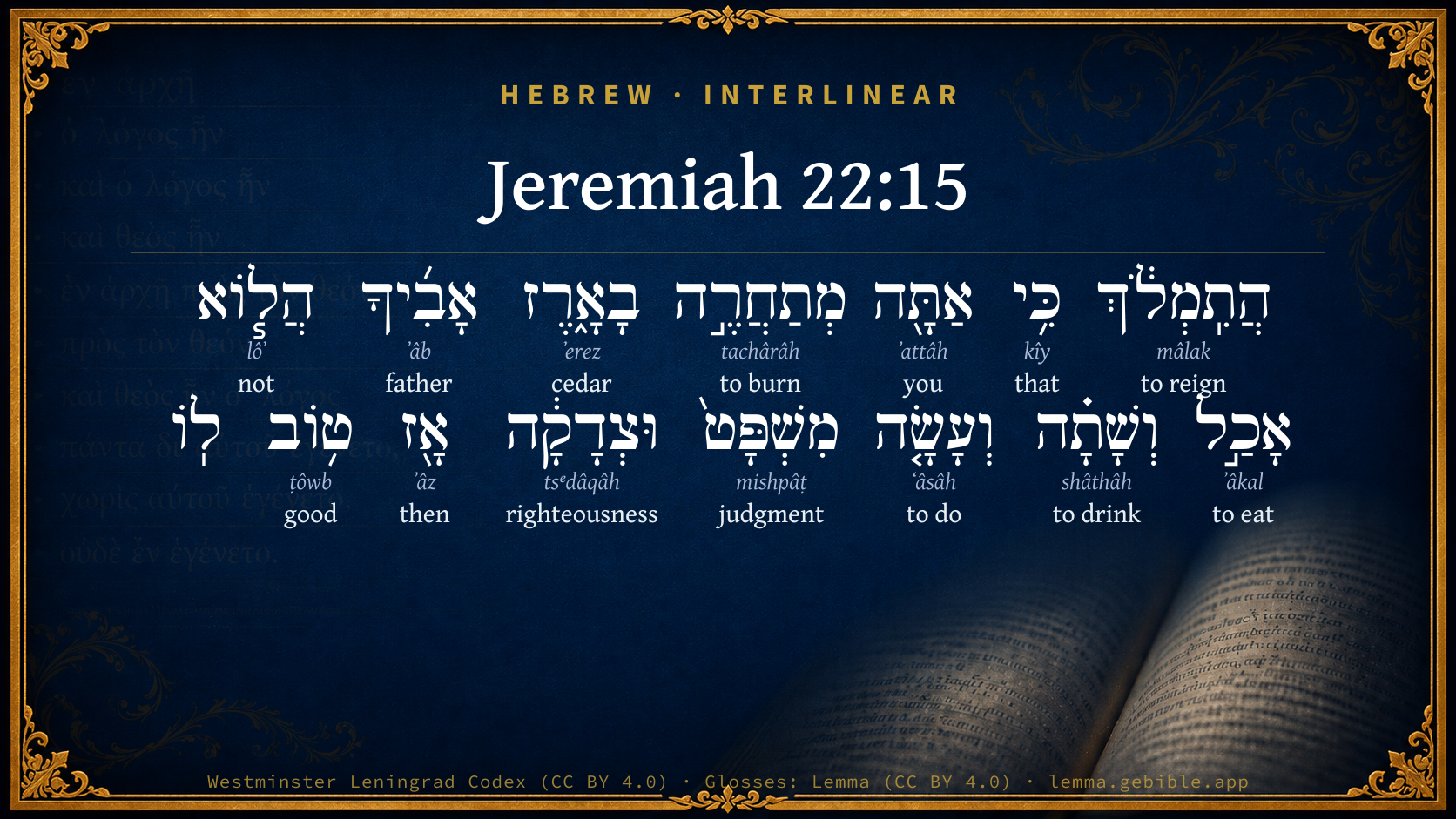
Hebrew (Westminster Leningrad Codex) Jeremiah 22:15 appears in the Hebrew Old Testament. The text above is from the Westminster Leningrad Codex. Each word links to its Strong’s number, a concise gloss, and parsing drawn from the Open Scriptures Hebrew Bible morphology. Click any word for its full Brown-Driver-Briggs (BDB) entry.
Download image
Cite this verse

Jeremiah 22:15 (World English Bible). Public Domain. Lemma interlinear Bible study tool, https://lemma.gebible.app/v/jeremiah/22/15.

Show BibTeX & RIS
BibTeX
RIS
English Translation
Shall you reign, because you strive to excel in cedar? Didn't your father eat and drink, and do justice and righteousness? then it was well with him.
World English Bible · Public Domain
Download a study sheet

One document with this verse’s original text, its word-by-word gloss line, the meaning frame, cross-references with their text, attributed commentary, and full source and license credits — printable, and it pastes into notes with its structure intact.

This verse Autodidact and up

Study sheet (.html) Plain text (.txt)

A passage Seminary Student

Up to 50 verses in one chapter. A passage sheet keeps up to 6 commentary sources and 12 cross-references per verse, in the order this page ranks them, and says so on the sheet whenever that leaves anything out. Ask for a single verse and you get the Autodidact verse sheet above.

Everything on this page stays free to read, with no account — the sheet is a download of what is already on screen, not access to it.

Want to remove ads? Support Godless Engineer
Compare translations 3

The same verse in 3 English versions, stacked beneath the original-language interlinear above. Click any original word for its lexicon entry.

Each is an independent rendering of the whole verse — the interlinear is not word-aligned to these translations.

Highlighted words mark where these versions differ — a whole-verse word diff, not a word-by-word alignment.

  • World English Bible Public Domain
    Shall you reign, because you strive to excel in cedar? Didn't your father eat and drink, and do justice and righteousness? then it was well with him.
  • King James Version Public Domain
    Shalt thou reign, because thou closest thyself in cedar? did not thy father eat and drink, and do judgment and justice, and then it was well with him?
  • unfoldingWord Literal Text CC BY-SA 4.0
    Will you reign because you are competing in cedar? Did not your father eat and drink and do justice and righteousness? Then was good for him.

unfoldingWord Literal Text — © unfoldingWord, licensed CC BY-SA 4.0. Word-aligned USFM3 via Door43 (git.door43.org/unfoldingWord/en_ult).

Versions to compare (up to 4)

3 of 4 selected

Show all 18 translations

Every available English version of this verse, each an independent rendering of the whole verse.

  • World English Bible Public Domain
    Shall you reign, because you strive to excel in cedar? Didn't your father eat and drink, and do justice and righteousness? then it was well with him.
  • Berean Standard Bible Public Domain
    Does it make you a king to excel in cedar? Did not your father have food and drink? He administered justice and righteousness, and so it went well with him.
  • Majority Standard Bible Public Domain
    Does it make you a king to excel in cedar? Did not your father have food and drink? He administered justice and righteousness, and so it went well with him.
  • King James Version Public Domain
    Shalt thou reign, because thou closest thyself in cedar? did not thy father eat and drink, and do judgment and justice, and then it was well with him?
  • American Standard Version (1901) Public Domain
    Shalt thou reign, because thou strivest to excel in cedar? Did not thy father eat and drink, and do justice and righteousness? then it was well with him.
  • Revised Version (1885) Public Domain
    Shalt thou reign, because thou strivest to excel in cedar? did not thy father eat and drink, and do judgment and justice? then it was well with him.
  • Geneva Bible (1599) Public Domain
    Shalt thou reigne, because thou closest thy selfe in cedar? did not thy father eate and drinke and prosper, when he executed iudgement and iustice?
  • Douay-Rheims (1899) Public Domain
    Shalt thou reign, because thou comparest thyself to the cedar? did not thy father eat and drink, and do judgment and justice, and it was then well with him?
  • Young's Literal Translation Public Domain
    Dost thou reign, because thou art fretting thyself in cedar? Thy father -- did he not eat and drink? Yea, he did judgment and righteousness, Then `it is' well with him.
  • Literal Standard Version CC BY-SA 4.0
    Do you reign, because you are fretting yourself in cedar? Your father—did he not eat and drink? Indeed, he did judgment and righteousness, || Then [it is] well with him.
  • Unlocked Literal Bible CC BY-SA 4.0
    Is this what makes you a good king, that you wanted to have boards of cedar? Did not your father also eat and drink, yet do justice and righteousness? Then things went well for him.
  • unfoldingWord Literal Text CC BY-SA 4.0
    Will you reign because you are competing in cedar? Did not your father eat and drink and do justice and righteousness? Then was good for him.
  • Darby Bible Public Domain
    Shalt thou reign, because thou viest with the cedar? Did not thy father eat and drink, and do judgment and justice? Then it was well with him.
  • World Messianic Bible Public Domain
    “Should you reign because you strive to excel in cedar? Didn’t your father eat and drink, and do justice and righteousness? Then it was well with him.
  • Webster's Bible Public Domain
    Shalt thou reign, because thou closest thyself in cedar? did not thy father eat and drink, and do judgment and justice, and then it was well with him?
  • Free Bible Version CC BY-SA 4.0
    Does it make you a king just because you have more cedar than anyone else? Your father had food and drink, didn't he? He ruled fairly and honestly, and he had a good life because of this.
  • Bible in Basic English Public Domain
    Are you to be a king because you make more use of cedar than your father? did not your father take food and drink and do right, judging in righteousness, and then it was well for him?
  • JPS Tanakh (1917) Public Domain
    Shalt thou reign, because thou strivest to excel in cedar? Did not thy father eat and drink, and do justice and righteousness? Then it was well with him.

Literal Standard Version (2020), Covenant Press — licensed CC BY-SA 4.0. Text via the HelloAO Bible API (eBible.org). Unlocked Literal Bible (unfoldingWord) — licensed CC BY-SA 4.0. Text via the HelloAO Bible API (eBible.org). unfoldingWord Literal Text — © unfoldingWord, licensed CC BY-SA 4.0. Word-aligned USFM3 via Door43 (git.door43.org/unfoldingWord/en_ult). Free Bible Version, Dr. Jonathan Gallagher — licensed CC BY-SA 4.0. Text via the HelloAO Bible API (eBible.org).

Word by word

More ways to search: Search by grammar → Find every occurrence → Compare this word →

Practice this passage: Drill this verse → Learn its vocabulary →

מְתַחֲרֶ֣ה
tachârâh
H8474
“burning”
Verb, Tiphil, Participle Active, Masculine, Singular, Absolute
Part of Speech
Verb
Stem
Tiphil
Form
Participle Active
Gender
Masculine
Number
Singular
State
Absolute
Full BDB Definition

Origin: a facetious root from H2734 through the idea of the heat of jealousy

TWOT: TWOT - 736

to burn, be kindled (of anger) - (Tiphel) to heat oneself in vexation
  1. הֲתִֽמְלֹ֔ךְ mâlak H4427 “to reign” Particle, Interrogative + Verb, Qal, Imperfect, 2nd Person, Masculine, Singular
  2. כִּ֥י kîy H3588 “that” Conjunction
  3. אַתָּ֖ה ʼattâh H859 “you” Pronoun, Personal, 2nd Person, Masculine, Singular
  4. בָאָ֑רֶז ʼerez H730 “in/at the · cedar” Preposition, Determined + Noun, Common, Masculine, Singular, Absolute
  5. אָבִ֜יךָ ʼâb H1 “father · your” Noun, Common, Masculine, Singular, Construct + Suffix, Personal, 2nd Person, Masculine, Singular
  6. הֲל֧וֹא lôʼ H3808 “not” Particle, Interrogative + Particle, Negative
  7. אָכַ֣ל ʼâkal H398 “to eat” Verb, Qal, Perfect, 3rd Person, Masculine, Singular
  8. וְשָׁתָ֗ה shâthâh H8354 “and · to drink” Conjunction + Verb, Qal, Perfect, 3rd Person, Masculine, Singular
  9. וְעָשָׂ֤ה ʻâsâh H6213 “and · to do” Conjunction + Verb, Qal, Perfect, 3rd Person, Masculine, Singular
  10. מִשְׁפָּט֙ mishpâṭ H4941 “judgment” Noun, Common, Masculine, Singular, Absolute
  11. וּצְדָקָ֔ה tsᵉdâqâh H6666 “and · righteousness” Conjunction + Noun, Common, Feminine, Singular, Absolute
  12. אָ֖ז ʼâz H227 “then” Adverb
  13. ט֥וֹב ṭôwb H2896 “good” Adjective, Adjective, Masculine, Singular, Absolute

About this verse

These counts appear in no published source. They are computed here, from the morphology-tagged text and Lemma’s own curated glosses. What Lemma adds →

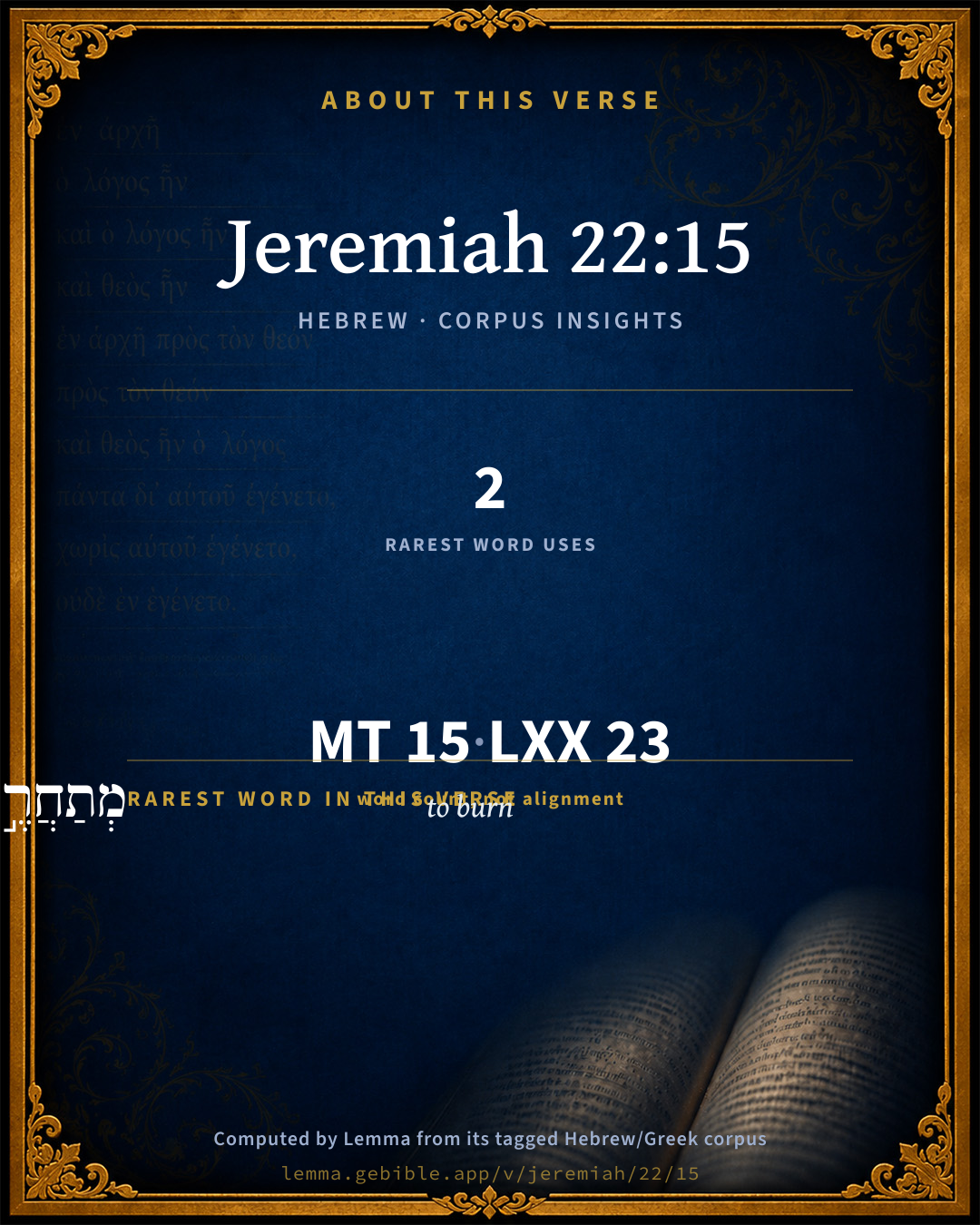
15
words
14
distinct lemmas
Prophets
section

Notable vocabulary

The rarest word here is מְתַחֲרֶ֣ה to burn H8474 — appearing just 2 times in the whole Hebrew Bible.

Shared distinctive vocabulary

מְתַחֲרֶ֣ה to burn H8474 occurs in 2 verses of the Hebrew Bible. Also found in:

Grammatical profile

  • 5 verbs
  • 4 nouns
  • 1 adjective
  • 1 pronoun
  • 1 preposition
  • 1 conjunction
  • 1 adverb
  • 1 particle

Verb forms

  • הֲתִֽמְלֹ֔ךְ Qal · Imperfect
  • מְתַחֲרֶ֣ה Tiphil · Participle Active
  • אָכַ֣ל Qal · Perfect
  • וְשָׁתָ֗ה Qal · Perfect
  • וְעָשָׂ֤ה Qal · Perfect

Hebrew & Septuagint length

In the original languages it is 15 Hebrew tokens and 23 Greek tokens — but the two are counted differently (Hebrew bundles its prefixes and suffixes into one token; the Greek is in lemma form), so that isn’t a like-for-like length.

Cross-references

30

Topical passages linked to Jeremiah 22:15 in the Treasury of Scripture Knowledge — connected by theme and wording, ordered by reader-vote popularity; previews shown in the World English Bible.

  • 2 Kings 23:25 Like him was there no king before him, who turned to Yahweh with all his heart, and with all his soul, and with all his might, according to all the law of Moses; neither after him arose there any like him.
  • Isaiah 3:10 Tell the righteous "Good!" For they shall eat the fruit of their deeds.
  • Proverbs 25:5 Take away the wicked from the king's presence, And his throne will be established in righteousness.
  • Ecclesiastes 10:17 Happy are you, land, when your king is the son of nobles, And your princes eat in due season, For strength, and not for drunkenness!
  • Proverbs 29:4 The king by justice makes the land stable, But he who takes bribes tears it down.
  • 2 Kings 22:2 He did that which was right in the eyes of Yahweh, and walked in all the way of David his father, and didn't turn aside to the right hand or to the left.
  • Psalms 128:1–2 Blessed is everyone who fears Yahweh, Who walks in his ways.
  • 2 Samuel 8:15 David reigned over all Israel; and David executed justice and righteousness to all his people.
  • 1 Kings 10:9 Blessed be Yahweh your God, who delighted in you, to set you on the throne of Israel: because Yahweh loved Israel forever, therefore made he you king, to do justice and righteousness.
  • Proverbs 21:3 To do righteousness and justice Is more acceptable to Yahweh than sacrifice.
  • Jeremiah 21:12 House of David, thus says Yahweh, Execute justice in the morning, and deliver him who is robbed out of the hand of the oppressor, lest my wrath go forth like fire, and burn so that none can quench it, because of the evil of your doings.
  • Jeremiah 42:6 Whether it be good, or whether it be evil, we will obey the voice of Yahweh our God, to whom we send you; that it may be well with us, when we obey the voice of Yahweh our God.
  • Deuteronomy 4:40 You shall keep his statutes, and his commandments, which I command you this day, that it may go well with you, and with your children after you, and that you may prolong your days in the land, which Yahweh your God gives you, forever.
  • 1 Kings 4:20–23 Judah and Israel were many as the sand which is by the sea in multitude, eating and drinking and making merry.
  • 1 Chronicles 3:15 The sons of Josiah: the firstborn Johanan, the second Jehoiakim, the third Zedekiah, the fourth Shallum.
  • 2 Chronicles 34:2 He did that which was right in the eyes of Yahweh, and walked in the ways of David his father, and didn't turn aside to the right hand or to the left.
  • 2 Chronicles 35:7–8 Josiah gave to the children of the people, of the flock, lambs and kids, all of them for the Passover offerings, to all who were present, to the number of thirty thousand, and three thousand bulls: these were of the king's substance.
  • 2 Chronicles 35:12–18 They removed the burnt offerings, that they might give them according to the divisions of the fathers' houses of the children of the people, to offer to Yahweh, as it is written in the book of Moses. So did they with the oxen.
  • Proverbs 20:28 Love and faithfulness keep the king safe. His throne is sustained by love.
  • Proverbs 31:9 Open your mouth, judge righteously, And serve justice to the poor and needy."
  • Ecclesiastes 2:24 There is nothing better for a man than that he should eat and drink, and make his soul enjoy good in his labor. This also I saw, that it is from the hand of God.
  • Ecclesiastes 9:7–10 Go your way--eat your bread with joy, and drink your wine with a merry heart; for God has already accepted your works.
  • Isaiah 9:7 Of the increase of his government and of peace there shall be no end, on the throne of David, and on his kingdom, to establish it, and to uphold it with justice and with righteousness from henceforth even forever. The zeal of Yahweh of Hosts will perform this.
  • Isaiah 33:16 He shall dwell on high; his place of defense shall be the munitions of rocks; his bread shall be given [him]; his waters shall be sure.
  • Jeremiah 22:3 Thus says Yahweh: Execute you justice and righteousness, and deliver him who is robbed out of the hand of the oppressor: and do no wrong, do no violence, to the foreigner, the fatherless, nor the widow; neither shed innocent blood in this place.
  • Jeremiah 22:18 Therefore thus says Yahweh concerning Jehoiakim the son of Josiah, king of Judah: they shall not lament for him, [saying], Ah my brother! or, Ah sister! They shall not lament for him, [saying] Ah lord! or, Ah his glory!
  • Jeremiah 23:5 Behold, the days come, says Yahweh, that I will raise to David a righteous Branch, and he shall reign as king and deal wisely, and shall execute justice and righteousness in the land.
  • Luke 11:41 But give for gifts to the needy those things which are within, and behold, all things will be clean to you.
  • Acts 2:46 Day by day, continuing steadfastly with one accord in the temple, and breaking bread at home, they took their food with gladness and singleness of heart,
  • 1 Corinthians 10:31 Whether therefore you eat, or drink, or whatever you do, do all to the glory of God.

Cross-references courtesy of OpenBible.info (CC BY 4.0).

Hebrew and Greek witnesses Masoretic Hebrew ↔ Greek Septuagint

The same verse in the two great witnesses to the Old Testament, shown verse-for-verse.

These are two independent witnesses, not word-aligned to each other, and the Septuagint is shown in lemma (dictionary) form.

Hebrew Jeremiah 22:15 Masoretic · Westminster Leningrad Codex

הֲתִֽמְלֹ֔ךְ כִּ֥י אַתָּ֖ה מְתַחֲרֶ֣ה בָאָ֑רֶז אָבִ֜יךָ הֲל֧וֹא אָכַ֣ל וְשָׁתָ֗ה וְעָשָׂ֤ה מִשְׁפָּט֙ וּצְדָקָ֔ה אָ֖ז ט֥וֹב לֽוֹ

Shall you reign, because you strive to excel in cedar? Didn't your father eat and drink, and do justice and righteousness? then it was well with him.

World English Bible · Public Domain

Greek LXX Structure differs

In the Septuagint, Jeremiah is about an eighth shorter than the Hebrew and arranges its material differently — the Oracles Against the Nations (Hebrew chapters 46–51) appear in the middle of the Greek book, after 25:13. Because the chapter and verse boundaries do not line up, a verse-for-verse comparison with the Hebrew is not shown.

A verse-for-verse comparison isn’t shown here because the chapters and verses don’t line up. Switch to the LXX edition with the MT / LXX toggle above to read the Greek directly.

On this verse, Keil & Delitzsch discusses the Septuagint’s reading. Read the note in Commentary ↓

Hebrew: Westminster Leningrad Codex (CC BY 4.0). Greek: Septuagint (public domain); English from a public-domain English Septuagint. How the Septuagint differs from the Hebrew →

Targum (Aramaic paraphrase)

1

The Targum is the ancient Jewish Aramaic paraphrase of the Hebrew Scriptures — an interpretive translation, not the Hebrew text itself. Onkelos (literal) and Pseudo-Jonathan (expansive) render the Torah, and Jonathan the Prophets. Coverage is partial: where no permissively-licensed English translation exists for a verse, only the Aramaic is shown. This is verse-level text, not a word-by-word alignment to the Hebrew.

  1. Targum Jonathan Prophets (Joshua–Malachi)
    הַאַתְּ מְדַמֵי לְמֶהֱוֵי בְּמַלְכָּא קַדְמָאָה אֲבוּךְ הֲלָא אָכַל וּשְׁתָא וַעֲבַד דִין דִקְשׁוֹט וְזָכוּ בְּכֵן טָב לֵיהּ:

    (no public-domain English translation for this verse)

    Targum Jonathan — Aramaic: “Mikraot Gedolot” (public domain). English: “Sefaria Community Translation” (CC0 1.0 (public-domain dedication)); “London "Chaldee Paraphrase," 1871” (public domain). Text via Sefaria.

Commentary

Notes on Jeremiah 22:15 from classic Christian and Jewish commentators (each source and its license shown beneath its notes). The classic Christian expositions comment on the surrounding passage and are grouped to its opening verse, so a note may address several verses; the Jewish commentaries on the Tanakh (Rashi and others) are per-verse, so they appear only where the commentator wrote on this verse.

Lemma curates 59 commentaries, every one of them public domain or Creative Commons licensed, each selected and text-cleaned for this edition rather than reprinted as found. About our sources →

Trapp's Complete Commentary

John Trapp

Jer 22:15 Shalt thou reign, because thou closest [thyself] in cedar? did not thy father eat and drink, and do judgment and justice, [and] then [it was] well with him?

Ver. 15. Shalt thou reign because thou closest thyself in cedar?] Hast thou no better mediums to establish thy throne? no better defence against a potent enemy that comes to dethrone thee than a ceiling of cedar? What if thy cedar putrify not can it secure thee that thou perish not? Ah, never think it.

Did not thy father eat and drink?] Live cheerfully and comfortably, enjoying peace and prosperity through his righteousness and piety.

And then it was well with him.] Heb., Then was good to him; though he did not flaunt it out in sumptuous buildings. But you have great thoughts, and will not take it as your father did.

John Trapp, A Commentary or Exposition upon All the Books of the Old and New Testament (1647–1656) — public domain. Text from a community e-Sword module.

The Biblical Illustrator

Joseph S. Exell

Jer_22:15-16

Did not thy father eat and drink.

Gods expostulation with Jehoiakim

I. God remembereth the piety and usefulness of our ancestors, and observeth how far we resemble them. The Eternal Mind cannot possibly forget anything. All things past, as well as present, are naked and open before His eyes. He remembers all the way in which our fathers walked; the secret piety of their hearts; the evidences of it in their lives, and all the service they did for God and their generation. He remembered how piously Josiah walked, and mentions it to his honour. God hath a kind remembrance of His faithful servants, when they are departed out of this world; and is not unrighteous, to forget any work and labour of love which they have performed. Let it be further observed, that God takes notice how far we resemble them. Thus He chargeth it upon Jehoiakim, that he had not trod in his fathers steps. God can and will make a just estimate, what our religious advantages are, compared with theirs, and what improvement we make of these advantages. He observeth every instance of declension from that which is good, and the principles from which our departures from God and religion flow.

II. Young persons often forsake the religion of their fathers, through pride, and love of elegance, pomp, and show. This was the case of Jehoiakim. No doubt it is lawful for persons of rank and fortune to build themselves houses and to beautify them; provided it be suitable to their circumstances, and no injury to justice or charity. But it was pride that led Jehoiakim to covet so much splendour, and practise so much injustice. This is a sin that easily besets the young, and often leads them to forsake the ways and the God of their fathers. They set out beyond their rank and circumstances, and begin where their wiser fathers ended. And this their pride and vanity leads them to forsake the religious profession of their fathers. Thus Jehoiakim, it is probable, turned idolater. He forsook the God of Israel, and persecuted His faithful prophets. Hence so many among us forsake the principles and profession of their ancestors; because the favour and preferments of the world and public fashion are not on that side. Set out in life, young friends, with moderate desires, wishes, and expectations. Be content with your rank and station. Endeavour to cultivate and strengthen religious principles and dispositions. Never compliment any at the expense of truth and conscience. Thus you will be able to do justice and mercy, and will retain that steadfastness in religion which is true politeness, and improve in that humility which is the brightest ornament.

III. It is a great dishonour and reproach to any to forsake the good ways of their fathers. Having fully known their manner of life, their devotion, purity, temperance, patience, charity, and love to Gods house and ordinances, they must act a very mean and scandalous part, if they neglect these virtues, and show themselves blind to the lustre of such good examples. How justly may such be expostulated with, as Jehoiakim was in the text! Did thy father, young man, do justice and judgment, and assist the poor and needy? Was he sober, diligent, grave, and devout? And will it be to thy credit to be giddy, dishonest, idle, extravagant, and an associate with rakes and sots? Did thy mother, young woman, fill up her place honourably? Was she active, prudent, serious, and good tempered? Did she sanctify Gods Sabbath, and labour to keep thee from pride and levity, and dangerous acquaintance? And wilt thou forget all this, and run into every fashionable folly? Will this be for thy reputation and comfort? But there is a more weighty thought than this, yet to be urged; and that is, if you act thus, you will forfeit the favour of God. There are terrible threatenings, in the context and other places of this prophecy, against this wicked Jehoiakim. All his wealth, pomp, and power could not shield him from the judgments of God. A few years after this prophecy, the King of Babylon seized him, and bound him in fetters to carry him to Babylon; but, being released upon his promise of allegiance, he afterwards rebelled, was slain in a sally out of Jerusalem, and was buried with the burial of an ass, drawn and cast forth beyond the gates of Jerusalem (Jer_22:19), and had no child to sit upon the throne of David (2Ch_36:6; Jer_36:30). If you forsake the religion of your pious ancestors, it will be to your shame.

IV. The way of religion is the way of wisdom, honour, and happiness.

1. The way of religion is the way of wisdom (Psa_111:10). With this the New Testament agreeth (1Jn_2:3-4). Many think themselves wiser than their good fathers; and perhaps they may have juster notions of religion, and be more free from superstition and enthusiasm. Yet, while they profess to know God, they may in works deny Him, and love the praise of man more than the praise of God. And thus they prove that they are not so wise as their fathers.

2. The way of religion is also the way of honour. Josiah was universally esteemed while living, and much lamented when dead. The prophet Jeremiah lamented for him. All Judah and Jerusalem mourned for him, and made them an ordinance in Israel, that his remembrance should be kept up by some annual form of lamentation (2Ch_35:25). Luxury and extravagance, splendour and show, are not the way to be truly honourable. The just, the generous, the friendly man, he who is strictly religious, and soberly singular, and who studies to do good to others, though he hath a mean house, and dresseth and liveth plain, this man will be held in reputation.

3. The way of religion is the way of happiness. It is the way to enjoy prosperity, and to have comfort in it. While we do well, it will certainly be well with us. If our views extended no further than the present life, it is our wisdom and interest to be steadfastly religious. But when we consider ourselves as in a state of trial for another world, and that our future state will be either happy or miserable forever, according to our present behaviour, it must be the greatest folly and madness to neglect religion, to sacrifice it to anything else, or not to make it the main business of our lives. (Job Orion, D. D.)

The Biblical Illustrator, edited by Joseph S. Exell (c. 1880s–1900s) — public domain. Text from a community e-Sword module.

Keil & Delitzsch

C. F. Keil & F. Delitzsch

In Jer 22:15 Jeremiah pursues the subject: kingship and kingcraft do not consist in the erection of splendid palaces, but in the administration of right and justice. The reproachful question התמלך has not the meaning: wilt thou reign long? or wilt thou consolidate thy dominion? but: dost thou suppose thyself to be a king, to show thyself a king, if thy aim and endeavour is solely fixed on the building of a stately palace? "Viest," as in Jer 12:5. בּארז, not: with the cedar, for תחרה is construed with the accus. of that with which one vies, but: in cedar, i.e., in the building of cedar palaces. It was not necessary to say with whom he vied, since the thought of Solomon's edifices would suggest itself. The lxx have changed בארז by a pointless quid pro quo into באחז, ἐν ̓́Αχαζ, for which Cod. Alex. and Arabs have ἐν ̓Αχαάβ. The fact that Ahab had built a palace veneered with ivory (Kg1 22:39) is not sufficient to approve this reading, which Ew. prefers. Still less cause is there to delete בארז as a gloss (Hitz.) in order to obtain the rendering, justified neither by grammar nor in fact, "if thou contendest with thy father." To confirm what he has said, the prophet sets before the worthless king the example of his godly father Josiah. "Thy father, did not he eat and drink," i.e., enjoy life (cf. Ecc 2:24; Ecc 3:13)? yet at the same time he administered right and justice, like his forefather David; Sa2 8:15. Then went it well with him and the kingdom. אז, Jer 22:16, is wider than אז טו: in respect that he did justice to the poor and wretched, things went well, were well managed in the kingdom at large. In so doing consists "the knowing of me." The knowledge of Jahveh is the practical recognition of God which is displayed in the fear of God and a pious life. The infinitive nomin. דּעת has the article because a special emphasis lies on the word (cf. Ew. 277, c), the true knowledge of God required to have stress laid on it. - But Jehoiakim is the reverse of his father. This thought, lying in Jer 22:16, is illustrated in Jer 22:17. For thine eyes are set upon nothing but gain. בּצע, gain with the suggestion of unrighteousness about it, cf. Jer 6:13; Jer 8:10. His whole endeavour was after wealth and splendour. The means of attaining this aim was injustice, since he not only withheld their wages from his workers (Jer 22:13), but caused the innocent to be condemned in the judgment that he might grasp their goods to himself, as e.g., Ahab had done with Naboth. He also put to death the prophets who rebuked his unrighteousness, Jer 26:23, and used every kind of lawless violence. "Oppression" is amplified by המרוּצה (from רצץ, cf. Deu 28:33; Sa1 12:3), crushing, "what we call flaying people" (Hitz.); cf. on this subject, Mic 3:3.

Keil & Delitzsch — Biblical Commentary on the Old Testament (1861–1891) — public domain (CC PDM 1.0). Text via the HelloAO Bible API. (Old Testament only.)

Tyndale Open Study Notes

Tyndale Open Resources

22:15-16 If Jehoiakim wanted plenty to eat and drink, he did not have to resort to corruption and oppression. Compared with his prosperous father, Josiah, Jehoiakim was not a great king. Josiah, by contrast, had been just and right in all his dealings, a servant of God and his people. Because he had lived up to the requirements of the ancient covenant, God blessed him.

Tyndale Open Study Notes — © Tyndale Open Resources, licensed CC BY-SA 4.0. Text via the HelloAO Bible API.

Geneva Bible (1599)

Geneva Bible translators

Meaning, Josiah, who was not given to ambition and superfluity, but was content with mediocrity, and did only delight in setting forth God’s glory, and to do justice to all.

Geneva Bible (1599) marginal notes — public domain. Text via Bolls.life.

Jamieson, Fausset & Brown

Robert Jamieson, A. R. Fausset & David Brown

closest thyself--rather, "thou viest," that is, art emulous to surpass thy forefathers in the magnificence of thy palaces.

eat and drink--Did not Josiah, thy father, enjoy all that man really needs for his bodily wants? Did he need to build costly palaces to secure his throne? Nay, he did secure it by "judgment and justice"; whereas thou, with all thy luxurious building, sittest on a tottering throne.

then--on that account, therefore.

Jamieson, Fausset & Brown — Commentary Critical and Explanatory on the Whole Bible (1871) — public domain (CC PDM 1.0). Text via the HelloAO Bible API.

Adam Clarke's Commentary

Verse 15. Shalt thou reign, &c.] Dost thou think thou art a great king, because thou dwellest in a splendid palace?

Adam Clarke's Commentary on the Bible (1810–1826) — public domain. Text from a community e-Sword/MySword module.

John Calvin's Commentaries

The Prophet here derides the foolish confidence of King Jehoiakim, because he set up empty things against his enemies instead of strong defences. Kings are wont to indulge themselves when there is quietness and security; that is, when they fear nothing; when no danger appears, they then give way to their own gratifications; and this is commonly the case with all; for we see that kings especially indulge in excesses, when there is no war, when no one gives them trouble, and no one threatens them; but Jehoiakim, had he the least particle of wisdom, might have known that he had many dangers to dread. Now, when he applied all his thoughts to the painting of his walls, and to the splendor of his palace, to its wainscotting and other trifles, must he not have been insane, and not of a sound mind?

It is this madness that Jeremiah now condemns when he says, Shalt thou reign, because thou surroundest thyself with cedar board? that is, “Can this confirm thy kingdom to thee? or, shalt thou be more happy on this account, because thou art surrounded by cedars?” The meaning of the Prophet may be more fully learnt from the remaining part of the verse; for it immediately follows, Thy father, did he not eat and drink when he did judgment and justice?

Some so understand the passage, as though the Prophet meant to obviate an objection; for Jehoiakim might have referred to the example of his father Josiah, who had not been a sordid man, but had displayed some royal dignity and grandeur through the whole course of his life. Some interpreters, then, think that the Prophet answers here what Jehoiakim might, have objected: “What! did not my father also make a royal display?” Thus they explain the words, as though the Prophet made at first a concession, but that by adding a correction, he shewed that the excuse of Jehoiakim was frivolous: “I allow that thy father was royally adorned, but he executed judgment and justice; why dost thou not imitate thy father in his virtues? God forgave what was superfluous or excessive, for through his great indulgence he bears with many things in kings; but thou art far different from thy father, for thou extortest labor from thy poor subjects, and buildest thy palaces by means of extortion and plunder. There is, therefore, no reason for thee to seek for thyself a covering from thy father, for thou art wholly fallen away from his integrity.”

Others elicit an entirely different meaning, — that Josiah had prolonged his life, and conciliated the favor of God by ruling with justice. So, then, they connect the words thus: “Did not thy father eat and drink,” that is, “did he not live happily, because God had blessed him? Inquire the cause, and you will find it to be this — he faithfully discharged his duties, for he executed judgment and justice. As, then, thou seest that the equity and moderation which thy father had practiced, was the cause of his happy life, why dost not thou also imitate him?”

But the Prophet seems to me to mean simply this, “Thy father doubtless lived happily, and nothing was wanting to him while he executed judgment and justice.” For thus appears better the contrast between the tyranny of Jehoiakim, and the uprightness of his father Josiah; as though he had said, “Thou deemest now thy state better than that of thy father, because thou surpassest him in luxury and splendor.

As then thou exultest in vain things, thou seemest to thyself to be happier than thy father: but thy father was contented with his lot; nay, if his condition be duly regarded, God honored him with every abundance and variety of blessings; he did eat and drink.”

By eating and drinking I understand nothing else, but that he lived cheerfully, enjoyed prosperity, spent a peaceable life. Thy father; he says, did eat and drink; that is, he had nothing to desire, and his condition was an evidence of God’s favor when he expected judgment and justice And not unsuitable to this view is what follows, Then it was well with him

We hence see that the foolish ambition of Jehoiakim is here laughed to scorn; for he seemed not to think himself a king unless he conducted himself like a madman. Such is the case with kings at this day; they are ashamed to appear humane, and devise means only to exercise tyranny; and they also contrive how they may depart as far as possible from the common usage and practice of men. As then kings are so ingenious in their own follies, which seem to be like veils, lest anything humane should be perceived in them, the Prophet justly inveighs here against Jehoiakim; “It was well,” he says, “with thy father; and yet he acted kindly and courteously towards his people; nor had he such haughtiness as to despise the common habits of men. Since then he was happy, if thou regardcst what belongs to real happiness, why dost thou please thyself so much? What hast thou that is better or more excellent than what he had!”

We now perceive what the object of the Prophet was to shew, that it is the only true glory and the chief honor of kings, when they discharge their duties, and that the image of God shines forth in them, when they execute judgment and justice; and that when they ambitiously seek through a blind zeal to be the slaves of pride, it is a vain attempt, and contributes nothing towards that happy life which they foolishly imagine. To the same purpose he adds, —

John Calvin's Commentaries (1540-1563) — public domain. Text from the Calvin Translation Society English edition (1840s-50s) via the Christian Classics Ethereal Library (ccel.org). Calvin's coverage is partial (roughly two-thirds of the Bible); uncommented books and verses are honest gaps, never fabricated. The 19th-century editor's footnotes and remarks are omitted so the notes are faithfully Calvin's own voice.

Ellicott's Commentary for English Readers

(15) Thou closest thyself in cedar.—Better, thine ambition is in cedar. The verb means strictly, as in Jer_12:5, “to vie with” or “to contend,” and Jehoiakim is reproached for endeavouring to outdo the magnificence even of his greatest predecessors. A various reading, followed by the LXX., gives, “thou viest with Ahaz,” or “Ahab,” probably, in this latter case, with reference to the ivory palace built by that king (1Ki_22:39).

Did not thy father eat and drink . . .?—The words are obviously those of praise, and paint a healthy, blameless enjoyment like that of Ecc_2:24; like those, we may add, which the Son of Man used to describe the outward portion of His own life (Mat_11:19). Josiah was not an ascetic, devotee king, but lived his life happily, and did his work—the true kingly work of judgment and justice—well. There was a truer greatness in that than in the stateliness of Jehoiakim’s palaces. “Then it was well with him” s repeated with the emphasis of iteration.

A Bible Commentary for English Readers, edited by Charles John Ellicott (1878–1897) — public domain. Text from a community e-Sword module.

The Cambridge Bible for Schools and Colleges

gen. ed. J. J. S. Perowne

15. Shalt thou reign] Dost thou think that ostentation and luxury constitute a king?

strivest to excel in cedar] mg. (less well), viest with the cedar. For “cedar” LXX (supported by the Arabic) have Ahaz (the two words resembling one another in Hebrew), but Codex A (Alexandrinus) of the LXX reads Ahab, apparently with a reference to 1Ki_22:39, and Co. (Heb. p. 62) accepts this as the original, on the ground that the context requires a proper name.

thy father] Josiah.

eat and drink, etc.] enjoyed life, but did not omit the fulfilment of the duties for which, as king, he was responsible.

The Cambridge Bible for Schools and Colleges (gen. ed. J. J. S. Perowne; Cambridge University Press, 1878–1918) — public domain. Text from a community e-Sword module.

John Gill's Exposition

Shalt thou reign because thou closest thyself in cedar?.... Dost thou think that thou shalt reign long, and thy throne be established firm and secure, because of thy cedar wainscot? as if that was a protection to thee, and were like the fortifications of a city or tower; when it may easily be broke to pieces, or burnt with fire; and must be a poor defence against a powerful enemy. The Targum is,

"dost thou think to be as the first king?''

as David; to be as great a prince, to keep as grand a court, and live in as splendid a manner, as he? The Septuagint version, instead of "ares", a cedar, reads "Ahaz", and takes it for the proper name of a king of Judah; and the Arabic version reads "Ahab"; and so the Alexandrian copy of the Septuagint; and both confound it with the next clause; the former rendering the words thus, "shalt thou reign, that thou provokest in", or "after the manner of Ahaz thy father?" and the latter thus,

"thou shalt not reign, because thou imitatest the original of Ahab thy father;''

but both wrong; though Grotius seems to approve of this reading:

did not thy father eat and drink, and do judgment and justice? that is, Josiah his father, who ate and drank in moderation, and lived cheerfully and comfortably; and kept a good table like a prince, without such a magnificent palace as he, his son, had built; and without oppressing his subjects, and detaining the hire of the labourer: living in a grand manner, becoming a king, may be done consistent with doing justice and judgment; let but that be done, and a prince will not be blamed for living like himself, and for supporting the dignity of his character and office, as Josiah did:

and then it was well with him; or, "therefore it was well with him" (u) he was blessed of God, and was prosperous and successful; he was happy himself as a prince, and his people under him, both enjoying peace and prosperity; there are never better times than when justice is done; by it the throne is established.

(u) "ideo bene fuit ei"; so Noldius renders the particle, Concord. Par. Ebr. p. 7.

John Gill's Exposition of the Whole Bible (1746–1763) — public domain (CC PDM 1.0). Text via the HelloAO Bible API.

Albert Barnes' Notes on the Bible

i. e., Will thy buildings make thy reign continue? These words imply that Jehoiakim was looking forward to, and taking measures to secure, a long continuance of power (compare Hab 2:9-13. If so, Jeremiah probably wrote this prophecy before Jehoiakim revolted 2Ki 24:1; and it, therefore, probably belongs to the same date as Jer 36:30, written in the interval between Nebuchadnezzars first conquest of Jerusalem, and Jehoiakim’s rebellion, and when Jeremiah was out of the reach of the tyrant’s power.

Closest thyself in cedar - Rather, viest “in cedar;” i. e., viest with Solomon.

Did not thy father eat and drink ... - i. e., he was prosperous and enjoyed life. There is a contrast between the life of Josiah spent in the discharge of his kingly duties, and that of Jehoiakim, busy with ambitious plans of splendor and aggrandisement.

Albert Barnes' Notes on the Bible (1834–1885) — public domain. Text from a community e-Sword/MySword module.

Haydock's Catholic Bible Commentary

Cedar; Josias. (Calmet) --- Shall thy magnificent palaces secure thy empire? (Haydock) --- Him. Obey the Lord, in like manner, that thou mayst prosper.

George Leo Haydock (1774–1849), Haydock's Catholic Family Bible and Commentary, 1859 edition — public domain. Excludes Psalms (Douay-Rheims chapter numbering differs from Protestant) and Deuterocanonical books (Catholic canon only).

Matthew Poole's English Annotations

Art thou so vain as to think that brave houses will continue thy kingdom? Thou art mistaken; magnificent buildings are not those things which establish a prince’s throne. How was it with thy father? he lived prosperously, yet had no such stately edifices; his throne was established by justice and judgment; that were the right way for thee to sit sure upon thy throne.

Matthew Poole's English Annotations on the Holy Bible (1683–1685) — public domain. Text from a community e-Sword/MySword module.

Whedon's Commentary on the Bible

Daniel D. Whedon

15. Shalt thou reign, etc. — Not as some interpret, Shalt thou protract thy reign by palace building? but, Does kingcraft consist in this at all? The prophet alludes to Josiah to point the contrast. He established his power, not by the splendours of his public works, but by doing judgment and justice.

Thou closest — Rather, viest in costly erections of cedar.

Daniel D. Whedon (gen. ed.), Commentary on the Old and New Testaments (1874–1909) — public domain. Text from a community e-Sword module.

The Pulpit Commentary

Shalt thou reign rather, dost thou reign; i.e. dost thou prove thy royal qualities)because thou closest thyself in cedar? The second part of the clause must at any rate be altered. Some render, "because thou viest (with thy forefathers) in cedar" (i.e. in building cedar palaces). Hitzig would strike out "in cedar," as having intruded from the preceding line (such a phenomenon meets us occasionally in the received Hebrew text), but this does not help us to a "connected translation of the passage. Graf"s rendering is grammatical, and not against usage; it is, "Dost thou reign because thou art eager about cedar-wood?" and yet the impression left on the mind is that there is some error in the text. The Septuagint finds a reference to one of Jehoiakim"s predecessors, "because thou viest with Ahaz" (so the Vatican Codex), or, "... with Ahab" (so the Alexandrine and the Sinaitic or Friderico-Augustan). The latter king is celebrated in the Old Testament on account of his buildings, especially his ivory palace. (2Ki_22:3-9) The former was at any rate addicted to the imitation of foreign ways. (2Ki_16:11 2Ki_20:11) Did not thy father eat and drink? There was no call upon Jehoiakim to live the life of a Nazarite. "Eating and drinking," i.e. enjoying the good things within his reach, was perfectly admissible; (Ecc_2:24) indeed, the Old Testament view of life is remarkable for its healthy naturalness. There was, however, one peremptory condition, itself as much in accordance with nature as with the Law of God, that the rights of other men should be studiously regarded. Josiah "ate and drank," but he also "did judgment and justice," and so "it was well with him.

Vers. 15, 16. True royalty.

The contrast between Josiah and his son has had many a parallel. The family emerges from honest homespun into splendid dishonor, dropping its virtues and its religion as it goes. In all periods of external development and material civilization it is well to remember that true greatness must be in the man and not in his circumstances, and that the richest amongst us cannot afford to do without the graces and benevolence that dignify and adorn even the humblest life.

I SHAM ROYALTY. "Shalt thou reign, because thou closest thyself in cedar?" With such persons the romp of circumstance is everything. Autocratic imperiousness is mistaken for empire. The whole superstructure is unsafe because the foundation is false. The ground is undermined. In proportion as men lose the reality of power they grasp at its shadow.

II TRUE ROYALTY. Essentially a spiritual thing.

1. In what it consists. In moral authority and real influence over men. This is never impaired by mere loss of external circumstance. The true king does not require his crown.

2. How it is secured. By

a. dependence on God,

b. simplicity of personal wants,

c. singleness of patriotic purpose,

d. sympathy with the ruled.

"It was well with him." This repetition is intended to impress. "Then it was well with him an emphasis of time that was to be noted. Josiah himself had gone away from this ideal life and God cast him off. M.

The Pulpit Commentary (1880–1919), ed. H.D.M. Spence-Jones & Joseph S. Exell — public domain. Text from a community e-Sword module.

unfoldingWord translationNotes

Door43 World Missions Community

Is this what makes you a good king, that you wanted to have boards of cedar?

Yahweh asks this rhetorical question to rebuke Jehoiakim for his expensive palace. AT: "Having a cedar palace does not make you a good king." (See: Rhetorical Question)

Did not your father also eat and drink, yet do ... righteousness?

Yahweh asks this rhetorical question to remind Jehoiakim about the example of his father, King Josiah. AT: "Your father King Josiah enjoyed his life, yet did ... righteousness." (See: Rhetorical Question)

do justice and righteousness

These abstract nouns have similar meanings, are repeated for emphasis and can be stated as actions. AT: "act justly and fairly" (See: Doublet and Abstract Nouns)

It was good then

"Things went well for him"

Is this not what it means to know me?

Yahweh asks this rhetorical question to rebuke Jehoiakim for not following the example of his father, King Josiah. AT: "This is what it means to know me." (See: Rhetorical Question)

this is Yahweh's declaration

Yahweh speaks of himself by name to express the certainty of what he is declaring. See how you translated this in Jeremiah 1:8. AT: "this is what Yahweh has declared" or "this is what I, Yahweh, have declared" (See: First, Second, or Third Person)

translationWords

just

righteous

judge

favor

know

Yahweh

declare

unfoldingWord translationNotes — © Distant Shores Media and the Door43 World Missions Community, licensed CC BY-SA 4.0. Source: git.door43.org/Door43/en_tn.

Rashi

Rabbi Shlomo Yitzchaki (Rashi)

Shall you reign Will you live long that you contend to make your rule oppressive to let all know that you are a king?

your father Josiah, who demeaned himself with humility, did he not eat and drink and enjoy pleasure all the days of his life?

Rashi on the Tanakh — English translations: “The Judaica Press complete Tanach with Rashi, translated by A. J. Rosenberg” (CC BY 4.0); “Pentateuch with Rashi's commentary by M. Rosenbaum and A.M. Silbermann, 1929-1934” (public domain); “The Metsudah Tanach series, Lakewood, N.J” (CC BY 4.0); and “The Book of Joshua, Metsudah Publications, 1997” (CC BY 4.0). Text via Sefaria.

Lesson kit

Teaching starters — assembled from the data on this page, not authored interpretation. Every prompt links to the verse data it draws on. Edit before teaching.

Jeremiah, in the Prophets, opens this verse with 15 words (14 distinct Hebrew lemmas). Its most distinctive word is tachârâh (“to burn”). A historical commentator’s framing appears above. Read the whole chapter for the surrounding context.

Discussion questions

  1. The word tachârâh carries the sense “to burn.” How does it shape the verse?
  2. How does Jeremiah 12:5, which shares the word «to burn», read alongside this verse?
  3. These translations render this verse differently; the difference is in the English rendering, not the original. What questions does that raise?
  4. «הֲתִֽמְלֹ֔ךְ» is a Qal Imperfect verb. How does that grammatical form shape the action described?
  5. Compare how Trapp's Complete Commentary and The Biblical Illustrator read this verse. Where do they agree or differ?

Things to notice

Reading settings

Reading text

Shown beneath each verse's original-language words.

Old Testament
Old Testament edition

Read the OT as the Masoretic Hebrew (MT) or the Greek Septuagint (LXX).

English shown for the Greek Septuagint (in the Hebrew ↔ Greek comparison).

Comparing translations? Open the Compare panel on any verse page to stack up to four side by side.