
Judges 7:5

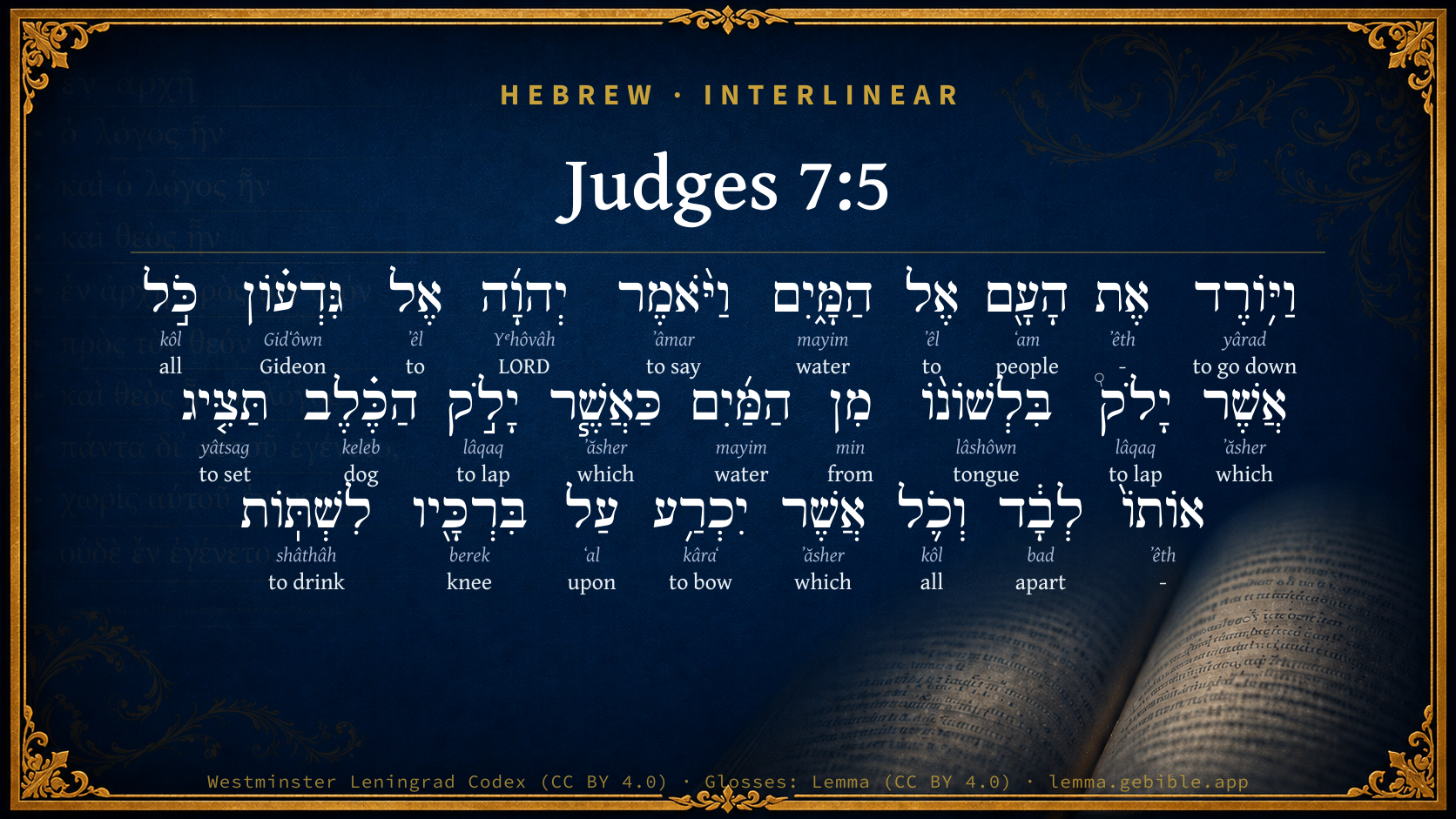
Hebrew (Westminster Leningrad Codex) Judges 7:5 appears in the Hebrew Old Testament. The text above is from the Westminster Leningrad Codex. Each word links to its Strong’s number, a concise gloss, and parsing drawn from the Open Scriptures Hebrew Bible morphology. Click any word for its full Brown-Driver-Briggs (BDB) entry.
Download image
Cite this verse

Judges 7:5 (World English Bible). Public Domain. Lemma interlinear Bible study tool, https://lemma.gebible.app/v/judges/7/5.

Show BibTeX & RIS
BibTeX
RIS
English Translation
So he brought down the people to the water: and Yahweh said to Gideon, Everyone who laps of the water with his tongue, as a dog laps, him shall you set by himself; likewise everyone who bows down on his knees to drink.
World English Bible · Public Domain
Highlights
  • 1 first appearance in the Hebrew Bible
Full analysis ↓
Download a study sheet

One document with this verse’s original text, its word-by-word gloss line, the meaning frame, cross-references with their text, attributed commentary, and full source and license credits — printable, and it pastes into notes with its structure intact.

This verse Autodidact and up

Study sheet (.html) Plain text (.txt)

A passage Seminary Student

Up to 50 verses in one chapter. A passage sheet keeps up to 6 commentary sources and 12 cross-references per verse, in the order this page ranks them, and says so on the sheet whenever that leaves anything out. Ask for a single verse and you get the Autodidact verse sheet above.

Everything on this page stays free to read, with no account — the sheet is a download of what is already on screen, not access to it.

Want to remove ads? Support Godless Engineer
Compare translations 3

The same verse in 3 English versions, stacked beneath the original-language interlinear above. Click any original word for its lexicon entry.

Each is an independent rendering of the whole verse — the interlinear is not word-aligned to these translations.

Highlighted words mark where these versions differ — a whole-verse word diff, not a word-by-word alignment.

  • World English Bible Public Domain
    So he brought down the people to the water: and Yahweh said to Gideon, Everyone who laps of the water with his tongue, as a dog laps, him shall you set by himself; likewise everyone who bows down on his knees to drink.
  • King James Version Public Domain
    So he brought down the people unto the water: and the LORD said unto Gideon, Every one that lappeth of the water with his tongue, as a dog lappeth, him shalt thou set by himself; likewise every one that boweth down upon his knees to drink.
  • unfoldingWord Literal Text CC BY-SA 4.0
    So he brought the people down to the water, and Yahweh said to Gideon, “Anyone who laps with his tongue from the water just as a dog laps, you shall set him apart, and anyone who kneels upon his knees to drink.”

unfoldingWord Literal Text — © unfoldingWord, licensed CC BY-SA 4.0. Word-aligned USFM3 via Door43 (git.door43.org/unfoldingWord/en_ult).

Versions to compare (up to 4)

3 of 4 selected

Show all 18 translations

Every available English version of this verse, each an independent rendering of the whole verse.

  • World English Bible Public Domain
    So he brought down the people to the water: and Yahweh said to Gideon, Everyone who laps of the water with his tongue, as a dog laps, him shall you set by himself; likewise everyone who bows down on his knees to drink.
  • Berean Standard Bible Public Domain
    So Gideon brought the people down to the water, and the LORD said to him, “Separate those who lap the water with their tongues like a dog from those who kneel to drink.”
  • Majority Standard Bible Public Domain
    So Gideon brought the men down to the water, and the LORD said to him, “Separate those who lap the water with their tongues like a dog from those who kneel to drink.”
  • King James Version Public Domain
    So he brought down the people unto the water: and the LORD said unto Gideon, Every one that lappeth of the water with his tongue, as a dog lappeth, him shalt thou set by himself; likewise every one that boweth down upon his knees to drink.
  • American Standard Version (1901) Public Domain
    So he brought down the people unto the water: and Jehovah said unto Gideon, Every one that lappeth of the water with his tongue, as a dog lappeth, him shalt thou set by himself; likewise every one that boweth down upon his knees to drink.
  • Revised Version (1885) Public Domain
    So he brought down the people unto the water: and the LORD said unto Gideon, Every one that lappeth of the water with his tongue, as a dog lappeth, him shalt thou set by himself; likewise every one that boweth down upon his knees to drink.
  • Geneva Bible (1599) Public Domain
    So he brought downe the people vnto the water. And the Lord sayd vnto Gideon, As many as lap the water with their tongues, as a dog lappeth, them put by themselues, and euery one that shall bow downe his knees to drinke, put apart.
  • Douay-Rheims (1899) Public Domain
    And when the people were come down to the waters, the Lord said to Gedeon: They that shall lap the water with their tongues, as dogs are wont to lap, thou shalt set apart by themselves: but they that shall drink bowing down their knees, shall be on the other side.
  • Young's Literal Translation Public Domain
    And he bringeth down the people unto the water, and Jehovah saith unto Gideon, `Every one who lappeth with his tongue of the water as the dog lappeth -- thou dost set him apart; also every one who boweth on his knees to drink.'
  • Literal Standard Version CC BY-SA 4.0
    And he brings the people down to the water, and YHWH says to Gideon, “Everyone who laps of the water with his tongue as the dog laps—you set him apart; also everyone who bows on his knees to drink.”
  • Unlocked Literal Bible CC BY-SA 4.0
    So Gideon brought the people down to the water, and Yahweh said to him, “Separate everyone who laps up the water, as a dog laps, from those who kneel down to drink.”
  • unfoldingWord Literal Text CC BY-SA 4.0
    So he brought the people down to the water, and Yahweh said to Gideon, “Anyone who laps with his tongue from the water just as a dog laps, you shall set him apart, and anyone who kneels upon his knees to drink.”
  • Darby Bible Public Domain
    So he brought the people down to the water; and the LORD said to Gideon, "Every one that laps the water with his tongue, as a dog laps, you shall set by himself; likewise every one that kneels down to drink."
  • World Messianic Bible Public Domain
    So he brought down the people to the water; and the LORD said to Gideon, “Everyone who laps of the water with his tongue, like a dog laps, you shall set him by himself; likewise everyone who bows down on his knees to drink.”
  • Webster's Bible Public Domain
    So he brought down the people to the water: and the LORD said to Gideon, Every one that lappeth of the water with his tongue as a dog lappeth, him shalt thou set by himself; likewise every one that boweth down upon his knees to drink.
  • Free Bible Version CC BY-SA 4.0
    Gideon took the soldiers down to the water. The Lord told Gideon, “Set to one side those who lap the water with their tongues, like a dog does, and on the other side those who kneel down to drink.”
  • Bible in Basic English Public Domain
    So he took the people down to the water; and the Lord said to Gideon, Put on one side by themselves all those drinking up the water with their tongues like a dog; and in the same way, all those who go down on their knees to the water while drinking.
  • JPS Tanakh (1917) Public Domain
    So he brought down the people unto the water; and the LORD said unto Gideon: 'Everyone that lappeth of the water with his tongue, as a dog lappeth, him shalt thou set by himself; likewise every one that boweth down upon his knees to drink.'

Literal Standard Version (2020), Covenant Press — licensed CC BY-SA 4.0. Text via the HelloAO Bible API (eBible.org). Unlocked Literal Bible (unfoldingWord) — licensed CC BY-SA 4.0. Text via the HelloAO Bible API (eBible.org). unfoldingWord Literal Text — © unfoldingWord, licensed CC BY-SA 4.0. Word-aligned USFM3 via Door43 (git.door43.org/unfoldingWord/en_ult). Free Bible Version, Dr. Jonathan Gallagher — licensed CC BY-SA 4.0. Text via the HelloAO Bible API (eBible.org).

Word by word

More ways to search: Search by grammar → Find every occurrence → Compare this word →

Practice this passage: Drill this verse → Learn its vocabulary →

יָלֹק֩
lâqaq
H3952
“to lap”
Verb, Qal, Imperfect, 3rd Person, Masculine, Singular
Part of Speech
Verb
Stem
Qal
Form
Imperfect
Person
3rd Person
Gender
Masculine
Number
Singular
Full BDB Definition

Origin: a primitive root

TWOT: 1126

to lap, lick, lap up - (Qal) to lap, lap up - (Piel) to lap up
  1. וַיּ֥וֹרֶד yârad H3381 “and · to go down” Conjunction + Verb, Hiphil, Sequential Imperfect, 3rd Person, Masculine, Singular
  2. אֶת ʼêth H853 “-” Particle, Direct Object
  3. הָעָ֖ם ʻam H5971 “the · people” Particle, Definite Article + Noun, Common, Masculine, Singular, Absolute
  4. אֶל ʼêl H413 “to” Preposition
  5. הַמָּ֑יִם mayim H4325 “the · water(s)” Particle, Definite Article + Noun, Common, Masculine, Plural, Absolute
  6. וַיֹּ֨אמֶר ʼâmar H559 “and · to say” Conjunction + Verb, Qal, Sequential Imperfect, 3rd Person, Masculine, Singular
  7. יְהוָ֜ה Yᵉhôvâh H3068 “LORD” Noun, Proper
  8. אֶל ʼêl H413 “to” Preposition
  9. גִּדְע֗וֹן Gidʻôwn H1439 “Gideon” Noun, Proper
  10. כֹּ֣ל kôl H3605 “all” Noun, Common, Masculine, Singular, Absolute
  11. אֲשֶׁר ʼăsher H834 “which” Particle, Relative
  12. בִּלְשׁוֹנ֨וֹ lâshôwn H3956 “in/at · tongue · his” Preposition + Noun, Common, Both, Singular, Construct + Suffix, Personal, 3rd Person, Masculine, Singular
  13. מִן min H4480 “from” Preposition
  14. הַמַּ֜יִם mayim H4325 “the · water(s)” Particle, Definite Article + Noun, Common, Masculine, Plural, Absolute
  15. כַּאֲשֶׁ֧ר ʼăsher H834 “like/as · which” Preposition + Particle, Relative
  16. יָלֹ֣ק lâqaq H3952 “to lap” Verb, Qal, Imperfect, 3rd Person, Masculine, Singular
  17. הַכֶּ֗לֶב keleb H3611 “the · dog” Particle, Definite Article + Noun, Common, Masculine, Singular, Absolute
  18. תַּצִּ֤יג yâtsag H3322 “to set” Verb, Hiphil, Imperfect, 2nd Person, Masculine, Singular
  19. אוֹתוֹ֙ ʼêth H853 “- · him” Particle, Direct Object + Suffix, Personal, 3rd Person, Masculine, Singular
  20. לְבָ֔ד bad H905 “to/for · apart” Preposition + Noun, Common, Masculine, Singular, Absolute
  21. וְכֹ֛ל kôl H3605 “and · all” Conjunction + Noun, Common, Masculine, Singular, Absolute
  22. אֲשֶׁר ʼăsher H834 “which” Particle, Relative
  23. יִכְרַ֥ע kâraʻ H3766 “to bow” Verb, Qal, Imperfect, 3rd Person, Masculine, Singular
  24. עַל ʻal H5921 “upon” Preposition
  25. בִּרְכָּ֖יו berek H1290 “knees · his” Noun, Common, Feminine, Dual, Construct + Suffix, Personal, 3rd Person, Masculine, Singular
  26. לִשְׁתּֽוֹת shâthâh H8354 “to drink” Preposition + Verb, Qal, Infinitive Construct

About this verse

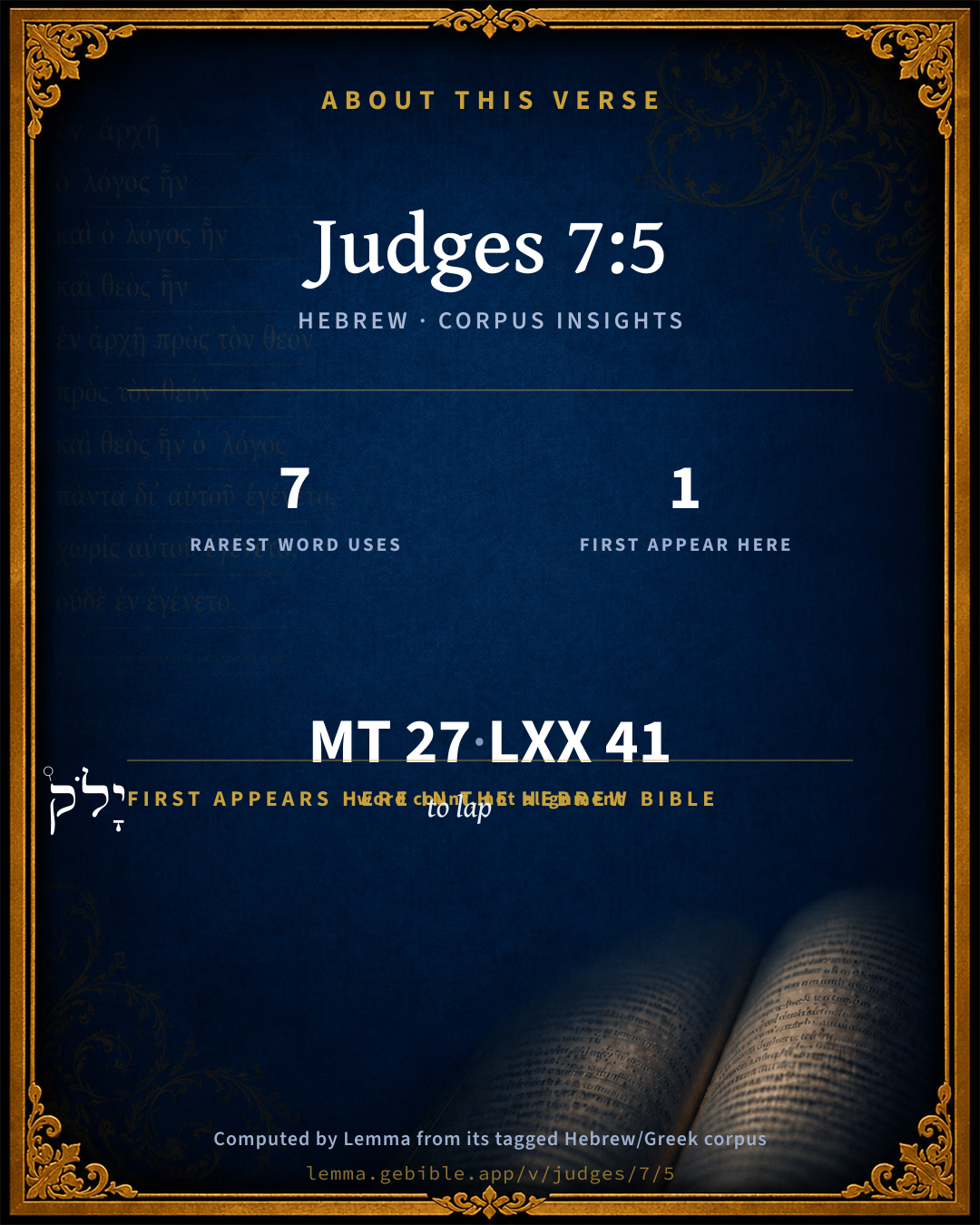
These counts appear in no published source. They are computed here, from the morphology-tagged text and Lemma’s own curated glosses. What Lemma adds →

27
words
20
distinct lemmas
Historical
section

Notable vocabulary

The rarest word here is יָלֹק֩ to lap H3952 — appearing just 7 times in the whole Hebrew Bible.

First appearance in Scripture

This word makes its first canonical appearance in the Hebrew Bible here:

  • יָלֹק֩ to lap H3952

Shared distinctive vocabulary

יָלֹק֩ to lap H3952 occurs in 5 verses of the Hebrew Bible. Also found in:

Grammatical profile

  • 7 verbs
  • 11 nouns
  • 4 prepositions
  • 5 particles

Verb forms

  • וַיּ֥וֹרֶד Hiphil · Sequential Imperfect
  • וַיֹּ֨אמֶר Qal · Sequential Imperfect
  • יָלֹק֩ Qal · Imperfect
  • יָלֹ֣ק Qal · Imperfect
  • תַּצִּ֤יג Hiphil · Imperfect
  • יִכְרַ֥ע Qal · Imperfect
  • לִשְׁתּֽוֹת Qal · Infinitive Construct

Repetition

Words recur within this verse — often emphatic in Hebrew:

  • הַמָּ֑יִם water H4325 ×2
  • כֹּ֣ל all H3605 ×2
  • יָלֹק֩ to lap H3952 ×2
  • אֲשֶׁר which H834 ×3
  • אֶל to H413 ×2

Hebrew & Septuagint length

In English translation the verse runs 43 words from the Hebrew and 46 from the Septuagint (LXX English) — closely comparable.

A rough comparison of the two English renderings, which tokenize alike — not a word-level alignment.

Word counts can differ between the Hebrew and the Greek without any difference in meaning — e.g. the Hebrew direct-object marker אֵת has no separate Greek word, and Greek often adds the article ὁ.

In the original languages it is 27 Hebrew tokens and 41 Greek tokens — but the two are counted differently (Hebrew bundles its prefixes and suffixes into one token; the Greek is in lemma form), so that isn’t a like-for-like length.

Hebrew and Greek witnesses Masoretic Hebrew ↔ Greek Septuagint

The same verse in the two great witnesses to the Old Testament, shown verse-for-verse.

These are two independent witnesses, not word-aligned to each other, and the Septuagint is shown in lemma (dictionary) form.

Hebrew Judges 7:5 Masoretic · Westminster Leningrad Codex

וַיּ֥וֹרֶד אֶת הָעָ֖ם אֶל הַמָּ֑יִם וַיֹּ֨אמֶר יְהוָ֜ה אֶל גִּדְע֗וֹן כֹּ֣ל אֲשֶׁר יָלֹק֩ בִּלְשׁוֹנ֨וֹ מִן הַמַּ֜יִם כַּאֲשֶׁ֧ר יָלֹ֣ק הַכֶּ֗לֶב תַּצִּ֤יג אוֹתוֹ֙ לְבָ֔ד וְכֹ֛ל אֲשֶׁר יִכְרַ֥ע עַל בִּרְכָּ֖יו לִשְׁתּֽוֹת

So he brought down the people to the water: and Yahweh said to Gideon, Everyone who laps of the water with his tongue, as a dog laps, him shall you set by himself; likewise everyone who bows down on his knees to drink.

World English Bible · Public Domain

Greek LXX Judges 7:5 Septuagint · lemma form

καί καταφέρω ὁ λαός πρός ὁ ὕδωρ καί εἶπον κύριος πρός γεδεων πᾶς ὅς ἄν λάπτω ὁ γλῶσσα αὐτός ἀπό ὁ ὕδωρ ὡς ἐάν λάπτω ὁ κύων ἵστημι αὐτός κατά μόνος καί πᾶς ὅς ἐάν κλίνη ἐπί ὁ γόνυ αὐτός πίνω

And he brought the people down to the water; and the Lord said to Gedeon, Whosoever shall lap of the water with his tongue as if a dog should lap, you shall set him apart, and also whoever shall bow down upon his knees to drink.

LXX2012 (modern English Septuagint) · Public Domain

On this verse, The Cambridge Bible for Schools and Colleges discusses the Septuagint’s reading. Read the note in Commentary ↓

Hebrew: Westminster Leningrad Codex (CC BY 4.0). Greek: Septuagint (public domain); English from LXX2012 (modern English Septuagint) (Public Domain). How the Septuagint differs from the Hebrew →

Targum (Aramaic paraphrase)

1

The Targum is the ancient Jewish Aramaic paraphrase of the Hebrew Scriptures — an interpretive translation, not the Hebrew text itself. Onkelos (literal) and Pseudo-Jonathan (expansive) render the Torah, and Jonathan the Prophets. Coverage is partial: where no permissively-licensed English translation exists for a verse, only the Aramaic is shown. This is verse-level text, not a word-by-word alignment to the Hebrew.

  1. Targum Jonathan Prophets (Joshua–Malachi)
    וַאֲחֵית יַת עַמָא לְמַיָא וַאֲמַר יְיָ לְגִדְעוֹן כֹּל דִי לָחֵיךְ בְּלִישָׁנֵיהּ מִן מַיָא כְּמָא דִמְלָחֵיךְ כַּלְבָּא תְּקִים יָתֵיהּ בִּלְחוֹדֵיה וְכֹל דִכְרַע עַל בִּרְכּוֹהִי לְמִשְׁתֵּי:

    (no public-domain English translation for this verse)

    Targum Jonathan — Aramaic: “Mikraot Gedolot” (public domain). English: “Sefaria Community Translation” (CC0 1.0 (public-domain dedication)); “London "Chaldee Paraphrase," 1871” (public domain). Text via Sefaria.

Commentary

Notes on Judges 7:5 from classic Christian and Jewish commentators (each source and its license shown beneath its notes). The classic Christian expositions comment on the surrounding passage and are grouped to its opening verse, so a note may address several verses; the Jewish commentaries on the Tanakh (Rashi and others) are per-verse, so they appear only where the commentator wrote on this verse.

Lemma curates 59 commentaries, every one of them public domain or Creative Commons licensed, each selected and text-cleaned for this edition rather than reprinted as found. About our sources →

Trapp's Complete Commentary

John Trapp

Jdg 7:5 So he brought down the people unto the water: and the LORD said unto Gideon, Every one that lappeth of the water with his tongue, as a dog lappeth, him shalt thou set by himself; likewise every one that boweth down upon his knees to drink.

Ver. 5. That lappeth of the water, &c.] Iudicium strenuitatis et temperantice, saith Piscator: this was a sign of strength of body and temperance of mind, as the other posture was of weakness and greediness. Those are fit to follow the Lord, saith Diodat here, who for zeal to his service, do but taste the pleasures of the world as they pass along, without staying with them, only for necessity, and not for any constant delight they take in them. He which, with some of the Polonians, or with that dog Diogenes, lappeth water out of his hands, may nevertheless go forwards; as an Egyptian dog doth, when he lappeth the water of Nile in fear of a crocodile. {a}

{a} Solin., cap. 20.

John Trapp, A Commentary or Exposition upon All the Books of the Old and New Testament (1647–1656) — public domain. Text from a community e-Sword module.

Geneva Bible (1599)

Geneva Bible translators

Let them depart as unmeet for this enterprise.

Geneva Bible (1599) marginal notes — public domain. Text via Bolls.life.

Jamieson, Fausset & Brown

Robert Jamieson, A. R. Fausset & David Brown

bring them down unto the water--When the wandering people in Asia, on a journey or in haste, come to water, they do not stoop down with deliberation on their knees, but only bend forward as much as is necessary to bring their hand in contact with the stream, and throw it up with rapidity, and at the same time such address, that they do not drop a particle. The Israelites, it seems, were acquainted with the practice; and those who adopted it on this occasion were selected as fit for a work that required expedition. The rest were dismissed according to the divine direction.

Jamieson, Fausset & Brown — Commentary Critical and Explanatory on the Whole Bible (1871) — public domain (CC PDM 1.0). Text via the HelloAO Bible API.

Adam Clarke's Commentary

Verse 5. Every one that lappeth of the water - as a dog] The original word ילק yalok is precisely the sound which a dog makes when he is drinking.

Adam Clarke's Commentary on the Bible (1810–1826) — public domain. Text from a community e-Sword/MySword module.

Ellicott's Commentary for English Readers

(5) Every one that lappeth of the water with his tongue.—Josephus (Antt. v. 6, § 4) says that Gideon led them down to the spring in the fiercest heat of the noonday, and that he judged those to be the bravest who flung themselves down and drank, and those to be the cowards who lapped the water hastily and tumultuously. Theodoret also thinks that the Divine aid was shown by the fact that the greatest cowards were chosen. This may have been a Jewish legend (Hagadah); but it seems more reasonable to suppose that greater self-control would be shown by stooping and drinking the water out of the hand than by flinging themselves at full length to drink, which would be the natural instinct of a thirsty man. Rashi says that those who went down on their knees to drink were secret idolators, who had “bowed the knee to Baal” (1Ki_19:18).

As a dog lappeth.—Some commentators fancy that this is an allusion to Egyptian dogs, who, out of fear for the Nile crocodiles, only venture to lap the water while they are running along the banks.

A Bible Commentary for English Readers, edited by Charles John Ellicott (1878–1897) — public domain. Text from a community e-Sword module.

The Cambridge Bible for Schools and Colleges

gen. ed. J. J. S. Perowne

5. At the end of the verse LXX. cod. A and Luc. adds ‘him shalt thou set by himself,’ completing the parallel with the foregoing sentence. The words have probably fallen out by accident.

The Cambridge Bible for Schools and Colleges (gen. ed. J. J. S. Perowne; Cambridge University Press, 1878–1918) — public domain. Text from a community e-Sword module.

John Gill's Exposition

So he brought them down to the water,.... His whole army of 10,000 men:

and the Lord said unto Gideon, everyone that lappeth of the water with his tongue, as a dog lappeth, him shall thou set by himself; this has led some, as particularly Grotius, to think of the Egyptian dogs; of whom Aelianus relates (b), that they do not drink at once freely, and to satiety, being afraid of the crocodiles in the river; but run about the bank, and by stealth snatch a little here and a little there, and so satisfy themselves: but the allusion here is to dogs in common, whose usual way it is not to sup in, and drink a drought, but by putting out their tongues to lick and lap water with them, as Aristotle (c) says all creatures do that have teeth like saws; and the likeness between the drinking of these men, to be observed lay not in anything else but in the single action of lapping; for they first took the water in the hollow of their hands, out of the stream, and then lapped it, as in Jdg 7:6 whereas a dog does not and cannot take water that way; and this lapping was standing upright, whereas dogs in common, as Aelianus in the same place suggests, bow themselves, and lap as much water as will satisfy their thirst; and by this these men were distinguished from those that bowed on their knees to drink; for had they not taken up water in their hands, they must have bowed down on their knees to have lapped, as well as those did, to sup it, or take in a large draught of it; now all those that thus lapped were to be set apart by themselves; but whether they were to go with Gideon or not, as yet he knew not: likewise everyone that boweth down on his knee to drink; were to be set by themselves also, but which of those were to go with him is after related.

(b) Var. Hist. l. 1. c. 4. (c) Hist. Animal. l. 8. c. 6.

John Gill's Exposition of the Whole Bible (1746–1763) — public domain (CC PDM 1.0). Text via the HelloAO Bible API.

Haydock's Catholic Bible Commentary

Tongues. Some Latin copies add, "and hand," as it is expressed in Hebrew, &c., in the following verse. They resembled dogs more in the hurry than in the method of taking water. An old proverb says, "the dog drinks and flees away," (Calmet) alluding to the dogs of Egypt, who, through fear of the crocodiles which infest the banks of the Nile, lap the water with all expedition, "like a dog from the Nile." (Erasmus; Haydock; Macrobius ii. 2.) --- Hence we might infer, that these 300 men were the most cowardly in the army, as Josephus, ([Antiquities?] v. 8,) Theodoret, (q. 15,) have done; (Calmet) and thus the glory of the victory would belong more incontrovertibly to God. (Haydock) --- But as these 300, on this supposition, ought to have been disbanded, as well as the rest, we may rather conclude that they shewed greater courage and temperance by their posture, and were therefore retained (Calmet) to accompany their heroic leader in his perilous expedition. We must, nevertheless remark, that only those who preferred to acknowledge their fear, were disbanded according to the law; and as, among those who were not quite so cowardly, (Haydock) there would be some less courageous than others, (Amama) these might be selected by God, that no flesh should glory in his sight, 1 Corinthians i. 29. (Haydock)

George Leo Haydock (1774–1849), Haydock's Catholic Family Bible and Commentary, 1859 edition — public domain. Excludes Psalms (Douay-Rheims chapter numbering differs from Protestant) and Deuterocanonical books (Catholic canon only).

Matthew Poole's English Annotations

It is true, there may be natural reasons given why some did only lap of the water, when others bowed down to drink; from the temperance, or fortitude, or patience, or strength, or diligence of the one, and the intemperance, or cowardice, or impatience, or weakness, or slothfulness of the other; but these seem to be mere conjectures: the true reason and design of this course seems to be only this, that God would reduce them to a very small number, which was likely to be done by this means; for the season of the year being hot, and the generality of the soldiers weary, and thirsty, and faint, they would most probably bow down upon their knees, that they might more fully refresh themselves by a liberal draught, as indeed they did; and it could be expected that there would be but few, who either could or would deny themselves in this matter, especially when God concurred in the work, and so disposed of the minds and bodies of them, that all, except three hundred, should lie down to drink.

Matthew Poole's English Annotations on the Holy Bible (1683–1685) — public domain. Text from a community e-Sword/MySword module.

Whedon's Commentary on the Bible

Daniel D. Whedon

5. Lappeth of the water with his tongue — The Hebrew word for lapping (ילק, yalok) is onomatopoetic, and sounds in its pronunciation like the noise of a dog when drinking. It appears from the next verse that the three hundred that lapped took up the water from the fountain in the hollow of their hands, and thence licked it into their mouths. This manner of drinking was no evidence of fear and cowardice, as Josephus imagines, but rather a commendable qualification in a soldier. For in the heat of battle it might often give a warrior great advantage over his foe, if, coming to a stream, he could thus easily refresh himself with drink without being obliged, if he drank at all, to fall down on his knees, and thereby expose himself to almost certain death from his enemy. “Those only are the true warriors of Jehovah, who, when an enjoyment is offered, as for instance, refreshment at a living well, taste it only in passing, and while standing on the alert; not seeking enjoyment, and crouching down to it in indolent comfort, but, mindful every minute of the business in hand and the desired victory, only lapping the water like dogs upon their way.” — Ewald.

Daniel D. Whedon (gen. ed.), Commentary on the Old and New Testaments (1874–1909) — public domain. Text from a community e-Sword module.

The Pulpit Commentary

Vers. 5, 6. The water, viz., of the well or spring of Harod. That lappeth, etc. It showed a much more soldierly and self-controlled spirit just to quench the thirst by lapping the water out of the palm of the hand, than to kneel down and drink without stint out of the spring itself. The Lord saw the difference of character indicated by the two actions, and chose his instruments accordingly.

The Pulpit Commentary (1880–1919), ed. H.D.M. Spence-Jones & Joseph S. Exell — public domain. Text from a community e-Sword module.

unfoldingWord translationNotes

Door43 World Missions Community

Gideon brought

The word "brought" can be translated as "took" or "led." (See: Go and Come)

laps

to drink by licking with the tongue

Three hundred men

"300 men" (See: Numbers)

translationWords

Gideon

water

Yahweh

unfoldingWord translationNotes — © Distant Shores Media and the Door43 World Missions Community, licensed CC BY-SA 4.0. Source: git.door43.org/Door43/en_tn.

Rashi

Rabbi Shlomo Yitzchaki (Rashi)

Anyone who laps with his tongue, etc. Anyone who bends forward while on his knees to drink, set them aside, out of your retinue. They shall not accompany you, since they are practiced in kneeling before idols.

Rashi on the Tanakh — English translations: “The Judaica Press complete Tanach with Rashi, translated by A. J. Rosenberg” (CC BY 4.0); “Pentateuch with Rashi's commentary by M. Rosenbaum and A.M. Silbermann, 1929-1934” (public domain); “The Metsudah Tanach series, Lakewood, N.J” (CC BY 4.0); and “The Book of Joshua, Metsudah Publications, 1997” (CC BY 4.0). Text via Sefaria.

Lesson kit

Teaching starters — assembled from the data on this page, not authored interpretation. Every prompt links to the verse data it draws on. Edit before teaching.

Judges, in the Historical, opens this verse with 27 words (20 distinct Hebrew lemmas). Its most distinctive word is lâqaq (“to lap”). A historical commentator’s framing appears above. Read the whole chapter for the surrounding context.

Discussion questions

  1. The word lâqaq carries the sense “to lap.” How does it shape the verse?
  2. The word “to lap” first appears here in Scripture. What is being introduced at this debut?
  3. Judges 7:6 shares the word «to lap» with this verse. How do the two illuminate each other?
  4. “water” occurs 2× in this one verse. What is the effect of the repetition?
  5. The translations on this page render this verse differently — a whole-verse word diff, not a word-by-word alignment. What might account for the different wordings?
  6. The verb «וַיּ֥וֹרֶד» is Hiphil Sequential Imperfect. How does its form color the action?
  7. Reading how Trapp's Complete Commentary and Geneva Bible (1599) read this verse, where do the two commentators agree and where do they part?

Things to notice

Reading settings

Reading text

Shown beneath each verse's original-language words.

Old Testament
Old Testament edition

Read the OT as the Masoretic Hebrew (MT) or the Greek Septuagint (LXX).

English shown for the Greek Septuagint (in the Hebrew ↔ Greek comparison).

Comparing translations? Open the Compare panel on any verse page to stack up to four side by side.