
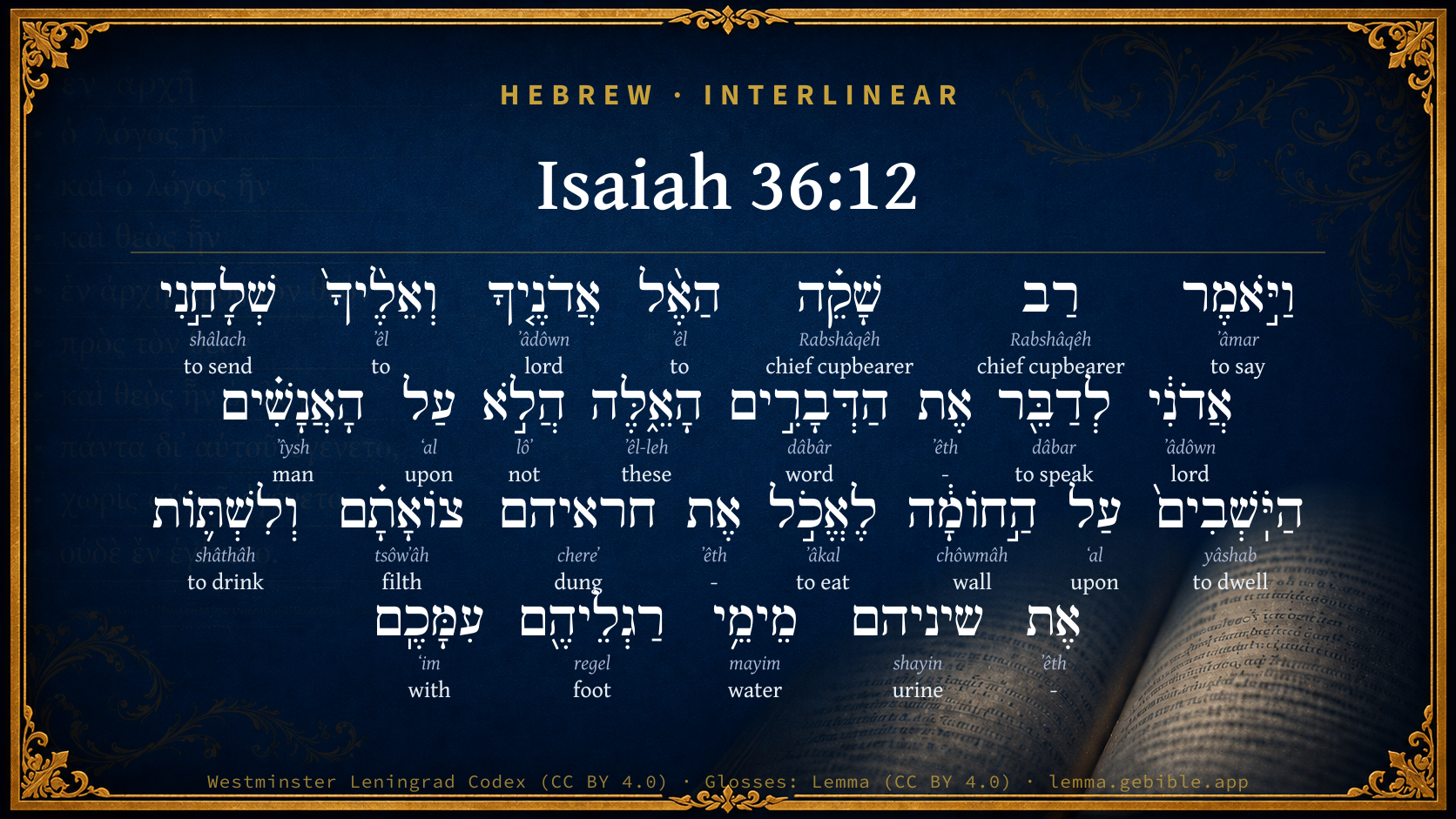
Isaiah 36:12

Hebrew (Westminster Leningrad Codex) Isaiah 36:12 appears in the Hebrew Old Testament. The text above is from the Westminster Leningrad Codex. Each word links to its Strong’s number, a concise gloss, and parsing drawn from the Open Scriptures Hebrew Bible morphology. Click any word for its full Brown-Driver-Briggs (BDB) entry.
Download image
Cite this verse

Isaiah 36:12 (World English Bible). Public Domain. Lemma interlinear Bible study tool, https://lemma.gebible.app/v/isaiah/36/12.

Show BibTeX & RIS
BibTeX
RIS
English Translation
But Rabshakeh said, Has my master sent me to your master, and to you, to speak these words? [has he] not [sent me] to the men who sit on the wall, to eat their own dung, and to drink their own water with you?
World English Bible · Public Domain
Highlights
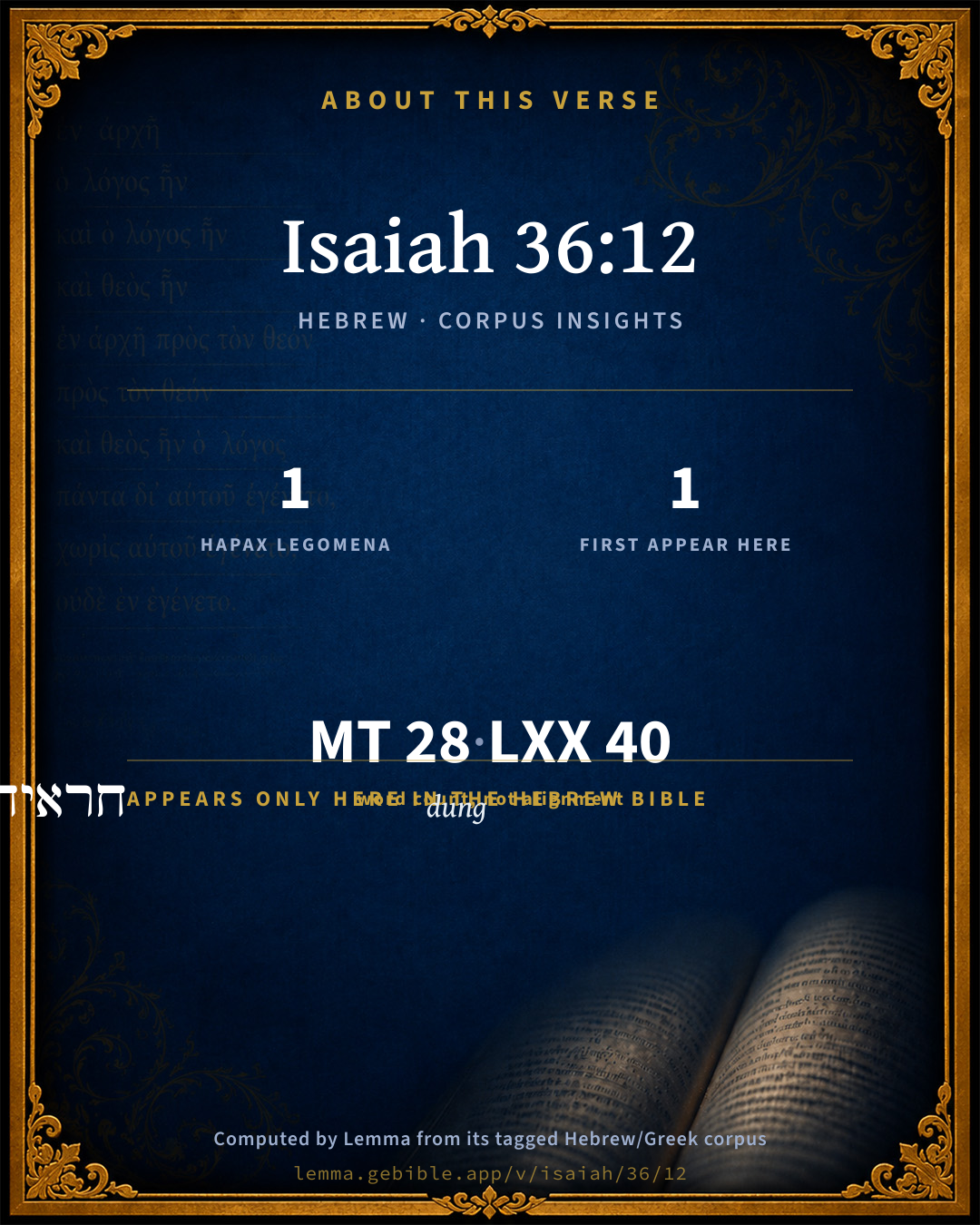
  • 1 hapax legomenon — only here in the Hebrew Bible
  • 1 first appearance in the Hebrew Bible
Full analysis ↓
Download a study sheet

One document with this verse’s original text, its word-by-word gloss line, the meaning frame, cross-references with their text, attributed commentary, and full source and license credits — printable, and it pastes into notes with its structure intact.

This verse Autodidact and up

Study sheet (.html) Plain text (.txt)

A passage Seminary Student

Up to 50 verses in one chapter. A passage sheet keeps up to 6 commentary sources and 12 cross-references per verse, in the order this page ranks them, and says so on the sheet whenever that leaves anything out. Ask for a single verse and you get the Autodidact verse sheet above.

Everything on this page stays free to read, with no account — the sheet is a download of what is already on screen, not access to it.

Want to remove ads? Support Godless Engineer
Compare translations 3

The same verse in 3 English versions, stacked beneath the original-language interlinear above. Click any original word for its lexicon entry.

Each is an independent rendering of the whole verse — the interlinear is not word-aligned to these translations.

Highlighted words mark where these versions differ — a whole-verse word diff, not a word-by-word alignment.

  • World English Bible Public Domain
    But Rabshakeh said, Has my master sent me to your master, and to you, to speak these words? [has he] not [sent me] to the men who sit on the wall, to eat their own dung, and to drink their own water with you?
  • King James Version Public Domain
    But Rabshakeh said, Hath my master sent me to thy master and to thee to speak these words? hath he not sent me to the men that sit upon the wall, that they may eat their own dung, and drink their own piss with you?
  • unfoldingWord Literal Text CC BY-SA 4.0
    But the Rabshakeh said, “Did my master send me to speak these words to your master and to you? not to the men sitting on the wall, who will eat their dung and drink their urine with you?”

unfoldingWord Literal Text — © unfoldingWord, licensed CC BY-SA 4.0. Word-aligned USFM3 via Door43 (git.door43.org/unfoldingWord/en_ult).

Versions to compare (up to 4)

3 of 4 selected

Show all 18 translations

Every available English version of this verse, each an independent rendering of the whole verse.

  • World English Bible Public Domain
    But Rabshakeh said, Has my master sent me to your master, and to you, to speak these words? [has he] not [sent me] to the men who sit on the wall, to eat their own dung, and to drink their own water with you?
  • Berean Standard Bible Public Domain
    But the Rabshakeh replied, “Has my master sent me to speak these words only to you and your master, and not to the men sitting on the wall, who are destined with you to eat their own dung and drink their own urine?”
  • Majority Standard Bible Public Domain
    But the Rabshakeh replied, “Has my master sent me to speak these words only to you and your master, and not to the men sitting on the wall, who are destined with you to eat their own dung and drink their own urine?”
  • King James Version Public Domain
    But Rabshakeh said, Hath my master sent me to thy master and to thee to speak these words? hath he not sent me to the men that sit upon the wall, that they may eat their own dung, and drink their own piss with you?
  • American Standard Version (1901) Public Domain
    But Rabshakeh said, Hath my master sent me to thy master, and to thee, to speak these words? `hath he' not `sent me' to the men that sit upon the wall, to eat their own dung, and to drink their own water with you?
  • Revised Version (1885) Public Domain
    But Rabshakeh said, Hath my master sent me to thy master, and to thee, to speak these words? hath he not sent me to the men that sit upon the wall, to eat their own dung, and to drink their own water with you?
  • Geneva Bible (1599) Public Domain
    Then said Rabshakeh, Hath my master sent me to thy master, and to thee to speake these wordes, and not to the men that sit on the wall? that they may eate their owne doung, and drinke their owne pisse with you?
  • Douay-Rheims (1899) Public Domain
    And Rabsaces said to them: Hath my master sent me to thy master and to thee, to speak all these words; and not rather to the men that sit on the wall; that they may eat their own dung, and drink their urine with you?
  • Young's Literal Translation Public Domain
    And Rabshakeh saith, `Unto thy lord, and unto thee, hath my lord sent me to speak these words? is it not for the men -- those sitting on the wall to eat their own dung and to drink their own water with you?'
  • Literal Standard Version CC BY-SA 4.0
    And Rabshakeh says, “To your lord, and to you, has my lord sent me to speak these words? Is it not for the men—those sitting on the wall to eat their own dung and to drink their own water with you?”
  • Unlocked Literal Bible CC BY-SA 4.0
    But the chief commander said, “Has my master sent me to your master and to you to speak these words? Has he not sent me to the men who sit on the wall, who will have to eat their own dung and drink their own urine with you?”
  • unfoldingWord Literal Text CC BY-SA 4.0
    But the Rabshakeh said, “Did my master send me to speak these words to your master and to you? not to the men sitting on the wall, who will eat their dung and drink their urine with you?”
  • Darby Bible Public Domain
    And Rab-shakeh said, Is it to thy master and to thee that my master sent me to speak these words? Is it not to the men that sit on the wall, that they may eat their own dung, and drink their own urine with you?
  • World Messianic Bible Public Domain
    But Rabshakeh said, “Has my master sent me only to your master and to you, to speak these words, and not to the men who sit on the wall, who will eat their own dung and drink their own urine with you?”
  • Webster's Bible Public Domain
    But Rabshakeh said, Hath my master sent me to thy master and to thee to speak these words? hath he not sent me to the men that sit upon the wall, that they may devour their vilest excretions with you?
  • Free Bible Version CC BY-SA 4.0
    But the army general replied, “Did my master only send me to say these things to your master and to you, and not to the people sitting on the wall? They too, just like you, are going to have to eat their own excrement and drink their own urine!”
  • Bible in Basic English Public Domain
    But the Rab-shakeh said, Is it to your master or to you that my master has sent me to say these words? has he not sent me to the men seated on the wall? for they are the people who will be short of food with you when the town is shut in.
  • JPS Tanakh (1917) Public Domain
    But Rab-shakeh said: 'Hath my master sent me to thy master, and to thee, to speak these words? hath he not sent me to the men that sit upon the wall, to eat their own dung, and to drink their own water with you?'

Literal Standard Version (2020), Covenant Press — licensed CC BY-SA 4.0. Text via the HelloAO Bible API (eBible.org). Unlocked Literal Bible (unfoldingWord) — licensed CC BY-SA 4.0. Text via the HelloAO Bible API (eBible.org). unfoldingWord Literal Text — © unfoldingWord, licensed CC BY-SA 4.0. Word-aligned USFM3 via Door43 (git.door43.org/unfoldingWord/en_ult). Free Bible Version, Dr. Jonathan Gallagher — licensed CC BY-SA 4.0. Text via the HelloAO Bible API (eBible.org).

Word by word

More ways to search: Search by grammar → Find every occurrence → Compare this word →

Practice this passage: Drill this verse → Learn its vocabulary →

חראיהם
chereʼ
H2716
“dung · their”
Noun, Common, Masculine, Plural, Construct + Suffix, Personal, 3rd Person, Masculine, Plural
Part of Speech
Noun
Type
Common
Gender
Masculine
Number
Plural
State
Construct
Full BDB Definition

Origin: from an unused (and vulgar) root probably meaning to evacuate the bowels

TWOT: 730a

dung, excrement
  1. וַיֹּ֣אמֶר ʼâmar H559 “and · to say” Conjunction + Verb, Qal, Sequential Imperfect, 3rd Person, Masculine, Singular
  2. רַב Rabshâqêh H7262 “chief cupbearer” Noun, Proper
  3. שָׁקֵ֗ה Rabshâqêh H7262 “chief cupbearer” Noun, Proper
  4. הַאֶ֨ל ʼêl H413 “to” Particle, Interrogative + Preposition
  5. אֲדֹנֶ֤יךָ ʼâdôwn H113 “lords · your” Noun, Common, Masculine, Plural, Construct + Suffix, Personal, 2nd Person, Masculine, Singular
  6. וְאֵלֶ֨יךָ֙ ʼêl H413 “and · to · you” Conjunction + Preposition + Suffix, Personal, 2nd Person, Masculine, Singular
  7. שְׁלָחַ֣נִי shâlach H7971 “to send · me” Verb, Qal, Perfect, 3rd Person, Masculine, Singular + Suffix, Personal, 1st Person, Common, Singular
  8. אֲדֹנִ֔י ʼâdôwn H113 “lord · my” Noun, Common, Masculine, Singular, Construct + Suffix, Personal, 1st Person, Common, Singular
  9. לְדַבֵּ֖ר dâbar H1696 “to speak” Preposition + Verb, Piel, Infinitive Construct
  10. אֶת ʼêth H853 “-” Particle, Direct Object
  11. הַדְּבָרִ֣ים dâbâr H1697 “the · words” Particle, Definite Article + Noun, Common, Masculine, Plural, Absolute
  12. הָאֵ֑לֶּה ʼêl-leh H428 “the · these” Particle, Definite Article + Pronoun, Demonstrative, Common, Plural
  13. הֲלֹ֣א lôʼ H3808 “not” Particle, Interrogative + Particle, Negative
  14. עַל ʻal H5921 “upon” Preposition
  15. הָאֲנָשִׁ֗ים ʼîysh H376 “the · men” Particle, Definite Article + Noun, Common, Masculine, Plural, Absolute
  16. הַיֹּֽשְׁבִים֙ yâshab H3427 “the · dwelling” Particle, Definite Article + Verb, Qal, Participle Active, Masculine, Plural, Absolute
  17. עַל ʻal H5921 “upon” Preposition
  18. הַ֣חוֹמָ֔ה chôwmâh H2346 “the · wall” Particle, Definite Article + Noun, Common, Feminine, Singular, Absolute
  19. לֶאֱכֹ֣ל ʼâkal H398 “to eat” Preposition + Verb, Qal, Infinitive Construct
  20. אֶת ʼêth H853 “-” Particle, Direct Object
  21. צוֹאָתָ֗ם tsôwʼâh H6675 “filth · their” Noun, Common, Feminine, Singular, Construct + Suffix, Personal, 3rd Person, Masculine, Plural
  22. וְלִשְׁתּ֛וֹת shâthâh H8354 “and · to drink” Conjunction + Preposition + Verb, Qal, Infinitive Construct
  23. אֶת ʼêth H853 “-” Particle, Direct Object
  24. שיניהם shayin H7890 “urine · their” Noun, Common, Masculine, Plural, Construct + Suffix, Personal, 3rd Person, Masculine, Plural
  25. מֵימֵ֥י mayim H4325 “water(s) of” Noun, Common, Masculine, Plural, Construct
  26. רַגְלֵיהֶ֖ם regel H7272 “feet · their” Noun, Common, Feminine, Dual, Construct + Suffix, Personal, 3rd Person, Masculine, Plural
  27. עִמָּכֶֽם ʻim H5973 “with · you” Preposition + Suffix, Personal, 2nd Person, Masculine, Plural

About this verse

These counts appear in no published source. They are computed here, from the morphology-tagged text and Lemma’s own curated glosses. What Lemma adds →

28
words
22
distinct lemmas
Prophets
section

Notable vocabulary

1 hapax legomenon — a word that appears only here in the entire Hebrew Bible:

  • חראיהם dung H2716

First appearance in Scripture

This word makes its first canonical appearance in the Hebrew Bible here:

  • חראיהם dung H2716

Shared distinctive vocabulary

שיניהם urine H7890 occurs in 2 verses of the Hebrew Bible. Also found in:

Grammatical profile

  • 6 verbs
  • 12 nouns
  • 1 pronoun
  • 5 prepositions
  • 4 particles

Verb forms

  • וַיֹּ֣אמֶר Qal · Sequential Imperfect
  • שְׁלָחַ֣נִי Qal · Perfect
  • לְדַבֵּ֖ר Piel · Infinitive Construct
  • הַיֹּֽשְׁבִים֙ Qal · Participle Active
  • לֶאֱכֹ֣ל Qal · Infinitive Construct
  • וְלִשְׁתּ֛וֹת Qal · Infinitive Construct

Repetition

Words recur within this verse — often emphatic in Hebrew:

  • רַב chief cupbearer H7262 ×2
  • אֲדֹנֶ֤יךָ lord H113 ×2
  • עַל upon H5921 ×2
  • הַאֶ֨ל to H413 ×2

Hebrew & Septuagint length

In English translation the verse runs 44 words from the Hebrew and 45 from the Septuagint (LXX English) — closely comparable.

A rough comparison of the two English renderings, which tokenize alike — not a word-level alignment.

Word counts can differ between the Hebrew and the Greek without any difference in meaning — e.g. the Hebrew direct-object marker אֵת has no separate Greek word, and Greek often adds the article ὁ.

In the original languages it is 28 Hebrew tokens and 40 Greek tokens — but the two are counted differently (Hebrew bundles its prefixes and suffixes into one token; the Greek is in lemma form), so that isn’t a like-for-like length.

Cross-references

8

Topical passages linked to Isaiah 36:12 in the Treasury of Scripture Knowledge — connected by theme and wording, ordered by reader-vote popularity; previews shown in the World English Bible.

  • Leviticus 26:29 You will eat the flesh of your sons, and you will eat the flesh of your daughters.
  • 2 Kings 18:27 But Rabshakeh said to them, Has my master sent me to your master, and to you, to speak these words? Hasn't he sent me to the men who sit on the wall, to eat their own dung, and to drink their own water with you?
  • Deuteronomy 28:53–57 You shall eat the fruit of your own body, the flesh of your sons and of your daughters, whom Yahweh your God has given you, in the siege and in the distress with which your enemies shall distress you.
  • 2 Kings 6:25–29 There was a great famine in Samaria: and, behold, they besieged it, until a donkey's head was sold for eighty [pieces] of silver, and the fourth part of a kab of dove's dung for five [pieces] of silver.
  • Isaiah 9:20 One shall snatch on the right hand, and be hungry; and he shall eat on the left hand, and they shall not be satisfied: they shall eat every man the flesh of his own arm:
  • Jeremiah 19:9 I will cause them to eat the flesh of their sons and the flesh of their daughters; and they shall eat everyone the flesh of his friend, in the siege and in the distress, with which their enemies, and those who seek their life, shall distress them.
  • Lamentations 4:9–10 Those who are killed with the sword are better than those who are killed with hunger; For these pine away, stricken through, for want of the fruits of the field.
  • Ezekiel 4:16 Moreover he said to me, Son of man, behold, I will break the staff of bread in Jerusalem: and they shall eat bread by weight, and with fearfulness; and they shall drink water by measure, and in dismay:

Cross-references courtesy of OpenBible.info (CC BY 4.0).

Hebrew and Greek witnesses Masoretic Hebrew ↔ Greek Septuagint

The same verse in the two great witnesses to the Old Testament, shown verse-for-verse.

These are two independent witnesses, not word-aligned to each other, and the Septuagint is shown in lemma (dictionary) form.

Hebrew Isaiah 36:12 Masoretic · Westminster Leningrad Codex

וַיֹּ֣אמֶר רַב שָׁקֵ֗ה הַאֶ֨ל אֲדֹנֶ֤יךָ וְאֵלֶ֨יךָ֙ שְׁלָחַ֣נִי אֲדֹנִ֔י לְדַבֵּ֖ר אֶת הַדְּבָרִ֣ים הָאֵ֑לֶּה הֲלֹ֣א עַל הָאֲנָשִׁ֗ים הַיֹּֽשְׁבִים֙ עַל הַ֣חוֹמָ֔ה לֶאֱכֹ֣ל אֶת חראיהם צוֹאָתָ֗ם וְלִשְׁתּ֛וֹת אֶת שיניהם מֵימֵ֥י רַגְלֵיהֶ֖ם עִמָּכֶֽם

But Rabshakeh said, Has my master sent me to your master, and to you, to speak these words? [has he] not [sent me] to the men who sit on the wall, to eat their own dung, and to drink their own water with you?

World English Bible · Public Domain

Greek LXX Isaiah 36:12 Septuagint · lemma form

καί εἶπον ραψακης πρός αὐτός μή πρός ὁ κύριος σύ ἤ πρός σύ ἀποστέλλω ἐγώ ὁ κύριος ἐγώ λαλέω ὁ λόγος οὗτος οὐ πρός ὁ ἄνθρωπος ὁ καταἧμαι ἐπί ὁ τεῖχος ἵνα ἐσθίω κόπρος καί πίνω οὖρον μετά σύ ἅμα

And Rabsaces said to them, Has my lord sent me to your lord or to you, to speak these words? has he not sent me to the men that sit on the wall, that they may eat dung, and drink their water together with you?

LXX2012 (modern English Septuagint) · Public Domain

Hebrew: Westminster Leningrad Codex (CC BY 4.0). Greek: Septuagint (public domain); English from LXX2012 (modern English Septuagint) (Public Domain). How the Septuagint differs from the Hebrew →

Targum (Aramaic paraphrase)

1

The Targum is the ancient Jewish Aramaic paraphrase of the Hebrew Scriptures — an interpretive translation, not the Hebrew text itself. Onkelos (literal) and Pseudo-Jonathan (expansive) render the Torah, and Jonathan the Prophets. Coverage is partial: where no permissively-licensed English translation exists for a verse, only the Aramaic is shown. This is verse-level text, not a word-by-word alignment to the Hebrew.

  1. Targum Jonathan Prophets (Joshua–Malachi)
    וַאֲמַר רַבְשָׁקֵה הַלְוַת רִבּוֹנָךְ וַעֲלָךְ שַׁלְחַנִי רִבּוֹנִי לְמַלָלָא יַת פִּתְגָמַיָא הָאִלֵין הֲלָא עַל גַבְרַיָא דְיַתְבִין עַל שׁוּרָא לְמֵיכַל יַת מַפְקַתְהוֹן וּלְמִשְׁתֵּי יַת מֵימֵי רִגְלֵיהוֹן בִּצְיָרָא עִמְכוֹן:

    But Rabshakeh said, Hath my master sent me to thy master and to thee to speak these words? hath he not sent me to the men that sit upon the wall, that they may eat their own dung, and drink their own piss in the siege with you?

    Targum Jonathan — Aramaic: “Mikraot Gedolot” (public domain). English: “Sefaria Community Translation” (CC0 1.0 (public-domain dedication)); “London "Chaldee Paraphrase," 1871” (public domain). Text via Sefaria.

Commentary

Notes on Isaiah 36:12 from classic Christian and Jewish commentators (each source and its license shown beneath its notes). The classic Christian expositions comment on the surrounding passage and are grouped to its opening verse, so a note may address several verses; the Jewish commentaries on the Tanakh (Rashi and others) are per-verse, so they appear only where the commentator wrote on this verse.

Lemma curates 59 commentaries, every one of them public domain or Creative Commons licensed, each selected and text-cleaned for this edition rather than reprinted as found. About our sources →

Keil & Delitzsch

C. F. Keil & F. Delitzsch

The harsh reply is given in Isa 36:12. "Then Rabshakeh said (K. to them), Has my lord sent me to (K. העל) the men who sit upon the wall, to eat their dung, and to drink their urine together with you?" - namely, because their rulers were exposing them to a siege which would involve the most dreadful state of famine.

Keil & Delitzsch — Biblical Commentary on the Old Testament (1861–1891) — public domain (CC PDM 1.0). Text via the HelloAO Bible API. (Old Testament only.)

Geneva Bible (1599)

Geneva Bible translators

Hebrew, the water of their feet.

Geneva Bible (1599) marginal notes — public domain. Text via Bolls.life.

Jamieson, Fausset & Brown

Robert Jamieson, A. R. Fausset & David Brown

Is it to thy master and thee that I am sent? Nay, it is to the men on the wall, to let them know (so far am I from wishing them not to hear, as you would wish), that unless they surrender, they shall be reduced to the direst extremities of famine in the siege (Ch2 32:11, explains the word here), namely, to eat their own excrements: or, connecting, "that they may eat," &c., with "sit upon the wall"; who, as they hold the wall, are knowingly exposing themselves to the direst extremities [MAURER]. Isaiah, as a faithful historian, records the filthy and blasphemous language of the Assyrians to mark aright the true character of the attack on Jerusalem.

Jamieson, Fausset & Brown — Commentary Critical and Explanatory on the Whole Bible (1871) — public domain (CC PDM 1.0). Text via the HelloAO Bible API.

Adam Clarke's Commentary

Verse 12. That they may eat their own dung - "Destined to eat their own dung"] לאכל leechol, that they may eat, as our translation literally renders it. But the Syriac reads מאכל meechol, that they may not eat, perhaps rightly, and afterward ומשתות umishshethoth, or ושתות ushethoth, to the same purpose. Seventeen of Dr. Kennicott's MSS., ten of De Rossi's and two of my own, read מימי meymey, the water; mine have מימי שניהם meymey sheneyhem, and write in the margin מימי רגליהם meymey regaleyhem, the water of their feet, a modest way of expressing urine.

Adam Clarke's Commentary on the Bible (1810–1826) — public domain. Text from a community e-Sword/MySword module.

Ellicott's Commentary for English Readers

(12) Hath he not sent me to the men that sit upon the wall . . .?—The words, which in their brutal coarseness have hardly a parallel in history, till we come to Bismarck’s telling the Parisians that they may “stew in their own gravy,” imply that the Assyrians were in a position to cut off the supplies both of food and water.

A Bible Commentary for English Readers, edited by Charles John Ellicott (1878–1897) — public domain. Text from a community e-Sword module.

The Cambridge Bible for Schools and Colleges

gen. ed. J. J. S. Perowne

12. that they may eat …] Note the contrast in Isa_36:16. The clause, therefore, expresses not the desire or purpose of the king of Assyria, but the effect of submitting to Hezekiah’s insane policy.

The Cambridge Bible for Schools and Colleges (gen. ed. J. J. S. Perowne; Cambridge University Press, 1878–1918) — public domain. Text from a community e-Sword module.

John Gill's Exposition

But Rabshakeh said, hath my master sent me to thy master, and to thee, to speak these words?.... That is, to them only, that he should use a language only understood by them:

hath he not sent me to the men that sit upon the wall; and therefore it is proper to speak in a language which they understand, and to let them know that if they will not surrender up the city, but will attempt to hold out a siege, they must expect

that they may eat their own dung, and drink their own piss with you? suggesting that they must expect a close siege, which would not be broke up until the city was taken; the consequence of which would be such a famine, that they would be reduced to such extremities. The Jews have substituted other words in the margin, instead of those in the text, as more cleanly, and less offensive; for "dung" they put "excrement", and for "piss" they read "the waters of the feet"; and had we in our version put excrement and urine instead of these words, it would have been more decent.

John Gill's Exposition of the Whole Bible (1746–1763) — public domain (CC PDM 1.0). Text via the HelloAO Bible API.

Albert Barnes' Notes on the Bible

Hath my master sent me to thy master and to thee? - To Hezekiah, and to you alone. A part of my purpose is to address the people, to induce them to leave Hezekiah, and to offer no resistance to the Assyrian.

To the men that sit on the wall ... - The meaning of this is, that the inhabitants of the city, if they do not surrender, will be subjected to the severest evils of famine. If they did not surrender, it was the purpose of the Assyrian to lay siege to the city, and to reduce it. But it was often the work of years to reduce and take a city. Nebuchadnezzar spent thirteen years before Tyre, and the Greeks employed ten in reducing ancient Troy. The sense here is, therefore, that unless the people could be induced to surrender to Sennacherib, they would be subjected to all the horrors of a siege, when they would be reduced to the most deplorable state of necessity and want. The idea in the whole verse is clearly expressed in the parallel place in 2Ch 32:11 : ‘Doth not Hezekiah persuade you to give over yourselves to die by famine and by thirst, saying, The Lord our God shall deliver us out of the hand of the king of Assyria?’ In regard to the indelicacy of this passage, we may observe:

1. That the Masoretes in the Hebrew text have so pointed the words used, that in reading it the offensiveness would be considerably avoided. It is common in the Hebrew Scriptures, when a word is used in the text that is indelicate, to place another word in the margin, and the vowel-points that belong to the word in the margin are applied to the word in the text, and the word in the margin is thus commonly read. In accordance with this custom among the Jews, it is evident that more delicacy might have been observed by our translators in this, and in some other places of the Scriptures.

2. The customs, habits, and modes of expression of people in different nations and times, differ. What appears indelicate at one time or in one country, may not only be tolerated, but common in another. Many things are esteemed indelicate among us which are not so in polite and refined France; many expressions are so regarded now which were not in the time when the Bible was translated into English. Many things may be to us offensive which were not so to the Syrians, the Babylonians, and the Jews; and many modes of expression which are common now, and consistent with all our notions of refinement, may appear improper in some other period of the world. There are many things in Shakespere, and in most of the Old English writers, which cannot now be read without a blush. Yet need I say that those expressions will be heard with unconcern in the theater by those whose delicacy is most offended by some expression in the Bible? There are things infinitely more offensive to delicacy in Byron, and Moore, and even Burns, than there are in the Scriptures; and yet are these not read without a murmur by those who make the loudest complaints of the slightest departure from delicacy in the Bible?

3. There is another remark to be made in regard to this. Isaiah is not at all responsible for the indelicacy of the language here. He is simply a historian. He did not say it; nor is he responsible for it. If there is indelicacy in it, it is not in recording it, but in saying it; and the responsibility is on Rabshakeh. If Isaiah undertook to make a record of an important transaction, what right had he to abridge it, or contract it, or to make it different from what it was?

4. And again: it was of importance to give the true character of the attack which was made on Jerusalem. The coming of Sennacherib was attended with pride, and insolence, and blasphemy; and it was important to state the true character of the transaction. and to record just what was said and done. Hence, Isaiah, as a faithful historian, recorded the coming of the Assyrians; the expressions of their haughtiness, insolence, and pride; their vain boasting, and their reproaches of Yahweh; and for the same reason he has recorded the gross and indelicate language which they used to add to the trials of the Jews. Let him who used the language, and not him who recorded it, bear the blame.

Albert Barnes' Notes on the Bible (1834–1885) — public domain. Text from a community e-Sword/MySword module.

The Pulpit Commentary

Hath he not sent me to the men that sit upon the wall? Rabshakeh was contravening all diplomatic usage, and no doubt was conscious of it. But the pride and arrogance of the Assyrians rendered them as careless of diplomatic etiquette as, at a later date, were the Romans (see Polybius, 29:11, Liv., 45:12). That they may eat, etc.; rather, to eat. That is, with no other result than that of being reduced, together with you, to the last extremity of famine, when the siege comes.

The Pulpit Commentary (1880–1919), ed. H.D.M. Spence-Jones & Joseph S. Exell — public domain. Text from a community e-Sword module.

J. A. Alexander on Isaiah

Joseph Addison Alexander

“And Rabshakeh said: Is it to thy master and to thee, that my master hath sent me to speak these words? Is it not to the men sitting on the wall to eat their own dung and to drink their own water with you?” The last clause is obviously descriptive of the horrors of famine in their most revolting form. The same idea is conveyed still more distinctly in Chronicles: ‘whereon do ye trust that ye abide in the fortress of Jerusalem? doth not Hezekiah persuade you to give over yourselves to die by famine and by thirst, saying, the Lord our God shall deliver us out of the hand of the king of Assyria?’ (2Ch 32:10-11). So here the people are described as sitting on the wall, (i.e., holding out against Sennacherib), only that they may experience these horrors.

Joseph Addison Alexander, The Prophecies of Isaiah (1846–1847; New York: Scribner, 1870–1878) — public domain. Text from a community e-Sword module.

Rashi

Rabbi Shlomo Yitzchaki (Rashi)

Did...to your master (הַאֶל) This is the interrogative form. It is therefore vowelized with a ‘hataf pattah’ (not so in our editions). Did my master send me to you two alone? Indeed, he sent me to all of them, and for that reason I have come, so that all the people hear and see, and let not Hezekiah persuade them to rebel.

to eat their dung They too (sic) would eat in the hunger of the siege.

their dung The kethib reads חֹרָאֵיהֶם, the dung that is excreted through their orifice. Our Sages instituted to euphemize and read it צוֹאָתָם, i.e., their dung. Thus did our Rabbis teach: Verses written in uncomplimentary words are to be read in a complimentary manner, e.g., (Deut. 28:27) עֲפֹלִים (is read) טְחֹרִים. (Both mean hemorrhoids. The former means ‘that which is in the dark holes,’ being more explicit than the latter. (ibid. v. 30) יִשְׁגָּלֶנָּה (is to be read) יִשְׁכָּבֶנָּה. (Both denoting intimacy, the former related as well to a dog.) חֹרָאֵיהֶם (is to be read) צוֹאָתָם, שִׁינֵיהֶם (is to be read) מֵימֵי רַגְלֵיהֶם.

their urine The kethib is שִׁינֵיהֶם, loose excrement. The teeth of the large intestine. That is the intestine called tabahie in O.F. that stands on three teeth, (i.e. the glands of the rectum, which is held by three glands. They are called שִׁנַּיִּם because they are shaped like teeth).

Rashi on the Tanakh — English translations: “The Judaica Press complete Tanach with Rashi, translated by A. J. Rosenberg” (CC BY 4.0); “Pentateuch with Rashi's commentary by M. Rosenbaum and A.M. Silbermann, 1929-1934” (public domain); “The Metsudah Tanach series, Lakewood, N.J” (CC BY 4.0); and “The Book of Joshua, Metsudah Publications, 1997” (CC BY 4.0). Text via Sefaria.

Lesson kit

Teaching starters — assembled from the data on this page, not authored interpretation. Every prompt links to the verse data it draws on. Edit before teaching.

Isaiah, in the Prophets, opens this verse with 28 words (22 distinct Hebrew lemmas). Its most distinctive word is chereʼ (“dung”). A historical commentator’s framing appears above. Read the whole chapter for the surrounding context.

Discussion questions

  1. What does “dung” (chereʼ) contribute to the verse as a whole?
  2. 1 word here appears nowhere else in the Hebrew Bible. Why might the author reach for such rare wording?
  3. This is the first place “dung” appears in Scripture (first appears here). What does its debut here establish?
  4. How does 2 Kings 18:27, which shares the word «urine», read alongside this verse?
  5. What does the repetition of “chief cupbearer” (2× in this one verse) do in this verse?
  6. These translations render this verse differently. What is at stake in choosing one wording over another?
  7. «וַיֹּ֣אמֶר» is a Qal Sequential Imperfect verb. How does that grammatical form shape the action described?
  8. Compare how Keil & Delitzsch and Geneva Bible (1599) read this verse. Where do they agree or differ?

Things to notice

  • 1 word in this verse appears nowhere else in the Hebrew Bible.
  • 1 word makes its first canonical appearance in Scripture here.
  • This verse counts 28 Hebrew ↔ 40 Greek words.
  • These translations choose different wording for 14 words in this verse.
  • “chief cupbearer” occurs 2× in this single verse.

Reading settings

Reading text

Shown beneath each verse's original-language words.

Old Testament
Old Testament edition

Read the OT as the Masoretic Hebrew (MT) or the Greek Septuagint (LXX).

English shown for the Greek Septuagint (in the Hebrew ↔ Greek comparison).

Comparing translations? Open the Compare panel on any verse page to stack up to four side by side.