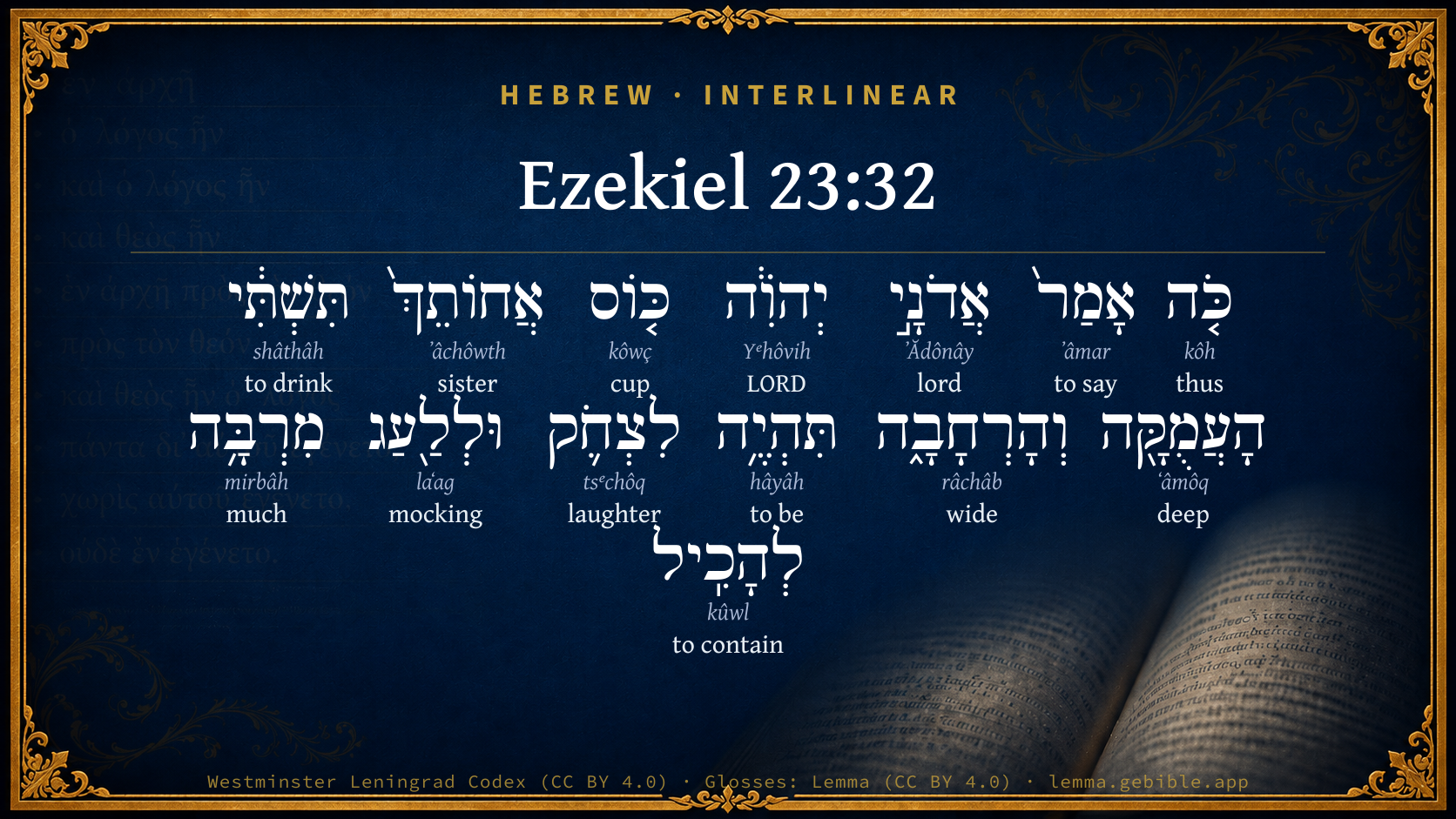
Ezekiel 23:32

Hebrew (Westminster Leningrad Codex) Ezekiel 23:32 appears in the Hebrew Old Testament. The text above is from the Westminster Leningrad Codex. Each word links to its Strong’s number, a concise gloss, and parsing drawn from the Open Scriptures Hebrew Bible morphology. Click any word for its full Brown-Driver-Briggs (BDB) entry.
Download image
Cite this verse

Ezekiel 23:32 (World English Bible). Public Domain. Lemma interlinear Bible study tool, https://lemma.gebible.app/v/ezekiel/23/32.

Show BibTeX & RIS
BibTeX
RIS
English Translation
Thus says the Lord Yahweh: You shall drink of your sister's cup, which is deep and large; you shall ridiculed and had in derision; it contains much.
World English Bible · Public Domain
Highlights Full analysis ↓
Download a study sheet

One document with this verse’s original text, its word-by-word gloss line, the meaning frame, cross-references with their text, attributed commentary, and full source and license credits — printable, and it pastes into notes with its structure intact.

This verse Autodidact and up

Study sheet (.html) Plain text (.txt)

A passage Seminary Student

Up to 50 verses in one chapter. A passage sheet keeps up to 6 commentary sources and 12 cross-references per verse, in the order this page ranks them, and says so on the sheet whenever that leaves anything out. Ask for a single verse and you get the Autodidact verse sheet above.

Everything on this page stays free to read, with no account — the sheet is a download of what is already on screen, not access to it.

Want to remove ads? Support Godless Engineer
Compare translations 3

The same verse in 3 English versions, stacked beneath the original-language interlinear above. Click any original word for its lexicon entry.

Each is an independent rendering of the whole verse — the interlinear is not word-aligned to these translations.

Highlighted words mark where these versions differ — a whole-verse word diff, not a word-by-word alignment.

  • World English Bible Public Domain
    Thus says the Lord Yahweh: You shall drink of your sister's cup, which is deep and large; you shall ridiculed and had in derision; it contains much.
  • King James Version Public Domain
    Thus saith the Lord GOD; Thou shalt drink of thy sister's cup deep and large: thou shalt be laughed to scorn and had in derision; it containeth much.
  • unfoldingWord Literal Text CC BY-SA 4.0
    The Lord Yahweh says this, ‘You will drink your sister’s cup that is deep and large. You will become a laughingstock and a subject for derision—this cup contains a great amount.

unfoldingWord Literal Text — © unfoldingWord, licensed CC BY-SA 4.0. Word-aligned USFM3 via Door43 (git.door43.org/unfoldingWord/en_ult).

Versions to compare (up to 4)

3 of 4 selected

Show all 18 translations

Every available English version of this verse, each an independent rendering of the whole verse.

  • World English Bible Public Domain
    Thus says the Lord Yahweh: You shall drink of your sister's cup, which is deep and large; you shall ridiculed and had in derision; it contains much.
  • Berean Standard Bible Public Domain
    This is what the Lord GOD says: ‘You will drink your sister’s cup, a cup deep and wide. It will bring scorn and derision, for it holds so much.
  • Majority Standard Bible Public Domain
    This is what the Lord GOD says: ‘You will drink your sister’s cup, a cup deep and wide. It will bring scorn and derision, for it holds so much.
  • King James Version Public Domain
    Thus saith the Lord GOD; Thou shalt drink of thy sister's cup deep and large: thou shalt be laughed to scorn and had in derision; it containeth much.
  • American Standard Version (1901) Public Domain
    Thus saith the Lord Jehovah: Thou shalt drink of thy sister's cup, which is deep and large; thou shalt be laughed to scorn and had in derision; it containeth much.
  • Revised Version (1885) Public Domain
    Thus saith the Lord GOD: Thou shalt drink of thy sister’s cup, which is deep and large: thou shalt be laughed to scorn and had in derision; it containeth much.
  • Geneva Bible (1599) Public Domain
    Thus saith ye Lord God, Thou shalt drinke of thy sisters cup, deepe and large: thou shalt be laughed to scorne and had in derision, because it containeth much.
  • Douay-Rheims (1899) Public Domain
    Thus saith the Lord God: Thou shalt drink thy sister's cup, deep, and wide: thou shalt be had in derision and scorn, which containeth very much.
  • Young's Literal Translation Public Domain
    Thus said the Lord Jehovah: The cup of thy sister thou dost drink, The deep and the wide one, (Thou art for laughter and for scorn,) Abundant to contain.
  • Literal Standard Version CC BY-SA 4.0
    Thus said Lord YHWH: You drink the cup of your sister, || The deep and the wide one || (You are for laughter and for scorn), || Abundant to contain.
  • Unlocked Literal Bible CC BY-SA 4.0
    The Lord Yahweh says this, 'You will drink your sister's cup that is deep and large. You will become a laughingstock and a subject for derision—this cup contains a great amount.
  • unfoldingWord Literal Text CC BY-SA 4.0
    The Lord Yahweh says this, ‘You will drink your sister’s cup that is deep and large. You will become a laughingstock and a subject for derision—this cup contains a great amount.
  • Darby Bible Public Domain
    Thus saith the Lord Jehovah: Thou shalt drink of thy sister's cup deep and large; thou shalt be for a laughing-stock and a derision, [for] it containeth much.
  • World Messianic Bible Public Domain
    “The Lord GOD says: ‘You will drink of your sister’s cup, which is deep and large. You will be ridiculed and held in derision. It contains much.
  • Webster's Bible Public Domain
    Thus saith the Lord GOD; Thou shalt drink of thy sister's cup deep and large: thou shalt be treated with scorn and had in derision; it containeth much.
  • Free Bible Version CC BY-SA 4.0
    This is what the Lord God says: You will drink from your sister's cup—a large, deep cup. You will be laughed at and insulted. You'll have to endure much of this.
  • Bible in Basic English Public Domain
    This is what the Lord has said: You will take a drink from your sister's cup, which is deep and wide: you will be laughed at and looked down on, more than you are able to undergo.
  • JPS Tanakh (1917) Public Domain
    Thus saith the Lord GOD: Thou shalt drink of thy sister's cup, which is deep and large; thou shalt be for a scorn and a derision; it is full to the uttermost.

Literal Standard Version (2020), Covenant Press — licensed CC BY-SA 4.0. Text via the HelloAO Bible API (eBible.org). Unlocked Literal Bible (unfoldingWord) — licensed CC BY-SA 4.0. Text via the HelloAO Bible API (eBible.org). unfoldingWord Literal Text — © unfoldingWord, licensed CC BY-SA 4.0. Word-aligned USFM3 via Door43 (git.door43.org/unfoldingWord/en_ult). Free Bible Version, Dr. Jonathan Gallagher — licensed CC BY-SA 4.0. Text via the HelloAO Bible API (eBible.org).

Word by word

More ways to search: Search by grammar → Find every occurrence → Compare this word →

Practice this passage: Drill this verse → Learn its vocabulary →

מִרְבָּ֥ה
mirbâh
H4767
“much”
Noun, Common, Feminine, Singular, Absolute
Part of Speech
Noun
Type
Common
Gender
Feminine
Number
Singular
State
Absolute
Full BDB Definition

Origin: from H7235

TWOT: 2103c

much
  1. כֹּ֤ה kôh H3541 “thus” Adverb
  2. אָמַר֙ ʼâmar H559 “to say” Verb, Qal, Perfect, 3rd Person, Masculine, Singular
  3. אֲדֹנָ֣י ʼĂdônây H136 “Lord · my” Noun, Common, Masculine, Plural, Construct + Suffix, Personal, 1st Person, Common, Singular
  4. יְהֹוִ֔ה Yᵉhôvih H3069 “LORD” Noun, Proper
  5. כּ֤וֹס kôwç H3563 “cup of” Noun, Common, Feminine, Singular, Construct
  6. אֲחוֹתֵךְ֙ ʼâchôwth H269 “sister · your” Noun, Common, Feminine, Singular, Construct + Suffix, Personal, 2nd Person, Feminine, Singular
  7. תִּשְׁתִּ֔י shâthâh H8354 “to drink” Verb, Qal, Imperfect, 2nd Person, Feminine, Singular
  8. הָעֲמֻקָּ֖ה ʻâmôq H6013 “the · deep” Particle, Definite Article + Adjective, Adjective, Feminine, Singular, Absolute
  9. וְהָרְחָבָ֑ה râchâb H7342 “and · the · wide” Conjunction + Particle, Definite Article + Adjective, Adjective, Feminine, Singular, Absolute
  10. תִּהְיֶ֥ה hâyâh H1961 “to be” Verb, Qal, Imperfect, 3rd Person, Feminine, Singular
  11. לִצְחֹ֛ק tsᵉchôq H6712 “to/for · laughter” Preposition + Noun, Common, Masculine, Singular, Absolute
  12. וּלְלַ֖עַג laʻag H3933 “and · to/for · mocking” Conjunction + Preposition + Noun, Common, Masculine, Singular, Absolute
  13. לְהָכִֽיל kûwl H3557 “to contain” Preposition + Verb, Hiphil, Infinitive Construct

About this verse

These counts appear in no published source. They are computed here, from the morphology-tagged text and Lemma’s own curated glosses. What Lemma adds →

14
words
14
distinct lemmas
Prophets
section

Notable vocabulary

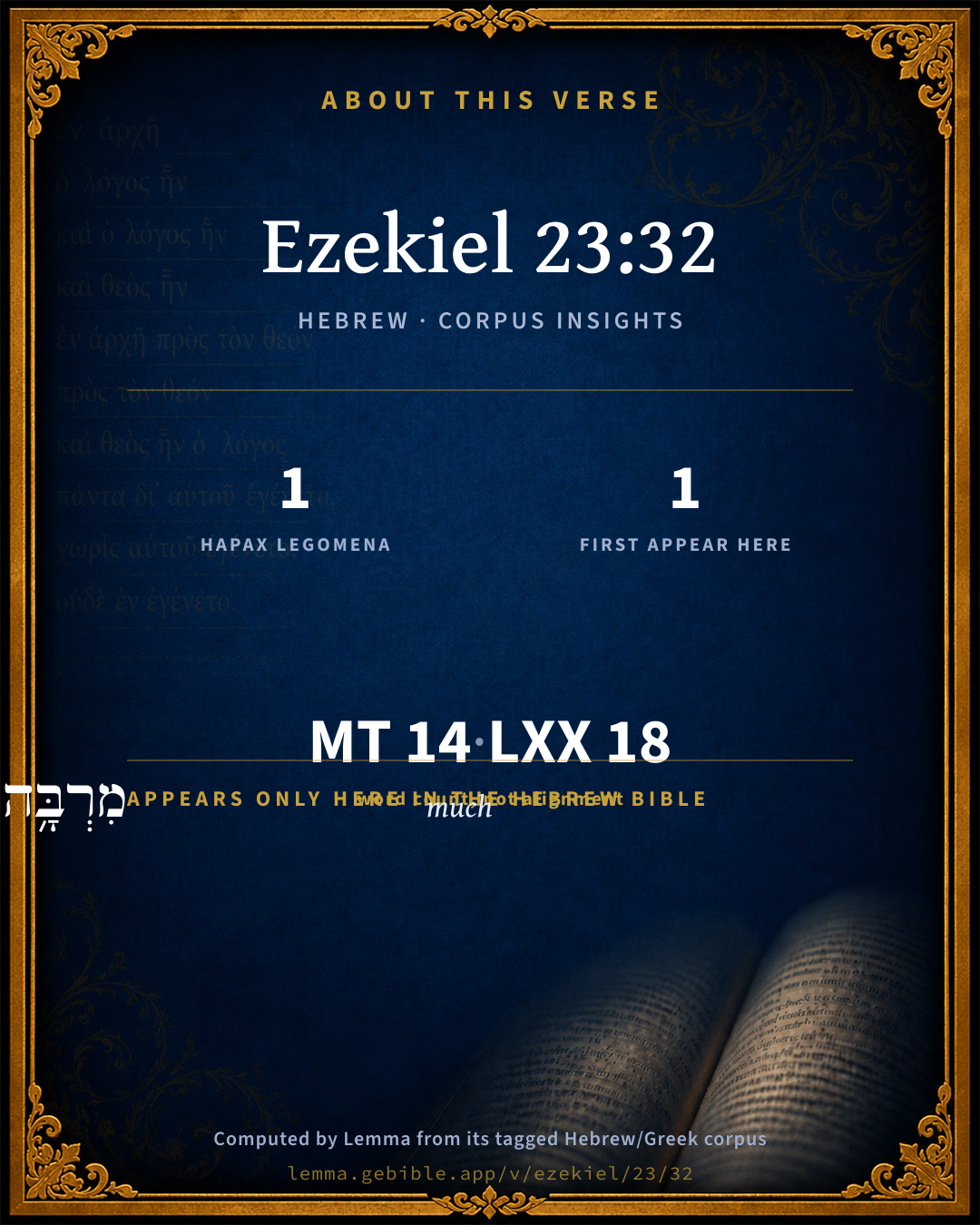
1 hapax legomenon — a word that appears only here in the entire Hebrew Bible:

  • מִרְבָּ֥ה much H4767

First appearance in Scripture

This word makes its first canonical appearance in the Hebrew Bible here:

  • מִרְבָּ֥ה much H4767

Shared distinctive vocabulary

לִצְחֹ֛ק laughter H6712 occurs in 2 verses of the Hebrew Bible. Also found in:

Grammatical profile

  • 4 verbs
  • 7 nouns
  • 2 adjectives
  • 1 adverb

Verb forms

  • אָמַר֙ Qal · Perfect
  • תִּשְׁתִּ֔י Qal · Imperfect
  • תִּהְיֶ֥ה Qal · Imperfect
  • לְהָכִֽיל Hiphil · Infinitive Construct

Hebrew & Septuagint length

In English translation the verse runs 27 words from the Hebrew and 17 from the Septuagint (LXX English) — the Septuagint runs noticeably shorter here. See the side-by-side →

A rough comparison of the two English renderings, which tokenize alike — not a word-level alignment.

Word counts can differ between the Hebrew and the Greek without any difference in meaning — e.g. the Hebrew direct-object marker אֵת has no separate Greek word, and Greek often adds the article ὁ.

In the original languages it is 14 Hebrew tokens and 18 Greek tokens — but the two are counted differently (Hebrew bundles its prefixes and suffixes into one token; the Greek is in lemma form), so that isn’t a like-for-like length.

Cross-references

18

Topical passages linked to Ezekiel 23:32 in the Treasury of Scripture Knowledge — connected by theme and wording, ordered by reader-vote popularity; previews shown in the World English Bible.

  • Psalms 60:3 You have shown your people hard things. You have made us drink the wine that makes us stagger.
  • Isaiah 51:17 Awake, awake, stand up, Jerusalem, that have drunk at the hand of Yahweh the cup of his wrath; you have drunken the bowl of the cup of staggering, and drained it.
  • Ezekiel 22:4–5 You have become guilty in your blood that you have shed, and are defiled in your idols which you have made; and you have caused your days to draw near, and are come even to your years: therefore have I made you a reproach to the nations, and a mocking to all the countries.
  • Deuteronomy 28:37 You shall become an astonishment, a proverb, and a byword, among all the peoples where Yahweh shall lead you away.
  • 1 Kings 9:7 then will I cut off Israel out of the land which I have given them; and this house, which I have made holy for my name, will I cast out of my sight; and Israel shall be a proverb and a byword among all peoples.
  • Psalms 79:3 Their blood they have shed like water around Jerusalem. There was no one to bury them.
  • Jeremiah 25:9 behold, I will send and take all the families of the north, says Yahweh, and [I will send] to Nebuchadrezzar the king of Babylon, my servant, and will bring them against this land, and against the inhabitants of it, and against all these nations round about; and I will utterly destroy them, and make them an astonishment, and a hissing, and perpetual desolations.
  • Jeremiah 25:15–28 For thus says Yahweh, the God of Israel, to me: take this cup of the wine of wrath at my hand, and cause all the nations, to whom I send you, to drink it.
  • Jeremiah 48:26 Make you him drunken; for he magnified himself against Yahweh: and Moab shall wallow in his vomit, and he also shall be in derision.
  • Lamentations 2:15–16 All that pass by clap their hands at you; They hiss and wag their head at the daughter of Jerusalem, [saying], Is this the city that men called The perfection of beauty, The joy of the whole earth?
  • Ezekiel 25:6 For thus says the Lord Yahweh: Because you have clapped your hands, and stamped with the feet, and rejoiced with all the despite of your soul against the land of Israel;
  • Ezekiel 26:2 Son of man, because Tyre has said against Jerusalem, Aha, she is broken: the gate of the peoples; she is turned to me; I shall be replenished, now that she is laid waste:
  • Ezekiel 35:15 As you did rejoice over the inheritance of the house of Israel, because it was desolate, so will I do to you: you shall be desolate, Mount Seir, and all Edom, even all of it; and they shall know that I am Yahweh.
  • Ezekiel 36:3 therefore prophesy, and say, Thus says the Lord Yahweh: Because, even because they have made you desolate, and swallowed you up on every side, that you might be a possession to the residue of the nations, and you are taken up in the lips of talkers, and the evil report of the people;
  • Micah 7:8 Don't rejoice against me, my enemy. When I fall, I will arise. When I sit in darkness, Yahweh will be a light to me.
  • Matthew 20:22–23 But Jesus answered, "You don't know what you are asking. Are you able to drink the cup that I am about to drink, and be baptized with the baptism that I am baptized with?" They said to him, "We are able."
  • Revelation 16:19 The great city was divided into three parts, and the cities of the nations fell. Babylon the great was remembered in the sight of God, to give to her the cup of the wine of the fierceness of his wrath.
  • Revelation 18:6 Return to her just as she returned, and repay her double as she did, and according to her works. In the cup which she mixed, mix to her double.

Cross-references courtesy of OpenBible.info (CC BY 4.0).

Hebrew and Greek witnesses Masoretic Hebrew ↔ Greek Septuagint

The same verse in the two great witnesses to the Old Testament, shown verse-for-verse.

Here the Septuagint runs noticeably shorter than the Hebrew — LXX2012 (modern English Septuagint) 17 words vs World English Bible 27. A rough length comparison of the two English translations, not a word-level alignment — read both below.

These are two independent witnesses, not word-aligned to each other, and the Septuagint is shown in lemma (dictionary) form.

Hebrew Ezekiel 23:32 Masoretic · Westminster Leningrad Codex

כֹּ֤ה אָמַר֙ אֲדֹנָ֣י יְהֹוִ֔ה כּ֤וֹס אֲחוֹתֵךְ֙ תִּשְׁתִּ֔י הָעֲמֻקָּ֖ה וְהָרְחָבָ֑ה תִּהְיֶ֥ה לִצְחֹ֛ק וּלְלַ֖עַג מִרְבָּ֥ה לְהָכִֽיל

Thus says the Lord Yahweh: You shall drink of your sister's cup, which is deep and large; you shall ridiculed and had in derision; it contains much.

World English Bible · Public Domain

Greek LXX Ezekiel 23:32 Septuagint · lemma form

ὅδε λέγω κύριος ὁ ποτήριον ὁ ἀδελφή σύ πίνω ὁ βαθύς καί ὁ πλατύς ὁ πλεονάζω ὁ συντελέω

Thus says the Lord; Drink your sister's cup, deep and large, and full, to cause complete drunkenness.

LXX2012 (modern English Septuagint) · Public Domain

On this verse, The Cambridge Bible for Schools and Colleges discusses the Septuagint’s reading. Read the note in Commentary ↓

Hebrew: Westminster Leningrad Codex (CC BY 4.0). Greek: Septuagint (public domain); English from LXX2012 (modern English Septuagint) (Public Domain). How the Septuagint differs from the Hebrew →

Targum (Aramaic paraphrase)

1

The Targum is the ancient Jewish Aramaic paraphrase of the Hebrew Scriptures — an interpretive translation, not the Hebrew text itself. Onkelos (literal) and Pseudo-Jonathan (expansive) render the Torah, and Jonathan the Prophets. Coverage is partial: where no permissively-licensed English translation exists for a verse, only the Aramaic is shown. This is verse-level text, not a word-by-word alignment to the Hebrew.

  1. Targum Jonathan Prophets (Joshua–Malachi)
    כִּדְנַן אֲמַר יְיָ אֱלֹהִים כָּס פּוּרְעֲנוּת אֲחָתֵיךְ תִּשְׁתִּין תַּקִיפָא וַחֲסֵינְתָּא תְּהִין לְחוֹךְ וְלִלְעֵיב מִסְגֵי עָקָא דְתֵיתֵי עֲלָךְ:

    (no public-domain English translation for this verse)

    Targum Jonathan — Aramaic: “Mikraot Gedolot” (public domain). English: “Sefaria Community Translation” (CC0 1.0 (public-domain dedication)); “London "Chaldee Paraphrase," 1871” (public domain). Text via Sefaria.

Commentary

Notes on Ezekiel 23:32 from classic Christian and Jewish commentators (each source and its license shown beneath its notes). The classic Christian expositions comment on the surrounding passage and are grouped to its opening verse, so a note may address several verses; the Jewish commentaries on the Tanakh (Rashi and others) are per-verse, so they appear only where the commentator wrote on this verse.

Lemma curates 59 commentaries, every one of them public domain or Creative Commons licensed, each selected and text-cleaned for this edition rather than reprinted as found. About our sources →

Trapp's Complete Commentary

John Trapp

Eze 23:32 Thus saith the Lord GOD; Thou shalt drink of thy sister’s cup deep and large: thou shalt be laughed to scorn and had in derision; it containeth much.

Ver. 32. Thou shaIt drink of thy sister’s cup deep and large.] Yea, though it have eternity to the bottom.

John Trapp, A Commentary or Exposition upon All the Books of the Old and New Testament (1647–1656) — public domain. Text from a community e-Sword module.

Adam Clarke's Commentary

Verse 32. Thou shalt drink of thy sister's cup] Thou shalt be ruined and desolated as Samaria was.

Adam Clarke's Commentary on the Bible (1810–1826) — public domain. Text from a community e-Sword/MySword module.

Ellicott's Commentary for English Readers

(32) It containeth much.—The cup of humiliation already drunk by Samaria was large, and filled with pain and sorrow, yet Jerusalem must drink it amid the derision of her neighbours.

A Bible Commentary for English Readers, edited by Charles John Ellicott (1878–1897) — public domain. Text from a community e-Sword module.

The Cambridge Bible for Schools and Colleges

gen. ed. J. J. S. Perowne

32. sister’s cup deep] i.e. which is deep. The words “thou shalt … derision” are parenthetical; LXX. omits.

The Cambridge Bible for Schools and Colleges (gen. ed. J. J. S. Perowne; Cambridge University Press, 1878–1918) — public domain. Text from a community e-Sword module.

John Gill's Exposition

Thus saith the Lord God, thou shall drink of thy sister's cup deep and large,.... That is, partake of the same punishment, which was very great, signified by a deep and large cup, which holds much:

thou shall be laughed to scorn, and had in derision; by the nations round about, who, instead of pitying them under their troubles, will rejoice at them; just as drunken men are laughed at, when intoxicated and reeling about:

it containeth much; the cup of wrath and vengeance; as much as will last severity years drinking. The Targum connects this with the preceding clause,

"and thou shalt be for derision and for laughter, because of the greatness of the tribulation that shall come upon thee.''

John Gill's Exposition of the Whole Bible (1746–1763) — public domain (CC PDM 1.0). Text via the HelloAO Bible API.

Matthew Poole's English Annotations

Thou shalt drink; thou shalt not put it by, and shift it off.

Deep; towards the dregs, where the bitterest poison of it lieth.

And large; in great quantity; thy punishment shall be most grievous who must drink so deep of this cup of astonishment.

Thou shalt be laughed to scorn; when sick as heart can hold, and needest pity and help to relieve, instead hereof thou shalt be derided and abused: these will be cruel mockings.

It, the cup,

containeth much; is large, and contains what will last many years, till the seventy years be expired; and of this cup thou shalt still drink, and be derided.

Matthew Poole's English Annotations on the Holy Bible (1683–1685) — public domain. Text from a community e-Sword/MySword module.

John Wesley's Explanatory Notes

It - Is large, and contains what will last many years, even 'till the seventy years be expired.

John Wesley, Explanatory Notes Upon the Whole Bible (1754–1765) — public domain. Text via the GEBible commentary corpus.

unfoldingWord translationNotes

Door43 World Missions Community

General Information:

Yahweh continues his metaphor in which he speaks of the cities of Jerusalem and Samaria as if they were two prostitutes. This metaphor continues through Ezekiel 23:34. (See: Metaphor)

You will drink your sister's cup

Here Yahweh speaks of punishment as if it were a cup of wine the woman drank. AT: "You will drink the same cup of punishment as your sister" (See: Metonymy)

your sister's cup that is

Here the "cup" represents what is in the cup. AT: "from your sister's cup that is" or "all that is in your sister's cup, and her cup is" (See: Metonymy)

a laughingstock ... a subject for derision

Both of these phrases refer to a person who is laughed at and criticized because of their foolish behavior. Derision is mocking or ridiculing something or someone. (See: Parallelism)

this cup contains a great amount

This sentence does not say what is in the cup because it is understood by reading Ezekiel 23:31. AT: "this cup contains a great amount of punishment" (See: Ellipsis)

translationWords

Lord Yahweh

unfoldingWord translationNotes — © Distant Shores Media and the Door43 World Missions Community, licensed CC BY-SA 4.0. Source: git.door43.org/Door43/en_tn.

Rashi

Rabbi Shlomo Yitzchaki (Rashi)

too much to bear Too much to contain, like to bear.

Rashi on the Tanakh — English translations: “The Judaica Press complete Tanach with Rashi, translated by A. J. Rosenberg” (CC BY 4.0); “Pentateuch with Rashi's commentary by M. Rosenbaum and A.M. Silbermann, 1929-1934” (public domain); “The Metsudah Tanach series, Lakewood, N.J” (CC BY 4.0); and “The Book of Joshua, Metsudah Publications, 1997” (CC BY 4.0). Text via Sefaria.

Lesson kit

Teaching starters — assembled from the data on this page, not authored interpretation. Every prompt links to the verse data it draws on. Edit before teaching.

Ezekiel, in the Prophets, opens this verse with 14 words (14 distinct Hebrew lemmas). Its most distinctive word is mirbâh (“much”). The Greek Septuagint runs shorter here. A historical commentator’s framing appears above. Read the whole chapter for the surrounding context.

Discussion questions

  1. What does “much” (mirbâh) contribute to the verse as a whole?
  2. 1 word here appears nowhere else in the Hebrew Bible. Why might the author reach for such rare wording?
  3. This is the first place “much” appears in Scripture (first appears here). What does its debut here establish?
  4. How does Genesis 21:6, which shares the word «laughter», read alongside this verse?
  5. The Septuagint runs shorter here than the Hebrew. What might account for the difference?
  6. These translations render this verse differently; the difference is in the English rendering, not the original. What questions does that raise?
  7. «אָמַר֙» is a Qal Perfect verb. How does that grammatical form shape the action described?
  8. Compare how Trapp's Complete Commentary and Adam Clarke's Commentary read this verse. Where do they agree or differ?

Things to notice

Reading settings

Reading text

Shown beneath each verse's original-language words.

Old Testament
Old Testament edition

Read the OT as the Masoretic Hebrew (MT) or the Greek Septuagint (LXX).

English shown for the Greek Septuagint (in the Hebrew ↔ Greek comparison).

Comparing translations? Open the Compare panel on any verse page to stack up to four side by side.