Proverbs 23:7

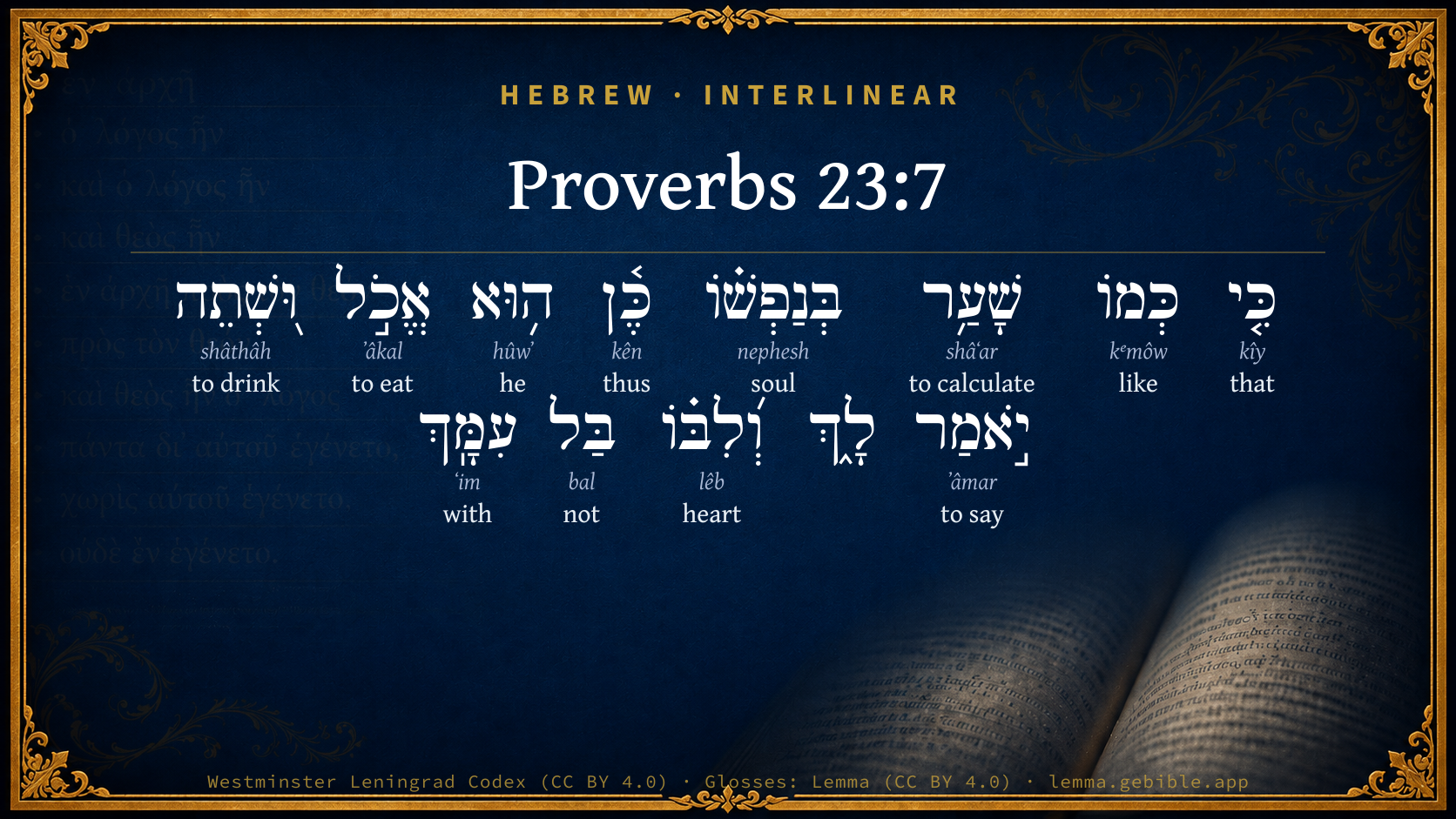
Hebrew (Westminster Leningrad Codex) Proverbs 23:7 appears in the Hebrew Old Testament. The text above is from the Westminster Leningrad Codex. Each word links to its Strong’s number, a concise gloss, and parsing drawn from the Open Scriptures Hebrew Bible morphology. Click any word for its full Brown-Driver-Briggs (BDB) entry.
Download image
Cite this verse

Proverbs 23:7 (World English Bible). Public Domain. Lemma interlinear Bible study tool, https://lemma.gebible.app/v/proverbs/23/7.

Show BibTeX & RIS
BibTeX
RIS
English Translation
For as he thinks about the cost, so he is. "Eat and drink!" he says to you, But his heart is not with you.
World English Bible · Public Domain
Highlights
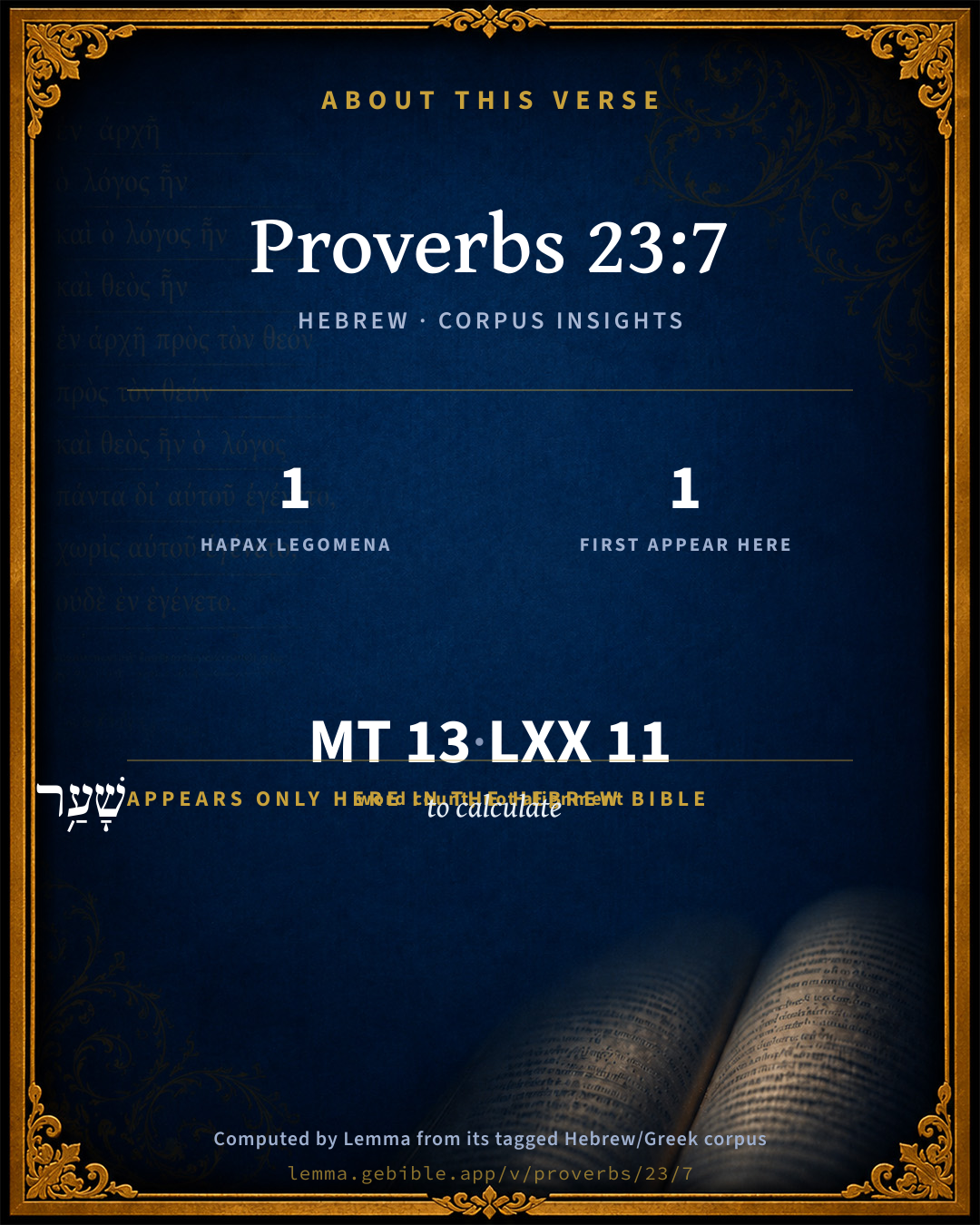
  • 1 hapax legomenon — only here in the Hebrew Bible
  • 1 first appearance in the Hebrew Bible
Full analysis ↓
Download a study sheet

One document with this verse’s original text, its word-by-word gloss line, the meaning frame, cross-references with their text, attributed commentary, and full source and license credits — printable, and it pastes into notes with its structure intact.

This verse Autodidact and up

Study sheet (.html) Plain text (.txt)

A passage Seminary Student

Up to 50 verses in one chapter. A passage sheet keeps up to 6 commentary sources and 12 cross-references per verse, in the order this page ranks them, and says so on the sheet whenever that leaves anything out. Ask for a single verse and you get the Autodidact verse sheet above.

Everything on this page stays free to read, with no account — the sheet is a download of what is already on screen, not access to it.

Want to remove ads? Support Godless Engineer
Compare translations 3

The same verse in 3 English versions, stacked beneath the original-language interlinear above. Click any original word for its lexicon entry.

Each is an independent rendering of the whole verse — the interlinear is not word-aligned to these translations.

Highlighted words mark where these versions differ — a whole-verse word diff, not a word-by-word alignment.

  • World English Bible Public Domain
    For as he thinks about the cost, so he is. "Eat and drink!" he says to you, But his heart is not with you.
  • King James Version Public Domain
    For as he thinketh in his heart, so is he: Eat and drink, saith he to thee; but his heart is not with thee.
  • unfoldingWord Literal Text CC BY-SA 4.0
    For like one who calculates in his soul, so he. “Eat and drink!” he will say to you, but his heart not with you.

unfoldingWord Literal Text — © unfoldingWord, licensed CC BY-SA 4.0. Word-aligned USFM3 via Door43 (git.door43.org/unfoldingWord/en_ult).

Versions to compare (up to 4)

3 of 4 selected

Show all 18 translations

Every available English version of this verse, each an independent rendering of the whole verse.

  • World English Bible Public Domain
    For as he thinks about the cost, so he is. "Eat and drink!" he says to you, But his heart is not with you.
  • Berean Standard Bible Public Domain
    for he is keeping track, inwardly counting the cost. “Eat and drink,” he says to you, but his heart is not with you.
  • Majority Standard Bible Public Domain
    for he is keeping track, inwardly counting the cost. “Eat and drink,” he says to you, but his heart is not with you.
  • King James Version Public Domain
    For as he thinketh in his heart, so is he: Eat and drink, saith he to thee; but his heart is not with thee.
  • American Standard Version (1901) Public Domain
    For as he thinketh within himself, so is he: Eat and drink, saith he to thee; But his heart is not with thee.
  • Revised Version (1885) Public Domain
    For as he reckoneth within himself, so is he: Eat and drink, saith he to thee; but his heart is not with thee.
  • Geneva Bible (1599) Public Domain
    For as though he thought it in his heart, so will hee say vnto thee, Eate and drinke: but his heart is not with thee.
  • Douay-Rheims (1899) Public Domain
    Because like a soothsayer, and diviner, he thinketh that which he knoweth not. Eat and drink, will he say to thee: and his mind is not with thee.
  • Young's Literal Translation Public Domain
    For as he hath thought in his soul, so `is' he, `Eat and drink,' saith he to thee, And his heart `is' not with thee.
  • Literal Standard Version CC BY-SA 4.0
    For as he has thought in his soul, so he [is]. “Eat and drink,” he says to you, || And his heart [is] not with you.
  • Unlocked Literal Bible CC BY-SA 4.0
    for he is the kind of man who counts the price of the food. “Eat and drink!” he says to you, but his heart is not with you.
  • unfoldingWord Literal Text CC BY-SA 4.0
    For like one who calculates in his soul, so he. “Eat and drink!” he will say to you, but his heart not with you.
  • Darby Bible Public Domain
    For as he thinketh in his soul, so is he. Eat and drink! will he say unto thee; but his heart is not with thee.
  • World Messianic Bible Public Domain
    for as he thinks about the cost, so he is. “Eat and drink!” he says to you, but his heart is not with you.
  • Webster's Bible Public Domain
    For as he thinketh in his heart, so is he: Eat and drink, saith he to thee; but his heart is not with thee.
  • Free Bible Version CC BY-SA 4.0
    for what they're thinking inside is what they really are. They say, “Come on, eat and drink!”—but in their minds they don't really care about you.
  • Bible in Basic English Public Domain
    For as the thoughts of his heart are, so is he: Take food and drink, he says to you; but his heart is not with you.
  • JPS Tanakh (1917) Public Domain
    For as one that hath reckoned within himself, so is he: 'Eat and drink', saith he to thee; but his heart is not with thee.

Literal Standard Version (2020), Covenant Press — licensed CC BY-SA 4.0. Text via the HelloAO Bible API (eBible.org). Unlocked Literal Bible (unfoldingWord) — licensed CC BY-SA 4.0. Text via the HelloAO Bible API (eBible.org). unfoldingWord Literal Text — © unfoldingWord, licensed CC BY-SA 4.0. Word-aligned USFM3 via Door43 (git.door43.org/unfoldingWord/en_ult). Free Bible Version, Dr. Jonathan Gallagher — licensed CC BY-SA 4.0. Text via the HelloAO Bible API (eBible.org).

Word by word

More ways to search: Search by grammar → Find every occurrence → Compare this word →

Practice this passage: Drill this verse → Learn its vocabulary →

שָׁעַ֥ר
shâʻar
H8176
“to calculate”
Verb, Qal, Perfect, 3rd Person, Masculine, Singular
Part of Speech
Verb
Stem
Qal
Form
Perfect
Person
3rd Person
Gender
Masculine
Number
Singular
Full BDB Definition

Origin: primitive root

TWOT: 2438

to split open, reason out, calculate, reckon, estimate - (Qal) to calculate Pro 23:7
  1. כִּ֤י kîy H3588 “that” Conjunction
  2. כְּמוֹ kᵉmôw H3644 “like” Preposition
  3. בְּנַפְשׁ֗וֹ nephesh H5315 “in/at · soul · his” Preposition + Noun, Common, Both, Singular, Construct + Suffix, Personal, 3rd Person, Masculine, Singular
  4. כֶּ֫ן kên H3651 “thus” Adverb
  5. ה֥וּא hûwʼ H1931 “he” Pronoun, Personal, 3rd Person, Masculine, Singular
  6. אֱכֹ֣ל ʼâkal H398 “eat” Verb, Qal, Imperative, 2nd Person, Masculine, Singular
  7. וּ֭שְׁתֵה shâthâh H8354 “and · drink” Conjunction + Verb, Qal, Imperative, 2nd Person, Masculine, Singular
  8. יֹ֣אמַר ʼâmar H559 “to say” Verb, Qal, Imperfect, 3rd Person, Masculine, Singular
  9. וְ֝לִבּ֗וֹ lêb H3820 “and · heart · his” Conjunction + Noun, Common, Masculine, Singular, Construct + Suffix, Personal, 3rd Person, Masculine, Singular
  10. בַּל bal H1077 “not” Particle, Negative
  11. עִמָּֽךְ ʻim H5973 “with · you” Preposition + Suffix, Personal, 2nd Person, Feminine, Singular

About this verse

These counts appear in no published source. They are computed here, from the morphology-tagged text and Lemma’s own curated glosses. What Lemma adds →

13
words
12
distinct lemmas
Wisdom
section

Notable vocabulary

1 hapax legomenon — a word that appears only here in the entire Hebrew Bible:

  • שָׁעַ֥ר to calculate H8176

First appearance in Scripture

This word makes its first canonical appearance in the Hebrew Bible here:

  • שָׁעַ֥ר to calculate H8176

Grammatical profile

  • 4 verbs
  • 2 nouns
  • 1 pronoun
  • 3 prepositions
  • 1 conjunction
  • 1 adverb
  • 1 particle

Verb forms

  • שָׁעַ֥ר Qal · Perfect
  • אֱכֹ֣ל Qal · Imperative
  • וּ֭שְׁתֵה Qal · Imperative
  • יֹ֣אמַר Qal · Imperfect

Hebrew & Septuagint length

In English translation the verse runs 24 words from the Hebrew and 27 from the Septuagint (LXX English) — closely comparable.

A rough comparison of the two English renderings, which tokenize alike — not a word-level alignment.

Word counts can differ between the Hebrew and the Greek without any difference in meaning — e.g. the Hebrew direct-object marker אֵת has no separate Greek word, and Greek often adds the article ὁ.

In the original languages it is 13 Hebrew tokens and 11 Greek tokens — but the two are counted differently (Hebrew bundles its prefixes and suffixes into one token; the Greek is in lemma form), so that isn’t a like-for-like length.

Cross-references

9

Topical passages linked to Proverbs 23:7 in the Treasury of Scripture Knowledge — connected by theme and wording, ordered by reader-vote popularity; previews shown in the World English Bible.

  • Psalms 12:2 Everyone lies to his neighbor. They speak with flattering lips, and with a double heart.
  • Psalms 55:21 His mouth was smooth as butter, But his heart was war. His words were softer than oil, Yet they were drawn swords.
  • Judges 16:15 She said to him, How can you say, I love you, when your heart is not with me? you have mocked me these three times, and have not told me in which your great strength lies.
  • Matthew 9:3–4 Behold, some of the scribes said to themselves, "This man blasphemes."
  • Luke 11:37–54 Now as he spoke, a certain Pharisee asked him to dine with him. He went in, and sat at the table.
  • Luke 7:39 Now when the Pharisee who had invited him saw it, he said to himself, "This man, if he were a prophet, would have perceived who and what kind of woman this is who touches him, that she is a sinner."
  • Daniel 11:27 As for both these kings, their hearts shall be to do mischief, and they shall speak lies at one table: but it shall not prosper; for yet the end shall be at the time appointed.
  • Proverbs 19:22 That which makes a man to be desired is his kindness. A poor man is better than a liar.
  • 2 Samuel 13:26–28 Then said Absalom, If not, please let my brother Amnon go with us. The king said to him, Why should he go with you?

Cross-references courtesy of OpenBible.info (CC BY 4.0).

Hebrew and Greek witnesses Masoretic Hebrew ↔ Greek Septuagint

The same verse in the two great witnesses to the Old Testament, shown verse-for-verse.

These are two independent witnesses, not word-aligned to each other, and the Septuagint is shown in lemma (dictionary) form.

Hebrew Proverbs 23:7 Masoretic · Westminster Leningrad Codex

כִּ֤י כְּמוֹ שָׁעַ֥ר בְּנַפְשׁ֗וֹ כֶּ֫ן ה֥וּא אֱכֹ֣ל וּ֭שְׁתֵה יֹ֣אמַר לָ֑ךְ וְ֝לִבּ֗וֹ בַּל עִמָּֽךְ

For as he thinks about the cost, so he is. "Eat and drink!" he says to you, But his heart is not with you.

World English Bible · Public Domain

Greek LXX Proverbs 23:7 Septuagint · lemma form

ὅς τρόπος γάρ εἰ τις καταπίνω θρίξ οὕτως ἐσθίω καί πίνω

so he eats and drinks as if any one should swallow a hair, and do not bring him in to yourself, nor eat your morsel with him:

LXX2012 (modern English Septuagint) · Public Domain

On this verse, Haydock's Catholic Bible Commentary discusses the Septuagint’s reading. Read the note in Commentary ↓

Hebrew: Westminster Leningrad Codex (CC BY 4.0). Greek: Septuagint (public domain); English from LXX2012 (modern English Septuagint) (Public Domain). How the Septuagint differs from the Hebrew →

Commentary

Notes on Proverbs 23:7 from classic Christian and Jewish commentators (each source and its license shown beneath its notes). The classic Christian expositions comment on the surrounding passage and are grouped to its opening verse, so a note may address several verses; the Jewish commentaries on the Tanakh (Rashi and others) are per-verse, so they appear only where the commentator wrote on this verse.

Lemma curates 59 commentaries, every one of them public domain or Creative Commons licensed, each selected and text-cleaned for this edition rather than reprinted as found. About our sources →

Trapp's Complete Commentary

John Trapp

Pro 23:7 For as he thinketh in his heart, so [is] he: Eat and drink, saith he to thee; but his heart [is] not with thee.

Ver. 7. For as he thinketh in his heart, so is he.] Mens cuiusque is est quisque: - The man is as his mind is; or as he thinketh in his heart, so he speaketh. He cannot so dissemble, but that soon he blurts out some word, or shows some sign of his sordid disposition. Some read it thus: For as he grudgeth his own soul, so he will say unto thee, Eat, drink, &c. As he starves his own genius, and cannot afford himself a good meal’s meat, so be grudgeth at his guests whom yet he bids welcome. Christ doth not so. {Son 5:1}

John Trapp, A Commentary or Exposition upon All the Books of the Old and New Testament (1647–1656) — public domain. Text from a community e-Sword module.

The Biblical Illustrator

Joseph S. Exell

Pro_23:7

For as he thinketh in his heart, so is he.

The importance of a mans thoughts

1. A man is as his thoughts.

2. A man has control over his thoughts.

3. God helps him in the exercise of that control.

We are that really, both to God and to man, which we are inwardly. (Matthew Henry.)

Thoughts

I. The infinite importance of mens thoughts. This text, in counselling for a particular case, and bidding us test the sincerity of one who invites us, asserts a principle of wide application. You do not know a man until you know his thoughts. God knows him perfectly, because He knows his thoughts.

1. You cannot know a man merely by listening to his words or watching his actions. There is always more, and often better, in men than comes into expression.

2. The revelations of close and trustful friendships are revelations of the thoughts.

3. The claims of God reach beyond right action, and demand right thought. The law of God searches the secret intents of the heart.

4. The redemption that is provided includes in its scheme the sanctification of the very thought.

5. All sin is represented as springing up out of, and finding expression for, lust in the sphere of thought. Show, by appeal to Christian experience, the difficulty found in the restraining of thought. In the unrestrainedness of thought often comes to us the feeling and the mastery of sin.

II. The amount of control man has over his thoughts. If he had no control over them his moral responsibility would be gone. We cannot help the evil thoughts coming to us. We have control--

1. Over the material of our thoughts. The materials are the sum of past impressions. Thinking is the combining, comparing, and rearranging of the actual contents of the mind. We can direct ourselves away from the evil and towards the good. We can fill our minds with good suggestions and associations. Illustrate from going into scenes suggestive of vice; reading questionable or immoral books, etc.

2. Over the processes of thought. There may be the nourishing of the evil. There may be the swaying of the mind through the power of the renewed will, and with the help of the indwelling Spirit. Apply to wandering thoughts in the house of God. Do we make the mastery of such evil the subject of real effort?

III. The help God renders man in the exercise of such control. An attempt to regulate thoughts will bring the conviction of human helplessness. When a man has mastered conduct he cannot say that he has mastered himself. When he thinks he has mastered thoughts he will surely find that he needs to cry unto God, saying, Try me and know my thoughts . . . and lead me in the way everlasting. (Robert Tuck, B.A.)

The thoughts of the heart the best evidence of a mans spiritual state

The knowledge of ourselves is one of the most noble and excellent attainments in human life. He that knows himself stands fair for immortal felicity. Doctrine: The thoughts of mens hearts do evidence what their spiritual state is. These do ordinarily give the best and surest measure of the frame of mens minds. What thoughts, then, evidence the spiritual state of men? Not occasional thoughts. Not such as arise from strong convictions, that come on us suddenly. Not such as arise from apparent Divine desertions. Despairing thoughts are no sure evidence of the condition of souls. Not such as arise from violent temptations. Not such as arise from mens particular calling and manner of life. Not such as arise from attendance upon, and the performance of, religious duties. The religious discourse of others may produce pious thoughts in an unregenerate person. A man may read Gods Word and be yet far from the kingdom. So he may attend the preaching of the Word, and even pray, without having more than surface thoughts. Answering the question affirmatively, mention may be made of voluntary thoughts, such as the mind is apt for and inclines towards. Four qualifications must attend them if they are to be a complete rule and a perfect standard of trial. They must be natural, numerous, satisfactory, and operative. Let us each see to it that our thoughts be such as evidence us to be holy persons. Practise frequent, serious, and close examination. (Nathanael Walter.)

The heart-state

The body is not the man. Our bodies die. Neither are a mans words himself. Words are often used to conceal, to misrepresent, to counterfeit. Neither is it possible, universally, to discern the essence of character in action. What good man is there who has not again and again failed to do himself justice in his life? Often, on the other hand, actions are much more beautiful than the thoughts of the heart. The essence of human character is found in the heart. It is the disposition, it is the heart-state, which is the true man. This test of human character is a just one, for our life is a progress, is in the direction of the realisation of this heart-state. Action is but heart-expression. The heart-thought, or purpose, is the true man. Not only is human progress towards the realisation of this heart-state, but the separation of the man from this full expression and realisation of his inner desire is not a matter of his own choice or creation, and therefore cannot enter as an element into his character. The field open, covered by the human choice, is only this, present desire. It often happens that a man is to a certain extent kept under the power of religious truth who is in heart utterly disloyal to the Divine law. When the life differs from the heart the latter, not the former, must be regarded as the true man. Sooner or later the full coincidence between the external and internal is inevitable; the full expression of the heart is sure to come.

1. Tendency is everything in the moral world.

2. Explain the different destinies of the Christian and un-Christian life.

3. Abstain from all judgment of your fellow-men.

4. Encourage those who are true and good at heart. (S. S. Mitchell, D.D.)

Thought the index of character

I. This is the Hebrew way of telling us in a casual word about feasting that a mans inmost thinking is the true index to his character. Talk is superficial. The lip gives a smiling welcome whilst a lofty disdain is in the heart. Mellifluous speech often comes from a malign spirit, whilst groanings that cannot be uttered are signs of a yearning supremely Divine. To the perfect ear of God, who catches the faintest quiver of hypocrisy in our devotion, and the lightest tone of insincerity in our song, our words justify or condemn us; but to our dull and insensitive organs they are unreliable signs, and our conclusions from them require to be corrected and qualified by the study of other data. We are, therefore, driven back upon the Hebrew teaching that a man is built up from within; that as he does his inward work--all his inward work--so he is in character, being, and power. He must be a whole man in his thinking in order to be to all intents and in all respects a man; for manly thinking, according to our ancient Scriptures, lies at the basis of manhood.

II. Christianity accepts and endorses this inward and broad basis of manhood, and employs its fact and revelation, impulse and inspiration, to secure a thorough regeneration of mans inmost life. It seeks to re-create him as a thinker, refuses to look on the mere scholar as the full man, and works on the Hebrew idea, lately re-announced by Emerson, that the true notion of manhood is man thinking; not man the victim of society and a mere thinker, or still worse, the parrot of other mens thinking--but man, thinking in his heart, with all his inward forces, conscience and will, fancy and emotion, hope and experience--thinking in the whole of him, and with the whole of him, and for the whole of him and his race, and so making speech the clear, full, and indivisible echo of his thought, and deed the visible garment of his inward life. God means us to be men, and He evokes the forces of an inward life by compelling us to wield the sword with our full strength against the enemy. For as a man battles for truth in his heart, so is he. Cowardly thinking makes a weak and poor life. Christ creates inward courage, heroic daring for reality and right, and renews the manliness of the world.

III. This is a thinking age. The sluggard intellect has received an unparalleled awakening, and thinking of nearly all kinds is proceeding with astonishing celerity and productiveness. The manliest thinking is done with the heart, i.e., with the whole of the inner forces of the life.

IV. Modern thinking, ignoring the Biblical rule, is smitten with the blight of cowardice, falls a victim to unreality, and lacks, notwithstanding its pride, Lutheran courage, holy daring, and self-devotion. Young men, do not be misled by the syren of a false peace. Truth is a prize to be won by strenuous battle with the shows and pretences of error, and the shock of downright attack with the foes of faith ought only to whet desire, quicken appetite, and concentrate your forces so that you may become masker of the situation. Give to your thinking the courage of the heart, the force of a resolute energy, the patience of an inflexible will, and as sure as you are true to your whole self God will be found of you in Christ Jesus, and become the sunshine of your life and the joy of your heart.

V. Another form of this mistake is that we expect too much to be done by mere thinking. Science thinks everything out, and we want to make all life scientific, and so we take out of it our personal trusts, and the subtle ministry of the reflex action of deeds on our thoughts. Convert thought-out truth into loyalty to Jesus Christ, and obedience to His laws. Courageous deed, following intrepid thinking, made the Reformation.

VI. No thinking is manly which fails to take adequate account of the force of intense moral enthusiasms. It is provable that only in the white heat of a glowing passion for an ethical goal have we the clearest vision of eternal fact.

VII. Again, the thinking that is of the brain only and not of the heart is in serious danger of passing over the unseen order and treating it as though it did not exist. It ignores the invisible forces which somehow or other, and from somewhere or other, undeniably find, move, and educate men.

VIII. But, above all things, do not let us be alarmed at any of the mistakes and mischiefs that cause disobedience to the Christian law of manly thinking. We need have no misgiving about the future. Man is essentially a thinker and a unit, and he must think towards unity, and truth, and perfection. Be his mistakes numberless, he cannot stop. He is made for God. God is his refuge and strength, a very present help in trouble; therefore, after every temporary eclipse, the Sun of Righteousness will break forth and reveal again the way to the Father. (J. Clifford, D.D.)

Thought

The capacity of thinking is a most wonderful thing. Here lies mans supremacy ever all the visible world about him. All great undertakings, the glorious enterprises of men for mens salvation, were once only thoughts. The character of a mans thoughts determines the character of his life. His actions are inspired from within. Every product of the soul, whether it be an action or a purpose, is first a germ. Sin lies in the soul in germs--in germs as well as in actions. The moral success of life consists in killing evil thoughts in the germ. There are few purer and richer pleasures in this world than the enjoyment of sweet thoughts, happy thoughts, holy thoughts. The heart determines our everlasting destiny. A heart without holiness never shall see the Lord. Christ is the only purifier of the heart. (Theodore L. Cuyler, D.D.)

The Biblical Illustrator, edited by Joseph S. Exell (c. 1880s–1900s) — public domain. Text from a community e-Sword module.

Ellicott's Commentary for English Readers

(7) For as he thinketh in his heart, so is he.—He is not really friendly and hospitable, as his words would imply, but he grudges every morsel thou takest, calculating its cost.

A Bible Commentary for English Readers, edited by Charles John Ellicott (1878–1897) — public domain. Text from a community e-Sword module.

The Cambridge Bible for Schools and Colleges

gen. ed. J. J. S. Perowne

7. thinketh in his heart] Rather, reckoneth within himself, R.V. Not by his liberal words, “eat and drink,” but by the mercenary reckoning of his heart, which is calculating meantime and grudging the cost, is he to be estimated.

The Cambridge Bible for Schools and Colleges (gen. ed. J. J. S. Perowne; Cambridge University Press, 1878–1918) — public domain. Text from a community e-Sword module.

John Gill's Exposition

For as he thinketh in his heart, so is he,.... He is not the man his mouth speaks or declares him to be, but what his heart thinks; which is discovered by his looks and actions, and by which he is to be judged of, and not by his words;

eat and drink, saith he to thee, but his heart is not with thee; he bids you eat and drink, but he does not desire you should, at least but very sparingly; it is only a mere compliment, not a hearty welcome.

John Gill's Exposition of the Whole Bible (1746–1763) — public domain (CC PDM 1.0). Text via the HelloAO Bible API.

Albert Barnes' Notes on the Bible

Thinketh - The Hebrew verb is found here only, and probably means, “as he is all along in his heart, so is he (at last) in act.”

Albert Barnes' Notes on the Bible (1834–1885) — public domain. Text from a community e-Sword/MySword module.

Haydock's Catholic Bible Commentary

Like. Protestants, "as he thinketh is his heart, so is he: eat," &c. (Haydock) --- He is still convinced that his guests will ruin him: or "like one guarding, or trembling for his soul." Septuagint, "swallowing a hair, he saith," &c. He is afraid of expense, and would allow himself as little as possible. --- Diviner. Such endeavour to speak what may come to pass, but are full of anxiety; so the miser’s words are contrary to his real sentiments, (Calmet) as the diviner knows that he is imposing on mankind. (Haydock)

George Leo Haydock (1774–1849), Haydock's Catholic Family Bible and Commentary, 1859 edition — public domain. Excludes Psalms (Douay-Rheims chapter numbering differs from Protestant) and Deuterocanonical books (Catholic canon only).

Matthew Poole's English Annotations

As he thinketh in his heart, so is he: you are not to judge of him by his words, for so he professeth kindness, as it follows; but by the constant temper of his mind, which he hath fully discovered to all that know him by the course of his life.

His heart is not with thee; he hath no sincere kindness to thee, but inwardly grudgeth thee that which he outwardly offers to thee.

Matthew Poole's English Annotations on the Holy Bible (1683–1685) — public domain. Text from a community e-Sword/MySword module.

The Pulpit Commentary

For as he thinketh in his heart, so is he. The verb here used is rv (shaar), "to estimate,...to calculate," and the clause is best rendered, For as one that calculates with himself, so is he. The meaning is that this niggardly host watches every morsel which his guest eats, and grudges what he appears to offer so liberally. In the Authorized Version the word "heart" occurs twice in this verse, but the Hebrew words are different. The first is nephesh , "breath," equivalent to "mind;" the second is leb, "heart." The Vulgate paraphrases the clause, Quoniam in similitudinem arioli et conjectoris, aestimat quod ignorat, "For like a soothsayer or diviner he conjectures that of which he is ignorant." Eat and drink, saith he to thee. He professes to make you welcome, and with seeming cordiality invites you to partake of the food upon his table. But his heart is not with thee. He is not glad to see you enjoy yourself, and his pressing invitation is empty verbiage with no heart in it. The Septuagint, pointing differently, translates, "For as if one should swallow a hair, so he eats and drinks." The Greek translators take the gnome to apply to one who invites an envious man to his table, and finds him eating his food as if it disgusted him. They go on, "Bring him not in to thee, nor eat thy morsel with him; for (ver. 8) he will vomit it up, and outrage thy fair words." In agreement with the gnome above, we find in the Talmud, "My son, eat not the bread of the covetous, nor sit thou at his table. The bread of the covetous is only pain and anguish; the bread of the generous man is a source of health and joy."

The Pulpit Commentary (1880–1919), ed. H.D.M. Spence-Jones & Joseph S. Exell — public domain. Text from a community e-Sword module.

John Wesley's Explanatory Notes

So is he - You are not to judge of him by his words, but by the constant temper of his mind.

John Wesley, Explanatory Notes Upon the Whole Bible (1754–1765) — public domain. Text via the GEBible commentary corpus.

Kretzmann's Popular Commentary

Paul E. Kretzmann

v. 7. for as he thinketh in his heart, so is he, his true nature does not appear on the outside, but his calculating meanness counts every bite his guest takes. Eat and drink, saith he to thee, with apparent politeness and cordial hospitality; but his heart is not with thee, he is not sincere, it is all sham and deceit, planned with selfish calculation.

Paul E. Kretzmann, Popular Commentary of the Bible (1921–1924) — public domain. Text from a community e-Sword module.

Rashi

Rabbi Shlomo Yitzchaki (Rashi)

for it is as though it poured gall שער. This שער is vowelized half with a “patach” and half with a “kamatz,” and the accent is at the end of the word; therefore, it is a verb and not a noun; for were it a noun, it would be [vowelized completely with] a “pattah” and the accent would be at the beginning of the word, like every שער in Scriptures. Its meaning is that it as though this food poured gall into the soul of this stingy man, so it is. gall Heb. שער, from the expression of (Jer. 29:17): “the loathsome (השערים) figs,” the bitter ones.

Rashi on the Tanakh — English translations: “The Judaica Press complete Tanach with Rashi, translated by A. J. Rosenberg” (CC BY 4.0); “Pentateuch with Rashi's commentary by M. Rosenbaum and A.M. Silbermann, 1929-1934” (public domain); “The Metsudah Tanach series, Lakewood, N.J” (CC BY 4.0); and “The Book of Joshua, Metsudah Publications, 1997” (CC BY 4.0). Text via Sefaria.

Lesson kit

Teaching starters — assembled from the data on this page, not authored interpretation. Every prompt links to the verse data it draws on. Edit before teaching.

Proverbs, in the Wisdom, opens this verse with 13 words (12 distinct Hebrew lemmas). Its most distinctive word is shâʻar (“to calculate”). A historical commentator’s framing appears above. Read the whole chapter for the surrounding context.

Discussion questions

  1. The word shâʻar carries the sense “to calculate.” How does it shape the verse?
  2. 1 word here appears nowhere else in the Hebrew Bible. Why might the author reach for such rare wording?
  3. This is the first place “to calculate” appears in Scripture (first appears here). What does its debut here establish?
  4. How does Psalms 12:2, which shares this passage’s theme, read alongside this verse?
  5. These translations render this verse differently; the difference is in the English rendering, not the original. What questions does that raise?
  6. «שָׁעַ֥ר» is a Qal Perfect verb. How does that grammatical form shape the action described?
  7. Compare how Trapp's Complete Commentary and The Biblical Illustrator read this verse. Where do they agree or differ?

Things to notice

Reading settings

Reading text

Shown beneath each verse's original-language words.

Old Testament
Old Testament edition

Read the OT as the Masoretic Hebrew (MT) or the Greek Septuagint (LXX).

English shown for the Greek Septuagint (in the Hebrew ↔ Greek comparison).

Comparing translations? Open the Compare panel on any verse page to stack up to four side by side.