
Isaiah 29:8

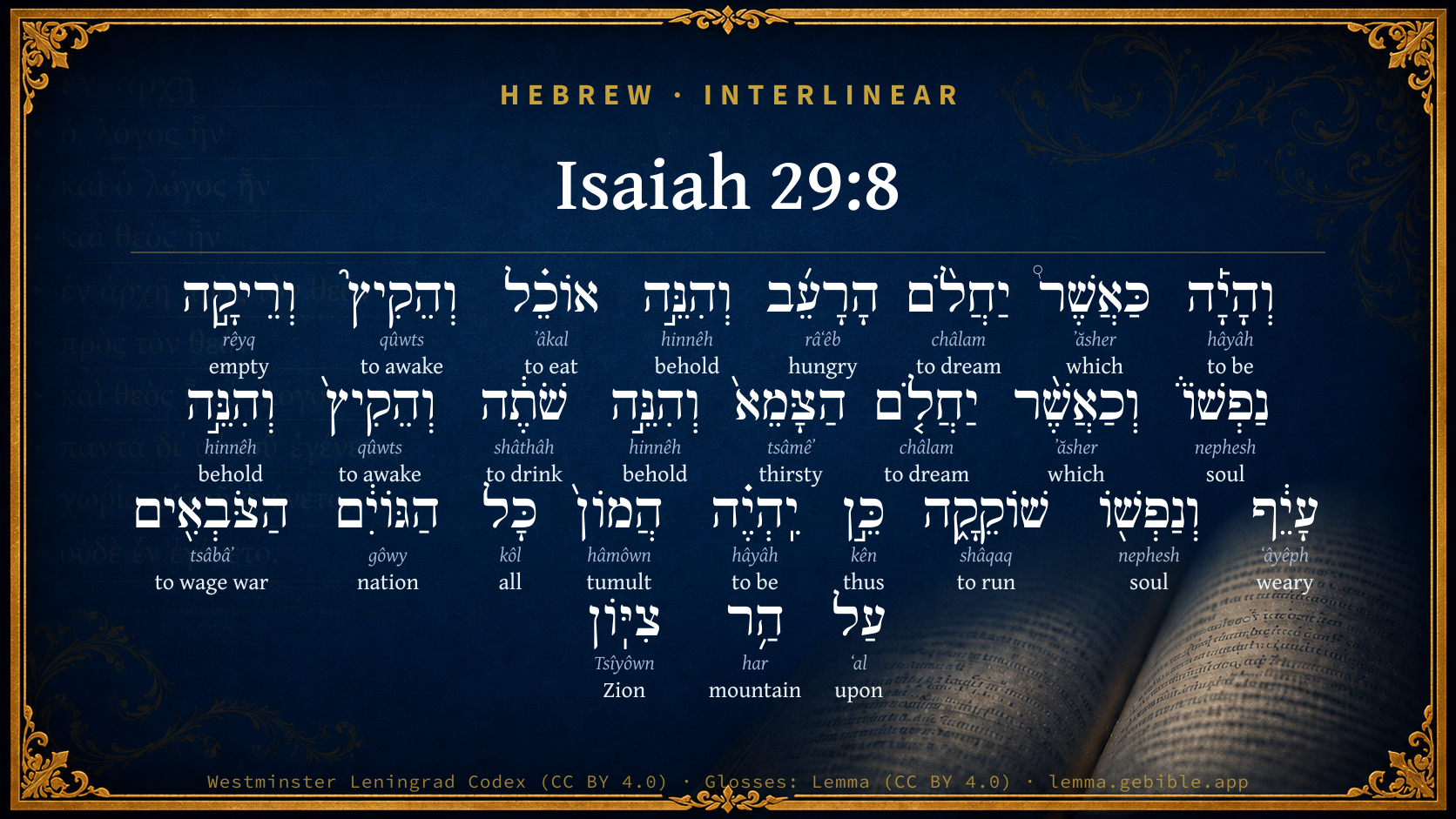
Hebrew (Westminster Leningrad Codex) Isaiah 29:8 appears in the Hebrew Old Testament. The text above is from the Westminster Leningrad Codex. Each word links to its Strong’s number, a concise gloss, and parsing drawn from the Open Scriptures Hebrew Bible morphology. Click any word for its full Brown-Driver-Briggs (BDB) entry.
Download image
Cite this verse

Isaiah 29:8 (World English Bible). Public Domain. Lemma interlinear Bible study tool, https://lemma.gebible.app/v/isaiah/29/8.

Show BibTeX & RIS
BibTeX
RIS
English Translation
It shall be as when a hungry man dreams, and, behold, he eats; but he awakes, and his soul is empty: or as when a thirsty man dreams, and, behold, he drinks; but he awakes, and, behold, he is faint, and his soul has appetite: so shall the multitude of all the nations be, that fight against Mount Zion.
World English Bible · Public Domain
Download a study sheet

One document with this verse’s original text, its word-by-word gloss line, the meaning frame, cross-references with their text, attributed commentary, and full source and license credits — printable, and it pastes into notes with its structure intact.

This verse Autodidact and up

Study sheet (.html) Plain text (.txt)

A passage Seminary Student

Up to 50 verses in one chapter. A passage sheet keeps up to 6 commentary sources and 12 cross-references per verse, in the order this page ranks them, and says so on the sheet whenever that leaves anything out. Ask for a single verse and you get the Autodidact verse sheet above.

Everything on this page stays free to read, with no account — the sheet is a download of what is already on screen, not access to it.

Want to remove ads? Support Godless Engineer
Compare translations 3

The same verse in 3 English versions, stacked beneath the original-language interlinear above. Click any original word for its lexicon entry.

Each is an independent rendering of the whole verse — the interlinear is not word-aligned to these translations.

Highlighted words mark where these versions differ — a whole-verse word diff, not a word-by-word alignment.

  • World English Bible Public Domain
    It shall be as when a hungry man dreams, and, behold, he eats; but he awakes, and his soul is empty: or as when a thirsty man dreams, and, behold, he drinks; but he awakes, and, behold, he is faint, and his soul has appetite: so shall the multitude of all the nations be, that fight against Mount Zion.
  • King James Version Public Domain
    It shall even be as when an hungry man dreameth, and, behold, he eateth; but he awaketh, and his soul is empty: or as when a thirsty man dreameth, and, behold, he drinketh; but he awaketh, and, behold, he is faint, and his soul hath appetite: so shall the multitude of all the nations be, that fight against mount Zion.
  • unfoldingWord Literal Text CC BY-SA 4.0
    And it will be like when the hungry dreams, and behold, he is eating, but he awakens, and his soul empty. Or like when the thirsty dreams, and behold, he is drinking, but he awakens, and behold, faint and his soul is longing. Thus will be the multitude of all of the nations warring against Mount Zion. q1

unfoldingWord Literal Text — © unfoldingWord, licensed CC BY-SA 4.0. Word-aligned USFM3 via Door43 (git.door43.org/unfoldingWord/en_ult).

Versions to compare (up to 4)

3 of 4 selected

Show all 18 translations

Every available English version of this verse, each an independent rendering of the whole verse.

  • World English Bible Public Domain
    It shall be as when a hungry man dreams, and, behold, he eats; but he awakes, and his soul is empty: or as when a thirsty man dreams, and, behold, he drinks; but he awakes, and, behold, he is faint, and his soul has appetite: so shall the multitude of all the nations be, that fight against Mount Zion.
  • Berean Standard Bible Public Domain
    as when a hungry man dreams he is eating, then awakens still hungry; as when a thirsty man dreams he is drinking, then awakens faint and parched. So will it be for all the many nations who go to battle against Mount Zion.
  • Majority Standard Bible Public Domain
    as when a hungry man dreams he is eating, then awakens still hungry; as when a thirsty man dreams he is drinking, then awakens faint and parched. So will it be for all the many nations who go to battle against Mount Zion.
  • King James Version Public Domain
    It shall even be as when an hungry man dreameth, and, behold, he eateth; but he awaketh, and his soul is empty: or as when a thirsty man dreameth, and, behold, he drinketh; but he awaketh, and, behold, he is faint, and his soul hath appetite: so shall the multitude of all the nations be, that fight against mount Zion.
  • American Standard Version (1901) Public Domain
    And it shall be as when a hungry man dreameth, and, behold, he eateth; but he awaketh, and his soul is empty: or as when a thirsty man dreameth, and, behold, he drinketh; but he awaketh, and, behold, he is faint, and his soul hath appetite: so shall the multitude of all the nations be, that fight against mount Zion.
  • Revised Version (1885) Public Domain
    And it shall be as when an hungry man dreameth, and, behold, he eateth; but he awaketh, and his soul is empty: or as when a thirsty man dreameth, and, behold, he drinketh; but he awaketh, and, behold, he is faint, and his soul hath appetite: so shall the multitude of all the nations be, that fight against mount Zion.
  • Geneva Bible (1599) Public Domain
    And it shalbe like as an hungry man dreameth, and beholde, he eateth: and when he awaketh, his soule is emptie: or like as a thirsty man dreameth, and loe, he is drinking, and when he awaketh, beholde, he is faint, and his soule longeth: so shall the multitude of all nations be that fight against mount Zion.
  • Douay-Rheims (1899) Public Domain
    And as he that is hungry dreameth, and eateth, but when he is awake, his soul is empty: and as he that is thirsty dreameth, and drinketh, and after he is awake, is yet faint with thirst, and his soul is empty: so shall be the multitude of all the Gentiles, that have fought against mount Sion.
  • Young's Literal Translation Public Domain
    And it hath been, as when the hungry dreameth, And lo, he is eating, And he hath waked, and empty `is' his soul, And as when the thirsty dreameth, And lo, he is drinking, and he hath waked, And lo, he is weary, and his soul is longing, So is the multitude of all the nations Who are warring against mount Zion.
  • Literal Standard Version CC BY-SA 4.0
    And it has been, as when the hungry dreams, || And behold, he is eating, || And he has awoken, || And his soul [is] empty, || And as when the thirsty dreams, || And behold, he is drinking, || And he has awoken, || And behold, he is weary, || And his soul is longing, || So is the multitude of all the nations || Who are warring against Mount Zion.
  • Unlocked Literal Bible CC BY-SA 4.0
    It will be like when a hungry man dreams he is eating, but when he awakes, his stomach is empty. It will be like when a thirsty man dreams that he is drinking, but he when he awakes, he is fainting, with his thirst not quenched. Yes, so will be the great number of nations that fights against Mount Zion.
  • unfoldingWord Literal Text CC BY-SA 4.0
    And it will be like when the hungry dreams, and behold, he is eating, but he awakens, and his soul empty. Or like when the thirsty dreams, and behold, he is drinking, but he awakens, and behold, faint and his soul is longing. Thus will be the multitude of all of the nations warring against Mount Zion. q1
  • Darby Bible Public Domain
    It shall even be as when the hungry dreameth, and, behold, he eateth; and he awaketh, and his soul is empty; or as when the thirsty dreameth, and, behold, he drinketh; and he awaketh, and, behold, he is faint, and his soul craveth: so shall the multitude of all the nations be that war against mount Zion.
  • World Messianic Bible Public Domain
    It will be like when a hungry man dreams, and behold, he eats; but he awakes, and his hunger isn’t satisfied; or like when a thirsty man dreams, and behold, he drinks; but he awakes, and behold, he is faint, and he is still thirsty. The multitude of all the nations that fight against Mount Zion will be like that.
  • Webster's Bible Public Domain
    It shall even be as when a hungry man dreameth, and behold, he eateth; but he awaketh, and his soul is empty: or as when a thirsty man dreameth, and behold, he drinketh; but he awaketh, and behold, he is faint, and his soul hath appetite: so shall the multitude of all the nations be, that fight against mount Zion.
  • Free Bible Version CC BY-SA 4.0
    It will be like someone hungry dreaming that they're eating but who wakes up still hungry. It will be like someone thirsty dreaming of drinking but who wakes up still weak and thirsty. This is what it will be like for all your enemies, the ones attacking Mount Zion.
  • Bible in Basic English Public Domain
    And it will be like a man desiring food, and dreaming that he is feasting; but when he is awake there is nothing in his mouth: or like a man in need of water, dreaming that he is drinking; but when he is awake he is feeble and his soul is full of desire: so will all the nations be which make war on Mount Zion.
  • JPS Tanakh (1917) Public Domain
    And it shall be as when a hungry man dreameth, and, behold, he eateth, but he awaketh, and his soul is empty; or as when a thirsty man dreameth, and, behold, he drinketh, but he awaketh, and, behold, he is faint, and his soul hath appetite — so shall the multitude of all the nations be, that fight against mount Zion.

Literal Standard Version (2020), Covenant Press — licensed CC BY-SA 4.0. Text via the HelloAO Bible API (eBible.org). Unlocked Literal Bible (unfoldingWord) — licensed CC BY-SA 4.0. Text via the HelloAO Bible API (eBible.org). unfoldingWord Literal Text — © unfoldingWord, licensed CC BY-SA 4.0. Word-aligned USFM3 via Door43 (git.door43.org/unfoldingWord/en_ult). Free Bible Version, Dr. Jonathan Gallagher — licensed CC BY-SA 4.0. Text via the HelloAO Bible API (eBible.org).

Word by word

More ways to search: Search by grammar → Find every occurrence → Compare this word →

Practice this passage: Drill this verse → Learn its vocabulary →

שׁוֹקֵקָ֑ה
shâqaq
H8264
“running”
Verb, Qal, Participle Active, Feminine, Singular, Absolute
Part of Speech
Verb
Stem
Qal
Form
Participle Active
Gender
Feminine
Number
Singular
State
Absolute
Full BDB Definition

Origin: a primitive root

TWOT: 2460

to run, run about, rush, run to and fro, be eager or greedy or thirsty - (Qal) roving, ranging, longing, rush out upon (participle) - (Hithpalpel) to rush to and fro, rush back and forth
  1. וְהָיָ֡ה hâyâh H1961 “and · to be” Conjunction + Verb, Qal, Sequential Perfect, 3rd Person, Masculine, Singular
  2. כַּאֲשֶׁר֩ ʼăsher H834 “like/as · which” Preposition + Particle, Relative
  3. יַחֲלֹ֨ם châlam H2492 “to dream” Verb, Qal, Imperfect, 3rd Person, Masculine, Singular
  4. הָרָעֵ֜ב râʻêb H7457 “the · hungry” Particle, Definite Article + Adjective, Adjective, Masculine, Singular, Absolute
  5. וְהִנֵּ֣ה hinnêh H2009 “and · behold” Conjunction + Particle, Demonstrative
  6. אוֹכֵ֗ל ʼâkal H398 “eating” Verb, Qal, Participle Active, Masculine, Singular, Absolute
  7. וְהֵקִיץ֮ qûwts H6974 “and · to awake” Conjunction + Verb, Hiphil, Sequential Perfect, 3rd Person, Masculine, Singular
  8. וְרֵיקָ֣ה rêyq H7386 “and · empty” Conjunction + Adjective, Adjective, Feminine, Singular, Absolute
  9. נַפְשׁוֹ֒ nephesh H5315 “soul · his” Noun, Common, Both, Singular, Construct + Suffix, Personal, 3rd Person, Masculine, Singular
  10. וְכַאֲשֶׁ֨ר ʼăsher H834 “and · like/as · which” Conjunction + Preposition + Particle, Relative
  11. יַחֲלֹ֤ם châlam H2492 “to dream” Verb, Qal, Imperfect, 3rd Person, Masculine, Singular
  12. הַצָּמֵא֙ tsâmêʼ H6771 “the · thirsty” Particle, Definite Article + Adjective, Adjective, Masculine, Singular, Absolute
  13. וְהִנֵּ֣ה hinnêh H2009 “and · behold” Conjunction + Particle, Demonstrative
  14. שֹׁתֶ֔ה shâthâh H8354 “drinking” Verb, Qal, Participle Active, Masculine, Singular, Absolute
  15. וְהֵקִיץ֙ qûwts H6974 “and · to awake” Conjunction + Verb, Hiphil, Sequential Perfect, 3rd Person, Masculine, Singular
  16. וְהִנֵּ֣ה hinnêh H2009 “and · behold” Conjunction + Particle, Demonstrative
  17. עָיֵ֔ף ʻâyêph H5889 “weary” Adjective, Adjective, Masculine, Singular, Absolute
  18. וְנַפְשׁ֖וֹ nephesh H5315 “and · soul · his” Conjunction + Noun, Common, Both, Singular, Construct + Suffix, Personal, 3rd Person, Masculine, Singular
  19. כֵּ֣ן kên H3651 “thus” Particle, Demonstrative
  20. יִֽהְיֶ֗ה hâyâh H1961 “to be” Verb, Qal, Imperfect, 3rd Person, Masculine, Singular
  21. הֲמוֹן֙ hâmôwn H1995 “tumult of” Noun, Common, Masculine, Singular, Construct
  22. כָּל kôl H3605 “all of” Noun, Common, Masculine, Singular, Construct
  23. הַגּוֹיִ֔ם gôwy H1471 “the · nations” Particle, Definite Article + Noun, Common, Masculine, Plural, Absolute
  24. הַצֹּבְאִ֖ים tsâbâʼ H6633 “the · waging war” Particle, Definite Article + Verb, Qal, Participle Active, Masculine, Plural, Absolute
  25. עַל ʻal H5921 “upon” Preposition
  26. הַ֥ר har H2022 “mountain of” Noun, Common, Masculine, Singular, Construct
  27. צִיּֽוֹן Tsîyôwn H6726 “Zion” Noun, Proper

About this verse

These counts appear in no published source. They are computed here, from the morphology-tagged text and Lemma’s own curated glosses. What Lemma adds →

28
words
21
distinct lemmas
Prophets
section

Notable vocabulary

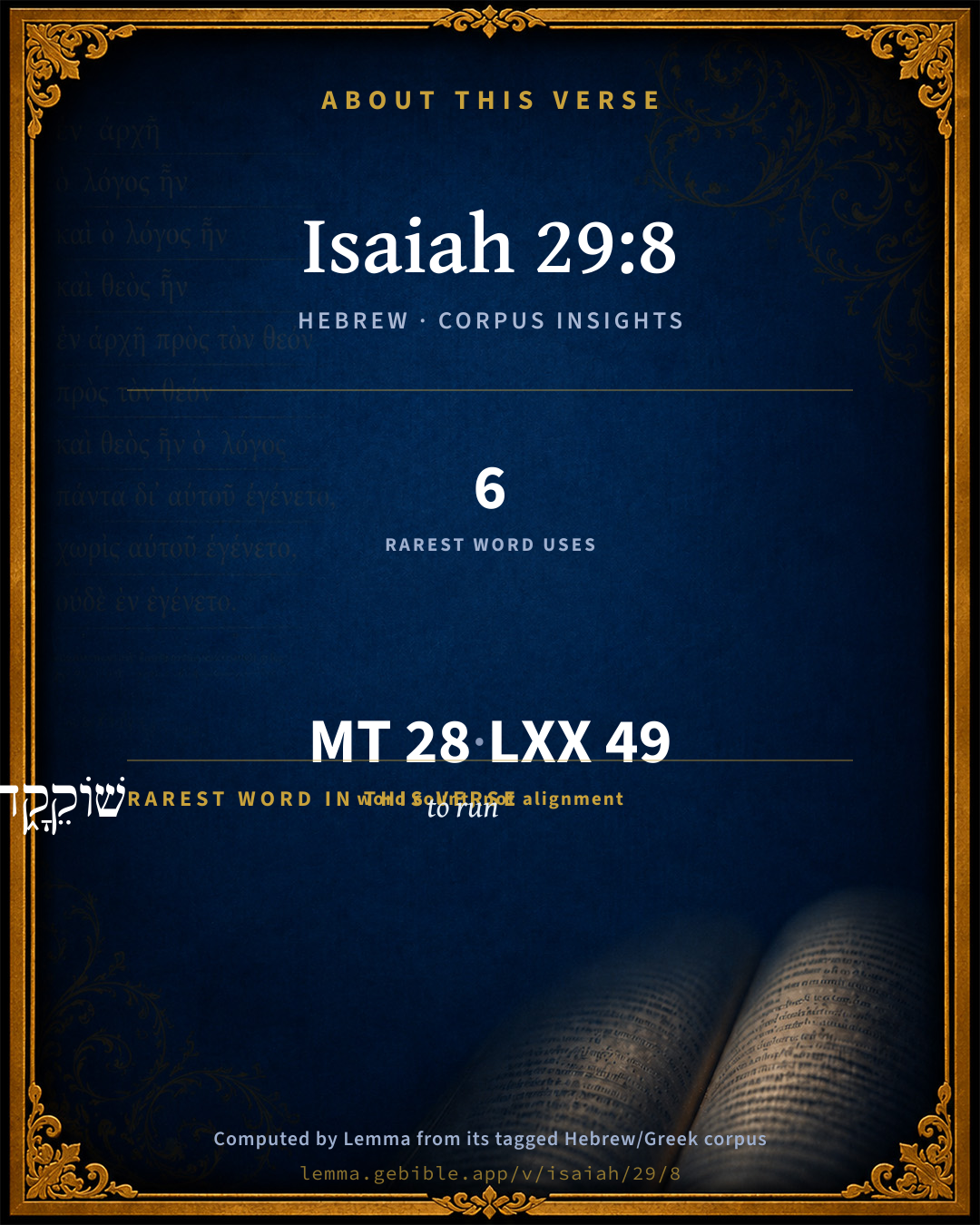
The rarest word here is שׁוֹקֵקָ֑ה to run H8264 — appearing just 6 times in the whole Hebrew Bible.

Shared distinctive vocabulary

שׁוֹקֵקָ֑ה to run H8264 occurs in 6 verses of the Hebrew Bible. Also found in:

Grammatical profile

  • 10 verbs
  • 7 nouns
  • 4 adjectives
  • 1 preposition
  • 6 particles

Verb forms

  • וְהָיָ֡ה Qal · Sequential Perfect
  • יַחֲלֹ֨ם Qal · Imperfect
  • אוֹכֵ֗ל Qal · Participle Active
  • וְהֵקִיץ֮ Hiphil · Sequential Perfect
  • יַחֲלֹ֤ם Qal · Imperfect
  • שֹׁתֶ֔ה Qal · Participle Active
  • וְהֵקִיץ֙ Hiphil · Sequential Perfect
  • שׁוֹקֵקָ֑ה Qal · Participle Active
  • יִֽהְיֶ֗ה Qal · Imperfect
  • הַצֹּבְאִ֖ים Qal · Participle Active

Repetition

Words recur within this verse — often emphatic in Hebrew:

  • וְהִנֵּ֣ה behold H2009 ×3
  • וְהָיָ֡ה to be H1961 ×2
  • יַחֲלֹ֨ם to dream H2492 ×2
  • וְהֵקִיץ֮ to awake H6974 ×2
  • נַפְשׁוֹ֒ soul H5315 ×2
  • כַּאֲשֶׁר֩ which H834 ×2

Hebrew & Septuagint length

In English translation the verse runs 59 words from the Hebrew and 58 from the Septuagint (LXX English) — closely comparable.

A rough comparison of the two English renderings, which tokenize alike — not a word-level alignment.

Word counts can differ between the Hebrew and the Greek without any difference in meaning — e.g. the Hebrew direct-object marker אֵת has no separate Greek word, and Greek often adds the article ὁ.

In the original languages it is 28 Hebrew tokens and 49 Greek tokens — but the two are counted differently (Hebrew bundles its prefixes and suffixes into one token; the Greek is in lemma form), so that isn’t a like-for-like length.

Cross-references

4

Topical passages linked to Isaiah 29:8 in the Treasury of Scripture Knowledge — connected by theme and wording, ordered by reader-vote popularity; previews shown in the World English Bible.

  • Psalms 73:20 As a dream when one wakes up, So, Lord, when you awake, you will despise their fantasies.
  • Isaiah 44:12 The smith [makes] an axe, and works in the coals, and fashions it with hammers, and works it with his strong arm: yes, he is hungry, and his strength fails; he drinks no water, and is faint.
  • Isaiah 10:7–16 However he doesn't mean so, neither does his heart think so; but it is in his heart to destroy, and to cut off not a few nations.
  • 2 Chronicles 32:21 Yahweh sent an angel, who cut off all the mighty men of valor, and the leaders and captains, in the camp of the king of Assyria. So he returned with shame of face to his own land. When he was come into the house of his god, those who came forth from his own bowels killed him there with the sword.

Cross-references courtesy of OpenBible.info (CC BY 4.0).

Hebrew and Greek witnesses Masoretic Hebrew ↔ Greek Septuagint

The same verse in the two great witnesses to the Old Testament, shown verse-for-verse.

These are two independent witnesses, not word-aligned to each other, and the Septuagint is shown in lemma (dictionary) form.

Hebrew Isaiah 29:8 Masoretic · Westminster Leningrad Codex

וְהָיָ֡ה כַּאֲשֶׁר֩ יַחֲלֹ֨ם הָרָעֵ֜ב וְהִנֵּ֣ה אוֹכֵ֗ל וְהֵקִיץ֮ וְרֵיקָ֣ה נַפְשׁוֹ֒ וְכַאֲשֶׁ֨ר יַחֲלֹ֤ם הַצָּמֵא֙ וְהִנֵּ֣ה שֹׁתֶ֔ה וְהֵקִיץ֙ וְהִנֵּ֣ה עָיֵ֔ף וְנַפְשׁ֖וֹ שׁוֹקֵקָ֑ה כֵּ֣ן יִֽהְיֶ֗ה הֲמוֹן֙ כָּל הַגּוֹיִ֔ם הַצֹּבְאִ֖ים עַל הַ֥ר צִיּֽוֹן

It shall be as when a hungry man dreams, and, behold, he eats; but he awakes, and his soul is empty: or as when a thirsty man dreams, and, behold, he drinks; but he awakes, and, behold, he is faint, and his soul has appetite: so shall the multitude of all the nations be, that fight against Mount Zion.

World English Bible · Public Domain

Greek LXX Isaiah 29:8 Septuagint · lemma form

καί εἰμί ὡς ὁ ἐν ὕπνος πίνω καί ἐσθίω καί ἐκ ἀναἵστημι μάταιος αὐτός ὁ ἐνύπνιον καί ὅς τρόπος ἐνυπνιάζομαι ὁ διψάω ὡς πίνω καί ἐκ ἀναἵστημι ἔτι διψάω ὁ δέ ψυχή αὐτός εἰς κενός ἐλπίζω οὕτως εἰμί ὁ πλοῦτος πᾶς ὁ ἔθνος ὅσος ἐπιστρατεύω ἐπί ὁ ὄρος σιων

And as men drink and eat in sleep, and when they have arisen, the dream is vain: and as a thirsty man dreams as if he drank, and having arisen is still thirsty, and his soul has desired in vain: so shall be the wealth of all the nations, as many as have fought against the mount Sion.

LXX2012 (modern English Septuagint) · Public Domain

Hebrew: Westminster Leningrad Codex (CC BY 4.0). Greek: Septuagint (public domain); English from LXX2012 (modern English Septuagint) (Public Domain). How the Septuagint differs from the Hebrew →

Targum (Aramaic paraphrase)

1

The Targum is the ancient Jewish Aramaic paraphrase of the Hebrew Scriptures — an interpretive translation, not the Hebrew text itself. Onkelos (literal) and Pseudo-Jonathan (expansive) render the Torah, and Jonathan the Prophets. Coverage is partial: where no permissively-licensed English translation exists for a verse, only the Aramaic is shown. This is verse-level text, not a word-by-word alignment to the Hebrew.

  1. Targum Jonathan Prophets (Joshua–Malachi)
    וִיהֵי כְּמָא דִי יַחֲלוֹם כַּפְנָא וְהָא אָכֵיל וּמִתְעַר וַחֲסֵירָא נַפְשֵׁיהּ וּכְמָא דְיַחֲלוֹם צָחְיָא וְהָא שְׁתֵי וּמִתְעָר וְהָא מְשַׁלְחֵי וְנַפְשֵׁהּ מְשַׁלְהַיָא כֵּן יְהֵי הֲמוֹן כָּל עַמְמַיָא דְמִתְכַּנְשִׁין עַל טוּרָא דְצִיוֹן:

    And it shall be as when a hungry man dreameth, behold, he eateth; but he awakes, and het is in want: or as when a thirsty man dreameth, and behold, he drinketh, but he awaketh, and behold, he is faint, he is spent: so shall the multitude of all the nations be, that gather themselves together against the mountain of Zion.

    Targum Jonathan — Aramaic: “Mikraot Gedolot” (public domain). English: “Sefaria Community Translation” (CC0 1.0 (public-domain dedication)); “London "Chaldee Paraphrase," 1871” (public domain). Text via Sefaria.

Commentary

Notes on Isaiah 29:8 from classic Christian and Jewish commentators (each source and its license shown beneath its notes). The classic Christian expositions comment on the surrounding passage and are grouped to its opening verse, so a note may address several verses; the Jewish commentaries on the Tanakh (Rashi and others) are per-verse, so they appear only where the commentator wrote on this verse.

Lemma curates 59 commentaries, every one of them public domain or Creative Commons licensed, each selected and text-cleaned for this edition rather than reprinted as found. About our sources →

Trapp's Complete Commentary

John Trapp

Isa 29:8 It shall even be as when an hungry [man] dreameth, and, behold, he eateth; but he awaketh, and his soul is empty: or as when a thirsty man dreameth, and, behold, he drinketh; but he awaketh, and, behold, [he is] faint, and his soul hath appetite: so shall the multitude of all the nations be, that fight against mount Zion.

Ver. 8. It shall be as when.] See on Isa 29:7.

John Trapp, A Commentary or Exposition upon All the Books of the Old and New Testament (1647–1656) — public domain. Text from a community e-Sword module.

Joseph Benson's Commentary

Isa 29:8. “As when a hungry man dreameth; and, lo! he seemeth to eat; but he awaketh, and his appetite is still unsatisfied: and as a thirsty man, &c. So shall it be with the multitude of all the nations, which have set themselves in array against mount Zion.” Thus Bishop Lowth. The Assyrians had swallowed up Jerusalem in their imagination: but God would suddenly disappoint all their hopes, and send them away empty and confounded. For, the reader will observe, “Sennacherib and his mighty army are not here compared to a dream, because of their sudden disappearance; but the disappointment of their eager hopes is compared to what happens to a hungry and thirsty man, when he awakes from a dream, in which fancy had presented to him meat and drink in abundance, and finds it nothing but a vain illusion. The comparison is elegant and beautiful in the highest, degree, well wrought up, and perfectly suited to the end proposed.”

Joseph Benson's Commentary on the Old and New Testaments (1811–1818) — public domain. Text from a community e-Sword module.

The Preacher's Complete Homiletical Commentary

Joseph S. Exell (gen. ed.)

THE FUTILITY OF FIGHTING AGAINST MOUNT ZION

(Missionary Sermon.)

Isa_29:8. So shall the multitude of the nations be that fight against Mount Zion.

Nothing tends to inspirit exertion in any great enterprise so much as the certain prospect of success. Hope is the spur of action, the very life of enterprise. Hence to encourage the fearful and animate the brave in the culture of their own piety, and especially in their efforts to extend the kingdom of the Redeemer, there are given in God’s Word the amplest promises of Divine help and assurances of ultimate success. But for “the sure word of prophecy,” the servants of God would long since have trembled for the ark of the Lord, and have despaired of the salvation of the race. But delays to us are not delays with God. Long ago He has declared, “Yet have I set my King on my holy hill of Zion.” “But we see not as yet all things put under Him.” The foot of His Providence falls too soft for mortal ear to mark. While He walks on the great ocean of human affairs as Jesus walked on the Galilean sea, His footsteps leave no traces behind. But yet He never stands still. “My Father worketh hitherto.” His progress is certain. In reference to the spread of His gospel it may be said, “In such an hour as ye think not the Son of man shall come.” At His approach all opposition is fruitless, all resistance vain. Every obstacle shall vanish, as a dream is forgotten when the dreamer awaketh.

This passage suggests—

I. The number and might of the enemies of the gospel. It is always unwise to underrate the forces of the enemy. Injury has been done to the cause of missions by this action. Good men in the ardour of their zeal seemed to speak as though heathendom was to be won by one new crusade, and that the walls of Satan’s kingdom would fall flat at a single blast of their rams’ horns. But Scripture takes opposite ground, and intimates that there must be a continuous and persistent struggle. Our Great General does not conquer in a single campaign; He goes forth “conquering and to conquer.” These numerous and powerful enemies of Christ’s kingdom arise from our own corrupt nature; from the peculiar circumstances of the heathen world; from every class of society, and are perpetually set in motion by the powers of darkness. Though they are “the multitude of all the nations,” they have one prince, “the prince of the powers of darkness.” To prevent our forming exaggerated pictures of success, let us remember:

1. That the original enmity of the human heart is always and everywhere the same. Every sinful passion of the human heart starts up an armed enemy against Christ and His truth. If at home, after centuries of Christian work, the obstacles to the gospel are so great, how much more formidable must they be in Pagan lands!

2. The power of Satan is at all times the same. And if here he rules supreme in the children of disobedience, what must his power be in those heathen lands where he is so strongly entrenched in superstition, idolatry and prejudices, crimes and passions of men confederated with him since Adam fell!

3. The world at large, in its spirit and pursuits, is decidedly hostile. Even in our own country, how few can be looked upon as the genuine disciples of Christ, the true soldiers of the cross! How mighty the forces sent out even here against the Lord and against His anointed! This part of the earth is still in the hands of the wicked.

II. The utter futility and certain overthrow of their projects.

1. Their schemes are fallacious and visionary. “It shall be as when a hungry man dreameth.” What more delusive than a dream!

2. Their disappointment is certain. The history of the past is against them. Past history has verified the words of the Master, “And the gates of hell shall not prevail against it.” The prophecy of the future, the course of Providence, the covenant of grace, the very progress of civilisation, but more than all the very existence of God, is against them. “The Lord reigneth; let the earth rejoice.”

III. The glory that shall arise from thence to Zion’s King (Psa_72:10-11; Psa_72:15). His wisdom will baffle all their designs, His power crush every hostile force, and His kingdom rise on the ruin of their dark confederacies (1Co_15:25).—Samuel Thodey.

The Preacher's Complete Homiletical Commentary (gen. ed. Joseph S. Exell; Funk & Wagnalls, c. 1892) — public domain (pre-1929). A full-Bible homiletical/sermon-outline anthology covering 65 of 66 books (2 John is absent from the source module). Text from a community e-Sword module.

Tyndale Open Study Notes

Tyndale Open Resources

29:8-12 Jerusalem’s blindness kept its people from understanding God’s plan.

29:8 Like a hungry or thirsty person, the Assyrians could taste the victory over Jerusalem. Yet they never became victorious.

Tyndale Open Study Notes — © Tyndale Open Resources, licensed CC BY-SA 4.0. Text via the HelloAO Bible API.

Geneva Bible (1599)

Geneva Bible translators

That is, he thinketh that he eateth.

Geneva Bible (1599) marginal notes — public domain. Text via Bolls.life.

Jamieson, Fausset & Brown

Robert Jamieson, A. R. Fausset & David Brown

Their disappointment in the very height of their confident expectation of taking Jerusalem shall be as great as that of the hungry man who in a dream fancies he eats, but awakes to hunger still (Psa 73:20); their dream shall be dissipated on the fatal morning (Isa 37:36).

soul--simply his appetite: he is still thirsty.

Jamieson, Fausset & Brown — Commentary Critical and Explanatory on the Whole Bible (1871) — public domain (CC PDM 1.0). Text via the HelloAO Bible API.

Ellicott's Commentary for English Readers

(8) It shall even be as when an hungry man . . . eateth.—The foes of Jerusalem were greedy of their prey, eager to devour; they thought it was already theirs. The rude awakening found them still empty. The lion of Judah was not to be devoured even by the strong bull of Assyria.

A Bible Commentary for English Readers, edited by Charles John Ellicott (1878–1897) — public domain. Text from a community e-Sword module.

The Cambridge Bible for Schools and Colleges

gen. ed. J. J. S. Perowne

8. dreameth, and behold] The invariable formula in narrating a dream; Gen_40:9; Gen_40:16; Gen_41:1 ff.; Dan_2:31; Dan_7:5-6.

his soul] the seat of appetite and desire: cf. Isa_5:14, Isa_32:6; Pro_6:30. A more vivid representation of utter disenchantment than this verse gives can scarcely be conceived.

The Cambridge Bible for Schools and Colleges (gen. ed. J. J. S. Perowne; Cambridge University Press, 1878–1918) — public domain. Text from a community e-Sword module.

John Gill's Exposition

It shall be even as when a hungry man dreameth, and, behold, he eateth,.... That is, he dreams of food, and imagines it before him, and that he is really eating it:

but he awaketh, and his soul is empty; his stomach is empty when he awakes, and he finds he has not ate anything at all:

or as when a thirsty man dreameth, and, behold, he drinketh: who fancies that he has got a cup of liquor in his hand, and at his mouth, and is drinking it with a great deal of eagerness and pleasure:

but he awaketh, and, behold, he is faint, and his soul hath appetite; when he awakes, he is not at all refreshed with his imaginary drinking, but still desires liquor to revive his fainting spirits, and extinguish his thirst:

so shall the multitude of all the nations be, that fight against Mount Zion; either shall quickly perish; or, having raised their expectations, and pleased themselves with the booty they should obtain, of which they thought themselves sure, shall find themselves mistaken, and all like an illusive dream. Some interpret this of the disappointment of Sennacherib's army; and others of the insatiable cruelty of the Chaldeans; but rather, if the above sense pleases not, it would be better to understand it of the Jews, who, amidst their greatest danger, flattered themselves with the hope of deliverance, which was all a dream and an illusion; and to which sense the following words seem to incline.

John Gill's Exposition of the Whole Bible (1746–1763) — public domain (CC PDM 1.0). Text via the HelloAO Bible API.

Albert Barnes' Notes on the Bible

It shall even be ... - This is a most striking figure representing the earnest desire of the Assyrian to possess the city of Jerusalem, and his utter disappointment. The comparison is elegant and beautiful in the highest degree. It is performed up to great perfection; and is perfectly suited to illustrate the object in view. The same image substantially is found in the classic writers; and this, says Lowth, may, for beauty and ingenuity, fairly come in competition with one of the most elegant of Virgil (greatly improved from Homer, “Iliad” xxii. 119), where he has applied to a different purpose, but not so happily, the same image of the ineffectual workings of the imagination in a dream:

Ac veluti in somnis oculos ubi languida pressit

Nocte quies, nequicquam avidos extendere cursus

Velle videmur, et in mediis conatibus aegri

Succidimus; non lingua valet, non corpore notae

Sufficiunt vires; nec, vox, nec verba scquuniur.

AEniad xii. 908.

And as when slumber seals the closing sight,

The sick wild fancy labors in the night,

Some dreadful visionary foe we shun,

With airy strides, but strive in vain to run;

In vain our baffled limbs their powers essay,

We faint, we struggle, sink, and fall away;

Drained of our strength we neither fight nor fly,

And on the tongue the struggling accents die.

Pitt.

See also Lucretius (iv. 10-19), who also expresses the same image as Isaiah. As the simile of the prophet is drawn from nature, an extract which describes the actual occurrence of such a circumstance will be agreeable. ‘The scarcity of water,’ says Park, ‘was greater here at Bubaker than at Benown. Day and night the wells were crowded with cattle lowing, and fighting with each other to come at the trough. Excessive thirst made many of them furious; others being too weak to contend for the water, endeavored to quench their thirst by devouring the black mud from the gutters near the wells; which they did with great avidity, though it was commonly fatal to them. This great scarcity of water was felt by all the people of the camp; and by none more than myself. I begged water from the negro slaves that attended the camp, but with very indifferent success, for though I let no opportunity slip, and was very urgent in my solicitations both to the Moors and to the negroes, I was but ill supplied, and frequently passed the night in the situation of Tantalus. No sooner had I shut my eyes, than fancy would convey me to the streams and rivera of my native land; there, as I wandered along the verdant bank, I surveyed the clear stream with transport, and hastened to swallow the delightful draught; but alas! disappointment awakened me, and I found myself a lonely captive, perishing of thirst amid the wilds of Africa.’ (“Travels in Africa”).

Albert Barnes' Notes on the Bible (1834–1885) — public domain. Text from a community e-Sword/MySword module.

Matthew Poole's English Annotations

His soul is empty; his appetite or desire (as the soul is taken, Psa 41:4; 78:18, and elsewhere) is unsatisfied. Or, his stomach or body (as the soul is used, Psa 16:10) is empty.

So shall the multitude of all the nations be, that fight against Mount Zion; no less unsatisfied and unsatiable shall the enemies of the Jews be, with all the cruelties which they have committed against you; and they shall be always thirsting after more of your blood, as if they had never tasted any of it.

Matthew Poole's English Annotations on the Holy Bible (1683–1685) — public domain. Text from a community e-Sword/MySword module.

The Pulpit Commentary

It shall be even as when a hungry man dreameth. The melting away of the vision would involve a keen disappointment. The enemies of Israel had expected to secure a most valuable prey. They had dreamed of a rich booty when they should take the city a booty which would reward them for all the hardships of their marches, their watches, their toils in the siege, the dangers to which they exposed themselves in the assaults. It was as if a hungry man had dreamed that he was engaged in a feast, or a thirsty man that he was drinking deep at a banquet, when suddenly he wakes up, and finds that he has been merely dreaming, and that there is no reality in his fancies. Dr. Kay quotes a passage which is much to the point from Mungo Park"s journals: "No sooner had I shut my eyes than fancy would convey me to the streams and rivers of my native land. There, as I wandered along the verdant bank, I surveyed the clear streams with transport, and hastened to swallow the delightful draught; but, alas! disappointment awaked me, and I found myself a lonely captive, perishing of thirst amid the wilds of Africa." Those engaged in the siege, while themselves vanishing away, would likewise find their dreams of plunder vanish, and Would bitterly feel the disappointment. That fight against Mount Zion. To attack Jerusalem was to fight against the mount of God, the place where Jehovah had "set his Name, "and where he condescended in some true sense to dwell continually. How could those who engaged in such an enterprise hope to succeed?

The Pulpit Commentary (1880–1919), ed. H.D.M. Spence-Jones & Joseph S. Exell — public domain. Text from a community e-Sword module.

John Wesley's Explanatory Notes

His soul - His appetite or desire is unsatisfied. So - No less unsatisfied and insatiable; they shall be always thirsting after more of your blood.

John Wesley, Explanatory Notes Upon the Whole Bible (1754–1765) — public domain. Text via the GEBible commentary corpus.

J. A. Alexander on Isaiah

Joseph Addison Alexander

“And it shall be as when the hungry dreams; and lo he eats, and he awakes, and his soul is empty; and as when the thirsty dreams, and lo he drinks, and he awakes, and lo he is faint and his soul craving: so shall be the multitude of all the nations that fight against Mount Zion.” In this verse ‘soul’ is twice used in the not uncommon sense of appetite, first described as empty (i.e., unsatisfied) and then as craving. A striking and affecting parallel from real life has been quoted from Mungo Park’s journals. "No sooner had I shut my eyes than fancy would convey me to the streams and rivers of my native land. There, as I wandered along the verdant bank, I surveyed the clear stream with transport, and hastened to swallow the delightful draught; but alas! disappointment awakened me, and I found myself a lonely captive, perishing of thirst amid the wilds of Africa."

Joseph Addison Alexander, The Prophecies of Isaiah (1846–1847; New York: Scribner, 1870–1878) — public domain. Text from a community e-Sword module.

Rashi

Rabbi Shlomo Yitzchaki (Rashi)

yearns (שׁוֹקֵקָה) desires. Comp. (Gen. 3:16) “And to your husband shall be your yearning (תְּשׁוּקָתֵךְ).”

So shall be, etc. They shall not achieve their desire which they planned to do.

Rashi on the Tanakh — English translations: “The Judaica Press complete Tanach with Rashi, translated by A. J. Rosenberg” (CC BY 4.0); “Pentateuch with Rashi's commentary by M. Rosenbaum and A.M. Silbermann, 1929-1934” (public domain); “The Metsudah Tanach series, Lakewood, N.J” (CC BY 4.0); and “The Book of Joshua, Metsudah Publications, 1997” (CC BY 4.0). Text via Sefaria.

Ibn Ezra

Rabbi Abraham ibn Ezra

והנה And behold. The word חלום dream, is usually followed by והנה and behold, or as if; the subject to the following אׄכֵל is רָעֵב the hungry.

שוקקה Desirous to drink.

Ibn Ezra on the Tanakh — English translations: “Sefaria Community Translation” (CC0 1.0 (public-domain dedication)); “Yalkut, Sifsei Chachomim Chumash, Metsudah Publications, 2009” (CC BY 4.0); and “Commentary of Ibn Ezra on Isaiah - trans. by M. Friedlander, 1873” (public domain). Text via Sefaria.

Lesson kit

Teaching starters — assembled from the data on this page, not authored interpretation. Every prompt links to the verse data it draws on. Edit before teaching.

Isaiah, in the Prophets, opens this verse with 28 words (21 distinct Hebrew lemmas). Its most distinctive word is shâqaq (“to run”). A historical commentator’s framing appears above. Read the whole chapter for the surrounding context.

Discussion questions

  1. How does “to run” (shâqaq) shape what this verse is saying?
  2. Psalms 107:9 shares the word «to run» with this verse. How do the two illuminate each other?
  3. “behold” occurs 3× in this one verse. What is the effect of the repetition?
  4. The translations on this page render this verse differently — a whole-verse word diff, not a word-by-word alignment. What might account for the different wordings?
  5. The verb «וְהָיָ֡ה» is Qal Sequential Perfect. How does its form color the action?
  6. Reading how Trapp's Complete Commentary and Joseph Benson's Commentary read this verse, where do the two commentators agree and where do they part?

Things to notice

Reading settings

Reading text

Shown beneath each verse's original-language words.

Old Testament
Old Testament edition

Read the OT as the Masoretic Hebrew (MT) or the Greek Septuagint (LXX).

English shown for the Greek Septuagint (in the Hebrew ↔ Greek comparison).

Comparing translations? Open the Compare panel on any verse page to stack up to four side by side.