Exodus 24:11

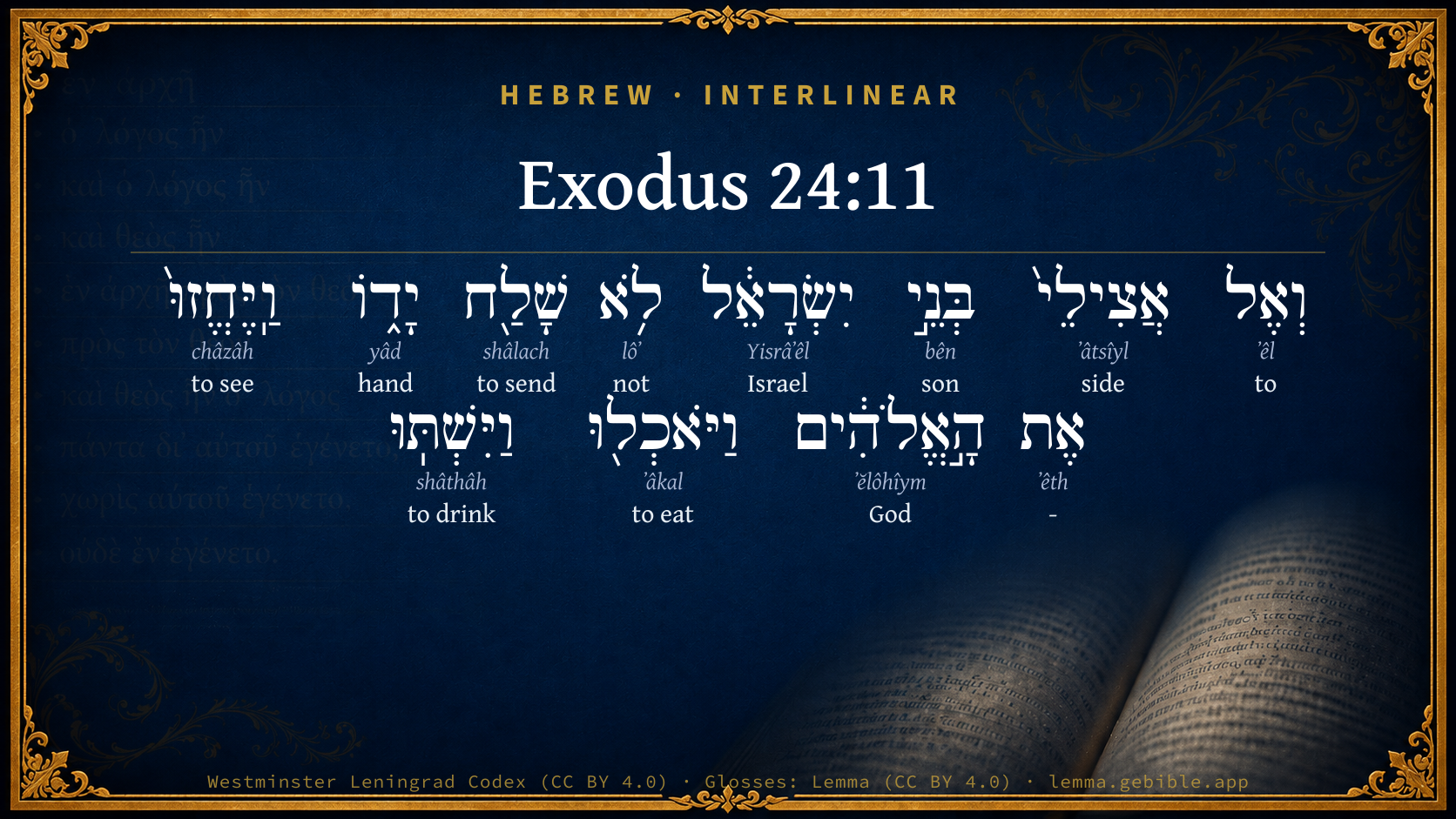
Hebrew (Westminster Leningrad Codex) Exodus 24:11 appears in the Hebrew Old Testament. The text above is from the Westminster Leningrad Codex. Each word links to its Strong’s number, a concise gloss, and parsing drawn from the Open Scriptures Hebrew Bible morphology. Click any word for its full Brown-Driver-Briggs (BDB) entry.
Download image
Cite this verse

Exodus 24:11 (World English Bible). Public Domain. Lemma interlinear Bible study tool, https://lemma.gebible.app/v/exodus/24/11.

Show BibTeX & RIS
BibTeX
RIS
English Translation
He didn't lay his hand on the nobles of the children of Israel. They saw God, and ate and drank.
World English Bible · Public Domain
Highlights
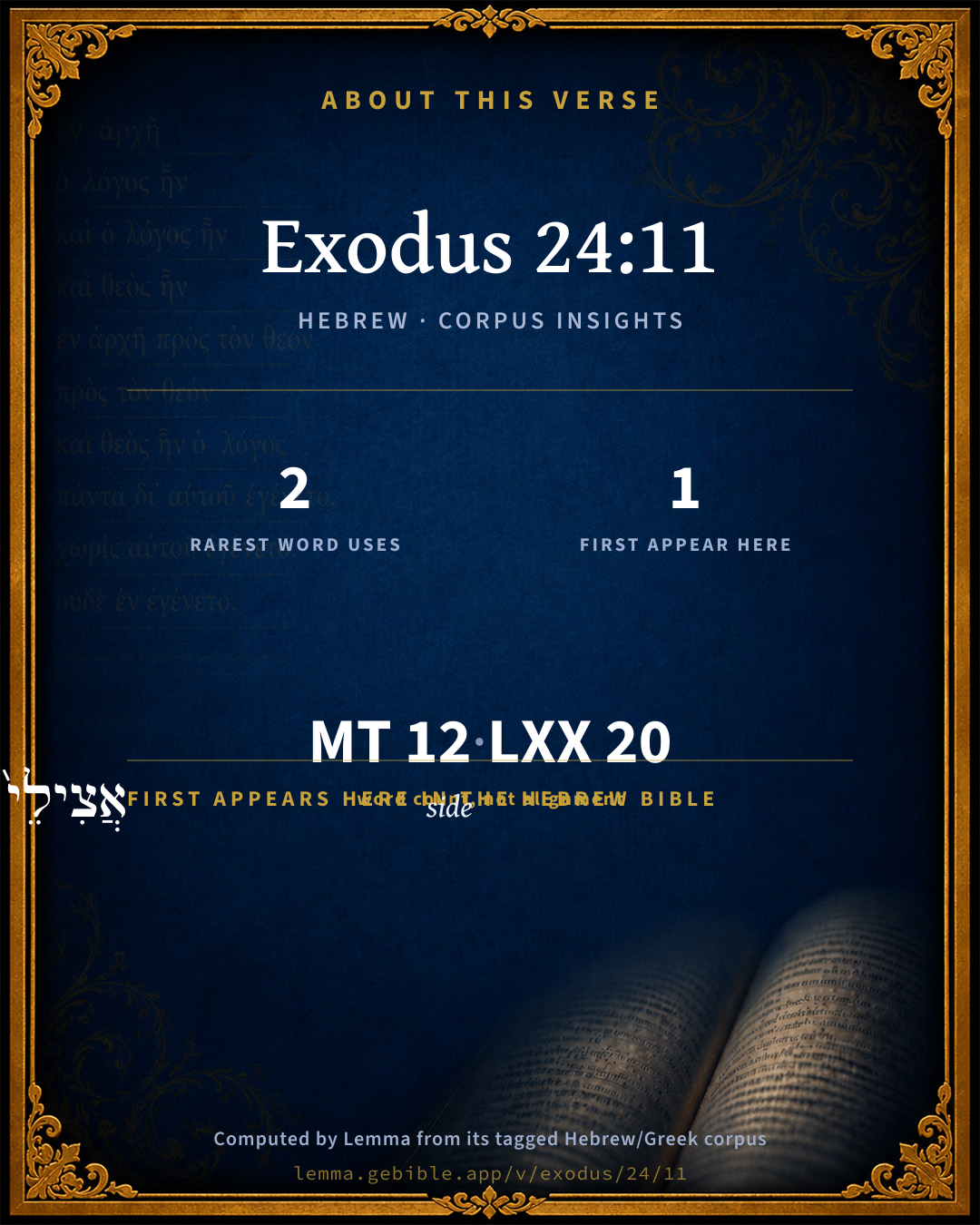
  • 1 first appearance in the Hebrew Bible
Full analysis ↓
Download a study sheet

One document with this verse’s original text, its word-by-word gloss line, the meaning frame, cross-references with their text, attributed commentary, and full source and license credits — printable, and it pastes into notes with its structure intact.

This verse Autodidact and up

Study sheet (.html) Plain text (.txt)

A passage Seminary Student

Up to 50 verses in one chapter. A passage sheet keeps up to 6 commentary sources and 12 cross-references per verse, in the order this page ranks them, and says so on the sheet whenever that leaves anything out. Ask for a single verse and you get the Autodidact verse sheet above.

Everything on this page stays free to read, with no account — the sheet is a download of what is already on screen, not access to it.

Want to remove ads? Support Godless Engineer
Compare translations 3

The same verse in 3 English versions, stacked beneath the original-language interlinear above. Click any original word for its lexicon entry.

Each is an independent rendering of the whole verse — the interlinear is not word-aligned to these translations.

Highlighted words mark where these versions differ — a whole-verse word diff, not a word-by-word alignment.

  • World English Bible Public Domain
    He didn't lay his hand on the nobles of the children of Israel. They saw God, and ate and drank.
  • King James Version Public Domain
    And upon the nobles of the children of Israel he laid not his hand: also they saw God, and did eat and drink.
  • unfoldingWord Literal Text CC BY-SA 4.0
    And he did not send out his hand to the leaders of the sons of Israel. And they saw God, and they ate and drank.

unfoldingWord Literal Text — © unfoldingWord, licensed CC BY-SA 4.0. Word-aligned USFM3 via Door43 (git.door43.org/unfoldingWord/en_ult).

Versions to compare (up to 4)

3 of 4 selected

Show all 18 translations

Every available English version of this verse, each an independent rendering of the whole verse.

  • World English Bible Public Domain
    He didn't lay his hand on the nobles of the children of Israel. They saw God, and ate and drank.
  • Berean Standard Bible Public Domain
    But God did not lay His hand on the nobles of Israel; they saw Him, and they ate and drank.
  • Majority Standard Bible Public Domain
    But God did not lay His hand on the nobles of Israel; they saw Him, and they ate and drank.
  • King James Version Public Domain
    And upon the nobles of the children of Israel he laid not his hand: also they saw God, and did eat and drink.
  • American Standard Version (1901) Public Domain
    And upon the nobles of the children of Israel he laid not his hand: and they beheld God, and did eat and drink.
  • Revised Version (1885) Public Domain
    And upon the nobles of the children of Israel he laid not his hand: and they beheld God, and did eat and drink.
  • Geneva Bible (1599) Public Domain
    And vpon the nobles of the children of Israel he laide not his hande: also they sawe God, and did eate and drinke.
  • Douay-Rheims (1899) Public Domain
    Neither did he lay his hand upon those of the children of Israel, that retired afar off, and they saw God, and they did eat and drink.
  • Young's Literal Translation Public Domain
    and unto those of the sons of Israel who are near He hath not put forth His hand, and they see God, and eat and drink.
  • Literal Standard Version CC BY-SA 4.0
    and He has not put forth His hand to those of the sons of Israel who are near, and they see God, and eat and drink.
  • Unlocked Literal Bible CC BY-SA 4.0
    God did not lay a hand on the Israelite leaders. They saw God, and they ate and drank.
  • unfoldingWord Literal Text CC BY-SA 4.0
    And he did not send out his hand to the leaders of the sons of Israel. And they saw God, and they ate and drank.
  • Darby Bible Public Domain
    And on the nobles of the children of Israel he laid not his hand: they saw God, and ate and drank.
  • World Messianic Bible Public Domain
    He didn’t lay his hand on the nobles of the children of Israel. They saw God, and ate and drank.
  • Webster's Bible Public Domain
    And upon the nobles of the children of Israel he laid not his hand: also they saw God, and ate and drank.
  • Free Bible Version CC BY-SA 4.0
    But God did not harm the leaders of Israel—they saw him, and they ate and drank a sacred meal.
  • Bible in Basic English Public Domain
    And he put not his hand on the chiefs of the children of Israel: they saw God, and took food and drink.
  • JPS Tanakh (1917) Public Domain
    And upon the nobles of the children of Israel He laid not His hand; and they beheld God, and did eat and drink.

Literal Standard Version (2020), Covenant Press — licensed CC BY-SA 4.0. Text via the HelloAO Bible API (eBible.org). Unlocked Literal Bible (unfoldingWord) — licensed CC BY-SA 4.0. Text via the HelloAO Bible API (eBible.org). unfoldingWord Literal Text — © unfoldingWord, licensed CC BY-SA 4.0. Word-aligned USFM3 via Door43 (git.door43.org/unfoldingWord/en_ult). Free Bible Version, Dr. Jonathan Gallagher — licensed CC BY-SA 4.0. Text via the HelloAO Bible API (eBible.org).

Word by word

More ways to search: Search by grammar → Find every occurrence → Compare this word →

Practice this passage: Drill this verse → Learn its vocabulary →

אֲצִילֵי֙
ʼâtsîyl
H678
“sides of”
Noun, Common, Masculine, Plural, Construct
Part of Speech
Noun
Type
Common
Gender
Masculine
Number
Plural
State
Construct
Full BDB Definition

Origin: from H680 (in its secondary sense of separation)

TWOT: 153b

side, corner, chief - (CLBL) nobles (figuratively)
  1. וְאֶל ʼêl H413 “and · to” Conjunction + Preposition
  2. בְּנֵ֣י bên H1121 “sons of” Noun, Common, Masculine, Plural, Construct
  3. יִשְׂרָאֵ֔ל Yisrâʼêl H3478 “Israel” Noun, Proper
  4. לֹ֥א lôʼ H3808 “not” Particle, Negative
  5. שָׁלַ֖ח shâlach H7971 “to send” Verb, Qal, Perfect, 3rd Person, Masculine, Singular
  6. יָד֑וֹ yâd H3027 “hand · his” Noun, Common, Both, Singular, Construct + Suffix, Personal, 3rd Person, Masculine, Singular
  7. וַֽיֶּחֱזוּ֙ châzâh H2372 “and · to see” Conjunction + Verb, Qal, Sequential Imperfect, 3rd Person, Masculine, Plural
  8. אֶת ʼêth H853 “-” Particle, Direct Object
  9. הָ֣אֱלֹהִ֔ים ʼĕlôhîym H430 “the · God(s)” Particle, Definite Article + Noun, Common, Masculine, Plural, Absolute
  10. וַיֹּאכְל֖וּ ʼâkal H398 “and · to eat” Conjunction + Verb, Qal, Sequential Imperfect, 3rd Person, Masculine, Plural
  11. וַיִּשְׁתּֽוּ shâthâh H8354 “and · to drink” Conjunction + Verb, Qal, Sequential Imperfect, 3rd Person, Masculine, Plural

About this verse

These counts appear in no published source. They are computed here, from the morphology-tagged text and Lemma’s own curated glosses. What Lemma adds →

12
words
12
distinct lemmas
Pentateuch
section

Notable vocabulary

The rarest word here is אֲצִילֵי֙ side H678 — appearing just 2 times in the whole Hebrew Bible.

First appearance in Scripture

This word makes its first canonical appearance in the Hebrew Bible here:

  • אֲצִילֵי֙ side H678

Shared distinctive vocabulary

אֲצִילֵי֙ side H678 occurs in 2 verses of the Hebrew Bible. Also found in:

Grammatical profile

  • 4 verbs
  • 5 nouns
  • 1 preposition
  • 2 particles

Verb forms

  • שָׁלַ֖ח Qal · Perfect
  • וַֽיֶּחֱזוּ֙ Qal · Sequential Imperfect
  • וַיֹּאכְל֖וּ Qal · Sequential Imperfect
  • וַיִּשְׁתּֽוּ Qal · Sequential Imperfect

Hebrew & Septuagint length

In English translation the verse runs 20 words from the Hebrew and 26 from the Septuagint (LXX English) — closely comparable.

A rough comparison of the two English renderings, which tokenize alike — not a word-level alignment.

Word counts can differ between the Hebrew and the Greek without any difference in meaning — e.g. the Hebrew direct-object marker אֵת has no separate Greek word, and Greek often adds the article ὁ.

In the original languages it is 12 Hebrew tokens and 20 Greek tokens — but the two are counted differently (Hebrew bundles its prefixes and suffixes into one token; the Greek is in lemma form), so that isn’t a like-for-like length.

Cross-references

21

Topical passages linked to Exodus 24:11 in the Treasury of Scripture Knowledge — connected by theme and wording, ordered by reader-vote popularity; previews shown in the World English Bible.

  • Exodus 18:12 Jethro, Moses' father-in-law, took a burnt offering and sacrifices for God. Aaron came with all of the elders of Israel, to eat bread with Moses' father-in-law before God.
  • Luke 15:23–24 Bring the fattened calf, kill it, and let us eat, and celebrate;
  • Genesis 31:54 Jacob offered a sacrifice in the mountain, and called his relatives to eat bread. They ate bread, and stayed all night in the mountain.
  • Genesis 16:13 She called the name of Yahweh who spoke to her, "You are a God who sees," for she said, "Have I even stayed alive after seeing him?"
  • Exodus 19:21 Yahweh said to Moses, "Go down, charge the people, lest they break through to Yahweh to gaze, and many of them perish.
  • Deuteronomy 12:7 and there you shall eat before Yahweh your God, and you shall rejoice in all that you put your hand to, you and your households, in which Yahweh your God has blessed you.
  • Ecclesiastes 9:7 Go your way--eat your bread with joy, and drink your wine with a merry heart; for God has already accepted your works.
  • 1 Corinthians 10:16–18 The cup of blessing which we bless, isn't it a communion of the blood of Christ? The bread which we break, isn't it a communion of the body of Christ?
  • Genesis 18:18 seeing that Abraham has surely become a great and mighty nation, and all the nations of the earth will be blessed in him?
  • Genesis 32:24–32 Jacob was left alone, and wrestled with a man there until the breaking of the day.
  • Exodus 24:1 He said to Moses, "Come up to Yahweh, you, and Aaron, Nadab, and Abihu, and seventy of the elders of Israel; and worship from a distance.
  • Exodus 24:9–10 Then Moses, Aaron, Nadab, Abihu, and seventy of the elders of Israel went up.
  • Exodus 33:20–23 He said, "You cannot see my face, for man may not see me and live."
  • Numbers 21:18 The well, which the princes dug, Which the nobles of the people dug, With the scepter, [and] with their poles. From the wilderness [they traveled] to Mattanah;
  • Deuteronomy 4:33 Did ever a people hear the voice of God speaking out of the midst of the fire, as you have heard, and live?
  • Judges 5:13 Then came down a remnant of the nobles [and] the people; Yahweh came down for me against the mighty.
  • Judges 13:22 Manoah said to his wife, We shall surely die, because we have seen God.
  • 1 Kings 21:8 So she wrote letters in Ahab's name, and sealed them with his seal, and sent the letters to the elders and to the nobles who were in his city, [and] who lived with Naboth.
  • 2 Chronicles 23:20 He took the captains of hundreds, and the nobles, and the governors of the people, and all the people of the land, and brought down the king from the house of Yahweh: and they came through the upper gate to the king's house, and set the king on the throne of the kingdom.
  • Nehemiah 2:16 The rulers didn't know where I went, or what I did; neither had I as yet told it to the Jews, nor to the priests, nor to the nobles, nor to the rulers, nor to the rest who did the work.
  • Jeremiah 14:3 Their nobles send their little ones to the waters: they come to the cisterns, and find no water; they return with their vessels empty; they are disappointed and confounded, and cover their heads.

Cross-references courtesy of OpenBible.info (CC BY 4.0).

Hebrew and Greek witnesses Masoretic Hebrew ↔ Greek Septuagint

The same verse in the two great witnesses to the Old Testament, shown verse-for-verse.

These are two independent witnesses, not word-aligned to each other, and the Septuagint is shown in lemma (dictionary) form.

Hebrew Exodus 24:11 Masoretic · Westminster Leningrad Codex

וְאֶל אֲצִילֵי֙ בְּנֵ֣י יִשְׂרָאֵ֔ל לֹ֥א שָׁלַ֖ח יָד֑וֹ וַֽיֶּחֱזוּ֙ אֶת הָ֣אֱלֹהִ֔ים וַיֹּאכְל֖וּ וַיִּשְׁתּֽוּ

He didn't lay his hand on the nobles of the children of Israel. They saw God, and ate and drank.

World English Bible · Public Domain

Greek LXX Exodus 24:11 Septuagint · lemma form

καί ὁ ἐπίλεκτος ὁ ἰσραήλ οὐ διαφωνέω οὐδέ εἷς καί ὁράω ἐν ὁ τόπος ὁ θεός καί ἐσθίω καί πίνω

And of the chosen ones of Israel there was not even one missing, and they appeared in the place of God, and did eat and drink.

LXX2012 (modern English Septuagint) · Public Domain

On this verse, The Cambridge Bible for Schools and Colleges discusses the Septuagint’s reading. Read the note in Commentary ↓

Hebrew: Westminster Leningrad Codex (CC BY 4.0). Greek: Septuagint (public domain); English from LXX2012 (modern English Septuagint) (Public Domain). How the Septuagint differs from the Hebrew →

Targum (Aramaic paraphrase)

2

The Targum is the ancient Jewish Aramaic paraphrase of the Hebrew Scriptures — an interpretive translation, not the Hebrew text itself. Onkelos (literal) and Pseudo-Jonathan (expansive) render the Torah, and Jonathan the Prophets. Coverage is partial: where no permissively-licensed English translation exists for a verse, only the Aramaic is shown. This is verse-level text, not a word-by-word alignment to the Hebrew.

  1. Targum Onkelos Torah (Genesis–Deuteronomy)
    וּלְרַבְרְבֵי בְּנֵי יִשְׂרָאֵל לָא הֲוָה נִזְקָא וַחֲזוֹ יָת יְקָרָא דַיְיָ וַהֲווֹ חָדָן בְּקָרְבָּנֵיהוֹן דְאִתְקַבָּלוּ בְּרַעֲוָא כְּאִלוּ אָכְלִין וְשָׁתָן:

    (no public-domain English translation for this verse)

    Targum Onkelos — Aramaic: “Onkelos Genesis” (public domain); “Onkelos Exodus” (public domain); “Onkelos Leviticus” (public domain); “Onkelos Numbers” (public domain); “Onkelos Deuteronomy” (public domain). English: “Sefaria Community Translation” (CC0 1.0 (public-domain dedication)); “J.W. Etheridge. The Targums of Onkelos and Jonathan Ben Uzziel on the Pentateuch. London: Longmans, Green, 1862” (public domain). Text via Sefaria.

  2. Targum Pseudo-Jonathan Torah (Genesis–Deuteronomy)
    וּלְוַת נָדָב וַאֲבִיהוּא עוּלֵמַיָא שַׁפִּירַיָא לָא שָׁדַר מַחְתֵּיהּ בְּהַהוּא שַׁעְתָּא בְּרַם אִתְנַטְרָא לְהוֹן לְיוֹם תְּמִינַיָא לְאַשְׁלָמוּתָא לְאַסְעָרָא עֲלֵיהוֹן וְחָמוֹן יַת אִיקַר שְׁכִינְתָּא דַיְיָ וַהֲווֹן חָדָן בְּקוּרְבָּנֵיהוֹן דְּאִתְקַבָּלוּ בְּרַעֲוָא הֵי כְאָכְלִין וְהֵי כְשַׁתְיָין

    But upon Nadab and Abihu, the comely young men, was the stroke not sent in that hour, but it awaited them on the eighth day for a retribution to destroy them; but they saw the glory of the Shekinah of the Lord, and rejoiced that their oblations were received with favour, [as if they] did eat and drink.

    Targum Pseudo-Jonathan — Aramaic: “Targum Jonathan on Genesis” (public domain); “Targum Jonathan on Exodus” (public domain); “Targum Jonathan on Leviticus” (public domain); “Targum Jonathan on Numbers” (public domain); “Targum Jonathan on Deuteronomy” (public domain). English: “The Targum of Jonathan ben Uzziel, trans. J. W. Etheridge, London, 1862” (public domain). Text via Sefaria.

Commentary

Notes on Exodus 24:11 from classic Christian and Jewish commentators (each source and its license shown beneath its notes). The classic Christian expositions comment on the surrounding passage and are grouped to its opening verse, so a note may address several verses; the Jewish commentaries on the Tanakh (Rashi and others) are per-verse, so they appear only where the commentator wrote on this verse.

Lemma curates 59 commentaries, every one of them public domain or Creative Commons licensed, each selected and text-cleaned for this edition rather than reprinted as found. About our sources →

Trapp's Complete Commentary

John Trapp

Exo 24:11 And upon the nobles of the children of Israel he laid not his hand: also they saw God, and did eat and drink.

Ver. 11. He laid not his hand,] i.e., They came off without hurt; which is reckoned as a great mercy: since no man, ordinarily, can see God and live: besides the infinite distance that is betwixt God and the greatest nobles.

And did eat and drink,] i.e., They were much cheered, and made merry in the Lord. Others sense it thus: - Though they had seen God, yet they turned again to temporal pleasures; they soon after ate and drank at that idolatrous feast of the golden calf, and rose up to play. It is set as an aggravation of Solomon’s sin, that he departed from God "that appeared unto him twice." {1Ki 11:9}

John Trapp, A Commentary or Exposition upon All the Books of the Old and New Testament (1647–1656) — public domain. Text from a community e-Sword module.

Joseph Benson's Commentary

Exo 24:11. Upon the nobles — Or elders; of Israel he laid not his hand — Though they were men, the splendour of his glory did not overwhelm them, but it was so moderated, (Job 36:9,) and they were so strengthened, (Dan 10:19,) that they were able to bear it: nay, though they were sinful men, and obnoxious to God’s justice, yet he did not lay his avenging hand upon them, as they feared he would. When we consider what a consuming fire God is, and what stubble we are before him, we shall have reason to say, in all our approaches to him, “It is of the Lord’s mercies we are not consumed.” They saw God, and did eat and drink — They had not only their lives preserved, but their vigour, courage, and comfort; it cast no damp upon their joy, but rather increased it. They feasted upon the sacrifice before God, in token of their cheerful consent to the covenant, their grateful acceptance of the benefits of it, and their communion with God in pursuance of that covenant.

Joseph Benson's Commentary on the Old and New Testaments (1811–1818) — public domain. Text from a community e-Sword module.

Tyndale Open Study Notes

Tyndale Open Resources

24:11 Around the world, then and now, the act of eating a meal together is often a sign of peace and good relations.

Tyndale Open Study Notes — © Tyndale Open Resources, licensed CC BY-SA 4.0. Text via the HelloAO Bible API.

Geneva Bible (1599)

Geneva Bible translators

That is, rejoiced.

He made them not afraid, nor punished them.

Geneva Bible (1599) marginal notes — public domain. Text via Bolls.life.

Jamieson, Fausset & Brown

Robert Jamieson, A. R. Fausset & David Brown

upon the nobles of the children of Israel he laid not his hand--The "nobles," that is, the elders, after the sprinkling of the blood, were not inspired with terror in presence of the calm, benign, radiant symbol of the divine majesty; so different from the terrific exhibitions at the giving of the law. The report of so many competent witnesses would tend to confirm the people's faith in the divine mission of Moses.

eat and drink--feasted on the peace offering--on the remnants of the late sacrifices and libations. This feast had a prophetic bearing, intimating God's dwelling with men.

Jamieson, Fausset & Brown — Commentary Critical and Explanatory on the Whole Bible (1871) — public domain (CC PDM 1.0). Text via the HelloAO Bible API.

Adam Clarke's Commentary

Verse 11. Upon the nobles of - Israel he laid not his hand] This laying on of the hand has been variously explained.

1. He did not conceal himself from the nobles of Israel by covering them with his hand, as he did Moses, Ex 33:22.

2. He did not endue any of the nobles, i.e., the seventy elders, with the gift of prophecy; for so laying on of the hand has been understood.

3. He did not slay any of them; none of them received any injury; which is certainly one meaning of the phrase: see Ne 13:21; Ps 55:20. Also they saw God, i.e., although they had this discovery of his majesty, yet they did eat and drink, i.e., were preserved alive and unhurt.

Perhaps the eating and drinking here may refer to the peace-offerings on which they feasted, and the libations that were then offered on the ratification of the covenant. But they rejoiced the more because they had been so highly favoured, and were still permitted to live; for it was generally apprehended that God never showed his glory in this signal manner but for the purpose of manifesting his justice; and therefore it appeared a strange thing that these should have seen God as it were face to face, and yet live. See Ge 16:13; Ge 33:10; and Jdg 13:22-23.

Adam Clarke's Commentary on the Bible (1810–1826) — public domain. Text from a community e-Sword/MySword module.

Ellicott's Commentary for English Readers

(11) The nobles.—The word used is an unusual one, but seems to designate the “elders” of Exo_24:1; Exo_24:9. It implies nobility of birth.

He laid not his hand—i.e., He in nowise hurt or injured them. The belief was general that a man could not see God and live (Gen_32:30; Exo_32:20; Jdg_6:22-23, &c.). In one sense it was true—“No man hath seen the Father.” But the Son could reveal Himself under the Old Dispensation, as under the New, and not even cause terror by His presence. (See the last clause of the verse.)

Also they saw God.—Rather, they both saw God, and also did eat and drink. It is intended to express in the clearest way that the two facts were concurrent. As they feasted on the sacrificial meal, the vision of God was made manifest to them. It is impossible to doubt that we have here a precious forecast of the Christian’s highest privilege—the realisation of the presence of God in the sacred feast of the Holy Communion.

A Bible Commentary for English Readers, edited by Charles John Ellicott (1878–1897) — public domain. Text from a community e-Sword module.

The Cambridge Bible for Schools and Colleges

gen. ed. J. J. S. Perowne

11. It was the general belief (see on Exo_33:20) that God could not be ‘seen,’—except in a purely spiritual sense,—with impunity; but upon this occasion Jehovah put not forth his hand (Exo_9:15, Exo_22:8) upon Moses or his companions, to harm them.

nobles] Heb. ‘ãẓîlîm, only here in this sense. The etym. is uncertain. In Isa_41:9 ’âẓîl means angle, corner: so perhaps, like pinnâh (see Jdg_20:2 RVm.), the word denotes men of position and responsibility, as the corners, or supports, of the community.

beheld] Heb. ḥâzâh, in prose only Exo_18:21 besides, but often used of a prophet seeing a vision (e.g. Num_24:4), and the verb of which one of the words rendered ‘seer’ (Amo_7:12 al.) is the partic. LXX. (cf. on v. 10) paraphrase by ‘appeared in the place of God.’

did eat and drink] viz. at a sacrificial meal: see on Exo_18:12

The Cambridge Bible for Schools and Colleges (gen. ed. J. J. S. Perowne; Cambridge University Press, 1878–1918) — public domain. Text from a community e-Sword module.

John Gill's Exposition

And upon the nobles of the children of Israel he laid not his hand,.... Which some interpret of his hand of prophecy, and of the measure of the Spirit, such an one as Moses had, and by virtue of which he lived forty days and nights without eating and drinking; but these not having such a measure of the Spirit, were obliged to eat and drink to support nature, as in the next clause: but it is rather to be understood of the hand of God; he did not inflict any disease or death upon them on their sight of him, it being a notion that no man could see God and live; but these men did live, not only Moses, and Aaron and his two sons, but the seventy elders, who were the principal choicest persons among the children of Israel; wherefore the Targum of Jonathan wrongly restrains this to Nadab and Abihu:

also they saw God, and did eat and drink: though they saw God, they continued alive and well, and in good health, of which their eating and drinking were a sign and evidence; or they ate, as Abendana, the sacrifices of the peace offerings, which were usually eaten by the priests and the people; and as a feast was common at covenant making, here was a feast kept by the elders, the representatives of the people, when they covenanted with God. Onkelos favours this sense,"and they rejoiced in their sacrifices, which were accepted with good will, as if they had ate and drank.''

John Gill's Exposition of the Whole Bible (1746–1763) — public domain (CC PDM 1.0). Text via the HelloAO Bible API.

Albert Barnes' Notes on the Bible

He laid not his hand - i. e. He did not strike them. It was believed that a mortal could not survive the sight of God Exo 33:20; Gen 32:30; Jdg 6:22; Jdg 13:22 : but these rulers of Israel were permitted to eat and drink, while they were enjoying in an extraordinary degree the sense of the divine presence, and received no harm.

Albert Barnes' Notes on the Bible (1834–1885) — public domain. Text from a community e-Sword/MySword module.

Haydock's Catholic Bible Commentary

Saw God, under the appearance of a burning fire, ver. 17. They beheld some rays of his glory, but not distinct similitude, (Deuteronomy iv. 15,) though Cajetan thinks that God appeared in a human form. (Calmet) --- Drink. They made a feast of thanksgiving for so great a favour, and for the preservation of their lives, after beholding such a glorious apparation. (Vatable)

George Leo Haydock (1774–1849), Haydock's Catholic Family Bible and Commentary, 1859 edition — public domain. Excludes Psalms (Douay-Rheims chapter numbering differs from Protestant) and Deuterocanonical books (Catholic canon only).

Matthew Poole's English Annotations

The nobles; or, separated or select ones, i.e. the persons who were singled out to go up with Moses, Exo 24:1,9, the same of whom it is said here, and Exo 24:10, that they saw God.

He laid not his hand, i.e. did not hurt or destroy them, as they might expect according to the vulgar opinion, Gen 16:13; 32:20, &c., and the conscience of their own guilt, as being now before their Lord and Judge. And so the phrase of putting or stretching forth the hand is most frequently used, as Gen 37:22; 1Sa 26:11,23; Es 2:21; Job 1:11,12; Psa 138:7, &c.

Did eat and drink; so far they were from being destroyed, that they were not affrighted at this glorious appearance of God, but were refreshed and comforted by it, and did joyfully eat and drink together in God’s presence, celebrating the sacred feast made of the remnant of the peace-offerings, according to the manner. Thus God gave them a taste of his grace and mercy in this covenant, and an assurance that he would not deal with them according to the rigours of the law, but for the sake of the blood of Christ typically represented there, would graciously pardon and accept all those that sincerely, though imperfectly, obey him.

Matthew Poole's English Annotations on the Holy Bible (1683–1685) — public domain. Text from a community e-Sword/MySword module.

Whedon's Commentary on the Bible

Daniel D. Whedon

11. He laid not his hand — Hebrews, He sent not forth his hand. No stroke of divine wrath was sent forth from that sublime display to destroy the Israelitish nobles. It was the common belief that such a vision of God must needs destroy the beholder, (comp. Gen_32:30; Jdg_6:22; Jdg_13:22; Isa_6:5,) but these chief men of Israel not only thus saw God, but they did eat and drink in presence of the awful sight. They ate in solemn reserve the sacrificial meal of the peace offerings by which the covenant had been sealed.

Daniel D. Whedon (gen. ed.), Commentary on the Old and New Testaments (1874–1909) — public domain. Text from a community e-Sword module.

The Pulpit Commentary

The noblesi.e. , the notables the seventy elders, and other persons, already mentioned (vers. 1, 9). He laid not his hand. God did not smite them with death, or pestilence, or even blindness. It was thought to be impossible to see God and live. (See above, (Exo_32:20; Jud_1:6:22, 23, etc.) Man was unworthy to draw near to God in any way; and to look on him was viewed as a kind of profanity. Yet some times he chose to show himself, in vision or otherwise, to his people, and then, as there could be no guilt on their part, there was no punishment on his. It is generally supposed that, in all such eases, it was the Second Person of the Blessed Trinity who condescended to show himself. Also they saw God. Rather, "they both saw God, and did eat and drink." The two were simultaneous. As they were engaged in the sacrificial meal, God revealed himself to them.

The Pulpit Commentary (1880–1919), ed. H.D.M. Spence-Jones & Joseph S. Exell — public domain. Text from a community e-Sword module.

John Wesley's Explanatory Notes

Upon the nobles or elders of Israel he laid not his hand - Though they were men, the splendour of his glory did not overwhelm them, but it was so moderated (Job xxxvi, 9,) and they were so strengthened (Dan. x, 19,) that they were able to bear it: nay, though they were sinful men, and obnoxious to God's justice, yet he did not lay his avenging hand upon them, as they feared he would. When we consider what a consuming fire God is, and what stubble we are before him, we shall have reason to say, in all our approaches to him, It is of the Lord's mercies we are not consumed. They saw God, and did eat and drink; They had not only their lives preserved, but their vigour, courage, and comfort; it cast no damp upon their joy, but rather increased it. They feasted upon the sacrifice before God, in token of their chearful consent to the covenant, their grateful acceptance of the benefits of it, and their communion with God in pursuance of that covenant.

John Wesley, Explanatory Notes Upon the Whole Bible (1754–1765) — public domain. Text via the GEBible commentary corpus.

Scofield Reference Notes

C. I. Scofield

eat and drink

Symbol of communion. Cf. Luk 22:15-18. A blood-sprinkled people, see Heb 9:19-22 who had not yet broken the law could thus commune with God. Never again was this repeated. Cf. Exo 24:9-11 with Lev 16:2 and Heb 9:6-8 But cf., under grace,; Eph 2:13; Heb 10:19; Heb 10:20.

The Scofield Reference Bible (1917 edition), notes by C. I. Scofield — public domain. Text from a community e-Sword module.

Rashi

Rabbi Shlomo Yitzchaki (Rashi)

ואל אצילי AND UPON THE NOBLES — these were Nadab and Abihu and the elders —

לא שלח ידו HE LAID NOT HIS HAND — This implies that they well deserved that God should stretch forth His hand against them (Midrash Tanchuma, Beha'alotcha 16).

ויחזו את האלהים AND THEY BEHELD GOD [AND DID EAT AND DRINK] — They gazed at him intimately as though their association with Him were a matter of eating and drinking. Thus does the Midrash Tanchuma, Beha'alotcha 16 explain it. Onkelos, however, does not translate the passage this way (i. e. he does not take it in a depreciative sense that Nadab and Abihu and the elders acted improperly. His translation is: they beheld God’s Glory and rejoiced in their offerings which were accepted as though they were eating and drinking). —

אצילי means “the great men”, as, (Isaiah 41:9) “I called thee from the chief men (אציליה) thereof”; (Numbers 11:17) “And he increased (ויאצל) some of the spirit” (cf. Rashi on Numbers 11:17 and Onkelos on 11:25); (Ezekiel 41:8) “six cubits in its size (largeness) (אצילה‎)”.

Rashi on the Tanakh — English translations: “The Judaica Press complete Tanach with Rashi, translated by A. J. Rosenberg” (CC BY 4.0); “Pentateuch with Rashi's commentary by M. Rosenbaum and A.M. Silbermann, 1929-1934” (public domain); “The Metsudah Tanach series, Lakewood, N.J” (CC BY 4.0); and “The Book of Joshua, Metsudah Publications, 1997” (CC BY 4.0). Text via Sefaria.

Ramban (Nachmanides)

Rabbi Moshe ben Nachman (Ramban / Nachmanides)

AND TO ‘ATZILEI’ (THE NOBLES OF) THE CHILDREN OF ISRAEL. These are Nadab, and Abihu, and the elders mentioned above. They are called atzilim [of the root atzal, to emanate] because the spirit of G-d emanated upon them. Similarly, I have called thee ‘mei’atzilehah’ — from those upon whom His spirit has emanated, or the great people upon whom honor has descended from royalty.

The meaning of the expression He laid not His hand, is that since He had said, But let not the priests and the people break through to come up unto the Eternal, lest He break forth upon them, therefore He let it be known here that they had been careful to observe that command and that He did not break forth upon them, and that the nobles of the children of Israel were worthy of that which they saw in this vision; thus the meaning of the verse is that they beheld G-d but they did not break through to come up unto the Eternal.

And they did eat and drink. This means that they ate there the peace-offerings at the lower part of the mountain before G-d previous to their returning to their tents, for peace-offerings have to be eaten within an enclosure; in Jerusalem they were eaten within the wall of the city, in Shiloh they could be eaten within sight of Shiloh, and here they were eaten before the altar at the lower part of the mountain, and not in the camp.

The meaning of the expression and they drank, is that they made it an occasion for rejoicing and festival, for such is one’s duty to rejoice at the receiving of the Torah, just as He commanded when they finished writing all the words of the Torah upon the stones, And thou shalt sacrifice peace-offerings, and shalt eat there; and thou shalt rejoice before the Eternal thy G-d. And with reference to Solomon it is written, Wisdom and knowledge is granted unto thee etc., and immediately after that, he came to Jerusalem… and made a feast for all his servants. “Said Rabbi Eleazar: From here you learn that we make a feast at the finishing of the Torah.” With reference to David, Solomon’s father, it is likewise said that when the people gave of their free-will towards the building of the Sanctuary, And they offered sacrifices unto the Eternal, and offered burnt-offerings unto the Eternal etc., and they did eat and drink before the Eternal on that day with great gladness. Similarly, here too on the day of the “wedding” of the Torah, they did likewise.

Ramban (Nachmanides) on the Tanakh — English translation: “Commentary on the Torah by Ramban (Nachmanides). Translated and annotated by Charles B. Chavel. New York, Shilo Pub. House, 1971-1976” (CC BY 4.0). Text via Sefaria.

Lesson kit

Teaching starters — assembled from the data on this page, not authored interpretation. Every prompt links to the verse data it draws on. Edit before teaching.

Exodus, in the Pentateuch, opens this verse with 12 words (12 distinct Hebrew lemmas). Its most distinctive word is ʼâtsîyl (“side”). A historical commentator’s framing appears above. Read the whole chapter for the surrounding context.

Discussion questions

  1. What does “side” (ʼâtsîyl) contribute to the verse as a whole?
  2. The word “side” first appears here in Scripture. What is being introduced at this debut?
  3. Isaiah 41:9 shares the word «side» with this verse. How do the two illuminate each other?
  4. The translations on this page render this verse differently — a whole-verse word diff, not a word-by-word alignment. What might account for the different wordings?
  5. The verb «שָׁלַ֖ח» is Qal Perfect. How does its form color the action?
  6. Reading how Trapp's Complete Commentary and Joseph Benson's Commentary read this verse, where do the two commentators agree and where do they part?

Things to notice

Reading settings

Reading text

Shown beneath each verse's original-language words.

Old Testament
Old Testament edition

Read the OT as the Masoretic Hebrew (MT) or the Greek Septuagint (LXX).

English shown for the Greek Septuagint (in the Hebrew ↔ Greek comparison).

Comparing translations? Open the Compare panel on any verse page to stack up to four side by side.