
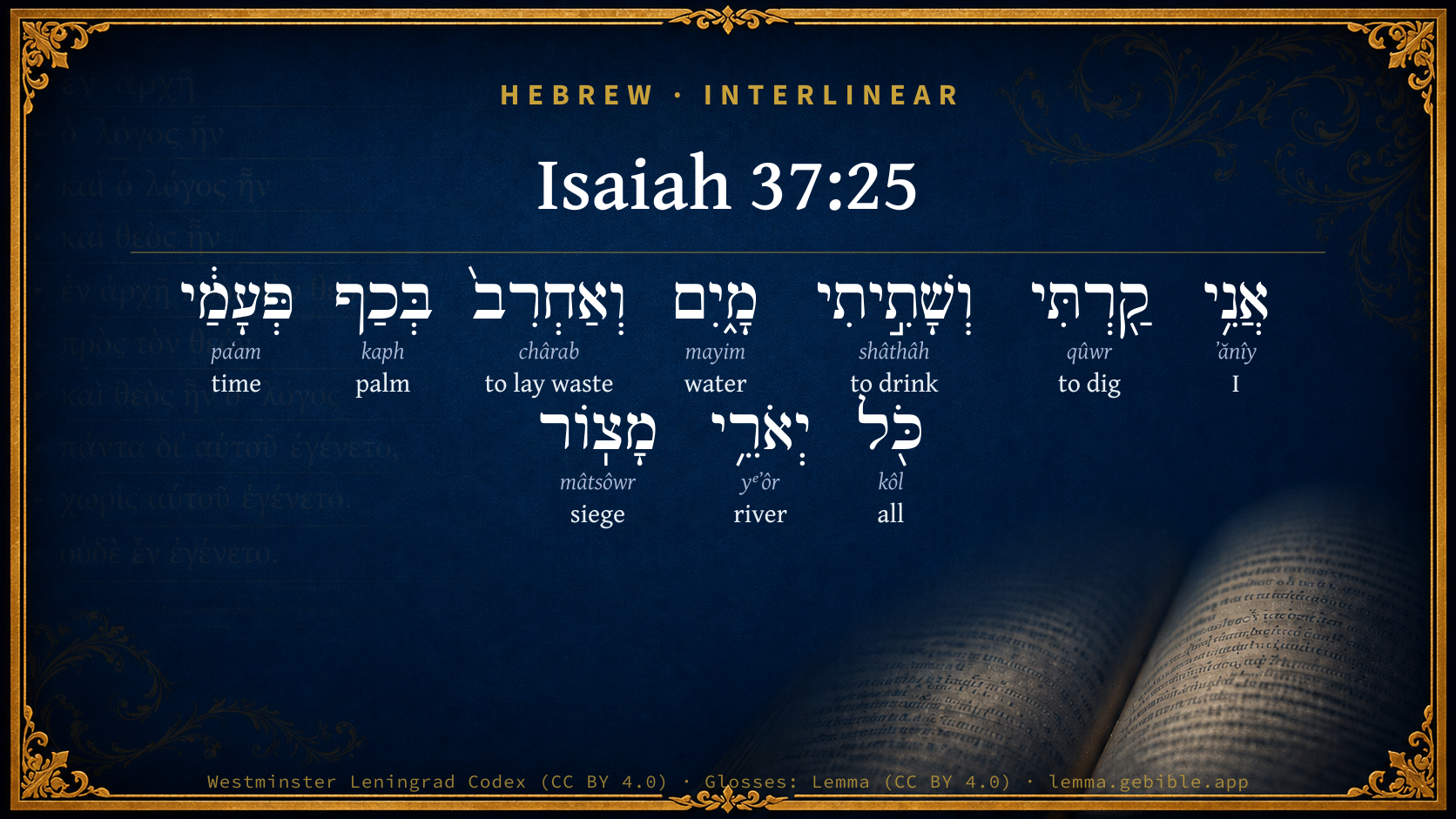
Isaiah 37:25

Hebrew (Westminster Leningrad Codex) Isaiah 37:25 appears in the Hebrew Old Testament. The text above is from the Westminster Leningrad Codex. Each word links to its Strong’s number, a concise gloss, and parsing drawn from the Open Scriptures Hebrew Bible morphology. Click any word for its full Brown-Driver-Briggs (BDB) entry.
Download image
Cite this verse

Isaiah 37:25 (World English Bible). Public Domain. Lemma interlinear Bible study tool, https://lemma.gebible.app/v/isaiah/37/25.

Show BibTeX & RIS
BibTeX
RIS
English Translation
I have dug and drunk water, and with the sole of my feet will I dry up all the rivers of Egypt.
World English Bible · Public Domain
Download a study sheet

One document with this verse’s original text, its word-by-word gloss line, the meaning frame, cross-references with their text, attributed commentary, and full source and license credits — printable, and it pastes into notes with its structure intact.

This verse Autodidact and up

Study sheet (.html) Plain text (.txt)

A passage Seminary Student

Up to 50 verses in one chapter. A passage sheet keeps up to 6 commentary sources and 12 cross-references per verse, in the order this page ranks them, and says so on the sheet whenever that leaves anything out. Ask for a single verse and you get the Autodidact verse sheet above.

Everything on this page stays free to read, with no account — the sheet is a download of what is already on screen, not access to it.

Want to remove ads? Support Godless Engineer
Compare translations 3

The same verse in 3 English versions, stacked beneath the original-language interlinear above. Click any original word for its lexicon entry.

Each is an independent rendering of the whole verse — the interlinear is not word-aligned to these translations.

Highlighted words mark where these versions differ — a whole-verse word diff, not a word-by-word alignment.

  • World English Bible Public Domain
    I have dug and drunk water, and with the sole of my feet will I dry up all the rivers of Egypt.
  • King James Version Public Domain
    I have digged, and drunk water; and with the sole of my feet have I dried up all the rivers of the besieged places.
  • unfoldingWord Literal Text CC BY-SA 4.0
    I, I dug, and I drank waters. And with the sole of my feet I will dry up all of the streams of Matsor.”

unfoldingWord Literal Text — © unfoldingWord, licensed CC BY-SA 4.0. Word-aligned USFM3 via Door43 (git.door43.org/unfoldingWord/en_ult).

Versions to compare (up to 4)

3 of 4 selected

Show all 18 translations

Every available English version of this verse, each an independent rendering of the whole verse.

  • World English Bible Public Domain
    I have dug and drunk water, and with the sole of my feet will I dry up all the rivers of Egypt.
  • Berean Standard Bible Public Domain
    I have dug wells and drunk foreign waters. With the soles of my feet I have dried up all the streams of Egypt.”
  • Majority Standard Bible Public Domain
    I have dug wells and drunk foreign waters. With the soles of my feet I have dried up all the streams of Egypt.”
  • King James Version Public Domain
    I have digged, and drunk water; and with the sole of my feet have I dried up all the rivers of the besieged places.
  • American Standard Version (1901) Public Domain
    I have digged and drunk water, and with the sole of my feet will I dry up all the rivers of Egypt.
  • Revised Version (1885) Public Domain
    I have digged and drunk water, and with the sole of my feet will I dry up all the rivers of Egypt.
  • Geneva Bible (1599) Public Domain
    I haue digged and drunke the waters, and with the plant of my feete haue I dryed all the riuers closed in.
  • Douay-Rheims (1899) Public Domain
    I have digged, and drunk water, and have dried up with the sole of my foot, all the rivers shut up in banks.
  • Young's Literal Translation Public Domain
    I -- I have dug and drunk waters, And I dry up with the sole of my steps All floods of a bulwark.
  • Literal Standard Version CC BY-SA 4.0
    I have dug and drunk waters, || And I dry up with the sole of my steps || All floods of a bulwark.
  • Unlocked Literal Bible CC BY-SA 4.0
    I have dug wells and drunk water; I dried up all the rivers of Egypt under the soles of my feet.'
  • unfoldingWord Literal Text CC BY-SA 4.0
    I, I dug, and I drank waters. And with the sole of my feet I will dry up all of the streams of Matsor.”
  • Darby Bible Public Domain
    I have digged and drunk water; and with the sole of my feet have I dried up all the streams of Matsor.
  • World Messianic Bible Public Domain
    I have dug and drunk water, and with the sole of my feet I will dry up all the rivers of Egypt.”
  • Webster's Bible Public Domain
    I have digged, and drank water; and with the sole of my feet have I dried up all the rivers of the besieged places.
  • Free Bible Version CC BY-SA 4.0
    I have dug wells and drunk water in foreign lands. With the soles of my feet I dried up all the rivers in Egypt.’”
  • Bible in Basic English Public Domain
    I have made water-holes and taken their waters, and with my foot I have made all the rivers of Egypt dry.
  • JPS Tanakh (1917) Public Domain
    I have digged and drunk water, and with the sole of my feet have I dried up all the rivers of Egypt.

Literal Standard Version (2020), Covenant Press — licensed CC BY-SA 4.0. Text via the HelloAO Bible API (eBible.org). Unlocked Literal Bible (unfoldingWord) — licensed CC BY-SA 4.0. Text via the HelloAO Bible API (eBible.org). unfoldingWord Literal Text — © unfoldingWord, licensed CC BY-SA 4.0. Word-aligned USFM3 via Door43 (git.door43.org/unfoldingWord/en_ult). Free Bible Version, Dr. Jonathan Gallagher — licensed CC BY-SA 4.0. Text via the HelloAO Bible API (eBible.org).

Word by word

More ways to search: Search by grammar → Find every occurrence → Compare this word →

Practice this passage: Drill this verse → Learn its vocabulary →

About this verse

These counts appear in no published source. They are computed here, from the morphology-tagged text and Lemma’s own curated glosses. What Lemma adds →

10
words
10
distinct lemmas
Prophets
section

Notable vocabulary

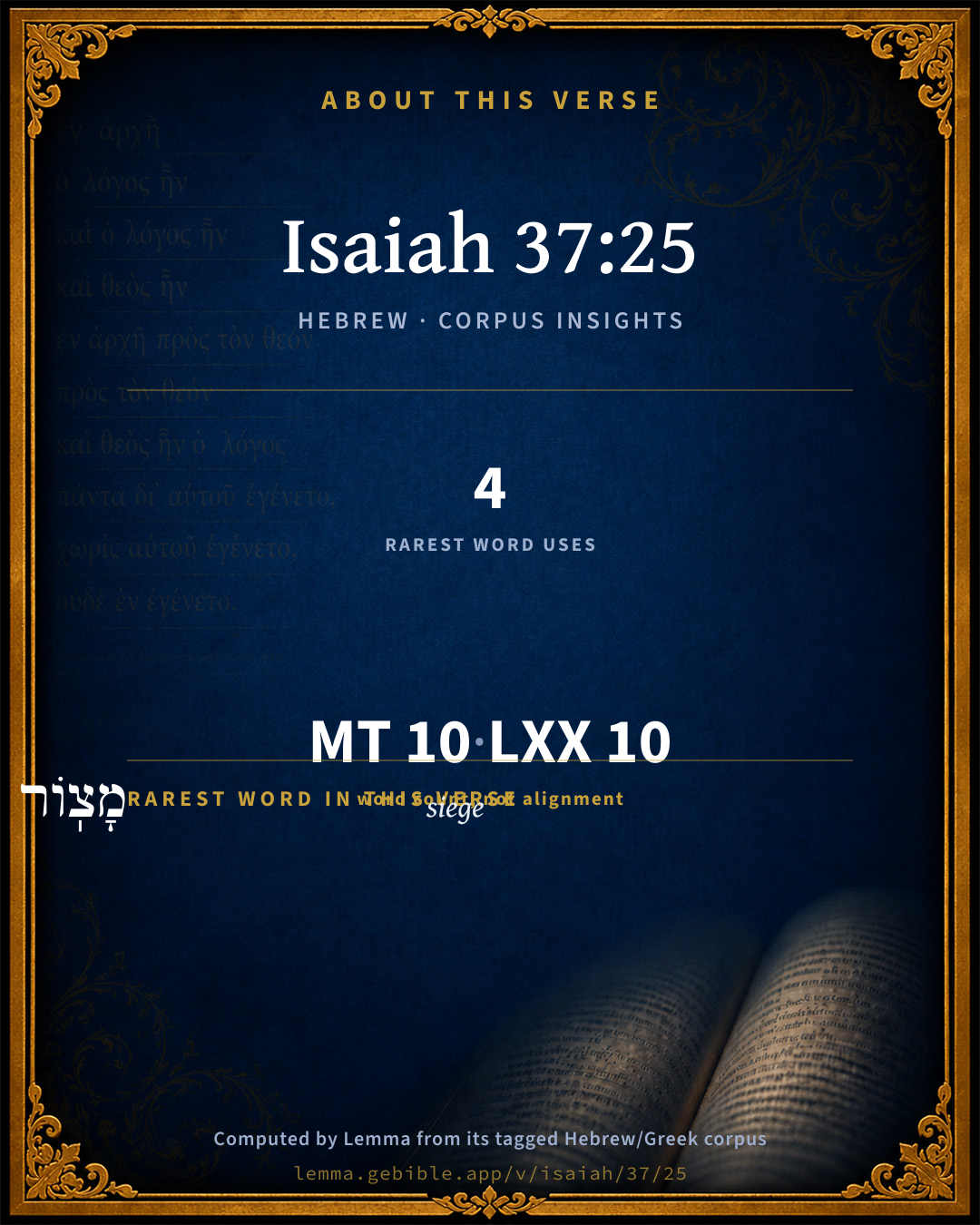
The rarest word here is מָצֽוֹר siege H4693 — appearing just 4 times in the whole Hebrew Bible.

Shared distinctive vocabulary

מָצֽוֹר siege H4693 occurs in 4 verses of the Hebrew Bible. Also found in:

Grammatical profile

  • 3 verbs
  • 6 nouns
  • 1 pronoun

Verb forms

  • קַ֖רְתִּי Qal · Perfect
  • וְשָׁתִ֣יתִי Qal · Perfect
  • וְאַחְרִב֙ Hiphil · Imperfect

Hebrew & Septuagint length

In English translation the verse runs 22 words from the Hebrew and 16 from the Septuagint (LXX English) — closely comparable.

A rough comparison of the two English renderings, which tokenize alike — not a word-level alignment.

Word counts can differ between the Hebrew and the Greek without any difference in meaning — e.g. the Hebrew direct-object marker אֵת has no separate Greek word, and Greek often adds the article ὁ.

In the original languages it is 10 Hebrew tokens and 10 Greek tokens — but the two are counted differently (Hebrew bundles its prefixes and suffixes into one token; the Greek is in lemma form), so that isn’t a like-for-like length.

Cross-references

4

Topical passages linked to Isaiah 37:25 in the Treasury of Scripture Knowledge — connected by theme and wording, ordered by reader-vote popularity; previews shown in the World English Bible.

  • 1 Kings 20:10 Ben Hadad sent to him, and said, The gods do so to me, and more also, if the dust of Samaria shall suffice for handfuls for all the people who follow me.
  • Deuteronomy 11:10 For the land, where you go in to possess it, isn't as the land of Egypt, from whence you came out, where you sowed your seed, and watered it with your foot, as a garden of herbs;
  • 2 Kings 19:23–24 By your messengers you have defied the Lord, and have said, With the multitude of my chariots am I come up to the height of the mountains, to the innermost parts of Lebanon; and I will cut down the tall cedars of it, and the choice fir trees of it; and I will enter into his farthest lodging-place, the forest of his fruitful field.
  • Isaiah 36:12 But Rabshakeh said, Has my master sent me to your master, and to you, to speak these words? [has he] not [sent me] to the men who sit on the wall, to eat their own dung, and to drink their own water with you?

Cross-references courtesy of OpenBible.info (CC BY 4.0).

Hebrew and Greek witnesses Masoretic Hebrew ↔ Greek Septuagint

The same verse in the two great witnesses to the Old Testament, shown verse-for-verse.

These are two independent witnesses, not word-aligned to each other, and the Septuagint is shown in lemma (dictionary) form.

Hebrew Isaiah 37:25 Masoretic · Westminster Leningrad Codex

אֲנִ֥י קַ֖רְתִּי וְשָׁתִ֣יתִי מָ֑יִם וְאַחְרִב֙ בְּכַף פְּעָמַ֔י כֹּ֖ל יְאֹרֵ֥י מָצֽוֹר

I have dug and drunk water, and with the sole of my feet will I dry up all the rivers of Egypt.

World English Bible · Public Domain

Greek LXX Isaiah 37:25 Septuagint · lemma form

καί τίθημι γέφυρα καί ἐρημόω ὕδωρ καί πᾶς συναγωγή ὕδωρ

and I have made a bridge, and dried up the waters, and every pool of water.

LXX2012 (modern English Septuagint) · Public Domain

Hebrew: Westminster Leningrad Codex (CC BY 4.0). Greek: Septuagint (public domain); English from LXX2012 (modern English Septuagint) (Public Domain). How the Septuagint differs from the Hebrew →

Targum (Aramaic paraphrase)

1

The Targum is the ancient Jewish Aramaic paraphrase of the Hebrew Scriptures — an interpretive translation, not the Hebrew text itself. Onkelos (literal) and Pseudo-Jonathan (expansive) render the Torah, and Jonathan the Prophets. Coverage is partial: where no permissively-licensed English translation exists for a verse, only the Aramaic is shown. This is verse-level text, not a word-by-word alignment to the Hebrew.

  1. Targum Jonathan Prophets (Joshua–Malachi)
    אֲנָא הֲוֵיתִי חָפֵיר גוּבִין וְשָׁתֵי מַיָן וּטְפָחֵית בְּפַרְסַת רִגְלֵי עַמָא דְעִמִי כָּל מֵי נַהֲרִין עֲמִיקִין:

    I have digged cisterns, and I have drunk water, and I have dried up all the waters of the deep rivers with the sole of the people that were with me.

    Targum Jonathan — Aramaic: “Mikraot Gedolot” (public domain). English: “Sefaria Community Translation” (CC0 1.0 (public-domain dedication)); “London "Chaldee Paraphrase," 1871” (public domain). Text via Sefaria.

Commentary

Notes on Isaiah 37:25 from classic Christian and Jewish commentators (each source and its license shown beneath its notes). The classic Christian expositions comment on the surrounding passage and are grouped to its opening verse, so a note may address several verses; the Jewish commentaries on the Tanakh (Rashi and others) are per-verse, so they appear only where the commentator wrote on this verse.

Lemma curates 59 commentaries, every one of them public domain or Creative Commons licensed, each selected and text-cleaned for this edition rather than reprinted as found. About our sources →

Keil & Delitzsch

C. F. Keil & F. Delitzsch

Third turn, "I, I have digged and drunk (K. foreign) waters, and will make dry with the sole of my feet all the Nile-arms (יארי, K. יאורי) of Matsor." If we take עליתי in Isa 37:24 as a perfect of certainty, Isa 37:25 would refer to the overcoming of the difficulties connected with the barren sandy steppe on the way to Egypt (viz., et-Tih); but the perfects stand out against the following futures, as statements of what was actually past. Thus, in places where there were no waters at all, and it might have been supposed that his army would inevitably perish, there he had dug them (qūr, from which mâqōr is derived, fodere; not scaturire, as Luzzatto supposes), and had drunk up these waters, which had been called up, as if by magic, upon foreign soil; and in places where there were waters, as in Egypt (mâtsōr is used in Isaiah and Micah for mitsrayim, with a play upon the appellative meaning of the word: an enclosing fence, a fortifying girdle: see Psa 31:22), the Nile-arms and canals of which appeared to bar all farther progress, it was an easy thing for him to set at nought all these opposing hindrances. The Nile, with its many arms, was nothing but a puddle to him, which he trampled out with his feet.

Keil & Delitzsch — Biblical Commentary on the Old Testament (1861–1891) — public domain (CC PDM 1.0). Text via the HelloAO Bible API. (Old Testament only.)

Tyndale Open Study Notes

Tyndale Open Resources

37:25 I have dug wells . . . I stopped up all the rivers of Egypt: Sennacherib’s boasts demonstrate his attitude of independence. However, the Lord alone is sovereign over nature (42:15; 43:19; 44:27).

Tyndale Open Study Notes — © Tyndale Open Resources, licensed CC BY-SA 4.0. Text via the HelloAO Bible API.

Geneva Bible (1599)

Geneva Bible translators

He boasteth of his policy, in that that he can find means to nourish his army: and of his power in that that his army is so great, that it is able to dry up whole rivers, and to destroy the waters which the Jews had closed in.

Geneva Bible (1599) marginal notes — public domain. Text via Bolls.life.

Jamieson, Fausset & Brown

Robert Jamieson, A. R. Fausset & David Brown

digged, and drunk water--In Kg2 19:24, it is "strange waters." I have marched into foreign lands where I had to dig wells for the supply of my armies; even the natural destitution of water there did not impede my march.

rivers of . . . besieged places--rather, "the streams (artificial canals from the Nile) of Egypt." "With the sole of my foot," expresses that as soon as his vast armies marched into a region, the streams were drunk up by them; or rather, that the rivers proved no obstruction to the onward march of his armies. So Isa 19:4-6, referring to Egypt, "the river--brooks of defense--shall be dried up." HORSLEY, translates the Hebrew for "besieged places," "rocks."

Jamieson, Fausset & Brown — Commentary Critical and Explanatory on the Whole Bible (1871) — public domain (CC PDM 1.0). Text via the HelloAO Bible API.

Adam Clarke's Commentary

Verse 25. Water - "Strange waters"] The word זרים zarim, strange, lost out of the Hebrew text in this place, is supplied from the other copy. A MS. supplies the word רבים rabbim, many, instead of it.

With the sole of my feet] With my infantry.

All the rivers of the besieged places - "All the canals of fenced places."] The principal cities of Egypt, the scene of his late exploits, were chiefly defended by deep moats, canals, or large lakes, made by labour and art, with which they were surrounded. See Harmer's Observ. ii. p. 304. Claudian introduces Alaric boasting of his conquests in the same extravagant manner: -

"Subsidere nostris

Sub pedibus montes; arescere vidimus amnes.__

Fregi Alpes, galeisque Padum victricibus hausi."

De Bello Getic. 526.

"The mountains have passed away under our feet; we have seen the rivers dried up. I have broken the Alps, and laden out the Po with our victorious helmets."

Adam Clarke's Commentary on the Bible (1810–1826) — public domain. Text from a community e-Sword/MySword module.

Ellicott's Commentary for English Readers

(25) I have digged, and drunk water . . .—This, again, was one of the common boasts of the Assyrian conquerors. It was Sennacherib’s special glory, as recorded in his inscriptions, that he had provided cities with water which were before scantily supplied, that he had made wells even in the deserts (Records of the Past, i. 29, 31, 9:23).

All the rivers of the besieged places.—As the words stand, they suggest the thought that the Assyrian army could cut off the supply of water as well as provide it, and so connect themselves with the Rabshakeh’s taunt in Isa_36:12. Their true meaning, however, is probably, as in Isa_19:6; Mic_7:12, “the rivers or canals of Egypt,” a form being used for Egypt which also conveys the idea of “besieged fortresses.” So taken, the words are a defiant threat against Tirhakah. Not all the branches of the Nile in the Delta should protect his cities. His armies would, as it were, dry them up.

A Bible Commentary for English Readers, edited by Charles John Ellicott (1878–1897) — public domain. Text from a community e-Sword module.

The Cambridge Bible for Schools and Colleges

gen. ed. J. J. S. Perowne

25. I have digged … water] I (again emphatic) dig and drink foreign waters. The word “foreign” is to be supplied from 2Ki_19:24. For the expression cf. Pro_9:17; Pro_5:15.

all the rivers of the besieged places] Render with R.V. all the rivers (lit. “Nile-streams”) of Egypt. See on ch. Isa_19:6. The extravagant hyperbole covers an empty boast; no Assyrian army had ever yet set foot in Egypt, and Sennacherib was not destined to see his dream fulfilled.

The Cambridge Bible for Schools and Colleges (gen. ed. J. J. S. Perowne; Cambridge University Press, 1878–1918) — public domain. Text from a community e-Sword module.

John Gill's Exposition

Therefore their inhabitants were of small power,.... Or, "short of hand" (u); it was not in the power of their hands to help themselves, because the Lord took away their strength, having determined that they should be destroyed for their sins; otherwise it would not have been in the power of Sennacherib to have subdued them; this takes off greatly from the king of Assyria's triumph, that they were a weak people, whom he had conquered, and were given up into his hands by the Lord, according to his purposes, or he had never been lord over them:

they were dismayed and confounded; not so much at the sight of Sennacherib's army, but because the Lord had dispirited them, and took away their natural courage from them, so that they became an easy prey to him:

they were as the grass of the field: which has no strength to stand before the mower:

and as the green herb; which is easily cropped with the hand of man, or eaten by the beasts of the field:

as the grass on the housetops: which has no matter of root, and is dried up with the heat of the sun:

and as corn blasted before it be grown up; before it rises up into anything of a stalk, and much less into ears; so the Targum,

"which is blasted before it comes to be ears;''

all which represent the feeble condition of the people overcome by him; so that he had not so much to glory of, as having done mighty things.

(u) breviati, "vel breves manu", Forerius; "abbreviati manu", Vatablus, Montanus.

John Gill's Exposition of the Whole Bible (1746–1763) — public domain (CC PDM 1.0). Text via the HelloAO Bible API.

Albert Barnes' Notes on the Bible

I have digged - That is, I have digged wells. This was regarded among eastern nations as an important achievement. It was difficult to find water, even by digging, in sandy deserts; and in a country abounding with rocks, it was an enterprise of great difficulty to sink a well. Hence, the possession of a well became a valuable property, and was sometimes the occasion of contention between neighboring tribes Gen 26:20. Hence, also to stop up the wells of water, by throwing in rocks or sand, became one of the most obvious ways of distressing an enemy, and was often resorted to Gen 26:15, Gen 26:18; 2Ki 3:19, 2Ki 3:25. To dig wells, or to furnish water in abundance to a people, became also an achievement which was deemed worthy to be recorded in the history of kings and princes 2Ch 26:10. Many of the most stupendous and costly of the works of the Romans in the capital of their empire, and in the principal towns of their provinces, consisted in building aqueducts to bring water from a distance into a city.

An achievement like this I understand Sennacherib as boasting he had performed; that he had furnished water for the cities and towns of his mighty empire; that he had accomplished what was deemed so difficult, and what required so much expense, as digging wells for his people; and that he had secured them from being stopped up by his enemies, so that he and his people drank of the water in peace. Gesenius, however, understands this as a boast that he had extended the bounds of his empire beyond its original limits, and unto regions that were naturally destitute of water, and where it was necessary to dig wells to supply his armies. Rosenmuller understands it as saying: ‘I have passed over, and taken possession of foreign lands.’ Drusius regards it as a proverbial saying, meaning ‘I have happily and successfully accomplished all that I have undertaken, as he who digs a well accomplishes that which he particularly desires.’ Vitringa regards it as saying, ‘that to dig wells, and to drink the water of them, is to enjoy the fruit of our labors, to be successful and happy.’ But it seems to me that the interpretation above suggested, and which I have not found in any of the commentators before me, is the correct exposition.

And drunk water - In 2Ki 19:24, it is, ‘I have drunk strange waters;’ that is, the waters of foreign lands. I have conquered them, and have dug wells in them. But the sense is not materially changed.

And with the sole of my feet - Expressions like this, denoting the desolations of a conqueror, are found in the classic writers. Perhaps the idea there is, that their armies were so numerous that they drank up all the waters in their march - a strong hyperbole to denote the number of their armies, and the extent of their desolations when even the waters failed before them. Thus Claudian (De Bello Getico, 526) introduces Alaric as boasting of his conquests in the same extravagant manner, and in language remarkably similar to this:

Cum cesserit omnis

Obsequiis natura meis. Subsidere nostris

Sub pedibus montes; arescere vidimus amnes -

Fregi Alpes, galeisque Padum victricibus hausi.

So Juvenal (Sat. 10:176), speaking of the dominion of Xerxes, says:

- credimus altos

Defecisse amnes, epotaque ilumina Medo

Prandente.

The boast of drying up streams with the sole of the foot, is intended to convey the idea that he had not only supplied water for his own empire by digging wells, but that he had cut off the supplies of water from the others against whom he had made war. The idea perhaps is, that if such an army as his was, should pass through the streams of a country that they should invade, and should only take away the water that would adhere to the sole or the hollow of the foot on their march, it would dry up all the streams. It is strong hyperbolical language, and is designed to indicate the number of the forces which were under his command.

Of the besieged places - Margin, ‘Fenced’ or ‘closed’. The word rendered ‘rivers’ (אורי 'rēy), may denote canals, or artificial streams, such as were common in Egypt. In Isa 19:6, it is rendered ‘brooks,’ and is applied to the artificial canals of Egypt (see the note on that place). The word rendered here ‘besieged places’ (מצור mâtsôr), may mean distress, straitness Deu 28:53; siege Eze 4:2, Eze 4:7; mound, bulwark, intrenchment Deu 20:20; or it may be a proper name for Egypt, being one of the forms of the name מצרים mitserayim or Egypt. The same phrase occurs in Isa 19:6, where it means Egypt (see the note on that place), and such should be regarded as its meaning here. It alludes to the conquests which Sennacherib is represented as boasting that he had made in Egypt, that he had easily removed obstructions, and destroyed their means of defense. Though he had been repulsed before Pelusium by Tirhakah king of Ethiopia (see the note at Isa 36:1), yet it is not improbable that he had taken many towns there, and had subdued no small part of the country to himself. In his vain boasting, he would strive to forget his repulse, and would dwell on the case of conquest, and the facility with which he had removed all obstructions from his way. The whole language of the verse therefore, is that of a proud and haughty Oriental prince, desirous of proclaiming his conquests, and forgetting his mortifying defeats.

Albert Barnes' Notes on the Bible (1834–1885) — public domain. Text from a community e-Sword/MySword module.

Haydock's Catholic Bible Commentary

Shut, &c. Hebrew matsor, (Haydock) "of Egypt," where Sennacherib had been. (Calmet)

George Leo Haydock (1774–1849), Haydock's Catholic Family Bible and Commentary, 1859 edition — public domain. Excludes Psalms (Douay-Rheims chapter numbering differs from Protestant) and Deuterocanonical books (Catholic canon only).

Whedon's Commentary on the Bible

Daniel D. Whedon

25. Each verse along here shows a strophical character — parties speaking in turn. Sennacherib is now the speaker. Yes, indeed, I have digged, and drunk water; and with the sole of my feet [steps of my feet] have I dried up all the streams of Egypt — The best views respecting the confusion of Hebrew tenses in this verse and the preceding, make good sense as follows: It is as if it were already done, that I have digged and drank water with my great army across the northern et-Tih desert to Egypt. My power is adequate to do it with the utmost ease. Likewise, as if already in Egypt, subduing all before me — it is as good as done — that with the step of foot of my whole army upon water tread mills I have completely exhausted all the Nile arms and canals of Egypt. Some favour is due to another sense, that of an hyperbole, in the last clause, namely, “The Nile was nothing but a puddle to him, which he could trample out with the sole of his foot.” — Delitzsch.

Daniel D. Whedon (gen. ed.), Commentary on the Old and New Testaments (1874–1909) — public domain. Text from a community e-Sword module.

The Pulpit Commentary

I have digged, and drunk water. Sennacherib notes three natural obstacles to his advance the forces of his opponents he does not appear to account an obstacle viz. mountains, deserts, rivers. Mountains do not stop him he crosses them even with his chariot-force (ver. 24). Deserts do not stop him he digs wells there, and drinks their waters. Rivers will not stop him he will dry them up, trample them into puddles. Note the contrast between the past tenses, "I have come up," "I have digged," "I have drunk," and the future, "I will dry up." He had crossed the mountain ranges Sinjar, Amanus, Lebanon; he had passed waterless tracts, where he had had to dig wells, in Mesopotamia and Northern Syria. He was about to find his chief obstacle, rivers, when he invaded Lower Egypt. The rivers of the besieged places; rather, the rivers of Egypt. Mazor, the singular form (compare Assyrian Muzr, and modern Arabic Misr), is used here, (as in Mic_7:12, and perhaps in Isa_19:6) instead of the ordinary dual term, Miz-raim, probably because Lower Egypt is especially intended. Sennacherib was looking especially to the invasion of Lower Egypt,where the Nile had "seven branches" (Herod., 2:17), and the country was also cut up by numerous canals, which would naturally constitute a great difficulty to a force depending mainly on its chariots. He believed, however, in his heart, that he would find a way of "drying up" these "rivers."

The Pulpit Commentary (1880–1919), ed. H.D.M. Spence-Jones & Joseph S. Exell — public domain. Text from a community e-Sword module.

J. A. Alexander on Isaiah

Joseph Addison Alexander

“I have digged and drunk water, and I will dry up with the sole of my feet (literally, steps) all the streams of Egypt.” As in the preceding verse, he begins with the past tense and then changes to the future, to denote that he had begun his enterprise successfully and expected to conclude it triumphantly. The confusion of the tenses, as all futures or all preterits, is entirely arbitrary, and the translation of them all as presents is at least unnecessary, when a stricter version not only yields a good sense, but adds to the significance and force of the expressions. The best interpretation, on the whole, is that which understands the verse to mean that no difficulties or privations could retard his march, that where there was no water he had dug for it and found it, and that where there was he would exhaust it, both assertions implying a vast multitude of soldiers. The drying up of the rivers with the soles of the feet is understood by some as an allusion to the Egyptian mode of drawing water with a tread-wheel (Deu 11:10). Others suppose it to mean, that they would cross the streams dry-shod, or that the dust raised by their march would choke and dry up rivers. In favor of supposing an allusion to the drawing out of water, is the obvious reference to digging and drinking in the other clause.

Joseph Addison Alexander, The Prophecies of Isaiah (1846–1847; New York: Scribner, 1870–1878) — public domain. Text from a community e-Sword module.

Rashi

Rabbi Shlomo Yitzchaki (Rashi)

I dug and drank (קַרְתִּי) I.e., to say, I started all my deeds and completed them and succeeded, as one who digs a hole and finds water and succeeds. This is an expression of a spring (מָקוֹר).

and I dry up with the soles of my feet If I would besiege a city reliant on the strength of its rivers, I would bring upon it many troops, and the water of their rivers would be depleted from their drinking and the drinking of their cattle and by the treading of their feet.

and I dry up (lit., and I will dry up) This is the present tense, i.e., to say, so is my wont always.

rivers of the siege The rivers of the city that is besieged through its rivers. ([Mss. yield:] that is besieged by me.)

Rashi on the Tanakh — English translations: “The Judaica Press complete Tanach with Rashi, translated by A. J. Rosenberg” (CC BY 4.0); “Pentateuch with Rashi's commentary by M. Rosenbaum and A.M. Silbermann, 1929-1934” (public domain); “The Metsudah Tanach series, Lakewood, N.J” (CC BY 4.0); and “The Book of Joshua, Metsudah Publications, 1997” (CC BY 4.0). Text via Sefaria.

Ibn Ezra

Rabbi Abraham ibn Ezra

3. In the book of Kings there is the addition of the words נהרי זרים═זרים, the rivers of strangers, after מים water.

Ibn Ezra on the Tanakh — English translations: “Sefaria Community Translation” (CC0 1.0 (public-domain dedication)); “Yalkut, Sifsei Chachomim Chumash, Metsudah Publications, 2009” (CC BY 4.0); and “Commentary of Ibn Ezra on Isaiah - trans. by M. Friedlander, 1873” (public domain). Text via Sefaria.

Lesson kit

Teaching starters — assembled from the data on this page, not authored interpretation. Every prompt links to the verse data it draws on. Edit before teaching.

Isaiah, in the Prophets, opens this verse with 10 words (10 distinct Hebrew lemmas). Its most distinctive word is mâtsôwr (“siege”). A historical commentator’s framing appears above. Read the whole chapter for the surrounding context.

Discussion questions

  1. How does “siege” (mâtsôwr) shape what this verse is saying?
  2. 2 Kings 19:24 shares the word «siege» with this verse. How do the two illuminate each other?
  3. These translations render this verse differently; the difference is in the English rendering, not the original. What questions does that raise?
  4. The verb «קַ֖רְתִּי» is Qal Perfect. How does its form color the action?
  5. Reading how Keil & Delitzsch and Tyndale Open Study Notes read this verse, where do the two commentators agree and where do they part?

Things to notice

Reading settings

Reading text

Shown beneath each verse's original-language words.

Old Testament
Old Testament edition

Read the OT as the Masoretic Hebrew (MT) or the Greek Septuagint (LXX).

English shown for the Greek Septuagint (in the Hebrew ↔ Greek comparison).

Comparing translations? Open the Compare panel on any verse page to stack up to four side by side.