
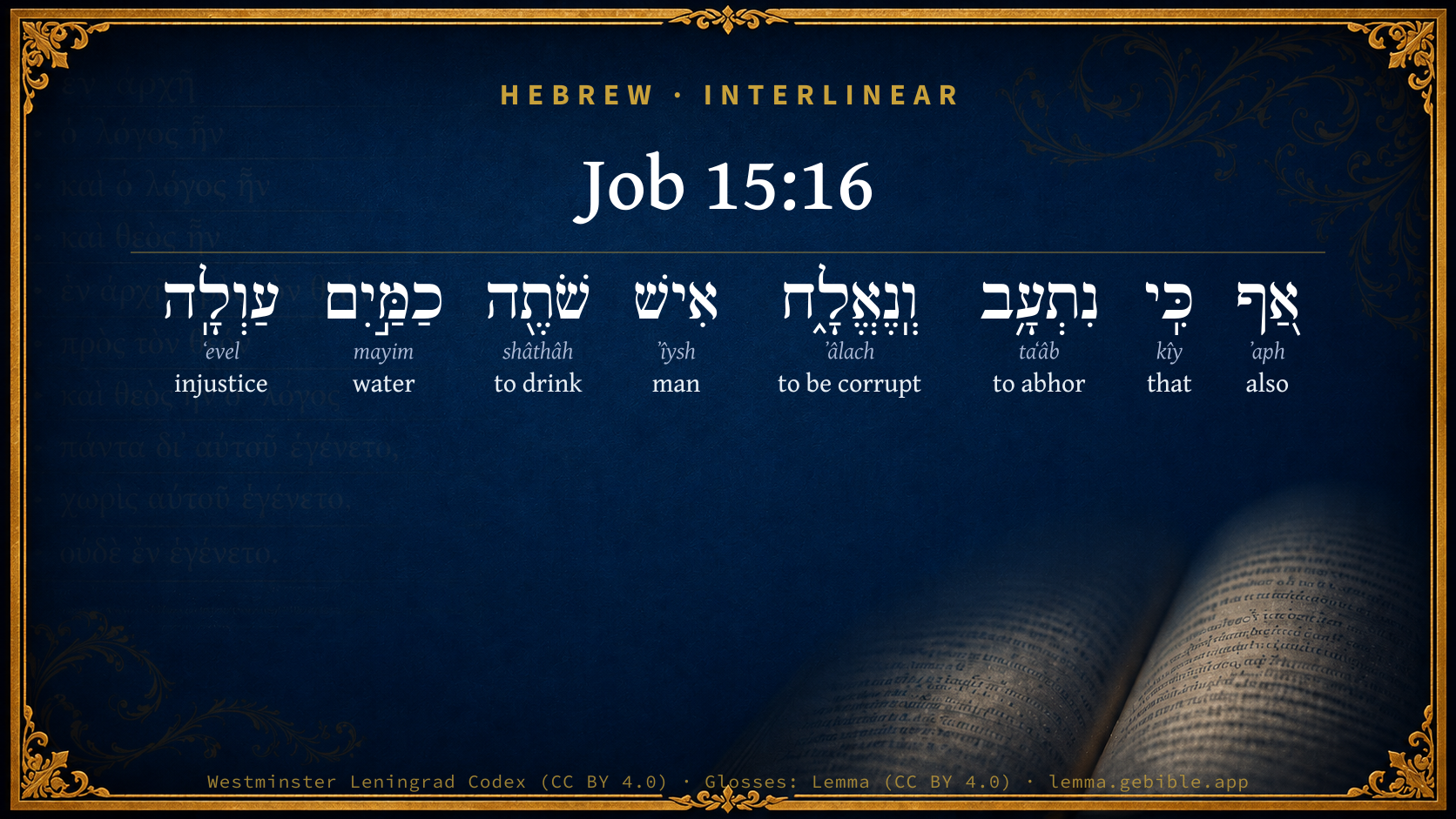
Job 15:16

Hebrew (Westminster Leningrad Codex) Job 15:16 appears in the Hebrew Old Testament. The text above is from the Westminster Leningrad Codex. Each word links to its Strong’s number, a concise gloss, and parsing drawn from the Open Scriptures Hebrew Bible morphology. Click any word for its full Brown-Driver-Briggs (BDB) entry.
Download image
Cite this verse

Job 15:16 (World English Bible). Public Domain. Lemma interlinear Bible study tool, https://lemma.gebible.app/v/job/15/16.

Show BibTeX & RIS
BibTeX
RIS
English Translation
How much less one who is abominable and corrupt, A man who drinks iniquity like water!
World English Bible · Public Domain
Highlights
  • 1 first appearance in the Hebrew Bible
Full analysis ↓
Download a study sheet

One document with this verse’s original text, its word-by-word gloss line, the meaning frame, cross-references with their text, attributed commentary, and full source and license credits — printable, and it pastes into notes with its structure intact.

This verse Autodidact and up

Study sheet (.html) Plain text (.txt)

A passage Seminary Student

Up to 50 verses in one chapter. A passage sheet keeps up to 6 commentary sources and 12 cross-references per verse, in the order this page ranks them, and says so on the sheet whenever that leaves anything out. Ask for a single verse and you get the Autodidact verse sheet above.

Everything on this page stays free to read, with no account — the sheet is a download of what is already on screen, not access to it.

Want to remove ads? Support Godless Engineer
Compare translations 3

The same verse in 3 English versions, stacked beneath the original-language interlinear above. Click any original word for its lexicon entry.

Each is an independent rendering of the whole verse — the interlinear is not word-aligned to these translations.

Highlighted words mark where these versions differ — a whole-verse word diff, not a word-by-word alignment.

  • World English Bible Public Domain
    How much less one who is abominable and corrupt, A man who drinks iniquity like water!
  • King James Version Public Domain
    How much more abominable and filthy is man, which drinketh iniquity like water?
  • unfoldingWord Literal Text CC BY-SA 4.0
    indeed that the abominable and the corrupted, a man drinking iniquity like water!

unfoldingWord Literal Text — © unfoldingWord, licensed CC BY-SA 4.0. Word-aligned USFM3 via Door43 (git.door43.org/unfoldingWord/en_ult).

Versions to compare (up to 4)

3 of 4 selected

Show all 18 translations

Every available English version of this verse, each an independent rendering of the whole verse.

  • World English Bible Public Domain
    How much less one who is abominable and corrupt, A man who drinks iniquity like water!
  • Berean Standard Bible Public Domain
    how much less man, who is vile and corrupt, who drinks injustice like water?
  • Majority Standard Bible Public Domain
    how much less man, who is vile and corrupt, who drinks injustice like water?
  • King James Version Public Domain
    How much more abominable and filthy is man, which drinketh iniquity like water?
  • American Standard Version (1901) Public Domain
    How much less one that is abominable and corrupt, A man that drinketh iniquity like water!
  • Revised Version (1885) Public Domain
    How much less one that is abominable and corrupt, a man that drinketh iniquity like water!
  • Geneva Bible (1599) Public Domain
    How much more is man abominable, and filthie, which drinketh iniquitie like water?
  • Douay-Rheims (1899) Public Domain
    How much more is man abominable, and unprofitable, who drinketh iniquity like water?
  • Young's Literal Translation Public Domain
    Also -- surely abominable and filthy Is man drinking as water perverseness.
  • Literal Standard Version CC BY-SA 4.0
    Also—surely abominable and filthy || Is man drinking perverseness as water.
  • Unlocked Literal Bible CC BY-SA 4.0
    how much less clean is one who is abominable and corrupt, a man who drinks iniquity like water!
  • unfoldingWord Literal Text CC BY-SA 4.0
    indeed that the abominable and the corrupted, a man drinking iniquity like water!
  • Darby Bible Public Domain
    How much less the abominable and corrupt, -- man, that drinketh unrighteousness like water!
  • World Messianic Bible Public Domain
    how much less one who is abominable and corrupt, a man who drinks iniquity like water!
  • Webster's Bible Public Domain
    How much more abominable and filthy is man, who drinketh iniquity like water?
  • Free Bible Version CC BY-SA 4.0
    How much less pure are those who are unclean and corrupt, drinking in sin like water!
  • Bible in Basic English Public Domain
    How much less one who is disgusting and unclean, a man who takes in evil like water!
  • JPS Tanakh (1917) Public Domain
    How much less one that is abominable and impure, man who drinketh iniquity like water!

Literal Standard Version (2020), Covenant Press — licensed CC BY-SA 4.0. Text via the HelloAO Bible API (eBible.org). Unlocked Literal Bible (unfoldingWord) — licensed CC BY-SA 4.0. Text via the HelloAO Bible API (eBible.org). unfoldingWord Literal Text — © unfoldingWord, licensed CC BY-SA 4.0. Word-aligned USFM3 via Door43 (git.door43.org/unfoldingWord/en_ult). Free Bible Version, Dr. Jonathan Gallagher — licensed CC BY-SA 4.0. Text via the HelloAO Bible API (eBible.org).

Word by word

More ways to search: Search by grammar → Find every occurrence → Compare this word →

Practice this passage: Drill this verse → Learn its vocabulary →

About this verse

These counts appear in no published source. They are computed here, from the morphology-tagged text and Lemma’s own curated glosses. What Lemma adds →

8
words
8
distinct lemmas
Wisdom
section

Notable vocabulary

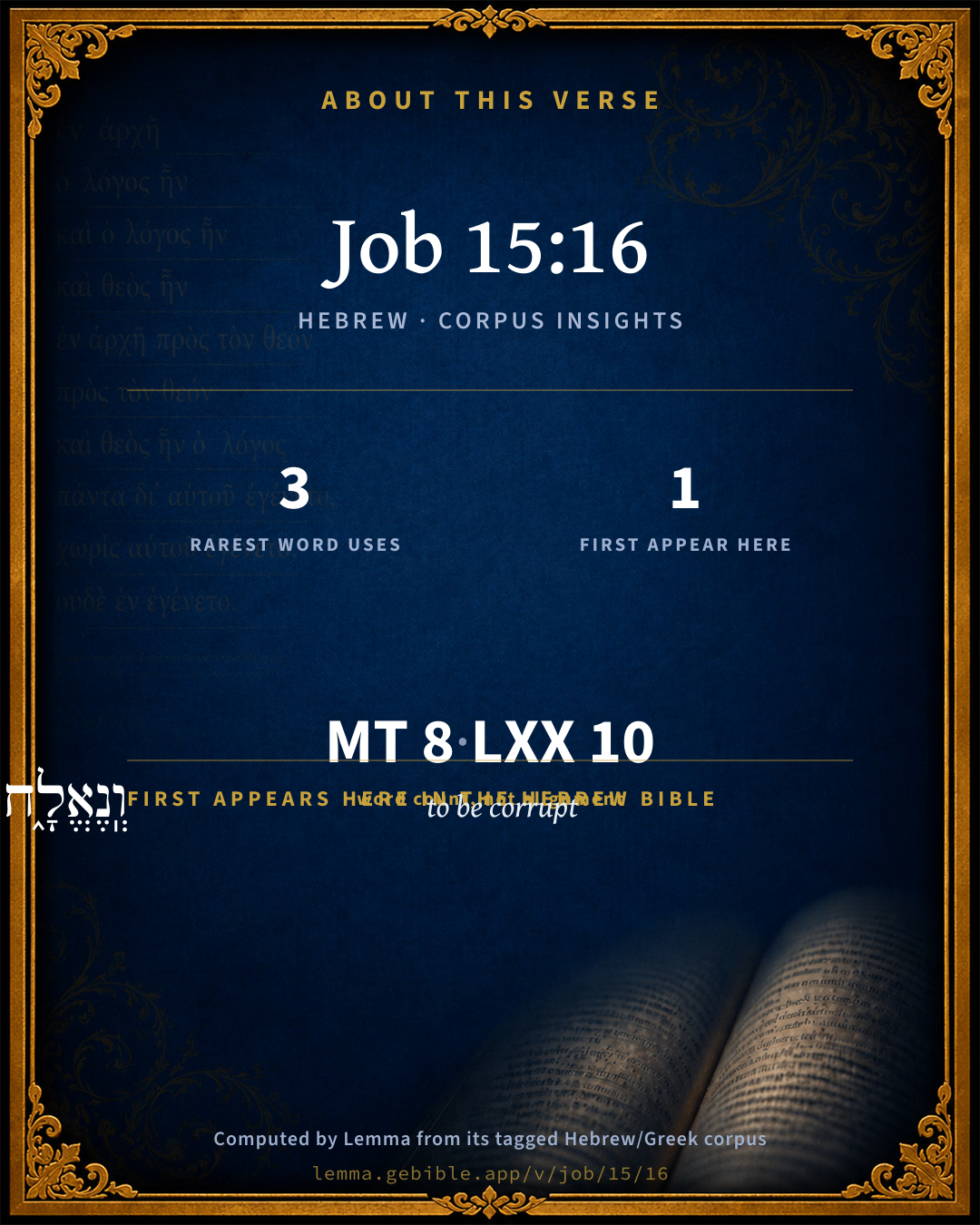
The rarest word here is וְֽנֶאֱלָ֑ח to be corrupt H444 — appearing just 3 times in the whole Hebrew Bible.

First appearance in Scripture

This word makes its first canonical appearance in the Hebrew Bible here:

  • וְֽנֶאֱלָ֑ח to be corrupt H444

Shared distinctive vocabulary

וְֽנֶאֱלָ֑ח to be corrupt H444 occurs in 3 verses of the Hebrew Bible. Also found in:

Grammatical profile

  • 3 verbs
  • 3 nouns
  • 1 conjunction
  • 1 particle

Verb forms

  • נִתְעָ֥ב Niphal · Participle Active
  • וְֽנֶאֱלָ֑ח Niphal · Participle Active
  • שֹׁתֶ֖ה Qal · Participle Active

Hebrew & Septuagint length

In English translation the verse runs 16 words from the Hebrew and 12 from the Septuagint (LXX English) — closely comparable.

A rough comparison of the two English renderings, which tokenize alike — not a word-level alignment.

Word counts can differ between the Hebrew and the Greek without any difference in meaning — e.g. the Hebrew direct-object marker אֵת has no separate Greek word, and Greek often adds the article ὁ.

In the original languages it is 8 Hebrew tokens and 10 Greek tokens — but the two are counted differently (Hebrew bundles its prefixes and suffixes into one token; the Greek is in lemma form), so that isn’t a like-for-like length.

Cross-references

10

Topical passages linked to Job 15:16 in the Treasury of Scripture Knowledge — connected by theme and wording, ordered by reader-vote popularity; previews shown in the World English Bible.

  • Job 34:7 What man is like Job, Who drinks scorn like water,
  • Proverbs 19:28 A corrupt witness mocks justice, And the mouth of the wicked gulps down iniquity.
  • Psalms 53:3 Every one of them has gone back. They have become filthy together. There is no one who does good, no, not one.
  • Romans 3:9–19 What then? Are we better than they? No, in no way. For we previously charged both Jews and Greeks, that they are all under sin.
  • Titus 3:3 For we were also once foolish, disobedient, deceived, serving various lusts and pleasures, living in malice and envy, hateful, and hating one another.
  • Job 4:19 How much more, those who dwell in houses of clay, Whose foundation is in the dust, Who are crushed before the moth!
  • Job 20:12 "Though wickedness is sweet in his mouth, Though he hide it under his tongue,
  • Job 42:6 Therefore I abhor myself, And repent in dust and ashes."
  • Psalms 14:1–3 The fool has said in his heart, "There is no God." They are corrupt. They have done abominable works. There is none who does good.
  • Romans 1:28–30 Even as they refused to have God in their knowledge, God gave them up to a reprobate mind, to do those things which are not fitting;

Cross-references courtesy of OpenBible.info (CC BY 4.0).

Hebrew and Greek witnesses Masoretic Hebrew ↔ Greek Septuagint

The same verse in the two great witnesses to the Old Testament, shown verse-for-verse.

These are two independent witnesses, not word-aligned to each other, and the Septuagint is shown in lemma (dictionary) form.

Hebrew Job 15:16 Masoretic · Westminster Leningrad Codex

אַ֭ף כִּֽי נִתְעָ֥ב וְֽנֶאֱלָ֑ח אִישׁ שֹׁתֶ֖ה כַמַּ֣יִם עַוְלָֽה

How much less one who is abominable and corrupt, A man who drinks iniquity like water!

World English Bible · Public Domain

Greek LXX Job 15:16 Septuagint · lemma form

ἔα δέ βδελύσσω καί ἀκάθαρτος ἀνήρ πίνω ἀδικία ἴσος ποτός

Alas then, abominable and unclean is man, drinking unrighteousness as a draught.

LXX2012 (modern English Septuagint) · Public Domain

Hebrew: Westminster Leningrad Codex (CC BY 4.0). Greek: Septuagint (public domain); English from LXX2012 (modern English Septuagint) (Public Domain). How the Septuagint differs from the Hebrew →

Commentary

Notes on Job 15:16 from classic Christian and Jewish commentators (each source and its license shown beneath its notes). The classic Christian expositions comment on the surrounding passage and are grouped to its opening verse, so a note may address several verses; the Jewish commentaries on the Tanakh (Rashi and others) are per-verse, so they appear only where the commentator wrote on this verse.

Lemma curates 59 commentaries, every one of them public domain or Creative Commons licensed, each selected and text-cleaned for this edition rather than reprinted as found. About our sources →

Trapp's Complete Commentary

John Trapp

Job 15:16 How much more abominable and filthy [is] man, which drinketh iniquity like water?

Ver. 16. How much more abominable and filthy is man?] And therefore abominable because filthy, or stinking and noisome, as putrefied meat is to the nose and palate. Now this is every man’s case by nature, Psa 14:3, there being never a barrel of better herring, but all in a pickle, though few believe it. Kακοι κεν θριπες κακοι δε και ιπες. Prov. Circumcision of old taught them, that that which was begotten by that part deserved, in like sort, as abominable and accursed, to be cut off and thrown away by God. And what else doth baptism still teach us? See Col 2:11-13 1Pe 3:21. David compareth man to the beasts that perish, pecoribus morticinis, to beasts that die of the murrain, and so become carrion, and are good for nothing, Psa 49:20 (Tremel.). He lieth rotting in the graves of sin, wrapt up in the winding sheet of hardness of heart, and (as the carcass crawleth with worms) swarming with noisome lusts, such as God’s soul abhorreth. This is his nature; and for his life,

He drinketh iniquity like water] He is as it were altogether steeped and soaked in sin; he sucks it in with delight, as an ox doth water, or a drunkard wine, who prefer that you take away his life as his liquor, and could find in his heart to be drowned in a butt of Malmsey; as George, duke of Clarence, was in the Tower of London, and, as some say, by his own election. Sure it is that a draught of sin is the only merry-go-down to a carnal man; he drinks it frequently and abundantly, even till he swelleth therewith. One observeth here, that Eliphaz saith not, Man eateth, but, drinketh iniquity; because to eat a man must chew, and this taketh up some time, and leaveth a liberty to spit out what he liketh not; but drink goeth down without delay, and we usually drink oftener than we eat; so here.

John Trapp, A Commentary or Exposition upon All the Books of the Old and New Testament (1647–1656) — public domain. Text from a community e-Sword module.

Joseph Benson's Commentary

Job 15:16. How much more abominable and filthy is man — If saints are not to be trusted, much less sinners. If the heavens are not pure; if heavenly beings, who maintained their allegiance to their Maker, are not free from imperfection, when compared with God, much less is man, who is degenerated, and has rebelled against him. Which drinketh iniquity like water — Who, besides his natural proneness to sin, has contracted habits of sinning; and sins as freely, as greedily, and delightfully, as men, especially in those hot countries, drink up water.

Joseph Benson's Commentary on the Old and New Testaments (1811–1818) — public domain. Text from a community e-Sword module.

Geneva Bible (1599)

Geneva Bible translators

Which hath a desire to sin, as he that is thirsty to drink.

Geneva Bible (1599) marginal notes — public domain. Text via Bolls.life.

Jamieson, Fausset & Brown

Robert Jamieson, A. R. Fausset & David Brown

filthy--in Arabic "sour" (Psa 14:3; Psa 53:3), corrupted from his original purity.

drinketh-- (Pro 19:28).

Jamieson, Fausset & Brown — Commentary Critical and Explanatory on the Whole Bible (1871) — public domain (CC PDM 1.0). Text via the HelloAO Bible API.

Adam Clarke's Commentary

Verse 16. How much more abominable and filthy is man] As in the preceding verse it is said, he putteth no trust in his saints, it has appeared both to translators and commentators that the original words, אף כי aph ki, should be rendered how much LESS, not how much MORE: How much less would he put confidence in man, who is filthy and abominable in his natures and profligate in his practice, as he drinks down iniquity like water? A man who is under the power of sinful propensities commits sin as greedily as the thirsty man or camel drinks down water. He thinks he can never have enough. This is a finished character of a BAD man; he hungers and thirsts after SIN: on the contrary, the GOOD man hungers and thirsts after RIGHTEOUSNESS.

Adam Clarke's Commentary on the Bible (1810–1826) — public domain. Text from a community e-Sword/MySword module.

Ellicott's Commentary for English Readers

(16) How much more abominable and filthy is man . . .—This strong language, thus couched in general terms, is doubtless intended to reflect on Job, otherwise it would not need to have been so strong.

A Bible Commentary for English Readers, edited by Charles John Ellicott (1878–1897) — public domain. Text from a community e-Sword module.

The Cambridge Bible for Schools and Colleges

gen. ed. J. J. S. Perowne

16. According to the Hebrew punctuation the verse runs,

How much less the abominable and corrupt,

Man, which drinketh in iniquity like water.

The word “corrupt,” only here and Psa_14:3 (Psa_53:3), occurs in Arab. in the sense of “turned,” sour, of milk; it is used in Heb. only in a moral sense (A. V. filthy). “Man” here is said, of course, of mankind, not specially of Job, and Eliphaz declares that his greedy avidity for evil is like that of a thirsty man for water. The words strongly indicate to Job the view which Eliphaz takes of him and his sufferings, and thus naturally form the transition to the second half of his speech.

The Cambridge Bible for Schools and Colleges (gen. ed. J. J. S. Perowne; Cambridge University Press, 1878–1918) — public domain. Text from a community e-Sword module.

John Gill's Exposition

How much more abominable and filthy is man,.... In his natural, corrupt, and unregenerate estate; man, as a creature, was not abominable, but becoming sinful he is; he is so in himself, cast out to the loathing of his person, being full of wounds, bruises, and putrefying sores, yea, like a dead corrupted carcass, for he is dead in trespasses and sins, Eph 2:1; and he appears to be corrupt by the abominable works done by him, as all the works of the flesh are; yea, he is abominable to himself, when made sensible of his state and case; he then abhors himself, and repents of his sins, he loathes his sins, and himself for them; and must be much more so in the sight of God, who is of purer eyes than to behold iniquity, as man is nothing else than a mass of sin, and therefore must be "filthy"; for sin is of a defiling nature, it defiles the body and all its members, and the soul with all its powers and faculties: man is naturally and originally filthy, being conceived in sin, and shapen in iniquity; nor can a clean thing be brought out of an unclean; he is internally and universally unclean, his heart is a sink of sin, desperately wicked, and wickedness itself; his mind and conscience are defiled, and there is no place clean; and this appears outwardly in his actions, in his life and conversation, which is filthy also: for if the ploughing of the wicked is sin, and the righteousnesses of men are filthy rags, how impure must the immoral actions of wicked men be? man is so impure, that nothing but the blood of Christ can purify his heart, and purge his conscience from dead works, and make white his outward conversation garment:

which drinketh iniquity like water; it is as natural to him to commit iniquity as it is for a man to drink water when he is thirsty, and he does it with equal gust, delight, and pleasure; as cold water is delightful to a thirsty soul, so is sin to a sinner, a sweet morsel he holds in his mouth; various lusts are various pleasures, though these pleasures are but for a season: sin, like water, is easy to be come at, it is near at hand, it easily besets men, and is all around them, and they easily give into it; everyone turns to his wicked course as readily as the horse rushes into the battle; and the phrase may be expressive of the abundance of sin committed, like large draughts of water greedily taken down by a man athirst, and repeated again and again; moreover, as water drank enters into men, and is taken down as an harmless thing, yet often proves very hurtful and pernicious to them when drank while they are hot, and occasions disorders, which issue in death; so sin, though it may seem harmless, and be pleasing and refreshing, going down like water, yet it works like poison, and is the gall of asps within a man, and ends in eternal death, if grace prevents not. This is the conclusion and application of the whole to man, arguing from the greater to the lesser, and so proving the impurity and imperfection of man, and that he cannot be clean and righteous before God of himself.

John Gill's Exposition of the Whole Bible (1746–1763) — public domain (CC PDM 1.0). Text via the HelloAO Bible API.

Albert Barnes' Notes on the Bible

How much more abominable and filthy is man - How much more than the angels, and than the heavens. In Job 4:19, the image is somewhat different. There it is, how can man be the object of the divine confidence since he lives in a house of clay, and is so frail? Here the image is more striking and forcible. The word rendered filthy (אלח 'âlach) means, in Arabic, to be sour, as milk, and then to be corrupt, in a moral sense; Psa 14:3; Psa 53:4. Here it means that man is defiled and polluted, and this declaration is a remarkable illustration of the ancient belief of the depravity of man.

Which drinketh iniquity like water - This is still a true, though a melancholy account of man. He loves sin, and is as greedy of it as a thirsty man is of water. He practices it as if it were his very nature - as much so as it is to drink. Perhaps too there may be an allusion, as Dr. Good supposes, to the large draught of water which the camel makes, implying that man is exceedingly greedy of iniquity; compare Job 20:12; Job 34:7; Pro 19:28.

Albert Barnes' Notes on the Bible (1834–1885) — public domain. Text from a community e-Sword/MySword module.

Haydock's Catholic Bible Commentary

Water, with the utmost avidity and unconcern, Proverbs x. 23., and xxvi. 6.

George Leo Haydock (1774–1849), Haydock's Catholic Family Bible and Commentary, 1859 edition — public domain. Excludes Psalms (Douay-Rheims chapter numbering differs from Protestant) and Deuterocanonical books (Catholic canon only).

Matthew Poole's English Annotations

Who, besides his natural proneness to sin, hath contracted habits and customs of sinning, and sinneth as freely and easily, as greedily and delightfully, as frequently and abundantly, as men, especially in those hot countries, used to drink up water. But this did not Job; and therefore though the things delivered by him and the rest be true in the general, yet they commit a great error in misapplying them to Job, for which therefore they are afterwards reproved.

Matthew Poole's English Annotations on the Holy Bible (1683–1685) — public domain. Text from a community e-Sword/MySword module.

Whedon's Commentary on the Bible

Daniel D. Whedon

16. How much more — Much less is he, the abominable and filthy man, that drinketh iniquity like water. Man’s pollution seems the greater by contrast.

Abominable — נתעב. Man is a being detestable because of his corruption. The original implies both. The more pure a nature is, the more it loathes moral corruption. An infinitely pure being regards it as infinitely abominable.

Filthy — אלח, to be muddy, dirty, spoken of water; hence, to be corrupt in a moral sense. (Furst.) The word in the Arabic means to turn sour, as in the case of milk or wine. The same word is used in Psa_14:3; Psa_53:3.

Drinketh iniquity like water — It is supposed by Dr. Good that this is a “proverbial expression, with a direct allusion to the prodigious draught of water swallowed by a camel.” A custom connected with the Arabic dance, described by Burckhardt, favours this view. In the exclamations with which the men standing in line animate the girl who dances, they do not address her by name, which would, according to Bedouin etiquette, be a breach of politeness, but style her “camel,” affecting to suppose that she advances toward them in search of food or water. This fiction is continued during the whole dance. “Get up, O camel,” “walk fast,” “the poor camel is thirsty,” and similar expressions, are used on the occasion. — Notes on the Bedouins, 1:254. The expression of the text, considered from any point of view, indicates an exceeding fondness for sin. Semper nitimur in vetitum, “We always strive for the forbidden.” (Ovid.) Evil takes the form of thirst. This thirst is abnormal — it conflicts with man’s entire being. Its indulgence only increases its power; the more the soul drinks of evil the more it demands. “In divine speech water is the hieroglyphic for abundance.” — Corderus. The soul drinks iniquity abundantly. Everywhere this holds true of man: “No one is born without vices.” — Horace, Sat., Job_3:1. Society, education, custom, manners, civilization, may do much to disguise the diseased condition of the soul, but it is everywhere man’s inalienable heritage, though the soul be, in the words of Sakuntala, (Sanscrit drama,) “like a deep well whose mouth is covered over with smiling plants.”

Daniel D. Whedon (gen. ed.), Commentary on the Old and New Testaments (1874–1909) — public domain. Text from a community e-Sword module.

The Pulpit Commentary

How much more abominable and filthy is man, which drinketh iniquity like water? rather, How much less one that is abominable and impurea man that drinketh in iniquityetc.? It cannot be doubted that Job is individually pointed at. Not mankind generally, but a particular man, is intended; and the particular man can be none other than Job. Thus we see how the progress of the controversy has tended to exasperate the disputants, and change the "comforters" from smooth-tongued friends into open enemies and accusers.

The Pulpit Commentary (1880–1919), ed. H.D.M. Spence-Jones & Joseph S. Exell — public domain. Text from a community e-Sword module.

John Wesley's Explanatory Notes

Who - Who besides his natural proneness to sin, has contracted habits of sinning; and sins as freely, as greedily and delightfully, as men, especially in those hot countries, drink up water.

John Wesley, Explanatory Notes Upon the Whole Bible (1754–1765) — public domain. Text via the GEBible commentary corpus.

Rashi

Rabbi Shlomo Yitzchaki (Rashi)

Surely Heb. אף, how much more.

and impure Heb. ונאלח, abominable and mixed. Similarly (Ps. 53: 4), “Are they all dross, altogether filthy (נאלחו)?”

Rashi on the Tanakh — English translations: “The Judaica Press complete Tanach with Rashi, translated by A. J. Rosenberg” (CC BY 4.0); “Pentateuch with Rashi's commentary by M. Rosenbaum and A.M. Silbermann, 1929-1934” (public domain); “The Metsudah Tanach series, Lakewood, N.J” (CC BY 4.0); and “The Book of Joshua, Metsudah Publications, 1997” (CC BY 4.0). Text via Sefaria.

Lesson kit

Teaching starters — assembled from the data on this page, not authored interpretation. Every prompt links to the verse data it draws on. Edit before teaching.

Job, in the Wisdom, opens this verse with 8 words (8 distinct Hebrew lemmas). Its most distinctive word is ʼâlach (“to be corrupt”). A historical commentator’s framing appears above. Read the whole chapter for the surrounding context.

Discussion questions

  1. The word ʼâlach carries the sense “to be corrupt.” How does it shape the verse?
  2. The word “to be corrupt” first appears here in Scripture. What is being introduced at this debut?
  3. Psalms 14:3 shares the word «to be corrupt» with this verse. How do the two illuminate each other?
  4. These translations render this verse differently. What is at stake in choosing one wording over another?
  5. The verb «נִתְעָ֥ב» is Niphal Participle Active. How does its form color the action?
  6. Reading how Trapp's Complete Commentary and Joseph Benson's Commentary read this verse, where do the two commentators agree and where do they part?

Things to notice

Reading settings

Reading text

Shown beneath each verse's original-language words.

Old Testament
Old Testament edition

Read the OT as the Masoretic Hebrew (MT) or the Greek Septuagint (LXX).

English shown for the Greek Septuagint (in the Hebrew ↔ Greek comparison).

Comparing translations? Open the Compare panel on any verse page to stack up to four side by side.