
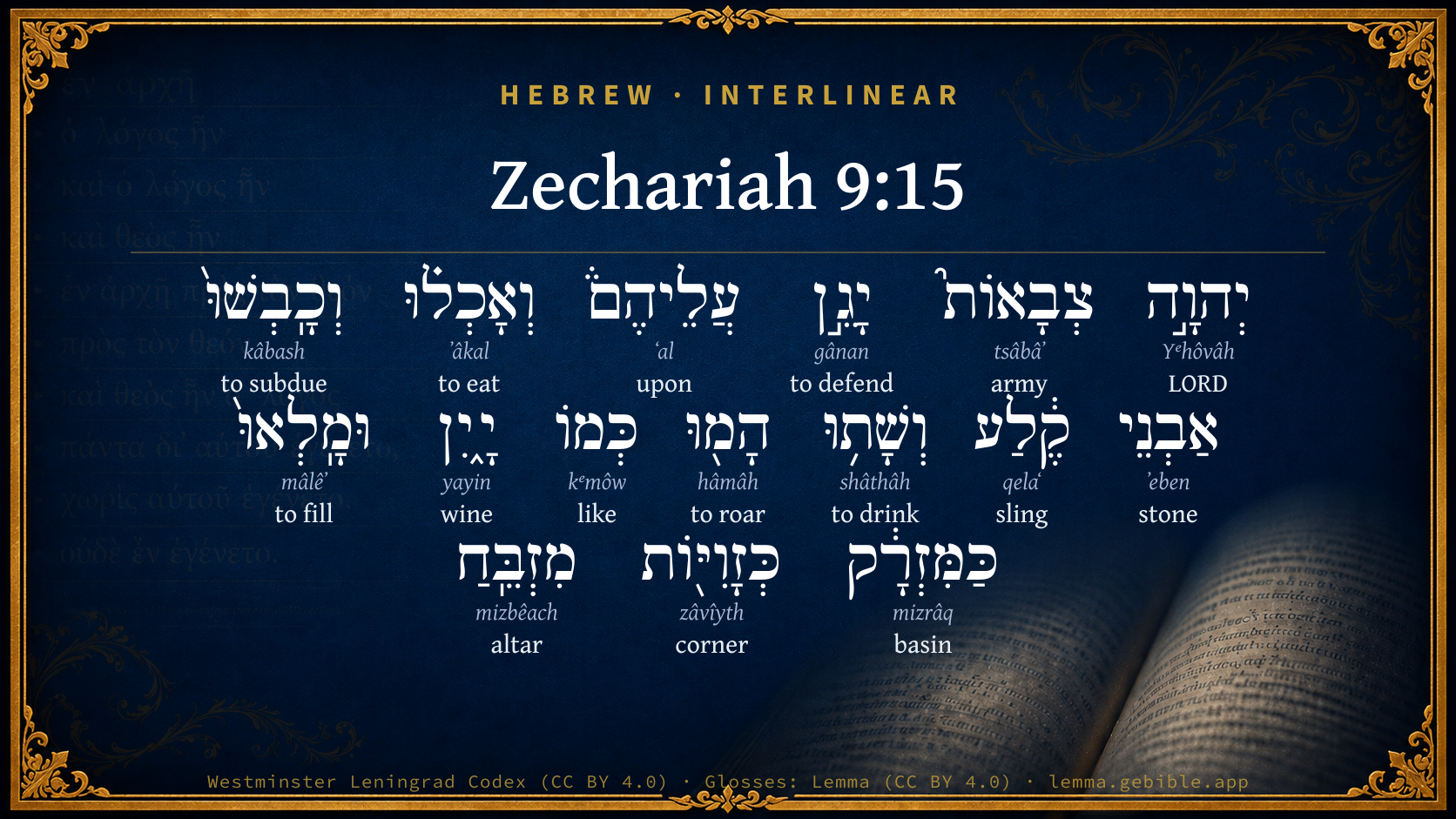
Zechariah 9:15

Hebrew (Westminster Leningrad Codex) Zechariah 9:15 appears in the Hebrew Old Testament. The text above is from the Westminster Leningrad Codex. Each word links to its Strong’s number, a concise gloss, and parsing drawn from the Open Scriptures Hebrew Bible morphology. Click any word for its full Brown-Driver-Briggs (BDB) entry.
Download image
Cite this verse

Zechariah 9:15 (World English Bible). Public Domain. Lemma interlinear Bible study tool, https://lemma.gebible.app/v/zechariah/9/15.

Show BibTeX & RIS
BibTeX
RIS
English Translation
Yahweh of Hosts will defend them; And they will destroy and overcome with sling-stones; And they will drink, and roar as through wine; And they will be filled like bowls, Like the corners of the altar.
World English Bible · Public Domain
Download a study sheet

One document with this verse’s original text, its word-by-word gloss line, the meaning frame, cross-references with their text, attributed commentary, and full source and license credits — printable, and it pastes into notes with its structure intact.

This verse Autodidact and up

Study sheet (.html) Plain text (.txt)

A passage Seminary Student

Up to 50 verses in one chapter. A passage sheet keeps up to 6 commentary sources and 12 cross-references per verse, in the order this page ranks them, and says so on the sheet whenever that leaves anything out. Ask for a single verse and you get the Autodidact verse sheet above.

Everything on this page stays free to read, with no account — the sheet is a download of what is already on screen, not access to it.

Want to remove ads? Support Godless Engineer
Compare translations 3

The same verse in 3 English versions, stacked beneath the original-language interlinear above. Click any original word for its lexicon entry.

Each is an independent rendering of the whole verse — the interlinear is not word-aligned to these translations.

Highlighted words mark where these versions differ — a whole-verse word diff, not a word-by-word alignment.

  • World English Bible Public Domain
    Yahweh of Hosts will defend them; And they will destroy and overcome with sling-stones; And they will drink, and roar as through wine; And they will be filled like bowls, Like the corners of the altar.
  • King James Version Public Domain
    The LORD of hosts shall defend them; and they shall devour, and subdue with sling stones; and they shall drink, and make a noise as through wine; and they shall be filled like bowls, and as the corners of the altar.
  • unfoldingWord Literal Text CC BY-SA 4.0
    Yahweh of hosts will defend them, and they will devour them and defeat the stones of the slings. Then they will drink and shout like men drunk on wine, and they will be filled with wine like bowls, like the corners of the altar.

unfoldingWord Literal Text — © unfoldingWord, licensed CC BY-SA 4.0. Word-aligned USFM3 via Door43 (git.door43.org/unfoldingWord/en_ult).

Versions to compare (up to 4)

3 of 4 selected

Show all 18 translations

Every available English version of this verse, each an independent rendering of the whole verse.

  • World English Bible Public Domain
    Yahweh of Hosts will defend them; And they will destroy and overcome with sling-stones; And they will drink, and roar as through wine; And they will be filled like bowls, Like the corners of the altar.
  • Berean Standard Bible Public Domain
    The LORD of Hosts will shield them. They will destroy and conquer with slingstones; they will drink and roar as with wine. And they will be filled like sprinkling bowls, drenched like the corners of the altar.
  • Majority Standard Bible Public Domain
    The LORD of Hosts will shield them. They will destroy and conquer with slingstones; they will drink and roar as with wine. And they will be filled like sprinkling bowls, drenched like the corners of the altar.
  • King James Version Public Domain
    The LORD of hosts shall defend them; and they shall devour, and subdue with sling stones; and they shall drink, and make a noise as through wine; and they shall be filled like bowls, and as the corners of the altar.
  • American Standard Version (1901) Public Domain
    Jehovah of hosts will defend them; and they shall devour, and shall tread down the sling-stones; and they shall drink, and make a noise as through wine; and they shall be filled like bowls, like the corners of the altar.
  • Revised Version (1885) Public Domain
    The LORD of hosts shall defend them; and they shall devour, and shall tread down the sling stones; and they shall drink, and make a noise as through wine: and they shall be filled like bowls, like the corners of the altar.
  • Geneva Bible (1599) Public Domain
    The Lord of hostes shall defend them, and they shall deuoure them, and subdue them with sling stones, and they shall drinke, and make a noyse as thorowe wine, and they shalbe filled like bowles, and as the hornes of the altar.
  • Douay-Rheims (1899) Public Domain
    The Lord of hosts will protect them: and they shall devour, and subdue with the stones of the sling: and drinking they shall be inebriated as it were with wine, and they shall be filled as bowls, and as the horns of the altar.
  • Young's Literal Translation Public Domain
    Jehovah of Hosts doth cover them over, And they consumed, and subdued sling-stones, Yea, they have drunk, They have made a noise as wine, And they have been full as a bowl, As corners of an altar.
  • Literal Standard Version CC BY-SA 4.0
    YHWH of Hosts covers them over, || And they consumed, and subdued sling-stones, || Indeed, they have drunk, || They have made a noise as wine, || And they have been full as a bowl, || As corners of an altar.
  • Unlocked Literal Bible CC BY-SA 4.0
    Yahweh of hosts will defend them, and they will devour them and defeat the stones of the slings. Then they will drink and shout like men drunk on wine, and they will be filled with wine like bowls, like the corners of the altar.
  • unfoldingWord Literal Text CC BY-SA 4.0
    Yahweh of hosts will defend them, and they will devour them and defeat the stones of the slings. Then they will drink and shout like men drunk on wine, and they will be filled with wine like bowls, like the corners of the altar.
  • Darby Bible Public Domain
    Jehovah of hosts will defend them; and they shall devour, and shall tread down the sling-stones; and they shall drink, [and] make a noise as from wine; and they shall be filled like a bowl, like the corners of the altar.
  • World Messianic Bible Public Domain
    The LORD of Hosts will defend them. They will destroy and overcome with sling stones. They will drink, and roar as through wine. They will be filled like bowls, like the corners of the altar.
  • Webster's Bible Public Domain
    The LORD of hosts will defend them; and they shall devour, and subdue with sling-stones; and they shall drink, and make a noise as through wine; and they shall be filled like bowls, and as the corners of the altar.
  • Free Bible Version CC BY-SA 4.0
    The Lord Almighty will protect them. They will destroy their enemies, conquering them with slingshots. They will drink and shout loudly like people who are drunk. They will be filled like a bowl, soaked liked the corners of an altar.
  • Bible in Basic English Public Domain
    The Lord of armies will be a cover for them; and they will overcome, crushing under foot the armed men; they will take their blood for drink like wine: they will be full like the sides of the altar.
  • JPS Tanakh (1917) Public Domain
    The LORD of hosts will defend them; and they shall devour, and shall tread down the sling-stones; and they shall drink, and make a noise as through wine; and they shall be filled like the basins, like the corners of the altar.

Literal Standard Version (2020), Covenant Press — licensed CC BY-SA 4.0. Text via the HelloAO Bible API (eBible.org). Unlocked Literal Bible (unfoldingWord) — licensed CC BY-SA 4.0. Text via the HelloAO Bible API (eBible.org). unfoldingWord Literal Text — © unfoldingWord, licensed CC BY-SA 4.0. Word-aligned USFM3 via Door43 (git.door43.org/unfoldingWord/en_ult). Free Bible Version, Dr. Jonathan Gallagher — licensed CC BY-SA 4.0. Text via the HelloAO Bible API (eBible.org).

Word by word

More ways to search: Search by grammar → Find every occurrence → Compare this word →

Practice this passage: Drill this verse → Learn its vocabulary →

כְּזָוִיּ֖וֹת
zâvîyth
H2106
“like/as · corners”
Preposition + Noun, Common, Feminine, Plural, Absolute
Part of Speech
Preposition + Noun
Type
Common
Gender
Feminine
Number
Plural
State
Absolute
Full BDB Definition

Origin: apparently from the same root as H2099 (in the sense of prominence)

TWOT: 534a

corner
  1. יְהוָ֣ה Yᵉhôvâh H3068 “LORD” Noun, Proper
  2. צְבָאוֹת֮ tsâbâʼ H6635 “armies” Noun, Common, Both, Plural, Absolute
  3. יָגֵ֣ן gânan H1598 “to defend” Verb, Qal, Imperfect, 3rd Person, Masculine, Singular
  4. עֲלֵיהֶם֒ ʻal H5921 “upon · them” Preposition + Suffix, Personal, 3rd Person, Masculine, Plural
  5. וְאָכְל֗וּ ʼâkal H398 “and · to eat” Conjunction + Verb, Qal, Perfect, 3rd Person, Common, Plural
  6. וְכָֽבְשׁוּ֙ kâbash H3533 “and · to subdue” Conjunction + Verb, Qal, Perfect, 3rd Person, Common, Plural
  7. אַבְנֵי ʼeben H68 “stones of” Noun, Common, Feminine, Plural, Construct
  8. קֶ֔לַע qelaʻ H7050 “sling” Noun, Common, Masculine, Singular, Absolute
  9. וְשָׁת֥וּ shâthâh H8354 “and · to drink” Conjunction + Verb, Qal, Perfect, 3rd Person, Common, Plural
  10. הָמ֖וּ hâmâh H1993 “to roar” Verb, Qal, Perfect, 3rd Person, Common, Plural
  11. כְּמוֹ kᵉmôw H3644 “like” Preposition
  12. יָ֑יִן yayin H3196 “wine” Noun, Common, Masculine, Singular, Absolute
  13. וּמָֽלְאוּ֙ mâlêʼ H4390 “and · to fill” Conjunction + Verb, Qal, Perfect, 3rd Person, Common, Plural
  14. כַּמִּזְרָ֔ק mizrâq H4219 “like/as the · basin” Preposition, Determined + Noun, Common, Masculine, Singular, Absolute
  15. מִזְבֵּֽחַ mizbêach H4196 “altar” Noun, Common, Masculine, Singular, Absolute

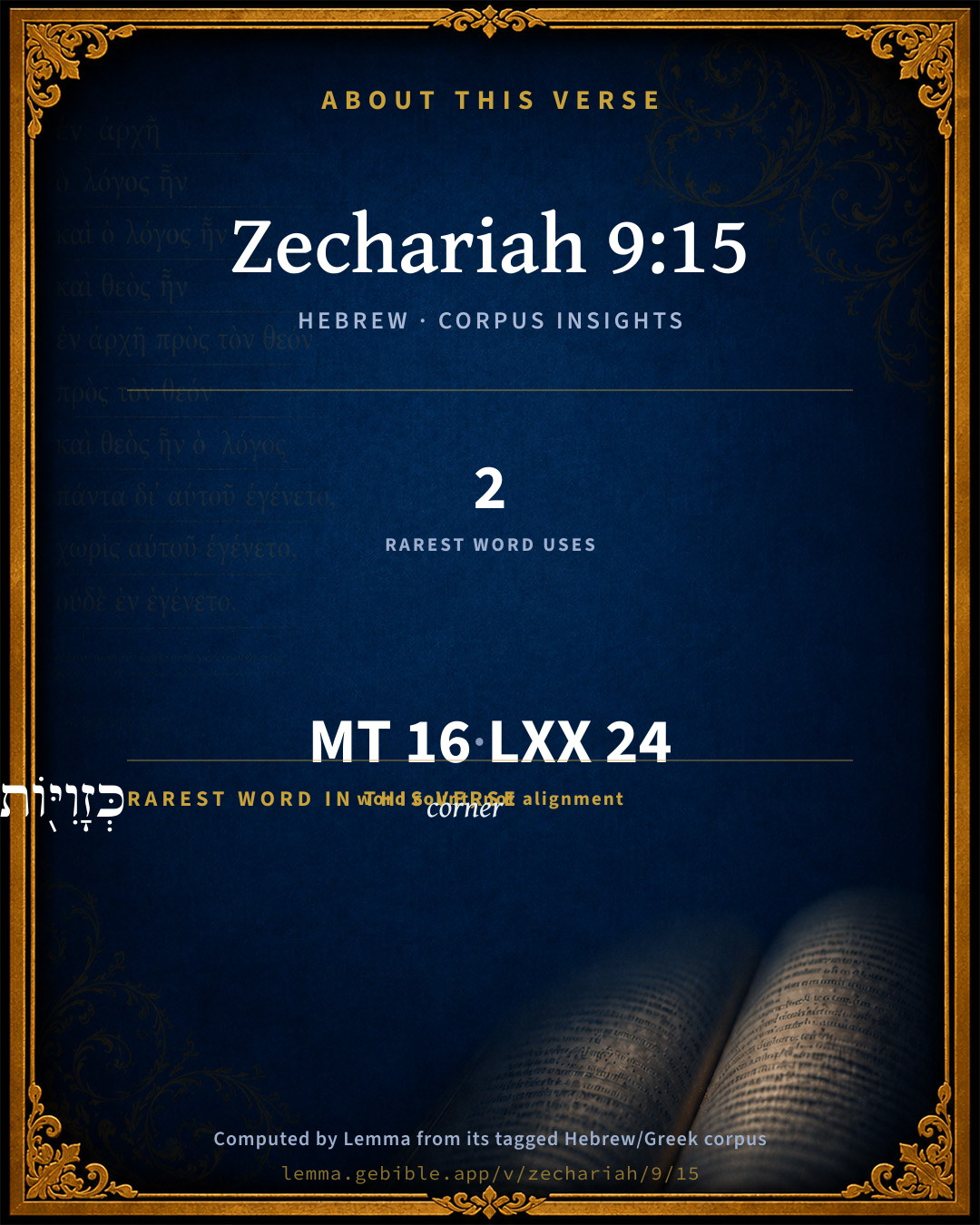
About this verse

These counts appear in no published source. They are computed here, from the morphology-tagged text and Lemma’s own curated glosses. What Lemma adds →

16
words
16
distinct lemmas
Prophets
section

Notable vocabulary

The rarest word here is כְּזָוִיּ֖וֹת corner H2106 — appearing just 2 times in the whole Hebrew Bible.

Shared distinctive vocabulary

כְּזָוִיּ֖וֹת corner H2106 occurs in 2 verses of the Hebrew Bible. Also found in:

Grammatical profile

  • 6 verbs
  • 8 nouns
  • 2 prepositions

Verb forms

  • יָגֵ֣ן Qal · Imperfect
  • וְאָכְל֗וּ Qal · Perfect
  • וְכָֽבְשׁוּ֙ Qal · Perfect
  • וְשָׁת֥וּ Qal · Perfect
  • הָמ֖וּ Qal · Perfect
  • וּמָֽלְאוּ֙ Qal · Perfect

Hebrew & Septuagint length

In English translation the verse runs 36 words from the Hebrew and 31 from the Septuagint (LXX English) — closely comparable.

A rough comparison of the two English renderings, which tokenize alike — not a word-level alignment.

Word counts can differ between the Hebrew and the Greek without any difference in meaning — e.g. the Hebrew direct-object marker אֵת has no separate Greek word, and Greek often adds the article ὁ.

In the original languages it is 16 Hebrew tokens and 24 Greek tokens — but the two are counted differently (Hebrew bundles its prefixes and suffixes into one token; the Greek is in lemma form), so that isn’t a like-for-like length.

Cross-references

22

Topical passages linked to Zechariah 9:15 in the Treasury of Scripture Knowledge — connected by theme and wording, ordered by reader-vote popularity; previews shown in the World English Bible.

  • Zechariah 12:6 In that day I will make the chieftains of Judah like a pan of fire among wood, and like a flaming torch among sheaves; and they will devour all the surrounding peoples, on the right hand and on the left; and Jerusalem will yet again dwell in their own place, even in Jerusalem.
  • Zechariah 10:7 Ephraim will be like a mighty man, And their heart will rejoice as through wine; Yes, their children will see it, and rejoice. Their heart will be glad in Yahweh.
  • Exodus 27:2 You shall make its horns on its four corners; its horns shall be of one piece with it; and you shall overlay it with brass.
  • Psalms 78:65 Then the Lord awakened as one out of sleep, Like a mighty man who shouts by reason of wine.
  • Zechariah 10:5 They shall be as mighty men, Treading down muddy streets in the battle; And they shall fight, because Yahweh is with them; And the riders on horses will be confounded.
  • Zechariah 12:8 In that day Yahweh will defend the inhabitants of Jerusalem. He who is feeble among them at that day will be like David, and the house of David will be like God, like the angel of Yahweh before them.
  • Leviticus 4:18 He shall put some of the blood on the horns of the altar which is before Yahweh, that is in the Tent of Meeting; and the rest of the blood he shall pour out at the base of the altar of burnt offering, which is at the door of the Tent of Meeting.
  • Leviticus 4:25 The priest shall take some of the blood of the sin offering with his finger, and put it on the horns of the altar of burnt offering. He shall pour out the rest of its blood at the base of the altar of burnt offering.
  • Revelation 19:13–21 He is clothed in a garment sprinkled with blood. His name is called "The Word of God."
  • Leviticus 4:7 The priest shall put some of the blood on the horns of the altar of sweet incense before Yahweh, which is in the tent of meeting; and he shall pour out all the blood of the bull out at the base of the altar of burnt offering, which is at the door of the Tent of Meeting.
  • 1 Samuel 17:45 Then said David to the Philistine, You come to me with a sword, and with a spear, and with a javelin: but I come to you in the name of Yahweh of hosts, the God of the armies of Israel, whom you have defied.
  • Song of Solomon 1:4 Take me away with you. Let us hurry. The king has brought me into his chambers. Friends We will be glad and rejoice in you. We will praise your love more than wine! Beloved They are right to love you.
  • Song of Solomon 5:1 I have come into my garden, my sister, my bride. I have gathered my myrrh with my spice; I have eaten my honeycomb with my honey; I have drunk my wine with my milk. Friends Eat, friends! Drink, yes, drink abundantly, beloved. Beloved
  • Song of Solomon 7:9 Your mouth like the best wine, That goes down smoothly for my beloved, Gliding through the lips of those who are asleep.
  • Isaiah 37:35 For I will defend this city to save it, for my own sake, and for my servant David's sake.
  • Isaiah 55:1 Ho, everyone who thirsts, come you to the waters, and he who has no money; come you, buy, and eat; yes, come, buy wine and milk without money and without price.
  • Micah 5:8 The remnant of Jacob will be among the nations, In the midst of many peoples, Like a lion among the animals of the forest, Like a young lion among the flocks of sheep; Who, if he goes through, treads down and tears in pieces, And there is no one to deliver.
  • Zechariah 9:17 For how great is his goodness, And how great is his beauty! Grain will make the young men flourish, And new wine the virgins.
  • Zechariah 14:20 In that day there will be on the bells of the horses, "HOLY TO YAHWEH;" and the pots in Yahweh's house will be like the bowls before the altar.
  • Acts 2:13–18 Others, mocking, said, "They are filled with new wine."
  • 1 Corinthians 1:18 For the word of the cross is foolishness to those who are dying, but to us who are saved it is the power of God.
  • Ephesians 5:18 Don't be drunken with wine, in which is dissipation, but be filled with the Spirit,

Cross-references courtesy of OpenBible.info (CC BY 4.0).

Hebrew and Greek witnesses Masoretic Hebrew ↔ Greek Septuagint

The same verse in the two great witnesses to the Old Testament, shown verse-for-verse.

These are two independent witnesses, not word-aligned to each other, and the Septuagint is shown in lemma (dictionary) form.

Hebrew Zechariah 9:15 Masoretic · Westminster Leningrad Codex

יְהוָ֣ה צְבָאוֹת֮ יָגֵ֣ן עֲלֵיהֶם֒ וְאָכְל֗וּ וְכָֽבְשׁוּ֙ אַבְנֵי קֶ֔לַע וְשָׁת֥וּ הָמ֖וּ כְּמוֹ יָ֑יִן וּמָֽלְאוּ֙ כַּמִּזְרָ֔ק כְּזָוִיּ֖וֹת מִזְבֵּֽחַ

Yahweh of Hosts will defend them; And they will destroy and overcome with sling-stones; And they will drink, and roar as through wine; And they will be filled like bowls, Like the corners of the altar.

World English Bible · Public Domain

Greek LXX Zechariah 9:15 Septuagint · lemma form

κύριος παντοκράτωρ ὑπερἀσπίζω αὐτός καί κατα ἀναἁλίσκω αὐτός καί καταχώννυμι αὐτός ἐν λίθος σφενδόνη καί ἐκπίνω αὐτός ὡς οἶνος καί πίμπλημι ὡς φιάλη θυσιαστήριον

The Lord Almighty shall protect them, and they shall destroy them, and overwhelm them with sling-stones; and they shall swallow them down as wine, and fill the bowls as the altar.

LXX2012 (modern English Septuagint) · Public Domain

On this verse, The Pulpit Commentary discusses the Septuagint’s reading. Read the note in Commentary ↓

Hebrew: Westminster Leningrad Codex (CC BY 4.0). Greek: Septuagint (public domain); English from LXX2012 (modern English Septuagint) (Public Domain). How the Septuagint differs from the Hebrew →

Targum (Aramaic paraphrase)

1

The Targum is the ancient Jewish Aramaic paraphrase of the Hebrew Scriptures — an interpretive translation, not the Hebrew text itself. Onkelos (literal) and Pseudo-Jonathan (expansive) render the Torah, and Jonathan the Prophets. Coverage is partial: where no permissively-licensed English translation exists for a verse, only the Aramaic is shown. This is verse-level text, not a word-by-word alignment to the Hebrew.

  1. Targum Jonathan Prophets (Joshua–Malachi)
    יְיָ צְבָאוֹת יְרַחֵם עֲלֵיהוֹן וְיִשְׁלְטוּן בְּעַמְמַיָא וְיִקְטְלוּנוּנוּן וּשְׁאָרְהוֹן יְגַמְרוּן כְּמָא דְשָׁדָן אַבְנָא בְקִלְעָא וְיִבְזוּן יַת נִכְסֵיהוֹן וְיִסְבְּעוּן מִנְהוֹן כְּשָׁתֵי חֲמַר וּתְהֵי נַפְשֵׁהוֹן מַלְיָא תַפְנוּקִין כְּמִזְרַק דִמְלֵי סוּלְתָּא וּמְשַׁח וִיהוֹן מְזַהֲרִין כִּדְמָא דִמְזָהֵר עַל כָּתְלָא דְמַדְבְּחָא:

    (no public-domain English translation for this verse)

    Targum Jonathan — Aramaic: “Mikraot Gedolot” (public domain). English: “Sefaria Community Translation” (CC0 1.0 (public-domain dedication)); “London "Chaldee Paraphrase," 1871” (public domain). Text via Sefaria.

Commentary

Notes on Zechariah 9:15 from classic Christian and Jewish commentators (each source and its license shown beneath its notes). The classic Christian expositions comment on the surrounding passage and are grouped to its opening verse, so a note may address several verses; the Jewish commentaries on the Tanakh (Rashi and others) are per-verse, so they appear only where the commentator wrote on this verse.

Lemma curates 59 commentaries, every one of them public domain or Creative Commons licensed, each selected and text-cleaned for this edition rather than reprinted as found. About our sources →

Trapp's Complete Commentary

John Trapp

Zec 9:15 The LORD of hosts shall defend them; and they shall devour, and subdue with sling stones; and they shall drink, [and] make a noise as through wine; and they shall be filled like bowls, [and] as the corners of the altar.

Ver. 15. The Lord of hosts shall defend them] Heb. Shall hold his buckler over them, which none can strike through.

And they shall devour] sc. Their enemies, that till then did eat up God’s people as they eat bread, Psa 14:5.

And subdue with sling stones] With weak means, as David did Goliath.

And they shall drink and make a noise] Tumultuabuntur quasi temulenti. It is a catechresis signifying the very great destruction of their enemies; so that they might be even drunk with their blood if they had any mind to it; the tongues of their dogs should be dipped therein, as Psa 68:23-24.

And they shall be filled like bowls, &c.] That held the blood of the sacrifices.

And as the corners of the altar] Which were all besprinkled with the blood of the sacrifices. A Lapide applies all this to those heavenly conquerors, and more, that is, triumphers, the apostles and martyrs.

John Trapp, A Commentary or Exposition upon All the Books of the Old and New Testament (1647–1656) — public domain. Text from a community e-Sword module.

Tyndale Open Study Notes

Tyndale Open Resources

9:15 In ancient battles, great stones (literally sling-stones) were hurled at defenders on city walls and catapulted onto the inhabitants inside. The Maccabees’ triumph over the Hellenistic Seleucids in the 100s BC might have partially fulfilled Zechariah’s prophecy of Israel’s defeat of the Greeks (see 1 Maccabees 3:16-24; 4:6-16; 7:40-50). • They will be filled with blood . . . drenched with blood: When the Lord unleashes his armies against the Greeks, the amount of bloodshed will be vast. • like a bowl: Ceremonial sprinkling bowls filled with animal blood were used in the rituals of sacrifice. This image almost suggests that the vanquishing of the Lord’s enemies is in some sense an offering to him (see Exod 24:6; Lev 1:5; 16:18).

Tyndale Open Study Notes — © Tyndale Open Resources, licensed CC BY-SA 4.0. Text via the HelloAO Bible API.

Geneva Bible (1599)

Geneva Bible translators

He promiseth that the Jews shall destroy their enemies, and have abundance and excess of all things, as there is abundance on the altar when the sacrifice is offered: Which things are not to move them to intemperancy, but to sobriety, and a thankful remembrance of God’s great liberality.

Geneva Bible (1599) marginal notes — public domain. Text via Bolls.life.

Jamieson, Fausset & Brown

Robert Jamieson, A. R. Fausset & David Brown

devour--the flesh of their foes.

drink--the blood of their foes; that is, utterly destroy them. Image (as Jer 46:10) from a sacrifice, wherein part of the flesh was eaten, and the blood poured in libation (compare Isa 63:1, &c.).

subdue with sling-stones--or, "tread under foot the sling-stones" hurled by the foe at them; that is, will contemptuously trample on the hostile missiles which shall fall harmless under their feet (compare Job 41:28). Probably, too, it is implied that their foes are as impotent as the common stones used in slinging when they have fallen under foot: in contrast to the people of God (Zac 9:16), "the (precious) stones of a crown" (compare Sa1 25:29) [MAURER]. English Version is good sense: The Jews shall subdue the foe at the first onset, with the mere slingers who stood in front of the line of battle and began the engagement. Though armed with but sling-stones, like David against Goliath, they shall subdue the foe (Jdg 20:16; Ch1 12:2) [GROTIUS].

noise--the battle shout.

through wine-- (Zac 10:7). The Spirit of God fills them with triumph (Eph 5:18).

filled--with blood.

like bowls--the bowls used to receive the blood of the sacrifices.

as . . . corners--or "horns" of the altar, which used to be sprinkled with blood from the bowls (Exo 29:12; Lev 4:18).

Jamieson, Fausset & Brown — Commentary Critical and Explanatory on the Whole Bible (1871) — public domain (CC PDM 1.0). Text via the HelloAO Bible API.

Adam Clarke's Commentary

Verse 15. The Lord of hosts shall defend them] He alone is the sure trust of his Church.

Subdue with sling-stones] This was an ancient and powerful instrument in the hands of the Hebrews. See Clarke on Jdg 20:16.

They shall drink] After the victory gained as above, thy people shall hold a feast, and drink and be filled with wine. There is no intimation here that they shall drink the blood of their enemies, as some barbarous nations were accustomed to do. When they have gained the victory, they shall banquet abundantly on the spoils taken from the enemy.

As the corners of the altar.] They shall pour out libations of wine at the foot of the altar, as the priests were accustomed to pour out the blood of the victims.

Adam Clarke's Commentary on the Bible (1810–1826) — public domain. Text from a community e-Sword/MySword module.

John Calvin's Commentaries

He expresses again the same thing in other words — that God would be like a shadow to his people, so that he would with an extended hand protect them from their enemies. Since the Jews might have justly felt a distrust in their own strength, the Prophet continually teaches them that their safety depended not on earthly aids, but that God alone was sufficient, for he could easily render them safe and secure. He also adds, that there would be to them plenty of bread and wine to satisfy them. He seems here indeed to promise too great an abundance, as by its abuse luxury came, for he says, that they would be satiated and be like the drunken; they shall drink, he says, and shall make a noise as through wine. Certainly those who drink wine moderately, do not make noise, but they are as composed and quiet after dinner as those who fast. Zechariah then seems here to make an unreasonable promise, even that of excess in meat and drink. But we have elsewhere seen that wherever the Holy Spirit promises abundance of good things he does not give loose reigns to men’s lusts, but his object is only to show that God will be so bountiful to his children that they shall stand in need of nothing, that they shall labor under no want. Nay, the affluence of blessings is to try our frugality, for when God pours forth as it were with a liberal hand more than what is needful, he thus tries the temperance of each of us; for when in the enjoyment of great abundance, we of our own accord restrain ourselves, we then really show that we are grateful to God.

It is indeed true, that cheerfulness for abundance of blessings is allowed us, for it is often said in the law, “Thou shalt rejoice before thy God,” (Deuteronomy 12:18;) but we must bear in mind, that frugal use of blessings is required, in order that the gifts of God may not be converted to a sinful purpose.

Then the Prophet does not here excite or stimulate the Jews to intemperance, that they might fill themselves with too much food, or inebriate themselves with too much wine; but he only promises that there would be no want of either food or drink when God blessed them as in former days. And this seems also to be specified at the end of the verse, when he mentions the horns of the altar. He had previously said, that they would be full as the bowls were; but when he adds, “the horns of the altar,” he no doubt reminds them of temperance, that they were to feast as though they were in God’s presence. They were indeed accustomed to pour out the wine and the oil on the horns of the altar; but, at the same time, since they professed that they offered from their abundance of wine and oil some first-fruits to God, it behaved them to remember that their wine was sacred, that their oil was sacred, as both proceeded from God. The Prophet then declares, that the Jews would be thus enriched and replenished with all good things, and that they were yet to remember, that they were to live as in God’s presence, lest they should by luxury pollute what he had consecrated to a legitimate end. He then adds —

John Calvin's Commentaries (1540-1563) — public domain. Text from the Calvin Translation Society English edition (1840s-50s) via the Christian Classics Ethereal Library (ccel.org). Calvin's coverage is partial (roughly two-thirds of the Bible); uncommented books and verses are honest gaps, never fabricated. The 19th-century editor's footnotes and remarks are omitted so the notes are faithfully Calvin's own voice.

Ellicott's Commentary for English Readers

(15) Subdue with sling stones.—Better, trample on sling stones in their valorous onslaught on the enemy. For the figures “devour” and “drink,” comp. Num_23:24; Mic_5:8; Eze_14:20; Eze_39:16-17.

Be filled.—With the blood of their enemies, like the bowls in which the priests caught the blood of the victims, and then sprinkled it on the corners of the altar.

A Bible Commentary for English Readers, edited by Charles John Ellicott (1878–1897) — public domain. Text from a community e-Sword module.

The Cambridge Bible for Schools and Colleges

gen. ed. J. J. S. Perowne

15. The Lord of hosts shall defend them] See, for examples of the first fulfilment, 1Ma_3:16-24; 1Ma_4:6-16; 1Ma_7:40-50.

devour] It is not said what they shall devour. Calvin takes this and what follows literally of eating and drinking, i.e. of enjoying plenty: “Adjungit etiam fore illis copiam panis et vini, ut saturentur.” Others, as Pusey, supply “their enemies” after “devour” and take it as an image of “destruction or absorption only, as in that, thou shall consume [lit. eat] all the people which the Lord thy God shall deliver thee, Deu_7:16.” Comp. Num_14:9. But then no adequate sense is given to the following clauses, Thou shalt drink, &c. It seems best to regard the whole as a figurative description of a wild beast devouring its prey: they shall devour (the flesh of their enemies, comp. Num_23:24); they shall tread on (them, as on) sling stones; they shall drink (their blood) and make a noise as through wine; they shall be filled (with it) like bowls (which hold the blood of the sacrifices), like the corners of the altar (round which it is copiously poured). See Lev_4:7; Lev_4:18; Lev_4:30.

sling stones] Comp. Job_41:28-29. The comparison of the Israelites to the precious “stones of a crown” in the next verse favours the view that their enemies themselves, and not the weapons which they hurl at them, are here compared to the “stones of a sling.” “Their enemies shall fall under them, as harmless and as of little account, as the sling-stones which have missed their aim (or spent their force), and lie as the road to be passed over.” Pusey.

The Cambridge Bible for Schools and Colleges (gen. ed. J. J. S. Perowne; Cambridge University Press, 1878–1918) — public domain. Text from a community e-Sword module.

John Gill's Exposition

The Lord of hosts shall defend them,.... Against all their enemies; against Satan, and his temptations, and all the opposition made by him; against the world, and all the rage and reproach of men; this was remarkably verified in the apostles, who were preserved by the Lord amidst a thousand snares and dangers; and who was able to do it, being Jehovah, and the Lord of armies in heaven and in earth; he was as a shield unto them, as the word (t) used signifies; and to which he is often compared in Scripture. The Targum renders it,

"the Lord of hosts shall have mercy on them;''

he encompassed them about with his favour as with a shield:

and they shall devour; or "eat" (u); spiritual food; Christ the bread of life; whose flesh is meat indeed, and who is lived upon by faith; the blessings and promises of the everlasting covenant, of which the meek eat, and are satisfied; the Gospel and the truths of it, the words of faith and good doctrine, with which faithful ministers are nourished; all which is necessary, that they may be strengthened, and qualified to feed others with knowledge and understanding:

and subdue with sling stones; such who are stouthearted, and far from righteousness; who become by their ministry penitent and humble, and subject to Christ, his Gospel and ordinances, even by the means of preaching of the word, which seem very unpromising and unlikely; being to men foolishness, and like the scrip and sling David took with him, and by which he brought Goliath down to the ground:

and they shall drink; of the love of God, which, for its antiquity, purity, and refreshing nature, is like the best wine; and of the blood of Christ, which is drink indeed; and of the grace of the Spirit, which revives, strengthens, and extinguishes thirst:

and make a noise as through wine; being full of joy and thankfulness for their spiritual food and drink; and so warm, zealous, and fervent in spirit, serving the Lord; free and open in their ministrations, loudly proclaiming the grace of God; bold, and fearless of danger:

and they shall be filled like bowls; that were full of the blood of the offerings, as Jarchi and Kimchi explain it; or rather, as the Targum, that were full of fine flour and oil; they having their souls filled with good things, as the first of the above writers observes; a comfortable view of interest in the love of God; a large measure of spiritual joy, and a fulness of the gifts and graces of the Spirit, qualifying them for their work:

and, as the corners of the altar; the Targum is,

"they shall shine as the blood that shines upon the wall of the altar;''

at the corners of which it was poured out; signifying that they should be as full of the Spirit, and spiritual things, as the altar was of blood: so the Jewish writers say, when the priest took the blood in the bowl, he sprinkled of it two sprinklings upon the two corners of the altar, on the diameter of it, and below upon the northeast horn, and upon the southwest horn; and he ordered it so, as to sprinkle the blood on the horn, that it might surround the corners, and that the blood might be on the four sides of the altar round about (w).

(t) "obteget", Burkius. (u) "ut comedant", Junius & Tremellius, Piscator, Tarnovius, "et edent", Burkius. (w) Maimon. Maase Hakorbanot, c. 5. sect. 6.

John Gill's Exposition of the Whole Bible (1746–1763) — public domain (CC PDM 1.0). Text via the HelloAO Bible API.

Albert Barnes' Notes on the Bible

The Lord of hosts, shall defend them - As God says, “I will defend this city to save it, for Mine own sake and for My servant David’s sake” . The word is used by Isaiah only before Zechariah, and of the protection of Almighty God. The image of the complete protection on all sides stands first in God’s words to Abraham, “I am thy shield” Gen 15:1; David thence says to God, “Thou, O Lord, art a shield around me” (Psa 3:4, (Psa 3:3 in English)).

And they shall devour, and subdue - Or more probably (as in the margin), “shall tread on, the stones of the sling,” as in the image of leviathan in Job, “The son of the bow will not make him flee; sling-stones are to him turned into stubble; clubs are counted as stubble; he laugheth at the shaking of a spear” (Job 41:20-21 (28, 29 English)). Their enemies shall fall under them, as harmless and as of little account as the slingstones which have missed their aim, and lie as the road to be passed over. It is not expressed what they shall devour, and so the image is not carried out, but left indefinite, as destruction or absorption only; as in that, “thou shalt consume (literally, eat) all the people which the Lord thy God shall deliver thee” Deu 7:16; and, “they are our bread” Num 14:9; and in that, “they shall devour (literally, eat) all the people round about” Zec 12:6, where the image is of fire, not of eating. The one thought seems to be, that their enemies should cease to be, so as to molest them any more, whether by ceasing to be their enemies or by ceasing to be. There is no comparison here, (as in Balaam) with the lion; or of eating flesh or drinking blood, which, apart from the image of the wild beast, would be intolerable to Israel, to whom the use of blood, even of animals, was so strictly forbidden. They should disappear, as completely as fuel before the fire, or food before the hungry. The fire was invigorated, not extinguished, by the multitude of the fuel: the multitude of the enemies but nerved and braced those, whom they sought to destroy.

And they shall be filled like bowls, like the corners of the altar - They shall be consecrated instruments of God; they shall not prevail for themselves, but for Him; they shall be hallowed like the bowls of the temple, from which the sacrificial blood is sprinkled on His altar, or “as the corners of the altar” which receive it.

Albert Barnes' Notes on the Bible (1834–1885) — public domain. Text from a community e-Sword/MySword module.

Haydock's Catholic Bible Commentary

Sling. At first the Machabees had no other weapon, 1 Machabees iv. 6. The sling was much used, Judges xx. 16. --- Wine. They will shed blood of the enemy so abundantly, and be all besmeared with it. They would never drink it, like the pagans, Leviticus xvii. 10. (Calmet)

George Leo Haydock (1774–1849), Haydock's Catholic Family Bible and Commentary, 1859 edition — public domain. Excludes Psalms (Douay-Rheims chapter numbering differs from Protestant) and Deuterocanonical books (Catholic canon only).

Matthew Poole's English Annotations

The Lord of hosts shall defend them; in the most dangerous attempts the Jews, under their captains in the wars against the Grecians, were preserved to a miracle, according to this promise.

They shall devour; a few of them destroy many of their enemies.

Subdue with sling stones: as we read this passage, it seems to refer to the slaughter of Goliath with a sling, by David, a stripling; so weak means, in the hand and trader the blessing of the great God, shall do mighty things: others read the words, they shall subdue the sling-stones, that is, conquer the Grecians, who in their wars used the sling, and that with great dexterity and success.

They shall drink, in their festivals, when they offered sacrifices of thanksgiving for their victories.

Make a noise, shout with shouts of triumph, make a great noise, as through wine; as men do whose hearts are glad with success, and cheered with wine.

They shall be filled like bowls, and as the corners of the altar; rather, they shall fill, i.e. with the blood of the sacrifices they offer, both the bowls and corners of the altars, all shall be full of the blood of eucharistical sacrifices.

Matthew Poole's English Annotations on the Holy Bible (1683–1685) — public domain. Text from a community e-Sword/MySword module.

The Pulpit Commentary

Shall defend them; uperaspiei autouv , "shall put his shield over them" (Septuagint). There are numerous examples, in the Books of Maccabees, of God"s special interposition in his people"s favour, and thus far and in part fulfilling this prophecy. (see RAPC 1Ma 3:16-24 4:6-16 7:40-50 2Ma 2:21, 22 3:24, etc.; RAPC 2Ma 5:2-4 11:8 12:11, 15, 22, 28, 37 15:7, etc.) They shall devour. The prophet seems to have had in view Num_23:24, where Israel is compared to a lion, eating of the prey and drinking the blood of the slain. So here he says they shall "devour," i.e. the flesh of their enemies. (comp. Mic_5:8) Subdue with sling stones. So the Vulgate, and virtually the Septuagint, taking the case of the noun as instrumental; but it is best to take it as accusative of the object, as in the margin of the Authorized Version, "They shall tread down the stones of the sling." The "slingstones" are the enemies, as in the next verse "the stones of a crown" are the Jews; and the sentence means that the Jews shall tread their enemies underfoot like spent slingstones, which are of no account. Or it may signify simply and without metaphor that they shall despise the enemies" missiles, which shall fall harmless among them. (Job_41:28, Job_41:29) They shall drink the blood of the slain, like lions. Make a noise. As men exhilarated with wine. Vulgate, Bibentes inebriabuntur quasi a vino. (Isa_49:26 Eze_39:17-19) Shall be filled like bowls. They shall be filled with blood like the sacrificial vessels in which the blood of victims was received. (Zec_14:20) The corners of the altar. The blood was also sprinkled on the corners or sides of the altar. (Lev_1:5, 11 3:2) There may be included the notion that the war against God"s enemies was a sacred war, and accepted by him as a sacrifice. In the Maccabean struggle the bloodshed was often very considerable. (see RAPC 1Ma 7:32, 46 11:47 2Ma 8:30 10:17, 23, 31, etc.)

The Pulpit Commentary (1880–1919), ed. H.D.M. Spence-Jones & Joseph S. Exell — public domain. Text from a community e-Sword module.

John Wesley's Explanatory Notes

Devour - Destroy their enemies. With sling-stones - As David did Goliath. Shall drink - In their festivals, when they offer sacrifices of thanksgiving for their victories. Make a noise - Shout with shouts of triumph, as men do whose hearts are glad with success, and cheared with wine. Shall fill - With the blood of the sacrifices they offer.

John Wesley, Explanatory Notes Upon the Whole Bible (1754–1765) — public domain. Text via the GEBible commentary corpus.

Rashi

Rabbi Shlomo Yitzchaki (Rashi)

and they shall devour the spoils of their enemies.

and they shall tread under them sling-stones They are the Greeks, who are trained to use the bow and to sling stones.

They shall make a noise like [those who drink] wine They shall make noise with a voice of joy and happiness, as those who have drunk much wine make noise.

and they shall become full Their souls shall become full of all good.

like the basin that is full of blood. before the altar.

like the corners of the altar where wine is libated. The wine would flow upon it, as we learned in tractate Sukkah (49b). This is an expression of satiety, an expression of drunkenness.

Rashi on the Tanakh — English translations: “The Judaica Press complete Tanach with Rashi, translated by A. J. Rosenberg” (CC BY 4.0); “Pentateuch with Rashi's commentary by M. Rosenbaum and A.M. Silbermann, 1929-1934” (public domain); “The Metsudah Tanach series, Lakewood, N.J” (CC BY 4.0); and “The Book of Joshua, Metsudah Publications, 1997” (CC BY 4.0). Text via Sefaria.

Lesson kit

Teaching starters — assembled from the data on this page, not authored interpretation. Every prompt links to the verse data it draws on. Edit before teaching.

Zechariah, in the Prophets, opens this verse with 16 words (16 distinct Hebrew lemmas). Its most distinctive word is zâvîyth (“corner”). A historical commentator’s framing appears above. Read the whole chapter for the surrounding context.

Discussion questions

  1. What does “corner” (zâvîyth) contribute to the verse as a whole?
  2. Psalms 144:12 shares the word «corner» with this verse. How do the two illuminate each other?
  3. These translations render this verse differently. What is at stake in choosing one wording over another?
  4. The verb «יָגֵ֣ן» is Qal Imperfect. How does its form color the action?
  5. Reading how Trapp's Complete Commentary and Tyndale Open Study Notes read this verse, where do the two commentators agree and where do they part?

Things to notice

Reading settings

Reading text

Shown beneath each verse's original-language words.

Old Testament
Old Testament edition

Read the OT as the Masoretic Hebrew (MT) or the Greek Septuagint (LXX).

English shown for the Greek Septuagint (in the Hebrew ↔ Greek comparison).

Comparing translations? Open the Compare panel on any verse page to stack up to four side by side.