
2 Kings 6:23

Hebrew (Westminster Leningrad Codex) 2 Kings 6:23 appears in the Hebrew Old Testament. The text above is from the Westminster Leningrad Codex. Each word links to its Strong’s number, a concise gloss, and parsing drawn from the Open Scriptures Hebrew Bible morphology. Click any word for its full Brown-Driver-Briggs (BDB) entry.
Download image
Cite this verse

2 Kings 6:23 (World English Bible). Public Domain. Lemma interlinear Bible study tool, https://lemma.gebible.app/v/2-kings/6/23.

Show BibTeX & RIS
BibTeX
RIS
English Translation
He prepared great provision for them; and when they had eaten and drunk, he sent them away, and they went to their master. The bands of Syria came no more into the land of Israel.
World English Bible · Public Domain
Highlights
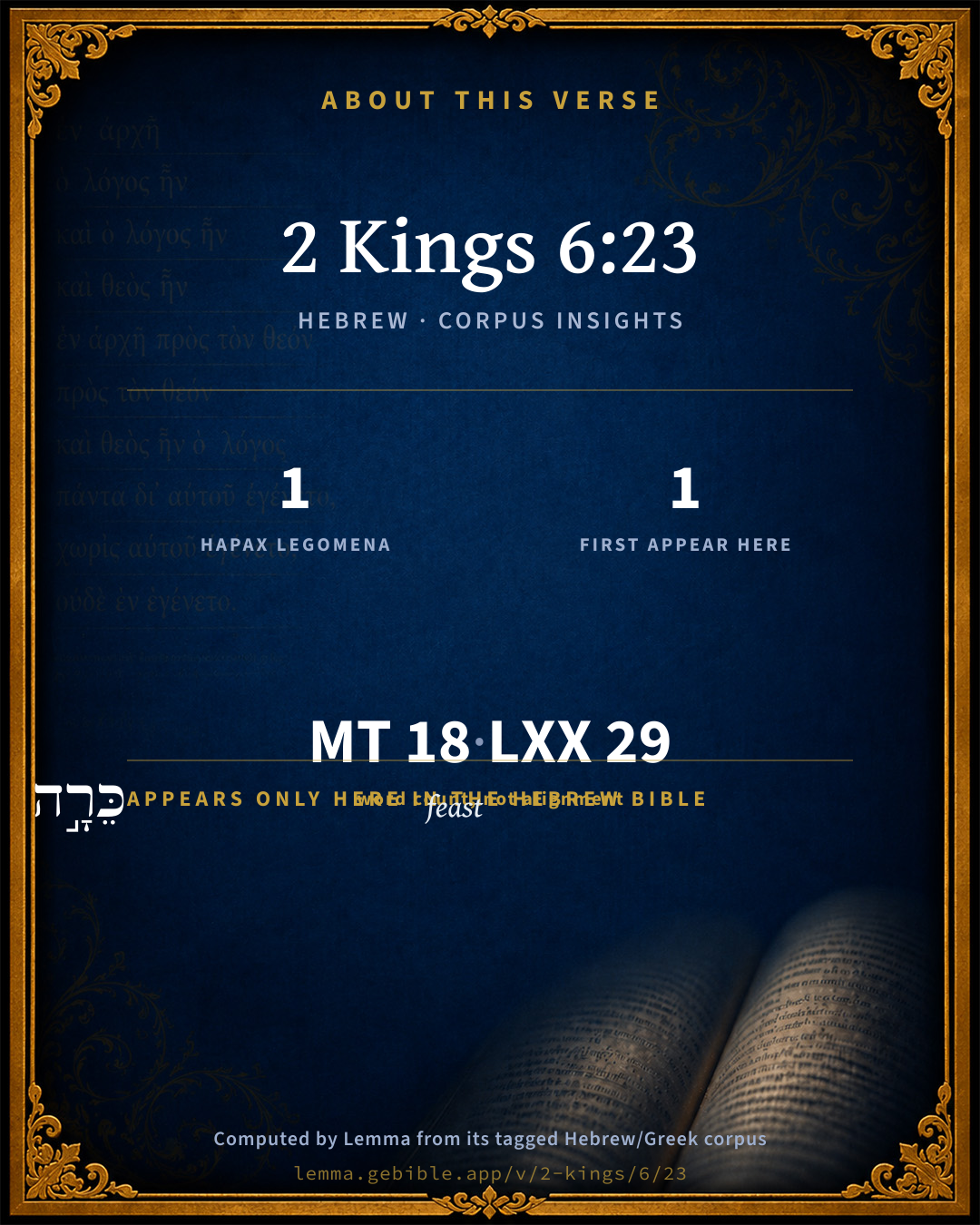
  • 1 hapax legomenon — only here in the Hebrew Bible
  • 1 first appearance in the Hebrew Bible
Full analysis ↓
Download a study sheet

One document with this verse’s original text, its word-by-word gloss line, the meaning frame, cross-references with their text, attributed commentary, and full source and license credits — printable, and it pastes into notes with its structure intact.

This verse Autodidact and up

Study sheet (.html) Plain text (.txt)

A passage Seminary Student

Up to 50 verses in one chapter. A passage sheet keeps up to 6 commentary sources and 12 cross-references per verse, in the order this page ranks them, and says so on the sheet whenever that leaves anything out. Ask for a single verse and you get the Autodidact verse sheet above.

Everything on this page stays free to read, with no account — the sheet is a download of what is already on screen, not access to it.

Want to remove ads? Support Godless Engineer
Compare translations 3

The same verse in 3 English versions, stacked beneath the original-language interlinear above. Click any original word for its lexicon entry.

Each is an independent rendering of the whole verse — the interlinear is not word-aligned to these translations.

Highlighted words mark where these versions differ — a whole-verse word diff, not a word-by-word alignment.

  • World English Bible Public Domain
    He prepared great provision for them; and when they had eaten and drunk, he sent them away, and they went to their master. The bands of Syria came no more into the land of Israel.
  • King James Version Public Domain
    And he prepared great provision for them: and when they had eaten and drunk, he sent them away, and they went to their master. So the bands of Syria came no more into the land of Israel.
  • unfoldingWord Literal Text CC BY-SA 4.0
    And he provided a great provision for them, and they ate and they drank, and he sent them, and they went to their master. And the raiding bands of Aram did not continue any longer to come into the land of Israel.

unfoldingWord Literal Text — © unfoldingWord, licensed CC BY-SA 4.0. Word-aligned USFM3 via Door43 (git.door43.org/unfoldingWord/en_ult).

Versions to compare (up to 4)

3 of 4 selected

Show all 18 translations

Every available English version of this verse, each an independent rendering of the whole verse.

  • World English Bible Public Domain
    He prepared great provision for them; and when they had eaten and drunk, he sent them away, and they went to their master. The bands of Syria came no more into the land of Israel.
  • Berean Standard Bible Public Domain
    So the king prepared a great feast for them, and after they had finished eating and drinking, he sent them away, and they returned to their master. And the Aramean raiders did not come into the land of Israel again.
  • Majority Standard Bible Public Domain
    So the king prepared a great feast for them, and after they had finished eating and drinking, he sent them away, and they returned to their master. And the Aramean raiders did not come into the land of Israel again.
  • King James Version Public Domain
    And he prepared great provision for them: and when they had eaten and drunk, he sent them away, and they went to their master. So the bands of Syria came no more into the land of Israel.
  • American Standard Version (1901) Public Domain
    And he prepared great provision for them; and when they had eaten and drunk, he sent them away, and they went to their master. And the bands of Syria came no more into the land of Israel.
  • Revised Version (1885) Public Domain
    And he prepared great provision for them: and when they had eaten and drunk, he sent them away, and they went to their master. And the bands of Syria came no more into the land of Israel.
  • Geneva Bible (1599) Public Domain
    And he made great preparation for them: and when they had eaten and drunken, he sent them away: and they went to their master. So ye bands of Aram came no more into the land of Israel.
  • Douay-Rheims (1899) Public Domain
    And a great provision of meats was set before them, and they ate and drank, and he let them go, and they went away to their master, and the robbers of Syria came no more into the land of Israel.
  • Young's Literal Translation Public Domain
    And he prepareth for them great provision, and they eat and drink, and he sendeth them away, and they go unto their lord: and troops of Aram have not added any more to come in to the land of Israel.
  • Literal Standard Version CC BY-SA 4.0
    And he prepares great provision for them, and they eat and drink, and he sends them away, and they go to their lord: and troops of Aram have not added to come into the land of Israel anymore.
  • Unlocked Literal Bible CC BY-SA 4.0
    So the king prepared much food for them, and when they had eaten and drunk, he sent them away, and they went back to their master. Those bands of Aramean soldiers did not return for a long time into the land of Israel.
  • unfoldingWord Literal Text CC BY-SA 4.0
    And he provided a great provision for them, and they ate and they drank, and he sent them, and they went to their master. And the raiding bands of Aram did not continue any longer to come into the land of Israel.
  • Darby Bible Public Domain
    And he prepared a great repast for them, and they ate and drank; and he sent them away, and they went to their master. And the bands of Syria came no more into the land of Israel.
  • World Messianic Bible Public Domain
    He prepared a great feast for them. After they ate and drank, he sent them away and they went to their master. So the bands of Syria stopped raiding Eretz-Israel.
  • Webster's Bible Public Domain
    And he prepared great provision for them: and when they had eaten and drank, he sent them away, and they went to their master. So the bands of Syria came no more into the land of Israel.
  • Free Bible Version CC BY-SA 4.0
    So the king had a great feast prepared for them, and once they had finished eating and drinking, he sent them back to their master. The Aramean raiders did not enter the land of Israel again.
  • Bible in Basic English Public Domain
    So he made ready a great feast for them, and when they had had food and drink, he sent them away and they went back to their master. And no more bands of Aramaeans came into the land of Israel.
  • JPS Tanakh (1917) Public Domain
    And he prepared great provision for them; and when they had eaten and drunk, he sent them away, and they went to their master. And the bands of Aram came no more into the land of Israel.

Literal Standard Version (2020), Covenant Press — licensed CC BY-SA 4.0. Text via the HelloAO Bible API (eBible.org). Unlocked Literal Bible (unfoldingWord) — licensed CC BY-SA 4.0. Text via the HelloAO Bible API (eBible.org). unfoldingWord Literal Text — © unfoldingWord, licensed CC BY-SA 4.0. Word-aligned USFM3 via Door43 (git.door43.org/unfoldingWord/en_ult). Free Bible Version, Dr. Jonathan Gallagher — licensed CC BY-SA 4.0. Text via the HelloAO Bible API (eBible.org).

Word by word

More ways to search: Search by grammar → Find every occurrence → Compare this word →

Practice this passage: Drill this verse → Learn its vocabulary →

כֵּרָ֣ה
kêrâh
H3740
“feast”
Noun, Common, Feminine, Singular, Absolute
Part of Speech
Noun
Type
Common
Gender
Feminine
Number
Singular
State
Absolute
Full BDB Definition

Origin: from H3739

TWOT: 1035a

feast
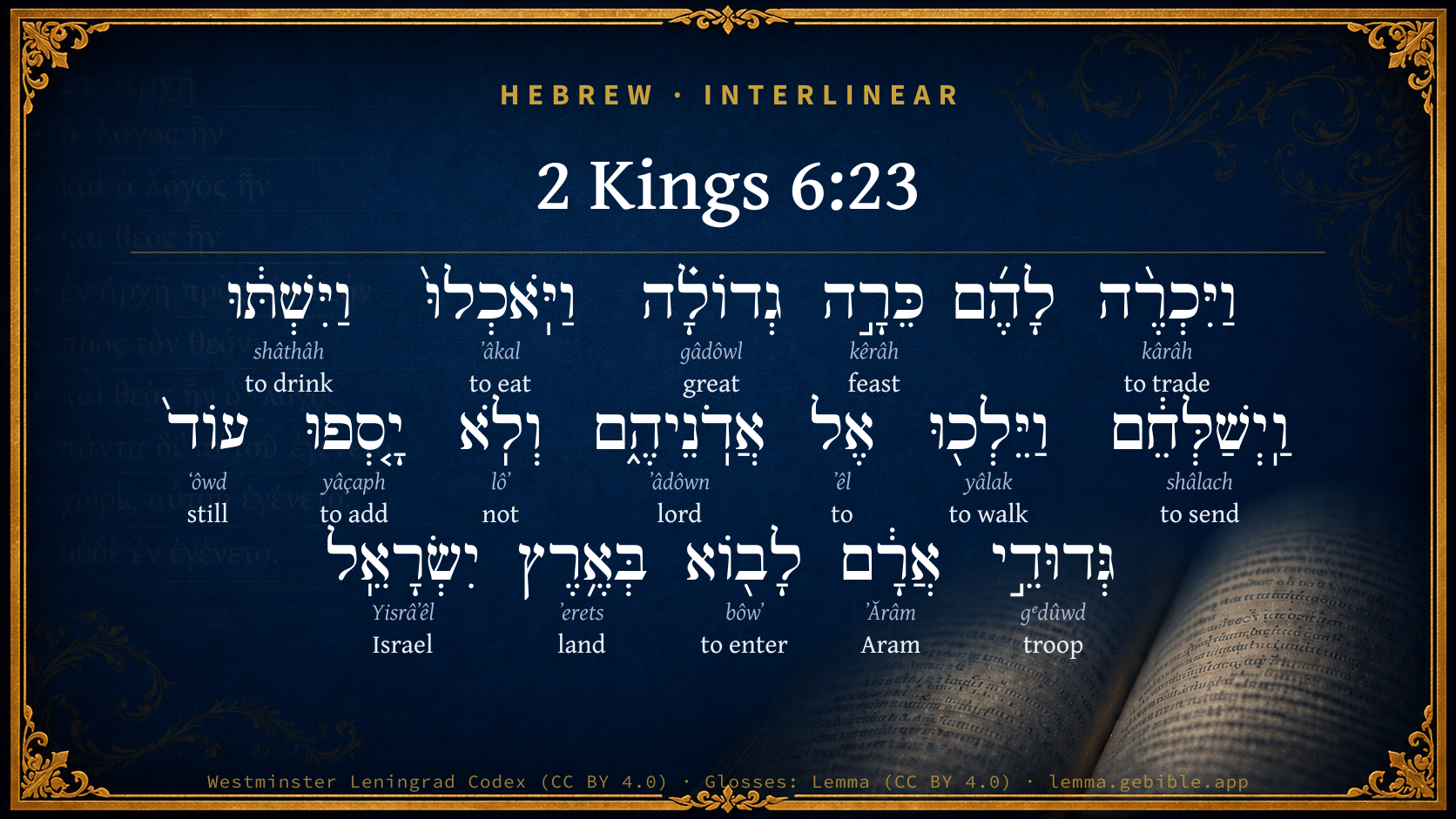
  1. וַיִּכְרֶ֨ה kârâh H3739 “and · to trade” Conjunction + Verb, Qal, Sequential Imperfect, 3rd Person, Masculine, Singular
  2. גְדוֹלָ֗ה gâdôwl H1419 “great” Adjective, Adjective, Feminine, Singular, Absolute
  3. וַיֹּֽאכְלוּ֙ ʼâkal H398 “and · to eat” Conjunction + Verb, Qal, Sequential Imperfect, 3rd Person, Masculine, Plural
  4. וַיִּשְׁתּ֔וּ shâthâh H8354 “and · to drink” Conjunction + Verb, Qal, Sequential Imperfect, 3rd Person, Masculine, Plural
  5. וַֽיְשַׁלְּחֵ֔ם shâlach H7971 “and · to send · them” Conjunction + Verb, Piel, Sequential Imperfect, 3rd Person, Masculine, Singular + Suffix, Personal, 3rd Person, Masculine, Plural
  6. וַיֵּלְכ֖וּ yâlak H3212 “and · to walk” Conjunction + Verb, Qal, Sequential Imperfect, 3rd Person, Masculine, Plural
  7. אֶל ʼêl H413 “to” Preposition
  8. אֲדֹֽנֵיהֶ֑ם ʼâdôwn H113 “lords · their” Noun, Common, Masculine, Plural, Construct + Suffix, Personal, 3rd Person, Masculine, Plural
  9. וְלֹֽא lôʼ H3808 “and · not” Conjunction + Particle, Negative
  10. יָ֤סְפוּ yâçaph H3254 “to add” Verb, Qal, Perfect, 3rd Person, Common, Plural
  11. עוֹד֙ ʻôwd H5750 “still” Adverb
  12. גְּדוּדֵ֣י gᵉdûwd H1416 “troops of” Noun, Common, Masculine, Plural, Construct
  13. אֲרָ֔ם ʼĂrâm H758 “Aram” Noun, Proper
  14. לָב֖וֹא bôwʼ H935 “to enter” Preposition + Verb, Qal, Infinitive Construct
  15. בְּאֶ֥רֶץ ʼerets H776 “in/at · land of” Preposition + Noun, Common, Both, Singular, Construct
  16. יִשְׂרָאֵֽל Yisrâʼêl H3478 “Israel” Noun, Proper

About this verse

These counts appear in no published source. They are computed here, from the morphology-tagged text and Lemma’s own curated glosses. What Lemma adds →

18
words
17
distinct lemmas
Historical
section

Notable vocabulary

1 hapax legomenon — a word that appears only here in the entire Hebrew Bible:

  • כֵּרָ֣ה feast H3740

First appearance in Scripture

This word makes its first canonical appearance in the Hebrew Bible here:

  • כֵּרָ֣ה feast H3740

Shared distinctive vocabulary

וַיִּכְרֶ֨ה to trade H3739 occurs in 3 verses of the Hebrew Bible. Also found in:

Grammatical profile

  • 7 verbs
  • 6 nouns
  • 1 adjective
  • 2 prepositions
  • 1 adverb
  • 1 particle

Verb forms

  • וַיִּכְרֶ֨ה Qal · Sequential Imperfect
  • וַיֹּֽאכְלוּ֙ Qal · Sequential Imperfect
  • וַיִּשְׁתּ֔וּ Qal · Sequential Imperfect
  • וַֽיְשַׁלְּחֵ֔ם Piel · Sequential Imperfect
  • וַיֵּלְכ֖וּ Qal · Sequential Imperfect
  • יָ֤סְפוּ Qal · Perfect
  • לָב֖וֹא Qal · Infinitive Construct

Hebrew & Septuagint length

In English translation the verse runs 35 words from the Hebrew and 36 from the Septuagint (LXX English) — closely comparable.

A rough comparison of the two English renderings, which tokenize alike — not a word-level alignment.

Word counts can differ between the Hebrew and the Greek without any difference in meaning — e.g. the Hebrew direct-object marker אֵת has no separate Greek word, and Greek often adds the article ὁ.

In the original languages it is 18 Hebrew tokens and 29 Greek tokens — but the two are counted differently (Hebrew bundles its prefixes and suffixes into one token; the Greek is in lemma form), so that isn’t a like-for-like length.

Cross-references

9

Topical passages linked to 2 Kings 6:23 in the Treasury of Scripture Knowledge — connected by theme and wording, ordered by reader-vote popularity; previews shown in the World English Bible.

  • 2 Kings 5:2 The Syrians had gone out in bands, and had brought away captive out of the land of Israel a little maiden; and she waited on Naaman's wife.
  • 2 Kings 24:2 Yahweh sent against him bands of the Chaldeans, and bands of the Syrians, and bands of the Moabites, and bands of the children of Ammon, and sent them against Judah to destroy it, according to the word of Yahweh, which he spoke by his servants the prophets.
  • 2 Kings 6:8–9 Now the king of Syria was warring against Israel; and he took counsel with his servants, saying, In such and such a place shall be my camp.
  • Luke 6:35 But love your enemies, and do good, and lend, expecting nothing back; and your reward will be great, and you will be children of the Most High; for he is kind toward the unthankful and evil.
  • Luke 10:29–37 But he, desiring to justify himself, asked Jesus, "Who is my neighbor?"
  • 2 Chronicles 28:15 The men who have been mentioned by name rose up, and took the captives, and with the spoil clothed all who were naked among them, and arrayed them, and shod them, and gave them to eat and to drink, and anointed them, and carried all the feeble of them on donkeys, and brought them to Jericho, the city of palm trees, to their brothers: then they returned to Samaria.
  • Proverbs 25:21–22 If your enemy is hungry, give him food to eat; If he is thirsty, give him water to drink:
  • Matthew 5:47 If you only greet your friends, what more do you do than others? Don't even the tax collectors do the same?
  • 1 Samuel 24:17–18 He said to David, You are more righteous than I; for you have rendered to me good, whereas I have rendered to you evil.

Cross-references courtesy of OpenBible.info (CC BY 4.0).

Hebrew and Greek witnesses Masoretic Hebrew ↔ Greek Septuagint

The same verse in the two great witnesses to the Old Testament, shown verse-for-verse.

These are two independent witnesses, not word-aligned to each other, and the Septuagint is shown in lemma (dictionary) form.

Hebrew 2 Kings 6:23 Masoretic · Westminster Leningrad Codex

וַיִּכְרֶ֨ה לָהֶ֜ם כֵּרָ֣ה גְדוֹלָ֗ה וַיֹּֽאכְלוּ֙ וַיִּשְׁתּ֔וּ וַֽיְשַׁלְּחֵ֔ם וַיֵּלְכ֖וּ אֶל אֲדֹֽנֵיהֶ֑ם וְלֹֽא יָ֤סְפוּ עוֹד֙ גְּדוּדֵ֣י אֲרָ֔ם לָב֖וֹא בְּאֶ֥רֶץ יִשְׂרָאֵֽל

He prepared great provision for them; and when they had eaten and drunk, he sent them away, and they went to their master. The bands of Syria came no more into the land of Israel.

World English Bible · Public Domain

Greek LXX 2 Kings 6:23 Septuagint · lemma form

καί παρατίθημι αὐτός παράθεσις μέγας καί ἐσθίω καί πίνω καί ἀποστέλλω αὐτός καί ἀποἔρχομαι πρός ὁ κύριος αὐτός καί οὐ προςτίθημι ἔτι μονόζωνος συρία ὁ ἔρχομαι εἰς γῆ ἰσραήλ

And he set before them a great feast, and they ate and drank: and he dismissed them and they departed to their master. And the bands of Syria came no longer into the land of Israel.

LXX2012 (modern English Septuagint) · Public Domain

Hebrew: Westminster Leningrad Codex (CC BY 4.0). Greek: Septuagint (public domain); English from LXX2012 (modern English Septuagint) (Public Domain). How the Septuagint differs from the Hebrew →

Targum (Aramaic paraphrase)

1

The Targum is the ancient Jewish Aramaic paraphrase of the Hebrew Scriptures — an interpretive translation, not the Hebrew text itself. Onkelos (literal) and Pseudo-Jonathan (expansive) render the Torah, and Jonathan the Prophets. Coverage is partial: where no permissively-licensed English translation exists for a verse, only the Aramaic is shown. This is verse-level text, not a word-by-word alignment to the Hebrew.

  1. Targum Jonathan Prophets (Joshua–Malachi)
    וְאַתְקִין לְהוֹן שֵׁירוּ רַבָּא וַאֲכַלוּ וּשְׁתִיאוּ וְשַׁלְחִינוּן וַאֲזַלוּ לְוַת רִבּוֹנֵיהוֹן וְלָא אוֹסִיפוּ עוֹד מַשִׁרְיַת אֲרָם לְמֵיעַל בִּתְחוּם אַרְעָא דְיִשְׂרָאֵל:

    (no public-domain English translation for this verse)

    Targum Jonathan — Aramaic: “Mikraot Gedolot” (public domain). English: “Sefaria Community Translation” (CC0 1.0 (public-domain dedication)); “London "Chaldee Paraphrase," 1871” (public domain). Text via Sefaria.

Commentary

Notes on 2 Kings 6:23 from classic Christian and Jewish commentators (each source and its license shown beneath its notes). The classic Christian expositions comment on the surrounding passage and are grouped to its opening verse, so a note may address several verses; the Jewish commentaries on the Tanakh (Rashi and others) are per-verse, so they appear only where the commentator wrote on this verse.

Lemma curates 59 commentaries, every one of them public domain or Creative Commons licensed, each selected and text-cleaned for this edition rather than reprinted as found. About our sources →

Trapp's Complete Commentary

John Trapp

2Ki 6:23 And he prepared great provision for them: and when they had eaten and drunk, he sent them away, and they went to their master. So the bands of Syria came no more into the land of Israel.

Ver. 23. So the bands of Syria came no more.] Those bands did not - though others did; - so much they were wrought upon by this miracle and the prophet’s courtesy. The king of Israel also hath done that by his feast, which he could not so easily have done by his sword. He is eased at least of his bands of brigands. In doing good to our enemies, we do most to ourselves.

John Trapp, A Commentary or Exposition upon All the Books of the Old and New Testament (1647–1656) — public domain. Text from a community e-Sword module.

Joseph Benson's Commentary

2Ki 6:23. When they had eaten and drunk, he sent them away — Refreshed, but disarmed, as is most probable. So the bands of Syria came no more into the land of Israel — For some considerable time, came no more as yet, as Dr. Waterland reads it; not until the memory and influence of these examples were gone out of their minds: or they came no more upon this errand, to take Elisha: they saw it was to no purpose to attempt that; nor would any of their bands be persuaded to make an assault on so great and good a man. The most glorious victory over an enemy is to turn him into a friend.

Joseph Benson's Commentary on the Old and New Testaments (1811–1818) — public domain. Text from a community e-Sword module.

Tyndale Open Study Notes

Tyndale Open Resources

6:23 great feast: The Israelites’ kind treatment had the result that the Arameans no longer raided Israel. However, it only provided a temporary suspension of hostilities.

Tyndale Open Study Notes — © Tyndale Open Resources, licensed CC BY-SA 4.0. Text via the HelloAO Bible API.

Geneva Bible (1599)

Geneva Bible translators

For this gentle entreaty and the miracle wrought by the Prophet, did more prevail for common quietness, than if they had been overcome in battle: for they returned no more at that time to fight against Israel, or in that King’s days.

Geneva Bible (1599) marginal notes — public domain. Text via Bolls.life.

Adam Clarke's Commentary

Verse 23. He prepared great provision for them] These, on the return to their master, could tell him strange things about the power of the God of Israel, and the magnanimity of its king.

So the bands of Syria came no more] Marauding parties were no more permitted by the Syrian king to make inroads upon Israel. And it is very likely that for some considerable time after this, there was no war between these two nations. What is mentioned in the next verse was more than a year afterwards.

Adam Clarke's Commentary on the Bible (1810–1826) — public domain. Text from a community e-Sword/MySword module.

Ellicott's Commentary for English Readers

(23) He.—The king of Israel.

Prepared great provision.—Or, a great feast. The Hebrew verb (kârâh) occurs nowhere else in this sense. The noun (kçrâh) is cognate with it, and the root meaning seems to be union: such as takes place at a common meal. Thenius renders kçrâh by “das Gastrund”—i.e., the circle of guests.

So the bands of Syria came no more.—The stress lies on the word “bands.” The Syrians, dreading Elisha, did not make any further clandestine attempts to injure Israel, like those above described, which only involved the despatch of predatory bands. They now resolved to try the fortunes of regular war with the whole strength of their army (2Ki_6:24). It is evident, therefore, that we must not think of any gratitude on their part for the clemency of Jehoram.

Into the land.—Syriac, “into the border;” Targum, “into the border of the land.” (Comp. 1Sa_7:13.)

A Bible Commentary for English Readers, edited by Charles John Ellicott (1878–1897) — public domain. Text from a community e-Sword module.

The Cambridge Bible for Schools and Colleges

gen. ed. J. J. S. Perowne

23. he prepared great provision for them] We can see from the use of the phrase ‘bread and water’ in other passages that the words embrace all kinds of food, and hence that Elisha’s injunction was equivalent to saying ‘Feed them well, and let them go’. Cf. for the phrase Deu_23:4; 1Ki_18:4 and 1Sa_25:11. In the last passage the extent of meaning in the words may be estimated by the gifts which, in verse 18, Abigail takes to David and his men.

the bands of Syria] i.e. these marauding parties, protected by the king of Syria’s authority.

came no more] The generous treatment had its effect. Josephus (Ant. IX. 44) says ‘King Adad was wonderstruck at the strange occurrence, as well as the manifestation and the power of the God of the Israelites, and at the prophet in whom the divine spirit was so manifestly present, hence he determined through fear of Elisha no longer to attack the king of Israel secretly, but decided to make open war’.

The Cambridge Bible for Schools and Colleges (gen. ed. J. J. S. Perowne; Cambridge University Press, 1878–1918) — public domain. Text from a community e-Sword module.

John Gill's Exposition

And there was a great famine in Samaria,.... No care, perhaps, having been taken to lay up stores against a siege:

and, behold, they besieged it until an ass's head was sold for fourscore pieces of silver; shekels, as the Targum explains the word in the next clause, which amounted to about nine or ten pounds of our money; a great price for the head of such a creature, by law unclean, its flesh disagreeable, and of that but very little, as is on an head:

and the fourth part of a cab of doves' dung for five pieces of silver; some of the Jewish writers say (h), this was bought for fuel, which was scarce: Josephus says (i), for salt, and so Procopious Gazaeus, and Theodoret; others, for dunging the lands, which is the use of it in Persia (k) for melons; neither of which are probable; most certainly it was for food; but as doves' dung must be not only disagreeable, but scarce affording any nourishment, something else must be meant; some have thought that the grains found in their crops, or in their excrements, undigested, and picked out, are meant; and others, their crops or craws themselves, or entrails; but Bochart (l) is of opinion, that a sort of pulse is meant, as lentiles or vetches, much the same with the kali or parched corn used in Israel, see Sa1 17:17 and a recent traveller (m) observes, that the leblebby of the Arabs is very probably the kali, or parched pulse, of the Scriptures, and has been taken for the pigeons' dung mentioned at the siege of Samaria; and indeed as the "cicer" (a sort of peas or pulse) is pointed at one end, and acquires an ash colour by parching, the first of which circumstances answers to the figure, the other to the usual colour of pigeons' dung, the supposition is by no means to be disregarded: a "cab" was a measure with the Jews, which held the quantity of twenty four egg shells; according to Godwin (n), it answered to our quart, so that a fourth part was half a pint; and half a pint of these lentiles, or vetches, or parched pulse, was sold for eleven or twelve shillings.

(h) R. Jonah in Ben Melech, Kimchi & Abarbinel in loc. (i) Antiqu. l. 9. c. 4. sect. 4. (k) Universal History, vol. 5. p. 90. (l) Hierozoic. par. 2. l. 1. c. 7. col. 44, &c. (m) Shaw's Travels, p. 140. (n) Moses & Aaron, B. 6. c. 9.

John Gill's Exposition of the Whole Bible (1746–1763) — public domain (CC PDM 1.0). Text via the HelloAO Bible API.

Albert Barnes' Notes on the Bible

Jehoram did not merely follow the letter of the prophet’s direction, but understood its spirit and acted accordingly. The plundering bands which had been in the habit of ravaging the territory 2Ki 5:2 ceased their incursions in consequence either of the miracle, or of the kind treatment which Elisha had recommended.

Albert Barnes' Notes on the Bible (1834–1885) — public domain. Text from a community e-Sword/MySword module.

Haydock's Catholic Bible Commentary

Meats. So the apostle orders us to treat our enemies, Romans xii. 20. --- The robbers, these soldiers, who were dismissed. (Haydock) --- No more, (ultra) or, "no farther." (Haydock) during this war, or in small troops; but, a little later, Benadad came with all his forces to besiege Samaria. (Tirinus) --- He was enraged at Eliseus and Joram, as if they despised his power. (Salien)

George Leo Haydock (1774–1849), Haydock's Catholic Family Bible and Commentary, 1859 edition — public domain. Excludes Psalms (Douay-Rheims chapter numbering differs from Protestant) and Deuterocanonical books (Catholic canon only).

Matthew Poole's English Annotations

He sent them away, refreshed, but disarmed, as is most probable.

The bands of Syria came no more; either,

1. In such a manner, to wit, in small bands, or companies, which might be entrapped, as these had been; but their next attempt was by all open and solemn war, and a conjunction of all their forces, which they still ridiculously conceited would be too hard for the king, and prophet, and God of Israel, notwithstanding their multiplied experiences to the contrary. Or,

2. For some considerable time, until the terror of these examples was got out of their minds.

Matthew Poole's English Annotations on the Holy Bible (1683–1685) — public domain. Text from a community e-Sword/MySword module.

Whedon's Commentary on the Bible

Daniel D. Whedon

23. The bands of Syria came no more — Such predatory hordes of Syrian warriors were no longer allowed by the king of Syria to invade the land of Israel. The signal defeat which all his plans and movements met at the hand of Elisha struck him with a terror of the prophet and of his God. But though it ended this predatory kind of warfare, it did not prevent Ben-hadad from a subsequent invasion of Israel with all his host.

Daniel D. Whedon (gen. ed.), Commentary on the Old and New Testaments (1874–1909) — public domain. Text from a community e-Sword module.

The Pulpit Commentary

And he prepared great provision for them. Jehoram followed the directions of the prophet, carrying them out, not in the letter merely, but in the spirit. He entertained the captives at a grand banquet (Josephus, "Ant. Jud:," 9:4. and then gave them leave to depart. And when they had eaten and drunk, he sent them away, and they went to their master. So the bands of Syria came no more into the land of Israel. The Syrian raids, which had hitherto been frequent, perhaps almost continuous, (2Ki_5:2) now ceased for a time, and the kingdom of Israel had a respite. Bahr supposes that the raids were discontinued simply "because the Syrians had found out that they could not accomplish anything by these expeditions, but rather brought themselves into circumstances of great peril" ("Commentary on Kings," vol. it. p. 69). But the nexus of the clause, "So the bands," etc., rather implies that the cessation was the consequence of Jehoram"s sparing and entertaining the captives.

The Pulpit Commentary (1880–1919), ed. H.D.M. Spence-Jones & Joseph S. Exell — public domain. Text from a community e-Sword module.

John Wesley's Explanatory Notes

No more - For some considerable time.

John Wesley, Explanatory Notes Upon the Whole Bible (1754–1765) — public domain. Text via the GEBible commentary corpus.

Rashi

Rabbi Shlomo Yitzchaki (Rashi)

He prepared. An expression of preparing a meal.

Rashi on the Tanakh — English translations: “The Judaica Press complete Tanach with Rashi, translated by A. J. Rosenberg” (CC BY 4.0); “Pentateuch with Rashi's commentary by M. Rosenbaum and A.M. Silbermann, 1929-1934” (public domain); “The Metsudah Tanach series, Lakewood, N.J” (CC BY 4.0); and “The Book of Joshua, Metsudah Publications, 1997” (CC BY 4.0). Text via Sefaria.

Lesson kit

Teaching starters — assembled from the data on this page, not authored interpretation. Every prompt links to the verse data it draws on. Edit before teaching.

2 Kings, in the Historical, opens this verse with 18 words (17 distinct Hebrew lemmas). Its most distinctive word is kêrâh (“feast”). A historical commentator’s framing appears above. Read the whole chapter for the surrounding context.

Discussion questions

  1. How does “feast” (kêrâh) shape what this verse is saying?
  2. 1 word here appears nowhere else in the Hebrew Bible. Why might the author reach for such rare wording?
  3. This is the first place “feast” appears in Scripture (first appears here). What does its debut here establish?
  4. How does Deuteronomy 2:6, which shares the word «to trade», read alongside this verse?
  5. These translations render this verse differently. What is at stake in choosing one wording over another?
  6. «וַיִּכְרֶ֨ה» is a Qal Sequential Imperfect verb. How does that grammatical form shape the action described?
  7. Compare how Trapp's Complete Commentary and Joseph Benson's Commentary read this verse. Where do they agree or differ?

Things to notice

Reading settings

Reading text

Shown beneath each verse's original-language words.

Old Testament
Old Testament edition

Read the OT as the Masoretic Hebrew (MT) or the Greek Septuagint (LXX).

English shown for the Greek Septuagint (in the Hebrew ↔ Greek comparison).

Comparing translations? Open the Compare panel on any verse page to stack up to four side by side.