Micah 6:15

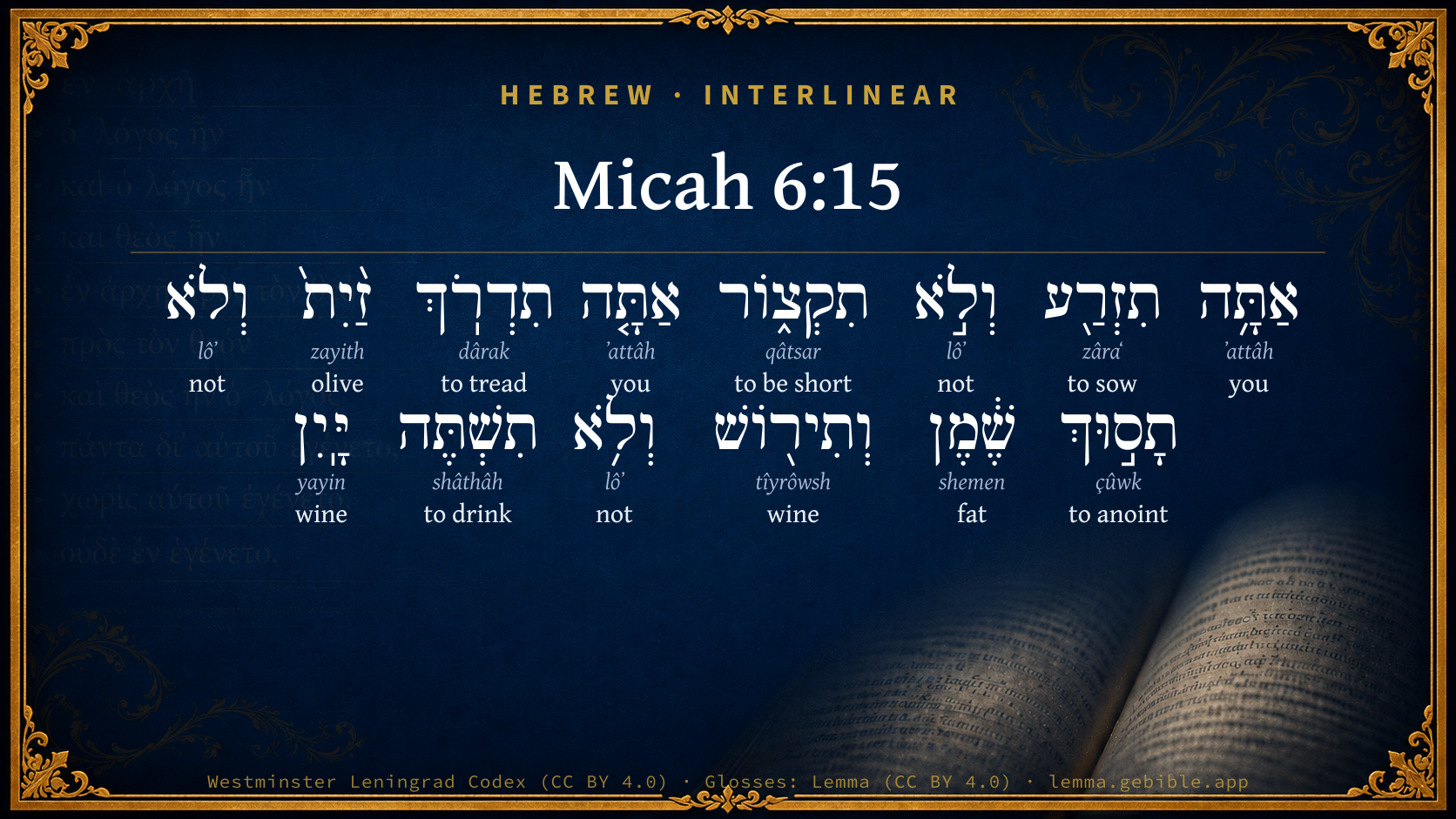
Hebrew (Westminster Leningrad Codex) Micah 6:15 appears in the Hebrew Old Testament. The text above is from the Westminster Leningrad Codex. Each word links to its Strong’s number, a concise gloss, and parsing drawn from the Open Scriptures Hebrew Bible morphology. Click any word for its full Brown-Driver-Briggs (BDB) entry.
Download image
Cite this verse

Micah 6:15 (World English Bible). Public Domain. Lemma interlinear Bible study tool, https://lemma.gebible.app/v/micah/6/15.

Show BibTeX & RIS
BibTeX
RIS
English Translation
You will sow, but won't reap. You will tread the olives, but won't anoint yourself with oil; And crush grapes, but won't drink the wine.
World English Bible · Public Domain
Download a study sheet

One document with this verse’s original text, its word-by-word gloss line, the meaning frame, cross-references with their text, attributed commentary, and full source and license credits — printable, and it pastes into notes with its structure intact.

This verse Autodidact and up

Study sheet (.html) Plain text (.txt)

A passage Seminary Student

Up to 50 verses in one chapter. A passage sheet keeps up to 6 commentary sources and 12 cross-references per verse, in the order this page ranks them, and says so on the sheet whenever that leaves anything out. Ask for a single verse and you get the Autodidact verse sheet above.

Everything on this page stays free to read, with no account — the sheet is a download of what is already on screen, not access to it.

Want to remove ads? Support Godless Engineer
Compare translations 3

The same verse in 3 English versions, stacked beneath the original-language interlinear above. Click any original word for its lexicon entry.

Each is an independent rendering of the whole verse — the interlinear is not word-aligned to these translations.

Highlighted words mark where these versions differ — a whole-verse word diff, not a word-by-word alignment.

  • World English Bible Public Domain
    You will sow, but won't reap. You will tread the olives, but won't anoint yourself with oil; And crush grapes, but won't drink the wine.
  • King James Version Public Domain
    Thou shalt sow, but thou shalt not reap; thou shalt tread the olives, but thou shalt not anoint thee with oil; and sweet wine, but shalt not drink wine.
  • unfoldingWord Literal Text CC BY-SA 4.0
    You will sow but not reap; you will tread the olive but not anoint with oil; and new wine but not drink wine.

unfoldingWord Literal Text — © unfoldingWord, licensed CC BY-SA 4.0. Word-aligned USFM3 via Door43 (git.door43.org/unfoldingWord/en_ult).

Versions to compare (up to 4)

3 of 4 selected

Show all 18 translations

Every available English version of this verse, each an independent rendering of the whole verse.

  • World English Bible Public Domain
    You will sow, but won't reap. You will tread the olives, but won't anoint yourself with oil; And crush grapes, but won't drink the wine.
  • Berean Standard Bible Public Domain
    You will sow but not reap; you will press olives but not anoint yourselves with oil; you will tread grapes but not drink the wine.
  • Majority Standard Bible Public Domain
    You will sow but not reap; you will press olives but not anoint yourselves with oil; you will tread grapes but not drink the wine.
  • King James Version Public Domain
    Thou shalt sow, but thou shalt not reap; thou shalt tread the olives, but thou shalt not anoint thee with oil; and sweet wine, but shalt not drink wine.
  • American Standard Version (1901) Public Domain
    Thou shalt sow, but shalt not reap; thou shalt tread the olives, but shalt not anoint thee with oil; and the vintage, but shalt not drink the wine.
  • Revised Version (1885) Public Domain
    Thou shalt sow, but shalt not reap: thou shalt tread the olives, but shalt not anoint thee with oil; and the vintage, but shalt not drink the wine.
  • Geneva Bible (1599) Public Domain
    Thou shalt sowe, but not reape: thou shalt treade the oliues, but thou shalt not anoint thee with oyle, and make sweete wine, but shalt not drinke wine.
  • Douay-Rheims (1899) Public Domain
    And I therefore began to strike thee with desolation for thy sins.
  • Young's Literal Translation Public Domain
    Thou -- thou sowest, and thou dost not reap, Thou -- thou treadest the olive, And thou pourest not out oil, And new wine -- and thou drinkest not wine.
  • Literal Standard Version CC BY-SA 4.0
    You sow, and you do not reap, || You tread the olive, || And you do not pour out oil, || And new wine—and you do not drink wine.
  • Unlocked Literal Bible CC BY-SA 4.0
    You will sow but not reap; you will tread the olives but not anoint yourselves with oil; you will press grapes but drink no wine.
  • unfoldingWord Literal Text CC BY-SA 4.0
    You will sow but not reap; you will tread the olive but not anoint with oil; and new wine but not drink wine.
  • Darby Bible Public Domain
    Thou shalt sow, but thou shalt not reap; thou shalt tread the olives, but thou shalt not anoint thee with oil; and new wine, but shalt not drink wine.
  • World Messianic Bible Public Domain
    You will sow, but won’t reap. You will tread the olives, but won’t anoint yourself with oil; and crush grapes, but won’t drink the wine.
  • Webster's Bible Public Domain
    Thou shalt sow, but thou shalt not reap; thou shalt tread the olives, but thou shalt not anoint thee with oil; and sweet wine, but shalt not drink wine.
  • Free Bible Version CC BY-SA 4.0
    You will sow, but you won't reap; you will press your olives, but not use the oil; you will make your wine, but drink none of it.
  • Bible in Basic English Public Domain
    You will put in seed, but you will not get in the grain; you will be crushing olives, but your bodies will not be rubbed with the oil; and you will get in the grapes, but you will have no wine.
  • JPS Tanakh (1917) Public Domain
    Thou shalt sow, but shalt not reap; thou shalt tread the olives, but shalt not anoint thee with oil; and the vintage, but shalt not drink wine.

Literal Standard Version (2020), Covenant Press — licensed CC BY-SA 4.0. Text via the HelloAO Bible API (eBible.org). Unlocked Literal Bible (unfoldingWord) — licensed CC BY-SA 4.0. Text via the HelloAO Bible API (eBible.org). unfoldingWord Literal Text — © unfoldingWord, licensed CC BY-SA 4.0. Word-aligned USFM3 via Door43 (git.door43.org/unfoldingWord/en_ult). Free Bible Version, Dr. Jonathan Gallagher — licensed CC BY-SA 4.0. Text via the HelloAO Bible API (eBible.org).

Word by word

More ways to search: Search by grammar → Find every occurrence → Compare this word →

Practice this passage: Drill this verse → Learn its vocabulary →

תָס֣וּךְ
çûwk
H5480
“to anoint”
Verb, Qal, Imperfect, 2nd Person, Masculine, Singular
Part of Speech
Verb
Stem
Qal
Form
Imperfect
Person
2nd Person
Gender
Masculine
Number
Singular
Full BDB Definition

Origin: a primitive root

TWOT: 1474

to anoint, pour in anointing - (Qal) to anoint - to anoint oneself - to anoint (another) - to be poured - (Hiphil) to anoint
  1. אַתָּ֥ה ʼattâh H859 “you” Pronoun, Personal, 2nd Person, Masculine, Singular
  2. תִזְרַ֖ע zâraʻ H2232 “to sow” Verb, Qal, Imperfect, 2nd Person, Masculine, Singular
  3. וְלֹ֣א lôʼ H3808 “and · not” Conjunction + Particle, Negative
  4. תִקְצ֑וֹר qâtsar H7114 “to be short” Verb, Qal, Imperfect, 2nd Person, Masculine, Singular
  5. אַתָּ֤ה ʼattâh H859 “you” Pronoun, Personal, 2nd Person, Masculine, Singular
  6. תִדְרֹֽךְ dârak H1869 “to tread” Verb, Qal, Imperfect, 2nd Person, Masculine, Singular
  7. זַ֨יִת֙ zayith H2132 “olive” Noun, Common, Masculine, Singular, Absolute
  8. וְלֹא lôʼ H3808 “and · not” Conjunction + Particle, Negative
  9. שֶׁ֔מֶן shemen H8081 “fat” Noun, Common, Masculine, Singular, Absolute
  10. וְתִיר֖וֹשׁ tîyrôwsh H8492 “and · wine” Conjunction + Noun, Common, Masculine, Singular, Absolute
  11. וְלֹ֥א lôʼ H3808 “and · not” Conjunction + Particle, Negative
  12. תִשְׁתֶּה shâthâh H8354 “to drink” Verb, Qal, Imperfect, 2nd Person, Masculine, Singular
  13. יָּֽיִן yayin H3196 “wine” Noun, Common, Masculine, Singular, Absolute

About this verse

These counts appear in no published source. They are computed here, from the morphology-tagged text and Lemma’s own curated glosses. What Lemma adds →

14
words
11
distinct lemmas
Prophets
section

Notable vocabulary

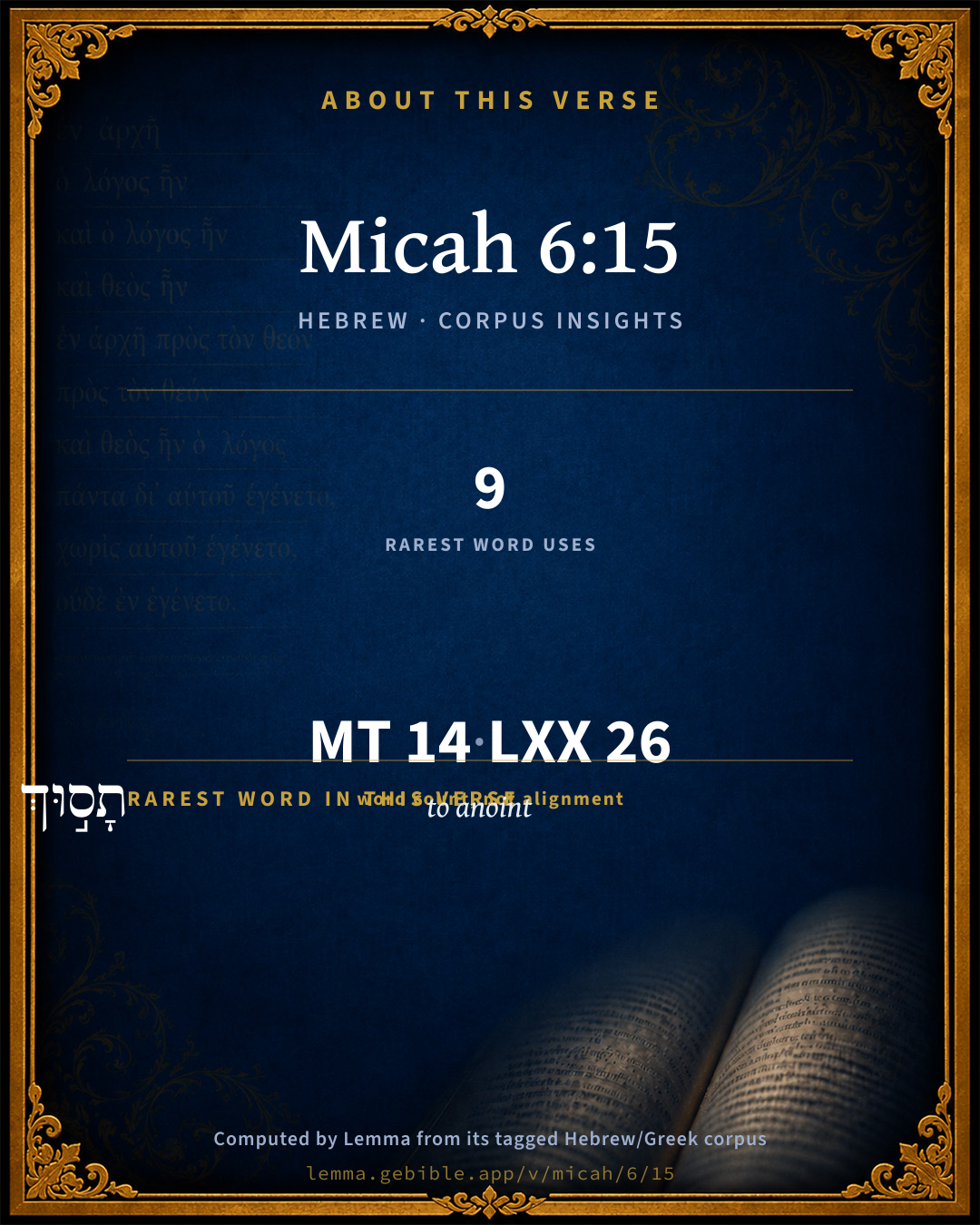
The rarest word here is תָס֣וּךְ to anoint H5480 — appearing just 9 times in the whole Hebrew Bible.

Shared distinctive vocabulary

תָס֣וּךְ to anoint H5480 occurs in 8 verses of the Hebrew Bible. Also found in:

Grammatical profile

  • 5 verbs
  • 4 nouns
  • 2 pronouns
  • 3 particles

Verb forms

  • תִזְרַ֖ע Qal · Imperfect
  • תִקְצ֑וֹר Qal · Imperfect
  • תִדְרֹֽךְ Qal · Imperfect
  • תָס֣וּךְ Qal · Imperfect
  • תִשְׁתֶּה Qal · Imperfect

Repetition

Words recur within this verse — often emphatic in Hebrew:

  • וְלֹ֣א not H3808 ×3
  • אַתָּ֥ה you H859 ×2

Hebrew & Septuagint length

In English translation the verse runs 25 words from the Hebrew and 41 from the Septuagint (LXX English) — the Septuagint runs noticeably longer here. See the side-by-side →

A rough comparison of the two English renderings, which tokenize alike — not a word-level alignment.

Word counts can differ between the Hebrew and the Greek without any difference in meaning — e.g. the Hebrew direct-object marker אֵת has no separate Greek word, and Greek often adds the article ὁ.

In the original languages it is 14 Hebrew tokens and 26 Greek tokens — but the two are counted differently (Hebrew bundles its prefixes and suffixes into one token; the Greek is in lemma form), so that isn’t a like-for-like length.

Cross-references

9

Topical passages linked to Micah 6:15 in the Treasury of Scripture Knowledge — connected by theme and wording, ordered by reader-vote popularity; previews shown in the World English Bible.

  • Zephaniah 1:13 Their wealth will become a spoil, and their houses a desolation. Yes, they will build houses, but won't inhabit them. They will plant vineyards, but won't drink their wine.
  • Amos 5:11 Forasmuch therefore as you trample on the poor, And take taxes from him of wheat: You have built houses of hewn stone, But you will not dwell in them. You have planted pleasant vineyards, But you shall not drink their wine.
  • Jeremiah 12:13 They have sown wheat, and have reaped thorns; they have put themselves to pain, and profit nothing: and you shall be ashamed of your fruits, because of the fierce anger of Yahweh.
  • Leviticus 26:20 and your strength will be spent in vain; for your land won't yield its increase, neither will the trees of the land yield their fruit.
  • Deuteronomy 28:38–40 You shall carry much seed out into the field, and shall gather little in; for the locust shall consume it.
  • Isaiah 62:8–9 Yahweh has sworn by his right hand, and by the arm of his strength, Surely I will no more give your grain to be food for your enemies; and foreigners shall not drink your new wine, for which you have labored:
  • Haggai 1:6 You have sown much, and bring in little. You eat, but you don't have enough. You drink, but you aren't filled with drink. You clothe yourselves, but no one is warm, and he who earns wages earns wages to put them into a bag with holes in it."
  • Isaiah 65:21–22 They shall build houses, and inhabit them; and they shall plant vineyards, and eat the fruit of them.
  • Joel 1:10–12 The field is laid waste. The land mourns, for the grain is destroyed, The new wine has dried up, And the oil languishes.

Cross-references courtesy of OpenBible.info (CC BY 4.0).

Hebrew and Greek witnesses Masoretic Hebrew ↔ Greek Septuagint

The same verse in the two great witnesses to the Old Testament, shown verse-for-verse.

Here the Septuagint runs noticeably longer than the Hebrew — LXX2012 (modern English Septuagint) 41 words vs World English Bible 25. A rough length comparison of the two English translations, not a word-level alignment — read both below.

These are two independent witnesses, not word-aligned to each other, and the Septuagint is shown in lemma (dictionary) form.

Hebrew Micah 6:15 Masoretic · Westminster Leningrad Codex

אַתָּ֥ה תִזְרַ֖ע וְלֹ֣א תִקְצ֑וֹר אַתָּ֤ה תִדְרֹֽךְ זַ֨יִת֙ וְלֹא תָס֣וּךְ שֶׁ֔מֶן וְתִיר֖וֹשׁ וְלֹ֥א תִשְׁתֶּה יָּֽיִן

You will sow, but won't reap. You will tread the olives, but won't anoint yourself with oil; And crush grapes, but won't drink the wine.

World English Bible · Public Domain

Greek LXX Micah 6:15 Septuagint · lemma form

σύ σπείρω καί οὐ μή ἀμάω σύ πιέζω ἐλαία καί οὐ μή ἀλείφω ἔλαιον καί οἶνος καί οὐ μή πίνω καί ἀπο ἀναἵζω νόμιμος λαός ἐγώ

You shall sow, but you shall not reap; you shall press the olive, but you shall not anoint yourself with oil; and shall make wine, but you⌃ shall drink no wine: and the ordinances of my people shall be utterly abolished.

LXX2012 (modern English Septuagint) · Public Domain

On this verse, The Pulpit Commentary discusses the Septuagint’s reading. Read the note in Commentary ↓

Hebrew: Westminster Leningrad Codex (CC BY 4.0). Greek: Septuagint (public domain); English from LXX2012 (modern English Septuagint) (Public Domain). How the Septuagint differs from the Hebrew →

Targum (Aramaic paraphrase)

1

The Targum is the ancient Jewish Aramaic paraphrase of the Hebrew Scriptures — an interpretive translation, not the Hebrew text itself. Onkelos (literal) and Pseudo-Jonathan (expansive) render the Torah, and Jonathan the Prophets. Coverage is partial: where no permissively-licensed English translation exists for a verse, only the Aramaic is shown. This is verse-level text, not a word-by-word alignment to the Hebrew.

  1. Targum Jonathan Prophets (Joshua–Malachi)
    אַתְּ תִּזְרַע וְלָא תֶחְצוֹד אַתְּ תְּבַדֵר זֵיתִין וְלָא תְשׁוּף מְשַׁח וְתַעֲצַר עִנְבִין וְלָא תִשְׁתֵּי חֲמָר:

    (no public-domain English translation for this verse)

    Targum Jonathan — Aramaic: “Mikraot Gedolot” (public domain). English: “Sefaria Community Translation” (CC0 1.0 (public-domain dedication)); “London "Chaldee Paraphrase," 1871” (public domain). Text via Sefaria.

Commentary

Notes on Micah 6:15 from classic Christian and Jewish commentators (each source and its license shown beneath its notes). The classic Christian expositions comment on the surrounding passage and are grouped to its opening verse, so a note may address several verses; the Jewish commentaries on the Tanakh (Rashi and others) are per-verse, so they appear only where the commentator wrote on this verse.

Lemma curates 59 commentaries, every one of them public domain or Creative Commons licensed, each selected and text-cleaned for this edition rather than reprinted as found. About our sources →

Trapp's Complete Commentary

John Trapp

Mic 6:15 Thou shalt sow, but thou shalt not reap; thou shalt tread the olives, but thou shalt not anoint thee with oil; and sweet wine, but shalt not drink wine.

Ver. 15. Thou shall sow, but thou shalt not reap] This had been long since threatened by Moses, Deu 28:38-40, and was now over seven hundred years after to receive its accomplishment in this people. There is an infallibility in all the menaces of God’s mouth. Men are apt to think that they were uttered in terrorem in fear only; and to put them off, as those in the Gospel did, with a God forbid: "Who knows if the Lord will deal with us according to all his wondrous works, that is evil may pass from us?" Jer 21:2. But what saith the prophet Zephaniah? "The just Lord is in the midst thereof; he will not do iniquity: every morning doth be bring his judgment to light, he faileth not: but the unjust knoweth no shame," Zep 3:5; sin hath wended such an impudence in his face, that he shuns no sin, dreads no danger.

John Trapp, A Commentary or Exposition upon All the Books of the Old and New Testament (1647–1656) — public domain. Text from a community e-Sword module.

Jamieson, Fausset & Brown

Robert Jamieson, A. R. Fausset & David Brown

sow . . . not reap--fulfilling the threat (Lev 26:16; Deu 28:38-40; Amo 5:11).

Jamieson, Fausset & Brown — Commentary Critical and Explanatory on the Whole Bible (1871) — public domain (CC PDM 1.0). Text via the HelloAO Bible API.

Adam Clarke's Commentary

Verse 15. Thou shalt sow, but thou shalt not reap] Thou shalt labour to amass property, but thou shalt not have God's blessing; and whatever thou collectest, thy enemies shall carry away. And at last carry thyself into captivity.

Adam Clarke's Commentary on the Bible (1810–1826) — public domain. Text from a community e-Sword/MySword module.

John Calvin's Commentaries

The Prophet adds another kind of punishment, which was to follow the calamity threatened in the last verse. He had said, that those who escaped would at length be destroyed by the sword; he says now, that the whole land would become a prey to enemies: and he took his words from Moses; for it was usual with the prophets, when they wished to secure greater authority to themselves, to quote literally the curses contained in the Law, as in the present instance: see Deuteronomy 28 and Leviticus 26. Now it is well known, that God denounced this punishment, with others, on the people, — that when they sowed their fields, another would reap, — that when they cultivated with great labor their vineyards, others would become the vintagers. The meaning is that whatever fruit the land produced, would come into the hands of enemies, for all things would be exposed to plunder. Now it is a very grievous thing, when we see not only our provisions consumed by enemies, but also the fruit of our labor; which is the same as though they were to drink our blood: for the labor of man is often compared to blood, for labor occasions perspiration. It now follows —

John Calvin's Commentaries (1540-1563) — public domain. Text from the Calvin Translation Society English edition (1840s-50s) via the Christian Classics Ethereal Library (ccel.org). Calvin's coverage is partial (roughly two-thirds of the Bible); uncommented books and verses are honest gaps, never fabricated. The 19th-century editor's footnotes and remarks are omitted so the notes are faithfully Calvin's own voice.

Ellicott's Commentary for English Readers

(15) Thou shalt tread the olives—i.e., as wheat upon the threshing-floor. Oil was regarded as indispensable for personal comfort. In Jotham’s parable of the trees in council about the choice of a king, the olive-tree was regarded first in estimation, before even the vine and fig-tree.

A Bible Commentary for English Readers, edited by Charles John Ellicott (1878–1897) — public domain. Text from a community e-Sword module.

The Cambridge Bible for Schools and Colleges

gen. ed. J. J. S. Perowne

15. tread the olives] It is now the custom only to press the olives; in olden times, they must have been trodden as well (like grapes). Ancient oil-presses are still found in Palestine. The olives were ground to a pulp sometimes by treading, sometimes by a stone-wheel. (Thomson, The Land and the Book, p. 207.)

The Cambridge Bible for Schools and Colleges (gen. ed. J. J. S. Perowne; Cambridge University Press, 1878–1918) — public domain. Text from a community e-Sword module.

John Gill's Exposition

Thou shall sow, but thou shalt not reap,.... Either that which is sown shall not spring up, but rot in the earth; or if it does spring up, and come to maturity, yet, before that, they should be removed into captivity, or slain by the sword, and their enemies should reap the increase of their land, their wheat and their grain:

thou shall tread the olives; in the olive press, to get out the oil:

but thou shalt not anoint with oil; as at feasts for refreshment, and at baths for health, this becoming another's property; or, it being a time of distress and mourning, would not be used, it being chiefly at festivals, and occasions of joy, that oil was used:

and sweet wine; that is, shalt tread the grapes in the winepress, to get out the sweet or new wine:

but shalt not drink wine; for, before it is fit to drink, the enemy would have it in his possession; see Lev 26:16; these are the punishments or corrections of the rod they are threatened with for their sins.

John Gill's Exposition of the Whole Bible (1746–1763) — public domain (CC PDM 1.0). Text via the HelloAO Bible API.

Albert Barnes' Notes on the Bible

Thou shalt sow, but thou shalt not reap - Micah renews the threatenings of the law Lev 26:16; Deu 28:30, Deu 28:38-41, which they had been habitually breaking. Those prophecies had been fulfilled before, throughout their history; they have been fulfilled lately in Israel for the like oppression of the poor Amo 5:11. Their frequent fulfillment spoke as much of a law of God’s righteousness, punishing sin, as the yearly supply in the ordinary course of nature spoke of His loving Providence. It is the bitterest punishment to the covetous to have the things which they coveted, taken away before their eyes; it was a token of God’s Hand, that He took them away, when just within their grasp. The prophet brings it before their eyes, that they might feel beforehand the bitterness of forgetting them. Montanus: “They should lose, not only what they gained unjustly, but the produce of their labor, care, industry, as, in agriculture, it is said that there is mostly much labor, little fraud, much benefit.”

Harvest is a proverb for joy; “they joy before Thee according to the joy in, harvest” Isa 9:3; “wine maketh glad the heart of man, and oil is to make him a cheerful countenance” Psa 104:15. But the harvest shall be turned into sorrow, the oil and wine shall be taken away, when all the labor had been employed (Compare Isa 16:9-10; Jer 5:17; Jer 48:37). Yet, since all these operations in nature are adapted to be, and are used as, symbols of things spiritual, then the words which describe them are adapted to be spiritual proverbs. Spiritually, , “he soweth and reapeth not, who soweth to the flesh, and of the flesh reapeth corruption” Gal 6:8, things corruptible, and inward decay and condemnation. He treadeth the olive, who, by shameful deeds contrary to the law, “grieveth the Holy Spirit of God” Eph 4:30, and therefore obtaineth not gladness of spirit; “he maketh wine, yet drinketh not wine, who teacheth others, not himself.” They too take hold but do not deliver, who for awhile believe and in time of temptation fall away, who repent for a while and then fall back into old sins, or in other ways bring no fruit to perfection; taking up the Cross for awhile and then wearying; using religious practices, as, more frequent prayer or fasting, and then tiring; cultivating some graces and then despairing because they see not the fruits. These tread the olive, but are not anointed with the oil of the Holy Spirit of grace, who (Rib.), “end by doing for the sake of man, what they had thought to do out of the love for God, and abandon, for some fear of man, the good which they had begun.”

Albert Barnes' Notes on the Bible (1834–1885) — public domain. Text from a community e-Sword/MySword module.

Matthew Poole's English Annotations

Thou shalt sow, be at great pains and cost in tilling and sowing,

but thou shalt not reap; it shall either not thrive to a harvest, or, if it does, an enemy shall reap it.

Thou shalt tread the olives, lay out thy labour and weary thyself in it, plant the tree, gather the fruit and tread it,

but thou shalt not anoint thee with oil; when thus prepared to use it, an enemy shall rob thee of it. Oil in those countries was much in use, because of the great refreshment it gave to the whole body.

And sweet wine: here is an ellipsis, and must be thus supplied, thou shalt tread the grapes which afford sweet wine.

But shalt not drink wine; in this, as in the other two, thou shalt be disappointed, thou shalt not enjoy thy labour, nor shall thy heart be cheered with new wine, nay, thou shalt be sick with vexing, to see thine enemies’ hearts glad with the wine thou hadst prepared for other guests.

Matthew Poole's English Annotations on the Holy Bible (1683–1685) — public domain. Text from a community e-Sword/MySword module.

The Pulpit Commentary

Here is another judgment in accordance with the threatenings of the Law. (Deu_28:33, Deu_28:38, etc.; comp. Amo_5:11 Zep_1:13 Hag_1:6) Shalt not reap. The effect may be owing to the judicial sterility of the soil, but more likely to the incursions of the enemy. Trochon quotes Virgil, "Eel.," 1:70"Impius haec tam culta novalia miles habebit? Barbarus has segetes? en, quo discordia cives Produxit miseros! his nos consevimus agros!

Tread the olives. Olives were usually pressed or crushed in a mill, in order to extract the oil; the process of treading; was probably adopted by the poor. Gethsemane took its name from the oil presses there. The oil was applied to the person for comfort, luxury, and ceremony, and was almost indispensable in a hot country. Sweet wine. Thou shalt tread the new wine of the vintage, but shalt have to leave it for the enemy. (comp. Amo_5:11) The Septuagint has here an interpolation, Kai afanisyhsetai nomima laou mou , "And the ordinances of my people shall vanish away," which has arisen partly from a confusion between Omri, the proper name in the next verse, and ammi, "my people."

The Pulpit Commentary (1880–1919), ed. H.D.M. Spence-Jones & Joseph S. Exell — public domain. Text from a community e-Sword module.

John Wesley's Explanatory Notes

Thou shalt not reap - An enemy shall reap it. Sweet wine - Thou shalt tread the grapes which afford sweet wine.

John Wesley, Explanatory Notes Upon the Whole Bible (1754–1765) — public domain. Text via the GEBible commentary corpus.

Lesson kit

Teaching starters — assembled from the data on this page, not authored interpretation. Every prompt links to the verse data it draws on. Edit before teaching.

Micah, in the Prophets, opens this verse with 14 words (11 distinct Hebrew lemmas). Its most distinctive word is çûwk (“to anoint”). The Greek Septuagint runs longer here. A historical commentator’s framing appears above. Read the whole chapter for the surrounding context.

Discussion questions

  1. The word çûwk carries the sense “to anoint.” How does it shape the verse?
  2. Deuteronomy 28:40 shares the word «to anoint» with this verse. How do the two illuminate each other?
  3. “not” occurs 3× in this one verse. What is the effect of the repetition?
  4. Compared with the Hebrew, the Septuagint runs longer here. What questions does that raise?
  5. The translations on this page render this verse differently — a whole-verse word diff, not a word-by-word alignment. What might account for the different wordings?
  6. The verb «תִזְרַ֖ע» is Qal Imperfect. How does its form color the action?
  7. Reading how Trapp's Complete Commentary and Jamieson, Fausset & Brown read this verse, where do the two commentators agree and where do they part?

Things to notice

Reading settings

Reading text

Shown beneath each verse's original-language words.

Old Testament
Old Testament edition

Read the OT as the Masoretic Hebrew (MT) or the Greek Septuagint (LXX).

English shown for the Greek Septuagint (in the Hebrew ↔ Greek comparison).

Comparing translations? Open the Compare panel on any verse page to stack up to four side by side.