
Ezekiel 39:18

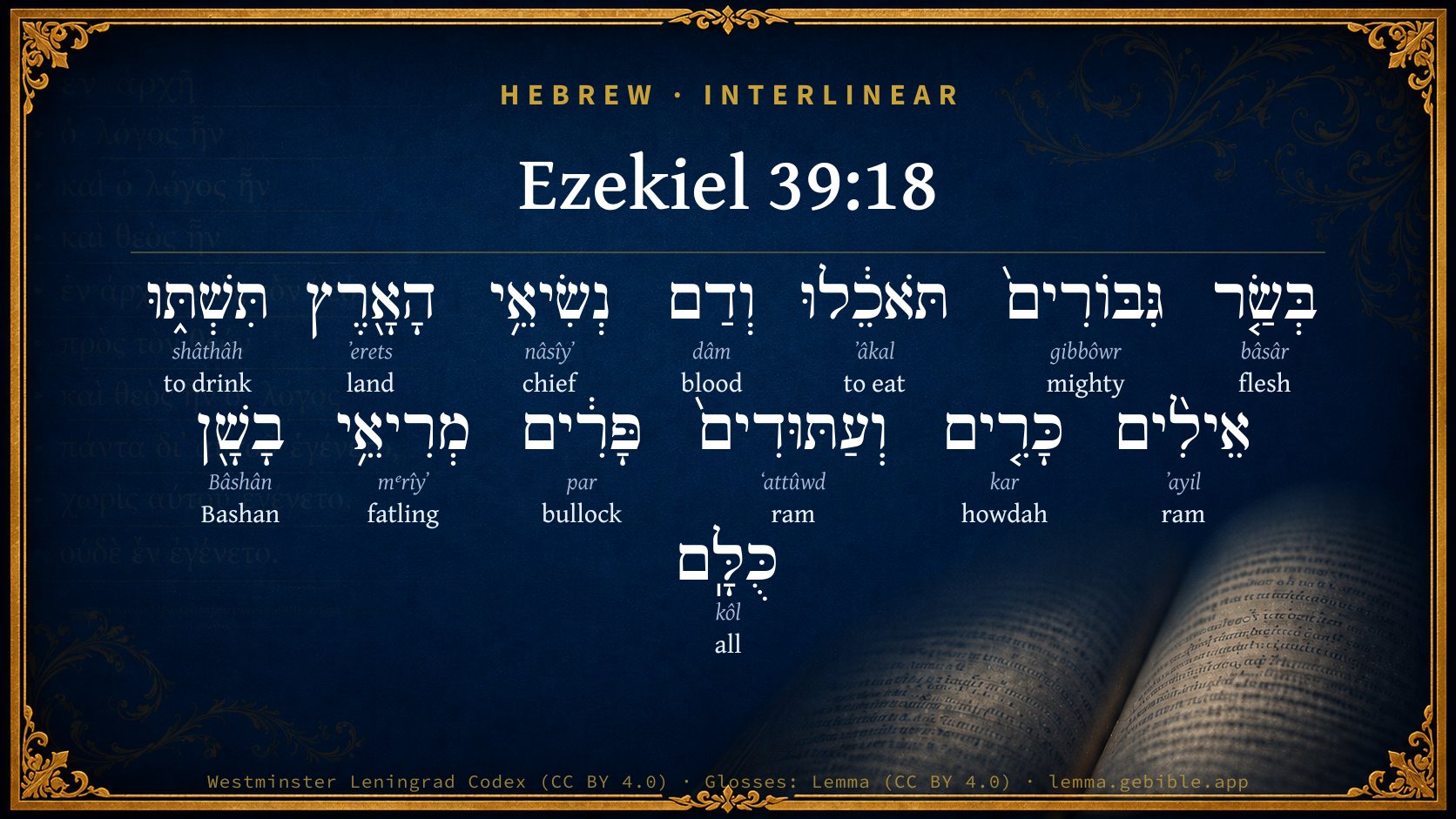
Hebrew (Westminster Leningrad Codex) Ezekiel 39:18 appears in the Hebrew Old Testament. The text above is from the Westminster Leningrad Codex. Each word links to its Strong’s number, a concise gloss, and parsing drawn from the Open Scriptures Hebrew Bible morphology. Click any word for its full Brown-Driver-Briggs (BDB) entry.
Download image
Cite this verse

Ezekiel 39:18 (World English Bible). Public Domain. Lemma interlinear Bible study tool, https://lemma.gebible.app/v/ezekiel/39/18.

Show BibTeX & RIS
BibTeX
RIS
English Translation
You shall eat the flesh of the mighty, and drink the blood of the princes of the earth, of rams, of lambs, and of goats, of bulls, all of them fatlings of Bashan.
World English Bible · Public Domain
Download a study sheet

One document with this verse’s original text, its word-by-word gloss line, the meaning frame, cross-references with their text, attributed commentary, and full source and license credits — printable, and it pastes into notes with its structure intact.

This verse Autodidact and up

Study sheet (.html) Plain text (.txt)

A passage Seminary Student

Up to 50 verses in one chapter. A passage sheet keeps up to 6 commentary sources and 12 cross-references per verse, in the order this page ranks them, and says so on the sheet whenever that leaves anything out. Ask for a single verse and you get the Autodidact verse sheet above.

Everything on this page stays free to read, with no account — the sheet is a download of what is already on screen, not access to it.

Want to remove ads? Support Godless Engineer
Compare translations 3

The same verse in 3 English versions, stacked beneath the original-language interlinear above. Click any original word for its lexicon entry.

Each is an independent rendering of the whole verse — the interlinear is not word-aligned to these translations.

Highlighted words mark where these versions differ — a whole-verse word diff, not a word-by-word alignment.

  • World English Bible Public Domain
    You shall eat the flesh of the mighty, and drink the blood of the princes of the earth, of rams, of lambs, and of goats, of bulls, all of them fatlings of Bashan.
  • King James Version Public Domain
    Ye shall eat the flesh of the mighty, and drink the blood of the princes of the earth, of rams, of lambs, and of goats, of bullocks, all of them fatlings of Bashan.
  • unfoldingWord Literal Text CC BY-SA 4.0
    You will consume the flesh of warriors and drink the blood of the princes of the earth; they will be rams, lambs, goats, and bulls, they were all fattened in Bashan.

unfoldingWord Literal Text — © unfoldingWord, licensed CC BY-SA 4.0. Word-aligned USFM3 via Door43 (git.door43.org/unfoldingWord/en_ult).

Versions to compare (up to 4)

3 of 4 selected

Show all 18 translations

Every available English version of this verse, each an independent rendering of the whole verse.

  • World English Bible Public Domain
    You shall eat the flesh of the mighty, and drink the blood of the princes of the earth, of rams, of lambs, and of goats, of bulls, all of them fatlings of Bashan.
  • Berean Standard Bible Public Domain
    You will eat the flesh of the mighty and drink the blood of the princes of the earth as though they were rams, lambs, goats, and bulls—all the fattened animals of Bashan.
  • Majority Standard Bible Public Domain
    You will eat the flesh of the mighty and drink the blood of the princes of the earth as though they were rams, lambs, goats, and bulls—all the fattened animals of Bashan.
  • King James Version Public Domain
    Ye shall eat the flesh of the mighty, and drink the blood of the princes of the earth, of rams, of lambs, and of goats, of bullocks, all of them fatlings of Bashan.
  • American Standard Version (1901) Public Domain
    Ye shall eat the flesh of the mighty, and drink the blood of the princes of the earth, of rams, of lambs, and of goats, of bullocks, all of them fatlings of Bashan.
  • Revised Version (1885) Public Domain
    Ye shall eat the flesh of the mighty, and drink the blood of the princes of the earth, of rams, of lambs, and of goats, of bullocks, all of them fatlings of Bashan.
  • Geneva Bible (1599) Public Domain
    Ye shall eate the flesh of the valiant, and drink the blood of the princes of the earth, of the weathers, of the lambes, and of the goates, and of bullockes, euen of all fat beastes of Bashan.
  • Douay-Rheims (1899) Public Domain
    You shall eat the flesh of the mighty, and you shall drink the blood of the princes of the earth, of rams, and of lambs, and of he goats, and bullocks, and of all that are well fed and fat.
  • Young's Literal Translation Public Domain
    Flesh of the mighty ye do eat, And blood of princes of the earth ye drink, Of rams, of lambs, and of he-goats, Of calves, fatlings of Bashan -- all of them.
  • Literal Standard Version CC BY-SA 4.0
    You eat [the] flesh of [the] mighty, || And you drink [the] blood of [the] princes of the earth, || Of rams, of lambs, and of male goats, || Of calves, fatlings of Bashan—all of them.
  • Unlocked Literal Bible CC BY-SA 4.0
    You will consume the flesh of warriors and drink the blood of the princes of the earth; they will be rams, lambs, goats, and bulls, they were all fattened in Bashan.
  • unfoldingWord Literal Text CC BY-SA 4.0
    You will consume the flesh of warriors and drink the blood of the princes of the earth; they will be rams, lambs, goats, and bulls, they were all fattened in Bashan.
  • Darby Bible Public Domain
    Ye shall eat the flesh of the mighty, and drink the blood of the princes of the earth, of rams, of lambs, and of goats, [and] of bullocks, all of them fatted beasts of Bashan.
  • World Messianic Bible Public Domain
    You shall eat the flesh of the mighty, and drink the blood of the princes of the earth, of rams, of lambs, and of goats, of bulls, all of them fatlings of Bashan.
  • Webster's Bible Public Domain
    Ye shall eat the flesh of the mighty, and drink the blood of the princes of the earth, of rams, of lambs, and of goats, of bullocks, all of them fatlings of Bashan.
  • Free Bible Version CC BY-SA 4.0
    You will eat the flesh of the powerful and drink the blood of the world's leaders just as if they were rams, lambs, goats, and bulls—all the fattened animals that come from Bashan.
  • Bible in Basic English Public Domain
    The flesh of the men of war will be your food, and your drink the blood of the princes of the earth, of sheep and lambs, of he-goats, of oxen, all of them fat beasts of Bashan.
  • JPS Tanakh (1917) Public Domain
    The flesh of the mighty shall ye eat, and the blood of the princes of the earth shall ye drink; rams, lambs, and goats, bullocks, fatlings of Bashan are they all of them.

Literal Standard Version (2020), Covenant Press — licensed CC BY-SA 4.0. Text via the HelloAO Bible API (eBible.org). Unlocked Literal Bible (unfoldingWord) — licensed CC BY-SA 4.0. Text via the HelloAO Bible API (eBible.org). unfoldingWord Literal Text — © unfoldingWord, licensed CC BY-SA 4.0. Word-aligned USFM3 via Door43 (git.door43.org/unfoldingWord/en_ult). Free Bible Version, Dr. Jonathan Gallagher — licensed CC BY-SA 4.0. Text via the HelloAO Bible API (eBible.org).

Word by word

More ways to search: Search by grammar → Find every occurrence → Compare this word →

Practice this passage: Drill this verse → Learn its vocabulary →

מְרִיאֵ֥י
mᵉrîyʼ
H4806
“fatlings of”
Noun, Common, Masculine, Plural, Construct
Part of Speech
Noun
Type
Common
Gender
Masculine
Number
Plural
State
Construct
Full BDB Definition

Origin: from H4754 in the sense of grossness, through the idea of domineering (compare H4756 )

TWOT: 1239a

well-fed, fatling
  1. בְּשַׂ֤ר bâsâr H1320 “flesh of” Noun, Common, Masculine, Singular, Construct
  2. גִּבּוֹרִים֙ gibbôwr H1368 “mighty” Adjective, Adjective, Masculine, Plural, Absolute
  3. תֹּאכֵ֔לוּ ʼâkal H398 “to eat” Verb, Qal, Imperfect, 2nd Person, Masculine, Plural
  4. וְדַם dâm H1818 “and · blood of” Conjunction + Noun, Common, Masculine, Singular, Construct
  5. נְשִׂיאֵ֥י nâsîyʼ H5387 “chiefs of” Noun, Common, Masculine, Plural, Construct
  6. הָאָ֖רֶץ ʼerets H776 “the · land” Particle, Definite Article + Noun, Common, Both, Singular, Absolute
  7. תִּשְׁתּ֑וּ shâthâh H8354 “to drink” Verb, Qal, Imperfect, 2nd Person, Masculine, Plural
  8. אֵילִ֨ים ʼayil H352 “rams” Noun, Common, Masculine, Plural, Absolute
  9. כָּרִ֤ים kar H3733 “howdahs” Noun, Common, Masculine, Plural, Absolute
  10. וְעַתּוּדִים֙ ʻattûwd H6260 “and · rams” Conjunction + Noun, Common, Masculine, Plural, Absolute
  11. פָּרִ֔ים par H6499 “bullocks” Noun, Common, Masculine, Plural, Absolute
  12. בָשָׁ֖ן Bâshân H1316 “Bashan” Noun, Proper
  13. כֻּלָּֽם kôl H3605 “all · their” Noun, Common, Masculine, Singular, Construct + Suffix, Personal, 3rd Person, Masculine, Plural

About this verse

These counts appear in no published source. They are computed here, from the morphology-tagged text and Lemma’s own curated glosses. What Lemma adds →

14
words
14
distinct lemmas
Prophets
section

Notable vocabulary

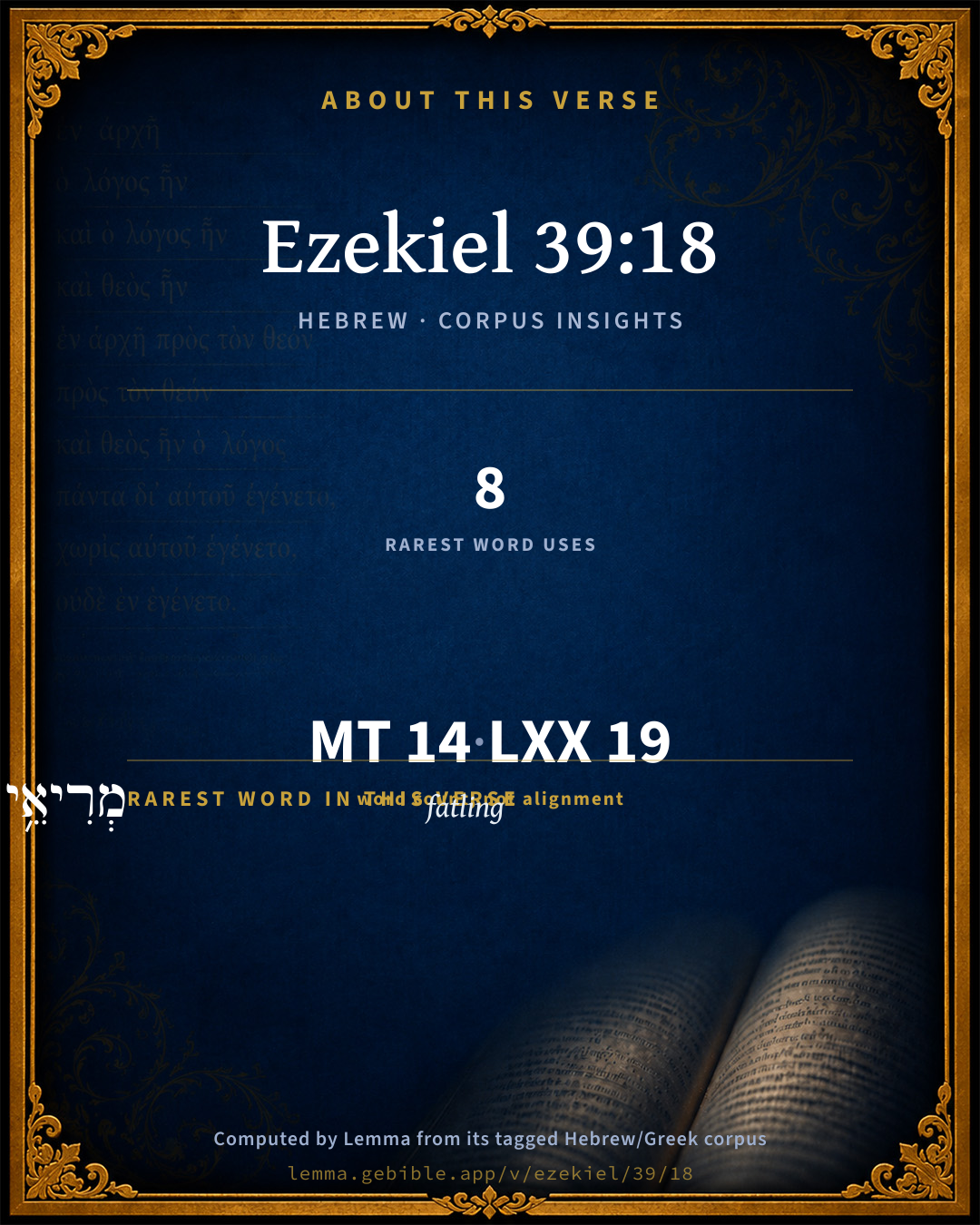
The rarest word here is מְרִיאֵ֥י fatling H4806 — appearing just 8 times in the whole Hebrew Bible.

Shared distinctive vocabulary

מְרִיאֵ֥י fatling H4806 occurs in 8 verses of the Hebrew Bible. Also found in:

Grammatical profile

  • 2 verbs
  • 11 nouns
  • 1 adjective

Verb forms

  • תֹּאכֵ֔לוּ Qal · Imperfect
  • תִּשְׁתּ֑וּ Qal · Imperfect

Hebrew & Septuagint length

In English translation the verse runs 33 words from the Hebrew and 30 from the Septuagint (LXX English) — closely comparable.

A rough comparison of the two English renderings, which tokenize alike — not a word-level alignment.

Word counts can differ between the Hebrew and the Greek without any difference in meaning — e.g. the Hebrew direct-object marker אֵת has no separate Greek word, and Greek often adds the article ὁ.

In the original languages it is 14 Hebrew tokens and 19 Greek tokens — but the two are counted differently (Hebrew bundles its prefixes and suffixes into one token; the Greek is in lemma form), so that isn’t a like-for-like length.

Cross-references

13

Topical passages linked to Ezekiel 39:18 in the Treasury of Scripture Knowledge — connected by theme and wording, ordered by reader-vote popularity; previews shown in the World English Bible.

  • Psalms 22:12 Many bulls have surrounded me. Strong bulls of Bashan have encircled me.
  • Jeremiah 51:40 I will bring them down like lambs to the slaughter, like rams with male goats.
  • Revelation 19:17–18 I saw an angel standing in the sun. He cried with a loud voice, saying to all the birds that fly in the sky, "Come! Be gathered together to the great supper of God,
  • Jeremiah 50:27 Kill all her bulls; let them go down to the slaughter: woe to them! for their day is come, the time of their visitation.
  • Ezekiel 29:5 I will cast you forth into the wilderness, you and all the fish of your rivers: you shall fall on the open field; you shall not be brought together, nor gathered; I have given you for food to the animals of the earth and to the birds of the sky.
  • Amos 4:1 Listen to this word, you cows of Bashan, who are on the mountain of Samaria, who oppress the poor, who crush the needy, who tell their lords, "Bring, and let us drink."
  • Deuteronomy 32:14 Butter of the herd, and milk of the flock, With fat of lambs, Rams of the breed of Bashan, and goats, With the finest of the wheat; Of the blood of the grape you drank wine.
  • Psalms 68:30 Rebuke the wild animal of the reeds, The multitude of the bulls, with the calves of the peoples. Being humbled, may it bring bars of silver. Scatter the nations that delight in war.
  • Isaiah 34:7 The wild-oxen shall come down with them, and the bulls with the bulls: and their land shall be drunken with blood, and their dust made fat with fatness.
  • Jeremiah 50:11 Because you are glad, because you rejoice, O you who plunder my heritage, because you are wanton as a heifer that treads out [the grain], and neigh as strong horses;
  • Ezekiel 34:8 As I live, says the Lord Yahweh, surely because my sheep became a prey, and my sheep became food to all the animals of the field, because there was no shepherd, neither did my shepherds search for my sheep, but the shepherds fed themselves, and didn't feed my sheep;
  • Ezekiel 34:17 As for you, O my flock, thus says the Lord Yahweh: Behold, I judge between sheep and sheep, the rams and the male goats.
  • Revelation 19:21 The rest were killed with the sword of him who sat on the horse, the sword which came forth out of his mouth. All the birds were filled with their flesh.

Cross-references courtesy of OpenBible.info (CC BY 4.0).

Hebrew and Greek witnesses Masoretic Hebrew ↔ Greek Septuagint

The same verse in the two great witnesses to the Old Testament, shown verse-for-verse.

These are two independent witnesses, not word-aligned to each other, and the Septuagint is shown in lemma (dictionary) form.

Hebrew Ezekiel 39:18 Masoretic · Westminster Leningrad Codex

בְּשַׂ֤ר גִּבּוֹרִים֙ תֹּאכֵ֔לוּ וְדַם נְשִׂיאֵ֥י הָאָ֖רֶץ תִּשְׁתּ֑וּ אֵילִ֨ים כָּרִ֤ים וְעַתּוּדִים֙ פָּרִ֔ים מְרִיאֵ֥י בָשָׁ֖ן כֻּלָּֽם

You shall eat the flesh of the mighty, and drink the blood of the princes of the earth, of rams, of lambs, and of goats, of bulls, all of them fatlings of Bashan.

World English Bible · Public Domain

Greek LXX Ezekiel 39:18 Septuagint · lemma form

κρέας γίγας ἐσθίω καί αἷμα ἄρχων ὁ γῆ πίνω κριός καί μόσχος καί τράγος καί ὁ μόσχος στεατόομαι πᾶς

You⌃ shall eat the flesh of mighty men, and you⌃ shall drink the blood of princes of the earth, rams, and calves and goats, and they are all fatted calves.

LXX2012 (modern English Septuagint) · Public Domain

On this verse, Haydock's Catholic Bible Commentary discusses the Septuagint’s reading. Read the note in Commentary ↓

Hebrew: Westminster Leningrad Codex (CC BY 4.0). Greek: Septuagint (public domain); English from LXX2012 (modern English Septuagint) (Public Domain). How the Septuagint differs from the Hebrew →

Targum (Aramaic paraphrase)

1

The Targum is the ancient Jewish Aramaic paraphrase of the Hebrew Scriptures — an interpretive translation, not the Hebrew text itself. Onkelos (literal) and Pseudo-Jonathan (expansive) render the Torah, and Jonathan the Prophets. Coverage is partial: where no permissively-licensed English translation exists for a verse, only the Aramaic is shown. This is verse-level text, not a word-by-word alignment to the Hebrew.

  1. Targum Jonathan Prophets (Joshua–Malachi)
    בְּסַר גִבָּרִין תֵּיכְלוּן וְדַם רַבְרְבֵי אַרְעָא תִּשְׁתּוּן מַלְכִין שִׁלְטוֹנִין וְטוּרְנִין גִבָּרִין עַתִּירֵי נִכְסַיָא כּוּלְהוֹן:

    (no public-domain English translation for this verse)

    Targum Jonathan — Aramaic: “Mikraot Gedolot” (public domain). English: “Sefaria Community Translation” (CC0 1.0 (public-domain dedication)); “London "Chaldee Paraphrase," 1871” (public domain). Text via Sefaria.

Commentary

Notes on Ezekiel 39:18 from classic Christian and Jewish commentators (each source and its license shown beneath its notes). The classic Christian expositions comment on the surrounding passage and are grouped to its opening verse, so a note may address several verses; the Jewish commentaries on the Tanakh (Rashi and others) are per-verse, so they appear only where the commentator wrote on this verse.

Lemma curates 59 commentaries, every one of them public domain or Creative Commons licensed, each selected and text-cleaned for this edition rather than reprinted as found. About our sources →

Trapp's Complete Commentary

John Trapp

Eze 39:18 Ye shall eat the flesh of the mighty, and drink the blood of the princes of the earth, of rams, of lambs, and of goats, of bullocks, all of them fatlings of Bashan.

Ver. 18. Ye shall eat the flesh of the mighty.] Whose flesh may he, perhaps, more delicate.

And drink the blood.] Blood royal, of a noble alloy. Sed nihil inde colligas, quam perpetuam eorum damnationem qui verbum Dei persequuntur, quique populum Israel spiritualem exagitant. {a} It importeth the eternal damnation of atheists and antichrists.

{a} Oecolampadius.

John Trapp, A Commentary or Exposition upon All the Books of the Old and New Testament (1647–1656) — public domain. Text from a community e-Sword module.

Tyndale Open Study Notes

Tyndale Open Resources

39:18-20 In most sacrificial feasts, humans dined on slaughtered animals. This feast would allow animals to dine on slaughtered humans as though they were rams, lambs, goats, and bulls. This reversal of the great messianic banquet (Isa 25:6) features the enemies of God as the menu rather than as the invited guests.

Tyndale Open Study Notes — © Tyndale Open Resources, licensed CC BY-SA 4.0. Text via the HelloAO Bible API.

Jamieson, Fausset & Brown

Robert Jamieson, A. R. Fausset & David Brown

rams . . . lambs . . . goats--By these various animal victims used in sacrifices are meant various ranks of men, princes, generals, and soldiers (compare Isa 34:6).

fatlings of Bashan--ungodly men of might (Psa 22:12). Bashan, beyond Jordan, was famed for its fat cattle. Fat implies prosperity which often makes men refractory towards God (Deu 32:14-15).

Jamieson, Fausset & Brown — Commentary Critical and Explanatory on the Whole Bible (1871) — public domain (CC PDM 1.0). Text via the HelloAO Bible API.

Adam Clarke's Commentary

Verse 18. Ye shall - drink the blood of the princes of the earth] I need not mention the custom of the Scandinavians: they were accustomed to drink the blood of their enemies out of the skulls of the dead. But this is spoken of fowls and beasts here-rams, lambs, and goats. The feast shall be as grateful and as plenteous to the fowls and beasts, as one made of the above animals, the fattest and best of their kind, (because fed in the fertile fields of Bashan,) would be to the guests of him who makes a sacrifice.

Adam Clarke's Commentary on the Bible (1810–1826) — public domain. Text from a community e-Sword/MySword module.

Ellicott's Commentary for English Readers

(18) Drink the blood of the princes.—In these verses there is a curious mingling of the figurative and the literal; thus the “princes” are immediately explained by the mention of the various sacrificial animals; and in Eze_39:20 these are again interpreted of “horses and chariots, with mighty men, and with all men of war.” And when the figure is so far explained it only leads to a literal sense which must yet be considered as itself but the symbol of something further. (Comp. Rev_19:17-18.)

A Bible Commentary for English Readers, edited by Charles John Ellicott (1878–1897) — public domain. Text from a community e-Sword module.

The Cambridge Bible for Schools and Colleges

gen. ed. J. J. S. Perowne

18. The actual victims sacrificed were princes and mighty men; here they are described as rams and goats—the usual animals sacrificed. Jer_51:40.

fatlings of Bashan] Bashan was a pastoral country, producing the fattest and greatest beasts. Cf. Deu_32:14; Amo_4:1; Isa_34:6-7; Psa_22:12.

The Cambridge Bible for Schools and Colleges (gen. ed. J. J. S. Perowne; Cambridge University Press, 1878–1918) — public domain. Text from a community e-Sword module.

John Gill's Exposition

Ye shall eat the flesh of the mighty,.... Of the soldiers, men of strength and courage, and fit for war, with which the army of Gog will abound:

and drink the blood of the princes of the earth: both the princes of his own family and court, and those of his allies and auxiliaries that will come along with him:

of rams, of lambs, and of goats, of bullocks; which the Targum Jarchi, and Kimchi, interpret of kings, princes, dukes, rulers, and governors; and so does John, in the Revelation, of kings, captains, and mighty men, Rev 19:18,

all of them fatlings of Baasha; which was a country in Israel, very fruitful, and full of pastures, where much fat cattle were bred; and to which these great personages in Gog's army are compared, for their bulk, strength, and wealth. So the Targum,

"all of them rich in substance.''

It may be rendered, "all of them the merie of Bashan"; for "meri" is the name of an ox or buffle; and Jarchi says that a fat ox is called in the Arabic language "almari" (h).

(h) Vid. Bochart. de Script. Animal. par. 1. l. 2. c. 28. col. 284.

John Gill's Exposition of the Whole Bible (1746–1763) — public domain (CC PDM 1.0). Text via the HelloAO Bible API.

Haydock's Catholic Bible Commentary

That are. Hebrew, "and of meries, (a species of oxen, in Syria.; Bellon. ii. 50.) all of them from Basan," beyond the Jordan, a most fertile country. Septuagint, "all calves fattened."

George Leo Haydock (1774–1849), Haydock's Catholic Family Bible and Commentary, 1859 edition — public domain. Excludes Psalms (Douay-Rheims chapter numbering differs from Protestant) and Deuterocanonical books (Catholic canon only).

Matthew Poole's English Annotations

In these two and the two following verses, God takes on him the person of one that makes a feast, invites his guests, and promiseth to satisfy them. Of the two former, the first is an enigmatical invitation, or an invitation in a riddle; the latter is the key to this character.

The mighty; who had great authority, great courage and strength, the giant-like ones, commanders of great note in the army.

The princes: many princes came with their countrymen and subjects to assist in this war, whose blood these fowls should drink; and these compared to rams which lead the flock.

Lambs are the more ordinary in the army. Goats; great goats, as the Hebrew denoteth; and these signify the more lascivious and impetuous among them.

Bullocks; such as, though more slow, were of great strength.

Fatlings; well fed, it was no lean sacrifice made.

Of Bashan, a mountain of most rich and sweet soil, and that fed the best of any.

Matthew Poole's English Annotations on the Holy Bible (1683–1685) — public domain. Text from a community e-Sword/MySword module.

The Pulpit Commentary

Verse 18 specifies the victims whose flesh and blood should form their banquet, viz. the mighty, as in Eze_32:12, Eze_32:27, and the princes of the earth, meaning the nobles and other dignitaries in Gog"s army, who, in accordance with the symbol of a feast, are spoken of as "rams," "lambs," "goats," "bullocks," and "fatlings of Bashan". (comp. Psa_22:12) "Per haec animantium, quae in saarificiis usurpari solebant, nomina varii hominum ordines intelliguntur, principum, ducum, militum, quod et Chaldaeus observat". (Grotius. Comp. Rev_19:17, Rev_19:18) in Zep_1:7 the heathen are the guests, and his people the victims, at Jehovah"s banquet.

The Pulpit Commentary (1880–1919), ed. H.D.M. Spence-Jones & Joseph S. Exell — public domain. Text from a community e-Sword module.

John Wesley's Explanatory Notes

Ye shall eat - In these two and the following verses, God takes on him the person of one that makes a feast, invites his guests, and promises to satisfy them. Of the two former, the first is an Enigmatical invitation, or an invitation in a riddle; the latter is the key to this character. The mighty - Who had great authority, great courage and strength, the giant-like ones, commanders of great note in the army. Princes - Many princes came with their country men and subjects to assist in this war. Rams - These are compared to rams which lead the flock. Lambs - Lambs are the more ordinary in the army. Goats - Goats signify the more lascivious, and impetuous among them. Bullocks - Bullocks, such as though more slow, were of great strength. Fatlings - Well fed. Bashan - A mountain of most rich, and sweet soil.

John Wesley, Explanatory Notes Upon the Whole Bible (1754–1765) — public domain. Text via the GEBible commentary corpus.

Rashi

Rabbi Shlomo Yitzchaki (Rashi)

rams, lambs, he-goats, and bulls kings and dukes, rulers, and princes.

fatlings of Bashan [Heb. מְרִיאִי בָשָּׁן,] An ox given to be fattened is called al meri in Arabic.

Rashi on the Tanakh — English translations: “The Judaica Press complete Tanach with Rashi, translated by A. J. Rosenberg” (CC BY 4.0); “Pentateuch with Rashi's commentary by M. Rosenbaum and A.M. Silbermann, 1929-1934” (public domain); “The Metsudah Tanach series, Lakewood, N.J” (CC BY 4.0); and “The Book of Joshua, Metsudah Publications, 1997” (CC BY 4.0). Text via Sefaria.

Lesson kit

Teaching starters — assembled from the data on this page, not authored interpretation. Every prompt links to the verse data it draws on. Edit before teaching.

Ezekiel, in the Prophets, opens this verse with 14 words (14 distinct Hebrew lemmas). Its most distinctive word is mᵉrîyʼ (“fatling”). A historical commentator’s framing appears above. Read the whole chapter for the surrounding context.

Discussion questions

  1. What does “fatling” (mᵉrîyʼ) contribute to the verse as a whole?
  2. 2 Samuel 6:13 shares the word «fatling» with this verse. How do the two illuminate each other?
  3. The translations on this page render this verse differently — a whole-verse word diff, not a word-by-word alignment. What might account for the different wordings?
  4. The verb «תֹּאכֵ֔לוּ» is Qal Imperfect. How does its form color the action?
  5. Reading how Trapp's Complete Commentary and Tyndale Open Study Notes read this verse, where do the two commentators agree and where do they part?

Things to notice

Reading settings

Reading text

Shown beneath each verse's original-language words.

Old Testament
Old Testament edition

Read the OT as the Masoretic Hebrew (MT) or the Greek Septuagint (LXX).

English shown for the Greek Septuagint (in the Hebrew ↔ Greek comparison).

Comparing translations? Open the Compare panel on any verse page to stack up to four side by side.