
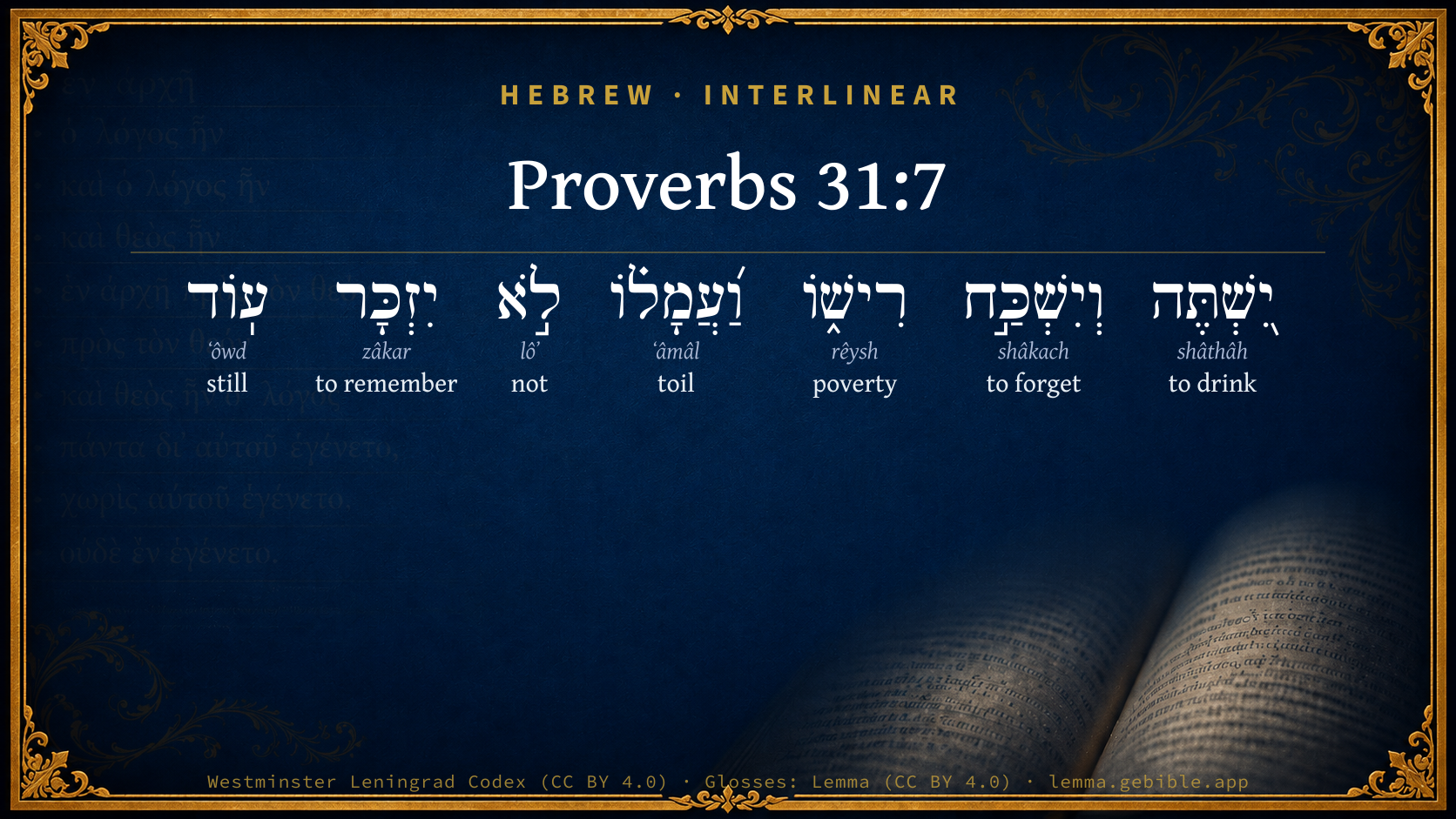
Proverbs 31:7

Hebrew (Westminster Leningrad Codex) Proverbs 31:7 appears in the Hebrew Old Testament. The text above is from the Westminster Leningrad Codex. Each word links to its Strong’s number, a concise gloss, and parsing drawn from the Open Scriptures Hebrew Bible morphology. Click any word for its full Brown-Driver-Briggs (BDB) entry.
Download image
Cite this verse

Proverbs 31:7 (World English Bible). Public Domain. Lemma interlinear Bible study tool, https://lemma.gebible.app/v/proverbs/31/7.

Show BibTeX & RIS
BibTeX
RIS
English Translation
Let him drink, and forget his poverty, And remember his misery no more.
World English Bible · Public Domain
Download a study sheet

One document with this verse’s original text, its word-by-word gloss line, the meaning frame, cross-references with their text, attributed commentary, and full source and license credits — printable, and it pastes into notes with its structure intact.

This verse Autodidact and up

Study sheet (.html) Plain text (.txt)

A passage Seminary Student

Up to 50 verses in one chapter. A passage sheet keeps up to 6 commentary sources and 12 cross-references per verse, in the order this page ranks them, and says so on the sheet whenever that leaves anything out. Ask for a single verse and you get the Autodidact verse sheet above.

Everything on this page stays free to read, with no account — the sheet is a download of what is already on screen, not access to it.

Want to remove ads? Support Godless Engineer
Compare translations 3

The same verse in 3 English versions, stacked beneath the original-language interlinear above. Click any original word for its lexicon entry.

Each is an independent rendering of the whole verse — the interlinear is not word-aligned to these translations.

Highlighted words mark where these versions differ — a whole-verse word diff, not a word-by-word alignment.

  • World English Bible Public Domain
    Let him drink, and forget his poverty, And remember his misery no more.
  • King James Version Public Domain
    Let him drink, and forget his poverty, and remember his misery no more.
  • unfoldingWord Literal Text CC BY-SA 4.0
    He will drink and forget his poverty, and his trouble he will not remember again.

unfoldingWord Literal Text — © unfoldingWord, licensed CC BY-SA 4.0. Word-aligned USFM3 via Door43 (git.door43.org/unfoldingWord/en_ult).

Versions to compare (up to 4)

3 of 4 selected

Show all 18 translations

Every available English version of this verse, each an independent rendering of the whole verse.

  • World English Bible Public Domain
    Let him drink, and forget his poverty, And remember his misery no more.
  • Berean Standard Bible Public Domain
    Let him drink and forget his poverty, and remember his misery no more.
  • Majority Standard Bible Public Domain
    Let him drink and forget his poverty, and remember his misery no more.
  • King James Version Public Domain
    Let him drink, and forget his poverty, and remember his misery no more.
  • American Standard Version (1901) Public Domain
    Let him drink, and forget his poverty, And remember his misery no more.
  • Revised Version (1885) Public Domain
    Let him drink, and forget his poverty, and remember his misery no more.
  • Geneva Bible (1599) Public Domain
    Let him drinke, that he may forget his pouertie, and remember his miserie no more.
  • Douay-Rheims (1899) Public Domain
    Let them drink, and forget their want, and remember their sorrow no more.
  • Young's Literal Translation Public Domain
    He drinketh, and forgetteth his poverty, And his misery he remembereth not again.
  • Literal Standard Version CC BY-SA 4.0
    He drinks, and forgets his poverty, || And he does not remember his misery again.
  • Unlocked Literal Bible CC BY-SA 4.0
    He will drink and he will forget his poverty and he will not remember his trouble.
  • unfoldingWord Literal Text CC BY-SA 4.0
    He will drink and forget his poverty, and his trouble he will not remember again.
  • Darby Bible Public Domain
    let him drink, and forget his poverty, and remember his misery no more.
  • World Messianic Bible Public Domain
    Let him drink, and forget his poverty, and remember his misery no more.
  • Webster's Bible Public Domain
    Let him drink, and forget his poverty, and remember his misery no more.
  • Free Bible Version CC BY-SA 4.0
    Let them drink so they can forget their poverty, and not remember their troubles any longer.
  • Bible in Basic English Public Domain
    Let him have drink, and his need will go from his mind, and the memory of his trouble will be gone.
  • JPS Tanakh (1917) Public Domain
    Let him drink, and forget his poverty, and remember his misery no more.

Literal Standard Version (2020), Covenant Press — licensed CC BY-SA 4.0. Text via the HelloAO Bible API (eBible.org). Unlocked Literal Bible (unfoldingWord) — licensed CC BY-SA 4.0. Text via the HelloAO Bible API (eBible.org). unfoldingWord Literal Text — © unfoldingWord, licensed CC BY-SA 4.0. Word-aligned USFM3 via Door43 (git.door43.org/unfoldingWord/en_ult). Free Bible Version, Dr. Jonathan Gallagher — licensed CC BY-SA 4.0. Text via the HelloAO Bible API (eBible.org).

Word by word

More ways to search: Search by grammar → Find every occurrence → Compare this word →

Practice this passage: Drill this verse → Learn its vocabulary →

About this verse

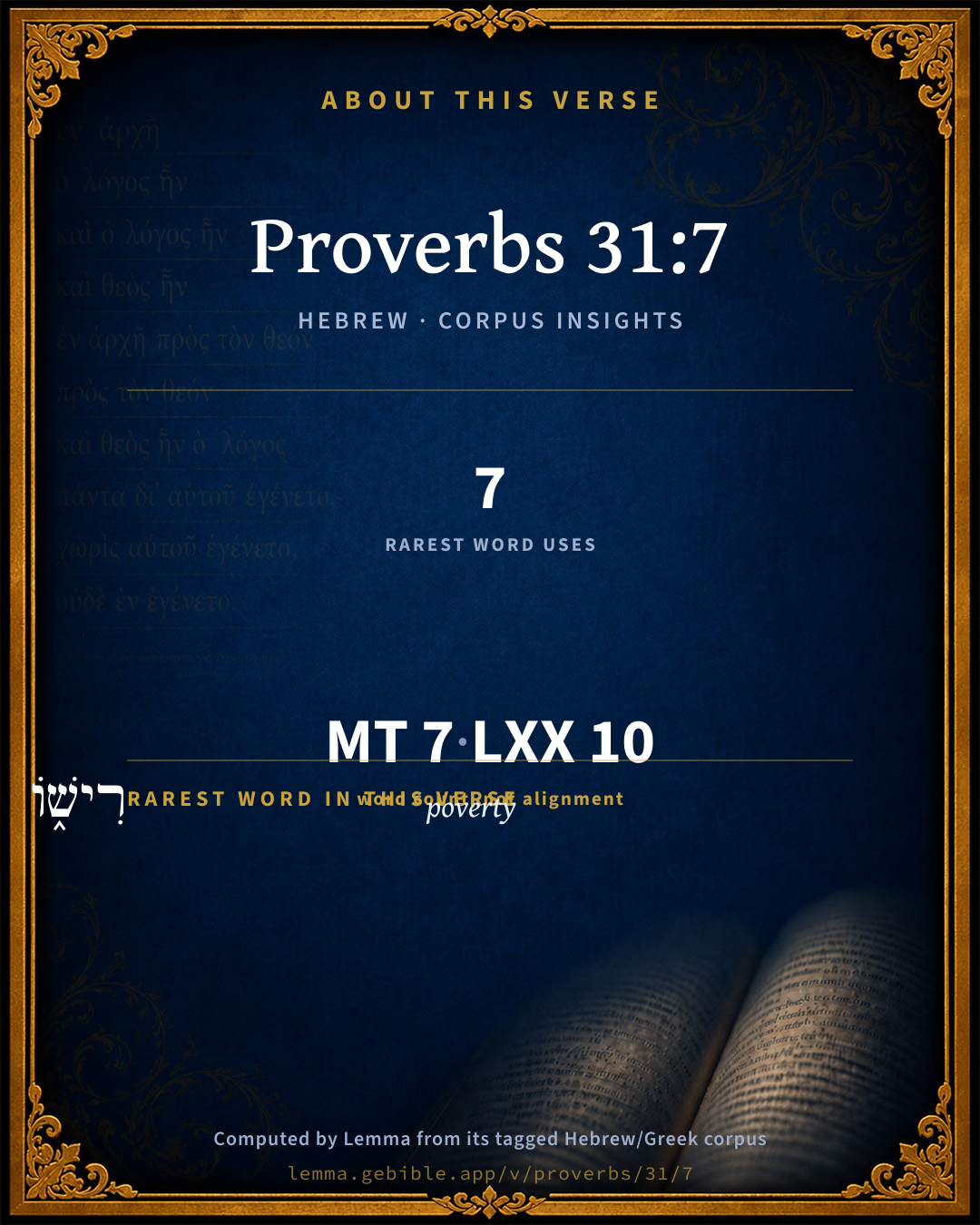
These counts appear in no published source. They are computed here, from the morphology-tagged text and Lemma’s own curated glosses. What Lemma adds →

7
words
7
distinct lemmas
Wisdom
section

Notable vocabulary

The rarest word here is רִישׁ֑וֹ poverty H7389 — appearing just 7 times in the whole Hebrew Bible.

Shared distinctive vocabulary

רִישׁ֑וֹ poverty H7389 occurs in 7 verses of the Hebrew Bible. Also found in:

Grammatical profile

  • 3 verbs
  • 2 nouns
  • 1 adverb
  • 1 particle

Verb forms

  • יִ֭שְׁתֶּה Qal · Imperfect
  • וְיִשְׁכַּ֣ח Qal · Imperfect
  • יִזְכָּר Qal · Jussive

Hebrew & Septuagint length

In English translation the verse runs 13 words from the Hebrew and 14 from the Septuagint (LXX English) — closely comparable.

A rough comparison of the two English renderings, which tokenize alike — not a word-level alignment.

Word counts can differ between the Hebrew and the Greek without any difference in meaning — e.g. the Hebrew direct-object marker אֵת has no separate Greek word, and Greek often adds the article ὁ.

In the original languages it is 7 Hebrew tokens and 10 Greek tokens — but the two are counted differently (Hebrew bundles its prefixes and suffixes into one token; the Greek is in lemma form), so that isn’t a like-for-like length.

Cross-references

1

Topical passages linked to Proverbs 31:7 in the Treasury of Scripture Knowledge — connected by theme and wording, ordered by reader-vote popularity; previews shown in the World English Bible.

  • Ephesians 5:18 Don't be drunken with wine, in which is dissipation, but be filled with the Spirit,

Cross-references courtesy of OpenBible.info (CC BY 4.0).

Hebrew and Greek witnesses Masoretic Hebrew ↔ Greek Septuagint

The same verse in the two great witnesses to the Old Testament, shown verse-for-verse.

These are two independent witnesses, not word-aligned to each other, and the Septuagint is shown in lemma (dictionary) form.

Hebrew Proverbs 31:7 Masoretic · Westminster Leningrad Codex

יִ֭שְׁתֶּה וְיִשְׁכַּ֣ח רִישׁ֑וֹ וַ֝עֲמָל֗וֹ לֹ֣א יִזְכָּר עֽוֹד

Let him drink, and forget his poverty, And remember his misery no more.

World English Bible · Public Domain

Greek LXX Proverbs 31:7 Septuagint · lemma form

ἵνα ἐπιλανθάνω ὁ πενία καί ὁ πόνος μή μιμνήσκω ἔτι

that they may forget their poverty, and may not remember their troubles any more.

LXX2012 (modern English Septuagint) · Public Domain

On this verse, John Gill's Exposition discusses the Septuagint’s reading. Read the note in Commentary ↓

Hebrew: Westminster Leningrad Codex (CC BY 4.0). Greek: Septuagint (public domain); English from LXX2012 (modern English Septuagint) (Public Domain). How the Septuagint differs from the Hebrew →

Commentary

Notes on Proverbs 31:7 from classic Christian and Jewish commentators (each source and its license shown beneath its notes). The classic Christian expositions comment on the surrounding passage and are grouped to its opening verse, so a note may address several verses; the Jewish commentaries on the Tanakh (Rashi and others) are per-verse, so they appear only where the commentator wrote on this verse.

Lemma curates 59 commentaries, every one of them public domain or Creative Commons licensed, each selected and text-cleaned for this edition rather than reprinted as found. About our sources →

Trapp's Complete Commentary

John Trapp

Pro 31:7 Let him drink, and forget his poverty, and remember his misery no more.

Ver. 7. Let him drink and forget his poverty.] And yet let him drink moderately too, lest he increase his sorrows, as Lot did, and not diminish them, for drunkenness leaves a sting behind it worse than that of a serpent or of a cockatrice. {Pro 23:32} Wine is a prohibited ware among the Turks, which makes some drink with scruple - others with danger. The baser sort, when taken drunk, are often bastinadoed {a} upon the bare feet. And I have seen some, saith mine author, {b} after a fit of drunkenness, lie a whole night crying, and praying to Mohammed for intercession, that I could not sleep near them, so strong is conscience, even where the foundation is but imaginary.

{a} To beat or cane on the soles of the feet.

{b} Blunt’s Voyage, p. 105.

John Trapp, A Commentary or Exposition upon All the Books of the Old and New Testament (1647–1656) — public domain. Text from a community e-Sword module.

Geneva Bible (1599)

Geneva Bible translators

For wine doth comfort the heart, as Ps. 104:15.

Geneva Bible (1599) marginal notes — public domain. Text via Bolls.life.

John Gill's Exposition

Let him drink, and forget his poverty,.... Which has been very pressing upon him, and afflicting to him; let him drink till he is cheerful, and forgets that he is a poor man; however, so far forgets as not to be troubled about it, and have any anxious thoughts how he must have food and raiment (k);

and remember his misery no more; the anguish of his mind because of his straitened circumstances; or "his labour" (l), as it may be rendered; so the Septuagint and Arabic versions, the labour of his body, the pains he takes to get a little food for himself and family. The Targum is,

"and remember his torn garments no more;''

his rags, a part of his poverty. Such virtue wine may have for the present to dispel care, than which it is said nothing can be better (m); and to induce a forgetfulness of misery, poverty, and of other troubles. So the mixed wine Helena gave to Telemachus, called Nepenthe, which when drunk, had such an effect as to remove sorrow, and to bring on forgetfulness of past evils (n); and of which Diodorus Siculus (o) and Pliny (p) speak as of such use. The ancients used to call Bacchus, the god of wine, the son of forgetfulness; but Plutarch (q) thought he should rather be called the father of it. Some, by those that are "ready to perish", understand condemned malefactors, just going to die; and think the Jewish practice of giving wine mingled with myrrh or frankincense, or a stupefying potion to such that they might not be sensible of their misery (r), such as the Jews are supposed to otter to Christ, Mar 15:23; is grounded upon this passage; but the sense given is best: the whole may be applied in a spiritual manner to such persons who see themselves in a "perishing", state and condition; whose consciences are loaded with guilt, whose souls are filled with a sense of wrath, have a sight of sin, but not of a Saviour; behold a broken, cursing, damning law, the flaming sword of justice turning every way, but no righteousness to answer for them, no peace, no pardon, no stoning sacrifice but look upon themselves lost and undone: and so of "heavy hearts"; have a spirit of heaviness in them, a heaviness upon their spirits: a load of guilt on them too heavy to bear, so that they cannot look up: or are "bitter in soul"; sin is made bitter to them, and they weep bitterly for it: now to such persons "wine", in a spiritual sense, should be given; the Gospel, which is as the best wine, that, goes down sweetly, should be preached unto them; they should be told of the love of God and Christ to poor sinners, which is better than wine; and the blessings of grace should be set before them, as peace, pardon, righteousness, and eternal life, by Christ, the milk and wine to be had without money and without price; of these they should drink, or participate of, by faith, freely, largely, and to full satisfaction; by means of which they will "forget" their spiritual "poverty", and consider themselves as possessed of the riches of grace, as rich in faith, and heirs of a kingdom; and so remember no more their miserable estate by nature, and the anguish of their souls in the view of that; unless it be to magnify and adore the riches of God's grace in their deliverance.

(k) "Tunc dolor a curae rugaqae frontis abit", Ovid. de Arte Amandi, l. 1. (l) "laboris sui", Pagninus, Montanus. (m) Cyprius poeta apud Suidam in voce (n) Homer. Odyss. 4. v. 220, 221. (o) Bibliothec. l. 1. p. 87, 88. (p) Nat. Hist. l. 21, c. 21. (q) Symposiac. l. 7. Probl. 5. p. 705. (r) Vid. T. Bab. Sanhedrin, fol. 43. 1. Bemidbar Rabba, s. 10. fol. 198. 4.

John Gill's Exposition of the Whole Bible (1746–1763) — public domain (CC PDM 1.0). Text via the HelloAO Bible API.

Haydock's Catholic Bible Commentary

More. Not that intoxication is permitted even to them.

George Leo Haydock (1774–1849), Haydock's Catholic Family Bible and Commentary, 1859 edition — public domain. Excludes Psalms (Douay-Rheims chapter numbering differs from Protestant) and Deuterocanonical books (Catholic canon only).

Matthew Poole's English Annotations

For wine, moderately used, allayeth men’s cares and fears, and cheereth their spirits, Psa 104:15.

Matthew Poole's English Annotations on the Holy Bible (1683–1685) — public domain. Text from a community e-Sword/MySword module.

The Pulpit Commentary

Let him drink, and forget his poverty. Ovid, "Art. Amat.," 1:237"Vina parant animos, faciuntque caloribus aptos: Cura fugit multo diluiturque mero. Tunc veniunt risus; tunc pauper cornua sumit; Tunc dolor, et curae, rugaque frontis abit. Thus is shown a way in which the rich can comfort and encourage their poorer brethren, which is a better method of using God"s good gifts than by expending them on their own selfish enjoyment.

The Pulpit Commentary (1880–1919), ed. H.D.M. Spence-Jones & Joseph S. Exell — public domain. Text from a community e-Sword module.

Lesson kit

Teaching starters — assembled from the data on this page, not authored interpretation. Every prompt links to the verse data it draws on. Edit before teaching.

Proverbs, in the Wisdom, opens this verse with 7 words (7 distinct Hebrew lemmas). Its most distinctive word is rêysh (“poverty”). A historical commentator’s framing appears above. Read the whole chapter for the surrounding context.

Discussion questions

  1. How does “poverty” (rêysh) shape what this verse is saying?
  2. Proverbs 6:11 shares the word «poverty» with this verse. How do the two illuminate each other?
  3. The translations on this page render this verse differently — a whole-verse word diff, not a word-by-word alignment. What might account for the different wordings?
  4. The verb «יִ֭שְׁתֶּה» is Qal Imperfect. How does its form color the action?
  5. Reading how Trapp's Complete Commentary and Geneva Bible (1599) read this verse, where do the two commentators agree and where do they part?

Things to notice

Reading settings

Reading text

Shown beneath each verse's original-language words.

Old Testament
Old Testament edition

Read the OT as the Masoretic Hebrew (MT) or the Greek Septuagint (LXX).

English shown for the Greek Septuagint (in the Hebrew ↔ Greek comparison).

Comparing translations? Open the Compare panel on any verse page to stack up to four side by side.