2 Kings 9:34

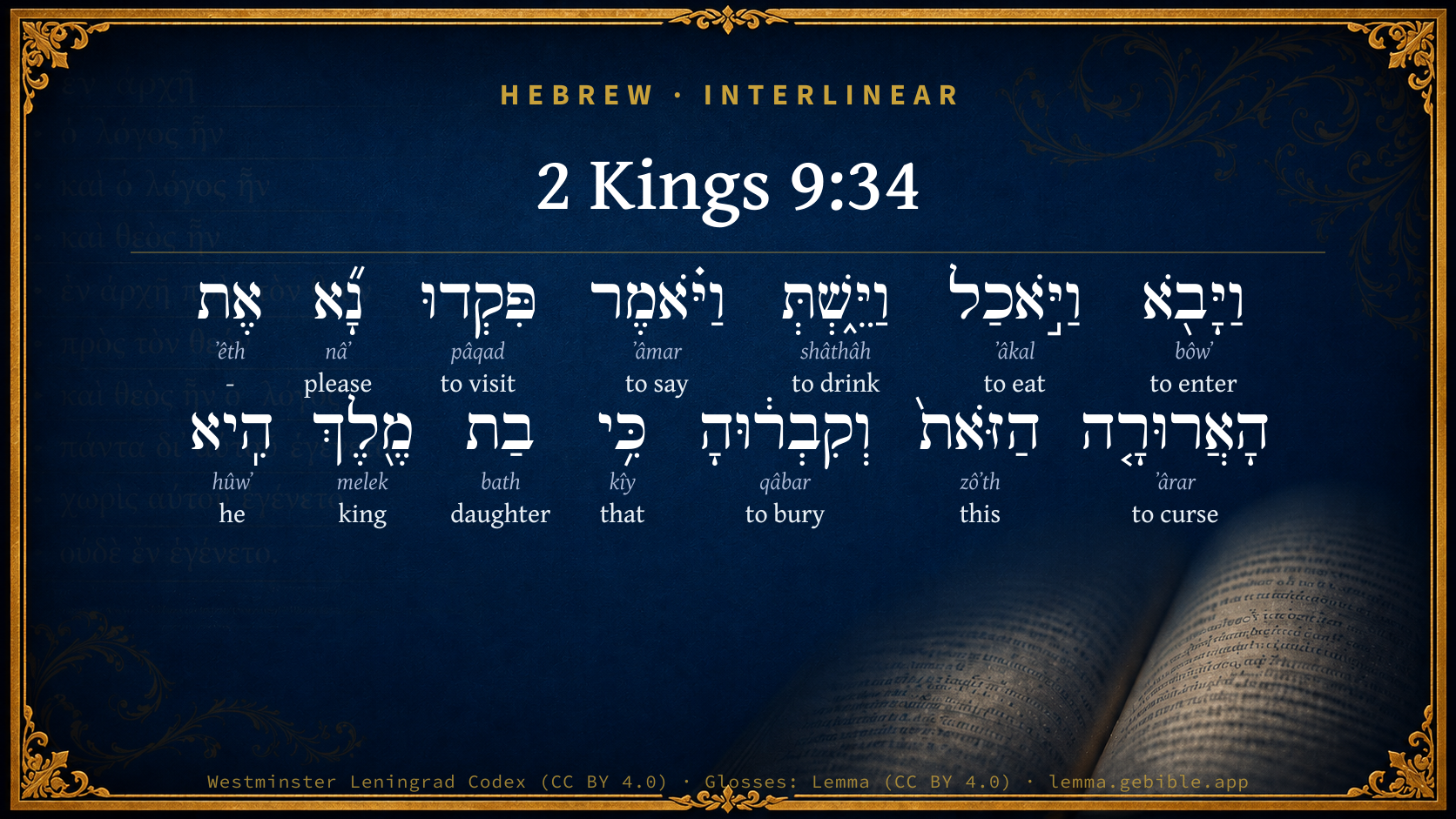
Hebrew (Westminster Leningrad Codex) 2 Kings 9:34 appears in the Hebrew Old Testament. The text above is from the Westminster Leningrad Codex. Each word links to its Strong’s number, a concise gloss, and parsing drawn from the Open Scriptures Hebrew Bible morphology. Click any word for its full Brown-Driver-Briggs (BDB) entry.
Download image
Cite this verse

2 Kings 9:34 (World English Bible). Public Domain. Lemma interlinear Bible study tool, https://lemma.gebible.app/v/2-kings/9/34.

Show BibTeX & RIS
BibTeX
RIS
English Translation
When he was come in, he ate and drink; and he said, See now to this cursed woman, and bury her; for she is a king's daughter.
World English Bible · Public Domain
Download a study sheet

One document with this verse’s original text, its word-by-word gloss line, the meaning frame, cross-references with their text, attributed commentary, and full source and license credits — printable, and it pastes into notes with its structure intact.

This verse Autodidact and up

Study sheet (.html) Plain text (.txt)

A passage Seminary Student

Up to 50 verses in one chapter. A passage sheet keeps up to 6 commentary sources and 12 cross-references per verse, in the order this page ranks them, and says so on the sheet whenever that leaves anything out. Ask for a single verse and you get the Autodidact verse sheet above.

Everything on this page stays free to read, with no account — the sheet is a download of what is already on screen, not access to it.

Want to remove ads? Support Godless Engineer
Compare translations 3

The same verse in 3 English versions, stacked beneath the original-language interlinear above. Click any original word for its lexicon entry.

Each is an independent rendering of the whole verse — the interlinear is not word-aligned to these translations.

Highlighted words mark where these versions differ — a whole-verse word diff, not a word-by-word alignment.

  • World English Bible Public Domain
    When he was come in, he ate and drink; and he said, See now to this cursed woman, and bury her; for she is a king's daughter.
  • King James Version Public Domain
    And when he was come in, he did eat and drink, and said, Go, see now this cursed woman, and bury her: for she is a king's daughter.
  • unfoldingWord Literal Text CC BY-SA 4.0
    And he entered, and he ate and drank. Then he said, “Look after this cursed woman, please, and bury her, for she the daughter of a king.”

unfoldingWord Literal Text — © unfoldingWord, licensed CC BY-SA 4.0. Word-aligned USFM3 via Door43 (git.door43.org/unfoldingWord/en_ult).

Versions to compare (up to 4)

3 of 4 selected

Show all 18 translations

Every available English version of this verse, each an independent rendering of the whole verse.

  • World English Bible Public Domain
    When he was come in, he ate and drink; and he said, See now to this cursed woman, and bury her; for she is a king's daughter.
  • Berean Standard Bible Public Domain
    Then Jehu went in and ate and drank. “Take care of this cursed woman,” he said, “and bury her, for she was the daughter of a king.”
  • Majority Standard Bible Public Domain
    Then Jehu went in and ate and drank. “Take care of this cursed woman,” he said, “and bury her, for she was the daughter of a king.”
  • King James Version Public Domain
    And when he was come in, he did eat and drink, and said, Go, see now this cursed woman, and bury her: for she is a king's daughter.
  • American Standard Version (1901) Public Domain
    And when he was come in, he did eat and drink; and he said, See now to this cursed woman, and bury her; for she is a king's daughter.
  • Revised Version (1885) Public Domain
    And when he was come in, he did eat and drink; and he said, See now to this cursed woman, and bury her: for she is a king’s daughter.
  • Geneva Bible (1599) Public Domain
    And when he was come in, he did eate and drinke, and sayde, Visite now yonder cursed woman, and burie her: for she is a Kings daughter.
  • Douay-Rheims (1899) Public Domain
    And when he was come in, to eat, and to drink, he said: Go, and see after that cursed woman, and bury her: because she is a king's daughter.
  • Young's Literal Translation Public Domain
    And he cometh in, and eateth, and drinketh, and saith, `Look after, I pray you, this cursed one, and bury her, for she `is' a king's daughter.'
  • Literal Standard Version CC BY-SA 4.0
    And he comes in, and eats, and drinks, and says, “Now look after this cursed one and bury her, for she [is] a king’s daughter.”
  • Unlocked Literal Bible CC BY-SA 4.0
    When Jehu entered the palace, he ate and drank. Then he said, “See now to this cursed woman and bury her, for she is a king's daughter.”
  • unfoldingWord Literal Text CC BY-SA 4.0
    And he entered, and he ate and drank. Then he said, “Look after this cursed woman, please, and bury her, for she the daughter of a king.”
  • Darby Bible Public Domain
    And he came in, and ate and drank; and he said, Go, look, I pray you, after this cursed [woman], and bury her; for she is a king's daughter.
  • World Messianic Bible Public Domain
    When he had come in, he ate and drank. Then he said, “See now to this cursed woman, and bury her; for she is a king’s daughter.”
  • Webster's Bible Public Domain
    And when he had come in, he ate, and drank, and said, Go, see now this cursed woman, and bury her: for she is a king's daughter.
  • Free Bible Version CC BY-SA 4.0
    Jehu went inside and ate and drank. Then he said, “Please deal with that cursed woman and bury her, for she was a king's daughter.”
  • Bible in Basic English Public Domain
    And he came in, and took food and drink; then he said, Now see to this cursed woman, and put her body into the earth, for she is a king's daughter.
  • JPS Tanakh (1917) Public Domain
    And when he was come in, he did eat and drink; and he said: 'Look now after this cursed woman, and bury her; for she is a king's daughter.'

Literal Standard Version (2020), Covenant Press — licensed CC BY-SA 4.0. Text via the HelloAO Bible API (eBible.org). Unlocked Literal Bible (unfoldingWord) — licensed CC BY-SA 4.0. Text via the HelloAO Bible API (eBible.org). unfoldingWord Literal Text — © unfoldingWord, licensed CC BY-SA 4.0. Word-aligned USFM3 via Door43 (git.door43.org/unfoldingWord/en_ult). Free Bible Version, Dr. Jonathan Gallagher — licensed CC BY-SA 4.0. Text via the HelloAO Bible API (eBible.org).

Word by word

More ways to search: Search by grammar → Find every occurrence → Compare this word →

Practice this passage: Drill this verse → Learn its vocabulary →

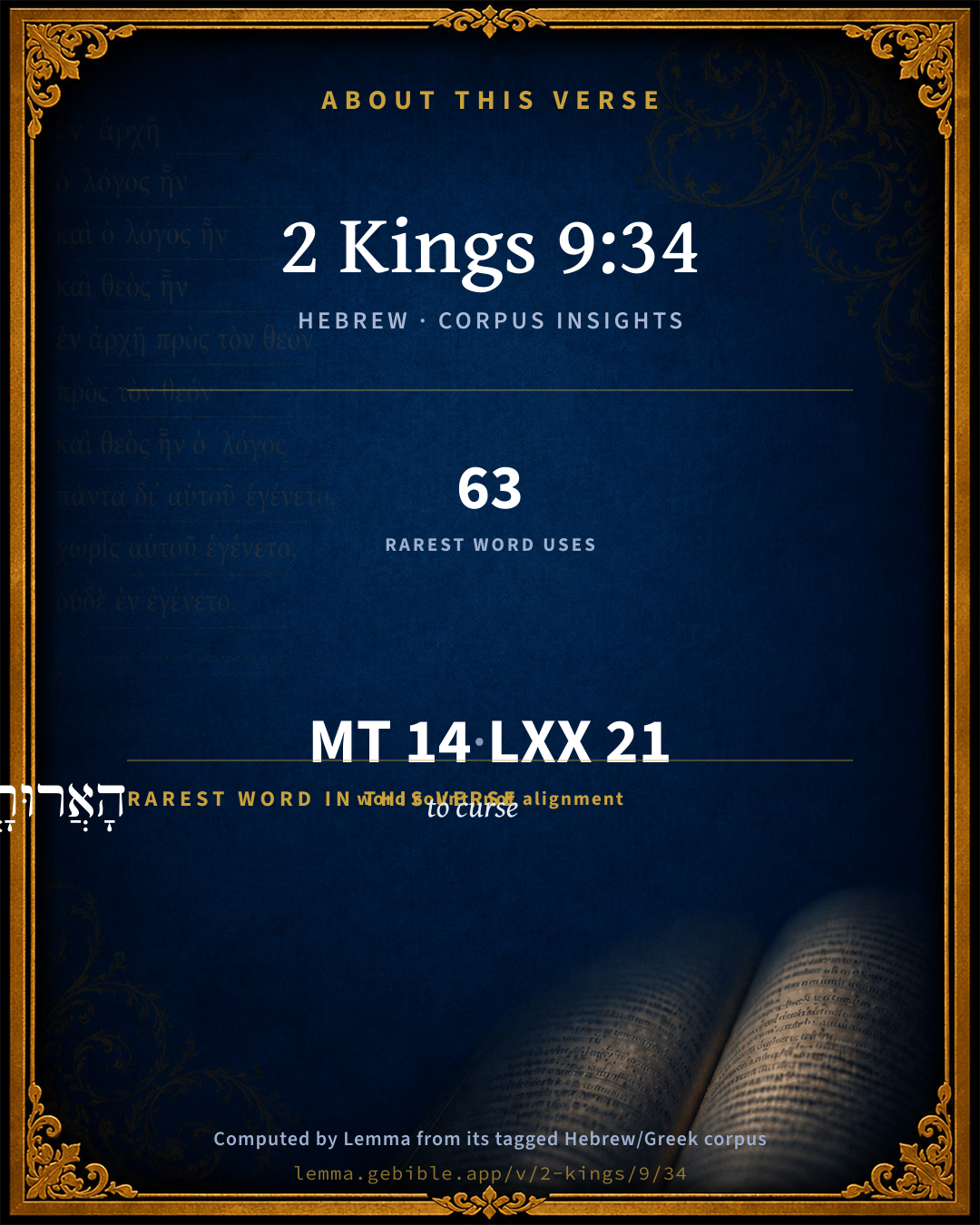
הָאֲרוּרָ֤ה
ʼârar
H779
“the · cursed”
Particle, Definite Article + Verb, Qal, Participle Passive, Feminine, Singular, Absolute
Part of Speech
Particle + Verb
Stem
Qal
Form
Participle Passive
Gender
Feminine
Number
Singular
State
Absolute
Full BDB Definition

Origin: a primitive root

TWOT: 168

to curse - (Qal) - to curse - cursed be he (participle used pr in curses) - (Niphal) to be cursed, cursed - (Piel) to curse, lay under a curse, put a curse on - (Hophal) to be made a curse, be cursed
  1. וַיָּבֹ֖א bôwʼ H935 “and · to enter” Conjunction + Verb, Qal, Sequential Imperfect, 3rd Person, Masculine, Singular
  2. וַיֹּ֣אכַל ʼâkal H398 “and · to eat” Conjunction + Verb, Qal, Sequential Imperfect, 3rd Person, Masculine, Singular
  3. וַיֵּ֑שְׁתְּ shâthâh H8354 “and · to drink” Conjunction + Verb, Qal, Sequential Imperfect, 3rd Person, Masculine, Singular
  4. וַיֹּ֗אמֶר ʼâmar H559 “and · to say” Conjunction + Verb, Qal, Sequential Imperfect, 3rd Person, Masculine, Singular
  5. פִּקְדוּ pâqad H6485 “visit” Verb, Qal, Imperative, 2nd Person, Masculine, Plural
  6. נָ֞א nâʼ H4994 “please” Particle, Exhortation
  7. אֶת ʼêth H853 “-” Particle, Direct Object
  8. הַזֹּאת֙ zôʼth H2063 “the · this” Particle, Definite Article + Pronoun, Demonstrative, Feminine, Singular
  9. וְקִבְר֔וּהָ qâbar H6912 “and · bury · her” Conjunction + Verb, Qal, Imperative, 2nd Person, Masculine, Plural + Suffix, Personal, 3rd Person, Feminine, Singular
  10. כִּ֥י kîy H3588 “that” Conjunction
  11. בַת bath H1323 “daughter of” Noun, Common, Feminine, Singular, Construct
  12. מֶ֖לֶךְ melek H4428 “king” Noun, Common, Masculine, Singular, Absolute
  13. הִֽיא hûwʼ H1931 “he” Pronoun, Personal, 3rd Person, Feminine, Singular

About this verse

These counts appear in no published source. They are computed here, from the morphology-tagged text and Lemma’s own curated glosses. What Lemma adds →

14
words
14
distinct lemmas
Historical
section

Grammatical profile

  • 7 verbs
  • 2 nouns
  • 2 pronouns
  • 1 conjunction
  • 2 particles

Verb forms

  • וַיָּבֹ֖א Qal · Sequential Imperfect
  • וַיֹּ֣אכַל Qal · Sequential Imperfect
  • וַיֵּ֑שְׁתְּ Qal · Sequential Imperfect
  • וַיֹּ֗אמֶר Qal · Sequential Imperfect
  • פִּקְדוּ Qal · Imperative
  • הָאֲרוּרָ֤ה Qal · Participle Passive
  • וְקִבְר֔וּהָ Qal · Imperative

Hebrew & Septuagint length

In English translation the verse runs 27 words from the Hebrew and 25 from the Septuagint (LXX English) — closely comparable.

A rough comparison of the two English renderings, which tokenize alike — not a word-level alignment.

Word counts can differ between the Hebrew and the Greek without any difference in meaning — e.g. the Hebrew direct-object marker אֵת has no separate Greek word, and Greek often adds the article ὁ.

In the original languages it is 14 Hebrew tokens and 21 Greek tokens — but the two are counted differently (Hebrew bundles its prefixes and suffixes into one token; the Greek is in lemma form), so that isn’t a like-for-like length.

Cross-references

8

Topical passages linked to 2 Kings 9:34 in the Treasury of Scripture Knowledge — connected by theme and wording, ordered by reader-vote popularity; previews shown in the World English Bible.

  • 1 Kings 16:31 It happened, as if it had been a light thing for him to walk in the sins of Jeroboam the son of Nebat, that he took as wife Jezebel the daughter of Ethbaal king of the Sidonians, and went and served Baal, and worshiped him.
  • 1 Kings 21:25 (But there was none like Ahab, who did sell himself to do that which was evil in the sight of Yahweh, whom Jezebel his wife stirred up.
  • 1 Kings 18:41 Elijah said to Ahab, Get you up, eat and drink; for there is the sound of abundance of rain.
  • Esther 3:15 The posts went forth in haste by the king's commandment, and the decree was given out in Shushan the palace. The king and Haman sat down to drink; but the city of Shushan was perplexed.
  • Proverbs 10:7 The memory of the righteous is blessed, But the name of the wicked will rot.
  • Isaiah 65:15 You shall leave your name for a curse to my chosen; and the Lord Yahweh will kill you; and he will call his servants by another name:
  • Matthew 25:41 Then he will say also to those on the left hand, 'Depart from me, you cursed, into the eternal fire which is prepared for the devil and his angels;
  • Amos 6:4 Who lie on beds of ivory, And stretch themselves on their couches, And eat the lambs out of the flock, And the calves out of the midst of the stall;

Cross-references courtesy of OpenBible.info (CC BY 4.0).

Hebrew and Greek witnesses Masoretic Hebrew ↔ Greek Septuagint

The same verse in the two great witnesses to the Old Testament, shown verse-for-verse.

These are two independent witnesses, not word-aligned to each other, and the Septuagint is shown in lemma (dictionary) form.

Hebrew 2 Kings 9:34 Masoretic · Westminster Leningrad Codex

וַיָּבֹ֖א וַיֹּ֣אכַל וַיֵּ֑שְׁתְּ וַיֹּ֗אמֶר פִּקְדוּ נָ֞א אֶת הָאֲרוּרָ֤ה הַזֹּאת֙ וְקִבְר֔וּהָ כִּ֥י בַת מֶ֖לֶךְ הִֽיא

When he was come in, he ate and drink; and he said, See now to this cursed woman, and bury her; for she is a king's daughter.

World English Bible · Public Domain

Greek LXX 2 Kings 9:34 Septuagint · lemma form

καί εἰςἔρχομαι ιου καί ἐσθίω καί πίνω καί εἶπον ἐπισκέπτομαι δή ὁ καταἀράομαι οὗτος καί θάπτω αὐτός ὅτι θυγάτηρ βασιλεύς εἰμί

And Ju went in and ate and drank, and said, Look now, after this cursed woman, and bury her, for she is a king's daughter.

LXX2012 (modern English Septuagint) · Public Domain

Hebrew: Westminster Leningrad Codex (CC BY 4.0). Greek: Septuagint (public domain); English from LXX2012 (modern English Septuagint) (Public Domain). How the Septuagint differs from the Hebrew →

Targum (Aramaic paraphrase)

1

The Targum is the ancient Jewish Aramaic paraphrase of the Hebrew Scriptures — an interpretive translation, not the Hebrew text itself. Onkelos (literal) and Pseudo-Jonathan (expansive) render the Torah, and Jonathan the Prophets. Coverage is partial: where no permissively-licensed English translation exists for a verse, only the Aramaic is shown. This is verse-level text, not a word-by-word alignment to the Hebrew.

  1. Targum Jonathan Prophets (Joshua–Malachi)
    וְעַל וַאֲכַל וּשְׁתֵי וַאֲמַר סְעַדוּ כְעַן יַת אֲרוּרְתָּא הָדָא וְקִבְרוּהָא אֲרֵי בַת מַלְכָּא הִיא:

    (no public-domain English translation for this verse)

    Targum Jonathan — Aramaic: “Mikraot Gedolot” (public domain). English: “Sefaria Community Translation” (CC0 1.0 (public-domain dedication)); “London "Chaldee Paraphrase," 1871” (public domain). Text via Sefaria.

Commentary

Notes on 2 Kings 9:34 from classic Christian and Jewish commentators (each source and its license shown beneath its notes). The classic Christian expositions comment on the surrounding passage and are grouped to its opening verse, so a note may address several verses; the Jewish commentaries on the Tanakh (Rashi and others) are per-verse, so they appear only where the commentator wrote on this verse.

Lemma curates 59 commentaries, every one of them public domain or Creative Commons licensed, each selected and text-cleaned for this edition rather than reprinted as found. About our sources →

Trapp's Complete Commentary

John Trapp

2Ki 9:34 And when he was come in, he did eat and drink, and said, Go, see now this cursed [woman], and bury her: for she [is] a king’s daughter.

Ver. 34. And bury her.] He had forgot, belike, at present, the prophecy of Elijah, that dogs should eat her flesh, which yet soon after he remembereth. {2Ki 9:36}

For she is a king’s daughter.] Meaning Ethbaal king of Zidon, whom he was loath to incense.

John Trapp, A Commentary or Exposition upon All the Books of the Old and New Testament (1647–1656) — public domain. Text from a community e-Sword module.

Joseph Benson's Commentary

2Ki 9:34. Go see now this cursed woman — She had been the greatest delinquent in the house of Ahab. She had introduced Baal; slain the Lord’s prophets; contrived the murder of Naboth; excited her husband first, and then her sons, to do wickedly. She had been a curse to her country, and one whose memory all who loved their country execrated. Three reigns her reign had lasted, but now, at length, her day was come to fall, and meet with the due reward of her deeds. And bury her, for she is a king’s daughter — He does not say, because she was a king’s wife, lest he should seem to show any respect to that wicked house of Ahab, which God had devoted to ignominy and destruction. When Jehu gave this order about burying Jezebel, he seems to have for gotten the prediction of the prophet, and the charge given, 2Ki 9:10. But though he had forgotten it, God had not: while he was eating and drinking, the dogs had devoured her dead body; so that there was nothing left but her bare scull, (the painted face was gone,) and her feet and hands. The hungry dogs paid no respect to the dignity of her extraction: a king’s daughter was no more to them than a common person. It is probable, when the horsemen were gone, who trod her under foot, the footmen stripped her, and left her in her own blood exposed to the dogs, that came out of the city in great numbers, by the ordination of Providence, and with a more than common hunger, otherwise they could not have devoured the body in so short a time.

Joseph Benson's Commentary on the Old and New Testaments (1811–1818) — public domain. Text from a community e-Sword module.

Tyndale Open Study Notes

Tyndale Open Resources

9:34-37 The scene depicting Jezebel’s end brought Elijah’s prophecy against the house of Ahab to final fulfillment (1 Kgs 21:21-24; 22:34-38).

9:34 Jehu went into the palace to dine, a tacit declaration of his assumption of the throne.

Tyndale Open Study Notes — © Tyndale Open Resources, licensed CC BY-SA 4.0. Text via the HelloAO Bible API.

Geneva Bible (1599)

Geneva Bible translators

To wit, of the king of Sidon, 1 Kings 16:31.

Geneva Bible (1599) marginal notes — public domain. Text via Bolls.life.

Adam Clarke's Commentary

Verse 34. She is a king's daughter.] Jezebel was certainly a woman of a very high lineage. She was daughter of the king of Tyre; wife of Ahab, king of Israel; mother of Joram, king of Israel; mother-in-law of Joram, king of Judah; and grandmother of Ahaziah, king of Judah.

Adam Clarke's Commentary on the Bible (1810–1826) — public domain. Text from a community e-Sword/MySword module.

Ellicott's Commentary for English Readers

(34) And when . . . drink.—Rather, And he went in (into the palace), and ate and drank. Jehu takes possession of the palace, having slain its former occupants. Savage warrior as he was, he forgot all about the victim of his violence until he had appeased the demands of his appetite. Then he could remember that even Jezebel was of royal rank, and perhaps a touch of remorse may be discerned in the mandate for her burial.

Go, see now.—Rather, Look, I pray, after.

This cursed woman.—Jehu was thinking of the curse pronounced on Jezebel by the prophet Elijah. (See next verse.)

She is a king’s daughter.—Compare 1Ki_16:31.

A Bible Commentary for English Readers, edited by Charles John Ellicott (1878–1897) — public domain. Text from a community e-Sword module.

The Cambridge Bible for Schools and Colleges

gen. ed. J. J. S. Perowne

34. And when he was come in] To the palace, where now he was master. Not only the eunuchs of Jezebel, but the household of Joram appears to have been ready to serve him, for the queen-mother is hardly dead before Jehu is set down to a banquet in the palace.

and said, Go, see now this cursed woman] [R.V. And he said, See now to this cursed woman] The ‘Go’ of A.V. is of course implied but not expressed in the original. By ‘cursed’ he means that she has brought God’s curse upon herself by her idolatry and bad example. It is no objurgation of his own. The word is the same that is employed in that solemn list of God’s curses on evil-doing in Deuteronomy 27, 28.

she is a king’s daughter] Jezebel was daughter of Ethbaal, king of the Sidonians. See note on 1Ki_16:31.

The Cambridge Bible for Schools and Colleges (gen. ed. J. J. S. Perowne; Cambridge University Press, 1878–1918) — public domain. Text from a community e-Sword module.

Albert Barnes' Notes on the Bible

Leaving the mangled body on the bare earth, Jehu went to the banquet. It was, no doubt, important that he should at once show himself to the court as king. In calling Jezebel “this cursed one,” Jehu means to remind his hearers that the curse of God had been pronounced upon her by Elijah 2Ki 9:36, and so to justify his own conduct.

A king’s daughter - Merely as the widow of Ahab and mother of Jehoram, Jehu would not have considered Jezebel entitled to buriah. But she was the daughter of Ethbaal, king of the Sidonians (marginal reference), and so a princess born. This would entitle her to greater respect. Wilfully to have denied her burial would have been regarded as an unpardonable insult by the reigning Sidonian monarch.

Albert Barnes' Notes on the Bible (1834–1885) — public domain. Text from a community e-Sword/MySword module.

Haydock's Catholic Bible Commentary

Bury. He had forgotten the prediction of Elias, ver. 36. (Salien) --- Daughter of Ethbaal, wife of Achab, mother of Joram king of Israel, and mother-in-law of Joram king of Juda, and grandmother of his son Ochozias. (Calmet) --- Her great connexions seemed to entitle her to the rights of sepulture. (Haydock)

George Leo Haydock (1774–1849), Haydock's Catholic Family Bible and Commentary, 1859 edition — public domain. Excludes Psalms (Douay-Rheims chapter numbering differs from Protestant) and Deuterocanonical books (Catholic canon only).

Matthew Poole's English Annotations

This he suddenly commanded: either because he had forgot the charge given him above, 2Ki 9:10, or because having done his own business, he was careless about God’s work, and the fulfilling of his threatening.

For she is a king’s daughter: see 1Ki 16:31. He doth not say, because she was a king’s wife, lest he should seem to show any respect to that wicked and cursed house of Ahab, which God had devoted to ignominy and utter destruction.

Matthew Poole's English Annotations on the Holy Bible (1683–1685) — public domain. Text from a community e-Sword/MySword module.

Whedon's Commentary on the Bible

Daniel D. Whedon

34. He did eat and drink — This scene of hilarity and cheer in the midst of such fearful bloodshed makes one shudder. But the minister of doom to Ahab’s guilty house must needs be such a one as Jehu. Tenderness and sympathy would unfit the avenger of blood for his work of death.

She is a king’s daughter — Yes, and a king’s widow and a king’s mother. But not till after his feast does Jehu reflect that so much royalty and greatness have fallen. He had left the mangled corpse of the once mighty Jezebel on the mounds of offal outside the gate, a prey to the dogs which in the East ever prowl about such spots.

Daniel D. Whedon (gen. ed.), Commentary on the Old and New Testaments (1874–1909) — public domain. Text from a community e-Sword module.

The Pulpit Commentary

And when he was come ini.e. when Jehu had established himself in the royal palacehe did eat and drink, and said. His first care was to refresh himself to order a banquet to be served, and to satisfy his appetite with food and drink. Not till afterwards did he bethink himself of the bloody corpse of his late queen and mistress, lying on the cold ground uncared for and untended, exposed to scorn and ignominy. When the thought occurred to him, it brought about a certain amount of relenting. Go, see now this cursed woman. He calls Jezebel, "a cursed woman," not inappropriately. She had brought a curse on her husband, on her sons, and on her grandsons; she had been the evil genius of two countries, Israel and Judah; she had been the prime mover in a bloody persecution of the worshippers of Jehovah; and was the true original source of the present revolution, which was to result in the deaths of so many others. And bury her: for she is a king"s daughter. As queen-mother, Jehu, it seems, would not have regarded Jezebel as entitled to burial; but as daughter of Eth-Baal, King of the Zidonians, (1Ki_16:31) and so a princess born, he allowed her claim. Perhaps he feared lest further insult to the corpse might provoke the resentment of the Phoenician monarch, and draw down upon him that prince"s hostility.

The Pulpit Commentary (1880–1919), ed. H.D.M. Spence-Jones & Joseph S. Exell — public domain. Text from a community e-Sword module.

John Wesley's Explanatory Notes

And said - It seems he had forgot the charge given him above, ver. 10. A king's daughter - He doth not say, because she was a king's wife, lest he should seem to shew any respect to that wicked house of Ahab, which God had devoted to utter destruction.

John Wesley, Explanatory Notes Upon the Whole Bible (1754–1765) — public domain. Text via the GEBible commentary corpus.

Keil & Delitzsch

C. F. Keil & F. Delitzsch

Jehu thereupon entered the palace, ate and drank, and then said to his men: "Look for this cursed woman and bury her, for she is a king's daughter." הארוּרה, the woman smitten by the curse of God.

Keil & Delitzsch — Biblical Commentary on the Old Testament (1861–1891) — public domain (CC PDM 1.0). Text via the HelloAO Bible API. (Old Testament only.)

Lesson kit

Teaching starters — assembled from the data on this page, not authored interpretation. Every prompt links to the verse data it draws on. Edit before teaching.

2 Kings, in the Historical, opens this verse with 14 words (14 distinct Hebrew lemmas). Its most distinctive word is ʼârar (“to curse”). A historical commentator’s framing appears above. Read the whole chapter for the surrounding context.

Discussion questions

  1. The word ʼârar carries the sense “to curse.” How does it shape the verse?
  2. 1 Kings 16:31 shares this passage’s theme. How do the two illuminate each other?
  3. The translations on this page render this verse differently — a whole-verse word diff, not a word-by-word alignment. What might account for the different wordings?
  4. The verb «וַיָּבֹ֖א» is Qal Sequential Imperfect. How does its form color the action?
  5. Reading how Trapp's Complete Commentary and Joseph Benson's Commentary read this verse, where do the two commentators agree and where do they part?

Things to notice

Reading settings

Reading text

Shown beneath each verse's original-language words.

Old Testament
Old Testament edition

Read the OT as the Masoretic Hebrew (MT) or the Greek Septuagint (LXX).

English shown for the Greek Septuagint (in the Hebrew ↔ Greek comparison).

Comparing translations? Open the Compare panel on any verse page to stack up to four side by side.