
Habakkuk 2:16

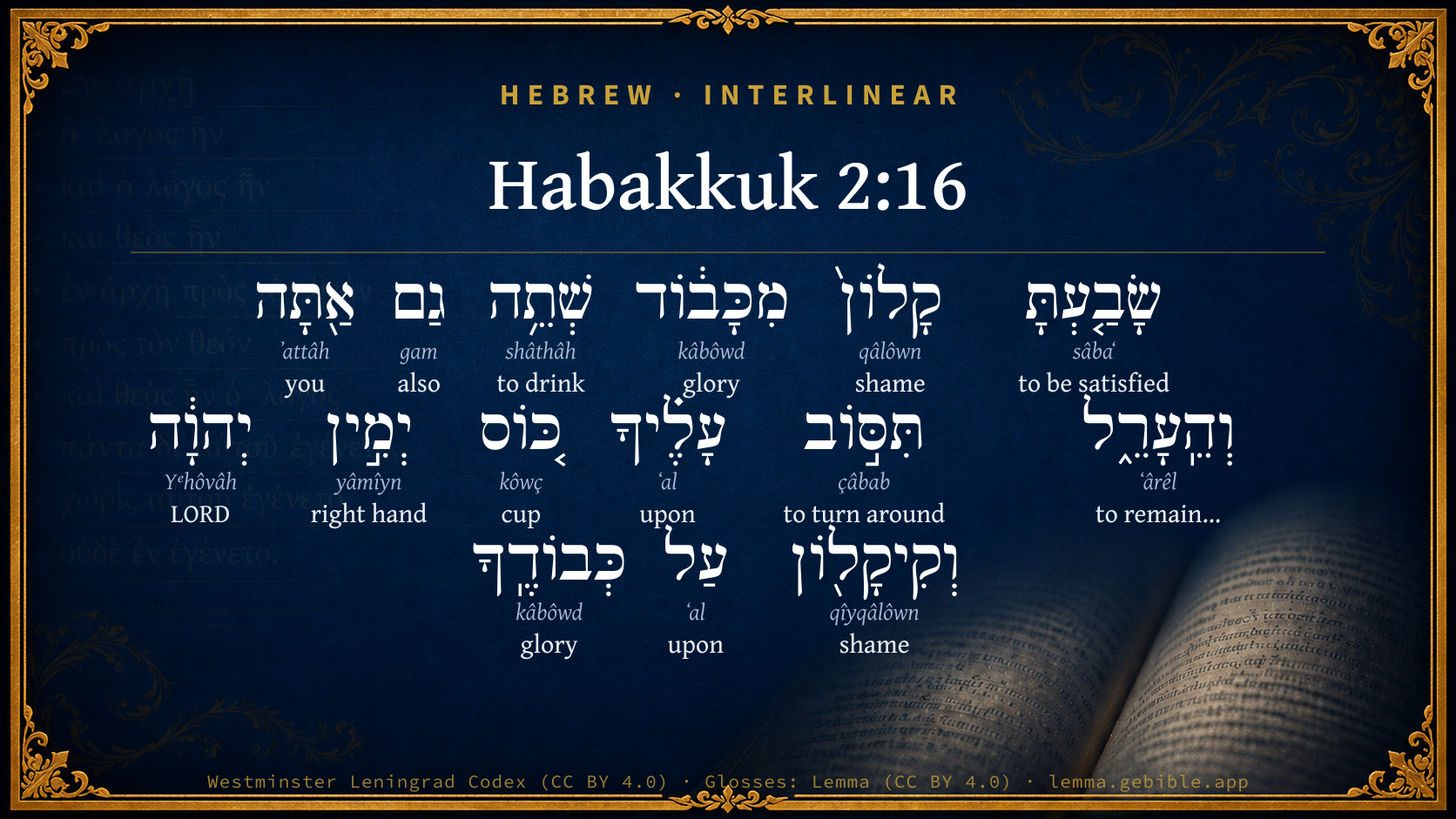
Hebrew (Westminster Leningrad Codex) Habakkuk 2:16 appears in the Hebrew Old Testament. The text above is from the Westminster Leningrad Codex. Each word links to its Strong’s number, a concise gloss, and parsing drawn from the Open Scriptures Hebrew Bible morphology. Click any word for its full Brown-Driver-Briggs (BDB) entry.
Download image
Cite this verse

Habakkuk 2:16 (World English Bible). Public Domain. Lemma interlinear Bible study tool, https://lemma.gebible.app/v/habakkuk/2/16.

Show BibTeX & RIS
BibTeX
RIS
English Translation
You are filled with shame, and not glory. You will also drink, and be exposed! The cup of Yahweh's right hand will come around to you, and disgrace will cover your glory.
World English Bible · Public Domain
Highlights
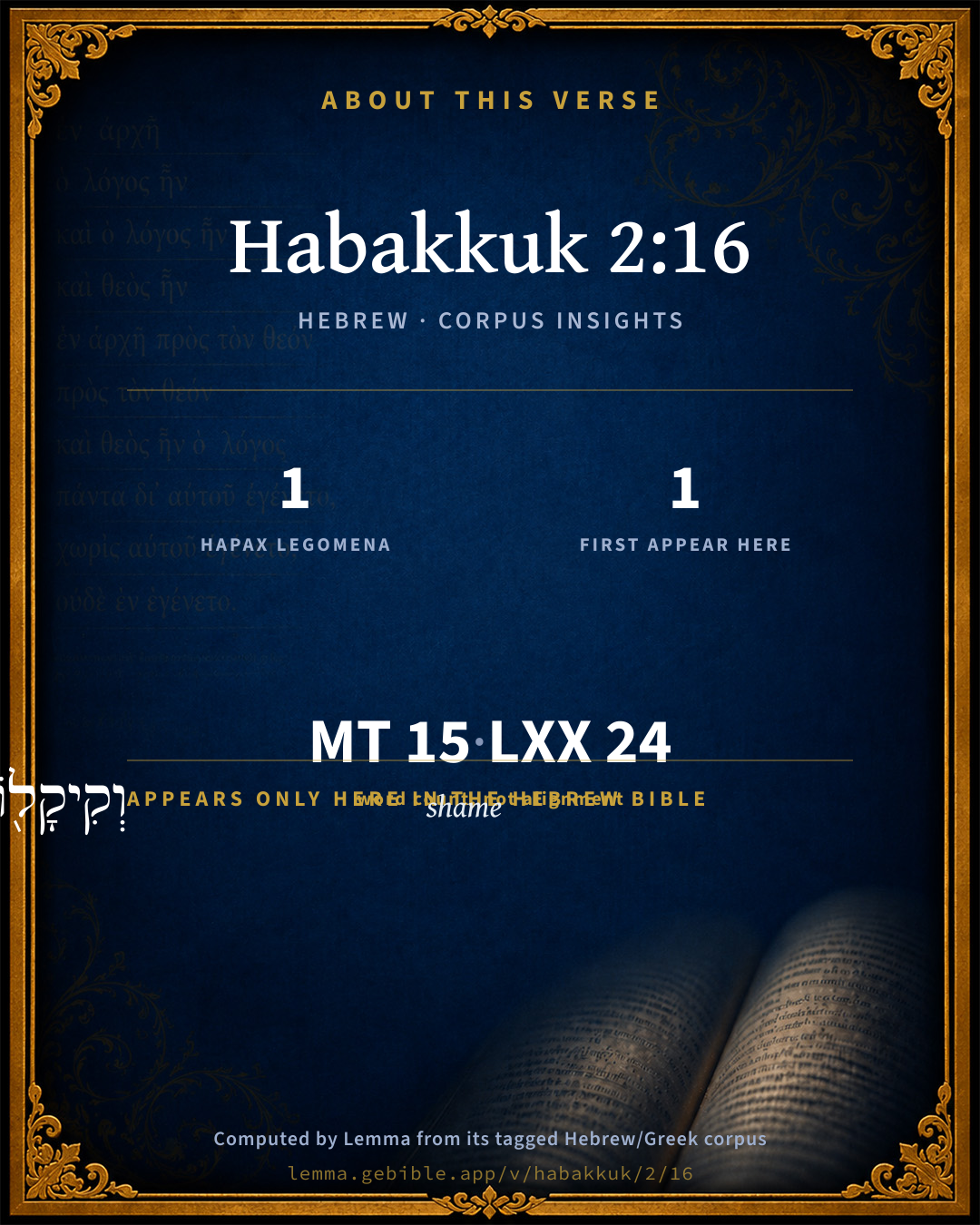
  • 1 hapax legomenon — only here in the Hebrew Bible
  • 1 first appearance in the Hebrew Bible
Full analysis ↓
Download a study sheet

One document with this verse’s original text, its word-by-word gloss line, the meaning frame, cross-references with their text, attributed commentary, and full source and license credits — printable, and it pastes into notes with its structure intact.

This verse Autodidact and up

Study sheet (.html) Plain text (.txt)

A passage Seminary Student

Up to 50 verses in one chapter. A passage sheet keeps up to 6 commentary sources and 12 cross-references per verse, in the order this page ranks them, and says so on the sheet whenever that leaves anything out. Ask for a single verse and you get the Autodidact verse sheet above.

Everything on this page stays free to read, with no account — the sheet is a download of what is already on screen, not access to it.

Want to remove ads? Support Godless Engineer
Compare translations 3

The same verse in 3 English versions, stacked beneath the original-language interlinear above. Click any original word for its lexicon entry.

Each is an independent rendering of the whole verse — the interlinear is not word-aligned to these translations.

Highlighted words mark where these versions differ — a whole-verse word diff, not a word-by-word alignment.

  • World English Bible Public Domain
    You are filled with shame, and not glory. You will also drink, and be exposed! The cup of Yahweh's right hand will come around to you, and disgrace will cover your glory.
  • King James Version Public Domain
    Thou art filled with shame for glory: drink thou also, and let thy foreskin be uncovered: the cup of the LORD's right hand shall be turned unto thee, and shameful spewing shall be on thy glory.
  • unfoldingWord Literal Text CC BY-SA 4.0
    You have become full shame instead of glory. Drink, you also, and be uncircumcised! The cup of the right hand of Yahweh will come around to you, and disgrace upon your glory.

unfoldingWord Literal Text — © unfoldingWord, licensed CC BY-SA 4.0. Word-aligned USFM3 via Door43 (git.door43.org/unfoldingWord/en_ult).

Versions to compare (up to 4)

3 of 4 selected

Show all 18 translations

Every available English version of this verse, each an independent rendering of the whole verse.

  • World English Bible Public Domain
    You are filled with shame, and not glory. You will also drink, and be exposed! The cup of Yahweh's right hand will come around to you, and disgrace will cover your glory.
  • Berean Standard Bible Public Domain
    You will be filled with shame instead of glory. You too must drink and expose your uncircumcision! The cup in the LORD’s right hand will come around to you, and utter disgrace will cover your glory.
  • Majority Standard Bible Public Domain
    You will be filled with shame instead of glory. You too must drink and expose your uncircumcision! The cup in the LORD’s right hand will come around to you, and utter disgrace will cover your glory.
  • King James Version Public Domain
    Thou art filled with shame for glory: drink thou also, and let thy foreskin be uncovered: the cup of the LORD's right hand shall be turned unto thee, and shameful spewing shall be on thy glory.
  • American Standard Version (1901) Public Domain
    Thou art filled with shame, and not glory: drink thou also, and be as one uncircumcised; the cup of Jehovah's right hand shall come round unto thee, and foul shame shall be upon thy glory.
  • Revised Version (1885) Public Domain
    Thou art filled with shame for glory: drink thou also, and be as one uncircumcised: the cup of the LORD’S right hand shall be turned unto thee, and foul shame shall be upon thy glory.
  • Geneva Bible (1599) Public Domain
    Thou art filled with shame for glorie: drinke thou also, and be made naked: the cup of the Lords right hand shall be turned vnto thee, and shamefull spuing shalbe for thy glory.
  • Douay-Rheims (1899) Public Domain
    Thou art filled with shame instead of glory: drink thou also, and fall fast asleep: the cup of the right hand of the Lord shall compass thee, and shameful vomiting shall be on thy glory.
  • Young's Literal Translation Public Domain
    Thou hast been filled -- shame without honour, Drink thou also, and be uncircumcised, Turn round unto thee doth the cup of the right hand of Jehovah, And shameful spewing `is' on thine honour.
  • Literal Standard Version CC BY-SA 4.0
    You have been filled—shame without honor, || Drink also, and be uncircumcised, || Turn around to you does the cup of the right hand of YHWH, || And shameful spewing [is] on your glory.
  • Unlocked Literal Bible CC BY-SA 4.0
    You will be filled with shame instead of glory. Now it is your turn! Drink, and you will expose your uncircumcised foreskin! The cup in Yahweh's right hand is coming around to you, and disgrace will cover your glory.
  • unfoldingWord Literal Text CC BY-SA 4.0
    You have become full shame instead of glory. Drink, you also, and be uncircumcised! The cup of the right hand of Yahweh will come around to you, and disgrace upon your glory.
  • Darby Bible Public Domain
    Thou art filled with shame instead of glory; drink thou also, and let thy foreskin be uncovered: the cup of Jehovah's right hand shall be turned unto thee, and a shameful spewing shall be on thy glory.
  • World Messianic Bible Public Domain
    You are filled with shame, and not glory. You will also drink and be exposed! The cup of the LORD’s right hand will come around to you, and disgrace will cover your glory.
  • Webster's Bible Public Domain
    Thou art filled with shame for glory: drink thou also, and let thy foreskin be uncovered: the cup of the LORD'S right hand shall be turned to thee, and shameful vomiting shall be on thy glory.
  • Free Bible Version CC BY-SA 4.0
    In turn you will be filled with shame instead of glory. Drink and expose your nakedness! The cup the Lord holds in his right hand will be passed round to you and your glory will turn to shame.
  • Bible in Basic English Public Domain
    You are full of shame in place of glory: take your part in the drinking, and let your shame be uncovered: the cup of the Lord's right hand will come round to you and your glory will be covered with shame.
  • JPS Tanakh (1917) Public Domain
    Thou art filled with shame instead of glory, drink thou also, and be uncovered; the cup of the LORD'S right hand shall be turned unto thee, and filthiness shall be upon thy glory.

Literal Standard Version (2020), Covenant Press — licensed CC BY-SA 4.0. Text via the HelloAO Bible API (eBible.org). Unlocked Literal Bible (unfoldingWord) — licensed CC BY-SA 4.0. Text via the HelloAO Bible API (eBible.org). unfoldingWord Literal Text — © unfoldingWord, licensed CC BY-SA 4.0. Word-aligned USFM3 via Door43 (git.door43.org/unfoldingWord/en_ult). Free Bible Version, Dr. Jonathan Gallagher — licensed CC BY-SA 4.0. Text via the HelloAO Bible API (eBible.org).

Word by word

More ways to search: Search by grammar → Find every occurrence → Compare this word →

Practice this passage: Drill this verse → Learn its vocabulary →

וְקִיקָל֖וֹן
qîyqâlôwn
H7022
“and · shame”
Conjunction + Noun, Common, Masculine, Singular, Absolute
Part of Speech
Conjunction + Noun
Type
Common
Gender
Masculine
Number
Singular
State
Absolute
Full BDB Definition

Origin: from H7036

TWOT: 2028f

disgrace, shame
  1. שָׂבַ֤עְתָּ sâbaʻ H7646 “to be satisfied” Verb, Qal, Perfect, 2nd Person, Masculine, Singular
  2. קָלוֹן֙ qâlôwn H7036 “shame” Noun, Common, Masculine, Singular, Absolute
  3. מִכָּב֔וֹד kâbôwd H3519 “from · glory” Preposition + Noun, Common, Both, Singular, Absolute
  4. שְׁתֵ֥ה shâthâh H8354 “drink” Verb, Qal, Imperative, 2nd Person, Masculine, Singular
  5. גַם gam H1571 “also” Adverb
  6. אַ֖תָּה ʼattâh H859 “you” Pronoun, Personal, 2nd Person, Masculine, Singular
  7. וְהֵֽעָרֵ֑ל ʻârêl H6188 “and · remain uncircumcised” Conjunction + Verb, Niphal, Imperative, 2nd Person, Masculine, Singular
  8. תִּסּ֣וֹב çâbab H5437 “to turn around” Verb, Qal, Imperfect, 3rd Person, Feminine, Singular
  9. עָלֶ֗יךָ ʻal H5921 “upon · you” Preposition + Suffix, Personal, 2nd Person, Masculine, Singular
  10. כּ֚וֹס kôwç H3563 “cup of” Noun, Common, Feminine, Singular, Construct
  11. יְמִ֣ין yâmîyn H3225 “right hand of” Noun, Common, Feminine, Singular, Construct
  12. יְהוָ֔ה Yᵉhôvâh H3068 “LORD” Noun, Proper
  13. עַל ʻal H5921 “upon” Preposition
  14. כְּבוֹדֶֽךָ kâbôwd H3519 “glory · your” Noun, Common, Both, Singular, Construct + Suffix, Personal, 2nd Person, Masculine, Singular

About this verse

These counts appear in no published source. They are computed here, from the morphology-tagged text and Lemma’s own curated glosses. What Lemma adds →

15
words
13
distinct lemmas
Prophets
section

Notable vocabulary

1 hapax legomenon — a word that appears only here in the entire Hebrew Bible:

  • וְקִיקָל֖וֹן shame H7022

First appearance in Scripture

This word makes its first canonical appearance in the Hebrew Bible here:

  • וְקִיקָל֖וֹן shame H7022

Shared distinctive vocabulary

וְהֵֽעָרֵ֑ל to remain uncircumcised H6188 occurs in 2 verses of the Hebrew Bible. Also found in:

Grammatical profile

  • 4 verbs
  • 7 nouns
  • 1 pronoun
  • 2 prepositions
  • 1 adverb

Verb forms

  • שָׂבַ֤עְתָּ Qal · Perfect
  • שְׁתֵ֥ה Qal · Imperative
  • וְהֵֽעָרֵ֑ל Niphal · Imperative
  • תִּסּ֣וֹב Qal · Imperfect

Repetition

Words recur within this verse — often emphatic in Hebrew:

  • מִכָּב֔וֹד glory H3519 ×2
  • עָלֶ֗יךָ upon H5921 ×2

Hebrew & Septuagint length

In English translation the verse runs 32 words from the Hebrew and 36 from the Septuagint (LXX English) — closely comparable.

A rough comparison of the two English renderings, which tokenize alike — not a word-level alignment.

Word counts can differ between the Hebrew and the Greek without any difference in meaning — e.g. the Hebrew direct-object marker אֵת has no separate Greek word, and Greek often adds the article ὁ.

In the original languages it is 15 Hebrew tokens and 24 Greek tokens — but the two are counted differently (Hebrew bundles its prefixes and suffixes into one token; the Greek is in lemma form), so that isn’t a like-for-like length.

Cross-references

16

Topical passages linked to Habakkuk 2:16 in the Treasury of Scripture Knowledge — connected by theme and wording, ordered by reader-vote popularity; previews shown in the World English Bible.

  • Isaiah 47:3 Your nakedness shall be uncovered, yes, your shame shall be seen: I will take vengeance, and will spare no man.
  • Nahum 3:5–6 "Behold, I am against you," says Yahweh of Hosts, "and I will lift your skirts over your face. I will show the nations your nakedness, and the kingdoms your shame.
  • Psalms 75:8 For in the hand of Yahweh there is a cup, Full of foaming wine mixed with spices. He pours it out. Indeed the wicked of the earth drink and drink it to its very dregs.
  • Proverbs 3:35 The wise will inherit glory, But shame will be the promotion of fools.
  • Isaiah 20:4 so shall the king of Assyria lead away the captives of Egypt, and the exiles of Ethiopia, young and old, naked and barefoot, and with buttocks uncovered, to the shame of Egypt.
  • Isaiah 28:7–8 Even these reel with wine, and stagger with strong drink; the priest and the prophet reel with strong drink, they are swallowed up of wine, they stagger with strong drink; they err in vision, they stumble in judgment.
  • Isaiah 49:26 I will feed those who oppress you with their own flesh; and they shall be drunken with their own blood, as with sweet wine: and all flesh shall know that I, Yahweh, am your Savior, and your Redeemer, the Mighty One of Jacob.
  • Isaiah 51:21–23 Therefore hear now this, you afflicted, and drunken, but now with wine:
  • Jeremiah 25:15 For thus says Yahweh, the God of Israel, to me: take this cup of the wine of wrath at my hand, and cause all the nations, to whom I send you, to drink it.
  • Jeremiah 25:26–29 and all the kings of the north, far and near, one with another; and all the kingdoms of the world, which are on the surface of the earth: and the king of Sheshach shall drink after them.
  • Jeremiah 51:57 I will make drunk her princes and her wise men, her governors and her deputies, and her mighty men; and they shall sleep a perpetual sleep, and not wake up, says the King, whose name is Yahweh of Hosts.
  • Lamentations 4:21 Rejoice and be glad, daughter of Edom, that dwell in the land of Uz: The cup shall pass through to you also; you shall be drunken, and shall make yourself naked.
  • Hosea 4:7 As they were multiplied, so they sinned against me. I will change their glory into shame.
  • Hosea 7:5 On the day of our king, the princes made themselves sick with the heat of wine. He joined his hand with mockers.
  • Philippians 3:19 whose end is destruction, whose god is the belly, and whose glory is in their shame, who think about earthly things.
  • Revelation 18:6 Return to her just as she returned, and repay her double as she did, and according to her works. In the cup which she mixed, mix to her double.

Cross-references courtesy of OpenBible.info (CC BY 4.0).

Hebrew and Greek witnesses Masoretic Hebrew ↔ Greek Septuagint

The same verse in the two great witnesses to the Old Testament, shown verse-for-verse.

These are two independent witnesses, not word-aligned to each other, and the Septuagint is shown in lemma (dictionary) form.

Hebrew Habakkuk 2:16 Masoretic · Westminster Leningrad Codex

שָׂבַ֤עְתָּ קָלוֹן֙ מִכָּב֔וֹד שְׁתֵ֥ה גַם אַ֖תָּה וְהֵֽעָרֵ֑ל תִּסּ֣וֹב עָלֶ֗יךָ כּ֚וֹס יְמִ֣ין יְהוָ֔ה וְקִיקָל֖וֹן עַל כְּבוֹדֶֽךָ

You are filled with shame, and not glory. You will also drink, and be exposed! The cup of Yahweh's right hand will come around to you, and disgrace will cover your glory.

World English Bible · Public Domain

Greek LXX Habakkuk 2:16 Septuagint · lemma form

πλησμονή ἀτιμία ἐκ δόξα πίνω καί σύ καί διασαλεύω καί σείω κυκλόω ἐπί σύ ποτήριον δεξιός κύριος καί συνἄγω ἀτιμία ἐπί ὁ δόξα σύ

Drink you also your fill of disgrace instead of glory: shake, O heart, and quake, the cup of the right hand of the Lord has come round upon you, and dishonor has gathered upon your glory.

LXX2012 (modern English Septuagint) · Public Domain

On this verse, The Pulpit Commentary discusses the Septuagint’s reading. Read the note in Commentary ↓

Hebrew: Westminster Leningrad Codex (CC BY 4.0). Greek: Septuagint (public domain); English from LXX2012 (modern English Septuagint) (Public Domain). How the Septuagint differs from the Hebrew →

Targum (Aramaic paraphrase)

1

The Targum is the ancient Jewish Aramaic paraphrase of the Hebrew Scriptures — an interpretive translation, not the Hebrew text itself. Onkelos (literal) and Pseudo-Jonathan (expansive) render the Torah, and Jonathan the Prophets. Coverage is partial: where no permissively-licensed English translation exists for a verse, only the Aramaic is shown. This is verse-level text, not a word-by-word alignment to the Hebrew.

  1. Targum Jonathan Prophets (Joshua–Malachi)
    שְׂבַעְתָּ קְלָנָא מִן יְקָרָא תִּשְׁתֵּי אַף אַתְּ וְאִתְעַרְטַל יִסְתְּחַר עֲלָךְ כָּס דִלְוָט מִן קֳדָם יְיָ וְיֵיתֵי קְלָנָא עַל יְקָרָךְ:

    (no public-domain English translation for this verse)

    Targum Jonathan — Aramaic: “Mikraot Gedolot” (public domain). English: “Sefaria Community Translation” (CC0 1.0 (public-domain dedication)); “London "Chaldee Paraphrase," 1871” (public domain). Text via Sefaria.

Commentary

Notes on Habakkuk 2:16 from classic Christian and Jewish commentators (each source and its license shown beneath its notes). The classic Christian expositions comment on the surrounding passage and are grouped to its opening verse, so a note may address several verses; the Jewish commentaries on the Tanakh (Rashi and others) are per-verse, so they appear only where the commentator wrote on this verse.

Lemma curates 59 commentaries, every one of them public domain or Creative Commons licensed, each selected and text-cleaned for this edition rather than reprinted as found. About our sources →

Trapp's Complete Commentary

John Trapp

Hab 2:16 Thou art filled with shame for glory: drink thou also, and let thy foreskin be uncovered: the cup of the LORD’S right hand shall be turned unto thee, and shameful spewing [shall be] on thy glory.

Ver. 16. Thou art filled with shame for glory] Or, more with shame than with glory. That is, thou shalt be filled shortly with ignominy for that glory wherein thou presently pridest thyself; thy drunkenness shall redound to thine utter disgrace, as it was to Darius, Alexander, Antoninus, Bonosus, Trajan (a good emperor otherwise, but a drunkard, and a sodomite, as Dio Cassius reporteth him). Yea, Cato, that most severe censurer of other men’s manners, to whom it was sometime objected (how deservedly I know not), quod nocturnis potationibus induigeret, that by night he would drink soundly. This is a blur to him, if true, and confutes that eulogium given him by Paterculus, that he was omnibus humanis vitiis immunis, free from all vices, and as like virtue herself as might be, Homo virtuti simillimus, et rigidae innocentiae. In Scripture the drunkard’s style begins in lawlessness, proceeds in unprofitableness, ends in misery; and all shut up in that denomination of his pedigree, A son of Belial.

Drink thou also] Since thou art so able at it, since thou hast so well deserved that infamous epitaph of a certain drunkard,

“ Heus, hic situs est Offellius Buratius Bibulus,

Qui dum vixit, aut bibit aut minxit, abi praeceps. ”

Drink another while of the cup of shame and sorrow; take thy part of all manner of miseries, Jer 25:26 Oba 1:16. "Snares, fire and brimstone, and a horrible tempest, shall one day be the portion of thy cup: For the righteous Lord loveth righteousness," Psa 11:6-7. Yea, he loveth to retaliate, and will therefore make these drunkards drink also; and those that made others drunk that they might look on their nakedness, to lie with their foreskins uncovered to their perpetual reproach. Uncircumcision was a shameful spectacle indeed among that people.

The cup of the Lord’s right hand shall be turned to thee] Heb. Turned about, or shall turn itself, quia rerum omnium vicissitudo; thy turn is now come to take off the dregs of God’s cup of calamity, Jer 25:15, that hath eternity to the bottom.

And shameful spewing shall be on thy glory] Kikalon, a compound word, the vomit of ignominy; a fit punishment for filthy drunkards, who break their heads, as swine do their bellies, over charge their stomachs, as dogs do their gorges, and then disgorge themselves in a Shameful sort; as Antonius did at Narbon amidst his guests at a feast; and as Eccius, Luther’s great adversary, whom he merrily called Ieccius, from his casting; as Tiberius was nicknamed Biberius.

Shall be on thy glory] The Hebrew word for glory properly signifieth weightiness; as the word twice here used for shame signifieth lightness; an elegant opposition, showing that whatsoever the Babylonians gloried in, and held themselves honourable for, should be lightly accounted of, and lie buried in the sheet of shame, as in a dunghill of filthy vomit.

John Trapp, A Commentary or Exposition upon All the Books of the Old and New Testament (1647–1656) — public domain. Text from a community e-Sword module.

Geneva Bible (1599)

Geneva Bible translators

Whereas thou thoughtest to have glory of these thy doings, they shall turn to thy shame: for thou shalt drink of the same cup with others in thy turn.

Geneva Bible (1599) marginal notes — public domain. Text via Bolls.life.

Jamieson, Fausset & Brown

Robert Jamieson, A. R. Fausset & David Brown

art filled--now that thou art fallen. "Thou art filled" indeed (though so insatiable), but it is "with shame."

shame for glory--instead of thy former glory (Hos 4:7).

drink thou also--The cup of sorrow is now in thy turn to pass to thee (Jer 25:15-17; Lam 4:21).

thy foreskin--expressing in Hebrew feeling the most utter contempt. So of Goliath (Sa1 17:36). It is not merely thy "nakedness," as in Hab 2:15, that shall be "uncovered," but the foreskin, the badge of thy being an uncircumcised alien from God. The same shall be done to thee, as thou didst to others, and worse.

cup . . . shall be turned unto thee--literally, "shall turn itself," namely, from the nations whom thou hast made to drink it. "Thou shalt drink it all, so that it may be turned as being drained" [GROTIUS].

shameful spewing--that is, vomiting; namely, that of the king of Babylon, compelled to disgorge the spoil he had swallowed. It expresses also the ignominious state of Babylon in its calamity (Jer 25:27). "Be drunken, spew, and fall." Less appropriately it is explained of the foe spewing in the face of the Babylonian king.

Jamieson, Fausset & Brown — Commentary Critical and Explanatory on the Whole Bible (1871) — public domain (CC PDM 1.0). Text via the HelloAO Bible API.

Adam Clarke's Commentary

Verse 16. The cup of the Lord's right hand] Among the ancients, all drank out of the same cup; was passed from hand to hand, and each drank as much as he chose. The Chaldeans gave to the neighbouring nations the cup of idolatry and of deceitful alliance: and in return they received from the Lord the cup of his fury. So Grotius.

Adam Clarke's Commentary on the Bible (1810–1826) — public domain. Text from a community e-Sword/MySword module.

John Calvin's Commentaries

He says that he is satiated with shame instead of glory. Some give this rendering—“Thou art satiated with shame more than glory;” but this does not suit the passage; for the Prophet does not mean that the Babylonian king was satiated with his own reproach, but rather with that of others. Secondly, the particle מ, mem, is not put here in a comparative sense, but the clause is on the contrary to be understood thus—“By thy glory, or, on account of thy glory, thou art satiated with shame”. It must also in the third place be observed, that punishment is not what the Prophet describes in these words; for it immediately follows—שתה גם אחה, shite gam ate, “drink thou also.” He comes now to punishment. By saying, then, that the king of Babylon was satiated with shame on account of glory, it is the same as though he had said, that while he was intent on increasing his own glory he brought all others to shame. It is indeed the common game of great kings, as it has been said, to enlarge their own power at the expense and loss of others. They would, indeed, if they could, render their friends safe; but when any one loses ground in their favor they neglect him. We see how at this day great kings, raising great armies, shed innocent blood. When a slaughter is made in war they express their grief, but it is only on account of their own glory or advantage. They will in words profess that they sympathise with the miserable men who faithfully spent their life for them, but they have for them no real concern. As, then, great kings draw human blood, and care nothing when many perish for their sake, the Prophet justly says, That the king of Babylon was satiated with shame on account of glory; that is, that while he was seeking his own glory he was satiated with the reproaches of many; for many perished on his account, many had been robbed of their power, or were afterwards to be robbed—for the Prophet refers not here to what had taken place, but he speaks of things future; and the past tense of verbs was intended to express certainty; and we know that this was a common mode of speaking with the Prophets.

He now adds—drink thou also. We hence see that the king of Babylon was secure as long as he remained untouched, though his alliance and friendship had proved ruinous to many. As long then as his kingdom flourished, the king of Babylon cared but little for the losses of others. Hence the Prophet says—“Thou shalt also drink; thou thinkest that others only shall be punished, as though thou were not exposed to God’s judgement; but thou shalt come in thy turn and drink;”—in what way? He speaks here allegorically of the vengeance which was nigh the king of Babylon—“Thou, also,” he says, “shalt drink and become a reproach,” or, shalt be uncovered.

The word ערל, orel, means in Hebrew the foreskin; and the foreskinned, or uncircumcised, was the name given to the profane and the base, or the contaminated; and hence many give this rendering—“Thou also shalt become ignominious;” but others express more clearly the Prophet’s meaning by this version—“Thou shalt be uncovered.” Yet their opinion is not amiss who think that there is here a change of letters, that הערל, eorel, is put for הרעל, erol; and רעל, rol, means to be cast asleep; and it well suits a drunken man to say that he is stupefied. But as the Prophet had spoken of nakedness, I retain the word as it is; and thus the two clauses will correspond—Then thou shalt drink and be uncovered

Then follows the explanation—Poured forth into thee shall be the cup of Jehovah’s right hand; that is, “the Lord shall in his time be thy cup-bearer; as thou hast inebriated many nations, and under the pretense of friendship hast defrauded those who, being bound to thee by treaties, have been ruined; so the Lord will now recompense thee with the reward which thou hast deserved: As thou hast been a cup-bearer to others, so the Lord will now become thy cup-bearer, and will inebriate thee, but after another manner.” We indeed know what the Scripture everywhere means by the cup of God’s hand—even vengeance of every kind. God strikes some with giddiness and precipitates them, when deprived of all humanity, into a state of madness; others he infatuates by insensibility; some he deprives of all understanding, so that they perceive nothing aright; against others he rouses up enemies, who treat them with cruelty. Hence the Lord is said to extend his cup to the wicked whenever he takes vengeance on them.

Therefore he adds—the reproach of spewing shall be on thy glory. The word קיקלון, kikolun, is a compound. We have already seen that קלוכ, kolun, is shame; and now he speaks of shameful spewing. And this may be referred to the king of Babylon—that he himself would shamefully spew out what he had before intemperately swallowed down; or it might be fitly applied to his enemies—that they would spew in the face of the king of Babylon.

The end of which Habakkuk speaks, awaits all tyrants, who disturb the world by their cupidity. Ambition does indeed so infatuate them, that they neither spare human blood, nor hesitate to endanger their nearest and most friendly associates. Since then an insatiable thirst for glory thus inflames them, the Prophet justly allots to them this reward—that they shall receive filthy and shameful spewing instead of that glory, in seeking which they observed no limits. Let us now proceed -

John Calvin's Commentaries (1540-1563) — public domain. Text from the Calvin Translation Society English edition (1840s-50s) via the Christian Classics Ethereal Library (ccel.org). Calvin's coverage is partial (roughly two-thirds of the Bible); uncommented books and verses are honest gaps, never fabricated. The 19th-century editor's footnotes and remarks are omitted so the notes are faithfully Calvin's own voice.

The Cambridge Bible for Schools and Colleges

gen. ed. J. J. S. Perowne

16. filled with shame for glory] with shame and not with glory, the construction as Hos_6:6, “mercy and not sacrifices,” cf. Psa_52:3. The term “art filled” or sated must have the meaning: “thou hast feasted thyself on shame,” i.e. on the shame of his victims, or more generally, on that which is shameful, rather than on what is decorous and honourable. Such a sense seems nowhere else expressed by the verb to be sated. The text may be uncertain.

cup … turned unto thee] Lam_4:21; Jer_25:15; Jer_51:7; Isa_51:17.

shameful spuing] Or, as R.V., foul shame. The word, like “thick clay” (Hab_2:6), has been taken as two words: spuing of shame, with the sense of A.V. It is no doubt an intensive form of the word shame.

The Cambridge Bible for Schools and Colleges (gen. ed. J. J. S. Perowne; Cambridge University Press, 1878–1918) — public domain. Text from a community e-Sword module.

John Gill's Exposition

For the violence of Lebanon shall cover thee,.... Lebanon was a mountain on the borders of the land of Israel, from whence cedar wood was brought, of which the temple was built, and for that reason is sometimes so called, as in Zac 11:1 and so the Targum and Jarchi interpret it,

"the violence of the house of the sanctuary shall cover thee;''

and this was a type of the church of Christ, the violence of which is that which is offered to it, and which it suffers; and designs all the injuries, oppressions, and persecutions of it by the Papists; who shall be surrounded with the judgments of God, and covered with his wrath and vengeance for the violence done to his people, as a man is covered with a garment: or else the sense is, that the same, or a like judgment, should come upon them, as did on Lebanon, or the material temple of Jerusalem, which with great force and violence destroyed it; as that was consumed by fire for the sins of the Jews in rejecting Christ and persecuting his people, so shall Rome be burnt with fire for the opposition of the inhabitants of it to Christ, and the injuries they have done to his church and people:

and the spoil of beasts, which made them afraid; or, "the spoil of the beasts" shall cover thee, which "made them afraid"; we read of two beasts, one rising out of the sea, and the other out of the earth; and both design the pope of Rome in different capacities, as considered in his secular and ecclesiastical power; and the spoil he has made of those that oppose him, the calamities of fire and sword he has brought upon them, are what have greatly terrified the sheep of Christ; but for all the spoil and havoc he has made, the judgments of God shall come upon him on all sides, and utterly destroy him; the beast and false prophet shall be cast into the lake of fire and brimstone; see Rev 13:1,

because of men's blood, and for the violence of the land, of the city, and of all that dwell therein; the same that is said in Hab 2:8 and here repeated, as respecting another body of men, guilty of the same or like crimes: there Rome Pagan, concerned in the crucifixion of Christ, the desolation of the land of Judea, and city of Jerusalem, and their inhabitants, as well as in persecuting the saints, the citizens of the church of God; here Rome Papal, where our Lord has been crucified again, and his blood, and the efficacy of it, set at nought; the blood of the saints and martyrs of Jesus shed in great abundance, and violent persecutions of the churches of Christ, and the members of them; for all which the above judgments shall come upon them; see Rev 11:8.

John Gill's Exposition of the Whole Bible (1746–1763) — public domain (CC PDM 1.0). Text via the HelloAO Bible API.

Albert Barnes' Notes on the Bible

Thou art filled with shame for glory - Oppressors think to make themselves great by bringing others down, to fill themselves with riches, by spoiling others. They loved shame Hos 4:8, because they loved that, which brought shame; they were filled with shame, in that they sated themselves with shamefulness, which was their shame within, before, in the just judgment of God, shame came on them from without Phi 3:19. “Their glory was in their shame.” They shall be filled, yea, he says, they are already filled; they would satisfy, gorge themselves, with all their hearts’ desires; they are “filled to the full,” but with shame instead of glory which they sought, or which they already had. “From” and “for” a state of “glory,” they were filled with contempt.

Drink thou also, and let thy foreskin be uncovered - thy shame like those whom thou puttest to shame, only the greater in being uncircumcised. “The cup of the Lord’s Right Hand shall be turned (round) unto thee (or against thee).” It had gone round the circuit of the nations whom God had employed him to chasten, and now, the circle completed, it should be brought round to himself, “With what measure ye mete, it shall be measured unto you again” Mat 7:2. So Jeremiah says, Jer 25:26, “And the king of Shesbach shall drink after them;” and of Edom, Lam 4:21, “To thee also shall the cup be brought round.” Thou, a man, madest man to drink of the cup of thine anger: the cup shall be brought round to thee, but not by man; to thee it shall be given by “the Right Hand of the Lord,” which thou canst not escape; it shall be “the cup of the wine of the fierceness of the wrath of Almighty God” Rev 16:19; as Asaph had said, Psa 76:8, “There is a cup in the Lord’s hand; it is full of mixture, and He poureth out therefrom; but the dregs thereof all the ungodly of the earth shall suck them out, shall drink them.”

And shameful spewing shall be on thy glory - Jerome: “With the shame of thy spewing shalt thou bring up all thou hast swallowed down, and from the height of glory shalt thou be brought to the utmost ills.” The shame of the ungodly cometh forth from himself; the shame he put others to is doubled upon himself; and the very means which he had used to fill himself with glory and greatness, cover the glory which by nature he had, with the deeper disgrace, so that he should be a loathsome and revolting sight to all. Man veils foul deeds under fair words; God, in His word, unveils the foulness.

Albert Barnes' Notes on the Bible (1834–1885) — public domain. Text from a community e-Sword/MySword module.

Haydock's Catholic Bible Commentary

Glory. Egypt shall suffer at last, Isaias xix. 14., Jeremias xliii., &c. It was customary to hand the cup about, Jeremias xxv. 17., and Matthew xxvi. 27. (Calmet)

George Leo Haydock (1774–1849), Haydock's Catholic Family Bible and Commentary, 1859 edition — public domain. Excludes Psalms (Douay-Rheims chapter numbering differs from Protestant) and Deuterocanonical books (Catholic canon only).

Matthew Poole's English Annotations

Thou, O king of Babylon,

art filled, shortly shalt be, and it is as sure as if already done, with shame for glory; as much filled with shame by the contempt they shall cast upon thee whom thou didst once vilify and contemn; thy shame shall be greater than ever was thy glory, as the Hebrew seems to import.

Drink thou also: thy sin was that thou didst drink, and madest others drink to shameless excess too; now thy punishment shall be to drink of the cup of God’s wrath, which will fill thee with astonishment and calamities.

Let thy foreskin be uncovered; let thy shame be laid open before all; this retaliation is just and necessary.

The cup; a Scripture phrase, expressing the just judgments and corrections of sinners.

Of the Lord’s right hand; it is said to be in his right hand here, and in his hand, Psa 75:8.

Shall be turned unto thee: they turned the cup of pleasure about, God will carry the cup of indignation about also, and make them drink deep of it, they shall not escape.

Shameful spewing shall be upon thy glory; then shalt thou be as much loathed as a shameful drunkard is in his vomit.

Matthew Poole's English Annotations on the Holy Bible (1683–1685) — public domain. Text from a community e-Sword/MySword module.

The Pulpit Commentary

Just retribution falls on Babylon. Thou art filled with shame for glory. Thou art satiated, indeed, but With shame, not with glory. Thou hast revelled in thy shameless conduct to the defencelses, but this redounds to thy dishonour, and will only add to the disgrace of thy fall The Septuagint joins this clause with part of the following: "Drink thou also fulness of shame for glory." Drink thou also the cup of wrath and retribution. Let thy foreskin be uncovered. Be thou in turn treated with the same ignominy with which thou hast treated others, the figure in ver. 15 being here repeated. (comp. Lam_4:21) It is otherwise translated, "Be thou," or "show thyself, uncircumcised." This, in a Jew"s eyes, would be the very climax of degradation. The Vulgate has consopire, from a slightly different reading. The LXX, Kardia saleuqhti kaisqhti "Be tossed, O my heart, and shaken." The present text is much more appropriate, though the Syriac and Arabic follow the Greek here. The cup of the Lord"s right hand. Retributive vengeance is often thus figured. (comp. Psa_60:3 Psa_75:8; Isa_51:17, Isa_51:22; Jer_25:15, etc.) Shall be turned unto thee. God himself shall bring round the cup of suffering and vengeance to thee in thy turn, and thou shalt be made to drink it to the dregs, so that shameful spewing (foul shame) shall be on thy glory. The apax legomenon kikalon is regarded as an intensive signifying "the utmost ignominy" (ajtimia, Septuagint), or as two words, or a compound word, meaning vomitus ignominiae (Vulgate). It was probably used by the prophet to suggest both ideas.

The Pulpit Commentary (1880–1919), ed. H.D.M. Spence-Jones & Joseph S. Exell — public domain. Text from a community e-Sword module.

John Wesley's Explanatory Notes

Thou - O king of Babylon. Shall be turned - They turned the cup of pleasure about, God will carry the cup of indignation about also, and make them drink deep of it. Shameful spewing - Thou shalt be as much loathed as a shameful drunkard is in his vomit.

John Wesley, Explanatory Notes Upon the Whole Bible (1754–1765) — public domain. Text via the GEBible commentary corpus.

Rashi

Rabbi Shlomo Yitzchaki (Rashi)

and become clogged up The “he” serves in this word as an expression of the reflexive, as in (Deut. 32:50) “And you shall be gathered to your people.” Here, too, הֵעָרֵל - you shall become clogged up with bewilderment and with astonishment of heart. Every expression of עָרְלָה is an expression of clogging, like (Jer. 6:10) “Their ear is clogged” and (Ezek 44:7) “Of clogged heart and of uncircumcised flesh.” Jonathan rendered: And become naked, an expression of (ibid. 16:7) “Naked and bare.”

Rashi on the Tanakh — English translations: “The Judaica Press complete Tanach with Rashi, translated by A. J. Rosenberg” (CC BY 4.0); “Pentateuch with Rashi's commentary by M. Rosenbaum and A.M. Silbermann, 1929-1934” (public domain); “The Metsudah Tanach series, Lakewood, N.J” (CC BY 4.0); and “The Book of Joshua, Metsudah Publications, 1997” (CC BY 4.0). Text via Sefaria.

Lesson kit

Teaching starters — assembled from the data on this page, not authored interpretation. Every prompt links to the verse data it draws on. Edit before teaching.

Habakkuk, in the Prophets, opens this verse with 15 words (13 distinct Hebrew lemmas). Its most distinctive word is qîyqâlôwn (“shame”). A historical commentator’s framing appears above. Read the whole chapter for the surrounding context.

Discussion questions

  1. The word qîyqâlôwn carries the sense “shame.” How does it shape the verse?
  2. 1 word here appears nowhere else in the Hebrew Bible. Why might the author reach for such rare wording?
  3. This is the first place “shame” appears in Scripture (first appears here). What does its debut here establish?
  4. How does Leviticus 19:23, which shares the word «to remain uncircumcised», read alongside this verse?
  5. What does the repetition of “glory” (2× in this one verse) do in this verse?
  6. The translations on this page render this verse differently — a whole-verse word diff, not a word-by-word alignment. What might account for the different wordings?
  7. «שָׂבַ֤עְתָּ» is a Qal Perfect verb. How does that grammatical form shape the action described?
  8. Compare how Trapp's Complete Commentary and Geneva Bible (1599) read this verse. Where do they agree or differ?

Things to notice

  • 1 word in this verse appears nowhere else in the Hebrew Bible.
  • 1 word makes its first canonical appearance in Scripture here.
  • This verse counts 15 Hebrew ↔ 24 Greek words.
  • These translations choose different wording for 24 words in this verse.
  • “glory” occurs 2× in this single verse.

Reading settings

Reading text

Shown beneath each verse's original-language words.

Old Testament
Old Testament edition

Read the OT as the Masoretic Hebrew (MT) or the Greek Septuagint (LXX).

English shown for the Greek Septuagint (in the Hebrew ↔ Greek comparison).

Comparing translations? Open the Compare panel on any verse page to stack up to four side by side.