
Lamentations 5:4

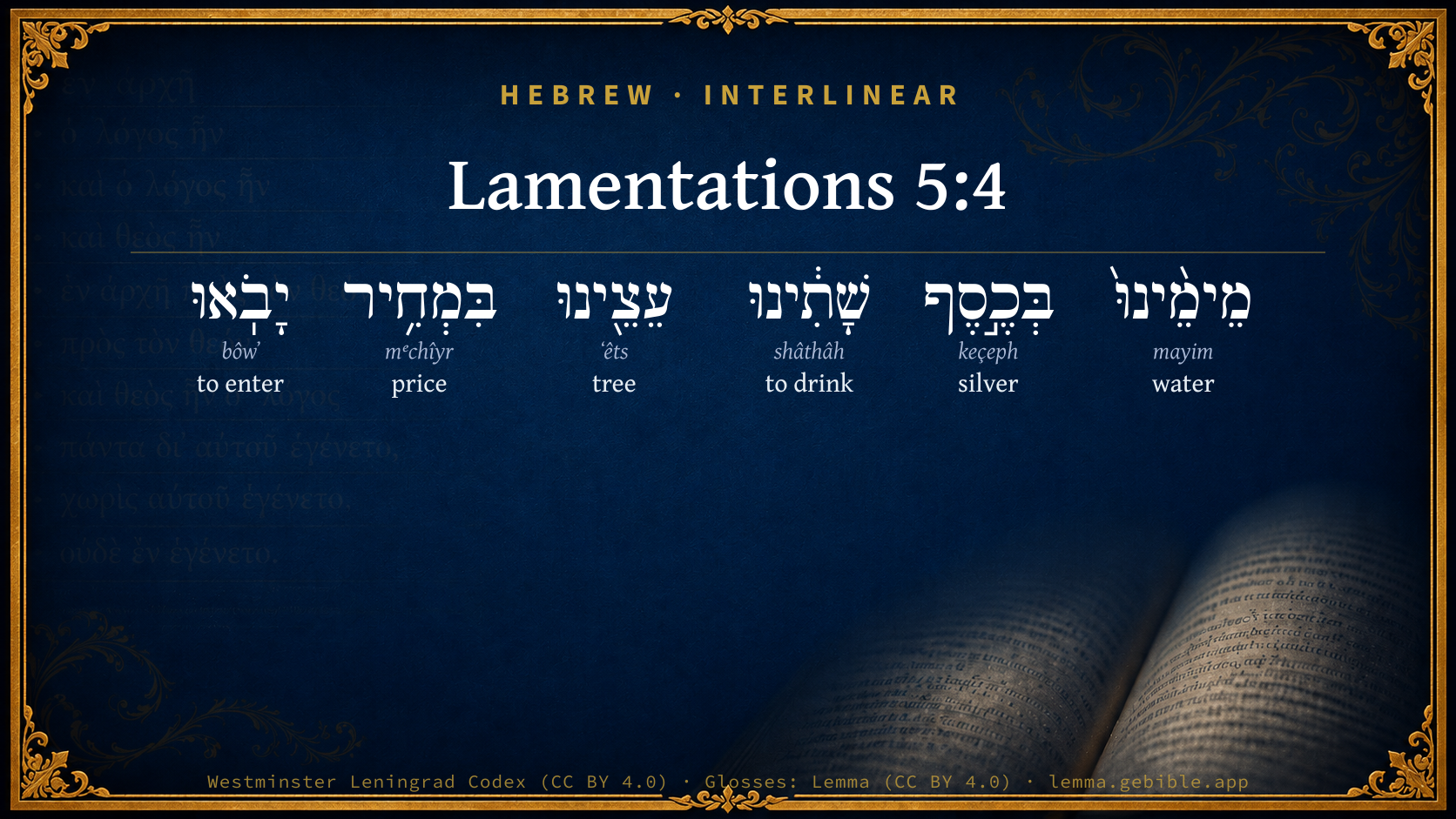
Hebrew (Westminster Leningrad Codex) Lamentations 5:4 appears in the Hebrew Old Testament. The text above is from the Westminster Leningrad Codex. Each word links to its Strong’s number, a concise gloss, and parsing drawn from the Open Scriptures Hebrew Bible morphology. Click any word for its full Brown-Driver-Briggs (BDB) entry.
Download image
Cite this verse

Lamentations 5:4 (World English Bible). Public Domain. Lemma interlinear Bible study tool, https://lemma.gebible.app/v/lamentations/5/4.

Show BibTeX & RIS
BibTeX
RIS
English Translation
We have drunken our water for money; Our wood is sold to us.
World English Bible · Public Domain
Download a study sheet

One document with this verse’s original text, its word-by-word gloss line, the meaning frame, cross-references with their text, attributed commentary, and full source and license credits — printable, and it pastes into notes with its structure intact.

This verse Autodidact and up

Study sheet (.html) Plain text (.txt)

A passage Seminary Student

Up to 50 verses in one chapter. A passage sheet keeps up to 6 commentary sources and 12 cross-references per verse, in the order this page ranks them, and says so on the sheet whenever that leaves anything out. Ask for a single verse and you get the Autodidact verse sheet above.

Everything on this page stays free to read, with no account — the sheet is a download of what is already on screen, not access to it.

Want to remove ads? Support Godless Engineer
Compare translations 3

The same verse in 3 English versions, stacked beneath the original-language interlinear above. Click any original word for its lexicon entry.

Each is an independent rendering of the whole verse — the interlinear is not word-aligned to these translations.

Highlighted words mark where these versions differ — a whole-verse word diff, not a word-by-word alignment.

  • World English Bible Public Domain
    We have drunken our water for money; Our wood is sold to us.
  • King James Version Public Domain
    We have drunken our water for money; our wood is sold unto us.
  • unfoldingWord Literal Text CC BY-SA 4.0
    Our water we drink for silver; our wood comes at a price.

unfoldingWord Literal Text — © unfoldingWord, licensed CC BY-SA 4.0. Word-aligned USFM3 via Door43 (git.door43.org/unfoldingWord/en_ult).

Versions to compare (up to 4)

3 of 4 selected

Show all 18 translations

Every available English version of this verse, each an independent rendering of the whole verse.

  • World English Bible Public Domain
    We have drunken our water for money; Our wood is sold to us.
  • Berean Standard Bible Public Domain
    We must buy the water we drink; our wood comes at a price.
  • Majority Standard Bible Public Domain
    We must buy the water we drink; our wood comes at a price.
  • King James Version Public Domain
    We have drunken our water for money; our wood is sold unto us.
  • American Standard Version (1901) Public Domain
    We have drunken our water for money; Our wood is sold unto us.
  • Revised Version (1885) Public Domain
    We have drunken our water for money; our wood is sold unto us.
  • Geneva Bible (1599) Public Domain
    Wee haue drunke our water for money, and our wood is solde vnto vs.
  • Douay-Rheims (1899) Public Domain
    We have drunk our water for money: we have bought our wood.
  • Young's Literal Translation Public Domain
    Our water for money we have drunk, Our wood for a price doth come.
  • Literal Standard Version CC BY-SA 4.0
    We have drunk our water for money, || Our wood comes for a price.
  • Unlocked Literal Bible CC BY-SA 4.0
    We must pay silver for the water we drink, and we must pay silver to get our own wood.
  • unfoldingWord Literal Text CC BY-SA 4.0
    Our water we drink for silver; our wood comes at a price.
  • Darby Bible Public Domain
    Our water have we to drink for money, our wood cometh unto us for a price.
  • World Messianic Bible Public Domain
    We must pay for water to drink. Our wood is sold to us.
  • Webster's Bible Public Domain
    We have drank our water for money; our wood is sold to us.
  • Free Bible Version CC BY-SA 4.0
    The water we drink we have to pay for; our firewood comes at a price.
  • Bible in Basic English Public Domain
    We give money for a drink of water, we get our wood for a price.
  • JPS Tanakh (1917) Public Domain
    We have drunk our water for money; our wood cometh to us for price.

Literal Standard Version (2020), Covenant Press — licensed CC BY-SA 4.0. Text via the HelloAO Bible API (eBible.org). Unlocked Literal Bible (unfoldingWord) — licensed CC BY-SA 4.0. Text via the HelloAO Bible API (eBible.org). unfoldingWord Literal Text — © unfoldingWord, licensed CC BY-SA 4.0. Word-aligned USFM3 via Door43 (git.door43.org/unfoldingWord/en_ult). Free Bible Version, Dr. Jonathan Gallagher — licensed CC BY-SA 4.0. Text via the HelloAO Bible API (eBible.org).

Word by word

More ways to search: Search by grammar → Find every occurrence → Compare this word →

Practice this passage: Drill this verse → Learn its vocabulary →

About this verse

These counts appear in no published source. They are computed here, from the morphology-tagged text and Lemma’s own curated glosses. What Lemma adds →

6
words
6
distinct lemmas
Prophets
section

Notable vocabulary

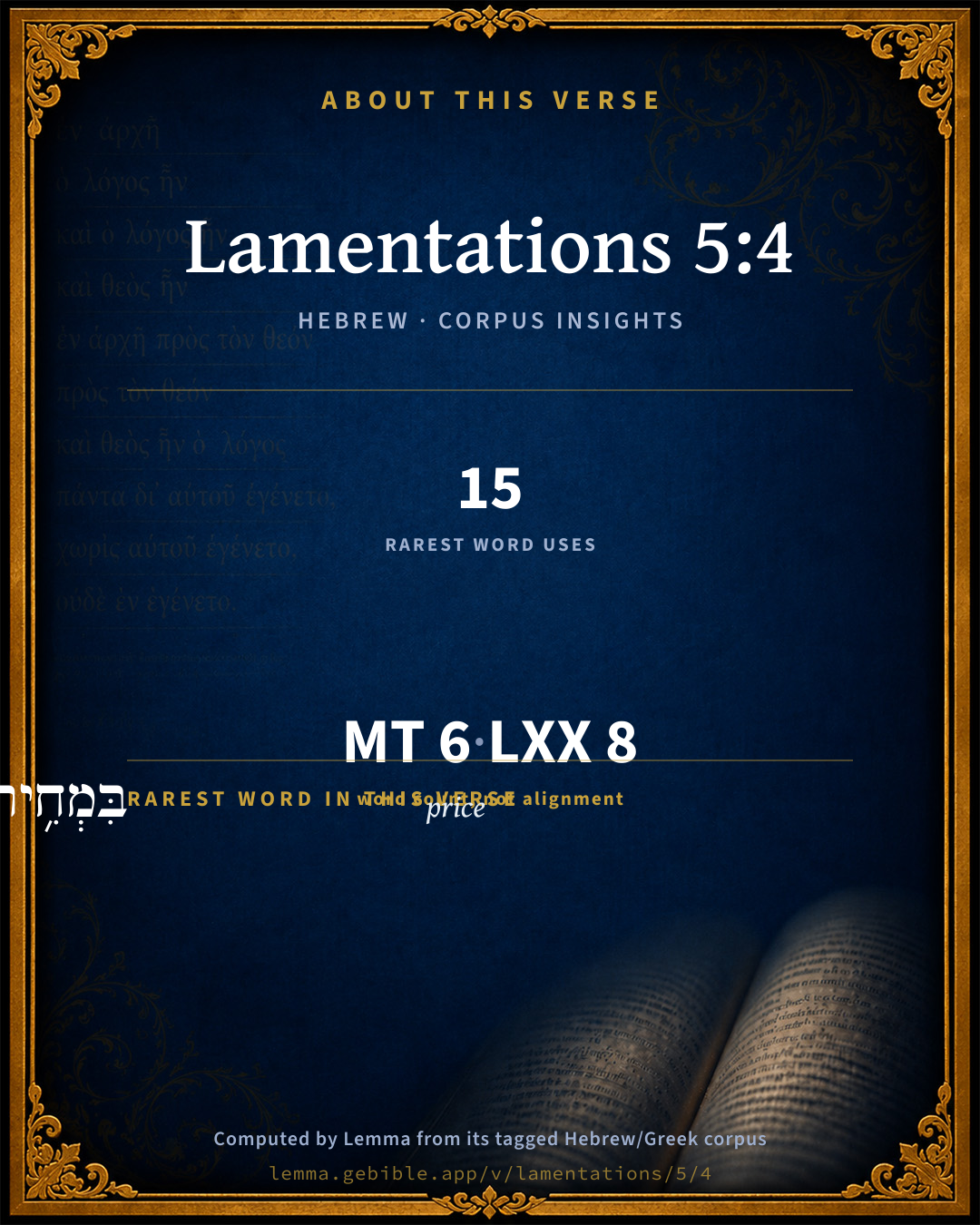
The rarest word here is בִּמְחִ֥יר price H4242 — appearing just 15 times in the whole Hebrew Bible.

Shared distinctive vocabulary

בִּמְחִ֥יר price H4242 occurs in 15 verses of the Hebrew Bible. Also found in:

Grammatical profile

  • 2 verbs
  • 4 nouns

Verb forms

  • שָׁתִ֔ינוּ Qal · Perfect
  • יָבֹֽאוּ Qal · Imperfect

Hebrew & Septuagint length

In English translation the verse runs 13 words from the Hebrew and 19 from the Septuagint (LXX English) — the Septuagint runs noticeably longer here. See the side-by-side →

A rough comparison of the two English renderings, which tokenize alike — not a word-level alignment.

Word counts can differ between the Hebrew and the Greek without any difference in meaning — e.g. the Hebrew direct-object marker אֵת has no separate Greek word, and Greek often adds the article ὁ.

In the original languages it is 6 Hebrew tokens and 8 Greek tokens — but the two are counted differently (Hebrew bundles its prefixes and suffixes into one token; the Greek is in lemma form), so that isn’t a like-for-like length.

Cross-references

3

Topical passages linked to Lamentations 5:4 in the Treasury of Scripture Knowledge — connected by theme and wording, ordered by reader-vote popularity; previews shown in the World English Bible.

  • Isaiah 3:1 For, behold, the Lord, Yahweh of Hosts, takes away from Jerusalem and from Judah supply and support, The whole supply of bread, And the whole supply of water;
  • Deuteronomy 28:48 therefore shall you serve your enemies whom Yahweh shall send against you, in hunger, and in thirst, and in nakedness, and in want of all things: and he shall put a yoke of iron on your neck, until he have destroyed you.
  • Ezekiel 4:9–17 Take for yourself also wheat, and barley, and beans, and lentils, and millet, and spelt, and put them in one vessel, and make you bread of it; [according to] the number of the days that you shall lie on your side, even three hundred ninety days, shall you eat of it.

Cross-references courtesy of OpenBible.info (CC BY 4.0).

Hebrew and Greek witnesses Masoretic Hebrew ↔ Greek Septuagint

The same verse in the two great witnesses to the Old Testament, shown verse-for-verse.

Here the Septuagint runs noticeably longer than the Hebrew — LXX2012 (modern English Septuagint) 19 words vs World English Bible 13. A rough length comparison of the two English translations, not a word-level alignment — read both below.

These are two independent witnesses, not word-aligned to each other, and the Septuagint is shown in lemma (dictionary) form.

Hebrew Lamentations 5:4 Masoretic · Westminster Leningrad Codex

מֵימֵ֨ינוּ֙ בְּכֶ֣סֶף שָׁתִ֔ינוּ עֵצֵ֖ינוּ בִּמְחִ֥יר יָבֹֽאוּ

We have drunken our water for money; Our wood is sold to us.

World English Bible · Public Domain

Greek LXX Lamentations 5:4 Septuagint · lemma form

ἐκ ἡμέρα ἐγώ ξύλον ἐγώ ἐν ἄλλαγμα ἔρχομαι

We have drunk our water for money; our wood is sold to us for a burden on our neck:

LXX2012 (modern English Septuagint) · Public Domain

Hebrew: Westminster Leningrad Codex (CC BY 4.0). Greek: Septuagint (public domain); English from LXX2012 (modern English Septuagint) (Public Domain). How the Septuagint differs from the Hebrew →

Commentary

Notes on Lamentations 5:4 from classic Christian and Jewish commentators (each source and its license shown beneath its notes). The classic Christian expositions comment on the surrounding passage and are grouped to its opening verse, so a note may address several verses; the Jewish commentaries on the Tanakh (Rashi and others) are per-verse, so they appear only where the commentator wrote on this verse.

Lemma curates 59 commentaries, every one of them public domain or Creative Commons licensed, each selected and text-cleaned for this edition rather than reprinted as found. About our sources →

Trapp's Complete Commentary

John Trapp

Lam 5:4 We have drunken our water for money; our wood is sold unto us.

Ver. 4. We have drunk our water for money.] Fire, water, and air are common good, quae iure naturae sunt omnium et singulorum, saith Cicero. {a} Lysimachus paid dear for a cup of water when he parted with his kingdom for it. Dives would have done as much in hell for a drop, and could not have it.

Our wood is sold to us.] This was strange to them - who had enough of their own growing, or might have it from the commons for fetching - but just upon them for their abuse of it to the service of the queen of heaven. {Jer 7:18}

{a} Offic., i.

John Trapp, A Commentary or Exposition upon All the Books of the Old and New Testament (1647–1656) — public domain. Text from a community e-Sword module.

The Biblical Illustrator

Joseph S. Exell

Lam_5:4

We have drunken our water for money, our wood is sold unto us.

Zions sufferings

1. Common necessaries denied by adversaries. Fire and water are two necessary elements, but though God in nature have given these in common to His creatures, the Jews being captives are now denied them by their cruel adversaries. Time was when they could command the fields, the wheat, the olives, and the wines, hut at this instant, such is their misery, that they cannot so much as have wood or water without price, unless for money.

(1) Enemies are cruel, they know this will be vexatious.

(2) Adversaries are covetous, our spoils, our moneys will be their riches.

It is not water alone, or wood alone that is now defective, it is both water and wood that they are forced to buy. War seldom deprives us of a single mercy, it strips us at once of many necessaries (Lam_4:1-5). It takes away gold, silver, possessions, habitations, victuals, wood, and water from its captives.

2. Wood and water sweet mercies.

3. We must not sit fast upon our present enjoyments. Full little did these Jews in their prosperity think that their water should become their charge, and that their wood, their fire, should be sold to themselves for money. From whence we note--That Christians ought to sit loose upon their enjoyments, and to look upon themselves as strangers and pilgrims in their most sure possessions. Do not glory, be not proud of what you have now at your own command (Ecc_5:13; Jer_9:23). The tide may turn, your condition may alter and not yourselves, not your friends, but your enemies may be their possessors Though we may complain we must not murmur, we must in patience possess our souls, when our very necessaries become a prey to others. Thus did the primitive Christians in their great afflictions (Heb_10:34; Heb_11:37-38). (D. Swift.)

The Biblical Illustrator, edited by Joseph S. Exell (c. 1880s–1900s) — public domain. Text from a community e-Sword module.

Geneva Bible (1599)

Geneva Bible translators

Meaning, their extreme servitude and bondage.

Geneva Bible (1599) marginal notes — public domain. Text via Bolls.life.

Jamieson, Fausset & Brown

Robert Jamieson, A. R. Fausset & David Brown

water for money--The Jews were compelled to pay the enemy for the water of their own cisterns after the overthrow of Jerusalem; or rather, it refers to their sojourn in Babylon; they had to pay tax for access to the rivers and fountains. Thus, "our" means the water which we need, the commonest necessary of life.

our wood--In Judea each one could get wood without pay; in Babylon, "our wood," the wood we need, must be paid for.

Jamieson, Fausset & Brown — Commentary Critical and Explanatory on the Whole Bible (1871) — public domain (CC PDM 1.0). Text via the HelloAO Bible API.

Adam Clarke's Commentary

Verse 4. We have drunken our water for money] I suppose the meaning of this is, that every thing was taxed by the Chaldeans, and that they kept the management in their own hands, so that wood and water were both sold, the people not being permitted to help themselves. They were now so lowly reduced by servitude, that they were obliged to pay dearly for those things which formerly were common and of no price. A poor Hindoo in the country never buys fire-wood, but when he comes to the city he is obliged to purchase his fuel, and considers it as a matter of great hardship.

Adam Clarke's Commentary on the Bible (1810–1826) — public domain. Text from a community e-Sword/MySword module.

John Calvin's Commentaries

The Prophet here relates, that the people were denuded, that they labored under the want of water and of wood. He does not say that they were only deprived of corn and wine, he does not complain that any of their luxuries were lessened; but he mentions water and wood, the common things of life; for the use of water, as it is said, is common to all; no one is so poor, if he dwells not in a land wholly dry, but that he has water enough to drink. For if there be no fountains, there are at least rivers, there are wells; nor do men perish through thirst, except in deserts and in places uninhabitable. As, then, water might be had everywhere, the Prophet here sets forth the extreme misery of the people, for water was even sold to them. In stony and high places water is sold; but this is a very rare thing. The Prophet here means that the people were not only deprived of their wealth, but reduced to such a state of want that they had no water without buying it.

At the same time he seems to express something worse when he says, Our water we drink for money, and our wood is brought to us for a price. It is not strange that wood should be bought; but the Prophet means that water was sold to the Jews which had been their own, and that they were also compelled to buy wood which had been their own. Thus the possessive pronouns are to be considered as emphatical. Then he says, “Our own waters we drink,” etc. He calls them the waters of the people, which by right they might have claimed as their own; and he also calls the wood The same; it was that to which the people had a legitimate right. He then says that all things had been so taken away by their enemies, that they were forced to buy, not only the wine which had been taken from their cellars, and the corn which had been taken from their granaries, but also the water and the wood.

But were any one disposed to take the words more simply, the complaint would not be unsuitable, — that the people, who before had abundance of wine and all other things, were constrained to buy everything, even water and wood. For it is a grievous change when any one, who could once cut wood of his own, and gather his own wine and corn, is not able to get even a drop of water without buying it. This is a sad change. So this passage may be understood. It follows, —

John Calvin's Commentaries (1540-1563) — public domain. Text from the Calvin Translation Society English edition (1840s-50s) via the Christian Classics Ethereal Library (ccel.org). Calvin's coverage is partial (roughly two-thirds of the Bible); uncommented books and verses are honest gaps, never fabricated. The 19th-century editor's footnotes and remarks are omitted so the notes are faithfully Calvin's own voice.

Ellicott's Commentary for English Readers

(4) Our water . . . our wood.—The point of the complaint lies in the possessive pronoun. The Chaldæan conquerors were in possession of the country, and the very necessaries of life, which had been looked on as the common property of all, were only to be had for money. In the Hebrew of the first clause the fact appears yet more emphatically: Our water comes to us for money. The words have been referred by some commentators to the sufferings of the exiles in Egypt, but the context fits in better with the idea of the hardships of those who were left in Judah.

A Bible Commentary for English Readers, edited by Charles John Ellicott (1878–1897) — public domain. Text from a community e-Sword module.

The Cambridge Bible for Schools and Colleges

gen. ed. J. J. S. Perowne

4. The bitterness of their captive state is shewn by the fact that they, the rightful owners, were compelled to buy from the enemy who had come into possession the commonest necessaries of life.

is sold] lit. as mg. cometh for price.

The Cambridge Bible for Schools and Colleges (gen. ed. J. J. S. Perowne; Cambridge University Press, 1878–1918) — public domain. Text from a community e-Sword module.

John Gill's Exposition

We have drunken our water for money,.... They who in their own land, which was a land of brooks of water, of fountains and depths, had wells of water of their own, and water freely and in abundance, now were obliged to pay for it, for drink, and other uses:

our wood is sold unto us; or, "comes to us by a price" (r); and a dear one; in their own land they could have wood out of the forest, for cutting down and bringing home; but now they were forced to give a large price for it.

(r) "in pretio venerunt", Pagninus, Montanus; "caro nobis pretio veniunt", Michaelis.

John Gill's Exposition of the Whole Bible (1746–1763) — public domain (CC PDM 1.0). Text via the HelloAO Bible API.

Albert Barnes' Notes on the Bible

Better as in the margin cometh to us for price. The rendering of the the King James Version spoils the carefully studied rhythm of the original. The bitterness of the complaint lies in this, that it was their own property which they had to buy.

Albert Barnes' Notes on the Bible (1834–1885) — public domain. Text from a community e-Sword/MySword module.

Haydock's Catholic Bible Commentary

Water. Even this was not given for nothing.

George Leo Haydock (1774–1849), Haydock's Catholic Family Bible and Commentary, 1859 edition — public domain. Excludes Psalms (Douay-Rheims chapter numbering differs from Protestant) and Deuterocanonical books (Catholic canon only).

Matthew Poole's English Annotations

This seemeth to refer to the state of the Jews in Babylon, where it is probable their adversaries made them buy both water and wood, which in the land of Canaan they had plentifully, and without any further charge to them than fetching the one, and cutting down and bringing home the other.

Matthew Poole's English Annotations on the Holy Bible (1683–1685) — public domain. Text from a community e-Sword/MySword module.

Whedon's Commentary on the Bible

Daniel D. Whedon

4. Our water for money, etc. — These are illustrations of the hardships they were experiencing. Such absolute necessities of life could be had by them only on the payment of money. And what greatly enhanced the bitterness of this complaint was, that they had to buy what was rightfully their own. In this not only is there distress and hardship, but a sense of degradation and wrong.

Daniel D. Whedon (gen. ed.), Commentary on the Old and New Testaments (1874–1909) — public domain. Text from a community e-Sword module.

The Pulpit Commentary

We have drunken our water, etc. The Jews were not yet carried away to Babylonia when this was written, but had to pay a dear price to the new lords of the soil for the commonest necessaries of life.

The Pulpit Commentary (1880–1919), ed. H.D.M. Spence-Jones & Joseph S. Exell — public domain. Text from a community e-Sword module.

John Wesley's Explanatory Notes

Sold - Whereas at other times there was abundance of wood and water throughout Judea.

John Wesley, Explanatory Notes Upon the Whole Bible (1754–1765) — public domain. Text via the GEBible commentary corpus.

Rashi

Rabbi Shlomo Yitzchaki (Rashi)

Our water we have drunk for payment We were afraid to draw water from the river because of the enemies; we therefore bought [it] from them with money.

Rashi on the Tanakh — English translations: “The Judaica Press complete Tanach with Rashi, translated by A. J. Rosenberg” (CC BY 4.0); “Pentateuch with Rashi's commentary by M. Rosenbaum and A.M. Silbermann, 1929-1934” (public domain); “The Metsudah Tanach series, Lakewood, N.J” (CC BY 4.0); and “The Book of Joshua, Metsudah Publications, 1997” (CC BY 4.0). Text via Sefaria.

Lesson kit

Teaching starters — assembled from the data on this page, not authored interpretation. Every prompt links to the verse data it draws on. Edit before teaching.

Lamentations, in the Prophets, opens this verse with 6 words (6 distinct Hebrew lemmas). Its most distinctive word is mᵉchîyr (“price”). The Greek Septuagint runs longer here. A historical commentator’s framing appears above. Read the whole chapter for the surrounding context.

Discussion questions

  1. The word mᵉchîyr carries the sense “price.” How does it shape the verse?
  2. Deuteronomy 23:18 shares the word «price» with this verse. How do the two illuminate each other?
  3. Compared with the Hebrew, the Septuagint runs longer here. What questions does that raise?
  4. These translations render this verse differently; the difference is in the English rendering, not the original. What questions does that raise?
  5. The verb «שָׁתִ֔ינוּ» is Qal Perfect. How does its form color the action?
  6. Reading how Trapp's Complete Commentary and The Biblical Illustrator read this verse, where do the two commentators agree and where do they part?

Things to notice

Reading settings

Reading text

Shown beneath each verse's original-language words.

Old Testament
Old Testament edition

Read the OT as the Masoretic Hebrew (MT) or the Greek Septuagint (LXX).

English shown for the Greek Septuagint (in the Hebrew ↔ Greek comparison).

Comparing translations? Open the Compare panel on any verse page to stack up to four side by side.