
1 Kings 16:9

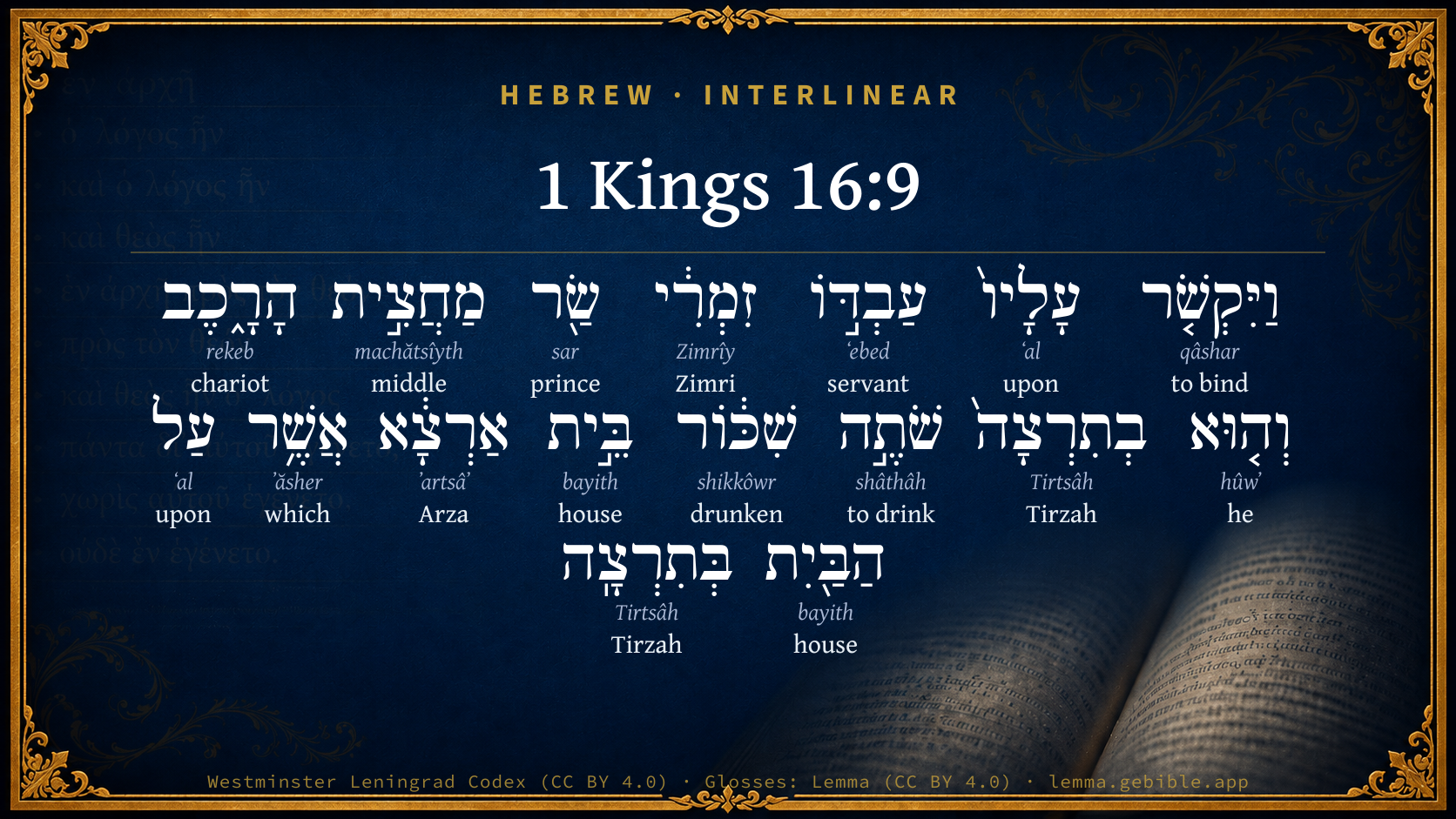
Hebrew (Westminster Leningrad Codex) 1 Kings 16:9 appears in the Hebrew Old Testament. The text above is from the Westminster Leningrad Codex. Each word links to its Strong’s number, a concise gloss, and parsing drawn from the Open Scriptures Hebrew Bible morphology. Click any word for its full Brown-Driver-Briggs (BDB) entry.
Download image
Cite this verse

1 Kings 16:9 (World English Bible). Public Domain. Lemma interlinear Bible study tool, https://lemma.gebible.app/v/1-kings/16/9.

Show BibTeX & RIS
BibTeX
RIS
English Translation
His servant Zimri, captain of half his chariots, conspired against him. Now he was in Tirzah, drinking himself drunk in the house of Arza, who was over the household in Tirzah:
World English Bible · Public Domain
Highlights
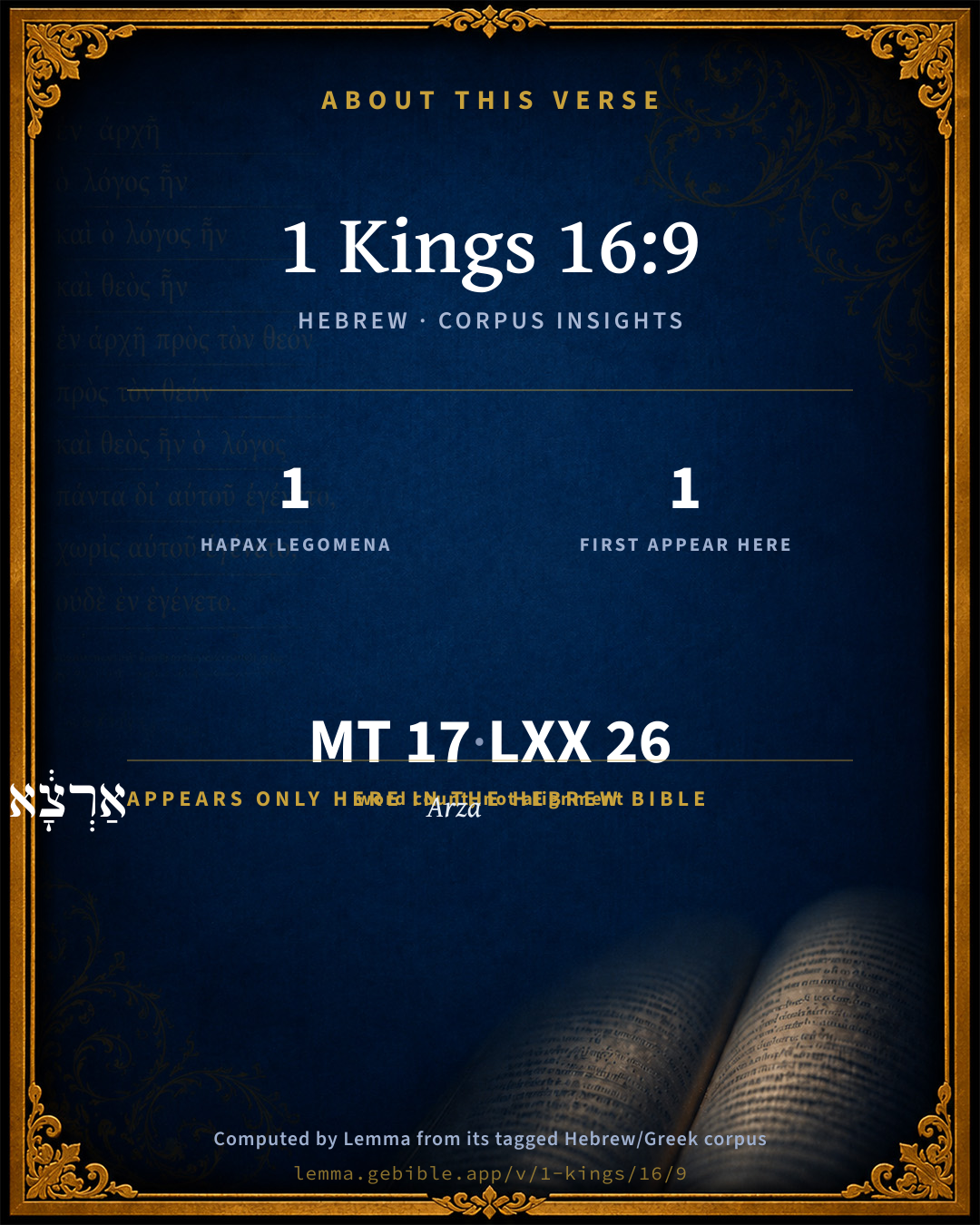
  • 1 hapax legomenon — only here in the Hebrew Bible
  • 1 first appearance in the Hebrew Bible
Full analysis ↓
Download a study sheet

One document with this verse’s original text, its word-by-word gloss line, the meaning frame, cross-references with their text, attributed commentary, and full source and license credits — printable, and it pastes into notes with its structure intact.

This verse Autodidact and up

Study sheet (.html) Plain text (.txt)

A passage Seminary Student

Up to 50 verses in one chapter. A passage sheet keeps up to 6 commentary sources and 12 cross-references per verse, in the order this page ranks them, and says so on the sheet whenever that leaves anything out. Ask for a single verse and you get the Autodidact verse sheet above.

Everything on this page stays free to read, with no account — the sheet is a download of what is already on screen, not access to it.

Want to remove ads? Support Godless Engineer
Compare translations 3

The same verse in 3 English versions, stacked beneath the original-language interlinear above. Click any original word for its lexicon entry.

Each is an independent rendering of the whole verse — the interlinear is not word-aligned to these translations.

Highlighted words mark where these versions differ — a whole-verse word diff, not a word-by-word alignment.

  • World English Bible Public Domain
    His servant Zimri, captain of half his chariots, conspired against him. Now he was in Tirzah, drinking himself drunk in the house of Arza, who was over the household in Tirzah:
  • King James Version Public Domain
    And his servant Zimri, captain of half his chariots, conspired against him, as he was in Tirzah, drinking himself drunk in the house of Arza steward of his house in Tirzah.
  • unfoldingWord Literal Text CC BY-SA 4.0
    And his servant Zimri, the commander of half of the chariotry, conspired against him. Now he in Tirzah, drinking drunk the house of Arza, who over the house in Tirzah.

unfoldingWord Literal Text — © unfoldingWord, licensed CC BY-SA 4.0. Word-aligned USFM3 via Door43 (git.door43.org/unfoldingWord/en_ult).

Versions to compare (up to 4)

3 of 4 selected

Show all 18 translations

Every available English version of this verse, each an independent rendering of the whole verse.

  • World English Bible Public Domain
    His servant Zimri, captain of half his chariots, conspired against him. Now he was in Tirzah, drinking himself drunk in the house of Arza, who was over the household in Tirzah:
  • Berean Standard Bible Public Domain
    However, while Elah was in Tirzah getting drunk in the house of Arza the steward of his household there, Elah’s servant Zimri, the commander of half his chariots, conspired against him.
  • Majority Standard Bible Public Domain
    However, while Elah was in Tirzah getting drunk in the house of Arza the steward of his household there, Elah’s servant Zimri, the commander of half his chariots, conspired against him.
  • King James Version Public Domain
    And his servant Zimri, captain of half his chariots, conspired against him, as he was in Tirzah, drinking himself drunk in the house of Arza steward of his house in Tirzah.
  • American Standard Version (1901) Public Domain
    And his servant Zimri, captain of half his chariots, conspired against him. Now he was in Tirzah, drinking himself drunk in the house of Arza, who was over the household in Tirzah:
  • Revised Version (1885) Public Domain
    And his servant Zimri, captain of half his chariots, conspired against him: now he was in Tirzah, drinking himself drunk in the house of Arza, which was over the household in Tirzah:
  • Geneva Bible (1599) Public Domain
    And his seruant Zimri, captaine of halfe his charets, conspired against him, as he was in Tirzah drinking, til he was drunken in the house of Arza steward of his house in Tirzah.
  • Douay-Rheims (1899) Public Domain
    And his servant Zambri, who was captain of half the horsemen, rebelled against him: now Ela was drinking in Thersa, and drunk in the house of Arsa the governor of Thersa.
  • Young's Literal Translation Public Domain
    and conspire against him doth his servant Zimri (head of the half of the chariots) and he `is' in Tirzah drinking -- a drunkard in the house of Arza, who `is' over the house in Tirzah.
  • Literal Standard Version CC BY-SA 4.0
    and his servant Zimri conspires against him (head of the half of the chariots) and he [is] in Tirzah drinking—a drunkard in the house of Arza, who [is] over the house in Tirzah.
  • Unlocked Literal Bible CC BY-SA 4.0
    His servant Zimri, captain of half his chariots, conspired against him. Now Elah was in Tirzah, drinking himself drunk in the house of Arza, who was over the household in Tirzah.
  • unfoldingWord Literal Text CC BY-SA 4.0
    And his servant Zimri, the commander of half of the chariotry, conspired against him. Now he in Tirzah, drinking drunk the house of Arza, who over the house in Tirzah.
  • Darby Bible Public Domain
    And his servant Zimri, captain of half [his] chariots, conspired against him; and he was in Tirzah, drinking himself drunk in the house of Arza, who was the steward of his house in Tirzah;
  • World Messianic Bible Public Domain
    His servant Zimri, captain of half his chariots, conspired against him. Now he was in Tirzah, drinking himself drunk in the house of Arza, who was over the household in Tirzah;
  • Webster's Bible Public Domain
    And his servant Zimri, captain of half his chariots, conspired against him, as he was in Tirzah, drinking himself drunk in the house of Arza steward of his house in Tirzah.
  • Free Bible Version CC BY-SA 4.0
    One of Elah's officials called Zimri who was in charge of half his chariots plotted a rebellion against him. One time Elah was in Tirzah, getting himself drunk at the home of Arza, the palace manager at Tirzah.
  • Bible in Basic English Public Domain
    And his servant Zimri, captain of half his war-carriages, made secret designs against him: now he was in Tirzah, drinking hard in the house of Arza, controller of the king's house in Tirzah.
  • JPS Tanakh (1917) Public Domain
    And his servant Zimri, captain of half his chariots, conspired against him; now he was in Tirzah, drinking himself drunk in the house of Arza, who was over the household in Tirzah;

Literal Standard Version (2020), Covenant Press — licensed CC BY-SA 4.0. Text via the HelloAO Bible API (eBible.org). Unlocked Literal Bible (unfoldingWord) — licensed CC BY-SA 4.0. Text via the HelloAO Bible API (eBible.org). unfoldingWord Literal Text — © unfoldingWord, licensed CC BY-SA 4.0. Word-aligned USFM3 via Door43 (git.door43.org/unfoldingWord/en_ult). Free Bible Version, Dr. Jonathan Gallagher — licensed CC BY-SA 4.0. Text via the HelloAO Bible API (eBible.org).

Word by word

More ways to search: Search by grammar → Find every occurrence → Compare this word →

Practice this passage: Drill this verse → Learn its vocabulary →

אַרְצָ֔א
ʼartsâʼ
H777
“Arza”
Noun, Proper
Part of Speech
Noun
Type
Proper
Full BDB Definition

Origin: from H776

TWOT: None

Arza = "earthy" - housekeeper of Elah, king of Israel
  1. וַיִּקְשֹׁ֤ר qâshar H7194 “and · to bind” Conjunction + Verb, Qal, Sequential Imperfect, 3rd Person, Masculine, Singular
  2. עָלָיו֙ ʻal H5921 “upon · him” Preposition + Suffix, Personal, 3rd Person, Masculine, Singular
  3. עַבְדּ֣וֹ ʻebed H5650 “servant · his” Noun, Common, Masculine, Singular, Construct + Suffix, Personal, 3rd Person, Masculine, Singular
  4. זִמְרִ֔י Zimrîy H2174 “Zimri” Noun, Proper
  5. שַׂ֖ר sar H8269 “prince of” Noun, Common, Masculine, Singular, Construct
  6. מַחֲצִ֣ית machătsîyth H4276 “middle of” Noun, Common, Feminine, Singular, Construct
  7. הָרָ֑כֶב rekeb H7393 “the · chariot” Particle, Definite Article + Noun, Common, Masculine, Singular, Absolute
  8. וְה֤וּא hûwʼ H1931 “and · he” Conjunction + Pronoun, Personal, 3rd Person, Masculine, Singular
  9. בְתִרְצָה֙ Tirtsâh H8656 “in/at · Tirzah” Preposition + Noun, Proper
  10. שֹׁתֶ֣ה shâthâh H8354 “drinking” Verb, Qal, Participle Active, Masculine, Singular, Absolute
  11. שִׁכּ֔וֹר shikkôwr H7910 “drunken” Adjective, Adjective, Masculine, Singular, Absolute
  12. בֵּ֣ית bayith H1004 “house of” Noun, Common, Masculine, Singular, Construct
  13. אֲשֶׁ֥ר ʼăsher H834 “which” Particle, Relative
  14. עַל ʻal H5921 “upon” Preposition
  15. הַבַּ֖יִת bayith H1004 “the · house” Particle, Definite Article + Noun, Common, Masculine, Singular, Absolute
  16. בְּתִרְצָֽה Tirtsâh H8656 “in/at · Tirzah” Preposition + Noun, Proper

About this verse

These counts appear in no published source. They are computed here, from the morphology-tagged text and Lemma’s own curated glosses. What Lemma adds →

17
words
14
distinct lemmas
Historical
section

Notable vocabulary

1 hapax legomenon — a word that appears only here in the entire Hebrew Bible:

  • אַרְצָ֔א Arza H777

First appearance in Scripture

This word makes its first canonical appearance in the Hebrew Bible here:

  • אַרְצָ֔א Arza H777

Shared distinctive vocabulary

שִׁכּ֔וֹר drunken H7910 occurs in 13 verses of the Hebrew Bible. Also found in:

Grammatical profile

  • 2 verbs
  • 10 nouns
  • 1 adjective
  • 1 pronoun
  • 2 prepositions
  • 1 particle

Verb forms

  • וַיִּקְשֹׁ֤ר Qal · Sequential Imperfect
  • שֹׁתֶ֣ה Qal · Participle Active

Repetition

Words recur within this verse — often emphatic in Hebrew:

  • עָלָיו֙ upon H5921 ×2
  • בְתִרְצָה֙ Tirzah H8656 ×2
  • בֵּ֣ית house H1004 ×2

Hebrew & Septuagint length

In English translation the verse runs 31 words from the Hebrew and 27 from the Septuagint (LXX English) — closely comparable.

A rough comparison of the two English renderings, which tokenize alike — not a word-level alignment.

Word counts can differ between the Hebrew and the Greek without any difference in meaning — e.g. the Hebrew direct-object marker אֵת has no separate Greek word, and Greek often adds the article ὁ.

In the original languages it is 17 Hebrew tokens and 26 Greek tokens — but the two are counted differently (Hebrew bundles its prefixes and suffixes into one token; the Greek is in lemma form), so that isn’t a like-for-like length.

Cross-references

24

Topical passages linked to 1 Kings 16:9 in the Treasury of Scripture Knowledge — connected by theme and wording, ordered by reader-vote popularity; previews shown in the World English Bible.

  • Genesis 24:2 Abraham said to his servant, the elder of his house, who ruled over all that he had, "Please put your hand under my thigh.
  • Genesis 39:4 Joseph found favor in his sight. He ministered to him, and he made him overseer over his house, and all that he had he put into his hand.
  • 1 Kings 18:3 Ahab called Obadiah, who was over the household. (Now Obadiah feared Yahweh greatly:
  • Daniel 5:1–4 Belshazzar the king made a great feast to a thousand of his lords, and drank wine before the thousand.
  • Genesis 15:2 Abram said, "Lord Yahweh, what will you give me, seeing I go childless, and he who will inherit my estate is Eliezer of Damascus?"
  • Genesis 24:10 The servant took ten camels, of his master's camels, and departed, having all goodly things of his master's in his hand. He arose, and went to Mesopotamia, to the city of Nahor.
  • Genesis 39:9 He isn't greater in this house than I, neither has he kept back anything from me but you, because you are his wife. How then can I do this great wickedness, and sin against God?"
  • 1 Samuel 25:36–38 Abigail came to Nabal; and, behold, he held a feast in his house, like the feast of a king; and Nabal's heart was merry within him, for he was very drunken: therefore she told him nothing, less or more, until the morning light.
  • 2 Samuel 13:28–29 Absalom commanded his servants, saying, Mark you now, when Amnon's heart is merry with wine; and when I tell you, Smite Amnon, then kill him; don't be afraid; haven't I commanded you? be courageous, and be valiant.
  • 1 Kings 15:27 Baasha the son of Ahijah, of the house of Issachar, conspired against him; and Baasha struck him at Gibbethon, which belonged to the Philistines; for Nadab and all Israel were laying siege to Gibbethon.
  • 1 Kings 20:16 They went out at noon. But Ben Hadad was drinking himself drunk in the pavilions, he and the kings, the thirty-two kings who helped him.
  • 2 Kings 9:14 So Jehu the son of Jehoshaphat the son of Nimshi conspired against Joram. (Now Joram was keeping Ramoth-gilead, he and all Israel, because of Hazael king of Syria;
  • 2 Kings 9:30–33 When Jehu was come to Jezreel, Jezebel heard of it; and she painted her eyes, and attired her head, and looked out at the window.
  • 2 Kings 12:20 His servants arose, and made a conspiracy, and struck Joash at the house of Millo, [on the way] that goes down to Silla.
  • 2 Kings 15:10 Shallum the son of Jabesh conspired against him, and struck him before the people, and killed him, and reigned in his place.
  • 2 Kings 15:25 Pekah the son of Remaliah, his captain, conspired against him, and struck him in Samaria, in the castle of the king's house, with Argob and Arieh; and with him were fifty men of the Gileadites: and he killed him, and reigned in his place.
  • 2 Kings 15:30 Hoshea the son of Elah made a conspiracy against Pekah the son of Remaliah, and struck him, and killed him, and reigned in his place, in the twentieth year of Jotham the son of Uzziah.
  • Proverbs 23:29–35 Who has woe? Who has sorrow? Who has strife? Who has complaints? Who has needless bruises? Who has bloodshot eyes?
  • Jeremiah 51:57 I will make drunk her princes and her wise men, her governors and her deputies, and her mighty men; and they shall sleep a perpetual sleep, and not wake up, says the King, whose name is Yahweh of Hosts.
  • Daniel 5:30 In that night Belshazzar the Chaldean King was slain.
  • Nahum 1:10 For entangled like thorns, and drunken as with their drink, they are consumed utterly like dry stubble.
  • Habakkuk 2:15–16 "Woe to him who gives his neighbor drink, pouring your inflaming wine until they are drunk, so that you may gaze at their naked bodies!
  • Matthew 24:49–51 and begins to beat his fellow-servants, and eat and drink with the drunken,
  • Luke 21:34 "So be careful, or your hearts will be loaded down with carousing, drunkenness, and cares of this life, and that day will come on you suddenly.

Cross-references courtesy of OpenBible.info (CC BY 4.0).

Hebrew and Greek witnesses Masoretic Hebrew ↔ Greek Septuagint

The same verse in the two great witnesses to the Old Testament, shown verse-for-verse.

These are two independent witnesses, not word-aligned to each other, and the Septuagint is shown in lemma (dictionary) form.

Hebrew 1 Kings 16:9 Masoretic · Westminster Leningrad Codex

וַיִּקְשֹׁ֤ר עָלָיו֙ עַבְדּ֣וֹ זִמְרִ֔י שַׂ֖ר מַחֲצִ֣ית הָרָ֑כֶב וְה֤וּא בְתִרְצָה֙ שֹׁתֶ֣ה שִׁכּ֔וֹר בֵּ֣ית אַרְצָ֔א אֲשֶׁ֥ר עַל הַבַּ֖יִת בְּתִרְצָֽה

His servant Zimri, captain of half his chariots, conspired against him. Now he was in Tirzah, drinking himself drunk in the house of Arza, who was over the household in Tirzah:

World English Bible · Public Domain

Greek LXX 1 Kings 16:9 Septuagint · lemma form

καί συνστρέφω ἐπί αὐτός ζαμβρι ὁ ἄρχω ὁ ἥμισυς ὁ ἵππος καί αὐτός εἰμί ἐν θερσα πίνω μεθύω ἐν ὁ οἶκος ωσα ὁ οἰκονόμος ἐν θερσα

And Zambri, captain of half his cavalry, conspired against him, while he was in Thersa, drinking himself drunk in the house of Osa the steward at Thersa.

LXX2012 (modern English Septuagint) · Public Domain

On this verse, The Cambridge Bible for Schools and Colleges discusses the Septuagint’s reading. Read the note in Commentary ↓

Hebrew: Westminster Leningrad Codex (CC BY 4.0). Greek: Septuagint (public domain); English from LXX2012 (modern English Septuagint) (Public Domain). How the Septuagint differs from the Hebrew →

Targum (Aramaic paraphrase)

1

The Targum is the ancient Jewish Aramaic paraphrase of the Hebrew Scriptures — an interpretive translation, not the Hebrew text itself. Onkelos (literal) and Pseudo-Jonathan (expansive) render the Torah, and Jonathan the Prophets. Coverage is partial: where no permissively-licensed English translation exists for a verse, only the Aramaic is shown. This is verse-level text, not a word-by-word alignment to the Hebrew.

  1. Targum Jonathan Prophets (Joshua–Malachi)
    וּמְרַד עֲלוֹהִי עַבְדֵיהּ זִמְרִי חַד מִתְרֵין רַבָּנֵי רְתִיכַיָא וְהוּא בְתִרְצָה שָׁתֵי רַוֵי בֵּית אַרְצָא טַעֲוָתָא דִי בְבֵיתָא בְּתִרְצָה:

    (no public-domain English translation for this verse)

    Targum Jonathan — Aramaic: “Mikraot Gedolot” (public domain). English: “Sefaria Community Translation” (CC0 1.0 (public-domain dedication)); “London "Chaldee Paraphrase," 1871” (public domain). Text via Sefaria.

Commentary

Notes on 1 Kings 16:9 from classic Christian and Jewish commentators (each source and its license shown beneath its notes). The classic Christian expositions comment on the surrounding passage and are grouped to its opening verse, so a note may address several verses; the Jewish commentaries on the Tanakh (Rashi and others) are per-verse, so they appear only where the commentator wrote on this verse.

Lemma curates 59 commentaries, every one of them public domain or Creative Commons licensed, each selected and text-cleaned for this edition rather than reprinted as found. About our sources →

Jamieson, Fausset & Brown

Robert Jamieson, A. R. Fausset & David Brown

ZIMRI'S CONSPIRACY. (Kg1 16:9-22)

Zimri . . . conspired against him--"Arza which was over his house." During a carousal in the house of his chamberlain, Zimri slew him, and having seized the sovereignty, endeavored to consolidate his throne by the massacre of all the royal race.

Jamieson, Fausset & Brown — Commentary Critical and Explanatory on the Whole Bible (1871) — public domain (CC PDM 1.0). Text via the HelloAO Bible API.

Trapp's Complete Commentary

John Trapp

1Ki 16:9 And his servant Zimri, captain of half [his] chariots, conspired against him, as he was in Tirzah, drinking himself drunk in the house of Arza steward of [his] house in Tirzah.

Ver. 9. And his servant Zimri.] Perhaps he of Saul’s posterity. {1Ch 8:36}

Drinking himself drunk.] Haply to put away the fear of death, like as Tacitus saith, Vitelius trepidus, dein temulentus.

John Trapp, A Commentary or Exposition upon All the Books of the Old and New Testament (1647–1656) — public domain. Text from a community e-Sword module.

Tyndale Open Study Notes

Tyndale Open Resources

16:9-10 Elah’s drunkenness in Tirzah while his army risked their lives at the Philistine-controlled city of Gibbethon (16:15) displayed his debased character; he was even less fit to reign than his father, Baasha (see 16:13).

Tyndale Open Study Notes — © Tyndale Open Resources, licensed CC BY-SA 4.0. Text via the HelloAO Bible API.

Geneva Bible (1599)

Geneva Bible translators

The Chaldea text hath thus, Drinking till he was drunken in the Temple of Arza the idol by his house in Tirzah.

Geneva Bible (1599) marginal notes — public domain. Text via Bolls.life.

Adam Clarke's Commentary

Verse 9. Captain of half his chariots] It is probable that Zimri, and some other who is not here named, were commanders of the cavalry.

Adam Clarke's Commentary on the Bible (1810–1826) — public domain. Text from a community e-Sword/MySword module.

Ellicott's Commentary for English Readers

(9) Drinking himself drunk.—There seems an emphasis of half-contemptuous condemnation in the description of Elah’s debauchery, evidently public, and in the house of a mere officer of his household, while war was raging at Gibbethon. On the other hand, Zimri—noted emphatically as “his servant”—was apparently the high officer left in special charge of the palace and the king’s person, while the mass of the army was in the field. Hence his name passed into a proverb for unusual treachery. (See 2Ki_9:31.)

A Bible Commentary for English Readers, edited by Charles John Ellicott (1878–1897) — public domain. Text from a community e-Sword module.

The Cambridge Bible for Schools and Colleges

gen. ed. J. J. S. Perowne

9. And his servant Zimri] The LXX. omits ‘his servant.’ The expression is used of any officer who served under the king, and has no mean signification. Here ‘the servant’ was a chief commander of the royal troops.

as [now R.V.] he was in Tirzah] The strongest stop in the Hebrew occurs immediately before these words. It is therefore well to make them, in the English also, to begin a new clause.

Arza steward of his house] R.V. (see also A.V. margin): Arza which was over the household. Cf. for a similar officer over the household of Joseph, Gen_43:16; Gen_43:19. It would almost seem that this major domo was mixed up in the plot for the murder of his master. The opportunity of the absence of the troops at Gibbethon would seem very favourable for carrying out such a scheme.

The Cambridge Bible for Schools and Colleges (gen. ed. J. J. S. Perowne; Cambridge University Press, 1878–1918) — public domain. Text from a community e-Sword module.

John Gill's Exposition

And it came to pass when he began to reign, as soon as he sat on his throne,.... Perhaps the very first day,

that he slew all the house of Baasha; his whole family, all the children that he had, that there might be none to make pretensions to the throne:

he left him not one that pisseth against a wall, neither of his kinsfolks nor of his friends; not any that might avenge the blood of his family, that might have a right or inclination to do it.

John Gill's Exposition of the Whole Bible (1746–1763) — public domain (CC PDM 1.0). Text via the HelloAO Bible API.

Albert Barnes' Notes on the Bible

The conspiracy of Zimri - Elah’s “servant” (i. e., “subject”) - was favored by his position, which probably gave him military authority in the city, by the absence of a great part of the people and of the officers who might have checked him, at Gibbethon 1Ki 16:15, and by the despicable character of Elah, who, instead of going up to the war, was continually reminding men of his low origin by conduct unworthy of royalty.

Steward - The office was evidently one of considerable importance. In Solomon’s court it gave the rank of שׂר śar, prince. In Persia the “steward of the household” acted sometimes as a sort of regent during the king’s absence.

Albert Barnes' Notes on the Bible (1834–1885) — public domain. Text from a community e-Sword/MySword module.

Haydock's Catholic Bible Commentary

Horsemen. Hebrew, "chariots." (Septuagint) (Calmet) --- But Josephus styles him, Hipparchon, "general of the horse." (Menochius) --- Rebelled. Hebrew, "conspired." (Haydock) --- He acted privately at first. (Menochius) --- Governor. Hebrew, "steward of his house." Chaldean and Arabic, "in the temple of the idol Arsa," the earth, whom the pagans worshipped as the mother of gods and men; unless Arsa be put for Asera, or Astarte. (Calmet)

George Leo Haydock (1774–1849), Haydock's Catholic Family Bible and Commentary, 1859 edition — public domain. Excludes Psalms (Douay-Rheims chapter numbering differs from Protestant) and Deuterocanonical books (Catholic canon only).

Matthew Poole's English Annotations

Captain of half his chariots, i.e. of all his military chariots, and the men belonging to them; the chariots for carriage of necessary things being put into other and meaner hands.

As he was in Tirzah; whilst his forces were elsewhere employed, 1Ki 16:15, which gave Zimri advantage to execute his design.

Matthew Poole's English Annotations on the Holy Bible (1683–1685) — public domain. Text from a community e-Sword/MySword module.

Whedon's Commentary on the Bible

Daniel D. Whedon

9. Captain of half his chariots — So, then, this northern kingdom had added to its other sins the transgression of the law forbidding the multiplication of horses, for chariots required their service. The whole cavalry force seems to have been divided into two portions, one or which served the army at the siege of Gibbethon, the other remained near Tirzah, and over it Zimri had command.

Drinking himself drunk — Surely it is not well for kings thus to drink wine. Pro_31:4. Here we find that Elah was a drunken, licentious profligate, whose very debasement was a temptation for daring hands to take his life.

Daniel D. Whedon (gen. ed.), Commentary on the Old and New Testaments (1874–1909) — public domain. Text from a community e-Sword module.

The Pulpit Commentary

And his servant Not only "subject," as Rawlinson, but officer. The same word is used of Jeroboam; 1Ki_11:26, note. We may almost trace here a lex talionis. Baasha was Nadab"s "servant," as Jeroboam was Solomon"s Zimri From the occurrence of this name among those of the descendants of Jonathan, (1Ch_8:36) it has been supposed (Stanley) that this was a last effort of the house of Saul to regain the throne, captain of half his chariots bk,r, as in 1Ki_9:19 1Ki_10:26. The violation of the law of, Deu_17:16 brings its own retribution conspired against him precisely as Elah"s father had "conspired" (1Ki_15:27) against Nadab, as he was in Tirzah drinking himself drunk in the house of Arza, steward of Heb. which was over; (cf. 1Ki_4:6 1Ki_18:3; 2Ki_10:5 2Ki_18:37) his house in Tirzah. Several points present themselves for notice here.

1. the example of Jeroboam has clearly had its full influence on the nation. "The Lord"s anointed "is no longer had in reverence, as in the days of 1Sa_24:6, 10 26:9, 16; (2Sa_1:14) nor is it accounted a sin to grasp at the crown.

2. Zimri only does what Baasha had done before him. That prince was "hoist with his own petard.

3. Elah would seem to have been a dissolute and pusillanimous prince. His place was clearly with his army at Gibbethon (ver. 15; cf. Jos_8:4). And as clearly it was not in the house of one of his subjects, even the intendant of his palace. "An Oriental monarch is precluded by etiquette from accepting the hospitality of his subjects Rawlinson, who further remarks that the low tastes which we here find Elah indulging" had probably been formed before his father was exalted out of the dust." As probably they were inherited direct from his father. Anyhow, they led to his destruction. It is clear that Elah"s want of character, like Nadab"s, suggested the conspiracy of Zimri.

4. It is extremely probable, though not absolutely certain, as Bahr affirms, that Arza was one of the conspirators, and that the wretched prince had been decoyed to his house and made drunk, with a view to his murder there.

The Pulpit Commentary (1880–1919), ed. H.D.M. Spence-Jones & Joseph S. Exell — public domain. Text from a community e-Sword module.

John Wesley's Explanatory Notes

Chariots - Of all his military chariots, and the men belonging to them: the chariots for carriage of necessary things, being put into meaner hands. Tirzah - Whilst his forces were elsewhere employed, ver. 15, which gave Zimri advantage to execute his design.

John Wesley, Explanatory Notes Upon the Whole Bible (1754–1765) — public domain. Text via the GEBible commentary corpus.

Rashi

Rabbi Shlomo Yitzchaki (Rashi)

He was the officer of half the chariots. He and another were captains over the chariots.

Rashi on the Tanakh — English translations: “The Judaica Press complete Tanach with Rashi, translated by A. J. Rosenberg” (CC BY 4.0); “Pentateuch with Rashi's commentary by M. Rosenbaum and A.M. Silbermann, 1929-1934” (public domain); “The Metsudah Tanach series, Lakewood, N.J” (CC BY 4.0); and “The Book of Joshua, Metsudah Publications, 1997” (CC BY 4.0). Text via Sefaria.

Lesson kit

Teaching starters — assembled from the data on this page, not authored interpretation. Every prompt links to the verse data it draws on. Edit before teaching.

1 Kings, in the Historical, opens this verse with 17 words (14 distinct Hebrew lemmas). Its most distinctive word is ʼartsâʼ (“Arza”). A historical commentator’s framing appears above. Read the whole chapter for the surrounding context.

Discussion questions

  1. How does “Arza” (ʼartsâʼ) shape what this verse is saying?
  2. 1 word here appears nowhere else in the Hebrew Bible. Why might the author reach for such rare wording?
  3. This is the first place “Arza” appears in Scripture (first appears here). What does its debut here establish?
  4. How does 1 Samuel 1:13, which shares the word «drunken», read alongside this verse?
  5. What does the repetition of “upon” (2× in this one verse) do in this verse?
  6. The translations on this page render this verse differently — a whole-verse word diff, not a word-by-word alignment. What might account for the different wordings?
  7. «וַיִּקְשֹׁ֤ר» is a Qal Sequential Imperfect verb. How does that grammatical form shape the action described?
  8. Compare how Jamieson, Fausset & Brown and Trapp's Complete Commentary read this verse. Where do they agree or differ?

Things to notice

  • 1 word in this verse appears nowhere else in the Hebrew Bible.
  • 1 word makes its first canonical appearance in Scripture here.
  • This verse counts 17 Hebrew ↔ 26 Greek words.
  • These translations choose different wording for 10 words in this verse.
  • “upon” occurs 2× in this single verse.

Reading settings

Reading text

Shown beneath each verse's original-language words.

Old Testament
Old Testament edition

Read the OT as the Masoretic Hebrew (MT) or the Greek Septuagint (LXX).

English shown for the Greek Septuagint (in the Hebrew ↔ Greek comparison).

Comparing translations? Open the Compare panel on any verse page to stack up to four side by side.