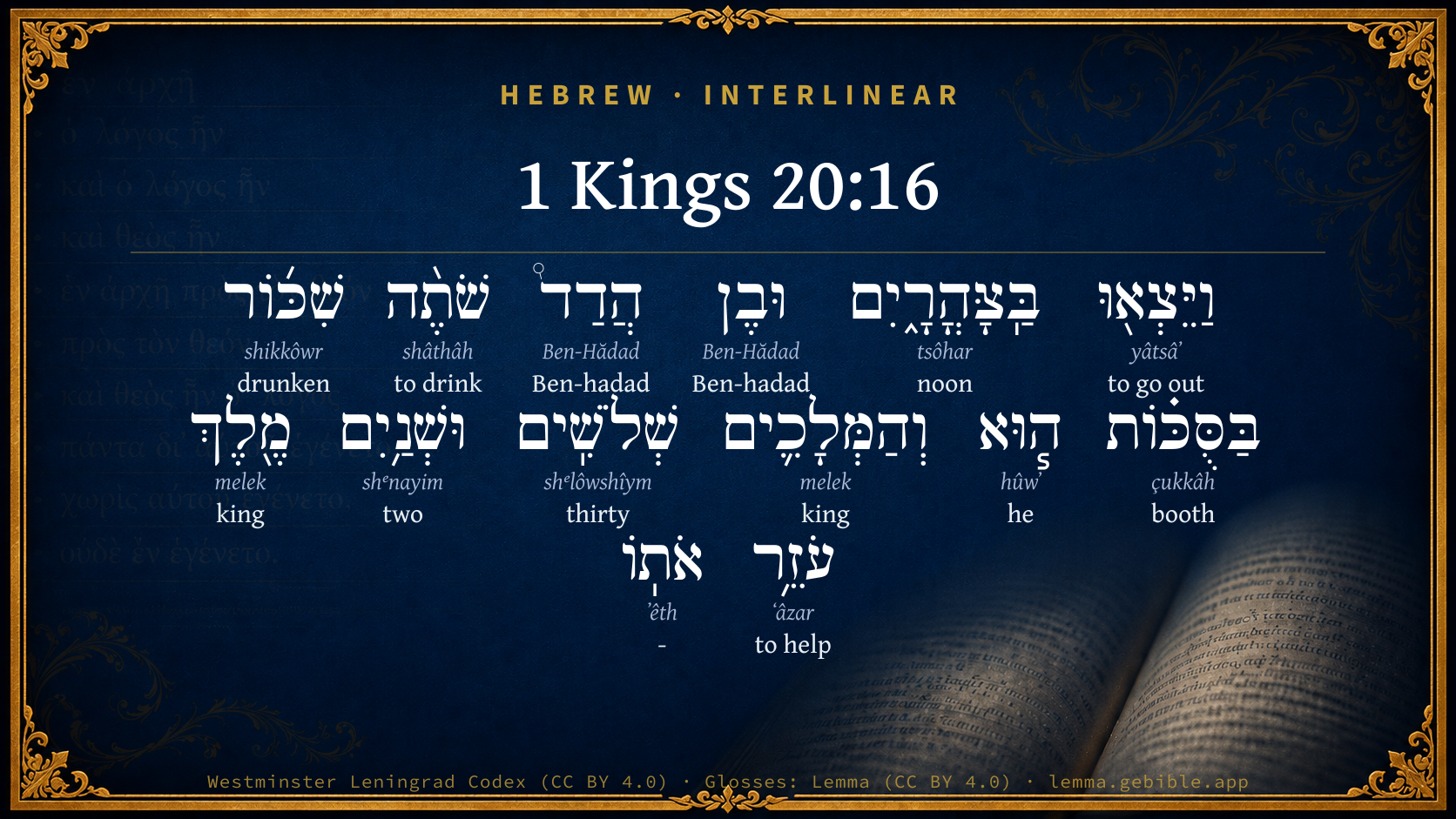
1 Kings 20:16

Hebrew (Westminster Leningrad Codex) 1 Kings 20:16 appears in the Hebrew Old Testament. The text above is from the Westminster Leningrad Codex. Each word links to its Strong’s number, a concise gloss, and parsing drawn from the Open Scriptures Hebrew Bible morphology. Click any word for its full Brown-Driver-Briggs (BDB) entry.
Download image
Cite this verse

1 Kings 20:16 (World English Bible). Public Domain. Lemma interlinear Bible study tool, https://lemma.gebible.app/v/1-kings/20/16.

Show BibTeX & RIS
BibTeX
RIS
English Translation
They went out at noon. But Ben Hadad was drinking himself drunk in the pavilions, he and the kings, the thirty-two kings who helped him.
World English Bible · Public Domain
Download a study sheet

One document with this verse’s original text, its word-by-word gloss line, the meaning frame, cross-references with their text, attributed commentary, and full source and license credits — printable, and it pastes into notes with its structure intact.

This verse Autodidact and up

Study sheet (.html) Plain text (.txt)

A passage Seminary Student

Up to 50 verses in one chapter. A passage sheet keeps up to 6 commentary sources and 12 cross-references per verse, in the order this page ranks them, and says so on the sheet whenever that leaves anything out. Ask for a single verse and you get the Autodidact verse sheet above.

Everything on this page stays free to read, with no account — the sheet is a download of what is already on screen, not access to it.

Want to remove ads? Support Godless Engineer
Compare translations 3

The same verse in 3 English versions, stacked beneath the original-language interlinear above. Click any original word for its lexicon entry.

Each is an independent rendering of the whole verse — the interlinear is not word-aligned to these translations.

Highlighted words mark where these versions differ — a whole-verse word diff, not a word-by-word alignment.

  • World English Bible Public Domain
    They went out at noon. But Ben Hadad was drinking himself drunk in the pavilions, he and the kings, the thirty-two kings who helped him.
  • King James Version Public Domain
    And they went out at noon. But Benhadad was drinking himself drunk in the pavilions, he and the kings, the thirty and two kings that helped him.
  • unfoldingWord Literal Text CC BY-SA 4.0
    And they went out at midday. (Now Ben Hadad was drinking drunk in the huts, he and the kings, 32 kings who helped him.)

unfoldingWord Literal Text — © unfoldingWord, licensed CC BY-SA 4.0. Word-aligned USFM3 via Door43 (git.door43.org/unfoldingWord/en_ult).

Versions to compare (up to 4)

3 of 4 selected

Show all 18 translations

Every available English version of this verse, each an independent rendering of the whole verse.

  • World English Bible Public Domain
    They went out at noon. But Ben Hadad was drinking himself drunk in the pavilions, he and the kings, the thirty-two kings who helped him.
  • Berean Standard Bible Public Domain
    They marched out at noon while Ben-hadad and the 32 kings allied with him were in their tents getting drunk.
  • Majority Standard Bible Public Domain
    They marched out at noon while Ben-hadad and the 32 kings allied with him were in their tents getting drunk.
  • King James Version Public Domain
    And they went out at noon. But Benhadad was drinking himself drunk in the pavilions, he and the kings, the thirty and two kings that helped him.
  • American Standard Version (1901) Public Domain
    And they went out at noon. But Ben-hadad was drinking himself drunk in the pavilions, he and the kings, the thirty and two kings that helped him.
  • Revised Version (1885) Public Domain
    And they went out at noon. But Ben-hadad was drinking himself drunk in the pavilions, he and the kings, the thirty and two kings that helped him.
  • Geneva Bible (1599) Public Domain
    And they went out at noone: but Ben-hadad did drinke till he was drunken in the tentes, both he and the Kings: for two and thirtie Kings helped him.
  • Douay-Rheims (1899) Public Domain
    And they went out at noon. But Benadad was drinking himself drunk in his pavilion, and the two and thirty kings with him, who were come to help him.
  • Young's Literal Translation Public Domain
    and they go out at noon, and Ben-Hadad is drinking -- drunk in the booths, he and the kings, the thirty and two kings, helping him.
  • Literal Standard Version CC BY-SA 4.0
    and they go out at noon, and Ben-Hadad is drinking—drunk in the shelters, he and the kings, the thirty-two kings helping him.
  • Unlocked Literal Bible CC BY-SA 4.0
    They went out at noon. Ben Hadad had been drinking himself drunk in his tent, he and the thirty-two lesser kings who were supporting him.
  • unfoldingWord Literal Text CC BY-SA 4.0
    And they went out at midday. (Now Ben Hadad was drinking drunk in the huts, he and the kings, 32 kings who helped him.)
  • Darby Bible Public Domain
    And they went out at noon; and Ben-Hadad drank himself drunk in the tents, he and the kings, the thirty-two kings that helped him.
  • World Messianic Bible Public Domain
    They went out at noon. But Ben Hadad was drinking himself drunk in the pavilions, he and the kings, the thirty-two kings who helped him.
  • Webster's Bible Public Domain
    And they went out at noon. But Ben-hadad was drinking himself drunk in the pavilions, he and the kings, the thirty and two kings that helped him.
  • Free Bible Version CC BY-SA 4.0
    They left at noon while Ben-hadad and the thirty-two kings with him were busy getting drunk in their tents.
  • Bible in Basic English Public Domain
    And in the middle of the day they went out. But Ben-hadad was drinking in the tents with the thirty-two kings who were helping him.
  • JPS Tanakh (1917) Public Domain
    And they went out at noon. But Ben-hadad was drinking himself drunk in the booths, he and the kings, the thirty and two kings that helped him.

Literal Standard Version (2020), Covenant Press — licensed CC BY-SA 4.0. Text via the HelloAO Bible API (eBible.org). Unlocked Literal Bible (unfoldingWord) — licensed CC BY-SA 4.0. Text via the HelloAO Bible API (eBible.org). unfoldingWord Literal Text — © unfoldingWord, licensed CC BY-SA 4.0. Word-aligned USFM3 via Door43 (git.door43.org/unfoldingWord/en_ult). Free Bible Version, Dr. Jonathan Gallagher — licensed CC BY-SA 4.0. Text via the HelloAO Bible API (eBible.org).

Word by word

More ways to search: Search by grammar → Find every occurrence → Compare this word →

Practice this passage: Drill this verse → Learn its vocabulary →

שִׁכּ֜וֹר
shikkôwr
H7910
“drunken”
Adjective, Adjective, Masculine, Singular, Absolute
Part of Speech
Adjective
Type
Adjective
Gender
Masculine
Number
Singular
State
Absolute
Full BDB Definition

Origin: from H7937

TWOT: 2388b

drunken - drunken - drunkard, drunken one (substantive)
  1. וַיֵּצְא֖וּ yâtsâʼ H3318 “and · to go out” Conjunction + Verb, Qal, Sequential Imperfect, 3rd Person, Masculine, Plural
  2. בַּֽצָּהֳרָ֑יִם tsôhar H6672 “in/at the · noon” Preposition, Determined + Noun, Common, Masculine, Plural, Absolute
  3. וּבֶן Ben-Hădad H1130 “and · Ben-hadad” Conjunction + Noun, Proper
  4. הֲדַד֩ Ben-Hădad H1130 “Ben-hadad” Noun, Proper
  5. שֹׁתֶ֨ה shâthâh H8354 “drinking” Verb, Qal, Participle Active, Masculine, Singular, Absolute
  6. בַּסֻּכּ֗וֹת çukkâh H5521 “in/at the · booths” Preposition, Determined + Noun, Common, Feminine, Plural, Absolute
  7. ה֧וּא hûwʼ H1931 “he” Pronoun, Personal, 3rd Person, Masculine, Singular
  8. וְהַמְּלָכִ֛ים melek H4428 “and · the · kings” Conjunction + Particle, Definite Article + Noun, Common, Masculine, Plural, Absolute
  9. שְׁלֹשִֽׁים shᵉlôwshîym H7970 “thirty” Adjective, Cardinal number, Both, Plural, Absolute
  10. וּשְׁנַ֥יִם shᵉnayim H8147 “and · two” Conjunction + Adjective, Cardinal number, Masculine, Dual, Absolute
  11. מֶ֖לֶךְ melek H4428 “king” Noun, Common, Masculine, Singular, Absolute
  12. עֹזֵ֥ר ʻâzar H5826 “helping” Verb, Qal, Participle Active, Masculine, Singular, Absolute
  13. אֹתֽוֹ ʼêth H853 “- · him” Particle, Direct Object + Suffix, Personal, 3rd Person, Masculine, Singular

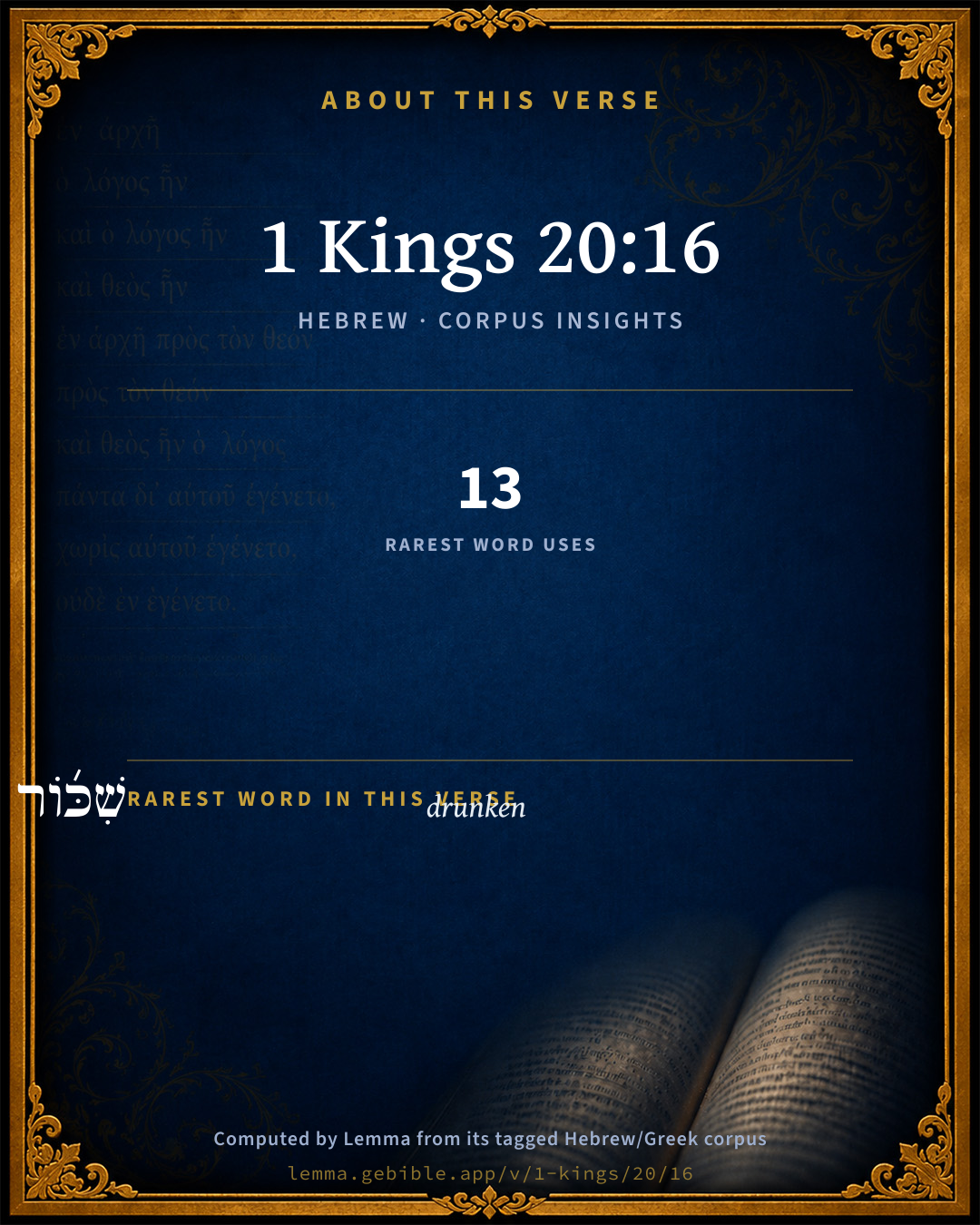
About this verse

These counts appear in no published source. They are computed here, from the morphology-tagged text and Lemma’s own curated glosses. What Lemma adds →

14
words
12
distinct lemmas
Historical
section

Notable vocabulary

The rarest word here is שִׁכּ֜וֹר drunken H7910 — appearing just 13 times in the whole Hebrew Bible.

Shared distinctive vocabulary

שִׁכּ֜וֹר drunken H7910 occurs in 13 verses of the Hebrew Bible. Also found in:

Grammatical profile

  • 3 verbs
  • 6 nouns
  • 3 adjectives
  • 1 pronoun
  • 1 particle

Verb forms

  • וַיֵּצְא֖וּ Qal · Sequential Imperfect
  • שֹׁתֶ֨ה Qal · Participle Active
  • עֹזֵ֥ר Qal · Participle Active

Repetition

Words recur within this verse — often emphatic in Hebrew:

  • וּבֶן Ben-hadad H1130 ×2
  • וְהַמְּלָכִ֛ים king H4428 ×2

Hebrew & Septuagint length

In English translation the verse runs 25 words from the Hebrew and 47 from the Septuagint (LXX English) — the Septuagint runs noticeably longer here. See the side-by-side →

A rough comparison of the two English renderings, which tokenize alike — not a word-level alignment.

Word counts can differ between the Hebrew and the Greek without any difference in meaning — e.g. the Hebrew direct-object marker אֵת has no separate Greek word, and Greek often adds the article ὁ.

Cross-references

7

Topical passages linked to 1 Kings 20:16 in the Treasury of Scripture Knowledge — connected by theme and wording, ordered by reader-vote popularity; previews shown in the World English Bible.

  • 1 Kings 16:7 Moreover by the prophet Jehu the son of Hanani came the word of Yahweh against Baasha, and against his house, both because of all the evil that he did in the sight of Yahweh, to provoke him to anger with the work of his hands, in being like the house of Jeroboam, and because he struck him.
  • 1 Kings 16:9 His servant Zimri, captain of half his chariots, conspired against him. Now he was in Tirzah, drinking himself drunk in the house of Arza, who was over the household in Tirzah:
  • 1 Kings 20:11–12 The king of Israel answered, Tell him, Don't let him who girds on [his armor] boast himself as he who puts it off.
  • Proverbs 23:29–32 Who has woe? Who has sorrow? Who has strife? Who has complaints? Who has needless bruises? Who has bloodshot eyes?
  • Ecclesiastes 10:16–17 Woe to you, land, when your king is a child, And your princes eat in the morning!
  • Isaiah 54:15 Behold, they may gather together, but not by me: whoever shall gather together against you shall fall because of you.
  • Hosea 4:11 Prostitution, wine, and new wine take away understanding.

Cross-references courtesy of OpenBible.info (CC BY 4.0).

Hebrew and Greek witnesses Masoretic Hebrew ↔ Greek Septuagint

The same verse in the two great witnesses to the Old Testament, shown verse-for-verse.

Here the Septuagint runs noticeably longer than the Hebrew — LXX2012 (modern English Septuagint) 47 words vs World English Bible 25. A rough length comparison of the two English translations, not a word-level alignment — read both below.

These are two independent witnesses, not word-aligned to each other, and the Septuagint is shown in lemma (dictionary) form.

Hebrew 1 Kings 20:16 Masoretic · Westminster Leningrad Codex

וַיֵּצְא֖וּ בַּֽצָּהֳרָ֑יִם וּבֶן הֲדַד֩ שֹׁתֶ֨ה שִׁכּ֜וֹר בַּסֻּכּ֗וֹת ה֧וּא וְהַמְּלָכִ֛ים שְׁלֹשִֽׁים וּשְׁנַ֥יִם מֶ֖לֶךְ עֹזֵ֥ר אֹתֽוֹ

They went out at noon. But Ben Hadad was drinking himself drunk in the pavilions, he and the kings, the thirty-two kings who helped him.

World English Bible · Public Domain

Greek LXX 1 Kings 20:16 Septuagint · lemma form

καί γίγνομαι ὡς ἀκούω αχααβ ὅτι θνήσκω ναβουθαι ὁ ιεζραηλίτης καί διαῥήγνυμι ὁ ἱμάτιον ἑαυτοῦ καί περιβάλλω σάκκος καί γίγνομαι μετά οὗτος καί ἀναἵστημι καί καταβαίνω αχααβ εἰς ὁ ἀμπελών ναβουθαι ὁ ιεζραηλίτης κληρονομέω αὐτός

And it came to pass, when Achaab heard that Nabuthai the Jezraelite was dead, that he tore his garments, and put on sackcloth. And it came to pass afterward, that Achaab arose and went down to the vineyard of Nabuthai the Jezraelite, to take possession of it.

LXX2012 (modern English Septuagint) · Public Domain

Hebrew: Westminster Leningrad Codex (CC BY 4.0). Greek: Septuagint (public domain); English from LXX2012 (modern English Septuagint) (Public Domain). How the Septuagint differs from the Hebrew →

Targum (Aramaic paraphrase)

1

The Targum is the ancient Jewish Aramaic paraphrase of the Hebrew Scriptures — an interpretive translation, not the Hebrew text itself. Onkelos (literal) and Pseudo-Jonathan (expansive) render the Torah, and Jonathan the Prophets. Coverage is partial: where no permissively-licensed English translation exists for a verse, only the Aramaic is shown. This is verse-level text, not a word-by-word alignment to the Hebrew.

  1. Targum Jonathan Prophets (Joshua–Malachi)
    וּנְפָקוּ בְּטִיהֲרָא וּבַר הֲדַד שָׁתֵי רָוֵי בִּמְטָלַיָא הוּא וּמַלְכַיָא תְּלָתִין וּתְרֵין מַלְכַיָא מְסַעְדִין לֵיהּ:

    (no public-domain English translation for this verse)

    Targum Jonathan — Aramaic: “Mikraot Gedolot” (public domain). English: “Sefaria Community Translation” (CC0 1.0 (public-domain dedication)); “London "Chaldee Paraphrase," 1871” (public domain). Text via Sefaria.

Commentary

Notes on 1 Kings 20:16 from classic Christian and Jewish commentators (each source and its license shown beneath its notes). The classic Christian expositions comment on the surrounding passage and are grouped to its opening verse, so a note may address several verses; the Jewish commentaries on the Tanakh (Rashi and others) are per-verse, so they appear only where the commentator wrote on this verse.

Lemma curates 59 commentaries, every one of them public domain or Creative Commons licensed, each selected and text-cleaned for this edition rather than reprinted as found. About our sources →

Trapp's Complete Commentary

John Trapp

1Ki 20:16 And they went out at noon. But Benhadad [was] drinking himself drunk in the pavilions, he and the kings, the thirty and two kings that helped him.

Ver. 16. And Benhadad was drinking himself drunk.] Security is the certain usher of destruction. See 1Ki 20:12.

John Trapp, A Commentary or Exposition upon All the Books of the Old and New Testament (1647–1656) — public domain. Text from a community e-Sword module.

Joseph Benson's Commentary

1Ki 20:16; 1Ki 20:18. And they went out at noon — When they knew the Syrians were at dinner, if not also drinking to excess, as their king was. And he said, Whether they be come for peace, take them alive, &c. — It was against the law of nations to apprehend those that came to treat of peace: but he, in his insolent pride, told his people not to trouble themselves to examine what they came for, but to take them alive, which he thought they might easily do, these Israelites being so few in number, and not able, he supposed, to stand the first brunt.

Joseph Benson's Commentary on the Old and New Testaments (1811–1818) — public domain. Text from a community e-Sword module.

The Cambridge Bible for Schools and Colleges

gen. ed. J. J. S. Perowne

16. they went out at noon] They had probably learnt that the royal banquet was in progress, and the moment would appear a favourable one. When the leaders were giving themselves up to self-indulgence the army would not be well-prepared for action. The words which follow shew that the revelry in the camp of the Syrians had been carried to a perilous length.

The Cambridge Bible for Schools and Colleges (gen. ed. J. J. S. Perowne; Cambridge University Press, 1878–1918) — public domain. Text from a community e-Sword module.

John Gill's Exposition

And they went out at noon,.... From Samaria, the two hundred and thirty two young men, and the 7000 Israelites, openly, with great spirit and courage, fearless and undaunted; but it is not said that Ahab went out at the head of them; it seems as if he did not by what is said, Kg1 20:21,

but Benhadad was drinking himself drunk in the pavilions (or booths, or tents), he, and the kings, the thirty two kings that helped him; who either were his subjects, or his tributaries, or confederates; being secure, and having nothing to fear from Ahab, he and they gave themselves up to carousing and drinking, even at noon, and so destruction came upon them unawares, as on Belshazzar.

John Gill's Exposition of the Whole Bible (1746–1763) — public domain (CC PDM 1.0). Text via the HelloAO Bible API.

Albert Barnes' Notes on the Bible

drinking himself drunk - Ben-hadad meant probably to mark his utter contempt of his foe. Compare the contempt of Belshazzar Dan 5:1-4.

Albert Barnes' Notes on the Bible (1834–1885) — public domain. Text from a community e-Sword/MySword module.

Matthew Poole's English Annotations

They went out at noon; when they were eating, and drinking, and secure from all fear and expectation of an assault.

Matthew Poole's English Annotations on the Holy Bible (1683–1685) — public domain. Text from a community e-Sword/MySword module.

The Pulpit Commentary

And they went out at noon. "At the time when Ben-hadad, haughty and confident, had given himself up with his vassals, to the table, news of which had probably been received in the city" (Bahr). But it seems at least equally probable that the noon hour was selected either in obedience to the unrecorded directions of the prophet, or as being a time for rest and sleep, as it still is in the East. But Ben-hadad was drinking himself drunk in the pavilions, he and the kings, the thirty and two kings that helped him. Strong drink would seem to have been a besetment of the monarchs of that age. (of 1Ki_16:9; Proverbs Dan_5:1 sqq.; Est_1:10 Est_7:2; Hab_2:5) It can hardly have been to "mark his utter contempt of the foe," Rawlinson, who compares Belshazzar"s feast (Dan_5:1-4) when besieged by Cyrus. But Ben-hadad was the besieger. We are rather reminded of Alexander"s carouse at Babylon.

Drinking himself drunk he and the kings." Of strong drink it may justly be said, "Many strong men have been slain by her". (Pro_7:20) "It is not for kings to drink wine". (Pro_31:4) Nor is it for warriors. Alexander, conqueror of the world, was conquered by wine. Our great generals of modern times have been abstainers. The march to Coomassie, to Candahar was effected without the aid of intoxicants. The Russian soldiers in the Crimea were drugged with vodka, but it did not prevent their defeat.

The Pulpit Commentary (1880–1919), ed. H.D.M. Spence-Jones & Joseph S. Exell — public domain. Text from a community e-Sword module.

unfoldingWord translationNotes

Door43 World Missions Community

They went out

Here the word "They" refers to the Israelite army.

thirty-two lesser kings

See how you translated this in 1 Kings 20:1.

Ben Hadad was informed by scouts that he had sent out

This can be expressed in active form. AT: "Scouts that Ben Hadad had sent out informed him" (See: Active or Passive)

scouts

A "scout" is a soldier sent to gather information about the enemy.

translationWords

drunk

king

send

Samaria

unfoldingWord translationNotes — © Distant Shores Media and the Door43 World Missions Community, licensed CC BY-SA 4.0. Source: git.door43.org/Door43/en_tn.

Rashi

Rabbi Shlomo Yitzchaki (Rashi)

In the shelters. That they had made for themselves [as protection] from the sun.

Rashi on the Tanakh — English translations: “The Judaica Press complete Tanach with Rashi, translated by A. J. Rosenberg” (CC BY 4.0); “Pentateuch with Rashi's commentary by M. Rosenbaum and A.M. Silbermann, 1929-1934” (public domain); “The Metsudah Tanach series, Lakewood, N.J” (CC BY 4.0); and “The Book of Joshua, Metsudah Publications, 1997” (CC BY 4.0). Text via Sefaria.

Lesson kit

Teaching starters — assembled from the data on this page, not authored interpretation. Every prompt links to the verse data it draws on. Edit before teaching.

1 Kings, in the Historical, opens this verse with 14 words (12 distinct Hebrew lemmas). Its most distinctive word is shikkôwr (“drunken”). The Greek Septuagint runs longer here. A historical commentator’s framing appears above. Read the whole chapter for the surrounding context.

Discussion questions

  1. How does “drunken” (shikkôwr) shape what this verse is saying?
  2. 1 Samuel 1:13 shares the word «drunken» with this verse. How do the two illuminate each other?
  3. “Ben-hadad” occurs 2× in this one verse. What is the effect of the repetition?
  4. Compared with the Hebrew, the Septuagint runs longer here. What questions does that raise?
  5. These translations render this verse differently; the difference is in the English rendering, not the original. What questions does that raise?
  6. The verb «וַיֵּצְא֖וּ» is Qal Sequential Imperfect. How does its form color the action?
  7. Reading how Trapp's Complete Commentary and Joseph Benson's Commentary read this verse, where do the two commentators agree and where do they part?

Things to notice

Reading settings

Reading text

Shown beneath each verse's original-language words.

Old Testament
Old Testament edition

Read the OT as the Masoretic Hebrew (MT) or the Greek Septuagint (LXX).

English shown for the Greek Septuagint (in the Hebrew ↔ Greek comparison).

Comparing translations? Open the Compare panel on any verse page to stack up to four side by side.