
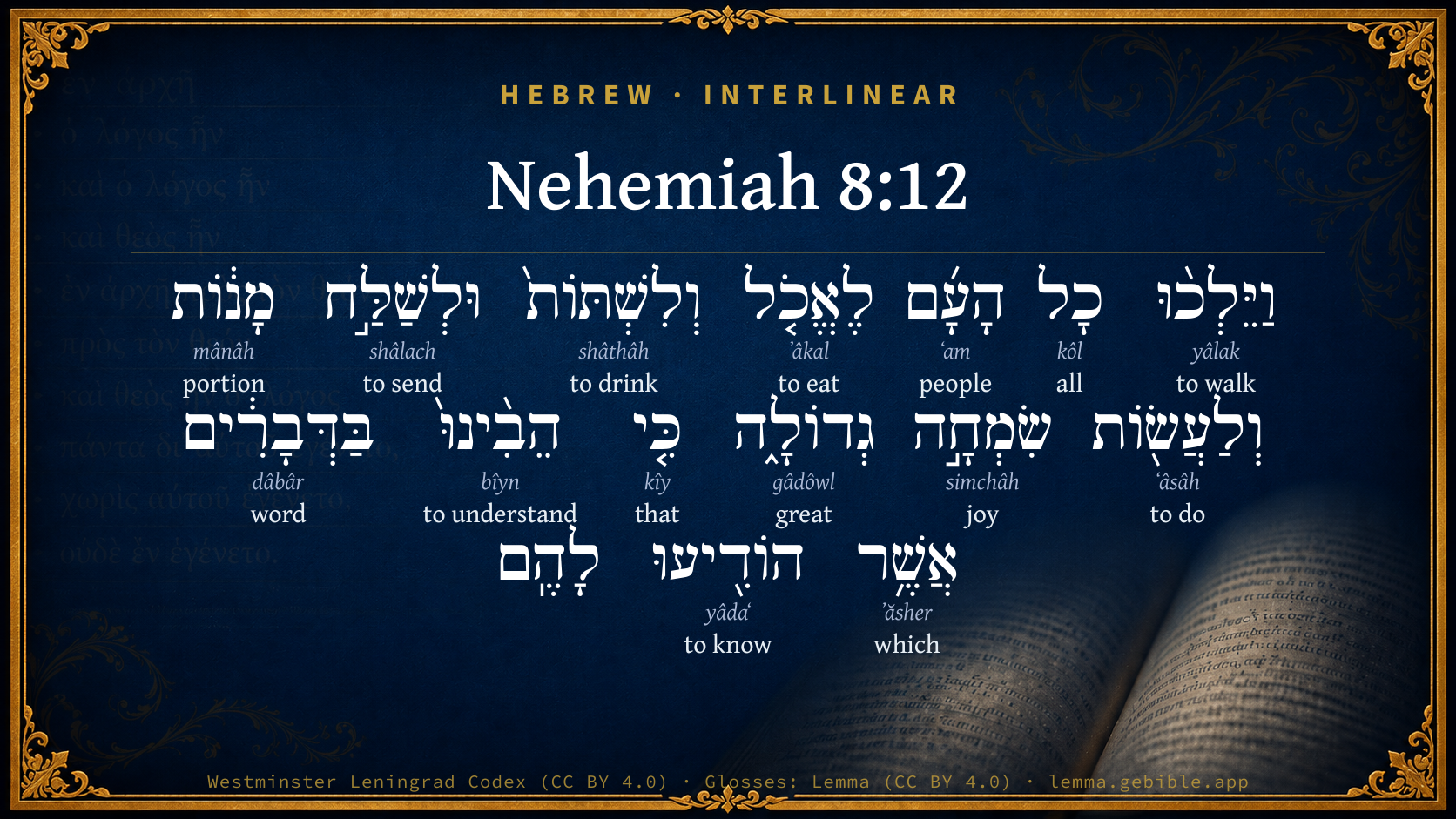
Nehemiah 8:12

Hebrew (Westminster Leningrad Codex) Nehemiah 8:12 appears in the Hebrew Old Testament. The text above is from the Westminster Leningrad Codex. Each word links to its Strong’s number, a concise gloss, and parsing drawn from the Open Scriptures Hebrew Bible morphology. Click any word for its full Brown-Driver-Briggs (BDB) entry.
Download image
Cite this verse

Nehemiah 8:12 (World English Bible). Public Domain. Lemma interlinear Bible study tool, https://lemma.gebible.app/v/nehemiah/8/12.

Show BibTeX & RIS
BibTeX
RIS
English Translation
All the people went their way to eat, and to drink, and to send portions, and to make great mirth, because they had understood the words that were declared to them.
World English Bible · Public Domain
Download a study sheet

One document with this verse’s original text, its word-by-word gloss line, the meaning frame, cross-references with their text, attributed commentary, and full source and license credits — printable, and it pastes into notes with its structure intact.

This verse Autodidact and up

Study sheet (.html) Plain text (.txt)

A passage Seminary Student

Up to 50 verses in one chapter. A passage sheet keeps up to 6 commentary sources and 12 cross-references per verse, in the order this page ranks them, and says so on the sheet whenever that leaves anything out. Ask for a single verse and you get the Autodidact verse sheet above.

Everything on this page stays free to read, with no account — the sheet is a download of what is already on screen, not access to it.

Want to remove ads? Support Godless Engineer
Compare translations 3

The same verse in 3 English versions, stacked beneath the original-language interlinear above. Click any original word for its lexicon entry.

Each is an independent rendering of the whole verse — the interlinear is not word-aligned to these translations.

Highlighted words mark where these versions differ — a whole-verse word diff, not a word-by-word alignment.

  • World English Bible Public Domain
    All the people went their way to eat, and to drink, and to send portions, and to make great mirth, because they had understood the words that were declared to them.
  • King James Version Public Domain
    And all the people went their way to eat, and to drink, and to send portions, and to make great mirth, because they had understood the words that were declared unto them.
  • unfoldingWord Literal Text CC BY-SA 4.0
    And all the people went to eat and to drink and to send away portions and to make a great rejoicing, for they understood the words that had been made known to them.

unfoldingWord Literal Text — © unfoldingWord, licensed CC BY-SA 4.0. Word-aligned USFM3 via Door43 (git.door43.org/unfoldingWord/en_ult).

Versions to compare (up to 4)

3 of 4 selected

Show all 18 translations

Every available English version of this verse, each an independent rendering of the whole verse.

  • World English Bible Public Domain
    All the people went their way to eat, and to drink, and to send portions, and to make great mirth, because they had understood the words that were declared to them.
  • Berean Standard Bible Public Domain
    Then all the people began to eat and drink, to send out portions, and to rejoice greatly, because they understood the words that had been made known to them.
  • Majority Standard Bible Public Domain
    Then all the people began to eat and drink, to send out portions, and to rejoice greatly, because they understood the words that had been made known to them.
  • King James Version Public Domain
    And all the people went their way to eat, and to drink, and to send portions, and to make great mirth, because they had understood the words that were declared unto them.
  • American Standard Version (1901) Public Domain
    And all the people went their way to eat, and to drink, and to send portions, and to make great mirth, because they had understood the words that were declared unto them.
  • Revised Version (1885) Public Domain
    And all the people went their way to eat, and to drink, and to send portions, and to make great mirth, because they had understood the words that were declared unto them.
  • Geneva Bible (1599) Public Domain
    Then all the people went to eate and to drinke, and to send away part, and to make great ioy, because they had vnderstand the wordes that they had taught them.
  • Douay-Rheims (1899) Public Domain
    So all the people went to eat and drink, and to send portions, and to make great mirth: because they understood the words that he had taught them.
  • Young's Literal Translation Public Domain
    And all the people go to eat, and to drink, and to send portions, and to make great joy, because they have understood concerning the words that they made known to them.
  • Literal Standard Version CC BY-SA 4.0
    And all the people go to eat, and to drink, and to send portions, and to make great joy, because they have understood concerning the words that they made known to them.
  • Unlocked Literal Bible CC BY-SA 4.0
    Then all the people went their way to eat and to drink and to share food and to celebrate with great joy because they had understood the words that were made known to them.
  • unfoldingWord Literal Text CC BY-SA 4.0
    And all the people went to eat and to drink and to send away portions and to make a great rejoicing, for they understood the words that had been made known to them.
  • Darby Bible Public Domain
    And all the people went their way, to eat and to drink, and to send portions, and to make great rejoicing. For they had understood the words that were declared to them.
  • World Messianic Bible Public Domain
    All the people went their way to eat, to drink, to send portions, and to celebrate, because they had understood the words that were declared to them.
  • Webster's Bible Public Domain
    And all the people went their way to eat, and to drink, and to send portions, and to make great mirth, because they had understood the words that were declared to them.
  • Free Bible Version CC BY-SA 4.0
    Then everyone went away to eat and drink, and to share their food. They celebrated happily because now they understood the Law as it had been explained to them.
  • Bible in Basic English Public Domain
    And all the people went away to take food and drink, and to send food to others, and to be glad, because the words which were said to them had been made clear.
  • JPS Tanakh (1917) Public Domain
    And all the people went their way to eat, and to drink, and to send portions, and to make great mirth, because they had understood the words that were declared unto them.

Literal Standard Version (2020), Covenant Press — licensed CC BY-SA 4.0. Text via the HelloAO Bible API (eBible.org). Unlocked Literal Bible (unfoldingWord) — licensed CC BY-SA 4.0. Text via the HelloAO Bible API (eBible.org). unfoldingWord Literal Text — © unfoldingWord, licensed CC BY-SA 4.0. Word-aligned USFM3 via Door43 (git.door43.org/unfoldingWord/en_ult). Free Bible Version, Dr. Jonathan Gallagher — licensed CC BY-SA 4.0. Text via the HelloAO Bible API (eBible.org).

Word by word

More ways to search: Search by grammar → Find every occurrence → Compare this word →

Practice this passage: Drill this verse → Learn its vocabulary →

מָנ֔וֹת
mânâh
H4490
“portions”
Noun, Common, Feminine, Plural, Absolute
Part of Speech
Noun
Type
Common
Gender
Feminine
Number
Plural
State
Absolute
Full BDB Definition

Origin: from H4487

TWOT: 1213a

part, portion
  1. וַיֵּלְכ֨וּ yâlak H3212 “and · to walk” Conjunction + Verb, Qal, Sequential Imperfect, 3rd Person, Masculine, Plural
  2. כָל kôl H3605 “all of” Noun, Common, Masculine, Singular, Construct
  3. הָעָ֜ם ʻam H5971 “the · people” Particle, Definite Article + Noun, Common, Masculine, Singular, Absolute
  4. לֶאֱכֹ֤ל ʼâkal H398 “to eat” Preposition + Verb, Qal, Infinitive Construct
  5. וְלִשְׁתּוֹת֙ shâthâh H8354 “and · to drink” Conjunction + Preposition + Verb, Qal, Infinitive Construct
  6. וּלְשַׁלַּ֣ח shâlach H7971 “and · to send” Conjunction + Preposition + Verb, Piel, Infinitive Construct
  7. וְלַעֲשׂ֖וֹת ʻâsâh H6213 “and · to do” Conjunction + Preposition + Verb, Qal, Infinitive Construct
  8. שִׂמְחָ֣ה simchâh H8057 “joy” Noun, Common, Feminine, Singular, Absolute
  9. גְדוֹלָ֑ה gâdôwl H1419 “great” Adjective, Adjective, Feminine, Singular, Absolute
  10. כִּ֤י kîy H3588 “that” Conjunction
  11. הֵבִ֨ינוּ֙ bîyn H995 “to understand” Verb, Hiphil, Perfect, 3rd Person, Common, Plural
  12. בַּדְּבָרִ֔ים dâbâr H1697 “in/at the · words” Preposition, Determined + Noun, Common, Masculine, Plural, Absolute
  13. אֲשֶׁ֥ר ʼăsher H834 “which” Particle, Relative
  14. הוֹדִ֖יעוּ yâdaʻ H3045 “to know” Verb, Hiphil, Perfect, 3rd Person, Common, Plural

About this verse

These counts appear in no published source. They are computed here, from the morphology-tagged text and Lemma’s own curated glosses. What Lemma adds →

16
words
15
distinct lemmas
Historical
section

Notable vocabulary

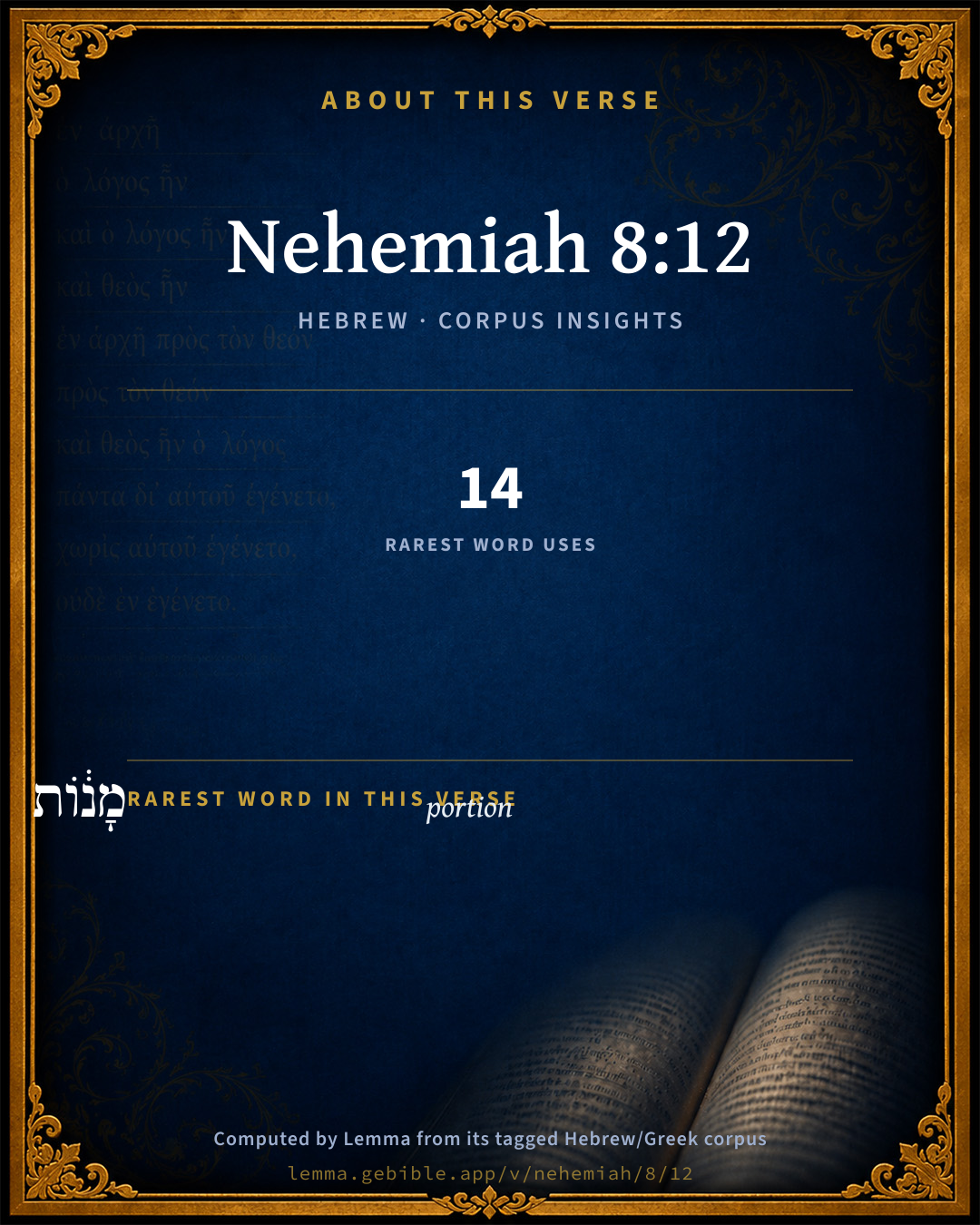
The rarest word here is מָנ֔וֹת portion H4490 — appearing just 14 times in the whole Hebrew Bible.

Shared distinctive vocabulary

מָנ֔וֹת portion H4490 occurs in 14 verses of the Hebrew Bible. Also found in:

Grammatical profile

  • 7 verbs
  • 5 nouns
  • 1 adjective
  • 1 preposition
  • 1 conjunction
  • 1 particle

Verb forms

  • וַיֵּלְכ֨וּ Qal · Sequential Imperfect
  • לֶאֱכֹ֤ל Qal · Infinitive Construct
  • וְלִשְׁתּוֹת֙ Qal · Infinitive Construct
  • וּלְשַׁלַּ֣ח Piel · Infinitive Construct
  • וְלַעֲשׂ֖וֹת Qal · Infinitive Construct
  • הֵבִ֨ינוּ֙ Hiphil · Perfect
  • הוֹדִ֖יעוּ Hiphil · Perfect

Cross-references

19

Topical passages linked to Nehemiah 8:12 in the Treasury of Scripture Knowledge — connected by theme and wording, ordered by reader-vote popularity; previews shown in the World English Bible.

  • Psalms 119:174 I have longed for your salvation, Yahweh. Your law is my delight.
  • Nehemiah 8:7–8 Also Jeshua, and Bani, and Sherebiah, Jamin, Akkub, Shabbethai, Hodiah, Maaseiah, Kelita, Azariah, Jozabad, Hanan, Pelaiah, and the Levites, caused the people to understand the law: and the people [stood] in their place.
  • Psalms 119:72 The law of your mouth is better to me than thousands of pieces of gold and silver.
  • Psalms 119:97 How love I your law! It is my meditation all day.
  • Psalms 119:103–104 How sweet are your promises to my taste, More than honey to my mouth!
  • Psalms 119:111 I have taken your testimonies as a heritage forever, For they are the joy of my heart.
  • Psalms 119:127 Therefore I love your commandments more than gold, Yes, more than pure gold.
  • Psalms 119:130 The entrance of your words gives light. It gives understanding to the simple.
  • Psalms 119:171 Let my lips utter praise, For you teach me your statutes.
  • Luke 24:32 They said one to another, "Weren't our hearts burning within us, while he spoke to us along the way, and while he opened the Scriptures to us?"
  • Job 23:12 I haven't gone back from the commandment of his lips. I have treasured up the words of his mouth more than my necessary food.
  • Psalms 19:8–11 Yahweh's precepts are right, rejoicing the heart. Yahweh's commandment is pure, enlightening the eyes.
  • Psalms 119:14 I have rejoiced in the way of your testimonies, As much as in all riches.
  • Psalms 119:16 I will delight myself in your statutes. I will not forget your word.
  • Psalms 126:1–3 When Yahweh brought back those who returned to Zion, We were like those who dream.
  • Proverbs 2:10–11 For wisdom will enter into your heart. Knowledge will be pleasant to your soul.
  • Proverbs 24:13–14 My son, eat honey, for it is good; The droppings of the honeycomb, which are sweet to your taste:
  • Jeremiah 15:16 Your words were found, and I ate them; and your words were to me a joy and the rejoicing of my heart: for I am called by your name, Yahweh, God of hosts.
  • Romans 7:18 For I know that in me, that is, in my flesh, dwells no good thing. For desire is present with me, but I don't find it doing that which is good.

Cross-references courtesy of OpenBible.info (CC BY 4.0).

Hebrew and Greek witnesses Masoretic Hebrew ↔ Greek Septuagint

The same verse in the two great witnesses to the Old Testament, shown verse-for-verse.

These are two independent witnesses, not word-aligned to each other, and the Septuagint is shown in lemma (dictionary) form.

Hebrew Nehemiah 8:12 Masoretic · Westminster Leningrad Codex

וַיֵּלְכ֨וּ כָל הָעָ֜ם לֶאֱכֹ֤ל וְלִשְׁתּוֹת֙ וּלְשַׁלַּ֣ח מָנ֔וֹת וְלַעֲשׂ֖וֹת שִׂמְחָ֣ה גְדוֹלָ֑ה כִּ֤י הֵבִ֨ינוּ֙ בַּדְּבָרִ֔ים אֲשֶׁ֥ר הוֹדִ֖יעוּ לָהֶֽם

All the people went their way to eat, and to drink, and to send portions, and to make great mirth, because they had understood the words that were declared to them.

World English Bible · Public Domain

Greek LXX Structure differs

The Septuagint has no separate book of Nehemiah. Its Greek text is the second half of Esdras B (2 Esdras), chapters 11–23; Ezra is the first half (1–10).

A verse-for-verse comparison isn’t shown here because the chapters and verses don’t line up. Switch to the LXX edition with the MT / LXX toggle above to read the Greek directly.

On this verse, The Cambridge Bible for Schools and Colleges discusses the Septuagint’s reading. Read the note in Commentary ↓

Hebrew: Westminster Leningrad Codex (CC BY 4.0). Greek: Septuagint (public domain); English from a public-domain English Septuagint. How the Septuagint differs from the Hebrew →

Commentary

Notes on Nehemiah 8:12 from classic Christian and Jewish commentators (each source and its license shown beneath its notes). The classic Christian expositions comment on the surrounding passage and are grouped to its opening verse, so a note may address several verses; the Jewish commentaries on the Tanakh (Rashi and others) are per-verse, so they appear only where the commentator wrote on this verse.

Lemma curates 59 commentaries, every one of them public domain or Creative Commons licensed, each selected and text-cleaned for this edition rather than reprinted as found. About our sources →

Trapp's Complete Commentary

John Trapp

Neh 8:12 And all the people went their way to eat, and to drink, and to send portions, and to make great mirth, because they had understood the words that were declared unto them.

Ver. 12. And all the people went their way to eat] To do all that they were directed to do. They had been in the furnace of mortification; and now they were willing to be cast into the mould of God’s word, and to be whatsoever the Lord would have them to be. They were only his clay and wax, a willing people, waiting for his law.

And to make great mirth] i.e. All kind of honest jollity; for the better exciting their hearts to true thankthlness.

Because they had understood the words] Not the threatenings only to the refractory, but the promises also to the penitent and obedient. The Levites had taught them, doubtless, as the truth is in Jesus, that God therefore threateneth that he may not punish, and desireth to be disarmed, Amo 4:12; that he giveth to do what he commandeth to be done; that his mercy is from everlasting to everlasting to them that fear him, to them that keep his covenant, and that think upon his commandments to do them, qui faciunt praecepta, etsi non perfieiant, that are doing at it, though they are far from perfection, Psa 103:18. This was very comfortable; this put into them that joy of the Lord which was their strength; this more cheered them than all their good cheer of their peace offerings.

John Trapp, A Commentary or Exposition upon All the Books of the Old and New Testament (1647–1656) — public domain. Text from a community e-Sword module.

Ellicott's Commentary for English Readers

(12) They had understood.—They had caught the meaning of the command to rejoice.

A Bible Commentary for English Readers, edited by Charles John Ellicott (1878–1897) — public domain. Text from a community e-Sword module.

The Cambridge Bible for Schools and Colleges

gen. ed. J. J. S. Perowne

12. send portions] Cf. Neh_8:10.

because they had understood the words that were declared unto them] Literally, ‘the words which they had declared unto them.’ The LXX. ἐγνώρισεν, Vulg. ‘docuerat’ make it probable that there was a reading ‘Which he had declared unto them.’ What are ‘the words’ here referred to? Some think that we should understand by them the command of Ezra and the Levites that the people should be joyful (Neh_8:9-11). But this gives a very limited application, and we should then have expected some other verb like ‘obeyed’ or ‘gave heed to’ rather than ‘understood.’ It will be noticed that the word ‘understood’ is the same as that used in Neh_8:8. This supplies the probable interpretation. The people sorrowed (Neh_8:9) because they had not kept the Law: they now rejoiced because they were able to understand it.

The Cambridge Bible for Schools and Colleges (gen. ed. J. J. S. Perowne; Cambridge University Press, 1878–1918) — public domain. Text from a community e-Sword module.

John Gill's Exposition

And all the people went their way to eat and to drink,.... Freely and cheerfully:

and to send portions; to the poor, who had nothing to eat and drink:

and to make great mirth; with music, vocal and instrumental:

because they had understood the words that were declared unto them; the meaning of the several laws read and explained unto them, whereby they better understood their duty, and in what instances and in what manner it was to be performed; how much more reason is there for joy and gladness, when the Gospel, and the doctrines of it, are clearly known and understood? Psa 89:15.

John Gill's Exposition of the Whole Bible (1746–1763) — public domain (CC PDM 1.0). Text via the HelloAO Bible API.

Matthew Poole's English Annotations

Because they now knew God’s mind, and their own duty, which they were resolved to practise; which gave them ground of hope and trust in God’s mercy, and consequently of great and just joy.

Matthew Poole's English Annotations on the Holy Bible (1683–1685) — public domain. Text from a community e-Sword/MySword module.

The Pulpit Commentary

To make great mirth. Or "great rejoicing," not "mirth" in the sense which the word now commonly bears.

The Pulpit Commentary (1880–1919), ed. H.D.M. Spence-Jones & Joseph S. Exell — public domain. Text from a community e-Sword module.

Lesson kit

Teaching starters — assembled from the data on this page, not authored interpretation. Every prompt links to the verse data it draws on. Edit before teaching.

Nehemiah, in the Historical, opens this verse with 16 words (15 distinct Hebrew lemmas). Its most distinctive word is mânâh (“portion”). A historical commentator’s framing appears above. Read the whole chapter for the surrounding context.

Discussion questions

  1. The word mânâh carries the sense “portion.” How does it shape the verse?
  2. Exodus 29:26 shares the word «portion» with this verse. How do the two illuminate each other?
  3. These translations render this verse differently. What is at stake in choosing one wording over another?
  4. The verb «וַיֵּלְכ֨וּ» is Qal Sequential Imperfect. How does its form color the action?
  5. Reading how Trapp's Complete Commentary and Ellicott's Commentary for English Readers read this verse, where do the two commentators agree and where do they part?

Things to notice

Reading settings

Reading text

Shown beneath each verse's original-language words.

Old Testament
Old Testament edition

Read the OT as the Masoretic Hebrew (MT) or the Greek Septuagint (LXX).

English shown for the Greek Septuagint (in the Hebrew ↔ Greek comparison).

Comparing translations? Open the Compare panel on any verse page to stack up to four side by side.