Isaiah 62:9

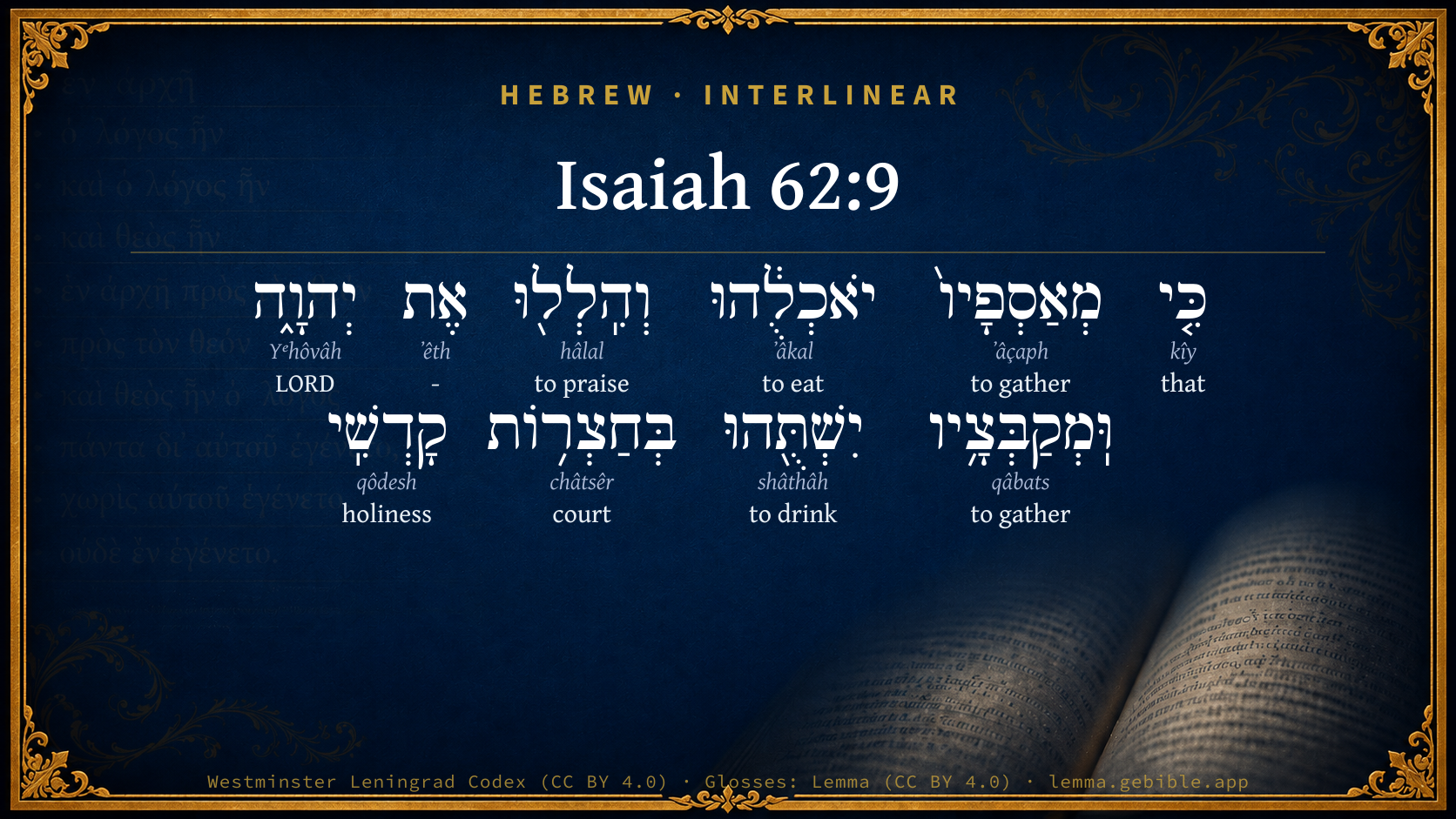
Hebrew (Westminster Leningrad Codex) Isaiah 62:9 appears in the Hebrew Old Testament. The text above is from the Westminster Leningrad Codex. Each word links to its Strong’s number, a concise gloss, and parsing drawn from the Open Scriptures Hebrew Bible morphology. Click any word for its full Brown-Driver-Briggs (BDB) entry.
Download image
Cite this verse

Isaiah 62:9 (World English Bible). Public Domain. Lemma interlinear Bible study tool, https://lemma.gebible.app/v/isaiah/62/9.

Show BibTeX & RIS
BibTeX
RIS
English Translation
but those who have garnered it shall eat it, and praise Yahweh; and those who have gathered it shall drink it in the courts of my sanctuary.
World English Bible · Public Domain
Download a study sheet

One document with this verse’s original text, its word-by-word gloss line, the meaning frame, cross-references with their text, attributed commentary, and full source and license credits — printable, and it pastes into notes with its structure intact.

This verse Autodidact and up

Study sheet (.html) Plain text (.txt)

A passage Seminary Student

Up to 50 verses in one chapter. A passage sheet keeps up to 6 commentary sources and 12 cross-references per verse, in the order this page ranks them, and says so on the sheet whenever that leaves anything out. Ask for a single verse and you get the Autodidact verse sheet above.

Everything on this page stays free to read, with no account — the sheet is a download of what is already on screen, not access to it.

Want to remove ads? Support Godless Engineer
Compare translations 3

The same verse in 3 English versions, stacked beneath the original-language interlinear above. Click any original word for its lexicon entry.

Each is an independent rendering of the whole verse — the interlinear is not word-aligned to these translations.

Highlighted words mark where these versions differ — a whole-verse word diff, not a word-by-word alignment.

  • World English Bible Public Domain
    but those who have garnered it shall eat it, and praise Yahweh; and those who have gathered it shall drink it in the courts of my sanctuary.
  • King James Version Public Domain
    But they that have gathered it shall eat it, and praise the LORD; and they that have brought it together shall drink it in the courts of my holiness.
  • unfoldingWord Literal Text CC BY-SA 4.0
    For its collectors will eat it and praise Yahweh, and its gatherers will drink it in the courts of my holiness.”

unfoldingWord Literal Text — © unfoldingWord, licensed CC BY-SA 4.0. Word-aligned USFM3 via Door43 (git.door43.org/unfoldingWord/en_ult).

Versions to compare (up to 4)

3 of 4 selected

Show all 18 translations

Every available English version of this verse, each an independent rendering of the whole verse.

  • World English Bible Public Domain
    but those who have garnered it shall eat it, and praise Yahweh; and those who have gathered it shall drink it in the courts of my sanctuary.
  • Berean Standard Bible Public Domain
    For those who harvest grain will eat it and praise the LORD, and those who gather grapes will drink the wine in My holy courts.”
  • Majority Standard Bible Public Domain
    For those who harvest grain will eat it and praise the LORD, and those who gather grapes will drink the wine in My holy courts.”
  • King James Version Public Domain
    But they that have gathered it shall eat it, and praise the LORD; and they that have brought it together shall drink it in the courts of my holiness.
  • American Standard Version (1901) Public Domain
    but they that have garnered it shall eat it, and praise Jehovah; and they that have gathered it shall drink it in the courts of my sanctuary.
  • Revised Version (1885) Public Domain
    but they that have garnered it shall eat it, and praise the LORD; and they that have gathered it shall drink it in the courts of my sanctuary.
  • Geneva Bible (1599) Public Domain
    But they that haue gathered it, shall eate it, and prayse the Lord, and the gatherers thereof shall drinke it in the courtes of my Sanctuarie.
  • Douay-Rheims (1899) Public Domain
    For they that gather it, shall eat it, and shall praise the Lord: and they that bring it together, shall drink it in my holy courts.
  • Young's Literal Translation Public Domain
    For, those gathering it do eat it, and have praised Jehovah, And those collecting it do drink it in My holy courts.'
  • Literal Standard Version CC BY-SA 4.0
    For those gathering it eat it, and have praised YHWH, || And those collecting it drink it in My holy courts.”
  • Unlocked Literal Bible CC BY-SA 4.0
    For those who harvest the grain will eat it and praise Yahweh, and those who pick the grapes will drink the wine in the courts of my holy sanctuary.”
  • unfoldingWord Literal Text CC BY-SA 4.0
    For its collectors will eat it and praise Yahweh, and its gatherers will drink it in the courts of my holiness.”
  • Darby Bible Public Domain
    for they that have garnered it shall eat it, and praise Jehovah; and they that have gathered it shall drink it in the courts of my holiness.
  • World Messianic Bible Public Domain
    but those who have harvested it will eat it, and praise the LORD. Those who have gathered it will drink it in the courts of my sanctuary.”
  • Webster's Bible Public Domain
    But they that have gathered it shall eat it, and praise the LORD; and they that have collected it shall drink it in the courts of my holiness.
  • Free Bible Version CC BY-SA 4.0
    Instead, those who harvest the grain will eat it and praise the Lord, and those who harvest the grapes for the wine will drink it in the courts of my Temple.
  • Bible in Basic English Public Domain
    But those who have got in the grain will have it for their food, and will give praise to the Lord; and those who have got in the grapes will take the wine of them in the open places of my holy house.
  • JPS Tanakh (1917) Public Domain
    But they that have garnered it shall eat it, and praise the LORD, and they that have gathered it shall drink it in the courts of My sanctuary.

Literal Standard Version (2020), Covenant Press — licensed CC BY-SA 4.0. Text via the HelloAO Bible API (eBible.org). Unlocked Literal Bible (unfoldingWord) — licensed CC BY-SA 4.0. Text via the HelloAO Bible API (eBible.org). unfoldingWord Literal Text — © unfoldingWord, licensed CC BY-SA 4.0. Word-aligned USFM3 via Door43 (git.door43.org/unfoldingWord/en_ult). Free Bible Version, Dr. Jonathan Gallagher — licensed CC BY-SA 4.0. Text via the HelloAO Bible API (eBible.org).

Word by word

More ways to search: Search by grammar → Find every occurrence → Compare this word →

Practice this passage: Drill this verse → Learn its vocabulary →

וּֽמְקַבְּצָ֥יו
qâbats
H6908
“and · gathering · him”
Conjunction + Verb, Piel, Participle Active, Masculine, Plural, Construct + Suffix, Personal, 3rd Person, Masculine, Singular
Part of Speech
Conjunction + Verb
Stem
Piel
Form
Participle Active
Gender
Masculine
Number
Plural
State
Construct
Full BDB Definition

Origin: a primitive root

TWOT: 1983

to gather, assemble - (Qal) to gather, collect, assemble - (Niphal) - to assemble, gather - to be gathered - (Piel) to gather, gather together, take away - (Pual) to be gathered together - (Hithpael) to gather together, be gathered together
  1. כִּ֤י kîy H3588 “that” Conjunction
  2. מְאַסְפָיו֙ ʼâçaph H622 “gathering · him” Verb, Piel, Participle Active, Masculine, Plural, Construct + Suffix, Personal, 3rd Person, Masculine, Singular
  3. יֹאכְלֻ֔הוּ ʼâkal H398 “to eat · him” Verb, Qal, Imperfect, 3rd Person, Masculine, Plural + Suffix, Personal, 3rd Person, Masculine, Singular
  4. וְהִֽלְל֖וּ hâlal H1984 “and · to praise” Conjunction + Verb, Piel, Sequential Perfect, 3rd Person, Common, Plural
  5. אֶת ʼêth H853 “-” Particle, Direct Object
  6. יְהוָ֑ה Yᵉhôvâh H3068 “LORD” Noun, Proper
  7. יִשְׁתֻּ֖הוּ shâthâh H8354 “to drink · him” Verb, Qal, Imperfect, 3rd Person, Masculine, Plural + Suffix, Personal, 3rd Person, Masculine, Singular
  8. בְּחַצְר֥וֹת châtsêr H2691 “in/at · courts of” Preposition + Noun, Common, Both, Plural, Construct
  9. קָדְשִֽׁי qôdesh H6944 “holiness · my” Noun, Common, Masculine, Singular, Construct + Suffix, Personal, 1st Person, Common, Singular

About this verse

These counts appear in no published source. They are computed here, from the morphology-tagged text and Lemma’s own curated glosses. What Lemma adds →

10
words
10
distinct lemmas
Prophets
section

Grammatical profile

  • 5 verbs
  • 3 nouns
  • 1 conjunction
  • 1 particle

Verb forms

  • מְאַסְפָיו֙ Piel · Participle Active
  • יֹאכְלֻ֔הוּ Qal · Imperfect
  • וְהִֽלְל֖וּ Piel · Sequential Perfect
  • וּֽמְקַבְּצָ֥יו Piel · Participle Active
  • יִשְׁתֻּ֖הוּ Qal · Imperfect

Hebrew & Septuagint length

In English translation the verse runs 27 words from the Hebrew and 29 from the Septuagint (LXX English) — closely comparable.

A rough comparison of the two English renderings, which tokenize alike — not a word-level alignment.

Word counts can differ between the Hebrew and the Greek without any difference in meaning — e.g. the Hebrew direct-object marker אֵת has no separate Greek word, and Greek often adds the article ὁ.

Cross-references

5

Topical passages linked to Isaiah 62:9 in the Treasury of Scripture Knowledge — connected by theme and wording, ordered by reader-vote popularity; previews shown in the World English Bible.

  • Deuteronomy 16:11 and you shall rejoice before Yahweh your God, you, and your son, and your daughter, and your man-servant, and your maid-servant, and the Levite who is within your gates, and the foreigner, and the fatherless, and the widow, who are in the midst of you, in the place which Yahweh your God shall choose, to cause his name to dwell there.
  • Deuteronomy 12:7 and there you shall eat before Yahweh your God, and you shall rejoice in all that you put your hand to, you and your households, in which Yahweh your God has blessed you.
  • Deuteronomy 12:12 You shall rejoice before Yahweh your God, you, and your sons, and your daughters, and your men-servants, and your maid-servants, and the Levite who is within your gates, because he has no portion nor inheritance with you.
  • Deuteronomy 14:23–29 You shall eat before Yahweh your God, in the place which he shall choose, to cause his name to dwell there, the tithe of your grain, of your new wine, and of your oil, and the firstborn of your herd and of your flock; that you may learn to fear Yahweh your God always.
  • Deuteronomy 16:14 and you shall rejoice in your feast, you, and your son, and your daughter, and your man-servant, and your maid-servant, and the Levite, and the foreigner, and the fatherless, and the widow, who are within your gates.

Cross-references courtesy of OpenBible.info (CC BY 4.0).

Hebrew and Greek witnesses Masoretic Hebrew ↔ Greek Septuagint

The same verse in the two great witnesses to the Old Testament, shown verse-for-verse.

These are two independent witnesses, not word-aligned to each other, and the Septuagint is shown in lemma (dictionary) form.

Hebrew Isaiah 62:9 Masoretic · Westminster Leningrad Codex

כִּ֤י מְאַסְפָיו֙ יֹאכְלֻ֔הוּ וְהִֽלְל֖וּ אֶת יְהוָ֑ה וּֽמְקַבְּצָ֥יו יִשְׁתֻּ֖הוּ בְּחַצְר֥וֹת קָדְשִֽׁי

but those who have garnered it shall eat it, and praise Yahweh; and those who have gathered it shall drink it in the courts of my sanctuary.

World English Bible · Public Domain

Greek LXX Isaiah 62:9 Septuagint · lemma form

ἀλλά ἤ ὁ συνἄγω ἐσθίω αὐτός καί αἰνέω κύριος καί ὁ συνἄγω πίνω αὐτός ἐν ὁ ἔπαυλις ὁ ἅγιος ἐγώ

But they that have gathered them shall eat them, and they shall praise the Lord; and they that have gathered the grapes shall drink thereof in my holy courts.

LXX2012 (modern English Septuagint) · Public Domain

Hebrew: Westminster Leningrad Codex (CC BY 4.0). Greek: Septuagint (public domain); English from LXX2012 (modern English Septuagint) (Public Domain). How the Septuagint differs from the Hebrew →

Targum (Aramaic paraphrase)

1

The Targum is the ancient Jewish Aramaic paraphrase of the Hebrew Scriptures — an interpretive translation, not the Hebrew text itself. Onkelos (literal) and Pseudo-Jonathan (expansive) render the Torah, and Jonathan the Prophets. Coverage is partial: where no permissively-licensed English translation exists for a verse, only the Aramaic is shown. This is verse-level text, not a word-by-word alignment to the Hebrew.

  1. Targum Jonathan Prophets (Joshua–Malachi)
    אֲרֵי דְכַנְשׁוֹהִי לְעִבּוּרָא יֵיכְלוּנֵהּ וִישַׁבְּחוּן קֳדָם יְיָ וּדְעַצְרוֹהִי לְחַמְרָא יִשְׂתּוּנֵהּ בְּדָרַת קוּדְשִׁי:

    But they that gather the corn, they shall eat it, and offer praise before the Lord; and they that tread out the wine, they shall drink it in the courts of my holiness.

    Targum Jonathan — Aramaic: “Mikraot Gedolot” (public domain). English: “Sefaria Community Translation” (CC0 1.0 (public-domain dedication)); “London "Chaldee Paraphrase," 1871” (public domain). Text via Sefaria.

Commentary

Notes on Isaiah 62:9 from classic Christian and Jewish commentators (each source and its license shown beneath its notes). The classic Christian expositions comment on the surrounding passage and are grouped to its opening verse, so a note may address several verses; the Jewish commentaries on the Tanakh (Rashi and others) are per-verse, so they appear only where the commentator wrote on this verse.

Lemma curates 59 commentaries, every one of them public domain or Creative Commons licensed, each selected and text-cleaned for this edition rather than reprinted as found. About our sources →

Trapp's Complete Commentary

John Trapp

Isa 62:9 But they that have gathered it shall eat it, and praise the LORD; and they that have brought it together shall drink it in the courts of my holiness.

Ver. 9. But they that have gathered it shall eat it.] A sufficiency of outward comforts they shall be sure of, together with righteousness, and peace, and joy in the Holy Ghost; so much, at least, as shall support their spirits. Mr Paul Bain {a} saith thus of himself, I thank God in Christ, sustentation I have, but suavities spiritual, I taste not any.

Shall drink it in the courts of my holiness.] He alludeth to their manner of feasting before the Lord, when they brought thank offerings; and the like is still done by us at the Eucharist, or Lord’s Supper especially.

{a} Bain’s Letters.

John Trapp, A Commentary or Exposition upon All the Books of the Old and New Testament (1647–1656) — public domain. Text from a community e-Sword module.

Tyndale Open Study Notes

Tyndale Open Resources

62:9 The people would eat and drink the fruit of their labor (65:13, 22; see Lev 23:39-40; Deut 14:22-26). This is the opposite of what happened when God judged them (see Deut 28:38-40; Amos 5:11; Mic 6:14-15).

Tyndale Open Study Notes — © Tyndale Open Resources, licensed CC BY-SA 4.0. Text via the HelloAO Bible API.

Jamieson, Fausset & Brown

Robert Jamieson, A. R. Fausset & David Brown

eat . . . and praise--not consume it on their own lusts, and without thanksgiving.

drink it in . . . courts--They who have gathered the vintage shall drink it at the feasts held in the courts surrounding the temple (Deu 12:17-18; Deu 14:23, &c.).

Jamieson, Fausset & Brown — Commentary Critical and Explanatory on the Whole Bible (1871) — public domain (CC PDM 1.0). Text via the HelloAO Bible API.

Adam Clarke's Commentary

Verse 9. But they that have gathered it shall eat it, and praise the Lord] This and the following line have reference to the law of Moses: "Thou mayest not eat within thy gates the tithe of thy corn, or of thy wine, or of thy oil; but thou must eat them before the Lord thy God, in the place which the Lord thy God shall choose," De 12:17-18. "And when ye shall come into the land, and shall have planted all manner of trees for food, then ye shall count the fruit thereof as uncircumcised: three years it shall be as uncircumcised unto you; it shall not be eaten of. But in the fourth year all the fruit thereof shall be holy to praise the Lord withal. And in the fifth year ye shall eat the fruit thereof," Le 19:23-25. This clearly explains the force of the expressions, "shall praise JEHOVAH," and "shall drink it in my sacred courts."

Five MSS., one ancient, have יאכלוהו yocheluhu, they shall eat it, fully expressed: and so likewise ישתוהו yishtuhu, they shall drink it, is found in nineteen MSS., three of them ancient. - L.

Adam Clarke's Commentary on the Bible (1810–1826) — public domain. Text from a community e-Sword/MySword module.

Ellicott's Commentary for English Readers

(9) In the courts of my holiness.—Better, of my sanctuary. The harvest and the vintage festivals are to be kept, as of old, without interruption, the master of the house, with his family and the Levites and the poor (Deu_14:22-27), eating of the first- fruits “before the Lord.”

A Bible Commentary for English Readers, edited by Charles John Ellicott (1878–1897) — public domain. Text from a community e-Sword module.

The Cambridge Bible for Schools and Colleges

gen. ed. J. J. S. Perowne

9. Cf. ch. Isa_65:21-22.

in the courts of my holiness] Render, in my holy courts; not as R.V., “in the courts of my sanctuary.” The allusion is to the festivals in the Temple, where the first-fruits were eaten with rejoicing before Jehovah (Deu_12:17 f., Isa_14:23 ff., Isa_16:9-14).

The Cambridge Bible for Schools and Colleges (gen. ed. J. J. S. Perowne; Cambridge University Press, 1878–1918) — public domain. Text from a community e-Sword module.

John Gill's Exposition

But they that have gathered it shall eat it, and praise the Lord,.... That is, the corn; they who have manured the land, sowed seed in it, reaped it when ripe, gathered it in its season; these shall eat the fruit of their labours, and praise the Lord for it, acknowledge his bounty and goodness to them; for notwithstanding all the diligence, industry, and labour of men, it is through the blessing of the Lord, and owing to his favour, that they have bread, and a sufficiency of it, to eat; which when they have, they should be thankful for it, Deu 8:10.

and they that have brought it together shall drink it in the courts of my holiness: that is, the wine they shall drink; having planted vineyards, and gathered the grapes when ripe, and brought them to the winepress, and there made wine of them; they shall drink it at a proper time and place: the allusion is to the priests and Levites eating and drinking holy things, within the compass and bounds of the temple; and may signify the converted Jews, partaking of the Gospel and Gospel ordinances in the house of God, as well as the Gentiles, being all now made priests unto God. The Arabic version interprets it of persons "gathered", that should eat and drink. The Targum is express, they that gather the corn in, and they that press the wine.

John Gill's Exposition of the Whole Bible (1746–1763) — public domain (CC PDM 1.0). Text via the HelloAO Bible API.

Albert Barnes' Notes on the Bible

But they that have gathered it shall eat it - There shall be a state of security, so that every man may enjoy the avails of his own labor. Nothing is a more certain indication of liberty and prosperity than this - that every man may securely enjoy the avails of his own labor. Nothing more certainly marks the advance of civilization, and nothing so much tends to encourage industry and to promote prosperity. When a man has no security that what he sows shall be reaped by himself; when there is danger that it will be destroyed or consumed by foreign invaders; or, when it is liable to be taken by arbitrary power to minister to the needs and luxuries of the great, there will be no industry, no incitement to labor. Such is the condition always in war. Such is the condition now in the Turkish dominions; and such is the state in savage life, and in all uncivilized communities. And as the tendency of true religion is to repress wars, to establish order, and to diffuse just views of the rights of man, it everywhere promotes prosperity by furnishing security that a man shall enjoy the avails of his own productive industry. Wherever the Christian religion prevails in its purity, there is seen the fulfillment of this prophecy; and the extension of that religion everywhere would promote universal industry, order, and law.

And praise the Lord - They shall not consume it on their lusts, nor shall they partake of it without gratitude. God shall be acknowledged as the bountiful giver, and they shall render him appropriate thanksgiving.

And they that have brought it together - They who have gathered in the vintage.

Shall drink it in the courts of my holiness - It would be drank with gratitude to God in the feasts which were celebrated at the temple (see Lev 6:16; Deu 12:17-18; Deu 14:23). The idea is, that the effect of true religion would be to produce security and liberty, and to make people feel that all their blessings came from God; to partake of them with gratitude, and to make them the occasion of praise and thanksgiving.

Albert Barnes' Notes on the Bible (1834–1885) — public domain. Text from a community e-Sword/MySword module.

Matthew Poole's English Annotations

They that have gathered it, i.e. the wine mentioned in the former verse, that have brought it from their several vineyards, and laid it in their cellars, every one shall eat the fruit of his own labours; thou shalt not sow, and another reap, as formerly.

And praise the Lord; they themselves shall praise him, viz. for his bounty and goodness; and others also that shall be partakers with them; God will be bountiful, and they shall be thankful. In the courts of my holiness; as I have commanded, Deu 14:23;

in my courts; holiness being put for God himself by a metonymy of the adjunct; alluding to those anniversary feasts and thank-offerings that were to be eaten in those places about the temple, and perhaps in special to that part which was appropriated to the priests, implying herein that they should be all priests; and, for aught I know, here may be an allusion to the great gospel feast, or thank-offering in the Lord’s supper, these promises being not only applicable to, but do point at, the soul protections and the soul provisions of the church of Christ.

Matthew Poole's English Annotations on the Holy Bible (1683–1685) — public domain. Text from a community e-Sword/MySword module.

The Pulpit Commentary

Shall drink it in the courts of my holiness. This is not to be understood literally, at any rate, of the whole produce of the laud. What is meant is, that the produce will be consecrated by such festal means as the Law enjoined, (Deu_14:22-27) and that then the remainder will be consumed with due thanks and acknowledgments.

The Pulpit Commentary (1880–1919), ed. H.D.M. Spence-Jones & Joseph S. Exell — public domain. Text from a community e-Sword module.

John Wesley's Explanatory Notes

But - Thou shalt not sow, and another reap, as formerly. Courts - In my courts: holiness being put for God himself.

John Wesley, Explanatory Notes Upon the Whole Bible (1754–1765) — public domain. Text via the GEBible commentary corpus.

J. A. Alexander on Isaiah

Joseph Addison Alexander

“For those gathering it shall eat it and shall praise Jehovah, and those collecting it shall drink it in my holy courts (or in the courts of my sanctuary).” That these are but types and emblems of abundance, and security, and liberty of worship, is acknowledged even by that school of interpreters supposed to be most strenuous in favor of attaching to these promises their strictest sense.

Joseph Addison Alexander, The Prophecies of Isaiah (1846–1847; New York: Scribner, 1870–1878) — public domain. Text from a community e-Sword module.

Rashi

Rabbi Shlomo Yitzchaki (Rashi)

shall eat it This refers back to “your grain.”

shall drink it This refers back to “your wine.”

Rashi on the Tanakh — English translations: “The Judaica Press complete Tanach with Rashi, translated by A. J. Rosenberg” (CC BY 4.0); “Pentateuch with Rashi's commentary by M. Rosenbaum and A.M. Silbermann, 1929-1934” (public domain); “The Metsudah Tanach series, Lakewood, N.J” (CC BY 4.0); and “The Book of Joshua, Metsudah Publications, 1997” (CC BY 4.0). Text via Sefaria.

Ibn Ezra

Rabbi Abraham ibn Ezra

Shall eat it. Shall eat thy corn. And they that have brought it together, that have brought the wine together.

Ibn Ezra on the Tanakh — English translations: “Sefaria Community Translation” (CC0 1.0 (public-domain dedication)); “Yalkut, Sifsei Chachomim Chumash, Metsudah Publications, 2009” (CC BY 4.0); and “Commentary of Ibn Ezra on Isaiah - trans. by M. Friedlander, 1873” (public domain). Text via Sefaria.

Lesson kit

Teaching starters — assembled from the data on this page, not authored interpretation. Every prompt links to the verse data it draws on. Edit before teaching.

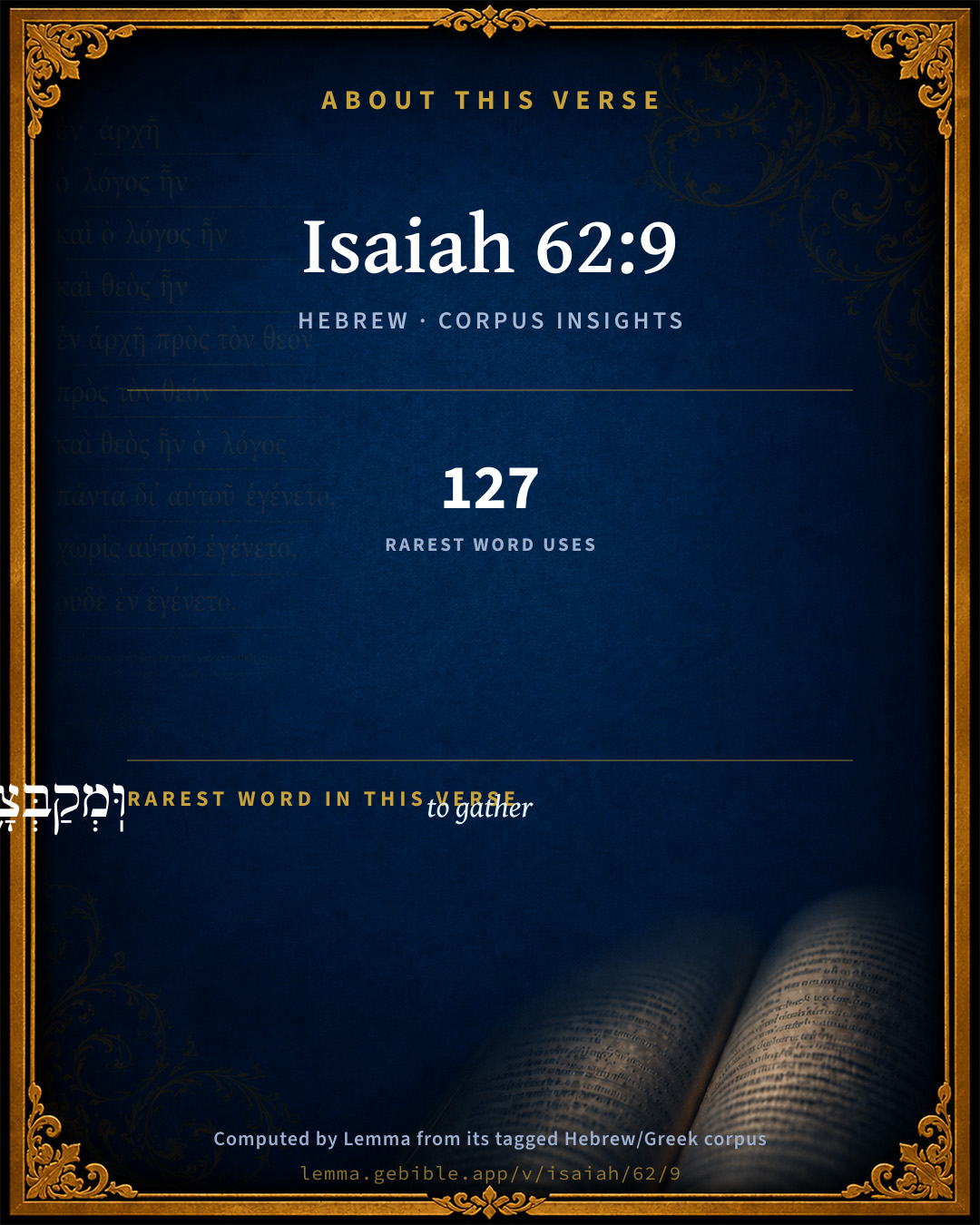
Isaiah, in the Prophets, opens this verse with 10 words (10 distinct Hebrew lemmas). Its most distinctive word is qâbats (“to gather”). A historical commentator’s framing appears above. Read the whole chapter for the surrounding context.

Discussion questions

  1. The word qâbats carries the sense “to gather.” How does it shape the verse?
  2. Deuteronomy 16:11 shares this passage’s theme. How do the two illuminate each other?
  3. These translations render this verse differently. What is at stake in choosing one wording over another?
  4. The verb «מְאַסְפָיו֙» is Piel Participle Active. How does its form color the action?
  5. Reading how Trapp's Complete Commentary and Tyndale Open Study Notes read this verse, where do the two commentators agree and where do they part?

Things to notice

Reading settings

Reading text

Shown beneath each verse's original-language words.

Old Testament
Old Testament edition

Read the OT as the Masoretic Hebrew (MT) or the Greek Septuagint (LXX).

English shown for the Greek Septuagint (in the Hebrew ↔ Greek comparison).

Comparing translations? Open the Compare panel on any verse page to stack up to four side by side.