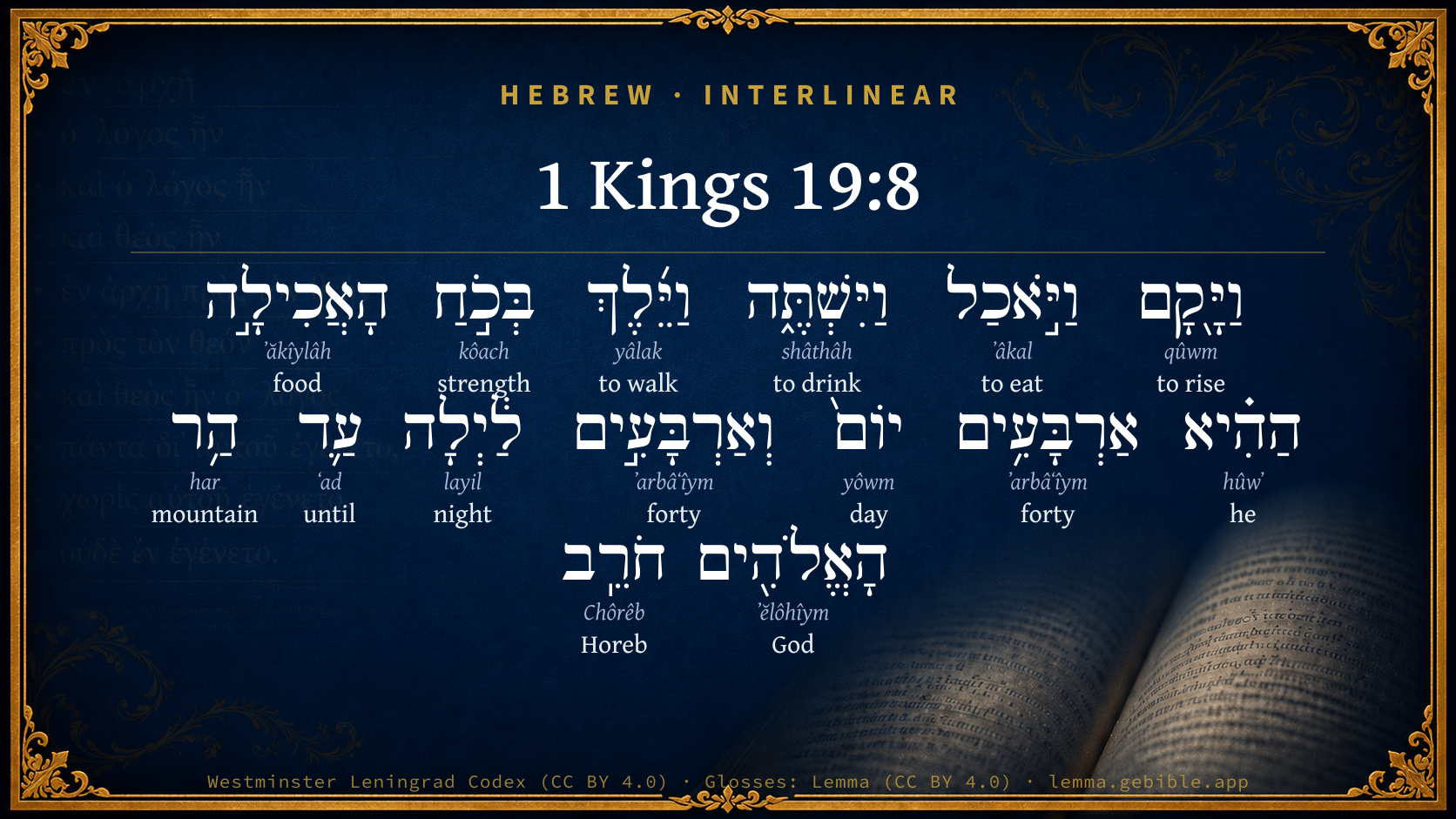
1 Kings 19:8

Hebrew (Westminster Leningrad Codex) 1 Kings 19:8 appears in the Hebrew Old Testament. The text above is from the Westminster Leningrad Codex. Each word links to its Strong’s number, a concise gloss, and parsing drawn from the Open Scriptures Hebrew Bible morphology. Click any word for its full Brown-Driver-Briggs (BDB) entry.
Download image
Cite this verse

1 Kings 19:8 (World English Bible). Public Domain. Lemma interlinear Bible study tool, https://lemma.gebible.app/v/1-kings/19/8.

Show BibTeX & RIS
BibTeX
RIS
English Translation
He arose, and ate and drink, and went in the strength of that food forty days and forty nights to Horeb the Mount of God.
World English Bible · Public Domain
Highlights
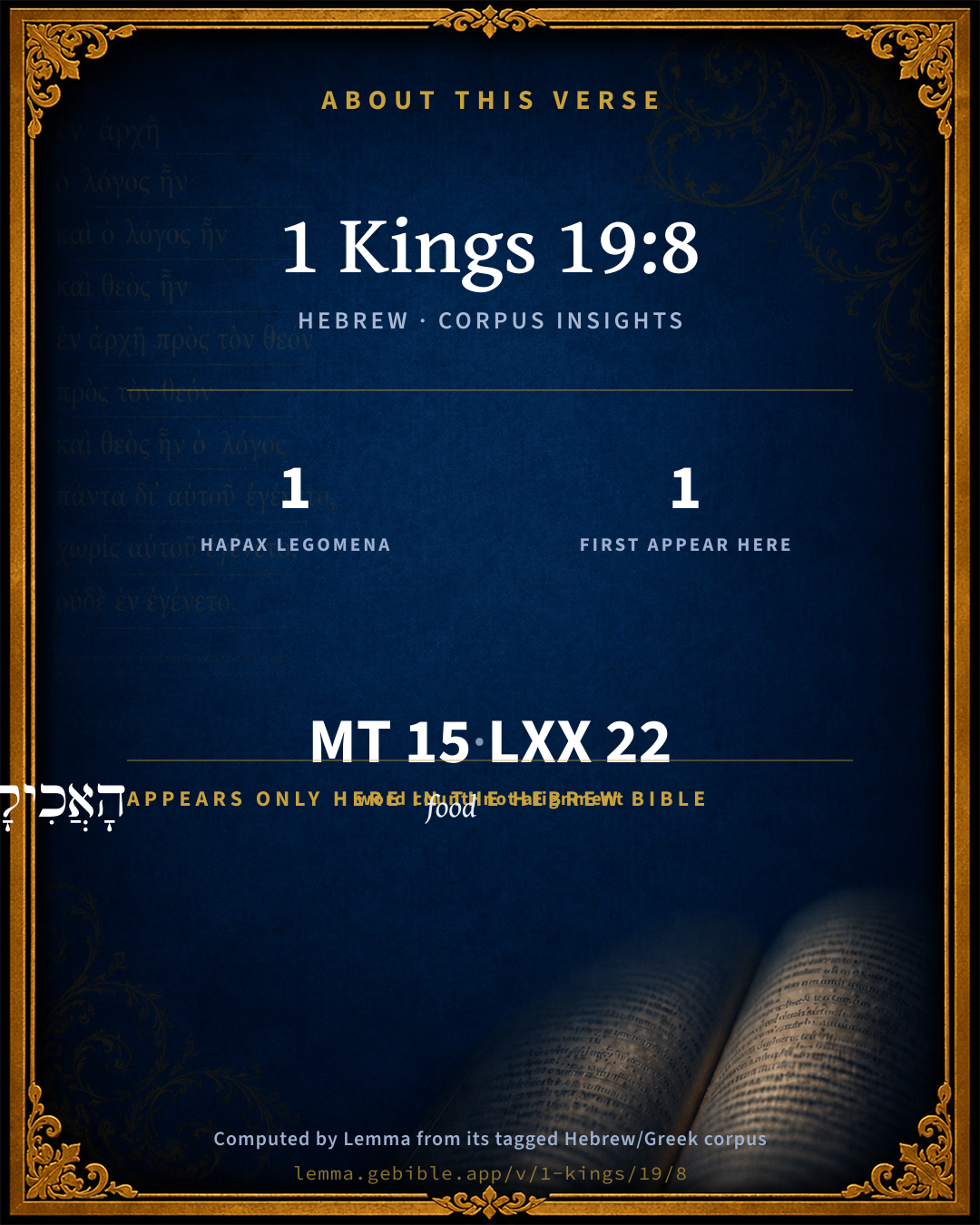
  • 1 hapax legomenon — only here in the Hebrew Bible
  • 1 first appearance in the Hebrew Bible
Full analysis ↓
Download a study sheet

One document with this verse’s original text, its word-by-word gloss line, the meaning frame, cross-references with their text, attributed commentary, and full source and license credits — printable, and it pastes into notes with its structure intact.

This verse Autodidact and up

Study sheet (.html) Plain text (.txt)

A passage Seminary Student

Up to 50 verses in one chapter. A passage sheet keeps up to 6 commentary sources and 12 cross-references per verse, in the order this page ranks them, and says so on the sheet whenever that leaves anything out. Ask for a single verse and you get the Autodidact verse sheet above.

Everything on this page stays free to read, with no account — the sheet is a download of what is already on screen, not access to it.

Want to remove ads? Support Godless Engineer
Compare translations 3

The same verse in 3 English versions, stacked beneath the original-language interlinear above. Click any original word for its lexicon entry.

Each is an independent rendering of the whole verse — the interlinear is not word-aligned to these translations.

Highlighted words mark where these versions differ — a whole-verse word diff, not a word-by-word alignment.

  • World English Bible Public Domain
    He arose, and ate and drink, and went in the strength of that food forty days and forty nights to Horeb the Mount of God.
  • King James Version Public Domain
    And he arose, and did eat and drink, and went in the strength of that meat forty days and forty nights unto Horeb the mount of God.
  • unfoldingWord Literal Text CC BY-SA 4.0
    So he arose, and he ate and drank. And he went in the strength of that food 40 days and 40 nights to the mountain of God, Horeb.

unfoldingWord Literal Text — © unfoldingWord, licensed CC BY-SA 4.0. Word-aligned USFM3 via Door43 (git.door43.org/unfoldingWord/en_ult).

Versions to compare (up to 4)

3 of 4 selected

Show all 18 translations

Every available English version of this verse, each an independent rendering of the whole verse.

  • World English Bible Public Domain
    He arose, and ate and drink, and went in the strength of that food forty days and forty nights to Horeb the Mount of God.
  • Berean Standard Bible Public Domain
    So he got up and ate and drank. And strengthened by that food, he walked forty days and forty nights until he reached Horeb, the mountain of God.
  • Majority Standard Bible Public Domain
    So he got up and ate and drank. And strengthened by that food, he walked forty days and forty nights until he reached Horeb, the mountain of God.
  • King James Version Public Domain
    And he arose, and did eat and drink, and went in the strength of that meat forty days and forty nights unto Horeb the mount of God.
  • American Standard Version (1901) Public Domain
    And he arose, and did eat and drink, and went in the strength of that food forty days and forty nights unto Horeb the mount of God.
  • Revised Version (1885) Public Domain
    And he arose, and did eat and drink, and went in the strength of that meat forty days and forty nights unto Horeb the mount of God.
  • Geneva Bible (1599) Public Domain
    Then he arose, and did eate and drinke, and walked in the strength of that meate fourtie dayes and fourtie nights, vnto Horeb the mount of God.
  • Douay-Rheims (1899) Public Domain
    And he arose, and ate, and drank, and walked in the strength of that food forty days and forty nights, unto the mount of God, Horeb.
  • Young's Literal Translation Public Domain
    and he riseth, and eateth, and drinketh, and goeth in the power of that food forty days and forty nights, unto the mount of God -- Horeb.
  • Literal Standard Version CC BY-SA 4.0
    and he rises, and eats, and drinks, and goes in the power of that food [for] forty days and forty nights, to the mountain of God—Horeb.
  • Unlocked Literal Bible CC BY-SA 4.0
    So he arose and ate and drank, and he traveled in the strength of that food forty days and forty nights to Horeb, the mountain of God.
  • unfoldingWord Literal Text CC BY-SA 4.0
    So he arose, and he ate and drank. And he went in the strength of that food 40 days and 40 nights to the mountain of God, Horeb.
  • Darby Bible Public Domain
    And he arose, and ate and drank, and went in the strength of that food forty days and forty nights to Horeb the mount of God.
  • World Messianic Bible Public Domain
    He arose, and ate and drank, and went in the strength of that food forty days and forty nights to Horeb, God’s Mountain.
  • Webster's Bible Public Domain
    And he arose, and ate and drank, and went in the strength of that food forty days and forty nights to Horeb the mount of God.
  • Free Bible Version CC BY-SA 4.0
    So he got up and ate and drank, and with the strength the food gave him he was able to walk forty days and forty nights to Mount Horeb, the mountain of God.
  • Bible in Basic English Public Domain
    So he got up and took food and drink, and in the strength of that food he went on for forty days and nights, to Horeb, the mountain of God.
  • JPS Tanakh (1917) Public Domain
    And he arose, and did eat and drink, and went in the strength of that meal forty days and forty nights unto Horeb the mount of God.

Literal Standard Version (2020), Covenant Press — licensed CC BY-SA 4.0. Text via the HelloAO Bible API (eBible.org). Unlocked Literal Bible (unfoldingWord) — licensed CC BY-SA 4.0. Text via the HelloAO Bible API (eBible.org). unfoldingWord Literal Text — © unfoldingWord, licensed CC BY-SA 4.0. Word-aligned USFM3 via Door43 (git.door43.org/unfoldingWord/en_ult). Free Bible Version, Dr. Jonathan Gallagher — licensed CC BY-SA 4.0. Text via the HelloAO Bible API (eBible.org).

Word by word

More ways to search: Search by grammar → Find every occurrence → Compare this word →

Practice this passage: Drill this verse → Learn its vocabulary →

הָאֲכִילָ֣ה
ʼăkîylâh
H396
“the · food”
Particle, Definite Article + Noun, Common, Feminine, Singular, Absolute
Part of Speech
Particle + Noun
Type
Common
Gender
Feminine
Number
Singular
State
Absolute
Full BDB Definition

Origin: from H398

TWOT: 85c

food, a meal, an eating, meat
  1. וַיָּ֖קָם qûwm H6965 “and · to rise” Conjunction + Verb, Qal, Sequential Imperfect, 3rd Person, Masculine, Singular
  2. וַיֹּ֣אכַל ʼâkal H398 “and · to eat” Conjunction + Verb, Qal, Sequential Imperfect, 3rd Person, Masculine, Singular
  3. וַיִּשְׁתֶּ֑ה shâthâh H8354 “and · to drink” Conjunction + Verb, Qal, Sequential Imperfect, 3rd Person, Masculine, Singular
  4. וַיֵּ֜לֶךְ yâlak H3212 “and · to walk” Conjunction + Verb, Qal, Sequential Imperfect, 3rd Person, Masculine, Singular
  5. בְּכֹ֣חַ kôach H3581 “in/at · strength of” Preposition + Noun, Common, Masculine, Singular, Construct
  6. הַהִ֗יא hûwʼ H1931 “the · he” Particle, Definite Article + Pronoun, Personal, 3rd Person, Feminine, Singular
  7. אַרְבָּעִ֥ים ʼarbâʻîym H705 “forty” Adjective, Cardinal number, Both, Plural, Absolute
  8. יוֹם֙ yôwm H3117 “day” Noun, Common, Masculine, Singular, Absolute
  9. וְאַרְבָּעִ֣ים ʼarbâʻîym H705 “and · forty” Conjunction + Adjective, Cardinal number, Both, Plural, Absolute
  10. לַ֔יְלָה layil H3915 “night” Noun, Common, Masculine, Singular, Absolute
  11. עַ֛ד ʻad H5704 “until” Preposition
  12. הַ֥ר har H2022 “mountain of” Noun, Common, Masculine, Singular, Construct
  13. הָאֱלֹהִ֖ים ʼĕlôhîym H430 “the · God(s)” Particle, Definite Article + Noun, Common, Masculine, Plural, Absolute
  14. חֹרֵֽב Chôrêb H2722 “Horeb” Noun, Proper

About this verse

These counts appear in no published source. They are computed here, from the morphology-tagged text and Lemma’s own curated glosses. What Lemma adds →

15
words
14
distinct lemmas
Historical
section

Notable vocabulary

1 hapax legomenon — a word that appears only here in the entire Hebrew Bible:

  • הָאֲכִילָ֣ה food H396

First appearance in Scripture

This word makes its first canonical appearance in the Hebrew Bible here:

  • הָאֲכִילָ֣ה food H396

Shared distinctive vocabulary

חֹרֵֽב Horeb H2722 occurs in 17 verses of the Hebrew Bible. Also found in:

Grammatical profile

  • 4 verbs
  • 7 nouns
  • 2 adjectives
  • 1 pronoun
  • 1 preposition

Verb forms

  • וַיָּ֖קָם Qal · Sequential Imperfect
  • וַיֹּ֣אכַל Qal · Sequential Imperfect
  • וַיִּשְׁתֶּ֑ה Qal · Sequential Imperfect
  • וַיֵּ֜לֶךְ Qal · Sequential Imperfect

Repetition

A word recurs within this verse — often emphatic in Hebrew:

  • אַרְבָּעִ֥ים forty H705 ×2

Hebrew & Septuagint length

In English translation the verse runs 25 words from the Hebrew and 23 from the Septuagint (LXX English) — closely comparable.

A rough comparison of the two English renderings, which tokenize alike — not a word-level alignment.

Word counts can differ between the Hebrew and the Greek without any difference in meaning — e.g. the Hebrew direct-object marker אֵת has no separate Greek word, and Greek often adds the article ὁ.

In the original languages it is 15 Hebrew tokens and 22 Greek tokens — but the two are counted differently (Hebrew bundles its prefixes and suffixes into one token; the Greek is in lemma form), so that isn’t a like-for-like length.

Cross-references

12

Topical passages linked to 1 Kings 19:8 in the Treasury of Scripture Knowledge — connected by theme and wording, ordered by reader-vote popularity; previews shown in the World English Bible.

  • Exodus 34:28 He was there with Yahweh forty days and forty nights; he neither ate bread, nor drank water. He wrote on the tablets the words of the covenant, the ten commandments.
  • Deuteronomy 9:18 I fell down before Yahweh, as at the first, forty days and forty nights; I did neither eat bread nor drink water; because of all your sin which you sinned, in doing that which was evil in the sight of Yahweh, to provoke him to anger.
  • Exodus 3:1 Now Moses was keeping the flock of Jethro, his father-in-law, the priest of Midian, and he led the flock to the back of the wilderness, and came to God's mountain, to Horeb.
  • Exodus 24:18 Moses entered into the midst of the cloud, and went up on the mountain; and Moses was on the mountain forty days and forty nights.
  • Matthew 4:2 When he had fasted forty days and forty nights, he was hungry afterward.
  • Mark 1:13 He was there in the wilderness forty days tempted by Satan. He was with the wild animals; and the angels were ministering to him.
  • Luke 4:2 for forty days, being tempted by the devil. He ate nothing in those days. Afterward, when they were completed, he was hungry.
  • 2 Corinthians 12:9 He has said to me, "My grace is sufficient for you, for my power is made perfect in weakness." Most gladly therefore I will rather glory in my weaknesses, that the power of Christ may rest on me.
  • Exodus 19:18 Mount Sinai, the whole of it, smoked, because Yahweh descended on it in fire; and its smoke ascended like the smoke of a furnace, and the whole mountain quaked greatly.
  • Deuteronomy 9:9–11 When I was gone up onto the mountain to receive the tables of stone, even the tables of the covenant which Yahweh made with you, then I stayed on the mountain forty days and forty nights; I did neither eat bread nor drink water.
  • Daniel 1:15 At the end of ten days their faces appeared fairer, and they were fatter in flesh, than all the youths who ate of the king's dainties.
  • Malachi 4:4–5 "Remember the law of Moses my servant, which I commanded to him in Horeb for all Israel, even statutes and ordinances.

Cross-references courtesy of OpenBible.info (CC BY 4.0).

Hebrew and Greek witnesses Masoretic Hebrew ↔ Greek Septuagint

The same verse in the two great witnesses to the Old Testament, shown verse-for-verse.

These are two independent witnesses, not word-aligned to each other, and the Septuagint is shown in lemma (dictionary) form.

Hebrew 1 Kings 19:8 Masoretic · Westminster Leningrad Codex

וַיָּ֖קָם וַיֹּ֣אכַל וַיִּשְׁתֶּ֑ה וַיֵּ֜לֶךְ בְּכֹ֣חַ הָאֲכִילָ֣ה הַהִ֗יא אַרְבָּעִ֥ים יוֹם֙ וְאַרְבָּעִ֣ים לַ֔יְלָה עַ֛ד הַ֥ר הָאֱלֹהִ֖ים חֹרֵֽב

He arose, and ate and drink, and went in the strength of that food forty days and forty nights to Horeb the Mount of God.

World English Bible · Public Domain

Greek LXX 1 Kings 19:8 Septuagint · lemma form

καί ἀναἵστημι καί ἐσθίω καί πίνω καί πορεύομαι ἐν ὁ ἰσχύς ὁ βρῶσις ἐκεῖνος τεσσαράκοντα ἡμέρα καί τεσσαράκοντα νύξ ἕως ὄρος χωρηβ

And he arose, and ate and drank, and went in the strength of that meat forty days and forty nights to mount Choreb.

LXX2012 (modern English Septuagint) · Public Domain

On this verse, The Cambridge Bible for Schools and Colleges discusses the Septuagint’s reading. Read the note in Commentary ↓

Hebrew: Westminster Leningrad Codex (CC BY 4.0). Greek: Septuagint (public domain); English from LXX2012 (modern English Septuagint) (Public Domain). How the Septuagint differs from the Hebrew →

Targum (Aramaic paraphrase)

1

The Targum is the ancient Jewish Aramaic paraphrase of the Hebrew Scriptures — an interpretive translation, not the Hebrew text itself. Onkelos (literal) and Pseudo-Jonathan (expansive) render the Torah, and Jonathan the Prophets. Coverage is partial: where no permissively-licensed English translation exists for a verse, only the Aramaic is shown. This is verse-level text, not a word-by-word alignment to the Hebrew.

  1. Targum Jonathan Prophets (Joshua–Malachi)
    וְקָם וַאֲכַל וּשְׁתֵי וַאֲזַל בְּחֵילָא דַאֲכִילָתָא הַהִיא אַרְבְּעִין יְמָמִין וְאַרְבְּעִין לֵילַוָן עַד דַאֲתָא לְטוּרָא דְאִתְגְלֵי עֲלוֹהִי יְקָרָא דַייָ לְחוֹרֵב:

    (no public-domain English translation for this verse)

    Targum Jonathan — Aramaic: “Mikraot Gedolot” (public domain). English: “Sefaria Community Translation” (CC0 1.0 (public-domain dedication)); “London "Chaldee Paraphrase," 1871” (public domain). Text via Sefaria.

Commentary

Notes on 1 Kings 19:8 from classic Christian and Jewish commentators (each source and its license shown beneath its notes). The classic Christian expositions comment on the surrounding passage and are grouped to its opening verse, so a note may address several verses; the Jewish commentaries on the Tanakh (Rashi and others) are per-verse, so they appear only where the commentator wrote on this verse.

Lemma curates 59 commentaries, every one of them public domain or Creative Commons licensed, each selected and text-cleaned for this edition rather than reprinted as found. About our sources →

Trapp's Complete Commentary

John Trapp

1Ki 19:8 And he arose, and did eat and drink, and went in the strength of that meat forty days and forty nights unto Horeb the mount of God.

Ver. 8. And he arose, and did eat and drink.] Let us do the like at the Lord’s supper, where to be a holy glutton is a great virtue.

Forty days and forty nights.] So long fasted Moses, Elias, and Christ; which three great fathers met afterwards gloriously in mount Tabor.

Unto Horeb the mount of God.] To this mount from Beersheba is reckoned fourscore miles; so that the prophet needed not to have been so long in going thither; but for safety’s sake, he might haply make many turnings, and fetch many bouts, through pathless places, to shun the pursuers; and whether he at first intended to go to Horeb, who can tell?

John Trapp, A Commentary or Exposition upon All the Books of the Old and New Testament (1647–1656) — public domain. Text from a community e-Sword module.

The Biblical Illustrator

Joseph S. Exell

1Ki_19:8

And went in the strength of that meal forty days.

Elijahs repast

I. The prophets repast.

1. The sacramental feast is alike simple and plain.

2. Yet is this a mysterious repast.

II. The peculiar unworthiness of the prophet on this occasion.

1. The Lords Supper is a repast prepared for sinners!

2. True, they must be penitent, broken-hearted sinners.

3. It is for the weary, burthened, troubled servants of Jesus.

III. The great benefit which the prophet derived from this repast, although he was so unworthy.

1. Spiritual benefits are not necessarily so attached to the Christian feast. (F. Close, M. A.)

Thought, on life

This incident suggests three things.

I. An undesirable possibility in human life. The fact that a man lived forty days and forty nights without food, certainly impresses us with the possibility of his being kept in existence without food for ever. The possibility is obvious. But such a state would clearly be very undesirable. Were men to continue here without food, a disastrous inactivity would ensue. Want of food keeps the world in action, keeps the limbs and faculties of men going. What would life be without action? a weak and worthless thing.

II. The supporting element of all life. What is it that kept Elijah alive without food? The will of God, nothing else; and this is that which supports all created existences every moment. Man cannot live by bread alone. Gods will can starve men with bread, and sustain them without it. It is He, not material substances, not food, that sustains life. He may do it with means, or without means, according to His pleasure. Let us not trust in means or secondary causes, but in Him who is the Fountain of Life.

III. The Divine care of a godly life. That God takes care of His people individually is

(1) Accordant with reason;

(2) taught by Scripture;

(3) attested by the experience of the good. (Homilist.)

The Biblical Illustrator, edited by Joseph S. Exell (c. 1880s–1900s) — public domain. Text from a community e-Sword module.

Joseph Benson's Commentary

1Ki 19:8. He went in the strength of that meat forty days and forty nights — Observe here, how many different ways God took to keep Elijah alive: he was fed by ravens, by a miraculous increase of meal and oil, by an angel, and now, to show that man lives not by bread alone, he is kept alive forty days without meat, while in the mean time he was not resting and sleeping, which might have made him the less to crave sustenance, but continually traversing the mazes of the desert, a day for each year of Israel’s wanderings; yet he neither needs food, nor desires it. The place, no doubt, reminds him of the manna, and encourages him to hope that God would sustain him here, and in due time bring him hence, as he did Israel. Unto Horeb, the mount of God — Which, in the direct road, was not above four or five days’ journey from Beer-sheba: but he wandered, it seems, hither and thither in the wilderness, till the Spirit of the Lord led him, probably beyond his intention, to this noted mountain, that he might have communion with God in the same place where Moses had; the law, that was given by Moses, being revived by him.

Joseph Benson's Commentary on the Old and New Testaments (1811–1818) — public domain. Text from a community e-Sword module.

Tyndale Open Study Notes

Tyndale Open Resources

19:8 Elijah’s determination to go to Mount Sinai took him on a journey of approximately 200 miles. The trip would not have required forty days and forty nights, so Elijah may have set a pace that was symbolic of Israel’s past. Moses spent forty days on Mount Sinai, and Israel subsequently wandered in the wilderness for forty years (Num 14:33-34; Deut 1:2-3). Forty sometimes represented a period of full testing (Gen 7:4; Ps 95:10; Jon 3:4; Matt 4:1-2).

Tyndale Open Study Notes — © Tyndale Open Resources, licensed CC BY-SA 4.0. Text via the HelloAO Bible API.

Adam Clarke's Commentary

Verse 8. Forty days and forty nights] So he fasted just the same time as Moses did at Horeb, and as Christ did in the wilderness.

Adam Clarke's Commentary on the Bible (1810–1826) — public domain. Text from a community e-Sword/MySword module.

Ellicott's Commentary for English Readers

(8) Forty days and forty nights.—Unless this time includes, as has been supposed by some, the whole journey to and from Horeb, and the sojourn there, it is far in excess of what would be recorded for a journey of some two hundred miles. It may, therefore, be thought to imply an interval of retirement for rest and solitary meditation, like the sojourn of Moses in Horeb, and the sojourn of our Lord in the wilderness (Exo_24:18; Mat_4:2) during which the spirit of the prophet might be calmed from the alternations of triumph and despondency, to receive the spiritual lesson which awaited him. During all that time he went “in the strength” of the Divine food, that he might know that “man doth not live by bread alone, but by every word that proceedeth out of the mouth of God” (Deu_8:3).

A Bible Commentary for English Readers, edited by Charles John Ellicott (1878–1897) — public domain. Text from a community e-Sword module.

The Cambridge Bible for Schools and Colleges

gen. ed. J. J. S. Perowne

8. in the strength of that meat] As Moses had been forty days on Sinai and had taken no food with him, so now Elijah, who was to be in many ways a counterpart of Moses, is divinely sustained by the food which had been supplied to him while he rested. The fasting of Jesus at the time of His temptation lights up these Old Testament histories, which were meant to preach to former ages the lesson which the Lord emphasises, ‘Man shall not live by bread alone.’

forty days and forty nights] A great deal has been written to shew that the journey from the edge of the wilderness of Paran to Mount Horeb could not have occupied forty days, even of very slow walking. But there is nothing in the verse to make it necessary to suppose that the writer intended such a sense. Elijah was wandering in despondency and seeking to hide himself. The time spent was not what was required for the journey only, but far more in meditation and prayer, and seeking from God a reason why all the toiling and testimony, which the prophet had bestowed, had proved so unproductive. The spiritual conflict of Elijah prefigures the spiritual conflict of Jesus.

unto Horeb the mount of God] So called because, above all other places, it was distinguished through God’s manifestations of His power and glory. The LXX. (Vat.) does not represent ‘of God.’

The Cambridge Bible for Schools and Colleges (gen. ed. J. J. S. Perowne; Cambridge University Press, 1878–1918) — public domain. Text from a community e-Sword module.

John Gill's Exposition

And he arose, and did eat and drink,.... Of what was left of the cake and cruse of water, before provided for him:

and went in the strength of that meat forty days and forty nights unto Horeb the mount of God; for so long he was going to that place, though it might have been gone in three or four days; but he went in byways, and wandered about in the wilderness, as the Israelites did, and that for the space of forty days, as they did near forty years; and all this while he had no other sustenance than what he had taken under the juniper tree, from whence he set out, which must be supernatural; for it is said (t), a man cannot live without food beyond seven days; see Gill on Exo 24:18 the food either staying in his stomach all this while, or however the nutritive virtue of it, by which he was supported, and held out till he came to Horeb or Sinai; called the mount of the Lord, because here he had appeared to Moses in the bush, and from hence gave the law to the children of Israel. Abarbinel is of opinion that this term of forty days was consumed in his whole journey to Horeb, his stay there, and return to the land of Israel.

(t) Macrob. in Soma Scipion. l. 1. c. 6.

John Gill's Exposition of the Whole Bible (1746–1763) — public domain (CC PDM 1.0). Text via the HelloAO Bible API.

Albert Barnes' Notes on the Bible

The old commentators generally understood this to mean that Elijah had no other food at all, and compared this long fast with that of Moses and that of our Lord (marginal references). But the words do not exclude the notion of the prophet’s having obtained such nourishment from roots and fruits as the desert offers to a wanderer, though these alone would not have sustained him.

Albert Barnes' Notes on the Bible (1834–1885) — public domain. Text from a community e-Sword/MySword module.

Haydock's Catholic Bible Commentary

In the strength of that food, &c. This bread with which Elias was fed in the wilderness, was a figure of the bread of life, which we receive in the blessed sacrament [of the Eucharist]: by the strength of which we are to be supported in our journey through the wilderness of this world, till we come to the true mountain of God, and his vision in a happy eternity. (Challoner) --- Horeb signifies "a rock, or dry wilderness." (Calmet)

George Leo Haydock (1774–1849), Haydock's Catholic Family Bible and Commentary, 1859 edition — public domain. Excludes Psalms (Douay-Rheims chapter numbering differs from Protestant) and Deuterocanonical books (Catholic canon only).

Matthew Poole's English Annotations

In the strength of that meat; God giving that food a far greater and more durable virtue than ordinary.

Unto Horeb: he wandered hither and thither for forty days, till at last he came to Horeb, which in the direct road was not above three or four days’ journey.

Matthew Poole's English Annotations on the Holy Bible (1683–1685) — public domain. Text from a community e-Sword/MySword module.

Whedon's Commentary on the Bible

Daniel D. Whedon

8. Forty days and forty nights — He was miraculously sustained. On the same mountain Moses had twice fasted this same length of time, (Exo_24:18; Exo_34:28,) and in another wilderness Jesus did the same.

Mat_4:2. “Elijah stands,” says Wordsworth, “at a middle point between Moses and Christ. He looks back to the law and forward to the Gospel. He restores the one and prepares the way for the other. He hears an echo of the terrors of the law in the wind, the earthquake, and the fire; he hears the far-off whispers of love in the Gospel in the still small voice.”

Horeb the mount of God — See on Exo_3:1. It is remarkable that after the giving of the law there is no account of any Jew visiting this holy mount except Elijah.

Daniel D. Whedon (gen. ed.), Commentary on the Old and New Testaments (1874–1909) — public domain. Text from a community e-Sword module.

The Pulpit Commentary

And he arose, and did eat and drink, and went in the strength of that meat forty days and forty nights Cf. Exo_24:18 Exo_34:28; Deu_9:9, Deu_9:25; Jon_3:4; Mat_4:2; Act_1:3. But the primary reference is perhaps to the "forty days and forty nights" which Moses spent in Horeb, during which he "neither did eat bread nor drink water", (Deu_9:9) or to the forty years during which Israel was sustained in this same desert with "angels" food". (Psa_78:25) It is noteworthy how both Moses and Elias were precursors of our Lord in a forty days" fast. "The three great rasters met gloriously on Tabor" (Hall). It is not implied that it took the prophet the whole of this time to reach Horeb, which is only distant from Beer-sheba some 130 miles. "There are eleven days" journey from Horeb, by the way of Mount Seir to Kadesh Barnes". (Deu_1:2) It is of course possible that he wandered aimlessly hither and thither during this period, but it seems better to understand the words of the whole of his desert sojourn unto Horeb the mount of God. See note on 1Ki_8:9. It is just possible that Horeb was already known as "the mount of God" at the time God appeared to Moses there the whole of the Sinaitic peninsula was sacred in the eyes of the Egyptians; but it is more probable that this designation is used in Exo_3:1 prophetically, and that it was Bestowed on the Mount of the Law because of the special revelation of the Godhead there. (Exo_3:6 Exo_19:3, Exo_19:11, Exo_19:18; Deu_1:6 Deu_4:10 Deu_5:2, etc.)

Went in the strength of that meat," etc. It is very noticeable how many miraculous feedings we have in Holy Scripture. Not only does the New Testament record a feeding, now of five thousand with five loaves, now of four thousand with seven loaves; (Mat_15:9, Mat_15:10) not only is one or other of these mentioned by all four evangelists (Mat_14:17; Mar_6:38; Luk_9:13; Joh_6:9; Mat_15:36; Mar_8:6) but the Old Testament, in addition to such narratives as those of 1Ki_17:14 sqq.; 2Ki_4:1-6, 42 sqq., tells of a miraculous supply of food which extended over forty years (Exo_16:14-35; Deu_8:3, Deu_8:4, Deu_8:16) Is not all this to teach us that man doth not live by bread alone? (Deu_8:3) Are they not rehearsals, adumbrations of the great mystery of our religion, of the true "bread from heaven which giveth life unto the world"? (Joh_6:32 sqq.) We too are journeying to Horeb, the mount of God. The home of our souls is the "mountain of myrrh and the hill of frankincense". (Son_4:6) And the journey is too great for us. Without Divine aid, without soul food, we shall faint by the way." But God has provided for us a gracious viaticum, a meat which the world knows not of, flesh which is meat indeed, blood which is drink indeed. (Joh_6:55)

The Pulpit Commentary (1880–1919), ed. H.D.M. Spence-Jones & Joseph S. Exell — public domain. Text from a community e-Sword module.

John Wesley's Explanatory Notes

And went - He wandered hither and thither for forty days, 'till at last he came to Horeb, which in the direct road was not above three or four days journey. Thither the spirit of the Lord led him, probably beyond his own intention, that he might have communion with God, in the same place that Moses had.

John Wesley, Explanatory Notes Upon the Whole Bible (1754–1765) — public domain. Text via the GEBible commentary corpus.

Lesson kit

Teaching starters — assembled from the data on this page, not authored interpretation. Every prompt links to the verse data it draws on. Edit before teaching.

1 Kings, in the Historical, opens this verse with 15 words (14 distinct Hebrew lemmas). Its most distinctive word is ʼăkîylâh (“food”). A historical commentator’s framing appears above. Read the whole chapter for the surrounding context.

Discussion questions

  1. What does “food” (ʼăkîylâh) contribute to the verse as a whole?
  2. 1 word here appears nowhere else in the Hebrew Bible. Why might the author reach for such rare wording?
  3. This is the first place “food” appears in Scripture (first appears here). What does its debut here establish?
  4. How does Exodus 3:1, which shares the word «Horeb», read alongside this verse?
  5. What does the repetition of “forty” (2× in this one verse) do in this verse?
  6. These translations render this verse differently. What is at stake in choosing one wording over another?
  7. «וַיָּ֖קָם» is a Qal Sequential Imperfect verb. How does that grammatical form shape the action described?
  8. Compare how Trapp's Complete Commentary and The Biblical Illustrator read this verse. Where do they agree or differ?

Things to notice

  • 1 word in this verse appears nowhere else in the Hebrew Bible.
  • 1 word makes its first canonical appearance in Scripture here.
  • This verse counts 15 Hebrew ↔ 22 Greek words.
  • These translations choose different wording for 11 words in this verse.
  • “forty” occurs 2× in this single verse.

Reading settings

Reading text

Shown beneath each verse's original-language words.

Old Testament
Old Testament edition

Read the OT as the Masoretic Hebrew (MT) or the Greek Septuagint (LXX).

English shown for the Greek Septuagint (in the Hebrew ↔ Greek comparison).

Comparing translations? Open the Compare panel on any verse page to stack up to four side by side.