
Ecclesiastes 3:13

Hebrew (Westminster Leningrad Codex) Ecclesiastes 3:13 appears in the Hebrew Old Testament. The text above is from the Westminster Leningrad Codex. Each word links to its Strong’s number, a concise gloss, and parsing drawn from the Open Scriptures Hebrew Bible morphology. Click any word for its full Brown-Driver-Briggs (BDB) entry.
Download image
Cite this verse

Ecclesiastes 3:13 (World English Bible). Public Domain. Lemma interlinear Bible study tool, https://lemma.gebible.app/v/ecclesiastes/3/13.

Show BibTeX & RIS
BibTeX
RIS
English Translation
Also that every man should eat and drink, and enjoy good in all his labor, is the gift of God.
World English Bible · Public Domain
Download a study sheet

One document with this verse’s original text, its word-by-word gloss line, the meaning frame, cross-references with their text, attributed commentary, and full source and license credits — printable, and it pastes into notes with its structure intact.

This verse Autodidact and up

Study sheet (.html) Plain text (.txt)

A passage Seminary Student

Up to 50 verses in one chapter. A passage sheet keeps up to 6 commentary sources and 12 cross-references per verse, in the order this page ranks them, and says so on the sheet whenever that leaves anything out. Ask for a single verse and you get the Autodidact verse sheet above.

Everything on this page stays free to read, with no account — the sheet is a download of what is already on screen, not access to it.

Want to remove ads? Support Godless Engineer
Compare translations 3

The same verse in 3 English versions, stacked beneath the original-language interlinear above. Click any original word for its lexicon entry.

Each is an independent rendering of the whole verse — the interlinear is not word-aligned to these translations.

Highlighted words mark where these versions differ — a whole-verse word diff, not a word-by-word alignment.

  • World English Bible Public Domain
    Also that every man should eat and drink, and enjoy good in all his labor, is the gift of God.
  • King James Version Public Domain
    And also that every man should eat and drink, and enjoy the good of all his labour, it is the gift of God.
  • unfoldingWord Literal Text CC BY-SA 4.0
    and every person who eats and drinks and sees good in all of his toil—it a gift of God.

unfoldingWord Literal Text — © unfoldingWord, licensed CC BY-SA 4.0. Word-aligned USFM3 via Door43 (git.door43.org/unfoldingWord/en_ult).

Versions to compare (up to 4)

3 of 4 selected

Show all 18 translations

Every available English version of this verse, each an independent rendering of the whole verse.

  • World English Bible Public Domain
    Also that every man should eat and drink, and enjoy good in all his labor, is the gift of God.
  • Berean Standard Bible Public Domain
    and also that every man should eat and drink and find satisfaction in all his labor—this is the gift of God.
  • Majority Standard Bible Public Domain
    and also that every man should eat and drink and find satisfaction in all his labor—this is the gift of God.
  • King James Version Public Domain
    And also that every man should eat and drink, and enjoy the good of all his labour, it is the gift of God.
  • American Standard Version (1901) Public Domain
    And also that every man should eat and drink, and enjoy good in all his labor, is the gift of God.
  • Revised Version (1885) Public Domain
    And also that every man should eat and drink, and enjoy good in all his labour, is the gift of God.
  • Geneva Bible (1599) Public Domain
    And also that euery man eateth and drinketh, and seeth the commoditie of all his labour. this is the gift of God.
  • Douay-Rheims (1899) Public Domain
    For every man that eateth and drinketh, and seeth good of his labour, this is the gift of God.
  • Young's Literal Translation Public Domain
    yea, even every man who eateth and hath drunk and seen good by all his labour, it `is' a gift of God.
  • Literal Standard Version CC BY-SA 4.0
    indeed, even every man who eats and has drunk and seen good by all his labor, it [is] a gift of God.
  • Unlocked Literal Bible CC BY-SA 4.0
    and that everyone should eat and drink, and should understand how to enjoy the good that comes from all his work. This is a gift from God.
  • unfoldingWord Literal Text CC BY-SA 4.0
    and every person who eats and drinks and sees good in all of his toil—it a gift of God.
  • Darby Bible Public Domain
    yea also that every man should eat and drink, and enjoy good in all his labour, it is the gift of God.
  • World Messianic Bible Public Domain
    Also that every man should eat and drink, and enjoy good in all his labor, is the gift of God.
  • Webster's Bible Public Domain
    And also that every man should eat and drink, and enjoy the good of all his labor, it is the gift of God.
  • Free Bible Version CC BY-SA 4.0
    In addition everyone should eat and drink and enjoy their work—this is God's gift to us.
  • Bible in Basic English Public Domain
    And for every man to take food and drink, and have joy in all his work, is a reward from God.
  • JPS Tanakh (1917) Public Domain
    But also that every man should eat and drink, and enjoy pleasure for all his labour, is the gift of God.

Literal Standard Version (2020), Covenant Press — licensed CC BY-SA 4.0. Text via the HelloAO Bible API (eBible.org). Unlocked Literal Bible (unfoldingWord) — licensed CC BY-SA 4.0. Text via the HelloAO Bible API (eBible.org). unfoldingWord Literal Text — © unfoldingWord, licensed CC BY-SA 4.0. Word-aligned USFM3 via Door43 (git.door43.org/unfoldingWord/en_ult). Free Bible Version, Dr. Jonathan Gallagher — licensed CC BY-SA 4.0. Text via the HelloAO Bible API (eBible.org).

Word by word

More ways to search: Search by grammar → Find every occurrence → Compare this word →

Practice this passage: Drill this verse → Learn its vocabulary →

מַתַּ֥ת
mattâth
H4991
“gift of”
Noun, Common, Feminine, Singular, Construct
Part of Speech
Noun
Type
Common
Gender
Feminine
Number
Singular
State
Construct
Full BDB Definition

Origin: from H4976 abbrev. form

TWOT: 1443d

gift, reward
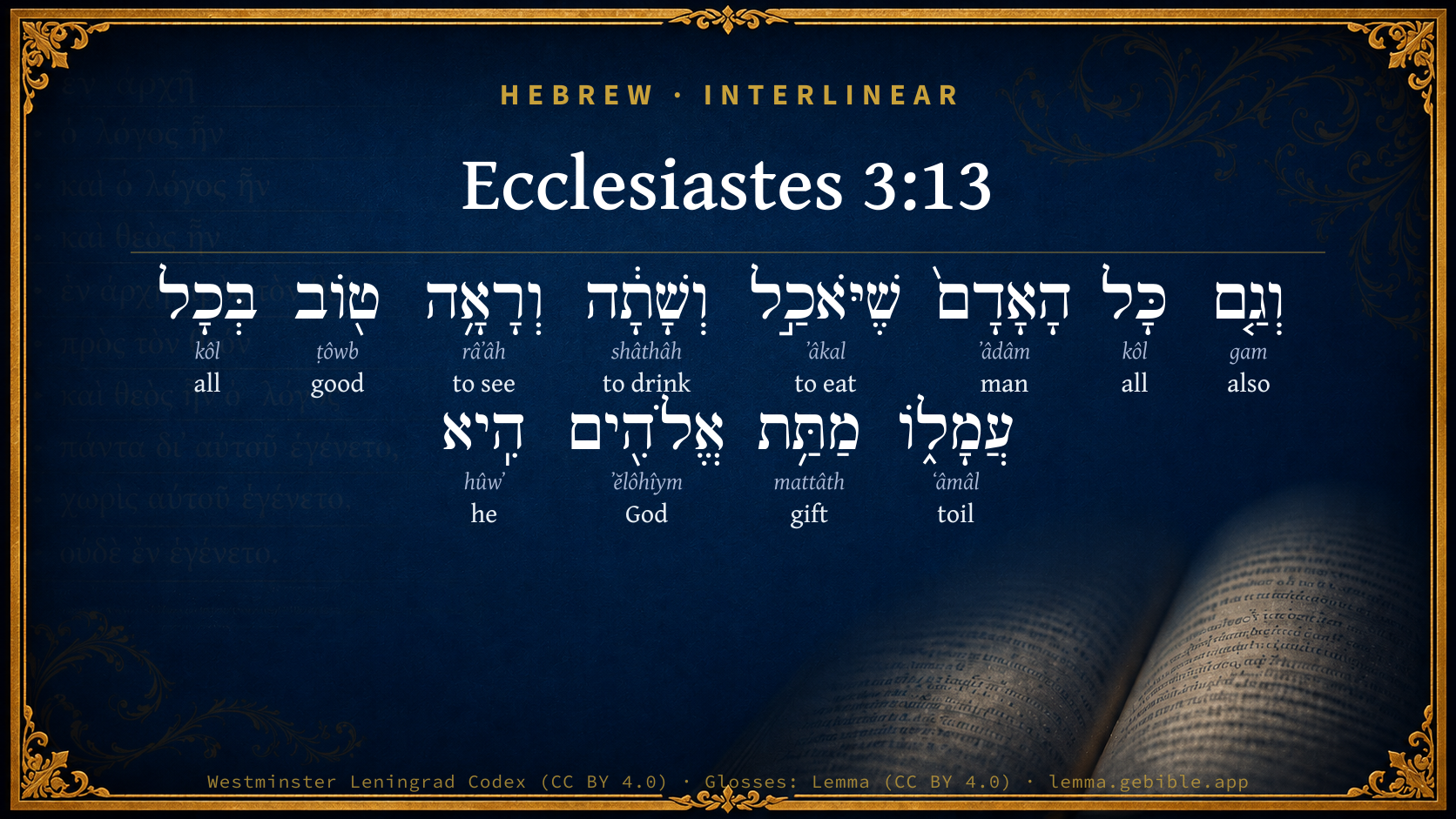
  1. וְגַ֤ם gam H1571 “and · also” Conjunction + Particle, Accusative
  2. כָּל kôl H3605 “all of” Noun, Common, Masculine, Singular, Construct
  3. הָאָדָם֙ ʼâdâm H120 “the · man” Particle, Definite Article + Noun, Common, Masculine, Singular, Absolute
  4. שֶׁיֹּאכַ֣ל ʼâkal H398 “who/which · to eat” Particle, Relative + Verb, Qal, Imperfect, 3rd Person, Masculine, Singular
  5. וְשָׁתָ֔ה shâthâh H8354 “and · to drink” Conjunction + Verb, Qal, Sequential Perfect, 3rd Person, Masculine, Singular
  6. וְרָאָ֥ה râʼâh H7200 “and · to see” Conjunction + Verb, Qal, Sequential Perfect, 3rd Person, Masculine, Singular
  7. ט֖וֹב ṭôwb H2896 “good” Adjective, Adjective, Masculine, Singular, Absolute
  8. בְּכָל kôl H3605 “in/at · all of” Preposition + Noun, Common, Masculine, Singular, Construct
  9. עֲמָל֑וֹ ʻâmâl H5999 “toil · his” Noun, Common, Both, Singular, Construct + Suffix, Personal, 3rd Person, Masculine, Singular
  10. אֱלֹהִ֖ים ʼĕlôhîym H430 “God(s)” Noun, Common, Masculine, Plural, Absolute
  11. הִֽיא hûwʼ H1931 “he” Pronoun, Personal, 3rd Person, Feminine, Singular

About this verse

These counts appear in no published source. They are computed here, from the morphology-tagged text and Lemma’s own curated glosses. What Lemma adds →

12
words
11
distinct lemmas
Wisdom
section

Notable vocabulary

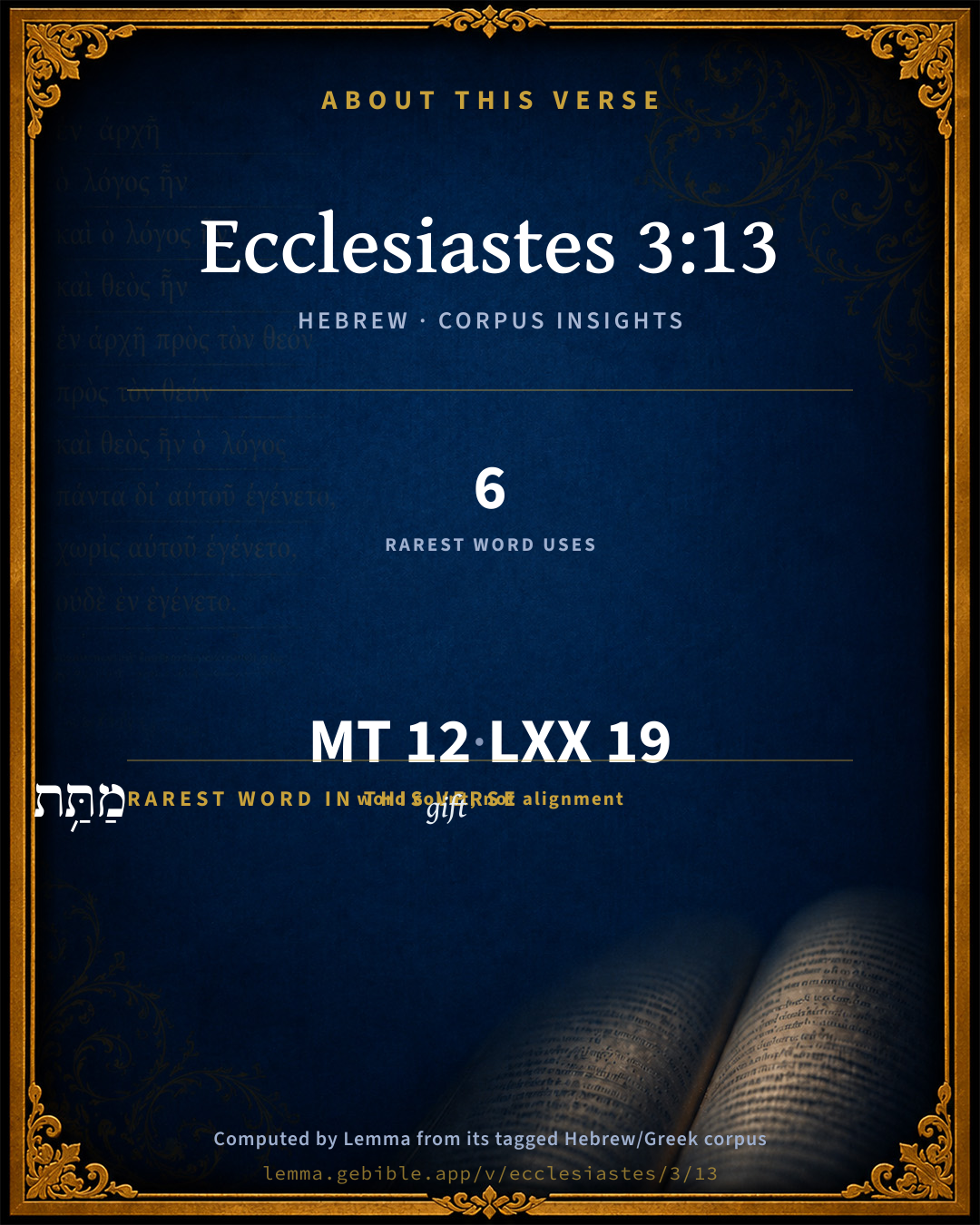
The rarest word here is מַתַּ֥ת gift H4991 — appearing just 6 times in the whole Hebrew Bible.

Shared distinctive vocabulary

מַתַּ֥ת gift H4991 occurs in 6 verses of the Hebrew Bible. Also found in:

Grammatical profile

  • 3 verbs
  • 6 nouns
  • 1 adjective
  • 1 pronoun
  • 1 particle

Verb forms

  • שֶׁיֹּאכַ֣ל Qal · Imperfect
  • וְשָׁתָ֔ה Qal · Sequential Perfect
  • וְרָאָ֥ה Qal · Sequential Perfect

Repetition

A word recurs within this verse — often emphatic in Hebrew:

Hebrew & Septuagint length

In English translation the verse runs 20 words from the Hebrew and 25 from the Septuagint (LXX English) — closely comparable.

A rough comparison of the two English renderings, which tokenize alike — not a word-level alignment.

Word counts can differ between the Hebrew and the Greek without any difference in meaning — e.g. the Hebrew direct-object marker אֵת has no separate Greek word, and Greek often adds the article ὁ.

In the original languages it is 12 Hebrew tokens and 19 Greek tokens — but the two are counted differently (Hebrew bundles its prefixes and suffixes into one token; the Greek is in lemma form), so that isn’t a like-for-like length.

Cross-references

6

Topical passages linked to Ecclesiastes 3:13 in the Treasury of Scripture Knowledge — connected by theme and wording, ordered by reader-vote popularity; previews shown in the World English Bible.

  • Ecclesiastes 2:24 There is nothing better for a man than that he should eat and drink, and make his soul enjoy good in his labor. This also I saw, that it is from the hand of God.
  • Ecclesiastes 9:7 Go your way--eat your bread with joy, and drink your wine with a merry heart; for God has already accepted your works.
  • Isaiah 65:21–23 They shall build houses, and inhabit them; and they shall plant vineyards, and eat the fruit of them.
  • Psalms 128:2 For you will eat the labor of your hands. You will be happy, and it will be well with you.
  • Ecclesiastes 5:18–20 Behold, that which I have seen to be good and proper is for one to eat and to drink, and to enjoy good in all his labor, in which he labors under the sun, all the days of his life which God has given him; for this is his portion.
  • Deuteronomy 28:30–31 You shall betroth a wife, and another man shall lie with her: you shall build a house, and you shall not dwell therein: you shall plant a vineyard, and shall not use the fruit of it.

Cross-references courtesy of OpenBible.info (CC BY 4.0).

Hebrew and Greek witnesses Masoretic Hebrew ↔ Greek Septuagint

The same verse in the two great witnesses to the Old Testament, shown verse-for-verse.

These are two independent witnesses, not word-aligned to each other, and the Septuagint is shown in lemma (dictionary) form.

Hebrew Ecclesiastes 3:13 Masoretic · Westminster Leningrad Codex

וְגַ֤ם כָּל הָאָדָם֙ שֶׁיֹּאכַ֣ל וְשָׁתָ֔ה וְרָאָ֥ה ט֖וֹב בְּכָל עֲמָל֑וֹ מַתַּ֥ת אֱלֹהִ֖ים הִֽיא

Also that every man should eat and drink, and enjoy good in all his labor, is the gift of God.

World English Bible · Public Domain

Greek LXX Ecclesiastes 3:13 Septuagint · lemma form

καί γέ πᾶς ὁ ἄνθρωπος ὅς ἐσθίω καί πίνω καί ὁράω ἀγαθός ἐν πᾶς μόχθος αὐτός δόμα θεός εἰμί

Also in the case of every man who shall eat and drink, and see good in all his labor, this is a gift of God.

LXX2012 (modern English Septuagint) · Public Domain

Hebrew: Westminster Leningrad Codex (CC BY 4.0). Greek: Septuagint (public domain); English from LXX2012 (modern English Septuagint) (Public Domain). How the Septuagint differs from the Hebrew →

Commentary

Notes on Ecclesiastes 3:13 from classic Christian and Jewish commentators (each source and its license shown beneath its notes). The classic Christian expositions comment on the surrounding passage and are grouped to its opening verse, so a note may address several verses; the Jewish commentaries on the Tanakh (Rashi and others) are per-verse, so they appear only where the commentator wrote on this verse.

Lemma curates 59 commentaries, every one of them public domain or Creative Commons licensed, each selected and text-cleaned for this edition rather than reprinted as found. About our sources →

Trapp's Complete Commentary

John Trapp

Ecc 3:13 And also that every man should eat and drink, and enjoy the good of all his labour, it [is] the gift of God.

Ver. 13. And enjoy the good of all his labour.] "They that will not labour must not eat," {2Th 3:10} saith the apostle. As they that do shall enjoy the good of all their labour, eat the labour of their hands, and be thrice happy. {Psa 128:1-2} Jabal and Jubal, {Gen 4:20-21} frugality and music, good husbandry and good content, dwell together; and yet not always, but where God gives the gift. He gives strength to labour, and health to enjoy the good of our labour. {a} This the rich fool in the gospel either knew not or considered not. "Eat, drink, and be merry," said he to himself; but God was not in all his thoughts. How much better David! "Hope in the Lord," {Psa 43:5} saith he to himself and others, "and be doing good; dwell in the land, and verily thou shalt be fed." {Psa 37:3}

{a} Valeat possessor oportet, si comportatis rebus bene cogitat uti. - Horat.

John Trapp, A Commentary or Exposition upon All the Books of the Old and New Testament (1647–1656) — public domain. Text from a community e-Sword module.

Keil & Delitzsch

C. F. Keil & F. Delitzsch

"But also that he should eat and drink, and see good in all his labour, is for every man a gift of God." The inverted and yet anacoluthistic formation of the sentence is quite like that at Ecc 5:18. כּל־הא signifies, properly, the totality of men = all men, e.g., Psa 116:11; but here and at 5:18; 12:13, the author uses the two words so that the determ. second member of the st. constr. does not determine the first (which elsewhere sometimes occurs, as bethulath Israel, a virgin of Israel, Deu 22:19): every one of men (cf. πᾶς τις βροτῶν). The subst. clause col-haadam is subject: every one of men, in this that he eats ... is dependent on God. Instead of מיּד the word מתּת (abbrev. from מתּנת) is here used, as at Ecc 5:18. The connection by vegam is related to the preceding adversat.: and (= but) also (= notwithstanding that), as at Ecc 6:7, Neh 5:8, cf. Jer 3:10, where gam is strengthened by becol-zoth. As for the rest, it follows from Ecc 3:13, in connection with Ecc 2:24-26, that for Koheleth εὐποΐ́α and εὐθυμία reciprocally condition each other, without, however, a conclusion following therefrom justifying the translation "to do good," Ecc 3:12. Men's being conditioned in the enjoyment of life, and, generally, their being conditioned by God the Absolute, has certainly an ethical end in view, as is expressed in the conclusion which Koheleth now reaches: -

Keil & Delitzsch — Biblical Commentary on the Old Testament (1861–1891) — public domain (CC PDM 1.0). Text via the HelloAO Bible API. (Old Testament only.)

Geneva Bible (1599)

Geneva Bible translators

Read Eccl. 2:24, and these places declare that we should do all things with sobriety and in the fear of God, forasmuch as he giveth not his gifts to the intent that they should be abused.

Geneva Bible (1599) marginal notes — public domain. Text via Bolls.life.

Jamieson, Fausset & Brown

Robert Jamieson, A. R. Fausset & David Brown

Literally, "And also as to every man who eats . . . this is the gift of God" (Ecc 3:22; Ecc 5:18). When received as God's gifts, and to God's glory, the good things of life are enjoyed in their due time and order (Act 2:46; Co1 10:31; Ti1 4:3-4).

Jamieson, Fausset & Brown — Commentary Critical and Explanatory on the Whole Bible (1871) — public domain (CC PDM 1.0). Text via the HelloAO Bible API.

Ellicott's Commentary for English Readers

(13, 14) Sir_11:17; Sir_18:6.

A Bible Commentary for English Readers, edited by Charles John Ellicott (1878–1897) — public domain. Text from a community e-Sword module.

The Cambridge Bible for Schools and Colleges

gen. ed. J. J. S. Perowne

13. And also that every man] The addition of this clause confirms the interpretation just given of the “doing good” of the preceding verse. Had that meant simply enjoyment, this clause would have been an idle repetition. As it is, “doing good” takes its place, as it did with the nobler Epicureans, among the elements of happiness. So Epicurus himself taught that “it is not possible to live happily without also living wisely, and nobly, and justly” (Diog. Laert. x. 1, § 140).

The Cambridge Bible for Schools and Colleges (gen. ed. J. J. S. Perowne; Cambridge University Press, 1878–1918) — public domain. Text from a community e-Sword module.

John Gill's Exposition

And also that every man should eat and drink,.... Not to excess, but in moderation; and yet freely, plentifully, and cheerfully; and not alone, but giving the poor a portion with him; and in all having in view the glory of God, Co1 10:31;

and enjoy the good of all his labour; take the comfort of what he has been labouring for, and not lay it up for, and leave it to, he knows not who: the Targum is,

"and see good in his days, and cause his children, at the time of his death, to inherit all his labour;''

it is the gift of God; not only to have, but to enjoy, and make a proper use of the mercies of life. This is the same doctrine which is delivered Ecc 2:24.

John Gill's Exposition of the Whole Bible (1746–1763) — public domain (CC PDM 1.0). Text via the HelloAO Bible API.

Haydock's Catholic Bible Commentary

God. He gives peace and plenty; and still more, the grace to use these things, so as to obtain heaven. (Calmet)

George Leo Haydock (1774–1849), Haydock's Catholic Family Bible and Commentary, 1859 edition — public domain. Excludes Psalms (Douay-Rheims chapter numbering differs from Protestant) and Deuterocanonical books (Catholic canon only).

Matthew Poole's English Annotations

That every man should eat and drink, i.e. hath power or a heart to use what God hath given him, as it is expressed, Ecc 6:2.

It is the gift of God; of which See Poole "Ecc 2:24".

Matthew Poole's English Annotations on the Holy Bible (1683–1685) — public domain. Text from a community e-Sword/MySword module.

Whedon's Commentary on the Bible

Daniel D. Whedon

13. Eat and drink — Nearly a repetition of the previous verse. Every form of present enjoyment is from the hand of God.

Daniel D. Whedon (gen. ed.), Commentary on the Old and New Testaments (1874–1909) — public domain. Text from a community e-Sword module.

The Pulpit Commentary

And also that every man should eat and drink... it is the gift of God. This enforces and intensifies the statement in the preceding verse; not only the power to "do good," but even to enjoy what comes in his way, (see on Ecc_2:24) man must receive from God. When we pray for our daily bread, we also ask for ability to take, assimilate, and profit by the supports and comforts afforded to us. "It" is better omitted, as "is the gift of God" forms the predicate of the sentence. Ecc_11:1-7, "The gift of the Lord remaineth with the godly, and his favor bringeth prosperity for ever."

The Pulpit Commentary (1880–1919), ed. H.D.M. Spence-Jones & Joseph S. Exell — public domain. Text from a community e-Sword module.

John Wesley's Explanatory Notes

Should eat - Use what God hath given him.

John Wesley, Explanatory Notes Upon the Whole Bible (1754–1765) — public domain. Text via the GEBible commentary corpus.

Rashi

Rabbi Shlomo Yitzchaki (Rashi)

and enjoys what is good The Torah and the commandments.

Rashi on the Tanakh — English translations: “The Judaica Press complete Tanach with Rashi, translated by A. J. Rosenberg” (CC BY 4.0); “Pentateuch with Rashi's commentary by M. Rosenbaum and A.M. Silbermann, 1929-1934” (public domain); “The Metsudah Tanach series, Lakewood, N.J” (CC BY 4.0); and “The Book of Joshua, Metsudah Publications, 1997” (CC BY 4.0). Text via Sefaria.

Lesson kit

Teaching starters — assembled from the data on this page, not authored interpretation. Every prompt links to the verse data it draws on. Edit before teaching.

Ecclesiastes, in the Wisdom, opens this verse with 12 words (11 distinct Hebrew lemmas). Its most distinctive word is mattâth (“gift”). A historical commentator’s framing appears above. Read the whole chapter for the surrounding context.

Discussion questions

  1. How does “gift” (mattâth) shape what this verse is saying?
  2. How does 1 Kings 13:7, which shares the word «gift», read alongside this verse?
  3. What does the repetition of “all” (2× in this one verse) do in this verse?
  4. These translations render this verse differently. What is at stake in choosing one wording over another?
  5. «שֶׁיֹּאכַ֣ל» is a Qal Imperfect verb. How does that grammatical form shape the action described?
  6. Compare how Trapp's Complete Commentary and Keil & Delitzsch read this verse. Where do they agree or differ?

Things to notice

Reading settings

Reading text

Shown beneath each verse's original-language words.

Old Testament
Old Testament edition

Read the OT as the Masoretic Hebrew (MT) or the Greek Septuagint (LXX).

English shown for the Greek Septuagint (in the Hebrew ↔ Greek comparison).

Comparing translations? Open the Compare panel on any verse page to stack up to four side by side.