
Proverbs 31:5

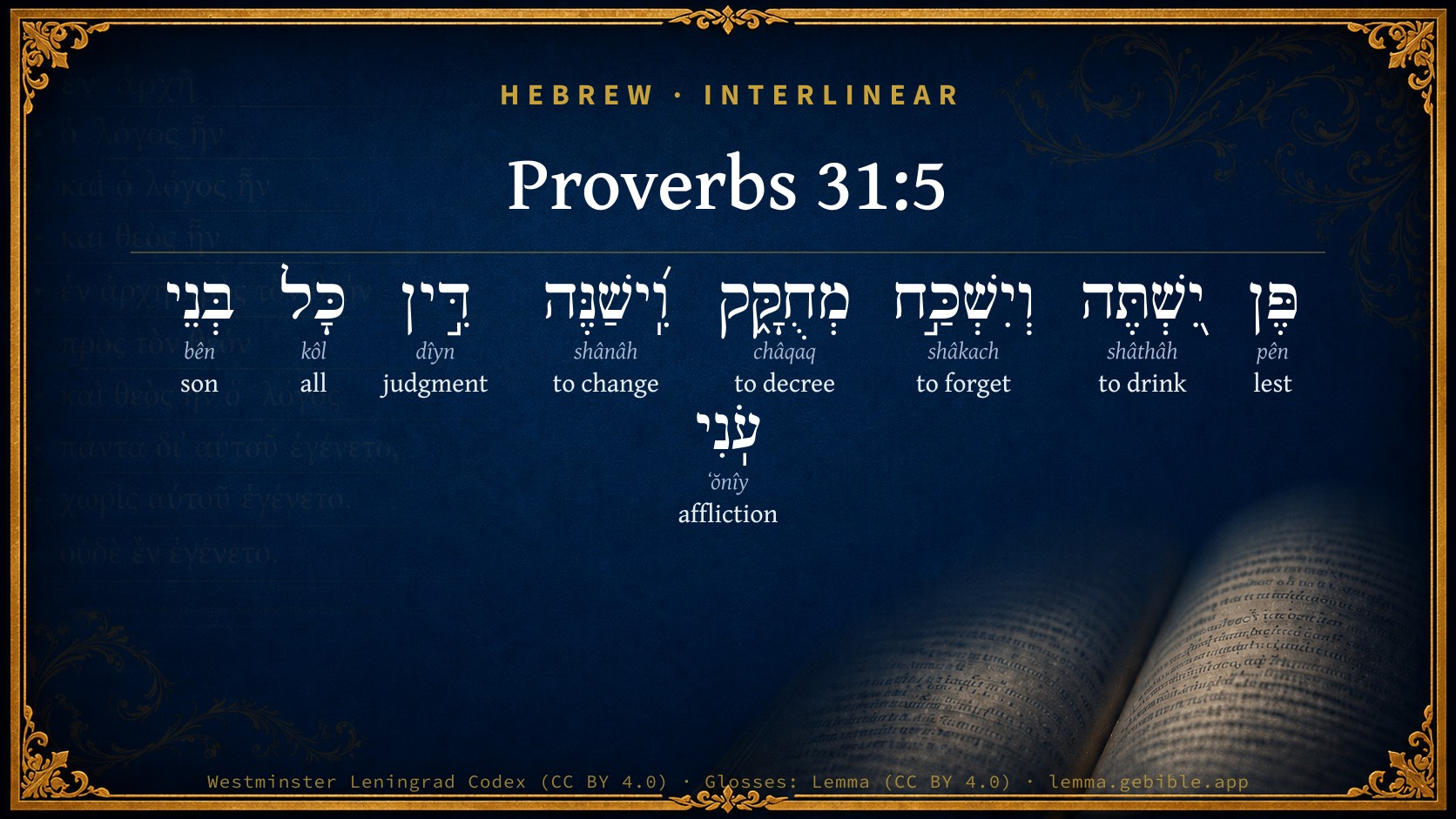
Hebrew (Westminster Leningrad Codex) Proverbs 31:5 appears in the Hebrew Old Testament. The text above is from the Westminster Leningrad Codex. Each word links to its Strong’s number, a concise gloss, and parsing drawn from the Open Scriptures Hebrew Bible morphology. Click any word for its full Brown-Driver-Briggs (BDB) entry.
Download image
Cite this verse

Proverbs 31:5 (World English Bible). Public Domain. Lemma interlinear Bible study tool, https://lemma.gebible.app/v/proverbs/31/5.

Show BibTeX & RIS
BibTeX
RIS
English Translation
Lest they drink, and forget the law, And pervert the justice due to anyone who is afflicted.
World English Bible · Public Domain
Download a study sheet

One document with this verse’s original text, its word-by-word gloss line, the meaning frame, cross-references with their text, attributed commentary, and full source and license credits — printable, and it pastes into notes with its structure intact.

This verse Autodidact and up

Study sheet (.html) Plain text (.txt)

A passage Seminary Student

Up to 50 verses in one chapter. A passage sheet keeps up to 6 commentary sources and 12 cross-references per verse, in the order this page ranks them, and says so on the sheet whenever that leaves anything out. Ask for a single verse and you get the Autodidact verse sheet above.

Everything on this page stays free to read, with no account — the sheet is a download of what is already on screen, not access to it.

Want to remove ads? Support Godless Engineer
Compare translations 3

The same verse in 3 English versions, stacked beneath the original-language interlinear above. Click any original word for its lexicon entry.

Each is an independent rendering of the whole verse — the interlinear is not word-aligned to these translations.

Highlighted words mark where these versions differ — a whole-verse word diff, not a word-by-word alignment.

  • World English Bible Public Domain
    Lest they drink, and forget the law, And pervert the justice due to anyone who is afflicted.
  • King James Version Public Domain
    Lest they drink, and forget the law, and pervert the judgment of any of the afflicted.
  • unfoldingWord Literal Text CC BY-SA 4.0
    Lest he drink and forget what has been decreed and pervert the legal claim of all the sons of the afflicted one.

unfoldingWord Literal Text — © unfoldingWord, licensed CC BY-SA 4.0. Word-aligned USFM3 via Door43 (git.door43.org/unfoldingWord/en_ult).

Versions to compare (up to 4)

3 of 4 selected

Show all 18 translations

Every available English version of this verse, each an independent rendering of the whole verse.

  • World English Bible Public Domain
    Lest they drink, and forget the law, And pervert the justice due to anyone who is afflicted.
  • Berean Standard Bible Public Domain
    lest they drink and forget what is decreed, depriving all the oppressed of justice.
  • Majority Standard Bible Public Domain
    lest they drink and forget what is decreed, depriving all the oppressed of justice.
  • King James Version Public Domain
    Lest they drink, and forget the law, and pervert the judgment of any of the afflicted.
  • American Standard Version (1901) Public Domain
    Lest they drink, and forget the law, And pervert the justice `due' to any that is afflicted.
  • Revised Version (1885) Public Domain
    Lest they drink, and forget the law, and pervert the judgment of any that is afflicted.
  • Geneva Bible (1599) Public Domain
    Lest he drinke and forget the decree, and change the iudgement of all the children of affliction.
  • Douay-Rheims (1899) Public Domain
    And lest they drink and forget judgments, and pervert the cause of the children of the poor.
  • Young's Literal Translation Public Domain
    Lest he drink, and forget the decree, And change the judgment of any of the sons of affliction.
  • Literal Standard Version CC BY-SA 4.0
    Lest he drink, and forget the decree, || And change the judgment of any of the sons of affliction.
  • Unlocked Literal Bible CC BY-SA 4.0
    because when they drink they forget what has been decreed, and pervert the rights of all the afflicted.
  • unfoldingWord Literal Text CC BY-SA 4.0
    Lest he drink and forget what has been decreed and pervert the legal claim of all the sons of the afflicted one.
  • Darby Bible Public Domain
    -- lest they drink and forget the law, and pervert the judgment of any of the children of affliction.
  • World Messianic Bible Public Domain
    lest they drink, and forget the decree, and pervert the justice due to anyone who is afflicted.
  • Webster's Bible Public Domain
    Lest they drink, and forget the law, and pervert the judgment of any of the afflicted.
  • Free Bible Version CC BY-SA 4.0
    For if they drink, they'll forget what the law says, and pervert the rights of those who are suffering.
  • Bible in Basic English Public Domain
    For fear that through drinking they may come to have no respect for the law, wrongly judging the cause of those who are in trouble.
  • JPS Tanakh (1917) Public Domain
    Lest they drink, and forget that which is decreed, and pervert the justice due to any that is afflicted.

Literal Standard Version (2020), Covenant Press — licensed CC BY-SA 4.0. Text via the HelloAO Bible API (eBible.org). Unlocked Literal Bible (unfoldingWord) — licensed CC BY-SA 4.0. Text via the HelloAO Bible API (eBible.org). unfoldingWord Literal Text — © unfoldingWord, licensed CC BY-SA 4.0. Word-aligned USFM3 via Door43 (git.door43.org/unfoldingWord/en_ult). Free Bible Version, Dr. Jonathan Gallagher — licensed CC BY-SA 4.0. Text via the HelloAO Bible API (eBible.org).

Word by word

More ways to search: Search by grammar → Find every occurrence → Compare this word →

Practice this passage: Drill this verse → Learn its vocabulary →

מְחֻקָּ֑ק
châqaq
H2710
“decreed”
Verb, Pual, Participle Passive, Masculine, Singular, Absolute
Part of Speech
Verb
Stem
Pual
Form
Participle Passive
Gender
Masculine
Number
Singular
State
Absolute
Full BDB Definition

Origin: a primitive root

TWOT: 728

to cut out, decree, inscribe, set, engrave, portray, govern - (Qal) - to cut in - to cut in or on, cut upon, engrave, inscribe - to trace, mark out - to engrave, inscribe (of a law) - (Poel) - to inscribe, enact, decree - one who decrees, lawgiver (participle) - (Pual) something decreed, the law (participle) - (Hophal) to be inscribed
  1. פֶּן pên H6435 “lest” Conjunction
  2. יִ֭שְׁתֶּה shâthâh H8354 “to drink” Verb, Qal, Imperfect, 3rd Person, Masculine, Singular
  3. וְיִשְׁכַּ֣ח shâkach H7911 “and · to forget” Conjunction + Verb, Qal, Imperfect, 3rd Person, Masculine, Singular
  4. וִֽ֝ישַׁנֶּה shânâh H8138 “and · to change” Conjunction + Verb, Piel, Imperfect, 3rd Person, Masculine, Singular
  5. דִּ֣ין dîyn H1779 “judgment of” Noun, Common, Masculine, Singular, Construct
  6. כָּל kôl H3605 “all of” Noun, Common, Masculine, Singular, Construct
  7. בְּנֵי bên H1121 “sons of” Noun, Common, Masculine, Plural, Construct
  8. עֹֽנִי ʻŏnîy H6040 “affliction” Noun, Common, Masculine, Singular, Absolute

About this verse

These counts appear in no published source. They are computed here, from the morphology-tagged text and Lemma’s own curated glosses. What Lemma adds →

9
words
9
distinct lemmas
Wisdom
section

Notable vocabulary

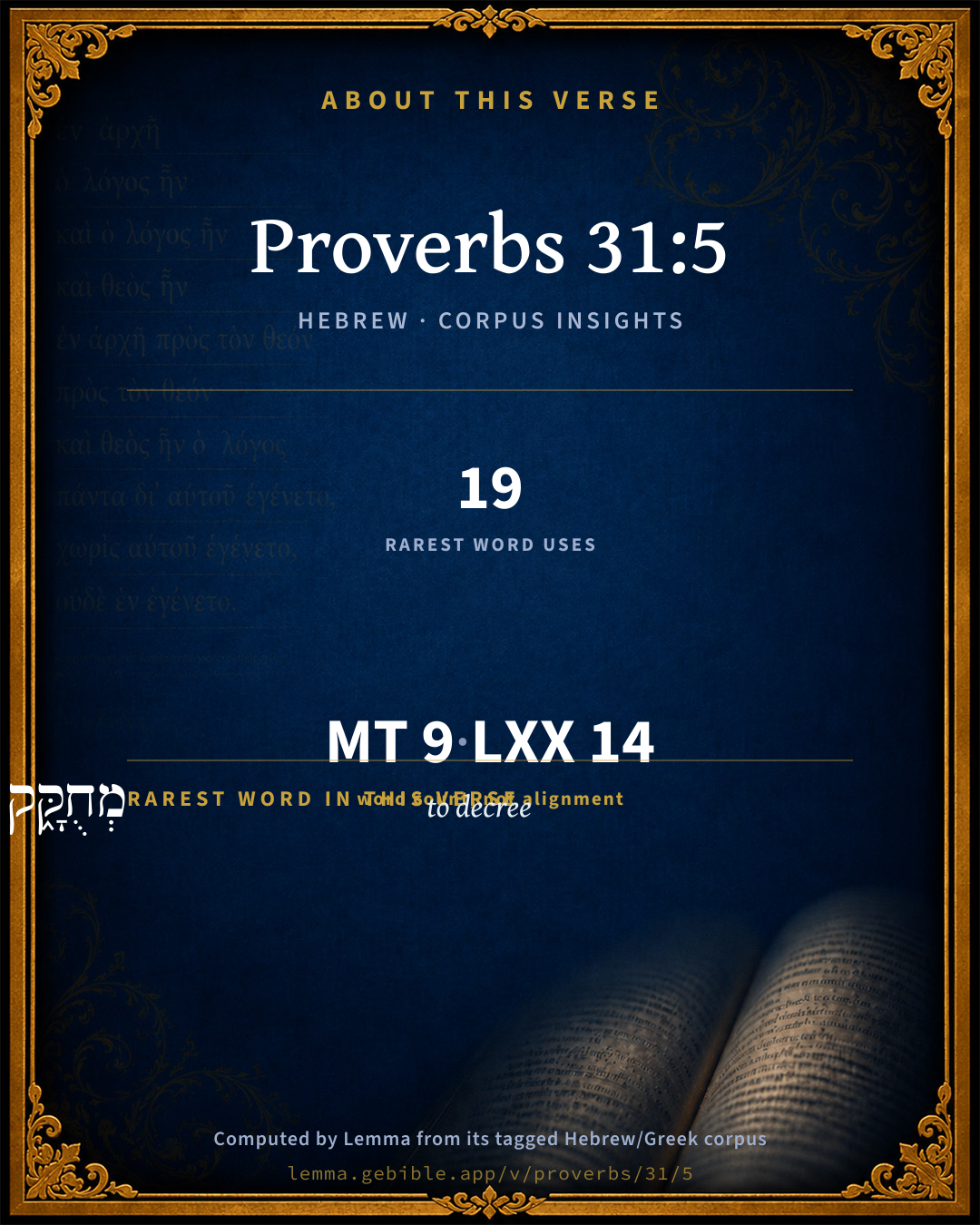
The rarest word here is מְחֻקָּ֑ק to decree H2710 — appearing just 19 times in the whole Hebrew Bible.

Shared distinctive vocabulary

מְחֻקָּ֑ק to decree H2710 occurs in 19 verses of the Hebrew Bible. Also found in:

Grammatical profile

  • 4 verbs
  • 4 nouns
  • 1 conjunction

Verb forms

  • יִ֭שְׁתֶּה Qal · Imperfect
  • וְיִשְׁכַּ֣ח Qal · Imperfect
  • מְחֻקָּ֑ק Pual · Participle Passive
  • וִֽ֝ישַׁנֶּה Piel · Imperfect

Hebrew & Septuagint length

In English translation the verse runs 17 words from the Hebrew and 15 from the Septuagint (LXX English) — closely comparable.

A rough comparison of the two English renderings, which tokenize alike — not a word-level alignment.

Word counts can differ between the Hebrew and the Greek without any difference in meaning — e.g. the Hebrew direct-object marker אֵת has no separate Greek word, and Greek often adds the article ὁ.

In the original languages it is 9 Hebrew tokens and 14 Greek tokens — but the two are counted differently (Hebrew bundles its prefixes and suffixes into one token; the Greek is in lemma form), so that isn’t a like-for-like length.

Cross-references

1

Topical passages linked to Proverbs 31:5 in the Treasury of Scripture Knowledge — connected by theme and wording, ordered by reader-vote popularity; previews shown in the World English Bible.

  • Habakkuk 2:5 Yes, moreover, wine is treacherous. A haughty man who doesn't stay at home, who enlarges his desire as Sheol, and he is like death, and can't be satisfied, but gathers to himself all nations, and heaps to himself all peoples.

Cross-references courtesy of OpenBible.info (CC BY 4.0).

Hebrew and Greek witnesses Masoretic Hebrew ↔ Greek Septuagint

The same verse in the two great witnesses to the Old Testament, shown verse-for-verse.

These are two independent witnesses, not word-aligned to each other, and the Septuagint is shown in lemma (dictionary) form.

Hebrew Proverbs 31:5 Masoretic · Westminster Leningrad Codex

פֶּן יִ֭שְׁתֶּה וְיִשְׁכַּ֣ח מְחֻקָּ֑ק וִֽ֝ישַׁנֶּה דִּ֣ין כָּל בְּנֵי עֹֽנִי

Lest they drink, and forget the law, And pervert the justice due to anyone who is afflicted.

World English Bible · Public Domain

Greek LXX Proverbs 31:5 Septuagint · lemma form

ἵνα μή πίνω ἐπιλανθάνω ὁ σοφία καί ὀρθός κρίνω οὐ μή δύναμαι ὁ ἀσθενής

lest they drink, and forget wisdom, and be not able to judge the poor rightly.

LXX2012 (modern English Septuagint) · Public Domain

On this verse, The Pulpit Commentary discusses the Septuagint’s reading. Read the note in Commentary ↓

Hebrew: Westminster Leningrad Codex (CC BY 4.0). Greek: Septuagint (public domain); English from LXX2012 (modern English Septuagint) (Public Domain). How the Septuagint differs from the Hebrew →

Commentary

Notes on Proverbs 31:5 from classic Christian and Jewish commentators (each source and its license shown beneath its notes). The classic Christian expositions comment on the surrounding passage and are grouped to its opening verse, so a note may address several verses; the Jewish commentaries on the Tanakh (Rashi and others) are per-verse, so they appear only where the commentator wrote on this verse.

Lemma curates 59 commentaries, every one of them public domain or Creative Commons licensed, each selected and text-cleaned for this edition rather than reprinted as found. About our sources →

Trapp's Complete Commentary

John Trapp

Pro 31:5 Lest they drink, and forget the law, and pervert the judgment of any of the afflicted.

Ver. 5. Lest they drink and forget the law.] Drunkenness causeth forgetfulness (hence the ancients feigned Bacchus to be the son of forgetfulness), and stands in full opposition to reason and religion: when the wine is in, the wit is out. Seneca saith, that for a man to think to be drunk, and yet to retain his right reason, is to think to drink rank poison, and yet not to die by it. {a}

And pervert the judgment, &c.] Pronounce an unrighteous sentence: which when Philip king of Macedon once did, the poor woman whose cause it was, presently appealed from Philip now drunk, to Philip when he should be sober again. The Carthagenians made a law that no magistrate of theirs should drink wine. The Persians permitted their kings to be drunk one day in a year only. Solon made a law at Athens that drunkenness in a prince should be punished with death. See Ecc 10:16-17.

{a} Plutarch in Sympos.

John Trapp, A Commentary or Exposition upon All the Books of the Old and New Testament (1647–1656) — public domain. Text from a community e-Sword module.

Adam Clarke's Commentary

Verse 5. Lest they drink, and forget the law] When they should be administering justice, they are found incapable of it; or, if they go into the judgment-seat, may pervert justice.

Adam Clarke's Commentary on the Bible (1810–1826) — public domain. Text from a community e-Sword/MySword module.

The Cambridge Bible for Schools and Colleges

gen. ed. J. J. S. Perowne

5. of any of the afflicted] “Heb. of all the sons of affliction,” A.V. and R.V. marg.

The Cambridge Bible for Schools and Colleges (gen. ed. J. J. S. Perowne; Cambridge University Press, 1878–1918) — public domain. Text from a community e-Sword module.

John Gill's Exposition

Lest they drink, and forget the law,.... The law of God by Moses, which the kings of Israel were obliged to write a copy of, and read over daily, to imprint it on their minds, that they might never forget it, but always govern according to it, Deu 17:18; or the law of their ancestors, or what was made by themselves, which through intemperance may be forgotten; for this sin stupefies the mind and hurts the memory, and makes men forgetful;

and pervert the judgment of any of the afflicted; a king on the throne, or a judge on the bench, drunk, must be very unfit for his office; since he must be incapable of attending to the cause before him, of taking in the true state of the case; and, as he forgets the law, which is his rule of judgment, so he will mistake the point in debate, and put one thing for another; and "change" (g) and alter, as the word signifies, the judgment of the afflicted and injured person, and give the cause against him which should be for him; and therefore it is of great consequence that kings and judges should he sober. A certain woman, being undeservedly condemned by Philip king of Macedon, when drunk, said,

"I would appeal to Philip, but it shall be when he is sober;''

which aroused him; and, more diligently examining the cause, he gave, a more righteous sentence (h).

(g) "mutet", Pagninus, Montanus, Junius & Tremellius, Piscator, Mercerus, Cocceius, Gejerus, Michaelis; "demutet", Schultens. (h) Valer. Maxim l. 6. c. 2. extern. 1.

John Gill's Exposition of the Whole Bible (1746–1763) — public domain (CC PDM 1.0). Text via the HelloAO Bible API.

Haydock's Catholic Bible Commentary

Poor. Solon condemned to death, at Athens, the prince who should get drunk; and the Areopagites excluded from their assembly a judge who had dined in a tavern. (Laertius 1.; Atheneus xiii. 2.)

George Leo Haydock (1774–1849), Haydock's Catholic Family Bible and Commentary, 1859 edition — public domain. Excludes Psalms (Douay-Rheims chapter numbering differs from Protestant) and Deuterocanonical books (Catholic canon only).

Matthew Poole's English Annotations

Forget the law; the laws of God, by which they are to govern themselves and their kingdoms.

Pervert the judgment of any of the afflicted; which may easily be done by a drunken judge, because drunkenness deprives a man of the use of reason; by which alone men can distinguish between right and wrong, and withal stirs up those passions which incline him both to precipitation and partiality.

Matthew Poole's English Annotations on the Holy Bible (1683–1685) — public domain. Text from a community e-Sword/MySword module.

Whedon's Commentary on the Bible

Daniel D. Whedon

5. Lest they — Rather, he.

Drink,… forget… law — מחקק, (mehhukkak,) that which is prescribed, the statute applicable to the particular case. The reasons here given for rulers, judges, princes, etc., abstaining from intoxicating drinks, are very similar to those given to the priests in Lev_10:10-11. No drunkard should be intrusted with authority or rule, either in civil, military, or ecclesiastical affairs. Property, character, life, and the immortal interests of the soul, are too precious to be committed to the decisions of a man whose intellect is at all beclouded by the fumes of alcohol. For a biblical example of kingly drunkenness, See 1Ki_16:9.

These verses should not, perhaps, be construed as containing a positive prohibition of wine and other strong drinks, even to Lemuel, any more than the caution in the third verse against giving his strength to women is to he considered as a prohibition of marriage. The object of the language was probably to guard him against excess in the gratification of his appetites. But, on the other hand, whatever may have been the implied limitations of the self-denial commended, it remains true, as a matter of fact, that the great danger lies in too much rather than in too little indulgence; and that, so far as the use of intoxicating drinks is concerned, the general rule is, that he who uses them least, or not at all, is the safest. For, as shown elsewhere, (Pro_23:29, et seq.,) the habit of using these beverages is insidious, and ever tending to greater and greater strength and greater danger of excess. Moreover, the sacred word is not without commendations of total abstinence, as in the case of the Rechabites, (Jer_35:6-7; 1Ch_2:55,) and the superior excellence of total abstinence is implied in the case of the Nazarites and others. When we come to the new dispensation, though the drinking of wine and strong drink is not prohibited in form, but, on the contrary, has the seeming sanction of our Saviour and his apostles, as pertaining to a Christian man’s liberty, yet, when from any cause that liberty becomes an occasion of stumbling to others, it is most imperatively obligatory upon us to abstain totally from the exercise of it. The principle is broadly laid down by the apostle, (Rom_14:20-21,) “All things [all kinds of food] indeed are pure; [in themselves they are not ceremonially unclean to the Christian;] but it is evil for that man who eateth with offence. It is good neither to eat flesh, nor to drink wine, nor any thing whereby thy brother stumbleth, or is offended, or is made weak.” While, therefore, a Christian may not always feel himself under obligations to abstain from wine for his own sake, either because it is directly prohibited or is injurious to him, he may, nevertheless, feel himself obliged to practise self-denial for the benefit of others and the general good. Most Christian men in this country feel that this is no time to give the sanction of their example to a custom so terribly fruitful of evil as is the use of intoxicating beverages.

Daniel D. Whedon (gen. ed.), Commentary on the Old and New Testaments (1874–1909) — public domain. Text from a community e-Sword module.

The Pulpit Commentary

This gives a reason for the warning. Lest they drink, and forget the Law. That which has been decreed, and is right and lawful, the appointed ordinance, particularly as regards the administration of justice. Septuagint, "Lest drinking, they forget wisdom." And pervert the judgment of any of the afflicted; literally, of all the sons of affliction; i.e. the whole class of poorer people. Intemperance leads to selfish disregard of others" claims, an inability to examine questions impartially, and consequent perversion of justice. Isaiah (Isa_5:23) speaks of intoxication as inducing men to "justify the wicked for reward, and take away the righteousness of the righteous from him."

The Pulpit Commentary (1880–1919), ed. H.D.M. Spence-Jones & Joseph S. Exell — public domain. Text from a community e-Sword module.

Rashi

Rabbi Shlomo Yitzchaki (Rashi)

what was made law What is written in the Torah—and surely the tradition that is committed to memory.

Rashi on the Tanakh — English translations: “The Judaica Press complete Tanach with Rashi, translated by A. J. Rosenberg” (CC BY 4.0); “Pentateuch with Rashi's commentary by M. Rosenbaum and A.M. Silbermann, 1929-1934” (public domain); “The Metsudah Tanach series, Lakewood, N.J” (CC BY 4.0); and “The Book of Joshua, Metsudah Publications, 1997” (CC BY 4.0). Text via Sefaria.

Lesson kit

Teaching starters — assembled from the data on this page, not authored interpretation. Every prompt links to the verse data it draws on. Edit before teaching.

Proverbs, in the Wisdom, opens this verse with 9 words (9 distinct Hebrew lemmas). Its most distinctive word is châqaq (“to decree”). A historical commentator’s framing appears above. Read the whole chapter for the surrounding context.

Discussion questions

  1. What does “to decree” (châqaq) contribute to the verse as a whole?
  2. Genesis 49:10 shares the word «to decree» with this verse. How do the two illuminate each other?
  3. These translations render this verse differently; the difference is in the English rendering, not the original. What questions does that raise?
  4. The verb «יִ֭שְׁתֶּה» is Qal Imperfect. How does its form color the action?
  5. Reading how Trapp's Complete Commentary and Adam Clarke's Commentary read this verse, where do the two commentators agree and where do they part?

Things to notice

Reading settings

Reading text

Shown beneath each verse's original-language words.

Old Testament
Old Testament edition

Read the OT as the Masoretic Hebrew (MT) or the Greek Septuagint (LXX).

English shown for the Greek Septuagint (in the Hebrew ↔ Greek comparison).

Comparing translations? Open the Compare panel on any verse page to stack up to four side by side.