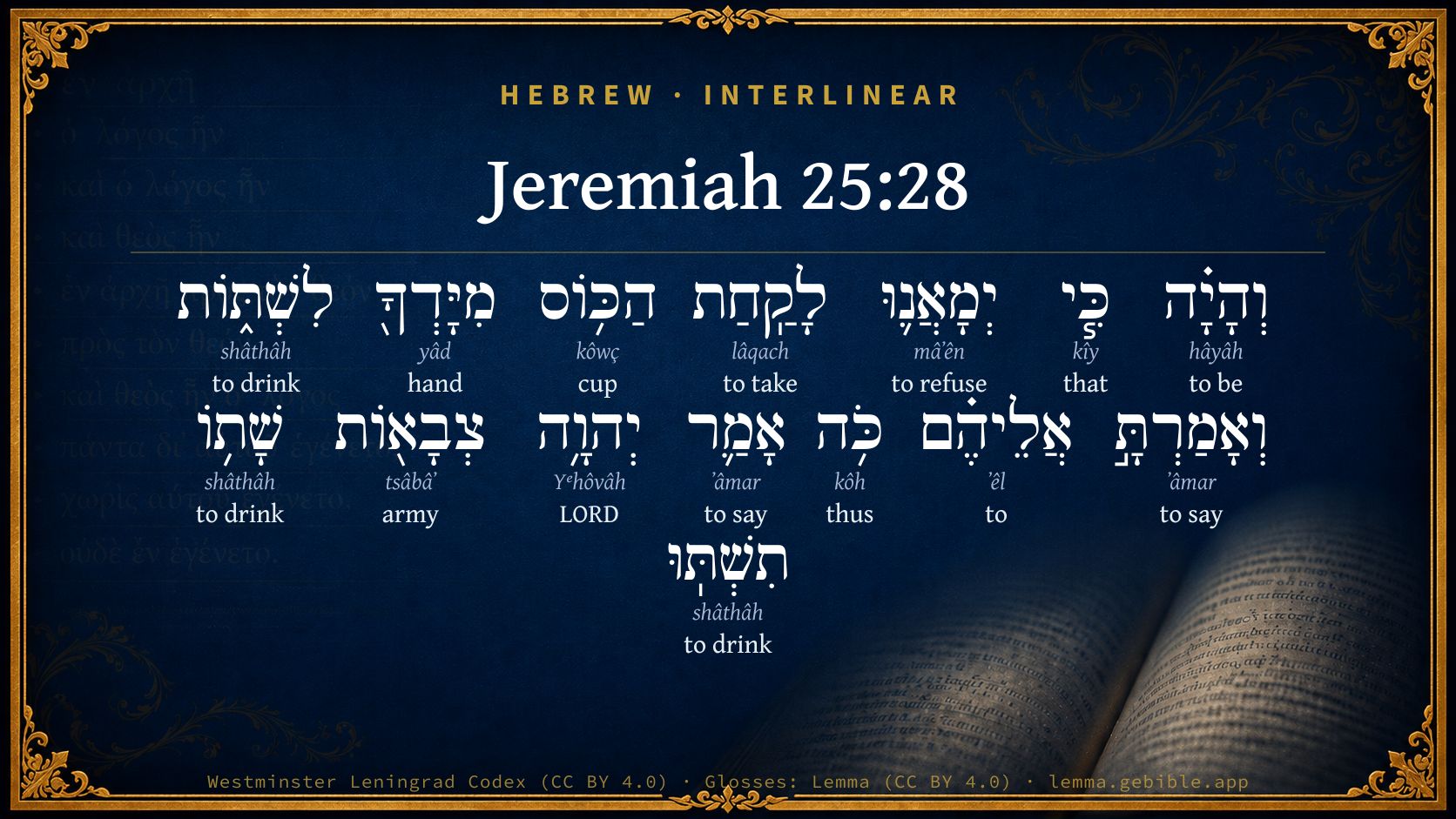
Jeremiah 25:28

Hebrew (Westminster Leningrad Codex) Jeremiah 25:28 appears in the Hebrew Old Testament. The text above is from the Westminster Leningrad Codex. Each word links to its Strong’s number, a concise gloss, and parsing drawn from the Open Scriptures Hebrew Bible morphology. Click any word for its full Brown-Driver-Briggs (BDB) entry.
Download image
Cite this verse

Jeremiah 25:28 (World English Bible). Public Domain. Lemma interlinear Bible study tool, https://lemma.gebible.app/v/jeremiah/25/28.

Show BibTeX & RIS
BibTeX
RIS
English Translation
It shall be, if they refuse to take the cup at your hand to drink, then shall you tell them, Thus says Yahweh of Hosts: You shall surely drink.
World English Bible · Public Domain
Download a study sheet

One document with this verse’s original text, its word-by-word gloss line, the meaning frame, cross-references with their text, attributed commentary, and full source and license credits — printable, and it pastes into notes with its structure intact.

This verse Autodidact and up

Study sheet (.html) Plain text (.txt)

A passage Seminary Student

Up to 50 verses in one chapter. A passage sheet keeps up to 6 commentary sources and 12 cross-references per verse, in the order this page ranks them, and says so on the sheet whenever that leaves anything out. Ask for a single verse and you get the Autodidact verse sheet above.

Everything on this page stays free to read, with no account — the sheet is a download of what is already on screen, not access to it.

Want to remove ads? Support Godless Engineer
Compare translations 3

The same verse in 3 English versions, stacked beneath the original-language interlinear above. Click any original word for its lexicon entry.

Each is an independent rendering of the whole verse — the interlinear is not word-aligned to these translations.

Highlighted words mark where these versions differ — a whole-verse word diff, not a word-by-word alignment.

  • World English Bible Public Domain
    It shall be, if they refuse to take the cup at your hand to drink, then shall you tell them, Thus says Yahweh of Hosts: You shall surely drink.
  • King James Version Public Domain
    And it shall be, if they refuse to take the cup at thine hand to drink, then shalt thou say unto them, Thus saith the LORD of hosts; Ye shall certainly drink.
  • unfoldingWord Literal Text CC BY-SA 4.0
    And it will happen, if they refuse to take the cup from your hand to drink, then you shall say to them, ‘Thus says Yahweh of Armies: Drinking, you shall drink.

unfoldingWord Literal Text — © unfoldingWord, licensed CC BY-SA 4.0. Word-aligned USFM3 via Door43 (git.door43.org/unfoldingWord/en_ult).

Versions to compare (up to 4)

3 of 4 selected

Show all 18 translations

Every available English version of this verse, each an independent rendering of the whole verse.

  • World English Bible Public Domain
    It shall be, if they refuse to take the cup at your hand to drink, then shall you tell them, Thus says Yahweh of Hosts: You shall surely drink.
  • Berean Standard Bible Public Domain
    If they refuse to take the cup from your hand and drink it, you are to tell them that this is what the LORD of Hosts says: ‘You most certainly must drink it!
  • Majority Standard Bible Public Domain
    If they refuse to take the cup from your hand and drink it, you are to tell them that this is what the LORD of Hosts says: ‘You most certainly must drink it!
  • King James Version Public Domain
    And it shall be, if they refuse to take the cup at thine hand to drink, then shalt thou say unto them, Thus saith the LORD of hosts; Ye shall certainly drink.
  • American Standard Version (1901) Public Domain
    And it shall be, if they refuse to take the cup at thy hand to drink, then shalt thou say unto them, Thus saith Jehovah of hosts: Ye shall surely drink.
  • Revised Version (1885) Public Domain
    And it shall be, if they refuse to take the cup at thine hand to drink, then shalt thou say unto them, Thus saith the LORD of hosts: Ye shall surely drink.
  • Geneva Bible (1599) Public Domain
    But if they refuse to take the cuppe at thine hande to drinke, then tell them, Thus saith the Lord of hostes, Ye shall certainely drinke.
  • Douay-Rheims (1899) Public Domain
    And if they refuse to take the cup at thy hand to drink, thou shalt say to them: Thus saith the Lord of hosts: Drinking you shall drink:
  • Young's Literal Translation Public Domain
    And it hath come to pass, When they refuse to receive the cup out of thy hand to drink, That thou hast said unto them: Thus said Jehovah of Hosts, Ye do certainly drink.
  • Literal Standard Version CC BY-SA 4.0
    And it has come to pass, || When they refuse to receive the cup out of your hand to drink, || That you have said to them, Thus said YHWH of Hosts: You certainly drink.
  • Unlocked Literal Bible CC BY-SA 4.0
    Then it will happen that if they refuse to take the cup from your hand to drink, you will say to them, 'Yahweh of hosts says this: You must certainly drink it.
  • unfoldingWord Literal Text CC BY-SA 4.0
    And it will happen, if they refuse to take the cup from your hand to drink, then you shall say to them, ‘Thus says Yahweh of Armies: Drinking, you shall drink.
  • Darby Bible Public Domain
    And it shall be, if they refuse to take the cup from thy hand to drink, then shalt thou say unto them, Thus saith Jehovah of hosts: Ye shall certainly drink.
  • World Messianic Bible Public Domain
    It shall be, if they refuse to take the cup at your hand to drink, then you shall tell them, ‘The LORD of Hosts says: “You shall surely drink.
  • Webster's Bible Public Domain
    And it shall be, if they refuse to take the cup at thy hand to drink, then shalt thou say to them, Thus saith the LORD of hosts; Ye shall certainly drink.
  • Free Bible Version CC BY-SA 4.0
    If they should refuse to take the cup and drink from it, tell them that this is what the Lord Almighty says: You can't avoid drinking it—you have to!
  • Bible in Basic English Public Domain
    And it will be, if they will not take of the cup in your hand, then you are to say to them, This is what the Lord of armies has said: You will certainly take of it.
  • JPS Tanakh (1917) Public Domain
    And it shall be, if they refuse to take the cup at thy hand to drink, then shalt thou say unto them: Thus saith the LORD of hosts: Ye shall surely drink.

Literal Standard Version (2020), Covenant Press — licensed CC BY-SA 4.0. Text via the HelloAO Bible API (eBible.org). Unlocked Literal Bible (unfoldingWord) — licensed CC BY-SA 4.0. Text via the HelloAO Bible API (eBible.org). unfoldingWord Literal Text — © unfoldingWord, licensed CC BY-SA 4.0. Word-aligned USFM3 via Door43 (git.door43.org/unfoldingWord/en_ult). Free Bible Version, Dr. Jonathan Gallagher — licensed CC BY-SA 4.0. Text via the HelloAO Bible API (eBible.org).

Word by word

More ways to search: Search by grammar → Find every occurrence → Compare this word →

Practice this passage: Drill this verse → Learn its vocabulary →

הַכּ֥וֹס
kôwç
H3563
“the · cup”
Particle, Definite Article + Noun, Common, Feminine, Singular, Absolute
Part of Speech
Particle + Noun
Type
Common
Gender
Feminine
Number
Singular
State
Absolute
Full BDB Definition

Origin: from an unused root meaning to hold together

TWOT: 965 , 966

cup (noun feminine) - a kind of owl (an unclean bird) (noun masculine)
  1. וְהָיָ֗ה hâyâh H1961 “and · to be” Conjunction + Verb, Qal, Sequential Perfect, 3rd Person, Masculine, Singular
  2. כִּ֧י kîy H3588 “that” Conjunction
  3. יְמָאֲנ֛וּ mâʼên H3985 “to refuse” Verb, Piel, Imperfect, 3rd Person, Masculine, Plural
  4. לָקַֽחַת lâqach H3947 “to take” Preposition + Verb, Qal, Infinitive Construct
  5. מִיָּדְךָ֖ yâd H3027 “from · hand · your” Preposition + Noun, Common, Both, Singular, Construct + Suffix, Personal, 2nd Person, Masculine, Singular
  6. לִשְׁתּ֑וֹת shâthâh H8354 “to drink” Preposition + Verb, Qal, Infinitive Construct
  7. וְאָמַרְתָּ֣ ʼâmar H559 “and · to say” Conjunction + Verb, Qal, Sequential Perfect, 2nd Person, Masculine, Singular
  8. אֲלֵיהֶ֗ם ʼêl H413 “to · them” Preposition + Suffix, Personal, 3rd Person, Masculine, Plural
  9. כֹּ֥ה kôh H3541 “thus” Adverb
  10. אָמַ֛ר ʼâmar H559 “to say” Verb, Qal, Perfect, 3rd Person, Masculine, Singular
  11. יְהוָ֥ה Yᵉhôvâh H3068 “LORD” Noun, Proper
  12. צְבָא֖וֹת tsâbâʼ H6635 “armies” Noun, Common, Both, Plural, Absolute
  13. שָׁת֥וֹ shâthâh H8354 “to drink” Verb, Qal, Infinitive Absolute
  14. תִשְׁתּֽוּ shâthâh H8354 “to drink” Verb, Qal, Imperfect, 2nd Person, Masculine, Plural

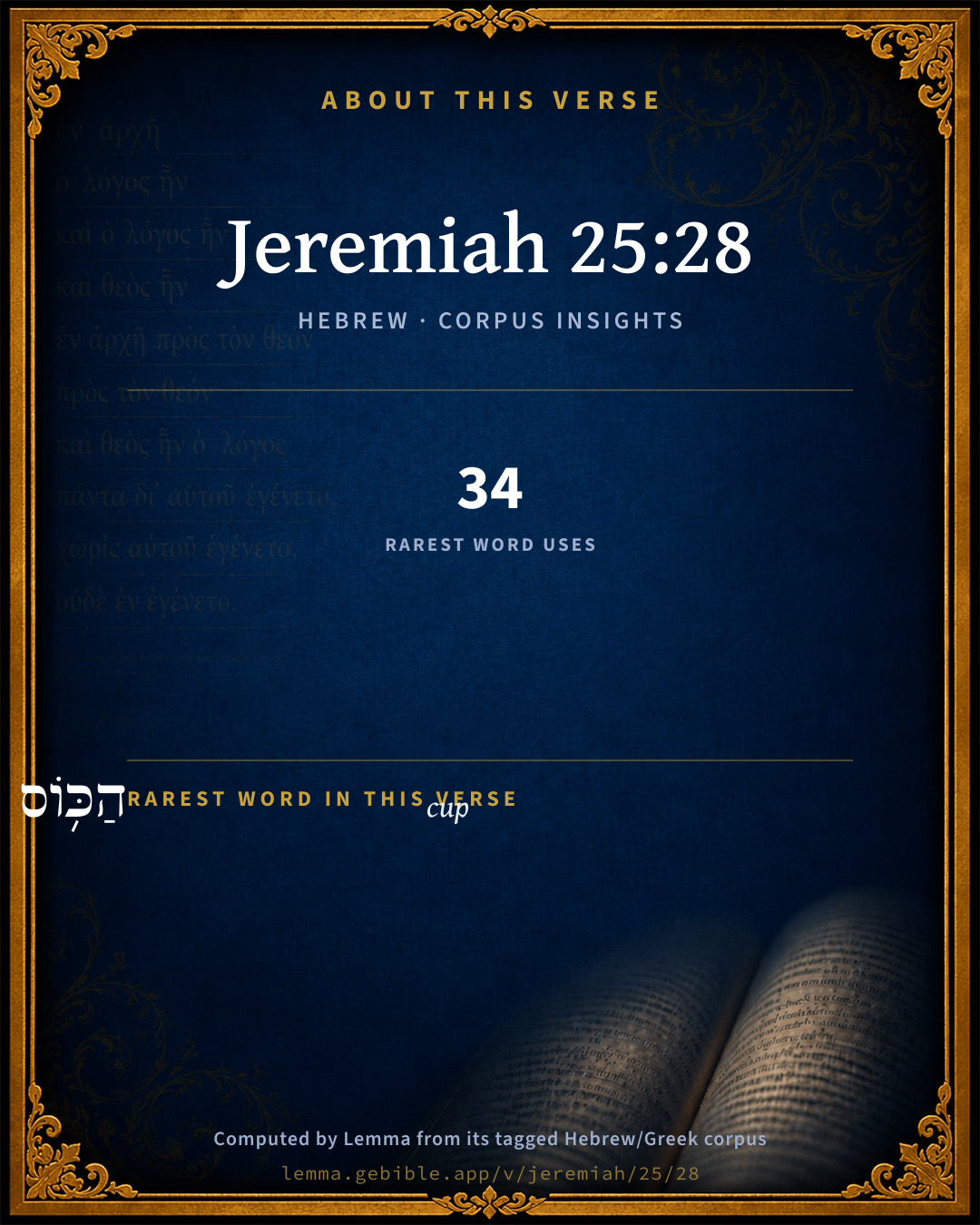
About this verse

These counts appear in no published source. They are computed here, from the morphology-tagged text and Lemma’s own curated glosses. What Lemma adds →

15
words
12
distinct lemmas
Prophets
section

Shared distinctive vocabulary

הַכּ֥וֹס cup H3563 occurs in 29 verses of the Hebrew Bible. Also found in:

Grammatical profile

  • 8 verbs
  • 4 nouns
  • 1 preposition
  • 1 conjunction
  • 1 adverb

Verb forms

  • וְהָיָ֗ה Qal · Sequential Perfect
  • יְמָאֲנ֛וּ Piel · Imperfect
  • לָקַֽחַת Qal · Infinitive Construct
  • לִשְׁתּ֑וֹת Qal · Infinitive Construct
  • וְאָמַרְתָּ֣ Qal · Sequential Perfect
  • אָמַ֛ר Qal · Perfect
  • שָׁת֥וֹ Qal · Infinitive Absolute
  • תִשְׁתּֽוּ Qal · Imperfect

Repetition

Words recur within this verse — often emphatic in Hebrew:

  • לִשְׁתּ֑וֹת to drink H8354 ×3
  • וְאָמַרְתָּ֣ to say H559 ×2

Cross-references

9

Topical passages linked to Jeremiah 25:28 in the Treasury of Scripture Knowledge — connected by theme and wording, ordered by reader-vote popularity; previews shown in the World English Bible.

  • Job 34:33 Shall his recompense be as you desire, that you refuse it? For you must choose, and not I. Therefore speak what you know.
  • Isaiah 14:24–27 Yahweh of Hosts has sworn, saying, Surely, as I have thought, so shall it happen; and as I have purposed, so shall it stand:
  • Isaiah 46:10–11 declaring the end from the beginning, and from ancient times things that are not [yet] done; saying, My counsel shall stand, and I will do all my pleasure;
  • Jeremiah 4:28 For this shall the earth mourn, and the heavens above be black; because I have spoken it, I have purposed it, and I have not repented, neither will I turn back from it.
  • Jeremiah 49:12 For thus says Yahweh: Behold, they to whom it didn't pertain to drink of the cup shall assuredly drink; and are you he who shall altogether go unpunished? you shall not go unpunished, but you shall surely drink.
  • Jeremiah 51:29 The land trembles and is in pain; for the purposes of Yahweh against Babylon do stand, to make the land of Babylon a desolation, without inhabitant.
  • Daniel 4:35 All the inhabitants of the earth are reputed as nothing; and he does according to his will in the army of heaven, and among the inhabitants of the earth; and none can stay his hand, or tell him, What do you?
  • Acts 4:28 to do whatever your hand and your council foreordained to happen.
  • Ephesians 1:11 in whom also we were assigned an inheritance, having been foreordained according to the purpose of him who works all things after the counsel of his will;

Cross-references courtesy of OpenBible.info (CC BY 4.0).

Hebrew and Greek witnesses Masoretic Hebrew ↔ Greek Septuagint

The same verse in the two great witnesses to the Old Testament, shown verse-for-verse.

These are two independent witnesses, not word-aligned to each other, and the Septuagint is shown in lemma (dictionary) form.

Hebrew Jeremiah 25:28 Masoretic · Westminster Leningrad Codex

וְהָיָ֗ה כִּ֧י יְמָאֲנ֛וּ לָקַֽחַת הַכּ֥וֹס מִיָּדְךָ֖ לִשְׁתּ֑וֹת וְאָמַרְתָּ֣ אֲלֵיהֶ֗ם כֹּ֥ה אָמַ֛ר יְהוָ֥ה צְבָא֖וֹת שָׁת֥וֹ תִשְׁתּֽוּ

It shall be, if they refuse to take the cup at your hand to drink, then shall you tell them, Thus says Yahweh of Hosts: You shall surely drink.

World English Bible · Public Domain

Greek LXX Structure differs

In the Septuagint, Jeremiah is about an eighth shorter than the Hebrew and arranges its material differently — the Oracles Against the Nations (Hebrew chapters 46–51) appear in the middle of the Greek book, after 25:13. Because the chapter and verse boundaries do not line up, a verse-for-verse comparison with the Hebrew is not shown.

A verse-for-verse comparison isn’t shown here because the chapters and verses don’t line up. Switch to the LXX edition with the MT / LXX toggle above to read the Greek directly.

Hebrew: Westminster Leningrad Codex (CC BY 4.0). Greek: Septuagint (public domain); English from a public-domain English Septuagint. How the Septuagint differs from the Hebrew →

Targum (Aramaic paraphrase)

1

The Targum is the ancient Jewish Aramaic paraphrase of the Hebrew Scriptures — an interpretive translation, not the Hebrew text itself. Onkelos (literal) and Pseudo-Jonathan (expansive) render the Torah, and Jonathan the Prophets. Coverage is partial: where no permissively-licensed English translation exists for a verse, only the Aramaic is shown. This is verse-level text, not a word-by-word alignment to the Hebrew.

  1. Targum Jonathan Prophets (Joshua–Malachi)
    וִיהֵי אֲרֵי יְסָרְבוּן לְקַבָּלָא כַּסָא מִן יְדָךְ לְמִשְׁתֵּי וְתֵימַר לְהוֹן כִּדְנַן אֲמַר יְיָ צְבָאוֹת מִשְׁתָּא תִשְׁתּוּן:

    (no public-domain English translation for this verse)

    Targum Jonathan — Aramaic: “Mikraot Gedolot” (public domain). English: “Sefaria Community Translation” (CC0 1.0 (public-domain dedication)); “London "Chaldee Paraphrase," 1871” (public domain). Text via Sefaria.

Commentary

Notes on Jeremiah 25:28 from classic Christian and Jewish commentators (each source and its license shown beneath its notes). The classic Christian expositions comment on the surrounding passage and are grouped to its opening verse, so a note may address several verses; the Jewish commentaries on the Tanakh (Rashi and others) are per-verse, so they appear only where the commentator wrote on this verse.

Lemma curates 59 commentaries, every one of them public domain or Creative Commons licensed, each selected and text-cleaned for this edition rather than reprinted as found. About our sources →

Trapp's Complete Commentary

John Trapp

Jer 25:28 And it shall be, if they refuse to take the cup at thine hand to drink, then shalt thou say unto them, Thus saith the LORD of hosts; Ye shall certainly drink.

Ver. 28. Ye shall certainly drink.] See on Jer 25:15.

John Trapp, A Commentary or Exposition upon All the Books of the Old and New Testament (1647–1656) — public domain. Text from a community e-Sword module.

Jamieson, Fausset & Brown

Robert Jamieson, A. R. Fausset & David Brown

if they refuse to take the cup--No effort of theirs to escape destruction will avail.

Jamieson, Fausset & Brown — Commentary Critical and Explanatory on the Whole Bible (1871) — public domain (CC PDM 1.0). Text via the HelloAO Bible API.

John Calvin's Commentaries

In this verse the Prophet intimates, that however refractory the nations might be, yet they could effect no good by their obstinacy, for willing or unwilling they would be constrained to drink of the cup. But in order to render the matter more striking, he introduces them as refusing; If they refuse to take the cup, thou shalt say to them, says God, Drinking ye shall drink We have before said that the Prophet was not set a teacher over the heathens: hence what he declares here appertained not to aliens; but the whole benefit belonged to God’s Church. Therefore what is said was spoken for God’s people, even that they might know that as God had determined to punish the wickedness of men, none of all those threatened with judgment could possibly escape. Men indeed are often like unruly horses, who kick and are ferocious, and rage against their rider, and also bite; but the Prophet shews that God possesses a power sufficient to quell such obstinacy. He however reminds us how rebellious most would be, nay, almost all, when chastised by God’s hand. It is indeed a rare instance when he who has sinned, willingly and calmly submits to God, and owns that he is justly punished: nay, they who confess that they have deserved some heavy punishment, do yet complain against God; for they dread his vengeance, and apprehend not his mercy, and promise not to themselves any pardon. There is then no wonder that the Prophet ascribes here to wicked men, both Jews and aliens, so hard and rebellious a spirit, that they would resist God, and try to extricate themselves from his hand, in short, that they would by all means attempt to escape his judgment.

This is the reason why he says, If they refuse to take the cup from thy hand We hence see that we are not to take the words in their literal sense: for the Prophet did not speak to aliens, but what he had in view was the event itself, or rather the disposition of the people. These nations had indeed some power, and doubtless they strenuously defended their own safety; and this was the act of refusing intended by the Prophet. For when the enemy attacked the Moabites, they did not immediately yield; and the same was the case with others. Tyre was almost unassailable, for it was situated in the sea; where it was easy to prevent the approach of enemies. As then they had resolutely opposed their enemies, they are said to have refused the cup from God’s hand, for they thought that they could keep off the coming evil. But however inconquerable they thought themselves to be, and how much soever they trusted in their own power, yet God says, that their efforts would be in vain and useless: drinking, he says, ye shall drink The reason follows —

John Calvin's Commentaries (1540-1563) — public domain. Text from the Calvin Translation Society English edition (1840s-50s) via the Christian Classics Ethereal Library (ccel.org). Calvin's coverage is partial (roughly two-thirds of the Bible); uncommented books and verses are honest gaps, never fabricated. The 19th-century editor's footnotes and remarks are omitted so the notes are faithfully Calvin's own voice.

Ellicott's Commentary for English Readers

(28) Ye shall certainly drink.—Literally, Drinking, ye shall drink.

A Bible Commentary for English Readers, edited by Charles John Ellicott (1878–1897) — public domain. Text from a community e-Sword module.

John Gill's Exposition

For, lo, I begin to bring evil upon the city which is called by my name,.... Jerusalem, the city of God, the holy city, where his name was called upon, and he was worshipped; on this he would first bring down his judgments; and indeed he had already begun to bring evil on it; for this very year Nebuchadnezzar came up to besiege it, and carried some away captives:

and should ye be utterly unpunished? or could they expect to go free from punishment, who had so grossly sinned, and were guilty of such abominable idolatries, and had been the means of drawing in the people of God into the same; and therefore, since the professing people of God, who had been drawn in by their examples, were punished, they could not, they ought not, to think of escaping. See the like argument in Luk 23:31;

ye shall not be unpunished; or cleared, or acquitted, or go free; but made instances and examples of vindictive justice:

for I will call for a sword upon all the inhabitants of the earth,

saith the Lord of hosts; or I will call them that kill with the sword, as the Targum; who will obey the call, answer to it, and come forth and slay the inhabitants of the earth, and none shall escape.

John Gill's Exposition of the Whole Bible (1746–1763) — public domain (CC PDM 1.0). Text via the HelloAO Bible API.

Matthew Poole's English Annotations

The meaning of these two verses is no more than this; God let Jeremiah in a vision know that it was his will that he should prophesy a certain and unavoidable ruin to all these nations, which was brought upon all the rest by the king of Babylon, whom God made his instrument to execute his vengeance upon them; and last of all upon the king of Babylon himself by Cyrus the king of Persia. This judgment which he telleth them should be by the sword he expresseth by the effects, falling and rising no more, and commands them to drink it, to comport with the metaphor of the wine-cup of God’s fury, mentioned Jer 25:15; the drinking of cups of heady, intoxicating wine ordinarily producing such effects as spewing and falling, &c. This cup of the Lord’s fury he assures them they should not turn by, but should most certainly drink it.

Matthew Poole's English Annotations on the Holy Bible (1683–1685) — public domain. Text from a community e-Sword/MySword module.

Lesson kit

Teaching starters — assembled from the data on this page, not authored interpretation. Every prompt links to the verse data it draws on. Edit before teaching.

Jeremiah, in the Prophets, opens this verse with 15 words (12 distinct Hebrew lemmas). Its most distinctive word is kôwç (“cup”). A historical commentator’s framing appears above. Read the whole chapter for the surrounding context.

Discussion questions

  1. How does “cup” (kôwç) shape what this verse is saying?
  2. Genesis 40:11 shares the word «cup» with this verse. How do the two illuminate each other?
  3. “to drink” occurs 3× in this one verse. What is the effect of the repetition?
  4. The translations on this page render this verse differently — a whole-verse word diff, not a word-by-word alignment. What might account for the different wordings?
  5. The verb «וְהָיָ֗ה» is Qal Sequential Perfect. How does its form color the action?
  6. Reading how Trapp's Complete Commentary and Jamieson, Fausset & Brown read this verse, where do the two commentators agree and where do they part?

Things to notice

Reading settings

Reading text

Shown beneath each verse's original-language words.

Old Testament
Old Testament edition

Read the OT as the Masoretic Hebrew (MT) or the Greek Septuagint (LXX).

English shown for the Greek Septuagint (in the Hebrew ↔ Greek comparison).

Comparing translations? Open the Compare panel on any verse page to stack up to four side by side.